It’s been an amazing three years and I’m sorry to have to do this, but I think our relationship has run its course.
The fireworks in the beginning were explosive. I couldn’t get enough of you. Like a besotted word nerd, I looked forward to our daily dates on the subway, at Starbucks, in the loo, and in bed at night. You are wonderful. Smart, funny, entertaining – even educational. You should know you did nothing wrong. It’s not you, it’s me. I have the attention span of a Gen Z-er mindlessly scrolling through TikTok. And when Spelling Bee and Sudoku winked at me, how could I resist?
This letter may not come as a surprise.I’m sure you’ve noticed our skipped lunch dates and lapsed streaks these last few weeks. I even tried playing your “hard” version hoping it would revive my waning passion, but I’m afraid I found it more annoying than arousing.
I’m sure you’ve noticed our skipped lunch dates and lapsed streaks these last few weeks.
When our meetings dwindled from daily to once a week, then down to once a month, and then to nothing, I knew our love affair was over. And no, it had nothing to do with my husband. He and I have an open relationship. He spends way more time with the New York Times Crossword than with me and will happily while away a lazy Saturday afternoon just staring into those big beautiful squares. My trysts with you, however, only average about three minutes. And while this is absolutely not the reason we’re over – I appreciate quality over quantity – I’d be lying if I said I wasn’t longing for more.
You must also remember we agreed to keep things casual. You are loved by millions yet I never let jealousy get the better of me. Being greeted every morning to my friends bragging about their time with you, posting their winning scores on Facebook and gushing all over you until I wanted to gag wasn’t easy, but I hung in there.
I stuck by you through thick and thin, even when you sold out to that mercenary behemoth of a newspaper that didn’t keep track of our scores just to rope us into buying a subscription. I get it. You were number one and that stuff goes to your head. And who couldn’t use the money? Sure, I was heartbroken over the betrayal and felt manipulated when I caved and bought a subscription to keep our relationship alive, but I forgave you anyway. I would’ve done anything for you. You were my drug of choice. I craved you more than Scrabble, and you know how I feel about Scrabble.
I craved you more than Scrabble, and you know how I feel about Scrabble.
I’m sure you’ll have no problem finding someone else. Everyone loves you. And let’s face it, most long relationships fizzle eventually. C’est la vie. But I have absolutely no regrets. I’ve learned a lot from our time together – like every five-letter word in the English language, or how to use “rainy” and “house” as starting words so you have all the vowels. And I’ll never forget our good times. Getting your answer in two tries (one doesn’t count, it’s just luck), beating my friends and making them as jealous as a gang of mean girls crushing on a hot quarterback with a perfect LSAT score, was one of the best feelings in the world. I’ll cherish it forever.
I wish you the best of luck and hope we can still be friends. An occasional breakfast or lunch would be nice. You should meet Spelling Bee and Sudoku sometime. They’re a lot of fun, and they last a lot longer.
Gnashing of grills in Atlanta
Renting of garments in Nawlins
When the news hits Phoenix
They’ll lose a week
Telling the birds and the bees

You just wait till the storm hits the Windy City
Lake Michigan’s gonna heave & ho when she hears
I’m not coming home

I hope folks dress with a toddler’s grace & a teenager’s tact
A mess of people in clashing shades of black
In fits when paint got on their good shoes
Five summers back

Staring at sunsets from aisle seats
Wondering why you’d even wear black
For a soul with a kookaburra’s laugh

I hope my funeral’s a fucking mess.
I hope they forget to book a venue, a hearse
The mortician is new, anxious, and nauseous

I hope it’s a shitshow.
I hope my pallbearers call out sick

Trip over thin air
Fresh sod
No, dash my ashes down the aisle
Take a deep breath, take a piece of me home with you

I hope the eulogy is wandering, confusing, abrupt
I hope the speakers are ineloquent and selfish
I hope it’s noisy and messy and fidgety and awful to sit through.

I hope my funeral’s a fucking mess.
I hope my funeral is packed with people unpracticed at grieving.
Not like our big siblings, the quilt sewers.
I hope my loved ones are downright clumsy mourners.

I hope they don’t struggle to figure out what music to put on.
  Bill Withers. I’m putting it in print here, now. Lean On Me, by Bill Withers.
But, I hope they know enough to dance.

By god, I hope they know enough to put on some Whitney & dance.

To get sunflowers
  & rice — you’ll feed everybody, right?
  The whole affair better smell like garlic
                                    & ginger
                                            & chlorophyll
        or I’m dragging my ass back.
You better keep each other fed, at least.
Native publishers are critical in preserving and amplifying Indigenous perspectives. While narratives about Indigenous peoples often focus on the devastating impacts of colonization—death, disease, grief, and addiction—these publishing programs create space for the full spectrum of the Native experience, including our distinct humor, joy, and triumphs.
I’m the director of California Indian Publishing at Heyday, an independent nonprofit based in Berkeley. Founded in 1974, we have a long history of publishing Native literature, hosting cultural events, and doing outreach in the community. We’ve published everything from beautifully illustrated children’s books to cookbooks on Indigenous foodways, to important historical memoirs. I am the editor for our quarterly magazine, News from Native California, devoted to the vibrant cultures, arts, languages, histories, social justice movements, and stories of California’s diverse Indian peoples. This magazine has a little bit of everything—news stories, essays, interviews, poetry, and artwork. It can even be a little gossipy for those in-the-know about California tribal communities.
The following list showcases publishers who get it right, allowing Indigenous writers to tell our stories in our own voices:
Ten years ago, the Pechanga Band of Luiseño Indians founded Great Oak Press to amplify and center Native voices and to grow and preserve Indigenous culture and knowledge. The tribally owned publisher mainly publishes academic titles, but they also print books for children and teens.
Abalone Mountain Press is a Diné woman-owned publishing house, operating on the traditional lands of the Akimel O’odham. They’re a indigiqueer, trans, non-binary, Black Indigenous, and feminist-friendly press with a goal of being a space where Native voices can flourish authentically and unapologetically.. Their books cover a wide range of genres including poetry, fiction, and nonfiction.
At 60 years old, Malki Museum is the oldest nonprofit museum founded by Native Americans on a California Indian reservation. Their books focus on the First People of Californiaand vary from academic works to guides on the best local hiking trails and usages of local plants.
Orca Book Publishers is an independently-owned Canadian publisher of popular and acclaimed children’s books. They publish more than 80 books a year for all ages and in multiple Indigenous languages including Anishinaabemowin, Diné, Inuktituk, and Plains Cree.
Native Northwest is a Canadian organization that sells everything from stationery and housewares to children’s books and clothing. Based in Vancouver, their mission statement places emphasis on authenticity and respect and they source all their art, merchandise, and literature from Native artists.
One of the oldest publishers on this list, Kamehameha Publishing amplifies Hawaiian voices, focusing on ʻŌlelo Hawaiʻi (Hawaiian language), ʻike Hawaiʻi (Hawaiian knowledge), and kuanaʻike Hawaiʻi (Hawaiian perspectives). Since 1888, they’ve provided engaging educational content across print and digital media, ranging from archival recovery to contemporary voices.
Located in Syilx territory on the Penticton Indian Reserve in British Columbia, Theytus Books is the oldest Indigenous publishing house in Canada. First Nations-owned and operated, Theytus supports Indigenous authors, illustrators, and artists. Their name, which means “preserving for the sake of handing down” in Salish, symbolizes the documentation of Indigenous life using literature.
Founded by Teddy Anderson (Yeíl S’aghi), an adopted member of the Carcross Tagish First Nations, Medicine Wheel Publishing specializes in books that provide a moral and cultural education, partnering with Indigenous authors and elders to ensure accuracy and respect. Their Orange Shirt Society campaign raises awareness of the lasting impact of Indian Residential Schools on generations of Native peoples. Their award-winning books are published in bookstores across Canada and the U.S. and they’ve gifted over 15,000 books to Indigenous schools and communities.
Based in Iqaluit, Nunavut, Inhabit Media is an Inuit-owned company with the goal of preserving and promoting the stories, knowledge, and talent of the Inuit. Since 2006, they’ve encouraged both Inuit and non-Inuit residents to share their stories and oral histories, with a focus on traditional knowledge and language preservation. Most books are available in English as well Inuktitut or Inuinnaqtun, bringing stories to readers in both the North and the South.
Founded in 1993 by Anishinaabe writer Kateri Akiwenzie-Damm, Kegedonce Press has been publishing Indigenous Canadian literature for over 30 years. Based in Neyaashiinigmiing, Ontario, they’ve published books by some of the most acclaimed contemporary Native writers including Kateri Akiwenzie-Damm, Cherie Dimaline, and Richard Van Camp. Their aim is to support Indigenous professionals in all stages of book production, including illustration, design, editing, and printing.
Community-ownedNative Voices Books, along with their imprint 7th Generation, offers fiction and nonfiction for children and young adults. Their works showcase the diversity of Native American Nations on Turtle Island and emphasize healthy sustainable living. The press has been located on The Farm, an intentional community, in Summertown, Tennessee since 1978.
I’ve dated my fair share of drummers. Same goes for guitarists, lead singers. There are songs out there that were written about me. Maybe you’ve heard one. Maybe you liked it.
I liked it too, once. But here’s the thing: I’ve also been a drummer, a guitarist, a lead singer. So why did I long to be someone else’s muse? Why did I invest time, desire, and displacement of my own creative goals to be the object of someone else’s?
The truth is that this is how many of us – many young women, not exclusively but especially – have been taught to be loved: as an object. We are trained to be observed, to be described, to be “captured” by the artist’s brushstroke or the author’s pen. We’re told, explicitly and tacitly, that this is our highest calling. And we’re expected to be grateful.
This is how many of us have been taught to be loved: as an object.
This idea was top-of-mind when I read Vincenzo Barney’s recent piece in Vanity Fair about Cormac McCarthy’s lifelong relationship with a “secret muse” that began when she was sixteen and he was forty-two.Augusta Britt, whom the article exhaustively touts as the titular “muse,” describes her experience:
“And I remember thinking to myself that being such a lover of books, I was surprised it didn’t feel romantic to be written about. I felt kind of violated. All these painful experiences regurgitated and rearranged into fiction. I didn’t know how to talk to Cormac about it because Cormac was the most important person in my life. I wondered, Is that all I was to him, a trainwreck to write about?”
Augusta Britt is a tremendously accomplished, intelligent, and demonstrably independent person who knows her way around horses and guns in a way that Cormac McCarthy never did. Her language reveals someone who’s perspicacious and original. And yet, both McCarthy and his nascent biographer seem keen on reducing Britt to the role of muse.
In the days since the Vanity Fair essay was published, it’s been rightfully, extensively lambasted. Much has been said about the age differential between McCarthy and Britt (definitely illegal and unambiguously pedophilic), and about the abysmal prose (eye-roll-triggering gems include “reading the blue ink meant for her blue eyes”), but I’d like to focus on something else. I’d like to talk about the idea of the muse.
The word “muse” appears no fewer than thirteen times in the essay, fourteen if you count the title. Its usage is not only borderline incessant but unnervingly lofty, and absolutely aligned with the hegemonic use of the term. The tone is one of awe, of reverence for someone (something) not quite human. I recognize the timbre: a compliment to one’s intelligence, humor, or ability as icing on the cake of “feminine aura.” But both icing and cake, of course, are meant to be consumed.
Under the pretense of flattery, designating someone a muse is insidiously derogatory, even denigrating. Even McCarthy seems to have understood the danger of this dynamic; during research for Blood Meridian, he wrote to Britt: “You are becoming something of an abstraction and I don’t think that’s so good. Need flesh and blood. Touch and feel. Actually, you’re something of an abstraction anyway. I have trouble coming to grips with the reality of you.” In further correspondence, McCarthy shares “sexy dreams” in which Britt is literally (and literarily) reduced to a [manic pixie] dream girl, a figment of the author’s fantasy.
Idolatry and debasement are two sides of the same coin. Whether the locus is a pedestal or a prison, both are forms of objectification, the reduction of the human to the non-human, the physical to the abstract. The very notion of the muse is dehumanizing. So why do we safeguard – even celebrate – this particular strain of artistic fetishization?
McCarthy and his nascent biographer seem keen on reducing Britt to the role of muse.
The answer is as simple as it is with most acts of violation: power.
Interestingly, the term muse was originally rife with power. Early usage of the termis in the realm of “protector of the arts.” That’s pretty badass – I’d love to be known as a protector of the arts. But by the 1800s, muse had taken on its more contemporary instantiation: that of a person, usually a young woman, whose function is to inspire the creative work of a typically older male.
Now, let me note: I don’t love making things about gender. This was about gender long before I came on the scene; and art, in this case, unfortunately very much imitates life. As reported by the International Labour Organization, women globally perform more than three times as much uncompensated care work as men. This invisible labor of care – of housekeeping and child-rearing but also of attention, of sex, of ego-stroking, of being quiet and holding still – is a calling card of the muse. The role requires one to decenter the self, to function in the orbit of another person’s gravity.
Another calling card of the muse is expendability. Like all not-quite-humans, they’re easily killed off. Characters inspired by Augusta Britt, for example, have a body count of at least nine. Not to be overly dramatic, but these are serial killer numbers.
Considering the deterioration of the muse from protector to pet, one is put in mind of other uses of art and language to reduce power. Think of the Old Testament angels, flaming-sword-wielding beings reduced in oil paintings to mini-winged infants. Or – far more recently and harrowingly – formidable two-spirit Taíno warriors reduced to effete savages in the writings of European colonizers who were daunted by concepts of gender considerably more nuanced than their own.
Whether the site of colonization is a land, a people, or a body, the project is exploitation. And the modus operandi of colonizers – and of proponents of the muse – is to take something they desire but don’t understand, something of which (or whom) they’re afraid, and to generate an artificial hierarchy that reduces it, even if (especially if) it’s innately greater.
For those who see everything outside of themselves as expendable for their art, anyone and anything that isn’t the artist can be reduced to a muse, from young women to nature itself. This tendency is apparent in the Vanity Fair essay too – the writer exhibits a near constant proclivity toward self-centering. Barney (and other users of the muse) tend to write as though a thing were one’s experience of the thing. He at one point compares the spectacular phenomenon of a rainbow to “the execution line on a document” and refers to “the menacing 116-degree sun.” Now, as a writer, I’m all for figurative language but, at the risk of being a bit granular, the sun is not 116 degrees. The sun is approximately twenty-seven million degrees Fahrenheit. And at the risk of being a bit broad, writers with an intrinsically colonial mentality write as though the world – and everything in it – belongs to them.
Language matters. Writing has the power to reduce and erase just as surely as it has the capacity to empower. There’s a significant difference between navigating real-life inspiration with dignity, courage, and care versus raiding the lives of others for sport.
Writing has the power to reduce and erase just as surely as it has the capacity to empower.
I’ve been guilty of the latter on both sides. As a muse, I’ve relished the attention, the view from the pedestal. As a writer, I’ve at times exploited others like I was doing them a favor. Now, I’m working on resisting the writer’s oft-fetishized solipsism in favor of invitation, collaboration, and consent.
At a recent event at Beacon Hill Bookstore in Boston, a very kind attendee asked about the origin of the title of my first book, Stories No One Hopes Are About Them. I was delighted to be honest: at one point, as a musician, I’d had enough with being a muse – with the entire premise – and was working on an album titled Songs No One Hopes Are About Them. In an act of self-reappropriation, I pivoted the title toward fiction. I aimed to write about people who transition from the object of others’ realities to the subjects of their own. I wanted to write about power. I wanted to write about degradation and agency. I wanted to write about the latent strength of muses, and the privileged myopia of those who keep them. I wanted to write with hope.
Here, I want to acknowledge myself (a human) addressing you, reader (also a human).
To anyone who may currently be a muse: Your value is not predicated on anyone else. Only when we acknowledge one another as others – as humans, as artists, as persons with autonomy and creative force – will we do our best work.
To anyone who sees themself in the story of Augusta Britt: your story being told on your terms matters.
And to everyone: You’re not an object. You’re not an idea. And you’re definitely no one’s goddamn muse.
Girls who dream of becoming models are often looked down upon as shallow, desperate, and insipid—victims of a society that teaches women that their greatest value is youth and beauty. While the fashion industry is undeniably ripe for the exploitation of the young and vulnerable, models retain a mythic power in our cultural imagination. There’s a meaningful difference, under capitalism, between being beautiful and being professionally beautiful. Modeling isn’t just a job; it’s a beautiful job, implying a beautiful life, where work doesn’t look or feel like work.
At sixteen, I got closer to the dream than some (the semi-finals of a mall model search), but not close enough to dispel it’s power. Even as it became clear that I’d never make money off parading around in interesting clothes, the idea of doing so—of all the different versions of myself I could be—appealed in a similar way to writing fiction. More than being beautiful, I would argue that models are powerful because they are chameleonic, blurring the lines between embodiment and imagination, self and performance, flesh and fantasy. As such, they make for fascinating characters.
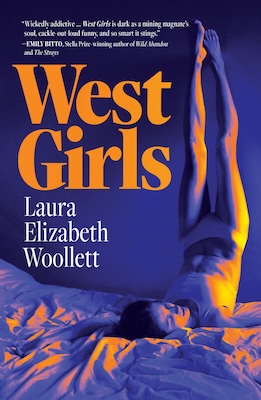
In West Girls, suburban teen Luna Lewis takes the performance of identity to extremes, styling herself as a mixed-race model ‘Luna Lu’. As well as being an answer to a lifelong ‘what-if’ (what if I had what it took, what if the dream became reality), Luna belongs to a tradition of literary women who turn to modeling in pursuit of a beautiful life and find more (and less) than they bargained for. The following list of books about models, ranging from young adult fiction to critical thinking, exposes the contradictory ugliness and transcendence of being professionally beautiful.
Hot Or What by Margaret Clark
A fixture of Australian school libraries, Margaret Clark’s Lisa Trelaw quartet follows the trials and tribulations of former ‘beached whale’ Lisa, who is scouted while working in her family’s hot dog van. The second book in the series, Hot Or What takes place in the cesspit of mid-nineties Sydney, where Lisa (rebranded as ‘Rebel’) is living in a model apartment. This retro Young Adult classic doesn’t shy from the grot of midnight 7/11 binges and purges, yet it’s also a bit camp (Lisa’s patron is named ‘Moira Sloane’) and packed with observational humour about Sydney’s upper echelons. Plus, the throwback slang is a delight.
Nobody does ugly feminine longing quite like Mary Gaitskill and Veronica, published in 2005, is Gaitskill at her finest. Moving backwards and forwards in time, it centres on Alison, a diseased model-turned-cleaner languishing in northern California, and her inexplicable connection with the late Veronica. Daggy, uptight, and in love with a gay man who has infected her with AIDs, Veronica is an object of contempt, fascination, and, ultimately, deep fidelity for Alison. As well as its heartrending portrayal of an unlikely friendship, Veronica is masterful exploration of the amoral, subterranean allure of physical beauty. As Alison observes, ‘Here is Beauty in a white dress. Here is the pumping music, grinding her into meat and dirt.’
If there was ever an industry calling for an anthropological investigation, it’s fashion. Originally published in French, this 2019 study by Italian academic Giulia Mensitieri exposes the labour conditions of fashion’s disposable slaves to genius: (non-super) models, interns, assistants, hair-and-makeup artists. While the surface details of these workers’ exploitation are exotic (models paid in Miu Miu rather than money, moonlighting as mannequins for Saudi billionaires’ wives), the underlying circumstances will be eerily familiar to any precariat ‘passion labourer’—writers included.
Meat Market by Juno Dawson
I never demand likeability of fictional characters, yet it’s hard not to love Jana Novak, the heroine of Juno Dawson’s Meat Market, a 2019 novel. A gangly South London girl from an immigrant family, Jana gets into modeling for some extra dosh. Grounded and intelligent, she is nevertheless believably vulnerable to the industry’s dizzying heights, exploitative lows, and crushing boredom. Tackling big themes—from #MeToo to class to casual sex– for a YA audience without being preachy is no small feat, but Dawson does so with absolute facility.
Black, statuesque, and Sorbonne-educated, Jadine Childs is a high fashion model with a white patron, a white millionaire boyfriend, and a sealskin coat. Son is a fugitive sailor. On a lavish Caribbean island estate, their paths cross, igniting a complicated romance. This relatively forgotten 1981 novel is lush, erotic, and delves into internalised racism, misogyny, the social stratification of beauty with Morrison’s signature poetic intelligence.
Charlotte Swenson, a falling star of Manhattan’s fashion scene, gets into a near-fatal car crash outside her hometown in Illinois, becoming unrecognisable. While the premise of Jennifer Egan’s second novel could be the jumping-off point for deep-dive into the beauty and disfigurement, the concerns of Look At Me are much broader: small town life, family madness, industrialisation, American dreams and nightmares, the construction and commodification of identity. It’s an everything-and-the-kitchen-sink novel, and doesn’t always cohere, yet it’s packed with ideas and weirdly prescient about online self-curation.
I expected Allie Rowbottom’s 2022 debut, which follows an ex-Instagram model’s reversal of the cosmetic enhancements she underwent in her youth, to be both body horrific and psychologically disturbing. I didn’t expect it to be so elegiac. Like Veronica, Aesthetica is laced with grief: over youthful missteps, abuses, failures to thrive and connect. I came for an ironic literary take on fillers and BBLs, yet it’s the image of teenaged Anna thumbing through her phone while her mother dies of cancer that has stayed with me most.
I wasn’t meant to be a dancer. It happened only because our north-facing window looked across the courtyard and into the apartment of a Ukrainian couple: a slender, soft-spoken mailman named Sergei Kostiuk and his cheerful and dark-haired wife. That family’s apartment was a diorama for my curious and bored eyes, as is often the case in compressed quarters of poor neighborhoods—although I didn’t yet think of myself as poor.
The Kostiuks had a son my age called Seryozha, whose padding around the rooms in a white sleeveless top and underwear is one of the earliest images I can recollect. Seryozha’s arms were all one thickness from shoulder to wrist, and he was pale, thin, and soft in a way that reminded me of a Q-tip. Like the other boys in our class, he filled me with disdain. I hated how they spoke in short, overlapping shouts that only they could understand, how they pulled on girls’ ponytails, the dirt caked under their nails, their damp smell like earthworms. Out of them, Seryozha was the worst because he constantly ran into me outside of school. When we crossed paths in the stairway I looked coldly away, although Mama said I should be nice to him because he was nice to me. I was sure Seryozha was only nice to me because his mama was saying behind our backs that I was nice to him. And so, on and on it went, the chain of mothers who forced their children to be nice to their neighbors’ children.
It was a cold and raw Sunday morning. A sense of resignation coursed through the dead leaves and fallen apples strewn in the courtyard. The crows on the electric lines started cawing and Seryozha turned to his window—he caught me staring, turned red, and disappeared. A little later the yellow curtains of his room were drawn hastily shut. The birds cried louder, then lifted off as Sveta entered the courtyard below.
Something that I learned from her is that some women are beautiful even from above. I called out to Mama, “Sveta is here!”
She opened our door before Mama had a chance to do a quick sweep around the apartment. Sveta—as I called her instead of Aunt Svetlana, at her insistence—had been visiting us as long as I could remember. Even as I grew older and Mama went to the theater more, Sveta enjoyed the tea, gossip, and bespoke adjustments Mama made for her at our home. She kissed Mama’s cheeks and the top of my head while pulling off her tight-fitting leather gloves, one finger at a time. Then she stood in front of Mama’s sewing table, exuding glamour at ten in the morning on a Sunday. It was the small details that proved fatal in ballet, Sveta said. Her Lilac Fairy costume was too tight in the bodice; the shoulder straps restricted the movement of her arms as she leaped onto the stage for her variation, so she couldn’t get any ballon. Sveta had asked the chief seamstress of the women’s costume department to loosen the straps so they could fall slightly off-shoulder, but the answer was a firm no. This was the costume design from the original 1890 production of The Sleeping Beauty, and changing something at the whim of a mere second soloist went against everything that the Mariinsky stood for, which was tradition—the very fabric of ballet passed down from feet to feet for two centuries. As Sveta said this, I imagined pointe shoes trampling all over the theater’s pale blue velvet curtains fringed with gold tassels.
Mama told Sveta not to worry and then ordered me to go play in the living room. I turned on the TV and sat on the floor, where Mama had laid out the finished costumes to be steamed. The news program ended, and a black-and-white figure of a ballerina appeared on the screen. She looked like Sveta, with long thin legs ending in pinpricks of pointe shoes—and she bounded off those sharp feet with one leg reaching high behind her so that it almost grazed her marvelous backbend. Her every movement was quick and spry like a sparrow’s, as if she barely needed to touch the ground. But what I really couldn’t resist was the music. I ran to our room to get my tutu that Mama sewed out of scrap tulle. I pulled it over my hips and started mimicking the dancer on the screen, shouting, “Mama, Sveta, look at me!” I turned up the volume of the TV, knowing that would annoy them. But I’d miscalculated how much I could push my luck, and a fatal back-bending jump sent me landing right on top of Mama’s piles of costumes.
Before my foot slid out from underneath me and my bottom crashed to the floor, Mama rushed over screaming. “I didn’t mean to,” I began to say, curled up on the floor. I could feel the beginnings of a massive bruise on my bottom, but I didn’t dare cry in front of Mama. She shushed me and examined the pieces one by one. There was a finger-length tear on a soft white tulle tutu, and she ran to the fabric closet in our room, swallowing curse words. When I made trouble like this, Mama whipped me with her belt. I wondered if she’d do that then—and suddenly I didn’t want to dance or wear a tutu or do anything, I didn’t want to live. I reached over and grabbed Sveta’s hand, and she folded me into her stomach.
“Sveta,” I closed my eyes and whispered. “Please take me with you.”
She stroked my hair and patted my back, the way I wished Mama would do more often. She then crouched down to kiss my cheeks, and said, “Natashka, I can’t.”
I stepped back from her in disappointment, but she held on to my shoulders and smiled. “I saw you dancing. Do you know what ballet that was?”
I shook my head.
“That was a solo from a ballet called Don Quixote. What you did is called a Kitri jump. How old are you, Natashka?”
“Seven,” I said, rolling my eyes to the ceiling while recalling the few significant dates in my short life. It was 1992 and I was actually seven and three months old. Less than a year ago, all the flags had been changed from red and yellow to white, blue, and red.
“Well. I’m going to tell your mama that you should start taking ballet, as soon as possible. You’re the rarest thing for a woman dancer, and by that, I mean you’re a jumper, Natalia Leonova.”
Sveta left early, promising to return soon for more gossip and fittings. The minute she walked out, Mama called me to her and boxed my ear hard. Just once, so I would know she meant only to set me in my place, to make me behave and not act so wild. It was not because she hated me—in fact it was because she loved me, she told me later while snuggling me tightly in her arms. I believed her words, the warmth of our creaky bed, her gentle hand caressing my head, which she kept reassuringly moving like an oar dipping into a lake, even though she was so tired. She was so tired that she sometimes fell asleep with her eyes open, but she would keep stroking my head for hours until I forgot that she’d struck me with that same hand. This was what love was, I thought—being able to forgive. But it was not happiness.
I knew that Mama couldn’t teach me happiness because she’d never been happy. At least not since Nikolai—a name that was within my name, yet so unfamiliar to me. Mama never talked about him with me; everything I know, I heard through whispered conversations between Mama and Sveta when they thought I was asleep. Mama met Nikolai while working as an alterations seamstress at a department store. Two men, rather shabbily dressed, walked in one day wanting to buy winter suits and coats and tailor them on the spot. They were friends who lumbered out in Sakhalin in the Far East; they had just come out for a month-long vacation after an eighteen-month run. The short, skinny, polite, clean-shaven one was Pavel, and the tall, blond, bearded, silent, and somewhat wild-eyed one was Nikolai. They were both flush with their wages that they hadn’t had the chance to spend for a year and a half. During that time, they had caught a glimpse of fewer than five women on the entire island of Sakhalin. Both were eager to do something with their money and to hold a woman close. And it so happened that Nikolai was the one who spoke to Mama first, which set the tone for all the rest that followed. If Pavel had been the one to approach her, Nikolai would have fallen respectfully behind his friend, and Mama would have gone along for the ride just the same, only her entire life would have been different.
Mama hemmed the coats for the two friends and they asked her to join them for dinner after her shift. After a few days of meeting like that, Pavel naturally fell away and Nikolai and Mama spent time together alone. Mama had not been courted until then. No one had bought her boxes of chocolates or walked the scenic way along the canals instead of taking the Metro. Nikolai quoted from the poets and asked Mama about her girlhood; and when she explained how lonely she’d felt her entire life, he wrapped her tightly in his arms and squeezed all the breath—and sadness—out of her. Nikolai, whose father had downed a bottle of vodka a day, ran away from home when he was fourteen and had been making his own way ever since. The only friends and family he had in the world were books and trees; he stared into loneliness every time his eyes opened in the morning. But not anymore—he told her, interlacing his hand with hers. His every word, glance, and kiss burned her like hot coal. In short, Mama fell in love with Nikolai.
At the end of the month, Nikolai flew back to Sakhalin, promising to call and write as often as he could. He did call every week for a number of months—even after Mama told him she was pregnant. Later she gave birth and had to stop working at the department store, and Nikolai started sending her money, too. I was already nine months old when he came to visit on leave. He spent hours playing with me, reading out loud from Pushkin and rocking me to sleep. Only on a few occasions, he disappeared and came back the next morning, saying he went out with his logging buddies and lost track of time. Mama was so relieved to see him, and the time she could spend with him was so short anyway, that she immediately forgave him.
Some months after Nikolai returned to the lumberyard, Mama couldn’t get a hold of him. He didn’t pick up, so she would leave messages. Did he miss her and Natasha? Did he still love her? He called her back, and they talked briefly about her concerns until he went back to work. This happened several more times—anywhere between four to a dozen times, her memory falters—but what Mama does remember is that, during what was to become their last phone call, he quoted to her these lines from Dante: “Take heart. Nothing can take our passage from us / When such a power has given warrant for it.”
By this time, his designated month-long vacation was drawing near. Mama believed that he would show up one day bearing a box of chocolates and toys for me. Incredibly, she never lost this faith until the last day of what was supposed to be his leave. When even that day passed without any sign of Nikolai, Mama would have gone mad if only she hadn’t had a toddler to feed and raise. Nikolai hadn’t sent money in months, and she had no idea how she could work. One winter day, when she had mustered enough energy to take a walk with me in a stroller, a gentleman in a familiar coat called out to her on the street. It was Pavel, wearing the same dark green wool gabardine coat she had sold to him, a lifetime ago it seemed. Nikolai had one exactly like it, she couldn’t help but recall at the same time. A thought crossed rapidly in her mind that she’d much rather have seen Nikolai in that coat instead, and this weakness shamed her as Pavel reached out his two gloved hands and wrapped them around her own. Pavel had gotten out of lumbering in the past year—he’d made enough to buy a co-op apartment for him and his new wife. After listening to him for a while, heart pounding from impatience, Mama finally asked in a shaky voice if he’d had any news of Nikolai—she was afraid he had been killed in a logging accident. Pavel looked at a loss for words, studying the face of the toddler in the stroller. Finally he said, very sadly, “I respect you so much, Anna Ivanovna; it hurts me that neither truth nor lie can bring you any comfort. In that case I think you might prefer hearing the truth. Nikolai is well. He found a better-paying post in Vladivostok, which isn’t so wild as Sakhalin. I didn’t know he stopped calling you.”
The only way to ensure that you don’t get left behind is for you to be the one to leave.
To Mama’s credit, she did not break down in tears out there on the plaza. She thanked Pavel for giving her this news with integrity and compassion. To Pavel’s credit, he did everything he could to help this woman whom, after all, he’d only met for a few days, several years ago at this point. His wife knew a makeup artist at Mariinsky, and through her he got Mama some sewing work that she could do at home.
So I learned early on that the most painful thing in the world is uncertainty. Not knowing whom to trust. Not knowing who will stay. The only way to ensure that you don’t get left behind is for you to be the one to leave.
When I lay in bed at night, I didn’t fantasize about getting married in a white wedding dress as did other girls, I fantasized about leaving. But instead of disappearing like Nikolai, I dreamed of becoming so famous that the only way the ones I left behind could see my face would be in photographs, in newspapers.
At the artist entrance, an unfamiliar porter is listening to Puccini on the radio. When I walk in, he stops humming, uncrosses his legs, and gets up from his swivel stool so abruptly that it skids to the back wall.
“Natash—Natalia Nikolaevna,” he stammers. “I am so—it is wonderful to see you again.”
I am ashamed to admit that I don’t remember him at all. “Please, just Natasha,” I say. “I’m here to take class.”
“Yes, of course.” The porter smiles nervously, smoothing down his dwindling hair with one hand and gesturing toward the hallway with the other. When I’m about to turn away, he stops me by my elbow.
“Natasha,” he reaches and clasps my hand, which costs me a great deal of effort not to flinch.
“Welcome back to Mariinsky,” he intones rather formally, and when I smile and thank him, he releases me with an expression of terrified joy.
The dressing room is empty, and so quiet that the second hand of the yellow-faced wall clock can be heard. It’s three minutes past eleven; the company class has already begun. I change into one of the brand-new leotards and tights. Without looking at a mirror, I rake my hair up into a bun. Inside ballet slippers, my feet begin to feel more alive and alert, connecting to the floor, lifting my kneecaps, turning out my hips. My shoulder blades pull down and back, my neck lengthens upright. A shocked relief courses through my body. I recognize myself again for a moment, like a candle flame enlarging and then coming into focus.
A trickle of music seeps into the dressing room, and I follow it out the hallway. The studio door has been left open. They are doing pliés, and as I slip inside to find a spot at the barre, all eyes turn to me—the ones facing me and even the ones facing away, who are staring at me in the mirror. They are expressionless. I cannot tell whether they are happy to see me or hostile—except Nina, who flashes me the briefest, kindest smile from her perch. Out of habit, I scan the room in vain for Seryozha. Not seeing him here gives my heart a brief, sharp sensation like a pinprick under your nail. The only person resolutely not looking at me is Katia Reznikova, who at forty-one is still ravishingly beautiful and commanding as only true primas can be. All this transpires before the pliés finish and Dmitri stands before the company with a hand on his hip, announcing, “Natasha will be guesting in the fall season, dancing Giselle with TaeHyung. Please welcome her back.”
A scattered round of applause, led mostly by Nina. I find a space at the barre and do a few pliés on my own before jumping into battement tendus with the others. Without any conscious thought, my toes activate against the floor like they’re plucking harp strings. That simple and ingrained movement floods me with an exquisite consciousness of my body; and it shocks me to realize that for the very first time since the accident, I am hopeful. But during frappés, the pain returns to my feet, traveling up to my ankles, then calves. A short center combination makes both my ankle and arch collapse, and I’m hopping out of a single pirouette. When Dmitri gives a basic coda ending in a fouetté, I have no choice but to leave the studio rather than expose my complete inability to execute what was once my signature.
In the dressing room, I slump down on the bench with elbows on my knees, cradling the weight of my head in my palms. When the faint trickling of the piano stops, I pick up my things and walk out.
Dmitri is waiting outside the door, leaning against the wall like an adolescent.
“Let’s talk in my office,” he says in a neutral voice, devoid of his usual mocking tone.
“It’s really not necessary,” I reply, sounding colder than I intend or feel. “Look, Dmitri. Aside from all the things in our past—I appreciate the confidence you’ve shown me. It was tempting, I admit. But as you can see yourself, I can’t do this.” For a second, I worry that I might break down while saying this. But my eyes remain dry—there are no more emotions I have left for this situation.
“We don’t have to go up. Let’s just talk in here.” Dmitri walks inside an empty studio and motions for me to follow. Since I have come to take his class, I at least owe him a conversation. Dmitri sits down on a chair in front of the mirrors, and I take a seat next to him. He smoothes his hair away from his face and exhales, and says something I didn’t expect.
“Tell me about your injury.”
After so many years of knowing Dmitri, he remains an enigma—not just to me, but to most of the world—which is probably why my eyes pool with moistness at the hint of something that, in anyone else’s voice, could be construed as compassion. His sudden openness catches me off guard and compels me to speak.
“Arches. Achilles. Calves also—but mostly down in feet and ankles.”
“Which side? Both?”
“Both.”
We are silent for a while. In the next room, the accompanist has begun playing the Act III pas de deux in La Bayadère, a sound as calm and luminous as spun moonlight. Moonlight, fountains, clinking of glasses, Dmitri’s laughter with my friends as I hid in a corner in pain. The memory comes alive as the swelling, throbbing pain in my feet—and then as fresh anger.
“My injury is because of you.”
Dmitri snaps his gaze onto me. “Natasha, I know you’re not my fan. But let’s be fair. I didn’t cause you to get hurt.”
“If it weren’t for you—” I struggle to string my words. “No accident.”
All traces of what I thought was compassion disappear from his face. “I wasn’t even there, Natasha. I—” He raises his eyebrows and emits a short laugh of disgust.
“You used to be someone who took responsibility for her own life. At the very least, I liked that about you.”
More silence. The pair in the next studio must be talking, working through the difficult lifts and transitions. After a minute, the piano restarts fitfully.
“Here’s what I think,” Dmitri begins again. “It wasn’t right to jump straight into company class. Let’s get you working slowly back up with your own pedagogue. And we’ll get you started on physiotherapy. I know you can do it.”
“It’s not possible,” I say weakly. Dmitri becomes impatient again.
“Natasha, I was watching you during class. Do you really want to know my opinion?” He fixes his grass-colored eyes on me, and I shrug.
“Your injury,” he says, tapping the side of his temple. “It’s mostly, if not all, in your head.”
On the way out, I pass by the next room rehearsing La Bayadère and see Nina working with her partner. She breaks protocol by stopping midsequence, causing the piano to peter off; and then she comes over to lock me in a tight embrace.
“I have a break in thirty minutes. Let’s get tea,” Nina says, standing close so I can see a cropping of lines on her forehead and the lovely flush of her cheeks. There is a new slackness to her skin over her neck, collarbones, and knees, which would not be discernible on stage. It is unexpectedly attractive off stage, in the way a white shirt feels more elegant after a few hours’ wear, when it’s not so pristinely pressed. Also new: shooting stars threading across the midnight black of her center-parted hair. Nina makes aging look like an adornment. I find myself mesmerized by her appearance, as if meeting an actress in real life—because so much of her now lives only in my memories.
“I’m so sorry, Nina,” I implore. “We have to catch up, but I’m exhausted right now. You saw me earlier, so you know why. I’ll be back tomorrow.”
“You really are coming back?” she asks doubtfully, and I nod. Her face softens with relief because the Natasha she knew would stop at nothing to fulfill what she said she’d do. Nina doesn’t know that this Natasha is gone. All I can think of now, standing with a parched throat and inflamed feet, is the Xanax on my bedside table. The pills are rattling like white bees in their bottle—soon they will take me to a room covered in down pillows, floor to wall to ceiling. I so look forward to the feeling that a tear forms at the corner of my eye. Nina sees this, mistakes it for the normal disappointment of a bad class, and pats me soothingly on my arm.
“It will get better. See you tomorrow, Natasha.”
Before I met Nina, I’d never had a real friend. I was always alone at school. It’s not that I didn’t want to make friends; but the other girls instinctively sensed that I was different. They were lambs—soft, pretty, playful, easily satisfied, happy in flocks. I didn’t have such endearing qualities. I was not good-looking, rich, pleasant, or noticeably bright. I was already serious and brooding, and my obsessive nature grated and exhausted me without a proper focus. What helped me later didn’t make me an ideal lunch companion in primary school. I dimmed the light behind my eyes, laughed at their jokes, and hid that thing that burned inside me, sometimes like ember and other times like molten rock. A secret power that others couldn’t fathom. I concealed this part of me at home, too, so that Mama wouldn’t have one more thing to upset her. It was only when I was alone that I didn’t have to act like what I was not—and only then did I not feel as if bursting into flames from the roots of my hair to my toes.
One day after school, I was walking home alone through the snow-packed streets. This was my favorite time of day, when I could be free to regard the world—even if that world was just bare black trees, brick buildings, and white fumes rising from smokestacks and pouring into the sun-blushed sky. In the summertime, the burning smell stung my nose and I ran as fast as I could. But now the iciness sealed everything cleanly and I breathed in only the pure scent of snow. As the wind blew and the evening chill set in, the crows began cawing from electric lines, tops of buildings, even the thin air where you couldn’t see but still hear them. Then above their cacophony, a sound of rapid footsteps was layered over my own, and momentarily my blood froze. Before I panicked, he caught up to me.
“Natasha.” It was Seryozha, with bright red cheeks. Like a couple of baby turtles on the sand, we used to clumsily overtake each other in height so that he was taller one year and I taller the next. This was evidently Seryozha’s year: he’d grown since I last stood so close to him, and I could see that he was now the exact height of a standing piano—which made me look up at him by a few centimeters. A little breathless, his blond hair swept up from the run, he asked if I would come with him to a party. It turned out that a certain Reznikov, his father’s boss’s boss, not just a postmaster but someone at the Ministry of Communications, was hosting a New Year’s party. Despite their difference in rank, the Reznikovs met the Kostiuks because their daughter used to train at Seryozha’s ballet school. I hadn’t known that he had been taking ballet lessons since he was three, and stared at him until his cheeks looked smeared with beet juice. I had never been to a party before. I said yes and Seryozha’s eyes brightened so that I could clearly see the starbursts of his blue irises. Somehow they reminded me, briefly, of snowflakes.
On the night of the party, which was very cold, the Kostiuks and I took the Metro to the Reznikovs’ apartment. After getting out of the station, we still had to walk many blocks to the Fontanka Embankment. Seryozha’s mother occasionally turned around to ask us if we were okay. Seryozha and I both shrugged, although I could feel my two pairs of thick tights had already become wet inside my boots. Soon, Seryozha’s father walked ahead to the ornate facade of a building, and motioned at us to catch up. On either side of the entrance, a pair of lanterns held the dancing light of real flames. The canal shimmered white in the moonlight except where people’s footsteps had dented the snow, revealing the hard, black ice beneath.
When we arrived, the door was opened by an elegant woman, older and more beautiful than either my mama or Seryozha’s. Her rust-red hair was swept up into a low bun, a style that usually suited young women better but looked perfectly becoming on her. She kissed Uncle Sergei on both cheeks, then moved on to his wife and son. Finally, Uncle Sergei pointed at me and said awkwardly, “And here is Natasha, a friend of Seryozha’s.” She barely glanced at me, but the way she smiled at Seryozha made me realize that they knew each other already—and that she thought highly of him. It struck me then that the Reznikovs invited the Kostiuks because of Seryozha, not Uncle Sergei.
“Have you been practicing hard for the Vaganova auditions? How are you getting on with your double tours?” She asked Seryozha, leading us through a hallway lined with paintings.
“I’ve been improving, thank you,” Seryozha said as we entered a large room. It was suffused in a smooth golden light that blurred the edges of everything. Guests were gathered in groups of twos and threes, never alone and never more than four; they were well-dressed, well-coiffed, and appropriately funny, like actors in commercials. The women were slender, polished, and lovely in a way that made me feel self-conscious for Seryozha’s mother. Madame Reznikova gestured in the direction of a striking girl, whose fiery hair immediately called to mind her own, and said, “There’s Katia. Why don’t you go say hello, Seryozha,” before being seamlessly pulled away to a sphere of guests.
Seryozha surprised me by walking up to Katia and greeting her. She was so much taller than him—she looked about sixteen or seventeen—but she smiled at him without impatience, much like her mother. Seryozha introduced me, standing a bit behind him, and she smiled at me, too. I was bewildered—why did this beautiful older girl act as though she was friends with Seryozha? He spoke rarely in class and never made any lasting impression; our teacher hardly paid more attention to him than to me. But here, Seryozha was at ease. They talked of his upcoming audition for Vaganova, where Katia was a star student in her final year. I gathered that this was the best and oldest ballet school in Russia, where the most talented children trained all day to become professionals.
As night deepened, guests grazed on the aspic, deviled eggs, and tiny buttered toasts topped with caviar. I was hungry but resisted going to the buffet table and drawing attention to myself. No one noticed that I was not eating or talking to anyone—not Seryozha, nor his parents, who were quietly milling around the room as if terrified.
The clock struck eleven. Everyone downed glasses of vodka until their careful mannerisms unraveled and they became messy; the men got red in the face and sweaty, and the women’s makeup wore off and looked dry on their skin. Then a tall man with tin-colored hair, who had been shaking hands with guests all night, raised his glass and called the room to attention. A hush spread around him.
“Thank you everyone for coming to our home and blessing us with your friendship.” Reznikov began, then proceeded to salute a long list of guests, no doubt in the order of importance at the Ministry. The air became slightly tense as this went on for a while; some guests had thought they ranked higher in Reznikov’s esteem, and when they lay down in bed later, they would toss and turn over this snub.
Then, most extraordinarily, Reznikov turned his attention to Seryozha.
“And I want to point out this brilliant young man, a gifted dancer, whom I met while my daughter Katia was still dancing at her old studio. I must say, I used to think ballet was for girls—I was happy for Katia to learn it, but took no interest in it myself. It was when I saw Seryozha dancing that I came to truly appreciate the art form.”
I thought that Seryozha would turn beet red and stare at his feet, but he didn’t. He stood tall and glowed as the elegant adults around him cast admiring glances.
“Speaking of ballet,” Reznikov now gestured at Katia, who had been allowed to drink a little bit of vodka for toasts. “Katia has just been offered the title role in Cinderella at the Mariinsky—six months before her graduation!”
Reznikov started clapping, and the guests followed suit, murmuring with astonishment; Madame Reznikova wrapped her arm around her daughter’s shoulder and embraced tightly. After the applause died down, Reznikov changed the music and asked Seryozha to dance. This surprised me less than the fact that Seryozha, the shy boy across the courtyard, showed no hesitation at the host’s request.
If you were talented enough, it didn’t matter if your papa was a postman or if your mama was heavyset and unfashionably dressed, even the rich adored you.
Seryozha’s eyes were glittering—not the dreamy, soft, snowy way they usually did, but hard like diamonds. He walked to the middle of the salon’s wooden floor, gently nodding his head to the beat of the strings. The guests fell into an attentive silence. Without any preparation or forewarning, Seryozha took his right foot to the side and then pushed off onto his left tip-toe, putting his right toes to his left knee. Then he turned. And turned. And turned.
I understood then the reason the Reznikovs took an interest in him—he was marked by talent, as young as he was. And if you were talented enough, it didn’t matter if your papa was a postman or if your mama was heavyset and unfashionably dressed, even the rich adored you. They remembered your name and noticed if you haven’t eaten or drunk anything. But these things, I did not envy. It was the expression on Seryozha’s face as he spun that made me burn with longing—and in that moment I realized that my inner fire, of which I was so proud, was not talent like Seryozha’s: it was merely desire.
Mama was waiting up for me to come home, wrapped in a blanket and drinking tea at the kitchen table. The TV in the living room was softly playing the rerun of the president’s New Year’s address, the only sign of the holiday in our family. I sat next to Mama and asked if I could audition for Vaganova. I guessed she would tell me no, because she mostly disapproved of new things or “nonsense.” But she took a long sip of her tea and told me I could, if I really wanted. She herself thought it was a bad idea. They auditioned thousands of girls each year and took thirty. And half of that number didn’t make it to their final year. Out of the remaining, just a few of the best graduates would enter Mariinsky as corps de ballet, mostly to be a prop in the background. If you were lucky, you could dance Queen of the Dryads some year or Myrtha in Giselle. Then your body would break down, a new crop of hungry graduates would fill your shoes while you languished in the rank and file. So you were finished with your career at thirty-eight, with no education or experience anywhere else outside the theater. It would be better to choose something more sensible. They always needed nurses and teachers.
“Mama, I know I can do it. Dance Odette—dance all of it,” I said quietly, and she shook her head.
“There’s something that they told me, Natashka. Prima ballerinas are born once in a decade.” As she said this she stirred another spoonful of jam into her cup of tea, as if to neutralize the bitterness of her words. But it wasn’t just her words. It was her thoughts about the world, about me.
That was the first time I realized something very important. Everyone—the girls at school, my teachers, even Mama—thought I was nothing. No, nothing would be infinite and consequential, like the vast black emptiness of space; I reminded them of something so little and ordinary, like a cat or a comb or a kettle, that it would be ridiculous to think of it trying to become anything else. Tears rained down my face and dropped on my lap. “I don’t want you to suffer, Natashka,” she said, patting my back.
But later that night, Mama called Svetlana, who had taken a teaching position at Vaganova. She was encouraging of the idea of auditioning and promised to register me herself for the August cycle. “I don’t know why she has to overreach,” Mama said to the receiver, not even bothering to lower her voice. “But I guess she was always bound to try something like this.” Hearing this, I jumped up and down in silence, pumping my arms in the air. From then on, I practiced copying the movements I saw on TV, leaping on my way to school and stretching my legs at night.
In June, Seryozha auditioned and was accepted, as his mama proudly told us at the stairwell. Mama smiled and agreed with her that indeed, Seryozha was exceptionally talented. She didn’t mention that I was auditioning, too. After we came back to our apartment, Mama opened the pantry door and said quietly to the jars of pickles, “Let’s not get our hopes up and just show up, Natashka.”
On audition day, Mama and I left together for Vaganova Academy on Rossi Street. Painted in cake-batter yellow and lined with white columns, it stretched an entire block toward the Alexandrinsky Theatre. There were dozens of children and their parents crowding around the entrance, and we took our places on one side of the stone stoop. A bronze-faced man with high cheekbones turned to Mama and asked, “Your girl is auditioning?”
“Yes, her name is Natasha,” Mama said, stroking my head.
“She has a nice form,” the man complimented me offhandedly before continuing. “My boy Farkhad is trying out, too,” he said, clasping a scrawny boy a few times on the shoulder. The son was his father’s miniature with dark almond-shaped eyes and sharp cheeks.
“Has your girl been doing ballet for a long time?” the man pressed, although Mama pursed her lips to show she wasn’t inviting further conversation.
“No, she hasn’t taken any classes. But she dances wonderfully.”
“Farkhad has been training and performing since he was five.” The man cast loving glances at his son, who reminded me of Seryozha with his mild discomfort around hovering parents. “But do not worry—I’m sure your girl—Natasha?—will do fine. You see, when I was admitted to Vaganova, I had no training either. They look for ability, not experience.”
“You were a student here?” Mama asked, forgetting to be annoyed at the man’s talkativeness, and he responded with enthusiasm.
“Yes! I started in 1960, right before Nureyev defected. It took my father and me three days to take the train from Nur-Sultan to St. Petersburg when I was ten. We packed all of our food for the journey, and I got so sick of boiled eggs by the end. Father said, this will help you stay strong and have energy for dancing! And we passed right through all the cities—Ufa, Samara, of course Moscow. I just watched everything through the window. It didn’t matter though, when I got in. The happiest day of my father’s life, he told me.
“You know, it’s funny. My son and I took the same train. And I packed the same foods for Farkhad and me, even though I was sure he’d hate it as much as I did back then. He doesn’t yet know what’s good for him.” The man smiled, his eyes shining with memories.
“Children take so long to realize anything, and then it’s too late,” Mama said.
“It’s all right though, isn’t it?” The man raked his hand through his son’s dark hair. He continued, non sequitur, “You know, Nureyev was a Tatar Muslim.”
“Was he? Well. So did you dance for a company?”
“I did, for a time in Nur-Sultan. Then I got injured . . . Back then, there wasn’t much you could do if your hip was finished, not like these days. Now I do contracting work.”
When people were starting to tire of waiting, and even Farkhad’s father fell silent, a teacher came out to tell the parents to leave. She stood aside so the children could walk into the foyer on their own. The moment I was inside, I knew that this was the world for which I was born. It was home—the walls painted in the light gray of February, the smell of aged wood, the blue-carpeted staircase, and the framed pictures of all the legendary graduates since 1742. I recognized the ethereal Anna Pavlova from her poster that had hung at my school, and instantly committed the others to memory. Nijinsky, Balanchine, Baryshnikov. And as I looked around in amazement, a clear sign assured me that I would pass the audition: there was music in my head that I’d heard only once before. It was from the ballet on television that day when Sveta told me I was a jumper. I could now recall the music note by note; I’d kept the score in my subconscious all this time. The very strangeness and improbability of the premonition made me feel absolutely certain that it was real.
But as I went through the physical exam and choreography, I realized I was far from the best. It was evident that most of the auditioners already had years of dance and gymnastics—whereas the extent of my training was doing splits in the living room when Mama wasn’t watching. The other girls seemed extraordinary in my eyes, but the teachers grumbled “stiff back,” “weak turnout,” “too short,” “too short legs,” “too muscular,” and in one horrific instance, “too fat,” loudly enough so that everyone could hear. Mine was “bad feet.” Not one, not two, but three board members muttered this while watching and prodding me as I stood or moved to their commands only in my underwear. On the second day, a doctor—one of those rather numerous people who look as though they were born middle-aged, wearing bad shoes—explained in more detail, as if comparing potato varieties in his garden: “You have a classic Greek foot. This will create problems later, on pointe.”
After the second-round medical exams, Svetlana came out and posted the results on the bulletin board. I didn’t have the strength to face it and let others push past me. There was a girl called Berezina who also hung back near me, looking frightened. She was vivid but delicate, like the wings of a butterfly. With her white leotard and white chiffon skirt, long-lashed dark eyes, and perfectly centered black bun, the only part of her that felt human was her bright pink earlobes. She was the one auditioner who hadn’t gotten any disparaging remarks—she had no discernible flaws. A girl near the board turned around and called out to her, “Nina, we both made the final round!” Only then did Berezina work up the courage to move to the front. I heard the friend say, “What would make you nervous, Nina? You’re one of the best girls here.”
My heart was beating right underneath my skin, which had become as thin as a balloon. Even other children had been taking stock of the competition, just as I inevitably noticed Berezina, and no one had singled me out or stared at me with envy. Then my mortification turned to fury, which pushed me to the front of the board. My heart nearly stopped when I saw my name with those who passed.
By the final round, the remaining fifteen auditioners resembled one another like apples at the grocery store. Small head, willowy neck, slender shoulders, supple spine, long thin legs, narrow feet—the Vaganova look, one they say is more delicate and graceful than any other school in the world. Differences in physique had been weeded out; girls simply standing in their underwear already had a pleasantly unified effect of a corps de ballet. For a second I couldn’t even locate myself in the mirror. Then I saw my reflection—same litheness, my skin stretched taut over my ribs, high and sculpted hips, sticklike legs, dark brown hair pulled back into a bun. Identical to all the others, no deviation worth mentioning except my bad feet.
“Girls, in one long row. Sixteen sautés in first, sixteen in second, sixteen changements,” one of the board members said, using her hands to show us the jumps. She cued the pianist.
In the mirror, the girls jumped together in unison. Then one of them—my reflection—rose higher than the rest. It was the force of all I’d been suppressing; I felt like I could reach my hands and tap the ceiling if I wished. The board members were now pointing in my direction. Murmurs and gasps. That’s a jumper. I sprang even higher. I could fly to space and touch the stars if I wished.
When the piano stopped, I finally came back down to earth, my cheeks warm with the other girls’ stares. I stood with my back straight, feet folded into a perfect fifth position, while the board members muttered and scribbled at their long table. Then they seemed to reach an agreement; the ones at the corners who had walked around the back to talk to other colleagues returned to their seats, and Svetlana cleared her throat.
“We are taking two,” Sveta said. Two out of five hundred girls. “Natalia Leonova. Nina Berezina. The rest of you are dismissed.”
I say goodbye to Nina and return to the hotel at three in the afternoon, the most ambivalent hour of the day. My curtains have been shut since I arrived, and the air is dense and warm. I pull aside the drapes and open the French doors, and a pale, foamy light pours into the room. Outside is a tableau of corniced buildings, cars, and people, mixing in and out of the frame, each in their own worlds. At the precise moment when I turn away from the balcony, my eyes catch the first of the cream roses drop a petal. It whispers softly as it touches the coffee table.
After I shower, I hobble out in a towel and collapse on the bed. An iron weight has been tied to every joint in my body. I feel I could fall through the many floors, to the lobby and to the center of the earth, until I put a Xanax on my tongue and float back to the surface. The cool breeze and the diffuse sound of traffic lull my eyes to close. Sleep crashes in like a wave, and I dream of a black bird—with shiny jet feathers, a curved yellow beak, and large eyes like dots of oil. I have seen this bird before. It flies ahead of me and I follow. Then more and more black birds appear, thickening the sky. Their cawing envelops me in a veil of sound, carrying me up to their height. They begin swirling upward in formation around me, creating a vortex of feathers above the clouds, just before plunging to the ground and taking me with them all the way down, down, down.
Of all creatures in the animal kingdom, birds are the most social. Even an albatross, which flies alone in the ocean for up to several years without ever touching land, sleeping midair and never seeing one of its kind, eventually returns to its colony—the exact place of its birth.
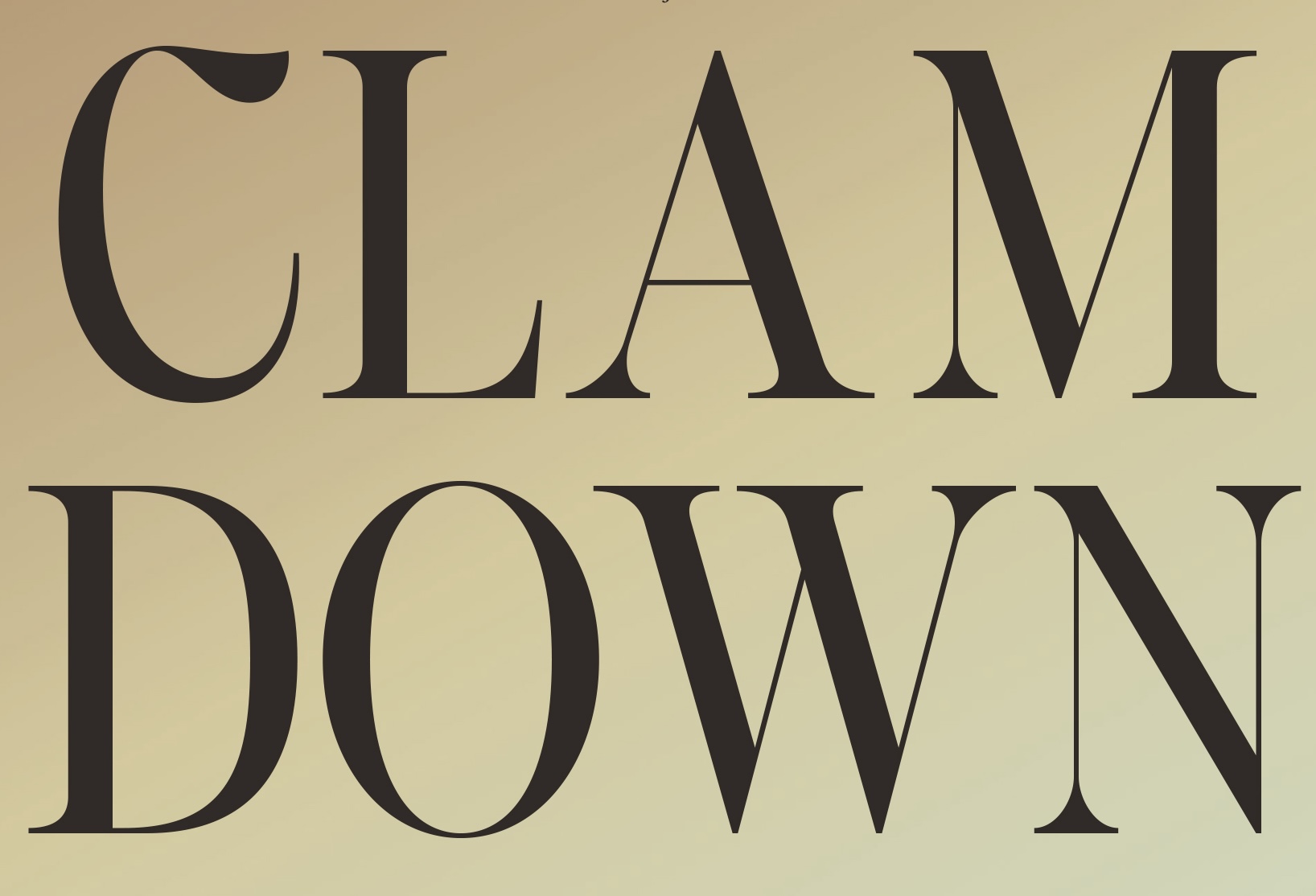
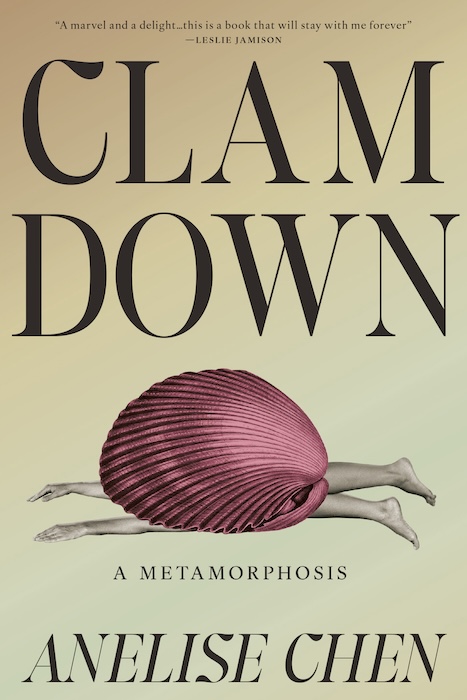
Electric Literature is pleased to reveal the cover of Clam Down: A Metamorphosis by Anelise Chen, which will be published by One World on June 03, 2025.
“We’ve all heard the one about waking up as a cockroach—but what if a crisis turned you into a clam?”
After the dissolution of her marriage, a writer is transformed into a “clam” via typo after her mother keeps texting her to “clam down.” The funny if unhelpful command forces her to ask what it means to “clam down” during crises—to retreat, hide, close up, and stay silent. Idiomatically, we are said to “clam up” when we can’t speak, and to “come out of our shell” when we reemerge, transformed.
In order to understand her path, the clam digs into examples of others who have also “succumbed to shellfish” to embrace lives of reclusiveness and extremity. But this is a story that radiates outward from the kernel of selfhood to family, society, and ecosystem. Finally, the writer must confront her own “clam genealogy” to interview her dad who disappeared for a decade to write a mysterious accounting software called Shell Computing. In learning about his past to better understand his decisions, she learns not only how to forgive him, but also how to move on from her own wounds of abandonment and insecurity.
Using a genre-defying structure and written in novelistic prose that draws from art, literature, and natural history, she unfolds a complex story of interspecies connectedness, in which humans learn lessons of adaptation and survival from their mollusk kin. While it makes sense in certain situations to retreat behind fortified walls, the choice to do so also exacts a price. What is the price of building up walls? How can one take them back down when they are no longer necessary?
Here is the cover, artwork by Tree Abraham.
Author Anelise Chen: “Think: googly eyes glued on pipe cleaner and construction paper, a child’s shoebox diorama for a school fair. Okay, how about, neglected seashell exhibit in an underfunded aquarium of a mid-tier city? Cabinet of curiosities. Those wood and glass vitrines from Deyrolle? But not so classy! Think dusty assemblage in a dish in a vacation rental in New Jersey. Or, midcentury science text, i.e. this one: The Sex Lives of Mollusks. Here’s a screenshot. Okay scratch that. Think line drawings in a Victorian malacology book. No. Wes Anderson poster for The Life Aquatic? Nicole, could you ask the book designer to go the American Museum of Natural History right now and study the exact font and palette of this exhibit on Nitrogen-Fixing Bacteria? Here’s a blurry photo I took. New idea. Think dial-up aesthetic, like Netscape or Windows 95 or go even further back, like a DOS command screen…
It took eight years to write the book, so I clearly had a lot of ideas about what the cover should look like. Nicole, my editor, did her best to translate my ‘ideas’ for the design team. When we finally got the options back, I was terrified, shaking as I opened the file, especially because Nicole had sent me a text to prep me for it. (It’s like she knows who she’s dealing with!) I was immediately floored by the diligence and zany creativity of the designer. (I still don’t know who it is.) They had captured the humor and the pathos and everything else I had been trying to convey.
I love the bold, timeless font on this cover. I love the iridescent hue of the background, which, as my agent Molly pointed out, looks like the pearly interior of a shell. But most of all I love the ‘I can’t even’ posture of this figure—spilled, splat—as if they’d just fallen. In fact, the book came to me all those years ago when I had been laid flat, literally and metaphorically, and I didn’t think I’d ever get up again. But I think there’s still a little bit of fight in this person. They’re down for now, but they’re just gathering themselves momentarily. And my hope with this story has always been to reach another person in that precise moment, in that lonely, desperate period of life, when you’re stuck in your shell, unrecognizable to yourself. This is a book for those of us who’ve been there, or who will perhaps be there one day. Clam down, carry on.”
Designer Tree Abraham: “I explored many approaches to the cover design (there was a late night diorama build that involved dismembering a plastic doll, gluing together shells, and suspending paper letters like a marionette). My mood notes read ‘CLAM ON CHAIR, CLAM ON SUBWAY, CLAM IN DESERT, CLAM IN PARIS, CLAM IN BED, CLAM AS HINGE, cereal boxes, Tums, a walking taco, an exquisite corpse.’ Chen’s work is a hybrid in every sense: the writing style blends experimental forms, the woman’s interiority metamorphs into mollusk conditions, and the imagery submerges itself into several aesthetic periods from 19th-century library books with engraved illustrations to computer software clipart from the 1990s. I wanted to draw upon natural history atlases while signaling that this was an unmistakably modern account of the struggle to remain human amidst the pressures of a world compelling us to clam down.”
Like many during the pandemic, I let my shit go. I cut my own bangs. I did not pay attention to the softening of my jawline as I enjoyed a more sedentary lifestyle, and I welcomed the incoming silver streaks above my ears. I wore loose linen, I made a lot of bread and witchy soups, and every night to ease my anxiety I listened to a guided meditation that described a nighttime walk through the boreal forest to meet Baba Yaga at her waltzing, chicken-legged hut.
In this meditation, Baba Yaga (who is oft depicted as a murderous cannibal) beckons me inside for some tea. As we sit and sip, she reminds me that it is okay to be wild and unburdened, to live by what my soul desires.
In the bubble of my carefully curated, neopagan approach to pandemic life, I fell out of touch with burgeoning trends. I had no idea the lengths that the younger generations were taking to avoid all old lady vibes, that many of them would not find embracing Baba Yaga as an act of comfort but of terror. The sum of every new face filter and #GRWM TikTok touting a pristine, smooth face equaled a conclusion that aging was the worst thing that could happen to anyone – even though it happens to everyone. Forget her alleged fence made of bones – Baba Yaga has far too many wrinkles to take on any other role than that of a monster.
I considered myself to be above the fear of aging as I looked forward to learning from Baba Yaga every night, but then 2022 arrived, and we stumbled back into being social. My bedtime routine changed, and the Baba Yaga meditation faded away. I started acting on stage again, growing conscious of my body in the public light, my face under the weight of stage makeup. Face masks went away. I was thirty-three, and if I caught my reflection by surprise in the window or a storefront, an insidious voice would whisper: Oh! You look…different.
To exist without receiving anti-aging treatments is a radical act.
I recognize that the mid-thirties is hardly an advanced age, but we live in a time where women begin botox in their early twenties, and where girls as young as eight are beginning anti-aging ‘preventative’ skin care regimes. Our obsession with aging has sharpened so acutely that to exist without receiving anti-aging treatments is a radical act, and every time I notice a new sag or wrinkle, my will to remain untouched weakens. I would like to think about myself as capable of enduring time’s footprint with grace, but I might be too vain.
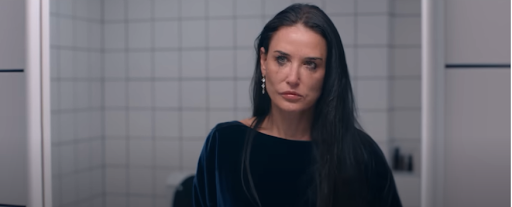
Enter Coralie Fargeat’s The Substance, a film that hit home in a way I hadn’t expected. Lauded as an instant body horror classic, the film delivered an Oscar-worthy performance from Demi Moore as Elisabeth Sparkle, a visceral sound design that stuck to my marrow days later, and a cornucopia of special effects that triggered laughter and nausea simultaneously. It was easy to overlook what The Substance, billed as science-fiction and horror, also embodied: a distorted fairy tale; a cautionary, crone-forward fable that I don’t want to forget, especially as I slip further into my thirties as a childfree, cat-owning woman whose self-esteem is sometimes not strong enough to withstand the rhetoric dictating what type of woman gets to hold value.
The film kicks off on Elisabeth Sparkle’s 50th birthday. Elisabeth is a stunning woman who possesses a naturally aging body, and because of this, she is promptly fired from the aerobics show which earned her fame. This is a decision made by network T.V. boss Harvey, played by Dennis Quaid. Harvey is never on screen without something screaming red to accompany him – the toilet stall doors in the men’s bathroom, an endless hallway, a pile of ravaged shrimp. He is the demon of the underworld in his snakeskin boots, exhaling puffs of cigarette smoke whose closeups bring to mind a fire-breathing sphincter. Elisabeth is already, unknowingly, in the palm-tree lined jaws of hell, forced to contend with a grim future of isolation. Only a deal with the devil will get her out–or so she thinks. Amid her distress, she learns of the titular Substance, which promises to deliver a better – aka younger – version of herself.
This central conceit immediately reminded me of the Triple Goddess theory. Simply put, the Triple Goddess is a deity archetype that aligns a woman’s life cycle with three phases: the Maiden (youth), the Mother (middle age), and the Crone (old age). This is an obviously limited framework with the glaring issue of assuming that all women will mother, and that bearing children is essential to womanhood. While Elisabeth Sparkle does not have children, she is the creator of Sue, and is later referred to by Sue as her “sick mother.” So The Substance asks us: what if, instead of progressing out of the Maiden phase, the Mother, staring down her Crone future with dread, could wield the Maiden again?
Elisabeth does not immediately give in to the temptations offered – she goes out drinking instead. As she drains her fourth dirty martini, she is unaware that the bar’s overhead lights cast cold angles on her exposed back, making it appear sapped of its collagen, bluish and paper-thin. As she shoots a covert, jealous glance at a younger woman, the crone has wrapped its inevitability around her like a cloak.
Intoxicated and in her apartment some time later, Elisabeth faces her collected awards and accolades with self-loathing etched across her face. She holds up a snow globe, which houses a small figurine of her younger self, flecked by golden snowflakes. The icon’s painted lips and doe eyes beckon to her, mocking.
And Elisabeth gives in.
The Substance has no visible customer service. There is only the cryptic representative on the other end of the line bearing the rules of the contract. The Substance, whose far-fetched science is grounded in a totally believable subscription box scheme, delivers clear and concise directions: Elisabeth must revert back to her middle-aged self every seven days, no exceptions. “Remember You Are One” is its core message, not unlike the philosophy behind Triple Goddess – that every woman carries these three selves within her, and they must be embodied with respect in order to live in total harmony.
But what if being the Maiden is too good to let go? Such writes Elisabeth’s downfall. Like a good fable, The Substance wields the consequences in an unforgettable, timeless way that I hope will shock others into reassessing their relationships with their crone future, as I did with mine.
When Sue, the Maiden, first emerges from Elisabeth’s back, we revel in the world opening to her. The pulse of the film score quickens, the sun beats iridescent rays on the boulevard. Her glistening youth is intoxicating, and Elisabeth lasts only two cycles of trading between bodies before she pushes the rules of the deal to spend more time as Sue. The first time she pushes the limit, forgoing the trade-off for one night, Elisabeth wakes to find her index finger irreversibility transformed, brown and scaly, a crone’s pointer.
What The Substance can teach us is that our ‘crone self’ is a product of our own creation.
This kicks off a war between her selves: Sue does not want to return to Elisabeth’s life, which seems meaningless and depressing, and Elisabeth wants Sue to respect the balance, to not allow for any more rapid aging.
They have forgotten the cardinal rule of the Substance – that they are one.
Elisabeth tries to make meaning for herself while she’s in her middle-aged body. She agrees to go on a date with a man best described as extremely nice and incredibly average, but in one of the more honestly tragic scenes in the film, she is unable to leave her house, too crippled by self-loathing. If only she gave herself just one more chance to find a friend, join a club, do literally anything other than obsess over the tautness of Sue’s flesh, she may have found a reason to look forward to living in her matured body.
Elisabeth-as-Sue continues to take beyond the parameters of the deal, and the next time Elisabeth wakes, she is changed completely. We hear the agonized scream as she takes stock of her new form: her hair is gray and coarse, her eyes dull and yellowed, her skin dry and scaly. Powder blue veins creep up her feet to swollen, knobbly knees. With no hope left for reclaiming the matured beauty of her “Mother” self, the Crone – or at least Crone 1.0, as Elisabeth’s transformation is yet to end – has fully emerged. Furious, she yells at the provider of The Substance who tells her she may stop the experience, preventing any more age advancement. But Elisabeth, now stuck in this older body, is unable to give up her tradeoff with Sue.
She concedes to the deal she made, and passes the time by cooking.
This is when, as I was watching the film, I recognized my favorite old lady archetype – but she was not the woman of my meditations. Elisabeth flips through a French cookbook, turning on the T.V. to find a late night interview with Sue, and begins to wage a food fight in their kitchen. As we look up at her from the stove’s point of view, we see a crazed face, gleaming with steam and sweat. Crone 1.0 Elisabeth is furious, petty, and bitter, but for the first time, she is something other than defeated. Angry, yes, but also triumphant. Knowing that Sue will wake up in this apartment, Elisabeth ruins it with abandon. As though conjured by dark magic, giant pig’s ears scatter the countertop as she stirs her many pots, frying blood sausage, eviscerating a turkey, finally giving into her rage. This Baba Yaga was tailor-made by Elisabeth’s self-loathing, bursting like a cystic zit forced to the surface.
When Sue takes stock of the mess Elisabeth made, she rages, pushing the bargain well past its limit until she is forced to trade off again, three months later. When Crone 2.0 emerges as a consequence of Sue’s greed, she’s meant to induce horror as one the film’s monsters, but somehow I saw the wisdom of a no-nonsense grandmother reflected back at me. Crone 2.0, which was dubbed “Gollum” during production, is a prosthetics and makeup marvel that evokes the terror of old age while ironically equipping Elisabeth with more zeal than any of her previous ‘versions.’ She knocks down doors and walks with surprising speed, and she is the only version of Elisabeth who is able to be honest, to finally admit that she needs Sue because she hates herself. Her grotesque, sagging form embodies the nightmare of the age-obsessed young generations; she is the personification of unchecked crow’s feet, the horror of time itself. And she comes for us all.
What The Substance can teach us is that our “crone self” is a product of our own creation.Elisabeth’s Crone was desperate and petty, clinging to the Maiden as the only phase worth living. What would my crone self look like if I went down a path of neck lifts and eyelid surgeries – two things I have spent time seriously considering – to fill a hole where I felt my value was departing? These small procedures may not be the Faustian bargain Elisabeth signed up for, but they say cosmetic surgery is addictive. How do I know what else I will take at the expense of my own self-acceptance?
The drive toward youth is fed to us constantly.
Even though I’m long past caring about the male gaze, coveting youth still proves a difficult thing to be rid of. It’s not limited to patriarchal subservience or heteronormativity. It exists, for me, in being an aging lesbian watching the Gen Z-driven sapphic renaissance. As young queer audiences flock to Chappell Roan, Young Miko, Billie Eilish and the rest of them, I’m forced to compare my maturing body with the youthful vibrancy embodied by them and their fans. The drive toward youth is fed to us constantly, even as “aging” stars like Demi Moore are proving their worth on screen by succeeding in these daring roles and shoving Hollywood’s standards back down its throat. But no amount of cognitive awareness prevents the anti-aging meal that is fed to us, which poisons our respect for time itself. It remains a constant effort to alchemize the dread that I feel about aging into acceptance and self-love.
Elisabeth’s own dread outpaced her acceptance and self-love every step of the way, because she had none; she was stuck in the past, cursed by the need for validation from people who only valued the “Maiden.” Crone wisdom exists as a way of navigating the certainty of death; of managing expectations from the get. You will arrive here, she says – perhaps with grace or perhaps a haggard wreck – but you will arrive here, whether you like it or not. And we don’t need a wicked man in a paisley suit to blow smoke in our face and make us fear her inevitability; as long as we continue to buy into the ever growing standards of what age should look like, we fill in those snakeskin shoes on our own. I may not be strong enough to age radically, but I hope to try – to remember how utterly beautiful the original Elisabeth looked before she caved to society’s will, and learn from her mistakes.
In a year packed with noteworthy debut novels, it can be easy to overlook a more eclectic type of debut: the short story collection. In these diverse, electrifying debut collections, you’ll encounter haunting allegorical ghosts, embattled ferocious women, gritty, bottom-feeding youths, and more unforgettable characters. These fresh voices of fiction offer new worlds—whether fantastical, absurd, or realistic—that are a treat to inhabit.—Skylar Miklus
Editor’s note: The book descriptions below were written by Skylar Miklus, Vivienne Germain, Marina Leigh, Willem Marx, Courtney DuChene, and Jalen Giovanni Jones.
Award-winning playwright Marshall offers feminist commentary, optimism, and humor in a collection of sharp, quirky, poignant short stories. Women! In! Peril! follows delightfully eclectic characters—including a failed ballerina, a sex bot, a lesbian with a mysteriously pregnant wife, and the last woman on Earth—as they grapple with womanhood and reclaim their power. From divorce to racial identity to coming-of-age narrative, Marshall’s collection embarks on twelve unique journeys, each one surprising and stunning.
Inventive, playful, and evocative, Half-Lives investigates women’s bodies and psyches in worlds that play by bizarre rules—or lack thereof. Schmeidler’s debut collection, which won the 2023 Autumn House Rising Writer Prize, explores women’s autonomy, sexuality, marriage, motherhood, aging, and mental and physical health in unfamiliar circumstances with all-too-familiar resonance. The sixteen imaginative stories are witty, wise, and wonderfully brilliant.
Jones’ debut short story collection introduces a new, captivating voice to investigate the pains, wonders, and complexities of the ways we say goodbye. From funny to tragic, from haunting to heartwarming, Jones’ dynamic stories navigate ends of many kinds: relationships, innocence, past versions of ourselves. The Goodbye Process is not only about loss and grief, but also love and healing. It’s deeply human—and a remarkable read.
Levy’s creative, riveting debut illustrates the chaotic world of Generation Z, embracing its strange, web-sourced, digitally powered mayhem. My First Book reflects reality, sometimes in surreal ways. With experimental form and style, ambitious imagination, and brutal honesty, the short stories follow earnest, anxious young people whose formative years take place in a frenzied environment. Levy’s collectionpromises a fresh and fantastic read.
In a mesmerizing debut collection of speculative short fiction, Aguda offers twelve dark, strange, and playful stories set in contemporary Lagos, Nigeria. Against a haunting and imaginative emotional and physical landscape, characters confront tradition, modernity, family, gender, myth, and magic. The storiesbrilliantlyweave supernatural chills with everyday living. Unsettling and breathtaking, Ghostroots introduces Aguda as a talented new force in the literary world.
In smart, insightful short stories, average Americans search for connection, freedom, and joy in today’s dispiriting society. Stuber’s masterfully-crafted characters—from a college professor dying from cancer to a pair of high school graduates planning a robbery—find their way through adult life, seeking liberation from consumerism, the climate crisis, and gender roles. Beautifully melancholic and full of warmth and hope, Sad Grownups is a must-read collection.
In this anti-romcom, Damilare Kuku writes twelve short stories set in Lagos, Nigeria, that detail various women, their relationships, and their experiences with men. Described as a “dynamic sociological satire,” by Bolu Babalola, this short story collection is a witty and humorous exploration of the exhaustive dating scene and attempts to find lasting love in the face of serial cheaters, mommy’s boys, abuse, and sexual naivety. Kuku doesn’t shy away from sex or promiscuity in this collection, but each story is layered and unique in its characterization and voice. This brilliant debut will have you laughing, crying, and blushing to the very last page.
In this surreal debut collection of short stories, Puloma Ghosh conjures haunting tales of otherworldly creatures and spaces to explore themes of grief, loneliness, sex, and bodily autonomy. Mouth is a collection hungry with desire. Ghosh’s stories are urgent and her characters insatiable. Between the necrophiliac fantasies, the ghosts, and the all-consuming infatuations, these stories are written to unsettle; to crawl underneath your skin. Throughout this collection, you’ll continue to wonder how far Ghosh is willing to go.
Loved and lauded, the stories in Lena Valencia’s debut collection take on contemporary and timeless subjects relating to womanhood–the #MeToo movement, the surge in female representation in cinema, the “hysterical” woman–and relentlessly turns them on their head. There’s an ineffable darkness when Holly’s younger sister goes missing and she feels relief at being “sisterless.” On the guided Glow Time Retreat, Pat finds self-actualization, not through yoga and meditation, but through a descent into the bowels of jealousy, competition, and the need for control. These are stories of revenge, violence, and horror that place women, not men, in powerful, destructive roles. Yet, for all the blood that’s spilled, all the psychological darkness that’s explored, there’s pathos, recognizable though unspoken, in the brutal, emotional honesty of these characters. Mystery Lights bends genres, inverts tropes, and ultimately reshapes what feminist literature looks like.
Electrodomésticos…household appliances, those integral parts of domestic life. That is the world this collection conjures by subtly weaving memory, history, and the rippleless moments of everyday life into a portrait of the Spanish Basque Country in the decades after World War II. Drawing on family history (McCavana’s traces her lineage to Bilbao) and deeply sensory awareness of place, this collection captures the specific tension that inhabits the quiet after the storm. The installation of a television becomes a fraught affair; music triggers memories of war; and language itself becomes a political statement (to speak Basque or Spanish? That is the question). Small vignettes spill over into larger stories and slowly, Electrodomésticos gives form to the smoothed over scars of history.
Ruben Reyes Jr. blurs the past, present, and futures in this debut collection, where he plays with the question of what we might do if we wake up one day as someone (or something) we don’t recognize. For the Central American characters in this book, they are often forced to make choices in the face of injustice, and to find voice in the shadows of what aims to silence them. There Is a Rio Grande in Heaven explores themes of sexuality, violence, masculinity, the consequences of unchecked capitalism and technological advances. The stories of this sci fi collection will stay with you long after the last page.
In thirteen short stories, J. Bowers details the ways horses have been used and abused throughout American history. Bowers’ writing is ridiculously smart and meticulous, but also lyrical and driven by the story itself. Horse Show forces a reader to examine the history of abuse and spectacle of horses, but it also shows how horses have come to be companions. Bowers shows us the best and the worst of the historical relationship between man and equine, and you don’t need to be a horse lover to thoroughly enjoy and become engrossed in this short collection.
Set in Nigeria, the stories in A Kind of Madness explore madness as an illness, but they also delve into the ways other feelings—desire, hunger, grief, shame, longing—too can bring about a type of madness. Okonkwo is interested in the relationships we hold closest to us, and why these relationships, or the spaces they exist in, are what drive us the maddest. These stories are about developing your own sense of identity in the face of cultural expectations, relationships, insecurities, and mental illness. The stories are deceptively short, demanding instead that you linger with them; that they be remembered.
The World With Its Mouth Open follows the lives of eleven people in Kashmir in the aftermath of war. Zahid Rafiq forces our eyes open and to bear witness to the real consequences of violence in communities where there is so much life. Rafiq refuses the facelessness that so often comes with news coverage and war, showing us the humanity behind the cameras. Through the haunting themes of violence, loss, displacement, and longing, Zahid Rafiq is also able to capture the profoundness of ordinary life, and this collection urges us toward beauty, laughter, and refuge in the face of darkness.
Winner of the Iowa Short Fiction Award, The Man in the Banana Trees is a collection in the old, nineteenth century sense of the term. Here you’ll find the odd and the beautiful, the fantastic and the provocative, a true assemblage of curiosities bound together with sharp sentences and ferocious intelligence. Perhaps only the banal everydayness of the world is missing. There are ghost stories (an artist who just can’t give up on her dreams of grandeur), science fiction imaginings (ice cream obsessions run amok in the year 2036), and countless other experiments in genre and ideas. What holds these stories together is a core human striving to survive, to understand, and to be happy, even in the strangest of times.
The creep factor is off the charts in this collection of thirteen strange, gothic, and otherworldly stories. But that hardly does justice to the depth of humanity buried in each tale–harbingers of death hang around to see what happens to their victims (will they escape the burning houses?), a young girl is bullied at school for not having a shadow until she befriends one that might love her a little too much, and a creature gets a little too infatuated with the humans living nearby. That’s a theme of this book, in which kernels of love and compassion repeatedly curdle into horrific realities that, nonetheless, bare the hallmarks of human affection. Flowers from the Void doesn’t revel in jump scares–no, it raises the horror genre up to a whole new level of unease by exploring genuine feeling.
Megan Howell’s twisty, speculative, bold short stories arrive with a flourish and make their presence known. In one story, a young woman’s babysitting side-hustle goes sideways when the child reveals shape-shifting abilities; in another, an Afro-French girl obsesses over her lover’s earlobes. The titular short story, in which two teenage girls detangle the fear and shame of their unusual living situation, stands out for its grit and poignancy. Howell’s stories carry an absurdity reminiscent of Yoko Ogawa and an urgent voice entirely her own. Her odd, brash, “softie” female protagonists will stay with you long after the final story.
Katie M. Flynn probes into everyday idiosyncrasies, supernatural happenings, and near-future dystopias in this collection of interconnected short fiction. In one standout, “The King of South Phoenix,” reality TV contestants beg their audience for urban funding, a scenario that feels almost too close to real life for comfort. In others, Flynn shows off her talent for world-building, conjuring peculiar universes that still ring emotionally true. The stories are united by their strong roots in terroir and by Flynn’s daring to swing for the fences.
Bad Seed marks the long-awaited first translation into English for emerging Puerto Rican fiction writer Gabriel Carle. Their prose is red-hot, erotic, and immediate as they investigate an eclectic cast of young queer Puerto Ricans. Preoccupations with gender identity, economic inequality, and the threat of HIV/AIDS tie together these breathtakingly sensual, audaciously spunky, and tenderly crafted stories.
Following her stunning poetry collection Mother/land, Ananda Lima makes her fiction debut with this interconnected set of short stories centered around a Brazilian writer who sleeps with the devil at a party. After their encounter, Lima’s writer composes these chilling stories for the devil; along the way, the writer discloses her own biographical details and experiences with migration. Lima’s tales frequently turn surreal, as in the excellent “Antropófaga,” in which a hospital cleaner becomes addicted to eating Americans out of a vending machine. The layered narrative structure creates an atmospheric, eclectic, and gripping reading experience.
In A Small Apocalypse, queer characters weave in and out of haunting, surreal stories. A group of friends manage relationship drama and tell ghost stories on a trip outside of Jacksonville. A grandmother shows her granddaughter how to pickle—and forget—painful memories. A woman slowly transforms into a reptile, forcing her to leave her boyfriend and her West Philly home for the warmth of Florida. Characters appear in multiple stories, making some scenes feel truly haunted when someone returns from the dead.
Pascha Sotolongo’s debut collection The Only Sound Is the Wind is broken into two parts: “Sustain” and “Release.” The characters in the “Sustain” section wind up in situations where they feel balanced within their bizarre circumstance though—like an acrobat on a tight rope—that equilibrium can be tenuous. One character uses invisibility to spy on her enchanting neighbor. In another story, humans birth animals. While the characters in “Sustain” come to accept their situations, those in “Release” transform their lives in ways large and small. The result is a striking collection that relishes in the intersection between reality and imagination.
Neighbors and Other Stories is the almost lost and long-awaited debut from Diane Oliver. Oliver, who died at age 22 in 1966 from a motorcycle accident, writes presciently and intimately about the daily lives and anxieties of Black Americans during the Jim Crow era. The titular story exemplifies this as it follows a family the night before their young son desegregates a local school. Oliver’s stories are unyielding and carry a clear-eyed realism about the realities of race in America.
In Perfect Little Angels, Vincent Anioke writes a beautifully tender collection that seamlessly flows into a larger narrative exploring masculinity, religion, and queerness. Largely set in Nigeria, confessions rewrite the truth when a son returns from abroad, while romance is turned dangerous when lovers develop a secret relationship. Through his recurring characters’ journeys, Anioke asks what happens when we can’t meet our own deeply held expectations.
Kate Axelrod’s writing throughout How to Get Along Without Me is unabashed and vicious in its humor. Exploring the dating lives of twentysomethings with wry, yet contemplative prose, Axelrod reveals a world that leaves us desperate for, but incapable of, intimate connections. These interwoven stories are modern, yet timeless, poignant, yet ruthless.
Award-winning author Cameron Walker writes a dreamy, enchanting debut collection that is at once spell-binding and somber. These stories confront the climate crisis in elegant prose that take understated leaps toward the magical. As readers are brought closer to the water’s edge, Walker dares us to look toward the depths of loss and love.
Following their novella “Funeral,” co-authored by Vi Khi Nao, Daisuke Shen’s debut collection writes through the uncanny to explore humanity’s most secret desires. In one story, a long-distance couple employs clones of their partners, before starting to lose their memories. In the titular story, angels transform into humans and gain the capacity to know emotions. Through concise prose and dazzling, surrealist worlds, these stories question the very nature of human connection.
The Theme Park of Women’s Bodies by Maggie Cooper
In her debut collection, Maggie Cooper writes us an escape route. In The Theme Park of Women’s Bodies, nine whip-smart stories contemplate worlds built by and for women. Through unsettling, haunting satire, Cooper dissects queerness, gender, and the patriarchy as she contemplates the bounds of womanhood.
From the World Fantasy Award-winning author of Flyaway comes a debut collection of twelve fantastical fables. These stories contain many elements of traditional myths, like treacherous quests and magical transformations, but Jennings offers a welcome twist with the ease and nonchalance of her narration. Her characters – especially the kind but absentminded cryptozoologist in “Undine Love” – are vivid, off-the-wall, and sure to stick in your brain.
Adiga’s tales of migration, from Nepal to the United States and back, trouble the borders of the typical American immigrant narrative and question the structure of the short story itself. Adiga refuses simplistic explanations for human behavior at every turn, instead showcasing his characters in all their messy, self-contradictory glory. The standout story “The Diversity Committee” takes this unflinching lens to another level as a meeting between a Nepali professor and the dean of his university turns brutally uncomfortable. Ranjan Adiga’s singular voice, tightly wound prose stylings, and clarity of narrative focus all assert him as a rising author to watch.
On November 20th 2024 at Cipriani Wall Street in New York City, the 75th National Book Awards emphasized the crucial role of literature during an unsettling time for politics in the U.S. and the world. Writers and publishers spoke about literature as a form of history, resistance, and change-making.
“As we gather in this room, surrounded by some of the most talented and visionary writers of our time, we are reminded that books do more than entertainment,” said Saturday Night Live comedian Kate McKinnon, the host of the night. “They illuminate, they provoke, and most importantly, they inspire change.”
A book is an offering. It’s a hand in the darkness, a way of saying, ‘I know, isn’t this crazy?’ And that’s something a robot will never be able to do.’
—Kate McKinnon
“That was written by Chat GPT,” McKinnon said, earning many laughs. But after the jokes, she shared a poignant message. “Why do we continue to write books?” she asked. “We continue because the world spins on offering us new situations, ranging from the tricky to the horrific—and I think ultimately, we tell stories because we want help. A book is an offering. It’s a hand in the darkness, a way of saying, ‘I know, isn’t this crazy?’ And that’s something a robot will never be able to do.”
In a way, McKinnon’s message foreshadowed the sentiment of the night: Books are necessary in times of unrest, because books are human.
Two writers were honored with lifetime achievements: Pulitzer-Prize winning author Barbara Kingsolver received the Medal for Distinguished Contribution to American Letters and W. Paul Coates, publisher and founder of Black Classic Press received the Literarian Award for Outstanding Service to the American Literary Community.
“Paul shares information that every man, woman, and most especially every child in America and therefore the world must know if they want their soul,” writer Walter Mosley said as he presented the award. To him, Coates is “a warrior publisher.”
“I obsessively curate those voices, especially the old, forgotten, radical, and less popular. The more scared they are, the more important they are in my quest. Those voices are all Black classes to me. I publish them, knowing that they are critical to fully understanding and making sense of the brightly colored mosaic that is American and world history,” Coates said. “All voices are important, and all stories are important.”
Sam Stoloff, president of the Frances Goldin Literary Agency, introduced Kingsolver’s contributions as “amazingly varied,” including “reviving the social novel,” writing fiction about climate change “before Cli-Fi was a thing,” and writing about the “dispossession of rural working people.”
“All of these things are gathered in her most recent novel, the stunning Demon Copperhead,” Stoloff said. “The original memo is the social protest.”
“I think we’re at our best when we’re disruptors,” Kingsolver said about writers. “I’m proud of the respect we have finally learned to give in this country to art that engages with the real ruckus of the world.”
Next, the winners were announced. This year, the judges considered a total of 1,917 titles. The winner in each category—fiction, nonfiction, poetry, translated literature, and young people’s literature—receives a medal, a trophy, and $10,000. Each finalist receives a medal and $1,000.
Shifa Saltagi Safadi won the award for young people’s literature, for Kareem Between, a coming-of-age novel about a Syrian-American boy navigating middle school and home life. “So often I saw books where Muslims were the villains, and I’m glad I finally got to write a story were we’re the heroes,” she said in her speech. While the novel started as historical fiction, Safadi emphasized that it is no longer historical fiction because “dehumanization of Arabs and Islamophobia have been rising more than ever in this past year to justify a genocide of the Palestinian people.” At the end of her speech, she called for justice, freedom, courage, and a free Palestine.
I want us to be uncomfortable and angry and demand that [our] adminstration should stop funding and arming a genocide in Gaza.
—Lena Khalaf Tuffaha
Author Yáng Shuāng-Zǐ and translator Lin King won the award for Translated Literature for Taiwan Travelogue, a love story nested in an exploration of lost histories and colonial power. Shuāng-Zǐ delivered the acceptance speech in Mandarin Chinese with King translating: “Writing about the past is a means of moving toward the future. Taiwan has never stopped facing the threat of invasion from another powerful national. Meanwhile, internally, the Taiwanese have a complicated relationship with our own national and ethnic identities… I, Shuāng-Zi, write in order to answer the question of ‘what is a Taiwanese person?’ and write about Taiwan’s past as a step into its future.”
The award for poetry went to Lena Khalaf Tuffaha for Something About Living, a collection about the oppression of the Palestinian people. “Our service is needed as writers. Our service is needed as human beings, in every room, in every space, especially where there is something to risk, where there is an opportunity to be lost, where that courage will really cost you—that’s what’s most needed,” Tuffaha said. “I want us to feel and be uncomfortable and be disoriented and be angry and get up, and demand that any administration, no matter what letter it has at the end of its name—D, R, whatever—should stop funding and arming a genocide in Gaza.”
I will not accept the dystopian American future […] that this incoming administration wants to propagate and profit from.
—Jason De León
The award for nonfiction went to Jason De León for Soldiers and Kings: Survival and Hope in the World of Human Smuggling, a work of reportage that chronicles the lives of smugglers guiding migrants across Latin America to the U.S. Border, investigating poverty, violence, and undocumented immigration. In his speech, he said that he “will not accept the dystopian American future” of corruption and injustice that faces people today. “These storytellers that I’m so grateful to be in this room with, I know that you will help us find our way,” he said. “Let’s all go read some banned books—we’re gonna need them in the future.”
Finally, Percival Everett accepted the most highly-anticipated award—the award for Fiction—for James, a novel that re-imagines Mark Twain’s Adventures of Huckleberry Finn from the perspective of Jim, Huckleberry’s friend who escaped enslavement. “I can feel some hope,” Everett said. “But it’s important to remember, hope really is no substitute for strategy.”
If there’s one takeaway from the 2024 National Book Awards, it’s that writing is crucial to history, including present and future history. Literature is a force for change, a fundamental part of cultural narratives, and always political.
Here is the 2024 National Book Award shortlist, with the winners in bold:
Sign up for our newsletter to get submission announcements and stay on top of our best work.
YOUR INBOX IS LIT
Enjoy absorbing fiction from Recommended Reading on Mondays, strange, diverting work from The Commuter on Wednesdays, and a roundup of our best work of the week on Fridays. Personalize your subscription preferences here.
Thank You!
Manage Consent
To provide the best experiences, we use technologies like cookies to store and/or access device information. Consenting to these technologies will allow us to process data such as browsing behavior or unique IDs on this site. Not consenting or withdrawing consent, may adversely affect certain features and functions.
Functional
Always active
The technical storage or access is strictly necessary for the legitimate purpose of enabling the use of a specific service explicitly requested by the subscriber or user, or for the sole purpose of carrying out the transmission of a communication over an electronic communications network.
Preferences
The technical storage or access is necessary for the legitimate purpose of storing preferences that are not requested by the subscriber or user.
Statistics
The technical storage or access that is used exclusively for statistical purposes.The technical storage or access that is used exclusively for anonymous statistical purposes. Without a subpoena, voluntary compliance on the part of your Internet Service Provider, or additional records from a third party, information stored or retrieved for this purpose alone cannot usually be used to identify you.
Marketing
The technical storage or access is required to create user profiles to send advertising, or to track the user on a website or across several websites for similar marketing purposes.