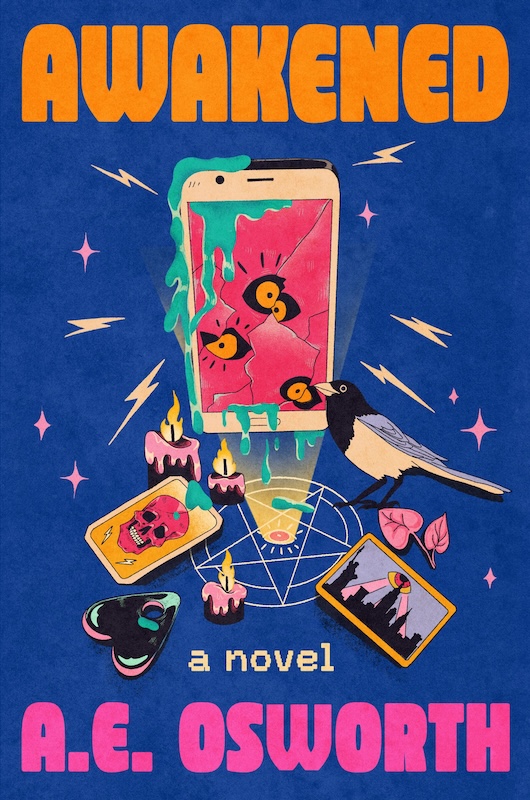
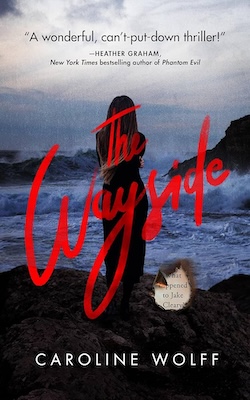
Electric Literature is pleased to reveal the cover of Awakened by A.E. Osworth, which will be published by Grand Central Publishing on April 29, 2025. You can pre-order your copy here.
A coven of trans witches battles an evil AI in the magical coming-of-middle-age romp about love, loss, drag shows, and late capitalism.
On a morning much like any other, 30-something queer Brooklynite Wilder makes the miraculous discovery: suddenly, as if by magic, they can understand every language in the world. Dazed and disconnected, Wilder is found and taken in by a small coven of trans witches who have all become Awakened with mystical powers of their own. Quibble, a handsome portal traveler, Artemis, the group’s caretaker and seer, and Mary Margaret, a smart-ass teen with telekinetic powers all work to make the cagey and suspicious Wilder feel comfortable, both within their group and with the knowledge that magic is, in fact, real.
Just as Wilder is finding their footing, a malicious AI threatens to dismantle the delicate balance of the coven and the world as they know it. Newly assembled and tenuously bound, the group scrambles to stay united as they parse the difference between difficult and dangerous, asking themselves continuously: is any consciousness—be it artificial, material, or magical—too dangerous to exist? Awakened is an exhilarating, hilarious and thought-provoking reflection on the ways that we are responsible for creating our own realities , a story of finding community, and a meditation on what it means to have a body (and if it might be far worse never to have had one at all).
Here is the cover, designed by Caitlin Sacks, Illustration by Andreea Dumuta:
Designer Caitlin Sacks: “Awakened is a wildly fun novel about a coven of trans witches who face off against an evil AI. Given the rich variety of themes and elements in this book, I aimed to incorporate as many symbolic icons as possible on the cover. The prominent eyes, for instance, carry a dual meaning. On one hand, they represent the idea of a ‘seer’—someone who possesses strong spiritual intuition. On the other hand, the eyes symbolize the ever-watchful AI, constantly monitoring the witches by infiltrating phones, cameras, and other electronic devices to gain power.
The color palette is inspired by the trans flag, with the pink and blue deliberately evoking a binary contrast. This choice was intentional, as the novel is fundamentally about rejecting that binary. I was particularly drawn to how every main character in this story, including the AI, is trans, and how the narrative beautifully highlights queer identities, the importance of community, and the feeling of connection.”
Author A.E. Osworth: “I squealed out loud in my office when I received this cover in three different colors. I ran door to door showing my colleagues—all of whom are authors, I work at University of British Columbia’s School of Creative Writing—because I was so amped up on the cover and I knew that they’d all cheer on my enthusiasm. And like—maybe I wasn’t supposed to do that and my editor is going to give me a stern talking to now that I’ve said it? I was just so excited. My closest creative friend, Nat Mesnard, once pointed out to me that in every single thing that I write, someone destroys a cell phone. When I saw a cracked cell screen front and center, it felt like the cover designer and the illustrator really got something, not just about Awakened, but about my body of work. About my simultaneous love of and criticism of the role of technology in our daily lives. Furthermore, the cover just felt—trans. Awakened is a trans book for trans people. Don’t get me wrong, everyone else can enjoy it too—it’s still going to be a fun book about magic no matter who you are. But when it comes to who I center as my audience, I center me and mine. The texture and bright colors feel akin to what I’m doing with the prose, who it’s for, what we like. I want a giant print of this cover on my wall and not just because I am proud of this book; I want one because this cover feels like it’s for me. And if you’re one of us (whatever ‘us’ means to you—trans, witch, a lover of magic and what it means to be a human)? I hope it feels like it’s for you, too.”
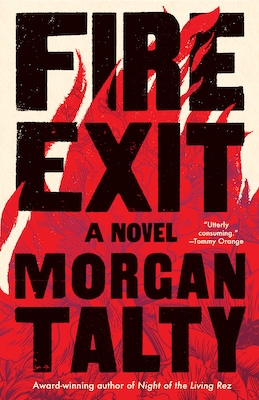
Morgan Talty’s debut novel, Fire Exit, is a poignant meditation on belonging, identity and family. The story follows Charles Lamosway, who lives across Maine’s Penobscot Reservation where he was raised by his mother, Louise, and stepfather, Frederick. While his mother could stay on the reservation because she married a Native man, Charles couldn’t. Despite not being Native, and not being granted access to the reservation after he comes of age, Charles still feels very much connected to the Native American experience, bound to it by the loving relationship he shares with his stepfather. Through this, Talty explores what it means to belong to a place, and to relationships not bound by blood.
The primary pulse of the book is Charles’s secret: he has a daughter, Elisabeth, who currently lives on the reservation. A daughter he has been watching grow up from across the river. A daughter who, by the fact of being his—is technically not native because to be native, blood percentages matter. As Charles contends with his desire to share this truth with Elisabeth, now a grown woman, he is also forced to grapple with the grief around his stepfather’s passing, and the relationship he has shared with his mother, whose dementia-induced episodes raise questions about his own history. Deeply moving and utterly gut wrenching, the novel reflects Talty’s commitment to placing emotion at the crux of his storytelling.
Morgan Talty, a citizen of the Penobscot Indian Nation, is the author of the critically acclaimed short story collection, Night of the Living Rez. His writing has appeared in Granta, The Georgia Review, Shenandoah, and elsewhere. Over Zoom, we talk about blood quantum, colonization and the manipulation of stories, bodies as containers of legacy and trauma, and much more.
Bareerah Ghani: I wanted to start with a central through line of the novel—lineage. Charles tells Elizabeth the truth because he thinks it’s important that she knows her history. And when Charles’s mother’s memory starts to falter, he starts to question how much he knows about his own history. In the absence of oral history or an archive, how do you think we can discover and reclaim parts of our heritage?
Morgan Talty: Let’s say colonizers wipe out languages, stories, everything that makes a culture, a culture, yet still politically treat it as an entity. Something like what happened with the use of blood quantum where, if you dilute the blood enough, your Native Americans no longer exist yet you’re kind of born from a Native person. It’s like, we die but we don’t die. We’re still here. This random percentage has taken away our status as indigenous people. How do we reclaim our identity then?
If, on paper, what makes and shapes us, is gone, it’s gone. I think we need to look toward the future, toward rebuilding new stories. That’s what I try to do, at least, as a writer. The stories I don’t know or I know only pieces of, I’ll invent or reinvent them in my own way.
I think about traditional stories, like, of Glooscap, or Gluskabe, the Wabanaki cultural hero who had multiple attempts at creating human life. One of his failed attempts was where he tried building people out of rocks, and it didn’t work because he found that the rocks are cold. They had no hearts and the very short version is that he set out to destroy them but some escaped, and well, that’s one way to explain why some people today are cold hearted, or, you know, rotten and evil because they’re descendants of stone people. So I wrote about that in The Night of The Living Rez but I expanded it in a way that I didn’t know had been really told. And I think that’s the point with oral storytelling, too—there are certain things that can’t change, the rest you can, you know, build around, and every storyteller tells a story differently. And so going back to the idea of ‘when we have nothing, we reinvent’—if we have the DNA, we’re good to go. If we can’t remember how so and so told it 200 years ago but we know that these are the elements of it, that’s enough to reclaim those types of traditional oral stories.
BG: Following from this, I am wondering about how the novel at different points presents this idea of the body as a container of blood and legacy. Charles insists that our bodies retain memories that we may not be aware of. And I find that idea really fascinating, because that posits bodies as separate entities of themselves. I’m just curious about your thoughts on this. How do you contend with the possibility of not knowing something integral about yourself?
MT: I have been thinking a lot about this idea, especially with children who are adopted into families that they’re not actually related to. In South America between the ’70s and ’90s, a lot of babies were basically stolen for white people to adopt in the U.S. This one individual I know who grew up with their white family, they ended up teaching themselves Spanish to reconnect, and now they’ve gone back to their home country. They love their parents, and yet they find this strong pull to go back and reconnect. So I think our bodies hold memories that aren’t even ours, that don’t even belong to us.
There’s this experiment where scientists had taken adult mice and put them in a cage, and sprayed a specific scent the mice liked. They would wait a second or two after the mice had enjoyed it, and then the floor would deliver little electric shocks to their feet. They kept doing it, and eventually, when they would spray the scent, the mice would begin to jump because they knew they were going to get electrocuted. Then, they had those mice have babies which were placed in their own cage. Now the babies had never experienced what their parents experienced. Yet, when they sprayed that smell, the babies automatically jumped. Their bodies remembered what their parents had endured, and had adapted to make sure they wouldn’t get hurt. Their body had created a defense mechanism, which I find fascinating. And I wonder what our defense mechanisms are against intergenerational trauma, if they exist.
Speaking of not knowing things, I’m actually working on this memoir about my parents and in a way I envision it as one day, my son or children could read the book and be like, Oh, I feel like I’ve known my grandparents my whole life. And a while ago, I was at this event reading from Fire Exit actually and in the audience was my great aunt. She’s really young compared to my grandparents. She was surprisingly closer in age to my dad. At the end of the reading, she was telling me about how my dad, who had dropped out of Northwestern, and was bad into drugs and all that, had called my grandparents up one night and said he needed to be picked up. So my dad’s dad, my papa, and my papa’s brother went and they also had this little baby with them. And my dad looked over at this baby, and he was like, I’m never gonna get the chance to have a baby. That broke my heart because he loved babies and I never knew that about him. And after the reading that night, I was walking to get food, and I just started crying. I was like, shit. This memoir isn’t just about my son, Charlie. It’s also about what I don’t know. And so now I’m wanting to interview every single person that’s ever come in contact with my mother and father because the more we know, the more it helps us heal in a way. The happiest families I’ve ever seen are the ones who know their histories really well.
BG: There’s a line you have in the book that speaks to what you’re talking about. “We are made of stories, and if we don’t know them—the ones that make us—how can we ever be fully realized? How can we ever be who we really are?” I love this idea that we are an amalgamation of all that has come before us. We carry all these stories with us. But to me, the notion of stories also includes lies, and half truths and manipulation. How do you reconcile that with ideas about inheritance, legacy and identity?
MT: I think, to some degree we are living a life where stories have been manipulated. I think Indian Country is in that position because indigenous tribes have become internally colonized. We have adopted the ways of the colonizers. Blood quantum is a big thing. Now, it’s just a matter of, Are we going to choose to correct our biases and the racism we’ve inherited? And I’m not saying that tribes in the United States lived in perfect harmony prior to contact, because that’s not true. But some tribes did get pretty close at being right about how best to live. And no culture is ever going to be perfect. But that’s the thing, we’re even far from that imperfect, perfect. We have to confront the fact that we’re contributing to problems, and I don’t just mean indigenous people. I mean, everybody—we’re all in this together regardless of race. It’s just a matter of communities coming to terms with the fact that we need to fix ourselves. We need to fix the way we operate, or else we will disappear.
BG: I understand Blood Quantum is a colonialist construct that usurps identity and rights from Native Americans and yet, it continues to be implemented on grounds of preservation. Can you talk about what preservation means to you as a Native American?
MT: There’s two ways I think about it. One is preserving indigeneity but in the form of the white man’s image. We don’t have to use blood quantum but it’s what’s used by the majority of tribes. We use it to keep track of membership, which is a requirement by the federal government. So in a way we preserve ourselves by following blood quantum. We have the ability to lower the blood quantum and let people in and tribes try to do that when they’re close to extinction.
But on the other hand, I think, Why do we want to preserve ourselves in this way? I’ll use the example of a commodity because that’s pretty much what Indigenous people have become, and our culture is like a commodity to be consumed—let’s say, we’re something that’s supposed to be frozen after it’s been opened, and what’s happened is that we’ve basically put ourselves in the fridge instead of the freezer. I don’t mean to suggest dehumanization in any way, but if we had an answer to, what does it mean to be Indigenous, we’ve kept that answer in the fridge, and it’s slowly rotting, if not rotted already, when it should have been kept in the freezer. I don’t know if that metaphor makes sense.
BG: It does. It is this idea that the essence of indigeneity has been distorted over time when it really should have been preserved.
This random percentage has taken away our status as indigenous people. How do we reclaim our identity then?
MT: Yeah, it shouldn’t have gone this way in history but it did because of powerful people who wanted land and they made it so they got the things they wanted, which inadvertently affected us. If there had been an actual mutual attempt to—I’m gonna quote Audre Lorde here—celebrate difference, we wouldn’t be needing to find the goddamn tools to dismantle the master’s house.
BG: This novel defies certain expectations about indigenous fiction. One of the most fascinating aspects of this novel to me is how it explores this idea of belonging through its protagonist Charles, a white man who he feels like he’s native, or that he has “a stake in their experience.” The novel is brilliant in exploring questions about where we belong, who gets to define and shape that sense of belonging. I would love your thoughts on this, in connection with how the novel came to you.
MT: I think the people who get to define belonging are the people who love one another, genuinely, unconditionally. That’s the whole reason Charles feels a connection to the tribe—because of his relationships with his stepfather, Frederick, who he sees as his true father, and with Gizos, Mary, even Roger, especially when you think about the end and the way they’re just able to sit there in that type of silence. And I know it’s a dramatic moment, but I think love is the thing that defines it.
As to where the novel came from, Louise Erdrich was actually an inspiration for this book. Her book, The Round House, which won the National Book Award, is told from the point of view of 13-year-old Joe Coutts. The story is that his mother is raped. There’s a high rate of violence, including sexual violence, against Native women. I think it was reported one in three Native women would be bludgeoned and/ or murdered in their lifetime. That’s 33%. That’s a high number. And one of the reasons why is because in 1978 there was a Supreme Court case, Oliphant v. Suquamish Indian Tribe, where the Supreme Court ultimately ruled that tribes don’t have the inherent power to try non-members who commit crimes on their land. But the Federal Government has the Major Crimes Act, and they’re the ones who are responsible for trying and prosecuting our members. There’s a story of a Cherokee woman who was driven around blindfolded and raped by two or three men, and just dumped somewhere and even though she knew who did it, she couldn’t say where the crime happened, whether it was tribal, state or private land, because you need to know where it happened in order to know who has jurisdiction. And that’s the whole premise of the book—they’re trying to figure out where the crime occurred. So that court case was and is a huge contributing factor as to that high number, and so I was thinking about that. I was like, I wonder what I can look at, in policy or law, and not use it as the plot, really, because blood quantum isn’t the plot of this book. I remember I was at Dartmouth College as an undergrad. I got out of class and a bunch of us were talking about The Round House. I’m just sitting there, smoking a cigarette, and the idea just came to me. I was like, Hmm! What happens if a white guy grew up on the rez his whole life, had a baby with a quarter blood, which would mean, in this instance, the child wouldn’t be an enrolled member, and so the mother lies and says it’s somebody else’s. And I was like, alright cool. I didn’t write it though until a couple of years later. But it was that fast, just looking at it, and that gave me the engine. But it was six rewrites of this book to figure out what it was really about, which is family and belonging. So yeah, I owe it all to Louise Erdrich and her dedication to always have been writing about women. And you know, highlighting the violence that exists. Without her work, this book wouldn’t exist.
BG: It’s not uncommon for writers of color and those from marginalized communities to feel a lingering pressure to write in a certain way or about specific things. I’m wondering if you’ve felt something similar and how you navigated these external pressures and expectations about what indigenous stories should be or how they should be written?
MT: When I started writing, there was Louise Erdrich and a scattering of other voices that I hadn’t yet encountered. And then there was the Native writer, we all know who I’m talking about, that person is obviously no longer in the literary community. But when I started reading, that was the author I knew, that was who I was copying to some degree. I studied that literature, understood how it worked and its relationship to, at least for indigenous people as well as I imagine other marginalized communities, how we’ve had to sell ourselves in order to progress.
I think about Penobscots baskets. We used to have these utility baskets, meant for lugging stuff. We still use them, going out to camp, that’s what we would pack our stuff in because they can carry so much, and they’re made from pounded ash. When tourism started to come up in the early, I don’t know, 1900s, we started to make baskets that were prettier, looked a certain way. I recognized that kind of performative nature—and you see it all over Indian country with various aspects, to various degrees—in that individual’s writing and I was like, I guess I have to do that to be successful. But my first mentor—who I consider to be the best mentor I’ve ever had and that’s throwing no shade on anybody—told me that that kind of writing is garbage. This isn’t real literature. And he was right. But at the same time, it wasn’t that writer’s fault with how they were writing, at least to some degree. My first mentor taught me what really mattered, and that was emotion, setting, the principles of fiction, and then I could do whatever I wanted. I refused to do the performative stuff, refused to explain things. That’s how I navigated it, I didn’t adhere or conform to what readers thought they wanted, which is what Louis Owens kind of talks about, this comfortable, colorful, easy tour of Indian Country. I was not going to give them that. I was going to give them my experience, which so happened to be in a manner that you can look at it as stereotypes, tropes, things that have been talked about or written about. But I kept going that way, and then Tommy Orange came out and subverted a lot of people’s expectations and since then, I think that’s why we have such a boom in indigenous literature.
And about my thoughts on expectations about what indigenous stories should be or how they should be written—a story is a story. A story should make you feel, should aim for transcendentalism, it should change something, maybe not for everybody but it should affect at least somebody. It should be in conversation with all other forms of literature out there, despite race and background. It should be written to address the heart of the human condition.
The realtor had let herself into the house on Sunday morning while Frankie slept—overslept, rather—and baked something sweet-smelling. Now she was darting around the kitchen, opening cabinets and banging them closed, while monologuing into her Bluetooth earpiece about escrow or maybe escarole. Frankie only half listened; she lurked in the doorway in her black turtleneck and jeans, damp hair pulled into a low ponytail, saying a silent goodbye to her kitchen, the only room in the one-hundred-year-old farmhouse that reflected her taste. Last year, she’d been forced to renovate after her husband, seventy-four and thirty years her senior, started a fire in the toaster oven. The fruit and rooster wallpaper swapped for a blue-and-white floral, the cherry cabinets for white, the brown Formica countertops for pearly granite. Pleased with the brightened results, she’d replaced all the gold appliances with stainless steel, though it had busted her budget to do so.
“Smells good in here,” Frankie said when the realtor ended her call.
“Toll House cookies!” Suzy said. “Trick of the trade.” In her mid-fifties, blonde and conventionally pretty, Suzy wore a navy pinstriped suit, the jacket cut close to her narrow waist. “Out of all the senses, smell is the most evocative.”
“That’s true. I remember the first time I met my stepdaughters. They were making pies right here. They wore these adorable little—”
“You wouldn’t happen to have a cutting board, would you? I’d hate to scratch this gorgeous countertop.”
Aprons. What was Suzy’s deal? The realtor stood to earn a healthy commission: the least she could do was listen to one measly memory. Frankie crossed to the lower cabinet, slid out the wooden board, and slapped it onto the counter.
“I looked all over for that little rascal,” Suzy said. “Usually, it’s right next to the knife block.” She picked up the knife. “So, what was I saying? Oh, right, sense of smell. I challenge you to find even one person who associates baking smells with something bad.”
She could think of one: someone who was raped in a bakery, but she kept this to herself. She’d repressed quite a few noxious comebacks these past weeks, while submitting to the realtor’s endless instructions for cleaning, painting, staging, and landscaping. At times, she’d felt cornered, even bullied, into going ahead with the sale, despite her growing ambivalence. The timer dinged. Suzy slipped on the blue oven mitt, and smiling tensely, waited for Frankie to step aside.
“We’ll just let these cool a minute.” Suzy slid the baking sheet out from the oven and rested it on the countertop. “Would you like to take this batch to the nursing home?”
“Sure, thanks,” she said, thinking: Here’s your hat, what’s your hurry. “Don’t you want to put them out for the people?”
“Actually, no. I just need the baking smells. The cookies make a mess. Crumbs everywhere—” The doorbell rang, and Suzy looked at the oven clock, her face creased with annoyance. “For goodness’ sake! Early birds?” She looked older and sadder. Like a different person.
Frankie opened the door to her twenty-nine-year-old stepdaughter, Clara, who was dressed like an acrobat in a black V-neck sweater and leggings. She had inherited her German mother’s tall, sturdy frame, fair complexion, and fawn-colored hair, which she wore in a single braid, thick as a fist, down the center of her back.
“Stupid truck’s blocking the driveway,” Clara said, thrusting a take-out coffee at Frankie. Behind her in the October mist, two landscapers planted yellow chrysanthemums along the walkway. “They couldn’t do this last week?” Clara said. “Talk about last minute—” She broke off to sniff the air. “You’re baking?”
“Hello, to you, too.”
“Sorry.” Clara reached around to pat Frankie’s back. “How’re you doing? Is this hard?”
“A little.” She peeled back the plastic coffee lid. “I may be having second thoughts—”
“It’s brighter in here.” Clara moved past Frankie and took in the spacious living room. “I like it. What’d you do?”
“What? Oh—well, this rug’s new, and the linen drapes. What else?” She sipped the scalding coffee and examined the room, her gaze falling on the scratched wood floor, the buckling walls, the chipped newel post. All the flaws that had stopped registering long ago were obvious and intolerable now that strangers would be eyeing them.
“Basically, I de-cluttered,” she said.
“It’s called staging,” Suzy called out from the kitchen.
Clara’s eyes bugged out; she mouthed, “What?”
“Thanks, Suzy!” Frankie shouted. “Forgot the word.” She pressed a finger to her lips and beckoned Clara to follow her to the far corner. “The realtor. I’ll introduce you in a minute. I’m curious to know what you make of her.”
Clara’s judgments were often hasty and harsh. Without evidence, she’d accused the nursing home staff of abuse last week after Frankie mentioned seeing a bruise on Bruce’s arm. Apart from Clara, however, she had no one to ask. After her layoff from the university press the summer before, she worked from home on freelance editing projects and only occasionally met up with her former co-workers. Her book group, formed during Bruce’s Princeton tenure, was slowly unraveling as the older members moved away or lost interest.
At a louder volume, in case Suzy guessed they were talking about her, Frankie said, “I put away those needlepoint pillows, your oma’s. You can have them if you want.”
“Oma Lilly was a straight-up bitch. You should just burn them.”
“Really?” she said, taken aback. “You think Jean would want them?”
“No fucking way.”
“Well, if you’re sure. What about this painting?” She gestured toward the dark oil painting, a forest scene inside an ornate gold frame, hanging over the fireplace. Clara’s mother had brought it from Germany. “Do you want it?”
“No.” Clara hitched her tote strap higher on her shoulder. “Burn that too.”
“You sure?” Clara’s answer surprised Frankie: though her stepdaughter was unsentimental, she had adored her mother. “It’s old, might be worth something,” she tried.
“Then sell it. I don’t want it. Don’t look at me that way, Frankie. That painting gave me nightmares when mom was sick. Ask Jean. I dreamed I was lost in that forest. I mean, I dreamed I was trapped inside the painting.”
“Wish you’d told me. I would’ve taken it down. I hate it, too.” She had made no changes to the décor when she moved in with Bruce and his two daughters sixteen years ago, though the late Annaliese’s somber art and heavy antique furniture had oppressed her. “I don’t want to erase the girls’ mother,” she’d told her new husband. But at twenty-eight, she’d had no decorating preferences; she tried on other people’s opinions and tastes. If she had it to do all over again, she would redecorate every room. Outside, rain lashed the windows. A pale maple leaf pressed against one pane like a small hand. She felt drained, thinking about the long day ahead.
She opened the breakfront drawer, took out a lime-green Game Boy, and handed it to Clara. “The cleaning crew found this behind your dresser.” Frankie remembered how Bruce had nagged thirteen-year-old Clara at the dinner table, in the car, and at bedtime to “put that thing down.” In private, Frankie tried to make him understand: to ease his own grief, he’d had his adoring Princeton students and his bottomless Twain research. And Frankie, the English department administrator, a much younger woman, to satisfy needs that fell well outside her job description.
“What am I supposed to do with this?” Clara handed the Game Boy back to Frankie.
In the heavy downpour, Clara cruised through Sunny Vista’s small parking lot, the car’s wipers on top speed, searching for an open space. Frankie held the Tupperware container on her lap, a Target bag filled with new undershirts and briefs wedged between her feet.
“Are you going to tell Dad about selling the house today?” Clara believed her father should know, but she’d promised not to interfere.
“I’m not sure,” she said, though she was leaning toward never telling him. He’d soon forget everything, including the house. And what if Suzy couldn’t find a buyer, or Frankie changed her mind about selling? She would have upset Bruce for nothing.
Clara began a second loop around the parking lot. Sundays were the busiest at the nursing home, and rain increased the visitors’ numbers. Last Sunday, another washout, a woman in her late fifties with pinched features and overplucked eyebrows had asked Frankie if it bothered her dad that there were so few men at the home. Frankie had been standing over Bruce as he studied the receipt from the grocery bag she’d used to carry his books—Augustine’s Confessions, A Connecticut Yankee in King Arthur’s Court, Paradise Lost—books he’d requested from his personal library in a moment of increasingly rare lucidity. The titles, she’d hoped, were an ironic acknowledgement of his monthslong confinement, but it was the receipt that claimed his attention while the books sat neglected on the side table.
“He’s not my dad; he’s my husband,” she’d snapped, forcing the woman to stutter an apology and hurry off.
‘He’s not my dad; he’s my husband,’ she’d snapped, forcing the woman to stutter an apology and hurry off.
A reasonable assumption, she thought now. So why had she taken offense? Maybe it wasn’t offense she’d felt. Paradise Lost had been one of the first books Bruce had lent her. They’d discussed the poem for hours and hours. She pried open the Tupperware lid and took out a chocolate chip cookie. Clara thrust out her hand and Frankie placed a cookie on it.
“You wanted my opinion?” Clara said, chewing. “About that realtor, that Suzy Q?”
“Suzy Whitacre. Yes, tell me,” she said, with no expectation of deep insight or revelation; Clara had spoken briefly to Suzy, grilling her about the Princeton real estate market. Clara slammed on the brakes. Taillights had lit up on a white Cadillac parked in the row closest to the building, only fifty yards away. Waiting, Clara brushed crumbs from her lap. “So, this Suzy Q—”
“Suzy Whitacre.”
“Whatever. She looks like a fake person.”
“Fake? As in shallow? Or fake like a replicant?” She half hoped for the latter. Suzy’s studied courtesy, her self-conscious cheerfulness had a Stepford Wife quality.
“Replicant?” Clara made a face of disbelief. “Jesus, I’m not insane.” She pulled into the vacated spot so fast, Frankie feared they’d hit the parked cars. Clara shut off the engine and twisted in her seat, leaning her back against the door and tucking one leg beneath her. “I mean fake like a casting agent’s idea of a cheerful, selfless mom. Was she on one of those Nickelodeon sitcoms Jean and I used to watch? I swear I’ve seen her somewhere.”
“You’re probably thinking about her advertising signs. They’re everywhere.” Frankie had stared at one on her grocery cart last week for five minutes before she’d connected the pretty face with Suzy. She yawned. If only they could pass the afternoon inside the warm Honda, chatting and eating cookies. She preferred visiting Bruce alone. Easier that way to numb out, to practice denial.
“Nope. Not the signs.” Clara reached for her umbrella on the back seat. “I’ll Google it. You’ll see, she’s one of those perfect moms.”
“Perfect mom.” She scoffed. “What an oxymoron.”
“What are you talking about?”
“A contradiction in terms. If you and Jean judged me against those sitcom mothers, well . . . ,” she trailed off, feeling unexpectedly emotional.
“I know what the word means.” Clara met Frankie’s eyes. “Listen, we were practically feral when you showed up. I mean, who leaves an eleven-year-old in charge of a house and her nine-year-old sister? Dad was AWOL for like two years. Believe me, we were thrilled to have you take care of us. No one ever judged you. Okay?” She gave Frankie’s shoulder an awkward pat.
She nodded, grateful. Clara had told her this before. So, why did she need to hear it over and over again?
In the Memory Wing, Clara went on ahead to the solarium where the inmates—her name for the residents—received visitors, while Frankie popped into the staff’s break room. Once or twice a week, she brought the staff bagels, pastries, or donuts. Clara called this her don’t-hurt-my-husband bribes. They’d both seen the viral videos, the orderlies abusing or manhandling the slow or uncooperative residents. In one black-and-white video that Jean, her younger stepdaughter, had sent, an aide slapped an elderly man’s face hard every time he slumped over in his wheelchair. Idiotic to think a raisin bagel would deter a sadist. If Frankie found a second bruise, she would hide a camera in her husband’s room—Jean’s suggestion. Jean, twenty-six, lived in Washington State and played clarinet with the Seattle Symphony. Her husband, Wendell, a software developer, had offered to hook them up with some “sweet” surveillance equipment.
For now, Frankie would rely on trust and kindness, though she couldn’t help thinking that Annaliese, Bruce’s first wife, a mathematician, would have opted for something more rigorous, like an official investigation. She arranged the cookies on a scratched yellow plastic plate. Without attribution, the cookies would be pointless. She took a Bic pen from her pocketbook and scrawled across a brown paper towel: Enjoy! From Frankie Mulroney! She laid the note on top of the cookies, but then picked it up again and scribbled Shay, a name she’d never taken as her own.
Rain drummed the solarium’s glass roof and muffled the visitors’ conversations. She guessed there must be thirty or so people in the room. The air, clammy and close, smelled faintly of ammonia. She spotted Clara hovering behind her father who was seated at the card table across from another man, a stranger to Frankie. Male residents came and went at such a dizzying pace that by the time she learned their names, they were gone from the nursing home and maybe gone from the world. As she drew nearer, Frankie discovered that the two were actually playing cards and betting with cellophane-wrapped hard candies. Her husband’s opponent had a pile of Jolly Ranchers and Starlight peppermints twice the size of Bruce’s. He also had an astounding protuberance, like a small doorknob, on his forehead over his left eye.
“He’s got two pairs,” Clara whispered to Frankie. “Tell him; he won’t listen to me.”
She smiled at her husband’s card partner before bending down to eye level with Bruce. His face brightened when he saw her. The bruise on his forearm had faded, and she saw no new marks. A quick assessment of his silver hair, ruddy skin, and navy wool pullover—all clean, all neat—reassured her. She moved closer for a kiss, and he opened his dry lips. Still enjoyable to kiss him. They hadn’t had sex in two and a half years, but she remembered their physical life with pleasure. Bruce’s unhurried, attentive lovemaking, after all her younger, greedy boyfriends, had been a revelation. She pointed out his pairs. He wriggled his eyebrows playfully and tossed two peppermints into the pot. His partner folded, and Bruce used two hands to sweep the small pile of candy toward himself. The other man stood, filled his pockets, and took off—probably to fleece another, more debilitated resident.
“Does he ever talk, that guy?” Clara dropped into the vacated seat.
“Excuse me, young lady,” Bruce said. “Maybe she’d like to sit.” He had forgotten their names again. He met Frankie’s eyes, a wry smile deepening his long dimples. It was their old way of communicating in the girls’ presence, mutely expressing their affection or frustration with the children.
Clara, looking sheepish, rose from the chair, but Frankie gestured for her to sit. She set down her shopping bag, pocketbook, and empty Tupperware on the card table, and circled behind Bruce to massage his tight neck and shoulders. His lifelong sedentary habits had not changed: tall and lanky, he’d grown a little belly, and his legs were thinner, frailer. He avoided all the chair exercise classes—just as he’d ignored his doctor’s orders to exercise when his health had started to decline at sixty-four. Instead, he’d holed up in his study preparing lectures and burning through weekends writing his second book; he’d flown to conferences during the winter and spring breaks.
Now she wondered if he had been racing the clock—his father had succumbed to Alzheimer’s at seventy—but at the time, she’d fixated on her own resentment and loneliness. That made her an easy mark for Kip Jones, the new faculty hire, a seasoned flirt. When the intense four-month affair ended with Kip’s abrupt departure for another teaching post in Texas, she’d felt limp and empty, a purse turned inside out.
“So, old man,” Clara said, stretching out her long legs. “What’s new?”
“New?” He chuckled. “What do you think? I’m stuck in this . . . this cuckoo’s nest.” He sounded amused and resigned. In recent weeks, he’d stopped pleading to be taken home, which should have been a relief but felt like a betrayal. The old meticulous Bruce with his subtle, logical mind would’ve been—had been—horrified to find himself trapped here.
“What’s new with you?” he asked. “You married yet?”
Frankie’s hands froze on Bruce’s shoulders as she watched her stepdaughter’s grimace soften into a patient smile. “Not until I find a man as wonderful as my father,” Clara said.
He laughed. “Smart girl.” He gave her a thumbs-up. “So, how’s . . . how’s work?” Bruce had always connected with his daughters through their academic careers and later through their professions. Clara was a data analyst in the Rockefeller Foundation’s grant office. Now she told her father about a global commission to end energy poverty.
“Energy poverty,” he repeated, nodding thoughtfully. As Clara elaborated on the project, he continued to repeat the odd word or phrase, an old teaching technique, Frankie suspected, meant to reassure the speaker that he was listening, that her ideas had merit. When Clara reeled off some figures, he twisted in his chair to view the room behind him. Clara raised her voice, as though his hearing was the issue. He pushed back his chair, and Frankie staggered out of the way. She reached out for him, heart racing, when he struggled to a standing position. It was muscle memory from the winter evenings when she’d had to stop him from leaving the house in his pajamas. Once she’d found him teetering at the top of the staircase, his arms loaded with books.
“Do you need the bathroom?” she asked, taking his elbow.
“I need . . . I need . . . .” He looked around with a panicked expression. “Where’d that fella go? The one with the . . . um . . . .” He touched his forehead.
“He’s with his daughter.” Frankie gestured toward the couch where the card shark sat with the woman she’d rebuffed last weekend. She brought her iPhone out from her pocketbook. “I have Jean’s latest recording. The symphony? Come sit, Bruce. Take a listen.”
Clara got up to help lower her father into the chair. Frankie handed him her AirPods; he looked with a bewildered expression at the two white plastic devices resting in his palm. She shot Clara a worried glance before calling out Bruce’s name. He looked up, and she pointed to her ears. He inserted the earbuds one at a time. She found the recording on her playlist. He closed his eyes and settled back in the chair with a contented smile on his still handsome face.
“He seems out of it,” Clara said, frowning down at Bruce. “Usually, he’s like this later in the day. Did they change his meds?”
“They raised the dosage on his antipsychotic; I meant to tell you. He blocked his door with a chair. He thinks someone’s taking his stuff.”
“Maybe something else is scaring him.” Clara patted her father’s shoulder. He grabbed her hand and held it. “Time to set up that camera, Frankie,” she said.
“Okay.” She tugged at her turtleneck; the room was too warm. “I guess you’re right.”
“Of course, I’m right.” Clara unhooked her tote from the chair. “I’ll go talk to the director. If they’re overmedicating Dad to make him easier to handle, I’m raising hell.”
After Clara left, Frankie moved the empty chair closer to Bruce. She took his large hand in hers. No doubt her stepdaughter would get some straight answers. While she admired Clara’s initiative, she sometimes feared her questions and demands would provoke the staff into taking out their resentment on Bruce. On the other hand, Frankie was probably too accommodating, too understanding; after months of managing her husband’s care at home she knew how challenging the job could be. Bruce plucked one earbud from his ear and offered it to her.
The gentle, melancholy strains of a Mozart clarinet adagio loosened the tight knot in her chest, and she breathed more deeply. The rain had become a misty drizzle and a weak light filled the solarium. This moment was as good as it would ever get. She remembered her mother’s warning: “If you marry him, you’ll end up being his caretaker.” Anyone could have predicted that. What Frankie hadn’t anticipated was how much it would hurt her heart to say goodbye to Bruce after every visit. Or the particular pain of imagining one of the night orderlies reacting with indiscretion or unkindness to Bruce’s occasional incontinence. Or how she’d seethe when visitors or staff spoke to her brilliant husband as though he were a child. When Bruce was still begging her to take him home, she’d asked the director about weekend visits, but his doctor had advised against it. Frankie had been secretly relieved, remembering his wakeful nights, his belligerence when confused, and that terrifying fire in their kitchen.
What Frankie hadn’t anticipated was how much it would hurt her heart to say goodbye to Bruce after every visit.
Bruce’s hand loosened its grip on hers. He’d fallen asleep.
Clara returned, looking agitated. Frankie removed the earbud. “Is something wrong?”
“Everything’s fine. Well, not really. Dad was hallucinating. And the medication is helping, but it’s making him sleepier.” She glanced at her father, slumped in his chair, snoring. “I left a message for his doctor to call us.”
“Oh, good. Thank you. Let’s get someone to—” she began, but Clara talked over her.
“The thing is—oh my god, Frankie. I looked her up, that Suzy Whitacre. You are not going to believe what I found.”
In the car, before they left the nursing home parking lot, Clara pulled up the newspaper account on her phone and read it aloud: “On June 15, 2004, in Bloomsburg, Pennsylvania, Thomas McCrae (42) threatened his wife, Susan Whitacre McCrae (39), with a butcher knife before kidnapping their two-year-old daughter, Tracey. After a weeklong manhunt, authorities found the father and daughter dead in a motel room 281 miles away in Fredonia, New York. Police labeled the deaths a murder-suicide. The child had been suffocated, and Thomas McCrae had slashed his own wrists.”
On the short drive to the Princeton Café, Frankie silently read the newspaper account. She didn’t want it to be true, but when she proposed that the woman in the article wasn’t the same woman baking cookies in her kitchen, Clara shot her a pitying glance. “It all lines up: the dates, the name, your Suzy’s weirdness.”
Once they were seated inside the crowded café, Frankie and Clara forced themselves to read the menu and order lunch. Frankie selected a good bottle of sauvignon blanc. Their quiches grew cold as they both kept putting down their forks to pick up their iPhones. On the realty site, Clara found Suzy’s professional bio, which featured the same headshot that was on all her local ads. A list of her credentials revealed a BA from Rutgers, an MBA from Wharton, and an earlier successful career on Wall Street. “No dates,” Clara pointed out. “Looks like she’s hiding something, doesn’t it? There are dates for her awards though. See?” Clara held out her phone.
Frankie googled the most recent award. The newspaper announcement mentioned that Suzy Whitacre and her real estate lawyer husband, Bradley Clark, had resided in Princeton, New Jersey, for ten years.
“Seems like a miracle she could trust another man.” Clara poured herself a second glass of wine and topped off Frankie’s glass. “Does it say how long she and Clark Kent have been married?”
“It’s Bradley Clark. No, it doesn’t.” She put her phone down and pushed it away. “Let’s talk about something else,” she said. “How are you and Jason doing?”
Clara had moved in with the thirty-eight-year-old, never-been-married orthopedist four months ago. Initially, Frankie had chalked up Clara’s complaints about Jason’s rigidity and brooding silences to the normal adjustment of living with another person. But after a few dinners with the couple, she wondered if they were a bad match. The alteration in Clara’s personality on those occasions had been surprising. Her stepdaughter seemed subdued, her natural frankness and exuberance repressed in Jason’s presence.
Clara blew out her breath. “You know how he was always dropping hints I might be able to change his mind about not wanting kids? Well, he told me he’s made up his mind. No kids.”
Frankie grimaced with sympathy. “I’m afraid you have to take his word for it this time.” She had not taken Bruce’s no-kids decision seriously. In the early days of their relationship, she’d managed to change his mind about so many things, including beach vacations, house cats, and Greek food. Yet, he’d held disappointingly firm on the issue of children. If he had relented, she would be raising a teenager now. Not an easy or affordable thing to do on her own.
Clara pulled her braid over her shoulder and held onto it with both hands. “To tell you the truth, things have been sort of shitty with him. This might be the off-ramp I’ve been looking for.” She tossed her braid behind her. “Hey, did that Clark-Whitacre union produce any offspring?”
Frankie picked up her phone and skimmed the announcement. “Nope. Nothing on the realty site either.” It made sense now why Suzy had cut her off earlier when she’d brought up her stepdaughters. Perhaps, Suzy could not bear to bring another child into the world after her daughter’s murder. Or maybe by the time she’d met Bradley Clark, she had been too old to conceive—another kind of sorrow, one Frankie hoped Clara could avoid.
After they’d ordered dessert, Clara excused herself to go to the restroom. Frankie looked around the crowded restaurant. Most of the tables had big groups of professional people, men and women on their lunch breaks. Suzy had been a stockbroker, which Frankie imagined as a boys’ club. Not an easy field to advance in unless you played the boys’ game. When Clara returned, Frankie wondered aloud whether an affair had been the motive for the murder suicide. “You know Wall Street. Suzy’s an attractive woman, working long hours, entertaining clients—”
“What are you saying?” Clara looked disappointed. “It’s Suzy’s fault her husband killed her kid? Really, Frankie? Check yourself.”
She opened her mouth to speak, but closed it when the chubby young waiter appeared to set down their desserts: chocolate cake for Clara and for her, crème brûlée, which the waiter set aflame with a small propane torch he’d kept tucked beneath his arm. Frankie gasped. Clara clapped her hands. Heads turned at the nearby tables.
“I’m not saying it’s her fault,” she said, after the waiter had moved off, taking some of their dirty dishes and silverware with him. “I just want to know the story behind—”
“You want someone to blame,” Clara said. “It’s not that simple. If Suzy was fooling around, she probably had her reasons. Her husband was clearly unstable. Plus, who knows what their sex life was like.” She scraped her fork through the chocolate frosting on her plate. “People in good marriages don’t have affairs, do they? I mean, yeah, sure, it’s a fucked-up way to deal with marital problems but not as bad as murder.”
Their eyes met for a brief, uncomfortable moment. Bruce may have been oblivious to his wife’s affair, but a teenage girl, roiling with hormones, would’ve been tuned in. Frankie had managed to meet Kip Jones at least four times a week, partly by making sure the household ran smoothly: regular meals, bills paid, clean laundry. If Clara had caught on, she’d kept it to herself. Having lost one mother, she wouldn’t want to risk losing another. What an awful secret to keep, Frankie thought now.
She put down her spoon. The heavy sweetness of the crème brûlée unsettled her stomach. The waiter placed the check folder on the table next to Frankie, correctly assuming that she was the responsible party. She skimmed the charges. Clara offered to pay half, but Frankie pretended not to hear and reached into her pocketbook for her wallet.
“What I want to know,” she said, sliding her credit card into the little plastic holder, “is how you recover from something like that? How do you keep getting up in the morning?”
“You become a realtor, that’s how,” Clara said.
Frankie looked to see if Clara was being sarcastic, but she was serious.
“You take over strangers’ houses,” Clara continued. “You stage the rooms to look like some idealized domestic space. You bake cookies in their pretty kitchens. You borrow someone else’s life for a weekend. You become”—she made air quotes—“the perfect mom.”
Frankie smiled wanly at that impossible phrase. In a sense, she had borrowed Annaliese’s life. She had been a good enough mother to the dead woman’s grieving little girls. She’d done her best through Clara and Jean’s rebellious teenage years. She’d handled it all—meeting with their teachers, meeting their friends, finding them therapists, raiding their bedrooms when necessary. Their stickier offenses, like truancy, sex, and drugs, she’d kept from Bruce, sensing he’d overreact, make things worse for everyone. In those instances, she’d behaved more like an empathetic and responsible older sibling. But it had all worked out. Everyone had survived, including Frankie, who had managed to keep a part of herself separate and safe, like a roped-off room in an otherwise open house.
After lunch, as they walked across the parking lot to the car, she asked Clara how she felt about selling the house. “I should’ve checked with you sooner,” she said. “It’s your childhood home. All those memories.”
Clara didn’t answer until they were both inside, seatbelts fastened. “It’s your decision to make, Frankie. Your future. It’s sad to think about, but he’s not going to get better.”
They drove in silence. The rain had ended, and the streets were busy with cyclists and runners. Frankie asked Clara to drop her off a mile from home. The open house still had an hour to go. Clara pulled over to the curb, and with the car running, she searched the internet for Wi-Fi nanny cameras. Frankie agreed: they couldn’t wait for her son-in-law Wendell’s suggestions. They settled on one model that was disguised as a small phone charger; it would allow them to watch videos, both live and recorded, on their phones or laptops. “Buy two,” Frankie told her. “I’ll pay you back.” Clara sent her a questioning look. “One for the house,” Frankie said.
Frankie walked home, buzzed from the wine. She had the floaty sensation that she was outside her body, watching herself, attentive to what came next. The sky had cleared, and the late afternoon sun lit up the gold and green leaves arching over the street. Everywhere, the thunderous roar of leaf blowers and lawn mowers, the landscapers making up for lost time. The bright air shimmered with leaf dust. Her street, with its older houses, deep landscaped properties, and tall shade trees, had not changed much in sixteen years, though strangers lived in most of these houses now. Only a few people knew her as Bruce’s wife and Clara and Jean’s stepmother. Older people, Bruce’s age, some his Princeton colleagues. She’d see them out strolling with spouses or dogs, and they’d wave to each other like survivors on adjacent life rafts, drifting toward the falls that were, for now, only a faint roar in the distance.
She slowed her pace as she approached her house. The old place had never looked better with its fresh coat of gray paint, new roof, and the yellow chrysanthemums dolloped along the walkway. Suzy’s red Mini Cooper was still parked at the curb, a blue Audi station wagon and a black Lincoln SUV behind it. Through the open front door, Frankie spied shadowy figures moving about her living room. She checked the time on her phone: a half hour to go until the house was hers again.
She sat beneath the old tulip tree at the edge of her property to wait. The ground was uncomfortably hard, bumpy with roots. Dampness seeped through her jeans. Overhead, migrating Canada geese filled the sky with cacophonous honking. She tilted her head back to look through the yellow leaves, and spotted the frayed gray rope dangling from one thick branch—all that remained of the tire swing Bruce had hung years ago, back when Annaliese was alive. How could Frankie have forgotten the swing? Every time she’d visited Bruce, his girls would drag her outside, begging her to push them. Although she was younger then, it had taken all her strength to lift that heavy tire into the sky. That heart-stopping instant when she had to let go. Once, she’d ducked too slowly, or maybe in the wrong direction, and the hurtling tire had landed a glancing blow. Clara and Jean covered her throbbing shoulder with little kisses. Where was Bruce in this memory? Somewhere inside the house—in his study, probably—already receding into the background.
In January, soon after the house had been sold, Frankie put a deposit down on a two-bedroom condo, but the closings were still a month off. She found solace in watching the nanny cam videos. Bruce, alone in his room, listening to music, napping, or serenely gazing out his window. By this time, he was calling her Anneliese and sometimes Doris, his beloved deceased sister’s name. She minded less than she’d expected. On days when Frankie needed cheering up, she’d watch the video of Suzy recorded on the day she’d sold the farmhouse for twenty thousand over the asking price. The realtor entered Frankie’s kitchen like a boxing champ, chin lifted, punching the air with two fists. She plucked one of the wooden spoons from the ceramic holder and spoke into it like a microphone. “I’d like to thank everyone who believed in me,” she said. “My gorgeous husband, Brad, and all the kind, talented people I work with who probably thought I was a hot mess, but gave me a chance anyway—” she broke off, doubled over with laughter. Frankie could watch this video over and over again. It never grew old.
It’s one thing for a book to pass the Bechdel Test or give readers a glimpse inside Virginia Woolf’s room of one’s own—it’s another for a book to let that room extend from cover to cover. After spending far too many of my school years reading books about cis boys and men, as an adult, I’ve gravitated toward books about the rest of us, and I’m particularly fascinated with stories that focus spaces where women are not only present, but centered.
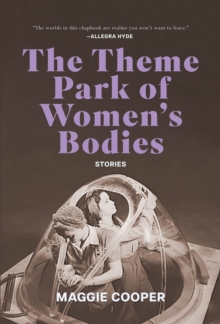
My chapbook of flash fiction, The Theme Park of Women’s Bodies, is organized around spaces created by, for, or around women. Some—like the ship run by badass lady pirates in a story called “Our Lady of the High Seas”—are spaces of empowerment and mutuality, while others—like the sanatorium in “The Cure”—are sites of oppression and control. Many fall somewhere in the middle and explore the ways that gender and the body can both foster solidarity and beget violence, exclusion, and exploitation.
As it turns out, even the absence of men on the page cannot neutralize the impact of the patriarchy, a reality that the following writers grapple with as they consider woodsy islands, old mansions, college campuses, and locker rooms populated by women and nonbinary people. Still, each of these authors carves out space for the pleasures, rewards, and even the radical possibilities of creating space for marginalized genders—on the page and in the world beyond our bookshelves.
In The Women Could Fly, a Bureau of Witchcraft mandates women marry by age 30 to ensure their magic will be controlled. The only alternative for protagonist Jo: a mysterious island that appears in the middle of Lake Superior once every seven years—a witchy Brigadoon where she has reason to believe she’ll find the mother who disappeared when Jo was a teenager. Come for the timely speculative premise, stay for the precisely observed and grounded description—Giddings is equally great on the indignities (and occasional pleasures!) of dating as a Black woman in the Midwest and the thrill of magical flight over a wooded island.
As climate change renders earth increasingly uninhabitable, a lucky subset of the population retreats to the Inside: an elaborately built shelter designed by Jacqueline Millender, a toxic cis white ladyboss whose version of utopia many millennial readers will recognize as sinister send-up of the Wing, complete with mauve uniforms and a signature scent that just-so-happens to double as a sedative. Jacqueline’s thesis is that men are responsible for the ecological destruction of the world, and so, she’ll rebuild civilization from a generation of women only. This plan is exactly as foolproof as it sounds, and the fallout is both emotionally and literally disastrous. Told through the perspectives of Jacqueline and a diverse cast of women both Inside and out, Yours for the Taking is a queer dystopian novel about a certain brand of feminism and its shortcomings—a sequel, The Shutouts, is forthcoming later this year.
The action of Killingly revolves around the disappearance of Betha Mellish, a student at Mount Holyoke College, a place devoted to the education of women in a time when that was in itself a somewhat radical notion. There are plenty of men in this book, from Bertha’s family’s doctor to the detective hired to find her. However, the essential mystery of the novel is inextricably linked with the secret world Bertha and her fellow young women made for themselves—and Bertha’s desire to live a life outside the strictures of what was permitted of a woman in 1897. Juicy and suspenseful, literary and atmospheric, Killingly is a queer crime novel with Sarah Waters vibes.
Not unlike Jessamine Chan’s The School for Good Mothers, Joanne Ramos’s The Farm uses an institutional setting to dig into the complications and injustices of modern motherhood. The novel is centered on a commercial surrogacy outfit called Golden Acres, where women are paid big bucks to gestate under intense surveillance; the main character, Jane, is an immigrant from the Philippines who hopes carrying the child of a super wealthy client will be her ticket to financial security. The novel toes the line of realism and dystopia, offering a character-driven critique of the all-too-recognizable ways the economy of motherhood rests on the exploitation of low-income and BIPOC women.
Clare Beams’ haunting second novel takes place in 1948 at a grand old house in the Berkshires, where main character Irene, alongside several dozen other women, receives an experimental treatment for repeated miscarriages in the hope of finally carrying a baby to term. Yet as much as Irene wants a child, she’s also not a rule follower, sneaking away to discover a walled garden that appears to have uncanny powers. Inspired by the real history of mid-century fertility treatments and their chilling side effects, Beams weaves a gorgeously written account of what she’s called “pregnancy as a haunted house” and the troubled relationship of women’s reproduction and the medical establishment.
Kelcey Ervick’s graphic memoir tells the story of Title IX and its impact on women’s sports alongside her own experience as a goalkeeper through childhood and into college. This is Ervick’s first foray into book-length graphic narrative, after a decade of publishing fiction and prose nonfiction, and The Keeper showcases both her breathtaking artwork and literary sensibility. Ervick reminds readers that Nabokov, too, was a goal keeper, and like one of his butterflies making its way from bloom to bloom, The Keeper beautifully draws from sports, feminist history, and memoir.
I have to admit my bias here—I’m Thomas’s literary agent, but I’d like to think that even if I weren’t, I’d be talking about her “charming, irreverent, tender…journey through lesbian history.” In six chapters, she digs into the largely untold stories of lesbian bars, feminist bookstores, sex-toy boutiques, softball diamonds, rural retreats, and vacation destinations—exploring the way these places were the settings where women fell in love, formed communities, and engaged in organizing and advocacy. Thomas is clear eyed about the way many of these spaces fell short, replicating the transphobic or racist biases of the women who built them; at the same time, she reveals the ways these places and the women in them laid the groundwork for queer life in 2024.
When I first read Kate Chopin’s The Awakening, I was straight. Or, at least I thought I was. It was 2014, and I was a sixteen-year-old closeted bisexual in the Pennsylvania suburbs, with nothing to my name but a mildly successful hipster-themed Tumblr blog. The novel’s ending, in which Edna walks confidently into the sea and presumably drowns, left its mark on me. I couldn’t shake the image it conjured: a grown woman, defeated and determined, descending into the waves until there is none of her left. At the time, I chalked up my obsession with this ending to its overall melodrama and second-wave feminist messaging. It took a decade and a queer awakening of my own to understand the real reason I couldn’t seem to let it go.
In the past year or two, I’ve seen parts of this ending reflected in piece after piece of queer media. From novels to TV shows to music videos, there it is: this very dramatic, very wet end. A descent into the water, an ambiguous death, a life or lover left behind—it’s all there. In each story, a main character is transformed into something non-human, neither dead nor alive, destined for life underwater. And the lover left behind is almost always queer.
It’s quite a specific trope to encounter upwards of five times in the span of a few years. While there’s certainly more queer representation in media than there used to be, it’s still undeniably a much smaller genre—an island of queer stories amongst oceans of hetero romance. Smaller still is the percentage of these stories that spotlight sapphic love between queer women and non-binary people. So it feels significant, and more than just an odd coincidence, that multiple fairly popular sapphic stories released in the last five years hinge on this strange plot point.
In each story, a main character is transformed into something non-human, neither dead nor alive, destined for life underwater.
I first recognized it as a trope when watching The Haunting of Bly Manor. Like many young lesbians in the fall of 2020, I spent two days in October glued to my couch, binge-watching the new Netflix miniseries. New sapphic romance in mainstream media is not an everyday event, so when I heard whispers on social media of the new gothic drama featuring WLW love, I didn’t walk: I ran.
Though Dani and Jamie’s romance is briefly a sweet, infrequently seen picture of lesbian domesticity, it comes to a harrowing, wet end in the season finale. Dani, who’s spent the last decade growing increasingly possessed by the evil Lady of the Lake, makes the decision to leave for Jamie’s safety and retreat back to the lake on the manor. Like Edna in The Awakening, she walks steadfast into the water. Though rather than presume she drowned, we understand her to live on as the new Lady of the Lake. The following scene, in which Jamie swims into the water to find her wife asleep on the lake’s bed, is one of pure sapphic suffering—a wailing woman, weeping for the loss of her wife.
Then there it is again in Julia Armfield’s novel Our Wives Under the Sea: After Miri’s wife, Leah, returns from a submarine mission gone wrong, she watches as Leah slowly transforms from her charismatic, loving wife into a sea creature of sorts—drinking salt water, bathing for hours, shedding human skin. Something happened in that submarine that changed Leah forever, and Miri cannot get her back. She is, instead, forced to carry her into the sea and watch as her wife swims away.
In Chlorine, the 2023 debut novel by Jade Song, we see it yet again. Ren, a talented teenage athlete, grows so obsessive over her competitive swimming career that her childhood fascination with mermaids takes on a life of its own, and the line between human girl and mermaid blurs to the point of no return. Meanwhile, the novel’s other protagonist, Cathy, endures the queerest of fates: falling desperately in unrequited love with Ren, her best friend. Ultimately, it is Cathy who must deliver Ren-the-mermaid to a creek, and watch as she swims underwater without resurfacing.
Jamie, Miri, and Cathy all have no choice but to helplessly witness the deterioration of their lovers as they turn from a human woman to something not-quite—something whose home was no longer in them, but in the water.
As someone who has experienced the heart-wrenching, all-consuming emotional nightmare of one’s first lesbian breakup, the pain these queer characters endure by losing their relationship in communion with the loss of the person themselves sounds insurmountable to me, which may be part of why I recognized this repeating theme in the first place. Heartbreak is by no means exclusively queer, but one could argue that lesbians have somewhat of a monopoly on yearning—of which this trope begets plenty. In all of these stories, there is a refusal to let go that is decidedly sapphic. An unending yearning that is emboldened by the ambiguous loss of the lovers—they are both gone and not. They live on in the water, and their lovers are left to blindly hope for their return.
One could argue that lesbians have somewhat of a monopoly on yearning.
In Bly Manor’s finale, it’s revealed that the show’s omniscient narrator is Jamie herself, telling her and Dani’s story some twenty-five years later. It’s been decades since she lost her wife, and still we watch Jamie sleep with her door open just a crack, in case of Dani’s return. Still she runs a bath and fills the sink at night, in case Dani is called to the water, I Shall Believe by Sherly Crow playing softly in the background.
When Ren swims away from Cathy in Chlorine, instead of letting go and moving on, Cathy does the gayest thing one could: writes love letters. These love letters are more than just a coping mechanism for her grief—they’re an earnest attempt to communicate with Ren underwater, regularly depositing messages-in-bottles into the creek with hope Ren the mermaid will write back. In one of her letters to Ren, she writes, “Remember, remember, remember? Feels like all I do is remember the times I had with you.”
It’s dark, quite frankly. Both Cathy and Jamie are stuck living their lives in the past. This level of devotion blurs the line between romantic and pathetic, love and purpose, independence and codependence. And yet—such is lesbianism. Nothing has ever distorted my sense of self and purpose quite like queer love, which is precisely why I think this trope has found its home in queer media. It provides the perfect stage for the darkest, most vulnerable parts of sapphic love to shine.
Even Chappell Roan is in on the metaphor: in the “Casual” music video, Roan’s love for a sexy siren develops quickly and forcefully, from sharing a popsicle on the beach to making out with her in a pool. Over the course of the video, we see Roan’s character transform herself into what (she thinks) the siren wants—dressing in bluer tones, giving her bedroom a sea-themed makeover, even turning a blind eye to the siren’s murderous tendencies. All of this just to be abandoned by the siren in the end, and of course: watch as she retreats into the sea. The sapphic yearning is desperate here—just as it is in Bly Manor, Our Wives, and Chlorine—to the point where these queer characters are willing to abandon common sense. They believe the unbelievable because the love, the want, feels so good.
The mythical nature of these lovers (the siren, the mermaid, the sea creature, the possessed) intensifies the queer love within the stories, extending it past reality. Without the fantastical element, the loss of these characters to the water would be matter-of-fact. It would just be…death. Instead, magical realism creates a layer of ambiguity to the losses, allowing the longing to be theatrical and placing queer love on a bigger scale, for all its complexities and pieces to be seen up-close.
For the human-half of these relationships, taking care of a lover-turned-mythical-creature seems instinctual. In Bly Manor, Jamie spends the majority of her marriage compensating for Dani’s deteriorating self and memory. “If you can’t feel anything, then I’ll feel everything for the both of us,” she says. In Our Wives, Miri tends to Leah day and night in the bathtub, where she’s most comfortable. She dissolves tablespoons of salt into water for her to drink, bandages her face when her human eye is lost. In the “Casual” music video, Roan intimately bathes her murderous, shark-toothed siren.
The trope provides the perfect stage for the darkest, most vulnerable parts of sapphic love to shine.
In each instance, love is an active effort. As said in Bly Manor, “To truly love another person is to accept the work of loving them is worth the pain of losing them.” The way in which each of these stories refer to love as “work” is purposeful; the work may not be effortless, but when so deeply entrenched in queer love, it feels natural.
There is something to be said for the unspoken way in which a queer lover is often able to anticipate the wants and needs of their partner. The effect is a blurring of bodies and hearts—I am made up of you and you are made up of me. The question of adopting the caretaker role through their partner’s transformation is not a question at all, but rather a raw determination to channel the intensity of love into action.
Maybe this is why the lover-lost-to-water trope is surfacing in so many queer narratives, like dots waiting to be connected, or breadcrumbs on the trail. The love we are capable of as queer women and non-binary people is like the sea, unwieldy and vast, and the consequence of losing this love is just as unpredictable and terrifying—which all of these authors and artists tap into and lay bare in their heartbroken characters.
I see in them the parts of myself I shrink from—the parts I like to pretend don’t exist within me, lurking. Jamie’s helplessness, Miri’s detachment, Cathy’s desperation, Roan’s codependence, all triggered by loss and change. And yet, just as clearly, I see the parts I revel in—the hopeful feeling of unending, easy love. Of yearning satiated. It is the kind of representation I hope to see more of as queer literature and media continue to expand—raw and dark, beautiful and truthful, yet done in a way that plays with the unknown. And what is more unknown than the sea?
In The Awakening, Chopin writes, “…[Edna] was beginning to recognize her relations to the world within and about her… [the] voice of the sea is seductive; never ceasing, whispering, clamoring, murmuring… the touch of the sea is sensuous, enfolding the body in its soft, close embrace.” Aside from this being the most sapphic description of the sea I’ve ever read, I like to think Chopin intended more for Edna’s final moment than death. I like to think she inspired a generation of queers to play with the boundaries of love and yearning—of wanting more—just as she did.
My whole life I’ve felt like a bad girl, like something was inherently wrong with me that I couldn’t manage to play the part society (and my immigrant family) had carefully laid out for me. From coming out to being splashed across headlines for listing “sex work” as a work experience on LinkedIn, I always seemed to be doing something wrong. Never mind my ADHD and autism—just recently discovered—that now puts a whole new lens of understanding behind my “badness”.
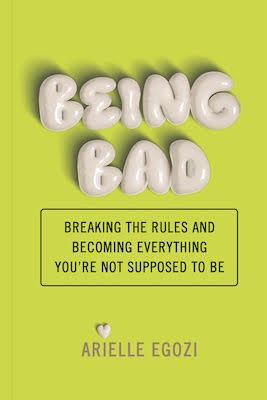
I can only speak to my experience, which I do in my debut, Being Bad: Breaking the Rules and Becoming Everything You’re Not Supposed to Be, so the books below—spanning from auto-fiction to fiction and back to memoir—recount stories of AFAB people (Assigned Female at Birth) and trans women, and all the ways society has claimed our behavior—and sheer existence—bad.
It’s not always that obvious, and some of these works never say it out loud, but to be born without a penis—let alone born with one and being a woman anyway—makes us all bad from birth. And if we choose to not conform, constrict, and consistently meet all the instructions laid out for us before we ever exited the womb, well, society deems us doomed.
The books below are some of my favorites. From a trans non-binary butch memoir about a person going to a conservative Catholic college, to a postmenopausal woman orgasming herself into trouble, each work is not only achingly well-written, but infused with the particular perspective of those who know what it is to be on the outside—even if they pretend not to be.
Playboy by Constance Debre, translated by Holly James
Constance Debre’s prose is direct, emotionally removed staccato sentences that makes it clear she’s now a butch dyke. The granddaughter of France’s former prime minister, Playboy, the first in her trilogy of memoirs, is a series of sharply cut short vignettes, chronicling her first sexual encounters with women—an older married woman, a young model—and her fumbling liberation away from her prominent career as a lawyer, and becoming a broke, single lesbian—which is already “bad” enough. But add her obvious distaste for her grandfather’s politics, and descriptions of her eye-fucking passing woman, and she becomes one of the foremost contemporary voices in French literature and discourse to date. Her writing is vivid, unworried about offending, and alive.
Dark and uncomfortable, this novel begins with Edie, a young Black woman having online sex while sitting at a desk at her day job. The man she’s talking to is older and white, a midwestern married man living in Jersey with a much simpler life. Narrated in the first-person, there’s a self-destructiveness about Edie, an attraction to violence and an apathy towards herself. We see her on an uncomfortable first date with the white man, Eric, and after losing her job, she finds herself in front of his home, meeting his wife, and offered the guest room. It is a fascinating work, yet I found myself wanting to close my eyes and cover my ears through some of the violently visceral descriptions of Edie’s life—a woman making “bad”, if not terrible, choices that you keep rooting for.
This searing memoir is one of bravery, courage, and a shitload of confusion. When Mertz moves away from their abusive father and moves in with their mother and stepfather—who’ve entrenched themselves into conservative Catholic homeschooling, and all that comes with that—Mertz is just starting to feel the first stirrings of queerness. And yet, Catholicism becomes the safety shield away from their father who’s a non-believer. We watch Mertz choose a Catholic college in conservative Ohio, navigating their way through sexual attractions, questions of identity, and whether there’s space for them in the community they gave so much of themselves to, or anywhere else. Mertz isn’t just a bad Catholic, but not even a girl, at all.
I can’t talk about this book without talking about the cover, the first reason I picked it up. A cropped close-up shot of a man’s chest peeking through emerald green corduroy, his gold braceleted wrist resting on his thigh, his hands right over the pants of his crotch. The narrator is a literary professor in her late 50’s, married to the chair of the English Department who’s had his fair share of sexual student relationships. Now, the narrator’s “feminism” is being questioned as she doesn’t support the removal of her husband from faculty after 300 hundred students sign a petition against him. She now has become “an enabler” by frowning upon the female students’ claim of no agency. She stops being a student favorite just as a young new assistant professor moves to town with his brilliant writer wife. Our narrator becomes hopelessly jealous of the wife—not just of her husband, but of her writing career that’s taking off, while hers has stagnated. A postmenopausal woman filled with lust, ambition, and a little hint of violent recklessness, a story of an older woman doing none of the things she’s “supposed to”.
Bad Girls by Camila Sosa Villada, translated by Kit Maude
“Las Malas” (translated from the Spanish) dives into a community of Argentinian trans sex workers, mirroring the author’s real life experience. Our heroine is Camila, a young trans woman who’s born to a poor family that violently rejects her once she starts dressing like a girl. She finds her way to university, and, to support herself, starts working as a sex worker and finds her way into a community of trans sex workers who take her in and become family. In the bushes, they find a baby, and the magical realism begins to unfold. Funny, gritty, and perfectly magical, Sosa Villada writes to her community, not for anyone else to understand.
A summer in the Hamptons with a self-destructive sugar baby. Need I say more? Okay, okay, I will. Alex fucks up at a fancy dinner party and gets dumped by her rich older “boyfriend” and put on a train back to Brooklyn. Except, she doesn’t get on it and instead spends a week pretending to be totally fine—with no money, no phone, and nowhere to sleep, conning and causing destruction along the way. All she needs is to get through the week until her ex’s Labor Day party where she can win him back. I won’t spoil the ending. A story of excess, addiction, and dark comedy, somehow you’ll find yourself rooting for this antiheroine.
Easily one of my favorites, this book is often considered the first work of the new “trans lit”. Written by a trans woman for other trans women, the novel follows Maria, a Brooklyn internet blogging trans woman who writes tips for other trans women online. Although she’s positioned herself as an “educator” of sorts for baby trans women, she’s a mess. Her external and internal lives come undone as she gets dumped, gets fired, and borrows-but-actually-steals her best friend’s car and begins a roadtrip across the country, meeting a young sales assistant at a Walmart in Nevada who she can tell is maybe, probably, trans. She takes James under her wing and you’ll have to read the rest because it’s an absolute cult classic for a reason, primarily because it’s not written for anyone else but Binnie’s own community.
This book is wildly visceral, strange and somehow extremely relatable—at least for me, having struggled with eating disorders, and being queer and Jewish. The story follows Rachel, a mentally unwell young woman working in LA who falls in love with a Jewish Orthodox woman who runs the frozen yogurt counter at her chosen spot. The story is filled with self-loathing and perfectly accurate descriptions of what it is to be food-obsessed with an eating disorder, a repressed queer person, and a lonely human. The whole time I was reading I found myself being completely captivated by Broder’s mind. A book that shows all the traps of trying so hard to be “good”.
Li-Young Lee’s first collection in a decade, The Invention of the Darling, remixes many themes from his five previous poetry books: family, exile, intimacy, and the divine. Yet somehow these plain verses feel fresh. In “Counting the Ten Thousand Things,” Lee writes,
“Start over in secret, at night with my mother and father and the escape to… Canaan? Bethlehem? America? Where was it we thought was safe?”
Four quick lines recall the pain of a refugee’s journey, one that never quite arrives at the land he was promised. Since Lee’s last collection, various horsemen have come calling: a deadly pandemic, a spike in anti-Asian violence, a U.S.-enabled genocide. In Lee’s poetry, love (“the true lover lives / only to love the beloved”) is a powerful expression of resistance against external forces of harm and displacement.
Lee, born in 1957, immigrated as a child to the U.S. while fleeing violence in Indonesia directed at its ethnic Chinese population. Before embracing what would become a decorated poetry career—including a Lannan Literary Award, an American Book Award, and fellowships from the Academy of American Poets and the Guggenheim Foundation—Lee packed books in a warehouse and, with his brother, launched a fried chicken restaurant and a jewelry business. (The jewelry, made of found materials like Coke cans, was featured in Vogue and the rom-com Pretty in Pink.) In addition to his poetry, Lee has also published a memoir and a book of interviews, which often range into the philosophical and mystical.
I spoke to Lee over Zoom between the release of The Invention of the Darling and the publication of his co-translation with cosmologist Yun Wang of Laozi’s Daoist verse Dao De Jing.
April Yee: You said in 2016 to the LA Review of Books,
“The Chinese say, ‘In order to write poems, it’s a process of Yin, the practice of Yin beckoning to Yang.’ Yin is yielding. That is, you practice yielding. We live in a culture in which yielding is not a virtue. Retiring is not a virtue. Staying silent is not a virtue.”
I’m curious about these ideas of silence versus aggression, Yin and Yang, and the practice of poetry, this idea of aesthetics and activism. Particularly in the current environment—which feels like a silly thing to say because something terrible is always happening in the world. But I think the particular way in which things are happening today engenders a type of complicity, particularly as Americans, that’s possibly different than before. And so I’m curious about that relationship to Yin and yielding and silence and retiring, whether that’s changed—and also about your relationship to activism today.
Li-Young Lee: I feel as if this Yin becomes more important in my life, more and more and more important. It’s almost exclusively what I’m interested in at the moment and, you know, it’s not weakness. In the martial arts, when you throw a strike, the more Yin you have in that strike, the more precise and the more powerful it is. Even Western boxers know this when they say, “Sit inside your punches.” Think about that. The punch is going out, but they’re saying, “Sit inside the punch,” right?
Poetry is the logic of all logic. And it’s a logic beyond reason.
The longer I live, the more I realize that the world is a koan to me. It’s an instance of something beyond reasoning, beyond rationality, beyond understanding, beyond my grasp. I live in complete mystery all the time. I don’t know how to deal with it. Now, it seems to me that out of desperation and fear, I’ve been telling myself I can fix it, I can control the world. But in my trying to fix things, I’ve ruined so many things. I cannot tell you. I believed that I was trying to fix the world. I ruined so many things, personal things I live with every day. The world is no better. I didn’t fix the world. And so I realized I better practice this koan attitude. And that finally poetry is the logic of all logic. And it’s a logic beyond reason. It’s the logic of God. It’s the logic of my mother. She endured so much.
From the day our neighbor in Indonesia raised the machete to my parents and said, “I have to drink your blood, I just have to”—the world became beyond my understanding. Nothing will be able to explain that. I played with that man’s children. And the flip of a switch, he was standing there covered in sweat, spattered in blood. I don’t know who else he had killed. And he says to my family, “I have to drink your blood. You don’t understand, I have to.”
How am I going to fix that? He’s not the only one. And if I’d talked to him, he might have had reason to. Is there a reason to kill your neighbor? I don’t know. The horror is just beyond us. The beauty is beyond description. The mystery is beyond description. The terror is beyond description. The joy is beyond description. It’s all beyond me. I don’t know what I’m going to do. I keep thinking that poetic logic will be able to account for it or something.
AY: That memory you just raised, you know, reminds me of some of my own family histories. And I suppose what’s different is that those things have happened. We’re left to grapple with them and the different ways that they manifest in our consciousness and in our bodies. But is there some kind of obligation in the more Yang sense to prevent that [violence] from happening, and how do we do that as poets?
LL: The first thing for me, when I discovered that murderer in me, I thought on a daily basis… I’m not murdering people, but I found that I’m capable of the same kind of violence, the same kind of rage, the same kind of anger, the same kind of reactive whatever-it-was that man was experiencing. I realized—it’s so hard to accept—I’m no different than him.
So I started to think, during the activism part—I want to tell you maybe I was usually unlucky. I was very involved with activism, but a lot of the people I was involved with were the worst people in the world.
AY: Can I ask what specific areas you were working on?
LL: When we first came to Chicago, this area was crime-infested, and there was just garbage everywhere, dirt lots, a lot of drugs being sold openly on the street. So we began a neighborhood watch. We began a local neighborhood gardening project. We built gardens. We stood watch. We did outreach to the projects, young people. We got a lot of them to finish high school. I mean, we started from the ground. We weren’t just beautifying the things. We started teaching meditation, martial arts reading, after-school programmes. Years of this. Years. We had some success stories, a lot of success stories. People finishing college, people going to college for the first time.
But at the same time it wasn’t even a drop in the bucket. It was nothing. Everything just kept getting worse. And on top of it the people working there were so ego-bound and so glory-bound and fame-bound and everybody saw the activism as a way to—I didn’t understand it—as a way to gain more influence or as a way to gain political power in the neighborhood.
After I saw that, I thought, I’m not against activism. But if there’s not inner work going on, I just don’t see any hope. I don’t think there’s a political solution. I don’t think there’s a social solution to a spiritual crisis.
AY: I have a question more in the vein of what we call craft or process. I was really curious about the way that you wrote your memoir and about that desire to write the book in a single night. And correct me if I’m wrong, but even when it would be revised, it would also be rewritten in the span of a night, or as close to a night—a couple of nights—as you could get to as possible. This kind of thing nearing automatic writing, or maybe it’s nocturnal prayer, or whatever it is. I’m curious if that’s also the mode in which you write poetry and if that’s something—that long form—that you might ever want to return to, and what specific knowledge that mode of creation can unlock?
The practice of poetry is the practice of polarities—which is Tai Chi.
LL: I’m troubled by the long form. I keep noticing my ego is really at play in the long form. There’s something about it thinks it’s huge. The ego thinks, “Look, look, look, I’m just so big. I’m so competitive. There’s so much of me.”
I feel as if I’m beginning to wonder about what’s driving that, because I thought I was trying to make a model of the universe. My models aren’t other works of art. My models are things in nature. So when I set out to write that [memoir], I thought, that has to be the universe. So it has to have everything in it. It’s impossible.
And I feel as if what might be more interesting right now is a model of the universe in a small lyric poem. The tension between the size, the smallness of the lyric poem and the largeness of the universe—that polarity might be the thing that I need. Because I feel like the practice of poetry is the practice of polarities—which is Tai Chi, right?
AY: One of the polarities that I noticed in your work in general but maybe more specifically in The Invention of the Darling is the polarity between the specific and the nonspecific. You have this poem, “Call a Body”:
“The one with bones is born of the boneless.
The one with a face is born of the faceless.
Too obvious?
The one with skin is born of the borderless. The one was features is born of that without features.
Not concrete enough?“
I’m really curious about who that’s addressed to. For me, I read that almost as a challenge to the kind of poet’s critic [saying], “This image is not tethered to detail sufficiently for the detail-hungry reader.”
And then a couple of poems later, there’s this much more specific one. That’s “Thus the World is Made,” where the speaker of the poem is saying,
“We fled the soldiers. We fled the police. We fled the revolutionaries. We fled the mobs.”
And so there’s this feeding into that specificity and that biography, or supposed biography, that the reader is often hungry for. So I’m curious about how you balance that in your writing, this drive between these two polarities and the reader’s hunger, that third party.
LL: The most I can do is demonstrate my openness and ready assimilation of the divine. It’s the same thing a shaman does. That’s what they do for the community. They enact possession by the divine. But the third party, I’m not looking at the third party. That poem “Call a Body” is a dialogue between the lover and the beloved. All of my poems are a dialogue between lover and beloved. Sometimes that dialogue is full of love. Sometimes that dialogue is inflected with stress, and maybe even strife. Both the lover and the beloved, I think, is the founding paradigm of all my work.
The cover of The Invention of the Darling is the image of Yin-Yang. That is the tantric Buddhist image of the union, the male and the female in conjugation, staring into each other’s eyes. They said out of that encounter with the male and the female—the polarities of weak force, strong force, Yin and Yang—out of that encounter, the whole world manifests.
And I want to clarify here, that when I talk about silence, I’m not talking about the white page. I think nobody understands that the white page isn’t silence. It is full of noise. So a lot of times I see people using this convention where they leave a lot of white space. It just fills up with noise. Poetry has this very powerful effect. It creates silence. That’s why it’s so hard to face the white page. It’s not the silence. It’s the noise.
I have to say Emily Dickinson does this so superbly. I don’t even know how she was able to—she builds her own silence within which to hear the poem.
AY: I wonder if that’s a flaw of the form of the book, in general, and that Emily Dickinson wasn’t writing into the book form.
I want to write with a daemon hand and a Christ-like heart.
LL: Yeah, I think that’s catastrophic to write into a book form. I’ve never written into a bookform. I feel as if the poem is the thing. The book is just a collection of those instances. I think poetry is the practice of ultimate polarity, ultimate stillness, and ultimate motion. It’s this tension between absolute stillness or silence and the speed of the fastest thought. And then there’s the polarity between male and female. There’s the polarity between denotation and connotation. There’s the polarity between the One and the All, between the specific and the general.
The One and the All is one of the highest-tension polarities in lyric poem. It’s the One, the mortal being, inflecting the All that is eternity. And somehow, that polarity, if it’s not experienced in the poem—if the poem is just an instance for the ego and it isn’t this polarity between mortality and eternity—somehow there’s not enough tension in the poem, you know?
AY: Back in 1995, in an interview with Bomb, you said, “When I’m writing, I’m trying to stand neck and neck with Whitman or Melville, or for that matter, the utterances of Christ in the New Testament, or the Epistles of Paul.” I’m curious, three decades on, if those are still those who you’re trying to stand with today.
LL: I want God to speak through me. I’m tired of my own voice. I’m tired of me. I’m tired of all my own schemes, all my egos and machinations. I’m tired of being lost. I’m tired of following my ego. I’m tired of the whole thing. I just want God to live my life. I want God to speak those poems. And I feel as if—you know, Melville went mad. I mean, his best books are insane. There’s some sort of daemon, you know. I want to write with a daemon hand and a Christ-like heart. Does that make sense?
“September,” an excerpt from Come By Here by Neesha Powell-Ingabire
YAHA
The tour guide calls our class’s attention to an alligator on a log, napping to a symphony of songbirds and swaying bald cypress trees. Y2K is around the corner, and we’re on a field trip at the Okefenokee Swamp. Our lives are in the hands of a tour guide captain, a middle-aged white man whose name I can’t remember. Since we are under twelve and got a children’s discount, the tour cost us each less than twenty bucks. During the one-hour bus ride to our destination, kids joked about who would get eaten first.
Mr. Tour Guide is expected to save two dozen of us from the whims of a thirty-five-mile-per-hour-running reptile with an appetite for small mammals. He is the only protector on our long white canoe in the middle of miles of black water. This 400,000-acre wetland, the traditional territories of the Timucua peoples near the Georgia-Florida border, is now his domain. White men claimed it as theirs hundreds of years ago, falsely believing land is intended to be owned as products of a feudal society. I am supposed to trust this man, but I don’t. He is a stranger with the same skin color as the kids who call me “nigger.” I can’t stop my foot from shaking. There are an estimated ten thousand alligators in the surrounding water, no known attacks, but I’m not privy to this knowledge. SoI wonder if the reptiles are hungry for human flesh, hungry to conquer like those white colonizers.
Thirty years from now, a white-owned company will apply for a permit to open a mine by this swamp, threatening all the wildlife we’re here to see—and burial grounds of the Muscogee (Creek) Nation.
YUCHA
If you’re curious about the Timucua, you won’t find anything about them on the Okefenokee Swamp’s website. You won’t find out what Okefenokee means either. It could derive from a Muscogee word for bubbling water, oki fanôki. Or, from a Creek word meaning “trembling land.” Timucua may originate from a term one of their enemy tribes used to refer to them, Thimogoua, or the Spanish mispronunciation of atimoqua, the Timucuan word for “lord” or “chief.” Before their extinction, the Timucua had thirty-five chiefdoms in southeast Georgia and North Florida. The last Timucuans are said to have either left for Cuba on a boat in 1763 or been taken in by other Indigenous groups.
Our tour guide didn’t share this information with us. Perhaps he thought it insignificant. I hope he didn’t withhold it intentionally. Native American history was rarely taught at my elementary school until Thanksgiving came around. I once graced my local newspaper in kindergarten wearing a pilgrim costume. Reading my picture book of Christopher Columbus “discovering” the Americas, I made no value judgments; although, I visually identified with the colorful, feathered brown-skinned people with jet black hair. The only Native Americans I knew at the time lived inside an electronic tube. From bed, Mama watched black and white “cowboys and Indians” movies on weekends. I saw Native American cartoon characters (usually voiced by non-Natives) far more than actual Native American actors. I didn’t know any Indigenous folks in real life, as far as I knew.
On the morning of my eighth birthday, Mama gave me my gifts by spreading them out on her bed: a smorgasbord of Pocahontas, the first Disney princess to look remotely like me with her sepia-colored skin. I loved everything about the rebellious character and found her attractive. Among the presents was a soundtrack CD with a book of lyrics, which included a song loosely based on an Algonquin language that implores the Great Spirit to help Pocahontas’s people “keep the ancient ways.” I boisterously sang the chant at the beginning and end of the song, pretending to dance by the sacred fire: “Hega hega yah-pi-ye-hega/Yah-pi-ye-he-he hega.” It felt like the cousin of the clapping, dancing, jumping, and shouting that shook my Black Missionary Baptist church each Sunday. It felt joyful.
HAPU
“Woahhh ohhh ohhh ohhh,” my cheer squad warbles to the tune of the band playing in front of us, our right hands making a chopping gesture. We’re cheering on our middle school football team, the red and black Needwood Warriors. I’m standing beside a friend who I consensually touch on during practice. We touch each other, not sexually but playfully. It gives me a rush. I’m crushing on her; although, I would never admit it because no one is openly gay at my school. I only see gay people on TV.
A white male teacher with a brown ponytail wearing Native American garb stands in the distance, and nobody questions whether it’s cultural appreciation or appropriation. Native American costumery is ubiquitous here, and we are all blissfully ignorant or at least we behave that way. A group of parents and students voted for the Warrior to be our mascot to channel the spirit and strength of “Georgia’s first Americans.” The Warrior’s side profile graces a wall of our cafeteria: a chisel-faced man with red warpaint across his nose and a red and white headdress.
I cringe when I see myself tomahawk chopping on the morning announcements, a goofy grin spread across my face. I wish I could hide inside of my shirt. We all look terribly silly. None of us are Native American; I know of only one Native American kid in the entire school. Nevertheless, I dutifully chop whenever I hear those familiar notes. We chop and chop and chop away, never knowing we’re cheering on Timucua land.
Native American costumery is ubiquitous here, and we are all blissfully ignorant or at least we behave that way.
CHEQUETA
I stretch my legs out, resting them on the back of the seat in front of me. It’s the mid-2000s, and I’m sitting in a college lecture hall with my friend, Alexa, waiting for class to start.
Alexa examines my legs.
“Your skin is red like an Indian’s… you got Indian in your family, girl?” she asks.
“Who knows?” I reply.
I am tickled by the question, a little flattered even. I’ve been asked if I was mixed with white before, but this feels a whole lot cooler.
Almost every African American at some point wonders whether our great-grandmother with high cheekbones and straight black hair hanging down to her butt or whether our own loose curls mean we got “Indian” in our family. I think it makes us feel better, like at least not all our ancestors came over in chains. Being Black and Native American is seen as infinitely more special and exotic than being plain old Black. Black American guests on Henry Louis Gates Jr.’s PBS genealogy show, Finding Your Roots, are always surprised when family rumors of Native American ancestry are proven wrong via DNA. Gates tells them Black people with Native American heritage are a lot less common than we think.
Still, the myth of the Black and Native great-grandmother persists. When another Black girl at school had long, straight hair without putting a chemical relaxer in it, I thought to myself with a tinge of envy, “She must got Indian in her family.” She had won the genetic lottery because she didn’t have to waste hours with smelly paste burning her scalp like most of us fully Black girls.
MARUA
I am on the phone in my rundown office on the southside of Seattle in 2014, chatting with an elderly white activist. We’ve met once or twice at meetings. Our conversation about organizing public housing tenants drifts to other topics, like the Duwamish tribe, whose land Seattle occupies, and their fight for federal recognition.
“By the looks of it, you’ve got Native American blood in you,” the lady says.
I tell her she is mistaken. I have my suspicions, but I don’t want to be misconstrued as claiming an Indigenous identity. I am more aware of whose land I’m on than ever living in a state with twenty-nine Indian reservations, a stark contrast to my home state Georgia’s zero. It’s easy for people in Georgia to talk about Indigenous Peoples as if they’re all gone. Not here though. Here, I attend events where land acknowledgements are spoken first, brief statements made in respect to the Native American tribes whose land we inhabit. The city is named after a Duwamish and Suquamish chief who befriended white settlers, who in turn expelled Chief Seattle’s people from their ancestral home. I wouldn’t dare say, “I might have Indian in my family,” in this achingly beautiful environment. I literally cried as Jojo and I drove on the edge of Washington state’s snow peaked mountains dotted with evergreens on our trek from down south. The Duwamish are the rightful keepers of these lush, enchanting lands. It infuriates me to think about their tribe being denied their right to self-governance and federal funding for decades.
Being Black and Native American is seen as infinitely more special and exotic than being plain old Black.
One of my first Thanksgivings in Seattle, Jojo and I eat dinner with two friends, another couple. One of them is an enrolled member of a Coast Salish tribe, but we don’t discuss the irony of him being here. He’s here to spend time with friends, not to celebrate. Somehow, we end up watching Pocahontas on VHS after dinner, and when I hear the familiar Algonquin chant of my childhood, I instinctually belt it out. A sharp look from my wife stops me mid-chant, and my face burns. Our Coast Salish friend doesn’t say a word, but I am still ashamed. I’m not an eight-year-old nor a middle schooler anymore. I now know Pocahontas’s story is about colonization, genocide, and trafficking, not a romance between her and the Englishman John Smith like Disney portrays. I know you shouldn’t wear traditional Indigenous clothes as a costume. I know Indigenous songs aren’t meant for me to sing—they’re for the descendants of those who fought and died to preserve them. I know they are sacred. I know you shouldn’t adopt another culture’s customs without their explicit permission, and even then, you walk a fine line between appreciation and appropriation. I ask myself, am I no better than the “white man”?
I silently vow to do better. I act unbothered as we watch the rest of the movie, even jeering at John Smith, but I’m secretly disturbed by my own ignorance.
MARECA
Sitting in my office chair at the tenants’ union, I spit into a tube with vigor. This tube and this spit hold the key to reconstructing lineage lost in the Middle Passage. This is redemption for the times in school when I couldn’t answer, “Where is your family from?” As a Christmas gift to myself, I forked over $99 to 23andMe for an ancestry DNA test.
My mother gets excited when I tell her about the test. “You know we have Indian in our family, right? My grandmother who you never met, my dad’s mom, used to tell me her grandmother, September, was an Indian with long hair down her back who lived in South Carolina.” Mama never mentioned this before, but I’m not surprised. Every Black American family has a September.
A month goes by. I hungrily scan my DNA test results as soon as they hit my inbox: 75.6 percent West African, 9.4 percent Congolese and Southern East African, 12.1 percent European, one percent Chinese and Southeast Asian…and 0.4 percent Native American. This means 0.4 percent of my DNA matches Native American samples in 23andMe’s database. Being this percentage Native American means my most recent fully Native American ancestors roamed the earth two hundred to three hundred years ago. September was probably more white than Native American.
When Mama hears the news, she sounds disappointed. We got “Indian” in our family—but it’s extremely distant. Just enough for the Americas on my 23AndMe ancestry composition map to be colored in yellow. Across the Atlantic, Africa is colored in purple. My DNA comprises 31.5 percent Nigerian, 29.9 percent Ghanaian, Liberian, and Sierra Leonean, and 8.6 percent Angolan and Congolese, among myriad other African ethnicities. I felt a smidge of disappointment about lacking Native American ancestry because I grew up believing it would make me important and special. I’d internalized anti-Black beliefs in our culture that say being just plain Black isn’t good enough. But I quickly shifted my focus to the pride I felt in being majority African. I like thinking about how my ancestors have found intimacy and companionship in their own communities for thousands of years, even after being stolen and displaced to another continent.
I’ve had conversations with my Rwandan spouse where they say, “African people are always left out of conversations about indigeneity in the United States, but we are Indigenous, too. We are indigenous to our different regions of Africa.”I may be an Indigenous African, but still, I have no claim to the native dances, songs, food, and customs of my ancestors. I am indefinitely unmoored. When I wear the mushanana of my wife’s culture for special occasions, a sash draped over one shoulder and a wraparound skirt, I’m not sure if it’s an act of appreciation or appropriation. But I am sure it makes me feel beautiful and makes my wife happy.
PIQICHA
It’s a drizzly day in Atlanta, where we have moved back to from Seattle. Jojo and I are both on holiday break and want to do something outside our norm. We decide to visit the Etowah Indian Mounds less than an hour away. Etowah is a Muscogee word for town or trail crossing. It is afternoon when we walk into the building at the historic site, where we are the only visitors. We pay our six dollars each and go on our own private tour of the museum. We read the stories of the prehistoric ancestors to the Muscogee Creek, the Indigenous peoples of the South Appalachian Mississippian culture, who are responsible for building the site’s six earthen mounds between 1000 and 1550 A.D. A thousands-years-old culture and society vanquished by Europeans’ smallpox, measles, and violence.
After circling the entire museum, we step outside to face the towering mounds. Ten-foot-high Mound C is the only one that’s been completely excavated, offering clues on a way of life full of arts, games, worship, and ceremonies. The tallest of them, The Temple Mound or Mound A, stands sixty-three-feet high, equivalent to a six-story building. It was likely a platform for the home of the chief. We walk up the stairs of the Temple Mound, taking care not to slip on the slick steps. Pleased with our mini workout, we snap a selfie at the top. We take another with the Etowah River in the background. Unlike in Okefenokee all those years ago, I am my own tour guide now. I choose which displays to engage with and read them critically since they were likely written by employees of our racist state government. I interpret what I’m seeing for myself. I’m no longer reliant upon a white man.
I may be an Indigenous African, but still, I have no claim to the native dances, songs, food, and customs of my ancestors.
We are browsing the gift shop about to leave when two Black men with locs walk in the door and buy tickets. I wonder why they’ve shown up less than an hour before the site closes. Jojo and I give them a nod of solidarity as fellow Black people appreciating Indigenous culture. Maybe they, too, recognized the links between people indigenous to the Americas and indigenous Africans—how both groups lived in harmony with nature before being colonized and are currently reclaiming ancestral land and cultural traditions. The more we learn about each other, the more empathy we can foster for our different but similar struggles.
Back in our car, we start planning trips to other nearby Indian mounds.
PIQINAHU
I come across an article about gender-variant and queer Timucuans on Twitter. I already know Indigenous tribes have included gender-expansive people and same-gender relationships since their inception but never thought about them living on the land of my hometown. I can’t find much on the topic, but an academic article by Heather Martel in the Journal of the History of Sexuality enumerates the differences between how the French and the Spanish interacted with the Timucuans when they arrived on their land in the 1500s. Spaniards perpetrated physical and sexual violence onto them, while the Huguenots, French protestants, enacted a policy of “allurement” with the tribe, performing love and friendship. As the Huguenots cultivated this amiable relationship, they also wrote lies to people back home about the Timucuans being perverse while also rejecting “hermaphrodites” and “sodomites” in their society. To them, a culture accepting of queerness was inherently savage and depraved.
I wish I could’ve learned about gender-expansive and sexually diverse Timucuans growing up, how their culture viewed loving the same gender as natural and normal, how I was far from the first queer person on Georgia’s coast. I wish their legacy wasn’t strategically left out of history books. Since I rarely saw myself in history lessons, learning about Timucuans who diverged from sexuality and gender norms would have been affirming. Maybe I wouldn’t have repressed my queerness until college if I’d known queer people have always been here. It would have shown me Indigenous Peoples aren’t as “other” as my teachers made them out to be.
I resonate with Indigenous cultures that acknowledge more than two genders exist, that a person can embody more than one gender, and that intimate relationships between any gender are valid. How I love and who I am will never be fixed. My identity can change with the weather, the season, the location of the planets, the alignment of the stars. But the western world is too rigid to accept this way of being. We’re forced to label ourselves and to then stick to those labels. We’re taught particular identities are attached to shame. The Timucua knew of no such thing. We have a lot to learn from Indigenous peoples throughout the world about how to live without shame. Colonialism teaches us to do the opposite quite literally by dictating school curriculum and controlling our culture, our media narratives, the very stories we internalize.
Sometimes I feel like I’m drowning in this country’s puritanism. I wish I could be free. But is freedom attainable in a place founded on bloodshed and plundering?
* Note: Each section header is a number from the extinct Timucua language. They are in chronological order from one to eight. I use them here in an effort to resist the erasure of my hometown’s Indigenous peoples. I consider this an act of cultural exchange.
If the rise in popularity of Dark Academia has taught us anything, it’s that readers love a campus novel with an eerie bent. Of course, the murder-y campus aesthetic extends well before the #darkacademia hashtag garnered over 100 million posts on TikTok. Arguably first, there was The Secret History, Donna Tartt’s 1992 novel that introduced readers to the clan of snobbish classics majors who end up murdering one of their own.But even before that, the campus novel genre has always had dark tendencies. Consider Dorothy L. Sayers’ 1935 novel Gaudy Night, perhaps the first murder mystery set on a college campus, or even John Williams’ quietly devastating Stoner, released in 1965 and to me a paragon of Midwest Gothic literature.
I tapped into that tradition in my novel, The Wayside, which takes place at Paloma College, a (fictional) liberal arts school in Northern California. The novel opens with a pair of hikers discovering the body of Jake Cleary, a student at Paloma, at the bottom of a cliff. Local police deem Jake’s death a suicide. But as Jake’s mother Kate uncovers the secrets of his life on campus, she becomes convinced that something even more sinister might have pushed Jake over the edge.
It’s not hard to see why college campuses are great fodder for thrillers, even beyond the ivy-bricked, ivory-towered settings that make such perfect mystery set pieces. What do you get when you throw thousands of ambitious young adultsinto an insular environment with highly specific, often unspoken codes of conduct and ask them to compete for success, attention, and romance? In the real world, you become a grown-up.In a certain kind of genre fiction, sometimes you get murdered.
In addition to The Secret History (at this point, a given), here are seven mysterious and unsettling novels set on campuses.
The first in a trilogy by a Ukrainian husband-and-wife writing team, Vita Nostra lingers in some liminal space along the spectrum of dark fantasy, speculative fiction, and (stay with me here) metaphysical treatise. Briefly, it follows Sasha, a teenaged girl who’s recruited to enter a mysterious university. There, Sasha and her peers undergo increasingly bizarre tests, such as memorizing nonsense passages and listening to excruciatingly long recordings of absolute silence. The students are never told the purpose of these lessons—only that they’re of vital importance, and that progressing through them will result in uncanny changes in their biological and psychological makeups. If they fail, their instructors warn them, their loved ones will die.
This is an intellectually rigorous read, as we’re left to our own devices to uncover both the what and the why of Sasha’s byzantine education. The translation from its original Russian captures the bleak setting for a deeply unsettling sensory experience overall. But this is incredibly rewarding, too, and it’ll stay with you long after you read the final page.
LeighBardugo is a master of YA fantasy, and she brought all of that fast-paced plotting and dynamic worldbuilding to her first adult novel. Here Bardugo reimagines her alma mater, Yale, as an occult-inflected institution run by eight secret societies that engage in all kinds of fantastical activities, from necromancy to shapeshifting. Alex Stern, a high school dropout with a troubled history, gets an unexpected full ride to the school on the grounds that she join Lethe, the shadowy “ninth house” that’s tasked with policing the other houses—all of which are populated with the children of the rich and entitled, and who’d happily set forth on supernatural power trips that would threaten to upend the campus (and, potentially, the world) if not for Lethe keeping them in line. This is as much a send-up of the social politics on elite campuses as it is a smart, thoroughly entertaining fantasy.
This tightly plotted thriller follows Mariana Andros, a recently widowed therapist whose niece, Zoe, asks her to come to Cambridge—Mariana’s alma mater, where Zoe is a current student—after her friend dies under mysterious circumstances. Mariana becomes convinced that Edward Fosca, a beloved Greek Tragedy professor and the de facto leader of a secret society that calls themselves “the Maidens,” played a role in the murder. When yet another Maiden is found dead, Mariana digs deeper into her theory that Fosca is guilty, despite a seemingly airtight alibi. Dark Academia fans will eat up the setting, plus the Greek mythology symbolism sprinkled throughout.
Another new entry into the Dark Academia canon, M.L. Rio’s debut novel opens with Oliver Marks the evening before he’s released from prison on charges related to the death of his former peer at an elite theater conservatory. Before he retires from the force, Detective Colborne, the lead investigator on Oliver’s case, asks Oliver to finally share what really happened the night of the murder. Like its spiritual predecessor The Secret History, this deftly explores the (sometimes murderous) tensions that arise among highly competitive, emotionally intertwined young people in an enclosed, pressurized environment.
Heathers meets Jennifer’s Body meets “Guy in your MFA” Twitter in this deliciously twisted novel. When Samantha Mackay enters a prestigious creative writing MFA program, she’s introverted, awkward, and can’t quite seem to find her place—which doesn’t bode well in a cutthroat workshop environment. Then she’s pulled into the “Bunnies,” a cabal of students who engage in less-than-savory extracurricular activities, including ritual animal sacrifice. And things only get weirder from there.
Pessl’s debut novel is ambitious, eclectic, scrappy, and wildly unique—probably why it garnered such extremes of praise and scorn when it was released in 2006. It’s very much a “black licorice” novel, but it appeals to my tastes. This follows Blue van Meer, a precocious teenager who enters a new private school and is soon drawn into the “Bluebloods,” a clique of rich and popular students. The group’s mentor, Hannah, is a cool film studies teacher who takes a special liking to Blue. When Hannah is found dead, Blue takes it upon herself to solve the case. This reads less as a mystery per se than a coming-of-age story that happens to include a murder, but I think its genre-bending, formally inventive nature is what makes it so compelling.
Set in a dystopian near-past, Never Let Me Go follows three friends at an English boarding school who come to discover that they’re human clones raised for the sole purpose of harvesting and donating their organs. Think Etonrun through the Black Mirror wash. It’s hard to keep the twist under wraps almost twenty years after its publication (not to mention a movie adaptation starring Keira Knightley, Carey Mulligan, and Andrew Garfield), but this will still break your heart and haunt your dreams.
In Tony Tulathimutte’s new short story collection, Rejection, a man fantasizes that his “individual spermatozoa are so tall and charismatic that they’re elected to lead the G8 nations”; a group chat splinters over a bloodthirsty raven and a “coochie juice” stain; and a terminally online recluse ascends “from human to spam.”
Brain-twisting, incisive, and laugh-out-loud funny, these stories follow a loosely connected group of loners who obsess over their respective experiences of rejection.
I first met Tulathimutte when I took his creative writing class, CRIT, earlier this year. We spoke over Zoom and email about autofiction, inspiration, and indulging one’s vices.
Angela Hui: The first story in Rejection is “The Feminist,” which went viral after being published in N+1 in 2019. The main character is a male feminist who becomes a blackpilled misogynist. I’m curious to know about your inspirations, literary and otherwise.
Tony Tulathimutte: When I started the story in 2013, it was just about a guy who gets rejected a lot, and I didn’t know what to do with it. There was no movement to it. Around the time of #MeToo, I thought it would be a funny angle and give the story a stronger focus to make the character someone who’s rejected because of a misapplication of ideology: he’s a feminist but in an incredibly off-putting way. At first I thought his character arc would be something like Breaking Bad. But I realized that making this dichotomy was actually a bit naive and Manichaean, because acting like a feminist to suit your own purposes is not the opposite of misogyny; it’s on the same continuum. There’s the same ideological strictness used to justify self-interest, and the same hyper-confidence in your ideological purity, which tends to blind you to your other faults. So it’s less about a process of corruption than it is about his apprehending and acting on what was there the whole time.
But anyway, the story just started with the feeling of rejection. Rejection is a very intimate and isolating state. You don’t welcome condolence or reassurance, especially not from the person who rejected you, and often not even from your friends. So you’re alone with this condition that forces you to think about what you look like to other people, what they saw in you that caused them to reject you. You’re not likely to chalk it up to bad luck or fate unless you’re very mentally healthy. As a sort of ego-protective mechanism, you start creating this theory of the world and of other people that externalizes your own flaws.
What I wanted to hold onto was the idea that all the way up until the end, even as he commits this act of violence, he still considers himself an unimpeachable feminist. He believes he’s the true feminist and everybody has adopted this insincere bad-faith form of it, which explains why he’s not being rewarded for it.
AH: A common theme in this collection is how people behave when they anticipate being rejected: they can try to get ahead of it through self-sabotage, antisocial behavior, or preemptively acknowledging their own faults. Are people better off not knowing why they keep being rejected?
Rejection is a very intimate and isolating state. So you’re alone [and forced] to think about what you look like to other people, what they saw in you that caused them to reject you.
TT: Yeah, probably. When someone rejects you, their reasons for doing so may not be straightforward, so if they give you a reason why, they might be telling the truth, but they also might dress it up to spare your feelings, or give you false reasons so they don’t reveal something ugly about themselves, or may not properly articulate what they really mean. In the moment it may not even be articulable at all, but just a vibe or intuition. Of course feedback can be very helpful, but the person giving it has to be doing so accurately and in good faith, and the person receiving it has to uncynically lower their guard, and those things don’t often line up when rejection is involved.
AH: Your story “Our Dope Future” takes the form of a Reddit post, and I’ve noticed that many of your stories, if posted in r/AmITheAsshole, would get a lot of conflicting responses, probably with a plurality voting “Everyone Sucks Here.” You’ve said yourself that your characters are insufferable pieces of shit, but I also sympathize with them deeply at times. What are your intentions when it comes to reader response?
TT: Obviously, I’m saying this in a tongue-in-cheek way, but what I really mean is I’m an insufferable piece of shit, or at least that’s how I feel most of the time. And that’s something I project onto my characters, who I do care about, whether or not I like them. Most of the stories in this book are a form of hairshirt in some way or another. “Our Dope Future” was mainly a vessel for my grievances around working in Silicon Valley and the capitalist, solutionist mindset behind it, toward the ends of maximizing utility and profit, irrespective of people’s dignity, rights, and happiness. Maybe because of my time in Silicon Valley, and maybe not, I tend to approach problems by trying to break them down and fix them, which is something I’ve tried to moderate in myself, because not everything warrants it. That story is about a guy who attempts to break down and fix someone else who does not want or need it, and his attempts to do so wind up constituting hideous psychological abuse, whose effects he’s completely oblivious to.
To your question about reader response, I try not to think about it too much, except that I want to make people laugh.
AH: You’ve mentioned that you didn’t start using humor in your writing until around 2010. What have you gained from switching to a more comic writing style?
TT: For the first seven years of writing I did nothing but write mopey stories about white people, and I had a lot of convincing-sounding justifications for that. I grew up in a very white town and went to very white schools, so I thought, why do I have to write about myself at all, isn’t this fiction? I believed that a writer was good insofar as the characters were fictionalized, that the extent to which they were different from the writer was the yardstick of talent and empathy and imagination. A lot of this denial was fueled by stereotype threat. I was aware that anything that I wrote would automatically be associated with Asians, and be seen as typifying “the Asian experience,” and so on. I think a lot of Asian writers go through some version of that, and it was even worse back then, when there were fewer prominent Asian American writers. With some significant exceptions it wasn’t until recently, I mean like six or seven years ago, that the publishing world consistently cared about Asian American writers writing about things other than Asianness.
Around the time that I decided I wanted to write comedy was when I realized I could write about race in a way that suited me. It turns out I had plenty of things to say about race, but through some heavy layers of grotesquery and irony, and that was not available to me in the shoegaze-y mode I was writing in before.
AH: Let’s talk about beating the autofiction allegations. Your stories “Main Character” and “Re: Rejection” explicitly point out that you have biographical similarities to several of your characters, including ones that you probably wouldn’t want to be confused with.
TT: To answer this, I want to unravel the thread of autofiction a little bit. I’ve said before that I think autofiction is like the personal essay plus plausible deniability, and that for a lot of reasons—maybe out of a desire to stay in your lane, or maybe just because some publisher decided on it—we have been migrating towards fiction that cheekily skirts the boundaries of self-reference. It goes some way toward alleviating those anxieties around things like stereotype threat I was talking about earlier, getting ahead of readers connecting you to your work by doing it yourself, and telegraphing your awareness of it.
It wasn’t until recently that the publishing world consistently cared about Asian American writers writing about things other than Asianness.
I knew that with really personal subject matter and with characters that resemble me in all kinds of ways, this book was going to get read as autofiction no matter what. And so my attempt here is to fight autofiction with metafiction. The thing is, I actually kind of hate metafiction as it’s usually practiced, the exhausted Hall-of-Mirrors variety. Like yes, we get that this is all a game, we’re all very smart. But I think it gets interesting again when you run it through autofiction. It takes for granted what autofiction is always hinting at, which is the meddling of the author, and the self-conscious construction of the stories. And the distancing that’s inherent to metafiction stands in a tense relationship to the assumption of personal investment and involvement in autofiction.
Originally I thought that the only story I’d take that approach with is “Main Character,” which has an authorial self-insert near the end. Even though it goes pretty far, I didn’t feel like I’d gone far enough, so the last piece, “Re: Rejection,” goes all in and ends up disassembling the entire book in the form of a rejection letter from a fictional editorial committee. I thought it was funny that I’d written myself into a corner by writing a book that resisted closure, and the conventional redemption narratives around rejection, or any suggestion of self-knowledge or virtue as a silver lining. But I didn’t want to end it flatly either. And so this was the other solution that I came up with—that, staying true to the point, it’d rip itself apart at the end, recapitulating itself in kind of a mean way. And metafiction is good at that.
AH: Speaking of the conventional redemption narrative around rejection, is that what the Ralph Waldo Emerson epigraph is supposed to represent? (“…but dearer are those who reject us as unworthy, for they add another life; they build a heaven before us, whereof we had not dreamed, and thereby supply to us new powers out of the recesses of the spirit, and urge us to new and unattempted performances.”) The book seems to reject that narrative around rejection, but as a work inspired by rejection, it also kind of proves it right.
TT: Emerson actually comes up twice in the book, and the idea was to sort of twist his optimism about individuality into something more ominous. What I like about the quote is that it’s written in this soaring exalted style, but if you read closely, there’s nothing definitively positive about it. “They build a heaven before us,” but that means you’re stuck on the outside of heaven looking in. The “new powers” and “new and unattempted performances” just sound ambiguous to me, because why couldn’t new mean worse? But the real key here is that it’s only the second half of the passage. The first half is about how people who accept us are “dear” to us. This idea, that your rejectors matter more to you than those who accept you, certainly worked with my premise.
AH: As we’ve discussed, many of the stories in Rejection experiment with form. “Re: Rejection” is a rejection letter, “Our Dope Future” is a Reddit post, “Main Character” is a wiki, and “Sixteen Metaphors” is a list story in the vein of Lydia Davis and Carmen Maria Machado. What do you feel that this formal experimentation afforded you?
TT: First of all, variety. Switching the form up is one way to keep things lively, and it’s a good way of forcing yourself into different registers. I had originally imagined this book as being about half fiction and half nonfiction, so it was actually a lot more experimental at its inception. The fiction parts were meant to have a specific kind of voice that followed all kinds of rules, like distant-omniscient narration, protagonists with no names, mostly summary, and so on. I got the idea from self-help books, where sometimes the chapters will begin with made-up anecdotes, you know, like: “Meet Bob. Bob wakes up in the morning at seven o’clock and gets up and brushes his teeth,” etc. I was doing a takeoff on that: what if this went on for much longer and got much more specific and was not so much a morality play or a “Goofus and Gallant” story, but this voyeuristic account of somebody messing their life up, with no lessons learned whatsoever? I thought that all the fiction pieces would be like that, and you’ll notice that the first three stories of the book form a kind of trilogy along those lines, but after the third piece, I didn’t feel like writing that way anymore. I also think form is just usefully generative. It helps me come out with more writing and results in a less monotonous experience in reading it.
AH: In your previous interview with Electric Literature, you said it’s interesting in writing to “hyper-indulge your vices.” What does that mean to you? Is that something you did when writing this collection?
Your vices are things you’re automatically going to be interested in, and will generate feeling and insight and material.
TT: Yeah, like I alluded to before, developing as a writer really demands that you strip away different layers of denial. I think that your biggest enemy is this vaunted idea of yourself as a writer, which is bound up in ego and wanting to be perceived and respected in a certain way. Your vices, however you define them for yourself, are things you’re automatically going to be interested in, and will generate feeling and insight and material.
Obviously the glaring example of this is all the porn in “Ahegao.” It’s not really the most dignified thing to be authoritative about, but you have to push past that and write about whatever you’re really interested in. When I was working on that story I found that the ending, which is a very elaborate custom porn video that was not in the first drafts at all, kept getting longer and longer, to the point where I just had to concede that everything else had to be organized around it.
AH: The editorial board in “Re: Rejection” also calls metafiction self-indulgent.
TT: Another word would be “masturbatory.”
AH: It’s funny that “Re: Rejection” accuses the book of taking on different perspectives to ward off accusations of navel gazing, but “Ahegao” has an image that takes literal navel-gazing to its extreme: attaching an endoscope to a dildo and winding it through nine meters of digestive tract. Was that something you were thinking about?
TT: Actually, that is literally the operating metaphor there. With that image I was partly playing off that David Foster Wallace story in Oblivion, “The Suffering Channel,” which is about an artist who shits out intricate sculptures, with cameras trained on his asshole while he’s excreting them. I think this dovetails with what we were just talking about, the desublimation of your interests in writing, because this is where Kant is actually able to get past his inhibitions and articulate what he wants, despite it being comically gross and impossible. He is gaining literal insight into his fantasy, though he falls short of ever getting it. It’s an expression of his most honest self, even if he doesn’t mean it that way.
DON’T MISS OUT
Sign up for our newsletter to get submission announcements and stay on top of our best work.
YOUR INBOX IS LIT
Enjoy absorbing fiction from Recommended Reading on Mondays, strange, diverting work from The Commuter on Wednesdays, and a roundup of our best work of the week on Fridays. Personalize your subscription preferences here.