Everything we live through shapes how we understand and engage with institutions and social connections.
There are so many examples in history and in books of young people reckoning with institutions and dominant cultures, forcing—catalyzing—change through their actions. The beauty of so much literature is that it continues to find ways to remind us how this work has been done before —how we have suffered, yes, but also how we have made it through. That is the power of the personal.
There is no such thing as political fiction to me, because such a term feels redundant: All fiction is political. The worlds we choose to build, the histories we choose to write about—the way we tell those stories, who we focus on, how we determine who is in the room—these are all choices, made by a writer, affected by histories and institutions and the way they walk through the world. Political.
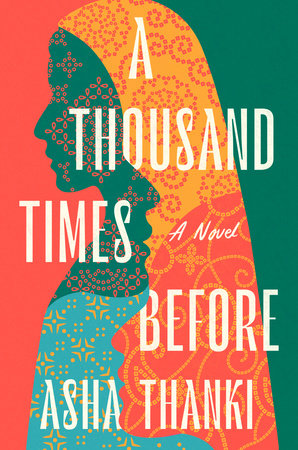
When I was writing my novel, A Thousand Times Before, I knew I was writing against histories that had been framed and reframed by people in power who could benefit from a specific style of storytelling. I wanted to write about the partition of India and Pakistan without celebration, without love for any resulting national identity. Similarly, in writing about the Nav Nirman Andolan in 1974, I wanted to balance bringing this important slice of history forward with its ultimate consequence: the devastating and shameful Emergency of 1975 and the resulting power vacuum that led to the Bharatiya Janata Party’s foothold in Gujarat and the country.
In my novel, these moments shape how characters understand and engage their countries, governments, and communities. These moments, major in political history, are prioritized in the way that they are foundationally personal for the characters. What you can afford to eat—the commodities that are available—are personal just as much as they are the result of political economics. When and how you are displaced, the violence that results from this, and the loves you lose in the process—these too are personal and still political.
Each of these books demonstrates the consequences of the world we live in, the ways that our political histories are inseparable from how we walk through the world. That the political and the personal are always, always, intertwined.
Reading this book is like moving through concentric circles, out from the middle. At its center is the Gwangju Uprising. The novel opens with the student Dong-ho’s experiences prior to the May uprising, as he volunteers at a school to help individuals identify civilians killed by soldiers. As he builds friendships with other volunteers and ponders what happens to a soul when it has left the body, the inevitable moves closer: his own death at the hands of soldiers.
For the rest of the novel, the reader moves to new narrators, some known from prior chapters, some not, as the years become further and further from the 1980 uprising. These refractions of experience demonstrate the consequences of one moment throughout the lives of Dong-ho’s loved ones, of his friends, of witnesses and journalists. The novel asks how one event might permeate through our lives—how we are all affected.
From the prologue of Brotherless Night and then all the way through, this novel puts forth an experience of conflict and history with the type of voice that makes you feel like the narrator is looking directly at you as she speaks. For Sashi, nearly 18 years old at the novel’s beginning, her four brothers and the neighbor boy, her parents and her grandmother—all fill her world with so much care, love, and joy. Their lane in Jaffna is a place of safety for so much of Sashi’s life, until the growing violence against Tamil people leads to the murder of her oldest brother, spurring both Sashi’s loved ones—and Sashi—to action.
Ganeshananthan writes in a way I can only dream of doing. Sashi’s voice engages the reader directly—indicts them. From the beginning, the novel asks, Who created the labels we use, and what happens when those labels serve to distance the observer so that empathy, humanity, and understanding are erased? And if it were you, what would you do, in order to protect the people you call home?
When Pirbhai takes a boat from Gujarat to Mombasa at the end of the nineteenth century, serving in indentured servitude to the British as they lay down railroads, A History of Burning begins its nearly century-long family history. Pirbhai’s story in this new place begins with a stain—a burning—and it will not be the only burning witnessed on the family’s path to stability. And soon, under Idi Amin’s rule, when Asians are ousted from Uganda, this family splinters.
How do you become part of a place? What does that mean you carry with you? From Mombasa to Uganda, to London and Canada, Oza writes the story of a family whose paths fork. A History of Burning is about the ways we remember, the ways we love, and how we hold ourselves together.
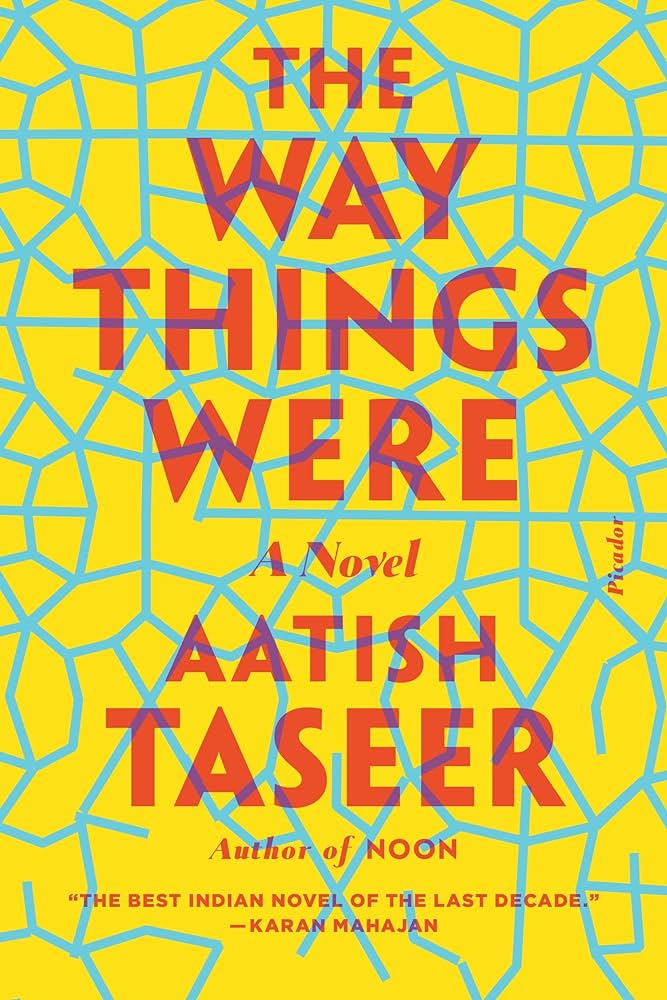
The Way Things Were by Aatish Taseer
A hefty novel with a love for linguistic digression—the protagonist and his father are both scholars of Sanskrit—the novel opens with Skanda traveling to be with his ill father, and then later transporting his father’s ashes to India. Meanwhile, the circumstances of Skanda’s parents’ lives are revealed, as well as the changing relationships to a ton-like social structure, against the historical backdrops of the 1975 Emergency, the 1984 pogroms of Sikhs, and the 1992 demolition of Babri Masjid.
Through their romanticization and academic study of Sanskrit, both father and son are united across time in wondering how their beloved language became co-opted by Hindu nationalism. But what happens when one chooses to study rather than make any change in their society? The novel is as much a study of a particular family’s passivity as it is begging its readers to do more.
Few intergenerational novels do it like Pachinko. Immediately, the reader is invested in Sunja’s life: from the circumstances of her parents’ marriage, her adolescence and later exploitation by the wealthy Hansu, and the marriage to minister Isak which whisks her away to Osaka. Lee lingers in early descriptions of Sunja’s fishing village, and these early moments throw her experiences during the Japanese occupation of Korea into stark contrast.
Pachinko is in many ways about the power and consequences of a secret, the way it can trickle through children and children’s children, and, all the while, the ways in which a woman might protect herself and her family.
Burnt Shadows spans nearly 70 years in the lives of Hiroko and Ilse’s respective families. Its driving premise—how did we get here?—reflects the feelings of displacement, of confusion and consequence, and a yearning for stability against the backdrop of imperialism. Hiroko and Ilse’s sons, Raza and Harry, carry forward some of the same questions that their mothers grappled with: Is it possible to escape our pasts? And how are our stories intertwined with narratives of power?
In many ways, the sheer proximity of this novel’s history is damning on its own. The family story feels inseparable from its chronology, which begins with the U.S. dropping an atomic bomb in Nagasaki, and moves later to the partitioning of India and Pakistan, the American proxy wars in Afghanistan, and 9/11.
In Exit West, the central family is a couple—Saeed and Nadia—who live in an unnamed city in an unnamed country that is suffering conflict. Violence grows as they maneuver a relationship that prompts them to live together sooner than Nadia had expected, and soon they flee together through the fantastic element of this novel: doors that are like portals to other places around the world. The two, like many displaced people, try to find a safe place to build a stable home.
Though it is governed by this speculative element, Exit West is a world that the reader immediately recognizes. The novel is about labor and class, displacement, and power—and it is also about what it means to love a person, to see them to safety, and to build something new. This book reads like poetry; it’s impossible to put down.
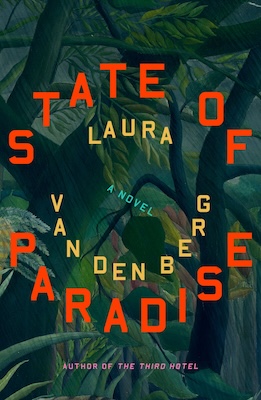
Laura van den Berg’s latest novel, her fifth, State of Paradise, is set in a time and place both familiar and wildly unsettling: Florida during a period of pandemic and social unease. The unnamed narrator, a ghost-writer, weathers the pandemic at her mother’s house with her husband, a historian and avid runner. Her sister lives next door and spends hours each day plugged into a MIND’S EYE, a virtual reality device that seems to sometimes actually whisk its users into another world, and which may account for the rash of missing persons in the town. Other weird occurrences happen—at one point, a downpour begins that doesn’t let up for days, flooding the town. And the narrator discovers that, after recuperating from the pandemic virus, her belly button has expanded to become a secret space within her body, big enough to hide a tube of chapstick.
Anyone who has read van den Berg’s previous books—like her acclaimed short story collection I Hold a Wolf by the Ears, or her novel The Third Hotel, a finalist for the New York Public Library’s Young Lions Fiction Award—would be forgiven for thinking this kind of dreamlike, uncanny story sounds like peak van den Berg, eerie in the best of ways. But there’s a big difference with State of Paradise, in the profound and powerful passages in which the narrator remembers her teenage years at a place called The Institute, where she spent time in treatment for alcoholism and depression. This attention to mental health and memory feels new. And for fans who know something about van den Berg—that she’s from Florida, that she and her husband, writer Paul Yoon, hunkered down with van den Berg’s family during the pandemic—they may recognize the strong undertow of the personal in this story. They wouldn’t be wrong: State of Paradise has been described as “speculative autofiction,” an intriguing and apt oxymoron.
Over email, I spoke with van den Berg about this term, and writing through the COVID-19 pandemic, as well as the time she spent in an institution as a teenager, and how that shaped her understanding of time and narrative.
Brian Gresko: The last time we spoke about your work over email like this was between February and April of 2020. A tense and scary time. At the end of that interview, when I asked about how the pandemic was affecting your creative life, you replied, “I’ve been trying to just remain alert to the bewildering present tense, which is evolving in frightening ways day to day.”
I was struck by the similarity between that and this line from State of Paradise: “I start writing down one detail a day… Privately I begin to think of this project as my Florida Diary.”
Can you tell me how this book grew out of your pandemic experiences? This is one of the first novels I’ve read that feels like it fully grapples with that time, not just the illness, but the overall sense of societal and personal unease, the shaky feeling everything might collapse.
Laura van den Berg: This is amazing synchronicity, Brian—it would have been right around then that I started writing down daily meditations in an attempt to “remain alert.” My husband, Paul, and I landed in Florida, where I’m from, during the pandemic. We were sharing space with my mom for much of that time and lived just down the street from my younger sister. I hadn’t lived in Florida since my early twenties. Now I was back, with no exit plan in sight. A lot of memory was activated. The kinds of conversations with my family that would never bubble up over short holiday visits were happening. There’s a line in State of Paradise where the narrator says, “I have, to my absolute horror, all my former selves for company.” That was exactly how I felt! I’d started the year intending to work on a different novel, but found myself unable to focus on that project. So I started writing these daily meditations on personal history, family, landscape, memory. It felt important to have a record of this period of time, but I never thought that it would become a book; it was just supposed to be for me.
BG: That’s surprising to hear, because while much of the book is grounded in the narrator’s close observations, the narrative involves such fantastical, mythical elements, from the MIND’S EYE virtual reality device that whisks Floridians into a digital meditative state (and perhaps literally portals them away), to an unexplained weather event of Biblical proportion that floods the town. How did those speculative elements come into play?
LvdB: “Other worlds” became a kind of governing philosophy. Certainly the pandemic dropped us all into a different world, where once mundane things like going to the grocery store suddenly seemed perilous. And since Florida didn’t employ the same restrictions as other states, I’d talk to friends in New York City or Los Angeles and our realities felt very “split screen.”
Meanwhile, something that started coming up when I was writing those daily meditations was the many months I spent in an in-patient treatment center as a teenanger (State of Paradise is a novel but the narrator’s experience at The Institute closely resembles my own history). Looking back, I think being yanked out of the familiar world at such a malleable age totally reshaped my sense of reality. Reality became a continuum, as opposed to a fixed point; we move up and down that continuum throughout our lives, sometimes in ways that feel shocking. As a young person, I was so disconnected from the familiar world that I might as well have been in outer space. And even when I did eventually find my way back the familiar world didn’t look and feel the same as it did before. I had a hard time trusting it, believing that it was real.
This personal history was not something I’ve written about directly before, but in Florida doing so started to feel unavoidable. I think the whole process really clarified why I’m drawn to the speculative in the first place. In State of Paradise I could literally manifest “other worlds” through MIND’S EYE and also write about “other worlds” from a place of deep personal experience.
BG: It’s while at The Institute that the narrator decides to be a writer. In fact, she describes playing a game with an orderly in which she gives him a word each day that he must use in a sentence as the way she came to understand the flexibility of language. “Fuck the rules, language said to me, and find the truth.”
Can you help me understand this in terms of your origin story as a writer? You’ve described how you enrolled in a fiction workshop when you were almost flunking out of college, hoping for an easy A, and that’s where you fell in love with short stories. Was this before or after your time at the in-person treatment center?
LvdB: College came several years after. After I was discharged from the in-patient treatment center, I got my GED—I’d left high school—and later enrolled in college. I had no notion that I wanted to be a writer until I did.
After I was discharged, there was a period of time where I’d bump into a classmate from high school and they were kind of like what happened? I would either downplay things or polish a detail or two into an outlandish anecdote. Certainly this was one way of dealing with the shame and the awkwardness; the performance became a kind of armor. But I can also see that younger version of myself grasping for a way to narrate her own experiences. The facts, somehow, did not seem to adequately capture the emotional reality.
Also, this period of my life really broke my sense of time in a way that has never been fully restored. There is a three year period, from 15-17, where there are significant gaps in what I remember; part of it was feeling so eaten alive by my own interiority that my sense of the outside world was constricted. I have a lot of vivid memories from that time, many of which are in State of Paradise, but it’s hard for me to put them in sequence and there’s a lot I don’t remember well or at all. And now time in fiction is something that is of endless interest. I love to talk about it, think about it, write about it. It wasn’t until I was working on this novel that I made the connection between working with fictional temporalities and an unarticulated desire to restore my own understanding of time—which is probably beyond the capacities of fiction, but I actually think fiction has given me something even more powerful. Which is to expand my understanding of what and how time is, so instead of seeing my own timeline as a straight line marred by holes that needed to be filled I could imagine a more capacious temporal landscape that allows for these kinds of gaps.
BG: Could what you said about facts vs. emotional reality be applied to understanding the two versions of the story that the narrator tells about her relationship with the orderly and how it came to an end? That was such a bold and fascinating decision, one that defied linear logic and yet felt right. Can you unpack that for me?
LvdB: There’s a line where the narrator talks about how she’s been telling different versions of this story for years, searching for the one that could “match what it felt like to live it.” I think that’s the quest of the fiction writer, which is also of concern to the narrator, who longs to be a “real writer” (as opposed to a ghost writer) herself–and sometimes that means departing wildly from those facts. I wanted the novel’s structure to actually embody that quest, as opposed to just discussing it.
BG: What are some of your favorite novels that play with time? And what novels in particular inspired or influenced State of Paradise? (I noticed the word annihilation in the text a couple of times and thought immediately of Jeff VanderMeer’s Southern Reach trilogy, also set in Florida.)
My younger version of myself grasping for a way to narrate her own experiences.
LvdB: I’m a huge Jeff VanderMeer fan and I love Annihilation in particular. In the short form, Cortázar and Borges are two of my favorite time-bending writers. And I’m obsessed with Marie NDiaye—Ladivine is my favorite with hers, and I also loved Vengance Is Mine, the latest to be translated into English (by Jordan Stump). NDiaye distorts and twists time in surprising and deeply unsettling ways; the familiar world is always just a mask.
BG: One image that recurs in the book is that of a hole. Literal sinkholes, and figuratively there are holes in the narrator’s knowledge of her family history, and holes around which the family speaks, and then, most fascinating to me, the hole that her belly button becomes after she is sick with the pandemic virus. Even the portal of the MIND’S EYE device is a kind of hole! I’d love to know how you settled on that theme.
LvdB: Early on, in those daily meditations, certain words kept coming up—including holes, sinkholes, etc. I actually hung these little scraps of prose on a wall and highlighted words that recurred and then built off of those repetitions. How many things can I say about a sinkhole? What surfaces in the imagination and in memory if I think about this word for long enough? That was the process I followed for writing the first 50 or so pages. Later on, I was able to give more concentrated thought to the thematic implications and undercurrents of certain words. I was really interested in the idea of “word as portal.” How can one word, looked at from a variety of different angles, transport us to another place?
BG: Interesting, because especially early on there is a weaving quality to the narrative, as certain images repeat and recur, like holes, cats, runners, and knives. The narrative feels driven by images, like a poem, or a dream, and that made me think of the comparison between your work and David Lynch’s that I’ve sometimes seen, because there are moments in movies like Mulhalland Drive or Twin Peaks: Fire Walk With Me that feel uncanny in the same way. Do you like that comparison to Lynch, or think it a helpful one in getting across to readers the vibe of your narratives? Are there other filmmakers you feel have influenced your narrative decisions in State of Paradise or in general?
LvdB: I think David Lynch’s worlds, like Mulhalland Drive, descend into outright nightmare in a way that feels different from trajectory of State of Paradise, but the aesthetic of being in a world where something is deeply off—that’s where I see the connection. Like you are in a place that appears familiar but feels deeply uncomfortable. In different ways, I think Karyn Kusama and Jane Campion are gifted at placing viewers in a familiar-feeling place and then eroding that familiarity.
As you know from our past conversation, I spent a lot of time watching horror films when I was working on The Third Hotel and a lot of horror is very image driven, with momentum coming from the repetition of certain images and how those repetitions mutate. When I think of The Shining, for example, it’s the images that come to mind first: the twins, the blood gushing from the elevator. I’m always interested in the visual languages that films locate, and though State of Paradise doesn’t belong to that genre maybe some of the imagistic language was still with me—the tides of images that roll in and out, and reshape the landscape in the process.
BG: I saw the term “speculative autofiction” used both in the publisher’s marketplace synopsis and the book’s Kirkus review. Was that a term used to describe the book after it was complete, or was that a helpful concept for you when writing it?
‘Speculative memoir’ can use clearly made-up elements to hold all kinds of difficult human things.
LvdB: It was a helpful concept in the writing. Early on I became really interested in the genre of “speculative memoir,” and how that form can use clearly made-up elements to hold all kinds of difficult human things. Sofia Samatar has said in an interview: “it’s precisely the tropes of fantasy and science fiction that are capable of expressing trauma, it’s the impossible that conveys emotional reality, it’s the rush of imagined material that’s the actual ‘me’ of me.” Samatar’s ideas were an essential lighthouse when I was working on the book—how and why I needed the “impossible” to write into things that had actually happened. I joked for a while that State of Paradise was my “science fiction memoir,” but at the same time I am a fiction writer, that is the grammar that is most available to me, so “speculative autofiction” is more accurate.
BG: State of Paradise seems to suggest that we’re all experiencing a different truth, a unique reality, though the unifying factor is that we are all traumatized by it. Emotionally, what was it like to work on State of Paradise? Was it different from or similar to your experience with your previous novels?
LvdB: It was definitely different. My other novels have taken a lot longer to write. This one came out quickly by comparison.There was definitely an emotional rawness but also a lot of joy. I think the book is pretty funny and so a lot of play was happening in the writing. This might sound strange, but I turned in the final version the year I turned 40 and I had this feeling of—I’ve finally put down what I’ve always needed to put down and now I can really move on. I have never in my life thought of writing fiction as therapeutic but in this case there was a discernible feeling of resolution and maybe even catharsis which was a new experience for me.
An excerpt from Goodnight Tokyo by Atsuhiro Yoshida
The clock struck 1:00 A.M.
It must have been wound a little faster than the others, as the timepiece that Mitsuki was carrying sounded ahead of the countless others kept in the warehouse.
A few moments later, a deluge of tones, some low and heavy, some dry and clear, competed to announce the coming of the hour.
The warehouse, easily large enough to hold two small airplanes, was filled with near endless rows of shelves and drawers, its walls lined with clocks and paintings and calendars and tapestries and the like until there was little room for anything else.
Those shelves and drawers were filled with all sorts of knick-knacks, items of every size and shape imaginable that told the story of everyday lives in Japan for the past three hundred years.
You could find practically anything in here.
For example, if one of the directors told her that he wanted a travel trunk from the Taisho era, all she had to do was find it within the limits of this building and promptly deliver it to the set prior to shooting.
Mitsuki was what was known as a procurer, and she had been working at this large film company on the outskirts of Tokyo for almost five years.
The wall clock that she was presently carrying was for a 9:00 A.M. shoot. There were several other items that she had to prepare as well, most of which could be found inside the warehouse. The timepiece that she had unearthed was a perfect fit for the director’s requirement for something classical and with gravitas. Carrying it carefully with both hands, she traced her steps back to the assistant director in the waiting room. While everyone called it a waiting room, it was simply a small area to store props that the film crew intended to use in an upcoming shoot, not a place for actors to wait before entering the set.
Mitsuki would have preferred to work on large-scale stage sets. She had always longed for a job where she could make life-size sets that looked exactly like the real thing, to actually create an entire corner of a fictional town. But the very moment she set foot into the prop warehouse on her first day of training, she had fallen instantly in love.
The warehouse was a gigantic box crammed with every kind of object one might think of, and Mitsuki had been fascinated by small miscellaneous things ever since she was a young girl.
She remembered being particularly obsessed with old medicine chests, their lids opening to reveal bags and bottles printed with all sorts of colorful symbols and small lettering. Bandages, antiseptics, eye drops, plasters, ointments—to a child’s eye, each one had looked unique and special.
That same fascination blossomed in her heart all over again upon discovering the warehouse, to the point that she felt like letting out an excited squeal. The past itself was preserved amid the miscellany of objects here. For Mitsuki, the prop warehouse was nothing short of a time capsule encompassing a full three hundred years, and each time she stepped inside, she was overcome with an elation as if setting out on a new little adventure. Then came the added fun of seeking out the best items to meet the directors’ requests—tasks that she relished as though engrossed in a child’s game.
The only problem was that Mitsuki herself wasn’t compatible with time. Or, strictly speaking, she always found herself out of step with clocks, like the one that she was currently holding in her arms.
Clocks were her natural enemy, and the reason for that was simple enough. Her internal body clock and the laidback personality that it had imparted her with were constantly at odds with the endlessly harrying—as she saw it—clocks of the modern world. And so she often found herself bristling at the deadlines that the directors gave her.
With a dull tone, one more clock, somewhere deep in the warehouse, struck 1:00 A.M.
It was probably the slowest one in the whole collection. That one’s me, isn’t it? The slowest clock of them all.
With a deep breath, she tightened her grip on the antique timepiece cradled in her arms.
“See you tomorrow,” Mitsuki said after handing the wall clock to the assistant director, Mizushima.
She was about to call it a day when Mizushima held her back. “Actually, there’s one more thing.”
“This is everything on the list you gave me, though?”
“There’s a new addition. And we’ll need ’em by nine o’clock. A bunch of fresh loquats.”
“Loquats?”
“Yeah, loquats. The fruit. Not kumquats. Loquats.”
“I know what you meant . . . ”
So she said, but in truth, Mitsuki had never purchased a loquat before. At the very least, she had never had to procure one for work, and she didn’t recall ever having bought one personally from a greengrocer or a supermarket.
She had eaten one once, she remembered that, but the specifics—where exactly she had eaten it, what it tasted like—eluded her.
That was one of the consequences of working at a job like hers—always having to look back on her life so far, to reflect on the experiences its journey had given her and those it hadn’t.
Pressure cookers, for example. Silk hats. Unicycles.
More often than not, she was completely ignorant about the items that one director or another expected her to provide. She had lived a full twenty-seven years, and still she understood nothing whatsoever about them.
It was the same for loquats. She didn’t know whether they were even available in early summer.
“I did look into it a bit myself,” Mizushima said, as if reading her thoughts. “This is just based on what I read online, but they’re still in season, just barely. There has to be somewhere that still has them this time of year.”
“Oh, I see.” The next moment, Mitsuki’s voice picked up. “But in Tokyo?”
Mizushima flashed her a forced grin. When he smiled like that, it inevitably meant that the road ahead was going to be a bumpy one. In short, his expression just now anticipated difficulties in sourcing loquats.
“Besides, think about the time,” Mitsuki added, her shoulders slumping.
“Right, yeah. There won’t be a whole lot of greengrocers open at this hour. I’d suggest having a look in the all-night supermarkets, but there seems to be fewer and fewer of them around these days.”
Mitsuki responded with a silent nod. When society and the economy were booming, all-night shops popped up all over the place. And just as Mizushima had said, their numbers had fallen dramatically in recent years.
“Yep,” the assistant director whispered, as though his words were meant not for Mitsuki, but for himself. “Nights in Tokyo are starting to feel awful lonely lately.”
Matsui sipped at his can of coffee while waiting for his shift to start in the office’s half-lit break room.
The cab company where he worked was called Blackbird, specializing in serving customers from evening through to early morning. The cars were dark blue in tint, almost black, and the drivers wore similarly colored uniforms. Being a small company, Blackbird only had a limited fleet of vehicles, with most of its business coming from advance bookings. Recently, however, the number of such customers had been on a steady decline, forcing the fleet to turn to picking up customers on the street. And so tonight, Matsui found himself stuffing the blank reservation list into his pocket when he let out a sudden sneeze.
Maybe someone was badmouthing him around town? But even if so, it wasn’t like there was anything he could do about it. Yes, if someone was criticizing him behind his back this late at night, it could only be a customer. He couldn’t think of anyone else who would bother to go to all that effort. He had hit his fifties while still a bachelor, he had been born and raised in Tokyo, which meant that he had no other hometown he might return to, and being an only child whose parents had died young, he had spent a lifetime away from anything even resembling family.
He was, he remarked to himself, a boring man.
When asked by a colleague why he had become a taxi driver, he could answer only that he had just sort of wound up in the role.
But there was at least one small twist of fate that had guided him down this path.
As a child, he had stumbled upon a picture book titled The Car is the Color of the Sky at the local library. The main character was a taxi driver called Mr. Matsui, who sometimes picked up strange passengers like bears and foxes. He remembered positively devouring the book, all the while imagining how fun it would be to have such a job.
Whenever he closed the cover after reading the book, he would stare at the picture of Mr. Matsui in his light blue cab.
This, he thought to himself, was what he would one day become.
He remembered positively devouring the book, all the while imagining how fun it would be to have such a job.
And so he did. Over the past thirty years, he had moved from one company to the next, each time changing the color of his vehicle.
But he still hadn’t come across a sky-blue taxi.
After leaving the break room, he made his way to the garage and his parked car—not a bright blue, but a deep one, almost black. The garage was roofless, exposed to the wind, and when he looked up, he could take in the sky and a yellow banana-shaped moon. The stars were barely visible. The usual dreary Tokyo night scene.
Hmm? At that moment, his gaze passing between his vehicle and the night sky, he suddenly realized something.
“So they are the same color, huh?” he mumbled.
Then, all of a sudden, his cellphone began to ring.
He quickly pulled the device from his pocket and glanced down at the screen.
Beneath the cold anonymity of the eleven-digit number was a name—Mitsuki Sawatari.
Looks like Matsui is my only choice, Mitsuki thought with a sigh.
She felt bad having to call on him again like this. How many times now had she turned to him for help, unable to find what she needed for herself?
She hastened to lower the phone and end the call, when her eyes fell on faint glimmer reflecting from her left ring finger.
“Oh . . . ” sounded her voice weakly.
The ring had been a gift from Koichi.
Just three days ago, she had finally been able to meet her boyfriend Koichi on her first day off in longer than she could remember.
“I’m sorry,” she had said. “I didn’t have any free time this week.” “I’ve been so busy.” “Sorry again.” “Next week, I promise.”
For the past month, every time he called asking to meet, she had ended up turning him down. It was true that things had been hectic at the studio, but there was another reason for these constant postponements.
Why? Because Koichi had asked for her ring size. Her ring finger, he had specified—though he had never once mentioned the word engagement.
But he was always like that. Mitsuki could hardly stand it.
Though Koichi was three years her junior, she would have liked to say she didn’t feel the age gap—but in fact, the opposite was true. He had a natural little brother personality, and he was constantly demanding her attention or else begging for her help. Once, he had even told her upfront: “I want you to take care of me in life.”
“What’s the problem?” Aiko, a close friend of hers had asked her. “He sounds adorable.”
But perhaps because she had lost her father at a young age, Mitsuki would have sooner had a partner willing to indulge her, not the other way around.
“Then why don’t you break up with him?”
Given what Mitsuki wanted for herself, Aiko’s suggestion was no doubt the right one. Yet Mitsuki was touched by Koichi’s dedication and single-mindedness—even if that devotion wasn’t meant for her.
“One of the crows,” he began all of a sudden during their rendezvous.
He arrived at the restaurant on the top floor of a hotel in Shinjuku ten minutes late. Throughout all their years together, they had never been to a place like this before, making it a rare extravagance for the both of them. With the expansive night view outside the window, it felt like they were dining beyond the limits of the sky.
“One of the crows, it made a bookshelf.”
Mitsuki was unable to make heads or tails of this bizarre statement—but playing the role of a wise older sister, she did her best to coax out what he wanted to say.
“A bookshelf?” she repeated.
“The old crow was collecting books, you see.”
“Oh? Where?”
“On its bookshelf. It brought a piece of plywood or something to the top of an oak tree and built a shelf there. I was observing it the whole time. It started arranging all these books and magazines that it must have taken from people’s garbage. Seriously, it was one smart little guy.”
Koichi was a subcontractor brought into the Crow Control Initiative set up by the Tokyo Metropolitan Government Environment Bureau. Or rather, that was his self-proclaimed role. His real job was delivering newspapers. Making his rounds during the early hours of the morning, he had developed a pronounced curiosity with crows, and before long, he took to observing their ecology. While he had no qualifications to his name, the experience and knowledge gleaned from his many years of observation had been well-received by professional scholars, with some even turning to him for his insights and opinions.
There was a park with a large grove near his apartment, a place that served as a roosting area for crows. A train line ran next to the park, and one day, the editor of a free newsletter distributed at the station reached out wanting to interview Koichi. Thanks to that article, Koichi earned a reputation as the city’s resident Crow Professor. Mitsuki had been a student back then, working part time as the editor’s assistant, and as such, she had accompanied him during the interview, later pulling an all-nighter to write the clumsy article detailing the Crow Professor’s many observations.
That was how she first met Koichi. And so the two of them had been dating for a good many years.
However, as far as she was concerned, their relationship had barely changed since their student days. Koichi may have gone to the trouble of dressing up in a fancy suit and booking a table at a restaurant in a luxury hotel, but he had completely forgotten the purpose of the dinner, going on and on and on about a crow building a bookshelf. It was no different to that rambling, incoherent interview.
“Hey, you know . . . ” Mitsuki interrupted, stopping him once the meal was over and the waiter brought out dessert. “Didn’t you have something you wanted to say to me?
There had been no real forewarning as such, but after being asked her ring size and with Koichi inviting her to an expensive restaurant, there could only be one possible explanation.
“Ah, right.” He rummaged through the inner pocket of his jacket, presenting her with a red box tied with a white ribbon. “I almost forgot.”
That was all.
Mitsuki knew perfectly well what it was, but having lost all patience with him, she asked bluntly: “What is it?”
She proceeded to tear off the ribbon, opening the lid as if it was no more than a box of caramels. “What’s this?” she asked again, yanking the ring out and jamming it on her left ring finger. Then, as if only joking, she tried to pull it off.
The ring, however, wouldn’t budge.
Huh? Tilting her head in an effort to keep Koichi from noticing, she applied even more force—but no, it was firmly stuck. She had meant to remove it right away, and even had her next words already planned out. “I can’t accept this unless you explain to me exactly what it is.”
But if it wouldn’t come off, she could hardly say anything like that.
Try as she might to remove it, the ring was fixed in place, clinging to her finger like a thing alive.
Mitsuki was standing next to a supermarket’s neon sign, lips curled in a pout, when Matsui arrived to pick her up. The taxi’s Reserved sign stood out brightly in the murky dark.
“I’m screwed,” she murmured as she stepped into the vehicle.
“What happened?” Matsui asked, watching her in the rear-view mirror.
“This is the sixth all-night supermarket I’ve been to. At least this time I got to talk to someone who actually knows what’s what when it comes to stocking fruit, but when I asked him if he knew anywhere that would still be selling them, he said I’d be hard pressed to find them anywhere in Tokyo . . . ”
“Fruit, you said?”
Matsui was puzzled as to the problem, but this wasn’t the first time that Mitsuki had called him to help in some bizarre collection task. In that sense, she was one of his few reliable repeat customers.
“Here I am turning to you again, Matsui. I’m sorry. I wanted to find them on my own this time, but I’m not having any luck.”
“And what are you looking for today?”
“Loquats. The fruit. Not kumquats. Loquats . . . Right, speaking of fruits, didn’t you help me run all over Tokyo looking for green apples once, even though they were out of season?”
“Yes, that was a real head-scratcher.” Despite his words, Matsui sounded like someone looking back over a fond memory. “But if even the store clerk thinks there aren’t any to be found, where should I go?” Mitsuki asked.
Matsui started driving. “Well, where do you want to start?”
He glanced at her through the rear-view mirror.
Mitsuki’s eyes were downcast, her eyebrows furrowed as she fidgeted with something on her left hand. “Oh, it just won’t come off,” she murmured with a sigh.
Matsui turned his attention back to the road. “If nowhere in Tokyo has any, maybe we should look outside of Tokyo?”
Leaving the city meant going either north or west. Matsui turned onto one of the main roads and began drawing a mental map as he considered which way to go. The streets were empty tonight. A lone motorcycle overtook them, speeding comfortably past.
“Ah. Can you wait a minute?” Mitsuki took her hand away from the ring, checking the incoming message on her cellphone as she nodded her head. “Uh-huh.”
“What is it?”
“Um, yes . . . ” she paused for a moment to finish reading the message. “Is the main intersection at Sakuradani far from here?”
“No. It will probably take around fifteen minutes to get there.”
“Around fifty meters from the intersection, on the road to Fukagawacho—it says here there’s supposed to be a tree there. According to this, it had loquats on it yesterday.”
“Oh? That’s very precise information.”
Matsui sounded surprised, but he couldn’t have been any more amazed than Mitsuki herself. A few minutes earlier, she had sent Koichi a text message asking if he might know anywhere that she could find loquats. She hadn’t really expected to receive a reply.
You were awake? she hurriedly texted him back.
About to head out on deliveries, came his response.
How did you know about the loquat tree?
Crows like to take the fruits once they’ve ripened.
Ah. Mitsuki was impressed. His knowledge could actually prove useful at times.
Koichi took little interest in anything other than crows. If you were to ask him what interesting experiences life had brought him, no doubt his responses would be about nothing else.
He had lived without worrying about pressure cookers, or silk hats, or unicycles. Mitsuki suspected that he had never so much as tasted a loquat.
But perhaps he was a living example that if you master one specific thing, it can lead you to so many others. Even if he didn’t know the first thing about loquats, crows, it seemed, had nonetheless led him to them.
Koichi took little interest in anything other than crows.
“Uh-huh,” Mitsuki nodded to herself in realization as the vehicle approached Sakuradani.
“We’re almost there.”
Startled by Matsui’s voice, she pressed her face up against the window to check the roadside trees one by one.
Only then did she realize that she had no idea what a loquat tree even looked like. And it was the middle of the night. The streetlamps provided some illumination, so maybe she could try identifying the fruits from their color? But it would probably be better to step outside and investigate on foot.
“I’ll wait here, then,” Matsui said, pulling over on the side of the road.
Mitsuki stepped outside and started walking, scrutinizing the trees.
But she couldn’t spot what she needed.
She began to doubt whether her memories of loquats—their size, their color—were truly accurate.
If she wasn’t mistaken, they were meant to be light orange.
The ones sold in stores were definitely that color, but maybe they were a different hue while still on the tree? Perhaps they were greener, the color of young grass, only ripening after they had fallen from the branch?
It was certainly possible. And so she set about peering into the trees once more.
At that moment, a flash of orange entered the corner of her vision.
“That’s it!” she exclaimed—when the fruit was obscured behind a dark mass. Whatever it was, she couldn’t help but feel like the thing had snatched the loquat away.
A crow? Mitsuki braced herself.
It had to be a crow. There was no question about it. Clinging to the branch, an unbelievably huge crow was grabbing the orange fruits one after another.
No, wait a minute.
Just as Mitsuki told herself that there couldn’t possibly be a crow that large, a truck passed by, its headlights illuminating the tree and revealing the identity of the shadowy creature.
It was a person.
Black hair and a black jacket. Not a man, but a woman. “Um,” Mitsuki called out cautiously.
For a brief moment, a chill ran down her spine—but as her eyes adjusted to the darkness, she could clearly make out a tall, slender woman scrambling further up the tree.
“Um, excuse me? What are you doing up there?”
The woman startled for a moment, but maybe this wasn’t the first time that someone had caught her in the act, as she stared down at Mitsuki and answered without hesitation: “I’m a loquat thief.”
“It’s just around the corner. Why don’t you stop by?”
Hidden inside the woman’s black jacket were magnificent loquats, exactly as Mitsuki had imagined. Naturally, she remained on her guard, but she couldn’t turn her back on this chance. So long as she had Matsui with her, she reasoned, she would be fine—and so she accepted the invitation to drop by the apartment of this self-proclaimed loquat thief.
“Please,” the woman said, and with no more warning than that, pulled out three glasses and poured them all a cup of golden loquat wine.
“Last year’s batch,” the loquat thief said in a mellow voice.
Every year, it seemed, she would climb loquat trees in the middle of the night, harvest the fruits, and turn them into liqueur.
“My brother used to do this all the time,” she explained. She looked over at a frame on the corner of the cupboard—a photo of smiling man, much younger than the woman but almost identical in appearance.
The woman looked back to Mitsuki with a faint smile. “But you’re telling me this bunch will make its way onto the big screen?”
Just one bunch would do, Mitsuki had insisted.
“Alright,” the woman answered readily enough. She seemed amused by Mitsuki’s job title of procurer. “They’ll be the stars of the show, right? They’re already stolen goods, so don’t hold back. Take as many as you want. I might have a little less to make into next year’s wine, but I’ll be able to enjoy looking out for them in a big-name film, right?”
The woman had called herself a loquat thief, and she had indeed taken the fruit without anyone’s permission. But putting aside that one small crime once a year, she was a remarkably earnest, even tireless, individual. She wore a white business shirt beneath her black jacket, and while her makeup was modest, her facial features were those of a traditional Japanese beauty—not that she was one to boast of her own good looks. No, she worked through the night day after day, hardly ever making use of her vacation time.
Tonight was a rare day off, allowing her to take on the mantle of the loquat thief, but she would normally spend these late-night hours in an operator’s room, responding to the incessant barrage of phone calls as they came in.
“It’s always some nameless person on the other end of the line. Young and old, men and women, they call in looking for someone to talk to about their problems, everything from silly life advice to serious life-and-death issues.”
Mitsuki accepted this explanation without further question. After all, it was thanks to that friendly, dependable voice that she had let her guard down even though she had never once met this woman before.
“I’m with the Tokyo No. 3 Consultation Room. If you need anything, give me a call,” the woman said, handing Mitsuki her business card. “I might be able to help with your procurement. And of course, I’m always happy to talk about love affairs or family problems or the like.”
Mitsuki closed her eyes as she savored the complex taste of the loquat wine, its wonderful contrast of sweet and sour. Matsui was still on the job, so he merely tasted it with the tip of his tongue and relished its aroma.
“Hey, Matsui?” Mitsuki asked as she leaned deep into the back seat of the taxi, cradling a handful of loquats on her lap. “I think I’m going to nod off here.”
The loquat wine was having an effect, a sugary drowsiness taking hold of her body.
“I understand. Please, go ahead. I’ll take you back to your apartment.”
“No, don’t do that. If I go to bed, I’ll never be able to wake up. Just keep driving around until dawn, please.”
“Very well,” Matsui answered, watching her through the rear-view mirror.
Mitsuki, her eyes already closed, reached out to the ring glimmering on her left hand, gently stroking its surface with her fingertip as she dozed off. Her face was as innocent as an angel’s.
For Tokyo too, it was time for the briefest moments of shut-eye.
With the city asleep, wrapped in the warm embrace of night, only the loquat fruits stood out, softly reflecting the dim moonlight.
There’s this song that I love that I listened to quite a bit in the Fall of 2021. It became a kind of North Star lyric as I was rewriting my novel, Lo Fi, as it encompassed a feeling my narrator was dealing with, fresh off a too-long situationship, trying to forget someone. I wasn’t going through any kind of breakup myself as I wrote, but I needed to channel those same emotions, so I listened over and over.
I’ve found new ways to count the days that you’re not in
And there’ll come a time when you won’t be on my mind every second
Doesn’t that count for something?
To me, this lyric in the aching title track from Madi Diaz’s History of a Feeling captures a sentiment that has given me (and I think many other writers!) endless inspiration.
I have always looked to music and books about romantic heartbreak, those songs and novels that tell you of a complicated relationship that just didn’t, couldn’t—wouldn’t—work out. Or, perhaps one of those ones that never even really got its chance. These books explore the grief of loss, the things we’ll do (often stupidly) for love, and the ways we try to move on and fail. The people or exes that we keep coming back to. If you’ve got someone like this in your life—we probably all do—these are the books you should be reading.
This excellent early-twenties coming-of-age novel set in Dublin zeroes in on a toxic, emotionally abusive relationship. Megan Nolan renders the upside-down power dynamic between the narrator and Ciaran with piercing honesty, allowing the reader to see past the blinders we turn on when we fall in love, the way physical attraction can cloud all our better judgment and the way manipulation and emotional abuse can rot a relationship or person from the inside out. “I was in love with him from the beginning, and there wasn’t a thing he or anybody else could do to change it,” the narrator tells us just a few pages into the novel—and the truth of this becomes very clear. Even at our narrator’s lowest, darkest moments (of which there are many!), I was with her every step of the way, as sucked into the story as one can get in a dark yet addictive relationship. Nolan’s depiction of sex, the body, and love—and the ways we give and take all of these—are what make this book stand out from so many others that have traversed into this territory before.
Maybe it’s Paris, maybe it’s James Baldwin, maybe it’s a perfect novel. What I would consider to be my favorite ‘classic’ novel, this taut, heartbreaking story of a covert gay affair between David and Giovanni in 1950s Paris, is one of excruciating love, regret and grief. As David sits in Southern France and tells us the story, we are clear on the stakes from the beginning. There’s much to be drawn to here: the electric yet accessible prose, the snapshots of Paris of another time (desultory, charming, even in its own depression) and of course: the endless pain of a love that could never really be. A masterfully concise read—Baldwin does in 160 pages what most writers try to do in 600—this book (as many know) is a triumph of tragedy. You didn’t need me to tell you this, of course, but after reading it three times in the last handful of years (one in a muddling French!) I’m still amazed at how universal nearly every sentence of this book is.
I read this book earlier this spring in about 48 hours, immediately drawn in by the classic premise: a young woman gets involved in a tumultuous affair with an older, married man (who just so happens to be one of her coworkers.) The affair between Hera and Arthur is mildly predictable in its trajectory—how could it not be?— but what holds the reader close is Gray’s smart, hilarious and wholly commanding voice. While these types of relationship stories typically have the same arc, as there is mostly only one way for them to end, Gray’s storytelling is anything but. I do not say this lightly: this book is laugh out loud funny, and I almost never laugh out loud while reading. The humor and self-awareness will make you root for Hera, even as she makes objectively terrible decisions over and over again—and then makes some more. The sex is good, the consequences are bad, the ending you already know. You should read every word of it anyway.
Bryan Washington’s latest novel is for me, in many ways, a story of how we get through our lowest points of grief and try to make our way to the other side of it, if there is one. Cam has moved from California back home to Houston after his partner of several years, Kai, has died. He muddles through his overwhelming grief with endless sex (and there is a lot of it), self-destructive behaviors, and begins working at his old friend—TJ’s—family bakery. Once he and TJ reconnect, the antagonistic chemistry between them crackles at their first exchange. They hate each other; they love each other. They have learned to live without each other but maybe they don’t have to. Washington writes food beautifully, sex painfully, and makes you ache on every page.
Much has been written about his recent smash success that will be better and wiser than what I could say here, and even though this book is mostly comedic, it is the hardest I have cried reading a novel since A Little Life. Thanks, Dolly. A funny, extremely relatable story of a mid-thirties break-up—told almost entirely from the guy’s perspective, Dolly gets everything right about the feelings, thoughts, and actions people experience immediately post-split. I’m talking: drinking alone midday, stalking your ex online, splitting up your shit, closing the joint checking account, drinking alone in the evening—etc.. But what ultimately moved me to tears here was Alderton’s spot-on insight into being in your mid-thirties and finding yourself in a Very Different Place than many of your peers. Everyone knows Dolly Alderton is funny, that she knows relationships better than most, but it’s the heart at the core of this novel that set it apart for me.
This was one of my favorite releases of last year, by the Australian writer Amy Taylor. A breakup tale for the digital age, the narrator, Ana, begins dating a new guy she meets online after a breakup, and she quickly becomes obsessed with his ex, whom she finds out has died the year prior. It is terrifying and compelling to go down the digital rabbit hole with Ana (we’ve all done it, right? Stalking a new lover’s old flame?) but Taylor renders it all with such an undercurrent of unease as we wonder when the narrator’s obsession will come to light, what consequences it will have. It reminded me of the delicate tension of a Ripley novel, the way Ana stalks in plain sight as we hold our breaths, wondering what she will find. I like that this book turns a breakup narrative on its head: Ana doesn’t stalk her ex—in fact, he’s never even named—instead she’s haunted by another woman, one who isn’t even alive. But the frantic obsession still occupies her every thought, making it nearly impossible to actually enjoy her new relationship. In the end, which obsession is worse?
Try not to think of Timothée Chalamet, peaches, and certainly not Armie Hammer. But instead: think of sitting in the sunshine, think of the first time you fell in love, when you were far too young to know what was going on, when all you understood was the all-encompassing sensation of dopamine and hormones, the insatiable arousal. Now, imagine you live in the Italian countryside, with endless afternoons and stretches of blue sky. It’s a perfect summer, too much time to kill. Aciman’s first person novel is so gorgeous that you should read it basking in the sun yourself if you can. The falling in love is hardly straightforward: a queer sexual awakening complicated by an age and power dynamic, among other things. But Aciman’s prose and the near tangibility of the emotions on the page make me want to reach for this book again and again. Even if you’ve seen the movie, you’ll love reading this book, being reminded of how it feels to fall in love for the first time, and how to cope with the illicit fragility of a relationship like this.
I read Ponyboy this Spring at the recommendation of a friend, and it is unlike almost anything I’ve ever read. A story of youth, addiction, love, transitioning, queerness—to me this book is the story of all of those people you can’t quite forget. Yes, that one person you loved once, but also everyone that floated in and out around. The people that destroyed you and the people that put you back together, the ones you thought would never disappear but did, and the ones you thought might disappear but didn’t. Ponyboy’s tale is harrowing and heartbreaking—and very difficult to read at times—but the prose is miraculous and the ending is hopeful. It’s poetry, really, and I underlined more than I had in ages.
Kwon’s latest is an exacting, potent book of desire. The narrator, Jin, is a photographer who we immediately see struggling to produce the photos she’s promised for an upcoming exhibit; she’s been throwing out anything she shoots for ages. Married to a man, she becomes quickly enchanted, drawn to—fascinated by—a ballerina named Lidija. The relationship is charged from the beginning (to say the least) as Jin gets swept into Lidija’s life as we watch their desire unspool. Kwon’s prose is so precise, every single word chosen with delicate attention (she took nine years to write the book, and much of it reads like exquisite poetry) but she also writes passion, obsession—yearning—so well that no matter what happens, you are still thinking about this ballerina, this relationship just like our narrator.
This Patricia Highsmith classic—an illicit lesbian affair set in the 1950s in New York. Here, we follow Therese, who is dating a man she’s obviously barely interested in while working at a department store. The beautiful, mysterious, sexy Carol comes in one day, and from there it is obvious where we’re headed. As the two women grow closer together—and decide what dangers they will wade into for their desire—the story begins to feel more like that of two fugitives on the run across America as tension rises. Accessible and page-turning, this is one of Highsmith’s finest.
Long before the question of “man versus bear” began to tear up TikTok, people have contemplated what it’s like to be with a beast. The earliest art we know of, cave paintings and rock carvings, shows humans interacting with wild animals. Over the tens of thousands of years since making those early marks, people have domesticated wolves, learned how to keep livestock, and forged bonds with countless beings furred, feathered, and scaled. Oh, yeah, and started asking the tough questions on TikTok, too. It’s been a great run.
Considering this long legacy, it comes as no surprise that some of our most exciting, absorbing, and resonant stories are about the human-creature relationship. Through stories, we both tell each other what’s real and imagine what might be possible. And when we put a woman at our story’s center—as is the case in my new novel, Bear—we can explore a particularly compelling point of view on each.
In the books below, the women who meet wild creatures, both animal and mythical, are often trapped in their own lives. Domestic drudgery rules. They’re homemakers, caretakers, wives and mothers and daughters and sisters who are struggling against the limitations imposed on them. When they meet a beast, though, they are able to get to a previously inaccessible wildness. They break away from human rules, a strictly human world, and into something other—something extraordinary, something free. The beast outside provokes the transformation within. This is a reading list made to communicate how we might experience the same ourselves.
If you’ve only seen the Disney movie, you haven’t yet heard the whole of Beauty and the Beast. In this collection, fairy-tale scholar Maria Tatar gathers humanity’s many stories about those who wed animals. She writes of those animal spouses: “They stand in for everything we disavow in ourselves—ferocity, bestiality, and untamed urges. Because our relationship to them is saturated with mysterious desires and projected fantasies, our stories about them enable us to probe what remains uncivilized, unruly, and undomesticated in us.” Saturated with mysterious desires? Sounds like the ideal subject to me.
This modern classic collects Carter’s retold fairy tales, each one more unsettling than the last. Her portrayals of womanhood are provocative, challenging, and she writes men and monsters in such a way that the two blend together. In stories including “The Courtship of Mr. Lyon,” “The Tiger’s Bride,” and “The Company of Wolves,” Carter looks without flinching—has Angela Carter ever flinched?—at the terrors and thrills of an imagined relationship with a beast. It’s an unforgettable read.
Let’s leave the fairy-tale world behind for a moment to look at this decidedly 20th-century novella, full of cake mix and radio commercials, about a housewife who falls for an amphibian humanoid named Larry. I know, I know, you’ve heard that same plot a million times before, but this one, you really should pick up. No, seriously, this novel is surprising, moving, and deeply original. (If its subject rings any bells, please know that it was published a quarter century before The Shape of Water won the Oscar for Best Picture.) And it’s gorgeously written, so specific, so full. Indulge me in a name drop: I first read this after New York Times bestselling author Jessamine Chan recommended it as a “perfect book.” She was right.
Craving more woman-meets-sea-creature fiction? Look no further! The Pisces, about a grad student’s affair with a merman, is a sex-obsessed, thrilling, and profoundly weird read. It beautifully captures a particular kind of nihilism, where nothing is going your way and you’ve already decided that nothing ever will. Does that sound fun? Because it is. It’s fun, and funny, and shocking, and fantastic.
Sticking with the sea but scaling back the sex, this tender, gorgeous debut novel is about a grieving young woman’s bond with a giant Pacific octopus. The octopus, Dolores, is the main character’s last link to her lost father—but their connection is threatened when Dolores is threatened with a sale to a private aquarium. In interviews, Chung has said, “This is a story about love, loss, and cephalopods; things that everyone can relate to.” How true! So wrap your tentacles around this one and enjoy.
This poetic and wonderfully odd story is about a woman who gives birth to an owl. Everyone around the main character, Tiny, is shocked, even repulsed, but Tiny adores her dear, bizarre little bird. And thanks to the strength of the writing, we readers completely understand why. Oshetsky’s artistic vision here is unparalleled. I could not get enough.
The birds keep coming. This debut novel begins when its main character wakes from a dream about crows—only to find a severed crow’s head in her hands. The animals keep following her, in her dream life and her waking one, as she reckons with what happened on the long-ago night her sister died. Pulling from horror and the supernatural, Bad Cree is a suspenseful, atmospheric, and deeply feeling story about what connects us to each other, even across species and even after death.
In Nightbitch, the beast comes from within. This deliciously original novel is about a stay-at-home mom turning into a dog. The animal bursting out of her is ferocious, sensual, and unrestrained. What a delight! I read this book when my toddler was the same age as the main character’s, and I absolutely loved how Yoder captured the untethered animal joy of parenting a young kid, how sometimes you just want to run around and howl at the moon.
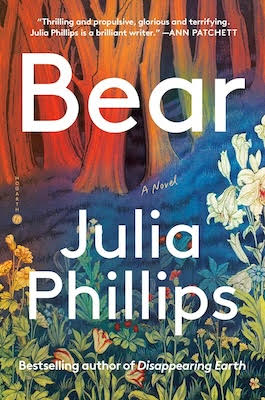
On this list about women coming into contact with wild creatures, we may have saved the wildest ones for last. Bear is a full-throated account of a lonely librarian’s sexual awakening on a private island with, yes, a bear. It’s a novel that will appall you, amaze you, and, in the end, make you consider what it would be like to do whatever you want in your life—to pursue your desires with full abandon. Perhaps, like Engel’s main character, you just need to go for it. Don’t hold back. (Though I very much hope what you desire isn’t to snuggle up with a bear!)
Masterfully written, Story Prize-winning, nationally bestselling, and exquisite at every turn, this collection includes a story called “Yeti Lovemaking.” Ferocity, bestiality and untamed urges, Maria Tatar described, when characterizing the narrative impulse to make a companion of a beast; Ma’s story has all of those, plus loneliness, loveliness, and determination. It channels all of the animal, all of the human, in only a few brief pages. Could there be a more perfect example of a collision with a creature? There could not.
Nina Sharma is a woman in love. In her debut memoir, The Way You Make Me Feel: Love In Black And Brown, she reflects on the powerful love and solidarity of Afro-Asian allyship through the lens of her own interracial relationship as an Indian woman married to a Black man.
Beginning in the suburbs of New Jersey, we follow Nina through her struggles with bipolar disorder as she simultaneously grapples with her South Asian identity. Nina shares intimate details of her experiences with psychosis that mirror the story of her meeting, falling in love, and building a life with her husband Quincy Jones.
From ruminations on Mira Nair’s classic Afro-Asian love story Mississippi Masala to the visceral confrontation of anti-Blackness in South Asian communities, Nina approaches her own life with equal parts raw vulnerability, humor, and empathy.
Yes, Nina is a woman in love. However, her love extends beyond the context of marriage. Through a deeply intimate portrait of a woman finding her place, we see Nina as someone in love with her husband, her family, and herself.
I spoke with Nina Sharma about South Asian identity, self-love in the writing process, and what Afro-Asian solidarity means to her.
Anupa Otiv: As a South Asian writer from New Jersey, this collection felt immediately personal to me. You write about your life against the backdrop of North Jersey and speak to a specific kind of South Asian upbringing in America. What role does New Jersey play in your identity as a South Asian woman? Was that something you were thinking about while writing?
Nina Sharma: Thank you! It takes a fellow New Jerseyan to notice some of the deep cut references in this book, so I really appreciate it.
Having been raised in Edison in the late ’80s and ’90s, I got to see it become the Edison it is today, an enclave of South Asian culture and community. For example, there was an ice cream shop that became a Bombay chaat house, but the structure of the building was preserved with the same ice cream sign. It wasn’t technically chaat, but they made it work for them! In a way, my journey was the inverse of that. Even though I grew up in a South Asian community, I went to a predominantly white private school and spent a large portion of my youth assimilating into whiteness.
That journey reminds me of my parents and their journey immigrating to this country. And even though Edison has a strong South Asian community, that dichotomy is a reminder of how white supremacy operates in this country and how large it looms for immigrants. It’s a large touchpoint throughout the book, and something I think about constantly having grown up in that part of New Jersey. My Edison roots deeply inform my identity as a first generation South Asian and have helped me articulate my sense of self over time.
AO: One of the most poignant relationships in this book aside from your marriage is the one you have with your parents. You write about them with such honesty and nuance, whether it’s in regards to your mental health or their grappling with your Afro-Asian relationship. What was it like writing about your parents in such a personal way?
NS: Honestly, it was very hard. It was a relentless inner conflict I faced, but I’m so grateful that my husband Quincy was a reader throughout the writing process. He helped me see the power in writing complex human characters with virtues and flaws, whether it was my parents or myself. Around the time I had begun my MFA, I would write stories about my life and relationships through a filtered lens. There was a sheen of perfection that ended up creating distance between me and the reader. Once I started to write messy stories about our fights, about dirty dishes, I found that readers were able to relate to me more.
By bestowing humanity onto everyone in this book, I hope to portray the people I love as characters readers are rooting for.
Even though it’s a memoir, I view the people in this book as characters, including myself. My hope was to portray everyone, especially my parents, with the complexity they deserved. And that complexity is what makes them endearing. By bestowing humanity onto everyone in this book, I hope to portray the people I love as characters readers are rooting for.
AO: I understand that impulse to add a “sheen of perfection.” It feels safer to withhold the inevitable ugliness of our lived experience. What allowed you to be so raw in your writing?
NS: In general, I think of myself as a private person. However, writing has always been my excuse to just let it all hang out. Essays in particular are my chosen medium to connect with others and share my raw self with the world.
One of my teachers at Columbia, Phillip Lopate, wrote in his book The Art of The Personal Essay: An Anthology from the Classical Era to Present, that the heart of the essay is a feeling of companionship between the reader and the writer and I think that is very true. Whether you’re writing broadly about complex political issues, or you’re writing something deeply intimate, that companionship is an essential component to connect with other people. It requires a level of rawness to foster that.
AO: How did you decide which stories were essential for the narrative of this collection and which ones to leave out?
NS: When I was developing the essay “Shithole Country Clubs” originally for The Margins, my editor Jyothi Natarajan was reading my essay “Shithole Country Clubs,” which has made its way into the book. At the time, there were so many competing ideas and threads in the piece. To narrow it down she asked me, “How much can this story hold?”
I think about that all the time. What is the core reactor of an essay and what will help me move closer towards that? What can be saved for another story, another essay, or another book? Sometimes, I will write something and be like “Woah, I found some gold! But this gold is for another day.” So, it doesn’t feel like leaving things out, but rather seeing potential in my stories to become something else.
AO: The collection primarily navigates your interracial marriage to Quincy Jones, however the love in this book extends beyond marriage. What struck me most was your ability to write about yourself and your own mental health journey with so much empathy and self-love. How did you practice centering self-love throughout the writing process?
NS: Writing to me is ultimately an act of self-love. The process of writing about my mental health, for example, is a way to address and overcome my reservations about it. Sometimes I’m surprised that I still encounter reservations [about mental health], but I think it’s ultimately good to have those moments of reckoning.
Afro-Asian allyship starts with two things: Listening and remembering our history.
Writing is an opportunity to dig deeper into my feelings and understand where they are coming from. Am I feeling shame? Is it internalized judgment or stigma? A big part of the process for this book was writing through that insecurity to reach a point of self-love. This is where writing myself as a character in a novel instead of the narrator of my life comes in handy. It forces me to root for myself!
AO: I love that. You’re Nina the heroine on her hero’s journey!
NS: I’m like the princess from Mario.
AO: Princess Peach?
NS: Yes!
AO: Your sense of humor is deeply present throughout this collection, even as you wrote about racism, white supremacy, and mental health. How did you lean into humor as a tool to communicate these things without sugarcoating it or overlooking it?
NS: Humor is a way to create a conversation on the page. It’s the art of capturing how we talk to one another. When we talk to friends, we emotionally heighten to get a reaction or to make them laugh. We tell jokes to bring us closer. Humor is integral to how I talk to everyone. I can’t imagine creating a relationship with my readers without it, you know?
If I’m writing and the comedy doesn’t emerge, then there’s a problem. Even if the subject matter is dark, I tend to reach for laughter. Laughter to me isn’t making light. I don’t subscribe to the idea of “comic relief.” Laughter to me is mission-driven, can help me hone in on something I want to break a silence over, laughter is maybe the first and most primal act of breaking a silence.
Back when I started performing improv comedy at The Magnet Theater in Manhattan, I was working on stories that would eventually end up in this book. I saw a flier at the theater for “You Are Not Alone,” a show that merges improv with uplifting stories about mental health and depression. When I saw that, I knew it was for me! It showed me how powerful comedy can be in making people feel seen and understood. Comedy is a tool to relate to people without minimizing myself or my experience.
AO: Another powerful tool you use is pop culture criticism. One essay in this book is about your complicated relationship with the Mira Nair film “Mississippi Masala.” What role does pop culture criticism play in storytelling for you?
NS: American pop culture is a big part of this book, partly because it’s a vehicle for assimilation as a first generation Indian American. Movies and music were an anchor for me as I was coming into myself as an Indian and an American.
With Mississippi Masala, a film about an Afro-Asian relationship, I always thought it was beautiful and iconic, but it took me a few watches to have that breakthrough moment with it. I could never understand what was stopping me from having a personal relationship with the film. Was it internalized racism? Was it simply hard to watch as I experienced something similar with my own parents over my own Afro-Asian relationship?
Writing through those feelings helped me to come to terms with them. I realized that my journey to understanding and loving that movie was mirrored in my journey to understanding and loving myself.
AO: Afro-Asian allyship is an ongoing theme throughout the book, especially in the context of your marriage. What does Afro-Asian allyship and solidarity mean to you beyond the context of romantic love?
NS: We are living in a time when teaching and recording the history of racism in this country is being threatened. We’re living in a time when racism in this country is being challenged in a new way. Diversity and inclusion programs are being threatened and cut, books are being banned in record numbers, and critical race theory is being removed from school curriculums. It’s scary, but it’s also an opportunity to stand up and outwardly oppose that future.
To me, Afro-Asian allyship starts with two things: Listening and remembering our history. Of course, there are direct actions that must be taken through protesting and mutual aid. But in a time where schools are being policed and students are being censored, knowledge is our greatest power. Remembering our history ensures we don’t repeat the same mistakes of our ancestors. We can practice that in different ways too, like donating time and money to grassroots organizations, and platforming the work of Black, queer, feminist scholars. Most importantly, I think it’s about choosing to show up every day to express and practice solidarity.
When I was fourteen, I became convinced that I was a witch. My magical powers included bringing imagined things to life, seeing the future, and an ability to make inanimate objects move. The walls in our school breathed as I walked down the hall. The posters of notable literary women in the English classroom winked at me. Having been brought up Catholic, my instinct was to try to understand why God wanted me to have these powers. But soon, searching for an answer in religion didn’t feel genuine. In truth, I was to God as waves are to shore—ebbing close then far, depending on the moon. In truth, I just needed someone to blame.
I attended an American Methodist school from second to twelfth grade. We were not a Methodist family, but the institution came recommended and was walking distance from our apartment. In school, we attended chapel every other Wednesday, we hosted religious speakers and, when permitted, we danced with no fewer than five inches between our eager bodies. We were required to take a religion class; the hem of my skirt was required to touch my knee.
One night, while standing in our San Juan apartment hallway, I saw a woman appear on the other end. Her right side was consumed by the wall, and her left was translucent and silver. The air got caught in my throat and I stood, stoic and wide-eyed, mouth agape and silent. Her hair, long and waved, billowed even though there was no wind in our concrete hallway. I took one step forward, my teenage body unsteady. She glided toward me and then disintegrated before reaching me. I pressed my eyelids to my cheeks and then looked again, but she was gone. I ran to my bedroom and shut the door behind me. On my bed, thighs hugged tight to my developing chest, I waited for her to come for me, to claim my soul. She never did.
The next day, in homeroom, I told my friend Lisa about the silver woman and her wispy hair. “You need to pray for that spirit,” Lisa said, miming the cross with her hand and kissing her fingertips. “And you need to pray for you, too.”
Instead, I told the school psychiatrist that I had seen a ghost. The doctor assured me that the ghost was likely a woman I had seen at the grocery store or on the sidewalk, her image suddenly surfacing. “Sometimes the subconscious manifests in confusing ways. If you feel you need guidance, why not speak to Reverend Maldonado?”
I pressed my eyelids to my cheeks and then looked again, but she was gone.
I rarely engaged with the religious parts of my schooling. Jesus was tacked above the door to the reverend’s classroom. Inside, our chapel songs were strewn in sheets on his desk. Leaning back on his swivel chair, the reverend prompted, “Describe the figure.”
I delved into the moment with detail and concluded, “I don’t know what to think, she was almost beautiful.”
He pursed his lips. “What did you feel when she came toward you?” he asked.
“I was stuck. I couldn’t believe it.” My heart had stopped, my breath had shortened, my feet had hardened. I’d been awestruck, but I hadn’t been afraid.
“She could have been an angel,” said the reverend. “You are unharmed and present, you haven’t gone mad, you’re not upset. This couldn’t have been a negative energy. You’re very lucky.” His answer was unexpected, although I didn’t know whether I would have preferred a different explanation. If I was not cursed, then what was I?
When I moved to New York to begin my freshman year, my powers hit a growth spurt. I began astral projecting regularly, my soul escaping my body and hovering above it, watching its limbs carry the rest to class, to the grocery store. When my soul would rejoin my body, it would startle in the mirror, taking time to find something familiar in the person staring back. Oftentimes, I would not see myself at all. By my sophomore year, the ghost voices became defined into those of two men, and their running commentary often teetered between insulting and demanding.
The taunting was such that I sometimes had no choice but to fulfill the voices’ demands. I still knew better than to drink my laundry detergent (something they asked), but other orders prompted me to leave my dorm room in the middle of the night barefoot to catch snowflakes on my tongue. Or, press my body against strangers in the darkened corners of bars, to give myself up before the voices listed all the ways in which I could lose control. I spotted orbs of white-yellow light with the corners of my eyes, hopeful that goodness had come to protect me. Sometimes, I remained under my covers all day, afraid of having to interact with others, aware that I couldn’t form a single sentence. My thoughts raced and jumbled together, meeting each other in their middles and sprouting wings from there. Is there milk left for the essays on Emerson were due by the time you get yourself out is someone home close your eyes before you forgot to hand in there is no one here with you the time mom took you am I hungry the night is coming you will die. I couldn’t grab at a single one, couldn’t explain what was taking place in my head, let alone talk around it. So I kept my lips tight, kept my head on my pillow when the weight of my consciousness became too heavy.
My senior year of college, at 21, I found myself at the Lenox Hill Hospital ER accompanied by an NYU psychiatrist. During my scheduled appointment earlier that day, after I broke down and confessed what had been plaguing me, my doctor suggested an in-patient stay to tackle my substance use and hallucinations. Desperate, I agreed. I sat in a bare and dry exam room, black sweater pulled tight across my chest, a barrier between me and the manufactured cold. Scorpions did not crawl across the floor, gnats did not buzz around the clinical lighting. I repeated this to myself each time an imagined bug threatened to get close.
Why are we here?This is a mistake.
Sometimes, I remained under my covers all day.
Two doctors sat across from me expectantly. “Tania?” One of them scrunched her nose, pressed her lips together.
“We asked when your last drink was.” A gentle push from the second lab coat.
“Last night.”
“Before or after midnight?” My eyes wandered over to the sparkling ocean behind them, held together by a rusted golden frame. I could not recognize the beach—there were no palm trees.
“We sense that you’re distracted.”
Lie. Don’t you dare tell the truth. They leaned in so close, I could feel the words leave their lips and sit on my ear.
What are you waiting for?!
Lie. “I just can’t hear anything other than these men.” I let it escape me through tired breath.
“Men?” asked the second doctor.
You dirty slut.
“They follow me everywhere. They tell me to do things. I can usually keep them under control. The alcohol helps, and the coke either helps or makes it worse, fifty-fifty. I don’t know what they want with me. They appeared one day and never went away.”
Fuck you, you whore.
“Tania,” started the first doctor. “We think that based on your current and previous drug use, you have what is called substance-induced psychosis. Basically these substances that you’ve been abusing are driving you mad. We need to admit you. Now.” I was admitted to their psychiatric wing a couple of hours after my arrival at the emergency room.
On my fourth day at the ward, as I napped between Life Skills and lunch, I was brought back to the present by a hushed, “Miss? Wake up Miss.” The young male nurse who took our vitals appeared in the doorway, his hand flipping away the dreads on his shoulder. He brought the rest of his body in and leaned his back against the frame. “Are you alright? You’ve been sleeping quite a bit.” I pushed myself up and nodded, scooping sleep gunk from my tear duct with my pinky.
“This place won’t help you, you know.”
“Excuse me?” Newly awake, my throat stumbled on sound.
“The only thing that will help you is God. You must be spiritual.” He took two steps into my room and leaned toward me to share a secret. “What you must do is run a bath and submerge yourself in the water.” He walked me through a ritual that included infusing the bath with flowers and herbs. He offered the commercial name for plants my grandmother used to grow in her backyard in Puerto Rico. I listened to his instructions closely, as if I were planning to execute them. His long dreadlocks swayed slightly as he listed home remedies for addiction and depression. “You must cleanse your spirit of demons, and then you will release your afflictions.” He waited for my reaction.
“Thank you,” my voice pushed out in one raspy whisper. I laid back in bed, awake, and didn’t get up until dinner time.
Four days later, I was discharged from the unit. As I walked out, the nurse caught up to me, dreadlocs flapping behind him. The body of the books and clothes I had amassed during my stay weighed inside my duffel bag, I still had my prescription in hand. “Remember what I told you,” he said with a pat on my back. He left his hand there for one second and continued, “or you’ll end up right back where you started.”
I listened to his instructions closely, as if I were planning to execute them.
In different cultures, or at different epochs, the ability to hear voices—from beyond, God, the stars—has been revered as a tight spiritual connection to the greater powers that be. We see less of this mindset in contemporary Western culture; less but not none. It’s been found that a fraction of people first go to their pastor or religious figure of authority with issues of mental health. And, it’s been recorded that people with psychotic symptoms who are religious are more likely to have what the psychiatric community calls delusions with religious ideation. It makes sense to me that a person’s mental illness would play on the ideas and ideals they already espoused, that previously religious folks are more likely to believe that they are Jesus, or the devil, or a saint is a testament to how mental illness interacts with identity.
How do you convince someone they aren’t hearing angels when we’ve revered religious spirits for the same thing? I imagine church scenes, not from years ago, but from our time, where people are consumed with the Holy Spirit, their bodies flailing about or falling backward, their tongues manifesting language we are too earthly to know. Were these people not protected by the cloak of religion, their actions would be perceived not as divine, but as psychosis. I imagine modern day prophets, be they living on a New York street corner or preaching in a privately-funded church. I do not doubt the purity of faith in the every-day person, but, despite my mother’s efforts, I do not veil myself in a religious system and therefore do not doubt the intrinsic nature of mental illness.
My mother, who was medicated for depression after spending a year crying, calls herself spiritual but expresses spiritualism in terms of Christianity. Although she won’t admit it, she believes in ghosts. I know this because, shortly after her sister passed away, when my cousin and I were in the first grade, I would often find her standing in the middle of a given room mumbling, “I know you’re here. I can feel you here.”
2
Jacob and I met and began dating a year after my hospital stay, when I was 22. Born and raised in a homely town nestled between the trees in the Pennsylvania woods, Jacob was a true country boy and indoctrinated in God’s plan. I was an agnostic city girl. Every Sunday, he got up early to go to church, and I spread out my body, arms and legs reclaiming the bed space he’d left. Once, I asked him if it bothered him that I wasn’t Christian. “I hate the sin, not the sinner,” he answered.
He’s going to ruin your life. I’d never told Jacob about the voices. I had spent a year substance free, but they still beat at my drums, chipped at me with insults. Even with group therapy and AA meetings under my belt, I needed help navigating my increasingly confusing mind. I was running out of energy to keep focused, and Jacob started to notice. Sobs came every night before sleep did, with or without Jacob laying beside me. Neither of us knew there were symptoms that hadn’t come into full bloom yet, but the glimpses Jacob got of what would become my psychosis worried him enough to suggest a cleansing. I agreed to go to service with him.
We made our way to the auditorium at the Times Center in Times Square, where Christian City Church, or C3, gathered. Jacob introduced me to friends I’d never known he had. On stage, a pastor in his forties wearing jeans explained what it meant to be loved unconditionally by God, how it can heal our shortcomings and lead us to success. His words ricocheted throughout the room, filling us all from different directions.
Why are we here? They came to me sitting in my seat, elbows on my knees. I blinked them away and focused on the pastor.
He got up early to go to church, and I spread out my body
Let’s go somewhere fun. I dropped my eye line to my feet for a moment, pushing against the voices. I quickly looked around at the audience, a crowd of young writers and actors and waiters and receptionists. They all nodded and smiled warmly as their leader spoke his message, his earpiece microphone jiggling slightly with each step.
Don’t test us. I closed my eyes and imagined a bright yellow light emanating from a black void. I prayed to it, asking for the voices to quiet. After a few minutes, I realized that my mind had eased, the stillness new, echoing. There was room in my mind to insert my hand and pick which thoughts I wanted to mind.
Soon, I was volunteering for the cause, spending less time applying for work and more time at the pastor’s townhouse in the West Village. Alongside his wife, their children, and other volunteers, I stuffed envelopes or crafted decorations for any given holiday. I joined a Bible study group with other women in their twenties. We went out to dinner and prayed over our food. We held hands for comfort. Our long-term relationship strengthened in God, Jacob relished in my salvation.
One night, about a year into my relationship with Jacob, as I watched TV in my empty apartment, a shadow slid up the wall, peeled itself off the cement, and began hovering around me, an abstract mass of dark. It kept to my periphery as I tried to catch a better look. Afraid, I started to wave my hands as if shooing a fly, moderately at first and then with more and more desperation. The mass began to torment me. It flew one way and then another, it got close and then retreated, got close and then retreated. You don’t have to be afraid. Drink yourself to sleep.
“No,” I said loudly. The shadow lunged at me and I dropped to the floor, arms protecting my head. It’s going to get you. You don’t deserve God’s love. “Stop it.” On my hands and knees, I crawled to my bedroom and closed the door. The shadow slipped in between the door and floor, and went up my wall, wiggling about.
“Please. Please help me. Please.” I sat at the foot of my bed, thighs against breasts, “God please help me.” There’s no one here for you. You’re all alone with us. I called Jacob, fingers vibrating from inside out. “Can you come over?”
“What’s wrong?” He heard my quiver instantly.
“I’m so scared, I don’t know what’s happening, I’m freaking out.” I’d been panting and only noticed as I tried to speak. The salt that had dewed in my eyes raced down my cheeks and met the corners of my mouth. “Please.” I couldn’t raise my voice, but managed one more plea. “Please.”
“I’m coming.”
He’s not coming. I put the phone down and covered my ears. When they got too sore, I balled my hands into tight fists. The shadow swam to an adjacent wall and covered the pictures taped to that wall. “Get out!” I climbed onto my bed and ripped off the pictures, clawing at the translucent mass. “Get out!”
The ire strangled me from the inside. My molars grinded against each other, jaw tense, temples tight. The loud knock on the front door brought me back at once. Jacob gasped when I opened it.
The shadow slipped in between the door and floor, and went up my wall, wiggling about.
For the first time, I felt my eyes swollen and stinging. The red rake trails that I had curtained my face with, from eye level to jaw bone, started to burn. Jacob lifted his cold hand and cupped my face. I let the tears go and fell to the floor, drained. Jacob squatted, and with a reassuring gaze, picked me up by the elbows. We walked the apartment as if it were a disaster area, hands held and slow pace. His head dropped when he opened my bedroom door.
“You tore it all down?” I nodded from the couch.
He walked into the room and I followed. It had taken him an hour to get to the Upper East Side from Brooklyn. I had torn every piece of paper in my room to shreds. The pictures on my wall, the poems I’d put up, everything I had put love into was now confetti strewn over every surface. “What did you see?”
“There was a shadow,” I regained my voice. “I heard… things.” Jacob sat on my bed and waved me over. I sat next to him, my head on the edge of his shoulder.
“I think you just survived the devil.” My heart muscle flinched in my chest, but I did not move. “I think that was the devil,” he repeated in awe.
“I’m exhausted.” My whole self was a ball of lead; Jacob tucked me in.
It became clear to me that I was destined for greatness, for golden light and joy. I had been born into Jesus’s legacy, had been chosen from birth. Jacob believed the same about himself. He put his complete faith in the hands of the Lord, and had yet to encounter his big break because that was the design of the master plan. By virtue of believing, a job I didn’t get or money I didn’t have were blessings. Instead, they pointed to a future where I would have earned those things the way that God wanted me to.I was constantly reminded by the church-goers around me of how lucky I was to have returned to God’s love and promise. I was a success story, a saved heathen with a new future. Except, outside of my fellowship, I was rotting.
God is not real. You’re a fool.
The voices ebbed in and out of my head, always returning a little louder. Compulsions brewed in me. I stole money from my roommate and used it to buy expensive purses and stilettos. I lied about completing errands at work and began to wear tight clothing. It was imperative that I appear fashionable, that I was seen in the trendiest bars. My drinking and stamina were sustained by my secret use of cocaine, a drug Jacob thought I had quit but that I had picked up again to fight the voices. I watched myself strut to work, my spirit hovering feet above my peacock body. I lied and cried often, the grip of truth squeezing my breastbone.
The noise inside me would quiet with God over me but I couldn’t keep God around long enough for the peace to be permanent. Each Sunday, hungover and sick, I vowed to be better, to be worthy. The pressure to keep up my personas of a perfect girlfriend, wise Christian, and fashionable city girl was breaking me. I did not know why I had to be so many people, but in doing so I was unraveling.
You’re a bad person. You’re not worth saving.
I was constantly reminded by the church-goers around me of how lucky I was to have returned to God’s love and promise.
When the shadow came again, after a year with the church, I surrendered to it. My bones ached, my joints stiffened, I could not stand through a shower, could not eat. It was just me and the shadow in a knot in the dark. The depression would last weeks, until I convinced myself that I would truly commit to God this time around.
But the voices and the orbs and the bouts of despair and paranoia soon developed complete immunity to God and His love. Jacob tried to keep me tethered to Him, but I severed that thread. I understood that God would not save me, that I was on my own. Almost two years into my relationship with Jacob, at 24, he and I broke up. I never returned to C3 and never heard from my Bible study friends, as if I’d never been there to begin with.
3
Two months after my 25th birthday, my parents flew to my neighborhood in New York for an intervention. The imbalance within me had resulted in a slew of bad decisions and false memories. Facing eviction and unable to function, I moved back home to Puerto Rico with my parents.
My mother and I sat across from a neurologist’s desk, the doctor behind it holding up scans of my brain to the light and reading through them. Please find something, please find something. She put the paperwork down and faced us. “All of the scans came back clean. As far as I can tell, there is no neurological explanation for these behaviors. Your next step should be to speak to a psychiatrist.” The truth hit me in the breastbone. I had wanted to be sick in a way that I could understand and explain. I wanted to be able to point at something and say, “See? There. That’s why.”
I was entrusted to the care of Dr. Robert, a man with a Freudian beard and olive skin, with an office in Old San Juan. I had never thought of myself as symptomatic, but Dr. Robert laid my own actions out in front of me. Puzzle pieces that he arranged to form the picture of Bipolar I. He went through my irresponsible shopping habits, my blackouts of memory. He quantified my actions as “lack of impulse control,” “illusions of grandeur,” and “hallucinations.” I was tied to the real world by the waist with a rope, and each checked symptom was a foot of slack, a measure of how far I was floating away from everything. I couldn’t feel my feet on the ground, couldn’t hear my parents’ questions. I was too far into the ether, where the ghosts had found me.
As I processed the diagnosis, my instinct was to refute it. I had heard voices. I had seen ghosts. That these manifestations were not real was besides the point. Were it not because my mania had led to eviction and debt, I would have put up more of an argument. Under a diagnosis, I came to understand that there was nothing special about me. I was different, yes, because I was sick. Now, when the episodes of mania accelerated my thoughts and hinted at bringing back the ghosts, I would find myself sitting down, laying down, with my palms pressed to my temples as if the pressure might quiet my mind. In my delusions, I was meant for something. Diagnosed, I was a statistic, a numerical anomaly, randomly plagued.
My doctor explained that perception and imagination use the same pathways in the brain. Perception moves from the outside to the inside—bottom up—and imagination goes inside to outside—top to bottom. Two lanes on the same road. Some of my friends find it funny that I don’t believe in God, but believed that two men were following me and giving me orders for the first half of my twenties. It took me a couple of years post-diagnosis to understand that this was in part because I already believed that it was possible for ghostly men to haunt a person. As I embarked on my journey back to baseline, I found it more and more difficult to differentiate between myself and my mental illness. I didn’t feel so much that I had bipolar, I felt that I was bipolar. When did my imagination start fueling my perception instead of the other way around? I’d once tried to introduce an imaginary friend to my cousin, who insisted he couldn’t see anyone standing next to me. Was I sick then?
I couldn’t feel my feet on the ground, couldn’t hear my parents’ questions.
Depression met me when I met my diagnosis. For days at a time I would lay in bed, silent, eyes fixed on the wall. I lay there through my mother poking her head into my room to ask if I was hungry. I lay there as she and my father presumably tried to understand how this bipolar had changed their daughter, how they themselves would cope. It was all I could do to lay still and be quiet. In my head, the chaos and guilt thrashed against itself, my thoughts either drowning in helplessness or taken over by the next one. After a couple of weeks, the aura of exhaustion around me was visible. I had no energy left for living. My mother suggested that I return to church. I gave a half-hearted “Sure,” even though I already knew that it wouldn’t help. Still, in an attempt to remain cooperative, I took my friend Liliana up on her standing invitation to attend the youth group she frequented.
One Friday night, she picked me up and we drove to her church. We pulled into a long driveway and went into what must have been, at one point, a two story house, now somewhat converted to a temple. She introduced me to her friends and we gathered in the former garage around soda and chips under fluorescent lights. After a few pleasantries, worship began.
“Come,” the pastor signaled for all of us to come to the front of the room. “We will pray for each one of you.” I followed my friend up to the altar, all of us pillars in no particular order. Everyone closed their eyes. I cracked one open. The pastor went pillar to pillar, and moved to a young man next, putting his hand on the man’s head.
Suddenly, a rabid growl and terrified scream filled the church. We all looked around, startled, and saw the pastor pinned down by the man he had been praying over. “Fuck you!” the man yelled in a deep and scratched-up voice. The other men in the group ripped the angry man off the pastor. “Hold him down!” yelled the leader of the church. “Bring me the water!” His wife ran behind the lectern and produced a small glass bottle. “The devil is in you!” the pastor yelled at the man squirming and turning fire-y red under those holding him down.
“Everyone, give him room!” yelled the pastor’s wife as she approached her husband and handed him the glass bottle. The pinned young man thrashed violently, fighting the grip of the guys weighing on his legs and arms.
“You are nothing! You are no one! There is no God!” his blasphemous claims echoed all around, into us.
The pastor opened the bottle and threw the water on the man’s face. “The Lord demands you gone! The Lord will condemn you! Leave this man, demon. Back to hell with you!” The man on the floor began to cackle maniacally, loud and insulting. “You motherfucker! You are a liar! You piece of shit, you have the love of no god!”
The other members of the group had formed a circle around the spectacle, their hands extended over those doing the physical work, their individual prayers and denunciations amassing into a unified hum. I stood on the far left, just outside the circle. I extended my arm toward them all and whispered to myself with eyes tightly shut, “God help us. God help us. God help us.” I prayed with every cell, with every pore, despite not knowing exactly what we needed protection from or that protection would come. The man on the floor had begun to release white bubbly saliva from his mouth. The people holding him down grew tired, and others jumped in to replace them. The pastor called out, “The Lord condemns you!” and slammed his Bible on the affected man’s chest. At once, the man stopped his fighting and laid limp on the floor. We all took a collective breath.
The pastor went pillar to pillar, and moved to a young man next, putting his hand on the man’s head.
Before I could collect my scattered thoughts, the man on the floor came to life. “You’re all fuckers! You have no god! Fuck all of you!” The hatred that sprayed from his mouth jarred us back into surreality. Those acting as human binds jumped on top of him before he could get up, the man already preparing to lunge at the pastor once again.
The pastor threw more water at him. “The power of Christ demands you gone! God will prevail! Demon, leave this man!” The circle reconvened around them and the hum grew louder. Arms stretched over the man on the floor, some members sobbed their cries to God, “release this man, release this man from evil.”
Liliana backed away from the circle and tugged at the hem of my shirt. She nodded for me to follow her, and we walked to the office in the back of the room. The cubicle windows faced the altar, a swaying group of bodies begging for mercy. “Are you ok?” she asked, motioning for me to take a seat.
“Yeah,” I lied. I was physically unharmed, but emotionally distraught. The confusion had seeped into my bloodstream. I had no words to describe what we were witnessing, making my desperation even more palpable. The pastor’s wife entered the office, shutting the door behind her carefully and quietly.
“How are you doing?” she asked, her eyes meeting mine.
“I’m ok.”
“Do you want to talk about this? There is no need to be afraid. We cannot have fear or doubt around us now.” Her tone felt accusatory.
“I don’t need to talk. I just defaulted to prayer.”
“Good,” she sat down by the door. “It might be a good idea to stay here for a while, until they get the demon out of the boy.”
The scene carried on for another hour. And then another hour after that. I felt exposed, susceptible. I wasn’t sure what afflicted the man, but I knew that my own headspace needed work. I had improved, but I was not in control of the way my brain processed information, or how my emotions reacted.
His voice broke through the prayer hum, spreading through the church in waves. The circle’s shoulders slumped. Members broke away, staggering to sit on the altar steps. The man writhing on the floor was finally liberated after one hundred and fifty minutes.His whole body was red, stark against his white polo shirt. “Come,” motioned the pastor’s wife, “It’s over.”
The pastor helped the man up, his face wet with holy water and sweat. He’d popped blood vessels from screaming. He sat on a pew, weak and panting. My friend and I stood nearby as members of the group fetched him drinking water and a towel. “Are you with us?” the pastor asked him, gripping him by the shoulders.
The man blinked and focused his eyesight. “Yes.”
I wasn’t sure what afflicted the man, but I knew that my own headspace needed work.
“How do you feel?”
“I don’t know. I don’t know what happened to me.” The terror in his face only softened when the pastor placed his hand atop the man’s wet head.
“God is in you now. There is nothing to fear.”
On the ride home, Liliana broke our silence. “It’s not always like that. This doesn’t happen often.” Her hands held onto the wheel, her fingertips turning white.
I nodded, eyes fixed on the road ahead of us.
“God is with us,” she whispered to herself.
I arrived home three hours later than expected. When I told my parents why, what I had witnessed, they believed me immediately. It was a reaction I wasn’t used to, as they had struggled to believe my hallucinations and delusions. They didn’t believe me when I said I had no memory of certain things, or if I remembered them differently. But they believed this happened. They had vocabulary for it, a religious baseline that I never fully adopted. “Say a prayer before bed,” my mother offered, “just in case.”
I did not return to the youth group, nor did I return to the church. But that night, I did say a prayer.
Dr. Robert prescribed a combination of medication as treatment. As the medicine began to kick in, it replaced my symptoms with a slight numbness, almost a gentle humming that overrode the loudness of my half-thoughts. Reading was often difficult as I would forget the beginning of a sentence by the time I reached its end. My thoughts slowed, sometimes to a glacial pace. There was an impenetrable stillness in my mind. The orbs of light in my periphery dimmed until they disappeared. The voices held on for as long as they could, but they lost volume, then lost consistency, until they were lost.
I became aware of the quiet surrounding me. No more visions, no more ghosts. I swallowed a sudden loneliness. I was part of the world now, a world I knew very little about. I still believed in ghosts, but I didn’t tell Dr. Robert that. It would always be the only reality I knew, that which was not real at all.
It began with observations. Then questions. Then speculations. Then the conclusion came that Ikenna Anyanwu, who lived at 8 Okigwe Road, was sleeping with a manfriend, Gbenga Afolabi. It had to be true. What two men who cohabited, shared a bed, fed from the same plate, and washed in the same bathroom, would claim that they were not a thing? Like husband and wife. Except in this case, the wife was a man.
The whole street gathered outside.
“Aru!Abomination,” one man shouted.
“How can a man lie with a fellow man as with a woman?” a woman cried.
“What is becoming of this generation? Our government has failed us. We don’t have stable electricity. No good roads. No clean water. Ah, we’re not even sure where our next meal will come from. Yet, these two men wish to incur Allah’s wrath upon us. Allah ka tausaya mana!God, have mercy on us!”
“We must get rid of them, lest they corrupt our sons.”
“Yes, we must.”
“Yes!” they chanted. Their faces contorted, and they nodded at each other.
The sky was darkening. The men lit torches. The women gathered big rocks. They tightened their fists around machetes and clubs. Children trailed behind. All marched down to 8 Okigwe Road.
In their lamplit room, on the mattress that pressed against half the length of the peeling wall, Ikenna Anyanwu’s mouth worked its way down Gbenga Afolabi’s nakedness. Kisses on the forehead, lips meeting lips, throats pulsing with moans. Around their sweating bodies, in cracks and corners, mosquitoes hummed and crickets sang. Ikenna’s mouth settled on the flesh just before the dark mound of hair below which Gbenga’s shaft bobbed with life. Their bodies rose and fell in harmony. Ikenna’s lips brushed Gbenga’s stiffness, and then his mouth opened and welcomed all of it in. Gbenga threw his head backward on the pillow, his hands balling up the sheets. Their eyes shut, and the world melted away.
Perhaps they had drifted to a realm where only lovers go during lovemaking. Perhaps the world had melted away around them, and they were suspended in space, their bodies so fully attuned to each other that Ikenna could have sworn he had registered nothing that night.
The wooden door came unhinged, hitting the concrete floor. The night breeze swept in, and with it came the mob, trooping in by twos and threes. Their eyes caught Gbenga and Ikenna folded into each other, arms wrapped. They dragged Ikenna away, pulling him this and that way, as though they wanted to devour him. They upended the room: they tore down the curtains, kicked the cabinet of books by the window, flung the kerosene lamp against the wall where it landed on a heap of unwashed clothes—its globe shattered, the little flame flickering and flickering, emanating, kissing fabric, erupting, the room glowing a spiteful red.
Ikenna heeded Gbenga’s screams. He glanced over his shoulder. Blows crashed into his face. The people shouted for tires and petrol. He held his arms against his face, toppled to the ground, and curled into himself, a tight ball. Gbenga’s screams persisted.
For a moment, the beating stopped. Ikenna half opened his eyes and focused on a gap before him. He leaped, mustering the last of his strength, and negotiated his escape. A woman grabbed his shirt. Her grip was weak, or the shirt was worn thin from many years of use; the cloth ripped along its middle. Ikenna fled, past rows of kiosks lining the street, past houses and the intersection where Okigwe Road ended and two other streets began, then down an alley that smelled of garbage and rat feces. He ran, momentarily inspecting the shadows behind until he could not spot them anymore. He surmounted a hill that overlooked the north of Enugu, tears and wind in his eyes. Fat whorls of smoke ascended the sky. Gbenga’s cries rang in his head.
The night was breaking into dawn. Swallows, trogons, and wagtails littered the air above. Birdsongs—a backdrop for the endless thoughts that assailed his mind. He plodded until he came upon a cliff and peeked over the precipice. He had met Gbenga during choir practice at St. Paul’s Anglican Church. A conversation led to a date, which led to trading visits, which bloomed into a first kiss, and another kiss, and then a relationship. They had made plans.
What good were the plans now?
He had received a government scholarship a month ago for graduate studies in the US. Gbenga was to join him in California after the first year of his Ph.D. program, where they could live, without fear, without judgment, and seek asylum. Or maybe they would not be asylees. Ikenna would get a job as a professor and, years later, become a permanent resident. These hopes now lay in ashes.
He inched closer to the edge of the cliff, peering down at the boulders and the river gurgling by. A rustling noise jolted him, and he turned back. A girl, about seven or eight, he guessed, gazed at him. A tray of oranges balanced on her head. He returned her stare. She was like him, stripped of everything dear. How else could he picture this girl who should be in bed at that time or waking up that morning, expecting to meet her friends at school later in the day, but instead was sent out in tattered clothes to hawk oranges? He searched her eyes. Finding nothing, he braved a step.
I love books in which a character learns, or learns to master, a new skill. I don’t necessarily buy that the character in question has to discover something deep about themself in the process of taking up Italian or marimbas, but I do believe that they’re bound to start seeing things a bit differently, to make interesting connections between elements they previously saw as belonging to different categories. And that’s when fiction can become extraordinary: when it gives you access to another mind at work, as that mind makes room for new thoughts, expands in some ways, and perhaps shrinks in others—it is pretty common to feel extremely dumb in the early stages of learning something new.
In a movie, the amassing of knowledge would more often than not be summarized in a two-minute montage: we’d see the protagonist training, or bent over books at his carrel (the passage of time indicated by changing seasons behind him), until the big match, the “your-future-relies-on-this” exam. And those movies can be great, occasionally, but novels can accommodate interiority in such spectacular ways that following its trajectory—the way its energy gets redirected on a dime, shot in the direction it now absolutely needs to go—can be the plot itself. Stories can unfold around it, but the protagonist’s mind is the plot, there is no need to rely so much on end goals, on dramatizing wins or losses, epiphanies and setbacks. The excitement lies in following a consciousness as it transforms on the way to proficiency, to fluency.
The following seven novels are, each in their own way, gorgeous examples of what I’m talking about.
This contemporary classic might not need introduction, but I’ll go for it anyway: narrated in turn by Sibylla and her young son Ludo (an absolute prodigy capable of reading ancient Greek and doing advanced calculus at age 5), it is perhaps the most fun novel ever written about the nature of intelligence. Sibylla is extremely smart herself, but can’t always keep up with her son, who’s constantly asking her to teach him something new. Yet her lessons are like magic tricks: when Sibylla teaches her son to read ancient Greek, we learn alongside him, and are entertained the whole way through. The book is smart and hilarious (Sibylla is very judgmental) without ever condescending to its reader. It assumes we are as smart as it is.
In its second half, Ludo goes on a quest to find a suitable father for himself, and the volume of lessons drops, but other types of learning come into play. Namely, he starts hearing a lot about games (chess, bridge), and there is this line that I find absolutely gorgeous in its simplicity when it comes to explaining what teaching is, and what its limits might be:
“When you play bridge with beginners—when you try to help them out—you give them some general rule to go by. Then they follow the rule and something goes wrong. But if you’d had their hand you wouldn’t have played the thing you told them to play, because you’d have seen all the reasons the rule did not apply.”
In a Toronto veterinary clinic, 15 dogs are granted (or cursed with) human intelligence overnight. The reason this happens, I’ll let the reader lucky enough not to have yet read this book find out for himself. Human intelligence doesn’t mean the dogs wake up full of opinions on the nature of time, or speaking whole sentences, but with the capacity to wonder and learn about such things. Which some of the dogs are interested in doing, and others…not so much. While a group of them establishes a common, articulated language (one dog immediately starting to pun in it, and shortly thereafter, to write poetry) others are weary of the new thoughts that naming everything has brought about. They find self-consciousness intolerable. Conflict ensues (not a spoiler alert: the pack will not stay together long). Those who embrace their new form of intelligence are in for a ride, constantly curious about the world of men. They hilariously misunderstand or near-understand it at times, but more disturbing is when they get a full grasp on what is actually going on.
What the unnamed twin boys narrating The Notebook are trying to master here is objectivity, although they would probably call it truth. Left in the “care” of their grandmother in a remote village in Eastern Europe during Nazi occupation, the brothers attempt to teach themselves to see the world dispassionately in order to mute and even perhaps annihilate (the reader quickly gathers) their feelings about the horror that surrounds them. In an early chapter, they explain their method to attain truth through studying and writing “compositions” about their surroundings:
“It is forbidden to write: ‘Grandmother is like a witch,’ but we are allowed to write ‘People call grandmother the Witch.’ It is forbidden to write: ‘the Little Town is beautiful,’ because the Little Town may be beautiful for us and ugly for someone else. Similarly, if we write: ‘the batman is nice,’ this isn’t a truth, because the batman may be capable of nasty acts that we know nothing about. So we would simply write: ‘the batman has given us some blankets.’ We would write: ‘We eat a lot of walnuts,’ because the word ‘love’ is not a definite word, it lacks precision and objectivity. ‘To love walnuts’ and ‘to love Mother’ don’t mean the same thing. The first expression designates a pleasant taste in the mouth, the second a feeling. Words that define feelings are very vague; it is better to avoid using them and to stick to the description of objects, human beings and oneself; that is to say, to the faithful description of facts.”
Such guidelines might sound like they will make for a stark and harrowing book, which it is (brutality mounts, the war ends, but something perhaps equally as bad replaces it, and the twins hone their survival skills by going through “Exercises to toughen the mind,” “Exercises to toughen the body,” “Exercises in Cruelty,” all dryly described), but it culminates in one of the most heart-wrenching endings I have read, the boys’ training complete.
In this short and absolutely delightful novel, there isn’t exactly a skill that the narrator tries to acquire: rather, she wants to master a whole philosophy of living. Stumbling upon Robert Louis Stevenson’s Treasure Island one day, she becomes convinced that the book holds all answers to a life well-lived. The book turns into her “golden compass” for a new life. She studies it relentlessly, and with an obsession that one might previously have thought reserved for scripture analysis. She tries to live according to its protagonist’s best qualities, which she redefines as the core values that should ground her existence: boldness, resolution, independence and horn-blowing. This often proves difficult, though, as she doesn’t have an income and is scared to drive, but she’s determined: she’s picked her object of study and won’t give up on it, even as her friends and family (whose concern for her is growing by the day) try to yank it away from her. She will take everyone down with her if necessary, but she won’t let go.
Another determined character is the narrator of Stephen Florida. We meet him at a time when his ultimate goal in life is to win the Kenosha Wrestling Championship (he’s a senior in college, on a wrestling scholarship). He is disciplined and so single-minded that tension rises quickly: we don’t only, as readers, start to worry that he might not win (his life shattered as a result), but also that he might (his life rendered immediately meaningless by the win, the ultimate goal already achieved at age 22). His level of commitment and obsessiveness makes it hard to imagine a positive outcome, one way or another, and yet, the description of his tactics and meticulous training is so propulsive and manic, so funny and full of heart, that we have no choice but to cheer for him. What I also love about this book is all the time we spend inside Stephen’s head while he is not training. What matters to him is time on the mat, match time. According to him, “the rest is maneuvering your mind away from the wrong things, more than keeping to the right things.” This makes it sound like Stephen’s thoughts between matches and practice might be mere blobs, floating around aimlessly as he waits, but his mind is in constant tension between those wrong and right things. He brings intensity to every little action he undertakes, including clipping toenails, and intensity is what I always look for in fiction.
I consider Maylis de Kerangal a French national treasure. Her writing is out of this world. Her sentences are immediately recognizable, inimitable in their mix of registers (colloquial, technical, lyrical)—they’re luscious and immersive. Even though she’s writing about people today, speaking normally, going about their lives, there is a sense that you’re reading mythology. I do not understand how she does it. I encountered her writing first in 2008, with her book Corniche Kennedy (which someone needs to translate into English!) and I was immediately mesmerized. As a reader, up to that point, I’d never really pictured anything while I read. The words I read would create emotional responses within me, not images. With Maylis de Kerangal, I picture everything.
Which is especially useful in Painting Time, a novel that follows Paula Karst’s journey from student at the Institut Supérieur de Peinture in Brussels (where she studies not “traditional” painting, but the at of trompe-l’oeil) to professional artist on theater and film sets. What I love about this book is how we see her reaching mastery, one trompe-l’oeil at a time, and how de Kerangal describes what mastery also creates space for: instinct. Instinct can be such a cheesy notion in fiction (novels and movies alike), but here, it rings true. The repetition of the same gestures, no matter how small, will change your body and your brain, the way they respond to the world. It’s not a plot point. Instinct, in itself, is a skill.
A Country Doctor’s Notebook by Mikhail Bulgakov, translated by Michael Glenny
A young man (Bulgakov’s alter ego), freshly out of medical school in Russia, is sent to his first post in an extremely rural area, a small remote hospital. The year is 1916. He is the only doctor there, and the weight of responsibility crushes him. He worries he’s forgotten how to fix hernias and makes a plan to study them again after his work day, but his first case is a lot more challenging than a hernia: a man brings him his daughter’s mangled body (a horrible accident), the girl barely breathing. The way the first story alternates between high-tension moments in the operating theatre and calmer scenes in which the protagonist retreats to his room to study the case at hand feels extremely true to life: the solution will be found in textbooks, the protagonist thinks. He needs to amass more knowledge, because the instincts are not yet there. By the end of the book, this will have changed.
In the first 50 pages of the book, we meet Albert, an apprentice burglar, and Jerome, his mentor. We follow Albert as he goes from house to house, learns to always identify at least two escape routes, what to look for and where, and teaches himself to stop being startled by his reflection in mirrors (always oddly placed, it turns out, when encountered in other people’s homes). Albert is a simple man. What he likes about being a burglar is the hours.
“They allowed him to do the things he really wanted to do—hang out with his friends, play pinball and basketball, get laid, go to movies in the afternoon, which he loved to do: to come out of the cool darkness of the movie, still excited with the other life he had been part of, and then to walk out into the hot, bright light of the day. He felt then that the day was something he had chosen, as he had chosen the movie.”
Still excited with the other life he had been part of—this feeling he experiences exiting a movie theatre he also encounters at work. At first, Albert spends a lot of time in the houses he burglarizes, imagining what the people who live there might do with the strange objects he notices, what they ever saw in them (a goose shaped lamp, a ceramic match-strike). But as his training progresses, he will have to sacrifice this pleasure on the altar of efficiency (and personal safety), and that feels like a tremendous loss, for both him and the reader, who’s gotten immersed and guiltily comfortable seeing the world through his eyes.
Electric Literature is pleased to reveal the cover of Song So Wild and Blue: A Life with Joni Mitchell, the new memoir by acclaimed writer Paul Lisicky, which will be published by HarperOne on February 4th, 2025. You can pre-order your copy here.
From the moment Paul Lisicky heard Joni Mitchell while growing up in New Jersey, he recognized she was that rarity among musicians—a talent whose combination of introspection, liberation, and deep musicality set her apart from any other artist of the time. As a young man, Paul was a budding songwriter who took his cues from Mitchell’s mysteries and idiosyncrasies. But as he matured, he set his guitar aside and lost himself in prose, a practice that would eventually take him to the Iowa Writers’ Workshop and into the professional world of letters. Here are his thoughts on Mitchell, his memoir, and its cover.
My book’s title comes from a line in Joni Mitchell’s song “Amelia,” which thinks about what it means to make a life in art. It’s about the solitariness of that life, the precarity—how easy it is to disappear, which was the fate of the aviator Amelia Earhart, who attempted to be the first woman to circumnavigate the world on a solo flight in 1937. The song is addressed to her, not simply as an aviator, but as a woman who struggled between the twin poles of achievement and desire. The song never reconciles this struggle. Instead, it calls on its listener to make their own connections through a chain of images, from six vapor trails in the sky, to an ascending Icarus, to a motel flung out in the desert.
Song So Wild and Blue uses that song (and others) as a starting point. It’s a book that wants to examine my development as a musician and writer through the frame of Joni’s music, but alongside that, it has questions to ask. How is art-making intertwined with self-making? How is art-making a call to connect with others? What happens when one comes up against the limits of self, and what lies on the other side of that? What are the costs of living with a drive you can’t say no to? How is performance a vehicle that both draws a stranger closer and keeps them out? What does the body have to tell us about our short time here? What does love, in all its variations, ask of us?
Here is the cover, designed by Stephen Brayda, with artwork by Marianna Tomaselli:
It’s widely known that Joni thinks of herself as a painter first. Even her phrasing summons up pictures, so the cover image had to be just right. I didn’t want it to mimic one of her paintings or her self-designed album covers. Instead, I thought of the graphic novel as a reference point, a form I love for all the ways in which the panel magnifies what it encloses. So many of Joni’s longer songs operate as sequences of panels— think of ‘Refuge of the Roads’ or ‘Song for Sharon.’ My book wants to play with that structure too.
I love the inviting palette of this image, the variations of blue, the contrast between light and dark, which suggests the oppositions that fire Joni’s lyrics and music. Love, too, the silhouette of Joni’s face in the sky, which conjures up “the hexagram of the heavens” in “Amelia.” Here Joni’s face is neither desolate nor hopeful, neither older nor younger, half human, half bird. If there’s a particular period of Joni’s arc referenced in this image, it’s 1988’s Chalk Mark in a Rainstorm, when her earlier reputation had ebbed for some years. With eyes closed, she’s attuned to her inner life, her specific vision for her work. She’s not giving over too much attention to her detractors. She’s an aspect of the landscape—all of Joni’s songs are of a piece with place, so that place reads as an emotional state—and this landscape is the Columbia River Gorge, in Washington state, where my boyfriend Jude and I traveled to see Joni perform as part of Brandi Carlisle’s Joni Jam in June 2023. The experience of that concert is central to the book, and that’s all I’ll say for now.
I’d always been drawn to the meticulousness of Joni’s songs, their sense of being sculpted line by line over time. But they’re also documents of process, seeking, exploration, spontaneity, the mutability of feeling. Little side trips. One would think that a belief in capturing spontaneity would be at odds with a commitment to technique, but Joni once again brings two contradictory perspectives into the same room. For that I thought it would be important for the cover image to suggest motion, brokenness. It shouldn’t be too fixed, too heavy or known. It should leave space for inquiry. I love the sheets of paper rising on the right, the curvature of their positioning, the handwriting on one, another folded into an origami bird, and still another too high up to be contained by any margin.
DON’T MISS OUT
Sign up for our newsletter to get submission announcements and stay on top of our best work.
YOUR INBOX IS LIT
Enjoy strange, diverting work from The Commuter on Mondays, absorbing fiction from Recommended Reading on Wednesdays, and a roundup of our best work of the week on Fridays. Personalize your subscription preferences here.