It fractures bodies into camps of health and malfunction. It fractures time into I probably can and I simply cannot. It fractures trust in the medical system. It fractures relationships, careers, bank accounts, hope.
In writing The Body Alone, form and content needed to reflect what I have experienced as the cyclical quest of a body tangled in pain for nearly two decades. By leaning into hybridity, I could capture the devastating—though often invisible—rift pain caused by activating multiple voices, various literary elements, scholarship, research, theology, and philosophy to carry the weight of an increasingly complicated story.
Broken bodies tell broken stories. Or, they can, at least. Mine does. I find that hybridity beautifully accommodates chronic pain and illness narratives by offering flexible space in which to unravel intricate narratives. This reading list honors the boundary-pressing books that in their hybridity expand and rethink the narrative of chronic pain and illness.
Portrait of a Body in Wreckages traverses the biological systems of the body by calling to the surface the body’s function and, at times, dysfunction. Meghan McClure notes, with exacting brevity in micro-reflections and poetic essays, the parts of the body where one might want to linger—its corners and pockets—as well as the parts chronically left behind—skin, fingernails, saliva, piss. Acknowledging the body’s porousness alongside the small violences it endures, McClure beholds pain as a reminder of occupancy in our own bodies and in this world.
To read Lisa Olstein’s Pain Studies is to look over the shoulder of the author as she gathers, researches, interrogates, dismantles, absorbs, and critiques cultural and literary histories of pain. Blending lyric essay with poetry, Olstein teases out the distinctions between acute and chronic pain while affirming that pain itself is an unknowable condition except by the person, and in the moment, it is being experienced. Unique to this luminous collection is the way Olstein grabs and attaches to the paper those fleeting moments of the experience of pain marveling how, even now, years later, the arrival of pain still manages to surprise.
The Cancer Journals documents more than Audre Lorde’s experience with breast cancer and mastectomy. By expanding selected journal entries with critical essays, Lorde, a “Black lesbian feminist mother lover poet,” accounts for the tangled emotional and intellectual journey women face in illness and pain. Confronting the anger, pain, and fear that surrounds diagnosis, treatment, and recovery, Lorde uses her own experience of cancer to illuminate but also push back on the lack of proper care and personal models for survival and recovery. This slim collection captures the brilliance of Lorde’s poetic mind and tender beating heart.
Ava unravels, sentence by sentence, the ecstatic mind of Ava Klein, a 39-year-old woman on her last day alive. Maso devotees will recognize, and gravitate towards, this unconventional novel that leaps and circles its way through a blur of memory and actuality, poetry and prose, consciousness and reality, imagination and emotion. Driven by desire and grounded in the search for meaning, Ava articulates the mind of body that has reached its conclusion.
The Voice of the Fish reads like a current. With ease and purpose, Lars Horn navigates the sometimes fluid other times solid borders and boundaries of the body: their own body, bodies of water, the animal body. Horn identifies and gives language to the complex way the body exists as a locus of tension and an ever-evolving contradiction. Part memoir, part essay, a blend of scholarship and criticism, entirely poetic and gripping, The Voice of the Fish widens the banks of river by expanding our collective understanding of what it means to tell the story of body.
What Her Body Thought by Susan Griffin
Susan Griffin refuses the silence of illness by electing instead to honor the redemptive power of the witness. In What Her Body Thought, Griffin vocalizes the experiences of pain as a means to maintain agency and validate the invisible. Nausea, Nails, Knees: slipped between sections of memoir are collections of micro-essays that evoke dawning awareness of the body. Space, Paper, Wave: these sections capture the voice of a child’s body, a social body, and an erotic body. Pulse, The Honey, Song.
In the same way people in pain can’t help but press fingertips against the sore spots, Amy Berkowitz admits they can’t resist the impulse to solve the riddle of pain. The arithmetic is this: to be diagnosed with Fibromyalgia, patients must experience discomfort in 11 out of 18 identified places. The micro-essays in Tender Points similarly act as points of contact; they exist as tender points of reflection, refusal, and critique. Berkowitz stares down the ghosts of their past and uses art to reclaim their presence, their voice. (CW: rape and trauma.)
In her memoir, Mettlework: A Mining Daughter on Home, Jessica E. Johnson writes “a story that has room for men who get things done” and “women who make-do and ask for little.” It’s a story about growing up in various mining camps, interwoven with her transition to parenthood in post-recession Portland, Oregon. But at its heart, it’s a story about motherhood, what is means to create a home, and what society determines valuable.
In Johnson’s world, hard tangible things like gold and silver held value; thus, her family made homes around these things. More abstract things like caring for others and making a home comfortable—things Johnson’s mom did and what Johnson does for her children many years later—come secondary.
When an archive of her childhood arrives via email from her mother during the early weeks of postpartum, Johnson begins to see how the bedrock images of her isolated upbringing have stayed with her.
Married to a third-generation Alaskan fisherman, having uprooted myself to live with him and relinquished my career to raise our children, I saw parallels between my life and the narrator’s mother. Reading this book felt very resonant as I reflected on my contributions, both inside and outside the home, and the worth of motherhood in a capitalistic world.
Summer Koester: What was it like to pour over your mother’s letters during her times in the mining camps—places without help, running water, and help—while you were just a few weeks postpartum?
Jessica E. Johnson: Growing up and in my twenties, I had a lot of ambivalence about being a mom, and even after I knew I wanted a family of my own, I carried that uncertainty with me. There was less public writing then about ambivalent motherhood, and I sometimes felt freakish in my feelings and unsupported as my actual self in my actual circumstances. My mother’s letters opened a window onto the past-before-memory; both what happened, and a sense of my mother’s account taking shape. I sensed that some of the contradictions I was experiencing were set up by the past and the narratives I’d received about it. I had an inkling, too, of the ways in which the life into which I was born was emblematic of larger social narratives. The experience started me down this path of investigation that became Mettlework.
SK: So much lip service is given to mothers who sacrifice their careers to stay home and raise children. But when the rubber hits the pavement, we live in a capitalist society, and there is no capital in mothering. Most do not consider parenting “work” and, therefore, it deserves no compensation.
You write, “A different currency is required.” Can you elaborate on that, or what another currency would look like?
JJ: I used the word “currency” there because I’d been working with this language of metal and capital throughout the book, but in fact I’m a socialist, and I think the real answer to this question is working toward a society (or many small ones) with the capacity to value land and people and plants and animals beyond their ability to be exploited. To me, the call for a new currency in this passage is the simple recognition that the current form of capitalism reaches into every part of life and fails to value that which is most precious. This is a simple thing to know and not an original insight on my part but still a difficult thing to live with here and now.
The current form of capitalism reaches into every part of life and fails to value that which is most precious.
There are large-scale policy changes that would make a huge difference in perception of value, things like the right to healthcare, housing, and a fully funded education, and the orientation of all of these away from profit and toward the idea of widespread and balanced thriving into the future. Some low hanging fruit might be decent parental leave for both parents and something like an expanded child tax credit.
However, value is a social proposition, which means people can always create some sense of value simply by recognizing each other and fostering the spaces in which recognition is possible. Inclusive literary and learning spaces are important to me for this reason. So are the writer-mom text threads that get me through day to day.
In your question, I also note the ways in which naturalism and gender attach to carework. The idea that gestating, birthing, and raising children is a matter of instinct and nature for women, is an idea that has made the biology and labor of pregnancy, birth, and childcare invisible. One can see this in public discourse about abortion: educated people are deeply ignorant of many basic obstetric and gynecological facts. I want to think this mythology can change, first through awareness.
What does it mean to recognize and value the work of raising people—or the work of study, or of art-making—in the communities where we have the most influence? In individual workplaces? In friend groups? In families? Recognition and re-valuing can start anywhere. And part of change might be simply the awareness of living in deep contradictions.
SK: You write about pursuing a “workmanlike identity” that might “feel masculine and purposeful.” How does pursuing such an identity square with the role of mothering that you are naturally drawn to? How do you reconcile your role as the self-sacrificing, virtuous mother similar to the one depicted in your mother’s handbook for mothers and that of financial contributors?
JJ: When I was younger, I was definitely more drawn to the workmanlike identity–it was the primary, consequential role in the very small places where I grew up, and I think people who know me might say I still carry some of this identity.
As union members who work in the same (public) sector, my husband and I have generally maintained balance in the earning and caregiving. Membership in a union has been crucial to my ability to do this, and even to occasionally flex toward writing or additional caregiving when necessary. This is why I have thanked my local in both of my recent books–without the contract and its provisions and protections, I’m not sure I could have written them.
In Mettlework I was attempting to walk a difficult line: of reckoning with the internalized misogyny in my own desire not to become a mother like my own mother, but also thinking about the construction of the mythology around (white) maternal virtue and creative self-sacrifice. How much of this self-sacrifice is inherent in parenthood, how much is a deeply problematic myth that upholds the colonial family, and how much is reinforced by laws, policies, and practices? In my own thinking, I acknowledge that some elements of this problem are probably in the nature of being a parent, while trying to stay aware of myths that can be exposed as such and structural forces that can at least theoretically change.
As one example, as a wealthy society, we could have a functional childcare system that allows parents to work if they want to and children to thrive and childcare workers to be paid decently. This is possible, though perhaps politically far-off. But there are also smaller scale and interpersonal ways for everyday people to begin undoing this knot in which having children means diminished public participation.
In my own life, I think I reconcile these roles by recognizing that the gendered splitting of capacities in the nuclear family structure is ultimately not something I want to reproduce.
SK: You write: “Everything would work out, she was saying, if I could be endlessly fluid, endlessly gentle, addressing my needs by finding a way to need less.” Then you add, “Things would be fine if–for the first time—I could find a way to be more like her.” How has that belief shaped the way you parent and exist in the world?
Taking care of people is a form of expertise rarely recognized as such because the scale is small and because it has been seen as women’s work.
JJ: In that passage, I’m trying to figure out the diaper question—what kind of diapers to use—which stands for the larger question of how to fit the baby into lives already complicated by art and illness (two time- and energy-consuming factors that don’t pay). In this moment, I’m deeply resisting the idea of making things work out by giving up my job and sort of living in the moment like my mother did. In fact, I continued to resist, though I had some reprieve in the form of job-sharing periods (when I wrote much of this book, and another). I have been harder edged than she was. I insisted on maintaining some boundaries around a sense of what I need to do, both as a worker and as a writer. This has not been easy. Like many women I know, and men who take hands-on parenting seriously, I often feel torn apart by competing demands. On the other hand, I think it was pretty much impossible for me, personality-wise, to do what my mother did, and I’m sure that would have been profoundly challenging in other ways.
SK:Either by choice or expectation, your mother asked for little and managed with less. Later in the book, you describe how fish sacrifice their lives to reproduce:
“They keep going, I thought. Their bodies start to decay while they’re alive. They keep going. They are a vehicle for the next generation and nothing more and it’s okay. They change and change and change and then they die.”
What parallels, if any, did you see between your experience as a mother and your own mother’s?
JJ: I remember having some moments early on in which I had the sensation of inherited memory, the sense of what women before me survived. Each of us here is here because of a chain of women giving birth and raising people in what had to have been incredibly hard circumstances.
It was important for me in writing this book, even as I’m looking hard at the social role she occupied and some of the ways she made sense of her life, to honor my mother’s labor, her writing, and just who she is as a person. I hope to have done that. I wanted to reckon with the situation I was born into. At the same time, I felt that disavowing this past completely would be–ironically–a way of reproducing it. It’s easy to say, “that’s not me,” but something in that move reminded me of my parents’ unquestioned practice of picking up and moving on from one mine to the next, forming minimal relationships with the places they were.
One connection to my mother—though maybe not a parallel—is that she created and preserved this home that was often a place for wonder, creativity, and rest. She could do that by keeping a kind of mental barrier between the household and the outside world, an avoidance that I believe caused me harm. In writing this book, I sometimes came to think of the work I have tried to do in public–especially in my teaching–as a way of bringing the acceptance she showed me outside the family unit and into an open-access educational space. I have made different choices than she did; I also wouldn’t be able to do anything I do without the benefit of her responsiveness and care.
Possibly a more direct parallel is that the unpredictability of my husband’s illness sometimes requires of me a kind of responsiveness that is not unlike my mother’s. She had to shift according to the mine and my father’s career, and I often have to shift and scramble according to the health needs of my partner and children.
SK: In one passage, you are talking to your daughter and say: “I can’t watch you dreaming around the house and forest, talking to trees, embracing your brother, twirling for the sake of twirling, without remembering all the forces, outside and ahead, that will work to separate you from yourself, that will whisper that your beauty can be measured according to a standard, that your body can be ignored, that your time and brain are without value except as the means for someone to accrue profit, that your ability to see and hear and care for others is, at best, worth minimum wage.”
There are so many things to unpack here. Why do we undervalue caring for others? How do we evolve from attaching a price tag to our worth? How do we begin to value more intangible things like caring for others? Can we?
JJ: In this part, I’m stating my determination to pass on a worldview different from the one I inherited, a way of looking at things that could sustain my beloved child, even in an uncertain future. I was thinking that might mean a sense of herself that would keep her whole despite all she might encounter.
Part of that worldview requires putting care at the center. Taking care of people, holistically, in an intimate way is a form of expertise rarely recognized as such because the scale is small and because it has been seen as women’s work. I conjecture that this has to do with centuries of misogyny and probably colonialism—but I’m just a poet. Taking care of oneself is maybe undervalued, too. Society is structured in ways that often require people to override or ignore basic needs and make real care very difficult to get. I wanted everything good for my child, and as parents do, I considered the fact of her miraculous. Her being was (and is) precious to me. And while of course change begins the moment a person is born, I wanted to pass on an account of the world in which life–including her life–is in fact precious.
I think we evolve from attaching a price tag to our worth in social formations that can recognize non-monetary value and engage in resistance to notions of purely market-based value. Resistance can mean many things. Not everyone has the same options when it comes to activism. And political situations are always fluid, so the forms of resistance should be too. However, I see this question of value as fundamentally a social one. We can value care in community and as an act of resistance. This sounds super serious, but to me this is also about laughing for real and seizing joy where you find it and feeling greeted and seen and known–and being able to take more risks because you know there are some people who have got you.
When I think about everything I just said in relation to my mom’s life, I note that her physical isolation often made community very difficult. Still, I see it as almost impossible to do much of anything alone.
My right foot is a right foot in the garden in a black Croc no socks in a great deal of pain.
A day of summer
Neuropathy, the confusion of nerves, comes in a slew of colors. Indigo. Lemon. A cold lavender and a hot marmalade. I don’t walk to the public pool on F and Blake or up Howard to see the peach poppies blooming the size of dinner plates. I don’t lounge in the stalls of peppers at the farmer’s market or wander the arboretum or take myself running or hiking on Moscow Mountain, the place that returns my friends in this town to sanity multiple times a week.
I’ve lived in Northern Idaho for two years, but given what the disease has done to my connective tissue, I’ve never had reason to go up the mountain, and I probably never will,which is not a thing I’m supposed to say because I ought to narrate my body into healing. Language has the capacity to capture a state a person has never experienced, of course, but it’s my imagination in this case that’s unable to stretch to meet the words.
I’ve never been well; I don’t know what it feels like to have a body that’s not in pain.
I have a handicapped badge for my car that I renew every six months at first, and then later only every three years, as permanence sets into my body. I’m still afraid each time I hook it to my rearview, afraid of who might scowl at me in the parking lot as I rise to my feet, my twenty-eight-year-old but unsteady feet, my feet that have lost the ability to regulate what impulses move from them to my brain.
My desire with sentences is to translate something true.
Nerve pain, in all its colors, is ultimately a failure of communication—the sending of a warning message from the foot or elbow or neck to the brain when nothing external warrants that message. Pain is a somatic experience that the brain sends back; pain grows from the brain, shooting outward as prescribed by mixed signals—a faulty call and response.
Trying to justify my body will always make my sentences too long.
At home, I try to write better sentences, if try means: run the sink, make a cup of tea, stare from the couch at the pine out the large front window over a closed laptop or no laptop at all. Better sentences would be staccato with certainty. Instead: languishing trails of narrative that run in slow loops.
I take my body to the yard, where the limey green that’s crept over our raised bed, which stretches from one fence to the other, is not something I planted. A weed, with shields for leaves.
Pain, in my body, does not come in the color green.
A day of summer
I’ve never been well; I don’t know what it feels like to have a body that’s not in pain.
Where I grew up in Colorado, we had no creeping bellflower yet, but we did have roses, which Mom did not plant and did not love. For parts of every year, the bushes got so spindly that they’d wrap the mailbox, and the postal service would refuse to deliver mail—cutting us off from the outside world until we dealt with the “dangerous conditions” of our home. Mom does not have the right kind of hands for roses; her fingers are twice the width of mine, masculine and covered in scars from hot glue guns and kitchen burns. She’d use the French knife Uncle sharpened every Christmas to hack the bushes down to their stumps, both aware she was only encouraging their growth and temperamentally unable to take a daintier approach. When, every few years, she tried to dig them up, she never got much more than thorn gouges in her neck and the backs of her hands.
Mom and I have a disparate relationship to pain. She never notices when she’s sliced into herself or charred her wrist red on a saucepan’s edge, every nick a source of disembodied entertainment—Well! Look at that. —and then ambivalence. Meanwhile, my body curls around its center, collapsing floorward when I use its joints too much in a day for standing upright or twirling a wooden spoon. Even wordless, my shape hosts the femininity of complaint.
Another long sentence: Our pains are different, of course, but I can’t keep from comparing us—Mom has the strength of her family’s men, while I arrived waiflike, like the wisps of my patriline’s girls. I practiced her approach first, taking a kitchen knife to the tops of the bellflower plants colonizing the garden. It wasn’t sharp. The weeds keeled over but hung on at their hinges by threads.
A day of summer
Just as any body that can do harm, creeping bellflower is deceptively pretty, with light purple buds slumping like a wind chime along one side of its stems. Its near-lime green leaves ruffle in any breeze. The weed thrives in heat and cold, drought and monsoon. Last year this time, I’d pulled the bellflowers a handful of times already, and I had a deep tan from the 6 or 7am garden waterings that often took two hours or more. The tomatoes and the cucumbers and the broccoli and the thyme were always so thirsty.
This year, it’s rained near every day in June, and the Weather app’s flood warning decal has settled in for the season at the top of my phone screen. It’s 47 degrees. The back of the yard has leapt skyward in bellflower and nipplewort, which hadn’t made the fall from the raised beds to the lawn yet this time last year.
The internet says the bellflowers will eventually choke out every thread of grass from the fence to the house and that it’s all but impossible to eradicate. Bellflowers are electric, nervous and strange. Most gardeners write that the only effective method is to dig up every single thread of the plant. It has thick, carrot-like roots, though, which live a foot or more underground, and thousands of white hair-thin ones that tangle in every millimeter of soil above and below. Even a half centimeter of root or leaf left behind will regrow the plant, and if they’re allowed to flower, each individual can release 15,000 seeds to the wind.
I get out a trowel and the rusted kitchen mixing bowl my partner Adrien has dubbed our yard bowl. I set them on the stone wall that wraps the raised bed of bellflowers by the fence and, because Adrien is working, slowly walk the push mower in rows around the lawn. I think: I’ll clear the scene of grass before I get to the real work with the weeds. I’ll prepare the stage for my experiment.
If my body were manual, the sentence would be: I mow the lawn.
Instead, electrified and glitching, the sentences go: It is, by far, the most walking I can do in a day—more than the most—but I can’t stop myself. I can walk more than I can walk in a day. I reread the sentence. That’s correct. I can walk more than I can walk in a day, just like a credit card. Tomorrow: debt. Horizontal. My ligaments and joints. Before I’ve done anything at all with the weeds, I return the trowel to the garage, collapse in the shower, and cry my body to sleep.
A day of summer
The employee at the hardware store’s garden department has a body like Venus of Willendorf, a thing I like about them. A pre-mullet they run their hands through and run their hands through. What do you know about creeping bellflower? is what I ask them because there are these blue and yellow delphiniums in the greenhouse that look like giant sweet corn, and they’re all I want. There are these feminine, soft pink larkspurs I’d like to plant without condemning them to a slow choking death by the weed.
That’s rapunculoides, Venus starts. I don’t know if I have the creeping kind, but… They start to walk away.
Oh, no. I don’t want them is what I say, as quickly as I can. I have them. Everywhere.
I wonder if anyone before has come looking for my weed, has paid money for impossibility.
Later, outside the store, my knees and feet shoot through with pain as the lip of the horizon starts sucking the sun back toward the wheat fields. Into my trunk, I load up a pot for my ancho pepper and no delphiniums.
I ought to narrate my body into healing is something I said some other day just like this day. It’s an echo of what I’ve been told. Maybe, though, I’d find more relief in just handing over the yard to the weed, learning to love the matte dangle of its bells. Sometimes I do talk to my foot, ask what it needs. What I’m not saying is I ought to make peace with my pain. But I’m not not saying it either.
Just as any body that can do harm, creeping bellflower is deceptively pretty.
Alone in the car on the short ride home, I throw up my hands.
A day of summer
Now I get up at 3:45 or 4:45 in the morning because I’m afraid I’ve forgotten how to write a sentence in my dissolution. Clauses pile up around me. I’ve been getting sicker this summer, palpably so, and spending hours sitting on the tiled bathroom floor—which I crawl to from the bed—with my jawbone resting on the tub’s edge. Sometimes the cold ceramic can pull me back from puking. The light before the sun comes is blue, paler than the blue of Didion’s grievous blue nights, her gloaming, but more so in what it promises than truly in its shade.
Shade is not really what I mean. Shade, which has to do with a color’s proximity to light, to white, is too neat for this; the morning’s blue is more cyan than the night’s—ultimately a disagreement of hue.
Mostly, I’ve quit em dashes.
Mostly, my sentence structures still are painfully the same.
Commas. Qualifications. The word which, whose appearances I go back through and delete and delete until they are few enough to bear.
My body is only my body until I have to describe it.
This time of morning, my stomach picks a point in my esophagus where it would like to turn itself inside out. It sticks a pin there to remember the crease, irons it with heat.
I put on the kettle and collect my trowel from the garage. The yard bowl sits. Over hours, then days, I fill it with roots of the creeping weed. I dig in the blade and shake soil clods loose. With a fingernail, I part the floss of the bellflower’s root from the black clay.
In the bowl, the pile of leaf and white dries and collects dew and rain and dries again. I burn a slew of sports bra and tank top straps into my shoulders, turning my top half into a Sherwin Williams strip of sunshine.
The sentence, getting clearer, is I know something of compulsion.
A day of summer
A man who managed to get the weed out completely after four years of daily effort from spring till fall is labeled a wild success story by one blog’s comments section. A woman who’s given the same effort for ten still has stalks unfurl from the soil. Sisyphean is the sort of task I like to assign myself. Pain, anyway, can easily be a seed of purpose if only you do anything at all in response to it. Anything at all and response are definitively and importantly not the same as remedy and defense.
Adrien and I go to the fish truck that crosses the whole state of Washington from the coast to reach Moscow every Friday, and we pick out salmon and tuna and eel from the coolers of crushed ice. We roll sushi rice and fish in seaweed all day; we tuck the yard bowl in the collapsing garage, and when our friends fill our yard with their warm noise and cans of beer to eat, the soil of the raised bed behind them looks rich and dark. Open. The two sage bushes I’ve planted with hope are soft in their furry green, and for a night, we are unmarred by the lightning of my feet and my weeds.
A day of summer
On Wednesdays and Saturdays, I drive to a barn seventeen miles southwest, into wheat and lentil fields, where artists make and sell our work. I switch from throwing with a stiff chocolate clay that makes my fingers and neck and ribcage lock up, mechanical, to a white porcelain that’s thin and butter-like. My body can no longer manage the weight of something hard to move.
Now, I make bowls at the barn that look like the bodies of poppies; I pull their petals up and split them by hand. I stain them red-orange with oxides and frits. If thin enough, porcelain lets light come through once it’s fired, like real petals, but not like the clunky petals of the bellflower. A doctor once suggested that using a kick wheel and getting my hands in clay each day would be integral to my body accepting treatment for its disease. He said my cells needed the regulation earth can give. The few other potters who work in the barn mostly hate my finicky porcelain, but the softness of a new bag—twenty-five pounds I still can’t pick up on my own—turns my hands back to hands around it.
I crave these things that give my body back the malleability of a body.
Water does the same, presenting me with lightness, so I lie in the bathtub twice a day for two hours each, grading students’ papers and giving my bones a chance to float. Some days, when I am not taking doctors’ suggestions about grounding then wading—when I instead have something to prove to myself about both my pain and my tolerance of it—I remain in the tub after I’ve pulled the plug, feeling every ounce of my weight return to my frame, leaden, while the water takes itself from me.
Today, I drive myself to the public pool to watch the teenagers flip and belly flop with pride from the diving board, and I stand in the water, interlacing my hands in the warm field of my hair. Today, I let the pain take itself from me instead.
A day of summer
Pain punctuates.
In strange places.
Refracts.
A day of summer
I watch myself punish the body in small ways or play out games like this months-long fight with the bellflower. I call the body the body and refuse it the communion of my.
Something about compulsive acts rings not of goodness but of penance, and perhaps that’s the closest, just now, I can reach to the correct sound.
After an early morning pulling roots, I go inside and tweeze my bikini line one single hair at a time on the tile floor. The thinnest of them hurt the most, clinging to the tiny pores from whence they come. I do not wish to inflict injury on my body. I do not wish to inflict injury on my body, only to engage with any power at all in the conversation it and I have every day about what is tolerable and what is possible.
It’s not that I don’t know I’m practicing harm. But the body is loud.
I go back to the yard; I talk to the knotted, thread roots of the bellflower. At the far end of the lawn, its leaves—those I haven’t touched yet—flicker and glow. A fragment of the sentence is trying to change our narrative, the narrative we’re building, but I don’t know if the sentence’s subject and verb are “I am” or “we are” or “the weed is.”
Together, perhaps we might come up with something more kind.
I do not curse the weed. I compliment its tenacity and adaptability, the way it can make flowers from soil that’s almost entirely clay. I do this aloud. I ask if it might be willing to lend the space it occupies to some flower more delicate, less independent. I start every sentence in the paragraph with I and have to remind myself to listen for the response, even if I is important here, returning a voice to my voice.
Still, accord or amity with pain cannot depend upon ignoring the pain’s sound.
Might the weed be willing to trust that the seeds it’s made will still come up in more rugged places, will be freer, if it lets this one alone?
With the same tweezers I use for pubic hair and eyebrows in the house, I sort through the soil, plucking tiny root pieces my hands have left behind. I pile them into the steel bowl where they can commune.
The one time I mistakenly toss a worm into the bowl with the rest, I follow through on the terrible impulse to dump the whole thing soil-ward—saving the one at the cost of the whole. The ground, if it is to be healthy, needs the slick creatures’ aerating movement. If I am ever to be able to harvest some of the clay in this soil to turn into bowls for soup and mugs for tea in the artists’ barn out in the middle of the wheat field, the worms’ castings must first aggregate its particles.
How much work I’ve undone.
But the sentence presses in. Unless this, too, is part of the work.
A day of summer
The yard bowl sits through every day in the sun. When I walk it, finally, around the side of the house to the street, stalks shoot from its sides. Even with the heat. Even though it looks bone dry on top, a cow patty, the bellflowers have made something of their shards and grown from steel.
What I’m not saying is I ought to make peace with my pain. But I’m not not saying it either.
Together, the roots and I collect the trash bin from the curb and roll it slowly, my feet shuffling and swollen, back to its place. I dump what I can into the bin, soggy and molding detritus from the bowl’s bottom sliming my hands. Over the next week before the truck comes again, it’ll grow more in this dark plastic heat hole. Sprouts will clamber against the plastic sacks and coffee grounds we’ll toss on top.
Back at my post by the bellflowers, I wait on hold with the City of Moscow power department to ask after the map of pipes and electric wiring buried in our yard. A foot or more underground, I’d struck plastic-coated power lines, thick and knotted together. My trowel prodded at them, slipping its blade between and among the tangle, perhaps seeking a shock or a silent, relieved celebration. The hold music is silent; there is no hold music.
My anger rolls in red, a rainstorm, and the green of leaves I haven’t reached yet grows greener in contrast.
The phone slips from the place I pinned it between shoulder and ear and falls into the yard bowl with all of its slime. I give up, tooth off a garden glove to press end on the non-music. . Here is the place where I re-tuck the electrical cords into the clay with the carrot-like taproots that I can see below them but can’t get to. Where I talk to the bellflowers through a cramped stomach. From underneath the cords, they will lightning out, casting glimmers of root toward the ground’s surface.
I wonder if present palpable harm—the risk of exposed electricity—is always worse than future harm, which is guaranteed but has yet to occur. Everything, anyway, is electrified.
I hurt my body to do this work.
The sentence is ambiguous.
Is the hurt present or preordained?
In the bowl, I hope my weed will swallow the phone, swallow the City of Moscow and its silent hold music and the utility company and my pain and causation and clauses and charged waves of light.
In the bowl, for a moment, I love my weed entirely.
A day of summer
In the bath again, evidence of my work in the weeds twirls around me. A twig, a shard of grass. This is why, I know, people who don’t like baths don’t like baths: their own detritus ensconcing them. It’s one reason I do. I don’t mind the snails of my own blood that slide around the bowl for one week a month. As a child, I watched Mom pull her own out of her with a finger, quickening the process of dropping one’s lining. I think to take a handful of my dad’s ashes from the mason jar on my desk into the water with me but don’t want to risk what I’d lose down the drain. A body so finite, dwindled to so little that remains here.
A day of summer
This time of the morning, the light comes in the window blue, and I understand Seurat and pointillism for the first time. Adrien’s back is bare, made of pinpricks of pale grey-blue and muted indigo and a surprising deep red that I squint and rub my eyes at. And black too.
Black? is what I ask myself. Mom taught me to ask what the colors really are.
The wall beyond Adrien is everything the same as she is, just a shade lighter.
Last week I spent almost four hours mowing the grass, which was two feet tall when we came back from a trip to Colorado, according to the red dash I drew on my leg with my fingernail to measure its height. Took tens of small breaks, sitting on the bricks by the back door.
A day like that one turns me horizontal for several after.
Because of my immune system, I can draw anything I like on my skin, and it will stay for twenty minutes or an hour, depending on how upset my body is. When nettles from the yard sting the bottoms of my feet, my soles turn pillow-like and purple; I can walk the venom up my legs with a nail. The color of my marks is a white-orange first, then pink, cool red. I try not to touch myself with anything pointed, except on the days I draw a map of the weed on my thigh and the side of my hip with a bobby pin, coloring the thick taproots under the thin root strings with my finger or the plastic edge of our box of floss.
A day of summer
The dog’s new favorite treat is patties of wet, mulched grass, and waiting for her to puke emerald bile is a particularly interstitial way to inhabit time. Nipplewort almost choked out our Russian sage bushes while I wasn’t looking. The creeping bellflower feels like insanity, or I am insanity with my hands tangled in it. I don’t have my glasses on, and its green is the first color to break away from fuzzy blue in the morning. The leaf spears come up from the earth easy, but their snaking remains seem giddy, laughing.
I dig up roots. I throw the orange ball and then throw the orange ball for the dog. We are all just doing something to do something with ourselves. At night, I listen to sentences piling up one after another until my memory yells that it’s one too many to hold up. I stumble from the bed to the desk to get them out of my head.
I fear that my sentences will add up to nothing, monotony in which the whole is no sum, just a repetition of its parts. I fear this of my summer, of my weed, of my body’s pain. But the simplicity of monotony is also, I suppose, what I want. Else why would I be here, in the yard. When there is no solace to be found in extricating meaning, perhaps there is solace in meaning’s lack.
Sunrise has been creeping toward 7am. Fire season looms, and earth’s spinning refuses my artificial standing still.
Something, everything, has to change. Sentences link end to end instead of lying flat atop each other and still. I take my body out to my weeds.
A day of summer
I left my nice trowel out to get rained on. The creeping bellflower creeps. Disregard for my objects is the sort of thing my dad taught me I should hate myself for. It’s also the sort of lesson he said, when he was shrinking from cancer, that he regretted passing on. Stories are harder to dig out than never to plant.
When there is no solace to be found in extricating meaning, perhaps there is solace in meaning’s lack.
Last night, the lightning chased lightning until she caught herself. The two danced. Somehow, Adrien slept. The dog shook and shook. I tried to hold her still enough to come back to her soft body. The thunder sounds like a garbage can pushed endlessly down an echoing alley, but our alleys here are only black-brown gravel, no concrete, no noises but leashes jingling, boots going crunch.
Without wanting to, I’ll hear the way these sounds dissolve into fractions of themselves when the snow comes. The snow will come, so soon, after the season of smoke. I clutch the dog into my belly and ribs and wonder if this might be what pregnancy feels like—pregnant people, always clutching their abdomens—permitted for a period to caress their own bodies. I wonder if my bellflowers’ leaves will be able to breathe when the sky is red-orange and we clamp the windows shut with tape. I pray for them, my bellflowers. My pain.
A day of summer
6:20 in the morning. I was up till 2, reading. I start the day now in the act of the same, fuzzy eyed with Doris Grumbach’s memoir of one day, as I’ve started so many days this year. I take her from the library and take her from the library. I leave my little shred of paper in page 93 because no one else takes her out. I’ve not yet passed 93. I keep beginning again. She’s caught the chipmunk she caught in one of those no-kill traps tens of times now. I don’t know how her twenty-four hours of ordinariness ends, on Billings Cove where she’s lived for years. Time in these pages is both long and short. Eventually, Doris passes the time where I’ve left her.
A day of summer
I should be packing for Adrien’s birthday in Portland; for the writing conference on the Olympic Peninsula, packing my shower shoes; packing the tent and the sleeping bag and the tarp, the swimsuit for the sea. All of my camping things are in a pile by the fence, getting dirty, getting nettle hairs tucked into them.
Naturopathic doctors sometimes use nettle stings to treat nerve pain—a shock of light in the body, a rush of blood to the area. My body is far beyond tolerating such therapy but applies its ethos: pain for pain. My feet have gathered nettle stings in their soles all summer, where my body can’t rid itself of the poison, and so the stings last for weeks instead of just one day. My white cells rail against heat and pressure, exhausted in the face of poison; my heels and the big part of the sole below the toes swell indigo purple and deep and wide. I have bruises on my knees because when I wake up in the night, I crawl across the tile to the toilet instead of walking on my bloated feet.
Still, I make the cross of the yard to the bellflowers. The bed is the clearest it’ll ever be, as we’re leaving town. When we return, fall will be riding smoke season into the valley just south of here. The sun will come down earlier and rise at a different angle to the tomato plants. The tangled hairs of root will regrow the square yards I’ve spent weeks pinching them from while I’m away.
In a moment, the sky is too big here, the neighbor’s pine holding too much time.
I grab at the patch of remaining bellflower leaves above ground, ruthless. I’ve moved methodically inch by inch, flattening chunks of cakey soil into pancakes that split to release every torn tube of root for the plucking, but now I’m lightheaded and thick in the jaw; I nearly dump the metal bowl of roots into the grass instead of taking it to the bin. Who cares. My body spins or I spin in it, a side effect of a new medication that the doctor says is too effective to stop taking, a side effect of pain.
There are leaf shards in the crumby clay, torn in my rush. My nails are short and unhelpful. Adrien blessedly calls the dog in from barking, tells her Mom is busy with her bellflowers, doesn’t rush me to the things I ought to be doing instead. This is a moment when I love my partner more than ever before; I feel time stop around us, just for a second, as her voice becomes the thing protecting my body and reality from the one that presses in on it. Though we’ll only live here nine or ten more months—though we’ll pack up our boxes before it’s hot again next summer season—she reminds our dog of the rules of this yard’s world, in which the acts of my insanity are allowed and even held sacred, even if she has no reason to agree to their value. I am studying masochism if nothing else, and we both know it, even if we hope I’ll get to study what’s on its other side. Everyone always gets the definition for positive feedback loop wrong, like it’s a good thing instead of a spiral into oblivion.I must be allowed to conduct my experiment—we both know this—an experiment that demands the presence of my body in space, feet on the ground removed from and required for the puzzle that moves me in any direction.
Comics are unfettered by the respectable rules of the realist narrative. Dreams can bleed into waking life, metaphors can become literal, and contradictory sensory impressions can be juxtaposed without connective exposition. This is also how traumatic memories often present themselves. Graphic storytelling are an especially effective medium for depicting how abuse feels—how it alters your brain and drops you into a bizarro-world. The credibility police have no authority here.
Psychoanalyst and philosopher Alice Miller, a world-renowned expert on child abuse and its political repercussions, notably uncovered her own repressed memories by making visual art, a story she detailed in Pictures of a Childhood: Sixty-Six Watercolours and an Essay. Some of the creators listed below similarly found that they drew their way into truths that the logical, verbal part of their mind had hedged around with self-protective narratives.
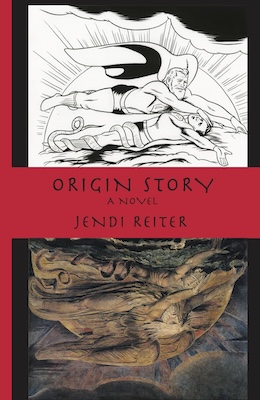
Peter, the protagonist of my novel Origin Story, is mentoring a genderfluid teen at a group home when they begin collaborating on “The Poison Cure,” a noir superhero comic about a mutant who seduces child abusers to kill them with his toxic touch. At first they merely seem to be working in the queer tradition of reclaiming monstrosity: Peter is a gay man looking for love during the 1990s AIDS crisis, and Tai’s femme Black identity is pathologized by their white foster care social workers. But as he goes deeper into his psyche to access his creativity, Peter starts to have flashbacks of a violation he never suspected. Identifying the villain of “The Poison Cure” will be a clue to his real-life trauma history—if he can bear to find out.
The books in this list demonstrate the potential of graphic storytelling as a container for experiences that shatter our conventional meaning-making structures.
In this horror comic by the author of Dead Blondes and Bad Mothers: Monstrosity, Patriarchy, and the Fear of Female Power, a rape survivor turns into a man-eating sea monster at a women’s spiritual healing retreat. Doyle complicates binary gender politics while remaining unflinching in his exposure of toxic masculinity. The island locale off the coast of Virginia resembles a sinister version of Wonder Woman’s Themiscyra, as suggested by the name of its charismatic and chilling matriarch, Diana Spiro. Women’s space, even when it includes trans women, isn’t immune to cult dynamics or violations of bodily consent. Yet when human society denies justice to survivors, becoming inhuman can seem like the only remaining good option.
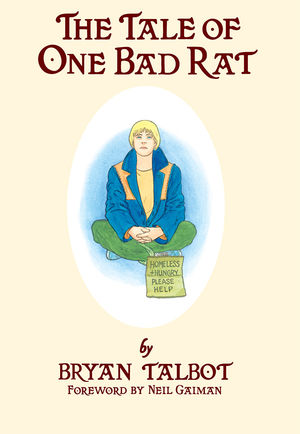
Quaint animal illustrations notwithstanding, Beatrix Potter actually wrote disturbing cautionary tales where the threat of predation hung over foolish females and runaway youngsters. Thus the allusion to her work makes a good framing device for this lushly illustrated full-color graphic novel about a homeless teen girl and her pet rat in contemporary Britain. When Helen runs away to escape her father’s sexual abuse, she heads for Potter’s historic home in the Lake District, which represents the childhood innocence she is determined to fight for. Potter’s example inspires her to become an artist and depict the truth about her family.
A story decades in the making, this memoir by a Canadian artist re-creates how she was groomed and sexually abused by her father’s friend when she was a teenager, and then her lengthy and fruitless efforts to hold him accountable through the courts. Uncluttered black-and-white line drawings broken up into small panels give this graphic narrative a low-key, almost detached aesthetic. This presentation style captures how a young person—at first naïve, then dissociated—would recount terrible facts whose significance would escape her at the time.
The amount of empty space in the drawings conveys her isolation in her father’s squalid cabin in the woods, but also the peace she found in solitude with her horse and sheep. It feels like a healing breakthrough when the final pages depart from strict realism, taking her on an inner psychic journey to rescue the abandoned part of herself.
A compelling narrative arc inspired by the #MeToo movement drives this second volume of Jackson’s self-published webcomic about the staff of an urban record store contending with unrequited love, addiction, fallen idols, and customers who have cringey taste in music. Chester Vick, a hard-partying music critic, is finally being held somewhat accountable for decades of preying on women, prompting some characters to defend him, and others to be angry and hurt that the “progressive” men in their life still don’t get it.
Most affected is Blackwax employee Veronika, a white woman who relapses into alcoholism because this news story triggers her memories of being sexually abused by her stepfather. The intersection of racial and sexual marginalizations causes a crisis when she calls the cops on a bombastic Black male activist who’s manhandling his girlfriend in the record store. However, Blackwax really is a place where people listen to each other, even when it’s painful. The resolution of their conflict is hopeful but not hokey.
Jackson’s work has standout composition, clarity, and dynamism. The black-and-white panels feel like a complete three-dimensional world because of effective variations in lighting, distance, and poses.
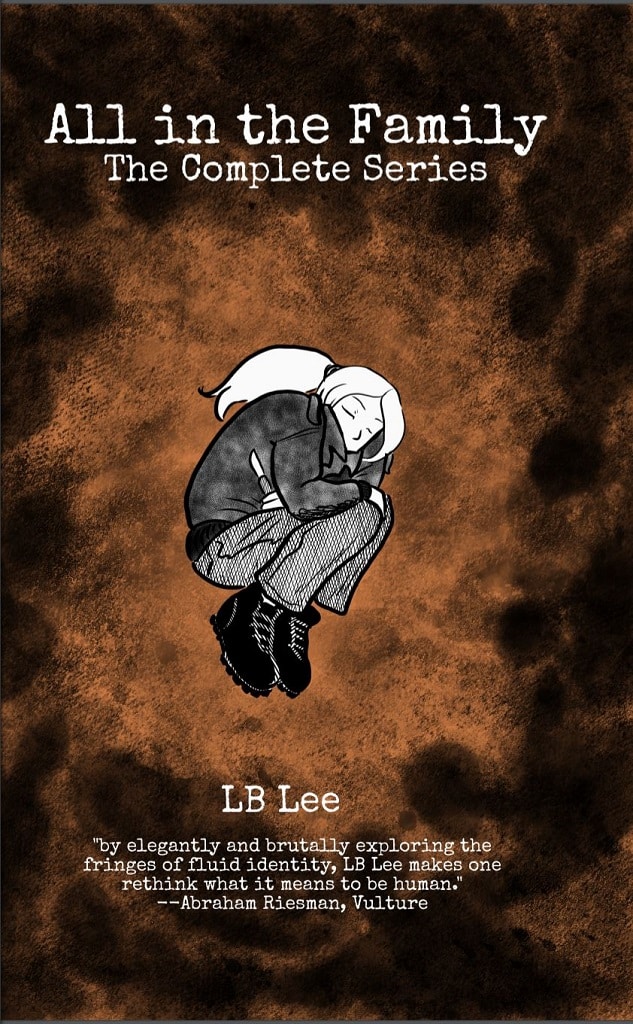
LB Lee is a transgender multiple-personality system. Their cartooning style is anime-inspired and has the simple candor of a young person’s diary combined with an adult’s tenderness toward their inner child. Subtitled “A psychological murder mystery,” All in the Family introduces us to their various headmates as they investigate why some system members have gone missing and what traumatic secrets they were created to hold.
This stark but beautiful graphic novel spans 100 years in the life of a working-class Mexican-American man. Though he lives through the major events of the 20th century, life seems to pass him by, while his family members down to the great-grandchildren experience love, madness, war, and adventure. Because of his closeted homosexuality, he passes through their lives like a ghost, so alone with his emotions that they become opaque even to himself.
It takes a generation, but his family ultimately faces the fact that Julio’s uncle is a serial predator on young boys, and metes out justice without involving the legal system. However, Julio remains in denial, perhaps associating his molestation with the sexual identity he’s been taught to abhor. The book’s stream-of-consciousness structure mimics how the significant memories of a lifetime flow into one another like fleeting impressions from a dream, rather than always being connected by complete narratives.
Drawn in the explosive and grotesque style popularized by R. Crumb and Zap Comix, whose influence Head cites, this shattering black-and-white graphic memoir takes its name from the New Jersey private school for “troubled youth” where the author was sent in seventh grade. Chartwell was run by a pedophile who groomed the boys with a bewildering combination of love-bombing, corporal punishment, and sexual abuse. It’s satisfying to learn that he was eventually convicted; Head reproduces newspaper articles and photographs of the man and his victims, definitively breaking the silence. Yet the cartoonist’s own life story is a decades-long struggle with alcoholism and pornography addiction because of his trauma. The underground comix movement was a kind of savior for him, a place where taboo thoughts and extreme emotions could be brought into the open without shame.
Eisner Award–winning graphic artist Emily Carroll adapts Anderson’s bestselling young adult novel from the 1990s about the aftermath of a date rape. Ninth-grader Melinda has gone virtually mute after a senior boy secretly assaulted her at a party the previous summer. Her parents are too preoccupied with their failing marriage to do more than punish her for her suddenly falling grades. Her classmates ostracize her for calling the police on the party, refusing to believe that their teen idol is a predator. However, an iconoclastic and devoted art teacher helps her find her voice through visual art.
This plot lends itself well to graphic storytelling, with Carroll’s pensive grayscale drawings expressing Melinda’s outer numbness and inner turmoil. An ongoing side plot about the school’s ham-fisted censorship efforts is satirically funny and timely, making it clear why Melinda feels her experience is unspeakable in her community.
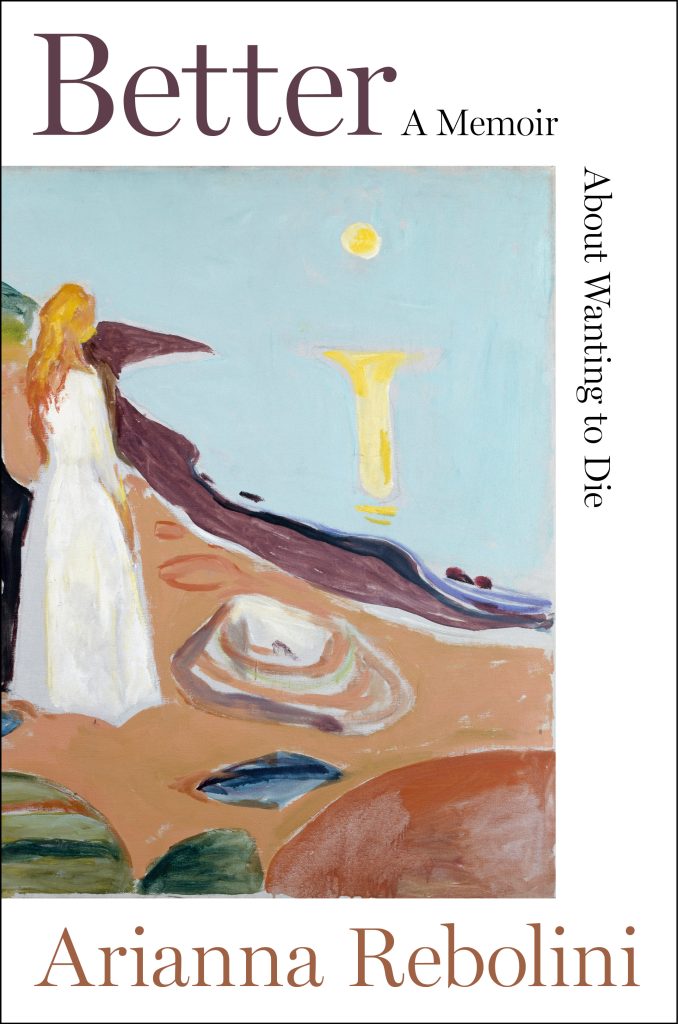
Electric Literature is pleased to reveal the cover of Better: A Memoir About Wanting to Die, the debut memoir by Arianna Rebolini, which will be published by Harper on April 29, 2025. You can pre-order your copy here.
After a decade of therapy and a stint in a psychiatric ward to treat suicidal depression, Arianna Rebolini was “better.” She’d published her first book, enjoyed an influential, rewarding publishing job, and celebrated the birth of her first child. Yet the pull of suicide was still there. One night, during bath time, as her young son Theo lined the tub with toy cars, she began calculating how many pills she’d have to down to effectively end her life.
In Better, Rebolini interweaves the story of her month-long period of crisis with decades of personal and family history, from her first cry for help in the fourth grade with a plastic knife, to her fears of passing down the dark seed of suicide to her own son, and her brother’s life-threatening affliction. To understand this dark desire, Arianna pored over the journals, memoirs, and writings of famous suicides, and eventually developed theories on what makes a person suicidal. Her curiosity was driven by the morbid, impossible need to understand what happens in the fatal moment between wanting to kill oneself and doing it—or, unthinkably, the moment between regretting the action and realizing it can’t be undone. Then her own brother became institutionalized, and Arianna realized that all of the patterns and trenchant insights could not crack the shell of his annihilating depression.
A harrowing intellectual and emotional odyssey marked by remarkable clarity and compassion, Better is a tour through the seductive darkness of death and a life-affirming memoir. Arianna touches on suicide’s public fallout and its intensely private origins as she searches for answers to the profound question: How do we get better for good?
Here is the cover, designed by Milan Bozic, featuring art by Edvard Munch.
“While writing Better, I was super conscientious about maintaining an honest albeit uncomfortable exploration of suicide without turning maudlin or nihilistic; it was important to me that the cover reflected that balance, as well,” says Rebolini. “A memoir about wanting to die doesn’t need help signaling sadness, but ultimately, the book is called Better—the point of it is that it believes in survival. We went through a few rounds of possible covers, trying to land on an image that evoked that sense of hope. That’s exactly what I see in the Munch painting: the young woman looking forward, the sun bright in the distance. I geeked out about Milan’s decision to curve the older woman—that kind of looming specter—onto the spine because it feels so true to the experience of suicidality, how it can lurk behind us, how it can feel separate from ourselves. As someone who is generally obsessed with book covers, I was giddy the second I saw the mockup.
I might have seen you for help
from my affliction with Blackness.

I don’t know. Kendrick says
he has been diagnosed

with real nigga conditions.
I needed you to make mine

go away. I wanted you
to will the earth to swallow

the cop at my door.
My relationship with the land

is the longing of my fathers
for their kin. As you know already,

I am not from here;
and cannot make request

from the land. Your fathers
have reaped from desire.

Upon learning the palace
will have its first black son

the crown decreed he will
never be called prince

and will hold no titles.
Although I do not condone,

I understand the queen.
The boy’s mother could

have removed him from
the crown’s household

because she could imagine
him growing up

to be the queen’s housenigga.
What puts us in bed with those

who lorded themselves over us
besides our desire for mercy?

When my people knew I stopped
seeing you, they wanted to know

if I was thankful because where I’m from
it’s often said that to be kept alive by

what could kill you is a gift.
Forty-One
I blamed the time difference.
  I blamed the miles over
which our voices were carried
  by the phone when my mother
claimed my voice didn’t sound
  like mine. I blamed the ocean
between us. I repeated myself;
  but my voice sounded like
a needle. When I opened
  my mouth all 23 years of Amadou
Diallo’s life fell out. I didn’t see
  his face until I rinsed the blood
off. But I held him even without knowing
  it was him because he has my body,
I mean my brother’s body. I hugged
  him because he is mine in the way
my body is mine. I cradled him until
  his eyes opened. I cradled his head
until his mouth opened into stories
  of the many ways his hands have
failed him. He stopped the stories
  abruptly before their ends. He was
restless. He wanted a haircut, food,
  and travel all at once. He wanted to live
all 22 years of his death in a minute.
  He wanted to live like he never died.
But he left me for the shores across
  which our mothers are waiting for us.
The more I learn about memory, the less I trust my own. Neuroscientists tell us that the process of remembering does not mean that we are retrieving fixed images or scenes from a sealed vault in the brain, but rather that we are firing synapses along specific pathways, leading us back to a moment from our past that changes a little every time we send for it. The stories we tell ourselves about our past are crafted and filtered, mutable and unreliable. We cannot trust that what we believe to have happened actually happened unless we can locate evidence from outside ourselves to corroborate our own story. And even then—what if the evidence is faulty?
In the age of misinformation and artificial intelligence and the Internet, this inability to trust what we remember has grown and morphed. Now we’re often unable to trust what we see, what we hear, and even what we feel. Then again, perhaps it’s unfair to blame technology… After all, isn’t this the province of literature? Haven’t stories always made us see, hear, and feel things that are not there?
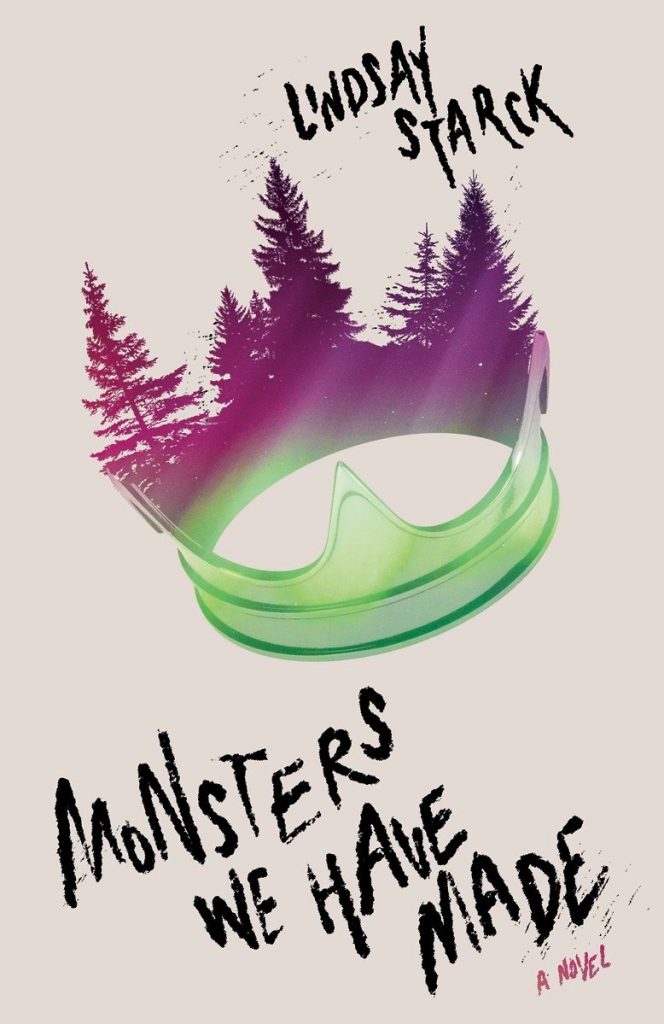
In my new novel, Monsters We Have Made, a dark and terrifying Internet legend inspires two young girls to commit a devastating crime. Thirteen years before the story opens, Sylvia’s nine-year-old daughter Faye attacked her babysitter in the name of the Kingman, a creature that she and her best friend discovered online. In the aftermath, Sylvia’s marriage, home, and family fell apart. Now Faye, recently released from a detention facility, has gone missing, and she’s left her four-year-old child behind.
As Sylvia hunts for the missing Faye, tracking her through unfamiliar cities and primeval forests, she is haunted by memories of the family she lost and by the monster who is growing ever more real to her. “In my peripheral vision,” she tells us, “I glimpsed quaking branches, cold white waves, stars colored brightly as jewels. Sometimes from my bedroom window: the crest of a black cloak coiling around the corner of the garage.” When she pages through old family photo albums, she sees the Kingman lurking just outside the frame; when she peers through the window, she sees a wooden face staring back at her.
“Sanity is a matter of borders: inside versus outside, truth versus dream, fact versus fiction,” Sylvia reflects. “How can a person tell, at any given hour, on any given sleepless night, what side of the line she is on?”
The books in this list are also concerned with those borders. What is real versus what is imagined? What is remembered and what is crafted? How do we know when to trust our perception, what do we do when our memories or our senses fail us, and what does “evidence” even mean in a world as slippery and shifting as we are?
“Scenes in a memoir,” Jill Ciment writes in her new book, “are no more accurate than reenactments on Forensic Files.” This claim is both startling and suitable for a new memoir (Consent) that revises a previous memoir (Half a Life) that Ciment wrote twenty-five years ago. The older narrator of Consent analyzes her younger self’s “memories” in Half a Life to illuminate how those memories were deliberately—sometimes creatively—crafted. In her first book, Ciment framed her relationship with an art teacher thirty years her senior as a choice she willingly made. In the second, she wonders whether it was ever possible for her seventeen-year-old self to willingly choose a married, middle-aged father of two. In a recent interview, Ciment described the first memoir as the product of the “shared mythology” that defines a relationship, and suggested that she didn’t tell the whole truth (even to herself) because she wanted the story of her marriage to be one in which she was empowered, not victimized. Her observation that “a memoir is closer to historical fiction than it is to biography” reminds us that our own memories, too, are crafted: polished, cut, exaggerated, shined.
Simultaneously a fictional biography and a counterfactual history, Biography of X follows narrator C. M. Lucca as she struggles to uncover and record the mysterious life of her recently-deceased wife, X. The trouble with X is that she was a performance artist whose entire life, we learn, was a series of performances—making it difficult for the grief-stricken Lucca to figure out which elements of their relationship were real. Lucca chooses to write X’s biography (expressly against X’s wishes) because she needs to be reassured “that our life had actually happened, that I had been there with her, and that I hadn’t imagined all those years, her company, our life, the home we had in each other—though I was forgetting her every day, forgetting whatever was between us and whom she’d been to me and who I’d been beside her.” With X gone, Lucca becomes the sole keeper of those memories; which means that she can no longer be certain of their veracity.
Ruth Ozeki’s A Tale for the Time Being, a novel concerned with the slippage between past and present, is filtered through protagonist Ruth, a writer unable to complete a memoir about her mother’s struggle with Alzheimer’s. When she finds the diary of a Japanese teenager, Nao, Ruth decides to track her down. As Ruth suffers increasingly from lapses in memory and dreams that bleed into reality, she becomes desperate for “corroboration from the outside world… that Nao and her diary were real and therefore traceable.” Over time, her own sense of self becomes uncertain: “Was she the dream? Was Nao the one writing her into being?… She’d never had any cause to doubt her senses. Her empirical sense of herself as a fully embodied being who persisted in a real world of her remembering seemed trustworthy enough, but now in the dark, at four in the morning, she wasn’t so sure.” Ruth’s uncertainty begs the question for readers, too: what evidence do we need in order to trust that what we have experienced is true?
I really love this strange, ethereal, fantastical, gem-like novel, which takes place in a magnificent, classical, sprawling mansion full of waves and statues. The protagonist, known to us as Piranesi, lives in “the House” alone and engages twice a week with a mysterious, irritable person we know only as “the Other.” When the book opens, Piranesi is content in his strange existence, unaware that anything might have come before it. But then he discovers that pages have been “violently removed” from his diary, and that other entries look like his handwriting even though he doesn’t remember writing them. When the Other informs Piranesi that he does, indeed, forget things, Piranesi’s initial shock gives way to disbelief. “‘The World’ (so far as I can tell) does not bear out the Other’s claim that there are gaps in my memory,” he muses. “And so I have to ask Myself: whose memory is at fault? Mine or his? Might he in fact be remembering conversations that never happened? Two memories. Two bright minds which remember past events differently. It is an awkward situation. There exists no third person to say which of us is correct.” Even without that third person, Piranesi’s new wariness of his own perception and experience leads him to conclude that the Other “is right about one thing. I am not as rational as I thought.”
At the heart of Valeria Luiselli’s Lost Children Archive are a boy and a girl traveling with their parents toward the Mexican border in Arizona. Their parents are sound documentarians working on different projects: their mother on the children’s immigration crisis at the border (a story that has been ignored) and their father on the last Apache leaders on the American continent (a story that has been erased). “The story I need to tell,” reflects the mother, “is the one of the children who are missing, those whose voices can no longer be heard because they are, possibly forever, lost. Perhaps, like my husband, I’m also chasing ghosts and echoes. Except mine are in history books, and not in cemeteries.” In the backseat of the car, the boy and girl play at being lost children, too; and when they finally take off alone, their game becomes real. The novel deals with the erasure of historical memory, the creation of familial memory, and the lengths we go to in order to prove to ourselves and each other that something happened. “When you get older,” the boy informs the girl, “and tell other people our story, they’ll tell you it’s not true, they’ll say it’s impossible, they won’t believe you. Don’t worry about them. Our story is true, and deep in your wild heart and in the whirls of your crazy curls, you will know it.”
One of my favorite novels to teach, Tim O’Brien’s In the Lake of the Woods is a vivid, sylvan thriller whose experiments with form and style contribute to its mystery. Centered on the disappearance of Kathy Wade—the wife of a Vietnam veteran-turned-politician John Wade—the book intersperses conventional narrative chapters with sections labeled “Evidence” (which consist of citations and interview fragments) and sections labeled “Hypothesis” (which describe all of the fates that could have befallen Kathy Wade). As the story progresses, John Wade struggles to remember what happened on the night she disappeared—but he has spent so many years deliberately forgetting what he saw and did in Vietnam that his memory is dangerous and unreliable. Although the “missing person” in the novel is ostensibly Kathy, John’s failure to remember what he did or didn’t do to her shatters any sense of a coherent self and transforms him into a type of missing person, too.
Minor Detail by Adania Shibli, translated by Elisabeth Jacquette
Adania Shibli’s slim and devastating Minor Detail is less about the erasure of the self and more about the disorienting experience of moving through a once-familiar, beloved landscape that is in the process of being erased. The first half of the novella depicts, in spare prose and unflinching detail, the rape and murder of a Bedouin woman by Israeli soldiers in Palestine in 1949. In the second half, an unnamed narrator in Ramalla undertakes a dangerous journey across borders and through checkpoints in order to learn more about the crime. The evidence she seeks is the kind of minor detail “like dust on the desk or fly shit on a painting, as the only way to arrive at the truth and definitive proof of its existence.” But no one she meets can tell her anything about the crime; and the further she travels into an occupied land from which all traces of Palestinian villages have been erased, the more disoriented she becomes. In a space in which the unimaginable—rape, murder, the bombing of the office building next door to hers—is so unrelenting as to become mundane, one’s very existence begins to feel surreal, unlikely, and nightmarish.
“The literature of adoption,” writes Shannon Gibney, “is a fictional genre in itself.” In The Girl I Am, Was, and Never Will Be, Gibney leans into this argument by weaving together her own actual adoption story (including documents and photographs) and the story of what might have happened if she had remained with her birth mother. By intentionally combining memoir with speculative fiction, the book illuminates the multiple pathways that exist between the past and the present. Gibney’s fictionalization of memory liberates the narrator from the impossible project of perfectly reconstructing the past, provides her a new angle on the present, and reminds us that the boundaries between inside and outside, truth and dream, fact and fiction are much more permeable than they appear.
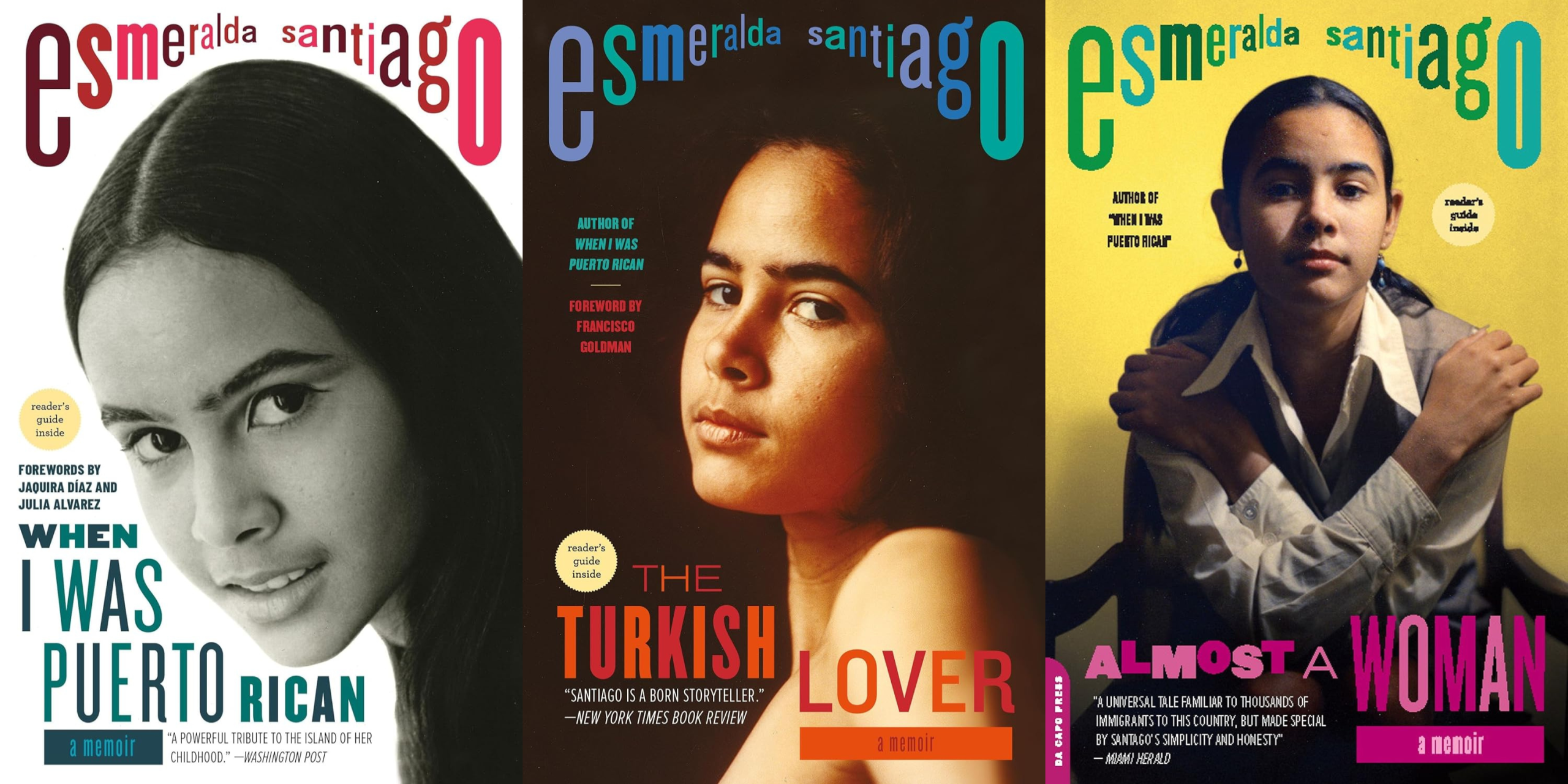
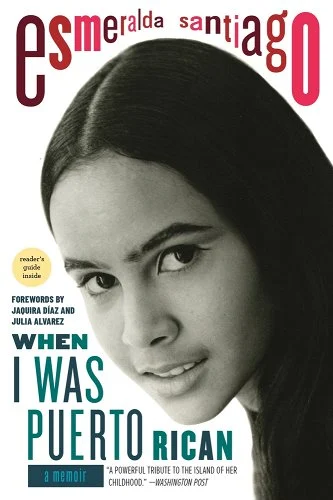
Esmeralda Santiago’s book When I Was Puerto Rican debuted 30 years ago. This memoir introduced us to Negi (Santiago), a pre-teen with a captivating voice who chronicles her life in rural Puerto Rico in the 1950s. In Santiago’s own words, the memoir captures a world that no longer exists in Puerto Rico.
We watch Negi grow from four years old to becoming a teenager, from living in rural Puerto Rico to living in Brooklyn, and from helping rear her younger siblings to having to take on the responsibility of learning English. We watch the dissolution of her parents’ relationship, constant dislocation, and how the United States transgresses into their lives by innocuous means like a nutrition guide and by a nasty concoction of powder milk and peanut butter. But we also see Negi’s curiosity, her incessant questions to her poet father, her defiance, her love of storytelling, and how Negi and her family survive. They keep going, and this memoir ends with a fairy tale ending, which is what any reader would want for Negi after reading this endearing and enduring memoir.
I interviewed Santiago via Zoom. Our conversation took frequent diversions which gave us insight into the world of working-class people in New York in the ‘60s; her ordinary, but extraordinary, mother; and how as we grow, we learn to forgive our parents and all the uprootings we may have suffered.
Ivelisse Rodriguez: All three of your memoirs, When I Was Puerto Rican, Almost a Woman, and The Turkish Lover,are being reissued, along with audio versions in English and Spanish narrated by you. What does it mean to you as a writer to have written books that have had such longevity to the extent that 30th anniversary editions are being published?
Esmeralda Santiago: I was thrilled to hear that the book has been in print for 30 years and being taught in schools across the United States and in some foreign countries. We often think our lives are so singular. But in many ways, there are so many points of connection between us and other people who are completely unlike us. This is what I love about memoir—you can write about your experience in rural Puerto Rico in the 1950s, and somebody in Moscow can get something out of it. It’s fantastic.
IR: What was the impetus to write your memoirs?
ES: I started writing from a place where I felt invisible in the United States. I had a child, and I was worried that my child would not know anything about his mother. We lived in suburban Massachusetts, and I was pretty sure I was the only Puerto Rican in this town. So I began to write because I didn’t want to forget the experience of how I grew up, and I wanted to pass it on to my children, so that they knew about it, even though they were going to have a very, very different life from the one that I had.
I started writing from a place where I felt invisible in the United States.
Also, when I was in Brooklyn, I found myself learning about the United States by reading the literature that I came across. But then at a certain point, I realized, wait a second, I’m not in this culture. None of the books are about me. And that’s when my need to write about people awakened, so that I would not be the only one going through this experience.
And when I was about 16 or 17 years old, the famous, wonderful poet, writer, essayist Langston Hughes came to my high school. He came to do a presentation about his book and to talk about being a writer. And I just remember he was just so very handsome, he was dressed beautifully, and he was this Black man with such dignity, and a beautiful voice, and he talked about his writing and about how he hadn’t seen himself in literature either.
IR: Oh my God, that’s amazing that you got to meet Langston Hughes!
ES: It was just sheer luck that on that day, I didn’t have to take my mother to welfare, or I wasn’t sick, or something. I happened to be there when this man was there with an important message for all of us. This message of writing yourself into the literature really, really stuck with me to the point where when I met people who were at his presentation, they don’t remember that event until I remind them. It was like he came from this place in Harlem to talk to me, who could barely understand English. But I literally went from school to the library and took a stack of all his books that I could find and read them all. He showed me the way to write about myself in literature, and I am forever grateful to him and to that event and to whoever organized it.
IR: Though there were hardships in your childhood, one of the things that always stood out to me about your book is how endearing it is, and how lovingly you recreate your childhood in Puerto Rico. How do you, as a writer, hold the hardships of the past alongside the love for the past?
ES: I decided to not write it from the perspective of an adult because an adult makes all kinds of assumptions about the past; we visit the past in a way that’s more comfortable for us. So, I decided I was just going to try and inhabit the child at that stage and detail what that child would have experienced and would have noticed at that age. And so, by doing that, it made it possible for me to really tell a story rather than trying to make sense of the past or turn the writing into therapy. By limiting the point of view to the child, I thought the reader would have a much more immediate connection to the experience.
IR: I was wondering about the courage to represent your mother as you saw her when you were young. She was doling out cocotazos and frequently fighting with your father. At first, she seems angry, but as we keep reading, we see what she was going through.
ES: In When I Was Puerto Rican, I just didn’t want to add the knowledge that I now have as an adult to this child’s head. As a child, all you know is what you’re seeing. For example, as a child, I didn’t have any idea about infidelity. My mother just said your dad is with other women. As a child, you can’t even envision what that means, but obviously it’s a bad thing. If you read my other memoirs, the character of Esmeralda continues to mature intellectually, so she’s better able to make those kinds of connections later on. It requires experience in life for you to understand those kinds of things.
Plus, I didn’t want to subject my parents to psychologizing. It was a literary decision that made it possible for me to avoid playing Dr. Freud.
IR: How did your mother react to the book?
ES: At some of my events, my mother would answer that question by saying, “You know, everybody talks about this book as if this is about Esmeralda, but this book is about me.” So, she understood that she was the hero in this book. Even though I’m the main protagonist, she really is the person who makes things happen for the character. And then my dad said he loved being the villain in this book.
This story was about people like us: jíbaros.
The rest of my family has been like her. They’ve been very, very supportive, encouraging and generous about not challenging any of the things that I’ve said because they all understand this is the way I saw things, even though they might have had a different experience. I’m the eldest of 11, so we all say that we each had a different mother. The more experience she had as a mother, the more she learned and became a different person.
My mother also thought it was great that this story was about people like us: jíbaros. I think my parents really understood that I picked up on something that had not been done in literature. There really wasn’t a lot of writing about the jíbaros from the perspective of the jíbaros. The books that existed about that community were written by people from places like Barcelona. They did not live that life, but I lived it. So, I wrote When I Was Puerto Rican from the perspective of a jíbara. And my mother really appreciated that. She said my book really sounds like the way it was. My parents were both smart people, and they liked reading, and they liked seeing themselves in literature.
IR: That’s an excellent point about the jíbaro experience and who was writing about it. I am glad you pointed out that this was a gap you were filling in literature by Puerto Ricans. Also, it is interesting to see how you come to understand yourself as a jíbara. Early in the text, when you’re living in Macún, you wonder what a jíbaro is, and you are told these people who live in the countryside with all there mores are nothing to aspire to. But when you moved to Santurce, you were called a jíbara, so you had to see yourself in a new way.
This is the beginning of a series of rejections and becomings that you had to endure for the rest of your life. How did this help you transition to living in Brooklyn?
ES: Well, I think when you live in chaos, you get used to living in chaos. You find ways to deal with the chaos around, for example, the chaos of being in one-room apartments with eight, nine, ten, 12, 15 people. I can’t control that. That was all we could afford. I really understood that. I was very empathetic to my mother’s struggles. In fact, at a very early age, even though I was angry at her for bringing me to New York, and not going back to Puerto Rico immediately when Raymond was fine about a year later, I really understood that a lot of what was happening around us was outside of our control, my mother’s too. I remember she would work in a sweatshop for a week, and on Friday when she got to work, it would be closed because they didn’t want to pay the workers. This happened to her all the time, to the point that she then only worked in the sweatshops where they would pay at the end of the day. She learned how to fight for herself. She had to make these transitions as well.
We were all going through these transitions: learning language, getting used to the climate, and more. All those kinds of challenges were happening to all of us at the same time. But of course, my mother had the biggest responsibility because she had all these children.
IR: One of those challenges was learning English, and this led to a fight with your mother when you came home late from the library. She accused you of thinking you could do whatever you wanted because you spoke English. In what ways did learning how to speak English give you freedom to develop a self?
ES: My mother really just drilled it into me that I had to learn English when we came to the United States because, first of all, she needed a translator. I was the eldest, and I was the most willing because I was always reading. I had to learn it fast because she couldn’t do it. And no one in our immediate family was remotely bilingual. So, I knew that this was my task. I had to learn it quickly, and I had to learn it well enough to be able to help my mom because that was the only way that I could as a little kid. I didn’t resent it. In fact, I thought it was great. I love learning. I came to the United States in 8th grade. By the time I graduated, I entered grade nine, and I was reading at a 10th grade level in English. But I couldn’t pronounce things. I couldn’t speak it. I mean, I could have, but I would have mispronounced everything. So I was very silent and quiet the first two or three years that I was in school, but I aced all my exams. I realized then that that gave me power. When translating for my mom, for example, I realized I couldn’t mess up the translation of application forms or mess up translating for a kid who’s convulsing.
The culture was harder for me. I was a teenager who wanted to be like every other girl. And, according to my mother, I was not like any other teenager because I was Puerto Rican.
IR: In Nicholsa Mohr’s Nilda, another classic book written by a Puerto Rican woman about girlhood, Nilda’s mother is giving Nilda consejos on her death bed. Among the advice the mom gives is that she warns Nilda that men will leave her with a bunch of children, and then she will have to go on welfare. This is, at times, what happens to your mother. Nilda’s mom continues with her advice and tells Nilda to always keep something for herself that is all hers and that if she cannot see beyond being a mother, then life was not worth it. What do you think are the things that your mother kept for herself that brought her joy?
ES: First, I think my mother really kept a lot of stuff from us. A lot. And I don’t know just how much. Maybe I know 4.5% of what she went through from the interviews that I did with her. And even that information was absolutely horrific to me. I know that I will never know what all her sacrifices were.
But in terms of what brought her joy, she was a child of the depression, so she just loved feeding the people she loved and making sure that they were nourished. She loved dancing. She loved music. She wasn’t a swimmer, but she liked going to the beach just to feel the salt air. She loved dressing nicely. When you’re raised very poor, you have longings for certain things. When my siblings and I all had jobs and could make money, we gave her gifts that would bring her joy.
She was somebody who was full of joy in many ways in the midst of chaos, tragedy, hard work, and humiliations. She always found a way to smile and to find joy in something. And I think she passed that on to all of her children.
IR: That’s really heartwarming—that you were able to participate in giving her that joy.
In When I was Puerto Rican, before you get to Brooklyn, you write that you did not forgive the uprooting. At this stage in your life, have you forgiven the uprooting of coming to the continental U.S.?
ES: Yeah, I guess I have. I’m not a person for regrets. As a child, I was very angry for years because I didn’t understand what had happened. Nobody explains it to you when parents break up. And then many, many years later, as I matured, as I learned, and as I knew my parents better, I understood that they really did the best that they could with what they had. Once I understood that adults do things for reasons that children cannot understand until they’re adults, then it was really easy for me to forgive.
In Puerto Rico, the doctors were ready to amputate my brother Raymond’s foot. My grandmother and all of my mother’s aunts and uncles were in New York, so they encouraged her to get a second opinion in the United States. And, the doctors in the U.S. said they could save his foot. She came back to Puerto Rico, and she asked my dad if he would go with us. My father and his family were very independence-minded, anti-imperialism, and anti-colonialism. So he refused. My mother was forced to make a choice between her children or her man. Even though they were always fighting, they really did love each other. She had to make that decision, and she chose her children. She knew that she would have to move to New York, at least for a year or two, in order to make sure that Raymond was completely well. I think once she was here, she realized, it’s equally hard here, but I have more help here. Seven years later, she did go back to Puerto Rico with all the kids that were left. And it was just me and Elsa who were in the United States. We were both studying, so we didn’t want to go back at the time.
Both my parents have passed, and I think they should be and must be very proud of the children that they had because we are two or three steps economically from where they were at their best. That was something that they wanted for us. They wanted us not to struggle quite so much. We still struggle, but the struggles are different. We live in nicer neighborhoods than we did when we were growing up. So, all their sacrifices, dreams, and aspirations did come about. I’m very proud of the work that my parents did with us.
Since its birth, Frankenstein has never lost its allure in adaptive possibilities. The novel was first adapted to the stage by Richard Brinsley Peake in 1823, just five years after the first edition of the novel was published in 1818. It’s widely known that Shelley herself attended a performance and was bemused by how he brought her masterpiece to life, even though she found it “not well managed.” Peake strips the Creature of voice and contributes the line, It lives!. The most contemporary image we have of the Creature is, of course, born of James Whale’s interpretation (I use that word loosely, as he renders the Creature nowhere close to what Shelley penned onto page) and Boris Karloff’s embodiment in Universal’s 1931 Frankenstein. It’s in this film we inherit, for all of eternity it seems, the bolts in the Creature’s neck. The voicelessness remains intact, continuing to refuse the eloquence of Shelley’s thoughtful abandoned creation.
Although I’ve engaged with Frankenstein textually for twenty years, culminating in my most recently published queer Asian Frankenstein retelling, Unwieldy Creatures, my first adaptation, Victor Frankenstein, was for the stage, a contemporary ballet dance theater adaptation I co-created with choreographer Dominic Walsh. Our adaptation didn’t just tell the story of Victor and the Creature, but also Shelley and Percy, her mother Mary Wollstonecraft, and how those relationships and losses informed her greatest work. Certainly there’s something the page can affect in a retelling that becomes more complicated in the embodied visualization on screen or stage, which must contend with how to successfully enact it, with limited funding, and with reliance on what the performer, design, or technological tool, can achieve. The reading experience is such an individualized act, and it doesn’t need to consider the flashiness of the gimmick, or the audience expectation of the spark. Our Victor Frankenstein received one review, by a reviewer who felt that whatever he wanted from a Frankenstein dance theater production, we didn’t quite deliver it.
As technological and reproductive advances open up questions around science, creation, and “nature,” Frankenstein continues to be a thriving laboratory for contemporary filmmakers. This past year, I encountered four different contemporary American films inspired by Frankenstein. I found myself considering the failure of these adaptations, a conclusion I’ve come to more often than its reverse, especially when helmed by white creators. It’s strange, isn’t it, to feel so protective over how a text is adapted by white creators, when it, itself, was brought into the world by one? Perhaps the difficulty of the Frankenstein adaptation is what also made my beloved so resonant as to stay attached to me through my entire life.
I co-created Victor Frankenstein early in my understanding of the role race, and whiteness, can perform on stage or screen, particularly when thinking of the power of the other as inflicted onto the Creature.
But in considering two of the four adaptations I saw this year, Poor Things and Birth/Rebirth, I was left wondering: Is a Creator ever able to see their Creation beyond their own biased need of greatness? Is it possible for a Creator to become both Creator and Creature all at once? When whiteness takes the wheel, how does the Creature (within the film as well as the film itself) suffer?
I first fell in love with Frankenstein at 19, the same age Shelley was when she penned my beloved into being. I was a young biracial Asian queer femme twin who’d just escaped the clutches of my dominant, narcissistic father—a Taiwanese NASA engineer by day who performed in Mandarin dramas by nights and on weekends—and an abandoning white mother who had just fled the state. It was the late 1990s, a time during which being biracial was stigmatized and made alien. If I wasn’t being exoticized—the mixed ones are always hotter, Asian women are tighter, you should meet my friend, he has yellow fever, “me love you long time”—I was asked what are you? No matter what answer I gave, I always felt creature, monstrous. It wasn’t an unfamiliar sensation, as I’d been treated like a specimen, a phenomenon, the uncanny, growing up as a mirror twin. Whatever fetishized experience I was forced to hold as a mixed race Asian teenage girl was doubled as one of twin mixed race Asian teenage girls. My relationship to my own identity apart from my twin was tenuous at best, a result of having an emotionally unstable and physically distant mother, a dominant and physically abusive father. We were kept from our American peers, surrounded by my father’s Taiwanese friends without any access to the language, sitting silently while we were ogled and referred to in a language we couldn’t understand. Beautiful and eerie, the world frightening yet familiar. Out of her own insecurity at her ability to be present with us as well as herself, my mother couldn’t get far enough away from us, or also became complicit in our exoticization—like the time she wanted us to audition in Miss Saigon at sixteen. My father’s unprocessed trauma with his own parents, complicated by having married and divorced a woman who saddled him with caring solely for children in a new country with no family support, was turned on us, raging when we made clear we were visible, independent bodies in the world, not merely there to support his own ego.
I’d been treated like a specimen, a phenomenon, the uncanny, growing up as a mirror twin.
From all of this confusion and pain, I met Frankenstein. It was through Frankenstein I learned about the narcissism of my father. I recognized the abandonment of my mother through the grief Victor experiences at his mother’s death. I navigated the duality with my twin as Victor and his creation orbited one another, as well as our complicated enmeshment that compels Victor towards and away from Elizabeth. It was in listening to the Creature’s literacy narrative I encountered a being who came to understand the world as I did—while watching my father enjoy his Mandarin-infused life to which I was relegated to the sidelines—watching and eavesdropping on others inhabiting a world he could not claim. Through the Creature’s heartbreaking plea for a companion I understood my own need to be connected to others on my own terms. As the Creature sang his devastating aria of rejection I, too, came to understand my own internalized monstrousness as a biracial person of color, a fetishized twin, seen only through the lens of others, rather than myself.
I knew nothing about Poor Things when I went to see it during the holidays. Multiple friends urged me to see it because it’s so Frankenstein. I should have been more discerning, as I’ve come to understand there is the stan whose fandom is excited by any interaction with the source of their fandom, and then there is me, who wants only the best for their beloved.
Poor Things is considered a feminist masterpiece and a journey of a woman’s female empowerment, through a fixed male gaze. It’s been disappointing how many in my community believe it is possible to create any story of female empowerment within that gaze. Is the wager still, even now, the same? If the gaze on women is composed from the eyes of men, then what is their empowerment made of?
Poor Things is a film helmed entirely by white men. Directed by Yorgos Lanthimos, the screenplay is written by Tony McNamara, based on a novel of the same name by Alasdair Gray. At its heart, the film uses the science of Frankenstein and the magic of scientific acceleration to depict a pedophilic fantasy. This embodiment is made ever more troubling given the long history of predation established between young girls and women in Hollywood and older, more powerful men who have groomed them with the promise of career and safety. This embodiment is made ever more troubling given that the central plot device that allows for this fantasy wasn’t literalized in the original novel.
If the gaze on women is composed from the eyes of men, then what is their empowerment made of?
Cinematically speaking, the film is stunning, in art direction and costuming, another trick of the hand to groom the watcher into a dopamine-fueled trance. This is also one of the ways we fall for Victorian dramas—the ruffles, the waistcoats, the coaches, the lavish countryside. We don’t question why there’s only one Black character who lasts just long enough to give our white protagonist some much needed wisdom and a check from her clueless position of privilege, because, hey, it’s the 1800s, only white people existed then! We don’t question why the heads of science are all white men. But regardless, no matter how critically aware a viewer might think they are, the conditioning of this sparkling white fantasy is still doing its part.
This is another way to make note of why Frankenstein adaptations so often fail—they focus more on the look of the thing, the science fiction of the dead body parts being brought to life, the technological magic to cinematically animate death, and less on how Frankenstein gives us the opportunity to reflect on what our creations say about our narcissistic exposures, how hidden our griefs on being rejected by those who create us.
Poor Things reminds me of a lacquered violet plum, the shade glistens as if shot in technicolor, yet when you take a bite, the rot overwhelms the brain to horrid confusion.
Bella is a woman-child. Her father, the medical scientist God (short for Godwin, its namesake Shelley’s own family and maiden name) resurrected her shortly after she drowned herself in the river while pregnant—by replacing her dead brain with that of her unborn child.
God’s father put science and progress over his safety and wellbeing by experimenting on his body in cruel and perturbing ways, such as taking out his oxyntic and pyloric juices so that he must use a contraption to make his own gastric juices (in order to discover that we need them ideally), pinned his thumbs into a small iron case to see whether he could retard the growth cycle of bones, and branded his genitals with hot irons. This is one of the first failures of this Frankenstein—using the white male lens to frame our white God as victim. Our God hires a young assistant, Max, to record his experiment Bella’s progress, who is progressing at an accelerated pace. Bella is a child in a woman’s body, waddling and speaking like a toddler, spitting out food she finds unpleasant, throwing tantrums when she doesn’t get her way, smashing dishes and important medical jars of equipment on the floor, and playing with the penis of a cadaver in God’s laboratory while stabbing its eyes out.
Max begins to fall in love with his subject. As Bella progresses, she becomes more independent and obstinate. She also begins to connect with sexual pleasure, but in her childlike state has no understanding of the complexities of desire and sexual connection.
The novel still refuses a story in which Bella speaks for herself, but at least she is a consenting adult.
Poor Things is supposedly about Bella’s journey—but one which largely depicts her insatiable sexual need as that of a horny fourteen-year-old boy, a need gratified either by men whose only desire is to control her, or clients for whom she provides a need and service as a sex worker, the only employment Bella is offered. Sexual consent is impossible because she has the (albeit rapidly-progressing) brain of her infant child, a brain that, since Bella does not age considerably throughout the film, cannot have developed that extensively. Because we are seeing her through the guise of an actual adult, played by Emma Stone, it is easy to forget Bella is not a woman, but a child with an adult body. If one possibly imagines she is consenting to her position as a sex worker, one need only be reminded that when she asks her supervisor why the sex workers are not allowed to choose their clients (their clients are the ones who get to choose), her supervisor responds, Some men enjoy that you do not like it.
In the original novel, Bella doesn’t have a child’s brain. It is a lie her husband tells to excuse her independent and free-spirited nature. The novel still refuses a story in which Bella speaks for herself, but at least she is a consenting adult.
As a Frankenstein, a novel that addresses what it means when the thing you’ve created is a monster in your eyes, Bella is called a monster, a word flung at her synonymously with the word whore, one she claims herself, but only because it is thrown at her by men who seek to control and possess her. How noble is the young scientist Max who agrees to wed her even knowing she is a whore, who sees her as both specimen he was hired to study, as well as the object of his affections? How predictable is it that this film, made by three white men, is unable to provide what Shelley gives her Creature: an opportunity for us to see Bella, and her world, from her own point of view?
What makes my beloved so unique, so resonant, for so many of us is that we do not see Frankenstein’s Creature through Frankenstein’s eyes as much as we see him through his own. Aside from three moments—when the Creature comes to life, when he approaches Frankenstein to ask for a companion, and upon seeing Frankenstein’s dead body—we become most acquainted with the Creature through his own words, his own experience. It matters that the most significant and substantial origin story we’re offered is not that of the scientist about his deep feeling of failure but of a Creature who seeks companionship and love, for his existence to be acknowledged. We learn what makes him monstrous—when Felix DeLacey comes upon the Creature attempting to befriend his blind father and misunderstands that the Creature’s hideous form does not translate to his spirit, which sets off an internalization of the world’s monstrous view of him so that he begins to exact a strategic system of revenge against his creator who has abandoned him—not through the point of view of Victor or even of Felix but himself.
In Poor Things, it is the Creator whose origin story of abuse is most centered, and it is the Creator and the Creator’s Assistant who we must witness in their grief of being abandoned by their child-woman experiment, left to sit in their loneliness and despair that their aims to control and study her have failed. Since the film is told through the eyes of men, Bella is never truly freed from their lens, never truly empowered to understand the world from her own eyes, and so neither are we.
Because we never leave the gaze of the Creator—both the men who have made the film as well as the Creators within the film’s narrative—we never see Bella outside of the object/monster/whore construction they have placed on her. After all, it is when Shelley’s Creature gets to speak, when we see the Creation from his own point of view, rather than he who has made and rejected him, that we understand.
How do we balance the cinematic titillation of the Frankenstein gimmick with the complexity of Shelley’s exchange around the maker and the made? How do we build a woman-child into a Creature without reducing her to a monstrous trope?
In 2019, I wrote Unwieldy Creatures, my queer non-binary Asian retelling of Frankenstein, because I wanted a queer POC-centered Frankenstein to exist in American fiction that explored my beloved in all the ways I most sought to find in the world.
IVF was on the rise and Georgia was beginning to restrict abortion.
IVF was on the rise and Georgia was beginning to restrict abortion. From the time I began therapy and came to terms with the toxic narcissism of my father and subsequently of so many people I would involve myself with in the mid-2000s up to that point, the word narcissist no longer held much meaning. We were having more thoughtful dialogue around how to write and publish stories by minoritized and marginalized writers that allowed for a complex range of characters, no longer relegated to caricatures of villainry or tragic sainthood. Since narcissism was almost exclusively considered the domain of men, I wanted to see what would happen if I created a Frankenstein who was a queer woman of color. How would it change the framework through which we see and understand our creator? How would the difference in power dynamic change their relationship if it were Ezra who now sought for Frankenstein’s wedding promise, instead of Elizabeth? If we made explicitly queer what many readers felt was a queer coded relationship between Victor and his dear friend Henry, what else would shift in its place? Finally, if the Creature, who has never been welcomed to participate in civilized society, was not assumed male (for isn’t it the case we accept, reject, and disrupt codes of gender because we are conditioned to live within these codes?), how would that change the way we view them? These were some of the larger ideological shifts I wanted to explore in a modern-day Frankenstein. I wanted to stitch together the heart of my beloved with my own blood, and see what would happen when I infused them with electricity.
Frankenstein is not really a horror film. It’s also not exactly science fiction, despite the fact that it’s often lauded as the first science fiction novel of the (Western) world. I have always seen Frankenstein as a film that addresses some of the most essential and complex ideas of humanity. In the capitalist mindfuck of 2024, I’m dying for a Frankenstein that addresses the ways we as marginalized bodies are used for the dominant structure’s egoist enterprise, the ways masculinity and power work hand in hand to disempower and abandon those most vulnerable. If filmmakers could mine all that Shelley gave us, we’re primed for a truly harrowing, complicated, and beautiful cinematic creation that takes into consideration that the point is not the stitching from dead body parts, the animation of electricity, the mad scientist. The point is not the Creature uncanny and awkward in their movements, soulless and cruel, seen only through the eyes of humans viewing a creature as experiment and progress. But in order to make such a creation, one needs to let go of the horror trope that has saddled Frankenstein’s Creature since the 1931 adaptation—the bolts in its head, the zombie walk, the non-verbal vocalizations. One needs to let go of the fixation on reanimation, electricity, it’s alive! One needs to let go of the film adaptation of Frankenstein as a cheap thrill, and instead consider how we might, as Frankenstein never could, see our Creature as multi-dimensional, rather than only through the eyes of voyeurism and commodification.
Just like Poor Things, the film Birth/Rebirth isn’t a Frankenstein stitched together with random dead body parts, but unlike Poor Things, Birth/Rebirth offers us a feminist lens. Shelley’s Frankenstein is a story of (white) men told by a (white) woman, during which all the women die. Poor Things is a story of a (white) woman told by (white) men (and does it hurt). Birth/Rebirth is a story of a white pathologist, a Black nurse, and her dead child, told by a (white) woman.
Shelley’s Frankenstein is a story of (white) men told by a (white) woman, during which all the women die.
In Birth/Rebirth, two women unexpectedly join forces through their separate experiences with loss. Rose, a white pathologist, has been working on bringing the dead back to life using fetal tissue. She resembles our Victor more than most modern-day Frankensteins—emotionless and obsessive, seeking solitude over connection, torn between solving the problem of her mother’s death and her own egoist need for advancement. She becomes entangled with Celie, an Afro-Latinx maternity nurse who works at Rose’s hospital, when Lila, Celie’s eight-year-old daughter, dies from bacterial meningitis. Rose steals Lila’s body to attempt to revive it through her own scientific discoveries. When Celie discovers where Rose has kept her child, she’s so desperate to have Lila back she insists on helping bring her back to life. The pain that connects Rose and Celie is that of the grief tied to the loss of Rose’s mother and Celie’s daughter.
In Frankenstein, Victor’s mother dies as a result of caring for Elizabeth after she contracts scarlet fever. Young Elizabeth survives, but his mother does not. Struck with grief and a grandiosity for his own ability to surpass the innovations of the scientists of his time, Victor becomes obsessed with curing death by reanimating the collaged bodies of the dead back to life. It’s this narrative thread that is the ghostly trail ribboning the room where Rose and Celie both need the experiment to work.
Although more compassionately complex than Poor Things, the failure of this Frankenstein remains the same: Frankenstein works because the story itself is told from that of a marginalized Creature (Shelley as a woman in the 19th century), rather than a Victor. Rose’s inability to connect emotionally to herself or others keeps Lila a specimen in her eyes, just like God’s Bella Baxter. The director’s unwillingness to bring Lila, the Creature to life—what pressure Whale has put on all Frankensteins for all of time!—means we never get to witness Lila outside of the experiment.
But, in this case, gender is only part of the story.
When I’m interviewed about Unwieldy Creatures, I often say toxic white masculinity is the true villain. I also say we learn through the novel what happens when a person reflects and examines the traumas of their own life so as not to perpetuate that harm onto others, and what happens when they don’t. In the case of Unwieldy Creatures, our narrator Plum, who replaces Frankenstein’s Captain Walton, comes to terms with her Taiwanese father’s abuse and leaves behind the glimmers of scientific achievement when she realizes how harmful Dr. Frank’s role in her life is and will become. Dr. Frank, on the other hand, never truly considers the deep mark her white father’s toxicity has imbued in her skin and in her life, which causes her to make decisions against those she claims to love, in the name of her own egoist need for success. It is this lack of examination that causes her to not only sabotage the only love she’s ever known and who enables her to make her creature, but also becomes the reason she never acknowledges her creation, left isolated and alone.
Victor is never the murderer. It is through Victor’s refusal to acknowledge his Creation in any way, that causes the Creature to enact his revenge on all the people that matter to him. People do die, but Victor is safe in his position of privilege, having never laid a hand on anyone, but also having kept the danger of his creation in the world a secret.
Birth/Rebirth is directed by Laura Moss, a white female director, who also collaborated on the screenplay. Although whiteness is not directly indicted or addressed in the film—one could make a case that Celie’s Blackness is happenstance—whiteness does rear its ugly head.
In order to keep Lila alive long enough to become a fully realized human, Rose needs fetal tissue. Rose’s chooses Lila because they are, medically speaking, a perfect match, and Rose impregnates herself to acquire the fetal tissue needed to continue the experiment. Due to Celie’s connections as a maternity nurse, she’s tasked with stealing the necessary implements while Rose monitors Lila’s progress and injects her with her fetal tissue. Trouble abounds when Rose develops an infection causing her to miscarry, depriving them of the tissue needed to keep Lila alive. When they try to use Rose’s bone marrow, Lila loses the progress of her development—speech, motor skills, recognition of her favorite songs and television programs. Lila starts to share a likeness with our cultural image of Frankenstein’s monster—her language reduced to inarticulate sounds, soulless and violent, leading her to even kill Muriel, Rose’s pig and only successfully resurrected experiment, named after her mother.
Rose and Celie find another match, a pregnant patient at the hospital, but to acquire the needed tissue, Celie must perform an amniocentesis monthly until she delivers, after which they can steal the placenta, providing enough tissue to bring Lila fully back to life. When the patient changes hospitals (stripping Celie and Rose of access to her material) as a result of the repeated, dangerous, tests, Lila dies again—this time in Celie’s arms.
This turn, irresponsibly inflicted on Celie by this white gaze, inevitably changes the frame of the monster.
Under the guise of needing paperwork filled out, Celie visits the patient at her home, so that she can drug her, induce labor and steal her placenta. The patient unexpectedly seizures and dies. This sequence of events complicates the failure of Birth/Rebirth, but from a racialized lens, in which the only Black character in the film commits thievery, crime, harm, and murder to save her daughter, while Rose remains invisible, safe from scrutiny. The film ends just before Lila is brought back to life, hopefully for good. We never learn if their experiment succeeds, what will happen for Rose and Celie once the task has been achieved, or for Lila, knowing her birth is now burdened by death.
This turn, irresponsibly inflicted on Celie by this white gaze, inevitably changes the frame of the monster. Through this gaze, the film begs the question: Is Celie made monstrous for coercing the white patient into trusting her, when her only interest is to sacrifice her health and life and that of her baby to save her own? Because our Creature—whether that of Celie or young Lila—is never given the opportunity to tell her story, the bodysnatcher Rose, protected by the gaze of her own white female creator, remains untouched, the Frankenstein tipping in the balance.
Last week I began writing a stage adaptation of Unwieldy Creatures into being. As I consider these failures, I’m left sitting with my own failed stage adaptation, in which the Creators took centerstage. Although our Creature’s voice reverberated through voiceover of Shelley’s eloquence, his three-bodied presence clung to the Creator he wanted most to love him. Our story centered the tension of Shelley’s life—as a child who lost her mother, a wife entrenched in a turbulent marriage. I’m proud of our Victor Frankenstein as my first (collaborative) attempt at bringing these loves and ideas to life, my first opportunity to embark on fashioning a story in stage and movement, the beginning of the journey that would lead me to Unwieldy Creatures. But I recognize that I hadn’t yet come to an understanding of how to visualize the othering of the Creature, an undertaking more challenging than meets the eye.
What these Frankensteins, and by that I mean the Creators of these adaptations, miss in the act of imbuing their own Creatures with life is that it was never the physical fact of them that made them monstrous. It was in the Creator’s refusal to contend with his own egoistic failure that caused him to spurn his own creation. It was in that spurning that caused him to leash his own monstrousness onto their creatures, and in that act of abandonment, onto the world.
In contemporary American film, what monstrousness does that leash onto our world? What is the consequence of bringing to life a woman-child through the eyes of the men who make, desire, and study her? What is the consequence of bringing to life a Black child through the eyes of a white woman who protects the white Frankenstein and casts only the Black mother through acts of thievery, fraud, and white death? Without the counterbalance of the Creature’s tale of what his Creator’s narcissistic irresponsibility sets into motion, what lessons does it corroborate?
As for me and my love, I’ll hold out hope for a new Frankenstein, one stitched into being by an artist both Creator and Creature, yearning, just like Shelley’s Creature, to be seen as he was, rather than as he was projected upon.
DON’T MISS OUT
Sign up for our newsletter to get submission announcements and stay on top of our best work.
YOUR INBOX IS LIT
Enjoy absorbing fiction from Recommended Reading on Mondays, strange, diverting work from The Commuter on Wednesdays, and a roundup of our best work of the week on Fridays. Personalize your subscription preferences here.