interviews
Patriarchy Is a Serial Killer Stalking Its Own Golden Boys
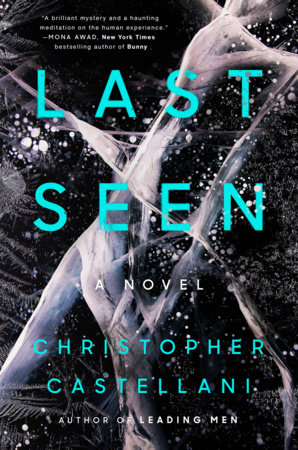
Christopher Castellani’s “Last Seen” interrogates the darker sides of our most loving relationships

For decades, in a series of unsettling cases that have fascinated people around the country for their eerie similarities, young men who fit a certain “all-American” profile have been found dead in frozen bodies of water. White, college-aged, traditionally attractive, and presumably cishet, they tend to be good at school and sports and are often last seen out drinking before their disappearances. Their physical resemblance to one another is also uncanny. “We could have been cousins, if not brothers,” says Caleb Aldrich, one of four such boys who form a chorus of beyond-the-grave narrators in Christopher Castellani’s latest novel Last Seen, which draws its inspiration from these real-life cases.
Other details that the real cases have in common—a smiley face graffito is usually painted nearby, the guys are discovered with their arms crossed over their chests, as if hugging themselves warm—led two retired detectives to posit the “Smiley Face Theory,” that a shadowy network of serial killers is targeting young men of this description nationwide. Castellani finds this theory, which has been widely debunked, decidedly unconvincing, but remains intrigued by the question of what, if anything, connects all these deaths.
In Last Seen, he investigates by plunging us deep into the consciousnesses of Caleb, Leo, Steven, and Matthew, four young men who are able to talk to each other, and others like them, in death. They hunt for patterns, posture, tell self-serving stories to one another and themselves, and look for evidence that they are being adequately mourned by the single loved one each can still see. They struggle to work out what, if anything, their brief lives meant. Time in the book moves as it does in Castellani’s imagined afterlife: meaningful memories are captured in bright bursts of lucid narrative, mixed with murky, half-remembered fragments; past, present, and future are all constantly colliding. What emerges is a detailed topography of the boys’ obsessions, a result of the pressures to perform certain kinds of masculinity colliding with their even deeper desires to love and be loved.
Castellani and I met over Zoom to discuss the dangers of patriarchy and love, the allure of age gap relationships like the ones lost to his generation of gay men as a result of the AIDS crisis, and our fundamental unknowability to our beloveds and ourselves. Electric Lit readers in the Providence and Boston areas are invited to join us as we continue the conversation in person at An Unlikely Story on Friday, February 20, 2026.
Preety Sidhu: In some ways, this book is a big tonal shift from your previous novel Leading Men, yet about half of that book takes place fifty years after the protagonist’s death as a friend honors his memory. Last Seen is also about four young men, watching from beyond the grave to see how their loved ones do and do not mourn them. Can you speak to your career-spanning interest in love that, specifically, transcends death? Why is it important how the people we love most remember us after we’re gone?
Christopher Castellani: I’ve always been drawn to retrospective narration because it allows a character to assess the whole breadth of their life. Looking back adds weight to the story. In some ways that’s good, and it can be overwhelming to the writer to have to deal with an entire life. To me, that’s what makes it most interesting, for people to evaluate what their lives meant to them and to the people who love them and who they love and who they hurt and who they want to do right by. It has always felt more compelling, narratively, than the decisions we make in the moment, where the reader doesn’t know what the aftershocks are.
Doing it from beyond the grave gives it even more weight, because all your choices are now over. In this book, they do try to make choices after death. They have some degree of power, but that is fairly limited and ineffectual. You don’t know how long your life is going to be, so you don’t know what you’re going to leave to people in terms of their feelings and the unfinished business that you had.
PS: These guys are obsessing over whether the actions of the people they love most are sufficiently distraught. The actions of the living, the way their lives have been changed by the dead or by the sudden deaths—why the fascination with that particular measure of a life?
CC: It’s about who’s telling the story. Who knows these people best? Do the guys know themselves best? Or do the people they consider their most beloved, or the most intense relationship that they had? The answer is neither. Nobody knows themselves and nobody knows each other, and nobody is reliable in what they say about themselves or each other. The answer to how do you define or know a person is: you can’t.
I kept feeling these guys were lying to me as they were telling me their stories, and lying to themselves. The people they left behind construct them into something they wanted or needed them to be. The boys, now that they’re gone, have no way to counter that. That has always been my obsession: how we construct ourselves, how others construct us, and how both are incomplete.
PS: The power of love is tethering people to each other across death, and even that’s not enough.
That has always been my obsession: how we construct ourselves, how others construct us, and how both are incomplete.
CC: Exactly, and love obscures things. Love transforms things and creates things that aren’t even there. That’s both a cynical and a romantic view. Both sides in this book, the living and the dead, are guilty of doing both. I chose one person that the dead could look in on and interact with—with whom they had the most intense love relationship—because love both blurs and shapes the way that we see each other, and our relationships. We see it through that particular lens.
While I don’t have some grand theory about it, I—maybe childishly or romantically—believe that love is the thing that breaks through whatever dividing line there is between this life and the next. I have a line about how the dead are busy, the dead are doing their thing and not really thinking about us. But there are times when we feel deeply connected, or our love for someone that we miss is so powerful that it has the effect of summoning them. I wanted to dramatize that. I’m almost embarrassed to say that because it is so borderline cheesy, but I do on some level believe that.
PS: You open the book with an epigraph from Anne Carson about the dead walking behind us, which ends with: “they are victims of love, many of them.” What does the phrase “victims of love” mean to you, and how were you thinking about it as you wrote Last Seen?
CC: That poem completely unlocked this book. It wasn’t that I wrote the book, then went searching for an epigraph. It was with me from the beginning. I love Anne Carson, she’s a genius.
I was exploring how deeply feeling people—when one of those emotions is love—can’t help but be victimized. It is more powerful than almost any other force. You can’t help but be under its thumb, serving love more than love is serving you. That’s what I was getting at with all the characters, in various ways. They’re still under love’s thumb, even in the afterlife. They’re never free, even after they’re gone. That’s how powerful love is for these four guys.
PS: How did you first encounter the unsolved deaths this novel is based on?
CC: There was a case in Boston in 2017 of a young man named Michael Kelleher. He was missing for weeks, then ultimately found. I was drawn to the mystery of this disappearance. In one of the comments, somebody said, “this seems like a Smiley Face thing.” I was like, “what’s that?” I went down the rabbit hole.
It’s completely absurd to think that over the past thirty years there’s been this network of people preying on these guys. I’m more interested in why we think that these guys are somehow endangered. What about our psyche, particularly the American psyche, gets more excited that it’s these types of guys who are being preyed upon or vulnerable? Obviously, we think about this type of person, in our American mindset, as leaders of America. Golden boys. The future. There’s something particularly upsetting or fascinating to people, and also probably thrilling in a schadenfreude way, to seeing these strong, healthy, attractive men being taken down.
PS: What’s your “theory” on how they are connected as victims?
CC: In that very way of being the “golden boy”: that identity, that pressure, that set of expectations to be a certain way. They do have a kinship with each other—young, ostensibly straight American men. Patriarchy has a lot of terms they may or may not have signed up for, but are born into. Most of them, not to generalize, perpetuate them, and fall easily into that role without questioning it. But I wanted to give these guys the dignity of an inner life, to treat them as three-dimensional people. Especially now, we have put all these guys into a box: this is who and what they are. I wanted to explore what made them and connected them psychically. That’s why I have them able to communicate only with each other in this afterlife. Not because they’re all victims of the Smiley Face Killer, but because they’re all victims, in some way, of patriarchy. And of love.
PS: The real serial killers.
CC: Right, the real killers are patriarchy and love! Spoiler alert.
PS: Each of the dead young men can look in on the person they love most who’s still alive. In all four cases, the relationships are intergenerational. What drew you to writing about age gap relationships?
CC: I did not set out to write about age gap relationships. It weirdly just happened, it was subconscious. I did want to write about different types of love, both romantic and family relationships. I realized halfway through writing that all these relationships did have that commonality. The book doesn’t have some grand theory about age gaps in general. It’s only interested in each particular relationship.
Throughout history, there have been famous age gap relationships between men. When I was growing up, that was completely cut off.
The one between James and Caleb—a young gay man who is attracted almost exclusively to older men—is a dynamic that comes up a lot in the gay male community. It’s interesting in the age of social media and hookup apps, because when I was growing up I never remotely thought of a person older than 25 as an option. Not because of attraction, but because they were usually dying or dead or diseased. That was the mentality, that anyone over a certain age was a victim of AIDS, or potentially that. Throughout history, there have been famous age gap relationships between men, both mentor and romantic relationships. When I was growing up, that was completely cut off. Now we’re seeing so many of these relationships, that are interesting for what attracts both sides. Other than the basic sexual chemistry, what do they get from each other? What do they need from each other? That was the thing I was exploring with James and Caleb, through the lens of Derrick, who is a survivor of that AIDS era.
I also wanted to show the connection between these young men disappearing and the young men who were disappearing all through the AIDS crisis. I wanted to draw some link between those two kinds of disappearances of young, usually attractive, often-but-of-course-not-always white, men. These are who became the face of the AIDS epidemic: young, pretty, white men. Not that they were remotely the only people affected.
PS: Matthew is obsessed with his college girlfriend Tessa—some might even say stalking her—but the person is able to see after death is his mother. What did you want to explore in the contrast between this obsessive love for a partner and the more enduring bond between mother and son?
CC: The relationship between mothers and sons has been my most consistent writing obsession. He’s half Italian, I’m full Italian. I was thinking of the really strong relationships between mothers and sons in Italian families. This mother is not Italian, but she’s in this Italian world of deeply passionate love among family members.
She’s relatively cold, she’s almost like a “stage mother.” There’s the trope of mothers that have this kind of romance with their sons, like the “hockey mom,” the “soccer mom,” the “swim mom.” They’re with their son almost like their partner. There’s this pride and a weird almost sexual vibe that I’ve always found interesting. I wanted to explore that. She’s never had a love relationship with her own husband. Her most “romantic” relationship, in a way, is with her son, which is why the enduring image she wants to have of him is with his head held high and his fists raised—the strong, all-American scholar-athlete, the perfect son. That myth-making between mother and son is what I was interested in, from her side.
From him, it’s recognition. He’s always wanted her to be a more nurturing mother, not putting him on a pedestal. To see him as more flawed, human, vulnerable. By dying, he’s achieved that, and wants to know that she sees him. He’s so upset when she walks by his picture and doesn’t notice him anymore. Because he also has this stalker, “extra” tendency, he almost wants his mom to stalk him. That’s the way he understands love, that kind of obsessiveness. Because she doesn’t have that for him, he keeps trying to “win” her, even from the afterlife.
PS: For Caleb and Steven, the people they love most, James and Monica, are older and married. What were you hoping to explore with these two affairs?
CC: I think of James and Caleb as a legitimate love affair. James is trapped in his bisexual identity, not able to have that fully recognized and integrated into his life. I wanted to explore that trap, closeted life. It’s narratively interesting to have a character who is leading a secret life—the stories he tells himself to justify his behavior. Using love as a pretext for dishonest, bad behavior. He’s cruising, he’s lying to his wife, but with Caleb he’s in love.
What is love if not seeing the messiness?
With Monica and Steven, from her side, I think of her as a trifler, a destructive force who doesn’t understand the extent of her own power and privilege. She procures him, basically prostitutes him for herself. While she had tender and certainly sexual feelings for him, I do not think of that as a love relationship.
He does love her, and sees her as a more wounded person than she sees herself. He wanted to be Arthur [her husband], because as a young, white American man, he felt like he should take over the world and saw Arthur as someone who had. He felt he should be in that position. All that was entangled in that obsession.
PS: How much is it about love enabling bad behavior versus expressions of love being impeded by unfair societal restrictions?
CC: I wonder whether the excuse for bad behavior is intrinsic to the love itself, part of the thrill. You can’t discount the thrill that James, Caleb, Steven, Monica, and to some extent Matthew feel. The charge, the illicitness that goes into these relationships is what makes them so exciting. Like a lot of people in the queer community say, once we get too mainstream, it’s not fun to be gay anymore. You almost need the constraints, the negative societal forces, to convince yourself and each other that you really do love each other, because you’re working against all those forces.
I don’t think that makes it any less legitimate. It’s just part of the unique “love package” every relationship has. Some relationships don’t have that, but they’re all legitimate relationships in terms of the emotion and passion.
They have different calibrations of things like, “how much of this is transactional?” and “obsession?” and “egocentric?” and “fulfilling a need from childhood trauma?” That is wrapped up in all of the relationships. No relationship is free of those. We all have things that draw us to each other in love, that could be considered negative or not healthy. All successful relationships have these dynamics that might be technically considered unhealthy but work for that relationship. We’re all victims of love in a relationship that is sustained and passionate.
PS: In describing his affair with James, Caleb says, “Seeing is a weird word to describe what we were doing, but it was also the perfect word.” Obviously, “seeing” is important in Last Seen. The sections have headings like “Crime Seen,” “First Seen,” “Last Seen,” and “Love Seen.” Why is “seeing” such an important theme?
CC: Seeing goes through every single relationship. What is love if not seeing the messiness? You see them in all their messiness and they see you in all your messiness, and you still stick with each other. That’s not a groundbreaking way to think about love, but to me it’s the most true.
It also means a recognition: even if I see all your messiness, there’s other messiness I will never see. You have your own life and parts of your life I don’t see, and I accept that too. Everything you’ve seen, you accept, but you also accept there’s a lot you won’t see. That’s part of the love.