Interviews
Poetry That Brings a Gardener’s Perceptiveness to Encounters With the Body
Debut author of “Maybe the Body” Asa Drake on moving to Florida, the desire undergirding anxiety, and reading aloud to an unwilling rabbit
This article is free to read. So is every article Electric Literature publishes. No limits, no paywalls—now or ever. Support from readers like you makes that possible.
Electric Literature is proud to be a space where writers are always paid and reading is always free, and we plan to keep it that way.
Donate now to our spring fundraiser to help ensure the future of free, accessible literature for all.
—————
A couple weeks after I first met the poet Asa Drake, a package from Florida showed up in my mailbox. Inside were jars of sweet jam and pickled peppadews, which I immediately understood Asa had grown and preserved herself. To receive a package in the mail is to feel cherished in a particularly quaint and immediate way, even more so if the package contains food grown and prepared by the hands of the sender. It is the experience of being cared for at a distance, which is not unlike the experience of moving through the poems of Maybe the Body, Asa’s debut poetry collection out from Tin House.
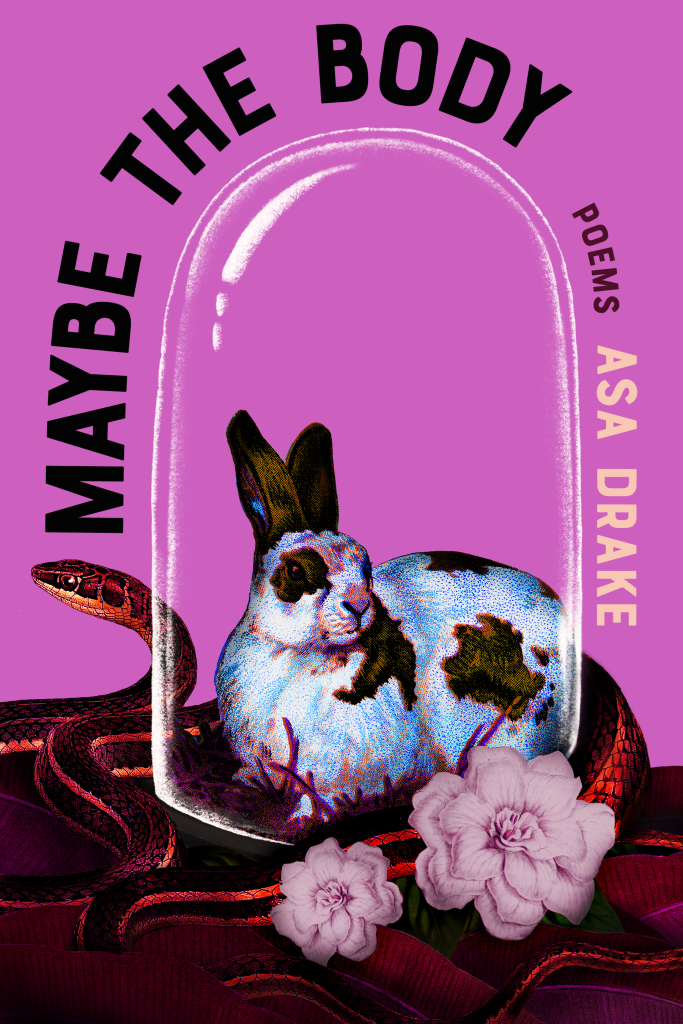
In a stunning assemblage of flora and fauna, music and memory, Asa weaves together the landscapes of the Philippines and the American South, rejecting easy conclusions about place, politics, and personhood. These thirty-eight poems, threaded together with a six-part braided sequence, are full of compassion and curiosity, often documenting offhand comments from friends, family, and strangers who demonstrate varying degrees of awareness about how they might be (mis)understood. But the speaker here is always aware, with the microscopic attention of a gardener watching her plants for new growth or signs of disease, never letting the reader, or themselves, off the hook when it comes to the way these encounters reflect ever-present conflicts between art, politics, and place. More than anything, masterful poems like “Toyo” invite us to encounter the body—corporal, geographic, literary—in its full complexity, asking us to notice the ways it is shaped by many voices and many pasts, full of economic, ecological, and aesthetic contradictions.
In our interview, I got to ask Asa about the relationship between desire and anxiety, “mother” as a conceptual placeholder, poetry as a means of creating safety, and pets who don’t like hearing poetry read aloud.
Cameron Quan: Can you begin by telling me how you got started with this collection? I know you published your chapbook, One Way to Listen, in 2023. Are there threads from that project that remain or were transformed in Maybe the Body?
Asa Drake: I remember going through an older version of Maybe the Body to pick the “strongest” poems as a chapbook. It was a very Darwinian approach—one that meant I’d always see the chapbook as neither complete nor incomplete. It was an attempt to understand how I could be heard. Only a few of the poems I considered the “strongest” in 2021 remain in either of my forthcoming full-length collections.
There’s something important to me about self-recognition, and when I start to feel like the speaker is an abstraction, I try to rework the poem. I think this version of the book has only become possible in the past few years because of the conversations I’ve had with friends. So much so that I started to keep an index of friends and poets who appear in particular poems. There’s a “(Fr)i(e)ndex” in the back of the book (Jimin Seo, Annie Wenstrup, Carolina Hotchandani, Rhoni Blankenhorn, and E. Hughes are just a few of the poets who appear and influence the text). And because of the way these poems are populated, I’m able to imagine the possibility of safety. These are poems where I’m writing towards others, who are kind of in the same ecotone, or liminal space that I consider home.
When I start to feel like the speaker is an abstraction, I try to rework the poem.
Other threads from One Way to Listen worked their way into my second forthcoming book, Beauty Talk, which is more willing to engage in confrontation vs. deflection. I allow myself to relish my own hostility—and question the use of it, especially as someone who, when confronting the white gaze, must acknowledge my partial relation—how I benefit from and replicate it.
CQ: Speaking of home, for me, the idea of place is often an entry point into poetry. In these poems, Florida and the South are major figures, as is Quezon City in the Philippines. Can you talk about how you unravel place and how it shapes your sense of self?
AD: I grew up on land that I was told could never be sold and could never be taken from me. Then I left and my relationship to that place changed. I actually didn’t realize what a profound impact this shift had on me until this summer when I had some incredible conversations with author Christola Phoenix at Storyknife. Sometimes a story about a place has to carry the absence of the place itself. In Maybe the Body, you’ll see this in some of the “I Love You” poems and “In the Tradition of Women to Try to Transfer Their Virtues.”
When it comes to the South, there’s a shape of ongoing institutional violence that I think I’m more able to see now. But at the same time, different bodies experience these dangers differently. I think that I have a lot of privilege as a small woman who people frequently can interpret as white passing. There is a certain safety in how that allows me to stay in the South and feel very close to home, but what interests me most is what role, what influence, that safety might buy. How does acknowledging that safety shape how I act and speak in personal and professional capacities?
When I moved to Florida, I tried to make myself at home by gathering plants from every place I felt close to. I was very aware of how this was a climate where I could replicate the South I had known in South Carolina, and also the home that I had visiting family in Quezon City. Maybe the Body was written in this period of accumulation. So often a plant in a poem is meant to unravel something sour: “I’m Interested in How Animals Teach us Pleasure” started as a poem about plums that someone promised me when I was six and never delivered. The grievance isn’t interesting to me any longer, but the desire is.
CQ: You said you wrote many of these poems at the library where you worked. I love the way you write about work and labor, the language of the workplace, and negotiating relationships in that environment. Why do you think the library comes up so much in this book?
AD: I suspect that the library is one of the best work environments one can ask for under capitalism. It’s not inherently exploitative in that there’s no surplus profit being extracted “from” my labor. But, as with any service position, I frequently found my attempts to be approachable misconstrued as invitations for personal gratification. Much of this collection was written while I worked at the reference desk of my public library. This included when we were an early voting location in 2016, and when we helped facilitate the census in 2020. I realized that I felt a professional responsibility to make myself approachable, and that I wanted to excise from my poems the language acts that are a part of this kind of customer service. In order to finish writing Maybe the Body, I quit my job because there were poems I knew I couldn’t write so long as I had this customer service script at the front of my mind. For me, Maybe the Body is a collection where I try to deflect the white gaze.
I suspect that the library is one of the best work environments one can ask for under capitalism.
I think being a librarian is different from other service industries because you’re a key access point to vital resources. And so you have poems like “Heirloom,” where the city cuts down a group of hedges a man had used as shelter—I could say a lot of things to mitigate blame, but essentially, it was a rote administrative action that destroyed someone’s home. I keep coming back to this question, “For whom am I making a safe space?” And I think this is a question that informs the whole collection. What kind of safety do I provide for others?
CQ: I know you cultivate plants and make incredible food from the things you grow. I also love the way you write about food, which is intertwined with language and relationships, like in “Toyo.” What are you growing now, and how does food figure into your writing?
AD: I didn’t do as much prep as I’d have liked to last summer, so I just harvested some soybeans, which come up in the last poem of the book. I’ve been planting them since I moved to Florida.
I’m interested in how the garden offers another way to keep time, a way that’s less linear and more cyclical. Food is so tactile. It’s a way to share memory. It’s a method of recognition. And I think that’s why there’s such a sting when something is misunderstood, like in “Toyo.” The garden is filled with examples of who and what we value. Adrienne Su covers this so richly in Peach State when she talks about the history of ginger and garlic, and when each of them becomes available in the grocery store—that it’s not only a question of access, but also appropriation and cost. I’ve been thinking about her poem “Ginger” a lot recently because of how Filipino communities in the United States can’t get bagoong right now—it’s a kind of shrimp paste—although I did get to try a fermented mushroom alternative in Seattle. With recent tariffs, there’s a question of what will be shipped, what will be stocked. Why are some ingredients considered more suspicious than others? And when food becomes trendy, who retains access when prices go up? The garden offers at least the illusion of being able to maintain certain traditions for myself. I say illusion because I don’t really believe small scale home gardening is a solution for true food insecurity. But it does mean I have calamansi most of the year.
“Toyo” was actually the first poem I wrote after I quit my job. I quit and then, the next month, I went with my mom to Manila to see my grandmother for her belated 80th birthday after COVID lockdown measures. One of my uncles loves to describe our whole family as “toyo.” It means salty, sour. It’s a red flag. But “toyo” was his way of extending a recognition of “this is who we are as a group,” a term of inclusion. I found this moment particularly precious, because it’s negative, but I was so happy to accept any term that made me a part of the whole.
CQ: You have an unusual mascot (muse?) in this book: your pet rabbit, who also appears on the beautiful cover. Along with the rabbit, I’m interested in all the images related to loving something, caring for a body (both your own, that of the other, and figurative bodies).
AD: She’s under the table with me right now, which is true whenever I’m doing anything on Zoom. She sits at my feet on her little rug, and she listens, which is funny because she hates when I read poems aloud. I really appreciate that about her. In the final printing of Maybe the Body, my author photo for the book is uncropped, so you can see my rabbit in the right-hand corner.
It’s funny to think about how this book, in many ways, is an attempt toward facsimile. It’s an attempt to offer attention to the people and things that I love but that I also recognize I’ll ultimately lose. I grew up with a lot of stories about how loss is so frequently unavoidable. The outliers were always about a witty purchase, like buying a ring during martial law instead of a mattress, so that 40 years later, when you would no longer have the mattress, you can still have the ring. I think the labor of a poem is witty in that way. I can lose the subjects again and again and still return to them.
CQ: In one of my favorite poems, “I Accept All Measures of Intimacy in the Digital Age, Especially Text,” you write, “At some point, this poem was about desire. / I think it still is.” What kinds of desire are you most interested in?
AD: Desire often feels like uncertainty. It’s a wishful emotion that touches so many other feelings. I think I often confuse desire and anxiety. There’s anxiety shaped as care, and there’s anxiety shaped as fear. But for me, they’re both desirous. And maybe this complicated cross-wiring between care and fear and desire reflects a certain social dynamic about who is desirous and who is desired; always there’s the specter of objectification. The result is that I’m suspicious of others’ desires, especially the audience’s intention. Even in “Toyo,” when I’m telling this story, I’m very guarded, and there are things I don’t say because I don’t know how generous the audience will be.
I’m interested in how the garden offers another way to keep time, a way that’s less linear and more cyclical.
It makes certain kinds of poems very difficult to write. For example, it’s easy for me to bring a shopping list into a poem and very difficult to write a self-portrait. It’s something I actively avoid, and I think it’s very much based on that same sense of trust and whose desire gets to come to the forefront.
CQ: Parenthood and motherhood loom over many of these poems. The mother is such a complex figure, made even more so because we usually get an incidental, fragmented sense of her. Is it fair to say that these poems express some ambivalence about mothers and motherhood? Or is that too cynical?
AD: I don’t feel ambivalent about my mother. I am obsessed with mothers! Maybe it’s best to say I have a large family, so I have many. As a result, the complication becomes twofold. There’s the complication of acknowledging the many versions of mothering, and there’s the complication of language. I grew up calling my mother’s mother “Nanay,” which means “mother.”
I’m a little mean to my mother in that, frequently when I’m writing, “mother” is not my mother but someone else in these poems. Someone who I’ve chosen not to explain my relationship with. Sometimes her dialogue belongs to a great aunt, extended family, even a lover. I’ve always disliked the demand to explain relationships that feel so natural to me. Sometimes I genuinely lack the language to be specific about a relationship. And in English, I have to wonder, who am I giving this personal information to? At some point in grad school, when I was being disagreeable in workshop, I gave up trying to explain the importance of different relationships, and I used “mother.” Everyone recognizes the importance of “mother.” I don’t want to risk a relationship being undervalued or considered temporary. Mothers are forever.
CQ: Many lines seem to communicate the frustration of being looked at incorrectly, at only ever being seen and understood in increments. This is certainly an experience I can relate to as an Asian American, and I expect it’s the case for many mixed-race people, complicated by other intersecting identities. Can you talk about how this plays out in a particular poem, or how it plays out over the course of the book?
AD: I don’t know if it’s entirely possible to be witnessed in one’s entirety, but I’m relieved when I’m recognized based on the traits I possess. I admire this kind of assessment, partially because I think this kind of attention is so rare. So many of the interactions throughout the book . . . they’re frequently me trying to determine how good someone is at paying attention. I don’t mean to be mean about it, but I do this as my own way of gauging what degree of vulnerability I can offer someone based on how much they pay attention, how much I’m being judged based on myself versus a narrative or a story or an image that they would like me to embody. It’s that attention that allows me to live with other people.
CQ: You’re publishing another book soon with Noemi Press, Beauty Talk. Do you see through-lines between these collections?
AD: In the writing process for both Maybe the Body and Beauty Talk, there was a point where editors, right before the final version, asked if I could write one more poem. Both times it was frightening—how does any poem come into being? But these last poems are my favorites. They’re written aware of all the other poems in the collection, and they become secret epilogues where I can say one last thing to shield against misinterpretation, one last thing to say goodbye to the project as a whole. I’ve really enjoyed that.