news
“Post-Truth” Is the Official Word of the Year
Oxford Dictionaries announce the U.S. and UK Winner

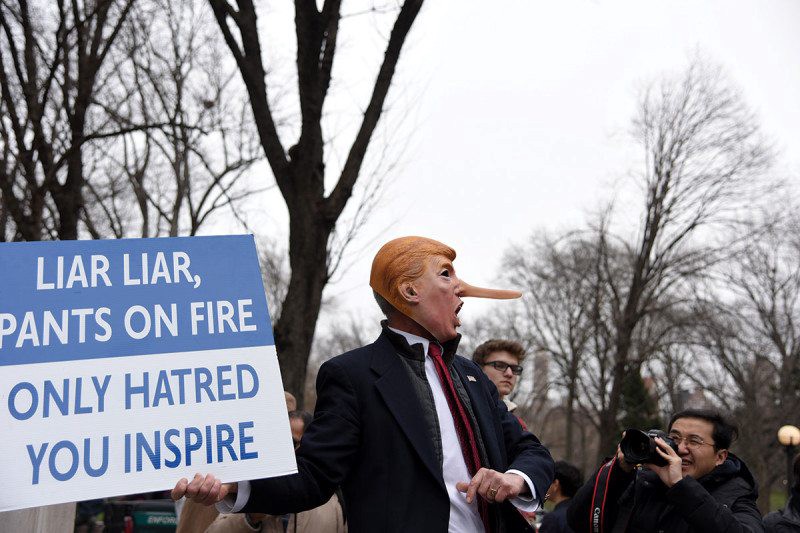
In perhaps the least post-truth moment of a very post-truth week, the Oxford English Dictionaries have selected ‘post-truth’ as the international word of the year. The OED defines post-truth as: “relating to or denoting circumstances in which objective facts are less influential in shaping public opinion than appeals to emotion and personal belief,” so, since the award strives to “reflect the passing year in language,” the accuracy of the choice will be rather difficult to figure out.
The adjective compound can also be pithily illustrated by this one minute video of Newt Gingrich explaining why facts are bad:
Although post-truth, with its current definition, has been in the vernacular since 1992 (the first recorded appearance is credited to Serbian/American playwright Steve Tesich who used it to describe the Iran-Contra affair), the term’s use has increased approximately 2,000% since 2015. Staff at the Oxford Dictionaries unsurprisingly credit attempts to describe the rhetorics of Brexit proponents and the Donald Trump’s campaign for the popularity.
Populist politics, particularly of the American variety, also showed up quite a bit on the contenders’ list, with “woke,” “latinx,” and “alt-right,” all appearing. And, since the amassing of identity driven political terminology reflects an urge for linguistic determinism amongst fractured political factions facing systemic (woke; latinx) or imagined (alt-right) disenfranchisement, we can expect more new political terminology to attain prominence during the Trump Presidency.
“Normalization” has abounded as post-election buzzword of sorts. And, with the appointment of Steve Bannon, references to White-Nationalism, Storm-Front, and other racist hyphenates that should not be normalized have also been cropping up a lot.
On a lighter note, while post-truth may not bode well for the relevancy of capital-T “Truth” as a concept, it does posit that there is a real truth out there and it can be expressed by language. That makes the decision a far less post-modern choice than last year’s OED pick: Crying-Face Emoji.