Personal Narrative
Studying Obituaries So I Can Write My Mother’s
An obit’s very form announces its most important news. This first, crucial piece of information is already redundant
Formalizing Grief: On Victoria Chang’s Obit by Robin Arble
The genius in Victoria Chang’s Obit lies in her turning the obituary into a poetic form. All her other feats—her dazzling flashes of language, her similes and images that feel realer than life—flow from this decision. Her first move is finding a form to turn and return to: Chang is, among many things, a poet’s poet, and she knows how to turn limitation into invention. But her real accomplishment is taking something as cold, factual, and isolating as writing an obituary and turning it into a cathartic experience, not just for herself, but for everyone—especially every poet—who has written one.
Most of Obit’s poems are obituaries of concepts, not people: Language, Memory, Love, My Father’s Hands. These poems orbit two enormous silences: the poet’s parents. Chang’s mother is the parent who dies, over and over, throughout the book, while her father survives a stroke that steals his ability to speak. Obit is all about these barriers and failures of language, especially language’s inherent failure to capture the essence of a person, and their loved ones’ memories of them. As such, each of these obits can only write “around” their subjects. For example,
My Mother’s Lungs—began their
dying sometime in the past.
Doctors talked around tombstones.
About the hedges near the
tombstones, the font.
An obit, even as it takes the narrow shape of a coffin, tombstone, burial plot, or cemetery hedge, can only talk “around” its subject the way the doctors in Chang’s poem only talk around the actual tombstone. Notice that the “font” of a tombstone isn’t even part of it. Even the tombstone isn’t the death itself. The white space around each letter and punctuation mark—and the larger white space around each tombstone of text—is where the actual death is.
“When my mother died,” Chang says in “My Mother’s Teeth,” “I saw myself in the mirror, her words around my mouth, like powder from a donut.” The simile is intentionally insipid, pairing her grief with a useless product someone would buy from a waiting room vending machine. “Her last words were in English. She asked for a Sprite. I wonder whether her last thought was in Chinese. I wonder what her last thought was.” Here is the triple silence of a language barrier, a generation gap, and the inescapable privacy of any death: “I used to think that a dead person’s words die with them. Now I know that they scatter, looking for meaning to attach to like a scent.” Obit tells us that the real death of any person—especially from the perspective of the obituary writer—is forgetfulness. Oblivion. It looks like this.
The week I wrote my mother’s obituary, I read a few sample obits on my local funeral home’s website to get a sense of their rhythms, their contents, and the demands of their form. Even in the midst of this task—writing my mother’s obituary, in the middle of the week, in the middle of a semester—my poetic instincts kicked in: reading preceded writing because the best teachers were texts. The adults in my life who assigned the family English Major the task of writing her mother’s obituary—especially my Aunt Karen, who’d assumed the role of family matriarch after my paternal grandmother died the second day of that year—gave me advice on writing obituaries because they’d written them before. Just like the poetry I was studying in school, I was taking notes from people twice and three times my age who had already done what I was struggling to start. They even told me that, ultimately—just like poetry—I had to do it myself.
The real death of any person—especially from the perspective of the obituary writer—is forgetfulness.
Rule one: Always begin with the announcement of the death. In her case, my mother’s death wrote itself: “Ellen Sue (Richardson) Arble, 57, of Belchertown—loving wife, mother, sister-in-law, cousin, and friend—died Monday, October 3, 2022 at Baystate Medical Center in Springfield after a brief illness.” I let the sentence sound too wordy; I figured the release of information was gradual enough to let those double dashes in. Of course, the most important fact of the sentence, the crown jewel of a verb, was located at the sentence’s center, right at the point of grammatical release: “died.” Ellen Arble died. That was all the reader needed to know. But the reader knew this before they even started reading the obituary. An obit’s very form announces its most important news. This first, crucial piece of information is already redundant. Dead on arrival. All the other information—my mother’s full name, how old she was when she died, where she lived, who she loved—crowded around this one (in)essential fact.
The second paragraph of an obit, the biography, is often the longest. Here is where the writer gathers all the essential facts of a person’s life into chronological order. Grammar school rules apply here: Make sure your paragraph is no more than a few sentences long so as not to bore your reader (your “hook” takes care of itself in the announcement):
Born in Holyoke, Ellen attended John J. Lynch Middle School and Holyoke High School, where she graduated in 1983. She married her husband, James, in 1999. Their only daughter, Robin, was born in 2001. Ellen worked as a Special Education Paraprofessional before leaving her job on September 11 to be a stay-at-home mother. Ellen moved to Belchertown with her family in 2020, where she lived happily for two years.
My aunt and editor Karen went through my obituary draft with me over the phone the night I started it. She asked me if the middle school my mother attended was really necessary to include. I told her that my mother had spoken of it often and fondly. And was the 9/11 reference really needed? Same thing: She’d told me that story my whole life. That was the day she thought the world was ending, and the first thing she thought of doing was going home to me. Obituary biographies are fascinating because they’re mostly written for (and by) unremarkable people, so ideas of necessary information are entirely subjective and therefore inapplicable to the usual rules of writerly etiquette. (Grammar school memories of teachers crossing out digressions and extra details failed me here.) I was proud of myself for crowding every meaningful fact of my mother’s life into one dense paragraph, knowing this paragraph was pure information to strangers. I felt the secret weight of every detail’s meaning. Only I could see what “she lived happily for two years” meant. I could close my eyes and see those first months of the pandemic, building a fire in the backyard every evening, plugging my phone into my father’s garage speaker and taking Spotify requests from them all night. Only I could see the night my mother signed along to Carly Simon’s version of “The Itsy Bitsy Spider” as me and my father watched in stoned discomfort. Only she could see the faces of the students she taught that song to, hovering in front of her from two decades away. Even these details are an open secret. You can’t see them any more clearly than I can.
The second half of an obituary begins with the survivors paragraph. This is where the obituary writer catalogs every friend, family member, and loved one who’s outlived the obituary’s subject. Even though I established this catalog in my announcement, it was bizarre listing my family members in descending order of (posthumous) proximity to my mother. By the time she died, there was no “mother’s side” of my family; almost everyone from it was dead or dead to me. Which brother-in-law should I name first? I decided to keep it as democratic as possible and list every extended family member alphabetically by first name, so Clarke went before William, even though I call him Bill to this day. Karen explained to me that spouses go in parentheses next to the relevant (blood) family member. This struck me as an odd display of grammatical ownership, but she insisted (Karen) goes next to Clark. As the list of survivors broke off, it became impossible to decide which names to include and which to imply. I took the easy way out: My mother is survived by “innumerable friends and acquaintances from her hometown.”
The final paragraph of a standard obituary is the arrangements: when and where the funeral will take place, if there will be one; where to send flowers, if the family wants any; where to make donations, if you can. My father and I were in no shape to throw a funeral; we had no money, and nothing to say. Like its announcement, the obituary’s penultimate sentence wrote itself: “All services for Ellen will be private.”
Rule one: Always begin with the announcement of the death.
Aunt Karen told me over the phone that Ellen often talked fondly about Kate’s Kitchen in Holyoke. My mother had been a prolific phone caller my whole life. If she’d been born fifty or a hundred years earlier—as my father, whenever he was teasing her for their three-month age difference, was convinced she was—she would have written several letters a day. Instead, she began and ended most days with a phone call to her mother-in-law, or my godmother or, when I was young, her own mother. Our floor of the family home was small. I heard my mother’s phone calls my whole life. I never once heard her talk about Kate’s Kitchen in Holyoke. At this point in my phone call with Karen, I realized how strange it felt to trust someone else’s memory of my mother over my own. Maybe I was offended that someone besides my father had a view into my mother’s interiority that I didn’t. Maybe this small fact threatened my sense of narrativity over my mother’s—and my own—life. I trusted Karen. She wrote the last sentence for me: “In lieu of flowers, please consider a donation to Kate’s Kitchen at 51 Hamilton St., Holyoke, MA 01040.”
Chang’s obits rarely, if ever, satisfy the four requirements of a newspaper obituary, but they almost always fulfill the form of the announcement: [Concept]—died on [month, day, year]. The announcement sentence of Chang’s obits act as a prompt for the rest of the poem. Images and narratives—donut powder, time zones, tombstone hedges—leap from the death-dates of concepts: My Mother’s Lungs, Love, Memory, Form. Like anaphora, every obit in this book starts from the formal base of its announcement.
The second demand, the biography, is often where Chang’s obits leap into themselves. Formal restraint gives way to discovery. The first half of “Appetite”:
Appetite—died its final death on
Father’s Day, June 21, 2015,
peacefully and quietly among
family. We dressed my mother,
rolled her down in her
wheelchair. The oxygen machine
breathing like an animal. They
were the only Chinese people in
the facility. The center table was
loud again, was invite-only
again. Like always I filled my
mother’s plates with food. Her
favorite colored puddings
contained in plastic cups. When
we got up to leave, her food still
there, glistening like worms. No
one thought much of it.
The first sentence, the announcement, is largely literal, though there’s a sardonic inversion of obituary jargon in “peacefully and quietly among family.” The real leap comes with the introduction of Chang’s mother in the second sentence, followed by the simile of her oxygen machine breathing “like an animal.” Here, the “biography” of her mother’s appetite is actually a description of its quiet, peaceful death among family: “Like always, I filled my mother’s plates with food.” An actual description of her appetite’s life would be besides the point. Its life (and death) is viewed through her daughter, the obituary’s speaker. Her mother’s appetite is a symptom of her decline, and its quiet death is the exemplary moment to view her decline through.
Because the biography of a Chang obit is where each poem leaps from its prompt, it’s often the place where the poem’s silence starts to take hold. Notice how many similes are hidden in these sentences. Like Chang’s donut simile in “My Mother’s Teeth,” her animal simile mocks the inherent failure of explaining one thing by comparing it to something else. What else breathes besides an animal? Plants? Rocks? A person? An oxygen machine? This simile is visually and emotionally evocative—I can hear the oxygen machine breathing like a tiger hunting its prey—but its juxtaposition of deathly serious and sardonically mundane mocks the very idea of comparison.
The last demand of the obituary’s form is the only one Chang never fulfills. The ending of “Appetite”:
There are moments that
are like brushstrokes, when only
much later after the ocean is
finished, become the cliff’s edge
that they were all along. Death is
our common ancestor. It doesn’t
care whom we have dined with.
What does it mean to read—and write—an obituary with no arrangements? In all of Obit’s hundred-plus pages, we never read a sarcastic play on arrangement jargon, no “All services will be private.” What does “private” mean in the second-to-last sentence of my mother’s obituary? What would it mean to Chang’s Obit? Her mother’s death is a secret she took to her grave: “I wonder whether her last thought was in Chinese. I wonder what her last thought was.” Her father, without his ability to speak, lost a portion of himself to the silence that his wife disappeared into. Death, whether it is full or partial, is just as private as any experience, no matter how fully we try to communicate it. Chang knows that she can’t translate any thought, mood, or emotion directly into her readers’ minds. In “Blame,” “the child cries out loud, makes a noise that is an expression of pain but not the pain itself. I can’t feel the child’s pain but some echo of her pain, based on my imagination.” Notice that Chang chooses “imagination” over “memory.” We all have visceral memories of pain that live in our bodies as much as our psyches, so why does her empathy rely on her imagination? What leap has to be made here? Why is something as obvious and universal as a child’s scraped knee so private to Chang?
My father and I were in no shape to throw a funeral; we had no money, and nothing to say.
The answer is in her craft: Nothing is comparable to anything, not even grief in “Grief”: “A picture of oblivion is not the same as oblivion. My grief is not the same as my pain.” There are no arrangements in Chang’s obits because the deaths they depict are never final. In “Form,” “When we die, we are represented by representations of representations, often in different forms. Memories too are representations of the dead.” Chang leaves the restless arrangements and rearrangements of each obituary to its close cousin, its almost-anagram: oblivion. Funerals, flowers, or donations—like obituaries—only serve to make the dead (in the minds of their survivors) more dead.
There is one demand of the standard obituary that is almost impossible to map onto Chang’s obits. It is difficult to determine when, where, or whether Chang satisfies the poetic catalog of an obituary’s survivors. Obit’s relentless repetition understands that, when someone dies, they die—and you die—over and over again, for the rest of your life. They die into oblivion through daily acts of forgetfulness. The anonymous blurb on the back cover says it best: “When someone you love dies, everything dies. Her blue dress dies. Empathy dies. Friendships die. You, having survived, die.” In Chang’s obits, their subjects’ survivors are better understood as descriptions of each micro-death that flows from the poem’s subject. But of course, the central survivor of any obituary is its writer. Its subject’s biographies, survivors, and arrangements blend into the obituary writer’s private oblivion.
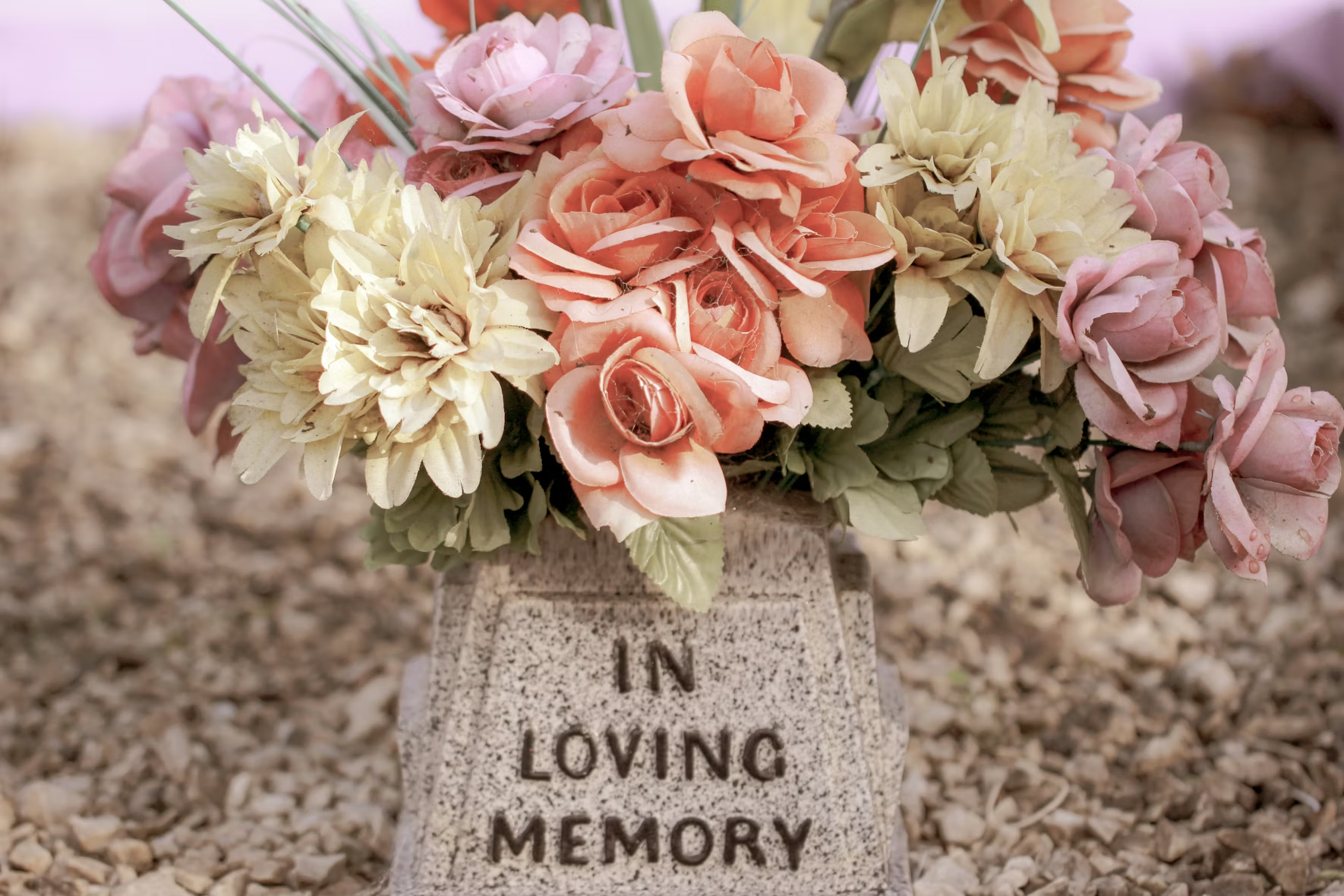
I held on to my mother’s obituary for eight days before I sent it to Barry J. Farrell Funeral Home. I wanted to hold my mother’s memory intact in prose, in a form I spent eight days tinkering with. Like Chang, I was using the formal borders of the obit to give my grief a shape, knowing it will always be shapeless—“Wind in a box,” as Terrance Hayes once wrote. The box is a poem’s form: the narrow rectangle of an obit, coffin, crematory, tombstone, death certificate, and burial plot. The wind is the box’s contents: meaning and memory. Next to nothing. “My mother was a mathematician so I tried to calculate my grief. My father was an engineer so I tried to build a box around my grief, along with a small wooden bed that grief could lie down on.” The borders of grief can also be a bed of flowers forming the hedges of a tombstone, or a bed to collapse in, even if the tears don’t come.
The central survivor of any obituary is its writer.
Three weeks after my mother died—literally, physically died—me and my father spent a weekend at his friend Odie’s camper in the depths of New Hampshire’s wilderness. He’d offered us a weekend away at the campgrounds, “to get away from it all.” That first night, we sat around a bonfire with Odie and his campground friends, middle-aged men and their wives in camouflage Carhartts. They were nothing like me, but I knew they’d all lived enough life to experience deaths as large as ours. When they were done with their cans of beer, they threw them into the fire. I watched the thin metal boil and writhe into nothing. We passed around a Mason jar of moonshine someone had smuggled up from Mississippi. It was the cleanest alcohol I’ve ever tasted. I never got drunk, not even when—at everyone’s insistence—I ate the peach slice at the bottom of the jar.
At the end of the night, Odie set me and my father up on the pullout couch in the living room of his camper. I heard a car door slam, and my father came back in with pillows and blankets in his hands. He held a lumpy gray pillow out to me: “This was your mother’s.”
As I was falling asleep, I buried my face in the smell of my mother’s hair, knowing the smell was fading too slowly for me to notice. I saw her perfectly that night: her hair tied tight in the back of her head, strips of black dye fading into gray. I saw her as I had my whole life, hunched over two or three pillows stacked between her arms and legs, sitting criss-cross, watching TV on her side of the bed. Writing this essay, Chang’s “Language” frames my memory’s memory: “A picture represents a moment that has died. Then every photo is a crime scene. When we remember the dead, at some point, we are remembering the picture, not the moment.” That night in New Hampshire, a pull-out couch measured the dimensions of my grief. Suddenly the Earth was spinning six miles a second. The bed I was laying in was a memory of hers. I refused to sit up. I closed my eyes and looked at her as hard as I could. I knew this was the last time I’d see her this clearly.
The poems quoted in the essay are credited to: Chang, Victoria. “Obit: poems.” Copper Canyon Press, 2020.