Lit Mags
Protected: A Goat Farmer Is Only as Vulnerable as Her Goats
An excerpt from SURRENDER by Jennifer Acker, recommended by Ben Shattuck
Introduction by Ben Shattuck
There’s a photo essay in a recent New Yorker issue about a Kentucky farming couple living with their teenage granddaughter. In the first photograph—the one I turned to while standing on the steps of my Brooklyn building trying to ignore the car alarm that was going off as the car was being cranked onto a tow truck in front of me—the granddaughter leans against her grandfather’s shoulder, holding his arm. Maybe they just went swimming, or a rainstorm had passed overhead, because they are soaked, their hair plastered to their foreheads. They look not just content, but something deeper—tranquil, peaceful, safe, open. As if a profound blessing has just passed through them. Their look made me wonder—as I speedwalked away from the car alarm, down the block, and nearly into a man yelling at a biker to “get back in the fucking bike lane!”—if life was just better out of the city. Maybe the forge of rural hardship, long put away for most Americans, might refine a sense of meaning and tranquility, might generate the heat to permanently bend that metallically hard sense of self that everyone (therapists, et al.) assures us is re-shapeable. And yet, the caption under this photograph reads, “You’re not guaranteed nothing when you farm.”
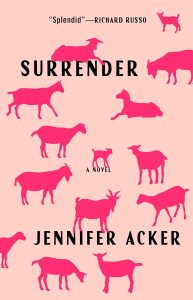
That tension—farming life and its fickle relationship with guarantees and happiness—is what Jennifer Acker’s new novel, Surrender, questions. Lucy Richard, in her mid-forties, has left her life in New York City to embark on a second act in her rural Massachusetts hometown. She’s going to raise dairy goats and make cheese. She’s there with her decades-older husband, Michael, who says he’s ready for his “next adventure” in this “little house in the country” and plans to “write slim, popular Roman histories.” But, well, his accelerating health decline quickly grips Lucy’s daily routine with suffocating strength. And, goat farming is very hard. And there’s the isolation. That bloom of rosy potential—the very real beauty of the landscape, the slower rhythm of the days, the house, all that time to read and write—falls away. One of the first petals to fall is financial stability: Michael has secretly made a disastrous investment that Lucy only discovers when she goes to the bank for a loan—a “craterous hole” has been left in their savings. Given these deficiencies—not enough money, time, compassion, farming knowledge, and maybe love—the question from the very beginning is: Can Lucy bear this?
I love books about second acts. They feel like a spring breeze, letting you sense purpose flush into a protagonist’s day, budding joy even in the small things. Like, as Acker describes, the smell of milk, holding a goat’s warm body, the good sleep that comes with physical work. But beginning something new mid-life is not loud or cinematic, it’s quiet and disorienting, nothing fits quite right at first. Surrender unfolds as a slow immersion into uncertainty, to yielding, and then, maybe, something like freedom flickers into view. So, here we go. Hoping the forge of hardship doesn’t burn Lucy to a crisp.
– Ben Shattuck
Author of The History of Sound
Protected: A Goat Farmer Is Only as Vulnerable as Her Goats
Jennifer Acker
Share article
This article is free to read. So is every article Electric Literature publishes. No limits, no paywalls—now or ever. But we rely on your support to keep it that way.
We need to raise $35,000 by April 15 to keep the lights on, and time is running out.
Help us reach the next milestone—$7,500 by Friday—by donating now.