interviews
TELEVISION Walks the Tightrope Between Reality and Performance
Lauren Rothery's debut novel explores the inner lives of Hollywood hopefuls, the myth of meritocracy, the chaos of luck, and the cult of celebrity

In Television, Lauren Rothery’s debut novel, the narrative switches between the interior monologues of Hollywood hopefuls, mainly Verity and Helen. Forever friends, sometimes lovers, they come to Los Angeles separately but for the same reason: to escape from somewhere else. Hollywood, however, is not sentimental about origins; it is a sorting machine. Some make it. Some don’t. Verity makes it—spectacularly. Helen does not.
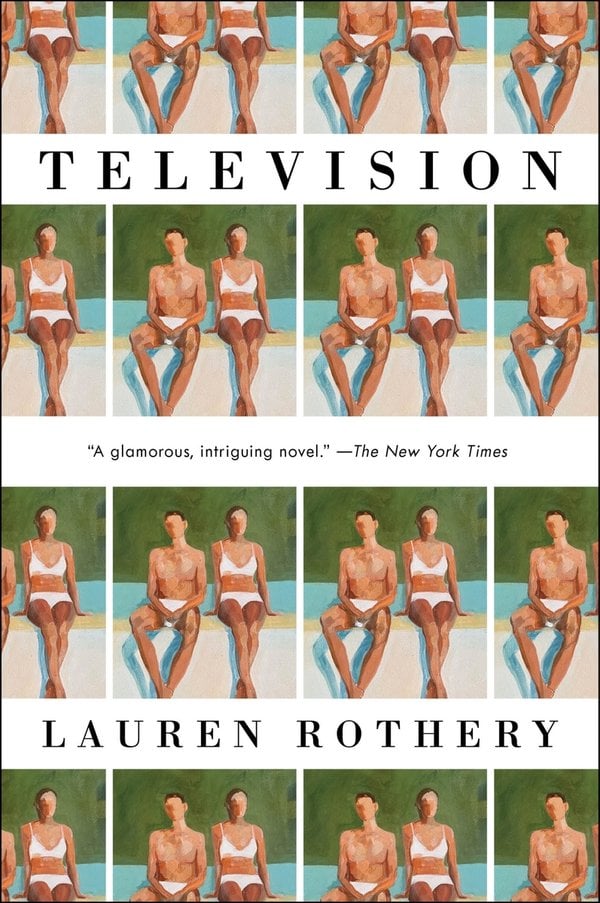
Verity is, we are told, very attractive. Helen, less so. The question that haunts Verity is whether it’s his tremendous good looks or his talent that accounts for the difference in their success. In an attempt to balance the cosmic ledger, to correct what he sees as the unfairness of his outsized success, Verity creates a lottery to give away his multi-million dollar salary from his acting role in the latest blockbuster. Rather than absolving him, the gesture only makes Verity more famous.
Through it all, Verity and Helen are bound by something rare: a mutual understanding of each other that feels singular. Yet even this intimacy warps under the pressure of Verity’s success. At one point in the novel, in a gesture that reads as both romantic and obsessive, Verity buys the apartment complex where Helen lives and moves into the unit next door. Like many successful actors, Verity is most himself when he is playing a role, and with Helen he is able to play house. Here, Rothery captures the uncanny position of the actor in relation to life: Performance can feel truer than sincerity. As a result, what emerges for both Verity and Helen isn’t a domestic life but its occasional simulation—an arrangement perpetually on the verge of collapse, as if a closer inspection of their surroundings might reveal it to be a film set, all pasteboard frontages, plywood facades, and painted-on windows. Such is the sensation of reading Television: the feeling that the novel itself might dissolve in your hands. Rothery’s sly prose slips across the boundary between reality and performance so that nothing escapes the sense of feeling staged, suggesting that Hollywood does not simply reward acting—it makes actors of us all.
Lauren Rothery and I spoke over Zoom about celebrity, luck, and the false meritocracy of art making.
Evander James Reyes: How did you arrive at the title Television?
Lauren Rothery: It was the title from really early on—it just felt right. It ended up connecting to a number of different things in the book. There’s the industry shift from film into television and streaming. And then there’s that moment near the end when Verity talks about what he finds romantic about television—an older version of it that I’m not sure exists so much anymore—where you really fall in love with a set of characters and just keep wanting to hang out with them. It’s not about the plot. You just want to be around them.
EJR: The novel does feel structured like a classic television show in that way. We tune in to the lives of these characters at different moments, often out of chronological order, as if we’re dropping into a favorite long-running series. But unlike a television show, you linger on quieter, more marginal scenes, often with the characters alone in their thoughts. Could you speak about what draws you to those kinds of moments, and how they shape the characters you’re building?
LR: I wanted to write a relationship where the reader felt like they were in on it. The ways people speak to each other when they’ve known each other for a long time can feel like intimacy, but they can also obfuscate intimacy, a way of not talking about what’s actually happening to them. I like doing something that feels a little thoughtless, where you simply feel the people: how they think, how they move through the world, how they interact with each other. They felt like very real characters to me, and I liked spending time with them. I like the idea of a Hollywood story that is very uncinematic. It’s an un-Hollywood love story. You don’t see the major climaxes or plot points. Even when Verity and Helen finally leave, you see them after they’ve already left.
I wanted to write a relationship where the reader felt like they were in on it.
What works for them is this very long friendship that is essentially romantic in nature. Sometimes they’re together, and when they’re not, they’re not—but I don’t think they ever feel that they’ve broken up or truly left each other.
EJR: A recurring question in the book seems to be how we share space, both with other people and with ourselves. Verity, especially, is always searching for connection and authenticity. And Verity and Helen seem to have found that rare kind of connection with each other.
LR: I don’t think they ever consider leaving each other. They operate under the assumption that they won’t like anyone else as much as they like each other. They’re different people, but there are certain things they see in a very similar way. Their relationship reminds me of the old Yiddish word landsman. It’s a term for meeting someone from your homeland, but it can also describe encountering someone who perceives the world the way you do—someone who simply sees things as you see them.
EJR: Throughout Television, there’s a tension between reality and unreality, between what is true and what is performance. Sometimes performance is treated as artificial, and other times performance seems more real than reality itself. How do you think about performance in the book?
LR: I was thinking a lot about how, in a very long relationship, you form the person you are around someone else, and it doesn’t feel like your complete self. It feels like one part of you, or one role that you’re playing. That doesn’t mean it isn’t real or true. It just feels very specific. That interested me, especially with an actor and a writer, because the story they’re telling about themselves is always going to be a kind of performance.
If you’re making art because you have to, and you’re making what you love, then you just hope for the best.
You can end up performing this role together over and over. It can be sweet, something you love and don’t want to lose, but it can also start to feel distant from yourself at times, like a mode you go into with someone else. To me, it feels like an inescapable paradox. The closer you get to someone, the more you create something slightly separate from yourself that you’re nurturing together.
EJR: Verity seems to have this deep fixation on being good, and on what goodness even means. At one point, he tries to imagine a modern man who is kind, handsome, good at his job, and he comes up blank. Can you talk about Verity’s impulse toward goodness, and what you see as driving that need?
LR: It’s something that confuses him. He’s drawn to things he perceives as pure or innocent. Sometimes he even makes a virtue out of things like not being conventionally beautiful. He describes his mother as spectacularly ugly, even dramatically ugly, and angry, but he attaches a certain kind of virtue to her that he doesn’t extend to his father, who was beautiful and simple and accepted things as they were. He also attaches virtue to a lack of success, especially monetary success. And then there’s the lottery. I don’t think he fully understands why he’s doing it as he’s doing it. It seems connected to guilt, a sense that he doesn’t deserve what he’s been given. Maybe he imagines that someone truly worthy will receive it, someone who deserves it. And when it’s just a random man who doesn’t fit his idea of worthiness, it’s depressing for him. I don’t think he fully understands his relationship to goodness and virtue, but there’s clearly a desire for it, a desire to feel that he’s good, that he’s honorable, that he’s doing things the right way. That desire stalks him, even as he does things he knows will be perceived as dishonorable or questionable.
EJR: Luck seems to function as a structural force in the novel. Being born beautiful, timing, and chance shape who succeeds. What role do you see luck playing in the book?
LR: I’m really interested in how impossible it is to parse what in your life feels like a result of chance and what feels like a result of choice, because they seem completely enmeshed. I was thinking a lot about luck in American culture, and especially in the film industry. Working in film, I felt there was such a strong narrative of meritocracy, that if your work is good enough, it will float to the surface and the money will come. I just don’t think that’s true.
In film, you need a certain amount of money, the right locations, the right people, the camera . . . With fiction, if I want something to be a certain way, it can just be that way.
I’m constantly discovering films by people who never had much success that are brilliant. The same is true in music or any other art form. There’s so much luck involved. In a way, that’s beautiful, because it takes some pressure off the artist. If you’re making art because you have to, and you’re making what you love, then you just hope for the best.
The meritocracy story is often told by people who have had success and want to believe that their success was fully earned. It’s almost the inverse of Verity, who is convinced he hasn’t earned anything.
EJR: Can you talk about the characters’ relationship to aging, especially in Hollywood? What does it mean to them, and how does it shape their understanding of themselves?
LR: I was thinking about the different messaging men and women receive about what their lives will be like as they start to age, especially as they begin to look older to other people. I haven’t come to any clear conclusion about it, but I find it interesting to think about the way we try to avoid aging. That makes sense in terms of not wanting to die or wanting more time, but we also try to avoid the appearance of aging, which is something all of us will inevitably experience. Attaching yourself to a youthful aesthetic seems almost insane, because it’s the one thing guaranteed not to last. It’s such a hopeless thing to love. They’re all arriving at aging from different places. Verity turning 50 is just beginning to think about losing his sexual currency. Helen has never viewed herself as conventionally beautiful by Hollywood standards. There’s this story young women absorb, that the best thing you can be is a beautiful 25-year-old, and that everything declines from there. It’s a strange and heavy message. Helen’s instinct is to find a way to write about aging, or think about it, so that it interests or amuses her. She tries to approach it in a way that allows her to see its absurdity. Phoebe, meanwhile, is confronting old age through her grandparents’ deaths, which feels so distant from her as to be almost alien. But she’s also beginning to track actresses as they age, comparing herself to them, which feels like an earlier version of Helen’s concerns. I don’t have a neat way to resolve it. It just interests me. Aging feels like a heavy part of life in Western society right now, especially the way appearance changes and how differently people are treated because of it.
EJR: The novel’s structure feels fragmented and elliptical, resistant to traditional arcs. You move between forms, including screenwriting, and even shift fonts. What drew you to that shape, and what emotional experience were you hoping to create for the reader?
LR: It was different for each character. They all felt very real to me, and I was trying to convey how each of them would tell the story. Verity tends to sound like he’s speaking directly to you. It’s almost one long stream of consciousness. Phoebe is thinking so much about writing, and about the clumsiness of different mediums, that she almost lives through what she’s writing. It felt natural that when she’s telling you something she can’t fully make sense of, she shifts into her script. You can feel how she’s metabolizing the experience and maybe understand her a little better than she understands herself in that moment. I like that idea, watching someone learn how to distill their own experience into something that didn’t exist before and now does. Helen, by contrast, sounds more like she’s writing to you. She’s probably the most consistent narrator. So the different formats, especially with Phoebe, felt like a way to understand her more deeply, in ways she wouldn’t necessarily be able to articulate directly.
EJR: You have a background as a filmmaker, so I’m curious how your filmmaking informs your writing in this way.
LR: I was on the fringes of film for about 10 years. I did menial on-set jobs to fund my own projects, and I learned a lot about how I like to write, how I like to tell a story, and how I try to create certain feelings in someone else. But it was refreshing to switch to fiction. For one thing, it’s much less expensive to write a book than to make a movie. Whatever I want to happen can simply happen.
That felt like an interesting test of his theory. If the only thing that’s compelling about him is his beauty, and you can’t actually see him, is he right? Is the suggestion of celebrity and beauty enough to make him interesting? Or is he wrong, and has his life been shaped far more by his personality and the way he speaks and thinks?
Fiction also lets you move through large spans of time in ways that would be complicated in a film. I found it really enjoyable. But I do think my editing process is informed by film. I’m a very harsh editor of my own work. I cut a lot. By the time I sold the book, we didn’t have a long editing process, probably because I’d spent so many years finishing things on my own.