Interviews
The Accidental, Unconscious Short Story
David Ryan’s story collection, “Alligator,” melds dream logic, experimentation, and the rigor of capturing reality’s unexpected moments
This article is free to read. So is every article Electric Literature publishes. No limits, no paywalls—now or ever. Support from readers like you makes that possible.
Electric Literature is proud to be a space where writers are always paid and reading is always free, and we plan to keep it that way.
Donate now to our spring fundraiser to help ensure the future of free, accessible literature for all.
—————
I met David Ryan in his faculty office at Sarah Lawrence College, about an hour before he was to give a reading from his new short story collection, Alligator, published by a recently-founded small press, Cash 4 Gold Books (the creation of Harris Lahti, Jon Lindsey, and Nathan Dragon). After I finished checking out the pile of free books outside David’s office, stashing two collections of Cynthia Ozick essays in my bag, we sat down to talk about Alligator, the contents of which I had read, mostly, as they were published in various magazines over the preceding decade.
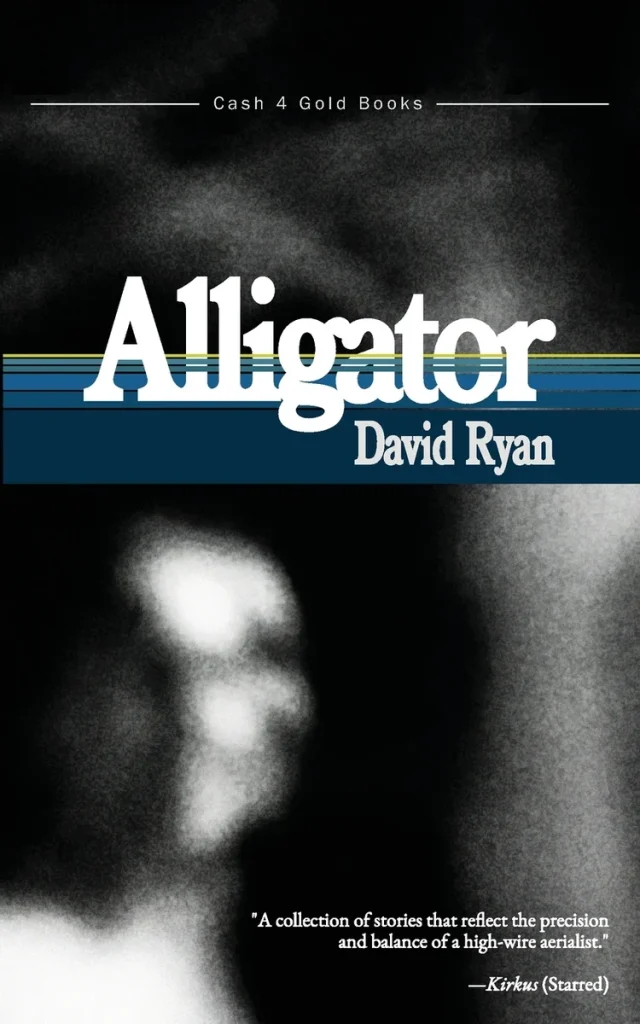
David is hard to keep up with—his stories appear at a regular clip in outlets, like Fence and Conjunctions, that appreciate his far-reaching formal experimentation—but the new collection stands as a cohesive sequence of stories to be read together. Floating fluidly between states of consciousness—waking experience, dreams (including those of animals), visions from the precipice of death—these 21 stories, few of them over 10 pages long, constitute a morbid investigation into the darkest mysteries of everyday existence.
Characters often appear in moments of stasis—staring at the conveyer belt of a grocery store’s checkout, sitting in a darkened movie theatre during a Robert Bresson retrospective, lying half-conscious on the floor after a fall down the stairs—while, in their minds, memories blur together with the present moment, surrealistic visions of animals and cosmic phenomena appear before their eyes. And then at the end, sometimes, it all recedes into a dream inside of a remembered dream.
What I wanted to learn from David, above all, was how he navigates the construction of his stories, which proceed under the logic of the unconscious, yet are as perfectly and precisely fashioned as an airplane. Their constituent parts fit together just right—not always in a way that’s rationally explicable, but never random, arbitrary, or out of place.
Seth Katz: Did the guys at Cash 4 Gold come to you with the idea of doing another story collection?
David Ryan: No, they were looking at a bunch of different things, and a story collection just made sense because I had so many. They’re pretty wildly open to whatever, which is something that I like about them—they’re not tied into any one thing. They weren’t interested in a thematic collection or anything like that. They just wanted the good stories that seemed to have something tonally that registered with them. Which let me get rid of some of my weirdest stuff.
SK: And it did turn out to be a thematic collection, in a subtle way.
DR: Everything has gotten so taxonomical. But the truth is, a collection of stories by Salinger is thematically tied, whether you want to believe it or not. It’s just nuanced in that way, it’s not hammering people over the head with it.
SK: One thing that interested me about the story “Pickpocket” is that, even though at first Bresson’s film (of the same name) doesn’t seem to have anything to do with the internal state of this character, sitting in the dark thinking about her lousy father, by the end they seem inextricably woven together. I’m wondering how consciously you construct your stories, and how much of the process is intuitive.
DR: That’s the fun of it. As you know, I’m a big fan of Bresson, and Pickpocket is such a strange movie about alienation. Actually, tonight I’m gonna read “Warp and Weft,” which “Pickpocket” came from—
SK: —the woman in “Pickpocket” hears the sound of the crane that crashes down in “Warp and Weft.” It feels like a deleted scene from the story.
Sometimes the best thing you can do when you’re writing is let something happen that feels spontaneous in the way reality is spontaneous.
DR: So, here’s the story about that. I was doing a lot of readings, and they give you certain time frames—five minutes, ten, twenty. And I thought it would be an interesting exercise to come up with a single story in vignettes, sort of rhizomatic maybe, that are each written to be self-contained, but also feed into each other.
So I free-wrote an opening and it was about a construction worker falling from a high-rise and seeing his wife and son in the windows as he passes. Then I used that as a model for a bunch of free-writes each subsequent day for a week, with the rule that each vignette that followed had to have something falling and something rising, and it had to deal with parenting in some way. And each one had to be punctuated with a sound that had happened in the opening vignette, like a simultaneity all across the city. It was inspired by 14 Stories by Stephen Dixon, about a gun going off in an apartment complex.
“Pickpocket” was just one of those. It was a spontaneous thing, another morning at 5 a.m. where I got up and was like: “Type!” Maybe I had been thinking about Pickpocket. And maybe I had my mom on my mind—she was born in Brazil, and her dad was a missionary, but I changed it to Nicaragua, and Nicaragua necessarily brings in other details from other things I know about.
I find that if you have a throughline of some basic idea, or if you let yourself daydream your way through it, the elements will come together, the subconscious will take care of it. Like at the end of “Pickpocket,” where the credits are described rolling up the screen with the black background as if descending—that was spontaneous. That was my unconscious, part of the free-write.
SK: How was it that “Pickpocket” came to be a separate story, then, from “Warp and Weft”?
DR: I sent the whole thing out to The Harvard Review, and they asked if I could think of something to cut because it was too long. So, I took the “Pickpocket” section and sent it to Threepenny Review—who I knew would reject it in a day or two—and then wrote back to Harvard and sent them the excised draft, which they took. Then, much to my surprise, Threepenny took “Pickpocket.”
SK: And even though “Pickpocket” is now a separate story, you decided to leave in the moment where the woman in the theatre hears the sound, the boom. Reading it in your book, I made the connection immediately because it comes a few stories after “Warp and Weft,” but otherwise that moment would be even more mysterious.
DR: This is a great trick that I’ve found. Sometimes the best thing you can do when you’re writing is just let something happen that has no bearing on the story necessarily, but feels spontaneous in the way that reality is spontaneous. It’s a little dose of realism. And the noise triggers a response in her mind. If it were just a sound, it might easily be excisable. But it also was reflective of her mindset in this movie theater and what she’s thinking about, which I think were probably my own thoughts at the time. That theater was the Waverly, by the way.
SK: Which is now the IFC Center. I recognized it because you mention Sixth Avenue in the story. Definitely a theatre where you might hear street noise.
DR: That was two addresses down from my old apartment, which is also the apartment in “Warp and Weft” where the couple has hooked up. I’m describing my bedroom, basically. It’s all in that little locale.
SK: There are these little details from your life littered throughout the book. Are there any stories that are more directly autobiographical?
DR: “The Shirt” is an entirely true story, in that someone lent me a shirt, and then I left town and lost the shirt. Years passed, decades, and we were still connected through some mutual friends on Facebook, but I had lost contact with that particular guy. I always felt like a jerk for losing his shirt and never owning up to it. Of course, you change the story to make it dramatically interesting, so there are elements that are confabulated. But the way the story ends is pretty accurate. When I found out he died, what was killing me was that I had never resolved this situation with the shirt, which felt really big to me. It was representative of something larger.
SK: And then, of course, in “Alligator,” you have your wife’s name, Susan. The end of that story feels like you pulling back the fictional curtain to reveal yourself, the author, in the process of working through a specific, overwhelming feeling of dread, a fear of loss.
If it flows naturally, you allow an unexpected genius to rise up.
DR: “Alligator” is the truest thing I’ve ever written. That was originally going to appear in a series that I’m working on called The Book of Lasts—I’m writing a bunch of lyric essays that play with the idea of a terminal moment. But then I did a reading of that story, and this incredibly bright student in the audience—when I explained that I’m working on this thing, The Book of Lasts—he raised his hand and he hit on something that I hadn’t admitted: “The thing about ‘last’ is it’s a verb, too.” It’s a duration. And so ironically, you have this idea of a terminal point, the last moment, but you also have its lasting. It just opened up a lot of possibilities for how to write a collection of these things. Now, “Alligator” ended up in a short story collection so I’ll have to write other things to take its place.
SK: Was writing that story as intuitive a process as the writing of “Pickpocket”?
DR: I had this image of an alligator stuck in my head and I couldn’t figure out what it was. And so you’ll hear me thinking out loud in parts of it where I’ll go, “No, that’s not it.”
SK: Right, it keeps negating itself. Actually, this is the story of the alligator.
DR: That’s literally me, as I’m writing it, talking to the text. Starting off, I wanted to get at this anxiety I was having, waking up in the middle of the night and imagining a day when I was alone, or my wife was alone. It’s a terrible thing to wake up thinking. I wasn’t trying to torture myself, it just seemed to be happening more and more. And so I picked a scenario that wasn’t at all true and just stepped into it like a daydream and started typing it. Which then started increasingly leading to associative things that were getting closer and closer to the truth until it was just the truth. I was really excited about that as a process, so that’s probably going to be more of what I do from now on.
I might plan out metaphors if it’s an ambitious idea and I want to figure out what the incision point is, but for the most part I try to rely on spontaneity because I don’t feel like I’m very smart when I’m thinking consciously. I’m constricting possibilities, and I feel like—maybe this is a product of teaching, where I can see from someone’s story when they’re thinking it out, muscling their way through something—if it flows naturally, you allow an unexpected genius to rise up that I don’t have when I’m trying to think.
SK: There are a lot of animals prominently featured in your stories. It’s possible that one of the most sympathetic characters in this whole book is the owl in “Reliquary.” Why are animals so central in your writing?
DR: I think animals are my access point for things that I don’t have the words for, and yet they represent things that are very human. They represent vulnerability, for instance. You can get at vulnerability by using a dog in a way you cannot with a human being. It just has a magical property. You’re taking a trait that one associates with a creature, and you’re allowing it to exist on its own separate terms from humanity, and yet it’s invariably going to tie into that humanity.
In “Reliquary,” the owl is the star, for me at least. At the time I was reading—and probably drawing a little too much from—Rodrigo Rey Rosa and his novella The African Shore. That owl represents something that I don’t know how to write. And the idea of the dog having a dream, then the owl stepping into the dream because they’re lying next to each other in a darkened barn—it creates a feeling of empathy between creatures that are stuck in the same situation. Animals represent something that is, of course, wordless, and yet has all of the emotional freight that we carry.
SK: Your first collection, Animals in Motion, came out just over a decade ago. What’s changed for you between then and now?
DR: I was teaching at Sarah Lawrence and I had never had a book published. I was sort of there accidentally, I think because I was an editor and I had been publishing a lot of stories. That gave me something. But it was kind of a miracle that I got this job. It was through Nelly Reifler, who wonderfully recommended me when she knew that she was gonna need to take a couple of sessions off.
Animals are my access point for things that I don’t have the words for.
The book deal was with Roundabout, this small press, but I remember thinking that at least this will give me a book so I’m not this weird outlier as somebody who’s teaching and who’s never actually published a book. And then a lot of stuff happened from that that I couldn’t have predicted. I try to emphasize to students that it’s not like you’re going to just get a book deal and then ABCD follows, right? The stuff that happens is sometimes better than your anticipated ABCD, but it falls from the sky.
SK: Such as?
DR: For instance, Rick Moody and I did a thing for the book at the Center for Fiction. A year later, someone from Colgate called and asked if I’d be interested in coming and doing a summer workshop. And it happened that somebody had been upstairs at the Center for Fiction, using one of the writer studios, and had come down and stopped because she could hear these voices, and she watched. And from that, a year later, when they asked her, “Can you think of anyone we can get,” she remembered me. How would you ever know that that was going to happen?
SK: Are there specific things that you find your students can do really well that you can’t do, or wish you could do?
DR: Almost everything. I have to remind myself sometimes that everyone’s starting from a certain spot. It may have been that they kept a diary from when they were five years old, and they just practiced this idea of accessing memory and things. Every once in a while there’ll be a student who just seems to have access to something that’s naturally beyond just being a good writer, and I think that’s usually of a piece with how loosely they play with consciousness. Sometimes it’s a troubled person who’s dealing with that and able to really write well. Sometimes the ability to control it is not so easy. I have a great class right now. There’s just a lot of life, a lot of energy and interest. It’s good.