interviews
The Best Friendships Have a Group Chat Worth Writing About
Emily Nemens’s “Clutch” explores the ups and downs of longstanding, and long-distance, friendships

This article is free to read. So is every article Electric Literature publishes. No limits, no paywalls—now or ever. But we rely on your support to keep it that way.
We need to raise $35,000 by April 15 to keep the lights on, and time is running out. Donate today.
—————
Emily Nemens’s Clutch is a sprawling, ambitious, and deeply-felt story of friendship. The five women—Hillary, Reba, Gregg, Carson, and Bella—are old enough for their fair share of regrets and responsibilities, and the book focuses on how they still show up for one another. Despite kids, addiction, ambition, parents, and career, these women will get on a plane and be there for one another, and if they can’t do that, there’s always their group chat. It’s an assured and wise book, unique in how seriously it takes the value of friendship between older women. I found myself rooting for each of the five protagonists, only to side-eye their choices in the next chapter, and then forgive them a few pages later. Similar, then, to most friendships.
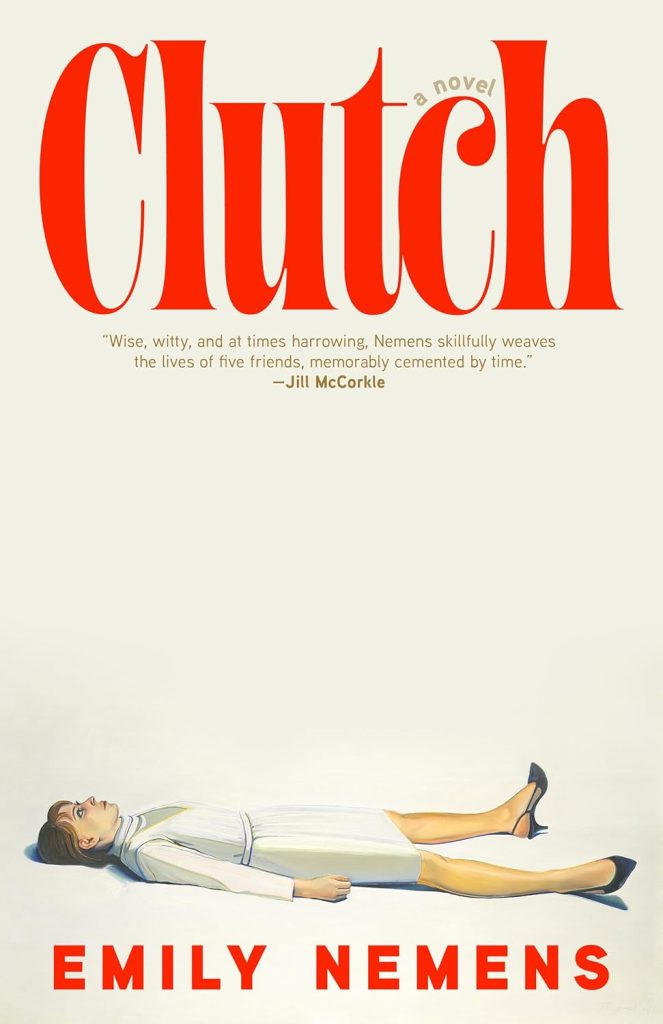
I first got to know Emily when she was my boss at The Southern Review, where I got to witness her editorial excellence up close. She eventually left The Southern Review to helm The Paris Review, before turning to focus on her own work. Her sharp editorial instincts are obvious in her work: Clutch is a feat of narrative structure and organization, with five main characters, most living in different cities, and all with competing interests and backgrounds. Nemens expertly moves through all these plots and perspectives, a complicated dance that pays off with one of the most memorable party scenes I’ve read in a long time.
I sat down with Emily to chat with her about the ups and downs of longstanding friendship, revision and organizational techniques, finding inspiration in post-Roe America, and more.
Kathleen Boland: The first pages of the book introduce the “Group Chat” of Reba, Hillary, Carson, Gregg, and Bella. The characters’ chat is an essential aspect of their long-distance and longstanding friendship, which is something I think many people can relate to. It’s where some crucial plot development happens, and each chapter starts with a text message. Can you talk more about the concept of the group chat in Clutch?
I was interested in the chats running at times contrary
to the way things are playing out on the ground.
Emily Nemens: Well, group chats are, in our contemporary moment, a shorthand for a certain threshold of close friendship, and I liked what that signified, right off the bat. But on a time-management level, I found the chats to be very handy. Sometimes, it’s a time stamp: This prologue opens in November 2022, when they’re hatching plans for their Palm Springs reunion, then in the first chapter it’s January 2023 and everyone is on their way to the airport (at the ungodly hour of 3:08am). Then, when they’re all together, they don’t need to text each other, but life back home interrupts with these pesky reminders of the real world, which help us learn about the characters in another way and accelerates some action. When they’re home from Palm Springs and back to their regularly programmed lives, the chat underscores the passage of the year, and, time and again, those little pings let the women know that as daunting as things feel, they have a woman (or four) in their corner—as long as they are willing to share that they feel daunted in the first place. That’s another thing: These women love each other but they don’t have ESP, and I was interested in the chats running at times contrary to the way things are playing out on the ground, because admitting shit’s gone sideways is its own kind of humility, especially for a group that is good at masking/coping/denying difficulty.
KB: I loved the tension between how the women portrayed their lives to each other versus how their lives actually were. You balanced this so artfully throughout the book, and you did so with five main characters across multiple locations! What was your organizational process while writing?
EN: I found I overwrote a lot—the version I sold was 15K words longer than its present iteration (thank you to my editor, Masie Cochran, for her knife-like pencil!), and that was after cutting back on my own for months and months. Plus, I put my characters into a lot of situations that never ended up in the book. All those extra scenes and beats before/after/between what ended up on the page helped me figure out each of them, so I had a good sense of how they’d behave in just about any room, which includes who would hide what in certain scenarios. As for organizing them and keeping everyone straight, I think all my editing experience helped—I have a long history of tracking down and correcting continuity errors, addressing illogical swings, and striking redundancies. An early reviewer compared me to some kind of homicide detective (or madwoman?) with a bunch of corkboards in my study, and there was certainly some problem-solving and course-corrections along the way—the hardest thing was keeping track of all the toddlers, who was pregnant when and who was wrangling infants vis-à-vis the Covid lockdown—but mostly I thought it was fun to try and keep all these timelines and characters on track. I have one tiny corkboard in my office, but it’s only for postcards from dear ones. Your new book, Scavengers, has its fair share of complicated timelines and consequential backstories, too: How’d you keep everyone straight?
KB: Scavengers involved a lot of color-coded post-its scattered around my desk and walls, which I wouldn’t recommend, though they did inspire the haphazard treasure map that appears in the book. I eventually moved my notes to Scrivener, which was much better.
I also cut a lot of words, but nothing close to 15K words! Any cut scenes you still think about?
EN: I, for one, loved that treasure map! Thank god for Post-its. As for cuts, two pre-editor ones come to mind: Reba had a friend in San Francisco for a long time—another person who felt kind of marooned on their island/peninsula, isolated by tech bros and the bad will that was festering across San Francisco at that time. Honestly, I think Reba still has that friend, living a few houses down, but I realized that I wanted to focus on the five core friends and their domestic situations, and not have the readers be pulled sideways by other close alliances. And a second cut: I love Jackie Sibblies Drury’s plays, and have been lucky to see a few of them produced, in all their jawdropping vitality and carnage—and I imagined Gregg’s acting in one or another of these wild productions. I could have written about Gregg’s acting and the way she unleashed herself onstage for pages and pages . . . but I didn’t want to get carried away. What readers need to know: Gregg, as a performer, has some range.
KB: The epigraph is from Robert Creeley’s poem “America,” which I found to be a very evocative choice, both before and after I read the book. How did you come about this poem, and why choose it for Clutch?
I’m a bit cynical about the conventional markers of
success at this moment in this country.
EN: I could come at this question from about a dozen angles, but I’ll try at one. “America” is a short poem, written in the late 1960s, as a protest against all the awful stuff America was doing in the world. Creeley starts by decrying imperialism and the war and the harm “on the four corners of the world,” but at the end (from which I draw the epigraph), he’s lamenting the plight of the Americans who have no choice but to be complicit in, or at least associated with, the marauding (“nowhere but you to be,” with you being America . . . such a gut punch). Well, tbh, that sentiment felt a little too familiar. I started writing Clutch soon after Roe was overturned, and as an American woman, I was so mad at the decisions that were being made by “us” for “we.” The same anger Creeley expressed, I felt it, I feel it all the time. I think my characters are mad too, or at least have a very ambivalent and conflicted relationship with the power structures of this nation, the systems that delivered them to this moment, and they’re asking questions about how things got so wrong. I’ll also note that Creeley is hardly the only poet to pen a rousing critique of this nation in the 1960s, but I wrote a lot of this book while teaching at Appalachian State, not far from the Black Mountain College, where Creeley studied and taught. Name-checking BMC felt like a small, secret homage. Well, not so secret anymore!
KB: You’re an astonishingly deft writer of group dynamics. One of my favorite chapters of your debut novel, The Cactus League, was the one that featured the wives of the baseball players. Those women were hyper-focused on the power that comes from money and sex: Who has it, and who doesn’t. In Clutch, money and sex are both major factors in the groups, but each woman has a much more nuanced approach to having it or not. I appreciated how the women didn’t let anyone get off easily (no pun intended) when it came to their friends’ choices. What were you hoping to convey about the power of money and sex in friendships in Clutch?
EN: Well, first of all, thanks for saying that. Regarding group dynamics, I am a quiet person, which means in any given group, friends or otherwise, I’m often the one observing others, watching for a while before I chime in, and sometimes then only when prodded. So I guess I’ve grown a knack for tracking the volley of presentation and preening, noting when people are proud or insecure or defensive or thrilled beyond belief. It’s fun to write the equivalent, extrapolating interiority from performance. As for power and money, I don’t think I’m the only one who’s felt the strain of friendships that start on the relatively neutral ground of college and dormitory life—we all have the same crappy extra-long twin bed for a few years, and nobody is particularly good at dating—but then, because of privilege or ambition, lives begin to differentiate. Who buys a house, who keeps renting. What vacations look like, hell, what success and happiness look like. That broadening delta can be difficult to navigate, as shared experiences become fewer and farther between. I’m a bit cynical about the conventional markers of success at this moment in this country, you could probably tell from reading Clutch and what I’ve laid out in our conversation, but I didn’t want to say: This is the way you should live. Because it’s different for everyone. The thing I want for my friends, and the things this group of friends wants for one another, is utter and sustainable happiness.
I guess I didn’t really talk about sex. Do you want me to talk about sex?
KB: Of course!
I didn’t write much in the way of sex acts so much
as I wrote about the consequences of them.
EN: I think these women have all figured out that your romantic partner can’t be your everything. Their careers, their kids, their friendships are given equal billing (if not higher rank) to whomever it is sharing their beds. I just read Andrew Martin’s new book, Down Time, and he writes about sex, well and a lot, which made me realize I didn’t write much in the way of sex acts so much as I wrote about the consequences of them: pregnancy and partnering, the expectations that come when we open ourselves up in this most intimate way. The friends have earned intimacy through loyalty and duration instead of attraction and [physical] intimacy. It’s apart, and less electric than the intoxication of romantic love perhaps, but maybe just as important in terms of reaching toward the aforementioned sustainable happiness?
KB: Oh, I love this answer. In a not-very-graceful segue, how does sustainability factor into your writing practice and career? What are some things you do to keep going?
EN: I read. I read and read and read. Yes, there are times when the momentum of a project (or the exigencies of life) mean I don’t make it through a lot of new texts, but looking at the possibilities of style, and researching topics that I want to understand, typically so that I might metabolize them into my own creative work (last week had me reading a text about the Fluxus movement in NJ and Anelise Chen’s Clam Down, for instance) has been an endless font. When I think about how little I read as a young writer, I shake my head. Of course, I was headstrong and impatient to get going! All reasonable emotions, but I am so glad to have figured out some modicum of patience, of humility. I’ve noticed I’m also getting more curious as I go, which I think is a good thing for a writer. I know less, but I want to know more. Ambition, curiosity, and humility—that brew is either paralyzing or you go Energizer bunny. I’ve opted for the latter route. Do you have any tips for the readers?
KB: I would add “write most days” but with the strong caveat that the writing need not be project-driven. A brief description of a person on the bus in my Notes app, transcribing favorite passages from the book I’m reading: This all counts. Anything to keep the writerly part of my brain lit up.
Finally, if a reader loves Clutch, which they will, what should they read next?
EN: I’m delighted by the cluster of “friend” books coming out right now—Angela Flournoy’s The Wilderness and the aforementioned Down Time, Grady Chambers’s Great Disasters. Maybe we all missed our friends during Covid? Who knows. You could also go historic—Mary McCarthy’s The Group and Rona Jaffe’s The Best of Everything were important to me while writing. For a group of precocious young women, there’s always Little Women; for a group reckoning with unspoken sadness, there’s The Heart Is a Lonely Hunter (there’s a reason I named one of the protagonists after Carson McCullers). Or, for a really deep cut, when was the last time you read Crime and Punishment?