Interviews
A Novel That’s Part Manifesto, Part Unauthorized Fictional Memoir
Jordy Rosenberg’s “Night Night Fawn” is a Marxist, trans, hysterical accounting of a terminally ill Jewish mother unrepentantly looking back on her life
This article is free to read. So is every article Electric Literature publishes. No limits, no paywalls—now or ever. But we rely on your support to keep it that way.
We need to raise $35,000 by April 15 to keep the lights on, and time is running out. Donate today.
—————
Night Night Fawn is without a doubt the Marxist, trans, comedic dystopia we need in 2026. Initially conceived as nonfiction, Jordy Rosenberg’s second novel subverts form to become an inherently transgressive, unauthorized, fictional “memoir” that reads as hysterical manifesto.
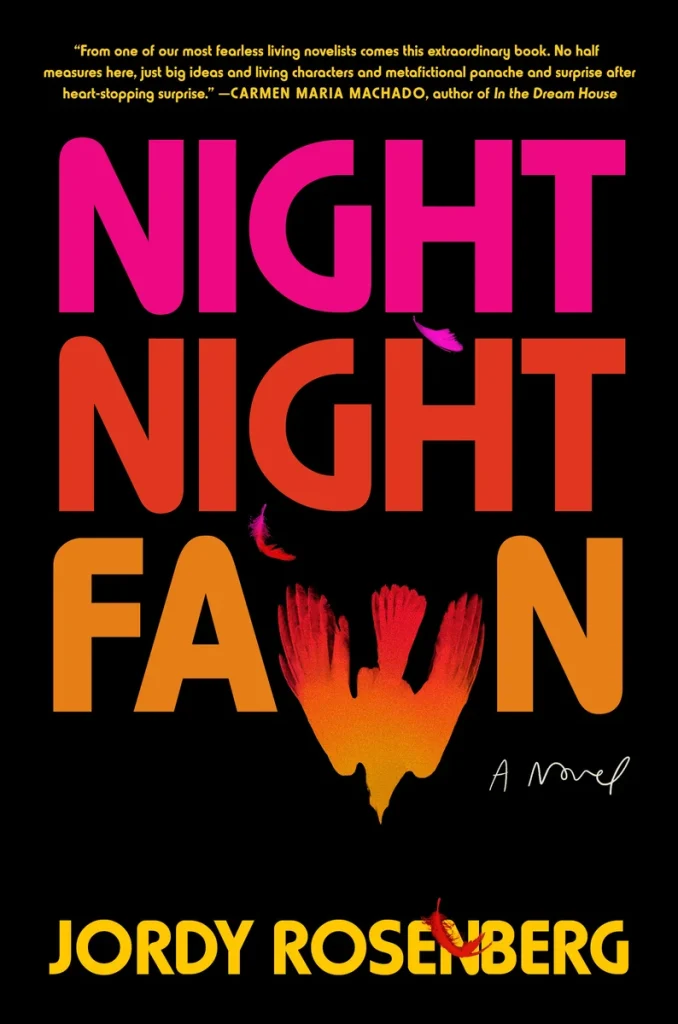
Barbara Rosenberg, a character modeled loosely on Rosenberg’s own mother, is a terminally ill Jewish “yenta.” High on opioids, looking back at her origins in post-war New York—where she grew up with aspirations to be a wealthy Jew—Barbara wonders where she went wrong with her estranged trans son and her ex best friend. As Barbara takes an “unrepentant account of all her failures,” she seeks to understand how her child ended up becoming her greatest fear—queer, unrecognizable, anti-capitalist, manly. All the while, Barbara tries to convince her reader that she is justified in her actions as a parent, and can’t we see why she had no choice but to hide that beloved corduroy blazer in the closet? Entrapped in “the bitter breath of aqua net,” Barbara is delightfully acerbic: We almost forget how homophobic, transphobic, Zionist she is. “What makes you a man,” Barbara tells us, “is how you die.” Meanwhile, a woman’s body is essentially a desecrateable thing.
The book draws on influences as vast as Marxism, Hollywood, and even, perhaps, the dark satirical wit of Angela Carter, as it takes surreal leaps. Rosenberg, interrogating American Jewish culpability, writes, “The stylization and submission of catastrophe to the ethereal classiness of [Hollywood] explains the fascination of the boomer generation with Israel and colonizing Palestine.” As with Rosenberg’s first book Confessions of the Fox, the prose crackles. “With yentas,” Barbara tells us, “there’s no defense, only offense.” Barbara never lets us forget it, and neither does her author.
I spoke with Rosenberg over Zoom about films, form, and the forbidden corduroy blazer.
D/Annie Liontas: This book is so funny! I think of humor as the first tool of the defenseless, and specifically of queers, yet so often we yield the power of humor to the political right. How is humor, particularly satire, an act of cultural resistance? Why do we need it, especially in 2026?
Jordy Rosenberg: I love comedy because it’s vernacular. History is lived in the vernacular, resistance is lived in the vernacular, and bits, jokes, and satire are all part of that. So I do think of comedy as part of building a durable culture of resistance that is inviting, provocative, seductive, and a place for the release of anxiety for people who are participating in struggle. That last element—the temporary alleviation of anxiety for readers who might be overwhelmed and exhausted, despairing etc.—is something that my partner, Jasbir, helped crystallize for me as a horizon. This was especially helpful while I was engaged in the often difficult project of writing a book that is a deep dive into a world of transphobes and colonizers. I also think that the satirical mode in particular has a special affinity for focalizing anger in the direction of political action.
D/AL: This book started as a memoir, but I’ve also heard you describe the novel as “70s erotic satire, gutter schtick, and a splash of gothic menace.” Can you speak to the genre and what it means to tell this story in a mode that is uncategorizable and irreducible?
JR: Well I’m not the first person to say that, in part, I was influenced/aggravated by the Rothian school of Jewish American literature. So going back to what you asked about comedy, there’s a certain element of this novel that isn’t only about stealing back parody and satire from the right, but was also about stealing back that kind of libidinal license from a kind of liberal Jewish-American cis male tradition. In this, I would like to think I am taking part in a larger movement among trans writers who have refused respectability politics in all of these incredibly visceral, imaginative ways. This is something that’s particularly evident in the wave of authors writing in or about trans horror, like Grace Byron, Gretchen Felker-Martin, Alison Rumfitt, and Zefyr Lisowski, to name just a few. Horror and satire are incredibly proximate modes. You see that in the Scream franchise, for example, right? There, the self-awareness of horror as a genre doesn’t subtract from the horror—it often just amplifies it, or combines it with laughter. That roving, over-excited affect of terror or laughter—well, it’s kind of fungible.
All to say that, genre-wise, I did try to combine a kind of (righteously) purloined Rothian libidinal license with undercurrents of horror. And all of it, I hope, contributes something to this broader movement in trans fiction that dispenses with the stultifying and unimaginative demands of respectability politics. And then of course, there’s also a very long history of anti-fascist and anti-authoritarian satire that I’m drawing on as well. Orwell speaks about the material impact on his work of having been part of the actual “machinery of despotism.” Having grown up within a Zionist and homophobic household, and in many ways trying to expose and satirize the interiors of those spaces, Orwell’s language did resonate with me. The satiric experiments at play in authors like Emile Habibi and Roberto Bolaño were also important examples. Randa Abdel-Fattah recently had some very compelling things to say about satire on David Naimon’s wonderful Between the Covers podcast, as well.
D/AL: Barbara is intoxicating and charming on the page and yet we understand her to be extremely flawed—Zionist, transphobic—and that, to be in close proximity—to be her child—might be impossible. Is it a dialectical exercise to fictionalize her? What did it take to shape this voice, and what are you confronting with it?
I am taking part in a larger movement among trans writers who have refused respectability politics in all of these incredibly visceral, imaginative ways.
JR: Something I was thinking about quite a bit while writing was the extent to which we unconsciously, melancholically incorporate the speech of the other—even of a parent who we may have had a very difficult relationship with, and whose politics we explicitly reject. What to do about the tangled situation of subject-formation? In many ways, this book is about complicity—our inextricability from the systems we confront. That’s dialectical. And it’s why, I think, I was compelled to write this book as a satiric novel from the perspective of a transphobic, Zionist character (rather than, for example, as a memoir from the perspective of me, a person who has refused those positions). One of the things I was interested in portraying was the ubiquity and ordinariness with which colonial ideology has been normalized within diasporic American households—in depicting a character who enjoys certain forms of power, who identifies in an unconcealed way with supremacist and colonial projects. It had to be written from that character’s perspective—someone who was not going to conceal or hedge or varnish over exactly what those attachments meant.
D/AL: Barbara yearns for family, defining it at one point as “amoeba people . . . individual members making up one entity, one cell, whose limbs reach out in many directions, but all held together by an invisible membrane.” What shapes her ideas of family, especially regarding gender policing? What is Night Night Fawn illuminating about queer and trans folks who are estranged from family?
JR: There’s a certain amount of portability to this feeling of being excluded from family. Certainly, trans people know this feeling very well and have been materially subjected not just to familial estrangement, but abandonment and abuse. But the feeling of wanting an ideal family, or of wanting something from family and not being able to get it, is pretty ubiquitous. Much of this book explores Barbara’s feelings about having been, from her perspective, denied the family that she wanted. She has to share a family with a trans person and for her this is an experience of victimization.
I was interested in exploring certain aspects of a kind of pre-second wave feminist mid-20th century worldview, and how a certain ressentiment gets channeled both into anti-trans animus and, in the case of this character, an identification with a colonial project which she sees as the ultimate locus of a liberated binary gendered discourse. Maybe this is another place where the dialectical aspect gets elaborated—because this is also a character from a working class background contending with certain frustrations with the conditions of her life and labor both at home and in the workplace. But as Sophie Lewis’s book, Enemy Feminisms, and others have pointed out, there’s nothing that has historically prevented some of these rightful grievances about gendered oppression from turning toward what Lewis describes as a “restrictive pessimism” about what it is to be female. Emma Heaney describes cis-ness as “feminism’s counter-revolution,” and I’d say that Barbara is mounting an epic counter-revolution throughout this book.
D/AL: Night Night Fawn integrates film as a way to contextualize Barbara, but also define the cultural era and name Israel’s hold on the American imagination. What is the power of noir films, specifically Sunset Boulevard?
JR: Barbara the character is obsessed with both noir and with Exodus. As for the latter, Exodus was an incredibly central piece of literary and filmic propaganda for people of that generation. As the scholar Amy Kaplan has argued, it “forged the popular American identification with Israel for decades to come.” Ultimately, the film became so influential that Israel’s minister of tourism (as Kaplan notes), said “we could have thrown away all the promotional literature we printed in the last two years and just circulated Exodus.” I won’t give any spoilers, but I will say I was interested in exploring that situation fictionally.
The feeling of wanting an ideal family, or of wanting something from family and not being able to get it, is pretty ubiquitous.
As for noir, I’m interested in noir conventions and ways in which a variety of filmic identifications were coming to shape certain forms of mid-century femininity and aesthetics. Sunset Boulevard is an iconic demonstration of noir form—specifically the ways in which the eeriness of noir voiceover, the fact that we are listening to a placeless voice speaking from an unknown location, gets incorporated so naturally by the viewer. This is something I found beautifully articulated in Theodore Martin’s wonderful book, Contemporary Drift. The entire technology of voiceover means that the voice that you hear when you’re looking at the picture on the screen is coming from a different place than the picture is. In Sunset Boulevard, you realize the film is being narrated by a character who is dead, and so they’re inhabiting a place that is radically outside the frame. But filmic form is about suturing together across gaps, and the viewer incorporates this process with pleasure. The viewer does not have a problem with these contradictions. Sunset Boulevard defined an important zeitgeist for Barbara’s character, so I wanted to explore the significance of it for the character’s world. But, also, Martin’s analysis gave me license in terms of literary form and trying to take risks with contradictions, and then trusting that the reader incorporates them.
D/AL: You set Night Night Fawn in Brooklyn and Manhattan, spanning from post-war era through the 1980s. What were you thinking about when you wrote about this city as a locus of power, and as you captured New York across the decades?
JR: I love something Andrea Lawlor has said about Paul Takes the Form of a Mortal Girl, which takes place in the 90s: “Well it wasn’t historical fiction when I started writing it.” I grew up in the 80s, and in some ways I’ve been “writing” this novel in my head since then. So there’s a certain continuity, and for me it doesn’t feel like historical fiction. But to a reader, especially a younger reader, of course, it will feel like a different world. There are, for example, glimpses into very specific niches of New York City culture. Studio 54-adjacent teenage life, for example. Or the milieu of garment trucking in midtown in the 60s. Or the life of a small upper east side office workplace during the 80s. My mother, like Barbara, was an administrative assistant in a plastic surgeon’s office, so I was also very interested in capturing some elements to do with the birth and commercialization of plastic surgery. Really, the beginnings of the intensification of a gender binary that has been taken to a comical zenith now.
D/AL: Can you talk about the forbidden corduroy blazer? I think about it every time I walk past my hall closet.
JR: Who doesn’t love a corduroy blazer? There is a recurrent issue that comes up in the book around the trans character’s desire to accouter himself as he likes (in this case, in corduroy). We are talking about the relationship between a desire for gender and gendered identity. I hardly need to say much about this, as Andrea Long-Chu’s iconic essay “On Liking Women” in n+1, has already covered this ground, fearlessly breaking a certain silence around a trans desire for gender. It was such a bombshell when she wrote, “The truth is, I have never been able to differentiate liking women from wanting to be like them.” Part of the point here is that it’s not just that, against all of the medicalizing and pathologizing prohibitions, trans people actually have complex affects and desires, but that we share these complex affects and desires with cis people. And so my own book is much more invested in exposing cis desire, through Barbara, who has an enormous desire for gender—to be a woman, to be part of a gendered binary with her husband, and all of it. In the course of that quest, Barbara becomes, you could say, fetishistically and phobically obsessed with her child’s own gendered desires, which take the form—for Barbara—of a desire for a corduroy blazer.
My decision to centralize and kind of riff on this obsession of Barbara’s around the blazer throughout the novel had a lot to do with everything I just described about gender and desire. But it also had something to do, as an extended bit in the novel, with Marx and the first chapter of Capital, where he lays out the fundamentals of capitalism using the example of a coat. He’s speaking there about how a coat, which is an object, composed of certain textiles, put together by a laborer—and he’s asking how it is possible that an item mediated through human labor comes out the other side as a commodity that erases its relationship to that labor. You don’t see the labor when you look at the coat, you see the coat. How is a commodity able to take on a value that is larger than the wage the laborer gets compensated for? That’s kind of the crux of Marx’s analysis in that book. So the blazer is a Marxist bit for Marx nerds, but I guess also I’m trying to expand on the often gendered dimensions of the commodity-fetish, something which does not get remarked in Marx. So it’s a trans bit for the trans nerds. Or the trans Marxist nerds.