Personal Narrative
What If Breaking Students to Build Them Back Up Only Breaks Them Down?
I experienced my college essay course not only as a threat to my personal style, but also as a threat to what writing—and writing education—could be
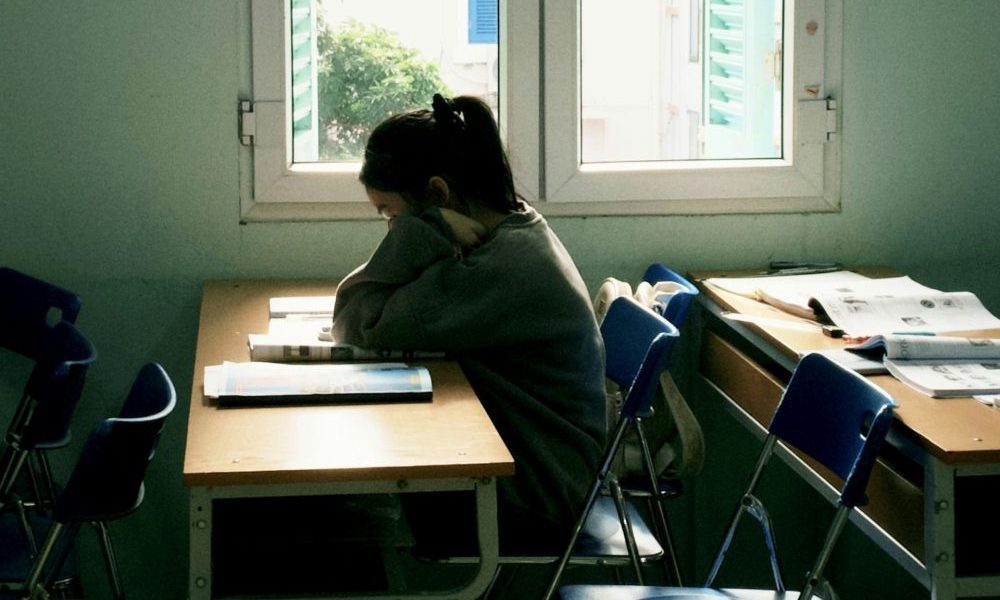
“Obedience to Authority: On Being Broken,” an excerpt from Feels Like Trouble by Helen Betya Rubinstein
It was my first class of college, the class I walked across the quad toward on the crisp morning after Labor Day, the empty days of orientation finally over, bell tower clanging out some approximation of a song. Writing the Modern Essay, it was called, which is funny, since Writing the Essay is the name of the course I teach now. We sat in heavy wooden chairs around a tremendous wooden table, all of us on time or early, all of us first-year students, every single one of us the kind of high school student who had wanted to go to Yale and gotten in. We were teacher pleasers and competition winners, elected leaders and admissions-committee-legible achievers, and we believed in the supremacy of our new school—it was why we were here, even if that wasn’t the story we told ourselves, even if some of us had chosen Yale precisely because it wasn’t Harvard. The room was a collective held breath. The walls were paneled in carved wood, the windows too high to see out of, diamond-paned, some of them stained glass. A few minutes after 10 o’clock the professor entered, tall, unsmiling, in a long skirt, her small eyes hard to read. She was pale, face haloed with curly dark hair I’d learn she had a habit of nervously patting. This essay is about her, but I wish it didn’t have to be.
Before college, my English teachers had been a motley bunch who made us put our hands on our bellies and practice belting out our voices, or do Surrealist-style automatic writing for 10 minutes of every 50-minute lesson. The high school I’d attended was prestigious—“the best in Louisiana,” it claimed—but it wasn’t rigorous. My chemistry teacher drank wine at his desk and regularly set fire to rings of lighter fluid he’d poured around our chairs. My art teacher built still lifes for us, then spent the rest of the period smoking outside the half-open door. There was one English teacher who sentenced us to interminable months with The Scarlet Letter, and insisted we write according to a formula, but for the most part the department was witchy and weird. I used the medieval Japanese monk Kenko’s “Essays in Idleness” as the model for an essay extolling the glories of the orange, and wrote a play made up of seven colors speaking nonsense, which my classmates performed before the whole school. My advisor, the closest thing I had to a grown-up friend, left handwritten raves at the bottoms of my poems and stories, which she stuffed into my locker and signed with her initials: “EM.” My first college writing professor had the same initials, and would sign her emails and critique letters that way, too.
The courses I’d signed up for only reinforced a sinking suspicion that students at Yale were less talented and less interesting than students I’d grown up with.
I was walking to the third meeting of that class when my cell phone’s ringer blared and Mom told me a plane had flown into the World Trade Center. The event meant little to me: Still a devoted student of my high school’s norms, I actively ignored anything that might be categorized as “the news.” Our professor showed up late, her face ashen. She offered to talk with us about what had happened and, when we had nothing to say, dismissed us. I padded back across the lawn to my lonely dorm room—I’d been assigned a single I didn’t want—and started work on our first assignment, to write about a time when politics had shown up in our lives.
My essay would be about the year David Duke ran for governor, how during third-grade recess I’d stood in a horde of kids shouting “NO DUKES! NO DUKES!” as we watched an airplane write D-U-K-E in the sky. I hadn’t known then that NO DUKES was an echo of NO NUKES, and to be honest I doubt I knew it when I was a freshman at Yale. Months of the KKK Grand Wizard’s campaigning had ingrained the chant as its own thing, memorable as the bumper stickers reading vote for the crook, it’s important, a lesson in choosing the lesser of two evils.
To my professor it might have seemed clever that I’d chosen as my topic an election, the baldest possible manifestation of politics showing up in a person’s life. But I was writing about politics in the superficial sense because that was what I thought politics were. She read my playground scene aloud to the class, her approval a rogue flare of welcome amid weeks that had been disorienting and disappointing in ways I was only beginning to let myself admit. The campus was “a medieval Disneyland,” as I would soon put it, the gothic buildings fake paeans to old churches I wanted nothing less than to inhabit. The courses I’d signed up for—introductions to Russian, music theory, and cognitive science—only reinforced a sinking suspicion that students at Yale were less talented and less interesting than students I’d grown up with. What they were, it seemed, was more doggedly devoted to internalizing whatever the professor was saying. In each class there was at least one nervous freshman whose questions turned meetings into dull call-and-response sessions, which dragged on until they were satisfied with their own feats of mirroring.
“Imagine the horror of being surrounded by people who look good on paper,” I wrote in the manifesto where I channeled my anger and sorrow. My classmates seemed stymied, small-minded and bland. They “weren’t willing to take risks or think for themselves,” I told my high school advisor in one of the few emails I saved from that dark semester.
I wish I’d saved more, because I know that I started going to my professor’s office not only because she and I disagreed about how to revise the work I was turning in—she would never approve of another essay of mine as unreservedly as the first—but also because I’d begun sending her messages criticizing her pedagogy. I would remember this as merely arrogant if I hadn’t practically run toward an opportunity to teach in local schools after that first semester, desperate to undo the damage I felt those months had done. I’d spent the summer before college researching learning styles and brainstorming lesson plans as part of a cohort of “students teaching students,” energized by the force of my convictions about how my eighth-grade English students should learn. In New Haven the following spring, I would encourage kids to write sideways and upside down and with their non-dominant hands, to draw monsters in the margins of their looseleaf pages and read aloud from them proudly, never mind that some of them had begun learning English just weeks before. They were the experts in their own stories—that’s the pedagogy I remember wanting to impart. But I no longer have the messages I sent my professor, just the memory of sobbing in the armchair in her basement office as she handed me a box of Kleenex and explained that she was doing for me as a professor had once done for her: “I’m breaking you to build you.”
The office was large, with a rug and a standing lamp whose shade permitted a sallow light. On the wall hung an oversized map of Louisiana. It took several visits for me to register that it was no longer normal to see the geography of my home state arrayed around school. My professor’s proudest publication, it turned out, had been a feature on Cajun Mardi Gras. Where in New Orleans had I lived? she wanted to know. Had I ever been to Mardi Gras in Acadiana myself? Well, I needed to go. She had a fascination with Louisiana, in love with its peculiar foreign rituals. It only made me distrust her more.
Those meetings must already have begun by October, when an email from my father advised me to “accept the fact that she is your teacher and you must adopt the writing requirement she imposes. It does not mean you have to agree or lose your personal style,” he added with some tenderness. “Just hold back for a while.”
He was the one who’d taught me to question my teachers and, it occurs to me now, the source of my pedagogical convictions. Every year or two from the time I was in fifth grade, he would grow so irritated with one of my math instructors that he’d request to meet with them, or with the school’s math department chair. The frustration emerged partly out of his experience as an engineering professor who regularly found himself facing undergrads ignorant of mathematical principles, and partly out of cultural difference. In the Soviet Union, kids were led to figure things out—to uncover the method of long division, for example—rather than introduced to formulas as if they were magic tricks to memorize and follow. Students, he believed, should never merely be told how to do things. If they are to understand a concept in a meaningful and memorable way, they must discover it for themselves.
It’s surprising, then, that in his message he encourages me just to submit. Maybe for him writing instruction was incomparable to math; maybe, in the Soviet Union, he’d been taught to write using formulas provided without rationale. Or maybe, as a dyslexic kid in a culture where “dyslexia” had no name or treatment, he’d accepted writing as a site of senseless subjugation, mysterious and intractable. He’d not been raised by a coven chorusing, “Be creative!” nor had he ever spent a summer offering eighth graders unpunctuated strings of words so they could invent punctuation for themselves. His message is less concerned with pedagogy, though, than with my capacity to grow up. “Be a big girl and stop crying,” he wrote. “The best writing for this class is the style she wants.”
I don’t have my reply, but I know I experienced the course not only as a threat to my “personal style,” but also as a threat to what writing—and writing education—could be. In the manifesto I pecked away at that fall, I wrote that “EDUCATION SHOULD BE AIMED AT PROGRESS,” but that the curricula of schools like Yale “have no reason to be progressive. they have PRESTIGE: reputation: SAFETY: security in history.” It’s surprising to see this articulated so clearly, since it’s an idea I’ve had to relearn countless times: that professors and institutions repeat the same principles upon which their own authority was constructed because insisting on these principles is a means of protecting their positions and thus themselves.
She handed me a box of Kleenex and explained that she was doing for me as a professor had once done for her: ‘I’m breaking you to build you.’
these institutions not only MAINTAIN SUCCESS, they also DEFINE SUCCESS […] college will BREAK TO BUILD, as my english teacher told me, as her english teacher once told her […] we take our daily doses of what the doctors (PhD’s) say until our intuition creativity natural anything is suffocated caged squashed killed LOST.
By winter, I was emailing my high school advisor that I feared the course had left me “too self-consciously analytical to write well ever again”; emailing my mother that I was “broken in english”; emailing myself (December 6, 2001, subject: “yo”) that I felt “so un-free.” “i am trying to write,” I wrote, “and i can’t. all i want is to be able to write.”
I was depressed, obviously: “i want to run away,” I ended that note to self, “to a place of value. that does not devalue.” But even as I unearth these traces of real suffering, I’m tempted to dismiss them. Aren’t they just the complaints of a wounded young writer who happened to write her first essay about a subject her professor claimed as a recreational interest, and could not bear the fall from grace that followed?
I see this dismissiveness, too, in the replies other people sent me. An email from my mother echoes my father’s: “Write to enjoy yourself in your free time. Write for the course in a way that shows you are trying to learn what she’s trying to teach you.” I must have complained that my professor was strong-arming me toward simplification, because she adds: “No, don’t tell her you’re being rewarded for less effort. It’s probably not true if writing the way she likes is a struggle for you.” Assuming my professor just wanted me to write more straightforwardly, it’s hard not to read my mother’s perspective as reasonable.
Still, the message to my high school advisor describes scenes that unsettle. How, in one of our meetings, my professor had said, “‘this is how we teach english here,’ and then recounted the story of her college english experience: how she couldn’t do well”—as measured by grades—and “how well she turned out because of it, the significance of ‘break you to build you.’
“and after teaching this summer,” I continued, “and gaining a stubborn philosophy on education, i am strongly against that idea, all for the significance of discovery in learning.” I wouldn’t read Paulo Freire until after college, but the pedagogy that offended me was akin to what he criticizes as the “banking” concept of education, where students are passive receptacles for knowledge teachers dump inside them. In the message to my advisor, I attribute the position not to my dad but to my high school’s motto, “We learn to do by doing.” Not by being told what to do—how to restructure an essay, which lines to cut—but by having, and making, choices.
I also quote from the “pagelong essay” my professor had apparently written “on the flaws” of my second assignment. “A writer needs backbone, not capricious word choice and declarations,” she’d said; my work should portray “that cycle of human mistakes and errors of which we are all a part.” These strike me now as bizarrely strong statements to issue about a college freshman’s four-page paper. As a professor, I’ve since responded to thousands of such essays, and don’t recall ever feeling impelled to make sweeping claims about the nature of humanity, or what “a writer needs.” Maybe I should have been flattered to be taken so seriously. But I was an 18-year-old who liked creative writing—of course my word choice was capricious! Capricious word choice was the stuff of joyful play! And, as I put it to my high school advisor, choosing plain words I want to take seriously now, my professor’s impassioned note had “scared me.”
I sense my professor wanted me to be less ‘creative,’ by which I mean more deferential to the norms of what we expect essays to be.
I didn’t elaborate. Instead, my attempt to be honest with my one grown-up friend evinces the same dissociation that leads me, now, to rely on these emailed traces: “i talked to her,” the message continues, “cried, blah blah blah, argued her philosophy of writing, and wrote painful paper after paper.” What was happening inside that “blah blah blah”’s dark blankness? More sweeping statements about what a writer “needed” to do or be? About the need for brokenness, for humility, to grow up, as my father had suggested, and disavow capricious play?
I don’t know. I sense my professor wanted me to be less “creative,” by which I mean more deferential to the norms of what we expect essays to be. In high school, the process of composing my “idly orange essays” had taught me nonfiction didn’t need to be boring, but my professor was a journalist, keen on our immediately reporting the who-what-where-when and never burying the lede. She prioritized meaning over style, I griped in another email, and seemed to prefer essays with whose perspectives she agreed. Understanding this about her meant understanding, too, that her appreciation of my first essay had likely resulted from a misreading. Where I’d rendered what was to me a simple childhood scene, she’d read an allegory about protest, powerlessness, and the ongoingness of history.
Still, why should any of her directives have upset me so severely? The answer that first jumps to mind is the one I’m sure my mother—if not also you; if not also me, now, at age 42—read into my behavior as an 18-year-old bumpkin arriving at Yale: I was no longer the big fish in a small pond, and the unseating of that lifelong identity must have been vertiginous, terrifying. My mom had warned me this would happen; it’s the story we expect to see. Like my best friend back home, she disapproved of my sour-grapes attitude about this hallowed opportunity.
But when I consider the locus of that despair—when I remember my surprise, the first time I visited, that a professor’s office might feature something soft as an armchair, and that I was expected to use it—when I remember that armchair’s orientation, near the door to the hallway, such that I worried people outside might hear—when I remember the box of Kleenex, moving toward me as though of its own volition, unable to conjure whether the tissues were proffered with sympathy, indifference, discomfort, disgust, or disdain—what I remember isn’t the egoic who-am-I of the fish who finds herself blinking among a school of identical clones, but the existential throes of the fish out of water, in the darkness adjacent to death. I was trying to say something, and she was refusing to hear. This was happening in my essays, where she claimed not to understand sentences that, as I put it to my mom, “i just don’t believe that she ACTUALLY doesn’t understand.” And this was happening off the page, where she refused my pleas to structure the essays in any way other than as prescribed, and where she wholly ignored the content of my messages about pedagogy.
I’d felt this way at least once before, in high school chemistry, on a day we’d had a substitute who requested a volunteer to explain a difficult problem to the class. One other student and I had offered, and he’d gone to the board, but begun solving the problem incorrectly. When I tried to redirect him, I was spoken over and shot down. “Wait wait wait,” he said, gesturing with excitement about his plan; other people made shushing noises; I heard someone behind me mutter, “Shut up.” For a decade I had engineered my behavior to avoid precisely a moment like this, the kind that books, movies, and a lifetime at a school more invested in athletics than academics had taught me to fear. I’d taken care not to overstep, not to gloat, to avoid the spotlight, to step in only when no one else would. It was crushing, now, to be treated as though I were showing off in a situation when I was trying to help. When the classmate reached the end of the problem and saw that his method was wrong, he turned to me for advice. Both of us were startled to find I couldn’t speak. I was crying—silently, but too hard for words.
Why do human animals have a reaction to injury that lets us make noise, but only in the form of incoherent moans? Why should pain rob us of the capacity to vocalize our feelings in language?
I’d taken care not to overstep, not to gloat, to avoid the spotlight, to step in only when no one else would.
Writing offers the potential to communicate when circumstances make it difficult to speak—to compose an angry manifesto, for instance, while weeping at your dorm-issue desk—but something of the speechlessness induced by sorrow must also be why it’s so hard to write when depressed. I remember the exact moment in January when, two weeks after stopping hormonal birth control and six weeks after leaving that professor’s class, my depression lifted. I was deep in another basement, in a computer lab printing out an assignment, when I was jolted by the sensation of having an idea, one I wanted to write down. I’d stopped realizing things, and had figured that was just what it was to grow up. Now I felt a complicated joy: I wasn’t finished discovering things, and for the first time since arriving at college, I felt like myself.
I don’t believe that mental health is ever purely chemical or purely circumstantial; circumstances always have a chemical corollary, and chemistry is just one kind of circumstance. Still, I find myself wondering how much of my experience at college—four years I remember as though they elapsed entirely in a colorless office underground—was determined by my professor’s insistence that “this is how we teach English here”: that the pedagogy of breaking-to-build was paradigmatic, the norm. Though I called her office large, the truth is I remember the furniture and the map clustered near the door as though at the edge of a cavernous expanse—I don’t actually remember it having walls.
For all that I resisted her demands, she was the one with the job title, the salary, and the right to author my transcript. The choice to come to this school depended on the assumption her power was valid, some part of me bound, as if contractually, to believe her. This part—the part that believed in Yale’s position in a cosmos of scholarship, the way some people believe in god—was compelled to trust what she said about how education happened, and about the problems with my work. Despite my protests, despite my efforts not to submit, I had no experience reading a grade as anything other than a verdict.
Besides, it’s not like “break you to build you” was unfamiliar. “Break you to build you,” or “break you to make you,” was why, when my childhood piano teacher was displeased with my playing, she sent me to exercise my fingering on a piano whose keys were hard to press and which responded only in muffled tones. “Break you to build you” was the practice haunting classrooms in children’s books by Roald Dahl and Beverly Cleary, where kids were forced to stand with their noses in a corner for hours, or write the same sentence over and over until its shape shaped their muscles in turn. “Break you to build you” was why, in movies, budding artists and mathematicians were challenged beyond what they thought they could bear, then became great; it was why athletes were pushed until they cried and begged, then won gold medals, thanked their coaches, and wept. If you allowed yourself to be tortured, bound, and nailed to the stake, went this Christian story, you would emerge anointed, a saint.
This is probably why, although I’d written that the course was the beginning of my “negative thinking” about college, I also told my high school advisor that “the class was one of those major Experiences. important. painful. to be remembered.” Rereading the words, I can still feel the effort of convincing myself they were true, that I would be grateful for the capital-E “Experience” in the end. I stuffed the memory into the contours of that recognizable narrative in an attempt to make it bearable, acceptable, an echo of the doctrine I’d been bucking against all fall: broken, then built.
*Author’s note: Identifying details have been changed to maintain privacy.
Excerpted from Feels Like Trouble by Helen Betya Rubinstein. Copyright © 2026 by Helen Betya Rubenstein.