Interviews
When Your Debut Is Not Your First Book
Siang Lu, author of GHOST CITIES, on dedicating yourself to craft in the face of failure and learning to be your own advocate
When I opened the Zoom, I was juggling feeding my toddler her yogurt pancakes and apologizing to Siang Lu for the chaos. We can reschedule, he said. I refused—just a few more bites and we’d be settled. He laughed and reminisced about the time his own children were that age, when he was trying to finish a book.
“Which book,” I asked. “Your debut?”
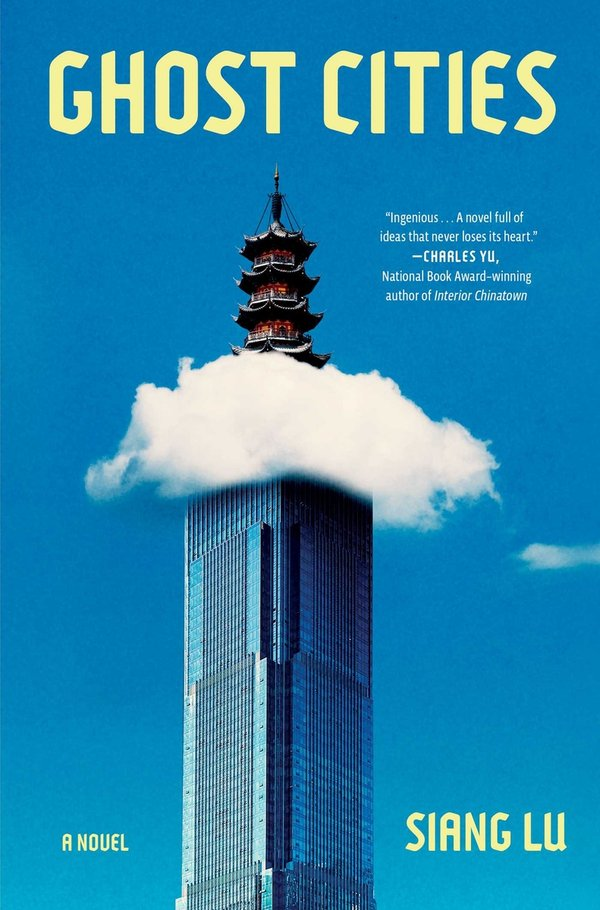
He smiled ruefully. His debut novel was The Whitewash, but the book he’d written first was actually Ghost Cities, which would go on to win the Miles Franklin Award, Australia’s highest literary honor. Back then, no one wanted it. This August, it finally gets its US debut.
I first encountered Siang when he slid into my Instagram DMs to ask whether I’d let him include my debut novel in his long-running #sillybookstagram project, where he “defaces” book covers by inserting his own name. I didn’t know who he was, but the concept was so delightful that I readily agreed. Love Can’t Feed You became Siang Can’t Feed You. It was funny and, in that moment, I took the pain and gravity around my book’s reception less seriously. I knew immediately that someone with this kind of humor also carried serious intellectual weight, which is evident the moment you read his work. But what I didn’t realize until speaking to him is that his intellect and talent are only dwarfed by his great heart.
Siang and I spoke candidly over Zoom and e-mail about failure, the publishing process, and what fatherhood does to an artist’s sense of time and purpose.
Cherry Lou Sy: First, I want to say that I am part Chinese and when I encountered your character Xiang Lu, the translator who didn’t know a lot of Chinese and had to rely on Google Translate to the point of him being labeled #BadChinese, I thought, this is me.
Siang Lu: Actually, putting that on the page was kind of exposing. It started out as a joke, but some people who read early versions of the manuscript really encouraged me to lean more into it, which was scary, because it’s something you’re sensitive about. But it has been a real joy—unexpectedly, at writers festivals and events—to have readers, not just Chinese but Indian, Pakistani, Greek, Italian, tell me that they are #BadChinese. That they relate to the second-gen migrant experience of not being fully educated in your own mother tongue and your own supposed culture, and what that means.
I was born in Malaysia, ethnically Chinese, and I grew up in Australia having moved there from the age of four. Growing up in a Western culture, when you’re young, you tend to want to blend in. Anything that makes you different is actually quite painful. Consequently, you sort of just wish you were white. And it takes a really long time to deprogram from that. It wasn’t until I was almost 20 when I started realizing there was a way for me to embrace my culture. And eventually—this sounds like a paradox—I realized even without fluency in my mother tongue, there is a way nonetheless to be part of your culture and be a good ambassador for it. That was my attempt to write through it, write through that pain, and into something like acceptance.
CS: You basically created your own version of “I am Spartacus.” That refrain—how many of us in the diaspora think of ourselves as #BadChinese?
You might be a mature reader, but as a writer you’re just starting out. So you default to all of the same problems.
SL: In Chinese and Malaysian culture, families are huge, so it was always the aunties and uncles who would bemusedly approach you at family gatherings and ask if you know how to speak the language yet. You end up memorizing a couple of phrases to get them off your back, which doesn’t really help anything. And it’s not only the self and the family—it’s also the media you consume. I think we’re in a different era now, which is good, and I’m glad my children are growing up in it. But when I was growing up, you wouldn’t see Asians on screen unless they were villains or ridiculous supporting characters. I was thinking about this recently: Why gravitate toward the page and toward fiction? I think it was a subconscious rejection of what I was seeing versus what I might be able to imagine for myself. Even though the stories I was consuming as a kid were just as problematic—I was still not seeing Chinese voices or culturally diverse voices—but it was somehow easier for me to find myself on the page.
This is the part I was mulling on: the weird paradox of finding that medium, the blank imaginative slate. As you’re reading, you can picture everything—enough to have a toehold into this is my space, this is my place. As a reader, that’s comforting. But then you run into that problem again when you start writing, because suddenly you lack the maturity. You might be a mature reader, but as a writer you’re just starting out. So you default to all of the same problems. When I was starting out writing, I didn’t know how to center Asian stories. It was a difficult transition, trying to work through that love and finding myself on the page again.
CS: I want to go back to the fact that Ghost Cities was actually your first novel, and The Whitewash was your second, but The Whitewash was the first to get published. That’s mind-blowing to me.
SL: I’ve been writing since I was 19, and I’m 40 now. That’s entirely half my life, and the entirety of my adult life. It’s humbling how not good [of] a writer you can be for so long. Ghost Cities is actually the third book I wrote—the first two were so bad, and necessarily so, because I had the desire to write, the love of the form, the love of sentences, but I really didn’t know how to be me yet.
I love to talk about failure. I’m so much less interested in success.
I finished Ghost Cities in 2014, and it is not remarkably different from the version you’ve just read. There was a very long period where I was left alone with the idea that this thing I’d written, which I thought had value, nobody else agreed with.
You’re dependent on external people to reflect back that the thing you’ve written is good. When you don’t have that, it becomes very difficult. But it’s also a nice lesson to learn: eventually, you’ll find your way into recognizing, okay, that thing was good. Maybe you’re being deluded—who knows—but you’ve got to come to that conclusion yourself.
I had a US agent and we had a good run of submitting to US trade publications, and in the end we had to put it in the drawer. I thought forever. And just that long period of thinking about this, continuing to write—even that was a very deliberate decision, made after long periods of agonizing: Is it worth it? If no one’s going to read this, is it worth it?
I hope other people don’t have to face that question, because it is very difficult. And I cheer on those success stories that come straight out of the gate. But we should also have stories like mine: that it is possible to endure far after the period when it seems appropriate to have given up. That was a strength for me. It allowed me to see who I was—which was a writer.
I love to talk about failure. I’m so much less interested in success. But failure I could think about and talk about forever. And anytime I get off a stage having done so, just the amount of heartfelt conversations I’ll have with people from the audience. It makes me realize how necessary all of this is, and how probably we do not talk about it enough. We love to see the ready-made successes, especially in literature. But no one really talks about this long middle, and what it means to dedicate yourself to a practice and an industry that is fundamentally uncaring. It’s a strange thing that we ruin ourselves in service of a dream. But that’s because the dream is powerful and we want to truly feel that we’ve had some impact when someone reads our works or listens to our story.
CS: And your books are obsessed with vanity and narcissism—which is just hysterical, given all of this.
SL: Having an inbuilt sense of humor helps a little, because your coping mechanism will also be lighthearted. And you can use it as fuel for the fire. I secretly wrote my second book [The Whitewash], which was published first, because of the failure of Ghost Cities. I poured those feelings of failure into a few characters. I didn’t know how they would survive, but I was interested to see how they would, so I could learn from them.
CS: So who has been your advocate within the Australian literary scene?
SL: The trite answer would be that I had to learn how to be my own advocate. But I’ll tell you one story.
I had to learn how to be my own advocate.
In Australia, the Miles Franklin Award is essentially the highest literary honor in the country. I won it in July of last year, and I’m only really beginning to come to terms with it.
I remember being at one regional festival where the main speaker was Omar El-Akkad. I had snuck into the back of the session, which was full—packed, about 500 people. It was brilliant and inspiring. I’d heard that both he and I would be on the same cab ride back to Melbourne airport two hours away.
We met in the lobby for the cab the next day. He turned to me with interest—he’d won the Giller Award in Canada, and I think he was curious to see whether our experiences were equivalent.
Sure enough, they were. We talked for the whole cab ride back. It was really edifying.
He was so funny and eloquent. Towards the end of the ride, the conversation became more personal, and he turned to me and said: “Have you made your peace with having won the award?”
He could tell immediately. He said, “Of course not.” I asked him if he had—he’d won the Giller maybe five years before. He said: “Yes, but only last year.”
That really hit me. I’d been carrying a feeling I couldn’t quite define—a kind of survivor’s guilt, or imposter syndrome. Feeling that I didn’t deserve it. I know what it was now: this feeling that the other people who were shortlisted and longlisted, and even fantastic authors who weren’t listed at all—they obviously deserve to win. The problem was this other so-called truth attached to it: Well, because other people deserve to have won, you don’t. That was essentially the problem I was grappling with.
About two weeks after the cab ride, I was walking on the street, when it suddenly occurred to me, like a great epiphany: Oh, I think I deserve the award. This was about four months after winning it. And only much later did I realize that thought would not have been possible without that cab ride. I’m in no way saying my story and Omar’s are equivalent, but it was so cosmically useful to speak to someone who had been through a similar experience, to see him come out the other side, and to see him being so truthful about how difficult it had been, privately, in all the ways that you don’t really talk about on stage. I think it saved me years of angst, honestly.
CS: What you’ve been saying is so inspiring. And you know, the Knicks just won their NBA championship after 53 years. And they’re a team made of failures, of people who were told they weren’t enough, including their captain Brunson, who was told repeatedly he was too short, not this, not that. He was asked what kept him confident despite all of that, and he said he just thought about the summers where he had to work really hard. That’s all.
SL: Part of me wishes it wasn’t like this, but it’s because of the hardship. It’s because you’ve been told you won’t make it. We find ourselves in that story. I don’t find myself wishing I’d lived a different life and that my book had been successful early. I made my peace with failure. I made it before any of this, and that was the right time for me to do so. Even if, weirdly, it was before I was published.
In publishing, much like in any industry, you need to have the right advocates. Sometimes we don’t have them. Sometimes we have advocates who aren’t perfect fits for us. Sometimes we have no advocates at all.
Not everyone can have their dreamed-of advocate. It’s a difficult lesson to learn, but it’s the lesson I learned in those nine years: okay, if you think the book’s good, then how do you get better within that whole arena? It’s not enough to have written a good book. You somehow have to be brilliant at pitching. You somehow have to be a great marketer. You somehow have to be all the things the industry purportedly supports you to do—and in most cases, if you’re an author on the midlist, you don’t find that support. That’s not to say people in publishing aren’t doing their jobs. That’s just how the industry works.
CS: So many of us feel so crushed by the industry, by the lack of care. As far as the industry is concerned, we’re all just units, content, a dime a dozen. And yet here you are.
SL: I was asked by my US publicist to write a hot take about AI for one of the broadsheets. I kind of dragged my feet. Eventually I offered something along the lines of: being published would have been the best thing, but the next best thing was not being published. And I really mean that. In fact, I think the best thing was actually not being published. Because it allowed me to confront what writing meant to me, what I was hoping to get from it. That practice and resilience doesn’t extend just to writing but to my entire life, which I’m thankful for.