Books & Culture
“Wuthering Heights” Was Never a Love Story
Fennell’s film is not a faithful adaptation; it’s a testament to the contagiousness of the energy and pleasure in Brontë’s writing
This article is free to read. So is every article Electric Literature publishes. No limits, no paywalls—now or ever. Support from readers like you makes that possible.
Electric Literature is proud to be a space where writers are always paid and reading is always free, and we plan to keep it that way.
Donate now to our spring fundraiser to help ensure the future of free, accessible literature for all.
—————
“This is a strange book,” begins a January 8, 1848 review of Emily Brontë’s Wuthering Heights. “It is not without evidences of considerable power: but, as a whole, it is wild, confused, disjointed, and improbable . . . ” Another review, published a week later, drew similar conclusions: “Wuthering Heights is a strange sort of book—baffling all regular criticism; yet, it is impossible to begin and not finish it . . . we must leave it to our readers to decide what sort of book it is.”
That may be the million-dollar question. What sort of a book is Wuthering Heights? Like many, I first came across the novel in my teens; unlike many, I couldn’t get through it. If I was too impatient to make sense of Joseph’s Yorkshire accent, I was also too unformed as a reader to probe the work’s complex narrative structure. I was fourteen and had no inkling of puppy love, much less passion. And because I didn’t know passion, I couldn’t understand Heathcliff.
A friend once described me as a late bloomer’s late bloomer. In that long period of my life, spanning a little over three decades, in which I had never been in a relationship, I lived mostly in my own head. Fantasy seemed, at times, preferable to reality, not because I ever believed that what I imagined was real, but because, in being able to control every element of every story down to the most minute detail, I could play God. My mind’s eye gave birth to multiple new selves, all beautiful, rich, coveted, and bearing not the slightest resemblance to reality. That a fantasy frequently ended in tragedy (my make-believe death, usually from tuberculosis or being fatally shot by an arrow) rendered it no less delicious, for the following evening I would resurrect myself and a new story with a new lover would commence.
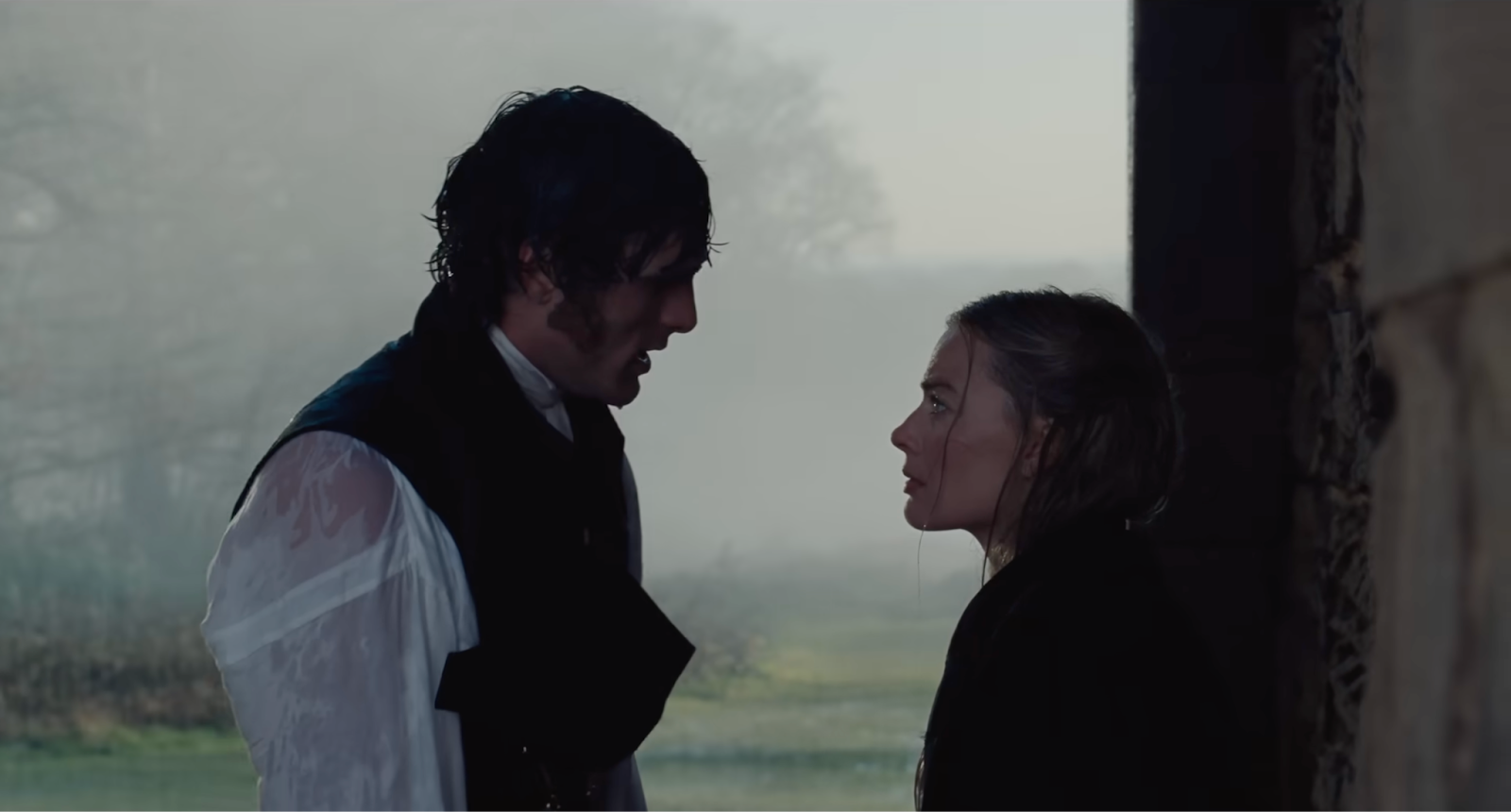
Perhaps this is why watching Emerald Fennell’s adaptation of Wuthering Heights felt so familiar. The landscape that Catherine and Heathcliff run through as children is a landscape that possesses an uncanny resemblance to the fantastical panoramas of my own lonely adolescence. And because fantasy owes very little, if anything, to history, this is a world governed solely by whim and the law of individual desire. Dresses can be anachronistic so long as they are beautiful. Feasts are laid out less for human consumption than for the delight of the eye. Few would be able to guess that Thrushcross Grange, which resembles in its exterior an iced sugar cookie, should contain a labyrinth of rooms with no unifying style beyond the ostentatious spectacle of wealth. There is a room for ribbons that is turned, for Mrs. Catherine Linton’s pleasure, into a room for the display of opulent gowns. Most memorably, there is a room the color and texture of flesh that lends new meaning to what it is to inhabit one’s own skin.
Because fantasy owes very little, if anything, to history, this is a world governed solely by whim and the law of individual desire.
As several reviews have pointed out, Fennell’s adaptation of Brontë’s magnum opus significantly departs from its source material; to document these disparities when the differences are both numerous and flagrant seems a meaningless exercise. What’s more, I don’t see much wrong with the degree of departure, whether minimal or extreme. There are no set rules for how to treat the source material, and different mediums require different modes of expression. Suzy Davies, the movie’s production designer, puts it well: “This film was never about documenting the 1800s in a literal or academic way. Instead, it was about capturing the essence of a teenage fever dream—the sensation of first encountering the book.”
I can’t help but feel disappointed both at critics who have extolled Fennell’s “Wuthering Heights” and those who have panned it. Reviews have run the gamut, from “sexy, dramatic, melodramatic, occasionally comic and often swoonily romantic” to simply “a dud.” Much of the problem seems to stem from the preconception that Brontë’s novel is a love story. In all the times I have failed or succeeded in reading the book, I have never been fully convinced that Wuthering Heights is a romance, or more accurately, that its most foundational element is the love affair between Catherine Earnshaw and Heathcliff. We tend to look for what we want to see on the page, not what is actually there. In reading Wuthering Heights, it’s easy to discern how a combination of atmosphere and titillating storytelling can render the mind susceptible to extracting specific moments and specific lines at the expense of others. Who, after all, can finish Brontë’s work without remembering Catherine’s cry, “I am Heathcliff!”
This all boils down to a certain amount of delusion around love: its addictive nature, its inextinguishable flame. That is, the belief that love is not love if it isn’t immortal, if it fails to live beyond the grave. Love is not love if one is not willing to kill for it, to give up one’s life for it, to exercise violence and exact vengeance on its behalf and under its banner. Love is not love if you do not place someone’s well-being totally above your own, if you do not sacrifice yourself to it, if formerly two separate selves do not merge wholly and completely into one. This thinking may be why we remember Wuthering Heights more for Heathcliff’s extreme—and insane—devotion to Catherine’s memory than as a story about generational abuse, otherness, and redemption. It is also why, regrettably, we remember Wuthering Heights less as an exemplar of vicarious, vivid, and vivacious storytelling than for the love story that was never really the crux of what is, from first page to last, a passion project: a passion not for romance but for, above all, the act of creativity and the pure, unadulterated joy of playing God in ink.
This is how the novel has always struck me: as a gratuitous exercise in artistry and play, in the kind of explosive energy that will unfold on the page when, for better or worse, the imagination is loosed like a dog that has been liberated from its leash in a park. How else to explain the layers of narrative that remind me, at times, of a mille-feuille? Revisiting the work in my early thirties, I noticed as I didn’t before the delightful recklessness, the heedlessness and risk-taking of Brontë’s prose. I laughed at Lockwood’s ineptitude and buffoonery, his pomposity, his romantic nature that allows him to be so easily beguiled by a pretty face and to fancy himself in love. In the first pages alone, a comic scene unfolds that sends the whole household into uproar. If there is passion, then it is passion made vivid to the point of fluorescence with melodrama.
Wuthering Heights is, in a nutshell, a noisy affair, raucous with Joseph’s ear-splitting outbursts, with Nellie Dean’s sanctimonious need to be right, with Linton Heathcliff’s whining, with violence and kidnapping and elopement and death and ghosts. In its ingenuity, its surrender to the spirit of its diverse and strange cast of characters, Wuthering Heights is more instinct than strategy, more id than superego, more the splatter of ink that leaks from a broken nib than a smooth and unbroken line. Thomas Wolfe is reputed to have said, “Writing is easy. Just put a sheet of paper in the typewriter and start bleeding.” I feel something different at work with Brontë. Even when I disliked the book, I always sensed how fun and, more vitally, how free it was. So often do we harp on the struggle of writing that we forget that pleasure can and frequently does accompany the uphill battle to put words on the page.
Fennell’s film is a testament to the contagiousness of that energy and pleasure. For all its adult themes, it’s a fantasy of the kind that precedes actual experience of the realities of the world; its stunning aesthetics betray, at its heart, a cluelessness. The hodgepodge of erotic imagery scattered throughout scenes recollects the giggles that would inevitably spread like wildfire in a classroom whenever someone happened to mention boobs or dared to say the word “dick” or “fuck” aloud. Tellingly, even symbolically, there is no nudity in Fennell’s movie: no breasts or buttocks or penises. But there are plenty of pig’s feet; there is the underside of a snail leaving a trail of slime across a glass pane. There’s the slap of wet dough and the meticulously handcrafted book Isabella Linton presents Catherine, which highlights more than one erotic feature in its pages: a pop-up of a phallus-shaped mushroom, a flower that resembles vaginal lips. Sex is clean, and its participants are, most of the time, even formally dressed for the occasion.
In one revealing scene, Catherine screams at her good-for-nothing father, as she stamps across the courtyard of Wuthering Heights, “We’re all ill! We’re all ill because of you!” This line hits at what Fennell’s “Wuthering Heights” is about. None of the characters know what they’re doing or how to go about getting what they want. Everyone is suffering under some form of delusion. Except for, surprisingly, Zillah, who has left the service of Wuthering Heights, married, and become a mother of a little boy, no one really grows up or moves on. With guardians like Mr. Earnshaw and Edgar Linton, maybe they don’t know how.
So often do we harp on the struggle of writing that we forget that pleasure can and frequently does accompany the uphill battle to put words on the page.
If Fennell’s “Wuthering Heights” is meant, to quote Davies, to replicate “a teenage fever dream,” it also warns of the dangers of being caught in the stage of hormonally fueled fantasy for too long. There is a difference between the love we imagine and the love we practice, and “compromise,” so integral to real life and to navigating any relationship, is not a word recognized in the world of this film. No one surrenders, except to their own fantasy of what and how things should be. Everyone clings. Edgar Linton deceives himself that his wife is perfect. Isabella allows herself to be treated, literally, like a dog. Nelly guards the only thing that gives meaning to her life: her proximity to those in power. And Catherine and Heathcliff abjectly fail to grow out of an adolescent hedonism; their creed remains, we can do anything we want, so long as we are the ones doing it. Appropriately, the film concludes with flashbacks to Catherine and Heathcliff’s childhood. This move is sentimental, even predictable, a play for easy audience tears. But the bigger lesson may be that if one can’t look forward, one runs the risk of living forever in an idealized past. And lest we forget, the film ends in tragedy.
While watching Fennell’s “Wuthering Heights,” I thought a lot about my debut novel, a retelling of Jane Austen’s Pride and Prejudice. I wrote it a few years out of college, having just been fired from a dead-end job I despised. I was twenty-five and had never had either a boyfriend or sex. My parents were filing for bankruptcy, and I was about to lose my childhood home. Some, or possibly most, of that pent-up frustration came out in the span of three months in a first draft of a novel that I composed while sweating in an airless basement I would very soon never have the privilege of sitting or typing in again. All of my fears and wishes for the future somehow found their expression in that first book. I had no idea what I was doing.
The end result was a fantasy. My protagonist not only gets her happy ending but also has a lot of fine, robust sex in between. I wondered that I could write about positions, about the sensation of lying naked beside a lover, without having experienced any of what I described. My inspiration came from what I had consumed in books, movies, and porn, from my introversion and isolation, from the buzz of sexual frustration and my despair at repetitive encounters with unrequited love. By and large, critics were much kinder to my first novel than readers were. Many were furious, outraged to the point of being almost comic. What I’d done to Austen was disgraceful, they declared; what right did I have to rewrite, to retell, to revise, to essentially destroy what had already attained the highest echelon of literary perfection. So, the litany of complaints went on and on—and on.
If I could, I’d inform the Janeite mob at my door that my treatment of Mr. Darcy and Lizzy, of Charlotte Lucas and Mr. Collins, of, notably, Mary Bennet, had nothing to do with them. I did not think of them. I didn’t want to think of them, not out of any disrespect, but because all that mattered as I was writing the novel was the absolute, all-consuming urgency I felt in transplanting my vision onto a preexisting world that had become so intimate to me that I had grown bold enough to wish to change the scenery and the weather, to shift the furniture and swap the curtains, and to rearrange characters as if they were my own playthings. You don’t do that out of hatred or scorn. You do that only when a book becomes so alive that you cannot remember who you were before you read it, when your tongue takes on the rhythm of its language and lines, and when the impulse to rummage around inside of its world becomes all but irresistible. In short, it is out of adulation—and out of love.
I sense the same impulse in Fennell’s adaptation. This is surely a personal vision, and because it is so personal, it will be, at times, moving, and, at times, ridiculous. The trailer for the film describes it as, “Inspired by the greatest love story of all time.” I don’t think, however, that this is accurate. Rather, I would say that Fennell’s “Wuthering Heights” is inspired simply by her love for a truly great—and truly strange—novel, that the passion which drove her to undertake such an ambitious project is the same that compelled Brontë to write the book. It’s a bold move, and it takes courage.
There’s a scene in the film where a shivering Catherine complains of the cold. Heathcliff offers to build a fire, but they cannot spare the firewood. After a brief exchange, Heathcliff stands up. He slams his chair against the floor, again, then again, until it breaks. With the remnants of the chair, he builds a fire; he will not see Catherine cold.
This scene doesn’t appear in the book. One could say it is cheesy, the stuff of which so many romances are made. But in its simple and unapologetic expression, it’s refreshing, too. We all wish that someone might break a chair to pieces if it meant we would not be cold. We all wish we could be loved so passionately. And who can say that such a moment or something very like it did not or could not happen in those gaps of the novel in which a reader’s imagination is given space to ferment? I recall one of my favorite lines from the book. In describing Heathcliff and Catherine’s final embrace, Brontë writes, “They were silent—their faces hid against each other, and washed by each other’s tears.” The edges of book and film begin to blur, and I wonder what memories these characters might have recalled, whether their youth came back to them, or whether they reveled, even fleetingly, in a glorious and unrealized future in which things had turned out different.
No one knows. That is the beauty of fiction.