Reading Lists
10 Graphic Novels About Our Nuclear Past, Present, and Future
These books tell human stories of the uncertainty, trauma, contamination, and ethical conundrums of the nuclear age
This article is free to read. So is every article Electric Literature publishes. No limits, no paywalls—now or ever. But we rely on your support to keep it that way.
We need to raise $35,000 by April 15 to keep the lights on, and time is running out. Donate today.
—————
Nuclear realities have been a consistent thread throughout my life. Since childhood, I’ve paused at semis hauling cement canisters full of nuclear waste down the only road in and out of the area I call home. A photograph taken not far from the hills I inhabit depicts a chamisa bush gathering wind in a Los Alamos canyon; unremarkable in appearance, human-made radionuclides infuse its molecules. While the atomic era’s seep into our daily, political, social, and environmental existence began decades ago, it remains unceasing.
Any art dealing with nuclear pasts and futures necessitates an acknowledgement of the intense politics embedded in the subject. Many recognizable comics—graphic novels’ ancestors—full of sci-fi drama were preceded by propagandistic booklets pushed by the U.S. Atomic Energy Commission that helped establish the promethean metaphors routinely woven through tales of the nuclear age. As LM García y Griego wrote, “From the beginning, the nuclear enterprise was portrayed as a heroic undertaking.” After centuries of alchemy, nuclear physics appeared imbued with controllable magic that many believed would equal permanent peace, boundless prosperity, and near immortality. Yet villains and heroes cannot be easily delineated, and reality does not obey presumptions nor fantastical visions.
From the Manhattan Project to commercial nuclear power plant accidents, the volumes below complicate oft-repeated narratives that polish and simplify events with mythified characters and tales of scientific conquest. The books in this list tell all-too-human stories of uncertainty, trauma, responsibility, contamination, ethical conundrums, human experimentation, and so much more. They are part of a growing canon, largely headed by authors outside the U.S. whose works are often untranslated into English—or out of print like Kōno Fumiyo’s stunning manga Town of Evening Calm, Country of Cherry Blossoms. Rooted in archives and personal experiences strung with almost tactile visuals, they reach inside us as only graphic novels can, drawing our senses alive.
Radium Girls by Cy., translated by Ivanka Hahnenberger
Originally published in French, Radium Girls follows a group of young women who meet while working as dial-painters in the nineteen-tens. It is the era of radium; the isotope infuses daily objects and myriad tonics marketed as cures for every known malady with florescence. As the friends at this novel’s center find their future dreams overshadowed by sickness, they navigate the realization that instructions to wet their brushes with their lips led them to ingest dangerous radioactive particles. As they prepare for slow deaths, they open a landmark court case that continues to influence workers’ rights. Shaded in hues of purple and green, each page thrums with a disquieting undercurrent as the girls go about their days and attend evening parties, hands glowing when they turn out the lights before bed. This book is best read slowly, savored, illustration by illustration, and accompanied by a scholarly work or two.
Guardian of Fukushima by Ewen Blain and Fabien Grolleau, translated by Jenna Martin
When a nine magnitude earthquake spurred a tsunami that tossed waves over Fukushima Daiichi Nuclear Power Plant’s seawall in 2011, officials reacted in shock—haphazardly, and besought with a lack of clear communication. While workers struggled to manage a worsening nuclear disaster, families were told to leave their livelihoods and animals—many of whom responders were ordered to kill—behind, but Naoto Matsumura stayed home in Tomioka, six miles from the nuclear plant. He quickly became the determined caretaker of the exclusion zone’s surviving animals. Although his story has been repeated across mediums, Guardian of Fukushima relays his daring decision with art’s “imaginative empathy,” as the manga artist, Roland Kelks, writes. Colorful graphics weave Matsumura’s life with Japanese folktales to build a book that reaches into hearts and lingers. Kelk calls it a “story of duty,” and perhaps it is; Matsumura does as we wish to in the midst of disaster: He does what he believes is right.
Nuking Alaska: Notes of an Atomic Fugitive by Peter Dunlap-Shohl
With a slightly salty tone, a sigh, and the galled bemusement of an adult looking back on childhood unknowns sifted clear, Nuking Alaska weaves Anchorage’s nuclear history with personal remembrances of growing up in the Cold War’s penumbra. Each page hums with Dunlap-Shohl’s strong voice and equally unique graphics. This quick read highlights moments where the overarching nuclear establishment interrupts daily life with accidents, tests, and buried secrets—and, finally, asks how we can find courage to face the continued future of our nuclear reality. While centered on Dunlap-Shohl’s personal relationship with the nuclear history he finds at home, the graphic novel incorporates the voices of other citizens living with the absurd realities of the Nike Hercules missiles poised around Anchorage in the 1950s and ’60s, U.S. plans to detonate a nuclear bomb to hollow out a port, the Cannikin nuclear bomb test on Amchitka Island, and a secret burial of radioactive dirt.
Radioactive: Marie and Pierre Curie, a Tale of Love and Fallout by Lauren Redniss
In some respects a love letter to Marie Curie, to passion, and to the immersion of curiosity itself, Radioactive begins: “With apologies to Marie Curie, who said, ‘There is no connection between my scientific work and the facts of private life.'” Although focused on Curie, Redniss weaves in important moments from across nuclear history to form a mosaic of a book as passionate as the people she profiles. Marie Curie’s life breaking barriers as both a scientist and a woman shines. Included in an astonishingly long list: Curie discovered multiple isotopes, changed the field of radiochemistry, and was the first woman to receive a Nobel Prize. With a mixture of poetic prose and dialogue pulled from archives, Redniss bends the idea of a graphic novel to present a delicately orchestrated work that feels like an art book, filled with stunning, often abstracted yet illustrious and colorful cyanotype prints.
The Bomb: Oppenheimer and the Weapon That Changed the World by Didier Alcante, Laurent-Frédéric Bollée, and Denis Rodier, translated by Ivanka T. Hahnenberger
Originally published in French, The Bomb follows the construction of the first atomic bombs through conjoined stories that are rarely incorporated into a single volume. The narrative opens with a personified voice of uranium that weaves between dramatic retellings of events—with a plethora of exclamation points in the dialogue. From General Groves’ appointment to the Manhattan Project, through tensions between military secrecy and scientific openness, covert operations to sabotage the Nazi nuclear program, and secret plutonium experiments on unaware hospital patients, a tremendous amount of care and attention to detail went into this book’s writing and scenography. Nearly every character, scene, and much of the dialogue draw from archives with one narratively important exception: a family in Hiroshima whose experiences, while fictionalized, also reach into historical accounts. Detailed illustrations that expand outside of a comic book’s traditional rectangles fill every page and make it hard to look away.
Ichi-F: A Worker’s Graphic Memoir of the Fukushima Nuclear Plant by Kazuto Tatsuta, translated by Stephen Paul
Ichi-F depicts post-disaster nuclear decommissioning from the eyes of a man on the ground. After a tsunami struck the Fukushima Daiichi Nuclear Power Plant in 2011, after irradiated towns were evacuated, after the plant’s workers managed to mitigate partial meltdowns and overheating nuclear waste, after the shortest lived radionuclides decayed, attention turned towards clean-up. Decommissioning is an immense undertaking. In Fukushima, it requires decades and thousands of workers hired through a complex arrangement of contractors and sub-contractors that Tatsuka deftly learns to navigate. Beginning in 2012, he returned to work in Fukushima again and again, writing and drawing Ichi-F along the way, cautious to ensure that he would not be refused further employment on the site. This book is rooted in his personal account, full of interesting people and details—including daily processes for working in irradiated zones. Both a guide to his experiences and Fukushima’s landscape, it is a unique, dynamically drawn memoir bursting with personality.
Chernobyl: the Fall of Atomgrad by Matyáš Namai
Wrapped in cerulean blue, soft yellow, army green, black, and white, the effects of corrupt government mechanisms and a climate that values speed and appearances over safety rise from vibrant illustrations. The Chernobyl Nuclear Power Plant disaster may have occurred in 1986, but this jaw-dropping graphic novel reminds us it will continue to affect individuals and ecosystems for generations to come. Originally published in Czech, the novel is replete with detail—from the complicated organization of the Soviet nuclear complex to the general components of an RBMK reactor. Matyás Namai pulls from witness testimonies, oral histories, and archival records to build a winding collage of voices. Packed with history that begins with the nuclear power plant’s construction and ends in 2016, this slim book manages to move through decades by highlighting moments in the individual lives of plant workers, farmers, villagers, liquidators, soldiers, and more. Each textural illustration is imbued with captivating visual depth and movement.
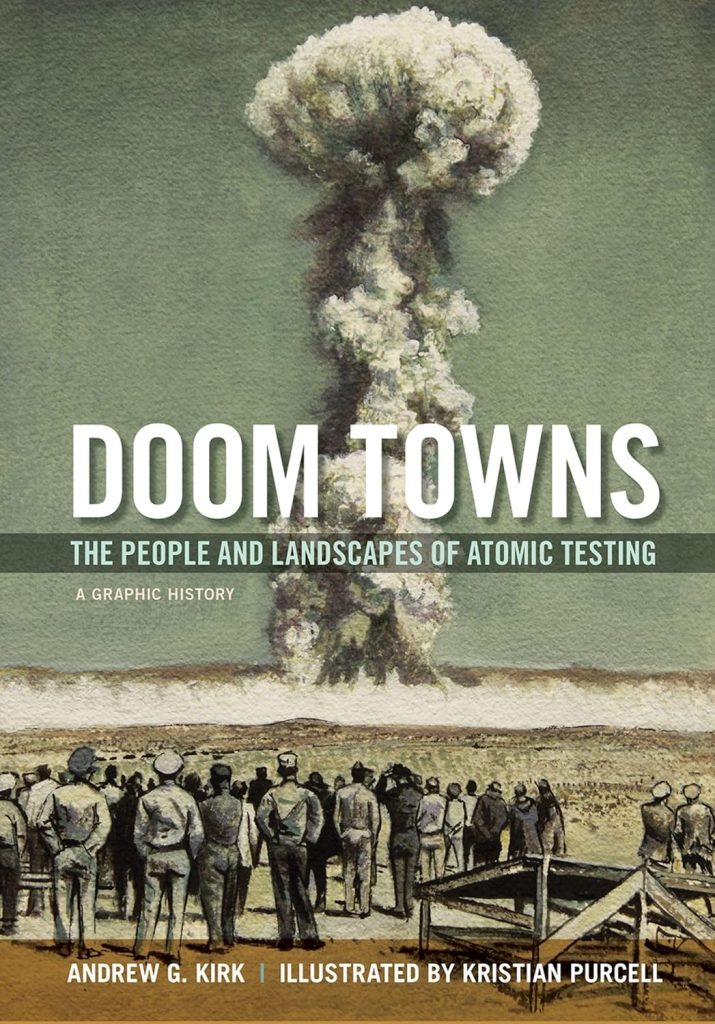
Doom Towns: The People and Landscapes of Atomic Testing by Andrew G. Kirk and Kristian Purcell
An important addition to the realms of both nuclear history books and graphic novels, Doom Towns rises from a quest to recount everyday experiences in the early atomic age. It is constructed with an eye for anecdotes bound to haunt. Wrapped in intensive, deep research, and full of graphics drawn directly from primary source documents, Kirk and Purcell illustrate oral narratives of atmospheric nuclear testing in Nevada between 1945 and 1963, gathered in the years prior to this book’s publication. Each chapter looks through the eyes of ordinary people who—knowingly and unknowingly—are caught in the fervor of the early atomic years’ and the literal and figurative fallout that continues to affect the environ. Ranchers, soldiers, journalists, and more speak from the pages. This book is a graphic history to its core: a deliberately constructed site for expanded tellings of deeply researched moments, portrayed through a close relationship between artistry and scholarship.

Springtime in Chernobyl by Emmanuel Lepage, translated by Edward Gauvin
This gorgeous volume opens with a chorus of voices as Emmanuel reads aloud in a train carriage on the way to a village near Chernobyl’s 30-kilometer Exclusion Zone in 2008. The journey was long in the making: Activist friends of his began arranging a small artist residency at the Exclusion Zone’s edge in Ukraine years prior. Emmanuel joins them despite deep unease. Laden with food, art supplies, and plans to meet as many people as they can, the group of artists spend a spring in Volodarka. Splashes of color explode black and white graphics as Emmanuel walks through a post-Chernobyl landscape of abandoned towns and shrinking villages, confronts his own expectations, and wrestles with the difficulties of finding a way to picturize the centuries’ long effects of radiation often invisible to the naked eye. At its heart, Springtime in Chernobyl is an ars poetica of navigating and depicting a disaster-struck environment.

Fallout: J. Robert Oppenheimer, Leo Szilard, and the Political Science of the Atomic Bomb by Jim Ottaviani, Janine Johnston, Steve Lieber, Vince Locke, Bernie Mireault, and Jeff Parker
A diligent tracing of Oppenheimer and Szilard’s engagement in the construction of the first atomic bomb and the moral quandaries faced by scientists at the beginning of the nuclear age, Fallout is a solid work with a certainty of focus and depth of characterization, timescales, and drawings. It is full of moments that jump off the page. The dialogue drives at a surprisingly smooth pace. The authors dig into the origins of the Szilard-Einstein letter that spurred the creation of the Manhattan Project, the divides between scientists who believed the bomb should not be dropped in war and those not averse to a deadly show of force, and the progression of Oppenheimer’s security hearing—where they deftly highlight both Oppenheimer and the ruling committee. As much a story of historical events as a window into the early atomic era’s politics, Fallout is a topically-hefty book that reads like a thriller and a drama mashed together. Oh, and Ottaviani has a nuclear physics degree.