Reading Lists
7 Literary Translators You Need to Know
From Indonesian to Brazilian Portuguese, here are the translators who are making contemporary world literature accessible to English readers

Imagine bookstores, libraries and life really, without Anne Frank, The Little Prince, the Quran, and Murakami. This is what a world without literary translators would look like—our literary travels would be devoid of global textures and much, much less rich.
Through the work of translators, whose labors are unseen and intensely-detailed, English readers are able to enter the afterlife of a Japanese laborer who toiled for the 1964 Tokyo Olympics, the complicated family dynamics of Italian immigrants of Somali and Argentine origins, the joys and despairs of queer Indonesians, the dramas of provincial life in northeastern Brazil, to pick just a few of the worlds translators in this list permit us to inhabit.
In the first part of this list of translators, I spoke to authors who translate and render linguistic, literary, and cultural nuances from Japanese, Spanish, Brazilian Portuguese, Catalan, Indonesian, Italian, French, Korean, and Thai to English. The list is skewed to emerging translators, women, and people of color, who’ve translated some of the most vibrant of classic and contemporary global literary voices. These elegant and expansive conversations, greatly truncated here for space reasons—translators are very possibly the most thoughtful subset of the literary world!—include their early acts of translation, secret languages of their childhoods, quirks of the languages they work in, and moving meanings between languages.
Morgan Giles: Japanese to English

Morgan’s Giles’ first book-length translation Tokyo Ueno Station, by the Japanese outsider novelist Yu Miri, debuted in the U.S. on the eve of what was to be the 2020 Tokyo Games, and shortly after landed on the 2020 National Book Award longlist for translated literature. The diaphanous novel features the 1964 Tokyo Olympics from the point of view of a dead laborer. The London-based Giles is taking on another Tokyo Olympics, that of 1944, which was canceled by World War II via Yu Miri’s The End of August, a novel about the author’s grandfather who might have represented Japan as a marathon runner in those games. Considered in Japan to be Yu Miri’s masterwork, the novel is set amid the Japanese occupation of Korea and a mash-up of Japanese and Korean languages.
A first act of translation: “Putting my thoughts into ‘standard’ English. It’s something that most people from Appalachia learn early on they’ll have to do to get ‘anywhere,’ even from the first day of school. It took me years to perfect; now when I go back people say I don’t sound like I’m from around there, which is painful. I feel like I translated myself out of my home.”

How a girl from Kentucky ended up translating Japanese literature: “There’s a pretty big Japanese community in Kentucky because of the Toyota factory and all the companies that supply it. At the school I went to, students didn’t start learning another language until high school. I was picked to go on a short exchange to Japan due to a Sister Cities relationship and I started learning a little Japanese before I went. After I came back home, I decided to keep studying Japanese and when I finished all the classes that were available, my teacher suggested I pick a Japanese book and read it with her. Reading became translation, as a way to help me understand better, and now here I am today. I don’t know if I chose it or it chose me, but Japanese has been part of my life since I was 13; it’s hard to imagine what my life would be without it.”
Aaron Robertson: Italian to English

When Aaron Robertson encountered Italian Somali writer Igiaba Scego’s Beyond Babylon in a library in Bologna, Italy, he wasn’t very impressed with the boot illustration on its cover but once he cracked its pages, he was enchanted. The encounter led to him translating the exuberant 400-page book as his undergraduate thesis at Princeton, where he studied with the American literary Italophile, Jhumpa Lahiri. His undertaking is extra impressive because he completed the book’s translation a mere five years after this first-ever Italian lesson. Robertson has also translated Scego’s shorter works and is exploring books by and about Black and POC Italians to translate. Robertson, who is in the midst of writing his own non-fiction book about African American utopianism, was named in September 2020 to the board of the American Literary Translators Association (ALTA).
In Detroit, dreaming of Italy: “In middle school, I had a very faint interest in the Italian Renaissance and I just wanted to go to Italy and study art. I had a very mythological view of the country, you know, with statues on every street corner. In college, I studied Italian and African American studies, which connected the language and the African diaspora for me.
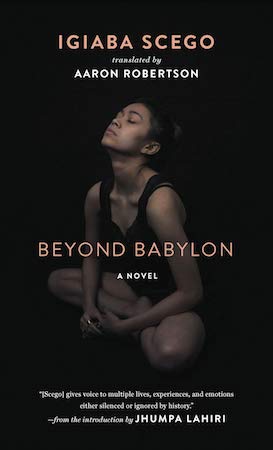
I was familiar with Igiaba Scego’s work but I didn’t know about Beyond Babylon. After I read it, I thought that she had echoes of Toni Morrison, but she was doing something that I had always wanted to see someone do. It is similar to what James Baldwin did when he moved to France. He bridged the experiences of Blackness and brought Blackness to a space where traditionally people, in the U.S. anyway, don’t really think that much about, that is what Blackness looks like in France or what it looks like in Italy. Scego bridges not only this experience of being a Black woman in Italy, but she looks at what this experience is like in Argentina, Somalia, and Tunisia. This alone is not necessarily a recipe for a great book, because you could ask, ‘Well, why is she looking at all these places? Isn’t it kind of scattered?’ When I first read the book, I didn’t know exactly why it worked, but I was stunned by it. Only by reading it constantly and by actually translating it, did I start to understand what it was that she was doing that was so effective.”
Translating race: “In Beyond Babylon, Mar talks about being the ‘fruit of the Third World’ where she’s wondering what to call herself like, ‘semi-negress,’ for example. She even uses ‘semi-n****r.’ Scego is constantly questioning the language you use to call yourself. Are you Black? Are you Somali-Italian? Italo-Somali? Afro-Italian? The character of Mar has roots, in a certain sense in the tragic mulatto character, although her end is more optimistic than that trope usually tends to be.
The novel celebrates the ambiguity, but also sees it as something both destabilizing and liberating. Scego uses the plot of her work to reflect on the whole process of translation. There are moments where the characters are talking about the translation of poetry, but there’s also the question, how do you transport who you are across boundaries? In every sense of the word. The inexhaustibility of that question is why the text is so rich, because you can approach that question from so many different angles.
Scego’s newest novel, which was published in Italian this February, is called The Color Line. It looks very specifically at the intersection of Italian and African American history. The main character is a Black woman abolitionist in the 19th century, who moves to Italy and becomes a painter. Her work has shown me that the points of cultural specificity will always be there. In terms of our experiences, not everything will be on a one-to-one ratio, but if you look, you find links between peoples, cultures, and time periods. In the new novel, she’s saying, ‘Let’s look at an African American woman in the 19th century, and how her story is also kind of the story of the Italian unification process.’ Her nonfiction has dealt with international solidarity too.”
Tiffany Tsao: Indonesian to English
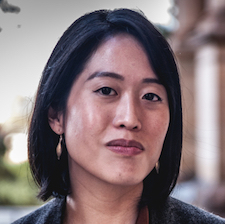
Indonesian was the language of the elders in Tiffany Tsao’s Chinese Indonesian family. Tsao, who was born in California and grew up in Indonesia and Singapore, reimmersed herself in the language while working on her Ph.D. in English at UC Berkeley. The now Sydney-based Tsao’s translations include Norman Erikson Pasaribu’s poetry collection Sergius Seeks Bacchus, Dee Lestari’s novel Paper Boats, and Laksmi Pamuntjak’s The Birdwoman’s Palate. She’s currently translating a collection of short stories by Budi Darma, called Orang-Orang Bloomington, or The People of Bloomington, set in Bloomington, Indiana (read one of the stories here). Also on the way is a collection of Norman Erikson Pasaribu’s short stories, Happy Stories, Mostly (check out at Catapult and The White Review). After that, Tsao will switch translation seats—her own English-language novel, The Majesties, will be translated into Indonesian by Norman Erikson Pasaribu.
On the gender-neutral pronouns of Indonesian: “Because translating Sergius Seeks Bacchus made me much more aware of it, nowadays I make much more of a conscious effort to replicate the effect than I did in the past—and if there is a passing ‘someone’ mentioned, I’m much more likely to just refer to them as ‘they/them.’ The gender-neutral pronouns make me realize how language shapes what is important and what is not. It becomes completely irrelevant whether the voice on the phone, or the doctor the protagonist sees, or the person working at the cake shop (just to use examples from The People of Bloomington by Budi Darma, the short-story collection I’m currently translating) is a he or a she or a they—the reader’s imagination doesn’t have to know the gender in order to get a complete and deep grasp of the stories or the scene, even if the author did have a gender in mind but didn’t specifically convey in the story text itself.”

On linguistic relativity: “It is taboo for someone who works with words to say this, but language and the abilities of language don’t always reflect or determine reality. As Norman and I have discussed in a conversation we had for AAWW’s The Margins—“Does A Face Need A Mask?”—assumptions about gender and gender differences obviously are still rife in Indonesia, and often when the gender-neutral pronoun is used ‘dia/ia/-nya,’ a listener or reader will often fill in the gender for themselves, the same way an English speaker might still automatically think ‘man’ when they hear ‘doctor,’ and ‘woman’ when they hear ‘nurse.’ I do think it is really awesome to have a language that easily accommodates inclusivity and gender fluidity. But I don’t think language is the magical antidote in itself—at least not when non-gendered pronouns are already conventional.”
Julia Sanches: Spanish, Portuguese, Catalan to English

By adulthood, Julia Sanches spoke Portuguese, English, Spanish, and French. During her master’s degree in Barcelona, she added Catalan to the impressive list. The Providence, Rhode Island-based translator worked as a literary agent at the Wylie Agency before switching her talents to translation, and is a founding member of the Cedilla & Co. translators collective. Her recent translations of contemporary Brazilian writing include Twenty After Midnight by Daniel Galera, Amora by Natalia Borges Polesso, and The Sun on My Head by Geovani Martins. She serves the chair of the Translators Group of the Authors Guild.
Early multilingualism with periods of languageless-ness: “I was born in Brazil, and I left when I was three-months-old. We lived in the United States until I was eight. We were lucky in that we were able to go back to Brazil once a year. Around five or six years old, whenever we went to Brazil, I would spend a week without speaking at all. I wouldn’t speak English and I wouldn’t speak Portuguese. And then suddenly I would speak fluent Portuguese, I wouldn’t mix anything, I would just need apparently this period of languageless-ness, a period of emptiness of language to be able to switch from one to the next one. The same thing would happen when I went back to the U.S. I would just sit at my desk in silence as I tried to get used to English again. I don’t have any memory of this, but apparently it happened, according to my mother.”

Dealing with problematic language: “I translate from a lot of languages that are having similar discussions as we are in the States, but they are at different points in the discussion. I’ve been co-translating this book with a friend and there was a metaphor that we thought was like gratuitously colorist in a way that added nothing to the text. We decided to take it out. I don’t know all the answers and I don’t know what the balance is. The conversation about language in the U.S. is having an influence in Brazil, in the way people talk about race and people talk about gender, which I think is quite positive because in Brazil for the longest time they were selling the story that the country was a racial democracy, which it is certainly not. I think also there’s a lot of danger of looking to the U.S. for moral guidance because of the proxy wars that they fought in Latin America and around the world.
Translators might know and might see both sides more clearly than other people, but I’m not sure that they’re the best people to be making decisions, especially since most translators are white. Not that many translators are heritage speakers. A grand majority of translators are people who grew up in monolingual families, studied the language at university, spent a year living in that place, and then came home as experts. I feel very uncomfortable with the notion of expertise, especially for a place as complex as Brazil. I’m a white Brazilian. There’s a lot that I don’t know. There’s a lot that I learned from my family that is incorrect because that’s what they learned at school. We’re in an interesting position. I’m not sure we have all the answers. We can mediate the answers but I am not sure if we are correct or incorrect in any given case.”
Emma Ramadan: French to English

Between them, Emma Ramadan’s parents spoke four languages, but to Emma and her brother, they only spoke in English. When they didn’t want their kids to know what they were saying, they spoke in French. To eavesdrop, Ramadan learned French. The childhood curiosity led her to bring English readers some of the most intriguing of literary works in French, including the much-acclaimed, genderless love tale of Sphinx by Anne F. Garréta and The Shutters, the poetry of Morrocan writer Ahmed Bouanani. Ramadan and her husband (and French translator!) Tom Roberge own Riffraff, the bookstore and bar in Providence, Rhode Island. Together, they’ve also translated a novel, Marcus Malte’s The Boy.

Relating to the struggles of the narrator of Brice Matthieussent’s French novel Revenge of the Translator: “At the end of Revenge of the Translator, the narrator announces that the book has an American translator named Mike Kirkfeld. When I first met Brice Matthieussent, I asked him what he thought about me changing the name of the American translator to my own name, because otherwise the conceit of the book falls apart, doesn’t add up. The American reader needs to realize that they’re holding in their hands the very translation that’s being spoken about. Matthieussent agreed immediately that I should put my own name. And then during an event for the book when Matthieussent was touring the U.S., someone in the audience asked about future translations of the book into other languages and whether the American translator’s name would be left as Mike Kirkfeld or instead changed to Emma Ramadan. Matthieussent insisted it should stay Mike Kirkfeld, but I argued that it should be Emma Ramadan because the book has an actual American translator now! That way the joke of the book keeps proliferating with each new translation. We’ll see what future translators decide to do.”
Translations from the perspective of bookselling: “I think American readers have proven they will embrace translations if they’re not sidelined in a translation section of a bookstore or only spoken about on that level. The success of Elena Ferrante is a perfect example of this. No one cares that those books are translated, they buy them because they’re fantastic reads. And that’s how translations should always be sold, I think: as fantastic reads, just like any other book. In my bookstore we put translations on the tables next to books originally written in English, we recommend them based on a customer’s taste, we treat them like any other book, and we have a very easy time selling them.”
Mui Poopoksakul: Thai to English
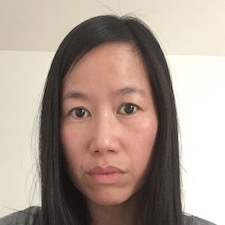
While Thai food and culture is beloved around the world, its literary riches are less known due to the dearth of translations of works written in the country’s rich language, which has many-pronged roots in Pali, Sanskrit, and Old Khmer. Enter (to our gratitude!): Mui Poopoksakul who has debuted works by contemporary Thai literary stars, Prabda Yoon and Duanwad Pimwana in English, via the courageous Tilted Axis Press (founded by translator Deborah Smith, who brought us Korean novelist Han Kang’s The Vegetarian). She practiced law in New York City before embarking on an M.A. in cultural translation at the American University of Paris. Her thesis eventually became Prabda Yoon’s The Sad Part Was, which was her first book-length translation. Mui, who guest-edited the Thailand issue of Words Without Borders, speaks fluent English and Thai, French (she reads “decently” in the language), and enough German to get by in Berlin, where she lives.
A quirk of Thai that is tricky to translate to English: “A term that’s been in the news a lot recently is ‘mob moong ming’ (ม็อบมุ๊งมิ้ง). It was used by a former army spokesperson to disparage pro-democracy student protestors as a ‘cute and cuddly crew’—I tried to replicate the alliteration there, but ‘moong ming’ is a word many people, myself included, weren’t previously familiar with (I’m not sure if the spokesperson newly made it up or if it’s super new slang), though you can sense the meaning from the cutesy sound. Not that I’m endorsing it, but the phrase is catchy for the reasons that make it so hard to translate.”
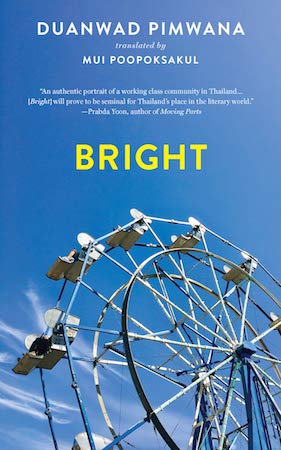
Contextualizing Prabda Yoon and Duanwad Pimwana and Thai literary movements: “Though they are writers of the same generation, Duanwad is a daughter of Thai social realism, which was a major literary movement in Thailand in the second half of the 20th century. Prabda, on the other hand, was seen as taking Thai literature in the direction of postmodernism when he came onto the scene in the late 90s. Now, given what’s going on in the country, we’re seeing a resurgence of social realist themes, or themes that are progenies of social realism, but narrative modes have become less straightforwardly realist.”
Padma Viswanathan: Portuguese to English
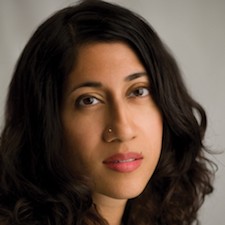
In May 2020, the Canadian novelist and playwright Padma Viswanathan debuted her first full-length translation, the late Brazilian novelist Graciliano Ramos’s São Bernardo, which was originally published in 1934. Viswanathan came to Brazilian Portuguese through the research she did on syncretic religions for her own first novel, The Toss of a Lemon—and then through a series of encounters, including a devotional music radio show she hosted, which brought her to Brazilian music. Viswanathan was mostly raised in English with parents who spoke Tamil as their secret language from their children, this parents-only language tradition was carried on by Viswanathan and her husband, the translator and poet Geoffrey Brock. French was their secret code—until their children picked it up.
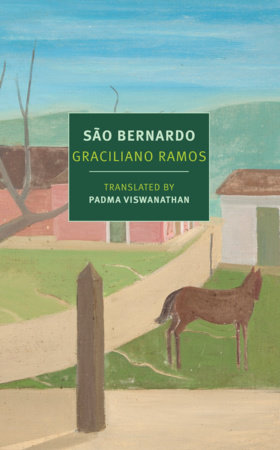
Path to Graciliano Ramos and translating São Bernardo: “We had moved to Arkansas and I felt I was losing my Portuguese without opportunities to practice, and my husband recommended I try retranslating something, suggesting that, as a novice, I might look for a book in need of retranslation. My impression of Graciliano Ramos had been that he was a social realist whose claim to fame was a sympathetic portrait of the downtrodden poor in his region. Opening his final and most famous novel, Vidas Secas, I found it to be very different from that: it was a complex portrait of a poor family fleeing drought, but of extraordinarily ambitious in its form and language. I translated and published the first chapter before learning rights to the book were unavailable in the U.S., but by then, I had read São Bernardo, a very different book, tough and ironic and full of incidental poetry, and another that could use a reintroduction into English freshening in various ways. I felt an even greater kinship with this book: one of my books is, as this one is, from the point of view of a relatively unlikeable man; another dives, as this one does, into provincial concerns in a remote and largely invisible region.”
Only-in-a-translators’-household conversations: “The classic one is watching a foreign film and quibbling with the subtitles. Then there are times when one of us walks into a room with some piece of writing translated by someone else, and says, ‘Look!’ Either the corresponding spouse is in the middle of something else and so passively receives the indignation or puzzlement or admiration, or, in another mood, engages, which means worrying the phrase, its possibilities and limitations, until it’s lying on the page like a dissected caterpillar. My husband is on a panel about retranslation next month with friends who have translated Anna Karenina, The Stranger, and Kafka’s The Metamorphosis, works of fiction with some of the most famous first lines ever. Apparently, they might just focus on different renderings of those famous opening lines—the sort of deep nerdiness translators love, and that I love in translators. I’ll be eating it up.”