Interviews
A Poetry Collection Where Play Collapses the Limits of Language
Anna Nygren’s “blush / river / fox” is a foray into the exuberant capacities of multilingual writing
This article is free to read. So is every article Electric Literature publishes. No limits, no paywalls—now or ever. Support from readers like you makes that possible.
Electric Literature is proud to be a space where writers are always paid and reading is always free, and we plan to keep it that way.
Donate now to our spring fundraiser to help ensure the future of free, accessible literature for all.
—————
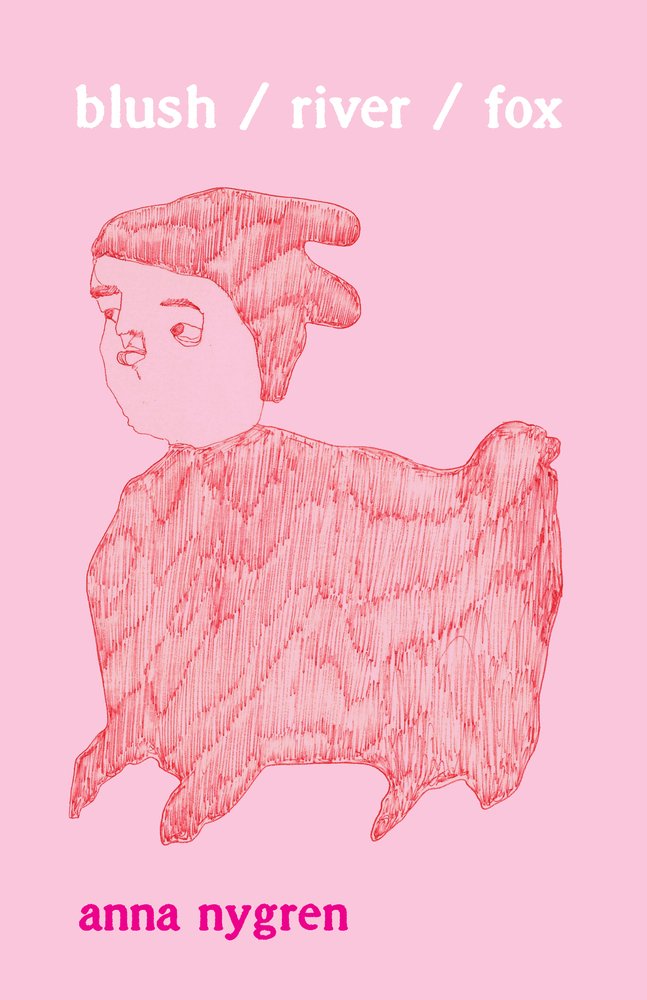
blush / river / fox is the English language debut of Swedish writer, artist, and translator Anna Nygren. Part of Milkweed Editions’ Multiverse series, which “gestures toward a correspondence—human and more-than-human—that lovingly exceeds what is normal and normative in our society, questioning and augmenting what literary culture is, has been, and can be,” Nygren’s book of poems and drawings plays with multiple styles and registers. The series, which includes the work of Hannah Emerson, whom Nygren has translated, pushes against the flattening that occurs when talking about neurodivergent and disabled people. Nygren’s work has its own rhythms and approaches, but demonstrates what the best poetry does: shares a different perspective and approach to language, and invites the reader into that world.
I spoke over Google docs with Nygren and their Milkweed editor, Morissa Young, who is also the founding co-editor of Strange Hymnal. The shared inquiry into language was evidenced by the working relationship between Nygren and Young. The ways that Nygren responded to both of us in conversation demonstrate a similar linguistic dynamism that can be found in their poetry. The inventive ways that they think about language, describing a word “like a tentacle stretching for another version of the word that could help the word’s world to expand in the reader’s mind.” This playful curiosity is part of how they think and work in both English and Swedish, something that Young said “collapses the limits of language.” Instead of worrying about not being fluent in English, they leaned into that in ways the language gap could open up exciting possibilities. It was a pleasure to talk with Nygren and Young about how they worked together, the double meaning of the book’s title, and the color pink.
Alex Dueben: I wonder if you could start by introducing yourselves.
Anna Nygren: Oh, I think this is the hardest question. I want to answer that I am a fish and not. Also, I live in Sweden with [my] cat Zlatan.
Morissa Young: My name is Morissa, and I’m an editor at Milkweed Editions. I manage production for many of our books, including all of our Multiverse titles. Milkweed’s Multiverse series publishes work by neurodivergent, autistic, neuroqueer, mad, nonspeaking, and disabled creators to surface and explore the different ways we use and interact with language. The series is curated by poet Chris Martin, who acquires manuscripts and works developmentally on them with authors before handing them over to me for production and final edits. As a neurodivergent editor myself, I find Multiverse to be one of the great joys of my work. I love thinking about language—how to both follow and break its rules, how to experience it with all five senses, how to live within, alongside, between it.
I live in Minneapolis, and like Anna, I keep company with cats and consider fish my kin.
AD: Anna, this isn’t your first book, but it is your first one published in English. What language do you prefer to write in? What does writing in English offer you that Swedish or other languages don’t?
AN: I think for me, using a language other than Swedish means a kind of expansion of the world, like, words are like things I feel a strong relation to. In a way, I find it a bit difficult to think that languages exist. I prefer to think about words, and words are like friends (that does not mean that they are not difficult, mean, evil, strange things, but they are friends, creatures) and English gives me more words. But the English words also have Swedish siblings, so they come with translation. And translation for me is always something sort of in-between, so a word might have a sound that reminds me of another word that comes from another context, and then the words have this as a kind of parallel sibling-meaning. Also it makes things a bit slower, and I find new things and words when translating.
MY: The way Anna thinks about words and translation and the way they explore this understanding in blush / river / fox are some of the many reasons I was so excited to begin working on this project with them. blush / river / fox gives body to complex ideas and emotions, like family memory, a fraught sense of gender and identity, and what it means to become, but it’s also deeply connected to play, which collapses the limits of language. The Swedish language, its sounds and the way it interacts with English, its cognates and false cognates expand and complicate this world of words. This book is written in English for an English-speaking audience, but at the same time it exists in this liminal space between languages.
I find new things and words when translating.
AN: Also, I am not flawlessly fluent in English, I make mistakes, and I like mistakes in spelling because I think of them as secret spells inside the words. But then sometimes I want to write correct, and I feel frustrated that I have not learnt, but then other times I think of not learning as a kind of refusal to make the right thing. But it is difficult to know what is a friendly reminder of the words’ worldly agency and what is just me being lazy. I think everything is difficult, but then I think that is the reason to do it.
MY: There are also many places in the book where, instead of defaulting to a correct English or Swedish spelling, we landed on something in between, an invented word. In the line “miss the forehead / slints / the wounds,” I asked what “slints” meant, and Anna replied that it’s a sort of mistranslation. They explained, “‘slinta’ in Swedish means ‘miss,’ sort of, like when using a knife and making a mistake and maybe accidentally hurting yourself.” My understanding of this mistranslation is made richer by Anna’s explanation, but I also still felt an understanding without it—in my brain, “slint” echoes off of words like “splint” or “sling” or “sprint,” which creates a new definition that can only be explained by the way the word feels to the reader.
The editing of this book was not so much searching for outright errors but instead finding spots where language sticks and reaching until we grasped the thing that felt right. What resulted was a kind of internal grammar built on wordplay, linguistic overlap, breaking rules to expand language, and following rules when structure became too slippery.
AD: Has your process changed from your earlier work? How much of that was related to the language? How much of that is this book, or working with Morissa?
AN: I think all works have their own process, but also, I think of everything I am doing as part of the same thing. I have worked with different editors on Swedish texts. The editors make the texts and processes different. I think it is like playing maybe, or just like, being together, I think it is like, one of my favorite ways of being together, being in a text. So BRF had multiple editors and we have never met in other ways than in text (or, I have met Chris on Zoom but that was after). I think there is something about having different relations to the words, or the language, that makes us meet in the text as a kind of careful strangers. I am so happy for that because it makes the word-world grow.
MY: I love the idea of meeting one another on the page and being together in a text—it’s absolutely true. The editorial process for blush / river / fox was very much a collaboration, and the book itself became this really beautiful medium for conversation and expansion.
Anna, I remember you mentioning a while ago that you’d composed some parts of this book in Swedish first, then translated into English, and other parts—“fox,” I think—you wrote directly in English without the Swedish intermediary. We haven’t talked much about that before, but I’m curious about those two different writing processes and how they impact the resulting work.
AN: Yes! I think in my head it is like, I don’t know, the three parts are like very different times or modes, and that has to do with translation, I think. Blush came first, and first it was in Swedish, and I translated it, and then when translating I sometimes use a dictionary and learn new words, and then sometimes I forget them again. The feeling of blush is also very much memory of childhood, and there is an aspect of blush that is difficult and angry and sad mixed with desire and longing and trying. So the translation is also a trying and tiring process . . . Fox yes, I wrote most of it in one evening, it just came like magic. Also, while we started working on the editing, I started to have more of these magic moments of words coming to me in English, so this summer I wrote so much poetry in English, except it was not me writing it but the words writing me, or something like that. And sometimes I think when writing directly in English, I use only the words I already know, but when translating I sometimes learn new words. [Writing] directly in English is more like a flow, while translating is more a slow kind of playfulness. But in both cases, there are ghosts of translation or Swedish (and sometimes more) languages.
AD: This book is primarily a book of poetry, but there’s artwork, there’s color. Was there a model for how you were thinking about combining these elements, either your previous work, or others work? And how does one edit work built around the interplay of such elements?
AN: Okay my answer is yes and no and I don’t remember. I am very much inspired by the other books in the Multiverse series. But I had not read all of them before writing BRF. Sometimes inspiration comes afterwards, or maybe it was a ghost from the future (I like ghosts and I like futures) and I always think it is so difficult to name single works or authors or artists, because I am afraid of forgetting some and remembering some and it feels unfair to do so . . .
I like mistakes in spelling because I think of them as secret spells inside the words.
MY: When it comes to the color and images in this book, my editorial approach wasn’t actually different from the way I edit poetry in general, which is very much informed by the way the words sit on the page, interact with negative space, and fit within the physical book. White space, color, and Anna’s drawings work together with the words themselves to express a mind’s topography, so I didn’t really think about them as separate elements to work around, but rather as inherent parts of the poems. For any book with a non-standard interior, I work closely with the designer to be a kind of intermediary between them and the author. Alex Guerra, our design fellow, did an incredible job typesetting blush / river / fox and doing a kind of translation of his own to move the book from the screen to the physical page.
AD: The book is titled blush / river / fox, which are the three sections of the book. To what degree do you think of the three sections of the book as distinct pieces? And how much are they three parts of one book?
AN: I try to remember (but I also think maybe I should try to forget and find new connections, but I don’t know). About a year ago I wrote this about the different sections:
“First part is blush. It is maybe: body, girl-fail, family, memory. Last part is fox. It is running, fur, forest, but also language. I think a lot about more-than-human animals, I think about writing about them. It is metaphor and it is not. It is violence when trying to love, I think, and that scares me. When writing this I wanted just to be. Therefore it is difficult to describe. I think the book is trying. River maybe like RIVER. Is more like prose, maybe, between forest and family is a translation. I never felt like human, never felt like girl. I think river is a play, with translation, words inside words, I think it is fun and sad. I think love is fun and sad. I try to describe but it is hard and I feel I don’t want to. I think of a river that is, between the lands of not-water, it is separating and glueing together, stitching together, scarring together, tearing apart. It is like becoming something, I don’t know if I want to write free, I don’t know if I want, free, I want try, to try and to follow and to try to continue and to listen.”
Is that an answer?
MY: Definitely! I leaned on that paragraph you wrote quite a bit when I was working on the book’s description.
Sensory and sensual perception mesh through the liquid movement of the book’s three parts as the speaker queers the notion of difference, exploring fraught ideas of gender and identity by tapping into the profane and the physical body. blush, hungry and dysphoric and tied inextricably to family memory, begins rooted in the corporeal before moving outside of it, calculating the speaker’s orientation to others and to the world. fox, meeting love with violence, characterizes pain with short, dissonant syntax and finds reprieve in the cover of forest. And between forest and family is translation, river, which simultaneously stitches together and tears apart as it bears witness to the epistemology of becoming.
AD: I love that idea of being rooted to the corporeal before moving outside of it. Related to that, what is the relationship for you between the lines of a drawing on the page and the shape of the words on a page, because they are both physical actions?
AN: I write a lot by hand. And then the word is a drawing. One of my favorite things is to just draw one word that is on my mind and then fill the rest of the page with color or like, movement of coloring . . . I don’t know really if I have thought about it in other ways. There is something thinking inside the words or inside me or in the drawing in the hand in the air . . . like the thought is always a bit strange, like something I don’t understand.
AD: Could you talk a little about the color pink and what that means to you?
AN: Oh! I like this question, I have already answered it. The answer is in the book as a note, and the note is super true, but also, the pink words were not my idea from the beginning! It is a stolen idea or borrowed or a gift. I mean, it is like all this is made together.
The book itself became this really beautiful medium for conversation and expansion.
MY: In one of our correspondences, Anna asked me if I wanted to know something about the color pink in translation, and of course I replied yes. I loved their response so much, and, like they mentioned, we wound up adding it to the book’s notes. I’ll include that passage below:
“The word PINK, and also the word KISS, means PEE in Swedish. The Swedish word for the color pink is ROSA, like a rose is a rose, but it is also one of the most common names for cows, like individual cows named Rosa. There is another, maybe older, word for ROSA that is SKÄR. SKÄR also means CUT. It is like a soft cut and a blushing cut a rose a romantic thingcolorword cutting across. SKÄRKIND is the name of the village where I was born. KIND has a meaning in English yes! In Swedish KIND means CHEEK, so SKÄRKIND is like a pink cheek like blushing but also a cut, in the cheek. It is like hurting. SKÄR also means a rock in the sea, I don’t know the English word, it is like a stone a thing in water it is cutting it is a rose and it is. And the sea. When I was a child I peed in bed every night for many many years and I was woken up by my parents changing sheets and I sometimes think of this when I think of bodies of water and so. On the other side of the sea closest to where I was born there is Finland and the Swedish word in Finland for PINK is simply LJUSRÖD, light red also like a red light. I love fish and all the creatures living in lakes and rivers and oceans. The flesh of salmon is PINK. I often think of this. There is also crayfish. The Swedish crayfish are of two kinds. Those living on the west coast (where I live now) become PINK when they are cooked. Those living in lakes on the east coast (where I was born) become red when cooked. The Swedish word for CRAYFISH is KRÄFTA. KRÄFTA is also the name of the star sign CANCER in Swedish (I think it is more of a crab in English but stars refuse to know anything about species, it is also my star sign) and also an old name for the illness CANCER I often think of this eating ocean stars and tumors the thing inside like pink and so.”
This is not the reason why the words are pink in the book because of blushing, but also it is.
AN: The reason for pink is always changing and tilting and growing and . . . So I had a CD with the artist P!NK when I was 13 (and blush is so much a 13 thing and that time was so important and difficult and much more) and I listened to the song “Family Portrait.” I only remember the line ”we look pretty happy” and then there is something about pretending. And I think there is a sad meaning in this. Because family and photos are difficult, but also much more. I wrote BRF for my family. And I also think pretending is not always a bad thing, I think it is also making other worlds, and I think that is very much needed [at the moment]. Like there is a thing in pretending that reminds about the possibility of other worlds, or that this world can be different. Then pink is also such a difficult color! But I like it.
AD: Some of the artwork is pink, and throughout “blush” there are words and phrases in pink. I kept thinking about that in relation to how you think about language, and the ways that sounds and spellings and meanings are tucked within words.
AN: That is just, I don’t know, how I imagine the words or phrases want to be. They feel pink.