Reading Lists
Bret Stephens Is Big Mad at the Best Writers He Hasn’t Read
The NYT opinion columnist referred to the National Book Award longlists as “the literary world’s DEI checklist"
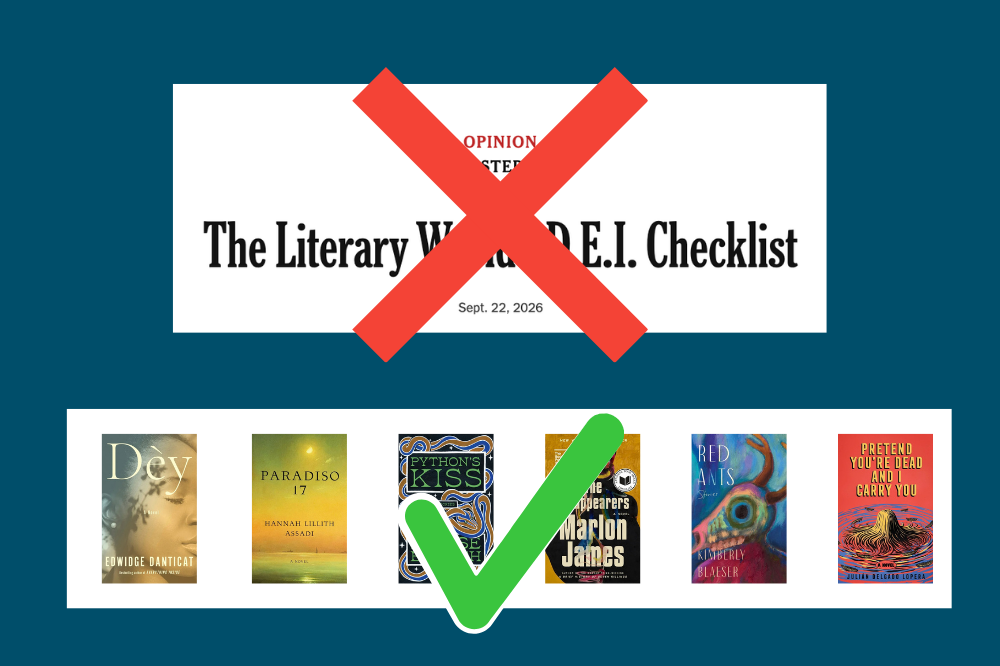
By now you might’ve seen the mystifying, callous, and yes—quite racist—opinion essay published two days ago in The New York Times by Bret Stephens. In it, he refers to the National Book Awards as the “literary world’s DEI checklist.” Electric Literature doesn’t link directly to foolishness—if you want to read the essay, you can find it on your own—but I was inspired to take a moment to unravel the premise upon which his essay rests and acknowledge the brilliance of the books he attacks.
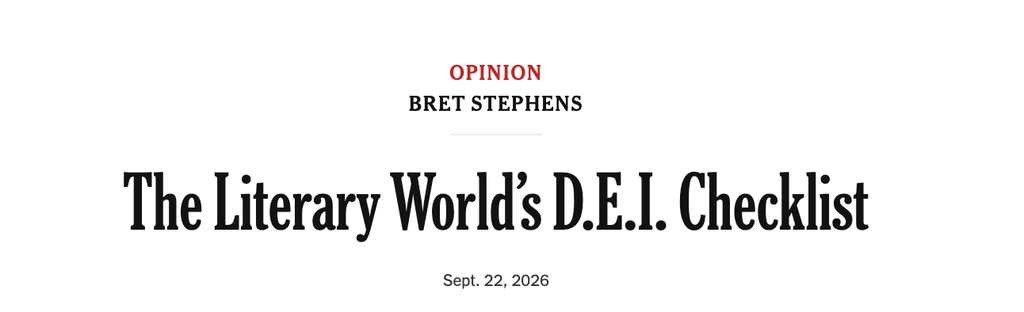
Stephens begins by noting, accurately, the increase in diversity among winners of the National Book Awards, particularly in fiction and nonfiction, over the last decade. He goes on to suggest that this is an overcorrection for the many decades in which white male authors, almost exclusively, were recognized with the award. He attributes this recent shift to the political leanings of the judges, embracing the idea that politics influencing art is problematic and diminishes the quality of the art itself. He concludes that these books couldn’t possibly be the best books of the year.
I’m not here to write an essay on the intersection of art and politics, but I do want to recognize the egregiousness of this argument. Literature is political; it has always been political. The very act of reading is, and has always been, politicized. Especially in this country. The idea that political ideology negates, or is irrelevant to, artistic merit is specious—I can’t even believe he wrote it. One look at any of these books, and you will realize that they are simply the result of the world we live in, the conditions of the lives of these authors, their communities, and those they are writing to and for. That they are being rewarded is, in my opinion, an indication of excellent taste.
At Electric Literature, we consider ourselves to be something of a literary tastemaker, and we want to acknowledge the quality of the books against which Stephens took aim—some of which we’ve been honored to cover over the last year. Joseph Osmundson, one of the longlisted authors in nonfiction, assembled this list as a resource, and is graciously allowing us to publish it here. Many of these books tell stories that wouldn’t, or couldn’t, have been told just a few decades ago. Diverse stories appeal to diverse readers. They bring more people to the practice of reading, which inspires more people to become writers. I’m sorry, Bret Stephens, but that is a good thing. To our readers, all of whom have the very best literary taste, I encourage you to buy these books. Read them! Let us know what you think.
—Denne Michele Norris
Executive Director and Publisher
The following list was compiled and annotated by Joseph Osmundson with help from the EL staff.
In order of his inane mockery:
Paradiso 17 by Hannah Lillith Assadi
“Assadi refuses easy answers. If there is irony here, it is muted, almost mournful. The author is after something slower: the way history settles into you, day by day. Modernity is both an escape from history and a stage on which its contradictions become unbearable.” – Zain Khalid, The New York Times
Red Ants by Kimberly Blaeser
“I love short stories that feel more expansive than their word count, and each story in Kimberly Blaeser’s debut collection operates like their own galaxies of possibility.” – Michael Welch, Chicago Review of Books
Dèy by Edwidge Danticat
(I mean, one of our best living writers, HOW DARE HE?!?!?!)
“The novelist’s duty is to present such questions and then leave the room — to grant the reader space to ponder them. Danticat does this masterfully, particularly regarding the subjects of love and home.” – The New York Times
Pretend You’re Dead and I Carry You by Julián Delgado Lopera
“The author’s turns of phrase are striking and indelible, and the characters are deeply and lovingly portrayed, including Mamadora, who looks out for the lonely Valentina, helping with her homework and making sure her disapproving aunt doesn’t try to separate her from Ignacio. It’s exquisite.” – Publisher’s Weekly, Starred
Python’s Kiss by Louise Erdrich
“Erdrich is an absolute master of fiction. Her characters come alive on the page, each of their voices as distinct and consuming as the last. Her work is infused with an incredible depth of humanity—both piercingly clear-eyed and deeply empathetic—that is, to me, the very best of what fiction can do.” – Katie Henken Robinson, Electric Literature
The Disappearers by Marlon James
(I mean, come ON!)
“This Masterpiece Is the Novel of the Decade, if Not the Century” – Dwight Garner, The New York Times
Beginning Middle End by Valeria Luiselli
“A novel that folds time and writing itself [ . . . ] The story leaves the reader wondering how fractured memories can be preserved and told through fabricated narratives. What is it to live in the middle when memories are fading away?” – Ofelia Montelongo, Electric Literature
The Renovation by Kenan Orhan
“It’s an odd, elegant little book with disarming sincerity that belies its metaphysical hocus pocus, held aloft by keen literary wordplay and an evocative exploration of what homeland really means.” – Kirkus Reviews
Mad Eden by Morgan Thomas
“Publishing too often uses the word groundbreaking, but in the case of Mad Eden, something about this rings true. Mad Eden, a debut, is nearly impossible to categorize yet joyful to inhabit.” – D/Annie Liontas, Electric Literature
Passengers by Alexander Maksik
“We don’t know if we’ve ever read a father-daughter bond written with more tenderness, complexity, or accuracy than in this slim novel about an interminably delayed flight… When inconvenience begins shading into apocalypse, this intimate portrait expands into a moving case for loving fully in the wake of a complicated past and the face of an uncertain future.” – Marion Winik and Charley Burlock, Oprah Daily
(Note: Stephens makes a *huge* point about Maksik being white and male and straight, which frankly, who cares, and why would I exclude him from the list for that reason? It’s still a mockery of his work to be discussed in this way.)
The nonfiction books didn’t even get their titles given or linked so people could buy, but WHATEVER
Seasons of Fury: Four Families and the Rise of Islamophobia in America by Rozina Ali
“The sweeping, landmark debut from journalist Ali explores decades of surveillance and harassment faced by Muslims in the U.S.” – Publisher’s Weekly, starred
Spawning Season: An Experiment in Queer Parenthood by Joseph Osmundson
(Hi, yes, this is me)
“A secondary narrative, following salmon on their journey to reproduce in warming waters, proves surprisingly apposite, partly thanks to Osmundson’s expertise on the subject, and partly because it underscores what is uniquely human about his dilemma: that, for us, a universal instinct can also be a question.” – The New Yorker, Best Books 2026
A Dead White: An Argument Against White Paint by Wendy S Walters
(Creative nonfiction icon!!!)
“Recursive yet resounding, a carefully curated aesthetic journey.” – Kirkus Reviews
Let the Poets Govern by Camonghne Felix
“Felix offers a lyrical manifesto that blends memoir and nonfiction to avow poetry’s transformative promise. Let the Poets Govern declares poetry a requisite teacher for both imagining and ensuring a brighter future [ . . . ] To learn the language of poetry, her book affirms, is to learn the language of liberation.” – Naomi Elias, Electric Literature
(Camonghne wasn’t in the Stephens bullshit, but I love this book, and you should buy it).