Reading Lists
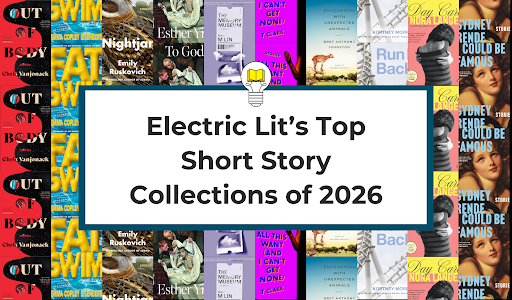
Electric Lit’s Top 10 Short Story Collections of 2026
Books by Emma Copley Eisenberg, M Lin, and Chris Vanjonack are among our favorites of the year
This article is free to read. So is every article Electric Literature publishes. No limits, no paywalls—now or ever. Support from readers like you makes that possible.
We need to raise $60,000 to start off 2027 strong. Donate now to our end of year fundraiser to help ensure the future of free, accessible literature for all.
—————
It’s been a particularly fruitful year for the short story. In Recommended Reading alone, we’ve had the honor of publishing excerpts from many of our favorite collections of the year. Along with surprising variance and singularity, there are also recurrences across these collections: identity, artifice, and distance—both temporal and physical—mediate the relationships at the core of these books.
In her introduction to Lim Sunwoo’s story “That Unfamiliar Night,” translator Chi-Young Kim writes: “Lim beautifully portrays how grounding it can be when someone sees you, when someone is quietly there for you.” Across these collections, a reader has this sense of bearing witness—and being seen—by so many small moments. In Bret Anthony Johnston’s “Paradeability”, a father accompanies his son to a clown convention in Texas; the costumes and air of performance both amplify and conceal vulnerability. In Sydney Rende’s “Monsters”, the dissolution of a relationship is distorted in the funhouse mirror of reality TV. In “Going Up” from Chris Vanjonack’s Out of Body, an anonymous speaker targets a woman plagued by uncertainty. Above all, our favorite collections this year play with ambiguity: What can be revealed when a story withholds a tidy answer to its central questions?
This year’s best works of short stories include five debut collections, as well as new collections from veterans of the form, such as Bret Anthony Johnston and Emily Ruskovich. Regardless of where you start, there are many delights to be found above—and below—the surface of these narratives.
–Lennie Roeber-Tsiongas
Assistant Editor
Editor’s note: The following books were hand-selected by Electric Literature staff and interns, with the help of our community of contributors, readers, and friends of the organization. Books by current staff or board members are not eligible for consideration. The 10 titles below are presented alphabetically by title; they are not ranked.
All This Want (and I Can’t Get None) by T Clark
Set in a small working-class neighborhood just on the edge of the bustle of New York City, T Clark’s stories are aware of the in-between. All of the Black girls, women, and nonbinary protagonists at the heart of these stories are in-between youth and adulthood, being and becoming, desire and realization. They face unexpected encounters with strangers, try to get just one more glimpse of an ex, get into viral fights, and attempt to simply exist authentically while caught in the riptide of a hypersexualized, patriarchal society. Everything is hungry, piercing, and alive; Clark writes with an awareness of the dynamics at play, even when the characters aren’t.
–Rachel Maybee, Editorial Intern
Encounters with Unexpected Animals by Bret Anthony Johnston
Under the light of the blazing Texas sun, Johnston reveals the ties that bind us to one another. His greatest strength lies in his characters, who are in turns strange, troubled, and deeply relatable; they represent the beating heart of each story. Some of the unexpected animals we encounter are: a baby alligator a father hopes will protect his family, a dog that sets a teenage boy up to discover a closely guarded secret, and a powerful, inspiring herd of wild horses. No matter which page you turn to in this collection, you’ll find an excavation of how relationships form, break, or ultimately endure. Read an excerpt from the collection here.
–Rachel Maybee, Editorial Intern
Day Care by Nora Lange
Nora Lange’s debut story collection left me restless and, quite counterintuitively, eager to stay in that feeling. These are stories of women with children and partners, and without them; they brim with the listless quality of not quite being where one is meant to be, or having what one wants to have. Accompanying this is a wild desire—unfulfilled but unfettered, roving for fulfillment. One story exists inside a snow globe. Another circles a landfill, a summer rental, and a child who’s learning to play the games that words make possible. A third—featuring the unforgettable line, “‘I hope you find the sex you’re looking for’ her mother said, and meant it.”—tracks a single new mother determined to find an outlet for her libido. Perhaps the most restless quality, though, is Lange’s language. A single sentence has the capacity to estrange and create intimacy, to toggle across distances and create a bewildering sense of both motion and stasis. These are stories I’ve returned to more than once this year, and certainly will next year. Read Lange’s interview about the book in EL’s digital pages with legendary author, and her former teacher, Carole Maso.
–Willem Marx, Associate Editor
Fat Swim by Emma Copley Eisenberg
In Fat Swim, the luminous interconnected debut short story collection by Emma Copley Eisenberg, the question of what it means to have a body, and to fully live in that body—to consume, to desire, to be seen and hated and loved and touched—is brought to the fore. Fatphobia is front and center in places, sure, but the embodiment of these characters is the much more powerful takeaway. Their humanity is centered. In the title story, Alice, a lonely, fat, eight-year-old girl living in West Philadelphia, with evolving feelings about her body, becomes friends with a group of fat women who swim at a nearby public pool. “Fat Swim,” “Beauty,” and “Lanternfly,” are three standouts among a collection of truly spectacular short fiction.
–Denne Michele Norris, Executive Director and Publisher
I Could Be Famous by Sydney Rende
In I Could Be Famous, Sydney Rende captures the feverish, modern itch of wanting to be perceived in a culture where visibility is treated as salvation. Set against the sun-baked, synthetic shimmer of Los Angeles, these linked stories track women orbiting the perimeter of relevance: a struggling actress going method in a hot tub showroom, an assistant filming celebrity mansions who develops a taste for petty theft, and strangers tethered to the downward spiral of a former teen heartthrob. What makes Rende’s debut so thrilling is how she balances biting, acidic wit with the genuine ache beneath all the self-invention. Beyond seemingly chasing vanity, her characters are terrified of remaining ordinary. Rende exposes modern fame for what it really is: a hollow secular religion, and an absurd, heartbreaking bid to prove we exist. Read more about this collection in our interview with the author.
–Shandela Contreras, Editorial Intern
The Memory Museum by M Lin
In his introduction to M Lin’s story “Yulan” in Recommended Reading, Jeremy Tiang writes: “If you can make yourself at home anywhere, how do you know where you belong?” This question weaves through the nine stories of The Memory Museum, exploring the relationship between migration, time, and memory. In “Yulan,” a Chinese artist based in Seattle returns to Beijing, where she is confronted with the emotional and physical distance that has emerged between herself and the life that once belonged to her. Other stories reckon with political constraints, censorship, and parenthood; in “Tough Egg,” an artist navigates the government restrictions on her artistic practice; “Scenes From Childhood” imagines a recent past from a distant future. Across these stories, the voice that emerges is both attentive and unflinching, honest and willing to linger in the lived reality of existing between worlds.
–Lennie Roeber-Tsiongas, Assistant Editor
Nightjar by Emily Ruskovich
When I attempt to describe Emily Ruskovich’s Nightjar, I end up orbiting around words like grounded and otherwordly—words that are accurate but inadequate and, of course, evoke completely opposite ideas. In the collection’s title story, 12-year-old Tess discovers magic in the pasture of her family’s rural farm. In any other narrative, magic would look and feel . . . well, magical. But in Tess’ eyes, it manifests, quite specifically, as “a wrinkled lump of what looked like mud but was not mud.” In Tess’ hands, it feels “as though it were made of wetness and nothing else.” With just this material—something wet that looks like mud—Ruskovich conjures something miraculous for Tess and, by extension, the reader. And then she does it again. And again. Every story in the collection looks like a story—but don’t be fooled. They look like words but they are not words. They are magic.
–Wynter K Miller, Director of Operations and Fiction Editor
Out of Body by Chris Vanjonack
Let’s get this out of the way: Chris Vanjonack is a former Electric Lit intern. He was a valued member of the staff and this fact, I honestly believe, has absolutely nothing to do with my affection for Out of Body. When I first read “Going Up,” one of my favorite stories from the collection and, not coincidentally, the story we published in Recommended Reading, I was surprised to find myself as interested in the mundanity of the main character’s life as in the supernatural specter harassing her with spam calls. Vanjonack never buries his characters under his speculative elements nor attempts to hide their ordinariness. The stories in Out of Body remind us that the experience of surreality isn’t possible without a reference point—without reality. And, of course, it’s always reality that is actually haunting us.
–Wynter K Miller, Director of Operations and Fiction Editor
To God by Esther Yi
Esther Yi’s sentences operate with a razor-sharp, eerie precision, where rigorous logic twists into deadpan comedy. In To God, her characters navigate underpaid jobs, slippery bodily boundaries, and manufactured rooms, treating devotion with fierce philosophical seriousness. Whether tracking lovers groping toward each other amid urban collapse, friends trying to think together in shared solitude, or a woman aspiring to love tirelessly, like an immaculate machine, each story asks what it costs when the self dissolves into another person. Grief, bodily decay, and fear offer no protection within these stories, but Yi’s unsettling vision uncovers an uncanny lightness within calamity. You find yourself laughing in unexpected places, then feeling utterly unmoored. Yi turns alienation into a strange kind of faith practice, showing that even in a world constructed this oddly, people cannot help reaching for one another anyway.
–Shandela Contreras, Editorial Intern
With the Heart of a Ghost by Lim Sunwoo, translated by Chi-Young Kim
The characters in Lim Sunwoo’s debut collection With the Heart of a Ghost are lonely, often despairing creatures, and they inhabit worlds of odd coincidence. In “Unfamiliar Night,” excerpted in Recommended Reading, a woman desperate for motherhood comes to feel imprisoned by fertility treatments and the invasive meddling of her father-in-law. When she encounters a childhood friend outside the subway station, an uncomfortable encounter evolves into a refuge for both women. In another story, a man transforms into a tree in his ex-girlfriend’s apartment as his heartbreak literally puts down roots. In the title story, a woman suppressing her emotions is haunted by the ghost of herself, a spectral twin who makes her feelings visible and raises the question: What does living look like? The raw material of Ghost—loneliness, disappointment, alienation—is heavy, but because the collection is infused with such whimsy, it manages to capture sorrow and offer an antidote to it.
–Wynter K Miller, Director of Operations and Fiction Editor