news
Granta: “Horror” at B&N with Don DeLillo and Paul Auster
This article is free to read. So is every article Electric Literature publishes. No limits, no paywalls—now or ever. Support from readers like you makes that possible.
We need to raise $60,000 to start off 2027 strong. Donate now to our end of year fundraiser to help ensure the future of free, accessible literature for all.
—————
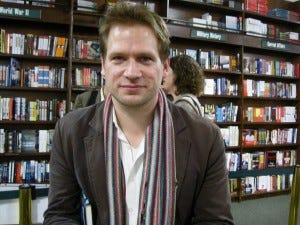
1. John Freeman, writer, literary critic and editor of Granta. 2. Paul Auster. He signed my copy of Sunset Park.

Ascending the massive complex of the Union Square Barnes & Noble is not unlike reading a Don DeLillo novel. Somewhere along the third escalator ride, symbols of hysterical consumerism begin to reveal themselves and it’s like you found a pair of the X-ray sunglasses from John Carpenter’s “They Live.” Then, all of a sudden, you’re ashamed of your Barnes & Noble membership card. Then you hear a voice over a loudspeaker giving instructions. Then a security guard directs you to a line, where you join others who will also buy some books.
This event celebrated the celebrated literary magazine Granta. The new issue, edited by John Freeman (the reading’s host), features stories by DeLillo and Paul Auster, as well as some other faves like Joy Williams and STEPHEN KING (the issue’s theme is ‘horror’). They sold mad copies, I was standing by the register.
1. The rockstars oblige their admirers. 2. DeLillo fan and Columbia University Italian teacher and critic, Patrizio! I bothered him while he graded papers as we waited to get our books signed.
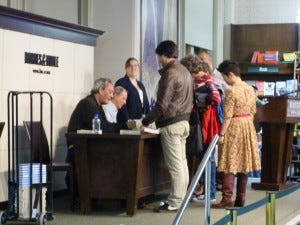

Auster said that the piece in this issue of Granta was part of his to-be-published book which is essentially a “history of my body” — his body “eating…having sex…cold…hot” — in different conditions and environments. I’m glad Freeman asked Auster about his invoking of the second person for this piece, being that every fiction class I’ve ever taken has shat all over my second person stuff. Auster shed some light, saying the second person had the advantage of being both distant and intimate. That thinking of yourself as ‘you’ turns you into a ‘you,’ not an ‘I,’ but one of ‘them.’ This idea sent chills all up and down my barcodes.
Freeman asked the boys about their feelings on the Big Apple, being that both of them write about it and live in it so much. Bronx-born DeLillo invoked the spirit of the flâneur, saying that he used to spend “endless hours just looking at the city” and being in it, walking the streets and thinking, then forgetting all about it, then coming home and letting it “distill into language.” Auster made a point of acknowledging the different types of New York, highlighting his top three: the “terrifying” New York, the “solitary” New York, and the New York “of friends and friendships.”
Some wacky things that happened: DeLillo’s mic didn’t work at first. Some light humor was made over it. Also, right as the standing section was getting restless, some guy with a scarf tried to listen to the reading up close by sneaking over to a roped-off section of shelves and attempting a scalp-scratching, chin-holding impersonation of a regular customer out for a casual browse among the ‘American Law’ textbooks. Before a riot ensued among the unseated, security caught wind of the ruse and chased him back to the escalator.
I will say I was blessed to witness the punch line of the evening. After eagerly shoveling his copies onto the table to be signed, an iPod-studded kid asked Delillo what he thought was “the most mundane situation” he could think of. A slightly startled DeLillo looked up with true confusion, uttering something like, “I don’t understand your question.” A heavily introspective pause was shared between the readers, the event coordinator, the kid and me (next in line) until Paul Auster, with rolling eyes, flipped another copy on to its title page, readied his pen and answered, “Signing books at Barnes & Noble.”
***
— Jesse Katz is a born-and-bred New York City writer and musician. He edits the local monthly zine, Having a Whiskey Coke With You.