Books & Culture
Growing Up Shouldn’t Mean Conforming and Forgetting
I always admired “Stranger Things” for insisting on imagination and nonconformity, but then the show betrayed its message
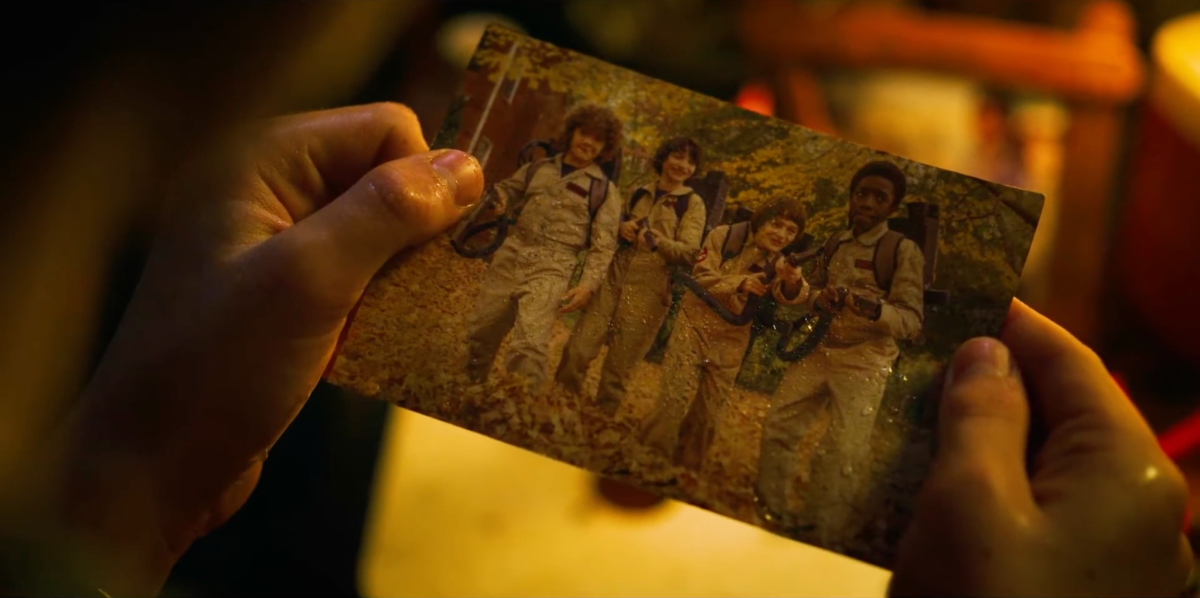
It was hard not to shed a tear or two when Stranger Things came to a close this winter. I was in college when the first season aired—not exactly a kid in a way that might have made the story’s characters relatable. But at 19, I was on the cusp of a symbolic split, straddling youth and adulthood with great expectations for adventures ahead and a good dose of melancholy for what I thought I was leaving behind. Perhaps Stranger Things found me at the right time. Like millions of others, in 2016 I was on the edge of my seat when Will Byers sent signals through the string lights in his living room. Over the years, the story grew with me, and I came to cherish its introspective portrayal of community and imagination.
As is usually the case with television, when oversight intensifies and budgets increase, writing tends to worsen. Previous seasons were already showing signs of decline, so I suspected going into season five that the ending would suffer from the same formulaic-slop-syndrome that now plagues most streaming platforms. Unfortunately, I was not far off. What started out 10 years ago as an insightful, character-driven story about friendship, trauma, and nostalgia devolved into an action-packed wannabe Marvel movie by the end. Writers and producers sacrificed depth for flashiness and wound up with over 10 hours of redundant dialogue and expensive action shots.
The story was a blueprint to struggle with the monsters of everyday life.
The $500 million budget of the final season is proof that you can’t buy a good story. But, sitting by a pile of bunched up tissues as the final credits rolled on January 1, I could not shake the sense that what I was feeling was not just the disappointed goodbye blues. I felt like something precious had just been gutted, and its carcass made to dance for entertainment. The more I thought about it, the more convinced I was that the Duffer Brothers had betrayed the heart of their own story, a transgression worse than bad writing. Some days later, my suspicions were confirmed. In an interview with Variety, the Duffers explained that Eleven had to die in the final episode because she represented “the magic of childhood. And we knew for our kids to be able to grow up, the magic had to leave Hawkins.” I was floored. Had not the whole story been about keeping the magic alive? And what does growing up even look like? For the Duffers, it looks like conforming and forgetting.
I had always admired Stranger Things for its insistence on imagination and nonconformity as keys to seeing the world for what it is, demogorgons and all. For years, we followed along as nightmarish creatures and state agents threatened the town of Hawkins. Characters attuned to this reality were often dismissed for being delusional or infantile, but the story consistently told us that the real heroes were the ones detached enough from social conventions to risk believing what might seem outlandish. Nerds and outcasts, queers and misfits, trailer park kids and single parents were the ones at a vantage point to believe in magic. From the margins, they could see and fight monsters. We are not just talking about demogorgons here. The story was a blueprint to struggle with the monsters of everyday life; the ones we fight alone and the ones we fight together.
The power of friendship can be an overused trope, but in its early seasons, Stranger Things did it well. Love was the show’s engine—the reason Will’s friends and family went looking for him, that Mike took Eleven into his home and Eleven saved Mike in return, the reason Bob died for Joyce and Eddie for Dustin, that Lucas could pull Max from Vecna’s curse, and that Hopper raised Eleven as his own. It was significant to see attachments on mainstream media premised on friendship not as a noun but as a verb. Friends in our story were rarely able to spare each other suffering—on the contrary, they were at times inadvertently causing it. But they chose to be together through it. And as external and internal forces ripped them away from one another, they refused to let each other go. In insisting that friendship was not an accessory but a potent part of the magic, the writers invited us to think about bonds as necessary rather than bound to dissolve with age.
In this regard, one of the most meaningful moments of the show for me was when Will destroys Castle Byers. The scene represents the very real pain that comes from change, but it does so without presenting childhood as something we permanently leave behind. Yes, the symbol of Will’s childhood is damaged, but it’s there that his friends come looking for him. Even after the destruction of Castle Byers, the kids know exactly where to find Will; their affection for each other is grounded in their histories, and by way of those histories they continue on their journey together. Things change, but they don’t have to end.
But by the show’s final season, the Duffers had departed drastically from this messaging. In the final shot of the saga, a new generation of kids takes over the Wheeler basement to begin their own D&D campaign, and Mike shuts the door behind him, leaving them with a bittersweet smile. The closed door is the last thing we see before the screen fades to black. We get it, they want us to grow up. Indeed, they beat us over the head with it. And growing up this time is rendered with isolated finality. While the remains of Castle Byers were a place for Will and his friends to embrace their next chapter together, the closed door of season five creates a barrier between childhood and adulthood. The message is clear: There is no going back, and the rest of life, you must do alone. Beyond this door? A set of sad tropes. In antithesis to everything the writers had expressed as important, magic is now a setback, and adulthood is a milestone that cannot be achieved without forgetting the past and conforming to a normative idea of life.
With the finale, the Duffers’ coming-of-age narrative becomes about manufacturing absorption into an idea of adulthood.
It is a familiar norm our society feeds its children, a tired American dream, and Stranger Things ultimately caved to it. Eleven dies, and the magic dies with her. As for the rest of our heroes, monster hunting ends and real life begins, which entails leaving community, creativity, and nonconformity behind in favor of “real” dreams like college, mortgages, marriage, and promotions. They barely speak of what happened to them and talk, instead, of moving on and not getting stuck in the past. In the end, the only characters who maintain meaningful relationships with each other do so in romantic partnerships, and almost everyone’s happy ending involves becoming a productive member of society and embarking on a solo identity building project: Jonathan, Robin, and Dustin are off to university; Will is finding himself in the city; Nancy is out girlbossing; and Steve is looking to settle down and start a family.
With the finale, the Duffers’ coming-of-age narrative becomes about manufacturing absorption into an idea of adulthood. I say idea here because, just like childhood, adulthood as a category has come to signal more than just an age range, but a standardized, socially acceptable set of attributes. In early seasons, a grown-up’s proximity to childhood was seen as an asset. Characters like Joyce, Hopper, or Murray had not really grown up yet, by societal standards: Joyce was a chain-smoking single mom, Hopper was a divorcee living in a trailer, and Murray a conspiracy theorist. But their failure (voluntary or not) to be disciplined into adulthood enabled them to believe what other adults dismissed and save Hawkins because of it.
By the end, even the adults are made to properly “grow up.” This is most obvious in the treatment of Hopper. When Eleven disappears in a storm of debris, I was sure he would never recover. He had, after all, spent the entire show fearing this would happen. Instead, he bounces back faster than I did. In their last heart-to-heart, Hopper encourages Mike to accept Eleven’s choice and move on, lest he make the same mistake Hopper had made after Sarah’s death. While there is nothing healthy about dwelling in the past, and Hopper had dealt with the trauma of Sarah in ways that hurt him and those around him, her memory also enabled him to sympathize with Joyce, help her save Will, and open his heart to Eleven, even at great cost to himself. There is a difference between healing and forgetting. Hopper deserved the former but got the latter. The Duffers wrote him a future at the cost of his past. To move on, he must cut ties with most everything that binds him to his own story—namely his friends, his town, and his cabin in the woods—in favor of an ending that mirrors all the others: marriage, a promotion, and a real house in a different city.
We need more people who are not done imagining better worlds and fighting monsters.
There are many reasons why youth are often at the forefront of struggles for justice—sure, they have more time and energy, but they also dare demand what the adult world has declared impossible. We saw this in the Black liberation and anti-war movements of the ’60s, in the early 2000s Occupy Wall Street, and more recently in efforts to abolish ICE and the movement against the genocide in Gaza. In Solidarity with Children, Madeline Lane-McKinley writes that progressive attributes and liberatory demands are often dismissed as childish in a society that wants to blunt their potential. “Language of infantilization,” she writes, “is consistently employed to demarcate what and who has gone too far, too often for the sake of defending the status quo, if not to moralize reformism.” Qualities like hope, creativity, and communal struggle, at the core of early Stranger Things, were ultimately relegated to kid things by what Lane-McKinley would call the “disciplinary horizon of adulthood.” Was Stranger Things ever telling us to be radical? Maybe not exactly. But it was telling us to be curious and imaginative, to embrace our singularities and use them in service of others, to love in concrete ways, to remember the dead, to play, and to keep the magic alive. These are small seeds for potentially big change if cultivated in earnest.
Instead, the Duffers presented the traits above as childish pelts to shed. The kids are all grown up now—time to put the toys away and settle down. But the reality is that we need more people who are not done imagining better worlds and fighting monsters. Stranger Things started off in praise of the underdogs who dare to believe their own eyes and take risks accordingly. In the end, it parroted a societal dismissal of what it had originally set out to praise: collective life, the courage to take risks, and the belief that things could be different. In so doing, it joined the catalog of texts that present the ideals of childhood as something to leave behind. This not only made for a poorly crafted ending; it was harmful to its audience. The writers encouraged generations of children and young adults to put their play away and leave their communities behind in favor of an individualist, cookie-cutter life. In the footsteps of our protagonists, we are to desire the ostensibly happy endings of well-adjusted adults—that is, nothing that rocks the boat or that exists beyond the parameters of “normal.”
This is why the only tragic ending in Stranger Things is also the only honest one: Mike, in love with Eleven, refuses to let go entirely. Their story, of course, should be read literally, as one of two young people learning how to be together. But if we run with the Duffers’ allegory, we also learn something important—that the only character who keeps the memory of childhood alive becomes a writer. Mike is not stuck in the past, he just lives life with continuity. Unlike the others who show no signs of being tethered to what happened, his life remains grounded in his story—he keeps a picture of Eleven on his desk and Will’s painting hangs on his wall. And so he writes, to make memory where the others won’t. It’s not a comfortable ending. But it is the one that shows that it is possible to exist in the world without succumbing to the death of being in awe of everything. Because losing the magic of childhood is not inevitable; we are just made to accept adulthood as life without wonder. The spark should be passed along as much as we should carry it with us. After all, it’s not just up to the kids—it’s up to you too.