Personal Narrative
I Wanted My Fiancé to Fight the Racist Men Who Harassed Me
His instinct was to get me out of there instead, and I never forgave him for it

This article is free to read. So is every article Electric Literature publishes. No limits, no paywalls—now or ever. But we rely on your support to keep it that way.
We need to raise $35,000 by April 15 to keep the lights on, and time is running out.
Help us reach the next milestone—$15,000 by Wednesday—by donating now.
—————
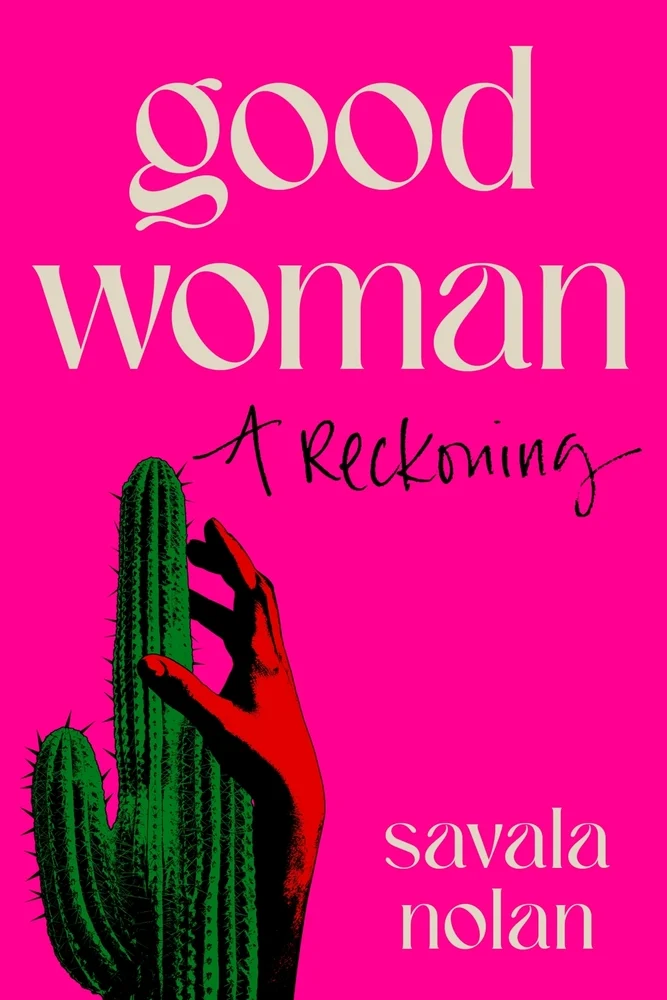
“Wyoming,” an excerpt from Good Woman by Savala Nolan
We pulled off the freeway and into a parking lot because we were hungry and we had seen a sign for a franchise steakhouse glowing white against the sky. The parking lot was massive, outsize like so much of the middle of the country, and empty. We crossed the concrete, probably holding hands, and settled into our booth. A waitress gave us laminated menus. We ordered steaks and they came and we ate, the steak salty, ice-cream scoops of butter melting on the baked potatoes, the soda cold and sweet.
I noticed the men in the adjacent booth, maybe because they’d noticed me. They were behind my then fiancé. Three or four of them, two facing me. White, middle-aged, rough. Work boots and dusty brown Carhartts, hair matted from the baseball caps set upside down on the table. Men just getting off work, men without their wives. One of them kept looking at me. Flirtation? Not quite—the shine in his eyes was attraction, but it wasn’t friendly. Our eyes kept meeting, though. A ways into our dinner, we were looking at each other again, and before I could look away, the man said porch monkey. He said it to me, and not to me. He was telling a story to the other men, a story that included that phrase, and when he said it, he’d made sure to be staring at me, his expression cocksure and unhurried. I heard it, and it was also as if I didn’t; a brief wave of dissociation.
Mine was the only Black face I’d seen for 500 miles, which was okay, in a way—I’d spent the drive from Nevada to Wyoming focused on the lonesome, rough beauty of the place: spiny mountains, Porter’s sagebrush, and blazing star flowers thick in the prairie grass, river water the color of brandy under the blue firmament. There in the steakhouse, I looked at my fiancé. I could see he was tired, his eyelids low on his blue eyes, his brown five-o’clock shadow two days long. He stared into space. He hadn’t heard porch monkey. But I had, the speaker’s eyes on mine, his face bright and pink with satisfaction, nearly postcoital, his arm slung across the back of the booth. I leaned toward my fiancé, felt the table press into my stomach.
I said, “You didn’t hear that, did you?”
He shook his head. “Hear what?”
“The guy behind us said porch monkey. He was looking at me.”
“Huh?”
I was whispering. Barely audible. So I repeated myself, adding, maybe unnecessarily, “Like, the racial slur?”
We hadn’t paid the check. We hadn’t even finished eating. But, his face impassive and his body moving slowly, he gathered his baseball cap and hooded sweatshirt from beside him. He stood up, quietly told me to get my purse, and headed to the hostess station. He didn’t look at me. The hostess appeared, her smile wide, her hair clipped back from her face. My fiancé told her we needed to pay the check. “Oh, okay!” A bit of confoundment in her voice. I saw something palpitate through his body, maybe anxiety; when I see it now, I rub his shoulder and ask, You okay, hon? He kept clearing his throat and looking around, wrapping the knuckle of his pointer finger on the hostess station. I wondered if he was going to add something like, Those guys are harassing my fiancée with racist language. He didn’t. Nor did I; speaking for myself, in this moment of hazard with strange men, did not feel like my place while I was standing next to my fiancé. The waitress typed into a little machine or flipped her pad or took his credit card, and we settled the bill and walked through the double doors into the big, empty parking lot, the Wyoming sky cavernous, dark, and daunting. We stood beside the two-lane stretch of Interstate 80, which runs from the Pacific Ocean to New Jersey, and the roar of big rigs drowned out anything we might have wanted to say.
Some guy called me a porch monkey, and my fiancé got me out of there. Like a good father, like a guardian angel. He did the right thing by any reasonable measure, and I never forgave him for it.
What I wanted was for him to fight. Physically. For me. I wanted him to observe my peril and respond, like a soldier. I craved a physical demonstration of my worth, his body the vessel and medium for the proof. Even as I whispered to him across the Formica table, the fatty rinds of our steaks turning opaque as they cooled, a part of me was already imagining him standing up—six feet, two inches of masculine pride, of indignant protection—and confronting those racist hicks with his fists. Strong fists, a mechanic’s hands, hard and skillful. The idea thrilled me; it unnerved me, which is itself a kind of thrill, too. I imagined him swinging his arm into the meat of the other man, my then fiancé’s arm, which was skinny and freckled and pale and lay warm around me at night. I imagined his arm a rifle, oiled and loaded, deployed in my defense. I imagined a brawl, my fiancé’s hair askew, his mind blank, instinct taking over, a pure, manly, punishing desire to avenge me. The ferocity of a dog. The other guy would lose, obviously. And in the cheap hotel where we were staying, I’d tend to my fiancé’s wounds with the keen intuition of an auteur. Scene: She wets a scratchy white washcloth in the bathroom sink and dabs it on his lip. He winces. She holds a bag of ice to his knuckles. She bends forward and lightly kisses the bruise spreading on his cheek. She whispers, Thank you, baby. He pulls her close. They look into each other’s eyes. They clutch, they kiss, they fuck. She, in gratitude, a damsel saved. He, in search of relief, in search of calm after being plunged into the most choppy, sightless depths of his masculinity; he’s kicking for the surface; sex, release, her body—the only way to reestablish his equilibrium.
That’s not what happened, though. There was no vengeance, and no subsequent merging of pleasure and vengeance, our normative gender roles eroticized and tightly coiled. Because his instinct wasn’t to fight. He didn’t talk to those men or shoot them a warning glance, let alone go ham. He didn’t engage them at all. Without even looking at me, he said, Let’s go, and hovered his hand on the small of my back as we wound through the restaurant to the hostess, and he pulled out his credit card, and he held the glossy wooden door for me and lead me to the Days Inn or Holiday Inn or Super 8 where we were spending a night on our drive from San Francisco to Detroit. He got me out of there, but I still felt exposed and diminished. It seemed I was (was I?) not worth fighting for. Whose gaze was I in? Which is to say, who was seeing me more powerfully in that moment? My fiancé, as he stared into the middle distance of the restaurant, as he steered me from the room without comment? Or those strangers, homing in on my race, homing in on this reality of my existence, making contact?
I thought of fairy tales, where the girls worthy of avenging are always an over-the-top version of mainstream pretty (big, dopey eyes; impossibly pointed noses; impossibly long, generally straight hair). That is their common denominator. I didn’t really see myself as pretty then, and when I did, it was fleeting and footnoted; I was pretty because the light was good and my lip gloss was sparkling, or I’d managed to avoid carbohydrates for a few weeks and the curves around my tits and waist were especially pronounced. Perhaps his choice not to fight for me was a sign of my ugliness.
There was no vengeance, and no subsequent merging of pleasure and vengeance, our normative gender roles eroticized and tightly coiled.
Also in fairy tales: The men worth their salt always avenge. They ride into battle. They fire their weapons. This is what makes them heroes. They clock and pound and make quick work of sweaty, steak-filled yokels in a greasy spoon outside Cheyenne, Wyoming. But not my man. He chose to leave, to, in effect, run away. Like a kid hauling ass from bullies, scrambling. Sensible, yes; I know that. I know that. For one thing, Wyoming was and is a permissive open-carry state. A wrong move and we might have been shot, our blood left in that gusty, bereft wilderness forever. But still. He chose something quiet, passive, and unseen, and in a corner of my mind, he suddenly flickered, the image of him no longer solid but blinking in and out; he seemed, despite my progressive politics, like less of a man.
That moment, in which I experienced our shared diminishment, still pokes me a decade later. (Hero status precluded. Damsel status denied.) I still sometimes consider what his choice—not to risk his own body, not to damage someone else’s body on my behalf, not to fight—might mean about each of us. I know him better now than I did then; I know his tendency to avoid conflict and limit exposure. Perhaps that’s what drove him, plain and simple. And perhaps I should be unambiguously thankful for it—my own tendencies are different and not necessarily better. On a New York subway, years ago, a man made a V with his fingers and wiggled his tongue between them, staring at me, raising his eyebrows. The doors opened seconds later, and it was my stop, so I stepped onto the platform; then I turned around, flipped him the bird, and shouted, “Fuck off, loser.” He stood up and lunged across the car, toward the open doors, toward me and my mom on the platform, my mom’s mouth open as she stared at me, not believing I’d antagonized him like that, my body rigid and prickled with the adrenal rush of being in a man’s crosshairs. Then the doors slid closed, keeping us and that man apart. Hand on her hip, her expression still disbelieving, my mom said, “Jesus Christ! Now, what did you learn from that, Savala?” Scoffing, I said, “Next time I’ll wait till the doors are closing.” Indeed, if my fiancé hadn’t been with me at that steakhouse, I might have said some hothead thing to those hicks myself. Screw you. Go to hell. Dumb. Incredibly stupid. But it’s my nature, or it’s my learned response. It’s what comes out when I can’t take it anymore.
In the hotel room, the sheet pulled up to my chin, I continued to ruminate as he slept. Or maybe he didn’t fight because I’m Black. Black women, even pretty ones, have such a precarious foothold in femininity, in the pink, satin-lined box where they keep ladies. That box that dudes carry in the crook of their armored arms, held tight to their chain-mailed chests, as they ride to battle for honor. We don’t really get to be women—in the sense of tender, soft, and in need of protection. They sack no villages and storm no castles in our gentle name. They prefer to send us into battle before the men, thinking us a front line of strong, indestructible things-with-vaginas. Is it possible that, though he loved me, loved me enough to “make me his wife,” to slide a diamond on my ring finger, some wire did not trip? Some alarm did not sound? Maybe his own internalized sense of Black womanhood left him feeling lazy, or reluctant, or useless, like I didn’t really need shielding because I, ever strong and not-quite-a-lady, could shield myself. He probably couldn’t see that some part of me, stuck in a culture that keeps my grip on normative femininity tenuous while telling me I must be normatively feminine, needed him to play the Man. I needed him to be my foil, against which my femininity could show in doe-eyed, blushing relief; if he didn’t play the Man, if his behavior crept across the line into the “feminine” space, then there was even less room for me to be the Woman. I wanted him to fight because any infringement on the feminine space I tried so desperately to occupy was, on some level, personally threatening—even an “infringement” as wise as his choice not to fight a crew of roughneck strangers.
This is not a need I’m proud of. It’s not even a need I strongly relate to when I happen to be residing in the more mature, evolved parts of myself. But we all have parts of ourselves that are young, that are stuck in childhood and adolescence, from which we’ve never effectively extracted the doctrines that were pressed into us. Doctrines about what it means to “be a man,” and what it means to be a woman (a “lady”). Mythologies that make someone else’s so-called gender-appropriate or gender-inappropriate behavior a signal of our worth. If your girlfriend won’t shave her legs, or is taller than you, or doesn’t want babies, is she less of a woman and are you, therefore, less of a man? If your boyfriend doesn’t like sports, or wants to paint his nails, or has small feet, is he less of a man and are you, therefore, less of a woman?
I don’t think my fiancé and I ever talked about that night; not when we got into the hotel room, not on the next day’s drive, not ever. Not in the ten years I’ve repeatedly thought about it. I didn’t want to point out my needs, or his deficits. I once asked him if he remembered it, though. He was packing his bag for work the next day, and I was reading on the couch, the sound of our daughter’s music box tinkling through the wall. Remember that night in Wyoming when we were having dinner and those guys called me a porch monkey, or just kind of said it to me? That’s what I asked. I do, he said, and that was all.
I also consider what his choice—not to fight—might suggest about how clearly, and even whether, he sees me. Whether he perceives and comprehends my female, Black body as something exquisite yet undefended in any and every space, because all spaces are acculturated. Maybe the answer is no; I didn’t get the gift of my husband’s aggression where I wanted to, where it might have protected me, or made me feel treasured, because he couldn’t see that I needed it.
Where have I seen his aggression? When he’s watching football, of course. And when we have sex. There are overlaps. Like many men, his noises in both are similar. The grunts and ohs of two-point conversions and interceptions and fumbles so very like his sounds in response to my touch, or to touching me. The players with their pads and cleats and taped-up fingers, running familiar routes, leaping over and shoving through piles of other men, extending their arms to the spiraling pigskin and yanking it to their chests, stiff-arming as they dance down the field. This is mine, fuckers. When he watches those games, every autumn and winter Saturday, he comes alive. The animal in his soft-spoken, glasses-wearing, Atlantic-reading person becomes visible. Not everyone knows that animal, but I do. I see it in my bedroom. I often convert myself for its expression. I want him to be able to feel like a man. I’m often told how “strong” I am; I am a strong woman—who gets off on that? So I fold and subsume myself into the familiar tropes of a girl wanting it, a girl who feigns mild resistance but who, we all know, is deeply ready for a man’s old-school, primal strength in the only place he’s still allowed to show it, damn it. Arms above my head, his hands around my wrists; eyes looking up, the girlish gaze, the innocent-yet-slutty affect; hips bone to bone; mouths lip to lip; words in my ear; bending forward and over backward. This is sex. It’s a portal for both of us. We go somewhere; we’re not who we are—me with my strength, him with his tender insides. He gets to be rough—not in the sense of causing pain, but in the sense of governing and controlling. Like men back in the day. Or maybe like men today. I get to be—what? Wanted? An object of enormous, fervent desire. Does that work for me? Physically, sure, okay, I guess so. Come for me. I will, and sometimes twice. But does it feel good? Does my pleasure have to merge with my subjugation? Does his pleasure have to come through dominance, swung like a bat, at me? I have tender insides, too. You know, that’s what those players are doing—they’re dominating. They’re kicking ass. The win goes to whoever wants it most. Anticipation: He says oh!, his arms fly up into a Y, he stands up from the couch—will it happen? yes! touchdown—he whoops, he pumps his fist. I don’t care about this game. I don’t like this game. I think this game is bullshit. But even I cheer.
Desire, desire everywhere you look: my desire to be left alone, to have my personal space respected by those men, their desire to engage (harass) me, my fiancé’s desire to protect me (I think) without any risk to himself (I think), my desire to feel the armor of my fiancé’s public protection. Desire is good. It’s the primary force of life. But it is also an indication that something is off, that the present moment isn’t quite right, isn’t quite good enough, that whatever it is you have, you want something different. Whether you are asking someone to pass the salt or asking someone to marry you, desire acknowledges some inadequacy in the status quo, some need or wish for things to be slightly, or significantly, different. Desire points to what we lack, or think we lack. It is a signal to scratch an itch, to solve a problem, to make yourself feel better.
He seemed, despite my progressive politics, like less of a man.
Of course, male desire is primus inter pares. We go out of our way to anticipate it, respond to it, and learn from it, perhaps because male desire can be not just consequential, but dangerous. Dangerous to women in a million practical ways (need I list them?), and dangerous to men in existential ways. Scholar Katherine Angel analyzes male desire in the realm of mainstream pornography, arguing that the recursive hostility toward women in these videos (“Take this, bitch. You fucking love it, bitch,” Angel offers) has nothing to do with female sexuality and is, instead, a way for heterosexual men to work out the aggression they feel toward their own weakness. In Angel’s vision, this weakness is part of desire; desiring a woman (or any partner) opens the doors to all kinds of experiences that frustrate the archetypal ideal of men as masterful and stoic and strong. To desire is to be vulnerable, and vulnerability is incompatible with normative masculinity, with what we think of as “manly.” Yes, “real men” are supposed to want women, but embedded in that wanting, deep below the surface, is, by definition, vulnerability and exposure. In pornography, we avoid this problem—that men have no choice but to experience vulnerability when they seek intimacy, and we don’t like vulnerable men—by making women wear the costume of vulnerability, and then having men react to it with despotic force and authority. Women wear the vulnerability because men cannot; to do so would be a profound threat to their normative social dominance, to their very identities as men. When the male actor gags and punishes the naughty virgin, or fingers the sleeping babysitter, or creampies the tight-assed MILF, what he’s really doing is gagging and punishing his own vulnerability—it’s just wearing the costume of a chick. My husband and I don’t have the kind of pornified sex Angel describes. And thank God. But her point landed for me. There is some of this dynamic at play; I recognize the idea of a man exorcizing the demons of his vulnerability through light, garden-variety domination of a woman’s body.
It seems obvious that he’s learned some of this, over the years, from porn, and some of it, also over the years, simply from observing what “real men” do in life. As have I. My willingness to contort for him—meaning, to bend into a shape that can be dominated—to invite it or at least make space for it with my own murmurings and expressions and body language, comes from what I’ve seen, too. It’s a way for me to be, or appear, feminine in the “right” way, where “right” is dictated by a lifetime of Disney movies and sexist media coverage and, here and there, forays into free porn driven by my own curiosity. What is it that men like? How do people act and what do people say when they have sex? What does sexuality look like? Porn is one way to answer those questions;1 it is also one way to ensure, before we understand the negative consequences of that assurance, that the sex we have is inspired by our relationships to dominant culture,2 by what Audre Lorde calls “external directives.”3
It also seems obvious that whatever those hicks in Wyoming were trying to do to me, it was, at its essence, some version of Take this, bitch. Some version of sticking their cocks into me against my will. Metaphorical cocks—there is a difference between a racist remark and rape. But cocks, nonetheless. Meaning, their strength, their impunity, their license to invade, their privilege, their sense of centrality and entitlement, their desire to belittle and dominate. In 1964, Supreme Court Justice Potter Stewart famously said that pornography is nearly impossible to define, but you know it when you see it. Those sad, racist, little men in the adjacent booth, their offhand, blunt utterings of porch monkey, the way in which their voices remade the space around me, so that I was no longer in a restaurant booth with my fiancé but in the center of a bull’s-eye, alone, as they watched. They were aroused by their power to do that, to transport me from one space to another without my permission. They were aroused by their right to make me take it. I know it when I see it.
It may be a lamentable truth that I wanted my fiancé to fight those Wyoming morons because I’m steeped in normative bullshit about what “real men” do, and because I wanted him to publicly confirm my femininity and his masculinity. But it is also true that I wanted him to fight because, in that restaurant, his aggression would have been more than just the “real man” impact of fist on flesh—it would have been speech. An offering. It would have been him lifting the chalice above his head and saying, to me and in front of everyone, I got you.
Aggression—or lack thereof—is a form of language. It communicates. It communicates to someone (a child, a stranger, a crowd), and it communicates something specific (I can over-power you, I will—or won’t—protect you). In our bedroom, when we’re alone and, despite our lefty sensibilities, both ultimately oriented toward the crescendo final act of his orgasm, my partner’s aggression speaks to me. It tells me that, to a larger or lesser degree, in at least this one realm, he needs to dominate me. I know what he is thinking; the loop of our communication is complete, and I therefore feel, if nothing else, existent. But I’ll never know what he was thinking in that restaurant. He might have been upset but hoping to avoid a public freak-out (meaning, me freaking out); he might have been scared for his own body—he’d be the one throwing and taking punches, after all; maybe to fight would have been, paradoxically, to reveal vulnerability, the vulnerability of loving me—and he did not want to experience that. I’ll never know what he was thinking, and so I don’t know what he observed; I don’t know what he saw and how it fit or did not fit into his worldview. Nor do the porch monkey guys with their dirty baseball caps and mugs of cheap beer. Nor does the hostess who cheerfully wrote up our check. Nor does anyone. He gave no testimony. So, there’s no story being told, its concentric circles rippling out from dining room tables in rural Wyoming houses, moving along like tumbleweed, creating, eventually, an indelible ripple through town. There’s no mark. There is no record. There’s only the fact that I still think about it, and nobody else does.
Aggression—or lack thereof—is a form of language. It communicates.
Well, why don’t I just ask him? What he saw that night and what he made of it. I don’t ask because my ex-husband is not a talker. He is, in that way, very much a “real man.” We joke that I say more in ten minutes than he says all day. He is also a “real man” in the sense that he doesn’t deeply plumb his emotions. Most of the time, his feelings are a mystery to me. Door locked, curtains drawn. I do see him delighted—our daughter is a delight, with her corkscrew curls and slender feet and hammy, head-thrown-back laugh. And I see him angry; I know he’s really pissed when his voice starts to shake. Psychologists consider anger a secondary emotion—meaning, one that rests on top of, and therefore conceals, an emotion that is more disturbing or taboo to feel, an emotion that one is not allowed to express. Sorrow, despair, grief, terror, for instance. Any of those might be under that shaking voice, that tight jaw. Sometimes he is so angry his eyes well up; what is under those tears? They don’t fall. They are, I guess, reabsorbed into his body. If I ask him what he’s feeling, what’s going on, he will usually say, I don’t know. And if I were to ask him what he felt that night, what he made of what he saw, what was driving him, he would almost certainly say, I don’t know, too. This would be its own fresh pain. My muteness keeps our peace.
It occurred to me only recently that my then fiancé, perhaps, did not know what porch monkey even means. Do all white people know the vocabulary of white racism, even the ones who aren’t overtly racist? Even the ones who would never, could never? I picture little white children gathered for story time, graham crackers and cups of milk and knee socks and sweet upturned faces, Mom or Dad reading from the Book of Whiteness, explaining the slurs and insults they should know even if they never use them. I texted my cousin, Do you think most white people know what “porch monkey” means? She’s white. She replied, Maybe? Ellipses. Then, I think it would ring a bell as racially problematic even if they weren’t sure of the particulars . . . I wonder if all men know the vocabulary of misogyny, even the ones who call themselves feminists. They must. They, too, see the films and TV shows, they see the magazine covers and read the books, they listen to the music and sing along, they, too, know history. They are sentient beings. They can observe who has been president and who the CEOs are and who gets raped and butchered and who gets paid more and who takes it.
There’s a certain type of man I call a voting-booth feminist. He’s down with Kamala Harris. AOC rocks. He’s even kind of intrigued by Sarah Thomas, the first woman the NFL hired to be a full-time official. But he doesn’t, like, pick up his socks. He doesn’t cook much. He doesn’t clean much. He doesn’t watch chick movies or read women authors. He doesn’t decide to watch only ethical, feminist porn, preferring the free shit that works as fast and reliably as thick lines of good coke. If there is a way to integrate his so-called feminism into his private life, he doesn’t see it. Which is to say, he doesn’t want to see it. I know a lot of these men. They’re a lot like a certain type of white person who says they don’t have a racist bone in their body.
He would object to this assessment, but it’s possible my husband sees my womanhood more through the lens of his own sexual desire and domestic needs than through the lens of my precarity and his responsibility, both political and personal, to respond to it. It’s possible he sees my Blackness only peripherally, too; if Blackness is a kind of profound otherness to most white people, maybe I’ve grown “less Black” to him as I’ve grown more familiar. Familiarity can be good; I long for it—I want him to see my hair as just hair, hair like anyone else’s, not “Black hair.” And it can be bad; I bristle at it: I want him to understand that I don’t just have hair, I have Black hair—with all the politics and drama and history and promise that designation bestows. He can’t win. Nor can I. But it isn’t about winning; it’s about being seen. I am the most compelling evidence of my existence. I want to be witnessed. Like my existence, or don’t—here I am, either way. I wanted my then fiancé to be present so that he—not as some power-holding white man but simply as my partner, or, even more simply, as someone who knows me—can verify that I, that these moments in my life, took place. I want my testimony corroborated. And I want him to have personal knowledge of my life, of this part of it. Not because these wounds and vexed realities form the core of my personality—they don’t; marginalized people are always overidentified with their social and political struggles, are too often defined by how they are impacted by and resist their oppressions, and that’s not what I’m talking about. I am simply stating that, because these wounds and vexed realities are part of my life, loving me, knowing me, and seeing me require that you see them, too.
Would that I could control how I’m seen. Would that I could solve this being hyper-visible or invisible in a given moment, in a given interaction, and simultaneously. Would that being seen as a woman, and a Black woman, was as simple as seeing a sign glowing against the night sky, or seeing—reading—the face of a pissed-off white man. Wishing does not make it so. Still, I pick up dandelions, little ubiquitous weeds, this plant that grows anywhere, even in spent, empty soil, even where no one wants it to grow, and blow their ethereal seeds into the air. My breath rushes over the bloom. It spreads private aches, the kind you can’t speak aloud to the people you wish could hear you, setting them loose on the wind.
- Actress and activist Jameela Jamil has observed that learning how to have sex by watching porn is like learning how to drive by watching The Fast and the Furious. ↩︎
- My phrasing is a riff on language from scholar Kevin Quashie, who, in The Sovereignty of Quiet, describes “pleasures that are inspired by familiar or social relationships or identity” as opposed to those that come from our authentic, unsullied interiority. ↩︎
- Language from Uses of the Erotic: The Erotic as Power by Audre Lorde. ↩︎
Excerpted from the book Good Woman by Savala Nolan. Copyright © 2026 by Savala Nolan.
From Mariner Books, an imprint of HarperCollins Publishers. Reprinted by permission.