Interviews
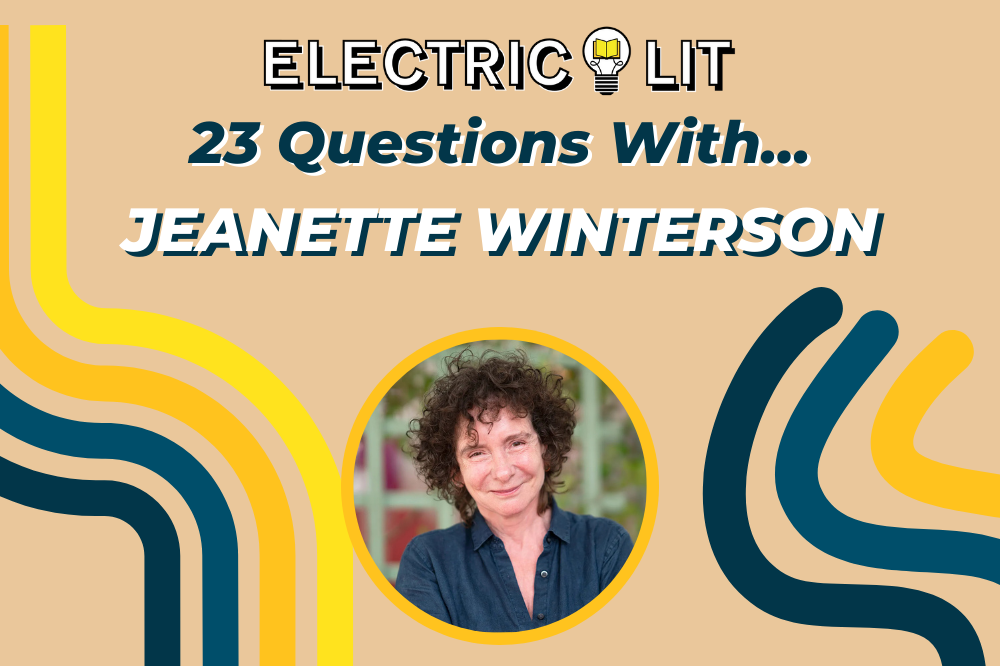
Jeanette Winterson Thinks Writer’s Block Is a Con Job
The author of “One Aladdin Two Lamps” on the state of the world, literary adaptations, and surrendering to your own work as the ultimate writerly guide
This article is free to read. So is every article Electric Literature publishes. No limits, no paywalls—now or ever. But we rely on your support to keep it that way.
We need to raise $35,000 by April 15 to keep the lights on, and time is running out.
Help us reach the next milestone—$15,000 by Wednesday—by donating now.
—————
When I first discovered Jeanette Winterson, I was struck by the incredible presence of her work; not only her ability to convey the tender, insular reality of love and conflict, but by the way her prose seemed to carry its own life force. Winterson doesn’t shy away from discomfort, from the turbulent landscape of her Pentecostal upbringing and disapproving family, from the question once asked of her: “Why be happy when you could be normal” (which later became the title of Winterson’s wonderfully moving 2011 memoir).
Winterson’s writing is visceral, embodied, and patiently political, capturing the reality of growing up queer in an environment built upon suppression. In spite—or perhaps in response—Winterson’s work transmutes an irreverent, unbridled joy, even amidst the inevitable sorrow and grief that comes with a human life. Her most recent book, One Aladdin Two Lamps, shatters and reassembles Shahrazad’s One Thousand and One Nights, asking ancient questions that feel both timeless and critically important to our contemporary world.
With forty years of writing and publishing experience under her belt, I was thrilled at the opportunity to speak with Jeanette about her routines and insights on the writing life, and all the more charmed by her passion, humor, and recognition of writing’s essential role, now more than ever.
– Lennie Roeber-Tsiongas
Editorial Intern
1. What book should everyone read growing up?
Jeanette Winterson: Everyone should read Wuthering Heights, especially before Emerald Fennell’s adaptation comes out on Valentine’s Day next year. I think she’s butchered it. So read the original, then you can watch the movie, and then you can say, Jeanette Winterson knows jack shit.
- EL: Did you see a screening? Or is this just an inkling you have?
- JW: I’ve been following it closely. I love the costumes—Margot Robbie in red latex does it for me—and I love adaptations, but sometimes as a writer who cares about text and language and all of that stuff, you do die inside. With a movie, you get great sets, wonderful actors; you get the story, but you don’t get the language.
2. Write alone or in community?
JW: Write by yourself. Oh, absolutely. All writing is about discomfort. It’s a lie detector that starts with yourself. If you’re always chatting to somebody else, you don’t get that discomfort and you don’t do the work of the lie detector on what you’re writing.
- EL: I’m inclined to agree.
- JW: If you’re doing a script or something which starts out as collaborative, a hundred percent. I’m working on a musical at the moment, and that’s really collaborative and I love it. But that’s because it fits the form.
3. How do you start from scratch?
JW: You don’t do it by going into the executive suite and trying to force an idea. It’s not office work, it’s not factory work. You have to work with your unconscious, with your inner self and let ideas bubble up, let images come forward, even images without words, pictures in your mind. Follow them with grace and humility. What I see with my students is a kind of terror—they close everything down and format it way too early on. That’s what I mean about discomfort. Let the thing develop. Let it play with you. And don’t tell it what it is all the time. Wait to see.
4. Three presses you’ll read anything from?
JW: Grove Press, of course. Melville House for the little editions and the essays that they do. I love those. And in Britain, Faber and Faber.
5. Hardcover, paperback, or e-reader?
JW: I always buy new books in hardcover if they exist like that because I can afford it. Somebody’s got to do it to support the industry and it’s a pleasure for me. I don’t want it on e-reader, not least because we all know that they can disappear your books any time they want.
- EL: I don’t like not knowing how many pages I have left to go.
- JW: Oh, I don’t mind that. That’s interesting. But I still think there’s some perfect forms that haven’t been bettered. It is the progress fallacy. So an egg is a perfect form. An apple is a perfect form. You can’t better them. And for me, a book is a perfect form. It’s not waiting to be updated to an e-reader because some tech nerd who does everything on Blinkist thinks it’s a good idea.
6. If you were a novel, what novel would you be?
JW: I don’t want to be a novel because it’s too big a possibility. I might end up as a 19th century three volume novel, and that would be upsetting because I’d be too long, or I might end up as post-structuralist fiction. What would I be? I think I’d rather be a poem because a poem is contained, it’s pressurized, every word counts, and it’s short. It is amazing to me and kind of glorious that poetry, which everybody thought was the ultimate outdated form, has made such a comeback because it’s short and nobody’s got any attention span anymore. Never say it’s over ‘til it’s over.
7. Describe your ideal writing day.
JW: Oh God, listen, when you’ve been doing it for 40 years, there is no such thing anymore. And that’s kind of great. When I am working, I don’t do anything outside of it. I don’t do events, I don’t do public stuff, which I do a lot of normally. So it’s just me in the country. I get up early, really early. I used to be a night owl, but now that I’m old I’m not. Walk the dog, chop the wood, light the fire, and do a couple of hours. Above all, keep your emails off, keep your Wi-Fi off. Don’t even think about it. When I’m doing real work, I never, ever switch the Wi-fi on until I’ve done the real work. Because it’s just a tsunami of interruptions, isn’t it? You have to deliberately interrupt the interruptions.
8. Typing or longhand?
JW: Never longhand, never did. When I started out, it was a typewriter and that made you look like Kermit or any of the other Muppets. You just sit there bashing it out. I love that because it gives a distance. I’ve never been somebody who carries around a notebook and writes down my thoughts, mostly because they’re garbage. It’s when I sit down and work that good things happen.
9. What’s a piece of writing advice you never want to hear again?
JW: I don’t know. I never look at writing advice. I’m a writer. I can do it. Jesus. I’ve been doing this for 40 years. If I need advice now, you shouldn’t be talking to me.
10. What’s a piece of writing advice you think everyone needs to hear?
JW: The main thing is turn up for work. Just make a pact with yourself on what time you can reasonably spend doing your work. Don’t do magical thinking, but when you’ve made the deal with yourself, stick to it.
11. Realism or Surrealism?
JW: Oh, God, I hate realism. I’ve never written social realism in my life, and I never will. It’s only a partial truth about who we are. I’ve spent all of my time begging people not to get lost in the literal. Without imagination, we’re nothing.
12. What’s your favorite comfort snack for writing?
JW: Salted peanuts. I mean, fortunately, I also have great self-discipline, so I’m not mainlining peanuts, but I do like to have a bowl of them. Probably towards the end, when I feel that I’m in the last hour, which is a feeling thing, then the nuts come out as a kind of reward.
13. Edit as you go or shitty first draft?
JW: Neither. Neither. Every book is different. Again we’re going for these formulae prescriptions that don’t work. You take each piece of work on its own merits in its own right and you give it what it needs. One piece of work might need endless going back over for whatever reason. Another piece of work might just come flying out and you don’t know why as a kind of act of grace.
14. How did you meet your agent?
JW: Oh, well, I’ve had more than one. You’re looking at a long life. My current agent, who’s been my agent for a long time, is Caroline Michelle at P.F.D. in the UK. I met her in 1978 when she was my publicist on The Passion. Now she runs a huge business. We sometimes look at each other and say, you know, we’ve known each other for 38 years. One of the beautiful things about getting older is that, especially if you’re a woman, you know, there are those women who stay with you and really become a kind of living diary of who you are and what you’ve done over all these years. It’s an incredible thing. And it’s something I really value about getting old. I look around and I see these amazing women like Elizabeth Schmitz at Grove, who I’ve known forever and we’re still here, girls!
15. What is your best advice for pushing through writer’s block?
JW: Never had it. It’s a con job. Really, any problem is your friend. It is not a difficulty. If you’re stuck, you need to work out why, because either it’s in your life or it’s in the work. Your unconscious, your creative self is trying to flag something to you and you have to dive deeper and go sideways and find out what’s going on. It might be in your life, it might be that you really need to take a break, or it might be in the work and you’re swerving something or trying to impose something on it.
16. What other art forms and literary genres inspire you?
JW: I love music, and particularly classical music and opera, because it’s so ludicrous. What a ridiculous art form to invent, all those people running around on stage. I love it because it’s this sense of humans at their most gloriously ridiculous. I think with art forms, you look at them and it reminds us that we can do so much more than seeking money and power and land grab and status and starting wars and blowing up the world. Now, whenever I see any art form, it doesn’t matter what it is, I just think this is the best of us. With the way the news works, we’re surrounded all the time with the worst of humans. And that can really get you down. We’ve got to remember that we need nourishment. It’s not elitist, it’s not a luxury item. I would urge anyone to do that every day. Working every day on your deathless prose doesn’t matter, but getting nourishment from somebody else every day, even if it’s just five minutes with a poem in the morning. That matters.
17. Book club or writing group?
JW: Almighty, I’d rather clean out the cesspit without gloves if that answers your question. I’ve already told you about writing groups. And book clubs, no. I can read. I know how to read on my own.
18. Who was the writer who made you want to write?
JW: It didn’t happen like that. I didn’t have an ordinary beginning in life. And the only book I had for a long time was the Bible. So that’s how I learnt to write. If anybody wants to know more, read Why Be Happy When You Could Be Normal. And then all questions will be answered.
19. How do you know when you’ve reached the end of a project?
JW: I think it’s completely obvious. When people say things like that I just think if you’re a writer and you don’t know when it’s the end, you should go and do another job. I am absolutely ruthless about this. By the time you’re well over the halfway mark, which is a different place for everybody, you really should be feeling the momentum of what you’ve done. That applies to a short story as much as it does to long-form fiction. It’s a co-creator with you. You have to let it do its job.If you come to it with humility and you listen, you get the feedback from the work itself.
20. What was the last indie bookstore you went to?
JW: I’ve just been in Bulgaria, and visited an indie bookstore there, but nobody will know about that one. I’m going to cheat and say that the best thing you can do when you’re traveling to a new place is immediately find out where the closest bookstore is, because it’s likely to be independent. And go there and buy a book. You don’t have to announce yourself as a writer if you are one. You just go there, and you support the local bookshop, and I think that really makes a difference.
21. What’s an activity you do when you need to take a writing break?
JW: I live in the country, so I can always just take a walk, which is great. I have to grow my own vegetables here and chop wood and keep the fires going and walk the dogs and so on. I don’t live a city life. In the summer things have to be watered, crops have to be planted, so on and so forth. So it’s a life that works very well for me because it’s art and nature and they do go really well together.
22. What does evolving as a writer mean to you?
JW: All you do is write each book, each set of stories, each non-fiction work, whatever it is that’s bugging you at the time, and that’s what you do. There’s no career progression. There’s just each piece of work as it turns up.
23. Outside of literature, what are you obsessed with?
JW: I’m obsessed with the state of the world at the moment. I believe that where we are now, politically, is a failure of imagination. It’s the 21st century and all we can think of to do is kill each other and trash the planet. The reason I’m always going around and doing my public-facing work and saying to people, “Look, you have to respect and nourish your imaginative capacity” is because what fiction does best of all is to take a situation and ask what if. It’s a way of refusing to be crushed by gravity, by the state of things. The way that we live isn’t a law like gravity. It’s not something that you’re subject to, whether you like it or not. This is a story we’re telling. And we could tell a better story. Anybody who tells stories for a living knows that you don’t have to have an ending you don’t want.