Personal Narrative
Observations from Inside Immigration Court
ICE regularly detains people in these very hallways, often violently separating children from their parents
The Gauntlet: Observations from Immigration Court by Laurie Lathem
“Aquí estoy,” reads the text from the man I am supposed to meet. I am here.
All I know of him is that his name is Dani, he is from Ecuador, and he is scared. It is a cold, damp morning in November, and we have arranged to meet in front of a coffee shop near the immigration court at 26 Federal Plaza for his asylum hearing. But I don’t see him, and I’m worried that he is in the wrong place. If he misses his hearing, the judge will issue an expedited deportation order. The night before, Dani texted me that he was “aterrada.” Between my phone set to English and my less-than-excellent Spanish, the text conversation was so full of typos and mistakes that I didn’t notice the feminine form of the word terrified. With cold fingers, I am texting back, “Donde esta?” when I am approached by a woman in black leggings and long false eyelashes. “Hola,” she says with a deeper than average voice, and I understand why Dani has double the reason to be afraid of being detained by ICE.
The security line to get into the massive building is unusually long, and Dani has no coat, though the wind is biting. I offer her mine, my scarf at least. She declines, bouncing up and down in her high heeled boots. She tells me that she lives in Corona. She works as a home health aide during the day and cleans office buildings at night. On the way through security, we are barked at several times by overwhelmed security guards, and when we arrive on the 14th floor, we don’t know which way to go. The floors that house the immigration courts are labyrinthine and confusing. Turns lead to dead ends or else go around in circles. Adding to the disorientation, the directional signs pointing to the numbered courtrooms have recently been taken down.
I ask a guard for help, and we head down the narrow hallway. We make a sharp turn and directly in front of us is what Dani has been fearing: a group of masked and armed ICE agents. They stand around an open doorway to one of the courtrooms, leaning casually against the walls on both sides of the hallway, making the space tighter than it already is. We have no choice but to walk through them. Dani’s boots click on the floor as she walks in front of me and between the ICE agents on either side of us, their gaiters and balaclavas tight across their faces. Standing among the ICE agents is the woman that some people call “Icicle.” She is under five feet tall, small-boned and thin. She is known to taunt photographers and brag about the number of people detained in court. As a supervisor here on the floor, she is the tiny boss to these men who tower over her. She looks like a child, with large brown eyes and hair pulled back in a tight bun. Sometimes she sucks on a lollipop. She is the only one who is maskless.
Inside the courtroom, Dani and I take a seat, and as the judge hears other cases, we wait. ICE lingers in the hallway. Dani notices my tattoo and shows me hers in the same place on the inner forearm, a butterfly. She leans her head back on the wall and closes her eyes.
As a court observer with New Sanctuary Coalition, I volunteer several times a month to accompany people to their routine asylum hearings when they need moral support. They know that having someone with them is no protection against being detained, and yet it is at least something, a small kindness. I often text with the person ahead of meeting them on the day of their hearing. We are total strangers. Sometimes they share something of their stories with me. Invariably, they tell me how scared they are. One man asks if he should bring along his medication in case he is detained, and I have to tell him that ICE confiscates medications but he should bring it anyway.
People leave the courts jubilant that a judge has granted them more time to make their cases, only to be taken by ICE in the hallway.
There have always been observers in immigration court. These hearings are by law open to the public, the idea being that deciding matters of liberty and family unity should not take place behind closed doors. But since ICE began abducting people in these buildings, the job of a court observer is more consequential. Among other things we do is to make sure to have the person’s information, including emergency contacts, in case they are detained. Some days, the security guards are helpful. Other days they seem especially anxious, even hostile, and they keep us from talking to people in the waiting rooms. On these days, all we do is stay and be seen. It is enough to be visible, to send a message to ICE that we are here, watching. There is a kind of tribalism in the courts, ICE agents on one side, and court observers, lawyers, advocates on the other. Even the press, though avowedly unbiased by nature, is there for a reason. Each of us knows where the other stands.
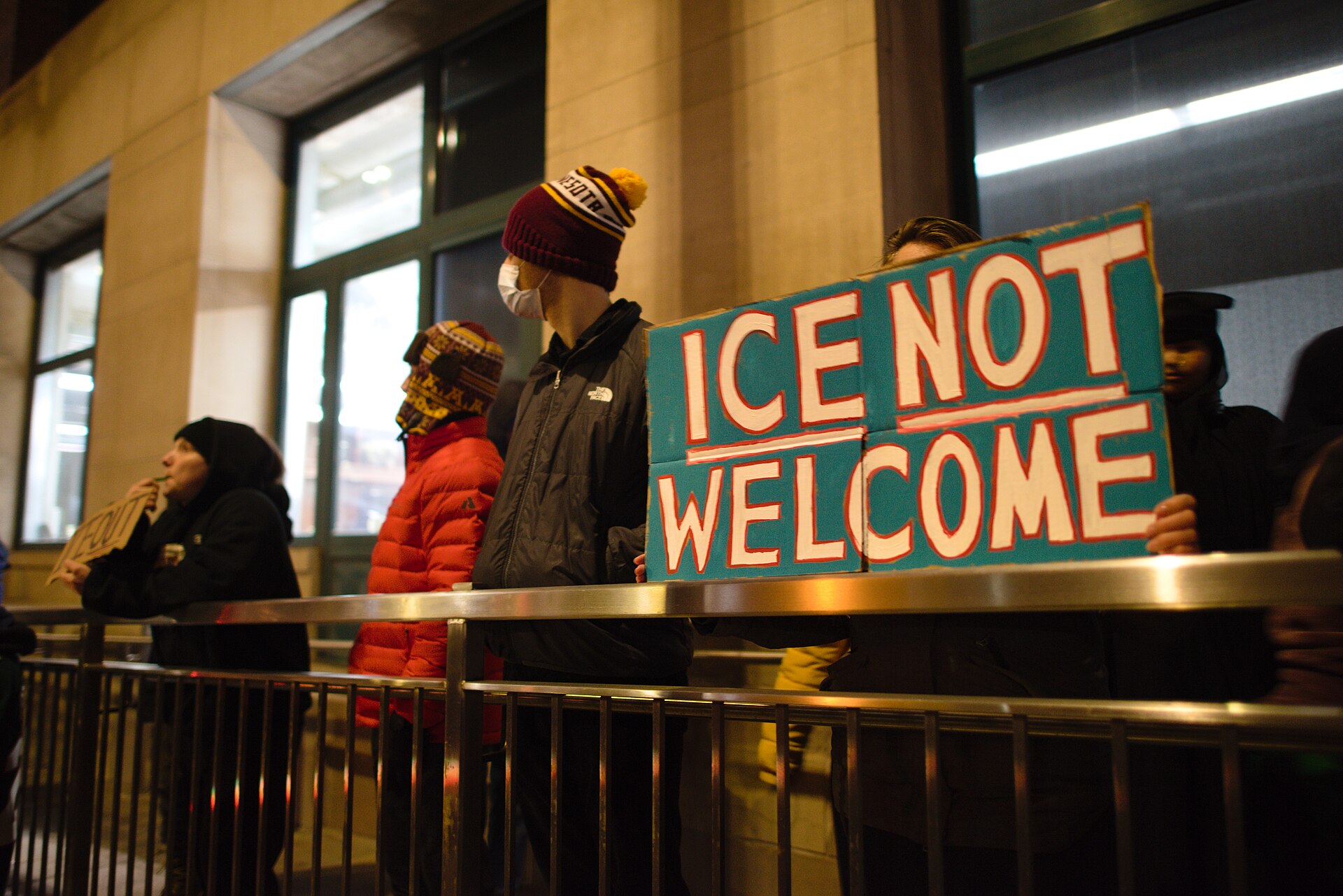
This is the new reality of the immigration courts. They are traps for those who arrive papers in hand for their court appointed hearings, faces tight with fear, often with young children in tow. If they fail to show up, the judges will issue immediate removal orders. But showing up is a game of Russian Roulette. ICE regularly detains people in these very hallways, often violently separating children from their parents. It doesn’t matter if the judge has granted a continuance, or if there is no history of arrest—according to official records, more than 70% of those held by ICE nationwide have no criminal record. People leave the courts jubilant that a judge has granted them more time to make their cases, only to be taken by ICE in the hallway.
On any given weekday, the waiting rooms begin to fill at 8AM. People from Ecuador, Venezuela, Senegal, Haiti, Dominican Republic, Guatemala take their seats and wait to be called. They are parents with young children and teenagers, couples, single men, single women. They live in the Bronx, Corona, Yonkers. They carry backpacks, file folders, baby blankets, and toys. Most do not have lawyers. Their faces register anything from mild anxiety to dread, and in some cases outright panic. The fear in these halls is like a stench, like smoke from a fire that everyone is breathing.
Only the children seem unaware of the danger. Dressed in their Sunday best—girls in dresses and pigtails with bows, boys in crisp pants and button-down shirts—they run and play in the halls, oblivious. The parents admonish their children to stay close, to be quiet.
I check the accompaniment group’s Signal chat, which we use to monitor ICE’s whereabouts. It stays active with updates. None on 20. Heavy ICE presence on 14. A murder of ICE agents on 22. We never know where ICE will gather, but it becomes obvious when they are about to detain someone. A couple of agents will be joined by a few more, and a few more after that, until there are eight or ten of them pacing and peering into an open courtroom door. Photographers, if they are not already on the floor, will arrive and take their places against a wall, close but not too close to the ICE agents. Since summer, there have been photographers in the courts every day. They document scenes of family separation, of terror and anguish that otherwise would be impossible to fathom. As disbelief begins to register on the face of a person being surrounded by ICE agents, as the disbelief turns to panic, shutters click away and the knot of people moves down the hallway—photographers, advocates and lawyers, ICE agents, friends and family of the detained all moving in a tight scrum through the narrow space until the detainee is disappeared behind a door and is gone. The photographers turn to those left behind, the spouses and partners, sisters, husbands, the now traumatized children as they head for the elevators. Keeping abreast of ICE’s movements through the building is all we can do to try to anticipate their actions and to support those in danger. We are relieved on the days when, unaccountably, they are nowhere to be found.
Much of my time in court is spent in this waiting room: witnessing, talking with people, trying to help where I can. I speak with a lawyer who sits with a stack of files on her lap, looking distraught and exhausted. She knows that her clients, a couple from Ecuador with three young children, are not going to show up for the hearing they are already late for and now they will be getting deportation orders. More and more of her clients are no-shows these days, she says, no matter how hard she begs them not to give up on the process.
A mother from Honduras eyes the agents with fear as her kids play a game on her phone. A young couple arrives; the mother pushes a baby in a carriage, the father carries a toddler. They make their way between two lines of ICE agents, single file, eyes straight ahead, pigtails bobbing over the father’s shoulder. There is no way to know which families will remain intact at the end of the day.
A man from Ecuador sitting nearby looks nervous. When I ask if he is afraid, he says God will protect him. A young man from Peru leaving his hearing asks if I can walk him out of the building. We don’t see any ICE agents, but he is so scared that he asks if I can escort him all the way to the subway. He is 23 years old, the same age as my son.
On the day of Dani’s hearing, she and I sit in the crowded courtroom and wait for her name to be called. She asks if I think it’s OK if she goes to the bathroom. I say yes if she goes quickly. I worry about her being in the hallway alone, but I feel I should stay behind in case the judge calls her.
Dani leaves her purse with me on the bench and steps out. I peek out into the hallway where ICE agents are amassing in front of a different courtroom, wondering whether they have a target in mind or are there for sheer intimidation. Some wear tactical vests, mirrored sunglasses and baseball caps in addition to the masks. They look like soldiers going into combat in the Zombie apocalypse. Others wear casual street clothing and pull their gaiters up around their noses, leaving their eyes visible. Not only do the agents not identify themselves, they hide their faces and oftentimes their badges as well.
There is no way to know which families will remain intact at the end of the day.
ICE says masks are used to protect the agents from doxing, to protect their families, the irony of which cannot be lost on anyone. But besides creating an accountability void, what does the masking do? There is a kind of performativity to it, a thuggishness meant to threaten and bully—and it works. I try to imagine them at home, those linebacker-sized arms tucking a child into bed. Whenever I look directly into the eyes of an ICE agent, I am hoping to glean something of humanity, of reason. But I don’t see anything that can illuminate the cleaving they must do in order to do their jobs.
As usual, “Icicle” is the only agent on the floor who’s not wearing a mask. This somehow makes her the scariest one of them all. That “Icicle” doesn’t feel she has to hide her face tells us that she dares us to challenge her. That she stands by what she is doing.
The Ku Klux Klan wore masks to shield the identity of their members who were bankers, lawyers, and leaders of their communities. But it was no accident that their elaborate costumes—conical hats, white robes—became instruments of terror all on their own. On the other hand, perpetrators of state-sponsored terror campaigns such as in Nazi Germany and Argentina’s “Dirty War” didn’t hide their identities at all, presumably because they didn’t think they would ever be held accountable. They were following the orders of the state, just as ICE officers say they are doing now. Do the laws of the state override personal accountability? At this moment in the United States, we are living inside this question. International human rights law rejects the doctrine of “due obedience,” so what kind of reckoning awaits those who enable DHS and ICE? If they believe they are only following orders, then why the masks?
It is because of the activities of the KKK that eighteen states have anti-mask laws, though they have been challenged in the courts on First Amendment grounds. In New York State, a mask ban was recently defeated by the ACLU which argued that it stifled dissent. Both sides of the political divide have fought for the right to wear masks and also for mask bans. Since COVID and the attempts to suppress pro-Palestine protests, the issue of masks has only become more fraught, a political yo-yo to say the least. But in the halls of immigration court and elsewhere, masks allow ICE to engage in cruel abductions and family separations without due process and with no accountability. As an inevitable and predictable fallout, ICE impersonators are now preying on women in immigrant communities, and according to a recent FBI bulletin, kidnapping and sexually assaulting them.
Dani comes back from the bathroom, and soon after, the judge calls her. She smiles at me nervously, goes through the little swinging gate and takes her seat in front of the judge.
One day, I help a woman from Honduras fill out the emergency contact form before her hearing. Her name is Noemi, and she has two boys with her, Jeremy and Justin, in third and fifth grade. They are dressed in shirts and ties, and they interpret for me when my Spanish fails. Inside the small and airless courtroom for Noemi’s hearing, the judge is weary but not unkind. He drones on about “advisals,” then one by one attends to the cases, first in Kréyol and then in Spanish, with interpreters appearing on a screen. In every case, he states the government’s assertion that the respondent is in the country illegally. In every case, he sets the next hearing for August 2026.
These courtrooms scenes can feel like another universe, one completely detached from what is happening in the hallways. One gets the sense that the courts are operating the way they are supposed to, with judges fairly deciding whether a case has merit and giving the respondents time to get a lawyer and to gather evidence for their cases. At least, that’s how it feels for now. Many judges considered favorable to asylum claims are being fired, and ones with DHS prosecution backgrounds are replacing them.
When it is Noemi’s turn, she and her boys sit at the table in front of the judge. Her back is to the room and to the doorway, where I see ICE agents beginning to arrive and gather, “Icicle” among them. I am sitting next to the NYC Comptroller, Brad Lander, who is often here, and we share a concerned look. Whenever ICE agents converge in various states of agitation, it becomes nerve racking and necessary to try to determine who their target might be. I stare at Noemi’s back. The judge asks if she would like to terminate her case. She must decide right away. To terminate or dismiss a case should mean that the government no longer seeks to deport the respondent, but ICE has been asking judges to dismiss cases precisely so that respondents no longer have an active case before the court and are therefore technically subject to expedited removal—which means that ICE can snatch them as soon as they leave the courtroom.
ICE says masks are used to protect the agents from doxing, to protect their families, the irony of which cannot be lost on anyone.
The judge repeats that Noemi must decide right now, and I don’t know if it is good news or a trick or how much she understands. Noemi responds, “Si,” deciding to terminate her case. Her hearing is quickly adjourned, and I meet her at the door. My heart is pounding. We walk out into the hallway right past the ICE agents. I ride the elevator down with Noemi and her boys. In the lobby, she smiles and we say goodbye as her boys skip ahead of her towards the revolving doors.
I go back upstairs and a little later, I sit with two sisters from Venezuela, Nelsy and Astrid, and Nelsy’s son who is about seven or eight. They have had their hearings and are waiting for their brother, Luís, to leave the same courtroom where his hearing is now occurring.
ICE agents begin to gather and hover. They seem a little more agitated than usual. They adjust their gaiters, peer inside the courtroom and back out again. We learn that this judge is new, another reason for concern. The sisters are scared. I am taking down their emergency contact information in a hurry when Nelsy whispers something to me. “No entiendo,” I say, and she repeats it, slower and a little louder but not much. “I have my next hearing in August of 2026,” she says. “Will ICE be here then?”
“Desculpe,” I say, and the word doesn’t do nearly enough to convey how sorry I am that she has to ask me this. I tell her we never know when they will be here. The little boy gets up and runs in the direction of the ICE agents; Nelsy calls him back.
Our accompaniment group quickly arranges to surround Luís when he comes out of the courtroom. Sometimes this helps, although most of the time it doesn’t do anything and the person is detained anyway. Nevertheless, it is all we can do. He comes out. He is young and looks very tired and worried. He says he has to go down to the 15th floor to attend to some paperwork, so we post people around him and walk toward the elevators. The ICE agents do not approach, which is some kind of miracle except that we know someone else will be taken. On the 15th floor, Luís looks dazed. He puts his head on the wall and closes his eyes.
We go back up to the courtroom where ICE is still hovering by the door. The press is there now, a small bank of photographers. All this activity tells us a detainment is imminent. ICE agents keep looking inside the courtroom where there are only two respondents left. We hear from another court observer that one of them has been here less than two years, which means he is the likely target, as the current rules state that unless a person can prove they have been in the country for at least two years, they are subject to expedited removal. Our group meets the man at the door. He is with his wife, an American citizen. They give their information to one of the observers, and then we make a circle around them and make our way through the small waiting room where the ICE agents are. They swoop in and push the man against the wall. The cameras are click-clicking. The man looks surprised. He makes no sound. It is the wife who yells, “Why are you taking him? This is stupid! This is so stupid!” As our observers go to her, hold her hand, speak quietly to her, she breaks down. The agents hustle the man, who has not uttered a sound, down an ill-lit hallway. It is only when he is out of sight that we can hear shouting and scuffling from around the dark corner. The wife sobs. A priest walks with her to the elevator. I go with them. She keeps saying, “I knew it! I knew it!”
We ride down the elevator together, the priest’s hand on her shoulder. They are headed to Representative Dan Goldman’s office for help with tracking her husband through ICE’s system. There is no way to comfort her as she cries. I say goodbye, tell her I’m sorry and that I hope her husband is freed very soon. Then I take the subway home, unable to shake the image of the woman crying, of her husband’s stunned silence as he was hustled down the hallway. I am afraid for her and for him, afraid that one day I will have grown accustomed to walking the gauntlet of ICE agents.
The judge verifies Dani’s basic information, and, as she looks over Dani’s filings, something in her tone changes. She appears to be choosing her words carefully to protect Dani’s privacy. That the judge seems sympathetic bodes well for Dani going forward because this is the same judge who will eventually decide her case. She sets a date for Dani’s individual, and final, hearing for late in 2026. Dani says, “Grácias.” She comes through the little gate, and we head out to the hallway. ICE agents lean against the wall and watch us pass.
We take the elevator down. Dani is eager to get to work. As we pass through the lobby, her steps get lighter and quicker. The revolving doors deliver us onto the sidewalk where there is a rush of fresh air, people hustling past on their way to do normal everyday things, a blue sky. We have spent four hours on high alert in the stifling, airless rooms of 26 Federal Plaza, rooms steeped in fear. Out here, the weather is blustery and brisk. Dani smiles. She hugs me and says, “Grácias por todo.” I want to say something more than “De nada,” but she turns quickly, heads for the subway, and is gone.