A train is a perfect setting for a story, with its confined space, its forward momentum, its promise of change and adventure. Whether thundering along the Californian coast, spending days staring out at Russian forests and tundra, or blinking as the Japanese countryside whips past too quickly to take in, I’ve been lucky enough to have travelled on trains through some incredible landscapes, but some of my most vivid memories of these journeys are of the people I met, and the odd intimacy that this enclosed world creates.
It is perhaps this enclosed world that has drawn so many writers to make use of trains in their novels. On a train we are at once moving but also somehow suspended in time and space. The carriages become their own community; the normal rhythms and rules of life break down.
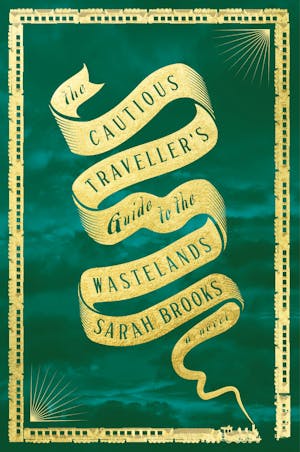
My debut novel The Cautious Traveller’s Guide to the Wastelands is set on a fantastical version of the Trans-Siberian Express, crossing a dangerous landscape that threatens the body and unsettles the mind. The powerful Trans-Siberia Company boasts that the armoured train is the only safe means of passage, but the passengers and crew begin to realise that its walls may not be as strong as the Company promises, and as the author of an infamous travel guide warns, there may be a high price to pay for undertaking the journey.
The novel was inspired partly by a memorable journey on the real Trans-Siberian Express, but also by a love of train travel that has been fed by fiction—of peril, romance, and crime on the rails. There are of course the classic train novels of Agatha Christie and others, but I’ve gone for the contemporary here. Putting together this list, I’ve chosen a mixture of genres, including crime, fantasy, historical fiction, and travel writing. But what they all have in common is a sense of adventure, and an exploration of the sometimes contradictory promises of escape and of connection that the railway offers.
Outlandish creatures and gigantic structures have always been a key element in Miéville’s novels, and Iron Council — ‘the perpetual train’ — is no exception. The story is set in the imagined world of Bas-lag, and moves back and forth through time, from the beginnings of train as it sets out to map the land and wipe out its inhabitants to make way for the rails, to the rebellion of the rail workers, and the attempts by a corrupt parliament and militia to destroy such a dangerous symbol of revolution. The ever moving, ever growing train provides great opportunities not only to explore the weird and wonderful landscapes of Bas-Lag, but also the febrile onboard world, with its renegades and ‘Remade’.
The ‘World of Wonders’ is a luxury steam train which is home to a travelling circus. Lena, the daughter of the troupe’s illusionist, uses a wheelchair after contracting polio as a child, and feels isolated from the bright, physical world of the circus. When a Jewish orphan, Alexandre, is discovered on board, Lena finally begins to find friendship — and something more — but her growing happiness is threatened by the outbreak of war. The novel paints a glorious picture of the circus train, but doesn’t shy away from the darkness closing in around it, leaving the reader to confront the changing meanings of the train in 1940s Europe. But it is at its core a hopeful story, and the rails carry its protagonists into a brighter future.
The first in the Adventures on Trains middle-grade series, this introduces train-mad Harrison Beck and his travel-writer uncle, and sends them on a journey aboard a famous steam train around the coast of Scotland. But in the tradition of classic tales of suspense, some priceless jewellery is stolen, not all the passengers are what they seem, and Harrison has to make sure the real culprit is found before they reach the end of their journey. In the novel, Harrison is a budding artist, and his sketches of the train and passengers provide lively illustrations for the story and even clues to help solve the mystery. Though it’s aimed a younger audience, this is very much a book for anyone who’s longed for a classic train adventure.
Working beside the rails as the Trans-Siberian Express thunders past, Olga Pushkin, Railway Engineer (Third Class) is knocked unconscious by a body falling from the train. The resourceful Olga, surrounded by some less than admirable men, investigates the mystery, whilst dreaming of achieving literary fame when she finally writes her magnum opus Find Your Rail Self: 100 Lessons from the Trans-Siberian Railway. Whilst much of the action here takes place off the train, the railway is central to the story and to Olga’s life, providing a powerful symbol of escape and opportunity in contrast to her stifling, inward-looking small town. There’s also an excellent hedgehog, called Dmitri.
It’s the 1960s and Louise and Henri are travelling by train across Europe. Louise has stolen a bag of money; the men Henri work for want it back. The story moves back and forth between the present moment on the train, travelling between Belgrade and Istanbul, and both characters’ pasts. It has a cinematic feel, bringing together the uneasy tension of a Hitchcock film with the woozy, romantic wordlessness of Wong Kar-wai, and upending genre expectations. The world of the 1960s train journey is beautifully evoked, but most of all the novel captures that odd feeling that travel can bring — the sense of being unmoored, estranged from your own life. It brims with fleeting, vivid encounters.
Bullet Train by Kōtarō Isaka, translated by Sam Malissa
Five assassins, a psychopathic school boy, a suitcase of money, and a very fast train. Bullet Train begins with Kimura boarding the shinkansen in Tokyo with the aim of taking revenge on the schoolboy who harmed his young son, but it soon becomes clear that Kimura is just one of a number of killers on board, including Nanao, “the unluckiest assassin in the world,” and Tangerine and Lemon (who is fond of quoting from Thomas and Friends, which he uses as a sort of self-help guide to the world). Part of the enjoyment of the novel comes with working out the connections between the killers and who they might (or might not) be working for. It also plays gleefully with its enclosed setting, and if you’ve ever wondered how you might hide a suitcase of money on a train, how to move between carriages undetected, or how not to draw attention to yourself whilst having a vicious fight at your seat, this is the novel for you.
Yes, I know — another Miéville, but it was impossible to choose between Iron Council and this, a novel aimed at younger readers, and perhaps the most “Train” any book could possibly be. The surface of this world is covered by rails, with the earth beneath them home to dangerous creatures. Sham ap Soorap finds work on the Medes, a mole-hunter train whose captain is obsessed with hunting a legendary great white mole, whilst on another train, two young salvagers are being pursued both by pirates and by a corrupt navy. There is great fun to be had here with the world and language of the trains, and even the novel’s use of the ampersand in place of ‘and’ turns out to have a link to the nature of the rails. The ending might either delight or infuriate you, but there’s no doubting that Miéville is entirely committed to his concept, and the adventure rattles along with a mad, rail-obsessed, energy.
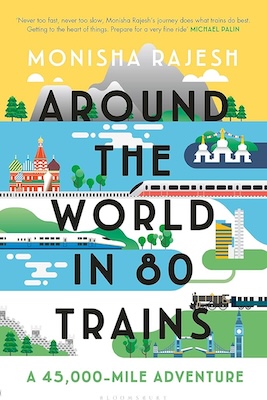
And finally, after all the mayhem and murder, I want to finish this list with a non-fiction account of an epic globe-spanning journey. Monisha Rajesh takes her backpack and her fiancé Jem and sets off from London on a journey that will stretch for seven months and 45,000 miles, through Europe, Asia, North America and back again. The eighty trains they travel on vary wildly in comfort and indeed safety, but they also offer a kaleidoscope of very human encounters, and a thoughtful and personal commentary on a contemporary world of vastly different lives and experiences. The book doesn’t look away from the challenges and dangers of the journey, but it also made this armchair traveller yearn for the sound of the rails again.
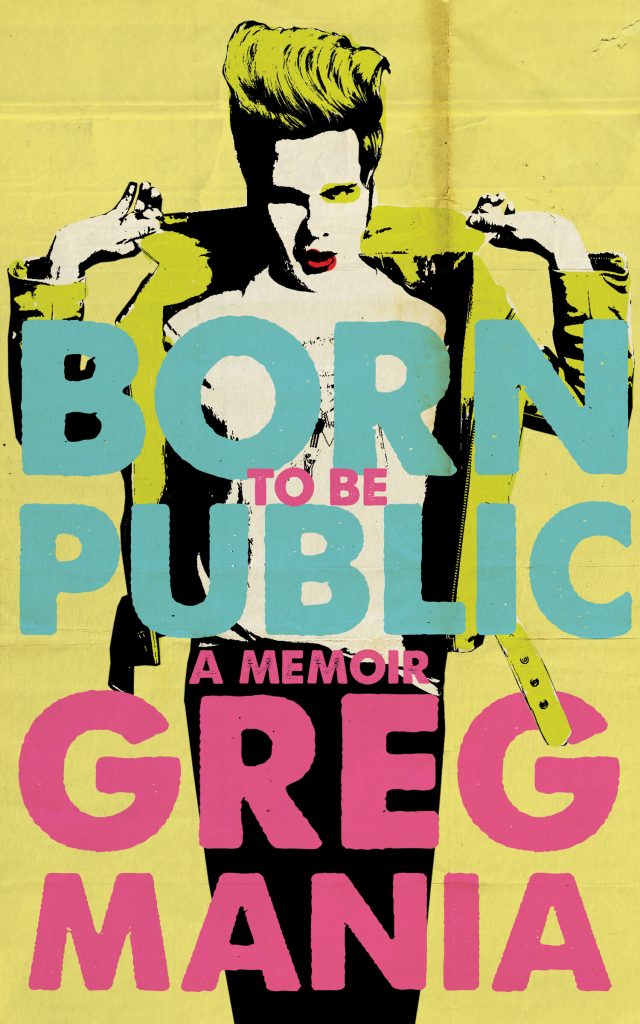
I found Greg Mania through the magic of the algorithm somewhere deep in quarantine, and the feeling I had was that I was late to the party. You could say I was right given their long list of bylines, but you could also say he curated that feeling via brilliant and relentless marketing tactics. Born to Be Public, released by Clash Books in 2020, is his hilarious tale of the heart-wrenching hours that befall a theatrical and closeted kid before he discovers the full scale magic that awaits him on the other side of the bridges and tunnels.
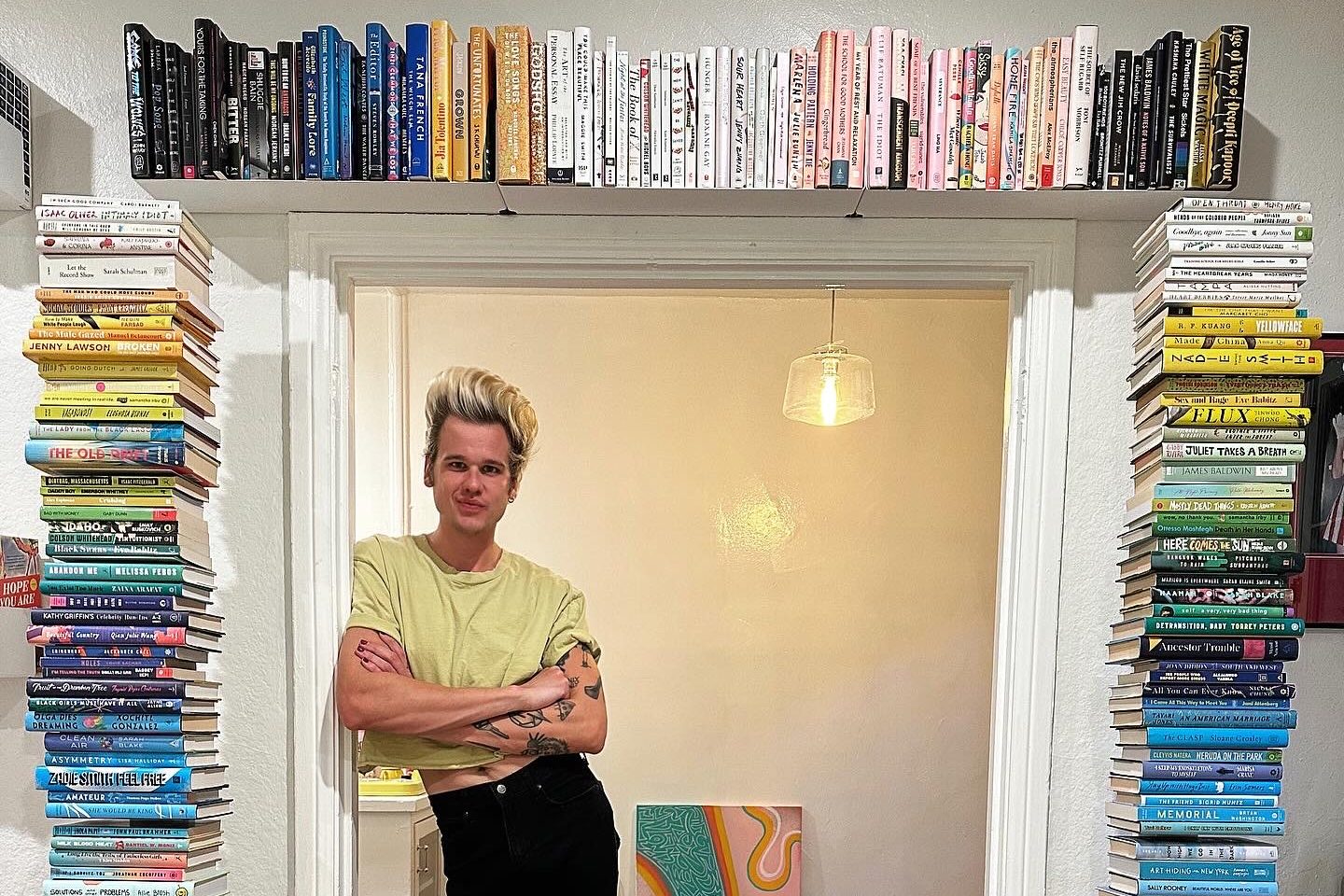
I first met Mania at Nonfiction for No Reason, the literary event series I started in March 2023. Afraid to say hello to this sleeper legend, I finally passed them on the way out, exclaiming, “I love your coffee table!,” an iridescent plastic wonder I’d seen in the tour of his NYC space in Apartment Therapy. “Oh, thank you so much!,” he said, reaching to touch my shoulder, and the warmth was a gorgeous surprise.
Less than a year later, they’d moved to Los Angeles, where I grew up, and I asked him to join the LA edition of Nonfiction for No Reason, which would be at my last family home before I left the city. His piece about searching for home anywhere he could find it had me crying in my old living room. This was the beginning of a dear friendship, and my fascination with Mania’s skillful dance between persona and person, critically acclaimed writer and jokester and extremely sincere human. In a moment of writerly existential crisis, I asked him to chat about how he made all of his beautiful selves. That conversation became this interview over Zoom.
Katie Lee Ellison: While reading your book, I kept wondering: How is it that these incredible opportunities and circumstances keep happening to him? The impression I got was that you wanted it all and you just kept chasing your dreams, a cliche, but seems true in your case. I wonder how much you had that in mind while you were deep in those pursuits, and if you were dogged about your desires as a writer and comedian.
Greg Mania: Born to Be Public is about growing up closeted in Central Jersey, then coming of age as a young adult on the Lower East Side. By the late 2000s, I was hungry to carve a space for myself. I’ve always been very flamboyant and theatrical. Still, I couldn’t find my groove on stage even though I loved performing. In 2009 on the Lower East Side, artists, singers, songwriters, dancers, all these different performers around me were bona fide stars, even if no one above 14th Street had heard of them. I found an artist, Lady Starlight, on MySpace who did this kind of hybrid rock and roll, heavy metal burlesque performance art. Watching her, I thought, maybe I don’t have to just do musicals like Annie. I can still perform in another capacity. Maybe I can figure out how to incorporate more of myself. All I wanted was to find out who I was. What was this insatiable hunger that I felt and how could I bring it to the surface?
Then, I came across this young woman running in the same circles as me by the name of Lady Gaga. I heard some of her music, and thought, “Oh, she’s gonna be a big star.” I was sort of taken under the wings of these performers in a very similar way to Gaga. From them, I learned how to create an image, and how to burn that image into people’s brains, especially when you’re constantly told, “No, you can’t do that, you can’t do this.” They instilled this rebellious spirit in me, so by the time I realized I wanted to become a writer, I had that attitude and realized that people would gravitate towards it. So I got my education as an NYC downtown personality. Starting with my last name, which is Mania (Mahn-ya), but my friends didn’t know it was my real last name and called me Mania (Main-ia). So that’s who I was to them. It’s one way I explored the art of persona and started to test where the overlap was between Gregory, who grew up in Jersey, and Greg Mania, an active participant in the NYC nightlife community. There’s this person that I can embody, who puts their insecurities aside, all the years of bullying aside, and can feel like a superstar, even though no one knows who I am. It’s a healthy dose of delusion. The way you walk, the way you talk, eventually people start to pay attention. And that’s what I learned from my friends in New York.
My goal was to be published in The New Yorker, in “Shouts and Murmurs,” to have a humor piece there, and that’s the only thing I saw. I had my horse blinders on. I was reading those pieces every day, then reaching out to the writers whose voices are similar to my own to get their advice. They didn’t know me; I didn’t know them. I was just emailing them, but more times than not I would get really lovely responses, and I actually became lifelong friends with two of those writers. Within a few years, my stubbornness paid off, and I got my first piece published in The New Yorker.
It’s a mixture of stubbornness, delusion, and the third ingredient is something different. For so many years, I was very hungry, and in my twenties selling my book was the only thing I cared about. As I get older, creating art to share with my friends and community is the impetus for me now.
KLE: What you said about insatiable hunger and the ways that it’s changed: I’m curious if you can talk more about how and why it shifted?
GM: The texture of that hunger and how I apply it specifically has changed. I realized I wanted my voice, my words on the page to be an extension of me, and vice versa, so when you read my work, you hear Greg Mania with the tall hair and you can pinpoint my voice. It was almost a narcissistic drive, but now I feel a responsibility to my community, the literary community, the media community, to drive us forward, especially as our landscape is in perpetual upheaval.
We have to move as a unit, and let that disrupt the powers that be.
It’s more important than ever to galvanize everyone and use the appetite that I have. I feel like I’m 19 again, or 22 being told, “No, you can’t do this. No, the market’s not good right now. No, this is too hard of a sell. Essays are a crowded category.” Or this. Or that. I don’t care about any of it. I know that my appetite needs to be fed by art and sharing my words and hearing my friends’ words, like we did at your reading. It was a moment to get together and listen, to be together. We have to move as a unit, and let that disrupt the powers that be. Let’s grow from the cracks, so we can flourish and let our roots eventually uplift the concrete that has tried to suppress us for so long.
When I say that appetite is still with me, it still very much is. If I have a goal in sight, I can’t stop thinking about it.
The trick is that I don’t have that clear picture of where my work is going to go, whom it is going to reach, after it leaves my hands. The only clear image I have is what I want to say, what story I want to tell. I’ve always had that. But I also feel like it’s too big to consider what impact I’m going to have, or whom I’m gonna reach: it’s assuming too much. I think that goes beyond the power of the writer. Once you let your work out into the world, whether it’s a zine or The New York Times, it’s not fully yours anymore.
I think what’s important, for me, is letting all these different facets of my identity shift and change, come and go, without any self-imposed sway. What I mean is, I don’t want to hide from the parts of myself that I know are there, the things that make me complex, maybe even contradict another part of me. I don’t want to bury these things anymore; I want to feel them, no matter how uncomfortable they make me. I refuse to hate myself. I’ve spent so many years hating myself, going down self-destructive paths left and right. If not to love, I’ve learned to accept those complicated, sometimes dark, parts of me. If I make them visible, others who may have been or currently are in similar relationships with themselves may see something reflected back at them. Sometimes feeling seen and understood is more powerful than any sentence crafted with surgical precision.
I think for folks who are asking, Who’s my work for? I would say looking inward is the only way you can find out who the right audience is. Ask yourself, What do I want to do? What satiates me creatively? What gets me excited? If you’re excited, someone else is going to be, too. That’s the best lesson I’ve ever learned. I thought, “Who the fuck am I to write a memoir? I’m not a celebrity, no one knows about me.” But if you care about your story, someone else will care about it, too. It can be 10 people. It can be 1,000. As long as you are writing from a place of unbridled selfhood and something that you’re passionate about, then you will create a space for yourself. You have to listen to what you wanna do. Let the work pull you.
I think we are always trying to be in the driver’s seat—in control, right?—and something that I’ve learned in the last few years is to let yourself be in the passenger seat for once. Let your gut and ideas steer, and see where they take you.
KLE: What you read at my old house was so lovely and perfect for the event because it was about searching for a home within yourself and the people you love. This feels very central to who you are as a writer and as a person, this search to find your people.
GM: We’re not supposed to ever arrive at a destination of self. We’re always meant to be growing. Just when we think we have ourselves figured out—I think I’m plagiarizing myself—we go and change again. We’re not supposed to ever stop and say, “This is who I am,” because in five years we’ll probably be different. It’s a good thing. I used to be like, Oh, my God, if I wrote Born to Be Public now, it’d be a completely different book. Of course it would be! In many ways, I’m a completely different person. I’m writing a completely different book now. I stopped thinking about all the ways I would rewrite my first book because the author who wrote it, wrote the book he wanted to, that he needed, at that particular time in his life. If you look back on your work and sort of cringe, that means you’re growing. If you don’t look back and want to rewrite, that’s not so great because there’s no trajectory. The destination is perpetual change, an endless search.
KLE: What is your relationship with fantasy and persona? How much does that get you through day to day, how much does it get you through writing projects?
We’re not supposed to ever arrive at a destination of self. We’re always meant to be growing.
GM: I’ve started drafting an essay, and I think it’s called “Reborn to Be Public,” or “Born to Be Private,” something like that. The whole point of Born to Be Public was that I wrote it as both Greg Mania (Main-ia), the nightlife persona, and as Greg Mania (Mahn-ya), the student, and then, the writer. I’ve always existed in duality, because for a while I was a student by day, go-go dancer by night, and always thought I had to operate as one or the other. Never in unison. Through writing this book, that duality became totality. I’m still Greg Mania. Wild, brazen, over-the-top. But I’m also Gregory. A son. A brother. Your friend.
In terms of fantasy and persona, I feel like I’m coming back to my roots. I’m being more honest with myself and becoming more confident. Greg Mania used to be a way for me to contend with self-doubt. Humor is still how I metabolize everything in my life. But I’m really grappling with the concept of home, how to find it. What is home in terms of people and community and places? I think I was very jaded before, and I don’t want to stay that way. I want to be a light. Yes, I can joke about depression, but ultimately I don’t want to run from this tender person that I have recently discovered. Yes, I have that grit and my leather jacket, but I’m also a very soft person, which I used to think of as a weakness. But now, I realize, it’s what makes me powerful. That unvarnished honesty is more freeing than having that sort of fuck-you and fuck-everything attitude that I used as an armor for so long.
I know that I can bring so much love and softness to the people that I care about. Being tender is punk. So I’m growing up and bringing the parts that have formed the foundation of me. I’m renovating a new home over that old foundation.
KLE: I’ve been really curious about how you bridge gaps between a kind of polarity I’ve noticed in the art world as a whole. There’s what I’ll call the critical literary realm, in which Art is G-d and the canon comes before all else, and the communal literary realm, in which work is done to hold up other writers and other people. I see you uniquely positioning yourself in both camps, able to play to a room of high level critique and really belong within a collective. I’m curious if you even believe this dichotomy exists and if so, if you’re intentionally bridging that gap and playing to both sides.
GM: That’s a really fucking great question. I think, on the whole, it’s a spectrum. I do believe there are polarities, but there may be another sort of anchor or nucleus that is your intention, your motivation as an artist.
I have played both camps. In New York, I knew what it-parties to go to; I knew where the photographers were; I’d go intentionally to be photographed and seen because I wanted people to memorize the tall hair, the tall guy, the blonde. That was a way for me to get those performance kicks I was looking for. I wouldn’t even go to the campus deli without a look, and it was fun and fabulous and theater and camp, but I wasn’t always comfortable. It was fun as a 20-something straight from New Jersey who just wanted to be noticed, but it was finite. Sometimes I wanted to just be, and I couldn’t. Ultimately, it didn’t feed me. I wasn’t nourished by it. Now, it’s about visibility, but it’s been lifted from the self to the collective, and that makes me a stronger writer, a better person, a better friend, a better lover. It feeds into every part of my life. Whether it’s sexy or not, that’s in the eye of the beholder to tell us, but I think when you’re going home from some literary salon with a coterie of names upon names and there’s photography and cocktails, versus going to a reading at a bar where your homies are at and you can catch up eating curly fries and talk through your writing woes, you’re gonna be more sated than the other event.
When it comes to bridging those two for me, I am someone that’s very precious with their senses and I’m not going to put anything out that is half-cooked. Some people may think it’s half-cooked, but for me it’s important that I’m sure it’s ready to be taken out of the oven. And some people like their cookies a little extra crispy, some people like it gooey, I like them a little bit in between. So it might not be everyone’s cookie, and that’s out of my control.
I think we have artists for whom everything is for the art, everything needs to be pristine and needs to have a veneer. I don’t think it’s possible to avoid that as a writer. We can be our most unvarnished selves, but the art is still going to impart a message, and that message is always going to have a discrepancy with the true self. To bring it back to persona, you are always dispatching a version of yourself to your readers that you have carefully crafted, regardless of genre, setting up a stage that is based on fact, but your props, your set, your characters are meant to be entertaining. Whether or not you are in it for the prestige, the awards or if I just really want to make my peers laugh. If you are writing no matter what you’re going to care about the quality of it, because you want to do your best job. But once it goes out into the world, I think that is when you fall into those categories. So I think it’s an exchange of how your work is received, and that transmits back to you and can force you to pivot or change direction.
KLE: What’s beautiful to see is that you’re able to put fear and discomfort aside for the sake of this big, growing life.
Being tender is punk.
GM: Fear has dictated my entire life since I was a kid struggling with really intense obsessive-compulsive disorder. My irrational fears of tornadoes and death had me by the throat for so long that I was scared to leave home to go to school. I went to college still apprehensive to be away from home, even though I was only one state away. All this fear, I just got sick of it. This is therapy-speak and so corny, but a self-help book, Feel the Fear and Do it Anyway, really changed the way I thought about fear. I thought, “You know what? I’m just gonna feel it. Yes, I’m scared. I’m uncomfortable. But I’m gonna do this thing that makes me uncomfortable. I’m gonna say this thing that might make me uncomfortable anyway, because I don’t want to live under this looming shadow.” Even two years ago, if you told me I would move across the country from all that I’ve known, I would have thought you were talking about someone else. I was scared. This is the farthest I’ve ever been from my family, but I had to do it. If I didn’t, I would have regretted it for the rest of my life, and I can’t take that chance. Even if I flop out here, then I’ve tried. These feelings of discomfort and fear are so uncomfortable. But those feelings are amplified by a hundred if you try to bury them. Instead of casting them aside, I am learning to coexist with them and finding a sustainable way of operating alongside them.
As for balancing the critical and business aspects of being a writer with community-driven ambitions, I lead by leaning on the relationships I’ve fostered, and vice versa. We share resources, opportunities, contacts, jobs and gigs we think another might be a good fit for, and more. More important than that, writing is a very solitary job, and we spend most of it in our own heads, which can get dicey up in there! We lift each other up, which is the only way we can navigate this tough business without completely losing it.
KLE: Can you describe your genius Blitzkrieg marketing campaign for your book? It’s such a wonder and an incredible model to follow because who gets press can be so deeply biased: who gets access to bigger platforms.
GM: The marketing campaign for Born to Be Public operated on complete and utter delusion. My publisher, CLASH Books, was a much-smaller press at the time. There wasn’t an in-house publicist. No marketing budget. We had to do most of it ourselves. I had saved up enough to hire an independent publicist, who was wonderful. But the M.O. was the same from the get-go: We were going to act like this was a lead, Big 5 title. I had already established relationships with a number of editors, authors, and other folks in the media world by virtue of my freelance work. That one editor who passed on a piece a few years ago, but who encouraged me to send along future work? They ran an excerpt in The New Yorker. That person with whom my friend connected me at that one mixer a few years ago? They put my book in a highly anticipated list. I went to school with the assistant books editor at this huge magazine, and sent her a galley. Boom, we’re in Oprah Daily. Shoot for the fucking moon. The worst thing that can happen is you get a no, or no response at all. You might as well go big; you don’t have anything to lose.
Also, platform doesn’t necessarily equate to book sales. We need to dispel this notion entirely. Remember when White House staffers were getting fired left and right during the previous administration, and there was one publisher in particular making it rain book deals on them? Girl, these folks got six-figure book deals for a book that no one asked for or cared about. And if they did hit The New York Times bestseller list it’s because—and I need to be careful here—it was because they allegedly bought the thousands of copies they needed to make the list, allegedly through one of their LLCs or some fakakta foundation they run, but then their book just disappeared into the void. Now, I’m not going to name names like Meghan McCain, but c’mon. Millions of dollars spent on a book that no one gives a fuck about when there are so many emerging voices; that’s millions of dollars that could be going to writers with unique points of view, stories that are destined to be told.
I understand that publishing is a business. And yes, there are bestselling books at imprints that single-handedly keep the lights on. But both of these things can be true at the same time. The media landscape is in complete disarray—layoffs, mergers, dissolutions. It’s scary, for everyone. But I also think this instability is going to foster a very necessary paradigm-shift, which I hope will be community-driven. I have faith in the work we are doing as a community. And I’m not talking about the huge commercial names you see when you walk into a Barnes & Noble. I’m talking about the writers recommended as staff picks at your local independent bookstore. Those are the people I hope spearhead that shift.
Bookstores are often literary safe havens for readers and places to build community through author readings, book signings, book clubs, or perhaps just bumping into a stranger in a niche genre section and exchanging numbers (a girl can dream!). From hybrid bookstore/coffee shops to bookstores that double as presses, we’ve curated a list of fourteen Black-owned bookstores across the United States.
Bestselling YA author Leah Johnson founded Loudmouth Books after a wave of anti-LGBTQ legislation in Indiana as a way for the community to preserve access to “lifesaving and life-affirming books.” The store carries literature by Black, LGBTQ+, and other marginalized writers, as well as books that have been banned or challenged in the U.S.
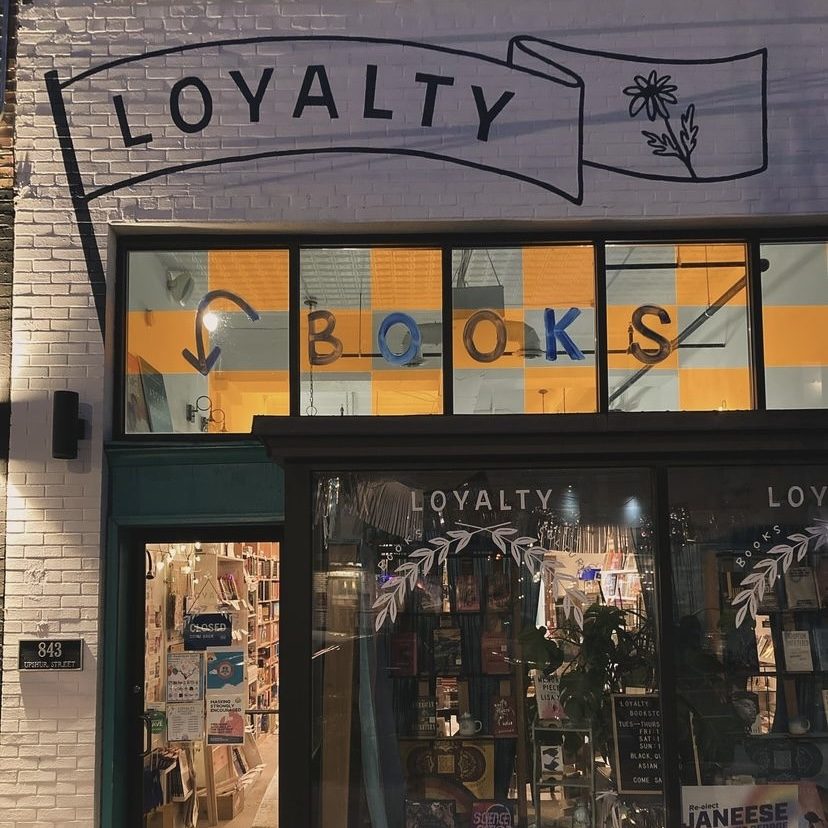
Founded by queer bookseller Hannah Oliver Depp, Loyalty Bookstore focuses on creating an inclusive environment that centers Black, POC, and queer voices in literature. In 2023, Christine Bollow, an Asian, queer, and disabled long-time employee was announced as the new co-owner. With genres categorized from Black Love to Caribbean Lit to Antiracist reads, Loyalty is active in celebrating diverse and intersectional identities in both the literature they sell and the community they build.
Located in Germantown, a historically Black neighborhood in Philadelphia, Uncle Bobbie’s is a space for “cool people. Dope books. Great coffee.” Founded by Marc Lamont Hill in 2017, they host free events such as workshops, author talks, and weekly readings for children. The warm and inviting space also doubles as a cafe with plenty of tables, chairs, and comfy couches, the perfect spot to grab a latte with a slice of sweet potato pie while you read a book.
Onikah Asamoa-Caesar’s bookstore “is a love letter to her younger self, a safe space for Black & Brown folks, an intersection and [cumulation] of her experiences as a Black woman in the United States of America.” Situated in Greenwood, a historical neighborhood in Tulsa, Fulton Street centers the narratives of people of color and marginalized communities, and their mission is to increase representation and intergenerational literacy. Their sleek industrial space has tall open ceilings, framed by a wall of windows, and a coffee bar with chairs scattered around the room. Be sure to try their cruffin and stop by for book launches, reading hours, spoken word events, and the occasional book fair.
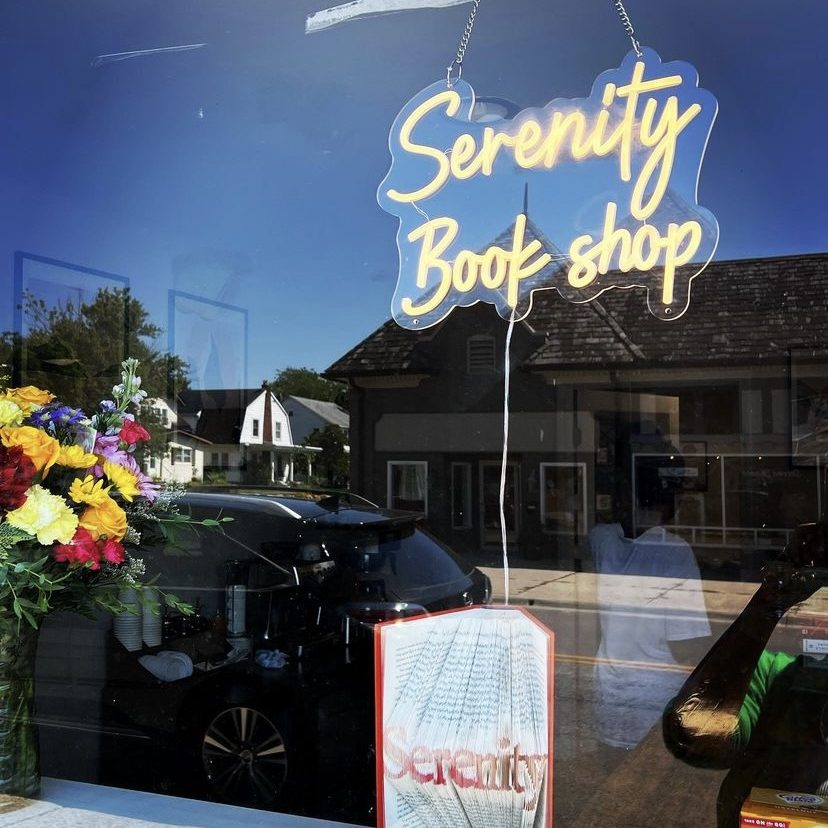
Shanna Tiggs envisioned Serenity Book Shop as a place of care, where those on any path or journey may find respite. The bookstore has a small kitchen and bar, offering food, coffee, tea, and wine, and a stage where they host live music and readings. If you’re looking for a place to read, the store has couches and chairs as well as bistro tables on the sidewalk. If you’re in the market for crystals, candles, sage, a small plant, a new mug, a journal, or, perhaps, a book, you’ll find what you need in this one-stop shop.
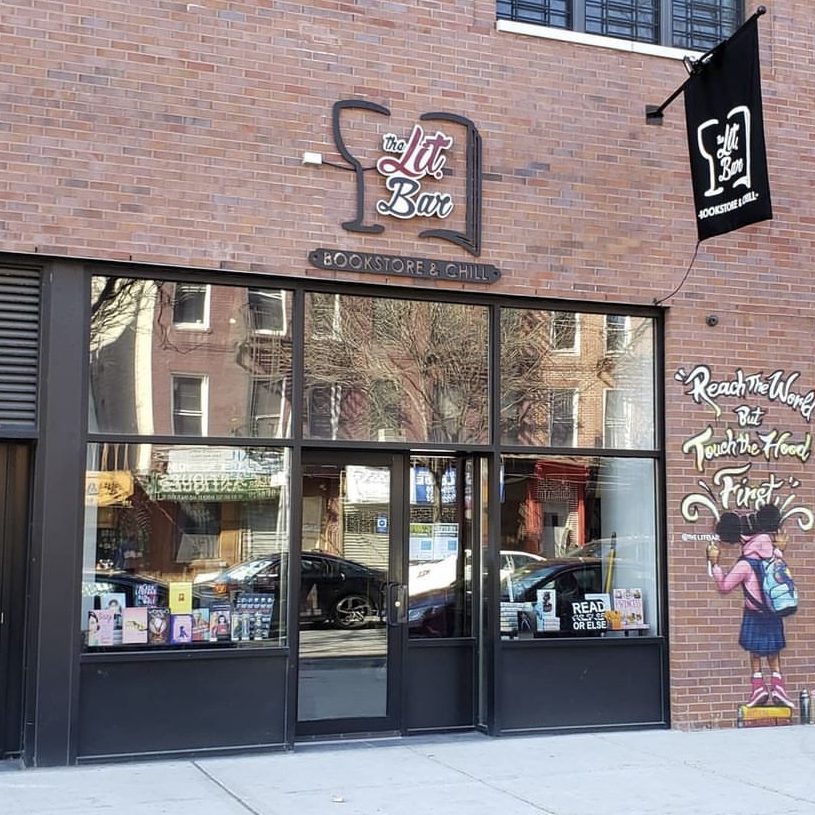
Founded by Noëlle Santos, an African American and Puerto Rican activist and Bronx native, The Lit. Bar is the only bookstore in this borough of New York City. With the bookstore tripling as a wine bar and community center, they welcome literary and community gatherings, and offer a full wine menu and bar snacks. It’s a beautiful space with crystal chandeliers, red velvet couches, and marble tables, anchored by a mural of Black girl holding a book. From categories like “Dear White People,” “Hip-Hop Is Poetry Too,” and “Bronx Tales,” stop by to support this bookstore and sip some red while you’re at it.
In this shrine to James Baldwin, you’ll find a mural of the author painted on books and coffee drinks named after his works. The bookstore cafe highlights the work of Black and Brown writers and artists and is dedicated to expanding literacy, developing economic equity, fostering intellectual growth, and using books for social justice reform and to end mass incarceration. They have a seasonal book festival, a book club where they meet and discuss the works of BIPOC authors, and a podcast studio. On top of that, you definitely won’t want to miss their celebration of James Baldwin’s 100th birthday on August 2nd.
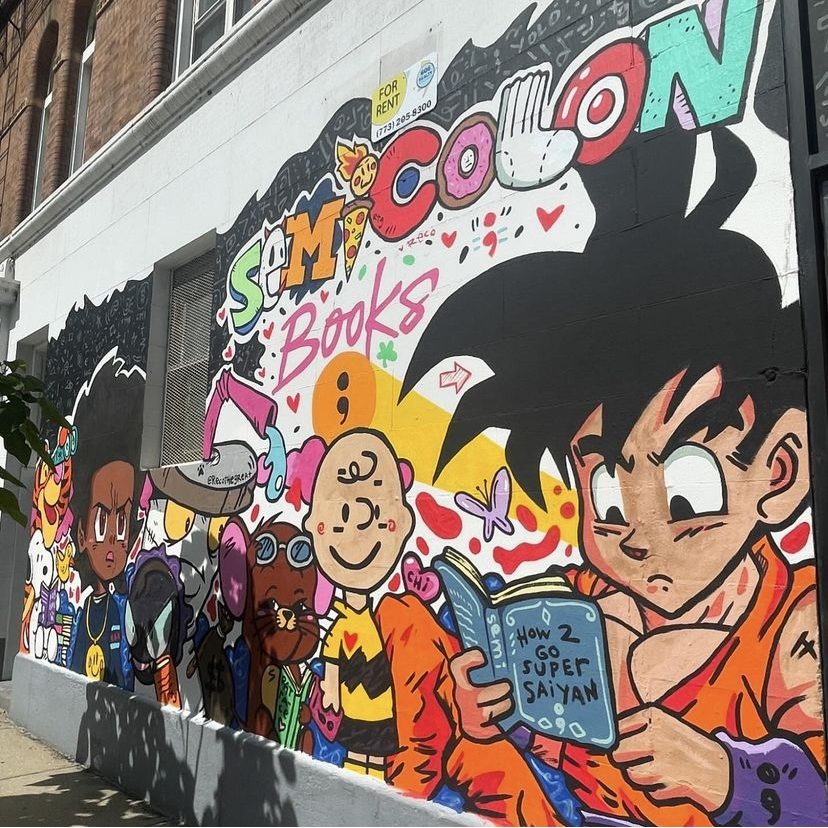
Founded by DL Mullen, Semicolon is the only bookstore in Chicago owned by a Black woman. As a bookstore/art gallery hybrid, visitors are invited to enjoy both the visual and literary arts. The space itself is an art piece, with a large mural painted by street artist, Ahmad Lee, an art gallery space that will rotate to feature local artists, and hand-picked books arranged with their covers facing out. Books are categorized by association, rather than genre, so instead of looking for “fiction” or “poetry,” you might want to try looking under “Wait, What?!? Page Turners with Just a Tinge of Weirdness” for your next read.
Good Books is an online and pop-up store, run by mother-daughter duo, Katherine and Katie. They offer vintage versions of beloved collections, such as Baldwin’s If Beale Street Could Talk or Angela Davis’ If They Come In The Morning, as well as new books by mail.
Asha Grant’s priority is highlighting literature by and about Black women—especially queer and trans Black women. Looking to add some literature to your “Black Feminist Toolkit” or learn more about “The Black Femme Body and Pleasure Politic”? Look no further. The Salt Eaters Bookshop’s got you covered.
Sistah Scifi is primarily an online store that centers literature written by Black and Indigenous women that falls into categories of magical realism, science fiction, horror, speculative fiction, and even voodoo. Created by Isis Asare, it’s the first Black-owned bookstore that focuses on science fiction and fantasy in the U.S. They also have book vending machines in Seattle and California. Check out their website for virtual and in-person events if you’re looking for community amongst other Black science fiction lovers or are interested in Afro-futurism literature (or merch!).
Nyshell Lawrence started Socialight Society to celebrate Black authors and artists, centered on the merging of her favorite ‘f‘ words: faith and feminism. This indie bookstore caters to the representation of Black women, not only in the literature they sell and promote, but in the community they build. On top of being a bookstore, Socialight Society hosts regular events, they offer various creative consultations and “pick my brain” sessions, they promote other local Black-owned businesses and organizations, host a monthly book club, and offer the store as an event space. They even have the option of booking a private after-hours shopping experience, where you can shop alone or with a group of friends, so if you’re in Lansing and are looking for a one of a kind book shopping experience, secure your spot online before stopping in for exclusive access to the store.
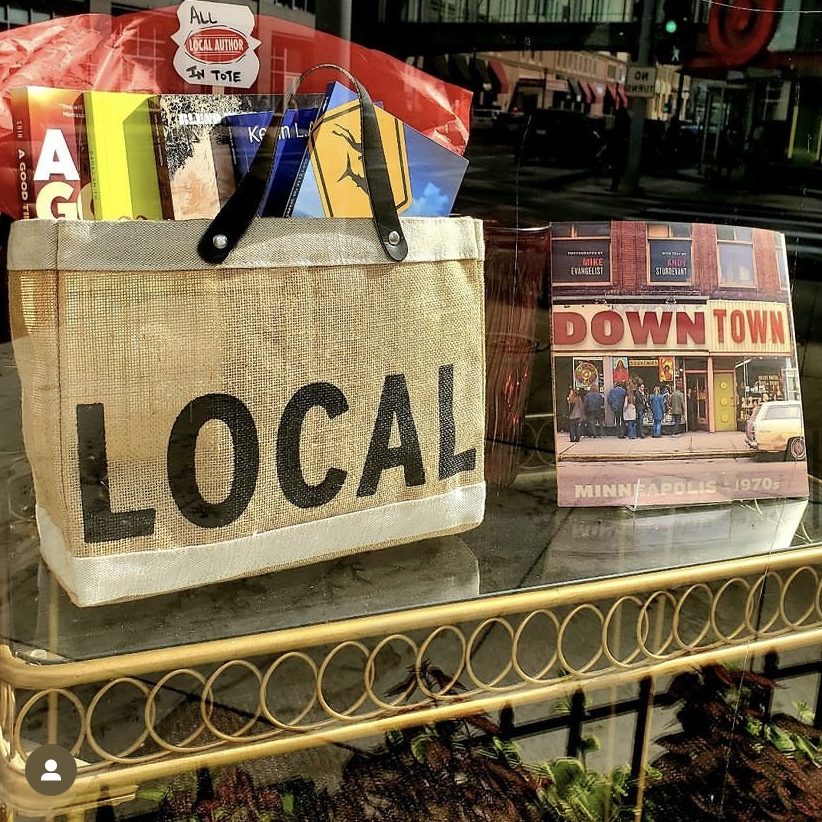
Mary Taris created Strive to center Black narratives and bring the joy of Black literature back to Minneapolis. The company doubles as a press, and “aims to inspire community collaboration through publishing stories to heal, teach, learn, and earn, while building an ecosystem that embodies a rich Black culture and heritage.” The Strive Bookstore, based in downtown Minneapolis, allows visitors to shop for books, attend workshops, and even host their own events. If you find yourself interested in collaboration, self-publishing, or just finding your next read, check out Strive Bookstore.
Loving Room: Books & Salon is an independent, queer woman-owned bookstore, reading room, and salon in Seattle, Washington. Kristina Clark opened Loving Room as a space “for our collective Black ancestral healing + transformation through Black literature + African Diasporic decolonial aesthetics.” Filled with artwork and textiles from Africa, the store includes a selection of new and used literature from Black American authors, as well as African, Caribbean, and Diaspora writers. Loving Room is community-oriented, offering events for readers of all ages, such as writing clubs, book clubs, poetry soirées, and film screenings.
The late Chuck Kinder once told me, “Fiction should be a fist.” Meaning fiction is a medium suited to emotional honesty, the place to have adult conversations. To engage with the world in all its complexities, and, often, its ugliness.
For me, this has meant writing characters who either confront oppression, assist in oppression, or make the choice to ignore and thus abet oppression. To separate their emotional lives from the political is to ignore the reality of human existence. Our world isn’t burning someone is setting the world on fire, and, whatever their flaws, the protagonists in my new collection, Weird Black Girls, are politically engaged people.
Poetry is where I’ve often turned to for confrontational writing from marginalized voices. Thanks to its brevity, poetry is, in many ways, the genre best suited for critiquing the status quo. However metaphorical the poet, they only have so much space to get their point across. The poets on this list use art as both archive and argument: an archive for those who cannot broadcast their viewpoint through textbooks and news outlets; an argument for those who cannot force their will with guns.
Seven years after publication, Danez Smith’s breakout collection remains an essential ode to queer existence, as well as polemic against white supremacy. Largely writing in response to the racist lynchings that have become a defining part of 21st century America, the poet not only confronts police murder, but commits the ultimate rebellion of celebrating their own life. Filled with poems expressing fear regarding their HIV diagnosis, Smith remains proudly queer, neither forgetting nor forgiving the system that allowed the plague to flourish. What stands out to me after all this time is the humanity in this collection. “I tried to love you,” Smith tells white people in “dear white america,” even as the inclusion of “you’re dead, america” reminds the reader that hate rules in this country. And yet, for all Smith’s rage and weariness, there remains, at the core of the book, that most forbidden love in the American conscience—the deep, joyful, unflinching love for black people.
Kohnjehr Woman by Ana-Maurine Lara
In this narrative-driven collection, a woman from the Caribbean is sold to an antebellum plantation. For the crime of poisoning her master, her tongue has been cut out. That doesn’t stop the conjure woman from wreaking havoc on the tyrants who run the place, nor from expressing her thoughts in beautiful poetry written in patois. As the other slaves come to know the woman called Shee, her thoughts meld more and more with their perspectives, painting a picture of black folks joining in community. An underrated gem about the black holocaust.
“We are time machines of water and flesh patterned for destruction, if we do not release the trauma.” Veteran poet CAConrad’s 2017 collection is a response to unspeakable pain: the murder of their boyfriend in a horrific hate crime. Grief and survival drive these poems, but never so much that Conrad forgets anger. In nonfiction sections interspersed throughout the book, Conrad documents their personal rebellions against animal imprisonment, the military-industrial complex, homophobia, and Christian extremism. Conrad is equally antagonistic towards form, shaping their poems like knives to cut anyone who’d dare harm an innocent person, or, from another lens, like bodies standing proudly upright. A ferocious work of queer rage.
“Through it all, the strawberries have never stopped growing.” A frank account of the violence visited upon Palestinian people, these poems are filled with shrapnel, F16 roar, twisted bodies, and funerals. Hand-in-hand with these visions of state terror are deftly crafted lines celebrating the land of Palestine down to the tiniest plants that dwell there. There’s even a strain of deadpan humor running through the book. A defiant statement from a talented poet.
Much of this collection is in response to President Obama’s 2009 apology to Native Americans for the genocide and oppression they experienced: an apology that Obama, rather than publicly declare, had read in private to a handful of tribal leaders. An Oglala Sioux poet, Long Soldier uses language to interrogate the role that language plays in genocide. She bluntly translates government doublespeak. (“One should read, the Dakota people starved.”) She turns the word whereas with its implication of resolution into an anaphoric indictment. She carves up official documents into erasure poems and Mad Libs and fragments; angles those documents into hills the reader must climb to stand above bureaucratic white noise, or, in other cases, descend right back into the violence. Long Soldier’s writing, filled with disdain for those who whitewash genocide, is as captivating as it is relentless.
In the forward by M.H. Halal, they pose the hard question about speaking to oppression: “How do I write this without mentioning the obvious oppressor? An oppressor who deserves no more space in our minds, in our imaginations.” To honor the experience of being Palestinian, George Abraham speaks and speaks. Of all books on this list, this one is the densest. Words cover the page like black rivers, poetry and prose, odes to everything Palestinians have lost written in a multitude of poetic forms. Abraham gives genocide no respite, speaking directly to murder and rape committed against his people. This is also a queer work. The homophobia Abraham experiences is countered with sensitivity towards the reasons toxic masculinity has spread among his family and peers. To discuss the lyricism in these ambidextrous poems would be nowhere near as effective as encouraging you to read them. This is poetry against annihilation.
The word intersectionality gets used in reference to the commonalities between different groups. Asghar writes of the intersectionality within her own identity. Much of the book addresses atrocities committed during the Partition of India. From there Asghar addresses the immigrant experience, post-9/11 islamophobia, and the anxieties of being a brown person during this surge in white nationalism. While her subject matter is heavy, her approach is playful. There is joy in the way she crafts poems as crossword puzzles, film treatments, bingo cards, and floor plans; breaking form to express the disjointedness in being othered. Speaking back to oppression is just one motif in this slim yet sprawling collection, loaded with imagery and deep empathy.
“What about civility? Respect for the people one loves? Discretion, for god’s sake?” asks Lucy Douglas “C.Z.” Guest, the enigmatic socialite and fashion icon played by Chloë Sevigny in Ryan Murphy’s latest installation of the Feud series, Capote vs. the Swans. Across from her sits the American novelist and screenwriter Truman Capote (Tom Hollander), author of several works, many of which have been heralded as literary classics like the novella Breakfast at Tiffany’sand the true crime novel In Cold Blood.
Seated at a table at La Côte Basque, an Upper West Side restaurant in Manhattan known as the go-to for the who’s who of New York’s high society, Capote attempts to repair the rift that has ruffled the feathers of his “swans”—a name affectionately bestowed by him upon a group of wealthy and elegant socialites like Barbara “Babe” Paley (Naomi Watts), Nancy “Slim” Keith (Diane Lane), Lee Radziwill (Calista Flockhart), and Guest—after an excerpt from his unpublished novel, Answered Prayers, has run in Esquire. The chapter, “La Côte Basque, 1965,” divulged the real-life secrets of these women with whom he’s formed close-knit relationships. Though fictionalized, it wasn’t hard to identify which character portrayed which swan, and what dirty laundry belonged to whom. Infidelity was exposed, accusations of murder were made, and that was enough to shun Capote—for the rest of his life—from the community he centered himself and his writing around.
When he tries to restore his friendship with his swans, starting with C.Z., he tells her, “It’s just a book.” He doesn’t seem to understand the magnitude of upset that has led to, not just his ostracism, but his ultimate professional and personal downfall—especially after one of the swans, Ann Woodward (Demi Moore), takes her life ahead of the excerpt’s publication in Esquire. She is shattered after word gets back to her that Capote has been going around telling everyone that she shot her late husband—fodder soon to be printed in text for public consumption—and death, to her, was the only viable response. When Capote maintains that his observations are merely a conduit for his storytelling, C.Z. snaps at him, “What about civility? Respect for the people one loves? Discretion, for god’s sake? Reciprocity! What about reciprocity?” (It’s worth noting and asking what kind of reciprocity, considering the stark imbalance of power that separates Capote from his elite entourage.)
This is not a unique angle when you boil it down to a writer and who is manifested in their work and how. Fictionalized or not, the perennial questions remain: Whose story is it to tell? What are the moral guidelines, if any? How far is too far? Does quality come before doing no harm? These questions will continue being asked for as long as stories will continue to be told.
I expected to hear from those I’d written about, but for the most part, I wasn’t anticipating any upset or confrontation.
When I published my memoir, Born to Be Public, in 2020, I expected to hear from those I’d written about, but for the most part, I wasn’t anticipating any upset or confrontation. Unless you’re the friend who all of your friends come to for recon on a dude they met on Bumble and are able to pull up said dude’s tax returns from the last three years along with his academic transcripts and the name of his second-grade teacher’s acupuncturist, you probably can’t identify the rude and condescending writer I crossed paths with at a networking event in one chapter or the semi-famous artist I talk shit about in another. The only person I was nervous to hear from—if I heard from him at all—was one particular ex, Roy, about whom I’d written a whole chapter, the longest in the book.
One morning, on the train to my day job in South Slope, Brooklyn, my phone buzzed in my tote. I put down the book I was reading and pulled it from my bag, feeling my heart skip a beat when I saw the number that had texted me. Even though I had broken off contact with him and deleted his number years ago, it remained locked in my memory. I opened up Roy’s text: just a screenshot, confirming his purchase of my book from my publisher’s website. I had just revealed the cover the day before, along with a link to pre-order my book. I stared at my screen, not knowing what to say, for several moments.
“Hey, that’s really sweet of you,” I typed. “I really appreciate it.” I hit send. I felt knots forming in my stomach, intensifying their grip every minute I waited for a response. My phone buzzed again: “I’m so proud of you,” he wrote back, followed by the smiling face with a tear emoji. Dots. More typing. “I can’t wait to read it,” read his latest response.
In some ways, this was a relief. I would not have to spend years after the publication of my book wondering if he had read it or not: the moment had just arrived in my literal lap. I knew I could not write, let alone publish, this book without telling my side of our story. Our relationship was the catalyst for the author that had emerged from the seemingly never-ending crescendo that was my excessively turbulent twenties. And, even though I had not initiated contact with him in years, I still deeply cared for him. Most certainly enough to give him the courtesy of a heads-up.
“So, there’s something I should tell you,” I started typing. “I wrote about us. I hope you can understand why.”
I was telling a story that few people knew, and even fewer had witnessed.
“I figured as much,” he writes back. “Why else do you think I pre-ordered it?” I let out a laugh; I knew him and his sense of humor well enough to know that this last part was a joke. Some of the tension that had taken hold of me dissolved. Yet, I knew I would remain anxious until he read it. I was telling a story that few people knew, and even fewer had witnessed, about the exceptionally volatile relationship that had almost destroyed us both. Through a series of painfully both public and private incidents, it had become unequivocally clear to me that Roy was struggling with severe mental illness, which, by virtue of being left untreated, spelled doom for us. I couldn’t not write about us without his demons, which threatened to consume us both. They were, in some ways, my demons, too. But also: it was not my place—or my job, for that matter—to diagnose him.
Anytime I write about someone, whether directly or tangentially, I make sure to give extra care to not just what I share (or don’t), but how. In my book, I wrote about how, when I described the increasingly toxic dynamic of our relationship to my therapist at the time, she said, based on what I had told her, it seemed, to her, that he might have borderline personality disorder. Syntax was especially crucial here: I did not ascribe his behavior and patterns to a mental disorder. That was neither my place, nor my skill set. However, by talking to a mental health professional, a hunch was named, without using any declarative language, which made it possible to provide the context necessary to successfully convey the complex, oftentimes painful, facets of our relationship affected by suspected mental illness.
“I made sure to protect you,” I replied. “I changed your name and didn’t share anything that wasn’t mine to share.”
“I’m not worried,” he wrote back. “I was actually hoping you would write about us. No matter what you wrote, I know you did it right.”
A few years later, we met up at a bar in Brooklyn. Roy had just moved back to New York from Denver, and had asked me if I wanted to get together and catch up over drinks. It had been eight years since we had last seen each other, and, despite how nervous it made me, I said yes; I felt ready for whatever conversations—both inevitable and unforeseen—would come from the night.
After a long, tearful embrace outside the bar, we made our way in and perched ourselves on two stools. No sooner had we ordered our first round did he pull a pen and a copy of my book from his backpack. He lovingly demanded that I sign his book.
“So, you don’t hate me?” I asked, half joking.
He laughed. He told me he could never hate me; in fact, he thanked me. “I needed to read that,” he said, after taking a swig of his gin and soda. “What hurt me most is how painful it was for you. I never would have known that unless you had written about it, and I’m glad you did. Now I know how much I actually need to apologize for, and even then, I don’t think it would be enough.”
The funny thing, though, is that him saying that was enough—perfectly, exactly enough. It would take a few more messy, tearful nights to fully go through everything that had happened between us, but eventually, we worked through it and came out as friends in the end. And not only did he read my book—twice!—he bought several copies for multiple people, even selling books to friends and strangers alike, joking that he was the villain in the book. In fact, last year at a reading I did, we slipped in a copy of my book that he signed as well—under both his real and fictional name—in a stack that was later stocked at a local bookstore in Brooklyn.
But this wasn’t the only unexpected outcome from publishing my book.
Every sentence must carry momentum towards what the writer is writing towards.
After my Born to Be Public came out, an old friend of mine from college reached out, asking me why I hadn’t written about them—us—in my book, implicitly wanting to know whether our friendship had meant anything to me. Of course, it did, and it still does. I had written about them in several earlier drafts of the book, but those sections were ultimately cut because they did little to serve the narrative trajectory of the book. I tried to explain this—how, no matter how much we may love a certain chunk or chapter we’ve written in a work-in-progress, none of them are safe until the final draft. Every sentence must carry momentum towards what the writer is writing towards. I tried to explain that this was a craft-based decision—but their disappointment remained and we haven’t spoken since.
It was the first time something that I didn’t write had upset someone. Like the age-old adage suggests, you can’t please everyone. Some will praise, some will argue, rebuke, or worse (take it out on you on Goodreads). But when it comes to an emotional response, the only common denominator is the truth, which is not singular. There is never just one truth, just like there’s never just one story. It is everyone’s story to tell. I will tell my story of Roy one way, and should he choose, he will tell it another.
“I don’t want love; I want forgiveness,” Truman says at the start of the Feud finale. Some may argue this was an overdrawn feud compounded by gilded pettiness; others may see it in black and white: Capote crossed a line that never should have been crossed. No matter where you stand on the matter, standing anywhere implies there is a line—and sometimes, that line gets crossed.
In some ways, this is how I feel when I write about people whom I suspect will take exception to the way I’ve written about them. Someone will inevitably get upset—even if they’re not in the text all, as I’ve come to learn. Depending on my relationship to the subject of my writing, I may ask permission—or I may not. If I’m writing about someone close to me, like my best friend, boyfriend, or a family member, I will, more times than not, ask them how they feel about what they’ve read. Other times, I don’t ask for permission at all. No matter the case, I hope for forgiveness, if not understanding.
I don’t believe in the ownership of stories. Our involvement in—or absence from—an occurrence does not grant exclusivity to how we choose to metabolize it, whether on or off the page. Capote was, at best, ancillary to the happenings he wrote about and published in Esquire. He wasn’t part of what he’d written about in the way that I was with Roy; he was a witness. He was an important part of these people’s lives—they opened up to him, trusted him— but he was never more than a bystander. He observed and layered his accounts into prose that spoke truth to power long before that expression solidified itself into our lexicon. In Episode 5, James Baldwin (Chris Chalk) spends a day dining and drinking with Capote, explaining what made him gravitate towards Answered Prayers. How class, race, and sexuality influence and inform the way the swans move through the world. In this scenario, he argued, it was good for society at large to see The Haves portrayed in this way, to reveal the dark underbelly of rot buoying the upper class. Witnessing something makes it the writer’s, every bit as much as reading what is written makes that writing the reader’s. A writer’s job is to experience something, either directly or indirectly, and then write about it.
I would argue, however, that the line is not a line at all. Whatever is possible to cross is not linear at all.
The only thing we can agree on is: There is a line; what we never will agree on: Where that line is. Some are careful not to cross it; others get off by moving the line and then pole-vaulting over it. I would argue, however, that the line is not a line at all. Whatever is possible to cross is not linear at all. I see it as more of a snaking thread, and the path it’s on isn’t fixed either.
Depending on who you ask, I cross lines. Or I don’t cross them enough. I’m not straddling something with no form to accommodate falling on both sides. I’m only navigating a path, guided by what is true to me, occupying the side that feels right to me at that particular moment my lived experiences fit into. My only constant in a sea of variables: I will never put my art before the welfare of those whom I love and deeply care for, even if they hurt me. Even if my words hurt them. I can’t control how my words are received once they leave my hands.
What I can control is how I tell a story. How, as a memoirist, I metabolize my life on the page. I am intentional: I care less about telling the truth and more about being truthful. There are, after all, things in my book that were true at one point that are not true today. So, while I aim to write with clarity and conviction, I really write to keep things alive, so my words, like me, have a chance to grow and change, too.
You may or may not realize it, but the 1990s weren’t just a few years ago, not even just twenty years ago. Though the style has been resurrected of late by younger generations eager to grift the gritty grunge and combat boots of the final decade of the 20th century, and the same slip dresses and crop tops I wore in my high school years are all the rage on, we are now thirty years removed from 1995.
Soak that in for a quick second if you will. The number of years millennials are from our most formative years are numbered enough to have earned a safe driver’s discount.
For those of you as stricken by me by the very thought, take consolation in the fact that we aren’t alone—there are others, especially elder millennials and late Generation Xers breaching the over 40 threshold, who are weeping alongside us—creaky knees, backaches, colonoscopy appointments and all.
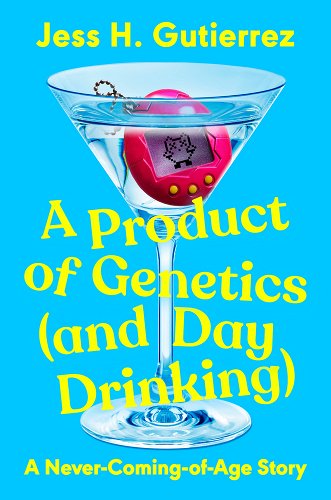
Rife with so much yesteryear reminiscence that you’ll be back to wearing low-rise jeans, butterfly clips, and burning CDs using pirated music sites in no time, my debut memoir collection, A Product of Genetics (and Day Drinking), is guaranteed to send you straight into a memory spiral. If you ever bought a box of cereal based solely on the prize promised inside, yearned to be a Full House sibling, or explored hundreds of miles on a bike barefoot and unsupervised, this collection of essays is right up your alley.
The books below are a compilation of funny essay collections written by millennial women that will have you laughing and soaking in the nostalgia of days gone by. The authors of these books have voices that show that quirk is in and that stumbling on the way is the norm. These are the titles you might not have known that you needed (but most certainly do).
For anyone who wants to relive the horror of a Furby come alive in a darkened room (you do, I promise), this taste of growing up in the 1990s is the perfect dip into shared memories and the author’s tales of surviving being messy and trying to figure out who she is. In this fantastic collection of stories, readers can expect to laugh, cry, and commiserate—sometimes all at once.
If you aren’t already in love with this author, prepare yourself because you’re about to be all in. In this 2020 tome, West examines all our favorite movies with her inane ability to tell it like it is. Amusingly enough, West says all the things we’ve all been thinking for years, but in a better, funnier, more biting way that makes us wish we had actually said it first. In her examination of the hallmarks of cinema, she begs us to ask ourselves: Do these box office hits and cult classics still hold water? Did they deserve the hype in the first place? What in the actual hell? And should we be proud to admit that they’re our favorites or watch them in absolute zipper-mouth private never to be spoken of?
If there’s anyone who gets what it’s like to just not get it, it’s Sophia Benoit as described in this book of funny essays. Plan to laugh, cry, and feel confused, certain, uncertain, and wholly understood by the book’s end. This collection is such a chef’s kiss embodiment of what growing up in the 1990s was like for so many of our generation. It rides the waves of crappy dates, guilty pleasures, so much self-doubt that our brains runneth over, and a human experience so comfortingly familiar that you suspect that you and the author are meant to be forever besties.
More than anything, this one made me feel seen and realize that not feeling normal, not always understanding myself, not knowing how to human is, in fact, standard. The author celebrates the fact that from the beginning we are all just a bunch of mostly aimless weirdos. We start out weird and just eventually evolve and age into a different kind of weird. If you don’t get some comfort from that, we are not the same kind of person.
There’s a reason that this book was an instant New York Times Bestseller, it deserved to be. Dripping with all things deliciously pop culture and growing up as a millennial, Kennedy takes her essay collection to a new level with her hilarious take on being a woman, her lived experiences, and what our culture and time in space means. Each story in the book drives you to want more and read onward just to revel in the fact that it’s so damned nice to commiserate with someone who is still very much in their figuring-it-out era.
Experiences so awkward that just peeking into them is a bit mortifying, hot takes that make you feel like all that crap swirling around in your head isn’t as crazy as you suspect, and chapter after chapter with Irby’s trademark wit and humor go a long way in this recent release. If any book of hers will snag new readers, this is it. She talks about her love for Dave Matthews, run-ins with anaphylaxis, and moments of bare-bones honesty that sometimes just hit you in the face.
In this 2021 collection by the iconic comedian who is truly making things happen on and off the page, Robinson’s conversational tone and nothing-off-limits banter make you feel like you’re riding shotgun in your bestie’s car on the way to the store to buy the makings for margaritas. Whether she’s bemoaning the woes of dating or shelling out advice like a big sister, she keeps her essays funny, light, and pop culture-infused enough to always make a reader flip forward for just one more story before moving on.
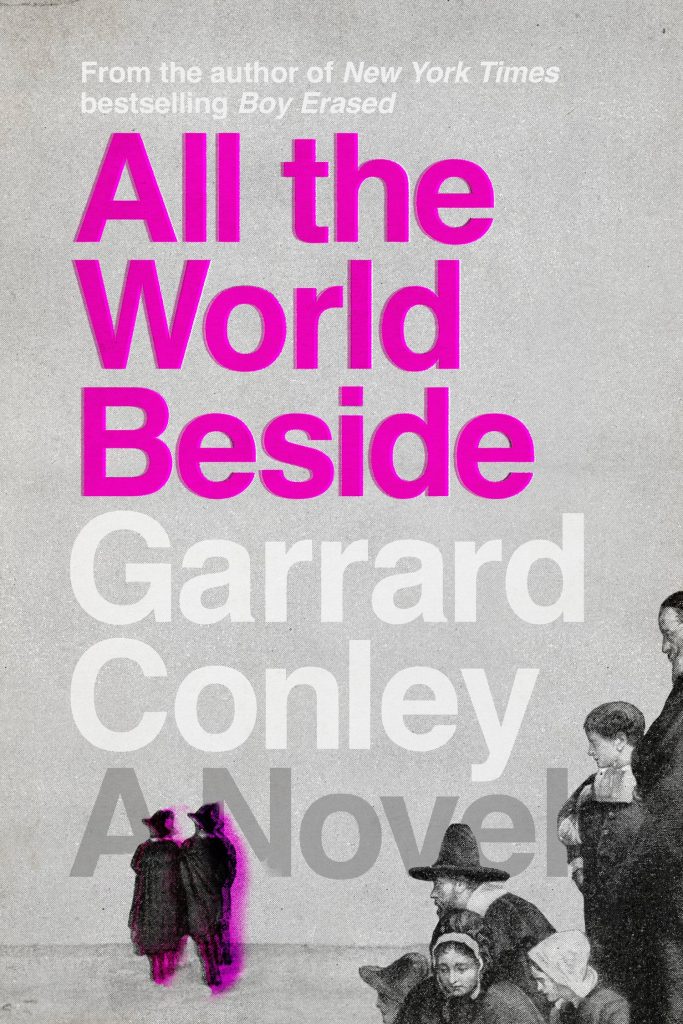
I heard Garrard Conley read from the research note for his first novel, All the World Beside, at an AWP reading earlier this year and was thoroughly riveted. In voicey, animated prose—he notably calls French philosopher Michel Foucault “Daddy Foucault”—he discussed the work of finding queer spaces within 18th century, Puritan New England, a task inherently complicated by the essential coding and concealment that kept queer identities (safely) out of the records.
Garrard Conley made a name for himself with his memoir, Boy Erased, which recounted his experience growing up in a religious household and going through conversion therapy. In his first novel, Conley brings his finely trained eye for dissecting human connection, spirituality, and emotion to the 1700s, Massachusetts, a religious community called Cana to which the Elect have been called. In lush, lyrical prose with reverence for the natural world and the complex lives of others, Conley tells the story of two men, the preacher Nathaniel Whitfield and doctor Arthur Lyman, who are bound by their forbidden love. All the World Beside enters the traditions of Nathaniel Hawthorne’s Romance and period pieces that imagine the shapes that queer love might have formed across history. Conley takes great care to balance the pressures of Puritan society with the freedom these two men uncover in each other. The book is a daring, compassionate, and humane portrait of a religious community that is seeking a way to organize the world for themselves, at once aware of the human impulses behind this work and the destructive forces that result from colonialism, manifest destiny, and religious fundamentalism.
We spoke about the novel, the society’s twin condemnation of and reverence for beauty, and how he found his way deep inside this world.
Michael Colbert: All the World Beside is deeply interested in beauty and the natural world. How did you find your way into writing about the landscape of colonial New England?
Garrard Conley: I’ve always been fascinated with how my family ended up falling for something that is so obviously insane: how did we end up in that 1984 bubble that was conversion therapy where we had hundreds of rules, had to ignore what our bodies were saying, and believe what our minds knew wasn’t true. It was anti-rational, anti-emotional, anti-everything really. Everything that it is to be human, it was anti. I was interested in how we get to a place where we ignore the basic facts of existence, and what our bodies are saying, in favor of a kind of fascist thinking, and how do we prevent ourselves from doing that again.
All the World Beside is full of that. Everyone is somehow not listening. I wanted to describe that moment when you realize, ‘Oh no, recognizing the truth, there’s going to be a great cost to me, and I’m going to do it anyway.’ There’s a good kind of pride, which says, ‘You know what, I’m not going to be a coward anymore. I’m going to live out this truth, and the consequences that come with it will feel like nothing. I know what it feels like to shut that off. I know what it feels like to live not like a human being but like an automaton, and so I will do it anyway.’ I think that there’s something really beautiful and triumphant in that choice because it paves the way for so many other people.
MC: Without giving too much away, this reminds me of Nathaniel’s worry about being an abomination if he lets himself be with Arthur, and when they get together, it doesn’t feel that way.
GC: That was a really difficult part of the book to convey, because I didn’t want to be unrealistic where these two men don’t have any problems when they’re finally together. The problems are still waiting outside the cabin. But really, I wanted to show that when they do get together and think and talk about God as this proto-gay couple, they’re actually closer to God than ever before. That was a big challenge for writing the whole book: How do I portray both that things are still terrible when you walk out that door, but in this private place, real freedom can exist? That acceptance can lead to a greater sense of the soul and beauty. It was true for me and probably true for almost anyone that realized that they weren’t alone and felt happy at that recognition and scared but still do it.
MC: You mentioned beauty. How were you interested in exploring the perils of beauty as the people of Cana understood it?
I wanted to show that when they do get together and think and talk about God as this proto-gay couple, they’re actually closer to God than ever before
GC: I have a symbol at the center of my book that I think operates as a way to talk about beauty. They have this beautiful ormolu clock that Catherine, the minister’s wife, has inherited, and it’s the one thing that is permitted within the house that’s beautiful in an obviously not productive way. The way that the characters respond to that beauty is really telling of where they are in their journey. Anything that went against that buttoned down, collared world of the Puritans was seen as suspect. That was something I dealt with in my childhood and wrote about in Boy Erased. Does that sound familiar today? It does to me. We can’t talk about the atrocities that are happening in the world, or what’s happening in Palestine without someone saying you must be anti-Semitic, you must be X, Y, or Z, let’s label you however it is that we need to label you to dismiss you. That is what Puritans do. It’s what fundamentalists do. It can happen in any religion, in any place, at any time. It doesn’t even have to be religious. I know it inside and out, and I can feel it the minute that it is being put on me. That’s where my arrow’s really aimed: the fundamentalists who say there is no room for discussion, nuance, or political or heartfelt opinion that goes against the orthodoxy. I think literature opens us up to thinking differently about that. There are a lot of kaleidoscopic feelings that make up the texture of a time like ours today. That texture is where the real truth is, that texture of everyone feeling differently. You find that web, that’s where we start to get at truth.
MC: I thought a lot about the gaps in how someone perceives others, or how they understand somebody else’s opinion or behavior, yet with access to that other character’s interiority, our sense of the world becomes so much richer. Through the novel’s point of view, the story is so much more humane.
GC: Yeah, we dismiss so many people with labels or whatever convenient ideological terms we have today. I think literature is a place where we don’t do that. It’s like the better version of ourselves. Maybe the characters are acting poorly, but the authorial voice, if it’s doing good work, shows us a bigger picture. It’s always saying, ‘Look at the margins. There’s something else there. You think you’ve got a hold on it? You don’t.’ Of course, that can be a frustrating reading experience, but I think what excites me as a reader is the discovery that someone has made that effort to see beyond their narrow, prescriptive view of the world. It’s the reason I read. I don’t read because I need my biases reaffirmed. I don’t read because I need comfort. I read because I want to see other people trying to reckon with the really complex and often terrifying world that we live in, in a way that feels humane and beautiful.
MC: In the research note at the end of the novel, you write, “The great thing about fiction is that when you start to fill in the gaps of history the imagination grows bolder.” Could you speak about this imperative?
GC: It was a little bit of a dance. I think I’m still understanding it. First of all, I set out to write not a novel but a Romance—the way that Hawthorne wrote Romance. I wanted people to understand this within a tradition in which the characters come alive by a sort of atmospheric effect, one that does not exactly adhere to every rule of reality but is still in conversation with reality. I wanted things to be a bit dramatic, maybe even melodramatic at times, and to lean into some of those genre feelings that people wouldn’t necessarily associate with literary fiction. If including a fact ruins the atmospheric effect, I won’t necessarily put it in there, but I won’t ever make up a fact that could ruin the historical accuracy.
I wanted things to be a bit dramatic, maybe even melodramatic at times, and to lean into some of those genre feelings
I did a ton of research on multiple areas of the 18th century. I would go to Historic Williamsburg and Historic Richmond Town on Staten Island, to understand how the walls felt and what kind of furniture would have been in these houses at the time. I read a lot of books; I’d say I probably compiled about 500 sources on everything from material culture to sexuality in the 18th century to maps of towns that could be like Cana. I felt it was necessary because I wanted this really ambitious combination of things. I needed to have a theory of sexuality that made sense to me, one that went beyond, as I call him, Daddy Foucault’s estimation that homosexuality was born in the 19th century. Of course, he was being a little funny, but I wanted to be careful not to map our contemporary identity politics onto the past because it wouldn’t work. In order to enter the past, I wanted to make sure that I got all the names for things that could be associated with queerness in the past.
MC: In many ways this book is about being ushered into new worlds, and there’s play between the new worlds of religion, colonialism, and the new world that opens with queer people. How do you see these forces intersecting?
GC: One character in my book says something like a movement is dangerous because it gathers everything in its wake. You don’t know what’s going to happen with the movement, it could go one way or the other. That’s something I’ve learned with doing a lot of advocacy work around ending conversion therapy. I’ve seen this movement change a lot in the last eight years, and I’ve seen this anti-trans backlash in 2024 that is really horrible. It’s been very frustrating to see this movement that many of us created hijacked by a gender-critical crowd, who is now attaching conversion therapy to this idea of turning gay people trans. It’s frustrating because it ignores a fundamental fact of conversion therapy, which is that trans kids were more likely to go to conversion therapy, that there’s no conversion therapy that’s turning gay people trans. It’s conversion therapy that’s trying to turn gay people straight and trans people cis.
That was a concern of mine when I went into All the World Beside. A different world is not always a better world. Movement is not always better movement; it doesn’t always turn out the way that you want it to. There is a kind of cynical realism at the heart of the book. To me, the world that is presented at the end of the book resembles a possibility that could be much more like our world today. We know the “New World” was never new, and it’s a very dark term. It doesn’t mean that the new world doesn’t have all of the same baggage. It does. That’s one of the messages that I want to get across in All the World Beside: Yeah, we’re in a much better place. There’s no denying that there is progress, but it always comes at a cost, and there’s always something that we’re ignoring or some ugly beast that’s going to rear its head again.
I think there are moments of joy and beauty between characters when they let their guard down. That, I hope, is a kind of acknowledgement of the queer joy that we can all exist together even in dark times. Our resiliency is what I want you to walk away with. We’ve been through a lot of shit. We’re going to be going through a lot more shit, but there’s always some new keyhole to look inside and see what’s going on. I won’t give away what that is, but it might involve one man pissing on another man in a way that you’ve never imagined in the 18th century. And maybe today, we’ll see new vistas of complete debauchery and beauty that we could have never imagined before.
Each afternoon at five minutes to four, Gigi emerged, descended from the mezzanine, and filled three glasses with ice, Tanqueray, and a pimento olive. A freezer beneath the wet bar produced small, gem-like cubes of unusual translucence and the sound they made, ringing into lowballs, was more powerful and prompt than any salvo.
I brushed my hair and set it, then donned a bra with actual underwire. In solidarity, my mother had left curlers, and my sister and aunt Ellen had abandoned appropriate lipsticks behind the triple-pane mirror. The four of us agreed on very little, but we shared a porous, frizz-prone hair texture and freckly complexion with cool undertones.
It was time. The mirror revealed a winking corridor in each periphery, flanked by peach hand towels that had hung in the guest bath for as long as I could remember. As a child, I used to peer into the mirror, trying to see around myself and into the future, but today there was only my obsequious hair in endless replica.
“Why Nina,” my grandmother cooed from below. “How nice you look.” It was hard not to make an entrance on the spiral stair. A nightmare, my sister had called it, after visiting with her newly mobile twins. Alison took after our mother and Aunt Ellen, girlish women who needed husbands and things. Gigi and I were different.
“Your shoes are sparkling,” I observed.
“I stole them from Maeve,” she said, glancing down.
“Dead Maeve?” For the last quarter-century, Buck and his wife Maeve had traversed The Sorrento each day at four o’clock, from their pool-side one-bedroom to Gigi’s coveted two-story unit with Gulf views. Maeve died of a stroke three months ago, and Buck moved in with Gigi shortly after.
“Let’s not call her that.” Gigi returned to the drinks. “What’s going on with work?” Her gaze met mine in the mirrored bar.
“I’m taking a break.” I didn’t wish to speak about my job or private life. There wasn’t much to say. At thirty-five, this left me in an awkward position. Failure in career could be blamed on love. Failure in love could be blamed on career. Failure in both suggested some personal shortcoming. But I was here to save Gigi, and at that, I would not fail.
I tried to tell if she looked older. Ninety-four now, but with two new hips and a cooler shade of gray. She’d accepted my compliment factually: “I was so attached to the champagne blonde, but silver suits me. I admit it.” The shoes clicked and glittered through the condo. Maeve had dressed like a card shark but Gigi kept herself classic. Linen and a splurgy handbag. Pink lipstick. Her secret to a youthful complexion was not to get too thin. “You’ve got to hit it just right though—type 2 is no picnic.”
“I want to hear about you.” We settled in the lounge. “You’re the one suddenly getting married.”
“Would you like to be a bridesmaid?”
Gigi and Buck had announced their engagement a week ago, leaving us little time for shock. They were holding a simple ceremony in the chapel of St. Ann’s on the first of the month.
I wasn’t going to let her flirt her way out of this. “You’ve known Buck forever,” I said. “Why marry him?”
Her gaze flicked to the clock. A minute to four. “If he’s late, maybe I won’t.” She shrugged like a glamorous starlet, evasive and smooth.
“Have you been lonely?”
The door crashed open. In the time it took Buck to enter and close it behind him, the condo was invaded by the violent white noise of The Sorrento’s atrium waterfall.
“May,” Buck nodded at Gigi.
I didn’t like that my grandmother’s first name was so similar to his recently deceased wife’s.
“Nina.” His greeting was a guttural grunt. Did she expect us to believe she was in love with him? My mother said dementia could manifest through unusual attachments.
For eighty-one, Buck was not unattractive. Dapper, still erect, and with hair that held a wave. Ellen speculated about a long-standing affair, but Gigi was neither a hypocrite nor a tragic figure. If she had wanted Buck before, she’d have had him, free and clear.
I knew Buck would ask about the pool and his cabana key. It was all he could ever think to ask about. I invented an excuse about work.
“For whom?” asked Gigi. “I thought you were taking a break.”
“I am,” I said. “I’m here!”
Gigi’s look conveyed concern and a little pity. “Do you want me to call Bernard?”
“No,” I said, perhaps too quickly. Gigi’s old friend in the DNC had procured me half the campaign jobs I’d ever had. I didn’t want another one.
“Your mother says you’re in a funk.”
“She always says that after we lose.”
“You do look run down.”
“Only because I’m not tan.” I dearly hoped my mother had not mentioned the breakup. “Floridians forget what it’s like up there.”
Gigi sighed. “I suppose it’s all become a little sordid and pointless, hasn’t it?” I usually found comfort in Gigi plucking out my feelings and speaking them aloud. Today her insight hurt. My face must have betrayed me. She turned to Buck. “Nina’s going to be my maid of honor!” she announced.
“Good get.” Buck nodded. “No easy task in matron-city.”
I felt disoriented. “What about Shireen?” Gigi’s withdrawal from her social circles was another item of recent alarm. As a hostess and booster for the scattered liberals of the southern Gulf, Gigi was integral to the state machine. Shireen, a major bundler, was her oldest friend.
“Shireen has become somewhat unbearable in her old age,” said Gigi.
“She says you’ve entirely disappeared.”
“All anyone talks about is who died and what’s happening with the estate. I’m tired of it.”
Buck grunted approvingly.
“Are you sure I can’t call Bernard? I don’t like to think of you idle and wallowing over some man.”
So my mother had mentioned him. “No thanks,” I said. Surely she had excluded his marital status, given Gigi’s strong moral opinions. “There’s no rush.” I knew better than to joke about how I didn’t need the money.
“So, your guy lost?” Buck interjected.
“I generally work with women.”
He rolled his eyes. “So your gal lost?”
“A win was only one of several acceptable outcomes.”
Buck shrugged. “Winners win.”
I maintained my bright, informative tone. “She still managed to pull the incumbent left.”
“Left.” He made it sound like a slur.
“Yes,” I couldn’t help responding. “Toward sanity.”
“Women,” Buck gurgled, “talking about sanity.”
“I beg your pardon?” It was my standard response to hostile men, but I knew I sounded shrill.
“Nina,” Gigi said sharply. I looked down at Buck’s puckered pectorals to deescalate. At his high white socks and Keds. Practically a child again. “I need to ask a favor while you’re here.” Gigi’s hostess’ instincts finally rose to the trick of redirection. “I’ve been having a problem with intruders—” The grunt sounded. “Buck—let me finish. I know what I saw, and what I saw were knees.”
“Knees?”
“Men’s knees. Up there.” Gigi pointed towards the mezzanine. Her condo had an exit on the second floor, though it was rarely used. From my seat, I could see a sliver of the landing through the floating staircase. “Twice I was sitting here and saw knees on the mezzanine.”
“Was it Al? Handymen?”
“This isn’t a hotel. I screamed! I completely screamed, both times, and the knees fled.” Gigi was indignant. “Does that sound like a handyman?”
“So they’re using the door up there.”
“I keep that door locked.”
Buck had spent his endurance for silence. “Seeing things,” he spouted.
“Was it you?” I accused.
“I’m worried,” Gigi insisted. “I may have a stalker.”
“She’s told me about her sister.” Buck said.
“Sister-in-law,” corrected Gigi. “Poor Elyse. She called the police nearly every day.”
“Why?” I’d heard of a batty great aunt, but never met her.
Gigi sighed. “She swore men from the CIA broke into her house at night to paint the ceilings.”
I couldn’t help but laugh.
“You need to help me catch him.”
“The man with the knees,” I said gravely. I refused to align with Buck by not taking her suspicions seriously. “I’ll look into it,” I pledged.
After dinner I checked my phone, forgetting about The Sorrento’s dead zone. I’d been told the lobby was newly wired, but my feed only refreshed inside the elevator, of all places. No news, but plenty of updates. Nothing from Mateo, the man for whom I would not wallow. The campaign was over. I wouldn’t even see him at work now.
I hadn’t told my friends about him, so they weren’t calling. In my twenties I would have, before anyone had husbands or children. Now, I knew their allegiances would be torn between me and his poor imagined wife, their three young sons. My mother only knew because I’d run into her at a fundraiser after too many champagnes.
The doors opened on the lobby, where the din of the waterfall was worst. Welcome to Niagara Falls, was how Gigi greeted guests now. The remodel had failed to account for the acoustics of all that marble. I missed the jungle-print rug and player piano. The basin for the cascade gaped wide and shallow, chlorinated teal. No Wading, a sign read. No Coins.
I explored the spaces for holding meetings and getting fit. In a tiny powder room, I found a spot they’d missed. The jungle-print rug survived! Acid-trip ruffles of pink and green fronds that now felt like treading on a Keith Haring. I looked at myself in the vanity. Was this the face of a woman who had lost her way? Introspection became tedious quickly.
In the office, I found Al reading Tiger in the Smoke. He read with such intensity that interrupting him felt like a small violence. “Nina!” he called. “What can I do for you?”
I broached the subject of the knees. No evidence, he swore, had appeared on the lobby footage of any intruder. “No one’s reported similar issues?”
“No,” fretted Al, “though I’ve insisted she call immediately if anything seems amiss.”
This was charming but not very useful. Al was a professional in the register of chivalric doorman, but his heart was in a cozy mystery. When I asked who had access to master keys, he stiffened. Al’s brother Cecco worked mornings, and Facilities consisted of Al’s two nephews. The whole clan came from “the original Naples.”
I backtracked. “Think she’s losing it?” It seemed wiser to besmirch my own family’s honor than risk any slight to his, but I only perturbed Al further.
“Your grandmother is sharp as a tack,” he repeated. “A tack.”
Six days until the wedding.
Five.
Gigi’s schedule felt mysterious and fixed, and did not include me, or even Buck, except at cocktail hour. Mostly, she stayed in her bedroom with the news at high volume. I sat in the kitchen and checked the extension, but on the occasions it rang, Gigi seemed only to be eliciting grim medical updates from one small and taffyish voice. Every few hours, I pressed my ear to her door, but didn’t knock.
As a teen, I’d felt no such reservations. I barged in at all hours to lie on her bed and argue with the television. Confide or confess as needed. In college, frustrated that no one wanted to talk about Cheney or Iraq or stagflation, I’d call Gigi, who could be relied upon to be appalled and entirely up to date. Gigi, I’d say, can you believe it? and she’d say: I cannot. Or: This is just insane. Then she’d call back after talking to Bernard to explain what was really going on.
I called less now. Perhaps much less, lately. Didn’t everyone? I wondered if Gigi was punishing me.
At noon, Buck left for golf, and she emerged. As a child, I’d dreaded Gigi’s lunches, each mayonnaise mélange she called salad a fresh horror. Now I loved them. Together we ate tuna, noodles, grapes off little saucers. I’d shimmied us into a conversation about cooking for one, and finally on to Buck. “A catch” she kept calling him. “Most of the men are dead.”
“Why not live with women?” I asked her. “We’re all much pleasanter and know how to do things.”
“What can I say,” she said. “It’s nice to have a man around. I know it’s not new-fangled.”
“You used to say you’d never trade your freedom after getting it back.” It sounded like an accusation, but when I was in high school, it had made a profound impression.
“I’m sure I did,” said Gigi.
“So what are you doing with Buck?”
“Whatever I want!” She ignored me, tidying.
“What about your freedom?”
“You try growing old alone.”
I am, I wanted to say, but knew it would not be well received. I followed her out of the kitchen and towards the stairs. I invited her to the pool. “You can’t stop exercising,” I scolded her departing back. “It’s important for longevity.”
“I’m ninety-four,” she called over her shoulder. “I’ve won.”
The pool was thick with women bobbing in unison. I sat in the sun with one of Mateo’s novels. We had pillaged one another’s pantheons as a form of foreplay, but now five pages felt like holding my breath underwater. All around me people sunbathed with intensity, or strolled between the cabanas and ice machine. All were equipped with a Tervis tumbler, clinking and redolent. I had an epiphany about the cabanas. They were full of booze.
The sun moved, and I retreated to the elevator. Nothing from Mateo, nor anyone looking to hire me in the shuffle of post-midterm turnover.
Messages from my mother.
Ellen had a good forensic accountant from her last divorce, she texted. SHOULD WE SIC HIM ON BUCK?
I couldn’t help but feel Buck was not worthy of our full adversarial response.
I couldn’t help but feel Buck was not worthy of our full adversarial response.
WHAT THEN? read the texts.
I’M WORKING ON IT.
I had succumbed to sitting on the floor to type and scroll when the doors reopened on a pair of knees. “Is this the seated car?” a boy—man?—asked, grinning down. The boy’s skin said he was five to ten years younger than me.
“The lobby wifi’s awful.”
“Good to know.” He twirled his racket with a flick of the wrist. “You play?”
“Not really.”
His chin tilted in a light scold. “I’ll see you by the pool, then.”
He had that god’s gift energy I hated, but I smiled.
“Al says you’ve been spending time in the elevator,” Gigi said at cocktail hour.
“It’s the only place I can work.”
Buck: “There’s a business center.”
“The internet is best in the elevator.”
Gigi hummed and sipped. “I’m sure it’s fine if you aren’t bothering anyone.”
“I like it,” I replied lamely. “It hasn’t been remodeled.”
Gigi rolled her eyes. “They tried.”
“We got our very own Jewish cabal on the twelfth floor,” barked Buck.
“I beg your pardon?”
He became animated. “They wanted their special elevator.”
“A Shabbat elevator,” Gigi clarified. “It was hardly a calamity.”
“Why’d they buy on the twelfth floor if they can’t use the elevator?”
Gigi addressed me calmly, as though I was the one complaining. “It was one elevator, one day a week. But no one could agree.”
“I see,” I said. My most diplomatic line.
Gigi visited the bar. “Is your mother still having those Holocaust dreams?”
I didn’t wish to speak about my mother’s strange, private dreamlife in front of Buck. Mercifully, he’d become disinterested. “She’s into lucid dreaming now.”
“She was always hiding in haystacks,” Gigi mused. My mother never recounted the dreams to me in detail. “She and the children she was rescuing. She’d hold her breath as Nazis speared the hay. I’d barge into her bedroom, worried she was choking, but she’d be dead asleep.”
“Did they spear the children?” I asked.
Gigi shrugged. “I always said it was all those Leon Uris books they assigned in school.”
Buck nodded off, whinnying faintly.
“I guess that explains the lucid dreaming.”
She squinted. “What’s that?”
I described how my mother envisioned what she wished to dream, then trained her subconscious to follow the plot. “Like a sitcom.”
“That works?”
“She’s developed a whole storyline involving Jude Law.”
Gigi raised her drink. “Better than haystacks.”
We watched Buck shift in his chair, still making animal sounds.
“Your grandfather could’ve used that trick.” Gigi exhaled as Buck settled. “He had them too,” she said. “Not quite nightmares . . . They started after that kerfuffle with 60 Minutes.” I had heard of no kerfuffle. Gigi sighed. “They brought him on to discuss Chlorofluorocarbons and Industry.” All I knew about my grandfather’s company was that they’d jarred peanut butter and filled aerosol cans with hairspray. “He tried to explain that they changed their process as soon as the science was clear—but when it aired, they only showed him talking about the car wax nozzle and how the EPA made them a superfund site.” Gigi rose for another drink. “That’s when the dreams started,” Gigi called, waking Buck. “Ozone guilt. He never trusted the media after that.”
“Smart man,” said Buck.
I’d been screening my mother’s calls but accepted the conference with Ellen as a compromise.
“Where have you been?” my mother demanded.
“Service is horrible here.”
“Are they still engaged?”
“For now,” I growled. “Did you know about the knees?”
“Knees?”
“She’s been seeing knees.”
“Oh, the stalker,” said Ellen. “I assumed it was Buck.”
“I taped a piece of my hair across the second-floor door. So far, no one’s come in or out.”
“Paranoia’s on the rise in the elderly,” said Ellen.
“This is what I’m talking about.” There was an eager sheen in my mother’s voice, like oil on water. “Paranoid behavior could be useful.”
“I’d hardly call it paranoid,” I said.
My mother: “Has she gone out at all?”
Ellen: “In August, it was just cable news and gin.”
My mother: “And Buck.”
Ellen: “Shireen says he convinced her to stop contributing.”
I felt the familiar fatigue of being right about all my worst suspicions. “And now I’m here. We look party sponsored.”
My mother scolded me. “Don’t be nasty. Shireen is one her oldest friends.”
Ellen: “She can’t believe Gigi’s marrying him either.”
My mother pounced. “Do you think she’d be willing to file a complaint?”
I made an incredulous sound.
“The lawyers say that in the event of a worst-case scenario, Florida’s deathbed marriage statues could help us invalidate his claims after the fact. But our case would be stronger if there were reports already on file that suggested fear of fraud or elder abuse.”
“Shireen’s the one who will look guilty of fraud if she files that complaint,” I said.
“You should file one with Adult Protective Services while you’re there,” my mother continued. “As insurance for her own protection.”
“You’re serious,” I said. “Gigi is saner than you are.”
“It isn’t about sanity,” said my mother. “It’s about influence and manipulation. Frankly, I’m concerned you don’t see the logic here.”
“Nina, it’s a failsafe!” I could almost see Ellen waving her bangled wrists around. “She would never even know about it!”
“I would know,” I said.
“Don’t be naïve,” my mother hissed. She’d never been able to manage me, but she knew how to deploy my least favorite accusations. I felt a powerful and refreshing lividness. Why? Because it was Gigi? I suppose if anything was sacred, it was her.
“She claims she’s seen an intruder twice,” I said, returning to the facts.
“A stalker?” Ellen scoffed. “In TheSorrento?”
“Al is hardly a paragon of vigilance.”
“Open your eyes,” my mother snapped. “This is your inheritance, too. At the rate you’re going, you’ll need it more than any of us.”
“What is that supposed to mean?” Though I knew perfectly well. Each of them with their stately husbands.
“Stop it,” said Ellen. “Can we not all agree that Buck must go?”
I kept silent.
“Good,” said Ellen.
My mother: “You’ll file the report?”
The elevator opened to admit a woman I recognized as Buck’s daughter. She had two first names I could never recall and seemed impossibly pleasant.
I hung up and greeted her. Had she heard about the stalker? It took only a moment to match her voice to the sticky-sweet tone from the landline. “An intruder?” She frowned over the news, contemplative with true concern. Teens had been breaking and entering for opioids downtown, but nothing this far up the boulevard. “I doubt they’d pick a building with security!” I was struck by her credulous expression and bad skin. Her air of exhausted good nature. She had the perfect face for a campaign ad.
During cocktail hour, I told Gigi I was installing a chain-lock on the mezzanine. Since scotch-taping my hair there, I’d found no empirical evidence of any intruder.
Gigi frowned. “It will look like a motel.” Then she stood, alarmed by a sudden thought. “Did you see him?”
“See who?”
“My stalker!”
“No.”
“Oh.” She sat back down. “They were very hairy,” she mused.
We’d returned to the knees. “What color?”
“White.”
I glanced at Buck with renewed suspicion. “He must be older.”
“White skin,” Gigi corrected. “Fair hair.”
At The Sorrento, this hardly narrowed things. “Do you have any valuables here?” I asked her.
“I keep everything important in the building safe.”
Buck joined us. “Smart woman.”
“Not much there,” Gigi went on. “But you should know where to check if I die.”
“Gigi.”
“Papers, mostly. I donated the jewelry.” Gigi drank deeply. “Don’t tell Ellen. She’s sentimental about that sort of thing.”
“What was the cause?” I asked innocently.
“One of Shireen’s auctions. Those pieces were the belle of the ball.”
After my grandfather died, Gigi went from quietly neutralizing his vote at the polls to donating large chunks of his estate to his age-old enemy, the Democratic party. There had been a fair measure of glee in it for her, but she couldn’t seem to beckon it now.
Buck grunted his disapproval. “You want to end up on a fixed income?”
I wondered if Buck was attempting a joke. Gigi waved him off. “The auction was years ago.”
I persisted. “I’ve always admired your purge, Gigi. I tell that story to women all the time, and it really moves them. You’ve inspired a lot of giving.”
Buck grew irritable. “Fools.” He gripped his armrests as though experiencing turbulence. Gigi looked irked by my antics, wise to what I was doing. He muttered louder. “A man works his whole life for his family, and how is he thanked?”
“Fix me a drink, Buck.” Gigi held her glass in the air. “My hips ache.” He twitched some more but did as she asked. Gigi turned to me. “Mind your manners.”
“Buck seems awfully concerned about the state of the family coffers,” I said.
“Then you have that in common!”
“I’m concerned about you,” I hissed.
“And I’m concerned about Buck.”
“Why?”
“He’s right you know,” she snapped. “A fixed income is no picnic.”
Buck returned with her drink.
“What’s wrong?” he asked, looking between us. It seemed he was not entirely oblivious.
“Nina was bullying me,” Gigi said, with a mean look. “She thinks I should wear white to the wedding.”
I excused myself from dinner. The beach was pretty but too calm. I walked until a canal of mangroves bisected the sand and I had to turn back. I sensed it was a character flaw that beaches made me nervous. Too much openness. Sky. Water. Reflect! the beach entreated. People always said I took after her, even if they never meant it entirely as a compliment. The comparison pleased me. Gigi was sharp. I did not understand her withdrawal and disinterest. Her snappish defense of Buck, of all people.
Back in the elevator, I searched the address and phone number for Adult Protective Services. I couldn’t bring myself to call, but I sent an email.
Outside the elevator, the waterfall crashed and echoed. In the condo, I listened at Gigi’s door. The television roared. Her rest had always been fitful, and the sound of the television bore no relation to whether she watched or slept. Buck was in there now. How could he stand it? I lifted a box of Cocoa Puffs from the pantry and ate them in defiance on the tasseled cream sofa. I had four days. I was her favorite. That was plenty.
At lunch, over a salad of minced ham on English muffins, Gigi encouraged me to get out more.
“Gigi,” I said, placing my muffin on the corner of the sink. “I’m here for you.”
“Honey,” she said, with a trace of her old tone, “you’re here because your mother thinks you can change my mind about the wedding. You can’t, so you may as well take it easy. Go to the Beach Club.”
I decided to admit nothing. “Will you go with me?”
“Sure,” said Gigi. “That sounds nice.”
“Today?”
She frowned. “Buck will be back by four.”
“Tell him we’re having a girl’s night.”
Gigi was firm. “If I don’t feed him, he just drinks and eats a can of bar nuts.”
“He’s a grown man.”
Gigi looked at me blankly.
“What about his daughter?”
“Darryl Ann has enough on her plate.” Gigi sealed the tub of ham and ran the water.
I flailed for a strategy. “I miss when it was just us.”
Gigi cocked her head. “How old are you?”
“Thirty-five.”
“And isn’t that old enough to think about other people?”
“You are my other person.”
“Nina,” she set her dish in the sink. “You’ve been here a few days—”
“Nearly a week—”
“—and it’s been lovely.” She looked at me pointedly. “But you’ll be off again before you know it.”
I knew the punch line. She didn’t have to say it. I grabbed for the dishrag, but Gigi boxed me from the sink. I hovered beside her, pathetically empty-handed. “We’re just worried about you,” I said, retreating into the cowardly “we.”
She set down the rag. “How do I look?” She faced me, almost posing. She held out her arms and swiveled her hips. “Well?” she demanded. “How do I look?”
“You look great,” I said, defeated. She did. Plump, tan, bare-footed, hair bobbed, fresh hips to steer her whole torso. Attempting to wield power over Gigi was a farce. She was the source.
“Good enough,” she said, turning back to the sink.
“Too good for Buck,” I mumbled. I couldn’t help it. “Will you at least be protecting yourself?”
“You make it sound like I need body armor.” She was taunting me.
“Confirm or deny.”
She paused. “I haven’t decided.” She held out a soapy hand to prevent my retort. “Do not for one more minute try to pretend this is for my own good.” The dish clattered lightly onto the porcelain. “I’ve asked for help with one thing.” She was shaking her head into the basin. “For someone to catch my stalker.”
“Alleged stalker,” I snapped. My comment managed to actually deflate her.
“I’m surprised at you,” she murmured, and left. Gigi, in retreat! Talking with her had become like walking through a familiar room in the dark, after someone has rearranged the furniture. I finished the dishes, went upstairs. Her door was shut. Downstairs, I paced around, but was sick of seeing myself in every surface. I grabbed my suit and the cabana key.
The cabana smelled of mildew and Coppertone. Beside a rack of faded beach chairs, a storage shelf held a handle of Svedka, a case of Tropicana, and a selection of insulated tumblers bearing the logos of golf invitationals. The tepid overhead fixture flickered then snuffed itself, but the sun through the slats was enough to see by.
The cup of vodka and juice tasted hot and disgusting until I recalled the ice machine. The pulp barnacled the cubes and the whole thing looked radioactive. I drank it quickly and felt better.
The clamor by the pool was too much, so I opted for a lounger set apart by fan palms and a low concave wall painted silver. I knew this wall had a function, but I liked it mainly for the privacy it afforded. I lay there, letting the sun bake my thoughts into little crisps, and fell asleep.
“Sorry to disturb,” said the boy from the elevator. “But I think you’re burning.”
I looked down, feeling the truth of his statement in the tight, hot skin on the tops of my thighs, arms, and chest. “Shit,” I said, sitting up.
“The reflectors’ll get you.”
“What’s your name again?”
“Drew,” he smiled, offering his shirt. “Want to share my umbrella?”
In truth, I wanted to keep his shirt and dispense with his company, but flirting with a ruddy-cheeked catalogue specimen was the least I could do while Mateo was out there, still married and not calling.
In truth, I wanted to keep his shirt and dispense with his company, but flirting with a ruddy-cheeked catalogue specimen was the least I could do while Mateo was out there, still married and not calling.
I followed Drew to the shaded loungers as he spoke of his own grandmother’s struggle with retirement. “I’m the cheer package.”
“Lucky her,” I played along.
“And you?” Drew asked.
“I’m here to break up my grandmother’s wedding.”
“No shit.” He grinned. “For real?”
My skin, beneath his shirt, began to pulse. “Younger man,” I added. “Republican.”
Drew’s enthusiasm dimmed, but after another of his full-body surveys, I saw he wasn’t going to let my politics bother him.
I adjusted to stay in the shade. “I wish there were more umbrellas.”
“My Gran loves complaining about the condo fees.”
I snorted. “The waterfall?”
“They truck in the beach sand, too.” He stretched his shoulders showily. “She’s thinking of suing. She doesn’t believe sand could possibly cost what the Condo Association says it does.” Drew had muscles that could be identified in tidy, hairless groups and I found this sweet and obnoxious.
“We should hang out,” Drew said when I stood.
“Hang out,” I repeated.
“Yeah.” He found nothing overfamiliar about jabbing two fingers into my waist. “Hang out.”
Was he leering? Or simply squinting into high sun?
Cocktail hour was quiet. I didn’t bother with my hair and could tell it was an effort for Gigi to withhold comment. By five, my skin began to emit a thrumming heat. Gigi gave me two aspirin and a gin and tonic, her version of babying. Her look said I’d done this to myself.
I went to bed early but woke from a fever dream in which I was falling. I landed with a thud on the Resolute Desk. Mateo and Drew had merged as President, and when they stood, they were wearing Keds. It was an obscene time to be awake, but when I stumbled into the kitchen, I found Gigi there with a bowl of cereal. She was reading the paper.
“Are those Cocoa Puffs?”
Gigi squinted. “So?”
“I thought they were for the twins.”
“You think Alison bought these?” It was true, my sister was not a laissez-faire parent. “What can I say,” Gigi went on. “I just—love them.” She threw up her hands as though she spoke about physical attraction or where we go after death. “You look awful.”
“I fell asleep by the reflector wall.”
Gigi nodded. “Stay inside today.” She looked down at her paper. “Have you read this?” She tilted the page. Seeing the headline in print made the news itself seem quaint.
“Obscene.”
Gigi shook her head. “They’re not even trying to hide it.”
I considered insinuating all the obvious similarities between the men in question and her very own fiancée, but I was too tired to summon my rutted schtick. My skin felt like a tomato’s in a pan. I shook my head. “It never ends.” I ate my own bowl of Cocoa Puffs in silence, cherishing it, afraid to disburse the density of this old, familiar atmosphere.
By midday, I had accrued several messages. UPDATES PLEASE NINA, read my mother’s latest. From my sister: I THOUGHT YOU WERE SUPPOSED TO BE A STRATEGIC OPERATIONS SPECIALIST. The wedding was in two days.
Darryl Ann boarded the elevator on Gigi’s floor. “Your grandmother is such a blessing,” she gushed as we descended. “My dad was so depressed before. Now look at him.”
I found myself incapable of assessing her sincerity. How did she truly feel about her father moving on so quickly? “I imagine it was a real shock to lose a partner of fifty years,” I said instead.
“My mother, their home—it would be too much for me, that’s for sure.”
“Their home?” I inquired politely.
“The Sorrento was always a bit rich for their pension,” Darryl Ann confided. “But lately? With all the fees? No way. We’ve been trying to convert our garage, but it’s impossible to get a contractor between hurricanes. When he moved in with May, it was a lifesaver, let me tell you.”
She chatted on, but I was ill-equipped to do anything but nod. I suppose I had stopped expecting an explanation, but here it was. My dismay surprised me. Was Gigi on a guilt trip? Or had she been fully conned?
Daryll Ann squeezed my hand before bustling into the lobby. “Love is a beautiful thing!”
I wore a red dress for cocktail hour. Unflattering, but it was the garment that touched my skin in the fewest possible places.
I was at the bar when Gigi started screaming. “It’s him! Hey you—it’s him! Hey, I see you. Hey you!” Buck twisted in his chair but did not rise. Gigi was pointing at the mezzanine, yelling and spilling her drink. I darted around but saw nothing. I listened for the door, but was distracted by the scream of my skin where Gigi had grabbed me. I would comfort her. I would go after him. I couldn’t organize my thoughts. “It’s him!” she kept repeating.
“Should I make chase?” The phrase came straight from a cozy mystery.
“White shorts!” she called, as I jogged up the stairs and out the second-floor door, realizing too late I’d ruined my own trap. White shorts. White knees. There was no one in the hall. I scanned the empty atrium from above. The waterfall obliterated all sound. The stairwell was silent. I ducked into the office, but Al had seen nothing.
At the pool, the usual scene. A hand on my waist made me jump.
“Hey,” said Drew. “You okay?” His breath smelled of rum and Coke. I headed for the beach and Drew followed. “How’s the burn?” he asked. “I’ve got aloe in my bag.”
“Did you see a man in white shorts come through here?”
“What sort of man?”
In this case, I couldn’t blame Drew for being useless. From the boardwalk, I surveyed the sand. “Can you see?”
“See what?”
“Help me! Is there a man in white shorts running in either direction?”
Drew peered around dutifully but shook his head. “Want to tell me what this is about?”
“Someone’s been breaking into my grandmother’s condo,” I said, leaning back against the railing, disappointed beyond all logic.
“Can I fix you a drink?” Drew touched my waist again. “Looks like you could use one.”
I brandished my key to Buck’s cabana.
“I’ve always wanted one of these,” Drew said, looking around the dank closet. “It’s like a hideout.” He shut the slatted door to make his point.
“For an alcoholic.” I grasped for a tumbler in the dim.
“Or other things.” Drew was suddenly close, pressing my body into the shelving unit. His mouth latched onto my neck and his pelvis ground my hip bones into the rough edge of plywood. I grunted with pain and knocked over the vodka.
“Whoa.” I righted the bottle, which had already glugged over my dress and onto the floor. This was not my first groping, but it had been years since I’d encountered this brand of it, suffused in the smell of sunscreen, vodka and orange juice. “Stop,” I said. “Stop now.” He slid his hands from my waist to my arms. My burned skin seared as he squeezed and I screamed. The sound sent him backwards, though he looked disgruntled more than guilty. I fled the cabana to poolside looks, and marched back into the building.
In the forgotten powder room, the rug soothed me. I blotted the dress. My skin was so angry, so red and tender and betrayed. It throbbed, and my heart hammered, a strange racket that would not slow. I didn’t know why I felt so upset. I had endured worse.
The man with the knees could have hidden in the trash room or ducked inside a condo. Hardly anyone locked their doors here. Did Gigi know Buck had nowhere else to go? Did she accept his proposal under duress? The vodka fumes thickened but I refused to wretch. The roar of the lobby smacked me.
In the office, Gigi and Buck were speaking to Al. When she spotted me through the glass, Gigi rushed out. “Did you find him?”
“Of course she didn’t find him,” Buck bellowed, wheezing behind her. “There’s nothing to find!”
I shook my head at Gigi, who looked defeated or, perhaps, frightened. Of the man? Or the chance that there had never been a man at all?
Buck cackled in her face.
“Go away,” I told Buck.
He drew himself up. “I live here.”
My skin throbbed. My heart continued to beat with unusual fervor.
“Nina—” Gigi’s voice was sharp again. I looked at her, in her linen shift and sparkling shoes. All I remembered of Maeve was that she had terrible posture and smoked over the pool. “He’s taking advantage of you,” I said.
“May,” Buck barked with his schoolboy’s bluster, “I’ve had about enough of this.”
“May. Maeve. You barely had to change a syllable!” I sneered. “Though you certainly upgraded otherwise.”
I suppose I was the one to approach Buck, to bring myself in range of him. There was a choreography to baiting someone that came naturally. He looked down at me with offense and hatred, his powdery gingivitis smell all at once too pungent and everywhere. With no warning, he reared back and spit.
The gob sprayed my neck and cheek. I felt powerfully that I must keep the spit from entering my body through my eyes or mouth. My breathing quickened, had never slowed, and I could no longer hear Gigi, who was using a tone of voice I had always dreaded. I’d never had a panic attack, but my short, fast breaths suggested some onrushing rupture. I climbed into the basin and stepped under the waterfall.
The force was pummeling and I struggled to breathe, but in a new way. I’d once watched my sister look down at her thrashing newborns after trying every trick she had to soothe them. She wailed right into their faces. Stunned and befuddled, they quieted.
Then, abruptly, the water was gone. Its source, two stories up, had been cut. I looked out at Buck and Gigi, fuming beside the basin. Inside the office, Al was on the telephone.
“Get out of there,” Gigi snapped at me. “Buck?” He turned to her. “You should go.”
“I live here,” he said again, though this time with less certainty.
“You spit on my granddaughter,” Gigi stated.
Buck whirled toward the basin and back, as though conflicted over where to direct his ire. His body jerked with age and discombobulation.
“The wedding’s off,” Gigi informed him. Her voice had become soft and rueful. “Al will call Darryl Ann.”
Even Buck knew not to argue. He looked stunned. When his gaze swiveled back to me, his nostrils flared, but he said nothing.
Gigi turned and walked carefully toward the elevators.
I began to shiver. Was this triumph?
Inside her bedroom, I could hear the television. When Gigi didn’t answer, I entered anyway.
She was slumped against the pillows. “I wanted to help him,” Gigi announced, glaring stubbornly at the screen.
“He was using you,” I said. I didn’t like seeing her neck that way.
“You think I didn’t know?” Gigi made a sad, tired sound. “He’s lived down the hall for twenty-five years. Daryll Ann has three kids and a sick husband. What’s the harm in having Buck in the guest room if it helps them?”
“He was sleeping in here!”
Gigi straightened and it was a relief to see her neck correct itself. “He was sleeping in here because you arrived and took the guest room! It was very inconvenient.”
“I’m sorry,” I said. So she pitied him. Fine. “But why marriage?”
Gigi closed her eyes. “Buck is a proud man.”
I couldn’t bear how forlorn she looked. Weary and, with every moment, less angry and more defeated. “So take him back,” I said. A flail.
“He spit on you,” said Gigi. “I can’t forgive that.” Her tone had turned hard and aloof.
My dress had become a cold wet skin. “It’s my fault, really. I baited him.”
“Your judgement,” Gigi stated. “I’m worried about it.”
“I’m sorry,” I repeated.
Gigi closed her eyes. “I’m tired now.”
I hesitated. “What about Buck?”
Gigi opened her eyes but wouldn’t look at me. “He’ll have to find another way.”
I couldn’t help it. I continued. “Would you really have left them everything?”
Gigi looked at her hands. “I was considering it.”
“Why?”
“It’s done none of you any favors.”
“Even me?”
She frowned at the hem of my unflattering dress. “You’re dripping on the rug.”
In the guest bath, I stripped and swallowed some aspirin, but as I drank from the faucet, the old trick of the triple mirror took hold. The worlds opened up on either side. Me, again, forever until death. Red, lonely, compromised. It took three tries to free myself. The water gushed. I had to close my eyes to lean in again to shut it off.
The robe was cool against my skin as I crept back beneath the cover of the television. Gigi did not stir. Her eyes were closed, her neck lolled back.
I sat, hoping she’d wake like she used to, at any true noise or movement. Immune to the raving television yet attuned to the living world. But my presence didn’t register, even when I reclined on the far side of the bed and felt the dip of it, her divot so much deeper in the soft mattress. “I’ve had twenty more years to dig it,” was her line.
“It’s good you’re spending time with her,” Al had said when I arrived. “Though if anyone could live forever, it’s your grandmother.”
The man on the television was yelling. The woman on the television was yelling. I shut off the television, which expired in its old-fashioned way, with an audible hiss. Beside me, Gigi stirred. She groped for the remote. I grasped her hand and held it.
For the last thirteen years, wherever I’ve taught, I’ve always been one of the only teachers of color. Having taught college, high school, and middle school, I’ve navigated each space as “other.” I often feel like an outsider with the very people I work with, in part because so few of them understand what it’s like to regularly be a minority, often the minority.
Every day I walk through crowded hallways: teachers, students, and staff. I rarely, if ever, see a face that looks like mine. A lot of folks experience this, but it’s the bigger picture that matters: American schools continue to be as segregated as they were before the 1954 Supreme Court decision to desegregate them. There are Black communities and white communities, and there continues to be unequal distribution of resources among their education systems. This is nothing new because the racist history of the American education system is bound to the history of racism in America, but it’s important for people to remember that it remains the status quo.
These days, however, the racism is subtle, hidden in microaggressions. Discrimination is coded in policies and politically-correct language: “failing schools” (Black schools), “those students” (Black students), “remedial classes” (Black classes), “low-income communities” (Black communities). These are buzzwords—dog whistles, if you will—and they’re used every single day to describe Black students, the measures employed to discipline them, and the lessons used to teach them, particularly those who attend white schools. And the crux of this, as a Black educator in a school system staffed by primarily white teachers, is that I feel responsible to defend these marginalized students—even though I am also in the margins myself.
If I’m honest, I’m not always thinking about my race when I stand in front of my students. I am their English teacher—only their English teacher. They don’t look at me and see the only Black teacher in the building. And yet my experiences as a person of color are fully tied to who I am as an educator. I used to ask myself if I could teach a book like To Kill a Mockingbird without teaching as a Black man. I wondered how I might react when a student highlighted the n-word, saying, “Mr. Loeb, look, it’s your favorite word!”
I feel responsible to defend these marginalized students—even though I am also in the margins myself
For everything I’ve written about my experience in high school, I currently teach at the high school I attended. Even though that was twenty years ago, not much has changed. In many ways, I move through this building the same way I did back then then, my past curriculum on loop. I dole out old copies of classics: To Kill a Mockingbird, The Crucible, Romeo and Juliet, Catcher in the Rye, twenty years of dates and lists of kids’ names crossed out. Even the same teachers are here, grayed and wrinkled, still lecturing the same lectures: Christopher Columbus, a renowned explorer. Andrew Jackson, a war hero. Thomas Jefferson, a visionary. Still these versions of a tainted America. And still diversity is lacking. Black and brown kids remain on the margins, peppered in one or two seats in the classroom. Sometimes, I look at those kids, and it’s like they see through me. Without saying anything, we know we don’t belong here.
As much as our society has changed since I was a boy, this place has stayed the same. It is a throwback to an American culture that, for many people, is in demand today; it is the perfect picture of “Make America Great Again,” or more simply: it’s just white.
This small non-diverse town in New Jersey is where I’m from, and for many reasons, too many parts of America are still very similar. As a boy of Black and Jewish descent, I clearly did not fit in with my classmates with my black, curly hair, brown skin, and thick lips. I was a thorough mix of Judeo-African heritage. Going through old class pictures, the kids lined up by height, the teacher on the end of the cast of students, I was always the only brown face, teacher and students included, meaning that the only people of color I saw with any regularity were family members, and the few other non-white kids in school. This was especially obvious in middle and high school, when children and teenagers began to understand how and why they all looked alike.
I questioned why my parents moved here, but for the twenty-plus years that we lived in this town, they argued one point: good schools. Today I wonder how a good school can also be the place where kid after kid asks their only Black classmate why Black people do whatever it is they think Black people do? How can a good school also be a place where that kid’s white teachers ask him why Black people can say the n-word in rap songs and they can’t? I’ll never forget that time during my sophomore year when we watched Roots in U.S. History, and my classmates stared at me as if I was an oddity, a spectacle, as Kunta Kinte was lashed. Or those Friday nights when I attended football games and my peers drove pick-up trucks adorned with fifteen-foot Confederate flags to the mounts, those flags waving in the breeze of an autumn night as Lynyrd Skynyrd blasted from a radio..
These things happened to me then, and they’re still happening to Black kids in white schools today. I used to fantasize that had been lucky enough to have had a Black teacher at my school, they would have understood what I was going through. This could have made a tremendous impact on my education. Having a Black teacher matters because even the most sympathetic white teacher in an entire school doesn’t understand what it’s like being Black in America. That’s something only Black people can appreciate.
Even the most sympathetic white teacher in an entire school doesn’t understand what it’s like being Black in America
I returned to this community to be the teacher I never had. I returned to find that boy I was, a teenager who sometimes felt afraid in this hostile place and also angry to be the other. I came back home, even though it did not always feel like home because I wanted to make a change. I believe a school like mine in a community like this needs teachers like me. And as much as my Black students need representation, they need to identify with the teacher in front of them, my white students need Black teachers too.
New Jersey teachers of color make up 16% of the state’s teacher workforce, and because the Black population in my town was almost nonexistent, this number was even smaller. In comparison, other communities where minority students are the majority are still educated by people who, for the most part, don’t look like them. Representation matters, especially in education. New Jersey, the most densely populated state in America, has a real shortage of Black teachers, but even across the nation, Black teachers still remain among the most underrepresented demographics in teaching compared to their percentage of the general population — and the student population.
I think the reason is a self-fulling prophecy – Black kids don’t have Black teachers, so they don’t consider it a viable career path. From kindergarten through high school, I never had any Black teachers. As a student who struggled academically and behaviorally, I know this was partly due to the racism and microaggressions I experienced. I was ostracized by my peers for being different, and my challenges were not recognized by teachers, administrators, and guidance counselors. But what if there had been even one teacher who understood how I felt? How would have that changed my educational trajectory? To be seen, to be valued—these things matter. I became a teacher in spite of what happened to me, almost spitefully, to say I will be the minority teacher for the minorities. But I’ve also spent the majority of my career in white schools, in white spaces. They are all I know. I am a product of a good American education, I teach at “good schools,” and am also very much a cog in this gear of a broken education system.
Growing up, I remember watching countless renditions of teacher-centered film and television: Boy Meets World, Dead Poets Society, Dawson’s Creek, Mr. Holland’s Opus, among many others, and the white teachers of those shows and movies seemed to be the idealization of what education looked like. It didn’t look like me, and I never saw myself. On the contrary, Black education has often been portrayed by struggle: Lean on Me, Dangerous Minds, Freedom Writers. The problem is that if you continue to only show Black people in education as one thing, that is what people believe.
But what if America could see all that Black teachers can do? What if, instead of portraying the same stereotypes of Black education and Black students in film and television, you showed Blackness as central to the success of these students? What if these shows celebrated race without being defined by it? Through film and television, I knew some great Black teachers: Mr. Hightower (TheSteve Harvey Show), Mr. Cooper (Hangin’ with Mr. Cooper) and Sister Mary Clarence (Sister Act).
Their race is part of the narrative but it’s never the driving force
That shift is happening now, specifically, the depiction of Black schools and Black educators in the award-winning series, Abbott Elementary. These characters, Janine Teagues (Quinta Brunson), Gregeory Eddie (Tyler James Williams), Barbara Howard (Sheryl Lee Ralph), and Ava Coleman (Janelle James) are Black educators who are not defined by their Blackness. Their race is part of the narrative but it’s never the driving force. And this is what Black kids need; I’d argue this is what all of us need. We need to see Black educators in schools, positively portrayed in schools. We need to see that Black schools, like the fictional Abbott Elementary in Philadelphia, can be great schools.
Abbott Elementary proves that schools serving majority Black and brown student populations not only deserve the best teachers, but also that those teachers have an important story to tell. Quinta Brunson, a product of the public school system in Philadelphia, defies the genre of American comedy by avoiding the racial and socio-economic stereotypes. Brunson recognizes place: Abbott Elementary is loudly and proudly Philadelphian, as is Brunson herself; She honors its people, like Philly-proud Melissa Schemmenti (Lisa Ann Walter), and she renders the very real experiences of being a teacher with humor and authenticity: parent-teacher conferences, field trips, the PTO, classroom management, the board of education—and never does she ever exploit stereotypes for a laugh. On the contrary; she leans in, doubling down on storytelling that is both Black but is also universal. She grounds her characters in their humanity. I believe her nuanced writing will create more teachers, much like Glee did.
I see the ghost of myself sitting in a chair in the back of the classroom
I’ve been in a classroom for most of my life. As both a teacher and a student, I have felt both invisible and hyper visible because of the color of my skin. I have been challenged and have battled with my race since I was a boy and still as a man. Even though I have been teaching for over a decade, I am still looking for representation in education. I do not have a Black colleague in my school, but I do have Gregory Eddie in Abbott Elementary, which helps me feel seen, especially as a Black male teacher. Gregory Eddie is epitome of what a teacher should be, what kind of teacher I want to be, one that is just driven by a love for simply teaching kids. All of which has nothing to do with Mr. Eddie’s Blackness, and yet, seeing a Black man in this role, fiction or nonfiction, will be paramount in some boys’ sense of self.
Sometimes when I’m in front of my students, I see the ghost of myself sitting in a chair in the back of the classroom. I see that kid I was, a teenager with a head of zig-zagging cornrows, a pair of baggy jeans, a FUBU jersey, Timberland boots. I see a kid who stood out because he was different but how he tried to hide but couldn’t. I see him sitting there and how he pretends to listen but isn’t, how he avoids my stare when I ask for a volunteer to answer a question. I see this boy, and I can tell he’s angry and wants to tell someone something, but he doesn’t. His eyes connect with mine, but then he looks away because he knows saying it isn’t worth it; he knows that no one will listen. I want to stop my lesson—lecturing on Of Mice and Men, on how Crooks was really the hero—and tell him that everything will be okay, that I’ll listen. I’ll care, even if other teachers don’t. I’ll tell him that despite the guidance counselor who told him not to apply to college, that despite the bodies that he bruised, and that bruised him when those kids called him the n-word; despite the classes he failed and all the times he was called down to the vice principal’s office, even though he barely is going to graduate high school, he will return to this place to be the teacher he never had.
DON’T MISS OUT
Sign up for our newsletter to get submission announcements and stay on top of our best work.
YOUR INBOX IS LIT
Enjoy strange, diverting work from The Commuter on Mondays, absorbing fiction from Recommended Reading on Wednesdays, and a roundup of our best work of the week on Fridays. Personalize your subscription preferences here.