Lilly Dancyger’s Book Is a Love Letter to Her Women Friends

Pop culture feeds on romantic couplings, but we all know the truth about who keeps us alive. Our friends, what would ever we do without them? It is passionate platonic friendship that concerns Lilly Dancyger in her second book, First Love: Essays on Friendship.

A collection of personal and critical essays, First Love began when she was writing her first book, Negative Space, a memoir about grieving her father, later selected by Carmen Maria Machado for the Santa Fe Writers Project Literary Award. “I was writing a chapter about my teenage life, when I was getting into drugs,” Dancyger tells me. “And there just wasn’t room to go into the relationships that were so important in my life at that time.” She promised herself she would return and write about them later.

Today that project is here: it tastes of whiskey and smells like cigarette smoke, and inside, reveals a tender heart roaring with loyalty. Each new essay on friendship reads like its own little universe, “with its own history and customs and themes and flavor,” she says. 

I spoke with Dancyger via phone about why love is softness, the problem with murder memoirs, and that gush of pleasure we get when a book all comes together at the end. 


Amy Reardon: I love this sentence: “We snarled and bristled, puffed ourselves up and bared our teeth, but only to protect the softness we’d made for each other where no one else had.” Can you talk about the tenderness and softness at work in this project? 

Lilly Dancyger: In that piece, I’m talking about the group of friends that I had as a teenager. We were the bad kids, we were degenerate getting into trouble, drinking a lot, shoplifting fighting. We were like dirty, grungy street kids that I don’t think people generally associate with softness, and softness was not what we showed to the world. I wanted to remind people or tell them, for the first time if they had never thought about it, that kids who act out like that are doing it for a reason. They need that softness. Those friends and I made that for each other. That was lifesaving. 

AR: In the essay, “Partners in Crime,” you write about two young girls who create themselves around each other. So much so that they start to look alike. Why do you think? 

We figure out who we are in the world in the context of our friends.

LD: It’s an experience that a lot of people have. We figure out who we are in the world in the context of our friends. First you have your family of origin, and that’s the beginning of learning who you are and how you fit in the world. But then a big part of growing up and developing is differentiating yourself from your family. Striking out on your own, you find your peers. It’s also a dangerous time for a lot of kids. That’s what peer pressure is all about. Kids get into all kinds of trouble and sometimes go down destructive paths because teenagers really want to fit in with their friends. That’s often talked about as like a kind of a psychological weakness in young people, but I think it’s inevitable and natural because how we establish our identities in the world. Ideally, or hopefully, there’s another phase of differentiation later when you realize you don’t have to go along with a crowd, and you figure out who you really, truly are as an individual. 

AR: In “Portraiture,” a photographer friend sends the narrator a mini-essay about why she shoots photos of her so often. Here she is describing years before, when the narrator was a bartender: 

“You kicked out grown men, and they complied. One night, some guy I’d been talking to eyed you from across the bar, cocked his head and commented on how hot you were, as if he was the first person to ever notice, like he’d discovered you. I wanted to laugh in his face.” 

Her words sort of took my breath away. How did it feel when you read that and why did you choose in include it in the collection?

LD: That took my breath away too. I thought it was so lovely, and also unexpected. That’s not what I asked her for. We were talking about collaborating on a photo project, and I thought she was going to send me some ideas for some images. And she sent me this really loving and seeing description of a past version of myself. It also got to the heart of a lot of what I was trying to talk about in the whole book, which just how clearly we’re able to see each other, even when nobody else can or nobody else wants to. She sent me that and I was like, well, shit, I’m falling short in all these other essays. Nothing I wrote in the rest of the essays is as perfect as this. That’s a good feeling.

AR: I love how this book is about mostly straight women, with all kinds of loving and hurting and hooking up going on, and the men are never the point. I’m guessing that was  intentional?

LD: The book is not about them. I do have some really close friendships with men too, and there was a point where I was like, should I write about them? Or maybe even put one essay in here about my closest guy friend who was my best man at my wedding. But it took away from what I was really trying to talk about, which is the love between women and all of the different shades of it.

AR: The scenes in this project are rendered so sensually—they actually taste like whiskey and smell like cigarette smoke. 

LD: I really wanted to write something about the role of alcohol in my social life. It was only when I [was editing and] zoomed in that I really realized just how often I mention whiskey. But I left it in because that’s authentic to my experience. I was a pretty heavy drinker from the age of 14 to about 27ish. 

AR: Then at the end of the collection, the narrator’s going to bed early, sober with a cup of herbal tea. 

There’s always kind of a scary vulnerability to putting something so personal out.

LD: That sharply declined when I quit bartending. And now I actually haven’t had any alcohol in over a year. It definitely has changed my mode of socializing and being in the world. And yeah, I don’t know. I haven’t quite reconciled that yet. I’m still thinking about what that means. There’s definitely a lot of upside to it. But also something that is lost undeniably. I sometimes miss a late night at the bar. I just don’t think I can physically handle it anymore.

AR: My friends and I have started to say we love each other at the end of conversations. What a treasure. Why didn’t we discover this sooner?

LD: I can’t speak for anybody but myself, but I’m lucky, I guess, to have had that for a long time. These friends that I met when I was 13, 14 years old, we always told each other, we loved each other, and we always were very unabashed in our devotion to each other. And I’m really grateful to have had that for so much of my life and to still have it. And I hope to hold onto it.

AR: So for people reading this, how do you create that? 

LD: I don’t know because it’s not something I went looking for, I just, I found the right people.

AR: Or, maybe it’s you?

LD:  It wasn’t like something I sought out in an intentional way. I met these people, and they became my family. I loved them, and it was important for me to show them that I loved them. If you feel that closeness with somebody, I think a lot of times we get shy or embarrassed, and we don’t want to scare people away.

AR: Yes…

LD: But I think that just going out of your way to do something nice for somebody or sending them a present out of the blue or telling them that you love them or whatever. Being open makes space for them to do that too. Once that’s been established and been said out loud, then it’s easier to live that. Rather than being like I don’t want to text her too much. Maybe she’s busy, or whatever.

AR: I’m obsessed with the final essay in the collection, “On Murder Memoirs.” Why does the book end here, after beginning with Sabina, your cousin who was tragically murdered in her early 20s?

LD: Yeah, I mean, the whole book is about her in a way. I think of all the rest of the essays as overflowing out of that first essay about her: talking about loving her is also talking about loving my friends. Because it’s all this mode of being that I think you were getting at with the last question—this openness and willingness to love in that way.  In the essay, “On Murder Memoirs,” my whole point is that it’s not true crime, and that I’m going to write about this person who I love who was killed. I’m going to write about her and about that experience without writing a book about murder. So it’s not a book about murder, it’s a book about love.

AR: At the end, I got that pleasurable rush in my brain, the one you get when you’re reading and suddenly everything comes together. Then I went back to the first chapter, and of course there it was, this line, “This is not a crime story, it’s a love story.” Did you have to go back and rewrite the first chapter after you finished? 

LD: No. You know what? Actually, that was already in there. As I was getting to the end of the last essay, I found myself kind of arriving at that same idea that I had started with. I love a full circle moment.

AR: I love that too.

LD: Yeah, it happened organically, but then once I wrote the ending of the last piece and realized that it was intended to kind of direct you back to the beginning and recast the whole book in a way. To revisit a moment, but have it feel completely different.

AR: How does it feel to finish a project that is such an act of love, and to put it out in the world? 

LD: All the things. There’s always kind of a scary vulnerability to putting something so personal out. Especially doing it twice in a row in such quick succession. I published my memoir, and I felt really just kind of flayed by the experience. Then it was like, why am I doing this again? It’s a drive, I don’t think it’s a rational or sane thing to do. To publish something so personal. But I feel compelled to explore these things on the page. Once I’ve written them, I’m proud of them, and I can’t help but want to put them out into the world, like a cat dropping a dead mouse in your shoe: there you go.

Meet the Transgender Fiction Finalists for the 36th Annual Lambda Literary Awards

A short story collection of queer Gen Z women in Michigan navigating their twenties. A novel about an Irish woman in Copenhagen who receives an unexpected visit from an ex from her pre-transition life. Stories following the hopes, dreams, and struggles of a group of Black queer and trans friends in Montreal. A novel exploring how a relationship between two gay men in London changes when one of them comes out as a trans. And a work of fiction set in a municipal dumpsite on the El Paso-Ciudad Juárez border that interweaves the lives of three very different women. These 5 books are the finalists for the 36th Annual Lambda Literary Awards‘s Transgender Fiction Prize, taking place on June 11th.

Centering trans characters at the heart of their work, these writers explore questions of identity, race, and gender. Whether in Kuala Lumpur or New York, the tie that binds these books together is the quest to find love, acceptance, and belonging in a world that’s hostile towards their very existence.

We talked to finalists Emily Zhou, Valérie Bah, Soula Emmanuel, Sylvia Aguilar Zéleny, and Nicola Dinan about their books, their path to becoming a writer, and their trans literary influences.


Emily Zhou

Tell us about your path to becoming a writer and publishing your book.

I joined The Michigan Daily as a junior in college and wrote a few dozen essays, reviews, and pieces of criticism for the arts and culture section, and gradually realized I had taught myself how to put together a coherent piece of writing. After I finished school, I tried my hand at writing short stories and put them on a Substack newsletter for a few friends and people on the internet to see. When LittlePuss Press got started, the poet Stephen Ira nudged me to submit what I had written so far as a partial manuscript, and to my complete surprise they accepted it. In the subsequent two years, I vastly reworked the stories I had already written and wrote the remaining stories. 

Tell us about your book.

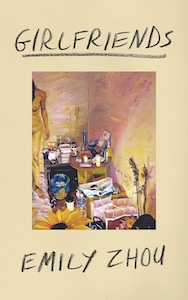
Girlfriends is a collection of realist short stories mostly about trans women in their early to mid twenties. It’s set in Ann Arbor, Michigan (where I grew up and went to college), and in New York City (where I have lived since 2021). My goal was to depict life in these places in a naturalistic but forgiving way, and show how young trans girls make their ways through social worlds that uncomfortably and incompletely accommodate us. Most of my characters are a few months to years into gender transitions that coincided with broader coming-of-age points in life, and are usually engaged in figuring out what to do next and experimenting with their senses of self. It’s a chatty book, light on plot, mostly pretty understated with a few moments of heightened emotion and drama. 

What books by trans authors have been influential to you and why?

One of the things that made me want to write fiction was my discovery of Topside Press’s catalog. In college I read a lot of queer theory, and I had become accustomed to primarily looking at transness as a sociopolitical phenomenon, examined from the outside. The Topside writers wanted a different way to write about trans people—not merely “telling our own stories,” but making art out of them and in so doing asserting agency over the domain of culture. In particular, Casey Plett’s book A Safe Girl to Love made me realize that I had something to say. (Casey later became the editor of Girlfriends at LittlePuss.) Her stories have a sort of understated, resonant emotional depth that I still aspire to in my own work, and they’re closely focused on the meaning locked in ordinary experience, memory, and friendship. I continue to learn a lot from her work. 

When I moved to New York I came to understand that there was a much wider world of experimental trans writing that had sprung up after Topside folded. One of the books that people told me to read was hannah baer’s memoir Trans Girl Suicide Museum, which made a big impression on me. Close to the beginning, she writes that she isn’t trying to write a “good book” or polish her thoughts to make them more coherent and digestible, and I think the spontaneous, thinking-out-loud quality the book has works in its favor—it feels like having a long, freewheeling conversation with a particularly intelligent and sensitive friend. (And despite what she says, there are some jaw-dropping, bravura passages in it.) In Girlfriends I was frequently trying to capture the quality of in-the-moment thinking and processing (particularly in the final story, “Gap Year”), and I took a lot of cues from baer’s book. 


Soula Emmanuel

Tell us about your path to becoming a writer and publishing your book.

I wrote Wild Geese during Covid, in 2020 and 2021, so it has the pensive and slightly claustrophobic feel of that time, when we couldn’t see each other but it also felt like the world was about to change. I was feeling slightly stuck between two versions of myself then, between the part of me that wanted to change and the part of me dominated by anxiety—all of that is reflected in the novel. Then things moved quite quickly: I won a mentorship place with a literary agency in the U.K. in 2021, and the book was published in 2023, so, ever the anxious person, I didn’t quite have time to have second thoughts about it.

Tell us about your book.

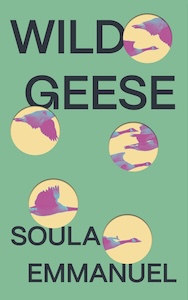
Wild Geese is about a trans woman, Phoebe, who has moved from Dublin to Copenhagen and is about three years into her transition. One evening she is visited by Grace, her ex from before her transition, who shows up unexpectedly at her door. They spend the weekend together, weaving their personal stories into the streets and old buildings of Copenhagen, and it becomes an exploration of how people change, how we can run away from our pasts and how we carry with us different versions of ourselves. It’s kind of a twist on the old Irish emigrant story too: instead of the main character going home, home comes to them, in a very 21st-century way. It has been compared to a trans Before Sunset, which I think is pretty accurate!

What books by trans authors have been influential to you and why?

My favourite trans novel is Little Blue Encyclopedia (for Vivian) by Hazel Jane Plante—a former Lammy winner in this category!—and I love the way she interplays transness with other topics like grief and fandom, to bring out the humanity and nuance of her characters. I also love the writing of Juliet Jacques and Garielle Lutz.


Valérie Bah

Tell us about your path to becoming a writer and publishing your book.

Franky, I’ve had exceptional support! My path to publication started with a fierce ass literary collective and collection called “Les Martiales” conceived by Stéphane Martelly, a poet, scholar and painter who assembled a community of Black women and femme writers. Honestly, she’s doing the Lorde’s work in a very white literary landscape in Québec. 

Also, shoutout to Metonymy Press, a small gay publisher co-founded by Ashley Fortier and Oliver Fugler, who hosted the translation by the artist Kama La Mackerel, who so generously envisioned bringing the book to an anglophone readership. 

Tell us about your book.

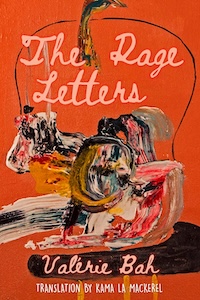
The Rage Letters, translated by Kama La Mackerel, explores the intertwined lives of a group of four Black queer and trans friends living in a Montrealish city. it’s also an experiment in narrative structure, tracing the patterns of their lives through cross sections of their joint experiences. Also, in the original version, I had fun circumventing the conventions of literary French.

What books by trans authors have been influential to you and why?

Love me some Awkaeke Emezi for their unapologetic voice and cosmology. We should all be so daring. Honestly, it was a game changer for me to see them doing their thang. Also, Kai Cheng Thom’s Fierce Femmes and Notorious Liars (also published by Metonymy!) is so real and precious as an intricate love letter to her younger self. That’s very much how I approached The Rage Letters.

Nicola Dinan

Tell us about your path to becoming a writer and publishing your book.

I don’t think I gave myself permission to call myself a writer until I started writing Bellies—a mistake! I’d always loved writing, but never felt “qualified” enough to write a book, until one day I did. The first draft of Bellies came together in seven months, and after another six months of editing I found an agent, and a few months after that there was a book deal on the table. Looking back, it feels like I wrote it in a flurry and with a real sense of urgency—maybe because I hated my day job and loved writing, or maybe because I was scared that there were a million other people with the exact same idea. I write a bit more sensibly now. 

Tell us about your book.

Bellies is the story of Tom and Ming. Tom’s an awkward white boy who had a privileged upbringing in South London (though he’ll do his best to hide it), and Ming is an ebullient playwright from Malaysia who struggles with OCD. They meet at a university drag night and fall quickly in love, as you do when you’re twenty, but when they move to London after graduation to start the next chapter of their lives, Ming comes out as a trans. A relationship seemingly between two gay men becomes something else, and Tom and Ming have to negotiate what that means for them, and where their love for each other goes. 

It’s a story about a relationship facing a potentially insurmountable hurdle, but it’s also a novel about the mess of being in your early twenties. 

What books by trans authors have been influential to you and why?

I wish I had more trans authors to list, but through my own failings, and maybe more critically those of mainstream publishing, I lacked exposure to a wide set of trans authors to draw inspiration from. Detransition, Baby was influential in the sense that I strongly believe it has made the publication of books like Bellies more possible. 

In the lead up to and since publishing Bellies, I’ve read so many more trans authors who inspire me. K. Patrick, Jordy Rosenberg and Kai Cheng Thom, to name a few. 


Sylvia Aguilar-Zéleny

Tell us about your path to becoming a writer and publishing your book.

I started teaching literature for high school students in the early 2000’s, I had always been an avid reader and, I guess, a storyteller. I liked writing short-stories and would publish some here and there back in Mexico, where I am from. Becoming a writer was not something I was pursuing, I like believing is something that happened to me, something that I started doing as a need to put my creativity (and my anxiety!) to work. 

I moved to El Paso in 2010 to do my MFA, and the program but most importantly, the life at this border gave the tools, the space, and most importantly, the motivation to write this novel. It was first published in Spain with Tránsito Editorial, but I knew I wanted to see it in English with Deep Vellum, I admired their catalogue and their work; they sorta knew me because of The Everything I Have Losta novel I wrote in English and published with Cinco Puntos Press. Deep Vellum proposed JD Pluecker to translate this book, and it was the best decision ever because JD had long conversations with me and involved me in the process in more than one way.

Tell us about your book.

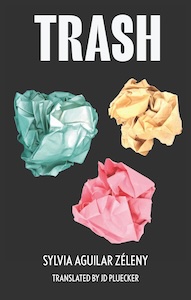
Trash interweaves the experiences and voices of three very different women whose life or work moves around the municipal dumpsite of Ciudad Juárez, México. A teenager orphan who has always lived and worked at this place, a scientist who is researching the site, and a transwoman who manages and cares a group of sex-workers become the protagonists of this attempt to observe the complexities of survival, love, violence, at the Mexico-U.S. border.

What books by trans authors have been influential to you and why?

I read Las Biuty Queens by Iván Monalisa Ojeda, a short-story collection/episodic novel when I had the first draft of Trash. My novel is all about voice and characterization and Ojeda does a great job in recreating the life of the cuir latina community in New York.

Trans: A Memoir by Juliet Jacques is probably the first memoir I read about a transwoman, it is a coming of age that brings attention to the loneliness, the struggle, and the violence trans and in general LGBT + community endures; but at the same time, it is an example of love, resistance, and community.

13 Queer Thrillers and Mystery Novels You Should Be Reading

In the past few years, books written by and about queer characters have become more visible to the general reading public. Gradually, straight, cisgender readers are discovering the pleasure of reading books by authors whose identities are different from their own. This is true in the mystery and thriller reading world as well. 

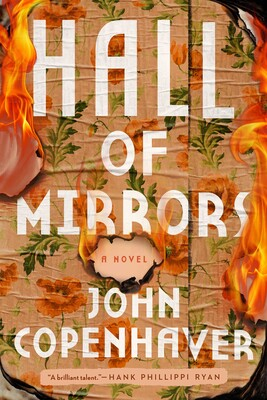
In my new novel, Hall of Mirrors, a mystery set in 1954 Washington, D.C., about two gay writers who co-author hard-boiled detective fiction under the macho moniker Ray Kane, I explore writing from the closet, the complexity of inventing a false persona to sell books, which in the 1950s was often necessary to find broad appeal to consumers, not to mention to avoid being discriminated against and persecuted. Thankfully, today, things have changed (for the most part), and readers of all types are reaching for queer books precisely because they want to read LGBTQIA+ characters (assuming a book ban doesn’t block their ability to access these books). 

Of course, prejudice still exists, and the grooves of unconscious bias take time to change; the specious idea that queer books are inferior is lodged deep in some. Book lists, however, should be made from a place of hope, so with that in mind, I’ve culled a list of the most influential queer crime novels published in the past four years. As with all lists, this one is incomplete, and I’ve had to leave out great writers. For more recommendations, check out Queer Crime Writers, an organization I co-founded to promote community among queer crime fiction authors and celebrate LGBTQIA+ crime books.  

Each of the novels below is by a queer writer about queer characters. I selected them because, in some way, they speak to the history of queer mysteries and thrillers, tell us something about crime fiction today, and of course, because they are great books. Dig in, start anywhere. You won’t be sorry. 

The Lost Americans by Chris Bollen

Bollen’s most recent stand-alone thriller follows Cate Castle as she travels to Cairo to investigate her brother Eric’s suspicious death, a fall from a hotel balcony that the local authorities have deemed a suicide. Eric works for a shady corporation, Polestar, that supplies missiles to authoritarian governments. When Cate orders an autopsy on Eric’s body, the result points to foul play, and despite Polestar’s intimidation tactics, she heads to the Middle East. In Egypt, she teams up with a gay, Western-educated Egyptian, Omar. They work together to unwind the mystery, which has the ambiance of a Graham Greene novel, the twists and turns of an Agatha Christie tale, and an ending with lasting emotional resonance. It’s a compelling exploration of how it feels to be queer in a country where widespread legal and cultural discrimination is the norm.

Whereabouts Unknown by Meredith Doench

In this police procedural about missing teenage girls in Ohio, Doench creates memorable characters in Detective Theodora (Theo) Madsen and her pregnant partner, Bree. When Theo gets injured during a routine interview, she must navigate convalescing, her new role as a parent, and, of course, finding the missing girls. One of the missing girls, Annabelle, a point-of-view character, is trapped in a terrifying situation, keeping the tension high and storytelling brisk. Doench carefully constructs her characters to reveal their humanity, give the reader compelling insight into lesbian parenthood, and deepen our understanding of Theo’s ability to do her job despite the physical challenges brought on by her injury. We’re invited to think about ablism and chronic illness and how those limitations play out in professional crimefighting.

Real Bad Things by Kelly J. Ford

Ford’s Real Bad Things is a queer homecoming novel and gritty rural noir. Jane Mooney fled her hometown of Maud Bottoms, Arkansas, to Boston after she, as a teenager, confessed to killing her abusive stepfather. His body was never found, so she was never convicted; she wasn’t even believed. Now, a body has surfaced after a flood in the Arkansas River and is suspected to be the stepfather’s. Jane returns to surrender to the police and do her time, a penance she feels she must pay. Of course, it’s never that simple: she must confront her vengeful mother, who rejected her, reconnect with other estranged friends and family, and reunite with the woman she once loved—getting to the truth of what happened means, as it does for many queer people, confronting the past. Indeed, you can go home again, but if you do, watch out.  

Scorched Grace by Margot Douaihy

In Douaihy’s first in a series, Sister Holiday, a tatted, chain-smoking nun, steps forward as a genuinely original queer protagonist. Set in New Orleans, Holiday teaches music at Saint Sebastian’s, a school adjacent to her convent, retreating from the chaos of her life as a punk rocker. When an arsonist strikes and someone is killed, she discovers she has a knack for solving crime, a nose for corruption, and a strong desire for justice. It’s easy to see what makes Holiday singular on the surface, but the juxtaposition of the narrative’s noir sensibility—a fatalism the subgenre is well known for—and Holiday’s earnest spirituality blends Philip Marlowe’s tough-minded, world-wear outlook with something akin to Christian existentialism. The result is a queer character full of contradictions, emotional complexity, and—you guessed it—surprises. 

Survivor’s Guilt by Robyn Gigl

Gigl’s second in the series, Survivor’s Guilt—named one of Time Magazine’s best mysteries and thrillers of all time—continues her legal thrillers anchored by the transgender defense attorney, Erin McCabe. When millionaire businessman Charles Parsons commits suicide, it seems like an open-and-shut case until a voice recording implicates his adoptive daughter Ann, who confesses and pleads guilty. Even after McCabe and her law partner Duane Swisher discover that Ann is a trans woman, they’re reluctant to take the case. Lucky for us, they do. After convincing Ann to withdraw her plea, they set out to clear her name, even as she keeps secrets from them. Eventually, the case takes them into the dark territory of sex trafficking. Erin McCabe allows Gigl, also a trans attorney, to discuss issues, both major and minor, that impact transgender people; through her inventive storytelling, we understand how poorly the legal system functions to protect them. 

Warn Me When It’s Time by Cheryl Head

While Head’s stand-alone Time’s Undoing has received much-deserved positive press, her Charlie Mack Motown series offers us her most memorable queer character: P.I. Charlie Mack, a cis Black lesbian, is one of the few intersectional queer characters in crime fiction. She’s tough-minded, intelligent, flawed, and sensitive; she must navigate everything from complex criminal schemes to her mother’s early-onset Alzheimer’s. In Warn Me When It’s Time, her sixth in the series, she takes on a hate group claiming responsibility for arsons and robberies at mosques, temples, and Black churches in Detroit. Head brilliantly traces the origins of systemic bigotry from the ground-level violence and into the shining halls of the government.

Bury Me In Shadows by Greg Herren

One of queer crime fiction’s most prolific and decorated writers, Herren takes a turn to the Southern Gothic in this YA novel. After a drug and alcohol binge, gay college student Jake Chapman is sent to his grandmother’s decaying home in rural Alabama adjacent to the ruins of an old plantation. During an archaeological team’s excavation on the plantation grounds to uncover the truth of a family legend, they find a skeleton. Soon, his family’s dark past begins to surface, bringing very present danger to his doorstep. Herren imbues the novel with rich details about the town and its multilayered history. Like any good gothic novel, the setting here, with its lush details and shadow-drenched landscape, conveys a palpable mood. 

Once You Go This Far by Kristen Lepionka

In Lepionka’s fourth P.I. Roxane Weary novel, school nurse Rebecca Newsome dies in a fall while hiking, but her daughter Maggie doesn’t believe it’s an accident; she suspects Rebecca’s ex-husband, a well-connected cop. She hires Weary, and the case takes the investigator down many paths, including to a fundamentalist church, a Canadian casino, and a women’s health organization run by a charismatic politician. Throughout the series, Lepionka juggles complex plotting with layered character development, anchored by Weary, who is bi, navigates a complex romantic life, and wears a tough exterior over a flawed and vulnerable interior. Her desire to solve crimes and find lasting love are threaded together believably, making for a genuinely memorable queer crime fighter.

Red Market by Dharma Kelleher

In this fifth novel in the Jinx Ballou series, Kelleher takes her Phoenix-based trans bounty hunter, Jinx, into grim terrain: the illegal selling of cadavers. When she’s hired to track down the body broker, and he ends up dead, she’s the prime suspect. As with the other books in this vivid and gritty series, Jinx is an unforgettable queer crime fiction protagonist. She’s a tough, powerful trans woman who takes action and propels the story forward at a breathless pace. Woven between carnage and plot twists, Kelleher, a trans woman, exposes the injustices visited on trans people with great sensitivity and without being didactic. There’s tenderness and authenticity under the leather-studded surface of all her novels.

Lies With Man by Michael Nava

Set in Los Angeles during the mid ’80s, the ninth Henry Rios novel concerns an initiative that right-wing Christians have placed on the November 1986 ballot, which would grant the health department the right to force people with HIV into quarantine camps. Latino defense attorney Rios agrees to serve as counsel for a group of peaceful young queer activists opposing the initiative. When a bomb at an evangelical church kills its pastor, one of Rios’s activist clients faces the death penalty. Like many of the novels in Nava’s award-winning series, Lies With Man explores complex morality and social justice through a legal thriller. It accomplishes what the best historical fiction should achieve: telling a compelling story that shows how the present reflects the past. As always, Rios is our compassionate and flawed guide through these troubled times, which still haunt us today.

Devil’s Chew Toy by Rob Osler

Of course, not all crime fiction needs to be dark and brooding. After all, humor and wit describe queer life as much, if not more, than adversity.  In Osler’s debut, we meet Seattle teacher and part-time blogger Hayden McCall, whose crush, go-go boy Camilo Rodriguez, has mysteriously vanished. Camilo is a “Dreamer” whose family was deported and whose sister has returned to Venezuela with them. Concerned that the police won’t take his disappearance seriously, McCall teams up with his friends—Hollister and Burley—to track down Camilo. With brisk pacing and hilarious situations—they discover the first clue at a pet store called Barkingham Palace—Osler designs a caper that’s both diverting and equally substantive, proving that a story can embrace levity without being fluff. 

Lavender House by Lev A.C. Rosen

In the first of Rosen’s historical series set in 1954 and inspired by the hard-boiled crime fiction of the ‘30s and ‘40s, Irene Lamontaine’s widow hires Evander “Andy” Mills to investigate her wife’s death. Mills has been recently fired from the San Francisco police department for being caught at a gay bar during a raid. The titular Lavender House refers to the Lamontaine estate, built with money from the Lamontaine soap empire, that serves as a queer paradise where all its inhabitants are free to be themselves. Of course, even within the walls of Lavender House, greed, jealousy, and murder exist, and Andy must discover the truth. Rosen blends hard-boiled aesthetics with a queer viewpoint, celebrating the cornerstone of American detective fiction while challenging it.

Bath Haus by P. J. Vernon

One of the most commercially successful queer thrillers in recent years, Vernon’s Bath Haus, explores the dark side of contemporary gay relationships. Oliver Park has everything that should make him happy: his partner, Nathan, a handsome, attentive, and wealthy trauma surgeon; a sprawling townhouse in Washington, D.C.; and, after years of struggling with addiction, his sobriety. So, when he seeks out anonymous sex at a local bathhouse and nearly dies at the hands of his hook-up partner, his life begins to unravel in dangerous and unsettling ways. This novel struck a nerve in part because of its titillating subject matter, in part because of its clever twists, and in part because of its complicated and sympathetic central character, a flawed queer man fighting for agency in his life.

I Saw Myself in the Intense Longing and Love Portrayed in “Fried Green Tomatoes” 

When my sixth-grade crush told me she didn’t want to partner up with me for a class project, I was quietly heartbroken. I didn’t yet know I was queer, but I knew I was devastated. Reeling from the loss of my closest friend (and imagined future wife), I did what I always do in times of crisis: I turned to a book. 

My mother had a copy of Fannie Flagg’s 1987 novel Fried Green Tomatoes at the Whistle Stop Café, so I picked it up and started to read. Evelyn Couch, a lonely empty-nester searching for purpose, meets Ninny Threadgoode at the retirement home where her mother-in-law lives. Ninny is a spunky chatterbox who soon draws Evelyn in by sharing her stories of life in Depression-era Alabama, including anecdotes about the lesbian couple who owned the Whistle Stop Café: the slyly charming Idgie Threadgoode (Ninny’s sister-in-law) and the angelic but strong Ruth Jamison.

Like Evelyn, I was quickly captivated by the stories of Idgie and Ruth’s bravery as two queer women, who ran a business together, raised a child together and stood up against racism in the South during the 1920s and 1930s. Idgie and Ruth’s devotion to one other, along with the pure joy they found in each other’s company, reflected how I felt when I experienced these strange pre-adolescent sparks with other girls my age. The intense longing and love described in the books felt like a recognition I had long been seeking.

Before I even knew I was the B in LGBTQIA+, I was writing short stories about running away with the other little girls in my class, who were mostly outgoing tomboys, while I was quieter and girlier. I wanted to spend all my time with them: protecting them, working side by side in school (like Idgie and Ruth did in their café), hearing their secrets and telling them mine. I wasn’t always sure what to do with these feelings, and Fried Green Tomatoes at the Whistle Stop Café provided me with some context. 

Fried Green Tomatoes, the book’s 1991 film adaptation, is currently enjoying a renaissance as new fans discover it on Netflix and fans from its heyday do nostalgic rewatches. Before my own rewatch, I turned back to Flagg’s source material, and I was immediately transported back to my thorny pre-teen years, which were filled with confused queer longing.

The book is even more explicit about Idgie and Ruth’s relationship than I remembered. When Ruth comes to stay with Idgie’s family one summer (at the time, Idgie is around 15 or 16; Ruth is around 21 or 22), Idgie’s open-hearted mother cautions her other children against mocking Idgie’s nervousness around Ruth, telling them, “Now, children, your sister has a crush, and I don’t want one person to laugh at her.” The fact that her crush is on a young woman like herself isn’t acknowledged; it’s treated like a normal crush that any angsty adolescent would have. Her siblings giggle at Idgie’s awkward behavior just as if her crush were a heteronormative one.

To my surprise, some of my friends who were happy to revisit the film did not know it was a queer love story. Or should it really be a surprise? While Flagg (an out and proud lesbian) makes it clear in her novel that the women are in a romantic relationship, the movie was subtle enough for the romance not to be read at all. In fact, the sweet, goofy food fight scene between Idgie and Ruth in the film was described by Jon Avnet, the director of the film adaptation, as a “love scene” during his director’s commentary on the DVD. If that’s the love scene, it’s no wonder people didn’t read their relationships as a romantic one.

I was writing short stories about running away with the other little girls in my class.

Something else surprised me, too. While I was more or less prepared to be hit with the bittersweet nostalgia of being a confused bisexual kid, I didn’t realize that my 40-year-old self would reread the novel (which I had read at least a dozen times in my childhood) and appreciate it for a completely different reason. 

While I did read the sections about Evelyn’s descent into menopause as a kid, I did not completely get it. Evelyn confides in Ninny, “I’m too young to be old and too old to be young.” As an 11-year-old, my understanding of that sentence was very surface level. Sure: Middle age is in the middle. 

Now, as a premenopausal woman myself, I read that sentence and get a chill. This was my older self mirrored back to me by Flagg’s iconic novel: I was no longer a lovelorn child, but a woman on the verge of… something. 

Evelyn is in a deep depression when the book begins. Her moods drop so low that she daydreams about death by suicide. As Flagg says, “Evelen was forty-eight years old and she had gotten lost somewhere along the way.” Evelyn is also obsessed with the ideas of pain and death. She also has what I think of as a healthy distrust of doctors.

“She wondered why she had to live in a body that would get old and break down and feel pain… While she had been in the throes of labor pains… her obstetrician had stood there and lied to her face. ‘Mrs. Couch, you’re going to forget these pains as soon as you see that baby of yours. So push a little harder. You won’t even remember this, trust me.’

WRONG! She remembered every pain, right down the line.”

I have experienced my share of doctors being obtuse or simply being ignorant of the realities of life as a person with a uterus. Evelyn’s dismissive doctor reminded me of some of mine, doctors who’d misdiagnosed or dismissed my painful symptoms of endometriosis, uterine fibroids and premenstrual dysphoric disorder (PMDD) for years. 

Like Evelyn, I am weary of doctors – I’ve encountered so many who don’t listen, especially when it comes to women’s health. I didn’t realize it when I was a tween obsessively reading Flagg’s novel, but Evelyn Couch was the first woman I encountered in fiction who called out how callous (and ill-informed) the medical system can be when it comes to menstruation, childbirth and menopause.

I went to many, many different gynecologists who shrugged off my extensive list of symptoms, chalking everything up to “normal” period pain. I felt powerless, just as Evelyn did. Having pain doubted, brushed off or diminished by medical professionals is a sadly common and demeaning experience faced by women, and particularly Black women. 

At the nursing home where Evelyn and Ninny meet, the only employee mentioned by name is Geneene, a Black nurse who takes care of the residents. While she makes few appearances in the book (and movie), she represents the medical community at the nursing home. Earlier in the book’s timeline, Onzell, a Black woman who works at the café along with her husband Big George, takes on the role of medical caretaker when cancer overwhelms Ruth. When Ruth becomes bedridden, Ninny tells Evelyn, “Onzell moved into the room with her and never left her side.” In fact, Onzell is the only person with Ruth when she passes away; when Ruth is ready, Onzell is brave enough to give her the morphine that will release her from her pain. Whether by coincidence or design, Black women are the trusted medical professionals in this story, and they treat their patients with the respect and dignity that is so often lacking in the medical establishment. 

I was no longer a lovelorn child, but a woman on the verge of… something.

Ninny gives Evelyn these inspiring stories of the little town of Whistle Stop, but she also gives her something else. When the older woman discovers Evelyn in tears at the nursing home, she quizzes her about her symptoms and quickly gives her a diagnosis: “You’re just going through a bad case of menopause, that’s all that’s the matter with you. What you need is to take your hormones and to get out every day and walk in the fresh air and walk yourself right through it.”

And she’s right! Much of Evelyn’s dark moods and hopelessness has to do with her fluctuating hormone levels. When Ninny gave Evelyn this advice, I remembered the relief I felt when a wise doctor pointed out to me that the horrifying and self-destructive mood swings I’d have around my menstrual cycle were actually the result of PMDD. It is always helpful to have validation when you’re constantly questioning your own sanity. My doctor provided that for me, and Ninny provided this for Evelyn. Ninny’s words of wisdom and support help Evelyn cope with her own changing body and mind as she goes into the next stage of her life.

Only in the last 10 years has menopause (and uterus-having people’s health in general) really taken a turn in the spotlight. When Flagg’s book was published in the late eighties, things like menstruation, menopause, reproductive issues and women’s aging weren’t common in literature, television or film – the obvious exception being the forward-thinking The Golden Girls, which premiered in 1985.

Reading about menopause in Flagg’s novel and watching the characters discuss it in the film adaptation didn’t completely absorb into my brain as a child. Rereading and rewatching these scenes as an adult, I was stunned by how effective they were – and how little effect they had on me when I initially came across them. It felt as though Flagg had left coded messages – the ink wasn’t invisible, but it was essentially indecipherable to me at the time I first read it. 

There are pieces of art that can have vastly different impacts on us throughout life. J.D. Salinger’s The Catcher in the Rye is a good example of a book children and teens often find pivotal, but rereading it as an adult might leave you with a less charitable understanding of the infamous Holden Caulfield. Reading Fried Green Tomatoes at the Whistle Stop Café as an adult, I realized I was now closer to Evelyn’s age than Idgie and Ruth’s during the lion’s share of the story. It felt magical to revisit this much-loved story after decades away and still find something new. Instead of eye-rolling as I had done when I reread The Catcher in the Rye (sorry, Holden; Phoebe, you’re still amazing), I felt I had access to a secret that had been hiding in plain sight for years. There are layers to Flagg’s work that I’m only now discovering.

It is always helpful to have validation when you’re constantly questioning your own sanity.

I was also able to look back at my pre-teen self a bit more tenderly. After my one-time crush rebuffed me (she ended up being queer, too, as it turns out), I found myself in yet another intense friendship with a girl my age who was similarly obsessed with Fried Green Tomatoes. What luck! We even called each other Idgie (her) and Ruth (me) – to date the most lesbian thing I’ve ever done. One of us often brought our copy of the book to school, and we’d quote our favorite parts, like Ruth quoting the Biblical Book of Ruth to Idgie in a letter in order to let her know she was ready to leave her abusive husband in Georgia and return home to Idgie:

“And Ruth said, Intreat me not to leave three, or to return from following after thee: for whither thou goest, I will go; and where thou lodgest, I will lodge; thy people shall be my people, and thy God my God.”

(It’s worth noting that Idgie’s mother continued to be supportive of Ruth and Idgie’s relationship throughout; when Idgie brings Ruth back home to Alabama, Idgie’s mother tells her,  “Poppa and I just want you to know that we think of you as one of the family now, and we couldn’t be happier for our little girl to have such a sweet companion as you.” Her support also upends cultural assumptions – this acceptance took place in the South in 1928.)

Although it sometimes feels strange to have “outlived” the versions of Idgie and Ruth whom I idolized in my youth, it also feels like coming full circle. After Idgie famously charms bees in order to get a honeycomb, Ruth (who is meant to be impressed) instead breaks down in tears. She was more worried about Idgie’s life than impressed by her swaggering bravado. And at that moment, her feelings for Idgie became crystal clear.

“When Idgie had grinned at her and tried to hand her that jar of honey, all these feelings that she had been trying to hold back came flooding though her, and it was at that second in time that she knew she loved Idgie with all her heart…. She had no idea why she wanted to be with Idgie more than anybody else on this earth, but she did.”

Now, as my older self, I could look back kindly at my youthful yearning and feel some compassion for the young girl who was always searching for a fearless tomboy to run off with. I no longer feel embarrassed or sad for the confused pre-teen (and to be honest, teen and early twentysomething) who squinted until she was able to shape the person in front of her into their perfect partner. 

When Fried Green Tomatoes at the Whistle Stop Café was published, young queer people like me gained some comfort from reading about Idgie and Ruth’s relationship. Now women Evelyn’s age can also see their own experiences reflected back at them. As I’m preparing for the changes ahead of me in my forties, I’m thrilled to see that Fried Green Tomatoes at the Whistle Stop Café had been there to guide me all along. 

In an era where regressive book banning has reared its ugly head, it’s all the more important to highlight stories like Fried Green Tomatoes at the Whistle Stop Café. Right-wing politicians and ordinary citizens claim they seek to protect children by banning books, but the only thing they’re “protecting” kids from is knowledge. And at worst, banning books makes it much more difficult for kids (and adults) to get ahold of the stories that might make a difference in their lives. 

I felt I had access to a secret that had been hiding in plain sight for years.

To see one’s self and community represented in art – whether it’s books, film, music or anything else – is validating; it lets readers know that they’re seen, and that they’re not alone. When I opened Fried Green Tomatoes at the Whistle Stop Café as an angsty pre-teen, I had no idea that it would nudge open the door to my happily queer life. When I reread it this year, I felt a rush of validation when I saw my frustrations with doctors and the health care system (and my experiences with a misbehaving uterus) reflected back at me. 

Back when Fried Green Tomatoes at the Whistle Stop Café was originally published in 1987, I can imagine that discussions of LGBTQ+ lifestyles and reproductive health issues were much more muted. How many other women picked up this best-seller and recognized themselves in the characters Flagg created? How many other people were able to connect with the book (and film) and be themselves more fully?

As a kid, I was able to turn to the book and its film adaptation, and see a little of myself there. I wasn’t aligned fully with either the extra feminine Ruth or the rakish Idgie, but the feelings they had for one another rang true. Meeting them was the first time I knowingly encountered queer characters. What if I hadn’t had that experience? What if I didn’t find this window into a different kind of relationship? Being introduced to the possibility of an LGBTQ+ life was a turning point; I can’t imagine how much harder it would’ve been to grapple with my romantic yearnings without the help of Flagg’s groundbreaking novel. With Ruth and Idgie, I knew I was not alone. 

With Fried Green Tomatoes having been added to Netflix at a time when queer stories are being threatened every day, it represents much more than a fun nostalgic rewatch. It reminds people of the courage it takes to live openly and stand up for their beliefs. Just as Ruth and Idgie inspired Evelyn, the book and film will continue to open up possibilities for readers and viewers, no matter who they are or where they are in their life. 

7 Books to Help You Battle Burnout

In my twenties, I was convinced I had a dream job. For five years I worked as a social media manager for a media non-profit that sent me around the world to cover its conferences online. The keg in the office kitchen became the center of my social life, and I regularly worked late as my team tracked PR crises and moderated Facebook comments. I was invested in the organization’s mission, and I truly believed we were changing the world. But the role came with costs: because social media never sleeps, I was always online, even when technically off the clock. The lack of boundaries and my emotional investment in my work meant that over time, stress ravaged my mental and physical health. Despite an emergency room visit, frequent panic attacks, and migraines from constantly clenching my jaw, I could not see that my job had taken over my life. It was only when I quit that I understood I was overworked and dealing with a dangerous case of burnout.

Burnout is a kind of physical and emotional exhaustion caused by being completely overextended, usually by work or caregiving. It can look like fatigue, hopelessness, a lack of motivation, even cynicism and anger. In my case, burnout overlapped with my depression and anxiety and turned me into a cranky, ashamed mess. I was lucky that I could afford to take time off after quitting, but I learned quickly that curing burnout isn’t as easy as bubble baths and hiking. Burnout isn’t an individual failure, it’s the result of how our economy and our workplaces are structured. We need to call burnout what it is: a workplace hazard and a labor issue.

In my novel But How Are You, Really, executive assistant Charlotte Thorne is forced to face her burnout when she attends a college reunion and her friends pick up on her despair. Layoffs and economic strain have pushed her into a job that sounds impressive but is actually exploitative and humiliating. As she reconnects with other alumni and the woman she once thought she would grow up to be, Charlotte wonders what success means to her—and if the burnout is even remotely worth it. 

Here are seven books that helped me understand burnout, from how to avoid it, to the toxic work cultures that cause it. 

Burnout: The Secret to Unlocking the Stress Cycle by Emily and Amelia Nagoski

Twins Emily and Amelia Nagoski teamed up to write Burnout: The Secret to Unlocking the Stress Cycle, a holistic look at the biological phenomenon of stress and how it lives in women’s bodies. They make the case that unprocessed stress from work and family life compounds on itself and gradually turns into burnout. A key way to prevent burnout is to help your body complete the activated stress response cycle by releasing the adrenaline and cortisol we feel during a difficult workday instead of storing it up. Physical activity like running, dancing, or even tightening your muscles and releasing them can help your body understand that the stressor has passed and it’s safe to let go of all that tension. 

Digital Minimalism: Choosing a Focused Life in a Noisy World by Cal Newport

In the era of smartphones, it’s nigh impossible to log off. As a result, it’s hard to create boundaries between work time and free time, between our private lives and our public profiles. Rather than encouraging digital detoxes or purging all wifi connectivity, Cal Newport wants us to use technology in ways that better align with our values, our goals and our happiness. In Digital Minimalism: Choosing a Focused Life in a Noisy World, he argues that digital life has stolen our solitude from us, and we need to take back those quiet moments of reflection where we are alone with our thoughts. Newport’s book is a practical guide that focuses on what is within your power as an individual. Creating space in your day free from stimulation and constant notifications is a powerful preventative step against burnout. 

Rest Is Resistance: A Manifesto by Tricia Hersey

Self care rooted in buying little treats and expensive vacations will not save us from burnout, but a true commitment to rest can. In Resistance: A Manifesto, Tricia Hersey urges us to nap, daydream and breathe in order to reclaim our bodies as our own, as opposed to machines that must grind and labor. Her Nap Ministry is rooted in black womanist thought and traces the long history of rest and daydreaming as radical resistance to white supremacy and capitalism. This beautiful book resembles a sermon for the overworked and isolated. “We must lighten our loads,” Hersey writes. “Survival is not the end goal for liberation. We must thrive. We must rest.” It is an open and urgent invitation to reject the idea that our value is tied to our productivity, rather than our humanity. 

An Ordinary Age: Finding Your Way In a World That Expects Exceptional by Rainesford Stauffer

One cause of burnout is the pressure we face to perfect our lives as we grow up, from building extraordinary careers to performing our “best lives” for the approval of others. In An Ordinary Age: Finding Your Way In a World That Expects Exceptional, Rainesford Stauffer unpacks the expectation that we will move away from home, build an extraordinary career, find the perfect romantic partner, and other milestones that have become increasingly unattainable for millennials and Generation Z. Rainesford grants us permission to reconsider the myths we have been fed about success, and to re-define what happiness and “being enough” means for us. It’s possible that a brag-worthy career that toasts us to a crisp isn’t in line with the life that truly brings us joy and connection.

Can’t Even: How Millennials Became the Burnout Generation by Anne Helen Petersen

Anne Helen Petersen’s viral BuzzFeed news article “How Millennials Became The Burnout Generation” introduced the concept of burnout to millions of readers. Her 2021 nonfiction book Can’t Even picks up the thread of economic precarity and the myth that everything will work out if we just try hard enough. Petersen makes it clear that burnout is the psychological result of overwork. While burnout has always existed, the millennial generation is being crushed by economic forces beyond their control: student debt, low wages and a shift to contract work, soaring housing and childcare costs, and overall downward mobility. A common symptom of burnout is what she jokingly refers to as “errand paralysis,” the dread and exhaustion many folks feel about high-effort, low-gratification tasks that lurk on our to-do lists, like mailing packages and submitting insurance claims. Petersen frames burnout as a societal problem as opposed to an individual crisis. “I can’t fix you when it’s society that’s broken you,” Petersen writes. “Instead, I’ve tried to provide a lens for you to see yourself and the world around you clearly.”

Work Won’t Love You Back: How Devotion to Our Jobs Keeps Us Exploited, Exhausted, and Alone by Sarah Jaffe

Corporate culture urges us to see our companies as a family, and our careers as sources of deep purpose and satisfaction. That pressure to “love” our job is a big contributor to burnout. But that hasn’t always been the case. Sarah Jaffe’s Work Won’t Love You Back: How Devotion to Our Jobs Keeps Us Exploited, Exhausted, and Alone reveals that the expectation that we love our work is a relatively new phenomenon rooted in neoliberalism. This elevation of work encourages us to put our companies before ourselves and distracts from our own exploitation. “What is burnout but the feeling experienced when one’s labor of love is anything but,” Jaffe asks. Instead she urges the reader to practice love through solidarity with one another. After all, work cannot love you back because it is not a living human being.

The Good Enough Job: Reclaiming Life from Work by Simone Stolzoff

Building on the work of Sarah Jaffee, Simone Stolzoff asks what a healthy relationship to employment can look like. In The Good Enough Job: Reclaiming Life from Work Simone Stolzoff traces the narratives that convince us that overwork is the only way to achieve happiness, success, and meaning in life. One pervasive concept is that of the “dream job,” a profession that feels like a personal calling as opposed to labor. This glamorous, even righteous idea of work puts us at risk of disappointment and heartbreak when the dream job doesn’t match our expectations. It can even make it harder to call out systemic issues within the workplace, from low wages to dangerous working conditions. Instead of a dream job, we should pursue the “good enough job.” A good enough job looks different for everyone depending on our needs. It might not offer the same in-office perks as a glamorous job at a tech company, but it won’t offer free dinners to manipulate you into working late either. “The most important thing work has given me—the thing I need it to give to me—is enough money to live,” Stolzoff writes. “A job is an economic contract. It’s an exchange of labor for money. The more clear-eyed we can be about that, the better.”

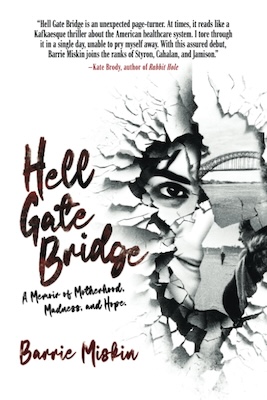
“Hell Gate Bridge” is a Harrowing Account of a Woman’s Battle With a Broken Maternal and Mental Healthcare System

I first met Barrie Miskin in the summer of 2023 in Astoria, about a mile away from the titular Hell Gate Bridge. All I knew then was that she was a writer, and she lived in my old neighborhood. We had coffee at Martha’s Country Bakery and talked about our kids, our teaching careers, and the endless struggle to find writing time. I found her endearing and sweet, and I asked her to send me the memoir she was editing.

When I got the PDF of Hell Gate Bridge, I read it in a single night. It was like watching a horror movie that happened to star my new friend. I wrote her an email the next morning: “Jesus Christ. I can’t believe the bright, funny woman I had coffee with is the same woman who endured this crushing ordeal.”

Hell Gate Bridge is the account of Miskin’s years-long experience battling a dissociative disorder that almost claimed her life. It begins with a very pregnant Miskin checking into a psych ward and descends into a nightmarish tour through our carceral mental healthcare system. She describes feeling as though she is “viewing the world through the scratched and filthy film of a glass box I was locked inside,” and no one can seem to help her get out. Instead, she is prescribed drugs that exacerbate her dissociative symptoms, and she starts learning how to game a broken system to secure her own freedom.

In the book, part of Miskin’s trouble is that her unusual symptoms are mysterious and poorly understood. Eventually, with the help of her psychiatrist father, she figures out her rare diagnosis—Depersonalization Derealization (DPDR)—and finds a specialist who helps her recover. This April, I sat down with Barrie to discuss her disorder, her thoughts on the current state of maternal healthcare, and the process of turning this harrowing experience into a book.


Kate Brody: Depersonalization/derealization: what is it? How did you find your way to that diagnosis? 

Barrie Miskin: I was diagnosed with major depressive disorder and generalized anxiety disorder when I was in my early 20s. I had these brutal panic attacks, and during them I would have the sensation that I was leaving my body and watching everything as if through a dream. I didn’t have a name for it then. It was just part of my panic attacks. 

When I got pregnant, I felt a sense of shame about being on an antidepressant, so I went off the Zoloft I had been taking for fifteen years. Then, my depression and anxiety returned with a vengeance, and I left them untreated for so long that I began to dissociate. Again, I started feeling like I was watching everything through a dream, which I later learned is called derealization. And this time, I went very deep into it. Family and friends became like alien proxies of themselves. Everything was so scary. When I Googled my symptoms, I kept landing on depersonalization/derealization syndrome or DPDR. But there’s no medication or treatment for that diagnosis, so I kept slamming the laptop shut, trying to will it away.

Eventually I had to do a lot of exposure therapy, and what I believe is called radical acceptance. I started thinking of it like Alzheimer’s or MS. Something I’d have to live with forever. But, in the end, since the DPDR occurred within the context of pregnancy, I did end up getting well. I got lucky.

KB: At what point in that process did you start conceiving of this experience as a story that you wanted to write?

BM: Once I was able to find a therapist who treated dissociative disorders, we had a really long road to recovery—about two years. That whole time I wasn’t conceiving of it as a story; I just wanted to get better. 

About a year after I felt like I had fully returned to myself, my psychiatrist suggested that I take a writing class and explore the experience in that way. I enrolled into the Intro to Memoir class at the 92nd Street Y with Sarah Perry, which was life-changing.

I’ve always turned to books to help me feel less so. When I was sick though, I couldn’t find anything to match what I was going through. Once I picked up some momentum in my writing class, I started to get the idea that my story might become a book, and maybe it could be the book someone else suffering from severe maternal mental illness needed.

KB: One thing that comes up in the book is your grief for your younger self. At one point, you ask Patrick, your husband, “do you remember her?” Obviously, it’s specific to your experience, but I think it also resonates with anyone who’s been severely ill or even more broadly women who feel they lose touch with who they were pre-motherhood. Do you still feel that sense of grief? Have you been able to return to that earlier version of yourself or has some new version emerged?
BM: I feel back to myself as far as my ability to experience joy and my sense of humor. When I was trying to get better, I found myself gravitating towards friends who were 15 years younger. I was mourning our old life in Brooklyn, even though it wasn’t there anymore. All our friends had moved on and had kids. Now that more time has passed, I feel settled. I’m a mom and a wife and someone who’s gone through a major change. I have a confidence in myself that I didn’t have before. I’m a writer, which came as a surprise. Once I started writing, I felt like: I have this for me, this is mine. And I was able to become a part of this amazing, supportive writing community. I was also not expecting that at all.

KB: In terms of writing the book, did you rely on notes or diary entries from your time being sick? Was it mostly drawn from memory or other people’s accounts? How did you put the story together?

BM: I was not taking notes. I could barely read when I was deep in my illness. Once the story got some momentum and I could see that it was taking shape as a book, I relied on my husband and my parents and friends and my psychiatrist to help me piece together details and conversations. I was also able to get the notes from each hospital stay as well as my stay at the clinic. Those were pretty detailed. But honestly, I remembered most of it. I could remember a lot of specific conversations and scenes. When I wrote the first draft, I was in this sweet spot where I had enough space to be objective, but also, it was close enough where I remembered what had happened. 

KB: There’s this heartbreaking moment in the book where you talk about seeing those hospital notes. And there’s this character, Dr. Abrams, who for me was almost a tragically villainous character, because at first, he’s so warm. But then when you see his notes later on, he had written that you were manipulative and inappropriate. I can’t imagine what that was like to go back see the way your trusted medical practitioners were writing about you.

BM: It was shocking. He said I was flirtatious and sexual with him. I mean, I was seven months pregnant and in a psych ward. I had already drafted that section before I received the notes, and he was the hero in that first draft. And then when I got the notes, I felt dirty and disgusting. I curled up in bed after and fell asleep in the middle of the day. I couldn’t believe he saw me in that way. I thought he was trying to help me. 

KB: You touch upon how you went into debt and had to borrow money from family to pay for certain treatments. How do you see class and money having played into your experience? 

The maternal and mental healthcare systems are beyond broken and it’s impossible not to notice the severe injustices within them.

BM: My husband and I are middle class. I’m a teacher; he works in the arts. We live in Queens and rent in a middle-class neighborhood. We are white and educated and come from white, educated middle to upper middle-class families.  We know that puts us in a place of privilege as far as receiving medical care.  I will say, we did go into debt for this care and it took us years and years to pay if off. That being said though, as with most systems in our country, the maternal and mental healthcare systems are beyond broken and it’s impossible not to notice the severe injustices within them. Patients in the psych ward who were white-presenting received care the fastest. All the doctors were white. All the doctors and the patients at the private clinic were white. You can’t unsee that, or turn a blind eye to it. That’s the depressing reality of where we are at right now.

KB: As I was reading, I was feeling so much anxiety that you were putting this all on credit cards. At the same time, I’m thinking, thank God Barrie’s dad is a psychiatrist. You had people who were helping you navigate this and find this obscure diagnosis and the right providers and still you came up against so many obstacles. There’s another world, obviously, where you get stopped at any one of those points. It was harrowing to think that this version of events is maybe the system functioning at its best, and it’s still not functioning very well.

BM: And I’m just there like, could someone please help me? One of my best friends just went through a psychiatric emergency that none of us saw coming. She was relying on me to tell her where to go. I said, go to NYU or Weill Cornell. The rest of the hospital systems, even in a major city like New York are awful. You get treated inhumanely. There’s already so much shame wrapped up in being mentally ill, and then the medical establishment, which is supposed to be there to help you, makes you feel like a criminal instead. 

KB: The way inpatient mental healthcare is first pitched you by your psychiatrist, it sounds nice. You’re like, I’m going to go to the hospital, I’m going to rest and get better. But then immediately what you describe is so different from any hospital experience I’ve ever had. To start with, you’re visibly pregnant and they strip you down, they’re barking orders at you. There is an immediate dehumanization. We treat mentally ill people with such disdain and suspicion, even when they are in the right place, voluntarily seeking help. Did you have any apprehension about writing the book given that stigma, given that you’re still teaching and you have a social life? 

BM: Well, first of all, I use a different last name in my teaching career, which will hopefully deter any students from finding the book. Mostly people have been very supportive, especially my principal and the admin at my school. The people affected by the book have already read it and okayed it. It was definitely was something I had to think about, but the response has actually warmer and more positive than I had anticipated, if anything. 

KB: I’m a teacher, and I found the teaching parts of the book is so wild, because you have to return to this high-stress, high-touch job when you’re obviously not well. There’s just no way for you to take more time off. What was that experience like returning to work when you’re still in the throes of this dissociative disorder?

BM: I was just super lucky, because my boss—I’m going to start crying, because he’s amazing—he wanted to keep me and see me get better. We had co-teachers, and he paired me with one of my close friends and colleagues, and she took the reins. They let me ride it out. I was blank for months. And actually, I have a new job in education. My old boss, my mentor, moved to a different school, and I followed him. 

I had really good union insurance, and we stretched it as far as we could, but we didn’t have enough money. I had to go back to work. I was just lucky to have a really gentle landing and a strong community at the school where I had worked for eight years. It made all the difference.

KB: In the book, the catalyst for this whole episode is that you go off Zoloft when you get pregnant. It’s not medically recommended exactly, but you just feel like it would be best for the baby for whatever reason. And I think everyone who’s been pregnant has had this experience of making choices that are more backed by mommy blogs and peer pressure and vibes than actual science. Is there anything that you like to see emerge in terms of the way we talk about prenatal health care? 

There’s already so much shame wrapped up in being mentally ill, and then the medical establishment, which is supposed to help you, makes you feel like a criminal instead. 

BM: I don’t read mommy blogs anymore. I have not touched a mommy blog. I do not Google a single thing. I am only asking questions of doctors whom I trust. Honestly, I feel like the shame around pharmaceuticals during pregnancy is a way to dehumanize women. I dyed my hair before I knew I was pregnant, and in the hospital, I kept telling people that was the catalyst, even though that’s so ridiculous. I love Emily Oster’s writing around pregnancy. There’s a lot of misinformation out there, but I hope that there is more and more information being brought to light about how pregnant women can take ownership of their bodies. 

KB: Sometimes I feel like we’re making progress, and then other times—

BM: They’re banning abortions. 

KB: Right, as we’re doing this interview, Arizona is reaching back to the 19th century to try to ban abortion. Speaking of, I love the way that Hell Gate Bridge contributes to the conversation around abortion by introducing the idea of a medically, psychologically necessary abortion. The idea that pregnancy doesn’t need to be an imminent physical threat to be endangering your life. It felt very new and necessary.

BM: There is this bizarre notion that your brain and your neurotransmitters and everything going on up there in your head is somehow separate from your body. To me, it’s the same thing. I could die if I were to get pregnant again. And now, there are medications that I’m on that you really can’t take while you’re pregnant. So I’d have to go off my benzodiazepine, and for me, that could mean severe depression or DPDR. I have a daughter, and I have to be a present mom for her. The abortion discourse feels like part of that same misogynistic impulse: don’t dye your hair, don’t eat this, don’t eat that. I have a few friends from the from The Clinic, who were severely depressed and suffering from PPA or bipolar, and they’ve had second children successfully in the intervening years. But that’s a really personal choice. As it should be.

KB: Have you thought about your daughter Nora reading the book in the future? Your love and your desire for her is so powerful and palpable in the book. You talk a little bit about the origin of her name as “light,” and that love does feel like the only glimmer when things are really dark.

BM:  My biggest fear is her reading the book. I am speaking with my psychiatrist about different ways we can approach discussing it with her, but we haven’t really hit on anything yet. It breaks my heart. I didn’t think hard enough about any of this when I was writing the book. I wanted to get the story out, to maybe it could help somebody else. But in my mind, it was always somebody far away. I wasn’t thinking about all my family and friends who are going to read it. 

KB: I wanted to talk about the title a little bit. I lived in Astoria for six years. So immediately, I recognized Hell Gate Bridge. But for people who are unfamiliar, what is it and how did it begin to take on this symbolic power for you? 

I feel like the shame around pharmaceuticals during pregnancy is a way to dehumanize women.

BM: When I was first getting sick, my psychiatrist gave me the sage advice to take walks. So I’d walk to Astoria Park and see the river and have ideation about taking my life. And there was a bridge there with this ominous name, Hell Gate Bridge. It was just always in my mind. I became obsessed with rivers and bridges. And then later in the book, I describe this day I was swimming with my daughter, and I look up and see it there, and I could see that it was just a bridge. You know? And then later, when I was writing the book, I realized that it’s actually from the Dutch hellgat which means “clear passage.” And there was this theme of clarity running through the book. I just want to feel clear. So that stayed with me. 

KB: It reminds me of the end of Darkness Visible, where Styron talks about Dante ascending from Hell: we came forth and once again beheld the stars. Are there books that you feel are like in conversation or related in some way to Hell Gate Bridge

BM: Catherine Cho’s Inferno and Susannah Cahalan’s Brain on Fire were the two that I went back to again and again. Also Suleika Jaouad’s Between Two Kingdoms about her recovery from cancer. My mentor Sarah Perry wrote a book called After the Eclipse about discovering her mother murdered when she was twelve. That stayed with me. I don’t know if these are necessarily in conversation with Hell Gate, but they are the books I kept turning to for comfort. I have a special place in my heart for Sarah Gerard, because hers was the first fiction I could read when I started to get better. She explores mental illness in her writing and gets the surreality of it just right. 

I was drawn to books about medical mysteries more than mental health memoirs, because my illness felt really mysterious for so long. There are a lot of mental health memoirs out there, but often I’d get this completely irrational sense of envy reading them, because those writers had diagnoses. I didn’t, and that made me feel even more alone. 

KB: Towards the end of the book, your sister-in-law, Celine, who has suffered from post-partum depression in the past, basically tells you to get off your ass, and you end up coming around to the idea that it’s great advice.

BM: Celine is a terrifying, a gorgeous French woman, and my psychiatrist is also a gorgeous, terrifying European woman. And they both knew exactly what I needed. I couldn’t have whatever the coddling kind of therapy is. I needed exposure therapy. I had to come around to the idea of: you have to do it yourself. That’s the scariest part of mental illness because I wanted to be taken care of, but you just have to take it step by step. Celine’s advice was basically echoed by my psychiatrist. And it’s what ended up working for me. I lived as if, and that healed me.
The Board Will Decide If I’m Qualified to Live in the Basement

“The Board” by Elif Batuman

The broker hadn’t arrived yet when I arrived at the address of the listing. A cold, fine rain was falling. Glancing up and down the street, I took in a series of garbage cans and recycling bins. The recycling bins also had garbage in them. Two ailing trees, surrounded by weeds, grew in front of the building, alongside some kind of malformed bush. As I paused to examine the bush, which appeared to be planted directly into the sidewalk, it turned to face me, and I realised with astonishment that it was, in fact, the broker: a young and emaciated man in a textured, shrubbery-colored coat.

“The seller will meet us downstairs,” said the broker in a low voice, and turned to enter the building. I followed him up the front stairs, side-stepping a heap of dirty carpets, which shifted, as we passed, to disclose the figure of a sleeping man who, disturbed by our approach, leapt to his feet and began cursing at the top of his lungs. Something in the broker’s posture, as he brushed past the shouting man, made me suspect that the two were not meeting for the first time.

Abruptly ceasing his shouting, the man turned to me. “You have to help me,” he said in a hoarse, pleading voice. “You have to help me with the board.”

His desperation was so striking that I stopped in my tracks, pausing to face him. But, as I was trying to read the expression in his ravaged face, I heard the broker clear his throat. “The seller,” he said, “is waiting.”

Despite the broker’s youth, I knew him to be one of the most sought-after men in his profession. It was something of a mystery that he had even agreed to meet with me, as I hardly had the wherewithal to make a large purchase, and his commission was unlikely to be a spectacular one. It was possible that, in securing this appointment, I had benefited from the advocacy of some person of influence, whose favour I had found for one reason or another, and who had intervened on my behalf. Whether or not this was the case, he was a figure I could hardly afford to alienate.
“You must forgive me,” I told the man. “I’m not able to help.” As I hurried after the broker into the building, I heard the unfortunate fellow resuming his curses behind me.

Circumnavigating an expensive-looking stroller that had been left in the foyer, the broker began to climb the stairs.

“I thought it was a basement unit,” I said.

“Every building is different,” the broker said. “Especially prewar buildings.”

“Surely the custom of putting the basement on the bottom floor has a venerable, even an ancient history,” I said, attempting a note of levity. But the back of the broker’s head betrayed no sign of amusement, and we resumed our climb in silence.

Finally, taking a key from the pocket of his overcoat—which, in the windowless stairwell, bore more resemblance than ever to a coniferous shrub—the broker unlocked one of two doors on the fourth-floor landing, and we passed into a spacious living room with south-facing windows, wooden ceiling beams, and hardwood floors. I paused to inspect the chimney of what appeared to be a working fireplace. But the broker, with scarce regard for the custom stonework, strode through the room and into the hallway.

Proceeding past a master bedroom, and a home office that could easily have accommodated a twin or perhaps even full-sized bed, we arrived at a newly remodeled bathroom. But the broker showed no interest in either the rain forest shower or the reclaimed bronze fixtures. Instead, he opened the linen closet and began removing stacks of plush towels, placing them with care on the vanity. When he had emptied the shelves, he pressed a panel in the back of the closet, which collapsed to reveal a pitch-dark airshaft. Climbing up the two lower shelves, the broker deftly maneuvered his body into the airshaft.

“This is an original detail,” he said, indicating what I saw to be an iron ladder descending into the gloom.


The way down the ladder felt significantly longer than the four stories we had climbed to reach it, and my hands were soon smarting from gripping the iron bars. I congratulated myself on the decision to wear running shoes, rather than the medium-heel Chelsea boots I had been considering. As I was wondering how much farther we had to go, and how far we had already descended—six floors? seven?—the ladder came to an end, leaving me with no choice but to drop several feet to the polished concrete floor. The broker—he was wearing glossy oxblood loafers—had clearly sustained some slight injury to his ankle, which he was doing his best to conceal.

Looking around, I perceived that we were in a moderately sized studio, with Bosch appliances and an exposed brick wall.

“It’s actually a junior one-bedroom,” said the broker, pulling a sliding door from the wall, blocking off the alcove that contained a Murphy bed. Looking around, I understood how the young broker had earned his reputation.

How many of his colleagues would have failed to identify what I now realized was—despite some slight peculiarities, which were, in any case, hardly shocking, given the price—a charming and centrally located apartment? There were, of course, no windows, but the recessed wall lighting gave the living room a homey glow. As I cast an eye over the low divan heaped with colorful cushions, I felt myself shaking off the mood of anxiety left by the long climb down the airshaft.

One corner of the room remained in shadow, and contained a plush dog bed, on which a cashmere blanket had been elegantly tossed. The five years in my childhood during which my family had had the means to keep a standard poodle have been preserved in my memory as the happiest time of my life, and this evidence of a similarly sized creature in residence struck me as an auspicious omen.

In the next moment, it occurred to me to wonder how the dog customarily entered and left the apartment, since it could hardly be expected to climb a six-story ladder. “So, tell me about this ladder,” I said to the broker. “Is that the only way to get in and out?”

“This building is pretty strict with its fire code,” replied the broker—somewhat cryptically, to my mind.

“But how,” I asked, “do they walk the dog?”

I realized, with a start, that what I had taken to be a cashmere blanket was actually the emaciated figure of an aged man with a long beard.

“The dog?”

I gestured toward the dog bed.

“There is no dog,” said the broker, and I realized, with a start, that what I had taken to be a cashmere blanket was actually the emaciated figure of an aged man with a long beard.

“Here we are,” the broker told the man in the dog bed, raising his voice.

“Ah,” said the man, slightly moving his head.

“This is the seller,” the broker told me.

“How fantastic to meet you!” I said, extending my hand. In my eagerness to hide my discomfiture, I had, perhaps, adopted a tone of excessive heartiness. The man looked at my hand, or near it, and briefly seemed about to speak, but did not, in the end, do so. “I love your apartment,” I continued. “It’s just what I’ve been looking for. I’d really given up hope of finding anything like it.”

At these words, the man, seeming to exert superhuman effort, raised his eyes to meet mine. I was surprised by the keenness of his gaze. The broker, seeming to recognize some signal, stepped forward with alacrity, inclining his body toward the dog bed and positioning his ear close to the seller’s face. Having listened in silence for some moments, the broker stood and faced me, and, when he spoke, it was with a newly belligerent note in his voice. “Listen,” he said. “The seller agreed to this viewing for one reason: because we were told you’re not a tire-kicker.”

“I see,” I said, suddenly adrift in a sea of speculations.

They had been told . . . by whom? So someone powerful had been pulling strings on my behalf.

“Are you a serious buyer, or aren’t you?” barked the broker.

I took a deep breath, recognizing that the crucial moment had arrived, and demanded swift action. It occurred to me, as I considered my options, to ask whether the seller had plans to move out—and, if so, whether his physical strength was adequate to their execution. As I was choosing my words, a series of images flickered before my eyes, most of them concerning the circumstances that had made my property search so imperative. I saw the disappointed faces of my family, should I prove unable to remain in this city, on which so many of our hopes depended. Finally, I saw the face of Eveline, our standard poodle. I saw her customary hopeful expression of ready intelligence; I saw her eyes full of pleading, as they had been at our last encounter. How much worse than even the loss of Eveline, if I were forced now to leave the city.

By comparison, I felt, the seller presented a relatively unobjectionable figure, unlikely to cause any disturbance, for example, through loud noises or sudden actions; it was, moreover, a poignant but inarguable fact that whatever inconvenience might be created by his presence was unlikely to be of a long duration.

“I’m a serious buyer,” I said.

The broker nodded briskly. “The board will consider your application,” he said—and, approaching the bed alcove, he opened a closet I had already admired for the number of suits, shirts, and coats it accommodated. Pushing these garments aside, he revealed a narrow passageway, into which he disappeared. 


The assembled board members were seated around an oak table, in a room with leather panels. By some curious effect, the flickering light from the wall fixtures resembled torchlight. As there were no unoccupied chairs, I remained standing.

“Have you ever been a homeowner?” shouted a man with a weathered face and excessively straight posture.

A murmur passed around the table when I admitted that I had not.

“At your age? You’re hardly young,” remarked a woman with pleasantly unkempt salt-and-pepper hair; she wore wooden earrings and a batik dress. The pointedness of her observation was mitigated by a kindly, soothing tone, which I strove to replicate in my reply.

“The time for a new undertaking may come at any age,” I said, smiling.

The woman continued to look at me, now with an expression of serious concern. “I cannot agree,” she said. “No, I cannot agree at all. One does not start new undertakings at any age. To attempt to do so is not just unrealistic, but tragic—a certain sign of some tragedy in the past, if not the future.”

“At any rate,” put in a clean-shaven man in a suit, with a hint of a Central European accent, “we are hardly looking here for adventurers.”

“I understand your concerns,” I said, “and I assure you—”

“You cannot understand,” pronounced an old man at the head of the table, presumably the director of the board.

“Why not, when the concerns are so natural? But you see—”

“It is not only that you yourself have never served on a board, but that you are so far from having been able to do so that, as you yourself just admitted, you have never owned property anywhere—let alone in our city,” said the man in the suit. “What, then, can you understand?”

I glanced at the broker, who was standing some feet behind me, but his total engrossment with his cell phone made it clear that, whatever his stake in its outcome, I could not rely upon his assistance in the interview.

You’re starting to get that you’re not qualified.

“Ladies and gentlemen,” I began. “Friends, if I may.” In truth, I detected no sign of friendliness on any of the faces turned toward me, so that this form of address was dictated more by wishful thinking than by any aim towards accuracy. “It is true that I have not owned property, and that, at my stage of life, this may be viewed as a form of negligence.”

“Hear, hear!” put in a man with ferociously orange hair. At this outburst, the old man at the head of the table directed at him a look of such unconcealed contempt that the orange-haired man fell to coughing.

“Nonetheless,” I continued, “I have been proud to call this city my home for eleven years. You will agree that it is not every newcomer who lasts eleven years here. I could hardly have accomplished so much without a keen awareness of the challenges faced by the people of this city, as well as the impossibility of being too scrupulous in choosing one’s neighbors.”

The director fixed me with a gaze of profound weariness. “You say you are aware,” he said, “yet you are no more aware than a blind man is aware of the viper coiled in darkness, silently poised for the strike.”

Somewhat taken aback, I assured him that I did not doubt that this was so, and that, since on this, as on all other points, his knowledge was greater than my own, the most efficient way forward might be for the board to tell me its concerns—insofar, I added humbly, as someone like myself was qualified to address them—so that I might attempt to lay them to rest.

“So you’re starting to get it,” piped a gaunt woman in a designer tracksuit. “You’re starting to get that you’re not qualified.”

“But I haven’t yet presented my qualifications.”

“Qualifications!” snarled the orange-haired man. “Qualifications—when before us we see those shoes!”

“My shoes?”

The director closed his eyes. “These shoes. These sneakers,” he began, but the task was too much for him, and he lapsed into silence.

“This . . . ‘footwear’ indicates not just a lack of concern for formal protocols, but a level of physical activity that we cannot view as favorable,” picked up the man in the suit.

I admitted that I had been apartment-searching for some time—an activity that often involved a great deal of walking.

“Walking, at all hours of the day and night, I suppose—indoors and out!” snapped the woman in the tracksuit. “Without a thought for those around you.”

“I do always wear slippers when I’m at home,” I said.

“Shoes, slippers—pah!” She waved her hand. “It’s the walking. The weight on the floors, the vibration, the potential damage to the internal structures.”

“But, with a basement unit—with the ground floor—”

“How can you know what’s under the ground floor?” demanded the man with the weathered face.

“Ignorant!” shouted the orange-haired man. “A negligent ignorance, typical of the unpropertied.”

I felt a flicker of impatience. “How can I overcome that ignorance, if it’s a ground for my not being able to buy an apartment?”

“This is a place of residence—not an educational institution.”

“A tragedy in the past—a foundational trauma,” the woman in the batik dress said sadly.

A curtain seemed to fall before my eyes, and for some time I heard nothing of what was being spoken.


“In view,” the director was saying, “of your incomplete application . . .”

“My application,” I echoed. On the one hand, I felt that I had hardly had time to submit an application, since I had only just seen the apartment for the first time. On the other hand, I felt that the director was right, that I had submitted an application, and that its faults were all that he said them to be.

“Missing all the most essential elements. What are we to understand of your financial history, your job security, your likelihood of suffering serious illness, requiring, perhaps, round-the-clock medical care, causing inconvenience to the others in the building?” asked the man with the weathered face.

“What you do not seem to understand,” began the director, closing his eyes with effort.

“. . . would take you ten lifetimes to learn!” put in the woman in the tracksuit.

“What you do not seem to understand is our responsibility. The responsibility of the board. The weightiness of the board’s responsibility.” As he spoke, the director’s head drooped forward, as if under the weight of which he spoke. “There is no decision more serious than whom to admit to live here. To live, after all, is a weighty matter. There is none weightier. To live—or not to live.”

“Not to live,” I echoed.

“Precisely. Not to live here. And what is life? Where is life? Where is it sustainable? To allow life where life cannot be sustained is an irresponsibility—and so our responsibility, the responsibility of the board, is not just to the tenants, but to the city itself.”


“Friends,” I said, several hours later, “I must thank you for helping me to understand more clearly the limitations of my knowledge, of my qualifications to live. I will trouble you no further.” As I turned to leave, the broker didn’t look up from his phone screen, on which, I saw, he was manipulating rows of rapidly accumulating, brightly colored jewels.

From the boardroom, I proceeded by means of the passage back to the studio, entering from behind the suits in the closet. The seller, from his place in the dog bed, fixed me with an avaricious gaze. Ignoring him, I made my way to the ladder. It was positioned so close to the ceiling that I had to jump as high as I could to even brush the bottom rung with my hand. Casting my eye around the room, I noticed a footstool under the counter. By dragging it under the ladder and climbing on top of it, I was able to grip the bottom rung with both hands. My feet hung an inch or two above the footstool. I did not, at that point, feel capable of letting go with one hand to reach the next rung. So I simply hung there, for some moments, contemplating my next move.

7 Novels That Give You Hope Before Devastating You

I feel like we look to fiction books to either uplift us and make us feel great about life and the world, or to devastate us and make us feel poopy about it. Personally, I believe that even in the latter instance that poopiness is meant to uplift us in how we go about living our lives afterwards. Has that book elicited a change in us at all? Are we behaving differently due to something in the novel, and acting out a hopeful outcome every day?

I feel sorrow stronger than I feel joy, so I love books that reflect that too, and make me commit to something through that feeling. The books that have affected me deeply have been almost always books with bad endings, where things don’t work out, and where things go from bad to worse, or where everything goes to shit at the end.

My own book, Land of No Regrets, is a book where things may go from bad to worse, but hopefully has something in it for readers to reflect on as a result. Four boys are sent away to a religious boarding school in rural Ontario, Canada, and quietly start rebelling against their new lives. They build up grand machinations for a different life, and dream bigger than their means, snowballing a series of events they have no control over to a cataclysmic result. 

I bristle a little when people say they don’t have an appetite for heart-breaking novels, or books where things don’t work out. People can ultimately choose whatever they want to read obviously, but I really wish they couldn’t. I think people have a responsibility to entertain themselves and feel something when reading, and I think books that make them feel bad can do that just as well as books that make them feel good. I think these seven books do a great job of illustrating that. I would love for people to make themselves sad on purpose through books, and then reflect on how to be happier and better as a result. Small ask, I know. 

Which books leave you feeling moved, books where everything works out in the end, or books where everything goes to hell?

Never Let Me Go by Kazuo Ishiguro

Never Let Me Go is a novel set in a fictional boarding school, where we’re introduced to a sci-fi-y, speculative setting where some humans are bred to simply donate their organs and then die. In this pursuit, these donors are given these really nice lives where they’re healthy, eat well, get exercise, but also build strange social relationships as they slowly learn what their fates are to be. Stunted, awkward and depressed, they mostly lead short lives with loose connections with one another. We are introduced to hope through the rumours of donation exemptions granted to the doomed if they are in love and can prove it. Two characters, who are very much in love, hold onto this hope and start to build up little pieces of evidence of their love, like drawings or artwork they create. Slowly, readers start to learn about small pieces of evidence that support this theory, like older folks who are still alive and matriculated at these institutions, or stories about couples who were shown mercy. They might make it out right? And shut down the boarding school for good? Turns out, exemptions aren’t granted, it was all just that, rumours. Everyone you grow to love and hope for dies and we’re left to reflect on the human cost of development when an identity supersedes the value of a soul.

Noughts and Crosses by Malorie Blackman

Noughts and Crosses is a YA novel set in a world where white people were the slaves all along. Bear with me. It’s a speculative fiction series about racism, told through the eyes of star-crossed lovers who are not meant to be together, because one of them is white and one of them is black. The books are well written, like a modern day Romeo and Juliet, and are set with an interesting premise for teenagers who can still be surprised by thought experiments. At that age, you’re used to books having happy endings, and things working out for protagonists in the end. Sure, once in a while (Bridge to Terabithia, Where the Red Fern Grows, etc.) things don’t work out, but for the most part, you expect love to. This isn’t the case here. Racism grows, both sets of parents on either side are dead-set on separating the two, even trying to force the protagonist into an abortion. In the end, her fated lover is hung at the gallows for ‘raping’ her, and that’s how that book ends.

No Longer Human by Osamu Dazai, by Donald Keene

No Longer Human by Osamu Dazai is an epistolary novel that feels foreboding from the first page to the last. The entire time I read it, I had the feeling that something was off and disturbing, and I loved it. Dazai doesn’t attempt to hide this feeling at all, telling readers exactly how his protagonist feels about himself, others, and the world around him. This dread permeates every page of the book as the self-pitying protagonist’s list of misdeeds grow. Guilt and shame abound as our protagonist Oda destroys marriages, becomes a drunk and a drug addict, finds sobriety and then relapses, completely unable to connect with humanity until finally, he’s taken away to exist in limbo amongst quiet nature. In real life, this is when Dazai killed himself.

Things Fall Apart by Chinua Achebe

I read Chinua Achebe’s Things Fall Apart in high school, as I’m sure many people did, and absolutely loved the real-to-life ending, and honest portrayal of pre-colonial Nigeria. As an idiot, I’m always learning, so I loved learning about the harsh-by-my-standards conduct of Okonkwo, a guy caught in standards of patriarchy that would make Andrew Tate pale in comparison. Okonkwo thought it was feminine to owe money to people. Anyways, living like this leads to disaster for him. The book takes place right around the time European missionaries showed up to colonize the land in the late 19th century, and demonstrates what happens when your community is made up of people who don’t think it’s cool to behead white messengers, and you’re also too ‘based’ to influence your community through love or diplomacy, or maybe things are out of your control. Either way, after a loss of face, dishonour, and exile, Okonkwo kills himself and becomes a paltry historical footnote.

Lord of the Flies by William Golding

Lord of the Flies’ impact on me can’t be understated. When I read it years ago, I loved how brutal and inhumane those children became over the course of events in the novel. I knew that when I wrote Land of No Regrets, I wanted to capture even the barest glimpse of the brutality humans were capable of, through the lens of childhood and young adulthood. That meant stranding them, not on an island, but at a boarding school, the setting for so many coming-of-age tales. In the same way Lord of the Flies is intended for adults, I wanted my own work to be intended for the same group, and to show the disastrous results of what happens when young people receive either no guidance or poor guidance as they indulged in every misdeed they could get away with. Fights, hunting pigs, theft, and finally, killing another kid, as chaos consumes the island.

The God of Small Things by Arundhati Roy

Books where things end in a painful, awkward, stunted manner are my favorite. They force us to wrestle and sit with a writer’s decision to tell us something we were not expecting. In The God of Small Things, Arundhati Roy weaves this masterful narrative of caste discrimination and class conflict, through the eyes of children. Rebellion can barely be afforded, and so one of the protagonists, a single mother, acts out through an affair with an Untouchable, the lowest caste of humanity in southern India. Communism is rising as the middle class family responds to it with alarm and opposition. One of the elder matriarchs of the family, Baby Kochamma, is an absolute piece of shit, a brown Auntie on hate roids, and manipulates events to bring about destruction and see everyone as miserable as her in life. I loved it. More than anything, Roy showed a true-to-life depiction of what happens every day, how people struggle and fail and die despite holding onto sad hope for a better life. I loved it.

A Fine Balance by Rohinton Mistry

Finally, A Fine Balance was the first book I read after finishing my undergrad, when the love of reading was almost beat out of me by having to read essays by Northrup Frye, and pretending Harold Bloom was an erudite worthy of worship. A Fine Balance left a greater impact on me because of the dire fate shared by all four protagonists. Indeed, it made sense that the book was so aptly named in reference to the middle sections that were a thin, fine respite that balanced the tragedy that would come before and after. In this same way, I wanted to present a story with some joyous balance in the middle as well. You really believe that this was going to be that diaspora literature full of hope, where young brown souls pull themselves out of ruin and poverty by their bootstraps, against the backdrop of Indira Gandhi’s India. An independent woman starting a business venture, sewer rats with dreams, and a young man studying hard. All you have to do is believe in the human spirit and extoll virtue. Instead, what really happened happens. Maim, castration, poverty, imprisonment, pity and suicide.

65 Queer Books You Need To Read In Summer 2024

A confession: I very nearly quit putting this list together. 

Throughout the year I keep a running list, adding new names whenever I learn about an upcoming queer book—from Tweets, publicist pitches, endless NetGalley scrolls—and I usually start writing the blurbs for each book a few months before the list is due. Let me also add that, because I am a novelist myself, someone who works very hard to put words on the page in a good-enough order for someone to respond to them, I try and read at least a little of each book featured. And here’s an incredible truth that’s both deeply satisfying and makes my job surprisingly difficult: there are more and more queer books published every year. There was a time when I could complete a list like this in an afternoon; I was lucky to find a dozen explicitly queer titles. Now there’s a pretty solid chance I miss a good number of them. 

In mid-December—at the half-way point, and a couple days after my birthday—I looked at the list, halfway done then, and thought, “There’s no way I can do this. There’s no way I can finish putting together this list in a way that does each book justice.” Partly it was the volume, yes, and partly it was the ambient dread of being alive in 2023. Partly it was also because of the lingering emotional hangover from publishing my debut novel and the approaching completion of my second—experiences that have left me excited, enervated, vulnerable, and protective of my own mental health. Partly I’ve become wary—weary?—of continuing to delineate LGBTQ stories from cis-straight ones, as if our identity is a genre, as if I’m daring hetero readers to overlook these books because of who the protagonists and authors choose to fuck. Partly—maybe superficially—I felt a crippling nihilism at the idea of putting so much time into this list only to have to promote it on the hollowed-out shell of an app whose home screen now serves as a violent reminder of how much we’ve lost at the whims of idiotic wannabe despots. 

Here’s how I finally finished this list: I read all the other ones. I went through most of the “best of” lists from last year, the “anticipated” lists for this one. And while we’re thrown a couple bones every now and then, given some gestures at progressive appeasement, our stories are still routinely passed over. Queer culture—our fashion, our humor, our art—has always moved everyone forward, toward a better, freer, more-fun world; we are and have been the tide that lifts, so our stories deserve not only to be included but centered. 

Here are 65 works of literature that will lift us all this year—bold new books by Danez Smith, Stacey D’Erasmo, Desiree Akhavan, Judith Butler, Lucas Rijneveld, R.O. Kwon, and Miranda July; and auspicious debuts from Santiago Jose Sanchez, Emma Copley Eisenberg, and Ursula Villarreal-Moura.

Blessings By Chukwuebuka Ibeh (June 4)

Ibeh’s graceful and poignant debut, set in a post-military Nigeria on the brink of criminalizing same-sex relationships, follows Obiefuna, who faces ostracism from his family and societal persecution after being discovered in an intimate moment with another boy. Americanah author Chimamanda Ngozi Adichie calls the novel “so wonderfully observant, and so beautiful.”

The Future Was Color by Patrick Nathan (June 4)

Everything Patrick Nathan writes is a banger, whether it be a wrenching coming-of-age novel, a work of criticism excoriating our country’s authoritarian obsession with images, or even his incisive Substack. Expect no less from the author’s second novel, which follows a closeted screenwriter in McCarthy-era Hollywood and the big screen starlet who seems to offer a sort of salvation. A monster mash between Sunset Boulevard and The Amazing Adventures of Kavalier and Clay

The Other Olympians by Michael Waters (June 4)

In 1934, Zdeněk Koubek, a Czech track star set a record in the women’s 800-meter dash. A year later, he announced that he was living as a man. He became something of a celebrity, so why don’t we know about him? Koubeck is at the center of Michael Waters’s fascinating first book, an important dive in to the archives, pubbing just in time for the summer games in Paris and amidst unprecedented panic over and attacks on trans and intersex athletes. 

Women by Chloe Caldwell (June 4)

Crazy how long ago 2014 feels, maybe even crazier to think that a decade ago it felt as though there were so few queer books being published—especially books about queer women—that we and all our friends and exes and friends-who-are-exes kind of just passed well-worn copies of the same ones around. That’s how Caldwell’s revelatory novella came to me, a copy that I probably left in some other bedroom. As Katie Heany writes in the foreword to the reissue: “For a little while, it wasn’t reliably easy to find Women in the wild. Copies were like shared secrets—you had to fall in love with someone in order to get your hands on it.” Now here we are ten years later, and what a gift it is to be able to reread and re-experience this cult classic, the story of a woman who falls in disastrous and delicious love with a woman for the first time. 

All Friends Are Necessary by Tomas Moniz (June 11)

Chino Flores is less starting over and more learning to put himself back together again. Once a married middle school teacher in Seattle, he’s now temping in San Francisco, dating men and women. There to help is group of new friends, including a red-haired metalhead and a couple with an OnlyFans account. The second novel from Moniz, a finalist for the PEN/Hemingway award, is, according to author Joseph Han, a “splendind and rejunventing novel [that] will make you feel so full and alive, held and comforted.”

The Sons of El Rey by Alex Espinoza (June 11)

Love and legacy square off in this multi-generational saga following a family of luchardores from Mexico City to Los Angeles. In one corner is Ernesto Vega, a former pig farmer turned famous wrestler; in another corner is Ernesto’s son Freddy, who’s trying to save his father’s gym, while his own son, Julian, navigates the gay dating world as a Mexican-American. 

Cicada Summer by Erica McKeen (June 18)

Canadian writer Erica McKeen, whose previous novel Tear was awarded the Rakuten Kobo Emerging Writer Prize for literary fiction, tells the story of a woman reeling from her mother’s death and quarantining with her grandfather at his lakeside cabin in Ontario. Things get complicated when her ex arrives unannounced and the trio find a strange book written by her late mother. 

More, Please by Emma Specter (June 18)

Specter, a culture writer at Vogue and vital voice in the literary landscape, makes her book-length debut exploring our love-hate relationship with food, how it can be both a source of nourishment and shame. Kelsey McKinney, host of the podcast Normal Gossip, calls the book “a five-course meal of delight. It is an absolutely delicious read, that never shies away from the truth in favor of some tidy, societally approved narrative.”

Hombrecito by Santiago Jose Sanchez (June 25)

In Sanchez’s soulful debut, a mother moves her two sons from Colombia to Miami, where the three of them rebel against and attempt to revel in their new lives. Santiago, the younger of the two boys, begins to explore his sexuality and eventually relocates to New York. But when his mother invites him to tag along on a trip back to their homeland, Santiago goes, forcing a reckoning with his father, his mother, and his motherland. 

Please Stop Trying to Leave Me by Alana Saab (June 25)

We’ve all been there: seeing an ad on Instagram and believing it to be a sign from the divine to make changes in your life. For Norma, the narrator of Saab’s debut novel, this social-media-generated spiritual suggestion tells her to break up with her girlfriend, which her therapist sees as a symptom of deep depression and dissociation. It might, of course, also be related to Norma’s inability to finish her book. Or it could be good old childhood trauma. Saab unfurls the very heady relationship between creativity and mental health. 

Coachella Elegy by Christian Gullette (July 1)

Cue the Frank Ocean and Lana Del Rey. I had the chance to hear some of the poems from Gullette’s forthcoming collection this past summer at Kenyon College and I found myself counting down the days until I could get my hands on the whole book. With the sparkling fluidity of sunshine in poolwater, Gullette acutely captures how California is not just a state but a state of mind, a quintessentially American place of Beginning Again, yet so often it is—like the festival referenced in the title—a mirage. 

Misrecognition By Madison Newbound (July 2)

I had to get my hands on Newbound’s debut as soon as I saw the evocative cover and read what it was about: a young woman reeling from her breakup with a polyamorous couple cyberstalks a straight celebrity who found fame playing gay, and ends up falling for the actor’s androgynous dinner companion. I got to blurb the book, but I’ll let Garth Greenwell’s always-wonderful words sell you on it: “I’ve never read anything that captures so vividly the distinct texture of desire, at once feverish and vacant, engendered by the infinite scroll of online life.”

Anyone’s Ghost by August Thompson (July 9)

A novel that shares its name with a song by The National will always stir my interest. Thompson’s debut, which has received glowing praise from literary heavyweights Jonathan Safran Foer and Junot Diaz, tracks the blurred-lines intimacy of two boys who meet as teenagers and dart in and out of one another’s lives. 

The Long Run: A Creative Inquiry by Stacey D’Erasmo (July 9)

As far as I’m concerned, Stacey D’Erasmo’s The Art of Intimacy is required reading for any and all writers, a masterclass on how to render the electric tension that occurs between characters on the page. Her latest looks just as important: a collection of conversations between artists on what it means to make and sustain a living as a creative person.

Evenings and Weekends by Oisín McKenna (July 16)

Named one of Publisher Weekly’s Writers to Watch, spoken word poet McKenna debuts with this novel following a trio of “desperate, tetchy, and horny” characters across London during the 2019 heatwave. There’s Maggie, a waitress and aspiring artist who chooses to flee the city after she becomes pregnant; Ed, a bike courier and father-to-be who has been secretly hooking up with men, including Phil, Maggie’s best friend. Fellow poet Eileen Myles calls it “A love letter to cities and people and heartbreak.”

The Nude by C. Michelle Lindley (July 23)

A little Cusk, a little Tartt—Lindley’s shrewd and sensual debut centers on an art historian traveling to a Greek island to acquire a recently discovered female sculpture and ends up embroiled in a complicated relationship with a translator and his artist wife (and with her own ambitions). 

The Pairing by Casey McQuiston (Aug. 6)

I mean, Casey McQuiston needs no introduction, right? The author of Red, White and Royal Blue and One Last Stop returns with another hot AF romp, this one a friends-to-lovers-to-rivals story about an aspiring sommelier and a fine-dining pastry chef who, independent of one another, decide to embark on the European food and wine tour they missed out on years ago when they broke up. Together again but still separate, they’ll eat their hearts out, but can anything else—anyone else—satiate their hunger for each other?

The Palace of Eros by Caro de Robertis (Aug. 13)

If you have not yet read Cantoras, de Robertis’s novel about a group of queer women who resist the militaristic dictatoriship of 1970s Uruguay by claiming an isolated cape along the coast as their own, please amend that. It is an utterly transporting and defiantly beautiful novel, a story about communal love and self love that will rend and mend your heart. The author’s latest—a retelling of the Greek myth of Psyche and Eros—promises to be another wondrous tale about queer joy and liberation. 

You’re Embarrassing Yourself by Desiree Akhavan (Aug. 13)

Akhavan is one of the most audacious and important filmmakers working today. Her autobiographical first feature Appropriate Behavior laid bare what it’s like to be the queer American child of Iranian immigrants and in myriad ways fundamentally changed the indie movie landscape, making room for so many diverse and indelible stories. Her BBC television series The Bisexual boldly and honestly and hilariously dared to ask complicated questions about desire and identity. She’s no stranger to mining her life for tragicomic gold, which she does aplenty in her memoir-in-essays, from navigating feelings of inadequacy as a student at Horace Mann to the triumphs and tribulations of fame.

Bluff by Danez Smith (Aug. 24)

A finalist for the National Book Award and the National Book Critics Circle Award, Danez Smith has over two—now three—collections tapped into poetry’s powerful playfulness and plangency to capture the complexities of queer Black life. Each book has been a revelation and Bluff is no different. Composed largely in the wake of the COVID crisis and the aftershocks of George Floyd’s murder, the latest from the Minneapolis-based poet reckons with the responsibility of the practitioners of the medium to both accurately represent and challenge inaccurate representations of communities and lives like theirs.


Don’t forget to check out the following titles, published January through May 2024!

You Only Call When You’re In Trouble by Stephen McCauley (Jan. 9)

Tom is an architect in his sixties, constructing what he hopes will be his “masterpiece.” But his longtime boyfriend has recently broken up with him, and both his sister and his niece—the latter of whom is the center of his life—are soliciting his help in solving crises of their own. Less author Andrew Sean Greer says McCauley’s “poignant, joyous, explosive” latest is one to cherish: “A book that loves you back. What more could you want, my gosh? Read it!”

City of Laughter by Temim Fruchter (Jan. 16)

Grieving the dual losses of both her father and the end of her first queer relationship, Shiva Margolin, a student of Jewish folklore, embarks on a sojourn to Poland, her family’s ancestral homeland. Danielle Evans calls Fruchter’s debut “a gorgeous and full-hearted exploration of inheritance, grief, desire, and connection, at once a story about what it means to go looking for the ghosts we always knew were there and what it means to be in the right place to encounter the unexpected things we didn’t know we were waiting for.” 

Portrait of a Body by Julie Delporte (Jan. 16)

The newest from French-Canadian cartoonist Delporte is a beautiful, moving look at coming out later in life, a diary-style graphic memoir about the queer liberation of both the body and mind. 

Dead in Long Beach, California by Venita Blackburn (Jan. 23)

How To Wrestle a Girl, Blackburn’s 2021 story collection, was a revelation, barbed and bold. She writes so well about the weirdness of grief and the grief of being weird. Her new novel centers on a successful speculative fiction author who discovers her brother dead by suicide and carries on pretending he’s still alive, a reality-shattering charade with far-reaching consequences. 

How We Named the Stars by Andrés N. Ordorica (Jan. 30)

Ordorica, a poet, weaves a tapestry of love in loss in his fiction debut, a tenderhearted coming-of-age story about a closeted college student who falls in love with his also-closeted roommate. Fellow poet Eduardo C. Corral calls the novel “majestic.”

Interesting Facts About Space by Emily Austin (Jan. 30)

The bestselling author of BookTok fave Everyone In This Room Will Someday Be Dead returns with a novel about a partially deaf lesbian obsessed with black holes and true crime podcasts struggling to balance new connections—both with her formerly estranged half-sisters and her first serious relationship. 

Antiquity by Hanna Johansson, trans. by Kira Josefsson (Feb. 6)

Imagine a female-fronted version of Call Me by Your Name told from Oliver’s point of view and set on a Greek island and you’ll get something like Johansson’s award-winning novel. Translated from the Swedish, it follows a thirtysomething woman to Ermoupoli as she becomes entangled in a complex relationship between an elegant older artist and her teenage daughter. 

Corey Fah Does Social Mobility by Isabel Waidner (Feb. 6)

Waidner’s last novel, the Kafkaesque Sterling Karat Gold, won the prestigious Goldsmiths Prize, and their latest surreal romp is about an author who wins a prestigious book prize. The catch? The trophy and monetary award are difficult to obtain, possibly impossible, and the quest for it sends the author back and forth through time. 

Greta & Valdin by Rebecca K Reilly (Feb. 6)

The titular siblings of Reilly’s charming debut are lovelorn flatmates in New Zealand, navigating their own queer heartbreaks and learning what their place in the world is—both as individuals and as members of a multiracial family. 

Ways and Means by Daniel Lefferts (Feb. 6)

Alistair McCabe, a young gay college student from the Rust Belt, dreams of a career in high finance, a fantasy turned nightmare when he finds himself entangled with an enigmatic billionaire whose nefarious ambition puts Alistair’s life at risk. Lefferts’s debut, an astute examination the complex intersection of money and intimacy, traces Alistair’s descent alongside the dissolution of the relationship between his paramours, an artistic couple with their own financial and existential woes.

Bugsy & Other Stories by Rafael Frumkin (Feb. 13)

The author of last year’s Highsmithian heist dramedy, Confidence, returns with a delirious, thrilling short fiction collection, including one story about a lonely college dropout who reinvents herself as a boom operator for porn shoots, and another about a Twitch streamer whose life is upended by the odd behavior of her best friend and the reply guy fan who’s come to declare his love. 

I Heard Her Call My Name by Lucy Sante (Feb. 13)

Often it’s easier to think and write about others’ lives, easier to dig for the truth in someone else’s story than it is to search for one’s own. Such as it had been for Sante, an acclaimed chronicler of iconoclastic queer life who found it difficult to confront her own identity, a confrontation made even more difficult by society’s discouragement of gender fluidity. Sante’s achingly poignant memoir charts her late-in-life transition, the shock and euphoria of self-recognition. 

Ten Bridges I’ve Burnt by Brontez Purnell (Feb. 13)

100 Boyfriends was a bawdy, brutal, and beautifully raw chronicle of queer Black life, and Purnell’s follow-up, a memoir-in-verse, promises even more of what made that book a must-read. 

The Rain Artist by Claire Rudy Foster (Feb. 24)

When I was an editor at O Magazine, I had the pleasure and privilege of publishing the dizzyingly good short story upon which this novel is based. It centers on a woman named Celine who is one of the sole remaining umbrella makers in a world in which water (and rain) has become a rare commodity only available to the uber-wealthy. For such a short story, the world Foster built already felt expansive, and I’m excited to see it expanded further. 

The American Daughters by Maurice Carlos Ruffin (Feb. 27)

The always-inventive author of the Pen/Faulkner finalist We Cast a Shadow returns with an electrifying work of historical fiction centered on a gutsy former slave girl who joins a clandestine band of female spies working to undermine the Confederacy. 

Green Dot by Madeleine Gray (Feb. 27)

Hera, the droll and extremely self-aware narrator of Gray’s debut, knows falling for a married man twice her age is an ill-fated cliche. And yet. Hera, who has only ever slept with women, works as a news outlet’s comment moderator, and it’s in the chilly, subterranean-seeming office she meets Arthur, a journalist who throws into disarray who she believes she is and who she wants to be. It’s Conversations with Friends meets Several People Are Typing.  

My Heavenly Favorite by Lucas Rijneveld (Mar. 2)

From the author of The Discomfort of Evening, the first Dutch book to win the International Book Prize, comes a queer and profane take on the Lolita archetype, following a pervy veternarian who becomes infatuated with a fourteen-year-old daughter of a local farmer—a girl who dreams of inhabiting a boy’s body. 

Ellipses by Vanessa Lawrence (Mar. 5)

Set amid the squalor and splendor of New York media, Lawrence’s debut follows Lily, a staff writer at a glossy fashion magazine who feels stalled both personally and professionally. Enter Billie, a cosmetics mogul who wants to mentor Lily…mostly from the distance of a phone screen. But what transpires in the digital realm seeps into real life until it’s all but impossible to tell where one ends and the other begins. 

Thunder Song by Sasha taqʷšəblu LaPointe (Mar. 5)

LaPointe follows up her award-winning memoir Red Paint with a collection of essays that explore the challenges and triumphs of proudly embracing a queer indigenous identity in the United States today, drawing on both personal experiences and the anthropological work of her great-grandmother. “Sasha taqʷšəblu LaPointe’s essays in Thunder Song are loud, bold, and startlingly majestic,” says Night of the Living Rez author Morgan Talty.

The Tower by Flora Carr (Mar. 5)

Set in sixteenth century Scotland, Carr’s fascinating work of historical fiction portrays the year-long imprisonment of Mary, Queen of Scots in a remote loch-surrounded castle, her only company a pair of inconspicuous-seeming chambermaids. Together, these three women—and later, a fourth, Mary’s lady-in-waiting—plot a daring path to freedom. 

Rainbow Black by Maggie Thrash (Mar. 19)

If you haven’t read Honor Girl, Thrash’s heartrending graphic memoir about queer summer camp love, then stop reading this and pick up a copy. Here, the author makes her first foray into prose, a murder mystery set against the backdrop of the 1990s Satanic Panic. 

Who’s Afraid of Gender? by Judith Butler (Mar. 19)

It’s hard to imagine a more important moment for a new Judith Butler book, though their mountain-moving work has always and forever been significant and necessary. Here, Butler examines how authoritarians tie together and blame ideas like “gender theory” and “critical race theory” for the disorienting fear people have about the future of their ways of life, addressing what has become the cornerstone of conservative politics and culture wars: the notion that the very concept of gender—and the questioning of that concept—is a denial of nature and danger to civilization.

All The World Beside by Garrard Conley (Mar. 26)

Many of you might know Conley as the bestselling memoirist and activist behind Boy Erased, a beautifully written and important book about survival and identity and a complicated family. Get ready now for Conley the novelist. His full-length fiction debut is a lush, epic love story set in Puritan New England. Every one of his sentences is a heaven-sent spectacle. 

Like Happiness by Ursula Villarreal-Moura (Mar. 26)

In this debut novel, Tatum Vega, living a fulfilling life in Chile with her partner Vera, finds her past resurfacing when a reporter contacts her about allegations of abuse against the renowned author M. Domínguez, with whom she had an incredibly complicated relationship. 

Firebugs by Nino Bulling (Apr. 2)

How can it be true that the world we inhabit so often feels both plagued by stasis and altered by constant, irreversible transformation? And what does this mean for individuals hoping to find and understand their own identities? These are the big questions of fiction, questions Bulling illustrates in this graphic novel about a couple navigating intimacy and transition in an environment ablaze from climate change. 

A Good Happy Girl by Marissa Higgins (Apr. 2)

Higgins’s visceral and vivacious debut is about a young, anxiety-ridden, compellingly prickly lawyer who becomes the lover of a married lesbian couple, an arrangement that rearranges her sense of self and her place in the world. I got the chance to blurb this one early, but I’m just going to co-sign Halle Butler’s blurb here: “Sometimes I could not believe how easily this book moved from gross-out sadism into genuine sympathy. Totally surprising, totally compelling.”

Women! In! Peril! by Jessie Ren Marshall (Apr. 2)

An early contender for best title/cover combo. An award-winning playwright makes her prose debut with this collection of short stories, including one in which a lesbian’s wife becomes mysteriously pregnant, and another about an ambitious sexbot. 

The Long Hallway by Richard Scott Larson (Apr. 16)

I first came upon Larson’s work in the queer horror anthology It Came from the Closet, in which he wrote about how John Carpenter’s Halloween—about a boy triggered by heterosexual desire becoming a monstrous masked voyeur—was actually a gay coming out story. I was thrilled, then, to discover the author’s upcoming memoir is a sequel of sorts, exploring how terror on screen sometimes mirrors the terror of queer interiority. 

So Long, Sad Love by Mirion Malle (Apr. 30)

In this graphic novel from the author-illustrator of This is How I Disappear, a French woman who has moved to Montreal to be with her boyfriend begins to uncover dark truths about his past, which forces her to confront who he might be—and who she could become without him. 

First Love by Lilly Dancyger (May 7)

Two summers ago, at the Sewanee Writers Conference, I had the chance to hear Lilly Dancyger read part of an early version of this book, and I was totally stunned. As soon as the reading was over, I started counting down the days until I—and everyone else—could read the whole thing. And now here it is: a soul-stirring compilation of essays about how our earliest intimacies—sisterly, friendly—so often resemble the intensity of romance, how the delineations between different kinds of relationships can blur, how if and when those relationships change or end it can feel like the most devastating heartbreak. 

How It Works Out by Myriam LaCroix (May 7)

An early contender for Best Premise: when Myriam and Alison fall in love at a local punk show, their relationship begins to play out as different hypotheticals in different realities. What if the two of them became bestselling lifestyle celesbians? What if they embraced motherhood upon finding an abandoned baby in alley? What if one was a CEO and the other was her lowly employee? 

All Fours by Miranda July (May 14)

For me, July’s 2007 short story collection No One Belongs Here More than You was a formative reading experience, a book about weirdo women that fundamentally altered my ideas of what kinds of stories were possible—something Sally Rooney and I have in common. In her second novel, July brings her singular brand of sardonic melancholia and wide-eyed wisdom to bear on this tale of a semi-famous middle-aged artist who decides to take a left turn from the left turn she had already planned.

Oye by Melissa Mogollon (May 14)

Told through several one-sided telephone conversations between protagonist Luciana and her sister Mari, Mogollon’s inventive debut novel is a unique coming of age story about uncovering family secrets and the secrets of the self. 

We Were the Universe by Kimberly King Parsons (May 14)

Parsons’s first book, the wonderful story collection Black Light, was longlisted for the National Book Award, and brimmed with world-weary wit, queer yearning, and Hempel-esque sentences so deftly crafted. Her first novel is just as much a marvel, following a horny housewife and young mother who desperately needs time away for and from herself. 

Self-Esteem and the End of the World by Luke Healy (May 14)

Irish cartoonist Luke Healy, who author Rafael Frumkin aptly describes as “a gay millennial Harvey Pekar,” casts a fictionalized version of himself into an increasingly surreal alternative present ravaged by climate change. Sly and cringingly funny, this graphic novel explores how even amidst actual apocalypse our seemingly minor anxieties of the self can feel just as world-ending.

Cactus Country by Zoë Bossiere (May 21)

Like the landscape depicted within, Bossiere’s memoir about growing up genderfluid in a Tucson trailer park and navigating the challenges of identity in the American Southwest promises to be both raw and beautiful. Fairest author Meredith Talusan likens the book to This Boy’s Life, “an indelible portrait of American boyhood that is at once typical and extraordinary.”

Exhibit by R. O. Kwon (May 21)

A few months ago, novelist R.O. Kwon made waves when she read aloud an excerpt from her long-awaited follow-up to The Incendiaries at the Vulture Festival; what better enticement to read something than hearing the author herself warn her own parents against reading it? But if you’ve read The Incendiaries, then you don’t need any further enticement. Kwon’s prose is unlike any other, sensuous and sumptuous and yet razor-sharp. Here, she captures the quick–developing intimacy between a photographer named Jin and a ballerina, to whom Jin spills a family secret—a confession with unforeseen consequences. 

The Guncle Abroad by Steven Rowley (May 21)

Few authors possess the infectious mix of light- and heavy-heartedness that makes every Steven Rowley novel an experience; his gift is to make the reader laugh out loud one minute and clutch their chest the next. Following the success of The Celebrants (a Read with Jenna pick), Rowley returns to the world of the eponymous gay uncle of 2021’s The Guncle, this time sending sitcom star Patrick to Lake Como for his brother’s wedding. 

In Tongues by Thomas Grattan (May 21)

Grattan’s Pen/Hemingway-longlisted first novel, 2021’s The Recent East, was sublime, a book about family and the mundane magic and messiness of everyday life. His second follows a Midwesterner-turned-Brooklynite at the dawn of the new millennium who takes a job as a dog walker for the wealthy, a gig that places him in the orbit of an older couple.  

Perfume and Pain by Anna Dorn (May 21)

In the new novel from LA Times Book Prize finalist, a “lightly” canceled mid-list author named Astrid attempts to resurrect her fledgling career when an influencer options her previous novel for TV. What seems like manna from heaven turns into a source of tension, assuaged only by a cocktail of Adderall, alcohol, and cigarettes—the Patricia Highsmith special—that also causes blackouts. On top of all that, Astrid just wants to love and be loved—mostly with Ivy, a grad student she meets on Zoom who’s studying lesbian pulp fiction form the 1950s. 

Shae by Mesha Maren (May 21)

Maren’s debut Sugar Run remains one of my favorite novels of the past five years. She is an astute and indispensable chronicler of Appalachian queerness. Her latest centers on two young women in West Virginia—one a teen mother and the other coming to terms with what it means to be trans in rural America. 

Trust and Safety by Laura Blackett and Eve Gleichman (May 21)

Rosie is jonesing for a cottagecore life right out of a meticulously curated Instagram feed, a rural fantasy she hopes to turn into a reality when she and her husband purchase a Hudson Valley fixer-upper. When her husband loses his job, they have to rent out part of the property. Their new tenants? An attractive pair of Home Depot queers whose presence throws the house into disarray—even as they help repair it. 

Housemates by Emma Copley Eisenberg (May 28)

There’s something about road trip stories that feel inherently queer: the freedom and desire to be someone else and/or somewhere else, maybe, or the exhilaration of being part of the world while being apart from it. Eisenberg, the acclaimed author of The Third Rainbow Girl, delivers a debut novel that’s part The Price of Salt and part Just Kids, in which two friends journey across America in pursuit of art and love. 

The Default World by Naomi Kanakia (May 28)

Come for the mesmerizing cover, stay for the even more mesmerizing story of a trans grocery store worker in San Francisco who hatches a plan to marry a wealthy tech bro—for his company’s health benefits, obviously—and ends up becoming taken by his hedonistic cohort’s lavish lifestyle. Imagine Gatsby set in Silicon Valley. 

My Favorite Thing is Monsters Book Two by Emil Ferris (May 28)

There are books I’ve been anticipating since I first heard/read about them, and then there are books that I have spent years preparing myself for. Emil Ferris’s follow-up to her mountain-moving, medium-altering graphic novel is the latter. Every page of that 2017 doorstop masterwork—a coming-of-age tale of a biracial girl in 1968 Chicago trying to solve her neighbor’s murder—is a marvel, breathtakingly alive, combining the sordid moodiness of pulp fiction and the diaristic sketches of an adolescent processing their outsized emotions on notebook paper. Finally, after a long seven-year wait, we get an equally gargantuan sequel continuing the story of preteen Karen Reyes as she deals with the enormity of grief and her burgeoning self.