“For weeks I haven’t been able to focus on even the most trivial thing, because all I can think about is the shape of my right foot,” the escalator technician confessed to me. He was clocking out of work. “Look at those escalators I was supposed to be servicing. They’ve all gone haywire, completely insane. Some of them slice the soles off their passengers’ feet when they arrive at the landing. Some of them throw people straight off, like catapults. And others . . . others . . . don’t even move at all . . . .”
I didn’t know what to tell my friend, except that perhaps, for the sake of everyone’s safety, he should take some time off, go to the beach a week or two, relax, and let someone a little more competent—no, more composed—take his job for a while.
“But if I go to the beach, then I’ll have to swim, which means I’ll have to take off my shoes . . . and that will make everything worse. I don’t want anyone else to see it . . . I don’t even want to look at it myself.”
To be honest, I was confused. Looking at his shoe I found no obvious peculiarities. So I asked him what about his foot had him so captivated, so afraid. He sighed, and told me not to worry. After all, he said, it wasn’t my problem, and he didn’t want to make it so, for fear that, once involved, I would, like him, never be able to extricate myself from what he referred to as his “curse of distraction.”
A week later I was back at the mall, and everyone was in a huff because the escalators still weren’t in working order. Those with wounded feet had left their few bloody footprints and collapsed. Bodies trebucheted from the escalators were strewn in heaps across the three floors of the mall. Impromptu medical camps had begun tending to the survivors. Shop owners on the upper levels were organizing in protest because they hadn’t had any customers for weeks: the shoppers could only buy goods from the first floor, and besides, hardly anyone dared enter the mall anymore for the carnage. And people of all stripes, united in rare fashion, were blaming the escalator mechanic.
But this mechanic was no happy exception to the unhappy rule. Indeed, he may have been the most miserable of them all. And he took me aside, clearly in a desperate mood:
“I need someone else to know. I can’t handle this alone anymore.”
Out of sheer curiosity, I assented.
Upon my saying so, the man began to unlace his shoes, which, given the rawness of his grated soles, peeled off with great pain. Now, what he produced from underneath that leather Lovecraft himself would surely have described as ineffable, inarticulable, rapturously grotesque beyond language. But I’m not one to balk at a chance to dig into what others might find disgusting. In fact, I relish it. So, as much as my descriptions may inspire horrific images in your mind, please foreground, even before these images, the great pleasure I derive from relating them to you.
Out from the shoe first came the lower shin, which, transparent like a beer bottle, contained a brown, semi-boiling liquid that resembled—and smelled of—fermented apple cider. Through an opening in its side flew the hordes of fruit flies which, because of an inverted cone produced by the filth inside this cylinder, could not escape once they had entered. As a result, the ankle, which emerged next, was stuffed ever more densely with these insects, alive and dead, and I could not help but fear that its skin, which resembled a dun plastic shopping bag, would soon burst, releasing into the world some unseen and authentically dangerous illness. Out came the heel then, which at first glance seemed a miniaturized waterfall of incredible beauty, but soon revealed itself to be a poached ivory tusk of the recently extinct black rhinoceros, covered in a thick, steamy, oozing coat of Hollandaise sauce. The last thing to produce itself from that shoe was a broken web of muscles and veins, which dangled from the heel to the floor, and a head of hair wetted with spray adhesive: it swung freely, and yet remained bunched together by the congealing fluid it expelled. The flesh of his toes, he claimed, he had lost long ago in some other shoe, as well as their long bones, which once had traveled over the arch of his foot. The entire body part hung there at the end of his leg, pulsing like a heart, expanding and contracting like a lung, the rising and falling of Nature herself, and he looked between it and me through the spaces between his fingers, which covered his petrified face, anticipating the criticism he had feared so acutely those past few weeks.
I was speechless. My words prostrated in silence before my sense of awe.
“Come to my house,” I pleaded. “Please, come to my house. I need to photograph you.”
“What? So everyone will know?”
“No, you fool!” I cried. “Because your foot makes me feel something. And I can’t say the same about many things anymore. How jaded I’ve become! Ever since childhood, I’ve been going along having these things we call experiences—each of which acts, at first, like a key to the next one that comes along and resembles it at all, and, later, like a blind that lies over it. That’s to say, if I haven’t already experienced something in itself, I’ve surely experienced something like it, and the similarity sits there like a lead blanket between the X-ray of my perception and whatever’s going on around me. I’m numb . . . completely numb! . . . Am I making any sense?”
“Mmm . . . I can’t tell.”
“All I mean to say is that I’ve never seen anything like your foot before . . . and it’s liberating, absolutely freeing, to see something entirely new.”
“Well, it couldn’t be entirely new. You just spent a page crafting ridiculous metaphors and similes comparing it to other things you’ve already seen. You’d have been more correct to, per Lovecraft, throw in the towel and call it indescribable, related to nothing, to no word, to . . . .”
In the meantime, the crowd had grown emotional to a point of total incoherence, dragging the escalator mechanic into its bloodthirsty ranks, and the author of this story drunk to such an extent that he is unable to continue writing, viewing his effort—for the time being, anyhow—as a tedium and a failure.
Excerpted from Cartoons, out May 21, 2024 from City Lights Books.
For years I thought myself in competition with another writer—a writer, I should say, whom I’d never met. I first became acquainted with this writer nearly a decade ago when I joined a Facebook group for people applying to MFA programs in creative writing. Ostensibly, the purpose of the group was to exchange information and resources and to support others who were navigating the application process. However, once application deadlines had passed and people began posting news of their acceptances—acceptances that went out long before rejections—the group did more to provoke my anxiety than anything else. Every day in the springtime of that year I visited the group’s page religiously, compulsively, and it wasn’t long before I began to recognize the same name, the writer’s name, as he posted acceptance after acceptance from some of the country’s most prestigious writing programs—programs I had also applied to and would be rejected from in due time.
Eventually my own acceptance letter came, and though I had a relatively idyllic MFA experience, I found myself in the same situation two years later when I applied for post-graduate fellowships. This time I was rejected across the board and experienced a kind of professional déjà vu when one morning I opened an email announcing the winners of one fellowship I had applied to. There, written plainly, was the writer’s name. The following year, I applied to the same handful of fellowships, and the same thing occurred: a series of rejections and one morning an email announcing the writer had been awarded another fellowship. In subsequent years, the trend continued. I continued to write and apply for fellowships and residencies and scholarship programs to summer writers’ conferences, and very often when I received my rejection, I would scroll down and find the writer’s name among the list of awardees.
It wasn’t long before the writer announced he had signed with an agent and sold his first book. When the book was released, it was shortlisted for a national award. By then the idea that I was in competition with the writer seemed a bit preposterous—the trajectory of his career had catapulted so far beyond my own. And yet every time I read his name on some announcement or other, a variation of the same thought occurred to me.
I thought, “That was meant to be mine.”
I cannot tell you the number of times I’ve read in craft books, or heard writers proclaim in lectures or interviews or on social media, that writing is not a competition. It is a sentiment I wholeheartedly agree with but one that can be difficult to integrate when, at times, this writing thing feels very much like a competition. When there are only so many slots in MFA or fellowship or residency programs, only so much available page space in publications.
Writing is not a competition.
I’ve written elsewhere about my experiences with professional jealousy and my belief that it is almost always a cover for disappointment. But there’s an important distinction, I think, between professional jealousy and competition. Julia Cameron elucidates this distinction in The Artist’s Way: A Spiritual Path to Higher Creativity more clearly than anything else I’ve read on the subject of competition. She writes, “You pick up a magazine—or even your alumni news—and somebody, somebody you know, has gone further, faster, toward your dream. Instead of saying, ‘That proves it can be done,’ your fear will say, ‘He or she will succeed instead of me.’”
The driving narrative of professional jealousy is that if I had what another writer has, I wouldn’t feel the way I feel (i.e., disappointed). But professional jealousy doesn’t require me to believe that another writer’s success precludes my own. Professional jealousy doesn’t—but competition does. The distinction between the two is a belief in scarcity.
Scarcity mentality tells me there are only so many pieces of the proverbial pie and only the worthy get fed. It is a mentality that fuels the construct of competition, and when it comes to the profession of writing, it is likely the unfortunate byproduct of trying to create art in a capitalist society in which value is determined by limited opportunities for success. But knowing this doesn’t make the construct feel any less real—or any less difficult to navigate.
Eventually I was able to deconstruct the belief that I was in competition with the writer, but it took years, and looking back I can see that its deconstruction was largely precipitated by two things.
The first was that I began teaching mindfulness practice for an Internet startup.
The term mindfulness practice has become a kind of catchall phrase for a variety of concepts and modalities. The definition of mindfulness practice I personally subscribe to is simply the practice of cultivating awareness, and I believe this practice can be broken down into two key components: nonjudgmental observation and inquiry.
Nonjudgmental observation, or noticing, as my friend Molly—a licensed therapist, life coach, and mindfulness teacher—likes to call it, is the act of paying attention to my physical, emotional, and mental states inthe present moment from a position of neutrality. It involves noticing my physical surroundings through the vehicle of my five senses; noticing any internal sensations present in my body, including how my emotions are registering physiologically; and noticing whatever thoughts are occupying my mind at the time. In other words, nonjudgmental observation is the act of observing what is actually happening.
For me—and for most human beings I know—there is what’s happening, and then there is the story I tell myself about what’s happening. It is the difference between “I did not get the fellowship and that writer did” and “I did not get the fellowship because that writer did.” The distinction here may seem subtle, but those are two profoundly different perspectives, and if nonjudgmental observation asks me to notice what’s happening in the present moment, the second component of mindfulness practice—inquiry—asks me to identify and interrogate the story I’m telling myself aboutwhat is happening.
There is what’s happening, and then there is the story I tell myself about what’s happening.
In inquiry, I identify the story and ask myself questions like, “Is the story I’m telling myself about this situation true? Can I be certain that it’s true? What other stories might I tell about this same situation that might also be true?” The benefit of practicing inquiry in tandem with nonjudgmental observation is that together they help me bridge the gap between what is happening and the story I’m telling myself so that I can take whatever actions are most in alignment with my values, rather than acting out from a place of scarcity or fear.
I had been practicing this approach to mindfulness for nearly a decade, but it wasn’t until I started teaching it to other people that I began to understand that the mechanism driving the story of that writer and I as competitors was the mechanism that drives most of the stories we tell ourselves: the ego.
Like mindfulness practice, much has been written about the ego—by far more skilled and articulate mindfulness practitioners than myself—but in short, the ego is the part of the mind that engages in a continuous commentary on the world around us and the events of our lives. Unlike the part of the mind that is capable of neutrally observing, the egoic mind constantly judges and assesses and busies itself by replaying and recasting events of the past or projecting and rehearsing events of the future. Which is exactly what the ego was designed to do.
Neurobiologically, the egoic mind evolved to perform two functions: avoid pain and seek pleasure. However, the ego is relatively uninventive, because it only has one tactic by which it performs these two functions: it identifies a problem and then finds the solution. That’s it. That’s the only trick the ego has up its sleeve. But it performs this trick remarkably well, and it keeps us engaged in a kind of perpetual easter-egg hunt, rooting out problems (or creating problems where there are none) for the sole purpose of finding that problem’s solution—i.e., to avoid pain and increase pleasure. This was really helpful when we were all living in caves, but is perhaps less helpful when applying to creative writing fellowships or submitting short stories to contests.
But here’s the life-changing bit about the ego, and it is hands down the most radical and helpful piece of information I’ve ever conveyed as a mindfulness teacher: The ego has no investment in peace. The ego is not interested in freedom. It is not interested in serenity or sustained relief. What the egoic mind wants more than anything is to stay in control. Which is why, once it has found the perceived solution to the problem it has sought out, the ego quickly goes to work searching for a new problem to solve. It is a cycle that never ends.
Sometime during my third year as a mindfulness teacher, I read Eva Hagberg’s How to Be Loved: A Memoir of Lifesaving Friendship, which contains a fantastic illustration of the relationship between the ego’s disinterest in relief and the construct of competition. In How to Be Loved, Hagberg tells a story about her arrival at UC Berkeley, where she was one of several graduate candidates vying for a limited number of slots in the school’s PhD program in architecture. When someone asks Hagberg if she’s finding her peers in the program helpful, the question surprises her. “I didn’t feel like I’d come to grad school to make friends,” she writes. “My cohorts were my competition.”
For the egoic mind there is never safety in being equal because equality presents no problem to solve.
Hagberg goes on to explain: “Stepping into the architectural history graduate student workroom, I met my cohort, and looked to place myself on the ladder—smarter than the social historian over here; not as smart as the nineteenth-century-focused theorist over there. Right from the start, I was imbalanced, unequal, already separate, looking for people to tell me how great I was…I starved for the idea that I might know where I fit on the ladder, that I could be better. There had always been safety in being better, never safety in being equal.”
Ah, yes, I thought. There is never safety in being equal.
For the egoic mind there is never safety in being equal because equality presents no problem to solve, which is what makes competition an ideal construct for it. Competition keeps us in a constant state of assessing and comparing our worth in relation to others based on our attainment of what we perceive to be a finite resource: opportunity. Specifically, opportunities that are valuable (and therefore validating) precisely because they are finite.
We are either losing, or we are winning.
The former is the problem, the latter the solution.
The validation of our worth once again rests on scarcity.
This is why the ego thrives on competition.
The second thing that helped me deconstruct the story that the writer and I were competitors truly surprised me—mostly, I think, because the story’s deconstruction was facilitated via an unlikely source. Remember that book the writer wrote? The one that was shortlisted for a national award? I read it. And it was a beautiful book—a book I believed was doing important and necessary work.
It was also a book I had absolutely no desire to write.
And with that revelation, any delusion I had about being in competition with the writer lifted—and my god, was I relieved. Here was a book I was so grateful existed in the world, a book I believed was worthy of all the praise and attention it received, and yet given the chance, I would not have written that book. In fact, I don’t believe I could have written that book, if only because I had no interest in writing it. The writer’s style and aesthetic and thematic concerns were so wildly different from mine. How could we possibly be in competition? The notion suddenly struck me as absurd.
The belief that what is meant for me is always meant for me is not asking me to surrender to some cosmic higher power.
The myth of competition is the myth of meritocracy—the belief that recognition validates the best work as the best work—and the profession of writing is not immune to that myth. We’ve all heard the axiom that comparing works of art is like comparing apples to oranges, but it’s really like comparing apples to poodles to waterslides. All three are delightful in their own right but best suited to different purposes. It is tempting to believe that when I submit a short story to a literary contest or an application to a prestigious fellowship, whether or not my work is selected will be determined by its value compared to the rest of the applicant pool. That is, by whose work is the best. But that’s just a story. What an award or fellowship really affirms is how well my work aligns with the tastes and interests of the selection committee. It is not a determination of value, but of values.
The funny thing is, I already knew this—from my work as an editor.
For eight years, I edited fiction and nonfiction for a fairly niche but well-respected literary journal. Every year during our general submissions cycle, I read anywhere between seven hundred and twelve hundred submissions, and of those submissions I selected approximately a dozen for inclusion in our annual print issue. Over the years I rejected a lot of fantastic work, including work I very much wanted to publish. But not once during my tenure as an editor was I ever forced to choose the better of two pieces for publication. Every time I rejected a story or essay, I did so because it didn’t fit within the constellation of a given issue. The decision to accept or reject was never about worth; it was always about fit. And in that way, no two writers were ever truly in competition with each other for the same creative real estate.
When I read the writer’s book, I realized the same was true for him and me.
We were not competitors. We had never been.
Today when I find myself tempted to buy into the construct of writerly competition, there are two reminders I’ve found useful in recalibrating my mindset. Used together, these reminders invite me to return to the two components of mindfulness practice. The first reminder is a mantra my friend Molly offered me some years ago when I was struggling in a romantic partnership. She said, “Whatever comes, let it come. Whatever goes, let it go. What is meant for you is always meant for you.”
What I love about this particular mantra is its practicality. First, it subverts my competitive thinking by asking me to step outside the framework of the scarcity mentality in which artistic achievement is a zero-sum game. But beyond that, by working backward from this mantra, I can use it as a tool for engaging nonjudgmental observation. That process looks something like this: If I am not awarded a creative opportunity, whatever that creative opportunity may be, it isn’t because someone else has won what I’ve lost. It’s because the opportunity was not meant for me.
How do I know it wasn’t meant for me?
Because I didn’t get it.
The belief that what is meant for me is always meant for me is not asking me to surrender to some cosmic higher power that’s busy doling out and withholding treats, but rather to surrender to the higher power I believe we all must ultimately surrender to: reality. It asks me to notice what is actually happening.
The second reminder comes from one of my favorite modalities of secular mindfulness practice, Acceptance and Commitment Therapy (ACT). In The Happiness Trap: How to Stop Struggling and Start Living, ACT practitioner Russ Harris advocates for a nuanced approach to inquiry. Instead of asking ourselves if the story we’re telling ourselves is true, Harris suggests we ask ourselves a different question: Is this story helpful?He writes, “You can waste a lot of time trying to decide whether your thoughts are actually true…again and again your mind will try to suck you into that debate. But although at times this is important, most of the time it is irrelevant and wastes a lot of energy. The more useful approach is to ask, ‘Is this thought helpful? Does it help me take action to create the life I want?’”
When I tell myself the story that I am competing with another writer, and I believe that story, I begin to doubt the value of my own work. And it is a short distance from doubting the value of my work to doubting thevalue of myself. Like Eva Hagberg, I begin jockeying for my place on the ladder of importance. My ego vacillates between asserting my worth (“I’m just as good as he is!”) and questioning it (“I’m just as good as he is, right?”). But ultimately that debate doesn’t serve me or my work, and it certainly doesn’t serve other writers or the literary community at large. Simply put, the construct of competition isn’t a particularly helpful one.
Now, it is important to acknowledge that the application of these tools to deconstruct stories of competition does not take place within a social or cultural vacuum. The writing and publishing industry, like any industry, has always privileged certain stories and certain storytellers to the diminishment of others. There are times when creative opportunities are not “meant for us” because systems of oppression and exclusion like racism, misogyny, heterosexism, queer- and transphobia, and ableism have predetermined that they are not meant for us. That’s not a story—that’s reality.
For me the entire point of incorporating mindfulness practice into my writing life and reframing constructs like competition is that the process encourages me to live in reality so that I can align myself with my values and take constructive action in their direction in order to stay within my integrity. A necessary part of that process—especially for individuals who belong to majority cultures—is acknowledging that systems of inequity are very much at play in the literary community. As writers, editors, publishers, and consumers of literature, we must ask ourselves if we truly value diversity and inclusive engagement. If we do—and I hope we do—it is imperative to consider how we are or are not putting those values into practice, and if we aren’t, we must ask ourselves why not and take action toward a more just version of literary stewardship.
In his essay “The Autobiography of My Novel,” Alexander Chee argues that “writing fiction is an exercise in giving a shit—an exercise in finding out what you really care about.” The same could be said about the writing life. When I deconstruct the construct of competition and return my attention to what I truly care about, which is the work, rather than the success and validation of that work, or how that success measures up to the success of my peers, I experience a shift. It is a shift away from the problem-finding-and-solving machinations of the ego and toward the present moment—the only place from which the work can be done.
“What is Meant for You is Always Meant for You: A Mindful Approach to Writerly Competition” was first published by Poets & Writers Magazine (October/September 2023). Reprinted by permission of the publisher, Poets and Writers, Inc., 90 Broad Street, New York, NY 10004. www.pw.org.
Translators are an incredibly vital part of the literary ecosystem—not only because they carry books from one language into another, but also because they are generally the ones who find and champion writers in other languages. They contribute to the circulation of ideas and narratives, as well as the formation of what we call “world literature.” Despite all this, translators are often underpaid, their names do not appear on the front covers of books, and their work is largely, as Lawrence Venuti wrote, invisible.
The protagonist of my debut novella, Prétend, is a young literary translator who goes by the names Jean, Jeanne, and John. Aside from engaging in translation, she herself is a translation, navigating multiple identities as she transgresses borders, genders, and languages. She translates poetry for her abusive husband, a very extreme example of an unhealthy translator-author relationship. Later, she starts to translate for another writer named M., who represents more experimental and liberated possibilities for translation. In writing this book, I was interested in dark and messy portrayals of translators, stories where the translator isn’t a servant of the author or a neat metaphor for bridging cultural gaps. Here are seven examples of literary translators in fiction that will give you a better appreciation and understanding of the art of translation.
Mauve Desert by Nicole Brossard, translated by Suzanne de Lotbinière-Harwood
Originally written in French and translated by the brilliant Suzanne de Lotbinière-Harwood, this is the novel that got me thinking deeply about translation and language. Mauve Desert is about Maude Laures, a professor from Québec who decides to translate a story she finds in a used bookstore. The novel is technically three books in one: the original Mauve Desert, a magical story of a teenage girl named Mélanie who is obsessed with driving her mother’s car around the Arizona desert, lesbians who work at a motel, and a villain named Longman who is also possibly Oppenheimer, Laures’ notes in preparation for the translation, including interviews with all the characters, and then finally, her translation of the story, allowing the reader to observe the differences from the original. Any one of the three parts would be worth a book in and of itself, but altogether they offer a queer, sensual, and immersive portrayal of the act of translation.
Croft is the translator of the award-winning Polish author Olga Tokarczuk, and a major public advocate for literary translators. Her second novel tells the story of celebrated author Irena Rey (she may or may not be based on Tokarczuk), who disappears in her home, the Białowieża Forest, a primeval forest stretching between Poland and Belarus. Eight of Rey’s adoring translators, referred to initially only by their mother tongues, go searching for her. Croft weaves translation together with topics like climate change, slime molds, and mythology to make a modern fairytale. Extinction highlights the power imbalances in published languages (especially the domination of English), and whether or not a translation stands on its own as a piece of art, playing with notions of authorship through the use of footnotes and multiple narratives. All in all, the book is a thought-provoking look at literary translation from one of the most talented living translators.
The Partition tells the story of Ingrid, a queer Korean American adoptee whose bid for tenure at her liberal arts college is interrupted when a translation she published of a novel by the mysterious South Korean writer Yoo Sun-mi is called into question. When Sun-mi arrives in the United States to confront Ingrid face to face, we get a look at a very chaotic translator-author relationship, similar to the one in Prétend. The story raises important questions about who has the right to translate, the weight of identity and language expertise in translation, and the role of translators in helping authors get recognition and literary prizes.
My Husband by Maud Ventura, translated by Emma Ramadan
It makes perfect sense to me that the narrator of this novella, a woman whose immense love and passion for her husband teeters on the brink of hatred, is an English-to-French translator. She considers her words carefully, putting tremendous thought into every sentence. Like all writers, she has certain phrases she favors, as we see in her compulsive repetition of “my husband.” The narrator approaches translation the way she does everything in the novel, with an all-consuming fervor, and a need to maintain control. Reflecting on her translation of a young Irish novelist, she writes, “I entered into her mind and adopted her logic until the mechanics of the whole were revealed to me.” This is a woman with no boundaries between life and work; in a wildly unethical move, she even has her students practice translating transcriptions of private conversations with her husband. Make sure to read the epilogue, which, like a good translator’s note, throws everything into a different light.
This dizzying, hilarious novel is the story of Ingrid, a Taiwanese American Ph.D. student who finds out the subject of her dissertation is actually a white man in yellowface pretending to be a Chinese poet named Xiaou-Wen Chou. We get a wickedly funny portrayal of a translator in Ingrid’s boyfriend, Stephen, the white American translator of the trendy Japanese author Azumi Kasuya. At first, Ingrid sees nothing wrong with Stephen translating Azumi’s work, beyond the fact that she is jealous of their proximity. But as she grows more politically and socially aware, Ingrid begins to take issue with Stephen’s history of only dating Asian women and his supposed authority on Japanese literature. Disorientation is not a subtle satire, but it never feels didactic because Chou expertly wields humor to make her point. When Ingrid starts asking questions about the prevalence of white translators in the Asian literary world, the reader is right there with her. As Lisa Hofmann-Kuroda put it in her essay, The Geopolitics of Japanese Literary Translation: “I am not saying the solution is for all white people to stop translating Japanese. But I am asking why it is that only white people are translating Japanese, still, today, and whether there are historical and structural reasons for that.”
Nevermore by Cécile Wajsbrot, translated by by Tess Lewis
Nevermore is the story of a woman who is consumed by grief, travels to Dresden, and decides to translate the section “Time Passes” from Virginia Woolf’s To the Lighthouse. The narrator finds resonances between different abandoned places where nature has reclaimed the land, such as the ruins of Chernobyl, the French village of Fleury, and the Scottish island Hirta, and the High Line in New York City. Wajsbrot showcases how the mind of the translator works, offering several possibilities for each sentence. As a whole her portrayal of translation is beautiful, treating it as a kind of healing. It’s also rooted in experience—Wajsbrot herself translated Woolf’s The Waves. Currently, the book is only available in French and German, but luckily for English readers, a translation by Tess Lewis is coming in November 2024.
In this madcap, meta novel by French translator Brice Matthieussent, a translator named Trad starts to take over and rewrite the novel, N.d.T, that he is supposed to be translating. Initially, he is limited to commentary in the footnotes, but slowly he breaks out of that barrier and the footnotes rise to include the entire page. Trad’s actions beg the question: at what point does translation become creative writing? The book becomes a layered power struggle between Trad, the author Abel Prote, and Prote’s characters, David Grey, also a translator, and Doris, a secretary. Emma Ramadan, who translated the book into English, put it best: “The book is an ode to translation in its unraveling, exploiting, and exploding of all existing tropes about translations and their translators.” Revenge will definitely make you rethink translation and in particular, the agency of the translator.
I have a soft spot for stories from Japan written about the time when all the conveniences of today’s society didn’t rule our lives.
Growing up in the suburbs of Tokyo in ‘80s and ‘90s, we had so much freedom. I was three when I was allowed to play with my friends at the park in our condo complex without supervision. I was five when I started crossing stop lights alone to visit my pre-school friend. We all walked to the school under the blazing sun or the harsh winters that gave us frostbite. From the time the school bell rang at 3:30pm to the 6:00pm evening siren that echoed through our town, we played hard. Our parents didn’t schlep us to lessons or organize sports practices. Instead, we crawled under rusty wire fences to an abandoned factory to build a secret base. We ventured into the forest to look for an air raid shelter. We squatted down by an irrigation canal to catch crayfish, only to learn that they eat their babies. If we were hungry, we stuffed ourselves with unknown fruits from trees. I remember spending the night crying under my blanket, worried that they could have been poisonous and praying none of us would be found dead tomorrow.
That society, what I like to call the analog society, was as imperfect as it is now, but we were free.
Kyoko, the protagonist of my novel, is a Japanese widow raising her son in San Francisco. She constantly navigates the different cultures in her life––Japanese, Jewish, and American. Her Jewish-American mother-in-law and her Japanese mother think they know what’s best. And because they have only lived in one country, they are confident what they tell her is right. But Kyoko sees both sides. It frees her and confuses her, and often leads her to unexpected decisions that bring her closer to the people around her.
Here are 7 works of Japanese fiction in translation that explore life in the analog age, an era before we were beholden to our cell phones, social media and the internet.
Rivers by Teru Miyamoto, translated by Roger K. Thomas and Ralph McCarthy
In the 1950s, the working-class people in Japan were trying to build a new life. Some rose and others fell. In the story “Muddy River,” Nobuo whose parents run a noodle shop by the river. Nobuo meets a boy named Kiichi who just moved to the other side of the river on an abandoned barge. We find out that Kiichi lost his father in the war and his mother supports her children by selling her body. Nobuo brings Kiichi and his older sister Ginko to his house. Nobuo’s mother welcomes them. Nobuo’s mother does not ask them anything about their mother. She combs Ginko’s hair, tries to give her a summer dress, and invites her to help around the noodle shop. Nobuo’s father pushes his male customers away to protect them from slander. They know how hard it is to live without a father. They know what the war has done to people. In Rivers, Teru Miyamoto gives life to displaced people. Miyamoto isn’t glorifying the people in post-war Japan, he is depicting the people he met during his childhood in Osaka.
Yoko Ogawa once wrote in an essay that when she rereads a book, she often finds the story isn’t how she remembered and that’s how it should be because readers continue to create their version of the story even after they finished the book.
The Diving Pool is a compilation of three novellas. The tone of the story “Pregnancy Diary” is deceptively peaceful and inviting, but the atmosphere is eerie. Yolks are yellow blood. Kiwi seeds are little black bugs. The macarons in the gratin are intestines stuffed with slimy stomach juices. These are descriptions made by a pregnant sister. Why does the older sister couple live with the protagonist? Where is their parents? We do not know the background of the sister and that is exactly the power of this story because we only focus on what is happening at the present moment.
The Friends by Kazumi Yumoto, translated by Cathy Hirano
Death seemed to be part of our lives as kids. Cicada carcasses scattered everywhere at the end of summer, male feral cats losing fights, and someone always missing school to attend their grandparent’s funeral.Three boys in The Friends decide to spy on an old man who is living on the edge of their town. They want to witness him dying. The old man notices being watched, and their strange friendship begins to form. The story is set in the time when summer vacation still belonged to kids.
Norwegian Wood by Haruki Murakami, translated by Jay Rubin
Norwegian Wood is a novel told from the perspective of Toru Watanabe as he looks back on his college days in Tokyo. A novel of love, longing, and nostalgia set against the backdrop of the 1968–1969 Japanese university protests. As a young man in the 1960s, he meets two women: Naoko and Midori. Naoko is a fragile beauty, her youth spent mostly in a psychiatric institution after breaking down over the deaths of her boyfriend and her sister. These two women, the opposites of each other, leave an indelible mark on Toru. But what’s most intriguing about the book is the character Midori. Midori is a woman who says exactly what she wants and how she wants to be loved. She is not looking for perfect love. She is looking for perfect selfishness. The book is set in 60’s in Japan when people didn’t question about male dominant society. You can see how refreshing someone like Midori back then and even the time when this was written in 80’s.
In “A Snake Stepped On,” when a woman steps on a snake, it transforms into a woman in her 50s. The woman claims the protagonist that she is her mother and lives in her house as if it is the most normal thing to do.
Anything is possible in Kawakami’s novel. The strangeness just slips into reality that if you do not pay attention, you will carry it into your day. Soon you will be chasing a snake on the mountain, saying “Don’t go. You are my mother.” In this book, a brother can be invisible still living alongside of their family, and coffee becomes night as you look into a cup. Master of borderlessness, Kawakami can leap across time, space, and body. When I read Kawakami’s book, I believe we can be friends with anyone, a horse woman, an invisible person, or a talking kiwi. I don’t smell time in her book. Things can behappening now or thirty years ago. It’s truly a timeless book and this all comes back to how elegantly Kawakami writes.
In the story “A Slender Back,” Ryōji sees Machiko sitting alone in the middle of the room at his father’s funeral. Machiko was the only woman who stayed with Ryōji’s father. Her smile flickers like a florescent light. He recalls the time he spent with her while his father chased other women. As Machiko endured the father’s behavior, she lost her mental stability.
Megumu’s story sharply captures emotions. Take the scene of Ryōji recalling the time when Machiko cut his hair. She used to be a hairdresser, but now she waits for his father at home making tiny paper cranes. Machiko’s pain is in this line: “There’s something forlorn about our hair, isn’t there, Ryōji… On someone’s head, we caress it––say it’s beautiful, even. But once that hair is cut off and falls to the ground, it becomes dirty to us somehow…” Just in one speech, we get the unforgettable images of loneliness and desperation.
The Eighth Day by Mitsuyo Kakuta, translated by Margaret Mitsutani
In 1985, when Kiwako Nonomiya kidnaps her married lover’s newborn baby, her days as a fugitive begin. She names his baby Kaoru and raises the child as her daughter. Kiwako hides in the cult religious group until the group is exposed to the public eye. She moves to Syodo island and blends with villagers all to find a peaceful life with her daughter. This page turner story sheds light on a woman who committed an unforgivable crime. Kakuta always focuses on the women’s side of stories. You know the book will end with tragedy but she is so good at taking readers through the protagonist’s movement and interior thoughts without ever being confused that you can’t stop reading. Literary, essays, crime fiction, and even the translation of The Tales of Genji, this veteran writer can write anything.
I saw Cecilia again when I turned twenty-four and switched jobs for the third time that year. In the laundry room of the chiropractor’s office, I folded four types of towels and three sizes of gowns, my fingers sidling along seams and clawing the lint screen clean. The towels, which were stored in white laminate cabinets and laid out on the examination tables, had to be folded into fourths and rolled thick as thighs. The fraying ones were retired to a metal shelf along the back wall, a columbarium for cloth. I mourned them all: the aging towels were the easiest to fold, to flatten. They were softer and thinner and hung like pigskin over my forearm, clinging directly to my meat, nursing on my heat. They didn’t get lumpy or beady when I tucked them, and their pleats never pickled into permanence, never stiffened into ridges.
The laundry room was a windowless space at the back of the clinic, painted pink and white like pork belly. I only ever saw the chiropractor and the receptionist when they entered to use the employee toilet in the closet next to the dryer. The chiropractor’s peeing was astonishingly loud, almost symphonic, resonating inside the walls and harmonizing with the retching of the washer. His stream was so insistent, so unflagging, that I sometimes imagined it siphoned directly into the pipes at the back of the washer. It was his piss that filled the machine, battering the glass window, seasoning the sheets. That would solve the mystery of the sheets on the gyrating table, which yellowed too quickly even when I bleached them in the sink, turning the insides of my wrists translucent. The gyrating table was my name for the uncanny contraption in treatment room two, the largest of the rooms. Once or twice the chiropractor had attempted to demonstrate its function to me, even inviting me to try it out myself. It was like a dentist’s chair, slanted at a forty-five-degree angle, its cushions made of foam and green pleather, except you were supposed to lie on it face down, and once you were cupped to its cutting-board surface, it began to rotate and twist and tip and rock and hum and sometimes even shudder. The chiropractor turned it on with a remote control and explained to me that its movements were expertly calibrated, allowing him to deliver the correct amounts of pressure to targeted areas without straining himself or distorting his own spine—but when it was empty, whirring without any body, it looked to me like a severed tongue, a fish flailing to speak. It wriggled in the dark like antennae, trying to tune in to a language it had lost. When I sprayed it down after appointments, patting its glossy flank to soothe it, convincing it not to buck anyone, I squinted at its stillness and imagined what word it wanted to say.
Unlike the chiropractor, the receptionist peed so discreetly that I found myself inching toward the door after she locked it, perching my ear against the thin plywood, listening for the rattle of her bladder. But I never heard anything, not even the shriek of her zipper or the applause of the toilet seat lowering, not even the sound of the faucet fidgeting. I imagined that her pee was like the rain in movies, a shimmering sheet so embedded in the scene that you could no longer distinguish its rhythm from the voices in the foreground, the faces feathering the screen. A rain like bestial breathing. A few times I became so entranced I forgot to flee, and when she opened the door, I was standing there with my ears flexed like wings. I pretended I’d been waiting for the bathroom myself, but I could tell she didn’t believe it, and she avoided speaking to me except to let me know when a patient had left. She began turning on the faucet while she pissed, and the sounds were unsortable, threading together into the weather. When it was time to address me, she knocked on the laundry room door, competing with the sound of towels fistfighting in the dryer, and said, Get the room. This was my cue to wipe down the tables and replace the towels and gather the soiled laundry.
In addition to doing the laundry, which overfilled the hampers and slumped like dead birds on every surface, I mopped the floors, vacuumed the rooms, and cleaned the patient and employee bathrooms. I refilled the soap dispenser in the patient bathroom, which dribbled like a nosebleed, its residue jellying on the rim of the sink. Every hour, I sponged away the gum. The toilet bowl turned brown because of mineral buildup, and although I scrubbed it daily, it always looked like someone had recently stewed their shit in it. The toilet-paper dispenser was broken and had to be bandaged with Scotch tape.
When I stirred the brush inside the bowl, I heard the contents of my own bladder sloshing, slapping all the walls of my body. I became aware that I needed to use the bathroom, but I abstained. I liked to see how long I could wait. My bladder stiffened into bone and became my fist. It tautened into a grape of pain.
The chiropractor claimed that at his busiest, he saw over one hundred patients a day, and though I never knew if this was true, never saw anyone coming or going, I gathered the aftermath of their bodies: alcohol-soggy cotton balls sunken in the trash cans, paper towels souping in the sink, handprints of sweat gilding the tables, bouquets of dark hair arranged in the chamber of my vacuum cleaner. Though the job was full time, the chiropractor said he’d only take me on as an independent contractor, which I knew was just a way of saying I’d have no benefits. My brother told me those were the best kinds of jobs: make sure they pay in cash, he said, you won’t have to pay taxes. He collected bills from handyman gigs and rolled them into sausages, encasing them in socks that were sweat-encrusted and mildewed—a natural repellent against thieves. In my family, we weaponized our stench.
It was Wednesday when I saw Cecilia. Unlike the receptionist, who had to keep track of appointment dates, I never knew the day of the week or whether it was winter, though it was winter. In the windowless room, it was always warm, and the wet fluorescent light flicked my earlobes with its tongue. At work, all conscious thought was caught in the mesh screen of my mind and balled away, and what remained was the beeping of the machine when it was done or overloaded, my fingers groping for corners, the volcanic power of the chiropractor’s piss as it plundered the pipes and grew gold roots beneath my feet. My only aspiration was to expel myself that fluently. On his best days, there was no trickling or tapering off: it ended as abruptly as it began, the stream severed cleanly as if it were snipped.
I learned it was Wednesday because the chiropractor, after exiting the bathroom that morning, turned to me and said, A lot of new patients today, and on a Wednesday. He said nothing else, and the words caught in my mind’s screen, separate from my living. Inside this room I was ghostly, a fly’s wing, leashed to the light above me. I folded to the rhythm of on a Wednesday, pluralizing each pleat, manufacturing halves and then quarters, rolling and stacking, bending and filling.
The receptionist knocked twice, Get the room, so I abandoned the hand towel I was using to wipe the window of the washer, leaving it to puddle on top of the machine.
Inside this room I was ghostly, a fly’s wing, leashed to the light above me.
The treatment rooms lined a narrow carpeted hallway, rows of sliding doors on either side. Unless you dislocated the doors a little, jiggling them in their sockets, they didn’t slide shut properly, or they made a metallic scraping sound that turned your spine to slime. When the doors were left half open, it was a sign for me to enter and clean the room as quickly as possible, without jostling the requisite plastic spine model. Each vertebra was labeled with a number, the spaces between them glowing like keyholes, inviting any finger to try and unlock them. As much as possible, I liked to face the spine while I cleaned; if I didn’t keep an eye on it, I heard the bones jingling like forks. They pricked my skin, took bites of my mind.
The door to treatment room two was open. It was the largest room and had its own gravity, holding the gyrating table in its orbit, and I braced myself for that giant tongue, that half-born word. The room was dimmed to let me know it was dirty, and I entered so quickly that for several steps, for a handful of feathered seconds, I didn’t notice there was someone still inside. I walked toward the cabinet where the bottles of cleaner were kept, the neon liquid sloshing like the acid in my belly. Only when I began to kneel did I see the bright piping of a gown, a hem I had flipped in the right direction, a slight heat still wafting from it.
My head jerked up, and I saw her standing directly in front of the spine model, the table tilted behind her, slick and poised to speak. Her diamonded gown was glowing, so dew-clean that the hallway light clung to her front, and I climbed the lattice of its pattern before reaching her face.
It was a face I had dusted off in my memory so frequently that seeing it now, in the present, made me wonder if this one was a bootleg, if the original had been destroyed to keep me from corrupting it. Her long hair was loose, which was unusual for patients, who were asked to arrive with their hair tied back so the chiropractor could traverse the full territory of their spines. She wore her gown unknotted, the strings limp at her sides like desiccated insect limbs. Her posture seemed perfect to me, not at all like the stance of someone who needed to see a chiropractor, who experienced gravity. A shadow clogged the doorway, and I glanced behind me to see if it was the receptionist or the chiropractor, telling me to hurry up or leave.
When I turned back around, she had taken a step closer to me. Her legs and feet were bare, the gown bunching at her sides, and I tried not to imagine what she looked like from behind. Though she was technically facing me, I felt her true gaze was pointing behind her. The opening in her gown was a flickering eyelid. I looked at the wall behind her, avoiding her face, knowing that it had changed since I last saw her. I didn’t want to look at it now, to reinstate the years between us. I wanted to turn and flee. I wanted the intimacy of distance, to be far enough away to see her entire surface.
Her heat hemmed me in, electrified the air. She was smiling, and her teeth were a single rind of light. I stood slowly, shifting away from their sour radius. The fresh towels clamped in my armpits were slopping out of shape, expanding in the steam of my sweat.
You remember me, she said. She didn’t say her name. Because I didn’t know how to answer, I stepped back toward the door and said I was sorry, I’d leave her to undress. When you leave, I told her, you can leave the door cracked. The lobby is straight ahead.
Cecilia didn’t move. Though the room was sapped of light, her shadow lapped at the floor, licking up my ankles. From where did her shadow summon its water?
She tilted her head, an unfamiliar motion. Cecilia’s movements were never minor, and this slight angling was so foreign that for a second I was comforted, wondering if I’d mistaken someone else for her.
But then she approached me. The spine model shifted into view as she stepped forward, which gave me the strange impression that she’d left her bones behind. That her spine was standing in its previous place, fully assembled, and only the sheet of her skin dangled in front of me.
It was her face. Her narrow chin, which I’d envied. Glistening as if I’d licked it. Even in this dim, I could see the canopy of her lashes, trapping any light that tried to reach her eyes. Because they could not reflect anything, her eyes were quiet as an animal’s, turned inward, preoccupied with the darkness inside her own skull. She still had the mole underneath her left eye, protruding slightly like a nipple, which she’d tried to scrape off with her mother’s As Seen on TV vegetable peeler and which had grown back identical, though she’d claimed it came back larger, fat enough to nurse on. I could see the color of her nipples through the gown. I ducked my head. Patients weren’t required to remove their underwear. The more I looked at her nipples, the more they widened like rings of displaced water, seeping across the front of her gown until I wondered if she was bleeding.
She itched her wrist, dredging up flecks of dried skin. She used to say she would someday scatter her own ashes. The impossibility of this act only strengthened the promise. Many times in my life, I had seen someone across the street or out the bus window, scraping plaque off the roots of their kumquat tree or laughing open mouthed at a flippant cloud or frothing from both nostrils while arguing with a stranger, and the way they were moving their hands and arms—with a fledgling’s awkwardness, elbows crooking like wings—disturbed me into indigestion. Only much later would I realize: my sickness was the shock of seeing her shadow appropriated, her behavior plagiarized.
She used to say she would someday scatter her own ashes. The impossibility of this act only strengthened the promise.
You look the same, she said. Her voice was lower. She glanced down, and it was the first time I realized she was uncertain about how to address me. She rolled her lower lip between her teeth, and I watched it ripple and shine with spit, the slug of my love.
I’ll change, she said, I just really like this room.
I was surprised. The room was so familiar to me I no longer saw anything in it—it was too staged, shaped like a room but not a room, the poster of a seaside view on one wall, the green glass lamp in the corner, the filters combing out the air. Only the motored table remained alive in my mind. I tried to imagine her magnetized to it, her body flung in elliptical orbits, her knees bouncing on the cushions. But when I thought of her lying on the table face down, I could only see her steering it, paddling it out into the day.
Cecilia turned around, ushering the scent of her sweat into the air, the loose curtains of her gown fluttering open in the back. Her skin was so sudden. The white elastic of her underwear, bare as bone, snapped against my throat. I recoiled and scurried out the door, the walls of the narrow hallway grating my shoulders, whittling me down. Behind me, I heard the door scraping shut.
My heart wrung itself out, and I felt the blood return to my wrists and hands and head. Two more knocks on the laundry room door, two more rooms cleared out, and treatment room two was still shut. No light sludging out the crack of its door, but I didn’t want to knock, so I waited until the receptionist let me know that room two needed getting. When I returned to it, I saw that the door was indeed cracked, but so slightly that only a thumb would fit in the gap. That was how she defined an opening.
I cleaned the room slower than usual, searching for a raft of stray hairs or some message she’d left for me. I even checked the ceiling. It would have never occurred to me to do this, except Cecilia used to enter a room with her chin tilted upward, pining for light. But when I looked up, I only saw shadows. Spores speckled the ceiling, fuzzing the light fixture. Repulsed, I lowered my head and knew I would never be able to enter this room again without thinking of the pelt above, thickening by the minute, begging to be petted. Even as I shuddered, I imagined stroking the spores: a row of nipples stiffening.
No message was left behind for me. Only the pile of used towels on the table, the gown flickering on top of it, stirred slightly by the air-conditioning. The gown’s fabric was starchy, the way the chiropractor preferred it, soft only at the armpits and around the neckline, where her sweat and heat might have congregated. I balled it up and tucked it under my left arm, then bundled the towels to bring to the laundry room. When I got back, I sorted only the towels into their correct hampers. The gown I tossed onto the folding table behind me, where the clean laundry was stacked into obelisks. Though I turned my back to the gown, I felt its presence cleaving to me, felt its sleeve holes whimpering for my wrists.
After stacking a load of dry towels, still hot enough to scald my fingertips, I turned back to the gown and lifted it, my nose roaming the fabric. It was bright as the leaf-brittle dryer sheets we used, even at the armpits. I tried to decide if the side seams were damp or just cold. I fluttered the gown flat on the table, looked around quickly, and bent to lick its loins. Like a bird chewing dew, my tongue dabbed at the diamonds patterning the crotch. The cloth was so devoid of flavor that it didn’t even taste clean: it was simply the fabric of absence. It hadn’t lived long enough on her skin to remember anything.
The chiropractor walked into the laundry room, and I shook out the gown and fiddled with the strings, pretending to be pleating it. When I stepped away, my lips lurked in its folds. But the chiropractor didn’t look at me, just headed straight to the bathroom. He flicked the switch, and the light lagged a few seconds before limping in. I saw his shadow coloring in the crack under the door. His piss trumpeted into the toilet, louder than I’d ever heard it. Then it thinned into a hiss, managing a few percussive beats before tapering into silence.
Cecilia was the one who first told me: Boys hold their dicks when they pee, isn’t that gross? We were thirteen and sitting on the curb together, waiting for the city bus. Whenever it arrived, jerking toward us, we made a game of seeing how long we could stay seated before its wheels severed our knees. Cecilia could wait the longest, the bus lunging toward her, the soles of her feet stapled to the street. I would watch the street while she watched the sky, refusing to move until the bus poured its shadow over her head. Then she would retract her legs and roll backward, bouncing up from the pavement.
When she told me this fact, I was so horrified that I didn’t believe her. Haven’t you noticed, she said, that you can never see a man’s hands when he pees? That they’re always in front, like they’re watering something? Guess what they’re holding. With a jolt, I realized this was true. My brother peed with the door open, the only one in our family of women, and from behind, I’d never once seen his hands. He was never holding a book in front of him, or holding a phone to his ear, or simply allowing his hands to slack off at his sides.
It seemed so impossible that I stopped watching the street. If this were true, it had to happen often, boys touching their penises. I’d never once touched myself while peeing, or even while not peeing. The idea hadn’t even occurred to me, touching. Underwear touched you. Toilet paper touched you, brief as a bee. But the directness of a hand was different. I thought everyone went their entire lives never directly touching the places they peed from, and when Cecilia repeated what she’d said, I still couldn’t believe it. They touch it every time? I said. Cecilia looked at the sky and laughed and said they had to. To direct it. The fact that it was a necessary and casual utility—like holding back your hair to drink from a water fountain— shocked me more than anything. It seemed grotesque and barbaric, designed purely to disgust me. But beneath my disgust was a constant awe, the kind Cecilia must have felt when she found a dead squirrel on our street, its flesh freed from the bone by a family of crows.
That is the worst thing I have ever heard, I said to Cecilia. That means they touch it every few hours! She smiled at me and reined in her legs, and I realized too late that the bus was lurching toward us. But we were linked at the elbows, and she pulled me up with her. We boarded the bus together, and I looked at the hands of every man inside it. Seven. Some were tall or old or ghosts. I looked at their hands for some visible evidence of savagery, moles or scales or knuckles poking out like horns. I waited for their hands to be let off their arms, free to sneak inside any skin.
Inside this bus, Cecilia and I were careful to touch very little. Our mothers warned us about the infectiousness of death. Even a safety railing or a bus strap could sicken us, so we pretended to be taxidermy, stiff and leaning against each other. I kept counting hands as they entered and exited, as they touched windows and green plastic seats and nostrils filled with moss and jean pockets and earlobes. There wasn’t skin between anything. The sky slipped and exposed the moon, and I wished Cecilia hadn’t told me the thing she knew. I wanted to know what was safe to look at.
When I got home, I sat down on the toilet. I listened to my piss prattle in the pipes, repeating her name. I didn’t touch anything but the toilet paper knotting in my sweaty fist, the bar of soap made of dog’s drool, the faucet spraying spittle, the frayed towel Ama mended once in a while. I was reassured by ritual. I inscribed my borders clearly. It didn’t matter if Cecilia was telling the truth, I decided, as long as I could inventory my touch, as long as I didn’t slip from my silhouette.
I kept my hands light, stuffing them with feathers and puppeting them in public, teaching them to flit from surface to surface. But they were not alone: they were hunted by another pair of hands, ghost hands grown in the darkness of my body, slicking out of me and into the toilet bowl. Shiny and skinless as organs. When they reached for me, I shut the lid and flushed.
That night, I lay in bed between Ma and Ama. Their creek of sweat hollowed out the valley where I slept. My hands doubled on each wrist, and I felt the weight of both pairs burdening the air, pulping my pelt, smearing me into the sheets. The knowledge of touch was touch.
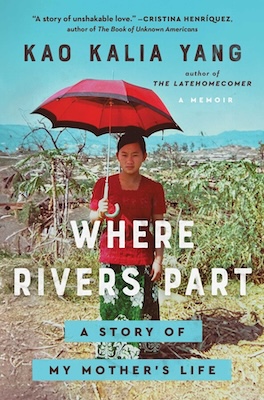
In this most recent memoir, Kao Kalia Yang takes on the voice of her mother, Tswb Muas, to tell the heart-wrenching (or rather “liver-wrenching” if you’re Hmong) story of a woman who made an impossible decision in the jungle of Laos that would shape the rest of her life. Where Rivers Part transports us to the village Dej Tshuam (Where Rivers Meet), where Tswb was born, and introduces us to her family, including her mother, a formidable woman who helps us to understand the kind of woman Tswb would become. Amidst the violence of the Laotian Civil War, we witness Tswb’s family’s flight to the protection of the jungle where, by chance, she crosses paths with the young man who would become her husband. At the age of sixteen, under threat of encroaching Pathet Lao forces, she leaves her family and follows her husband and his family to the refugee camps in Thailand and then to the United States. Each new environment brings new challenges, including hunger, death, and racism, that Tswb confronts with necessary courage but also quiet exhaustion and sometimes unspoken regret.
Tswb Muas’s story, as told in collaboration with her daughter, invites us to explore ideas of motherhood, womanhood, love, longing, home, and survivance in a patriarchal world heavily impacted by war and displacement.
I was born in Thailand, where so many refugees from the wars in Southeast Asia fled and waited and waited and waited to be resettled, including my father’s family. In 1990, when we arrived in the United States, I was five years old. I grew up in rural Northern California loving books, but most of the books I read were about people who didn’t look like me.
Kao Kalia Yang’s Hmong family memoir The Latehomecomercame out in 2008, when I was 21 years old. It was the first book I had ever seen written by a Hmong-American author about the Hmong-American experience. At that time, a part of me shied away from reading it, almost as if I knew I wasn’t ready to face that painful part of our people’s history.
Over the years, it traveled with me through the different phases of my life. Finally, in 2023, I finished The Latehomecomer on a dav hlau (iron eagle: airplane) heading to Portland for an academic conference. While it took me 15 years to finish The Latehomecomer, it took me two weeks to read The Song Poet, Kalia’s memoir about her father, and just a handful of days to read Kalia’s new memoir, Where Rivers Part.
I had the pleasure and honor of interviewing Kalia about some of these themes as well as possible presents and futures for peb hais neeg Hmoob (our Hmong people).
Pa Vue: I would love to start with the title of your memoir, Where Rivers Part. I can think of at least two instances in Hmong history where a river has made a significant impact on our community: first, when our ancestors settled along the Yellow River in what is known today as China; second, when hundreds of thousands of Hmong people had to flee across the Mekong River after the end of the Laotian Civil War. What do rivers mean to you, and how have they impacted your life?
Kao Kalia Yang: Where I was born, Ban Vinai Refugee Camp, the only river I knew was called “Dej Kua Quav”—translated to English, it means “River of Feces”. It wasn’t until I was in graduate school and was in conversation with a medical doctor who had visited the camp the year and month I was born that I learned that the river of my youth was just an open sewage canal. The adults knew it but I didn’t.
The first river that I truly met was the Mississippi River when my family was resettled in St. Paul, MN as refugees of war. As a child, my older sister Dawb and I often begged our father to let us accompany him on fishing trips… where my uncles took their sons. It was along the banks of the mighty Mississippi that I began to learn and connect with the other rivers in the lives of our people, the Hmong: the Yellow River in China and, of course, the Mekong River along Thailand and Laos.
All along the way, I was mystified by stories about the River of Forgetfulness; I was told as a child that when a Hmong person dies they return to the land of the ancestors, and there flows a river. If you drink from it, you forget everything and you can begin anew. My heart would race when I heard stories about the powerful dragons that dwelled in the deepest parts of the rivers of the past, the possibility that there might be dragons even now in the American rivers.
For me, rivers have always been a great mystery, a source of fear, of inspiration, of change and transformation. They speak to me of the places and people that I come from, the flow of history, of life, and of course, of love.
PV: In your prologue, you stated that you wanted to “claim the legacy of the woman” you came from. Can you share what you meant by this?
I was told as a child that when a Hmong person dies they return to the land of the ancestors, and there flows a river.
KKY: Our mothers and their mothers before them are so unknown to the world that we live in, so tremendously neglected by the history books, by the eyes and ears of people—not simply those in positions of power but the individuals they work with, drive alongside on the streets, and even the people whose houses are connected to theirs. I’ve watched generations of Hmong women live the consequences of that unknowing. They are subject to the stereotypes that people govern about who they are—as welfare mothers, as dispensable laborers, as inconsequential to the happenings of a larger society and history. I want to do my part in shedding light on the incredible lives that have enabled our possibility; yes, me in the story of Tswb Muas, but in some sense also other Hmong daughters and their mothers. There are worlds within worlds, hearts brimming with emotions, thoughts sparking whole horizons in the women who love us.
PV: Throughout the memoir I sensed that you were trying to define motherhood through your mother’s eyes, but I also felt that your own insights of motherhood were present. How did your experience of becoming a mother prepare you to write this memoir?
KKY: I knew that I couldn’t write my mother’s story until I experienced the realities of motherhood myself. I simply couldn’t do justice to her story. She is a woman who became a mother at the age of 16 and had her final child at the age of 42. In that span, she gave birth to seven living children and seven dead ones. So much of her life has been devoted to mothering, so I had to tell my impatient heart to hold until I knew what it was like to have a child grow inside of me, to give birth to her, to hold her close to my chest, and to lose a child, too, to reach with shaky hands for a baby the world would never know as mine.
When I came to this book, I had learned some of what it meant to be a mother, to have loved both the living and the dead. This allowed me to connect the pieces of my mother’s life and to understand her not simply as such, but as a woman in a body in ever-changing worlds, how the tides of patriarchy washed upon the shores of her heart, and severed her connections to her own mother, notions of home, and belonging. Mothering is such a defiant act in the face of death, the carnage of colonialism; it is an assertion that some connections persist, that to live we die a thousand deaths in one lifetime, and we will do it again and again.
PV: I loved seeing the Hmong language in this book. More specifically, you chose to write many names in Hmong when they, including your own, had previously been written in Anglicized form in your other books. As a Hmong language reclamation researcher, I’m curious about your thoughts, intentions, and hopes behind this choice.
Mothering is such a defiant act in the face of death, the carnage of colonialism.
KKY: I love the Hmong language, the softness of it, the feeling of carrying the wind in our throats, but the decision to write the names in the book all in Hmong was my mother’s. I asked her what she wanted and she told me. I think what results is a gift to readers from all languages, including Hmong speakers. I understand that it is a courageous act, so in this, too, it honors the legacy of my mother, the daughter she has raised. I understand that for many English-reading audiences the names will be a challenge, and that in a racist and linguistically monopolized world, it is more than an invitation to partake in the rich poetic possibilities of the Hmong language, that it can be read as something that makes the book less than, as a decision that could be construed as a liability to my writerly capacity to understand the audiences who buy books. But I do it anyway. I do it because it is my mother’s ask of me. I do it because I love the people who live in these names, walk them in the sun and the rain, and dream with them in the dark of night.
PV: In many parts of the book, your mother fought to hold on to who she was and who she is in the face of war, displacement, loss, and racism. How do you see this characteristic manifest in you and your siblings, all of whom your mother talks about lovingly in this memoir?
KKY: We are all such stubborn people, my siblings and me. From our father, we’ve inherited rebellious hearts. From our mother, we’ve been blessed with this idea that there is a standard we must hold ourselves to—despite all the things that life delivers the marginalized. Our eyes have been trained to see injustice at an early age and our hearts have had to harbor the pain of knowing that the world is unpredictable and governed by forces beyond our control. There is a humility in being Hmong, stateless as we are, war-stricken and often poverty-marked. Each, in our own way, have carried these truths that my mother has never tried to hide from us, and have tried to the best of our abilities to meet them in moments of trial with a measure of the love that our mother holds for us.
PV: Half of your mother’s memoir takes place in Laos and Thailand, during and after the Laotian Civil War, which the U.S. became heavily involved in. How do you think this book and your other works speak back to empire (the U.S. empire specifically)?
I believe in the healing power of tears. It is not a bad thing to cry for a story, for a people, for places lost never to be found again.
KKY: The marker of any colonial power is to sever a people from its history. In the American context, this is the history of slavery, the practice of the Native American boarding schools, and so much else. All of my books work to resist these kinds of deletions. Atrocities happen. To survive, we have done what we can. In each book I write, I do what I can to say: this is who we are, this is how our hearts beat, this is how our lives are lived—despite the secrecy, the efforts to annihilate, the humiliations. We live. We love. We make art. We grow our understanding of ourselves, a little bit at a time because we matter to ourselves and each other, because despite all that has happened, we matter to the world, too. I hope that my books show what is possible; in this way, that they accomplish the impossible in a colonized world.
PV: There are so many stories in the Hmong community, and we need to tell these stories to counter the harmful narratives that have been told about us by people who are not us. But how do we tell these stories that are so closely tied to war and popular ideas and images of refugees without continuously painting ourselves as damaged?
KKY: We are more than the things that have hurt us; no survivor is just the outcome of the violence committed against them. It is imperative that we, as storytellers, paint the full and complex, the terrifying and the beautiful truths that live in our stories. I firmly believe that when you look at Kao Kalia Yang, when you hear her, when you enter into the space of her words, you’ll understand that there is beauty there, that there is tenderness, that there is everything that makes us human to each other. The same is true of Tswb Muas. The same is true of Pa N. Vue. I know these things. We all should. For me, truth is the antidote to the damage in my heart and the way others approach me and my community.
PV: I cried a lot reading your memoirs, and I’m sure I’m not the only one. You put into words what many families in the Hmong community have experienced and are experiencing. Along the same lines of the previous question: how do we, as refugees and as children or grandchildren of refugees, access joy, hope, and healing in these stories that are so hard to hear and to read?
KKY: I believe in the healing power of tears. I grew up as a selective mute in English. When I became a published author and was tasked with speaking to the book I had written, I struggled to do so publicly. My father, at the launch of The Latehomecomer, said to me, “Me Naib, if Hmong tears can reincarnate, they would rain the world in our sorrow, but they cannot so they green the mountains of Phou Bia. If you speak, if the winds of humanity blow, then maybe our lives were not lost.” When I did speak, the words were soaked in my tears; they came from the softest part of me. Without the tears, I would have hardened up. It is not a bad thing to cry for a story, for a people, for places lost never to be found again. It is a gift, a realization of the joy, the hope, the healing that is embedded.
PV: I really appreciated your epilogue, which spoke so much to the longing that your mother referenced throughout the book. It also seemed to speak to the title of your memoir. In many ways, I felt like I was holding a breath, and your epilogue allowed me to release it. Was this something you intended to write? What was the thinking behind it?
KKY: I knew the ending of this book long before I began writing it. I wanted to bring my mother back into the arms of her mother. The question for most of my life has always been, how? In writing this book, I found a way.
There were many moments in the writing when I didn’t know if I could push through but for the thought: I have to return my mother to niam tais’s arms. Similar to you in the reading experience, as I was writing I was holding my breath. I found myself, at the epilogue, finally exhaling. The epilogue is the one part of the book I have been unable to read to my mother. I have tried. I can’t. My mother knows this. This is somehow enough.
One summer, my brother found a half-dead opossum on the side of the road in our neighborhood and he called me to handle it. “Well, is it dead?” I asked. “I don’t know. That’s why I called you.” And as much as I didn’t want to be the girl who dropped everything to go and save roadkill, I was. I was obsessed with animals. Which my family found to be an odd and unexpected quirk of moving to the United States. That day, my mother watched in horror as I crept into our backyard, with gloved hands and my little brother in tow, holding a mangled and full-size adult opossum, and laid it on her grass. Excuse me? When she marched outside, demanding answers and that we stop—Why do you always get your brother involved with things like this!—I informed her that the animal was a marsupial, and unfortunately for her and the opossum, it was likely carrying babies. Inside its pouch, Mom. They’re probably still in there. So I couldn’t, in good conscience, “stop” until I got them out safely. Animal Control said I could touch them. They will get eaten by another animal or hit by a car if I don’t!
And though I did bring the bloody opossum inside my mother’s house, after enlisting my brother’s help in holding down its limbs while I extracted the babies, and I did eventually stain our family’s Toyota Sienna transporting us all to the local Wildlife Center, my mother understood that despite not being what she had envisioned—I was her daughter. And if we were ever opposums injured on the side of the road, she’d hope there was a little weirdo out there, like me, ready to help. Even if the neighborhood thought I was crazy, or orchestrating some sort of satanic Colombian ritual. She merely observed us in silence the rest of that afternoon, like she had done many times before, as her children forged on with the bloody and laborious procedure that much like our lives, due to its nonsensical yet humanitarian nature, she had to accept she had no control over.
Growing up, these moments meant more than I realized. They were moments that asked my family to confront who we were and reimagine who we thought we would be. Fears, dreams, desires and all. Especially as 1st gen immigrants new to this country. Was I the barefoot girl that ran around with dead animals? Yes. Would that have any implications on my performance in school, commitment to family, or promising future as a congresswoman? No one was sure. And though we’d later go on to land some real, textbook immigrant-child-disappointments (atheism, abhorrent soccer skills, an American fast-food obsession, etc.) those earlier moments were roadmaps. They were signals to our community that things were changing and, for better or for worse, in this new place, we had been given the space to freely examine our full selves. (Or at least try! Some of us immigrated to Florida.)
These universal questions of, “Who am I?” and “Where did I come from?” were ones I tried to have my protagonist, Luciana, answer in real-time over the course of my debut novel, Oye. I found myself relentlessly rooting for this little weirdo who was saying and doing so many things that younger me—and many of my friends and family—had long wanted to say or do. Here are 8 incredible books that I hope will inspire the chaotic, weird, unrestrained, and glorious, blossoming 1st-gen immigrant in you.
If you want a riveting controlled mess–Olga will deliver. She’s a Nuyorican wedding planner for the Manhattan elite with telenovela-level secrets and a complicated family tree. Plus, she’s got a politician brother with murky finances and an even murkier personal calendar. In this book, Olga defies what people expect of her and attempts to invert the power dynamics of the traditional boys’ club. If you want government corruption, multigenerational drama, and an unexpected (adorable) love story–Olga Dies Dreaming is your book. You will devour this novel as the characters take on New York’s 1 percent, the volatile and erratic presence of their revolutionary activist mother, and the future of their increasingly gentrified hometown of Brooklyn. Gonzalez also recently released her sophomore novel this past March, Anita de Monte Laughs Last, which undoubtedly follows a cast of characters who could just as easily be included on this list.
Fiebre Tropical is the type of book I searched for my entire life as a young person in South Florida. Florida’s youth is immensely fortunate to now have this text that holds up a mirror to so many faces who would otherwise never see themselves in literature. The novel follows Francisca, a 15-year-old queer Colombian girl, who is trying to remain sane despite having just uprooted her entire life from Bogotá to Miami, alongside her mother, sister, and grandmother. There are so many inventive, stunning, and deeply moving things about Fiebre Tropical and its structure that illuminate the literary canon, but what makes it really sing is its unmistakable portrait of South Florida. You meet generations of immigrants from all over Latin America who are grappling with the unforeseen consequences of their decisions and the debilitating perception of others. This quest takes some to a nearby Hyatt hotel ballroom searching for God, a baptism for a miscarried baby 17 years late, and in Francisca’s case, falling for Carmen, the local youth group leader and pastor’s daughter. In addition to the book’s pitch-perfect cover and title, Delgado Lopera brings to life one of the most singular and musical voices in contemporary literature. The use of Spanglish in this novel is miraculously organic, giving readers that rare, authentic literary experience that makes Fiebre Tropical groundbreaking and required reading for all Floridians.
When I first read A Map of Home by Randa Jarrar I probably fell out of my chair. I didn’t know fiction could do half the things that Jarrar was doing, and I didn’t think I’d ever love a protagonist more than Nidali, the book’s captivating and righteous Palestinian-Egyptian-Greek-American narrator, who migrates across time to and from Kuwait, Egypt, and the United States. Nidali is defiant and curious, questioning her circumstances while embracing the traditions and people around her. We see Nidali flee war, search for a sense of a homeland, indulge in normal teen behaviors, grapple with her place in her family, and ultimately, define who she is on her own terms. Jarrar’s sentences control humor and heartbreak in this book magnificently. A valiant and gorgeous coming-of-age novel about power, identity, and the complex dance of growing up in the global immigrant diaspora.
Another required reading for all Floridians! In her outstanding debut collection, Jennine Capó Crucet pulls no punches when it comes to depicting an enthralling, real picture of the bustling Miami landscape. These stories are rich, gritty, tangible, lyrical, sexy, nuanced, and profound. Readers meet Cuban tías, primos, and siblings dealing with loss, migration, financial strife, self-preservation, and the absurd conditions that put them there. The first story, “Resurrection, or: The Story behind the Failure of the 2003 Radio Salsa 98.1 Semi-Annual Cuban and/or Puerto Rican Heritage Festival” introduces us to Jesenia, a Miami local who comes to the drug-fueled epiphany that in order to land a job at the local radio station, she must resurrect Celia Cruz and convince her to perform at the station’s music festival. Needless to say, the story is a banger. And lucky for us, Capó Crucet has also recently put out another South Florida anthem this spring, Say Hello To My Little Friend. In this new book, Capó Crucet masterfully blends and captures the energy of Pitbull, Tony Montana, the classic immigrant hustle, economic depression, and the late Lolita–Miami Seaquarium’s famous female orca whale who was notoriously held captive in horrid conditions for over 50 years. (May you Rest In Peace, queen). It does not get more chaotically 305 than that.
Damani is another messy fan-favorite protagonist on this list. She is a bisexual Tamil ride-share driver in her 30s who has just lost her dad, is responsible for her family’s rent and mother’s well-being, and is unexpectedly falling for one of her more privileged, social-activist-obsessed passengers. A passenger who, unbeknownst to her, ends up ushering in more chaos into Damani’s life than she could have ever imagined. Guns covers the exhilarating intoxicating feelings of a first-crush so well that you begin to forget, alongside Damani, the rising stakes of everything around her. Read this if you like a propulsive ending and if you love a character-driven book that confronts performative wokeness, systemic racism, money, and class.
Bless All This Could Be Different by Sarah Thankam Mathews because it delivers to us Sneha–a queer Indian woman in her 20s undergoing a self-examination of sorts concerning desire, community, financial security, and familial responsibilities. Sneha is apathetic, horny, and floating through her life-draining yet stability-providing corporate job in Milwaukee as she ponders what she wants vs. what is expected of her. Her tumultuous romance with an older white dancer and sometimes-intentional turn toward chaos make this an absolute necessary read for this list. Plus, the first chapter delivers one of the most iconic ending lines ever: “As the summer began, I move to Milwaukee, a rusted city where I had nobody, parents two oceans away, I lay on the sun-warmed wood floor of my paid-for apartment and decided I would be a slut.”
In this debut garnering massive buzz, Broughtupsy by Christina Cooke, we meet Akúa, a young queer Jamaican woman processing the death of her younger brother and anguish from a recent breakup. She is returning home to Kingston for the first time in years and, despite being warned and threatened by her religiously devout older sister about pursuing gay relationships in their hometown, Akúa falls hard for Jayda, an openly-queer stripper. Akúa courageously addresses questions of grief, queerness, family, and belonging that will have you pulling for her every step of the way.
Dreaming of You is a novel in verse about a Latinx poet dealing with heartbreak and interrogations of identity who, in order to cope, attempts to bring back famous Tejano popstar Selena Quintanilla-Pérez from the dead. YUP! The verse structure brilliantly introduces readers to the protagonist’s fragmented psyche, shifting sense of self, and messy yet determined resolve to see herself clearly, despite everything trying to figuratively kill her. Lozada-Oliva tackles obsession, Latinidad, and womanhood in this novel, which is unlike any other, and so satisfyingly playful.
After its massively successful streaming release last November, Emerald Fennell’s film Saltburn dominated cinematic discourse for months. A 2006-set period piece that starts as a 21st-century Brideshead Revisited and morphs into an ironic erotic thriller, its carefully honed aesthetic, plot twists, and off-kilter sexuality divided critics and audiences. Some lambasted the film for lacking subtlety; others admired its dark humor and transgressive sexuality. The “Saltburn discourse,” though, left out some of the film’s key features: Fennell embeds a complex set of influences, and conscious riffs on genre, that frequently went overlooked. Beyond simply acknowledging the works that inspired her, British “country house” films chief among them, Fennell uses her influences as raw material to create a counterintuitively topical class drama.Through Fennell’s manipulation of her influences, Saltburn ultimately speaks to an audience living amidst sky-high wealth inequality and primed to denigrate the rich, even as the filmmaker knows we can’t always resist the pull of wealth.
Saltburn’s protagonist is Oliver Quick, a socially isolated, middle-class Oxford undergraduate who endears himself to the alluring Felix Catton by feigning an impoverished background. Felix, taking pity on Oliver, invites him to spend the summer at his family estate, Saltburn. Oliver latches onto the house and the family, yet as his attachment to Saltburn grows, the Catton family’s interest in Oliver wanes, leading him to secure his place via manipulation, seduction, and violence.
The film’s array of aesthetic and narrative references reflects Fennell’s intent to subvert the tropes of the country house genre, in which social dramas among aristocrats play out in well-appointed estates, and critics picked up on the film’s clearest predecessors. Evelyn Waugh’s 1945 novel Brideshead Revisited and its 1981 miniseries adaptation were cited in practically every review I read: The premise and characters directly respond to Waugh’s tale of an Oxford student’s infatuation with a wealthy friend, his family, and their grand estate.
The premise and characters directly respond to Waugh’s tale of an Oxford student’s infatuation with a wealthy friend.
Waugh’s novel, set between the early 1920s and ending in the midst of World War II, gives an idealized view of the English aristocracy, tempered by melancholy at the jarring social changes that damaged their elevated status. Its attendant television adaptation, made nearly 40 years after the novel’s publication, placed the events of the story outside of living memory for many of its viewers, allowing even greater latitude for the romanticization of a bygone era.
Fennell set out to achieve the opposite effect: By setting the film less than 20 years before its release, she makes her audience look back on mid-aughts fashion and cringe. The aesthetics of the 2000s—“the least cool of all the periods,” according to Fennell—were uniformly garish, and the on-trend ugliness of the wealthy characters’ clothing undercuts their sense of superiority. Because the audience is not primed to idealize the period, it becomes easier to see Oliver’s desire for the Cattons’ lifestyle with a critical distance. They have no appealing or redeeming qualities beyond their wealth, and their taste in fashion and decoration are dominated by thoughtless conspicuous consumption. If Charles Ryder’s fixation on Brideshead and its inhabitants stems from a search for beauty, Oliver Quick’s appears to be a simple obsession with money and status.
Fennell also diverges from the stately genre in foregrounding exaggerated sexual drama and violent class envy. While sexual and class tensions are inherent to the genre, they are typically encased in an aesthetic of restraint and gauzy nostalgia. Fennell, though, intently bursts through the boundaries of taste that often relegate sexuality to subtext. Oliver’s desperation to transcend his class is so acute it manifests as sexual desire, and this guttural need forms the film’s narrative backbone and generates its most memorable scenes, which seesaw between the erotic and the ridiculous—Oliver slurping Felix’s semen from a bathtub drain, Oliver thrusting into the soil of a fresh grave, Oliver gleefully dancing nude through Saltburn’s cavernous rooms.
In an interview, Fennell laid out her aims in centering broad sexuality in a genre known for more refined pleasures: “[the viewer] is operating on the movie that it’s saying it is, which is a classic country house Merchant Ivory Gothic movie, and then the movie that it really is, which is just something about sex and desire and our very modern obsession with things … that will never love us back.” In other words, the film’s country house trappings are a mask for its actual subject matter of all-consuming class envy. She sets up a familiar bubble of idyllic nostalgia undergirded by generational wealth, then bursts it with the Cattons’ period-appropriate bad taste and Oliver’s desperate horniness for their privileged lives and elevated status. Oliver, in particular, illustrates the “modern obsession with things … that will never love us back” that Fennell notes is her subject matter: He craves the rarefied prestige that residence at Saltburn can confer, even as its residents have no regard for him, and Fennell implicitly suggests this desire is shared by those swept away by onscreen images of impossible wealth.
He craves the rarefied prestige that residence at Saltburn can confer.
Fennell invoked Brideshead Revisited and Merchant Ivory dramas only to undermine the romantic gloss they cast on wealth. Two other influences, which went comparatively unnoticed by critics and audiences, reveal even more about her aesthetic and narrative aims: Joseph Losey’s films The Servant and The Go-Between, deemed by Fennell in the same interview as “two of my favorite films of all time.”
Losey was a Hollywood director in the 1940s who decamped to England after being targeted by the House Un-American Activities Committee, and subsequently developed a substantial body of work. The Servant (1963) and The Go-Between (1971) came from a years-long collaboration with screenwriter Harold Pinter, and presaged Saltburn in their thematic concerns: class upheaval, sexual desire and manipulation, and the moral vacuity of the English upper classes.
The Go-Between, adapted from the 1953 novel by L.P. Hartley,is a lodestar of the country house genre, yet it features a distinctively unsettling portrayal of how sex and the British class system clash. The film centers on a middle-class 12-year-old boy, Leo, who stays with an aristocratic school friend at his family’s estate in the summer of 1900. Out-of-place and eager to please, he unwittingly facilitates an affair between his friend’s older sister and a neighboring farmer by delivering letters between them. As the affair comes to light, Leo learns sex can have cataclysmic consequences, even as he has no practical understanding of the act.
It’s very human, in spite of its extreme beauty. And it’s that thing that Losey and Pinter did together so much, which is: there’s so much cruelty there.
While Fennell borrows numerous narrative and formal touches from Losey’s film, the most important quality of The Go-Between she evokes is the dichotomy between a beautiful place and an ugly situation. In fact, she amplifies it: While The Go-Between features an elegant setting and morally ambiguous characters, Saltburn showcases an ostentatiously grand setting and amoral, ignorant characters.
Fennell delights in parading this contrast. Take the scene where Felix gives Oliver a tour of the house. The camera follows Felix through each lavish room as a romantic strain of strings plays underneath, yet his descriptions of each room are crass and banal: In one room he “accidentally fingered [his] cousin,” another is plastered with portraits of “dead rellies.” Felix’s inanity is loudly announced, and set against plush, regal interiors as if to emphasize his unworthiness.
In keeping with the recent trend of “eat the rich” cinema, the luxurious Saltburn is a breeding ground for moral and intellectual dissipation. In The Go-Between,it takes time for Leo to realize he doesn’t morally approve of his hosts; in Saltburn, Oliver, though he keeps his cards close to his chest, immediately concludes the Cattons have no substance and don’t deserve the abundance in their possession. As she makes it increasingly clear that Oliver is determined to destroy each member of the family and claim Saltburn for himself, Fennell prods the audience to delight in their downfall by repeatedly highlighting their superficiality. The Go-Between invites its audience to question the repression and exploitation that the English aristocracy can perpetuate; Saltburn takes this as a given and uses this as a starting point for a thriller with the aristocracy as the targets.
Fennell prods the audience to delight in their downfall by repeatedly highlighting their superficiality.
This development in Oliver’s character arc leads straight to The Servant. While Oliver’s introduction to Saltburn as both a welcomed guest and an uncomfortable outsider echoes Leo in The Go-Between, the reveal that he is a ruthless social climber parallels the titular servant in Losey’s earlier film.
The Servant, based on Robin Maugham’s 1949 novella, depicts a rich, suggestible young man, Tony, who hires a live-in manservant, Barrett. Barrett takes advantage of Tony’s upper-crust ignorance and his childlike desire to be catered to, and proceeds to pamper him, flatter him, and alienate him from his fiancé, while covertly exercising a plan to take control of the house. By the film’s end, the master is completely dependent on the servant. In effect, The Servant is both the logical inverse of a country house film and a corollary to the genre. It is pointedly contemporary and anti-nostalgic, yet it also views a well-appointed house as the ultimate site of wealth, romantic and sexual discord, and class tension.
Oliver tears through the Catton family with the ruthlessness of several Barretts, manipulating and disposing of family members as necessary. He seduces Felix’s insecure sister Venetia and his skeptical hanger-on cousin Farleigh, and endears himself to Felix’s parents, James and Elspeth. Oliver hits a snag in his plan when Felix discovers he was raised comfortably middle-class, despite portraying himself as a poor child of addicts. Felix demands he leave the next day, so Oliver kills Felix at the party with a poisoned drink to prevent his exile. Felix’s father evicts Farleigh after Oliver suggests he brought cocaine to the party, and Venetia dies by suicide soon after (Oliver supplied a drunk Venetia with razor blades). Years later, James dies, and Elspeth invites Oliver to stay at Saltburn again. She quickly grows ill and alters her will to leave Saltburn to Oliver. At the film’s conclusion, he delivers a menacing monologue describing his master plan to an unconscious Elspeth, which he completes by ripping out her ventilator tube.
Like The Go-Between, Fennell takes inspiration from The Servant through significant escalation. Oliver’s manipulation of the Cattons echoes Barrett’s domination of Tony, and his sexual methods reflect Barrett’s implicitly eroticized tactics. Yet that Oliver kills three people and explains it in a sinister monologue shows how far Fennell took the character arc presented in The Servant: While Losey and Pinter exercise restraint, showing Barrett’s scheme through action and suggestion rather than explanation, Fennell spells out that Oliver is a socially striving psychopath who kills to get what he wants. The Servant ultimately leaves the audience to decide whether Barrett’s actions are morally justified, while Oliver’s characterization descends into comic villainy by the film’s end.
Fennell’s idiosyncratic synthesis of her influences ultimately reveals a pointed, cynical viewpoint. Her deployment of country house tropes is meant to foreground their social and sexual subtexts and to subvert the soft gaze they cast on wealth, and she takes inspiration from Losey’s films by escalating their ambiguous, unsettling explorations of sex and class into a thriller familiar to viewers of recent eat-the-rich films. But rather than allowing audiences to claim any sort of moral or political satisfaction, Fennell places them in a more compromised position: The metatextual argument that Saltburn poses is that contemporary audiences have much in common with Oliver.
The progression of Oliver from a sympathetic figure to a serial killer with a bottomless hunger for wealth and status helps to make Saltburn an effective piece of pulpy entertainment. It also suggests, in exaggerated form, a double-bind in current cultural ideas around class. Responding to extreme and unabating global wealth inequality, some of the most talked-about films of the past few years, notably The Menu, Knives Out, and Triangle of Sadness, depict working-class characters toppling the idle rich, and audience sympathies are primed to lie squarely with the resourceful proletariats. Yet the middle-class striver at the heart of Saltburn, despite the melodramatic excesses of his characterization, is indicative of a different strain of class tension: He envies his hosts even more than he resents them, and his ultimate ambition is to maintain the class system with himself at the top, rather than destroy it.
He envies his hosts even more than he resents them.
It’s telling that another of Fennell’s cited influences is Cruel Intentions (1999), the soapy, sexy update of Dangerous Liaisons that became a source of aesthetic inspiration for a generation of teenagers. Just as director Roger Kumble achieved in that film, Fennell creates a surface of enviable luxury and sustains it through the entire film, but Fennell also subverts this at every turn: the clothes are ugly, the wealthy characters are selfish and simple-minded, and Oliver’s desire to supplant them is both desperate and villainous. Yet scenes of lavish birthday parties and lazy afternoons spent sunbathing are enough to make viewers want to inhabit its world. From Fennell’s point of view, even when we know the moral void at the heart of wealth, like Oliver, we still want to dance through its gilded halls.
Class envy ultimately reaches its tendrils into every facet of Oliver’s psyche, directing each of his desires toward the need for social elevation—his sexual obsession with Felix, in particular, is a physical outgrowth of his craving for higher status. In his final monologue to Elspeth, Oliver repeats “I hated him. I loved him” about Felix, indicating the depths of both his resentment and his desire. This irresolvable tension is ultimately the core of Saltburn: The simultaneous anger and envy that wealth inequality generates means that many may both reject the wealthy on principle and doggedly dream themselves into their world.
In the Summer of 2017, I went to see the European premiere of the Braden Jacobs-Jenkins play An Octoroon. Based on the 1859 melodrama by the Irish playwright Dion Boucicault, it was staged at the Orange Tree Theatre in the London Borough of Richmond upon Thames. A truly bombastic production that lampooned the tropes of the “tragic mulatto” story in a way that was confrontational, incredibly inventive and tonnes of fun. Sparked up by what we had just watched, the biracial man who was my date for the night, regaled me with the tale of his adoption by white parents in the North of England over a drawn-out meal at the white and blue Italian chain restaurant, Pizza Express, immediately afterward. As two unambiguously Black Britons, one might expect our feelings on the play to be more similar than they actually were. That night the awareness and emotional nuance that the actresses Lola Evans and Bafta Nominee Vivian Oparah (of Rye Lane fame) was not as readily apparent in my date. He diminished the cultural relevance of the production to us, warning me against using American racial perspectives to analyse the realities of how we are racialised in Britain. I did not listen.
My father is Zimbabwean. My mother is Jamaican. Raised in a pan Africanist household, my understanding of blackness was quite necessarily diasporic. All Black experience is of intellectual interest to me—including the experience of those who may not be perceived as Black. They cause me to ask questions of myself. Does the ambiguity of someone’s blackness negate its validity? Does my unambiguous blackness immovably place me at the top of a hierarchy of authenticity, irrespective of my internalized anti-blackness? Does someone who comes to know themselves as Black later in life, value their identity more, or maybe just differently, to the way I do?
My debut novel The Library Thief has a British main character who passes as white. To be more specific, she is “white presenting” as she is unaware of her African ancestry at the outset of the story. I concocted her story out of the novel The Long Song by Andrea Levy imagining the tale of the daughter descendant of the kidnapped light skinned baby Emily, as detailed in my Author’s note. Black women of all shades have been bleached out of Britain’s history whenever our presence is deemed incoherent, inconvenient or irrelevant. By telling the story of a woman who would definitely be described as ‘an octoroon’ in Victorian times, I was able to explore the way someone who presents as white with African ancestry could fight for agency and survival in a country that sought her literal and figurative erasure. I wanted to explore the experience of someone expanding their sense of self by discovering their blackness and the moral implications of that. In a white supremacist world, why wouldn’t one simply deny or neglect one’s blackness given the option of clear material rewards? What is gained by claiming one’s blackness if one has the chance not to?
White passing and white presenting are mistakenly used interchangeably in modern parlance, when in fact historically there was a clear distinction. To live one’s life “passing as white” requires a clear decision to leave one’s Black life behind, potentially cutting oneself off from family and community in order to obscure one’s African ancestry. To be white presenting doesn’t necessarily require this denial—it’s more neutral, in that one is only “perceived as white” in daily life, irrespective of whether one denies any color in one’s ancestry.
The title is as concise a definition of passing as one can imagine. A chosen exile being “a separation from one racial identity and the leap into another.” The book details how those whose blackness was ambiguous enough, would use their lighter skin as an opportunity to reach for freedom and opportunities that would have been summarily denied them otherwise. There are unexpected and unconsidered stories held within too. Those who sunk into a drowning melancholy grieving for the blackness they lost. Family, community, culture, richness and love. Stories of those who used their lighter skin to free darker members of their family and bring them to freedom. Stories of those who gave up passing after a period of time because the loss was too great for them to bare and/or whatever intended goal had been achieved and was deemed enough. To have such a thorough academic work as this is essential for those seeking to know exacting stories of those who rode the edge of existing racial categories and finagled their way into lives with as much agency as they could muster.
The nail-biting story of how an enslaved couple, where the wife passing as another race and gender to escape bondage in Georgia and become campaigners for abolition as escapees from recapture in Great Britain. Their story is a thrilling account that demands a cinematic rendering with its wily near misses and enslaving villains chasing them at every turn through the Carolinas, Virginia, Philadelphia, Boston and eventually to them having to take flight across the Atlantic. A tale of endurance and political principal where even before their freedom was fully secured their life’s purpose was consistently focused on securing the freedom of those they were compelled to leave behind.
The hopes and ambitions of post-Civil War Reconstruction era were repeatedly thwarted by the realities of Jim Crow and the terrorism of lynching. Nevertheless, the Northern states have never been able to get off scot-free convincingly. Racial segregation not even being more visibly polite in spite of claims to the contrary. The institutional discrimination faced by Black people, even at a time when W.E.B. Dubois had already graduated from Harvard, meant that the first Black female student at Vassar needed to conceal her blackness if she had any hope of admission. The novel teems with charged tension as Anita Hemmings’ pursuit of a decent education is constantly under threat from her fears of being caught in her whitest of lies. The guile and charisma of her senior year roommate entwining her into potential calamity that leaves the reader’s back damp with perspiration from the stress of it all. It’s been seven years since it was announced Zendaya will produce and star in the film adaptation of the novel renamed A White Lie.
The now seminal text portraying vignettes into the life of the ridiculously reckless Clare Kendry and the endlessly anxious Irene Redfield has captivated readers for a century. A sky-scraping achievement from a writer of the Harlem Renaissance, the queer coded depiction of a woman who uses her ability to pass as white to play in the face of a racist, will continue to be argued as an act of Black feminist defiance. Snatching racial privilege out of the mouth of the lion in the age of Gatsby which lasted only as long as it could. My mind remains made up, but I’ve never recovered from the “did she or didn’t she” of the last scene. Possibly the most perfect novella ever written.
The collaboration between Heather Terrell and Victoria Christopher Murray yields an immensely personal biographical fiction of Belle da Costa Greene who curated the library of J.P. Morgan. Completely upturning the assumption that librarians in the main have a desire to live quite quiet lives, the story wields its temerity with everything taking place just above the scandal. One of America’s most brilliant archivists finally gets the light shone on her that she always deserved.
My most purchased book ever. Why? I could depend on anyone I purchased the book for, texting or calling me about it and thus the gifting of it became a request for intimacy. Bennett’s research and sensitivity sings itself into the reader’s bones, in a page turner of a book infused with all the stories that have come before it. The chicken stock of “Passing.” The herbal aromas of “Imitation of Life.” Twin sisters: one who chooses to pass for white for more than her own personal gain, and the other who chooses to remain Black in spite of the cost. The fracturing of a family bubbling up lava between the shifting tectonic plates that shake the foundations of the characters all the way through the story. A page turner of the highest order that left me reeling at the end with memories of the locations I was lucky enough to read it in. A sensational masterpiece!
Things will only get better? Will a skin lightening procedure that’s less dermatologically dangerous than our current skin bleaching practices cause more or less harm? Penning provocative satirical prose in one of the boldest debuts of recent years, Ruffin’s warning of a potential future is nowhere near as ridiculous as one wants it to be. How should one deal with discomfort, desperation and longing? Is a father’s desire to help his biracial son escape the racial reality his own bourgeois accomplishments prove is doggedly inescapable, an act of love or madness? Some readers will feel more lanced than others but unfortunately it’s a story that implicates us all.
DON’T MISS OUT
Sign up for our newsletter to get submission announcements and stay on top of our best work.
YOUR INBOX IS LIT
Enjoy strange, diverting work from The Commuter on Mondays, absorbing fiction from Recommended Reading on Wednesdays, and a roundup of our best work of the week on Fridays. Personalize your subscription preferences here.