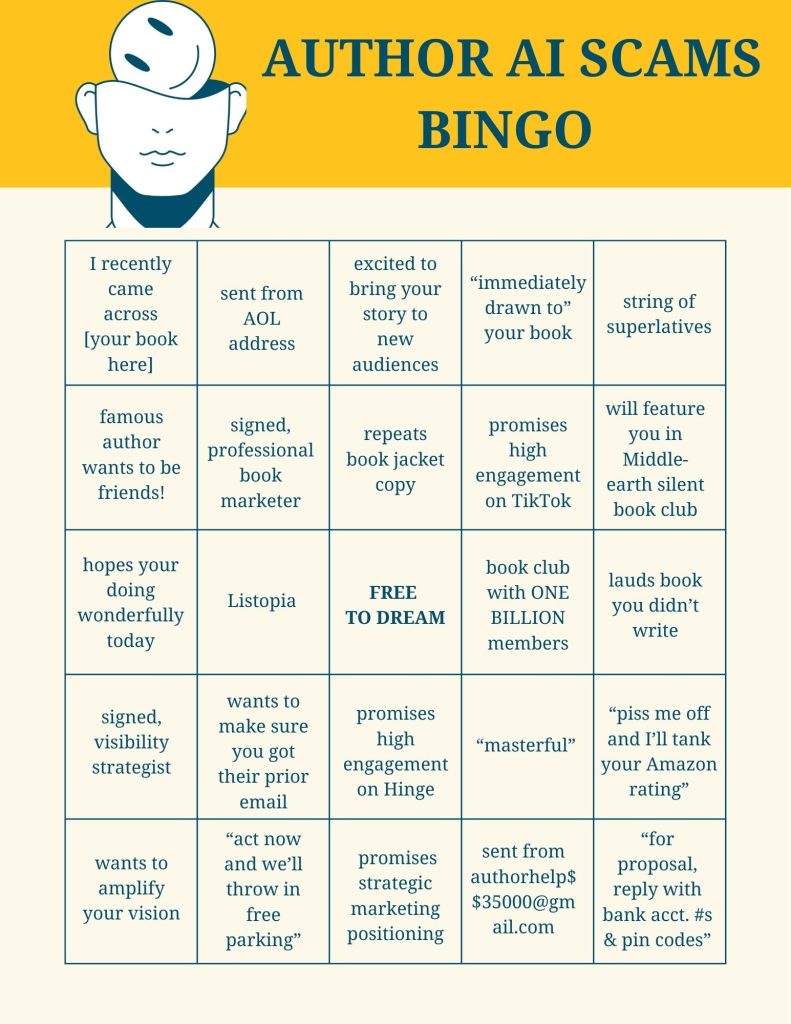
Author AI Scams Bingo



When I meet Arun’s parents for the first time that September, I bring flowers. On the drive down, he tells me not to worry: his parents will love me. I am an actual woman that he is dating. His mother will probably want to give me some of her jewelry, he says with excitement, as he turns into a neighborhood of cookie-cutter houses called The Landings.
But in his parents’ dark, shuttered house, we sit in silence. No jewelry is proffered, and my bubbliness falls flat. A large painting of Michelangelo’s David faces us. Their house is filled with fake flowers, Hindu gods, precious moment dolls, Italian statues of angels: monuments to a life that didn’t quite take off or land in the way they had hoped. They are eager for me to leave.
Later, Arun will admit that his parents advised him not to date me. It would be easy to walk away, they said, because we had only been dating for two months. I was another example of their family being cursed, they said.
It was true that we hadn’t known each other for long. We talked on the phone for the first time that March. Ambika, a childhood friend of mine, had decided she wanted to become a matchmaker for Indians in Atlanta. Like me, Ambika had been unlucky in love, was my hypothesis; now, she wanted to help others. Those who can’t do, teach. I had lost touch with Ambika, but my mother and her had stayed in contact.
One day, my mother said that Ambika had someone she wanted to give my number to. I had always refused to be introduced to an Indian man in this way because it sounded like an arranged marriage. But I had just turned 34, and I wanted children, if I could have them. After ten years in New York, I had just moved back to Atlanta, where no one was interested in me. I had also just gotten out of the hospital. It was a moment in time when I would have said yes to a dog. Ambika didn’t want money. Why not talk to this thickly accented Indian man in Durham?
But Arun, the guy on the other end of the line, did not have an Indian accent. He sounded Southern, like me. It felt almost as if we already knew each other. We did in a way, if shared backgrounds could do the work of backstory, which I suppose was the exact premise of an arranged marriage. We had both grown up eating thick, brown sambhars and thayir sadam mixed with baby mango pickles. We had both attended rival prep schools in Atlanta, two years apart. We were from such a thin lineage of Tamil Brahmins that we were likely related, far down, though why look too closely into that. He was handsome.
I had never been the kind of Indian girl that Indian guys liked, though I was interested in being that girl. This girl had skin a lighter brown than mine, and wore pink eye shadow and long, dangly, Indian-ish earrings. Her hair was straight, but not too straight. She was gorgeous and vegetarian; exceptional at yoga. She had no darkness to her.
The second time we talked, I told Arun I sometimes ate meat. I’d forgotten I’d earlier told him I was a vegetarian. He asked if I was trying to hide my meat eating, and if so, that was weird. I realized I could be myself with him: a vegetarian who had just started to eat red meat, for complicated reasons.
That May, Arun drove down from Durham, where he was finishing a fellowship, to look at apartments. He planned to move to Atlanta that July to start a new job, his first, as a cardiologist.
He suggested we meet and go for a walk. In person, he was tall and gentle, and nervous, with huge, light brown eyes that had nothing to hide. On the walk, I suggested we stop for a drink. He was funny.
I had never been the kind of Indian girl that Indian guys liked, though I was interested in being that girl.
Across a picnic table, he showed me photos of the blue ancestral home outside of Madras that he’d just visited. But he liked the Hawks, hazy west coast IPAs, and Bottle Rocket. A long time ago, an Indian friend had told me it would be impossible for me to meet someone like me because I was too odd a combination of Indian and American. But now that person was here, in front of me.
That July, Arun moved to Atlanta, and we began to go out night after night. We fell in love, giddy with our luck at having found each other after years of meeting people who weren’t right.
I had sometimes had this feeling that if something good happened to me, something bad must happen next—a certain, universal equilibrium to maintain. No one deserved it all. But maybe this would be different.
That February, one month before Arun and I first spoke, I had woken up with a fever. I ignored it, not realizing how sick I was. Three days later, I couldn’t breathe. My sister drove me to the hospital, and in the E.R., a nurse said, “she’s septic.” They stripped me in a back room. I begged for a blanket, but my fever was too high, the nurses said, as they took a mobile chest X-ray. I apologized for not wearing a bra, and the doctor in the room smiled awkwardly. This girl is about to die and is worried about a bra, is what that smile said. A nurse slid a bedpan underneath me.
I mentioned to one doctor that I had been to India the month before, and then no one could let go of that puzzle piece. Had this very anxious girl been to any dirty places in India? they kept asking.
One week later, I graduated from the ICU to the main floor of the hospital, after rounds of IV antibiotics for pneumonia, and assisted breathing and luck. I remember looking in the mirror (they did not have mirrors in the ICU) and feeling shocked. I had imagined the worst, and I looked much, much worse. I remember wild hair, a darkened, hollowed face.
After I passed a test of walking down the hall with an oxygen tank, I was discharged. I was ten pounds lighter and needed to regain my strength. I began to eat meat. Arun called.
As I recovered, my mother said that I looked better. She was so hopeful for and invested in my health in the way only a mother can be. But I felt scared. I had gone to different doctors over the years, saying that I felt sick, but each had dismissed me as anxious. It felt as if there was something in me that I couldn’t see.
Two weeks after Arun moved to Atlanta, I found a lump in my breast. It was the size of a pea, and hard, like a frozen pea.
The OB I sought out said it was a cyst. She chided me for doing my own self-exam because now, she had to send me for a mammogram. Three hours after my mammogram, I was the last, pink-robed person still in the waiting room. A radiologist came out and told me that they would do an ultrasound and biopsy of the lump, to be safe.
I got dressed and joined Arun, who was in his white coat in the outside waiting room. He had just started work at the same hospital, down the hall.
Another radiologist called three days later, on a Tuesday, to tell me the lump was cancerous. I hung up and called my mother.
“Hi, yes,” she said nervously.
“It’s cancer,” I blurted out.
In the past, I’d had trouble asking my mother for soothing, but in this moment, and in all moments of sickness, I knew to call her. Here, take this piece of information and do something with it. She said she and my father would be there immediately. I asked her if I should tell Arun. Gently, she said, “Yes, you have to call him.”
“What do you fear the most?” Arun asked me in darkness, later that night, in bed, back at his apartment.
We had just returned from my parents’ house. After I’d called my mother, my parents had apparated and brought me to their home. Arun had come straight from work. My parents and sister and cousin had fallen in love with Arun over dinner, despite the subterranean context of the meeting. Now we were alone, back at Arun’s place.
In three days, that Friday, I would find out what stage my cancer was. I could have found out the next day, but I hadn’t wanted to cancel my second class of the semester. I had just started teaching creative writing as an adjunct professor at Emory. It was a dream job for me, and I didn’t want to lose it.
“I don’t know,” I said.
“You probably haven’t thought about this, but do you want kids?” he said.
“Yes. Do you?”
“I think so,” he said.
“I really want kids,” I said. “That’s my biggest fear, that I won’t be able to.”
“When you meet the surgeon, can you ask her what your options are?” he said quietly.
“Yes.”
Two weeks later is when I went to Arun’s parents’ house for the first time. When I would badger Arun about their coldness, he would assure me I was imagining it.
Arun would later admit to me that his parents believed that their family had been cursed.
But then I’d find a text from his father saying we barely knew each other, so not to get too close to me. Arun would later admit to me that his parents believed that their family had been cursed. His older sister had eloped with a Muslim man. This was the worst thing they, conservative Hindus, could imagine, until their golden son met a girl with cancer.
The words underneath their words being: They didn’t want a daughter-in-law with cancer, who did? What if she’s always sick, his mother would ask Arun.
She cursed me, I yelled back at Arun, during fights later, when I was sick a lot.
A three day wait. A feeling of jet lag, my brain far behind my body, trying to catch up with what my body already knew.
In a tiny room with a surgeon at the end of that week, I hear the words “treatable and curable.” I text them to Arun. I want him to want to stay with me.
“Can I still have kids?” I ask the surgeon. I realize I have no idea how cancer works.
“You will still be able to have kids,” she says and pauses. “You should not have this.”
I ask her if I should freeze my eggs. She says there may not be time for that: The most important thing is for me to get the cancer out of my body. But she hands me the card of a reproductive endocrinologist.
Arun stands when he sees my mother, sister, and I walk back out into the waiting room. My mother, with all the hope in the world, tells Arun that I can still have children.
He smiles gently, as if he has walked through the wrong door. The door he had wanted was the one downstairs: the door to the OB office, where young couples hold hands, waiting to hear their baby’s first heartbeat. But this is the door that opened for him.
I had been wearing a long silver chain with a locket at the end that had an inscrutable piece of paper stuffed inside. Michael, a white guru that my mom found online, had given me this talisman two years earlier, to ward off evil. Michael practiced Vastu, the Indian version of feng shui, a “yoga for the home.” He had purportedly helped Bill Gates to rearrange the furniture in his first Microsoft office. My mother had asked Michael to shoo out the bad vibes from my Carroll Gardens apartment and open up new doors. I had ended up moving to Atlanta.
“It seems as if this silver pendant isn’t working as well as it could be,” I say to Arun.
In Hinduism, there is always a curse explaining why things have gone bad, and something you can do to try to remove the curse (talisman, short white man flitting around your apartment, using his phone like a compass, drawing yellow dots in corners, busily placing tiny stickers on windowsills.)
My parents’ neighbor used to take her golden retriever on walks in a stroller. My grandmother would watch and say confidently, “The dog must have done something very good in her last life.” There is a karmic equation, and it includes dogs. This slow-growing tumor, that started expanding in me ten years earlier, must have had its origins in some other layer of time.
One day, my father tells me that he’s always believed our family has been cursed, so this diagnosis makes sense to him. Before he was born, my father’s mother gave birth to two sets of twins. Each baby died before turning one. Bai, their family’s housekeeper, knew what to do. Bai was stout and only had a few teeth and was always squatting and washing dishes and speaking Hindi loudly and animatedly.
Bai said that for my grandmother’s next baby (my father) to live past one, my grandmother, a devout Hindu who believed in the holiness of cows, would need to watch a calf be killed. Afterward, Bai would need to sift my father in a banana leaf, like rice separating from its husk. She would need to throw my father up and catch him, like a rice kernel in a sieve. My grandmother would follow these instructions, and my father would live.
I want my cancer and new relationship worlds to stay separate, but they collide quickly.
The first reproductive endocrinologist I meet with, an older, icy Southern woman with perfect make-up, tells me that it is too late for me to preserve my fertility: I am 34.7, and I should have frozen my eggs in my 20s for IVF to work.
The second doctor I meet with, a kinder, older man, tells me that actually, I can have kids at 38, and Indian sperm donors are very popular right now. He says that even though embryos are more likely to end in live births than eggs, I should not freeze embryos with a new boyfriend. I wouldn’t want to end up in Sofia Vergara’s position.
I read online that frozen eggs are fragile and can crack when thawed; embryos tolerate freezing better. The summary of my research seems to be: If you know that you are going to want to have children with someone, freeze embryos.
There is a short, month-long window between my surgery, at the end of September, and the start of radiation, in November, in which I can freeze either eggs or embryos. If I want to freeze embryos, the conversation has to happen now.
One night that week, Arun and I are reading in his bed, which is a mattress on the floor. Since he has moved, our lives have been a storm of new jobs, new love, and new cancer, and our apartments feel like bare boned play sets. It feels as if we are still trying to figure out where things go, and what will stick and what will not, and what is worth investing in.
We haven’t talked about marriage, or children, except for that one quiet question he asked me in bed, the night of my diagnosis. But it feels as if we are heading in that direction.
I turn to Arun and casually ask him if he’d be open to considering freezing embryos with me.
“Do you think that’s wise to freeze embryos after two months?” Arun says, not meeting my eyes.
“I guess not,” I say and turn away and cry.
Of course, Arun is reasonable not to give away his valuable Indian sperm to someone he has just met. But option value, as my father, a finance professor, would say. The example of option value my father always gives is: Just bring the umbrella. If you bring the umbrella, you have the option of using it. That does not mean you have to use it.
What I want to say to Arun is, why not ensure our future happiness with those embryos in the bank? We are in love, we both want a family, and we are both morally fine with destroying embryos if we ever broke up. The clinic requires that we find a lawyer to draw up a contract stating this, since we are not married. I cannot see any downside to freezing embryos, only a greater possibility of having a family down the line with the person I love. I feel deep in my bones that we will stay together, and that this is our shot.
A few days later, we are eating tacos at Arun’s long, stainless steel kitchen island left behind by the apartment’s previous tenants. His apartment has become our world. The lucky bamboo plant that he gave me while I waited for my biopsy results sits on the island, next to a thick packet of my Livestrong paperwork. Livestrong provides financial aid for fertility preservation for cancer patients, but they only allow you to apply once, for either egg or embryo freezing. My application is due in two weeks. Chemo may permanently affect my fertility, but I will have to make this decision before I will know if I have to have chemo.
Pushing past my fear of difficult conversations, I bring up the option of freezing embryos again.
“I didn’t realize freezing embryos was a possibility,” Arun says, as if astounded by the technology that could make this possible.
I am astounded that he does not remember our earlier conversation. I realize at this moment that I do not know him at all. At two months, you can feel as if you know someone, but you can’t really know anyone without time.
He says he needs more time to think about it, and that he would like to involve our families. I suddenly don’t want him to be the perfect Indian son anymore. He walks to his balcony and sits alone.
I am trying to tether my fate to a stranger’s. We are orbiting on our own planets.
At night, we continue to meet each other’s friends at different noodle houses along Buford Highway, Atlanta’s long road of ethnic food stalls. We cheer on the losing Hawks and walk down the winding Beltline, admiring other peoples’ dogs. We both have career ambitions and work to make small marks at our new jobs.
I am astounded that he does not remember our earlier conversation. I realize at this moment that I do not know him at all.
I choose to have a lumpectomy surgery, in which my surgeon will remove my tumor, but leave the rest of my breast intact. After that, I will freeze eggs, or embryos, and finally, undergo radiation. When the surgeon takes out my tumor, the pathology lab will run a test on the tumor to see whether it responds well to chemo.
Before my lumpectomy, a nurse starts me on an IV of anesthesia, and I wave goodbye to my family. A moment later, I am awake again, facing Arun, in the post-op recovery room. I throw up.
“You look beautiful,” Arun says.
Back at my parents’ house, my father and I stand a few feet apart in the kitchen and play catch with a tiny, Vicodin pill. Things feel light. I love anesthesia.
A few nights later, Arun tells me my breast actually looks better. I look in the mirror. He’s right, my left breast is slightly more perfectly round, perkier. A science breast.
The weight of whether we are freezing embryos or not is still on top of every word we say. But I try to stay breezy and wait for him to bring it up again. I try to be as nice as I can, as if that might help.
An old couples counselor once told me that I tend to demand things angrily instead of asking for things softly, a more emotionally intelligent, subtle approach to negotiation.
The night before my Livestrong application is due, Arun and I are on opposite ends of his stiff, blue velvet Ikea couch.
“If you don’t know, you know,” I say finally.
Arun pauses and shifts.
“You’re right,” he says finally. “I’m not ready. You’re asking me to be a father and I’m not ready.”
“You have the option of being with someone else, years down the line, and having kids,” I say.
“Yes,” he says, as if that’s exactly right. “This feels equivalent to me asking you to marry me. I’m not ready for that,” he says and is strangely cold, and I am glad to know he doesn’t want to marry me.
“I’m going home,” I say then, getting up from his couch.
“I don’t know what you want me to say,” he says, getting up.
“I want you to say that you want to be with me. That this doesn’t affect how you see us or what you see for us in the future.”
With no other option, I choose to freeze my eggs and embrace injecting myself.
Later, as I will recover from my egg harvesting procedure, I will call to tell Arun that they retrieved 26 eggs. I feel proud of my body. “That’s great!” he says, and he will mean it.
I will try hard to push down any resentment I have.
That October, my mother, sister, and I wait to meet my medical oncologist, a young Indian woman who will go over my tumor’s pathology. A young Indian man storms into the office first, unannounced.
“You got pneumonia, and then cancer? What’s the connection?” he demands.
My sister and I make eye-contact and try not to laugh. Who is this kid-detective in an oversized suit?
Now, after having had years of lingering symptoms, I wonder about what that resident asked. Why wasn’t any doctor, including my doctor boyfriend, trying to connect the dots between my illnesses?
I want Arun to be my doctor, but he often doesn’t want another patient. He has trouble asking me how I am feeling when I am sick, which goes against my fantasy that it is his passion to uncover the source of my health issues and help me to regain my health. This seems as if it should be a built-in perk of dating a doctor: the ultimate concierge medicine.
But Arun will admit, deep in the throes of couples therapy later on, that it’s hard to be with someone who sometimes just has to sit on the couch instead of cleaning the kitchen because she is exhausted, again.
He has trouble believing that something more systemic could be happening in the underworld of my body. He says I do not look sick, unlike his actual patients, who are dying of advanced heart failure. Maybe there is a comfort in hoping and pretending as if the person closest to him, the person that he loves most, is healthy.
Maybe it is that he is a doctor, and he is used to death. Life moves on. I am still getting to know him and learning to understand what his silences mean.
My oncologist comes into the room and tells me that my tumor pathology has come back. I do not need chemotherapy.
The next week, I break down when I find out that the surgeon has to redo my lumpectomy because my tumor had positive margins. In every moment lives a recalculation: How many more days do I have to give to get my old life back. I don’t want to have to play Vicodin catch again. That night, I ask Arun to explain positive margins to me. He brings up something called micro metastases, and I beg him to stop. He pauses.
“Do you want me to talk to you like a patient or a girlfriend?”
“I don’t know, both,” I say.
On the back of a magazine, he draws two circles: the tumor and the circle the surgeon cuts out around it. The circle the surgeon cuts out should be larger than the tumor. Clear margins mean the excised tumor has healthy cells all around it. If the excised tumor has even one cancer cell on any edge, that means that there may still be cancer left in my breast. After my re-excision, my breast has been shifted a little wayward to the right, as if its sculptor’s priorities have shifted too; but the cancer is gone.
For the last six and a half weeks of my treatment, I lay daily on a mat as radiation techs, like Cinderella’s mice—if Cinderella had cancer—shift my clothing and hair and arms so I am in the perfect position for the radiation to hit. I watch other patients finish their final rounds of treatment and one by one ring a silver bell in the hall labeled “radiation vacation.”
On one of my last days of radiation, I spot a pre-med writing student of mine nearby, on Emory’s basement radiation floor. I run around the corner to hide.
I want my teaching world across Emory’s campus to stay separate from my sick, shadow, hospital world. I have a deep shame around having cancer, as if I have failed in some metaphysical way. As if, if no one knows about my diagnosis, I can still be perfect: a joke. Maybe the curse talk has settled in.
After my last session, the front desk attendant, Fatima, claps her plastic clapper hands and yells hahahaha with insane joy. My parents film on their cell phones as I ring the vacation bell, as if I am a radiation influencer now. My mother brings out a cake. I blow out the candles. Arun surprises me and shows up for the weird, joyful basement party.
They let radiation patients valet for free at the hospital. By the end, I realize why—there are no free rides. I can barely walk. The fatigue that comes with radiation crescendos, and is cumulative; you are most exhausted in the month after treatment. I begin to take tamoxifen, an estrogen blocker, which I will take for ten years; I wake up every night with hot flashes. But I made it. My job now is to rest. I am on vacation.
Around then, Arun and I go to the holiday party of an acquaintance, who stresses as her grandmother’s special cocktail glasses are broken one by one. I quickly have to leave because I am exhausted from standing. I had told Arun I was too tired to go, but relationships are always this negotiation between who we want our partners to be, and who they are. I could tell he really wanted me to try, so I pushed myself. Now I feel resentful.
In the parking lot, Arun runs to get his car and drives it as close to me as he can. He gets out of his car then and runs to me, picks me up and carries me back to his car. Back at home, he carries me to bed, wheezing the whole way. It’s an image and feeling I’ll never forget.
Through all of this, I won’t miss teaching a class or tell anyone outside of my immediate family and friends about my diagnosis. I only use my cancer to ask for a break once, when I’ve been asked to, for free, read through hundreds of essays for a writing prize I won the previous year. This reading period coincides with my radiation fatigue. I nervously call the founder of the prize and admit to him, with shame, that I have breast cancer and am too tired from radiation. “I’m so sorry I can’t do it.”
He pauses. Then he tells me, actually, he also had breast cancer and went through radiation. It actually made him really want to read, so it’ll help me to get through the radiation to have this reading work.
I laugh.
It’s as if the universe is saying—you’re lucky—you’re one of the lucky ones—don’t ask for breaks. I am one of the insanely lucky ones.
I select a few essays.
That New Year’s Eve, over enchiladas at a divey Mexican restaurant, Arun takes my hand. It’s been five months and a lifetime since we started dating. He tells me that he wants to buy a house, and he wants us to move into it together. He says he wants us to get engaged before we move in, and he wants us to get a dog. I think about those frozen eggs. My dreams are coming true, but in a different way. Why couldn’t he have decided all of this two months earlier?
If the excised tumor has even one cancer cell on any edge, that means that there may still be cancer left in my breast.
That summer, I email Ambika to tell her we’re engaged and to thank her for setting us up. I tell her that we’d love to invite her to our eventual wedding. She writes back within minutes and says that she’s not available to attend our wedding that doesn’t have a date yet, but she’ll add this to “her files.” I have this strange feeling that Arun and I were her only matchmaking experiment and that she is maybe a little sad that it worked. But I am grateful to her.
My favorite moment of our large, joyful three-day wedding will be napping with Arun in a dark hotel room, in between our 8 am ceremony, and 5 pm reception. I was supposed to have washed and dried my hair in that time, but I would have shown up with the greasiest hair in the world to our reception (and I did) to lay there in Arun’s arms, allowing the weight of the last two years to fall away.
We finally reach that miraculous point where we can try. I temporarily go off of tamoxifen, a teratogen that can cause birth defects if on it while pregnant. But tamoxifen is what prevents my cancer from recurring, so my OB says I should get pregnant fast. If, after three months, I am not pregnant, I should use my frozen eggs.
We try for three months, and I have one chemical pregnancy. I call my reproductive endocrinologist. This time, together, Arun and I will fill out paperwork and begin the process of making embryos with my previously frozen eggs. These embryos will be different from the embryos we would have made.
Everything I had thought would matter does not, due to sheer luck. 25 of my eggs fertilize, and ten of our embryos grow to “day five,” when the lab freezes them. After genetic testing, we will end up with six chromosomally normal embryos. Six perfect little embryos waiting to be born. I imagine a girl with pigtails, though I know they are just cells.
I get pregnant after my first embryo transfer. A few weeks later, Arun will come into our bathroom one night and find me keeled over, bleeding a lot. I will always remember his face—like one of those Italian pentimentos: underneath this sad face, a secret, sadder, more heartbroken face. So much is unspoken; if we can just have this baby, we can put the past and all of its darkness and resentments behind us. At an ultrasound the next day, a doctor tells us that the embryo’s heartbeat is low, but possibly viable. We take the ultrasound image home but do not know whether to tape it up or stuff it in a drawer. Two weeks later, the ultrasound tech can no longer find a heartbeat.
Though it isn’t like us to cope well, we decide to drive up to Asheville for the weekend. We hike through rolling green hills and drink wine. Back at the hotel, while we watch basketball in bed, I begin to have rhythmic, unbearable pain. Instinctively, I know these are contractions. Arun drives me to an E.R., and just as they are about to give me morphine, a red, palm-sized sliver slides out of me: the last of that embryo. The pain is gone in an instant, a switch turned off.
At home, I ask the IVF clinic to send me my file. I want a project. In the file, the clinic accidentally includes a sheet of paper with a list of the genders of our embryos, a byproduct of genetic testing. We had told the clinic we did not want to know the genders. Now I see that the one I lost would have been a girl. We had both wanted a girl, so much so that we had named her: Lalitha. Was it the embryo, or was it me, or was it Arun’s decision years ago that has brought us here? Maybe those other ghost embryos would have worked. There is no counterfactual.
Later that summer, another transfer. This time, I get pregnant with M: my firstborn, my little soulmate.
For the last two months of my pregnancy, Arun and I live separately because it is March 2020, and Arun is potentially exposed to Covid in the hospital every day.
We reunite for M’s birth, and it is our best date. He swims out as “Under Pressure” randomly plays on my playlist. I am shocked that my baby has ten fingers, ten toes, and huge inky black eyes, and that he is perfect, and that we got here.
Two and a half years later, after another transfer, I have K: my angel baby. They lift K’s dark, brown, writhing body out—and hold him up over a blue curtain for me to see. He cries out.
There is no curse, I think as I watch them carry my baby away. There is no curse, I whisper to my baby on my chest, when we are reunited.
Everything I dreamt of for myself has come true.
When K is a newborn, I watch the other mothers at M’s preschool drop-off. The ones with babies wrapped to their chests like koalas, or babies cradled in the crooks of their arms like footballs. I am envious. I never want to let go of K, but find myself panting when I have to bring him with me.
We had told the clinic we did not want to know the genders. Now I see that the one I lost would have been a girl.
I watch these healthy mothers toss their children into car seats with ease: mothers whose arms and legs are strong and sculpted and young. I watch these mothers push their toddlers in double strollers and wagons, up and down the light hills of our neighborhood. Their silk shirts fill with breeze, like sails with wind, as they bike their children around town. They are free, and so their children are free.
My dream came true, but I wonder about my children’s dreams. I assumed the doctors would cut out my cancer, and I would move on and finally be healthy. But I realize on many days that I am still not healthy. I have two wide-eyed, brilliant creatures and am not able to take care of themin the consistent, epic, daily way I had imagined. I try as hard as I can, but I have to pace myself. One day there will be an army of us older, frailer mothers who got here, but who are struggling. And one day after that, an army of our children wondering how to navigate their adult lives without us.
When I was pregnant with M, my therapist told me I was brave to have M, which made me feel brave. Later, I wondered what she meant by that.
Another therapist leans toward me on my computer’s Zoom screen, and says, “You must think about it, as a writer, how cancer is inside of you.”
“Meaning?” I ask.
“Well it’s metaphorical, there’s a darkness in you, some people would say.”
“No,” I say. “I disagree, I would not say that.”
I leave that therapist, but wonder about what she said.
My aunt in New Delhi was the first to tell me I have a “black tongue” because I have dark spots on my tongue, like the goddess Kali (and chow chow dogs). In South India, dark spots on your tongue mean that the negative things you say about other people will come true. One time, as a child in the Madras airport, at baggage claim, I said with my black tongue that my sister’s suitcase would not show up. Then, it did not show up. My sister still brings this up.
My mother tells me I projectile-vomited every day until I was two months old. A doctor in New Delhi discovered that the passage between my stomach and small intestine was blocked and corrected this with surgery. But maybe my body lost a way to rid itself of something.
When M is born, Pati, my mother’s mother, warns me about “drishti”: the Tamil word for the evil eye. Indian mothers will line their babies’ eyes with black kohl so that drishti, or the evil eye, will bounce off the darkness of this kohl. The darkness protects.
Pati tells me not to take or post too many photos of M: This will invite envy on the part of others, which will curse M. When M comes down with a cold at one month, and his tiny nostrils struggle to breathe, though we are quarantined because of Covid, Pati says this is drishti. My baby is sick because I sent photos of him to too many friends, and they all said how cute he was.
Arun plays hard with our boys, who are now five and three years old. He wrestles them during their self-coined “tumble time,” plants trees with them, stays up late to cook for them. He takes our rescue dog Sambhar, whom we named after the brown gravy we both grew up eating, on late night walks.
He is still unable to help me with my health, but I can see better now that he would if he knew how. Doctors are trained to look for certainty. Uncertainty is more vexing. He has gotten better about asking me how I feel.
At night, M’s small hands reach for mine. I ask him if he knows how much I love him. He says: yes, more than anything in the world. I tell him yes, and I will love him this much forever, and in my mind, I think, unless I die.
Sometimes I imagine M and K, older, stumbling toward the edge of the earth, looking for their mother and not remembering me and our every day that we have now. Was she nice? Was she mean? Did she love me more than life itself? Did she wonder if she was making the right decisions? Was she a good mother? Did she struggle a lot? Was she happy?
Yes yes yes yes yes yes yes.
I write to rid myself of, and embrace, the darkness. I am trying to be more free.
On one date, after Arun and I are already married and are trying to get pregnant, I down a glass of red wine. I tell Arun, “Let’s imagine your second wife. She’ll be so nice, give you blow jobs, never criticize you, be so nice to your parents, always want to visit them, and they’ll be nice to her of course because your second wife won’t have cancer.”
“Stop,” Arun says, and I burst into tears.
I asked my old oncologist at some point, when I could consider myself cancer-free.
“Whenever you decide,” she said.
She meant never, technically.
A few years ago, I decided to make my original diagnosis date my “cancer-free” date.
That’s when I started fighting cancer, one therapist said.
With slow-growing tumors, it is the fifth through tenth years that they are more likely to recur. I am now in year ten. I write to rid myself of, and embrace, the darkness. I am trying to be more free.
The embryos Arun and I made were different from the embryos we would have made. The babies we have are different from the babies we would have had. M who whispers with excitement, “Mama, there’s a new shape!” and tells me about the square with slanted, parallel sides that he learned about, is mine, for a little while. K, who asks Alexa to play Enya, and says, “Let’s relax, Mama,” and sways his arms, and whispers that he’s so relaxed. Who comes home in leggings and bursts out, “Mama, you forgot to give me pockets today!” These are the only children I could ever want.
A curse is one way of saying someone in the past has done something that will affect you. Biology is another way of saying that. Our dog Sambhar recently went blind, seemingly overnight, while we were away on a trip. In the mornings now, M raps on each step of our staircase, while counting aloud, “One, two, three . . . ” Sambhar tiptoes down, following M’s lead, into his new, dark world.
For many writers right now, the hardest question isn’t how to respond to the world, but how to keep writing at all without losing the joy that made the work possible. The pressure to address crisis—to be timely, responsive, morally legible—has begun to attach itself not just to what artists make, but to how they measure their own seriousness. For some, that urgency sharpens the work. For others, it turns art-making into another site of exhaustion.
I’ve been thinking a lot about where writers go when they’re trying to hold those tensions at once: the desire to stay awake to the world as it is, and the need for spaces that allow art to remain sustaining rather than punishing. Over the past several years, the McCormack Writing Center has become one such space, actively interrogating what care, accountability, and literary community actually look like in practice.
Formerly known as the Tin House Workshops, the organization became the McCormack Writing Center this year after Tin House Books was sold to Zando. With the support of Tin House founder Win McCormack, the workshop continues as a new entity, carrying forward its core values while shedding the constraints of a structure no longer designed to hold them. The change came with real loss. The Tin House name meant something to generations of writers. But it also clarified what had always mattered most: not a brand or a logo, but the people who showed up, the rigor of the work, and a commitment to generosity alongside ambition.
In the conversation that follows, I spoke with Lance Cleland, Executive Director of the McCormack Writing Center, about what it takes to sustain that kind of space through transition. We talked about naming the world as it is, the ethics of paying artists for their labor, and how leadership can remain collective rather than individual. At a moment when many literary institutions are being asked to reckon with their responsibilities, this conversation offers a candid look at what it means to place trust—and the artist themselves—at the center.
Alexis M. Wright: The name Tin House meant something very specific to a lot of writers. As the organization became the McCormack Writing Center, what felt essential to protect and carry forward?
Lance Cleland: One of the most important things for us was staying a value-driven organization—making sure everything we do continues to move through the lens of our core values. The more people you have to run things by, the harder it can be to hold onto that, so protecting that clarity really mattered.
We wanted to keep the same basic structure we already had. We have an owner I’m accountable to financially, but who largely trusts us to make decisions around values and programming. That structure mattered to me, to A.L., to Yimei, to Autumn—to our entire staff.
AW: And on the flip side, did the transition allow you to loosen anything? Things you might have felt attached to before?
LC: We thought about partnering with another organization that could offer more resources, maybe a college or something similar. But the more we looked into it, the more concerned we became about losing our ability to adhere to our values and respond to the moment.
If you have a board or a larger governing body that only meets once a year, and you’re saying, “We want to fund this scholarship now,” but the answer is, “No, we’ll revisit that in 2028,” that’s not the kind of organization we want to be. We want to stay nimble and respond to our community in real time.
AW: The transition was about protecting values and responsiveness. I’m curious how those values translate into the atmosphere writers actually experience. How do you actually hold space for joy while still being honest about what’s happening outside the work?
LC: One of the big things we try to do as an organization is name what’s actually happening. Not referencing “trouble in the Middle East,” but calling it a genocide in Palestine. Not a vague mention of immigration, but acknowledging that our neighbors are getting violently kidnapped by ICE.
We want to stay nimble and respond to our community in real time.
By naming things right away, whether in opening statements, on our website, or in early communications, it lets people know this is a space where those realities will be acknowledged, and that they don’t have to carry the burden of naming them themselves. That kind of naming creates trust. And for anything to work in a workshop or residency space, there has to be trust in the organization.
What we’re trying to do is create a space where writers can engage deeply with their practice without carrying that weight all the time—where people can be in community and celebrate one another without pretending the outside world doesn’t exist. That balance is hard, but it feels necessary.
AW: You’re talking about trust as a foundation. When that trust is really working, what do you hope writers actually walk away with after a workshop or program, especially beyond the manuscript itself?
LC: Early on, we were really focused on the manuscript itself, especially because we had a magazine attached to us. Seeing writers move from the workshop into the magazine or over to Tin House Books was great.
But over time—through my own interest or our staff’s—the focus shifted away from the business side and toward a bigger question: How do we nurture an artistic practice outside commodification? I think of writing as something that’s meant to sustain you for your entire life. When you look back, hopefully you’re happy not only with the publications and the wins, but with the fact that you dedicated your life to creation. And the question for us became: How do we nurture that?
AW: That longer view really shifts the frame. When you think about community over time, what actually makes it last? What have you learned about how writing communities sustain themselves?
LC: Institutions can create paths to mentorship, but the most meaningful mentorship often comes from peers.
When you talk about community, you’re really talking about sustaining it. I love seeing people who came through our programs as students return to teach, whether through our fellowship program, which you were a part of, or as workshop instructors. That cycle is what makes a community feel alive. So many of our strongest mentors were once mentored by someone who came through the program themselves. I love that cycle.
AW: You’re talking a lot about collective effort and shared responsibility. I’m curious how that plays out internally, especially in leadership. You’re a small but mighty staff, right? You and A.L. Major make up the programming leadership. How has that alignment shaped the work?
LC: Yeah, having an aligned staff really changes things. For the last five or six years, A.L. Major has brought so much insight and integrity to this work and has helped move the program forward in really meaningful ways. Having someone else on the leadership team with a different perspective—and who is also a working writer—is invaluable.
We’re here to understand what the writer is trying to do with their work and how we can help them get there.
From a place of expertise, A.L. has pushed us to demystify the professional writing process, whether that’s helping writers think through artist statements or creating space to talk openly about things like query letters. They’re deeply committed to making this a place that supports writers at every stage of their careers.
AW: There’s a line I keep coming back to: “in nurturing the artist, you nurture the art.” I’m curious how you’ve seen that play out over time, and what kinds of support writers actually need, both during a workshop and after it ends.
LC: I think that’s where the community aspect comes in through things like affinity groups on campus and craft intensives that are more holistic, not just focused on advancing one part of the writing. There’s always a balance. We are here to work on manuscripts, but we’re not here just to make a manuscript better.
We’re here to understand what the writer is trying to do with their work and how we can help them get there. We’re all going to have different ideas about plot points or how a line of a poem should read, and those conversations can be useful, but ultimately, we want to listen to the artist.
The artist is saying, “Here’s what I’m trying to do with my work. Here’s my vision.” The question for us becomes: How can we, as an organization, help you get there? That’s where nurturing the artist ends up nurturing the art.
AW: I want to shift slightly here. Are there moments you can think of when something happened and you realized, “We’re losing people we actually want to keep”?
LC: The first thing that comes to mind is the shift we made to start offering targeted scholarships to bring more writers of color into the summer workshops. You start with the awards, then you begin diversifying the faculty.
And what you realize very quickly—and this is a very white instinct—is that none of that is a magic elixir. When you bring in communities that haven’t historically been supported or represented, they come with different expectations and different needs. You start to see the gaps you haven’t yet addressed in making the space genuinely welcoming and safe for those communities.
That’s something you always have to keep interrogating and adjusting. The work doesn’t stop at access. It’s ongoing.
AW: How did those moments change the way you approached leadership and equity going forward?
LC: We had to start asking ourselves whether we were actually bringing in writers who represented a wide range of identities. Not only in terms of sexual orientation, ethnicity, and background, but also genre, educational background, and approach.
And you learn. You have to learn. I’ve been fortunate to be in a position where I could learn, and where people were willing to teach me.
AW: This is incredibly hard but important work. Now that the organization describes itself as a center, rather than only workshops and residencies, what does that shift make possible?
LC: I think we always felt a little constrained by a name that didn’t fully describe the totality of what we do. One of the reasons “center” felt right is that it reflects being a hub for many different kinds of activity.
At our physical location, for example, we have a bookstore on the first floor, Bishop and Wild, that’s become a real gathering place. Book clubs meet there. Other organizations use the space for activism and community engagement. We recently hosted a group of genocide survivors for the National Day of Remembrance. To be a space that can hold readings and something like that is very meaningful to me.
We also host the Constellation reading series, which pairs local writers with our residents, and we partner with the Alano Club to offer space and a residency for writers in recovery. What we’re trying to be is a community-facing place that other organizations can use, especially when they don’t have a physical space of their own.
All of this is adjacent to our equity mission. It felt like “center” named what we had been building all along, and being able to finally call it that was really exciting for us.
AW: So, if I’m a writer deciding where to invest my time, energy, and money, what do you hope I understand about MWC that isn’t immediately obvious?
LC: You’re going to be respected. And respect shows up in a lot of different ways. Do you know who’s reading your work? When we send a rejection, are we making sure we got your name and pronoun right? If you’re on a waitlist, are we telling you that we liked your work and how that process actually functions? Are we transparent about where the money is going?
We’re trusting our community to do right by us because we’re trying to do right by them.
If a fee is what it is, it’s because we pay our readers and we pay our faculty. Everyone who works with us gets paid. The economics of arts programming aren’t talked about enough, but people deserve to be compensated for their labor. All of that is about respect.
We also try to honor the fact that writers aren’t an inherently affluent group. Respecting that means being transparent about what we charge and offering payment plans. By the time many participants attend a workshop, they haven’t paid the full tuition yet.
That’s trust. We’re trusting our community to do right by us because we’re trying to do right by them. And transparency also means being honest when we make mistakes. Saying, “We tried this, it didn’t work,” and committing to doing it better next time.
AW: And when you look ahead a year, what does success actually feel like day-to-day inside MWC?
LC: That people know our name. [laughs] Not because we’re trying to distance ourselves from Tin House—we’re proud of that legacy—but because we want people to understand that we’re both a new and an old entity. Same people, new face.
AW: I think you’ve shown that you can do hard things.
LC: Yeah. I’d like to think we can.
AW: Is there anything that you wish I had asked that I didn’t ask?
LC: I’m not sure what the question would have been, but I do want to acknowledge that we’re not the only organization that’s doing this kind of work. I’d like to think we’ve been a leader in some ways. Karaoke, certainly. [laughs] I see a lot of other workshops doing karaoke now, and I will fully take credit for that—that’s my one flag I’ll plant.
But seriously, a lot of organizations have made really meaningful changes, and that’s exciting. One thing that’s shifted for me is letting go of competitiveness. There was a time when I thought we were the only ones doing this work seriously, and that mindset doesn’t lead to growth.
I love that organizations are sharing resources and ideas now. I want the entire literary landscape to be more equitable home for nurturing all writers.
AW: Absolutely. So, what’s your go-to karaoke song?
LC: You know there’s not one!
AW: The people want to know, Lance!
LC: I mean, it’s probably gonna be Usher or Nelly. Those are the two I’ll lean back on, but really it’s gotta be new ones every time. As often as we’re doing this, you have to keep it fresh.
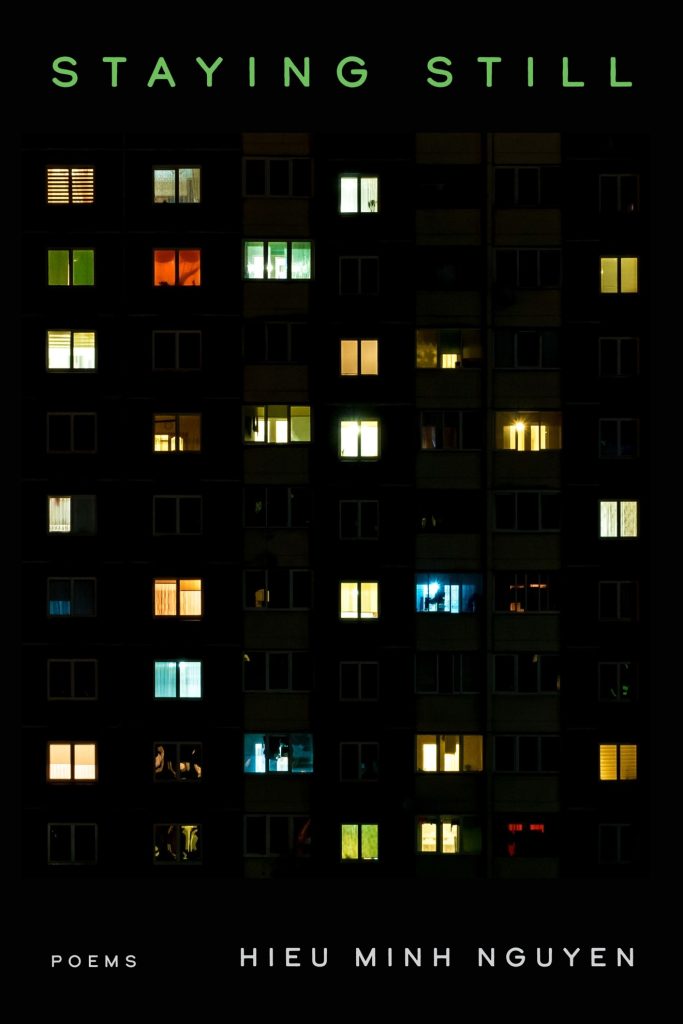
Electric Literature is pleased to reveal the cover of Staying Still by Hieu Minh Nguyen, which will be published September 1, 2026 by Tin House/Zando. You can pre-order your copy here!
The highly anticipated follow-up to the award-winning poetry collection Not Here, Stegner and NEA Fellow Hieu Minh Nguyen’s Staying Still centers on the question of how: How do our anxieties around the idea of belonging estrange us from the very world we seek to belong in? How impossible does it feel to stay still and face ourselves? From the intimate longing of queer boyhood to the collective expectations imposed upon children of refugees, these poems face head-on the rejections, grief, and violence we fear in fractured family dynamics, love, and desire as we search for our place in this world.
Here is the cover, designed by Lucy Kim:
Hieu Minh Nguyen: The poems in Staying Still are searching for the right word, the right song, the right color to articulate loneliness—a loneliness found while surrounded by people, a loneliness that circles my experiences as, to simplify and be wrong, an undesirable. Driven by a longing to stay, the poems in Staying Still travel through grief and wonder, through yearning and nostalgia, gathering beloveds—alive and dead, far and near—on the dance floor.
I’ve been working on the poems in this book for the last nine years. To say I entered the cover process with a few loose ideas would be downplaying just how much of a control freak I am. I had a Pinterest board. I made mock-ups of the cover image. Not unlike how some people have their drag name picked out long before they ever step on a stage—and then, once they’re finally in it, full face and hair, they realize the name no longer fits. Let’s just say: Before I was Pam, I thought I was Napalmela. And before working with Lucy Kim, I was equally convinced I knew exactly what this cover should be.
Then Lucy started sending options, and suddenly the book got bigger than my little vision for it. Her drafts didn’t flatter my expectations—they messed with them. They cracked the book open in ways I hadn’t planned for, offering new angles on the loneliness at the center of this collection. I never would have imagined anything like this as the cover before working with her, and now I truly can’t imagine it being anything else.
The image is dark and vibrant at once, erotic and melancholic. The outside gestures toward the inside in ways I didn’t expect. Each poem becomes a small room. The cover asks new questions—are we inside the room, or only looking in through a window? It makes me think about how loneliness feels from within: like the only house on the block, the only house for miles. And yet, from the outside, loneliness has neighbors. Our lonelinesses share walls.
Lucy Kim: The poems in this collection have a through-line of longing and loneliness: of self vs. other. There’s a restlessness in the narrative voice, of bodies constantly moving in the world, together but never in sync. It’s a challenging concept to convey on a cover, much less in a single still image. But what benefited me greatly is that Hieu has a background in visual arts himself and we began a dialog of sending images back and forth until, ultimately, landing on this image of apartment windows at night—familiar to any urban dweller yet made abstract by the erasing of details in its nighttime setting. There’s a musicality to the pattern in which the window lights are on or off and in different colors highlighting the different lives within . . . a striking visual metaphor for the concept of “together in separate spaces.”
I look at the cold floor.
Tap my loafer on top.
It holds.
I slide to the middle
and laugh. A horse
made of fog runs
out of my face.
The ice is the kind you find
in Antarctica. We walk back.
Satoru and I take turns standing
next to the potbelly stove.
I flip through a Sears catalog—
look for ice skates. I want to slice
the frozen water. I want to glide
so fast I become snow.
I want to glide so fast
I open a portal
to the future.
The war has ended.
I open a portal
and see dad.
His handcuffs
become a butterfly
he rests
on his finger.
Wind chills my cheeks.
I look up
and at the door,
a guard. His nightly headcount.
His eyes, a pair of searchlights
burning
against our faces.
It’s in a warehouse.	Lost.

      Guarded by tigers or a moat

of piranhas. I don’t know.

      We couldn’t lug it to camp.

It weighed as much

      as a small sky.

At night, I still hear it.

      The sound of a wedding,

a tangerine peeled in glorious heat.

      This country can’t make me

forget. Every song

      has a memory.

I lay in an army cot

      and smell a tuxedo.

I press an F chord into my thigh.

      Hum the note.
The grown-ups on our block look for their ghost lawnmowers,

but I’ve known you, Fusae, since before the war

Before I saw your wet hair freeze in January air, stepping out of the shower

Your mother’s voice sounds like bees through barrack walls

I’m glad you’re here

We sit by the fence under a glint of moonlight,

bury the last of our baby teeth
The book begins on a boat to an island: a woman running from the man who abused her as a child, a chance meeting with a stranger who promises to kill him—and then, days later, the murder. Whidbey’s opening pages offer spare information and a heightened sense of threat, evoking the everyday experience of people pursued by sexual predators. “You want to know who did it,” T Kira Madden writes, “but that was never the question. Or, it was never the right one.”
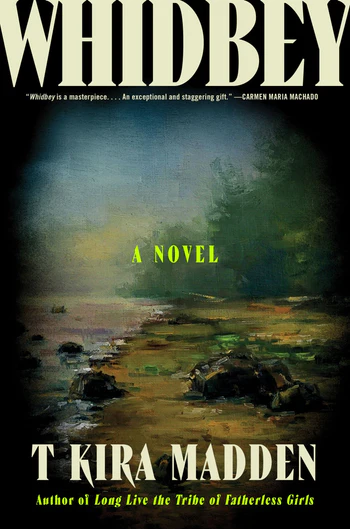
In Madden’s hands, this noir revenge story is full of so much more than blood. Like her memoir, Long Live the Tribe of Fatherless Girls, Madden’s debut novel subverts notions of power and powerlessness, particularly regarding women’s bodies, while asking complex questions about honesty and culpability. At the heart of the narrative is Birdie. Hiding from Calvin, the felon who has recently been released, she is fighting to take back not only her life, but her idea of a future. There is also Linzie, a former reality TV star who publishes a memoir in order to tell her story. But perhaps it is Mary-Beth, mother of the convicted sex offender who molested Birdie, who surprises us most. Despite acerbic dialogue like, “Why are you wetter than a tramp?” and a worldview best captured by the assertion that “Cola passed off as Pepsi would never fool anybody,” we read that Mary-Beth is a mother in pain, having failed either to protect or change her son. Florida, too, is rendered like a misunderstood character, beneath a façade of Winn-Dixies, Mystys, and, memorably, The North Pole Florida Gas & Save, where every day is Christmas. (“In the air: smoke sparkling from constant sugar burn and the always-smell of dead fish.”).
Madden is unflinching in her critique of a justice system that perpetually fails girls and women, and she sets that same sharp gaze on the media and how it defines cultural narratives about rape and molestation. But mostly, we feel her tenderness towards her characters, these women who are searching, hopeful, tough, flawed, ingenious. Whidbey, then, is perhaps less a novel about vengeance, and more about how women survive and go on to tell their stories.
D/AL: As you tell not only Birdie’s story, but Mary Beth’s—and even Linzie’s—there is such a generosity of spirit that seems to arise from years of living with certain questions. What did it mean to you to write this book? Who are you writing for?
TKM: With Long Live, I knew I was writing for a younger version of myself, because that was the only way to get it out. Whidbey is for survivors, but I also wanted to teach people who might be outside of this world about how the system works. There’s nothing in this book that isn’t rooted in fact. So called “Pervert Parks” in Florida are real. People having their address moved to under the Julia Tuttle Bridge after Ron Book’s legislation is real. What defines an explicit threat in the court of law is surprising to people. I wanted the focus not on the perpetrator, as we see in media, like our cultural obsession with True Crime and Ted Bundy, but on the women. To honor these people who are not perfect victims or survivors . . . they’re unreliable, they’re women who lie, abuse substances, who are messy.
D/AL: In “The Feels of Love,” from your memoir Long Live the Tribe of Fatherless Girls, you write about sexual assault. It’s a piece that I often teach, because it resonates so deeply with students, particularly young women. What did immersing yourself in a novel demand that the memoir didn’t, and vice versa? How are you thinking about a work that is fiction but driven by truth?
TKM: I believe, as silly as it might sound, that work continues to speak to you if it’s not over—the way people have dreams and feel their loved ones are visiting with unfinished business. I was editing “The Feels of Love” in the final draft of the memoir when my case went from a state order of protection to a federal trial. I thought I was done with that story, but it kept opening. I kept leaving those courtrooms feeling like there was so much more I didn’t understand and wanted to explore, all these feelings of disquiet and unease. I was thinking about a parent’s allegiance or loyalty to a child. I wanted to better understand the victim-survivor hierarchy that had been made in trial and in court systems where I was called the “credible witness” because I’m a professor, an author, [and] I was able to write my own victim impact statement. Whereas other victims and survivors are not always credited in the same way.
I knew my limitations, that nonfiction would be too limiting to dig deeper, that I wouldn’t be able to step outside of my own rage and confusion and sadness. For me, all fiction is driven by truth—true questions. By opening the scope in a work of fiction, I was able to create characters that animate these different questions and doubts and shadows of that system, the things that have stayed with me, haunted me.
D/AL: I notice that even as Birdie is well loved, she is very much alone. Can you talk about her isolation, and who she might have been had she not experienced such violation at age nine?
TKM: I do think that a question many of us have is, Who could I have been? Who would I have been? It’s a question that really gnaws at me. Like, would I be the same? I don’t know. For every single character, I had a list of questions, all questions that I’ve had for myself: Should someone care about this pain? How do I make them care about this? With the characters of Birdie and Linzie, I’m interested in obsession versus repression. What does it mean when you’re obsessed with what happened to you, versus when you can’t see what has happened to you at all?
I wanted the focus not on the perpetrator, but on the women.
I often get the question, “Why is it called Whidbey when it takes place in Florida?” For me, Whidbey is a symbol, a hope many of us have felt—if only I could go to this place or if only I could do this thing, seek this treatment, this kind of healing, then I could see who I really am. And yet Birdie never arrives at this place because she spends the whole time there living in the past. Birdie, who is obsessed with what’s happened, can’t move forward or live in the present at all. I don’t think Birdie sees a way yet.
D/AL: Birdie is not the only woman looking for resolution. What does it suggest that the women in these pages resort to revenge after justice has failed them and continues to?
TKM: The Science of Revenge, a book that came out last year, is about how acts of revenge—not only the act, but the imagining of it—creates this flood of dopamine. And I think that’s really seductive for a lot of people. Some people do move forward with revenge, and others just live in the fantasy of it, like some of these characters in the book. Like Birdie, I was posed a question by a stranger on a boat: “Would you like me to kill this person for you?” My immediate response was, no, of course. But in the days after I thought, God, what would it have felt like to say yes? Revenge can offer an illusion of control. Or the illusion of confrontation when there’s such a lack of confrontation or accountability within these systems.
I’m obsessed with the show Catfish. It’s kind of embarrassing, but I always have been! And I’ve really started questioning that this year—Why is this my comfort show? Why do I watch this almost every day? Even the repeats. And I think it’s the repetition of seeing someone having to face a consequence, having to face a truth. In almost every episode, there is a confrontation and someone has to look into the camera and look into the person’s eyes and say, “I did this.” They don’t have to be sorry, but they have to be confronted. And in life, that rarely happens. In the courtrooms, that person never turns to face you.
There’s the fantasy, a very rightful fantasy, of just wanting that moment.
D/AL: You’ve alluded to living through your own trial. What has the weight of that been like?
TKM: It’s a really isolating experience. This person has been in my life since I was a middle schooler, and I’m turning 38. In some ways, I’ve spent my life attached to this person, because the system keeps people attached. It’s an impossible thing to describe.
There is this weightiness that just follows you every year of your life. Sometimes it’s the person following you—my abuser was convicted of stalking—but sometimes it’s just the facts following you. The courts, the trials, there is an ongoingness that I think is hard to understand if you haven’t been through it. You think you sign off on a paper and something is fixed, something is healed, someone is punished. But it’s not like that. You go through one injunction, then you have to renew it each year. That weight, that tether, remains.
D/AL: Birdie lies not only out of self-protection, but possibly to recreate herself. Hal, one of your delightful secondary characters, lies because he can’t help it. Mary Beth, Calvin’s mother, lies to cope with the truth. How do fictions hurt and save people in these pages?
TKM: I’m really interested in honesty and dishonesty. I grew up in a house of people with severe substance abuse issues. There’s an old joke: You know when an addict is lying because their mouth is moving. I think it’s fair to say that was certainly the case in my childhood. I had siblings that I was never told about. There is dishonesty that comes with protecting one’s addictions. I’d like to think I’m a very honest person, and sometimes I wish I could be more withholding or dishonest or come up with a new identity, but as a shy, reserved person, everything stays bottled up, and then if I have a little outlet, it all comes out. That’s what the page does for me. And also, I did tell that man on the boat what had happened to me, a stranger, and that’s not a safe thing to do. It’s not a wise thing to do.
For me, all fiction is driven by truth—true questions.
With Birdie, I wanted to know what it would mean to totally step outside of oneself, to be able to change who you are at any given moment. I was really interested in the power of denial, which is also rooted in being a child of addicts. What I’ve noticed, not only in my case but in other cases, is the power of denial in the friends and loved ones of perpetrators of violent crimes. I’ve looked it in the eye. So what is the power of denial? How potent is it, and how does it hold? Where does it break and crack?
D/AL: After appearing on The Dating Show, Linzie writes a memoir, one that appropriates others’ stories even as the media exploits her own. Her handler tells her, “If you overcome one trauma, you’re a hero, but two or three make you a tragedy.” Late in the book, we come to understand just how badly Linzie has been hurt. What does Linzie offer to the reader that we might not otherwise understand or appreciate? What would this book be without her?
TKM: Unpopular opinion perhaps, but I love Linzie. It took me the longest to figure out how to love her, because in the original version she was just a punchline. Because I was writing a memoir at the same time that I was starting this book, and publicizing and talking about that memoir in the years after, I started to feel really guilty. What does it mean that I am doing this media and talking to NPR, and I have this platform where people are like, “This is so brave, I’m so grateful to you,” while these other people who have suffered immeasurably don’t have that at all. They’re living under different names. They’re unable to talk about what happened to them for myriad reasons. I felt this weird guilt or disgust that I was capitalizing on bad things that had happened to me.
My early readers gave me the challenge: What would it take for you to love this memoirist character, or understand her a little bit more? Then, without spoiling it, I understood how Linzie was just another chess piece in this system.
Since Linzie appears on reality TV in the book, I read a lot about reality television and how some of the tactics for the “ITM” (in the moment) interviews are actually very similar to other interrogation tactics. You’re being interviewed for an extensive period of time, with alcohol, without food. There are parallels between memoir, reality TV, the court system—the way victims are presented, how we’re packaged in villain/hero narratives, how we’re directed and media-trained to tell a certain story.
D/AL: Some of the most poignant moments in the book are in the point-of-view of Calvin’s mother. How do you understand someone like Mary Beth? What did it take to get close to her?
TKM: Mary-Beth was always [the] biggest voice in the room when I was writing Whidbey. That voice came first, it came the easiest. I knew her immediately, knew she worked in a Christmas-themed gas station. I knew she drank warm sodas. In earlier drafts, I also wrote her through a whole love story.
My first book investigates how one might love parents who are deeply imperfect and who make the wrong decisions, and maybe Mary-Beth was a way of writing that story in reverse. How do you love a child who has not only ruined the lives of others, but your own? The carceral system has completely disenfranchised Mary-Beth, which is the case for so many family members of those incarcerated, especially the parents and family members of those one the SA registry who have to live within certain city limits. What does it mean to love this person so much and to think about them as a boy, as someone who never grew up or into the person who committed these crimes, despite what they’ve done?
I think about how poverty and trauma can easily trap someone like Mary-Beth. She can’t think about the past. There is no future. She’s too busy trying to survive. All of these characters represent the past, present, and future. I really wanted these three to represent a triptych of traumatic timekeeping.
D/AL: In many ways, this book is one of queer reclamation. You write sex and desire with such complexity. What was it like to write these scenes between Birdie and Trace?
TKM: There was a lot more sex in this book when it was 500, 600 pages.
I want to hold what’s true, hold the suffering, ask a reader to stare at it. I think we’re owed that consideration.
As a queer woman, something that I’ve heard a lot or something that I’ve internalized at certain points in my life is you’re gay because you’ve been abused by a man. We hear things like that often, this idea that after trauma, one is sexually stunted, incapable of sexual desire or freedom. It was important to me that none of these characters would be defined sexually or in terms of their sexuality by the abuse that they endured. I was really curious about a character who’s been harmed like Birdie also being really interested in being a sub, finding safety there—and it’s actually her partner saying, No we have to exist in this kingdom of safety. We must be gentle. Birdie harbors a lot of biphobia because she was abused by a man, and it was important for me to see a character wrestling with that while also feeling all kinds of desires—she’s been harmed but she still wants to fuck, and the most exciting, joyful sex we see in the book is when she is completely submissive.
I wanted to have a book about sexual assault also be a book about sex. I wanted sex and harm to live side-by-side; they need not be connected.
D/AL: Your sentences, in their richness and rawness, resist the genre of noir and actually get us closer to your characters and their vulnerabilities. Can you talk about style?
TKM: A book’s shape—thinking about where it fits in terms of noir or thriller or genre—comes later and is usually influenced by other people, like smart editors. All I can do is try to make the best sentences. Tell the best story.
A major part of this book is perspective—it has first person, third person, and omniscience, because I’m trying to ask the reader, What makes you believe one perspective more than the other? Do you feel closest to Birdie because she’s the only one in first person? And what does it mean to have the free indirect speech of third person POV, and then a conflicting omniscience in part three—what does that do to a reader’s beliefs? What does one then take to be true, or of record? Perspective is its own character in Whidbey.
D/AL: What are you hoping that this book might offer young girls and women?
TKM: The true crime phenomenon tends to center on perpetrators. It’s more palatable or entertaining to read their stories, to populate the minds and bodies and psyches of people committing these crimes. What made them this way? And I think that’s easier than looking directly at the suffering, looking at the people who are impacted, staying with them for the long haul. It feels important to me that I challenge this. I want to hold what’s true, hold the suffering, ask a reader to stare at it. I think we’re owed that consideration.
One could argue that Gregory Maguire’s novel, Wicked, and its Broadway adaptation are entirely different stories. Alongside the stage musical’s revision of key character personalities, relationships, and even fates, it also softens the novel’s highly adult themes for a more diverse audience. But what binds the two together is an understanding that Wicked is more than a prequel to The Wizard of Oz—it’s an allegory for fascism and its irreversible cruelty. While the first Jon M. Chu stage-to-screen adaptation, Wicked, seemed aligned with this perspective, the much-anticipated second installment, Wicked: For Good, seems to have lost the plot.
Though Chu couldn’t have known that his adaptation would coincide with a second Trump presidency, the timing of Wicked: For Good and the media coverage it has garnered is highly culturally significant, given the United States’ own worrying rise of authoritarianism. Especially in our own era, the changes made by this film are not frivolous—they are dangerously out of touch and speak to a growing habit of downplaying the stickiness of fascism’s harm. The Broadway musical is certainly a more hopeful story than Maguire’s original novel, but its ending is still somber, as Elphaba fails to rescue the Animals and flees Oz, likely never to return. Changing Wicked’s ending to an unfettered triumph of overthrowing a dictatorial regime, Wicked: For Good occupies a problematic cultural perspective, one that blissfully forgets fascism’s lingering pain and permanent damage.
As others have pointed out, Wicked and the extensive literary history of Oz itself have long been considered political. L. Frank Baum’s 1900 novel The Wonderful Wizard of Oz has been suspected of being a commentary on the McKinley administration. And Maguire’s 1995, decidedly adult novel Wicked is undeniably political, with visible threads throughout of propaganda, anti-intellectualism, systemic oppression, and even state-sanctioned murder gesturing towards fascism in general, and specifically, the crimes of Nazi Germany. And at its debut in 2003, the Wicked musical cemented its own continuation of such political commentary, especially in relation to the George W. Bush presidency.
So when Chu’s Wicked premiered last year, we had no reason to doubt that this political narrative would remain, if not strengthen. Indeed, in comparison to the musical, part one of Chu’s adaptation saw a marked increase in the narrative time for the talking Animals—the population targeted and oppressed by the Wizard—no doubt due to the affordances of CGI in comparison to the limited abilities of stage productions. The film maintains the Broadway musical’s inclusion of the Cowardly Lion, the flying monkeys, and Dr. Dillamond, the Shiz University goat professor whose violent removal from his classroom as a result of anti-Animal legislation radicalizes Elphaba, who, in the film, keeps the professor’s glasses, broken during his arrest. In addition to these mainstay characters, the film adds Dulcibear, a talking bear who serves as Elphaba and her sister Nessa’s childhood nanny, alongside many other new Animal faces to strengthen their place in the narrative, and, in turn, their political significance to the overarching story.
When Chu’s Wicked premiered last year, we had no reason to doubt that this political narrative would remain, if not strengthen.
It isn’t difficult to read the novel or see the stage musical or film adaptations of Wicked without taking notice of Maguire’s intended allegory for Nazi Germany. The oppression and silencing of the Animals, including Dr. Dillamond, reflects the oppression and genocide of Jewish people and other “undesirables” during the Holocaust, including the ousting of Jewish professors and “politically unreliable” people from German universities and state positions with the Law for the Restoration of the Professional Civil Service. More recently, though, Dr. Dillamond’s removal compares with the removal of a Texas A&M University professor for teaching about gender identity, as well as the University of Oklahoma’s suspension and eventual firing of a graduate teaching assistant for failing a student’s paper on gender identity that cited the Bible and referred to trans people as “demonic.”
Compounding this, the second installment of Chu’s adaptation opens to a starkly different scene than audiences experienced in the first film, released in 2024. Wicked began with the Broadway musical’s well-known number “No One Mourns the Wicked,” but Chu’s Wicked: For Good opens with a scene unfamiliar to fans of the stage musical—the exacerbated state of the oppression of Oz’s Animals, set into motion during the events of the first film. In our return to the theater and Oz, audiences witness the continued construction of the yellow brick road, being built by the forced labor of Animals. We watch as an overseer whips two chained bison to keep them moving, snapping at them not to speak, as the Animals groan in pain, struggling to keep up.
It seemed, then, that Wicked: For Good was intent on creating a more visceral representation of oppression, including Wicked’s inevitable bad ending for the Animals that Elphaba tries to liberate. Yet shortly after the hard-hitting opening, this vision begins to falter. Elphaba encounters a group of Animals, including Dulcibear, hurriedly escaping through a tunnel dug into the yellow brick road and willingly venturing into the “Place Beyond Oz,” understood as a wasteland, to escape persecution.
As Dillamond’s removal from his position reflects contemporary attacks on American educators, the flight of the Animals evokes the real-world increase in “self-deportations” after the Trump administration’s threat to undocumented immigrants to “leave now” or be removed by force. Especially with the increase in ICE raids, it’s an option that was once unthinkable for those building lives in the United States, but one that many are now considering to avoid being taken from court houses, sidewalks, and schools, being held in detention centers, and being separated from their families.
When Elphaba finds the Animals escaping through the tunnel, she implores them to stay. Here, with the addition of the original song “No Place Like Home,” Wicked: For Good veers into confusing, even, dare I say, corny, territory.
In the song, Elphaba insists that “Oz is more than just a place / It’s a promise, an idea,” espousing a view similar to the “American Dream,” and, as others have noted, a liberal nationalistic perspective that prioritizes an “idea” over an actual place where the Animals are currently unable to live safely. Elphaba continues to sing, “When you feel you can’t fight anymore / just tell yourself there’s no place like home,” and “When you want to leave / discouraged and resigned / that’s what they want you to do / But think of how you will grieve / for all you leave behind / Oz belongs to you, too.”
On one hand, “No Place Like Home” can be accepted as a cheeky callback to Dorothy’s famous line in The Wizard of Oz and a musical addition to the film meant to galvanize the fleeing Animals into fighting back for their freedom. On the other hand, though it’s possible to see the sentiment behind the lyrics, “No Place Like Home” ultimately comes across as trite, even tone-deaf, given the high stakes that the Animals face. The insistence that the Animals shouldn’t be forced from their homes is a correct one, but the lyrics betray Elphaba’s idealism and feel patronizing.
Elphaba doesn’t offer supplies, routes to safehouses, or support of any kind. Rather, she asks the Animals to stay in an unsafe land with no other avenues or options for protection or shelter. While Elphaba has her magic, her undiscovered hideaway, and her mode of quick transportation when she’s in danger thanks to her broomstick, the Animals have none of this, on top of being quite easy to spot. Without real substance or promise, her words ring hollow.
Though I cringed at the lyricism of “No Place Like Home,” I was initially willing to write it off as a musical misstep, especially given the film’s apt attention to the many tools employed by authoritarian and fascist governments. Specifically, I was taken by the film’s focus on how easily orders fly off of desks and into enforceable law. Signs declaring “NO ANIMALS” go up around Oz, and travel bans are enforced for both Animals and Munchkins on the whim of Elphaba’s sister, Nessa, now mayor of Munchkinland.
Further into the film, like the stage musical, Elphaba eventually finds Dr. Dillamond again, kept in a cage and having lost the ability to speak. But unlike the stage musical, Elphaba finds far more Animals caged alongside Dillamond, driving home how widespread and systematic their disappearances have become. The Wizard, trying to win back Elphaba’s favor, tells her, “Some animals just can’t be trusted.” However, Chu’s film refuses to let us linger in this horror, undercutting the seriousness of Elphaba’s discovery by playing what comes next for comic relief.
By the end of the chaos, Morrible is launched, face-first, into the towering wedding cake, landing on the ground with a satisfying thwomp.
In her anger, Elphaba’s magic releases the Animals from their cages as she tells the Wizard: “Run.” The Animals give chase, barging through the doors and stampeding through the wedding of Glinda and Fiyero. Guests scream, scramble for cover in their over-the-top wedding guest attire and hairstyles, which adds to the absurdity. Madame Morrible, screaming, “This is the work of the Wicked Witch,” is drowned out by the noise caused by the Animals. By the end of the chaos, Morrible is launched, face-first, into the towering wedding cake, landing on the ground with a satisfying thwomp.
The Animal imprisonment quickly unravels from dark horror to a victory, and a funny one. It revises itself in real time into something lighthearted and whimsical, a distraction from the horrors of Oz’s fascist regime. The stage musical, while fun and colorful, is still meant to make audiences think hard about the pain they are witnessing. In this sense, the played-for-laughs fun of this scene arguably becomes reflective of the bubbly, fun nature of the massive marketing campaign and franchising of the Wicked films, which has developed into a narrative all its own.
Courtesy of 400+ brand partnerships, Wicked’s colorful, glittering aesthetic has been inescapable for over a year. The film’s marketing strategy and brand deals, suspected to have cost as much as the first film, have produced everything from nail polish, limited edition eye shadow pallettes, and Barbie dolls to Dawn dish spray, cereal, and even mac and cheese cups. Admittedly, I was not strong enough to resist the siren call of a Glinda-pink collapsible Swiffer sweeper, telling myself it was a practical purchase as I loaded it into my Amazon cart.
That isn’t to say this vibrant and Glinda-fied merchandising doesn’t have a connection to the story itself. Wicked has canonically had its fair share of whimsy, from elaborate set design to quirky language. But its ending has always maintained a somber tone. In the stage musical and Maguire’s novel, though the future for Animal liberation remains possible, Elphaba herself fails in her quest, and those she sought to save continue to be scapegoated by the Wizard’s administration, have their rights stripped, are silenced through cages, and even murdered. It’s a grim finality, but one that maintains a foothold in the reality of systematic oppression.
Yet Wicked: For Good takes a decidedly different approach. After Elphaba and Glinda have their emotional goodbye in “For Good,” Glinda returns to the Emerald City, demands that the Wizard remove himself from Oz via the hot air balloon he arrived in, and imprisons Madam Morrible in one of the cages she had built for Animals. The ending, like the original stage musical, returns us to the beginning with “No One Mourns the Wicked.” However, in this version, Glinda pauses the reprise, telling the crowd, “I have something more to say.”
Glinda motions for the Animals to emerge from the crowd of Ozians, gently imploring, “Come out. Wherever you are, come out.” Her prodding is akin to that of an adult encouraging children to return from a game of hide and seek, not to return from being hunted down. And given that we have, until this point, understood the Animals to have mostly been imprisoned or having fled from Oz entirely, it’s surprising to see them suddenly in the middle of the crowd, smiling up at Glinda.
Glinda continues her speech, clarifying, “I don’t see any enemies here. We’ve been through a frightening time. And there will be other times and other things that frighten us. But if you’ll let me, I’d like to try to help, to change things. I’d like to try to be… Glinda the Good.” The scene shifts quickly, showing Animals regaining their place in society, being greeted by the suddenly de-prejudiced Ozians. A wand wave, and years of persecution and fear evaporate.
The Animals who fled during “No Place Like Home” emerge again from the tunnel, Dulcibear smiling in relief. And then the kicker: the camera lands squarely on Dr. Dillamond, back in his classroom, glasses fixed, ready to teach again. His fate is magically reversed from his murder in the novel and his permanent silencing and transformation into a “real animal” in the stage musical. Instead, he resumes his career, presumably alongside the very colleagues and students who did nothing to intervene as he was dragged from his classroom.
You can’t uncast a spell. You can’t undo what has already been done.
Many have noted their immense relief that Dillamond survives, and a part of me has to agree with them. The character has always been a fan favorite, and Peter Dinklage’s talent only adds to his charm. But I also couldn’t help but feel uneasy at this change—it feels too clean, and far too simple.
The primary rule of magic that Elphaba and others in Wicked consistently repeat is that you can’t uncast a spell. You can’t undo what has already been done. In many ways, this idea points to the irreversibility of harm inflicted by fascist regimes and their implementation of systematic violence. This major change to Wicked’s ending, which sees smiling Animals with speech restored and once again accepted without question by previously prejudiced, and even violent, Ozians, is not just improbable but may even be dangerous messaging, especially given the growing levels of suspicion, propaganda, state and interpersonal violence, and heightened oppression of marginalized groups in the United States.
While injury is easily and hurriedly inflicted by powerful state entities, as we have been witnessing over the last year in particular, disentangling ourselves from that harm has been proven to be much, much more difficult. Wicked and Wicked: For Good both have a concrete understanding of how fascism operates, the delight it takes in violence, the tools it employs, and how it takes hold in the first place. What this film has trouble grappling with is how fascism is broken apart and what happens in the aftermath. Wicked: For Good’s finale shift is not merely an insistence on a happy ending for audience satisfaction. Rather, this small but significant change undercuts the real work that must be done to recover from fascist ideology. That recovery requires hope, certainly, but it must be a hope willing to hurt as it clambers after something better. It must be a hope that refuses to forget.
Building a future in the wake of fascism is never simple. It isn’t a heel click or a wand wave away. It’s a hard reckoning. It’s the beginning of a long climb. And it’s in our best interest not to pretend otherwise.
In his essay entitled “Shipping Out,” David Foster Wallace writes about being subjected to 1,500 professional smiles in a single week. He confides that the greatest lie the luxury cruise industry tells is “that enough pleasure and enough pampering will quiet [the] discontented part of you . . . when in fact, all it does is up the requirement.” Jung Yun’s new novel All the World Can Hold confronts this manufactured fun and carnival loneliness with nuanced complexity: namely, numerous characters let down loved ones in pinnacle moments of manufactured fun, while an underclass of employees labors largely in the shadows. In Yun’s spectacular cruise setting, there is endless drinking, entertainment on every deck. “All the freedom, all the waste,” writes Yun.
At the heart of the novel is Franny, an estate lawyer who only days ago was present at Ground Zero in 9/11—and who has told no one about what she’s been through, not even her husband. She boards the Sonata to celebrate her mother’s chilsun, her seventieth birthday. Doug Clayton, also aboard, is a recovering actor, and someone who fans talk about as if the best parts of him are in the past. Lucy is perhaps the most alienated on the cruise; a young Black woman contending with the weight of success and making her parents proud, she has to decide between security and selfhood. In this highly public, fabricated setting of a luxury cruise, these characters are all desperately trying to hide their real selves. Thousands of miles away from home, under Yun’s brilliantly blue sky, everything comes to light—especially why destruction makes art urgent.
Jung Yun and I are colleagues at George Washington University. In our second conversation for Electric Lit, we talked about cruise culture, outliers, and what it means to be legible to those we love.
D/Annie Liontas: Much like your three main characters, you went on a cruise in 2001 in the days immediately following 9/11. Can you tell us about it?
Jung Yun: My former mother-in-law—this is my ex-husband’s mother—grew up in California in the 50s and 60s and wanted to be an actress or model, so she was sort of obsessed with a Hollywood that no longer was. I think that’s why she loved that show on ABC, The Love Boat, because every episode featured all these old-timey actors who played passengers on a cruise ship. I grew up watching that show too. I thought it was pretty fun, but I never realized it was filmed on an actual working ship.
Anyway, one day my former mother-in-law calls and says the cruise line is taking the Love Boat out of commission, and she wanted to sail on it and invited us to come. She was excited about the trip, and she bought our tickets and it was a way to spend family time together, I suppose, so my ex and I didn’t want to say no. Of course, after 9/11 happened, I thought nobody in their right mind would be going on a cruise, but I was sort of outvoted there. People have different ways of grieving, and I think for them, it was easier to get away from New York rather than stay and be in the thick of things with everyone else, which is what I would have preferred. The timing of it just seemed so surreal to me. It still does. And in real life, the cruise was actually seven days, so seven really consequential days out at sea, missing everything that happened here—I still can’t believe we did it.
D/AL: One of my favorite moments in the book is when a waiter lifts a dome lid to reveal bananas flambé, and a passenger reacts in a way that makes bananas seem “thrilling.” When Franny looks around, she sees the spectacle is happening at every table. It’s a perfect image! How did you land on bananas flambé?
JY: Most of the desserts they served on our cruise were clearly meant to have some kind of “wow” factor—the kinds of things people would never make at home. The one I have the clearest memory of was Baked Alaska, which is ice cream encased in cake and a bunch of meringue, but all they did was cut slices of it tableside. I wanted to give Johannes and the other waiters more to do, so I researched desserts that had a fire element and eventually landed on bananas flambé. Have you ever had it? It’s disgusting—it’s so sweet because of the bananas and all the added sugar—but it was showy, which is what I was going for. After watching videos of people preparing it, I learned that the combination of cinnamon and fire creates a crackling noise, which made it even more of a spectacle.
D/AL: The scene points to a particular subculture of American consumerist indulgence that is both “infantilizing” and “hollow,” yet we also feel Franny’s longing for real connection. How is a cruise an ideal setting for this tension of spectacle vs. need for connection?
Cruises are a great way to vacation if you feel obligated to spend time with people but don’t really want to talk to them.
JY: I think there’s something so performative about cruising. The crew members often come from countries where working on a cruise ship is some of the best, most lucrative employment they can get. And then they encounter passengers who come from a level of wealth and privilege they can’t even imagine. That’s usually the dynamic that exists on a cruise, no matter how expensive or cheap the fare is. The crew’s primary responsibility is to make sure their passengers are having a good time.
The three main characters—none of them really want to be on this cruise, so I think they have a heightened awareness of the sense of performance that’s going on around them. They kind of try to go with the flow, to connect and do the things they see everyone else doing, but they can’t for various reasons. And that tension exists for all three of them in slightly different ways, and it feels bad.
I mentioned to someone recently that cruises are a great way to vacation if you feel obligated to spend time with people but don’t really want to talk to them. There are so many things on a cruise to entertain you—you can be with your family and perform togetherness but not actually connect in any meaningful way if you don’t want to, or can’t.
D/AL: Following the death of her father and brother, Franny has a fraught relationship with her mother, and even with her brother who, at thirty-five, she says “still behaves like dead weight.” How does Franny understand obligation? How does she understand love? What would it take for her to open herself to it? Claim it?
JY: Franny is really, really dear to me. She’s trying so hard to do the right thing and be a good daughter, but she’s trying to be a good daughter to a parent who comes from a different culture, and I think there’s a lot of misfiring and miscommunication as a result.
Franny assumes a lot about what her mother wants and needs, and she often assumes wrong. Then she feels resentful and sad and frustrated when those efforts aren’t acknowledged or appreciated in the way that she expects. But that’s the nature of her relationship with her mom. They’re so closed off from talking to each other. And Franny constantly thinks that if she does better, works harder, tries more, and is the good adult child that her mother deserves, then there will be an opening. She wants love, but she doesn’t understand her mother’s particular kind of love. And she doesn’t know how to communicate cross-culturally about what her needs are or ask for it in terms that are legible to the people in her life.
D/AL: Legibility is such a great word for this! I would say that’s also true for Doug, who’s recovering after a lifetime of secrecy and denial. I’m wondering how a vessel like the Sonata creates someone like him, but I’m also thinking about how true intimacy cannot exist without letting others witness our suffering. What allows Doug to finally be seen?
JY: I think it kind of goes back to that last question about love. After all these years, Doug still feels such love for someone he lost. On the cruise, he starts to realize that he’d rather hold onto that feeling instead of the regret and sense of failure he’s carried around since the relationship ended. Talking about who he lost with someone like Gideon—his nephew, whom he loves and cares about—will finally let Doug be known and accepted for who he truly is. That, for him, is a big part of what being seen means. He had that once, and with Gideon, who’s probably the closest person to him now, it’s sort of his way of inviting love back into his life.
D/AL: Lucy is very much an outlier and is under such a burden to succeed and make her parents proud. She is forced to choose between her analytical work—which would bring financial security—and her love of art. You write, “Maybe this is just what adulthood is, a series of choices made in doors closed.” What is at risk for Lucy in choosing freedom?
JY: Everything is at risk for Lucy. I mean, in many ways, she’s the character who was closest to me in age and situation at the time that 9/11 happened. It’s no coincidence that Lucy got a lot of the same messages from her family that I got from mine in terms of always working and trying harder than everybody else because that’s the only way to be successful in this country. For someone who’s been raised like that, someone who sees education as a path to success and success as financial stability and a career, at the end of the book, everything is at risk for her. The life that Lucy’s been taught to want and seek and work so hard for—it’s all on the table for her in the same way that it felt like it was all on the table for me when I left New York.
Some of my early readers—they always want to know what happens to Lucy. And I’m like, well, what do you think happens to Lucy? Part of what you assume about her future after she leaves the ship is rooted in one’s sense of optimism or cynicism.
D/AL: In your very touching open letter, you tell readers that this is your most personal novel, and that these characters represent an aspect of who you were in 2001, unfulfilled by work and grappling with regret. At one point you write, “Franny didn’t survive two disasters to return to the life she had before.” How can destruction be a beginning? How is that true not just for your characters, but for you?
JY: With each of these characters, they’re in this confined space—a place they don’t want to be—with people they don’t necessarily want to be with, and they realize that once they get off the ship, everything can continue on exactly as it was before. But I think something about the timing and the close quarters and the forced comingling makes the reality of their lives very stark, in ways they can’t necessarily see in their day to day. It’s all heightened because of the environment they’re in.
D/AL: Like being trapped in a car during a fight!
JY: Exactly! Nobody can walk away. You can take a lap around the ship but you can’t leave.
Because of what happened on 9/11, these characters suddenly understand how short life is, how unpredictable and often cruel life is. And even under the best of circumstances, life is never going to be as long as people want it to be. So here they are living these lives, not fulfilled by their relationships or their work, accepting what passes for love. And I think the destruction kind of serves as a microscope, a reason to look more closely at themselves. It was certainly a microscope for me.
In my 20s, when I was in New York, I was living like I thought I was immortal. I smoked a ton and didn’t sleep and had a terrible diet and worked all the time. I was just so stubborn and so trained to live the kind of life that I was living, it took a full-scale disaster to see that my life was pretty empty. I needed to be doing something different and what was I waiting for? If anything ever happened to me, I decided that I didn’t want to go without love in my life and without people who really knew me and accepted me as I am. And I didn’t want to go without doing the kind of things that mattered to me, like writing. But that’s where I was headed, so something had to change.
D/AL: There are so many stark descriptions of 9/11. The one that stays with me, especially, is the woman whom coworkers judgmentally describe as a clothes horse, not realizing that she carries her jacket down to ground level because she is so badly burned. What did it mean to you to get so many invisible or forgotten stories onto the page, nearly 25 years later?
JY: That meant so much to me, because I got to go back and research the seven days when I was gone. Today, if I miss an issue of The New York Times, I can just go online and find it again. Back then, I couldn’t do that. For twenty-some years, I lost those seven days. So part of my research was going into the archives and actually seeing the papers as they were in 2001 and all the things I missed. I read every single Portrait of Courage in The Times and so many accounts of people who got out of the towers and stories about people who helped in ways big and small. I immersed myself in the stories of that day and the days afterward that I wasn’t around to see, because I wasn’t in a place where I could see.
I didn’t claim being an artist for a very long time.
Having a chance to go back and do that research before starting the book—it put so much into perspective. It reminded me of the strength and goodness of people, how truly kind we can be to strangers and strangers can be to us. Things got complicated afterwards in ways that the final chapter refers to, but for a moment in time, so many stories were about our shared humanity.
D/AL: Most of the novel is written in close third, but you use the omniscient when we get to Bermuda and then again when we’re back on land. Can you talk about what that opened up for you, to follow the passengers as a collective?
JY: While I wanted the book to be really close to these three characters and for readers to know them well by the time they finished their journey together, the book has always been about something bigger. And I think the final chapter in particular is meant to signal how the world changed after this event, just as individual lives did.
D/AL: Lucy recalls her father bringing her to the National Portrait Gallery and asking: Was any of this art made by people who look like us? Lucy has to decide at this moment whether or not she can pursue her dream. What was it like for you to claim being an artist?
JY: I didn’t claim being an artist for a very long time. In my teens and twenties, the path felt more uncharted than it does now. It wasn’t until in my late 20s that I started to see writers who looked like me, who wrote stories that spoke to experiences similar to my own. I was the kind of person who needed examples of people who shared my identity and “made it” as a writer. I think part of the reason why it took so long to do this work is that it felt risky. And I was brought up to avoid risk, you know, coming from an immigrant family.
My parents were all about stability. You don’t come to this country with nothing and then work like they did to take any more risks. They already did that. So my generation was about building on their efforts and seeking stability, status, wealth, et cetera. Being an artist—that didn’t seem like a good bet. For a long time, it didn’t seem like a good bet, and yet it was the thing that I wanted to do more than anything.
Now, it feels like I’m finally doing exactly what I want to be doing, that my whole adult self is acting on my own desires rather than the desires of others.
I didn’t know anything about Whidbey Island when I chose it, only that it was far. Only that it would take a great deal of work to get there, and more work to be found. When I say I closed my eyes and pointed to a map, I really mean that. I did. Red votive candle dripping over foil in the center of our dining room table, my girlfriend, Trace, sitting across from me, a full moon over north Brooklyn. Safety, we repeated, a Trace manifestation, and I hovered my hand as if feeling for heat—but when we opened our eyes to Elko, Nevada, it wasn’t exactly far enough, so I moved my finger further west to Whidbey.
One month later Trace flew me to Seattle. We bought the one-way ferry ticket online, drove to the Mukilteo terminal. Then, there was my boat pulling in. Huge and white with a green lid over the top deck windows, a monstrous face to it, the gaping garage. Cars thumped from the ramp onto the ferry as I stepped on board, and it was dark in there, between all that machinery. I rolled my suitcase between cars and cinched my shoulders for better posture, wondering if any of the passengers were wondering about me. Who’s that girl with the practical green suitcase? the faces would ask. What about her?
When I had thoughts this self-dramatizing, which was often, I imagined being hurled down a flight of stairs right after thinking them. Sometimes, knocked out by a mail truck, envelopes bursting onto a wet street. On the boat I followed passengers, and one of them—a gaunt freckled woman smeared white with sunscreen—held a door for me at the side of the garage. Thanks, I said, and trailed her and the others up the damp stairwell, like I knew where we were all going. Rather than carrying my suitcase by the handle, I let it clack-clack on each step, the sound echoing awfully. A few of the people looked back at me, just to see who, I guess. I had to commit to the choice now. I clacked all the way up.
The second door brought us to a passenger seating area, and for a moment I was back in Penn Station. For a moment, I’d never left. A white sign read Upper Deck, and windows dotted the whole perimeter, casting a greenish pale light; tables, bolted between pleather booths, collected glossy half-finished puzzles. The room wafted fried fish and cleaning products, and doors led out to a deck. Out there, the day drizzled sloppily over the parking lot and water. Late May, first breezes of summer, but still a cold that crept up shrewd. People walked past me out onto the deck, no umbrellas or anything; they just stood beneath the rain, jackets darkening. They smiled, white caps melting on the mountains behind them, phones clamped onto sticks.
I found a seat inside at the rear of the boat, and with an uneasy quiet, the glass window vibrated, woke to movement. The shoreline of Washington, the trees, Trace waving from our rented Honda Civic, they all grew smaller.
Children chased each other down the aisle between the ferry’s benches. I flinched at their sounds, their little squawks and shrieks, thump of a tripped sneaker. One child aimed a toy slingshot, and powdery glittering balls arced through the air, fell slowly. Laughter, their mouths all laughing, before a man tiptoed beside them, arms up in a playful shield.
Then he sat across from me.
I’m Rich, he said, extending his hand. He gripped mine in that firm too firm single thrust this is a professional handshake way.
He was handsome, for a man, with black seal-like eyes and a tight stern forehead, hair blown back as if in motion. He carried a plastic drugstore bag lumpy with clothes, which he twisted, then let spin around his wrist. He looked around my age, mid-twenties, Middle Eastern—from where I couldn’t tell—and a bright rope of scar ran up his forearm and into his sleeve. I wondered if he was asked about that scar a lot, maybe the reveal was a benchmark in his romantic endeavors.
Finally, I said, I’m Birdie.
I’d introduced myself with pseudonyms off and on for most of my life, names I’d lifted from films, sometimes historical figures. When forced to sign Greenpeace clipboard petitions, I was Judy Barton. My coffee orders and library books belonged to Mary Ann Zielonko. Online, hotel bookings, mail: Wilma Dean Loomis or Jacy Farrow. It’s good, sometimes, to be another person, one therapist had said, long ago. The sound of my own, true name prickled, an ash in my mouth, and already I knew I was getting away with something. Birdie Chang, I told this man.
Rich was holding a paperback copy of Animorphs, a series I’d loved as a kid. On the cover, the boy in a brown jacket transformed into an eagle in vivid, holographic layers.
Haven’t seen one of those in years, I said, pointing.
He bent the book back and forth in his hands, testing its flexibility. It made no sound. One-dollar cart at Elliott Bay, Rich said. Collected these as a kid. Guess I wanted to take a trip back in time. And you know, the story really holds up. He slapped the book with the back of his hand. There’s some serious literary merit here, he said.
I hated men. More precisely, I hated how a man like Rich could carry a book like Animorphs on a boat, unashamed, gleeful. He could slap it. Some serious literary merit—he could say something like that, and it would be considered refreshing, sweet. What a confident man, my mother, Wendy, would say, not trying to prove a thing. Another woman might note his vulnerable masculinity, of course she would, he’d asked for it. But we were all trying, all the time, I reminded myself. That’s how we become the people we are, impressionistically, chiseling lumps of selfhood off the truer, moldering form. There was always the effort to prove, though only certain people got to do so with pleasure. I tried to reel empathy from any part of myself.
I hated how a man like Rich could carry a book like Animorphs on a boat, unashamed, gleeful. He could slap it.
I used to like that story, too, I said. Same generation, I guess.
It ends sad, he said.
It had to.
Rich spun the bag of clothes again. The plastic left pale ridges across his wrist. He said, what are you, twenty? Twenty-three?
Twenty-eight, I said.
No shit?
Asian genes.
Same, he said, tilting ear to shoulder.
I must have looked confused. I said nothing. There was nothing I could think of to say. Rich waited for me to go on, then smiled. He said: You Stanford sun-hat Asians always gonna forget brown Asians.
I rolled my suitcase directly in front of me, snapped the handle down. Then I wrapped my legs around the sides of it and squeezed, remembering the book that was inside.
You don’t know anything about me, I said.
I think you’re tired, this man said. Real tired.
I am tired.
What do you have going on on the rock?
The rock?
On Whidbey? he said.
Trace and I had rehearsed several potential responses: I was visiting family (boring, no follow-up questions). I was meeting with researchers to study moss and hydrology (for this I’d googled the absolute basics). Always I could default to I don’t speak English, the quickest way to be left alone, forgotten. But Rich was frank and direct and didn’t regard me with pity; no, he didn’t have that pitying scrunch between the eyebrows, the soft tone—it wasn’t there. He knew my real name, and speaking to him felt like a challenge, one I shamefully, senselessly, wanted to pass. So I told him the truth: I’m hiding from someone. From a lot of people.
Rich fanned the corner of the book with the tip of his thumb. Back and forth, tightly, like a deck of cards. He looked right at me, unmoved, elbows on his knees.
Someone, Rich said. He hurt you, or he wants to?
He already did, I said. He’s a pedophile.
Rich didn’t budge. His big seal eyes blinked sleepily. Trace would toss me off the boat if she knew I’d shared this much. My mother would say, You have got to be joking, maybe even get uncharacteristically violent. I knew better than to spill; I knew anyone could be a friend of Calvin’s, maybe someone he’d met inside, someone with my photo and information printed and folded in their wallet. But there were so many lessons I’d never learned in my life, so many mistakes I’d continued to make, and some thrill giving up and into that person.
So you’re hiding? he asked. Why now?
Now people know about it, I said. So he’s back.
I don’t know about it.
Other people know, I said, trust me.
I thought of the book. The photo on the cover. The New York Times Bestseller stickers glinting from her cheeks on the wall display at the airport. Trace had pulled my hand to keep walking. I was supposed to spend the summer on Whidbey to reset and recalibrate unplugged, to find that safety bubble, at last. These were other peoples’ words, but I knew how to use them.
What does this guy say he wants? Rich said.
He says all kinds of stuff. Says he wants to apologize.
Does he, apologize?
Depends.
On what?
On how you see it. How you think of apologies.
So what’s your issue? he asked.
A woman pushed inside from the deck, and the wind fluttered Rich’s hair before the door snapped closed. She was yelling into her phone to someone named Joey, and she said his name a lot: Joey, I said what I said. Listen, Joey, I’m not coming to Ballard, Joey, don’t be so stupid.
The issue, I said, is he finds me. He doesn’t go away. He’s out now, and he writes me—
Words aren’t violence, Rich said. He shook his head.
This is a violent person.
Well, Rich said. You say he’s a pedophile. Why would he care about you now?
I didn’t like somebody else talking about Calvin like he knew him, coolly calling him a pedophile. It was unnerving to hear it so casually with no bulk to it; his tone ground my deliberateness and my fear to dust, the life I’d lived leading to that word of who Calvin was, and the thorned acceptance of what that made me.
You don’t know what the fuck you’re talking about, I said. I looked him in the eyes.
Oh, there it is, Rich said. He smiled again. There, that’s where it lives.
I looked down at my fingers as if something were stuck there, something to be addressed. My fingertips, frayed from picking. Blood dried in horseshoes around the nail beds. I tried to focus it, the swell, the heat rising inside, a crimp in the gullet. Not the crying kind—but the other feeling. There it is. I looked back up at Rich.
It’s ’cause you’re too nice, Rich said. Guys fuck with girls like you because you let them.
I’d kill him, if I could, I said. I’d shoot him in the dick.
That’s how you’d do it?
The dick, then the head.
Nah, you wouldn’t, he said. Let me guess, you sleep with a gun, right? What kind?
I said nothing. Rich leaned closer. A focused crouch, hands ready, as if dribbling a ball.
Tell me. Smith and Wesson, 38 Special? You sleep with a big boyfriend, too?
I’m a dyke, actually.
Hey, girl, I’m cool with that, he said. Then, a thought behind his face. Slightest twitch at the corner of his mouth before he said it: You’d let him do it again, before shooting him. You don’t have that in you. Guarantee.
You’d let him do it again, before shooting him.
You have no idea, I said, and we sat there for a moment, the fluorescent ticking overhead. The boat slowed. I didn’t go to Stanford, I said.
The woman screamed at Joey some more from a nearby bench. She plugged one ear as she listened to what he had to say. I thought Joey had been a boy, but now it sounded as if he had been a lousy lover and owed her money. She hung up and threw the phone into her big purse, said, Unbelievable, to the rest of us.
Where’s the bad guy live? Rich said.
Florida.
Florida Man.
Don’t shit on Florida, that’s a boring thing to do, I said.
You still live there?
No.
Exactly. So where’s he in Florida?
Do you know what a pervert park is? I said, trying to prove a lax knowledge of my own life. That’s what they call them in Florida. Where he lives. It’s called Gateway to Grace.
I work East Coast a lot—cargo ships, cruise lines, Rich said. I’m down there next week, staying through summer. I got friends in Opa-locka.
What do you do, exactly?
Rich nodded his head like he was thinking. He said: Boats. Marina stuff.
He slapped the book down next to him, then buried his face in both hands, breathing in hard. He flicked the tip of his nose with a thumb. Sniffed. Outside the glass doors of the ferry, a little girl on the deck threw pieces of bread, or crackers, at some gulls that curved down to them. Behind her, the clouds parted a Magic 8 Ball blue.
Well, Rich said, looking up at me. He looked calm, almost sedated. You want me to kill him for you?
I glared at him. His stubble, his dry knuckles. I imagined him snapping off gloves, a dirtied spade, wiping prints from a revolver with a soft, meshy cloth. Then I imagined Calvin—bound and blood battered—screaming for his life in a ditch near the Everglades. A gator would finish him. It was all ridiculous.
I can do it for you, Rich said. It’d be my honor. Even the score in this small way. For the sun-hat nice girls.
He leaned back and crossed one foot over a knee. I crossed mine too. The children in the aisle were gathered by their parents. Backpacks and strollers. Arms flung around necks.
No one would ever connect us—who could connect us? I’d have no reason to kill this guy. But I could. Easy, without a hitch, trust me I could.
What are those people eating? I said. Rich looked outside, where I pointed. The birds multiplied and the little girl screamed. Orange life buoys clung to the deck gates, quivered brightly and weakly as the boat moved.
Probably chowder bowls, he said.
They love chowder here.
It’d be fun actually, Rich said. Taking your guy away.
I liked that he wouldn’t drop it. That he was asking something of me. A permission. He needed me to play along, to assuage some want. I knew what that looked like.
I told you, I was going to kill him, I said.
You don’t have it.
I can be scary, I said. Ask anyone who knows me.
I don’t know anyone who knows you. Then, after a pause, he said, You couldn’t scare anything.
I scare.
Scare me now, Rich said. Come on. Gimme your best. Scare me good.
I looked out the window to the water, the deep blue mat studded with white. An identical ferry passing by. Mount Rainier glowing like a postcard. I once went on a date with a woman who said she’d never get serious with someone who rolled a suitcase. That it was a lazy, humiliating thing to do—to not hold a suitcase by the handle, a proper handsome Samsonite from long ago, luggage with dignity. I didn’t know how to scare this man. I never would.
Are you lying? he said.
I’m not.
You seem like a liar. I just need his name. Gateway to Grace. Give the name. After this we never met. You’ll never hear from me again.
Give me your name, I said.
Rich Amani, he said. Do you trust that I’m a good person?
Absolutely not.
I respect that, he said. That’s fair.
Do you think I’m a good person? I asked. Out of the ferry’s loudspeaker, words clanged, indecipherable. The boat slowed even more. The island: closer.
Good and nice aren’t the same, he shrugged. Does he deserve to die?
He doesn’t deserve to live.
That’s the same thing, Rich said.
I don’t think it is, actually.
Say it, Rich said. Just say it out loud. It’s good for you.
Passengers opened the doors to exit. Cold air trailed through the room, and I pulled my jacket tighter to my chest. The ride was ending, a ramp ahead lowering to the boat, bridging to the rest of my life.
I said, Every day, when I wake up, it’s the first thing I wish for. Him gone.
Well, give the name, then. If you want me to.
I stared at Rich and he stared back. A dare with our eyes, who’d break first. That Disney villain scar, his twisting bag of clothes—I smiled, caught myself, straightened back up, serious now. Scary. Something mirrored between us, but he still didn’t think I could.
Calvin Boyer, I said, and Rich stood as soon as I said it.
Well, that was easy, he said. Birdie, good for you.
He slipped the book in his back pocket and walked away toward the deck.
For the late winter (practically spring) edition of our debut craft series, I spoke with three authors who, each in their own way, wrote about refraction and distorted reflections of self in their first novels. The novels feature complicated introspective characters and compelling relationships ranging from a late mother and her twenty-two-year-old almost-graduate daughter in a college town; a missing brother and his wayward sister in San Francisco; and a young woman and a poolside stranger in London.
In Jan Saenz’s 200 Monas, an orgasm-inducing drug wreaks havoc on the life of twenty-two-year-old Arvy. After finding the pills in her late mother’s closet and being confronted by drug dealers with an ultimatum, Arvy embarks upon a quest to sell all 200 capsules in 24 hours. Throughout the cutting prose and action-packed novel, Arvy discovers and unravels things about her mother as much as herself through flashes of memory, grief, and intoxicating entanglements with deep unavoidable emotion.
In American Han by Lisa Lee, set in the early 2000s Bay Area, Jane feels lost and on the verge of dropping out of law school. When her mother appears at her door unannounced, the surprise visit triggers a series of events that induce nostalgia, re-evaluation, and yes, refraction. The novel soon winds through family history, Korean folklore, one life-altering incident, and Jane’s evolving perceptions of her parents and her brother, Kevin, as she reaches for empathy, understanding and, ultimately, finds herself in the attempt.
Finally, refraction becomes perhaps clearest in The Body Builders by Albertine Clarke. The novel begins when Ada meets Atticus at an indoor pool in London. They have a rare, startling encounter—the kind that feels both destined and happenstance simultaneously. She recognizes him, not because he is an older prominent novelist. Instead, Ada recognizes herself in him: “Looking into his face was just like looking in the mirror. It wasn’t that they looked the same.” And through a long profound email correspondence and a trip to Greece with her mother, Ada retreats deeper and deeper into the feeling that someone else is more her than she is.
Jan Saenz, Lisa Lee, and Albertine Clarke are our debut novelists of the 2026 winter craft interview series. The three of them corresponded with me on the seeds of their novels, the artistic universe each exists in, and the potent characters that carried their weight through the many rounds of revisions and fresh drafts.
Kyla D. Walker: Did you know right away that the book would be in present tense? How did this choice affect the novel’s propulsive energy and pace?
Jan Saenz: Oh yeah. I wanted a book that felt cinematic. Positioning Arvy’s voice in present tense created a more urgent, anxious, minute-to-win-it energy, like watching a movie in real time. Likewise, I find that present tense pairs well with transgressive work because of its jarring nature. Past tense can sometimes feel nostalgic, very fond of itself. Present tense doesn’t give a fuck about all that—it hurls the ball at you and says, “Catch.”
KW: Were you intentional about genre or playing with and subverting genre conventions? There is so much humor in the narration (as well as a dark academia background) and thriller aspects with the race against the clock. Were you reading a range of books for research?
JS: Intentional about genre? Not at all. Sometimes I wonder if writing 200 Monas was simply an exercise in making sense of my eclectic taste in books and films. I look at my bookshelf: Who is this weirdo who shelves new adult novels next to transgressive fiction, Elle Kennedy’s The Deal next to Dennis Cooper’s The Sluts? Why is the Dogma screenplay next to Eugene O’Neill, Clive Barker next to Sideways Stories from Wayside School? It sounds pretentious, like I’m so well-read, but I’m actually not—I just like whatever holds my attention, and I don’t think that’s weird. I favor absurdity because, let’s be honest, life is absurd. There is so much abnormality in our normality. I don’t even know what “normal” is; I don’t think I’ve ever felt it. Boring, sure, but normal? There’s no such thing. I didn’t even know 200 Monas was weird until people started calling it weird. I thought it was the most commercial thing I’d ever written.
KW: What was your thought process behind the unique names of the characters such as Arvy and Wolf?

JS: The names came before the characters, like how a mother might name her baby in the womb before meeting the child. Names have a funny way of shaping us. I’m positive that being named “Jan” played a part in my sense of humor. It is not a serious name. I wanted something similar for Arvy—a name that felt at odds with the world, but also fun and inviting. You ever met someone who goes by their nickname? It’s charming and somewhat disarming; you instantly want to be their friend. Wolf’s name fits his character—the tousled hair, the lean, muscular build, the way he moves through campus. It’s fun to imagine Wolf’s name was inspired by Women Who Run With the Wolves by Clarissa Pinkola Estés, a feminist text, like maybe his feminist mother was reading it while pregnant.
KW: What was your favorite part of the writing process for 200 Monas? How long did it take from start to finish?
JS: 200 Monas took seven years to write. I’m thankful it took that long because time is one’s greatest revision tool—time brings wisdom, and if you’re lucky, that wisdom will find its way into the manuscript. For example, my favorite scenes to write were not the funny or over-the-top sex scenes, but rather the sweet scenes between Arvy and Wolf. To me, those were the scenes that made the book sexy. Time taught me that sexy isn’t really sexy, not on its own, not without irony. It must be sexy yet tender. Sexy yet flustered. Sexy yet weird. I don’t know if I would have come to that conclusion had I not spent so much time on the novel. In the end, it was irony that made the book sexy: Arvy and Wolf’s sweet, unlikely friendship against the backdrop of a hyper-sexual world.
Kyla D. Walker: When was the moment you felt ready to begin drafting American Han? And what was that initial spark—such as a specific sentence, scene, or possibly the end—that kicked off the writing?
Lisa Lee: I was already writing my PhD dissertation titled Korean American Han when I started writing my novel. I knew I wanted to explore the feeling of han in my book, but I had no intention of naming or defining it. I just wanted to capture the feeling. A couple years earlier, I had presented a paper on han at a conference in Seoul, where I was angrily shouted down by several male Korean professors who insisted that han was a thing of the past, no longer culturally relevant. This may have been true in Korea, but it didn’t match my American experience. I realized that even if han had receded from the Korean psyche by the 90s, it had come to America with my parents’ generation and been passed down, taking a new form, combined with the trauma of immigration and American racism and the pressure to assimilate and forget about the past, and it remains very much alive here.
When I was writing the book, I was trying to understand the anger that had run through my family and myself our whole lives. At home, this anger was so constant it was invisible, but when I expressed it outside of my house I was often shamed for it. Because it was forbidden, I had to understand it.
KW: On that note of home, how did the setting of the Bay Area in the early 2000s help shape the story or the voices that flowed through it?
LL: I grew up in the Bay Area and my identity was formed in the early 2000s. It’s where and when I figured out who I was and who I wasn’t. It was a uniquely misogynistic time, characterized by a backlash to third-wave feminism. For women of color, all this misogyny was compounded by the racism we had faced since forever. It was also the beginning of what would become a lasting transformation of San Francisco because of the influx of tech money. At the beginning of the novel, Jane’s mother is looking for a house but finds that everything is just out of her reach. What she’s seeing is the beginning of a problem that would only get exponentially worse in the coming years. In looking at Jane’s life in that time period, I’m looking back at a world I lived in but can never go back to because it doesn’t exist anymore.
KW: Jane and Kevin’s mother, Mrs. Kim, is such a magnetic character. She plays a poignant role in the novel, perhaps partly because a natural comparison is established between mother and daughter. But she is explained to the reader through Jane’s perception, which is sharp, critical, insightful, and yet naturally limited. What were some of the things you did to capture Mrs. Kim’s voice, desires, and actions on the page in relation to Jane’s?
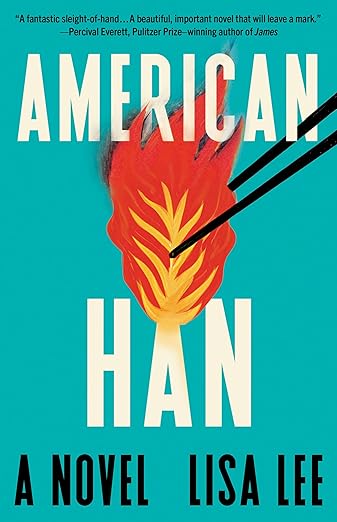
LL: Jane and her mother are presented as opposites. Jane has built her identity on being nothing like her mother, whom she sees as a narcissistic bully. But Jane begins to see the ways in which they’re similar, and how her mother is trapped by the patriarchy that she tries to force on Jane. While Jane is finding her way out, she feels guilty for leaving her mother behind.
When I created Jane’s mother, I tried to show how lost she was and how much hope and desire she had to get back the life she felt she’d missed out on, and I tried to get that on the page before Jane recognizes it and empathizes with her. Of course, I wanted the reader to understand where Jane was coming from and the damage her mother had done to her, but I also wanted her mother to be understood too.
KW: What did revision look like for American Han? And what was your favorite part of the overall writing process?
LL: I’ve lost count of how many times I revised this book. I don’t even know where to start counting. The first drafts of different stories I wrote while avoiding writing this one? Or the early seeds of what turned into American Han? Were those other stories the early seeds? At one point, I wrote a Harold & Kumar adventure starring Jane Kim and Margaret Cho’s mother. It was meant to be a comedy of errors, but it wasn’t funny. Early revision was about throwing out entire drafts and starting over. Eventually, I figured out that I had to write about what I didn’t want to write about—the sources of the anger in myself and my family—and that’s when the characters came to life.
My favorite part of the writing process is not the beginning when it’s new, and definitely not the end with all the rounds of editing. I like the middle, when I know the characters and I know where I’m going. At that point, I’m cutting a lot and filling in a lot, polishing scenes, adding detail to the characters and their motivations. It’s when I feel most confident and productive.
Kyla D. Walker: When was the moment you felt ready to begin drafting The Body Builders? And what was that initial spark—such as a specific sentence, scene, or possibly the end—that kicked off the writing?
Albertine Clarke: I had been living in Florida for about six months (having moved from London for my MFA) when I began the novel. I think the distance from my home gave me space to analyze it—certain experiences I’d had in my early twenties were suddenly framed by the past. I was sitting at my kitchen table, so lonely and so homesick, bored, at a loss, totally alienated in a new environment. I spent a lot of time reminiscing, and out of this I started writing a little short story about a young girl who thinks she’s a middle-aged man, but the man she thinks she is, has also been grooming her. The image was so powerful, like a jolt of electricity. I’d struck on a metaphor which allowed me to talk about experiences I’d had in a way that allowed for the full complexity and confusion to come through. What began as a story about abuse transformed into something more open and more empathetic, but it definitely started with anger.
KW: Were you intentional about genre or subverting genre conventions? There is so much play between surrealism and the slipperiness of the self through the act of reflection (along with symbols of swimming pools and islands).
AC: The genre-melding is possibly the only part of the novel that was completely intentional. Philip K. Dick was my inspiration, specifically Valis, the novel he wrote about his experience with schizophrenia. What I like about that book is that he flips himself inside out, imagining a world where his delusions become truth. That’s exactly what I wanted to do with The Body Builders. What if the things I felt were materially real? What if by feeling them, I made them real? Speculative fiction felt like the only place I could explore those possibilities.
More than any books, my inspiration was psychotherapy. As the book developed, I became obsessed by the relationship between literature and the logic, or structure, of the unconscious mind. The genre I was working in became a way for me to follow a self-directed dreamlike formula, where Ada is, in a sense, living inside her own head. The world warps and bends to the way she feels about it. I like this because it allowed me to keep images completely intact, without reconstruction or explanation. My ultimate goal became to imprint my own unconscious, as directly as I could, onto the page, as if it was a dream.
KW: What was the significance of the names Ada and Atticus?
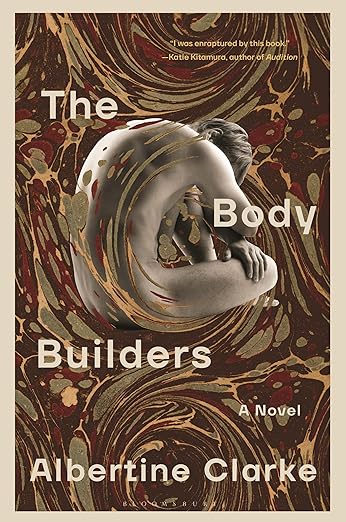
AC: Ada is palindromic, which is important to me because she is so elliptical. Her mother and father read her from opposite directions, getting opposite sides of the same coin. Atticus I liked because it’s Greek, which linked to the Greek section of the novel. I liked drawing these lines between Ada and Atticus, keeping them connected.
KW: Which novels or films do you feel The Body Builders is most in dialogue with?
AC: If Philip K. Dick is my literary father, then Natalia Ginzburg is my mother. Her novella The Dry Heart maps quite directly onto the first half of The Body Builders. She has a way of keeping her characters in utter confusion as to their own motivations, while showing those same motivations clearly to the audience. And, if they are my parents, Kurt Vonnegut is my grandfather. Slaughterhouse-Five does exactly what I wanted to do.
In terms of cinema, I mostly watch sci fi and action movies. Aesthetically films like Minority Report, Blade Runner, The Matrix, and 2001: A Space Odyssey have had a huge impact, especially when it comes to depictions of futuristic technology. Implants, androids, virtual realties all strike me as potent metaphors, all of which are present in The Body Builders. There’s a satisfying dialectical opportunity in the playing out of what-if scenarios—what if my body was fake? What if everybody else is fake? What would I do? What would I learn about myself? If I take away what I think is real, what is left underneath?
 Thank You!