What the Real Housewives Franchise Tells Us About the Triumphs and Pitfalls of Modern Feminism

The WGA had been on strike for months, with SAG-AFTRA joining the picket line fray just days earlier, when Bethenny Frankel, former star of Real Housewives of New York City, took to Instagram to say her piece: reality TV stars needed a union. It wasn’t fair that networks aired reruns of their shows for years or could use their faces in promotional materials for forever, all without paying the people who owned those faces one cent in residuals.

Soon, Bethenny upped the ante: She was suing The Real Housewives’s network, Bravo, and parent company, NBC, in a class-action suit alleging “depraved mistreatment” of reality TV participants. “[T]he sordid and dark underbelly of NBC’s widely consumed reality TV universe has remained under wraps for far too long,” Bethenny’s attorneys wrote. “Please be advised that the day of reckoning has arrived.”

The news grabbed my attention immediately. Regardless of Bethenny’s motives—which were quickly questioned in my social media feeds—if somebody wants to start a union and blast the executives who messed with my WGA friends, I’m here for it. But I was also interested for selfish reasons. I was working on a reality TV project myself, one centering Bethenny’s television alma mater, The Real Housewives.

Put another way, I’m 34 years old, which means The Real Housewives has been on television for half my life.

I’ve been re-watching old seasons of the franchise, trying to understand what this show—often treated as a trashy guilty pleasure—means for the more feminist, equitable society I want to live in. This undertaking involves dissecting women in 11 different cities over 17 years because, yes, that’s how big Bravo’s franchise is. Put another way, I’m 34 years old, which means The Real Housewives has been on television for half my life.

Re-watching old episodes, the overlap in our lifespans couldn’t be more obvious. It didn’t feel like viewing a show; it felt like reliving my life, remembering the world that raised us both.

Over the last 17 years, The Real Housewives and I made ourselves small, viciously slut shamed, and un-ironically Girlbossed; we mourned past pains and wore pussy hats so we could be #WomenSupportingWomen, but we also lost sight of what support should look like and who deserved supporting. We made paltry attempts at intersectional feminism that ended in backlash, costing us allies—and rights. Throughout all this, society’s expectations and definitions of women kept changing—continue changing—but one truth remains: We might often categorize The Real Housewives as frivolous pop culture, but it has always reflected how the world exists for real women. Two things can be true.

Then came Bethenny with her call for a union, safer workplaces, and management accountability, all things I want for women everywhere in that more equitable world I dream of. When Bethenny introduced those ideas as Real Housewives demands, I wanted her to succeed because I want women to succeed, and I see The Real Housewives and regular women’s fates linked.

So yes, I’m paying attention to Bethenny Frankel. I don’t want her call for change to go the way of our dream for a female president, of a lasting MeToo movement, of a woman’s right to define themselves and control their bodies—all things we thought we’d achieve in the last 17 years, only to come up short.

Speaking of those years, how did everything go so wrong? If my Real Housewives re-watch has taught me anything, it’s that the answer was always there. We just needed to pay more attention to what we were watching.


The Real Housewives debuted following five Orange County women in 2006 when I was 16 years old. It was a time when fashionable meant wearing skin-tight, low-rise jeans, pants so traumatically unflattering, we invented an insult for how they deformed our bodies—the muffin top—and everyone publicly counted the days until the Olsen twins, Lindsay Lohan, and other starlets turned 18 and could all be legally slept with. 

It meant wearing suggestive clothes and a don’t-take-me-too-seriously demeanor.

Our ideas about what it meant to be a woman were so small that when Bravo announced its new show following five “glamorous… sexy, sophisticated” housewives, viewers knew exactly what that meant: Straight, skinny, white, cis women. It didn’t yet mean screaming, partying, or throwing wine, stereotypes with which the show would later become synonymous. It meant wearing suggestive clothes and a don’t-take-me-too-seriously demeanor, all while performing the labor of the homemaker archetype with an easy, agreeable smile. Those first season Orange County housewives nailed this formula—except Jo.

Jo is a 24-year-old engaged to an older, wealthy man named Slade. And Jo, it should be said, is not white; she’s Peruvian-American, though we can likely thank ABC’s fictional Desperate Housewives for The Real Housewives’s decision to cast one token Latinx woman.

When we meet Jo, she’s acing the acceptable type of womanhood. Low-rise jeans look great on her. She’s recently quit her job, intending to stay home, to be Slade’s perfect housewife. The problem? She hates cleaning! She’s bored! In the 1960s, women were prescribed valium for this. In 2006, we put them on TV and watched their relationships implode.

Slade wants Jo to be happy caring for his house, picking up his dry cleaning, and parenting the kids from his first marriage. But Jo wants to go out! Jo wants to work! Jo does not want to clean! So, they fight. Slade laments Jo’s disinterest in becoming that housewife he’s always wanted, and she cries because she loves this creep. She wishes she was more like the woman he dreams of, too.

Enter Kimberly, Jo’s housewife fairy godmother. Kimberly, like Jo, used to work, until it was time to quit her job to raise babies. Kimberly, also like Jo, struggled with this identity shift at first. But then, Kimberly found new hobbies: Day drinking at country clubs, getting a boob job, buying lingerie. 

The worst part of this regressive Cinderella story is realizing Kimberly seems genuinely happy. She’s not only accepted the narrow parameters of womanhood in 2006—she’s embraced them, just like my friends and I embraced low-rise jeans. We never considered changing our pants or the roles society thrust upon us. We shrunk our bodies to fit the jeans, and we shrunk the women to make them ideal wives.      


The Real Housewives scored one of its first water-cooler moments in 2009, courtesy of the first season of The Real Housewives of New Jersey. This cast had no token Latinx woman—only skinny white ladies with dark skin via spray tan. Needless to say, our ideas about how to be a woman were still very straight, very white, and very small. And maybe it was because I was getting older, but it felt like the punishments for acting out had gotten steeper. Which brings me to a popular late-aughts punishment: Slut shaming.

Laurel’s face crumpled as she realized what everyone really thought of her.

Exhibit A: Laurel. My senior year of high school, my class voted Laurel “biggest mouth,” because once in English class she made a list of all the guys she’d hooked up with, and “class whore” wasn’t allowed. When an oblivious teacher announced, “This year’s biggest mouth is… Laurel,”  during Senior Awards Night, Laurel’s face crumpled as she realized what everyone really thought of her. I thought she was going to cry. Girls who were her friends—some of whom had voted for her—tried to comfort her, while boys who’d gladly accepted blowjobs before also voting for her snickered.

Exhibit B: Danielle. Danielle is New Jersey’s single wife who likes wearing skimpy clothes and sharing that she’s been engaged 19 times. She does not fit the mold of what a proper housewife, née woman, should be.

The rumors begin: most involve her sex life—specifically that she sleeps with married men, something the other housewives frequently repeat without much proof. During the season, the women also find a book and police records that seem to very much prove Danielle was arrested in the ’80s for kidnapping and extortion, and for troubling involvement with the Columbian drug cartel. But why shame a woman in 2009 for her cartel-kidnapper connections when you could nail her for a real crime, like enjoying sex? In the season finale, Danielle and married housewife Teresa have a fight that ends with Teresa flipping a table and calling Danielle  “prostitution whore,” a moment still seen as one of series’s most iconic of all time. 

No one chastises Teresa for making a scene at dinner—never mind for weaponizing sexuality, shaming sex workers, or confusing cheating rumors with sex work. Those latter infractions were the era’s social norms. But calling attention to oneself, making a scene, that could get a woman in trouble. At 18, when the show first aired, I attributed Teresa’s lack of punishment to the fact that she, unlike Danielle (and Laurel) had a husband—a man—who vouched for her behavior. In fact, he called it “sexy.” I thought loud female behavior didn’t matter if guys still wanted to sleep with you and support you. 

But that teenage explanation was a shallow understanding of a deeper truth: Teresa didn’t flip the table because she was angry about how the world controlled or shamed women. She flipped it to put a woman who didn’t conform to traditional expectations in her place. (Which was also why Laurel’s friends voted for her, even if they didn’t know that themselves.) Any woman who stands up for a world that holds women down always will find allies to protect her. It’s the ones making moves against that world who end up out of luck. 


With the 2010s came changes for women. Not systemic changes. But we did make several superficial changes. And we certainly called it progress. Actually, we called the changes Leaning In, and from leaning in, a new female archetype was born: The Girlboss. 

The Real Housewives’s viewers Leaned In by embracing louder, Teresa-esque wives who weren’t afraid to start fights, throw drinks, or even launch a prosthetic leg. We didn’t care if these women had a man’s permission—as long as they were mostly still white, conventionally attractive, and managing the houses and kids (labor that continuously went unacknowledged). And these new, louder housewives Leaned In, too: They capitalized on fame from the show and started businesses. The women sold everything from clothing to cannoli, sex toys to hair care, butt workouts to booze. They were women; hear them roar—then buy one of their products.

Outside of Real Housewives-land, I was a college student, then a recently graduated twentysomething who embraced this Lean In-Girlboss mantle in full. It’s embarrassing now to admit, but I did. After years of being told to stay small and quiet, of understanding men should dictate when loud female behavior was OK, this new attitude felt good—or, as my friends and I suddenly loved to say: Empowering. And since we couldn’t put our names on products like the housewives, we Girlbossed by focusing on different things, like pants. First, we killed muffin tops by moving our jeans’ waistlines higher. Then we ditched jeans altogether for something infinitely more comfortable: Leggings. When the world told us leggings aren’t pants, we insisted they were. We channeled Orange County housewife Tamra, who in 2014 became a GIF after screaming, “THAT’S MY OPINION!” perfectly encapsulating the regrettable Girlboss attitude that having an opinion is the only requirement necessary to share it.

Plenty of people at the time knew these Lean In-Girlboss ideas were garbage.

Plenty of people at the time knew these Lean In-Girlboss ideas were garbage, particularly queer and trans writers and writers of color. They called it faux feminism. Rich people feminism. White people feminism. Because the opportunity for conventionally attractive, mostly white housewives on TV to make money isn’t a landmark moment for labor or gender equality; it’s capitalism with beauty gatekeeping thrown in. And what oppressive systems were we dismantling, exactly, by replacing skin-tight jeans with…skinnier, tighter leggings? (Leggings that, in 2013, Lululemon founder Chip Wilson proclaimed “just don’t work” for all bodies.) Critics dubbed the era’s pathetic attempts at feminism as society paying lip service to progress while making none at all. And they were exactly right, except for one thing: Not enough people who needed to hear this criticism—and yes, I’m talking about white women—were calling themselves feminists, anyway.

Most were in a period of I’m not feminist, but… a line I distinctly remember telling my college roommate in 2012 after one of our school’s star athletes allegedly sexually assaulted a female student and received little punishment. Not even Sophia Amoruso, the largely forgotten white woman who coined the term Girlboss, considered herself a feminist, telling Elle Magazine in 2014, “I don’t really like to use that word.”

But the deeper into the 2010s we went, the more many women’s relationship to the word changed. Maybe it was because one in five women were sexually assaulted in college—a new stat for the public in 2014, even though it seemed obvious to me and so many others who’d attended college in the 2010s. Maybe it was because of Beyoncé. Isn’t everything good that happens, on some level, related to Beyoncé? Or maybe it was because the more times society leaves you saying, I’m not a feminist, but…, the more opportunities you have to ask yourself, But why not? Which is to say: The 2010’s embrace of feminism—particularly for white women—took time. But once we arrived, the Girlboss’s rebrand from superficial symbol of vaguely empowered white woman in leggings to superficial symbol of a white feminist was swift. 

And there’s no doubt she was a superficial symbol, because if this new Feminist Girlboss had any substance to her, then we would have addressed the important critiques about how class and race and wealth and other factors create uneven pains and obstacles for women. 

But she didn’t. So we didn’t. 

Worse, by the time masses of white women did start considering these critiques, we were approaching November of 2016, the moment we thought we had a fool-proof plan to solve them. As New York housewife Carole put it: “This is a historic election [because] … we showed the world that Americans will not tolerate division, exclusion, fear-mongering, sexist, and racist rhetoric.” Carole is reading from a pre-written speech, of course, one she never delivers. But it’s a speech that echoes what my fellow Girlbosses and I had been so sure was true: We were going to solve gender inequity by making a thin, blonde, white lady the first female president of the United States.


The 9th season of The Real Housewives of Atlanta filmed the summer before the 2016 election but aired mostly in its aftermath, premiering just two days before the election where the lady president did not save us.

The idea that America was cruel enough to elect him forced me to do some long-overdue white feminist Girlboss reflecting.

I was a 27-year-old who stayed up crying until 2 a.m. on election night, desperate to hear officials had found another 70,000 Democratic ballots in Michigan, Wisconsin, and Pennsylvania. I wasn’t so surprised the country couldn’t elect her, but the idea that America was cruel enough to elect him forced me to do some long-overdue white feminist Girlboss reflecting. 

“Don’t blame me,” Atlanta housewife Kenya quips about our new president at one point. She’s joking, but not, because, Black women aren’t the reason we failed to make the thin, blonde, white lady president. As for white women, that’s another story, but this Atlanta season features an all-Black cast. (Atlanta is, in fact, the only city to feature any Black Housewives for the first decade the show is on television, apart from one woman on one season of the since-forgotten Real Housewives of D.C.) Still, the Atlanta wives had their own reflecting to do.

Phaedra sets the self-improvement tone early by making peace with Kenya—a woman she’d nicknamed Kenya Moore Whore two seasons prior—and declaring, “As women, it cannot be acceptable to call each other hos and bitches and prostitutes… We have to make a conscious effort to change.” Then the message explodes in her face at the end of the season.

But first, Shereé and Bob. We spend much of this season rooting for Shereé to get back with her ex, Bob, only to later learn that Bob previously abused her. This comes to light when Bob jokes(!) on a group vacation that maybe he “didn’t choke [Shereé] hard enough” years ago. In a confessional interview, Shereé says she didn’t want to cry because that would give a man power while ruining everyone else’s day. I know Shereé thinks she’s being the strong, feminist woman we were all supposed to be now, but in practice, that Strong WomanTM is just another way we teach all women to stay small and quiet, now under the guise of having power—and for Black women, this trope comes with bigger consequences. 

Meanwhile, Porsha and Kandi are fighting. It starts when Kandi says Porsha hooked up with one of her exes, and escalates all season until Porsha says she heard Kandi wanted to drug and sleep with her. Which, yes, would constitute rape. Porsha accuses Kandi of wanting to rape her. Kandi vehemently denies it, while Porsha stands her ground, saying her source is sure. Then at the end of the season, Porsha’s source admits she made up that rape rumor after all. That source? One Miss Phaedra Parks: The woman who told us to make a conscious effort to be better.

Watching the women digest this news, I felt like I did on election night: Unprepared for how cruel we could be. It’s in that moment, though, that Phaedra’s message feels more necessary than ever. It is time for us to commit to changing.

The world had hurt us. Men had hurt us, women had hurt us, and we had hurt other people, other women. But we couldn’t go on like this. Something had to change.

Still, it’s hard to be better when you’re so angry: At the man who hurt you, the woman who lied about you, the people who voted for that new president (not to mention the ones who didn’t vote). I was 27 years old and had spent a lifetime trying to be the “right” kind of woman. Just when I thought I’d figured out how to be an empowered, feminist Girlboss, the country elected a man credibly accused of rape to become its next president. So yeah, I was angry. Every woman who’d been hurt by a patriarchal society was angry. Finally, we were ready to put our anger into action. 


Support women. This was the decided way forward. Not Black lives matter, or trans women are women. Just, support women. #WomenSupportingWomen. Sure, some of us thought these other mantras were implied by our support women cheers, though if we’d looked at who was chanting with us, we might have known better. Alternatively, we could have watched The Real Housewives of New York City, noticed that a show taking place in one of the most diverse cities in the country included just one woman of color in 10 seasons, and no one who wasn’t straight, so maybe we needed to be more explicit about inclusion when trying to solve the problems of women. But we didn’t notice. We were busy being women supporting women.

In 2017, as I entered my late twenties, we marched in pussy hats, took down Harvey Weinstein, and shared our stories of MeToo, a movement I’d say maybe half of us knew was started by Tarana Burke, a Black woman, years earlier. We combined that work with more emotionally symbolic victories, like buying t-shirts proclaiming “The future is female,” “Nevertheless, she persisted,” and “Girls just want to have fun-damental rights.” The Merriam-Webster Dictionary made “feminism” its 2017 word of the year. Imagine, a word I’d personally shunned five years earlier now the word of the year.

At that moment, I thought we were going to do it. We were going to make life materially better for women. The winds of change were on our side.

We didn’t notice. We were busy being women supporting women.

In reality, everyone seemed to be on our side—a clear sign that our side had problems. “Support women,” after all, didn’t draw distinctions over what support looked like or who deserved supporting. So while I thought we were going to listen to the problems of women we’d long ignored and try to do something to fix them, not everyone agreed, including some women of the 10th season of The Real Housewives of New York City.

The season aired in 2018—a peak year for proclaiming support of women—which is probably why Ramona and future union matriarch Bethenny both race to accuse one another of not living up to the standard. It begins when Bethenny calls Ramona to tell her she’s being mean to other women (specifically, she’s being mean to Bethenny). But Ramona beats Bethenny to the punch, screaming from a New York City sidewalk, “You don’t support other women!” Ramona’s reasoning has nothing to do with Bethenny becoming rich off of her brand SkinnyGirl, a name that doesn’t at all support women. Instead, Ramona drops this bomb because Bethenny made fun of Ramona, gossiped about Carole, and wasn’t happy when fellow housewife Dorinda gifted her a human-sized nutcracker for Christmas.

At the risk of stating the obvious, one rich white lady’s right to be thanked for gifting another rich white lady a toy nutcracker is not what feminists meant when we said support women. None of the behavior Ramona mentions is because it doesn’t contribute to the systemic unfairness we wanted to stop—though, here’s a behavior that does: Voting for the accused rapist to be president, which Ramona almost certainly did.

No housewife mentions voting records when Ramona yells at Bethenny. Neither do viewers. Viewers turn the moment into a GIF and buy t-shirts with Ramona screaming “You don’t support other women!” Then in September of 2018, a few months after this fight and one week before my twenty-ninth birthday, we watch Dr. Christine Blasey Ford tell the world Brett Kavanaugh sexually assaulted her—receiving support Anita Hill could’ve only dreamed of. We are emotionally shattered when it doesn’t matter.  

Toppling powerful predators is hard; it can’t happen every day.

Clearly, the support women mantra had been co-opted by bad actors—by Ramona and others. (A predictable outcome given white women’s aforementioned 2016 voting record.) But those of us who wanted systemic change needed to accept that our problems ran  deeper. As 2018 became 2019, the marches and takedowns of men like Harvey Weinstein slowed. That’s not our fault—toppling powerful predators is hard; it can’t happen every day. But we could wear spunky feminist t-shirts whenever we wanted, and increasingly, it seemed like that was the only goal we consistently worked toward. It was as if we’d decided feminism was easy, gender equality one “This pussy grabs back,” t-shirt away.

But feminism isn’t something you wear or even proclaim. Feminism is paid maternity and paternity leave. Feminism is recognizing housekeeping and childcare as work. Feminism is a world that respects, protects, and grants the same opportunities to everyone, regardless of race, sexuality, and gender identity—and making that abundantly clear in the work you do. Feminism is work—massive work—that involves reconstructing our political and social systems. Pretending it’s easy won’t keep alleged sexual predators out of the White House or off the Supreme Court. It just put a shirt quoting AOC in my dresser. And ones quoting Ramona in the drawers of others.


There is only one way to make the world better for women: You have to make the world better for everyone. You have to care as much about violence against Black men and trans women as you do about violence against young white women—and recognize the latter is a lot less common. By 2020, society seemed ready to do that. Having failed in every other attempt at world-betterment, we finally understood the need for intersectional feminism, considering how class and race and wealth and other factors impact a woman’s experience in the world. (So, yes, broad swaths of women “discovered” in their early thirties the ideas queer and trans writers and writers of color had raised during the Girlboss era of my early twenties—ideas that weren’t new then, either.) 

Our move toward intersectional feminism succeeded on one metric: We transformed the idea of a woman on The Real Housewives. Admittedly, we made little progress in queer inclusivity—17 years in, there’s two openly LGBTQIA+ housewives, despite legions of queer fans. The franchise has, however, made a serious commitment to casting non-white women on the show, including Garcelle, the first Black housewife on The Real Housewives of Beverly Hills. The problems came when the white women needed to be as serious in their commitment to the new wives.

The 11th season of The Real Housewives of Beverly Hills aired in 2021 and opened with Garcelle telling Kyle, a white housewife, why it matters that Kyle accused Garcelle of not donating to her charity after pledging to do so. “I don’t think you realize the effect it has on me as a Black woman,” Garcelle says. “There are stereotypes that people think we don’t pay for our rent, that we don’t tip.” Kyle later recounts this conversation to Sutton, another white housewife, and Crystal, Beverly Hills’s first Asian-American housewife. Crystal begins articulating the pain of experiencing racist stereotypes, until Sutton interjects to say this isn’t a race thing; everybody deals with stereotypes. And with that, the cracks in a white woman’s allyship come into view.

“Are you one of those people that [doesn’t] see color?” Crystal responds. “Tell me you’re that girl. [The one who says] I don’t see color.” Cue the dramatic music added in post-production. Cue Sutton tearfully declaring, “I really don’t see color. I don’t see race.”

“Race exists,” Crystal responds. “I’m proud of my race.” But Sutton and Kyle don’t hear her. “The word ‘racist,’ to me is like a virus, worse than COVID… To even get into this upsets me,” Sutton declares, to Kyle’s agreement. The women are defensive now, seeming more afraid of being labeled a racist than of engaging in racist behavior. Like too many white women before them, they want to correct the problem until it turns out they might be part of it.   

Life was better before we had to think about how to be fairer to everyone.

Maybe The Real Housewives isn’t the best medium for informed discussions on race. “I feel like most people watch these shows for the escapism and to laugh at it? The race stuff is depressing and stressful,” one Reddit user wrote, echoing posts I’ve seen online. But inside these comments is more than a request for a venue change; it’s Sutton and Kyle’s desire to not have the conversation at all. And inside that refusal is an admission that intersectional feminism is too much work, that life was better before we had to think about how to be fairer to everyone.

But it’s no coincidence that the fall of Roe and disintegration of reproductive freedom coincides with the removal of accurate Black history from classrooms and the eraser of queer and trans rights across the country. When you don’t care about advancing all people forward, you put others’ rights and lives in jeopardy. 


That was where my Real Housewives re-watch ended until Bethenny gave it an epilogue. By moving to create a union for The Real Housewives, she gave those women—yes, those rich, straight, and cis, but slightly less white women—a chance to win. Public support for labor unions, after all, is high. The popularity of the WAG and SAG-AFTRA strikes, both of which secured labor-rights wins, are testament to that. And if as The Real Housewives go, so go women; if as the rights of women go, so go the rights of every overlooked and underprotected person, then we should all want a Real Housewives union win. Yet every day, I’m more convinced it will turn out like all those other things we failed to achieve for the last 17 years. 

Vanity Fair recently published an article about The Real Housewives’s behind-the-scenes. It contains some damning details, including #WomenSupportingWomen bad actor Ramona using racial slurs. But the most memorable moment to me came from Eboni, New York City’s first Black housewife. According to the article, “Presented with the idea that she might participate in Frankel’s organizing, [Eboni] said, ‘Fuck Bethenny Frankel. You think I’m going to let some white girl speak for me with my experience with a multibillion-dollar corporation?’” I’m not exactly trying to call out Bethenny’s intersectionality here, though the quote is telling. It also shows how much work is left to make life better. I’m still convinced The Real Housewives reflects how we treat actual women, but I understand that connection isn’t random: What society accepts from its least-respected pop culture is always a barometer for how we treat the least-respected people. To the extent The Real Housewives has let us down with its representations and treatment of women, and, frankly, anyone, it’s because society has let us down, too. I want to believe the world can be better. So I’ll keep watching and looking for answers. I’ll keep hoping one day that it will be.

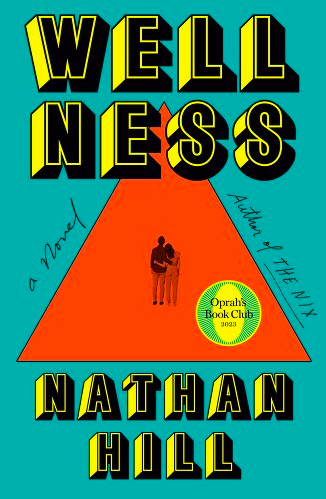
Nathan Hill Thinks the Stories We Consume Impact Us More Than Juice Cleanses

The world within Nathan Hill’s newest novel Wellness reflects and refracts parts of our own: the firehose of Facebook posts veering toward conspiracy; the research studies that offer insight into the development of adolescents or how to sleep better or how to eat; belief in the power of manifestation; articles that beg us to click with their claims that this one trick might save you from x, y, or z; the turmeric shots or crystals we might incorporate in the hopes of healing; and smartwatches that tell us, well, everything we might want to know about a body. Wellness pulls back the curtain on the illusion that anything we could possibly want is within reach, if only we tried the right supplement or study or routine.

Hill, who previously authored national bestseller The Nix, returns with another sweeping tale, one that follows the marriage of Elizabeth and Jack, who first meet because they live in apartments whose windows face one another. The image of them both separately looking through glass to peer in and imagine the other’s interior life captures many of the questions that this novel raises: How much can we really know about another person? What role do stories have in our perceptions of ourselves? Of love? Of the lives we build? How do we find happiness with ourselves, our bodies, and the ones we love when we are navigating life in a world telling us that things could always be better? 

I had the opportunity to speak with Hill via Zoom about intuition versus information, the coldness of algorithms, and the ways our relationships can be shaped by the narratives we give them. 


Jacqueline Alnes: Was there a defining moment that sparked the start of Wellness, or more just the collection of all these technologies and powders and tinctures that are sold to us?

Nathan Hill: It was that era, like 2014-ish when people started getting weird on Facebook, but we weren’t used to that yet. I had this creeping sensation that people were doing things and believing things and I was like, Where did this come from? My friends and I were all doing this stuff and now, looking back on it, I’m like, why was I tracking my macros? Why were we spiralizing zucchini instead of just making pasta? It started to feel like some people I knew, who were otherwise reasonable people, were living in completely different fact universes from me. We’re used to this feeling now, that we can’t decide on the same facts or the same reality. 

JA: I am similarly obsessed with the 2010s. I was in college at the time and I was deep into apple cider vinegar and so many other diet “hacks.” 

NH: It was this moment of optimism, I think. Look at all this new stuff we’re discovering! Look at all this information we now have! That optimism was leveraged by capitalism into clickbaity stuff that made us all constantly worried and afraid.

JA: I was laughing at “The System” watch that Jack wears, that measures literally almost everything you can about a human body. I wear a running watch and there’s this level where the information is too much. Like, did I sleep well? I can answer that myself when I wake up; I don’t need a watch to tell me. How much information do I need about my body when I’m living in it?

NH: Exactly. I feel like we’re all sort of coming out of it now, but for a while there we imbued those measurements with meaning. Technology is really good at counting your steps. But is that really all that meaningful? I also had an app on my phone, for a little while, that I would leave running in the night and it would listen to me tossing and turning and establish how much REM sleep I got. Eventually, I could find no pattern between what the app was telling me and how I felt in the morning, and sometimes it was weird because I’d wake up feeling great and the app was like, you slept like shit last night. And then my mood would plummet. It was paradoxically controlling my mood.

JA: Information is obviously so valuable. Elizabeth reviews a slew of studies in an attempt to understand her toddler. But there’s this line between information and intuition. From writing this novel, did you come to a conclusion about what that balance might look like for people?

NH: The issue of misinformation and disinformation is very well established. I think we can be misled by true things as much as we can be misled by false things if the true things are coming at us like a firehose of information and we don’t have time or perspective to contextualize them or apply any kind of wisdom to them. 

All of my friends had babies about exactly the same time, so I was watching them go through this. They are very thoughtful people whose parenthood they wanted to be informed by the best practices. But there are so many best practices that they started thinking they were bad parents. I’m watching them be amazing parents and they felt they were failing every day. You can never live up to all this information.

We live in a media ecosystem where, because these stories get clicks, we keep seeing these stories about some study, somewhere, with thirty participants where they learn something about a molecule. Suddenly, there’s a new health fad. That’s not how it’s supposed to work. It’s supposed to be very incremental. We’re not supposed to make big, rash decisions based on small sample sizes. There needs to be a reevaluation of health science communication and maybe, also, from a consumer’s point of view, taking everything with a grain of salt. If there’s a study that says, “We all need to do turmeric shots,” maybe look at the methodology. 

JA: Something I felt while reading the book was that Elizabeth is a reasonable person, doing research that is well-founded. On the other side, you have Brandie, who I loved, who is just manifesting her life, but to a delusional point where she’s unable to see the reality of her life. I usually think of these types of people as polar opposites, but the book allowed me to see that they are connected in that they are all people reaching for answers, and both methods can become harmful, in a way. 

Sometimes the stories impact you more than the turmeric or the juice cleanse.

NH: It struck me that any idea, even a good idea, when believed in too rigidly, too ideologically, too inflexibly, can turn into error. Brandie’s original thought, which is if you have confidence and intentionality about your life, then good things are more likely to happen, seems reasonable. But when you believe that so hard that you begin to think your good thoughts are sending good vibrations into the universe, or I’m actually changing the universe with my thoughts, then you might start to believe anyone who’s down on their luck it must be their fault –– they must be low-vibration people. I’ve heard of people who believe in the manifestation stuff thinking, Why would I get insurance? That’s me thinking bad things that might happen. She’s believing in it way too hard, and it’s curdling into error.

Elizabeth, too, is trying to make her parenthood informed by all the best scientific practices, but if you do that too much, it drives you crazy. There’s a line late in the book where Elizabeth’s mentor says something like, believe what you’re going to believe, but believe with curiosity, believe with humility. I think if there’s a moral of the story it’s probably that. 

JA: You did so much research for this book. I know this is not going to cover even a slice of it, but what did you learn about social media, conspiracy theories, and misinformation that interested you?  

NH: I read hundreds of pages of Facebook patent applications. Facebook is very hush-hush about the algorithm but they’re all patented and in that you have to describe what the algorithm does. That’s all public information. What struck me is how the algorithms are literally speaking a different language. That sounds obvious, but they’re taking us, the human person, and abstracting us into various mathematical values and then establishing relationships between other mathematical abstractions. And that’s all we are. 

What was surprising to me was understanding that we are a node in a system, and all the algorithm really cares about are these relationships to other nodes, and whether those connections are brittle or robust. The robust connections then implies that they might be interested in the connections that those nodes are connected to. In none of this incredibly brilliant genius-level math is anyone thinking, Are they having a good time? Is this good for them? Are they happy doing this? 

I was struck, in 2017-2018 by how many friends I had to ignore or unfriend on Facebook, how many people were going down the rabbit hole of conspiracy theory. I would message them and say, Hey, I don’t think this is right, and talk it out with them, and Facebook would keep showing me more of that content. I realized that I was losing this certain friend because I was fighting all the time, and Facebook would show me something he had posted three weeks ago that I had missed like, hey, do you want to fight about this now? It didn’t care whether I was fighting; it cared that I was engaging. It’s coldly, unemotionally mathematical. It cares about engagement and it does not care whether it makes you happy or not. It should have been obvious, but it was most surprising as I was doing the research.

JA: I feel like as a user of social media I so often tell myself it’s a platform where I can tell my story, like it feels personal and human. You get that in the book, too, with Brandie telling a version of her marriage on Instagram and then you get the reality which is sad. It’s interesting to think about the disparity between what social media might be and the algorithm that it really is. 

NH: I do not disbelieve people who say that they find some of the social media platforms valuable to them. If they’ve been able to carve out community in these places that feels intimate and good to them, that’s fantastic. I think you’re running uphill if you try to do that, but I do think it’s possible. My sense of it, and my experience with it, is that anything that goes on the platform just feels like “the platform.” When I post something on Facebook, it starts to feel like an ad rather than a sincere thing that I’m saying. There’s some kind of alchemy that happens whenever you post on social media, it’s a little separated from you, it’s a performance of you—almost necessarily. I think there’s a kind of Marshall McLuhan “the medium is the message” kind of quality to social media and the way we use it.

We don’t live in a world that offers a whole lot of care. But when you go to a spa, they’re listening to you. They are filling a gap, and sometimes grifters are coming in to fill that gap.

I think I understood a long time ago that Twitter was just bad for me. There was this joke account, Cormac McCarthy as if he were on Twitter, and it was funny only because you would never put this stuff on Twitter. I’m reading these tweets thinking, this is what I want to be reading, and if this is antagonistic to the platform’s ethos, then why am I on Twitter?

JA: There’s such a powerful thread of storytelling throughout this novel, and how time can shape memory, like you meet someone ten years ago and you have this story of your meeting and years later it’s not what you kept it as in your mind. How do we tell ourselves true stories when there is so much influencing our perceptions? When the power of story erodes, who are you? Are you the story you tell yourself?

NH: There’s this old thought experiment that I love and I was thinking about a lot when I was writing the book. It’s the Ship of Theseus. I think it was first told by Plutarch in one of his histories. The story is that the hero, Theseus, returns to Athens, and every year thereafter, the Athenians take his famous ship for a sail. Over time, the ship needs to be repaired—an oar here, a plank there—and after two centuries of this, every bit of the Ship of Theseus has been replaced. The question is: Is this still the Ship of Theseus? Is this still the same ship even though everything that’s made the ship has been replaced? 

I was thinking about friends of mine who were going to Phish concerts in their hippie garb who are now corporate lawyers. I was thinking about friends of mine who were completely straight-edge, didn’t touch a drop of chemicals in high school who are now LSD shamans. People can really, radically change. The thing about having a storytelling brain is that we will tell ourselves a story about why it makes sense, no matter what happens. I think we are really capable of fooling ourselves with that story. 

JA: Speaking of marriage, because of this book, I asked my husband this morning, Do you think that love is a story we tell ourselves or is it real? And he was like, What are you doing? To think about how much you built on your first time meeting someone or how much you’ve evolved, and to have two people telling stories at the same time, hoping they stay linked, it’s wild. Through writing Elizabeth and Jack’s story, did you learn anything about love or relationships that stood out to you? 

NH: By the way, did your husband have an answer? 

JA: He said love is real, so we’re in it for another year.

NH: Good answer. My wife and I have a great origin story. We had been flirting over email for a very long time and then finally she was like, I’m coming to visit you. I was driving to the airport to pick her up and got into a car accident on the way. It was a really rainy night and I spun out and hit another car. It was before cellphones so I had no way to reach her; she was waiting at the airport, thought she had been stood up, and on the side of the road I got talking to the guy whose car I had hit for a very long time and I was telling him how she was coming to see me. The tow truck took my car away and I convinced this guy to bring me to the airport as proof. We have told that story so many times that I’ve heard people telling it for us, just because they’ve heard it so many times. We have completely mythologized ourselves, chapter and verse, people can repeat it. 

But your question was about love. There’s this interesting research out there that talks about how emotions are simply the names we give to certain bodily sensations. Somewhere along the way, when we feel a certain way, we learn to call that anger, or we learn to call that hunger. I think if you think that love is that fluttery feeling you get inside at that first high romantic moment, then that might be disappointing ten years later when that fluttery feeling is a little more rare. But it’s replaced by something else and that feeling is not necessarily something inside of you. If people think of it as something that happens within themselves, it can curdle into something selfish, but if you think of it more as a practice, as a thing that’s mutually built and given, you can get that feeling back but it’s given instead of taken. That’s not anything new. bell hooks defines it that way in All About Love, Dan Savage has something very similar with his campground rule that in any relationship you leave it better than you found it. This all implies action. 

JA: It brings me back to thinking about wellness. Sometimes we think of it as the sparkly turmeric shot you think is going to heal you at the grocery store or the really expensive chlorophyll stuff that you can sprinkle on stuff and you’re like, wow, I did my job today. In reality, it’s deeper than that; it’s more of a practice. It’s rooted in how we feel about our bodies and how we’ve been conditioned to feel about illness. 

There’s some alchemy that happens whenever you post on social media, it’s a little separated from you, it’s a performance of you—almost necessarily.

NH: We live in a culture where you’re one nice, forever home away from happiness or one chlorophyll whatever away from never needing to go to the doctor again. I understand it. The last time I went to the doctor, I filled out stuff in triplicate even though I’d already filled everything out online and was seen an hour past my appointment time and saw the doctor for eight minutes and she couldn’t remember what she told me last time and then I got charged $200 and had to fight my insurance company to pay for it. That’s just a normal experience, you know? If there’s an influencer who’s saying if you take chlorophyll you’ll never need to see the doctor again, that’s tempting. I understand the impulse. We don’t live in a world that offers a whole lot of care; we don’t feel listened to. But when you go to a spa, they’re listening to you. They are filling a gap, and sometimes grifters are coming in to fill that gap.

JA: What do you hope readers take away from reading Wellness?

NH: I was having a fight with a friend once, he was doing a turmeric smoothie cleanse and doing crystal therapy and I was like, dude, none of this is real. And he was like, What does it matter if it’s not real if I feel better? That question haunted me. It’s not a secret that a lot of wellness stuff doesn’t perform a lot better than placebo, but it turns out that placebo can be sometimes pretty effective. Sometimes we are medicating ourselves with stories, with belief. What I’ve started really thinking about, as a result of this book, is the stories that are entering my brain. Sometimes you should pay more attention to the stories entering your brain than the chemicals entering your body. Sometimes the stories impact you more than the turmeric or the juice cleanse.

Brotherhood Is a Life Sentence

“Collision” by Bill Cotter

The two brothers met by chance near the ice machine in the hallway of the seventh floor of the Marriott Hotel on Liberty Avenue.

Liberty, if followed north for eleven miles, led to a squat stone building, two hundred yards from the main prison campus, in which was contained the chamber, the apparatus, and the drugs used to put prisoners to death. The two-lane road was colored by hardy wildflowers growing through cracks in the median, and was lined with street signs warning travelers not to litter or drive drunk or pick up hitchhikers.

Tomorrow, the two brothers would travel this road, in separate cars, at separate times.

Gerald and Tom Hoefler had not seen each other in five years, since Tom’s marriage to Abigail in 2003, and the brothers were not expecting to see each other until tomorrow, during the viewing, and then only for an hour or so. Running into Tom at the ice machine with the hand-written OUT OF ORDER sign stuck on with a Band-Aid made Gerald feel cheated, as he had no desire to see his brother at all.

“Gerald.”

“Tom.”

They tucked their respective empty ice buckets under their arms, and shook hands.

“No fuckin’ ice,” said Tom. “Huh.”

“Yeah.”

“What you up to these days, Gerry?”

Three minutes of conversation, and it was over. Gerald trudged back to his room. He tried to call Miriam, but cellphone reception was poor in the hotel room, so Gerald was forced to call on the room phone at God knows how many cents a minute.

“He looks like he’s been roughnecking,” said Gerald, sitting on the edge of the queen bed, the polyester rustling as he moved. “Or something like it, anyway, he’s all burnt and leathery and Marlboro Man and full of himself. Miriam?”

“I’m here.”

“He had a crushing handshake,” continued Gerald, studying his right hand in the low light. “The bastard. Nothing like that limp, week-old celery stalk he used to shake with, way back when he was making trillions at Polk & Sons. Do you remember that? Mariam, goddammit, why are you being so quiet?”

“Tomorrow is a lot larger than just seeing your brother, Gerald. You only have to tolerate his company for a little while, then you’ll be on your way home.”

“Wrong, Miriam. I’m having dinner with him tonight, in the lobby restaurant.”

A brief but steep silence, like the sound of space between the stars.

“Why’d you agree to that?”

I invited him. And I don’t know why.”

Gerald had done it out of guilt. A spasm of compensatory fraternal obligation had taken him over in the hallway by the ice machine. Gerald had been a rotten older brother, a bully and a shamer, before and after Faye had been killed. Something about seeing Tom unexpectedly made him feel an instant of compassion and regret; it was during this instant that he invited Tom to meet him at The Corral, the bar and grill attached to the hotel.

“Gerry,” said Miriam, as if her husband had dozed off at a dinner party.

Gerald stood up, juggling the phone while pulling on a clean pair of jeans and tucking in a button-down shirt. He swallowed two fingers of warm gin from a dented silver flask he’d won in a game of poker in high school, and declared to his wife that they better have goddam steak in the goddam restaurant. And ice.

“And I’m gonna pay for dinner, no matter what.”

“He’ll get the check if he has to stand up and pluck it out of your hand. You know that.”      

“Well, listen to this: I’m gonna go down early, give the restaurant my credit card first, tell them to just add 25% to whatever the total is when the meal’s done, run the charge, and bring me my card back. He’ll never even see the check. Ha!”

“You’re behaving like a twelve-year-old.”

“I don’t give a goddam goddamn.”

“Remember, he lost a sister, too.”

Miriam rarely ever referred to Faye, and almost never to her death. It was one of the first things Gerald came to love about Miriam—she always created a place where the tragedy and all its poisons were forbidden. But Gerald slowly came to resent this. He began to interpret her reticence not as a protective shell but as a product of an indifference that had always been there: an indifference whose first and most signal manifestation came as her decision to sleep in different bedrooms, a separation that soon extended to most aspects of their lives. It seemed the only times they ever engaged in a substantive conversation was by telephone while he was away. 

“You make me feel like I’m back in family therapy, Mir, for Christ’s sake.”

Gerald listened to the interstellar silence on the other end of the line.

“Miriam?”

Gerald could tell his wife was holding her breath.

“Never mind,” he said. “Call me later. Room 714.”


Tom was already sitting at a table, looking at the plastic stand that contained a list of The Corral’s beers and cocktails.

“What’s it like still being in high school, Gerry?” said Tom, standing up to give his brother another mangle of a handshake. Gerald resisted the urge to roll his brother’s knuckles around and make him yelp. He could do it. He’d always been stronger. But he didn’t want to embarrass the man so openly.

“Well, students don’t change much,” said Gerald.

Tom gave his brother a big smile. He’d gotten his teeth fixed; the old yellow picket fence, almost brown at the gumline, had been rebirthed as a row of Styrofoam-white implants that reminded Gerald of slammed front doors. Tom may have renounced his former, stock-brokering life, but he’d obviously held on to some of the fortune and vanity he’d acquired living it. Hell, let him pay for dinner.

“Nice and stable,” said Tom, returning to his study of the drink menu. “Like you.”

“What can I get for you boys,” said their waitress, a young woman that Gerald thought bore a slight resemblance to what he imagined Faye would have looked like had she been alive the last twenty-nine years. The waitress’ brown hair, like Faye’s, fell in shallow waves to her shoulders where it rested in lazy whorls, and the end of her nose was dimpled with the same tiny pock that would disappear when she smiled. The waitress was half-smiling now, because Tom had asked her if she wanted to come up to his room after her shift to see his etchings.

“I’m up la-a-ate,” Tom said to her, elbowing her on the hip.

Gerald wanted to hit him hard enough to knock all the money out of his mouth, but instead he ordered a double gin and tonic. Tom put his hand near the crook of the waitress’ naked elbow, looked up at her blushing face with what Gerald thought was subtle mockery, and ordered a shot of Bulleit and a Budweiser. She left, not smiling.

Gerald wanted to hit him hard enough to knock all the money out of his mouth, but instead he ordered a double gin and tonic.

Tom, it turned out, was not a roughneck, but a road-construction crew member, working long hours busting asphalt for the Nevada Highway Department.

“I’m the only white guy,” said Tom, inscrutably.

“That right,” said Gerald.

The waitress brought drinks. Tom completely ignored her. There was no steak. Gerald ordered pork tenderloin. The menu offered half a rotisserie chicken. Tom ordered two. Gerald gathered up the menus, handed them back to the waitress, and looked at her with a smile that he hoped was invested with suitable apology for the actions of his brother. She did not return it.

As they ate, Tom told his brother about his life, the deals he’d made, the pussy he’d scored, the jobs he’d had, the adversity he’d beaten, the money he’d squandered. He never mentioned his wife. Faye did not come up, either. She never did.

“What’d you quit Polk for, anyway?” said Gerald.

“You know, to get out there and experience real life, to say adios to that office and the two-thousand-dollar ergonomic chair and Darren Chiu, that waxed prick.”

Gerald suspected there was more to it than that, and that the law might be involved, but he didn’t really want to know what it was, and besides, he was sure his brother would deny any suggestion that anything outside his realm of control could possibly have happened.

He waited till Tom’s mouth was full, then asked a question to which Gerald already knew the precise answer (which was 5:25 PM): 

“Any idea what time we’re supposed to be there tomorrow?”

“I don’t know,” Tom said, through a clot of rotisserie chicken. “Around five. Which is a pile a crap, because afterwards I’m gonna have to drive nonstop to get back to work on time. Why can’t they have it at dawn, like in the rest of the fucking country? Everybody knows they put assholes to death at dawn in the United States. It’s the American Way. Anyway, we’re digging up a section of old frontage road off US 9 near Darrow. It’s gonna be 116°F by afternoon, and I gotta—”

“What do you think about tomorrow?” said Gerald.

“—drive all night, so tomorrow’s bullshit better be over within 30 minutes—”

“Tom.”

“—because if I’m not there that bitch Marisol, the only chick on the crew, big, like two kegs stacked up, lots to prove—”

“Jesus.”

“—will be in charge, and she always fucks shit up.”

“Maybe you ought to skip it altogether, then, Tom.”

“Skip what?” said Tom, a greasy knife in one hand, the other clenched like the fist of a newborn.

“Tomorrow, Jesus.”

Tom put his knife down, cracked his knuckles.

“Maybe I will.”

A different waitress came to the table and asked if they needed anything.

“Where’s our waitress?” said Tom, raising his lip like a theater curtain to reveal his teeth; his slur of dentition.

“She’s, um, no longer with us.”

“Serious? said Tom, grinning. “Dead?”

“Coffee, dessert?”

“Peach crumble and a drip,” said Tom.

Gerald ordered another gin and tonic. The waitress brought it, and the check. Tom pinched it right out of her hand, and immediately handed it back along with a black American Express card, even before she could finish saying Thank you for dining with us.

After dinner, Tom went up to his room while Gerald sat at the bar and drank gin until it got close to midnight, then paid his tab and went upstairs.

Miriam hadn’t called. He called her.

“Gerry, Sorry I didn’t call, I fell asleep—”

“No you didn’t, but it’s all right.”

He told his wife about dinner, about how his brother had come early and fucked up his plans to pay the bill.

“What did he say about . . . your sister and everything?”

Gerald could not think of a time his wife had ever spoken Faye’s name aloud. He tried to unscrew the lid on his silver flask of gin without making a sound, but it squeaked in a telltale way that filled the hotel room, the space between his ears, and the air in the phone receiver. Miriam heard it, he knew, he knew.

“Nothing,” said Gerald, almost shouting, to drown out the echoes of the telltale flask. “He didn’t say shit.”

“He never has.”

Neither have you.


It was exactly ten months after five-year-old Faye vanished from her bed one night, that Michael Lee Farris, an unemployed crane operator, confessed to kidnapping Faye and later led investigators to her remains. It was another year, at his trial, that photos were displayed that Farris had taken of Faye after he’d raped and asphyxiated her; photos that Tom was forced to look at—three-foot color enlargements pinned to big rolling bulletin boards—because he was to be called to the witness stand that day; photos that Gerald was spared because his testimony was never needed, as it had been Tom—not fast-asleep Gerald—who had seen a long-haired figure in the yard carrying a bundle into the cone of the streetlight, and who Tom pointed out in court as the man he’d seen.


Alone in their section of the viewing room—other relatives of more of Farris’ victims had their own sections, each separated by mobile partitions of large sheets of plywood painted white—Tom sat in the front row, an arm’s length from the lowered curtain, and Gerald sat in the center of the room.

Tom turned around.

“Gerry, you won’t believe this, but that waitress, the one that was ‘no longer with us,’ you know I was only messing with her at dinner, but I guess she took me seriously because she banged on my door around two in the morning, and I was dead asleep, she was kinda drunk, and she wanted to talk about something, I couldn’t tell what, because she was crying like a whupped child the whole time, but she eventually quit and let me fuck her, saying some incredibly dirty stuff in my ear. She was gone before I woke up.”

Tom turned back around to face the curtain. 

Gerald studied the room. He was wondering where his parents would’ve sat, had they not ultimately succumbed to grief in their own ways when the curtain raised, revealing a small beige room, in which were eight people: two men in white coats, three guards, a man and a woman in dark suits, and Michael Lee Farris, who was strapped to a table, one arm stretched out at a 45° angle and battened to a narrow length of greenish-blue Formica attached to the table.

A crackle as a microphone turned on. The woman produced a wrinkled piece of paper and read a summary of the warrant for execution. She asked Farris if he had a brief statement he would like to make. He said nothing. He closed his eyes and turned his head away from the viewing room.

Tom stood up. He said fucking coward, with a low, clenched ferocity. In another section of the viewing area, crying could be heard, and in another, a woman yelled something Gerald couldn’t understand. Tom sat down again. An IV was inserted into a vein in Farris’ arm. One of the technicians injected a liquid into the IV, waited a moment, then injected another. Farris faced the ceiling and opened his eyes. He turned red in the face and opened his mouth, as if for a dentist. He remained in this posture for a full minute, then appeared to shudder, and, finally, to relax. Fourteen minutes passed, and the other technician listened to his heart for a moment, then nodded. The curtain lowered.

Someone came into the viewing area and asked if Tom and Gerald wanted to speak to the media. Tom ignored the question, staying put, his back to the room. Gerald declined an interview and left.


Four years later, during lunchtime in a crowded line at a Korean grocery on Greenwich Street in Manhattan, Gerald found himself standing behind a woman who he realized after a moment was Tom’s wife, whom he hadn’t seen since their wedding nine year earlier. She was examining an array of various slaws in a glass case. She caught Gerry looking at her in the reflection and turned to face him.

“Please keep your eyes to yourself,” she said.

“Uh, Abigail?” said Gerald. “It’s Tom’s brother, Gerry.”

She stared at him for a moment, then smiled, and hugged him unexpectedly.

“Oh, Gerry. Gerry! How are you doing? Still in Chantilly with . . . .”

“Miriam. Yes. I’m in town for a teacher’s conference.”

“You were always so stable,” said Abigail, stepping out of the line, pulling Gerald along by the elbow. “I’m so sorry I never wrote to you or anything, especially when that man’s, um, death, was, you know, happening, but I . . . .”

Something about the timbre of her use of the word “stable” suggested that things with Tom were not. Abigail was so close to his face he could see the ruff of fine wrinkles under her eyes. Gerry had always thought she was attractive, but now even more so. He imparted himself a delectable moment where he imagined she would come to his room at the motel, and he’d tell her everything she’d ever wanted to know about her ex in-laws, about Faye, about Tom, about Miriam, about Michael Lee Farris, about the execution, about himself, and afterwards they would have sex, and more sex, all through the next day, pausing only to feel again what it was like to be falling in love.

He imparted himself a delectable moment where he imagined she would come to his room at the motel.

“That’s okay,” said Gerald, sensitive to Abigail’s hand, still on his elbow.

“Did it give you, you know, a sense of closure?”

Gerald especially hated that phrase.

“Not really.”

“Tom would never talk about it,” said Abigail, letting go of Gerald’s elbow. “He wouldn’t talk about family either.”

“Yeah,” said Gerald, fighting the urge to touch his own elbow, where Abigail’s hand had been.

“We’ve been separated. A long time now. Years. But you probably already knew that.”

“I didn’t.”

“Yeah, well, after he got out of prison for that embezzling thing at Polk, he started taking on these low-paying physical labor jobs to say screw you to the Man, but we ran out of savings, and he moved us back here so he could try brokering again. He figured enough time had passed for him to make a fresh start. Within a couple months he was making tens of thousands a week and sleeping with a floor messenger who evidently had sexual habits he hadn’t encountered before, and which pleased him in ways I never could.”

Embezzling. He should have guessed.

Tom felt absolutely no cold, righteous glee at this news. He just felt empty, like a fresh-dug grave.

Abigail, possibly upset with herself for going into such personal detail with someone she’d met only a couple of times, looked down, then accidentally backed into a shelf of analgesics. Gerald reached out to steady her.

“He’s still here, in Hell’s Kitchen,” she said, holding on to Gerald’s forearms. “Tom, I mean. I never see him. I’m on Chambers, a little spot with a shaft of sunlight for my orchids in the morning. And how long are you in town?”

“Two more nights, early flight out Saturday.”

Gerald had nothing more to say. He tried to think of something, but nothing came to him except his lessons at school, and the words I want to fuck you.

“Where are you?” said Abigail.

“Warrington Inn, at York and 75th.” After a moment he added, “Room 307.”

Abigail reached up and kissed him on the cheek, close to his lips, the corners of their mouths intersecting for an instant.

“It’s nice to see you, Gerry.”

After that day’s round of conference meetings, on the long walk back to the hotel, Gerald picked up two bottles of not-inexpensive wine, an Italian red and a South African white, plus a fifth of Bombay Sapphire. Restless, he wanted to take a walk, but he was afraid he would miss Abigail on the outside chance she chose to come by. He watched the Weather Channel, carefully poured gin into his old poker flask, and sipped it right back out, flask after flask, until early evening, when Miriam was due to call. She did not. He slept, but lightly, starting awake whenever he heard what he thought was a knock, and then falling back to sleep when he realized it was not.

The next day he woke with the sharp, well-defined hangover that attends costlier spirits—a keening, polished awl pushed through his optic nerve. He skipped the conference altogether and stayed in the hotel all day, the bottle of red wine on the luggage counter, the white in a bucket of ice that he renewed every few hours. Miriam again did not call.

It wasn’t until 3:30 in the morning that Gerald gave up the last shred of hope that Abigail would visit, or at least telephone. Around 4:15, Gerald called his wife.

“Gerald, what’s the matter for god’s sake? Are you all right?”

“Why didn’t you call me?” he said. He would not open his flask right now. “Tonight or last night?”

“I wasn’t feeling my best,” she said. Gerald knew she was waiting for him to ask her why, and he also knew that she knew he never would.

“A phone call was going to exacerbate your symptoms?”

“Don’t drink and dial, Gerry,” said Miriam.

“Where did you learn that phrase? And I’m not drinking, goddammit.”

“You’ll never change,” said Miriam.

“Everybody else calls that ‘stability.'”

Who everybody?”

Gerald—wondering if somehow his wife had intuited his subtle but open invitation to another woman and his desire to make the most of it should that invitation be answered—paused.

“Nobody!”

“Jesus, Gerald,” said Miriam, with what to Gerald sounded like fragile mirth. “Is there someone there with you?”

Gerald laughed, a bitter snort that was really about Abigail’s never showing up, but which he hoped sounded to his wife like an incredulous snigger.

“I’m not even going to answer that.”

Miriam didn’t bother to suppress a sigh this time.

“Oh, Gerry.”

“Oh, Gerry what,” he said.

Miriam hung up.


Three weeks later, on a late Sunday afternoon back in Chantilly, while Miriam was out getting their Subaru inspected, Gerald powered up his Mac, and googled CUNY Law Staff Directory, where he found an email address for Abigail.

Dear Abigail,

I’ve been thinking about you. With apologies for being blunt, I’d like to come back up to New York to see you. Maybe we can get dinner.
Let me know your thoughts. I can come anytime.


Gerry

Gerald hit send. He received an immediate response.

Gerald,

I must have somehow given you the wrong idea. I’m sorry, but I’m not interested. I wish you well.

Abigail


Gerald struggled to compose a response, one in which he seemed outwardly contrite, but between whose lines a careful reader could see that he blamed her for misleading him. Gerald worked at it for hours, but finally just deleted everything.

Miriam was not yet home. Maybe the car had failed inspection, and she was out getting it fixed. Gerald admitted to himself that this was unlikely on a Sunday evening. Gerald thought about calling her, but instead he sat on the couch to watch the Weather Channel and drink gin from his little high-school flask. A few hours later, near midnight, and still no Miriam, Gerald called her. But she didn’t answer, and he left no message. He considered calling around to the hospitals, but in the end did not. As he was falling asleep, he tried to convince himself that he really hoped she would be home sometime soon; that he was worried about her, but he knew the truth.

He woke early the next morning, alone. He wandered through the house to verify that his wife was not home, peeked into the driveway to make certain the car wasn’t there, then thought about calling the police. Instead, he called in sick to work, saying he’d be out for the next few days, poured himself three fingers of gin in a frosted tumbler (the flask had gone missing, like it had run away, a beaten dog finally fed up), and searched for pornography on the internet.  

The next day, still alone, he googled old girlfriends, finding Facebook pages for two of them and an email for another. He wrote to all three, one of whom responded with a confession that she still thought about him sometimes, and might like to get together, but that she was living in Los Angeles with a man whom she didn’t want to deceive, and who might react with thorough violence should he discover any shenanigans.

Later in the week, his wife still gone, some of Miriam’s friends began calling. But Gerald didn’t answer, or listen to their messages. On Friday afternoon, the phone rang, and it was with a mixture of despair and fury that he noted it was Miriam herself calling. She left a message less than fifteen seconds long. Gerald did not listen to it.

Early Saturday morning, he gathered what the gist of her message must have been when he noticed through the living room window that a Penske moving truck had backed into his driveway, and that three men, two unknowns in dark blue overalls, and Miriam’s father, Barry, were making their way up the walk.

Gerald stood in his robe, a frosted tumbler of gin in one hand, a remote control in the other, and listened for the clangor of a key in a lock.

Three Short Story Writers On Publishing and Crafting Their Debut Collections

The short story is an entirely different pleasure than the novel. For writers, the form demands precision and intense scrutiny of craft choices. The short story is constrained by its brevity but remains limitless in the opportunities it presents to challenge notions of craft. The short story collection, then, is an art form in and of itself. In conversation, stories produce something new and thrilling. We are let in to linger and marvel at the writer’s world, to listen to its chorus of voices telling us something urgent.

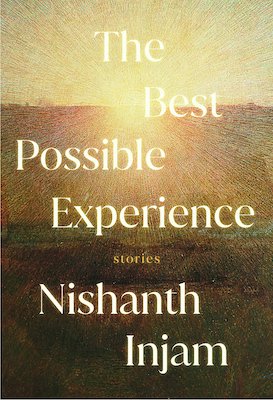
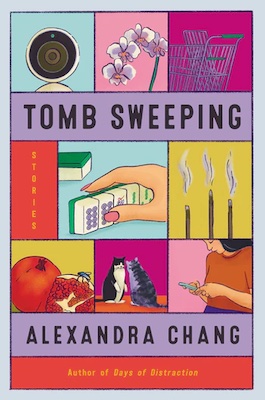
This interview features three writers who published their debut short story collections this year: Ada Zhang, the author of The Sorrows of Others; Nishanth Injam, the author of The Best Possible Experience; and Alexandra Chang, the author of Tomb Sweeping. I called Zhang, Injam, and Chang to learn about their writing processes, relationships with the short story form, and experiences publishing their first collections.


Ada Zhang: The Sorrows of Others is a deep, long glance into other people’s lives. It’s playing with this idea of what the other is in relation to who we are and in what ways we are others to people. There’s this unknowability to each person and I think language and storytelling help us mitigate those gaps and bring us closer, but even they can never really take us all the way. We’re all on our own little islands and this book was my attempt at reaching out.

I think imagination is powerful in the way that it can build our muscles when it comes to connecting. The point of the stories isn’t whether or not the characters are successful in connecting. I try not to make any judgments about that. But I think that in writing these stories, it was me trying to grapple with the essential loneliness of being a person. How are we supposed to move forward? It can feel really damning. Through writing these stories, I was able to comfort myself and hopefully comfort readers.

Brandon J. Choi: Can you speak to your relationship with the short story and the particular joys and challenges that come with it?

AZ: I love a big novel as much as anybody else but there is something about the short story that is just ungraspable. There are so many ways to write a short story and innovate within the form. I think that the form is actually really flexible. It allows for a lot of play. Everybody has taken and made the form their own and put their own fingerprint on it. I think that’s ultimately the goal. My favorite short story writers have all re-imagined what the form can do—and the form can do a lot.

I think that a good short story transcends the form and transcends craft altogether. Craft helps us talk about writing in terms of point of view, character, or plot, but I think any true work will always go beyond craft to a point where these words start to dissolve. What is point of view, is plot, is character? People talk about the short story tradition sometimes as though there is one aesthetic but I don’t think that there is.

BJC: When thinking about what you want to write about or who you want to write for, how do you think the story form enables you to do that?

AZ: I think that the main constraint of the short story is that it’s short. It’s not long like a novel. I say this to my students a lot: constraints in writing are a really good thing. That’s why people like prompts. It gives you a framework to work in and if you go for it, you can subvert that constraint, challenge it, flip it on its head and make it work for you.

I have noticed that because of this inherent constraint, the fact that the short story is short and therefore somewhat contained, I try to glimpse the end at the beginning. It is important to me to be able to see what the ending is going to be at least halfway through the story, even if what I “see” is just a feeling and even if I don’t quite reach it in the first draft. There’s always revision! Still, I never know how I’m going to get to the end. I have to write toward that image or feeling. I really think that the ending is not tricksy; it shouldn’t be a punchline or a bow, and I’m suspicious of a big reveal. People will often think, how am I supposed to end? I think the ending is not separate from the story. It’s just part of the story. It should be able to pass as just another detail, just another line, just like any line from the middle or beginning of the story. It’s like what I think about time. What is plot? In any story, it’s just time and the way it moves and the way we experience time is linear; we have one day, the next day, the next day, until we march right up to death. But time is actually cyclical. We are always living in the present and because of memory, we also are always in the past, and because of imagination, we are always in the future. So the way we experience and move through time is linear, but time is actually not. Being able to glimpse the ending early demonstrates my view of time.

BJC: How do you know when a story is done?

AZ: When you start a story, the whole story already exists. You’re the one who’s going to pull it out of the ether and put it onto a page and share it with other people. The story is out there, independent of you, that’s how I think of it. The moment a story begins is terrifying because just one paragraph in, you’ve already set some rules and expectations for the reader and therefore for yourself which means you’ve already determined in a certain sense how things are going to end. So I think it just helps to have the ending in your mind. Not what it is, but that it exists and is waiting for you.

In terms of knowing when a story is done, I keep returning to what I heard a writer say once. I was young at the time and he said that the work is never finished, only abandoned. At a certain point, it is about letting go. When you can see the piece objectively and see why someone would think it’s a good story and also why someone might overlook it, and you’re okay with both outcomes, it’s a complete story. You know that this is a story for someone out there and maybe it’s not for others. I imagine that’s what it’s like with one’s children. They teach you a lot about yourself and you hope that they find people who are going to love them but you also know that you can’t protect them. They’ve got to go out there and find their people. A lot of it is letting go.

In my first drafts, it’s very clear what tools I’m using to make things happen. In the later drafts, I try to leave craft behind and journey the last leg alone. You have character, point of view, and place, all the great fiction angels, guarding you, marching with you into the story, but you have to be willing to leave them behind at some point. Craft gives us tools, not rules. They should not be constraints that hold you back. The real constraints are the ones that are unique to you, unique drafting problems that you have, that you have decided to face in the story. If you do that, that’s when your story becomes unlike anybody else’s story.

BJC: Beyond writing individual stories, can you talk about how you approached assembling them? Do you think your work lands differently when put together?

AZ: You know what? I actually do. I didn’t think that they would have a cumulative effect but that was naive of me because every time I’ve read a story collection, that’s what has happened to me. With individual stories, it’s like dropping singles and then the collection is the album.  The most pronounced way that I felt this was when I listened to my audiobook. Of course the performances were incredible and the experience made me realize that the whole is something different from its parts. It’s greater, bigger. The story is a form, and the collection is a form in and of itself, which is great because your story gets to be itself and also be part of a family.

Craft gives us tools, not rules. They should not be constraints that hold you back.

I was rereading my collection to refresh myself. “The Subject,” the first story, was my attempt to up the ante for reading the rest of the book. I realized it was actually the last story I drafted. That makes sense to me because by then I’d written quite a number of stories about Chinese immigrants, Chinese citizens, Chinese Americans… There’s always discourse on representation and I started to feel a responsibility to engage in this conversation. I have my thoughts but I didn’t want to just shoot some tweets out into the world. All my questions about what we owe people we’re making art about live in that first story. It’s the last one I wrote because I had done all this work but began to question whether I had a right to be writing about these people. I don’t think there are definitive answers here, which is why I think we should let our stories do that rigorous and deeply imaginative work. That’s how “The Subject” came to be first in the collection. At one point, we wondered if “Compromise,” the last story in the collection, should be first but I think that would’ve changed the tone.

BJC: I’ve heard you talk about Chekhov, William Trevor, and Yiyun Li as sources of inspiration. Were there any books you found yourself returning to while writing your collection or any books or writers you wanted to be in conversation with? Who have you learned from and how have you been influenced when creating your own aesthetic?

AZ: Influences while writing the book: Mavis Gallant, Edward P. Jones, William Maxwell, Toni Morrison, James Alan McPherson, Denis Johnson. And all the names you mention. I love these writers. I guess what I’ll say about lineage is that by learning about your tradition you also learn how to break free from that tradition, meanwhile carrying the best parts of it forward. This might also be true of life.


Nishanth Injam: I wasn’t much of a reader or a writer when I was in India. It wasn’t until after I moved to the States and worked a tech job that the idea of writing occurred to me. I had moved to this new country where I didn’t know anybody and I had this keen sense that I was going to live a pretty narrow imitation of life. It felt like a deep loss. I was extremely lonely. I couldn’t switch my job and just hated it. I had all these obligations back home so I couldn’t quit. And I was desperate to create an alternative world in which I could be more in touch with myself, with the past and the person that I was before I had come to the States. I was building these stories to keep myself alive in a deeper sense. When I started writing, it wasn’t necessarily to achieve something. It was purely to help me live.

It also helped that I found out about MFA programs around then. I saw that they usually workshopped stories and I was trying to get better at my craft so it seemed like stories would be easier, but I was so wrong.

Brandon J. Choi: Can you speak more to the pleasures and difficulties of the form?

NI: The pleasure is that you could be done quickly and you can take on a voice that might not be immediately accessible to you. For instance, I could take on the voice of a tailor, even though I’ve never worked as a tailor or have significant experience being in close proximity to one. I can become this person who mimics somebody’s consciousness and their patterns of behavior enough for the length of the story and still make it convincing. Whereas, I think that inherent lack of knowledge comes through in the span of a novel because it’s too many pages for you to keep up that pretense. The other thing that I like about the short story is that you can really play with structure. With the novel, I think, because you have more room, the structure matters less. Then there are pleasures of language. You have less space so you can make every sentence count. With the novel, I think readers are less likely to spend time rereading a sentence. You always want to keep moving within the space of a novel. As for disadvantages, there are difficulties with the form as it has traditionally been practiced in North America. If you’re coming at it from a different culture, it might be challenging to get your story to fit into the general perception of how a short story should work.

BJC: Can you elaborate?

NI: One general working definition of a short story is that a good short story should have two stories. There’s an over-story and there’s an under-story, and then both of them meet at the end. You think the story’s about X all along and then the story turns out to be about Y. Another definition is that a short story should be like a pinprick that you feel at the end of an injection. When you are being injected and then take out the needle, that’s when the emotions should have you writhing in pain. The other definition is that an ending of a good short story should always result in complexity of afterthought. I have issues with almost all of those. I think the form itself has been so contaminated by the world we live in and by capitalism that it seems weird to expect pleasure or a release of emotion only at the end. You can compare it to a masculine orgasm where it’s only pleasure when the man comes at the end. It’s also the sense that emotion is permitted at certain expected hours and any unmanageable or uncontrollable emotion is only seen as irrational or not valid. It’s also very capitalistic. It’s a value system that rewards atomization. Because thoughts by themselves are not as dangerous. You can construct a story with a point in mind and bring it out at the end, and that mode of storytelling is very safe.

There are other forms of storytelling. For instance, there are many oral storytelling cultures within India, in which there is no expectation for a short story to end in a certain way with everything neatly tied together. There’s no pressure to make every single sentence accounted for. It can be this loose thing but it can still have its own power and be its own thing. Growing up, I remember reading short stories which were like tiny novels. They didn’t have all these formal constraints. So when I moved here and encountered those definitions, I was shocked to see all these perceptions, which were actually held by people practicing the form and not clearly stated anywhere. I think that’s an experience many writers of color have. We are usually told that our stories are not correct in terms of craft. Matthew Salesses does a wonderful job of showing all the ways in which our writing gets marginalized in his Craft in the Real World.

BJC: I read that this collection was your MFA thesis during your time at Michigan. How do you think you changed as a writer during your time there?

NI: Before the MFA, when I wrote the initial drafts of these stories, the heart of the stories was there, but there was much to improve formally and linguistically. You have to know that when I started writing, I couldn’t even hold tense and had absolutely no idea what the past perfect was. I struggled with grammar. I used to write sentences with ellipses because I didn’t know what a sentence was, functionally or otherwise. I went from that to writing sentences that people were calling lyrical and beautiful. When I got into the MFA, I became more conscious of how every word choice contributes to the meaning of the story. This is not something that people usually talk about because a lot of writers are writing in their first language. People sometimes read a sentence and judge if you are any good. If you are able to write a really good sentence, does that make you a better writer than someone who’s gutting their heart on the page? My opinion is that you don’t exactly know where a writer is on their journey, and those kinds of judgements are silly. Even if you are somebody who grew up with English, you are still writing from your subconscious where you’re trying to find words. There is always an effort to translate the unsayable.

The MFA gave me the space to read and write and see how my work was being perceived by others and the ways in which I was falling short. The community and the friendships I formed there are invaluable. The MFA gave me friends I would trust with my life. If you can find friends whose work you can be excited about and who can similarly be excited about yours, then you can all grow together. That’s really the best thing you can hope for.

BJC: What do you want the readers to leave the collection with?

I was building these stories to keep myself alive in a deeper sense.

NI: When I read a book, I don’t always want to be just entertained. I want nourishment, something that will help me live a richer, more meaningful life. There are so many collections that come out every year and so many good books that are out there already. Why am I spending all this time trying to add something? Why am I contributing to this massive pile of good literature? Why do I write? Why do I think that I have the right to say anything? Finding my answers for those questions was challenging. When I arrived at my own particular answer, I knew I had a book. I wanted to tell stories, not for entertainment or pleasure. But to move me along in the path of greater love. I wrote the stories as a way of making meaning and holding onto and transforming the love that I have. I think a lot of that is in the title story.

BJC: When writing this collection, were there any books that you found yourself returning to or any that you wanted to be in conversation with?

NI: When I started writing short stories, I googled what the best short story collection of all time was and one of the answers was James Joyce’s Dubliners. I still stand by this when I say that when I wrote my collection, I was writing to be in conversation with James Joyce. It’s crazy, but it’s true.

We have this Western canon, of thinking and art, and I’m just a small individual from a faraway place, leading a nondescript life, and trying to make meaning from it. Who should I look up to for instruction? Obviously, I’m going to be looking at all the greats and seeing what I can learn from them.

I’m really interested in epiphanies. Nobody believes in epiphanies these days because nobody learns anything the first time. You have an epiphany but you keep making the same mistake. Sometimes, that epiphany is something that holds after multiple times. My sense of epiphany is different. It comes from transcendence, from trying to move out of limbo. I’m trying to elevate myself to a better place, to being a better person. I’m naturally attracted to books in which there’s a similar strain. I see that in Dubliners. If you are sitting there in Dublin a hundred years ago, writing these stories, trying to be artful and truthful to your vision of life in Dublin that you want to present, why shouldn’t I be, in my own small way, be similarly truthful, similarly artful?


Alexandra Chang: Tomb Sweeping is a collection that follows characters who are going through some sort of transition or dealing with loss. It’s a slice-of-life collection that focuses on the ordinary grief that ordinary people tend to experience, and the deeply affecting and moving moments in their day-to-day lives.

The collection likely started when I started writing short stories and thinking more carefully about short stories as a form. The oldest story is from nine years ago. That became the title story. At the time, I did not realize that it was going to be a collection because I was such a baby writer that I wasn’t really thinking in terms of books or even the possibility of publishing. I was thinking: What are stories? How do I want to write stories? And also, how do story writers I love do what they do? What resonates with me and how can I take what I learned and apply it to my own version of this form?

Brandon J. Choi: How has your relationship to the story form changed over time?

AC: We have this exposure to very canonical work, like Hemingway, Cheever, Carver… There are so many things happening in these stories that are moving, but maybe don’t necessarily reflect what I want to do as a writer. In an undergrad workshop (that I took after undergrad, when I was a staff employee at Cornell), I was exposed to flash fiction for the first time. I read Lydia Davis. I read a lot of very weird stories. My professor was J. Robert Lennon, and he is also a very strange and fun and experimental short story writer. That really opened up the possibilities of the short story for me. There are incredible things that you can do with structure and such a short amount of space, like two, three pages. The emotional effect can be huge. That really changed what I understood a short story could be and the limitlessness of a short story.

BJC: You have spoken about constraints in past interviews. Can you elaborate on what your writing and editing look like when working with constraints?

AC: Constraint is basically a way into a story, because for me, there are limitless ways to approach a story. To me, that is both exciting and very daunting. Having certain constraints like, for example, committing to writing a story in vignettes, helps. Or, for example, I’ll have a story take place in only one month of time or only one day. I wrote this one story that didn’t make it into the collection, but it had very long sentences to capture a tiny amount of time—the constraint being that I had to expand time as much as possible. Those kinds of directives/prompts/constraints—whatever you want to call them—can give me a lot of creative energy. They give me a sense of direction and a path to go down with a story that I may previously have felt paralyzed by.

BJC: It’s something to push on versus free falling in nothing.

AC: That really is how it feels, because there are just so many ways to do a story. Which, I mentioned, is also why I love stories. That there are so many ways to approach a story, but without constraint, I don’t know that I would necessarily finish very much. That’s why I find novels so hard, too. Talk about a form that’s incredibly capacious and very flexible. There are no constraints on it in terms of length or anything.

BJC: I want to talk more about revision. I imagine your stories with their various structures and constraints were very different to write but also very different to edit. Can you speak to your editing experience for this collection?

AC: It was hard, not only because each story has its own mechanisms that I recognize and want to honor, but also because my relationship to each of the stories was so different. Some of them felt very old and then some of them still feel extremely fresh to me.

One thing that I hadn’t really considered before I started actually putting all the stories together was ordering. How does a story move into another in terms of what it’s about, or even an emotional state? What would I want to leave a reader with as they enter a new story? That definitely took up a lot of time for me, more time than I probably needed to spend on it.

Still, even with the older stories, it was exciting to re-enter each and see something new I wanted to change in it, even if it was as small as wanting to change a comma to an em dash or changing a word like “home” to “house.” Those small moments as a writer can breathe a lot of new life into a story and give a writer a new relationship to it. And then, of course, there were the huge revisions. “Cure for Life,” for example, was told in a completely different perspective before.

It goes back to a sense of play for me. I want to write about stuff that is important and moving, at least to me. But in the writing itself, I also want to remain playful. With each new revision, I approached it open to discovering something new about the story that I hadn’t seen before.

BJC: Though this is your debut story collection, this is not your debut book. How is the experience of editing a story collection different from that of a novel?

AC: I have this new analogy for writing and editing a short story collection versus a novel. Writing the novel felt like having this huge, open expanse of land and thinking, what do I want to build here? It can be any kind of building. It can be a corral for horses. It can be a skyscraper. Whatever. The beginning is just this empty plot of land. Because of that, the novel was a very lengthy and difficult process because I just had no idea what I was doing. But it was also kind of exciting because I had no idea what I was doing. It was a lot of constructing and then destroying and reconstructing and tearing down again. I think I wrote 50,000 words across two summers and then immediately cut 30,000 when I started revising.

Stories feel more like stepping into an empty room and thinking, what do I want to put into this room?

The stories in this analogy feel more like stepping into an empty room—but it’s already a room that’s there—and thinking, okay, here are these four walls and a floor and a ceiling to work with. Or maybe it’s a circular room. I’m stepping into a space and now I’m thinking, how do I decorate this particular space? What do I want to put into this room? Now rearrange the furniture and the decor I’ve put in there. It felt more manageable to write each individual story and it felt lower stakes in the sense that I could experiment and play and it wasn’t ever going to be a waste of time if it didn’t work out.

With the novel, after spending so much time writing, writing, and writing all these words, I felt like I had to stay committed to the project. The novel also took a lot more of me in a shorter amount of time. The stories were these fun things that I was working on over a longer period of time. I was following whatever impulses I had. I think short stories are where a lot of writers really learn to be writers. And because of that, there’s so much love and respect for the form. I don’t think that I could ever let go of writing short stories. There are definitely writers who only write novels, but there are so many of us who are deeply invested and tied to the short story.

BJC: When writing Tomb Sweeping, were there any books you found yourself returning to, any books or writers you wanted to be in conversation with? Thinking in terms of literary lineage, I am curious who influenced you and your aesthetic.

AC: Some of my stories are in direct conversation with specific writers and stories that, after I read them, inspired me to write. That’s something that I need to constantly remind myself of too: reading other writers is a huge source of inspiration. If you’re feeling blocked or down on writing for whatever reason, return to these story writers who you love, who have inspired you before.

Some examples: Maile Meloy, Stephen Dixon, Lucia Berlin. I think I carried A Manual for Cleaning Women around with me for two years. Yiyun Li. I’ve read every single one of her books. I read Gold Boy, Emerald Girl when I first started writing stories, and Lan Samantha Chang’s Hunger.

There are so many new writers I feel in conversation with as well, like Asako Serizawa’s Inheritors and Shruti Swamy’s A House is a Body. Shruti talks about writing stories that are deeply feminine and emotional, almost in opposition to this very canonical male, everything-is-subtext, minimalist style. Shruti’s stories are so dreamlike and disorienting, but in a way where you can tell that she’s very purposefully taking you on this journey. I really admire her work and it inspires me to write in new ways.

Celebrating What We’ve Accomplished in 2023

Dear Reader, 

Each snow globe in this illustration by Alli Katz depicts one of Electric Literature’s achievements this year. We reached important milestones, launched new projects, and continued to expand the ways that we connect with over 3 million readers and advocate for our writers (536 published so far in 2023).

Over the next few weeks, my colleagues and I will be sharing more about each of these achievements, but a brief summary is included below. We’re proud of what we’ve accomplished, and we’ve got even more in store for next year.

Please take a moment to support our work by making a year-end gift to Electric Literature. Our goal is to raise $15,000 by New Year’s Eve, which will allow us to balance our budget for this year, and start 2024 strong. 

Thank you for spending the year with us! Whether you’re on our homepage every day, an occasional visitor, or a contributor, we’re so very grateful for your time and support.

Yours, 

Halimah Marcus
Executive Director, Electric Literature

P.S. One third of Electric Literature’s annual budget comes from individual donations: we rely on our community to publish every day, to pay our writers, and to keep EL free for readers. Please give today.

Inside the Snow Globes

The Commuter, our home for poetry, flash, graphic, or experimental narrative debuted in January 2018. "Replying All on the Death Announcement Email" by Janessa Abrams is the 300th issue.

The Masquerade of the Red Death is still the literary party of the year, honoring the legacy of Edgar Allan Poe and paying homage to "The Fall of the House of Usher."


Both/And, the first essay series of its kind, published 15 essays written and edited by trans writers of color.

Electric Lit announced our new creative nonfiction program, and received 500 submissions in 36 hours. We will begin publishing CNF essays every Thursday in January 2024.

Electric Lit partnered with Paul English and Joyce Linehan to launch Banned Books USA, which sends free banned and challenged books to Florida residents for only the cost of postage.

Our fiction magazine Recommended Reading which debuted in May 2012, published its 600th issue, an excerpt from A Nearby Country Called Love by Salar Abdoh.

Best American Short Stories selected three stories from Recommended Reading, an unprecedented feat for an online literary magazine. Best American Mystery and Suspense featured two.

For the first time, Electric Literature offered in-house manuscript consultations to writers of all experience levels. Writers received a comprehensive draft review, with detailed notes, and a video call with one of our editors.


We achieved all of this in addition to maintaining our regular publication schedule, which includes author interviews, reading lists, and robust literary coverage, five days a week. 

Please make a year-end donation to support our work, and help spread the word!

Exclusive Cover Reveal: Cally Fiedorek’s “Atta Boy”

Electric Literature is pleased to reveal the cover for the novel Atta Boy by Cally Fiedorek, which will be published by University of Iowa Press on April 2, 2024. Preorder the book here.


In December 2018, we meet Rudy Coyle, a bar owner’s son from Flushing, Queens, in the throes of a major quarter-life crisis. Cut out of the family business, he gets a Hail Mary job as a night doorman in a storied Park Avenue apartment building, where he comes under the wing of the family in 4E, the Cohens.

Jacob “Jake” Cohen, the fast-talking patriarch, is one of a generation of financiers who made hundreds of millions of dollars in the cutthroat taxi medallion industry in the early 2000s, largely by preying on the hopes and dreams of impoverished immigrant drivers. As Jake tries to stop the bleed from the debt crisis now plaguing his company, clawing back his assets from an increasingly dangerous coterie of Russian American associates, Rudy gets promoted from doorman to errand boy to bodyguard to something like Jake’s right-hand man.

By turns a gripping portrait of corruption and a tender family dramedy, Atta Boy combines the urban cool of Richard Price with the glossy, uptown charm of Taffy Brodesser-Akner. Here is a novel richly attuned to its time and place, but with something for everyone—high-wire prose and ripped-from-the-headlines social realism with the warmth, angst, and humor of its indelible voices.


Here is the cover, designed by David Litman.

Author Cally Fiedorek: I was a big fan of David Litman’s design before ever thinking he would agree to work on my cover. I had a little “mood board” going, which was fun to assemble; there were a few comps of David’s own recent work, including the cover for Sam Lipsyte’s latest book, plus the cover of a Weegee photo book, Naked City, that I liked. I wanted something pointedly urban, with some big-city glamour to it, but not too on-the-nose—neither self-consciously gritty, nor too cute. Especially with a motif as iconic as the New York City taxicab, there are many opportunities for cheesiness. 

David sent me three options, all of which I loved, but in the end I went with the most straightforward of the three. It just felt the most assured and most itself, somehow. I love how unfussy it is. If “unfussy” sounds like faint praise, it is not! The instinct to overdo it is so strong, especially for me, in my writing, and it feels like such a win when you bombard someone with twenty-five references and ideas, and they somehow manage to distill them into something natural, simple, and convincing. Thank you, David! 

Designer David Litman: Cally had some great suggestions at the outset that were very helpful. Atta Boy has dual perspectives, as it is both a New York crime story as well as a coming-of-age story, so we wanted to toe the line between gritty noir and youthful or playful. I designed a type treatment that felt mid-century noir but not too on-the-nose. Torn newspaper alludes to the periodicals that occur at intervals throughout the book. The imagery and color scheme hints a central element of the plot: the taxicab industry.

9 Books About the Aftermath of the Balkan Wars

All wars have their own brutal logic, but only a few manage to make an entire country disappear.

The former Yugoslavia was still a one-party socialist country under General Tito when I came to Macedonia from Australia in the 1980s to learn Balkan and Romany folk music. When I returned two decades later, this time as a playwright guest of Belgrade-based theater artists and anti-war activists Dah Teatar, the wars had broken the country into pieces. Hundreds of thousands of people were dead; millions more were displaced.

In researching my novel Nadia, about a young queer Bosnian refugee living in London who fears her co-worker may be a Serbian ex-sniper from the war she fled, books such as U.K. war reporter Misha Glenny’s The Fall of Yugoslavia: The Third Balkan War and Laura Silber and Allen Little’s Yugoslavia: Death of A Nation provided historical context. But the hyperreal, terrifying and tragicomic experience of surviving a melting world, in a war zone and in exile, could only be absorbed imaginatively through conversations with friends and colleagues, and through fiction, memoir and poetry.

Here are nine books—funny, tragic, absurd, harsh and beautiful—about the aftermath of the Balkan wars. While they’re different in tone, style and approach, certain strands recur: Ironic humor as bitter and dark as black coffee; absurdist or fabulist elements, born of the dissolution of reality in the acid of murderous politics; moments of simple observation, when certain details burn themselves into the eye; the use of formal juxtaposition to convey the epistemic shock and grotesquerie of war’s collision with ordinary life.

The Book of My Lives by Alexsandar Hemon

Alexsander Hemon’s extraordinary memoir-in-essays interweaves memories of his life in Sarajevo; reflections on war’s aftermath, food, football and friendship; the divided condition of the immigrant; love, family and heartbreak; and the attempt to rebuild a sense of home in his new city-of-exile, Chicago.

Briefly in the US on a writing fellowship, during Hemon’s absence the looming war engulfed Sarajevo. On May 2, 1992, the day after he canceled his return flight, the last trains left the city and “the longest siege in modern history” began. At first unmoored and unable to comprehend American space, Hemon writes about the need to find in Chicago what he’d lost through exile from Sarajevo: a “geography of the soul.” He builds this, block by block, through walking the city and finding: a café, a bar, a football game in which he can anchor himself.

Hemon’s book is a mosaic made from such maps and stories, the ironies and impact of which are only apparent from absorbing the whole. The essay “The Book of My Life” is about Hemon’s Sarajevo literature professor, who told his students about the book his five-year-old daughter was writing. “She had titled it ‘The Book of My Life,’ but had written only the first chapter. She planned to wait for more life to accumulate, he told us, before starting Chapter 2. We laughed, still in our early chapters, oblivious to the malignant plots accelerating all around us.” Later, the professor joins the Serbian Democratic Party (SDS) “headed by Radovan Karadžić, the talentless poet destined to become the world’s most-wanted war criminal.” When the SDS is involved in the bombing of the Sarajevo library, Hemon writes, “The infernal irony of a poet (bad though he may have been) and a literature professor causing the destruction of hundreds of thousands of books did not escape me.”

It was only on finishing the book that I was struck, in turn, by the infernal irony of Hemon naming his own book by adapting a title (“Life” to “Lives”) invented by the young child of a book-burner and mass-murderer.

The Little Red Chairs by Edna O’Brien

The collapsing black hole at the center of Irish novelist Edna O’Brien’s book is a lightly fictionalized Radovan Karadžić—the “talentless poet” and “war criminal” Hemon references. Dr. Vladimir Dragan has reinvented himself as a mystic shaman and sex healer, hiding out from retribution for his genocidal crimes against Bosnian Muslims in a conservative Irish village. Fidelma, a lonely villager who longs to conceive a child and cannot foresee it happening with her older husband, becomes pregnant by the charismatic outsider. But when the village discovers that Dragan is “the Beast of Bosnia,” Fidelma is reviled, violated by a group of local men, and driven out.

In Fidelma’s subsequent displacement and new life of exile in London, her own experience connects in unexpected ways with that of other refugees from catastrophes large and small. The story is told from multiple viewpoints and ranges from flat, spare prose to hallucinatory insights, and skewers the simple labels and easy cruelties, large and small, that create scapegoats for both misogynist violence and genocide. Yet it is also a story of hope and survival, as Fidelma travels to the Hague to attend the war crimes trial of her prior lover in search of answers. Her world expands through personal loss into a wider grasp of the deadly consequences of following charismatic leaders.

Girl at War by Sara Nović

The Deaf Croatian American Sara Nović’s novel toggles in spare and elegant prose between two periods in her fictional protagonist’s life: Ana’s war-shattered young childhood in Croatia, and her present life as a war adoptee and college student in the US. Like The Little Red Chairs and The Book of My Lives, this evokes the impossibility of fitting a war-shattered past and an oblivious present landscape into a single frame. Nović writes poignantly of the incomprehension of Americans, who mean well but can’t begin to grasp what happened in the Balkan wars; Ana decides simply to shut down that part of her life. Her attempt to do so falls apart when the attacks on the Twin Towers on 9/11 land on her new home city, New York, shattering her fragile inner equilibrium.

Ana spirals back into a barely-buried past full of horrors that resulted, at ten years of age, in her temporary muteness and her becoming “a child with a gun.” She returns to Croatia to trace the remnants of her family’s life. Accompanied by Luka, her childhood best friend, and the book Black Lamb and Grey Falcon: A Journey Through Yugoslavia (Rebecca West’s 1930s travelogue and cultural-historical commentary on the Balkans), Ana sets out on a tour to revisit scenes of loss and violence. Through descriptions of burned houses and overgrown forest massacre sites, Girl at War evokes the imperfect and unfinished work of bearing witness to obscured atrocities. “I looked out at the gilded mountains and thought of the centuries of war and mistakes that had come together in this place. History did not get buried here. It was still being unearthed.” In the book’s gorgeous final image, the moon fills the gaps in a wounded wall, layering memories of past wholeness over current broken-ness through Ana’s attentive and longing gaze.

The Tiger’s Wife by Téa Obreht

In Téa Obreht’s heralded debut novel, the buried past literally poisons the soil: A group of sickly diggers return to the site of an orphanage to find, exhume and lay to rest one of their number who was improperly buried. This strand of the story recurs in the present-day of the narrator, the young doctor Natalia, who has traveled to the orphanage to inoculate the children. At first skeptical of the diggers’ resistance to Western medical solutions to their malaise, she slowly comes to empathize with their search.

The Tiger’s Wife revolves around Natalia and her grandfather’s close relationship in the present and in Natalia’s childhood—also a doctor, he is a story-teller par excellence. Obreht avoids historical specifics of the wars, instead layering the 1990s conflict, its cruelties and unburied grudges and ghosts, over prior conflicts and the mythic stories her grandfather tells her. When her grandfather disappears, Natalia looks for answers by revisiting his stories.

In the novel’s boldest twist, what seemed a Grimm-style folk tale about a witch who marries a tiger turns out to be based on real events from the grandfather’s village childhood: a deaf-mute abused woman befriends a tiger who has escaped from a zoo, arousing deadly suspicions in the village. An innocent boy is tricked into delivering her death, in the disguise of medicine.

Death and medicine, rational science-based healing, and the deeper soul-sickness that only literal and metaphysical exhumation and ritual can heal—all are interwoven in this powerful coming-of-age tale to show that sometimes, only when truth is told slant through stories can certain histories unfold.

The Hired Man by Aminatta Forna

Aminatta Forna’s novel takes place over a decade after the end of the exceptionally bloody conflict in the Krajina region of Croatia. At its center is a house, which an English tourist falls in love with and hires a local to restore. When Duro Kolak, the “hired man” (and narrator), begins renovations, he gradually uncovers the mosaic of a peacock hidden under old plaster, reviving the memory of the previous residents who were violently removed, and raising tensions in the village. The story, like the house itself, is a palimpsest, and Kolak both participates in and resists the slow scraping back of the present to reveal an ugly past. The compelling question posed is not the novel’s most obvious (how could people turn on their long-time neighbors?), but the thornier and more subtle problem of what to do afterwards—how to keep living next door to the perpetrators, drinking in the same bars, doing business in the same shops—when it’s your home and you have nowhere else to go.

Sarajevo Blues by Semezdin Mehmedinović, translated by Ammiel Alcalay

Poet and novelist Semezdin Mehmedinović remained in Sarajevo with his family for the duration of the siege while he played a vital role in the city’s renowned cultural resistance. This harrowing and beautiful book of poems and short prose juxtaposes small everyday moments, both tender (stroking a child’s hair) and horrifying (walking past corpse-eating dogs), with insights into the ubiquity of death and the persistence of beauty. The everyday and the world-rending are entwined.

In the poem “Iman Bey’s Mosque,” Mehmedinović writes, “Here’s what I think: there are neither major or minor tragedies. Tragedies exist. Some can be described. There are others for which every heart is too small. Those kind cannot fit into the heart.” Through the precision, gaps and collisions of his writing, Mehmedinović creates an imaginative space in which the kind of tragedies that “cannot fit into the heart” reverberate. He now lives in the US: prompted by surviving a heart attack and reflecting on his bifurcated life, his autobiographical novel, My Heart, was published in 2021.

The Bosnia Elegies by Adrian Oktenberg

The simplicity and spacing on the line of Adrian Oktenberg’s poems evoke a kind of thought punctuated and shot through with silence, on the border of the unspeakable. There is love, and a bed lit by sun. Roses. Scenes of public destruction; micro-moments of acute personal loss. These poems convey the psychic aftermath of war as inextricable from the ruinous politics of genocide.

“Memory persists with or without speech
Spoiled memory humiliated memory memory broken
into its heartbroken parts every strand shredded
Common memory deep memory
Ruined by this war.”

the form for it is a spiral

Me & My Multi-cultural Street by Jasmina Tešanović

Jasmina Tešanović’s book is a multi-genre mixture of personal essays, reflections, letters and political manifestos. Published by Feminist Publisher 94 in Belgrade in 2001, the book is split in the middle between text written in English, and—turned upside down and read the other way—in Serbian. Tešanović is an anti-war activist, feminist, translator, film-maker and pacifist whose worked for decades with Women in Black, a group who opposed all war and supported refugees. With Habiba Metikos and Julie A. Mertos, she also edited The Suitcase: Refugee Stories from Bosnia and Croatia, where through essays, letters, poems, photographs and personal testimony, refugees of all ethnicities from Bosnia and Croatia recount tales of forced exile.

Although Me & My Multi-cultural Street is unavailable in the U.S., I include the book for its formal inventiveness and moral force, and also simply to make its absence here visible. The book presents radical feminist and anti-war perspectives from former Yugoslavia that are often missing from patriarchal and Anglophone frameworks, and depicts the absurd and lethal results of forcibly sorting the inhabitants of a thoroughly intermarried and inter-ethnic country into “pure” ethnic groups.

The Ministry of Pain by Dubravka Ugrešić

Dubravka Ugrešić was a Croatian literature professor and an ironic and scathing critic of the politics of ethnic division in her former country who relocated from Zagreb to Holland after the wars. A major international literary voice, she died this year.

The Ministry of Pain’s protagonist, like Ugrešić, is a literature professor who has fled Zagreb and finds herself teaching a class to her fellow exiles on a subject that no longer exists: the literature of Yugoslavia. Sensing her students are as lost as she is, Tanja Lucić changes the course to a therapeutic purpose, the collective reclamation of nostalgic memories. But language itself is now a minefield: For instance, Serbo-Croatian is now two separate languages, distinguished only by minute differences in dialect. When the course falls apart, so does Lucić; finally, she is shaken from numbness into rage and grief after reporting a degrading assault by a former student.

Lucić has a bleak and prescient view of the future of displaced Eastern European humanity that could equally describe the precarity of today’s American gig workers: Undergirding the emerging rhetoric of connection, fluidity, globalism, “[a]ll through the grey backwaters people will be eking out precarious livings manufacturing the goods the West European magnates are calling for […] They will sell their sperm, their kidneys, they will sell any organ that will fetch a price on the global black market. They will rent out fresh Eastern European sexual organs to the weary ones of Enlarged Europe […] And some of them will travel all the way to the shores of Western Europe, where the more fortunate will pick asparagus in Germany and tulips in Holland and the less fortunate will scrub toilets.”

And yet the numbness is broken; while retaining its ironic tone, the book concludes with Lucić walking through a landscape at once imaginary, flooded with nostalgia, and a toy-like Amsterdam which is, nevertheless, now her home.

Electric Lit’s Best Novels of 2023

There’s no denying that this year has been an embarrassment of riches when it comes to truly extraordinary, life-changing novels. From books that quietly interrogate the nuances of life among the elite, to stunning panoramic works that imagine a more physically and spatially flexible world, the authors on this list took a classic literary form and reimagined it from the inside out, even bringing us tales from the future—some green lights, some warning signs. The books on this list tell family stories, love stories, stories of ambition and lust and power and greed, and stories of rest, relaxation, and meditation. All of them are important, and we’re grateful to have read and loved them. 

Here are Electric Lit’s top 5 novels of the year, followed by additional favorites below: 


The Top 5 Novels of The Year:

The Guest by Emma Cline

Emma Cline is masterful at subtle tension and heightening anticipation while dropping profound insight seamlessly throughout everything she writes. Her second novel, The Guest, reads like a short story—in its taut, tight, crystalline prose and plot—and Cline has even said that it was inspired by John Cheever’s “The Swimmer.” But The Guest manages to do something possibly even more magical and intensifying with that alluring idea of a drifter floating through the pools, parties, and private lives of the wealthy elite. For a summer in the Hamptons, 22-year-old Alex uses her freeloading talents to get by unemployed among the one-percent. But when she slips up, and she’s silently dismissed by her latest target, Simon, she waits out the week—on her own devices—with a plan to confront him once and for all at the annual Labor Day party.

Big Swiss by Jen Beagin

Greta is a 45-year-old transcriber for a New Age sex therapist named Om. Flavia is a 28-year-old patient of said sex therapist. While typing out her sessions, Greta becomes infatuated by Flavia, and to the point of obsession, invested in her life story while learning about all of her past trauma. One day at the dog park, Greta becomes starstruck when she hears Flavia’s voice but manages to introduce herself under a fake name, and their banter and instant chemistry quickly leads to a passionate affair built upon a lie. Set in Hudson, New York, this novel is part character study, part mystery, and entirely riveting. Beagin’s prose is beguiling with an absurd, witty tone that leaves the reader, like the novel’s characters, desperately wanting it never to end. 

Chain-Gang All-Stars by Nana Kwame Adjei-Brenyah

In a near dystopian future, the most popular form of entertainment is “hard action-sports”—gladiator-style death-matches between incarcerated individuals within America’s increasingly dominant private prison industry. If a contestant, known as a Link, survives for three years, a nearly impossible achievement, they are granted freedom. The Links team up in Chains to fight groups from other prisons all while being live streamed to the American public. The novel is layered with chapters from the perspectives not only of Links but also those of viewers, protestors who believe that action-sports are inhumane, and board members who oversee the regulations of matches. As Adjei-Brenyah told Electric Lit: “There’s a lot of suffering going around, and we don’t have the vocabulary or the ability to engage that suffering outside the terms of creating more suffering.” In this breathtaking novel, sprinkled with footnotes that provide facts and statistics on the prison system, Adjei-Brenyah places a critical eye—through a fictional lens—on the very real human costs of entertainment and the humane reasons for abolition today.

Terrace Story by Hilary Leichter

Based on the National Magazine Award winning story, Hilary Leichter’s profound second novel asks how far the mind can travel when it’s looking for something that’s gone. Annie, Edward, and their young daughter Rose live in a cramped city apartment. One night, when their friend Stephanie visits, a beautiful and spacious terrace appears in their closet. When Stephanie leaves, the terrace disappears, only to return when Stephanie returns. But Annie and Edward must learn that every bit of space comes at a hidden cost, setting off a seismic chain of events. Ultimately, Terrace Story is a love story that seeks to mend a broken-hearted world. Read an interview with Leichter here.

Forgive Me Not by Jennifer Baker 

From former Electric Literature contributing editor Jennifer Baker comes a searing indictment of the juvenile justice system. It takes one night, one bad decision, and one drunk driving accident for fifteen year old Violetta Chen-Samuels to cause the accident that kills her little sister. In the juvenile justice system, her future lies in the hands of those she’s wronged—her family. Denied their forgiveness, Violetta is forced to make one of two choices: to remain in detention, or participate in The Trials—no easy feat. But success might bring her freedom, and what she craves most of all: her family’s love. In the quest to win her family’s forgiveness, Violetta must confront her own grief, and consider that it might be more important to forgive herself. 


Electric Literature’s Other Favorite Novels:

I Have Some Questions for You by Rebecca Makkai

Bodie Kane, successful film professor and podcast host is invited back to the New England boarding school, where she spent four miserable years, to teach a new course. While she’d prefer to let sleeping dogs lie, Bodie finds herself drawn back into the case of Thalia Keith, her classmate who died, and Omar Evans, the athletic trainer who was convicted for her murder. As the many flaws in the case, and a rush to conviction, become apparent, Kane begins to wonder if something from her past holds the key to solving the case. Read an excerpt of I Have Some Questions For You here

Jonathan Abernathy You Are Kind by Molly McGhee

When Jonathan Abernathy lands a job with a government loan forgiveness program, one that will absolve him of his debts if he is successful, he jumps at the chance. He can give himself a new life if he proves competent at entering the dreams of middle class workers while they sleep and removes the unsavory detritus from their daily lives. As he settles into his new job, reality and morality begin to collide, forcing him to confront the lines between love and hate, work and life, right and wrong, and even sleep and consciousness. Read an excerpt of Jonathan Abernathy You Are Kind here.

Land of Milk and Honey by C. Pam Zhang

In a world covered in smog and filled with disappearing food crops, a chef leaves behind her dying career in a dreary city for a mountaintop escape, a colony where the world’s troubles seem more like faraway annoyances. The sky is clear, elusive ingredients are plenty, and she is reminded of the pleasures of taste, touch, and her own body. Sensuous, surprising, and alluring, Land of Milk and Honey examines the ethics of seeking pleasure in a world who’s days are numbered. 

Blackouts by Justin Torres

In the desert in a place called The Palace, a young man tends to a dying soul who’s haunted the margins of his life: Juan Gay. Juan has a project to pass along, a book: Sex Variants: A Study of Homosexual Patterns, and its devastating history. Hidden in buried and muted voices are the stories of early twentieth century queer life. As Juan waits for his end, he and the narrator regale each other with moments of joy and sadness, of love and loss. A book about storytelling, this National Book Award winning novel reminds us that the past is with us, beside us, behind us, and ahead of us. 

Holding Pattern by Jenny Xie

In Jenny Xie’s debut novel, Kathleen moves back to Oakland and back in with her mother, Marissa, after a recent heartbreak. To distract herself and to get out of the house quite frankly, she applies for a job as a professional cuddler at the tactile therapy startup, Midas Touch. Marissa, meanwhile, is recently engaged and in the midst of planning her wedding. Holding Pattern—with its mesmerizing prose and endearingly authentic mother-daughter relationship—is about connection in all its many forms and fashions. Get a taste of the poignant novel by reading this excerpt published in Recommended Reading earlier this year.

People Collide by Isle McElroy

When Eli wakes up alone in the cramped Bulgarian apartment he shares with his wife, Elizabeth, who’s more organized and successful, he discovers that somehow he’s in her body. She, in his body, has vanished. As he searches throughout Europe for his wife, he embarks on an exploration of gender and embodied reality. People Collide is rich, rewarding, and a tender portrayal of ambition, desire, and shared lives and bodies. Check out Electric Lit’s exclusive cover reveal here

The Late Americans by Brandon Taylor

Set in Iowa City around a group of acquaintances—some friends, some lovers, some strangers—this mosaic of a novel alternates perspectives each chapter to dissect and discover the complexities as well as tragedies of being human. Eventually leading up to a dramatic weekend in a cabin, the central ensemble of artists, café-workers, poets, dancers, writers, and mathematicians are all haunted by societal expectations, cultural notions of art, Capitalism, their pasts, and perhaps each other. As Taylor probes the tension between individuals, communities, and contemporary America, he surely displays “the rhythms of living in the world” with this lasting, memorable novel. 

Yellowface by R. F. Kuang

Yellowface follows two friends, June Hayward and Athena Liu, who are both writers but have had drastically different career outcomes. While Athena has become a bestseller, June’s books continue to go unnoticed. But after June witnesses Athena’s death, she steals her friend’s latest manuscript about Chinese laborers in World War I. June, who is white, changes her name to sound more ethnic and edits, plagiarizes, lies, then publishes Athena’s manuscript under the racially ambiguous “Juniper Song.” Unsurprisingly, June, or Juniper, is haunted by the threat of getting caught. The tension is high, and so are the stakes in this literary thriller, as Kuang develops her characters into ultra-real people and insightful commentaries on today’s publishing industry.

A Quitter’s Paradise by Elysha Chang

What holds a family together when the fallout seems inevitable? After Eleanor’s mother passes, she quits her PhD program, lies to her boyfriend, and continues down a path of questionable choices to distract herself from her own feelings. In hopes of confronting the present, Eleanor looks to the past and soon finds family secrets in every corner. Told through interwoven narratives from varying perspectives, eras, and continents, Elysha Chang’s debut is a sharp, intimate, and poignant investigation of grief, family dynamics, and selfhood. 

Mrs. S by K. Patrick

Mrs. S is an atmospheric slow burn of a novel. Taking place at an all-girls English boarding school, the titular character is the wife of the headmaster and the narrator, an unnamed 22-year-old and new matron hired to supervise the girls, is obsessed. What follows is a story of utmost yearning in the sense of queer desire, the attempt to understand one’s self, and a simple longing to be understood. The prose in this novel makes it stand out immensely—filled with poetry and melancholy around every corner and a hypnotic voice that conveys the intensity of youth and infatuation exquisitely. 

Sea Change by Gina Chung

Ro, having entered her thirties, her mother estranged, and her boyfriend having recently left to join a mission to Mars, is feeling stuck. She spends her days working at the aquarium, where she befriends Dolores, a giant Pacific octopus who is also Ro’s last remaining link to her father, a marine biologist who disappeared on an expedition. When Dolores is sold, Ro is left to wade through her memories and trauma, and finally come to terms with her history while finding her place in the ever-changing world around her. 

Where There Was Fire by John Manuel Arias

When a lethal fire burns evidence of a cover up at the American Fruit Company’s most lucrative banana plantation, a Costa Rican family is forever changed. What unfolds is a story of forgiveness, of a mother and daughter, of trying to cope with family mysteries and forces not fully understood. Brimming with ancestral ghosts and spirits, John Manuel Arias weaves a gorgeous tapestry of love, loss, secrets, and redemption in this debut National Bestseller. 

All the Sinners Bleed by S.A. Cosby

When former-FBI agent Titus Crowne returns to his hometown in Virginia as the newly-appointed sheriff, he’s faced with a tragedy and trail of secrets. The town, he finds, is torn apart and coming undone by Confederacy statues and flags on every street. And at the heart of the novel is a school shooting with the serial killer still on the loose—unleashing more tension and drama until it all brims over in this dark, complex story. All the Sinners Bleed asks its readers to reckon with what’s been lost and what’s about to be.

Moonrise Over New Jessup by Jamila Minnicks

In 1957, Alice Young steps off the bus in the all-Black town of New Jessup, Alabama, where residents have rejected racial integration as a method of social advancement. When Alice falls in love with Raymond Campbell, whose community organizing challenges the status quo, she realizes their love could lead to their expulsion from the town they both so dearly love. Rendered in lush, exquisite prose, Moonrise Over New Jessup revels in the turbulent underbelly of the politics of love. 

Rouge by Mona Awad

To borrow phrasing from Chelsea Davis, who interviewed Awad for Electric Lit in September, “Rouge tenderly explores grief, the psychic damage wrought by Eurocentric beauty standards, and the fierce, fraught love between mothers and daughters.” When Belle’s estranged mother dies suddenly, she returns to California to settle the debts and the mystery behind the cause. Belle has always been addicted to the endless stream of YouTube beauty tutorials and skincare rituals (because who hasn’t been at one point?), but things are taken to the next level when Belle enters La Maison de Méduse—the culty spa her mother was supposedly a part of—and finds possible answers as well as secrets galore. 

The Great Reclamation by Rachel Heng

Born in a fishing village amid the heat and coastal beauty of Singapore, Ah Boon is a gentle boy not much interested in fishing. He prefers to spend time playing with the neighbor girl, but when he discovers an ability to find beautiful islands that no one else can find, he feels an obligation to impress the girl he loves. Told amidst the backdrop of the Japanese army’s invasion, and the rise of resistance, The Great Reclamation is an aching love, and coming of age story that reckons with colonialism and the wounds of progress.  

We Are a Haunting by Tyriek White

Set in Brooklyn in the 1980s, Key, a charming and tender doula serving the Black women of East New York is enchanted with her world. Like her mother, she lives among the departed, learning to speak to and for them. Her untimely death leaves behind her mother Audrey, and her son, Colly, who soon learns that he, too, has inherited his mother’s gifts. As he moves between the living and the dead, he begins a journey of radical self-realization. Part supernatural family saga, part searing social critique, Tyriek White’s Center for Fiction First Novel Prize winning debut is a lyrical and potent work of art.

Enter Ghost by Isabella Hammad

Isabella Hammad’s second novel follows Sonia Nasir, an actress who leaves London and a ruinous love affair, to spend the summer with her older sister in Haifa—their family’s ancestral city. Sonia gets caught up in a production of Hamlet (in Arabic and premiering on the West Bank) that a friend of her sister’s is organizing. Through the narrator, the complexities, dangers, and haunting realities of contemporary Palestinian existence seep through the tightly-woven plot and beautifully moving prose of Enter Ghost

Our Share of Night by Mariana Enriquez, translated by Megan McDowell

When a young father and son set out on a roadtrip, devastated by the death of their wife and mother, they must confront her terrifying legacy: a family called The Order that commits unspeakable acts in search of immortality. Moving back and forth in time, from London in the 60s to the Argentinian military dictatorship and its aftermath, Our Share of Night is a beautiful, arresting novel of love and longing. 

Biography of X by Catherine Lacey 

As Lauren Groff writes in her introduction to this excerpt published in Recommended Reading, “Biography of X is a ghost story in which the living haunts the dead; it is a doomed and obsessive attempt by Lucca to make contact with X through time and space, coming closer and closer, but—infuriatingly—never being quite able to touch her lost love.” Set in an alternative USA, Biography of X is at its surface a book within a book—a biography of the late enigmatic and shape-shifting artist X, written by her wife, the journalist C.M. Lucca—but it becomes so much more than that as secrets, unknown histories, and questions unravel themselves with an almost equal amount of force as Lacey’s breathtaking sentences.

Writing Desire in Middle Age

Diana Whitney’s second poetry collection, Dark Beds, is a rich text built of the many narratives that comprise middle age for caregivers: the demands of young children growing into themselves, parents aging away from themselves, a marriage suffering from the stress of relentless obligations.

Through these poems, Whitney explores the ache of desire that is often the backdrop of these caregiving years—the desire to be on the receiving end of tenderness and to be witnessed as a whole being rather than attendant. In the poem “The Long Goodbye” the speaker asks, “How can you savor what you have when it demands so much of your attention?” 

Within these poems, Whitney builds a landscape that is at once realistic and dreamlike, filled with coyotes, frozen rivers, orchards. These poems attend to the natural world with the same care and grace that they bear witness to the unfolding of desire, as in this stanza from “The Same Earth”:  

All I want is April on her back—

ecstatic creatures hatching in the ice pond,

green frog moon waxing like a come-on,

the bulbs busting up through dusty grass.  

Whitney and I spoke over the phone—from opposite sides of the country— just before the official launch of her book, during a quiet moment away from the demands of work and family. 


Jennifer Berney: I wanted to start by acknowledging that you just lost your mom, and so it must be odd to be launching a book. 

Diana Whitney: Yeah, I’m really tired. It was about three weeks that she was dying, so I took a lot of time off to go be there. My mom is a big part of the book, so to have just lost her and to be bringing the book into the world is really weird. 

JB: Are you up for saying a little more about that? 

DW: Yeah, absolutely. I mean, I’ll say that I’m a late bloomer with book publishing and I consider myself a slow writer, but I’ve come to embrace that and not compare myself to authors who whip out a book every two years. But this book was a long time coming. I’ve been writing these poems over a long period of time, like over the past 10 years. So they range from when my daughters were young to the later stages of their adolescence. And the poems range through the stages of my mom’s Alzheimer’s. So when I think about the title Dark Beds, there are layers of meanings there. The beds are definitely the garden beds because I’m a gardener.  And then also the marital bed and the darkness that can happen there when distance and conflict and estrangement develop within a relationship. And then there’s the darkest bed, which is mortality and death. And the poems witness my daughters as they move into adolescence while my mom was declining with Alzheimer’s. That’s one of the big arcs of the book. 

I’m a late bloomer with book publishing and I consider myself a slow writer, but I’ve come to embrace that and not compare myself.

So now having it come out in the world at this moment—yes—it’s particularly poignant and strange and vulnerable. The poem that I wrote, The Long Goodbye: the long goodbye is another name for Alzheimer’s. I remember reading that somewhere and thinking, I need to fit that into something I write. I didn’t know that when the book came out, that the long goodbye would be over. It was a 10-year goodbye. But I have this feeling that she lives through me and my daughters and my writing even though the mother that I’m remembering now, the one before Alzheimer’s, isn’t quite in these poems. But it’s a weird juxtaposition, the book launch and the grieving happening at the same time, because you have to be external when your book is launching. And you have to be internal to properly grieve.

JB: You described yourself as a late bloomer just now, and I wanted to ask you about writing from the perspective of middle age. And, just to toss this out there, my personal experience of middle age is that it doesn’t feel late to me.

DW: I do use “late bloomer” in quotes because it’s not my word, it’s the culture’s word. Maybe because we live in this youth worshiping culture. My journey with writing has taken the time it needed to take. And the wisdom I’m stepping into is around trusting that my own journey was the right path for me. I’m actually finishing my MFA, and I’ll graduate in January. I had started in my twenties and I had to take medical leave because of a chronic pain condition that was really debilitating. And then I didn’t go back for a variety of reasons, including my father’s death and then having two babies. But it became important to me that I finish what I’d started and I had this deep intuitive knowing that it was something that I needed to do without apology and without a good practical reason. 

I went to my residency as probably the oldest writer there, and actually loved that role. I felt like a wise maternal figure there, like I had a lot of insights and knowledge and depth to offer to younger writers. And I don’t say that in a condescending way, just more like: I just turned 50 and I’m at home with myself right now. The older I get, the more loss I see. Life is short. In terms of writing, we have to celebrate even the smallest accomplishments. We really do! Like, there’s no more waiting around for the poem in the New Yorker or the Pulitzer Prize or the NEA grant—it has to be now! 

JB: I’m curious too about the thread of desire in Dark Beds. Did it come easily, or was it scary to write about desire in middle age? 

DW: The first thing I’ll say is that I had writing friends who thought I should write a novel, that I should fictionalize my story. I’m not a novelist. I had to write it the way it came out of me, which was in poems and a lot of the poems were written a long time ago. So a lot of the hotter, desire-themed poems in the book were written in 2013, which is 10 years of a 20-year marriage. The experiences that I had that shaped the book, they might have ended in a different way. The last couple of poems really wrestle with the questions of: what is fidelity? What is longevity? What are the boundaries that we need within a marriage? What does it mean to fall in love with somebody else? For me that was inextricable from the experience of mothering young children and the kind of abnegation of self that can happen. 

I did the full-time motherhood thing very intensively. I called it the Baby Cave. And a lot of these poems were written right as I was stepping out of the baby cave and this experience of limerence happened to me—which is a word I had to learn, but it definitely applies. And the poems came out of this thrilling intoxication,  an awakening of both creative and sensual energy. It was incredible to both get poems from that and to be able to work things out with my partner. I’m intensely grateful for both things. I said, I’m not going to apologize for the poems. The experience of longing and desire, that was temporary. It was a catalyst for the poems, but the poems exist and I did not ask permission either to write them or to publish them. That’s maybe scary, and maybe people who aren’t writers wouldn’t understand that, but that was really important to me. Actually, one of the ways that I could stay in my marriage was not to apologize and not to ask for permission. 

JB: I feel like the standard cultural narrative is that motherhood depletes our desire, but a thread through the book is that motherhood actually drives this longing. 

I went to my residency as probably the oldest writer there, and actually loved that role.

DW: It did, it did. And some of the trap I felt was the domesticity of being a wife and being a queer woman in a hetero-seeming marriage. And that’s actually something now, in middle age, I’m needing to work on: finding space to express my bisexuality and what does that look like within a committed partnership.  I’m writing poems about that. But at that point, I felt stifled by the institution of marriage, by this notion of wife and the expectations of being a good mother. But desire was this exhilarating freedom—and the place to come back to myself. 

Before getting married, when I was single and dating a lot of people—I used to call it the vixen days. I don’t necessarily write about those in a nostalgic way in this book, but I think that the emotional affair that I write about in Dark Beds was a way of reliving the energy of those younger days. It was actually very adolescent. 

JB: With limerence and desire though, there is something about those emotions that seems adolescent, but I want to second guess that association. Is that just our cultural narrative again? 

DW: It might be. I mean, I know for me, I started listening to the same music I had in high school. Actually there’s a playlist for my book that my wonderful editor and publisher asked for. And it’s: The Cure, The Smiths, Suzanne Vega— these songs that I associate nostalgically as songs of longing and that was the music I wanted to listen to. 

I think maybe we denigrate that period of time, but it’s also a really fertile and generative period of time. I mean, it’s full of tumultuousness and pain and all of that, but it really can be very charged and beautiful and, and creative.

JB: Well, it’s the time before we’re locked in, right? I wish I could take a vacation in my twenties but as my 47-year-old self, I would love to be simultaneously in my twenties and my forties. 

DW: I feel the same way. And sometimes I say, oh, am I just being nostalgic? But I think it’s much more nuanced than that, going back to the experience of adolescence. I remember being 16 or 17 and a friend’s mom saying “Oh, you’re in discovery mode.” She was probably in her forties.  She said “You know, discovery mode doesn’t end when you get older.” And I remember thinking that was so weird, and like, why was this old mom saying that to me? And I think that’s probably what I was longing for in the poems, to be in that state of discovery and possibility. 

JB: I’m curious to what extent desire is about wanting to be seen. So much of raising kids is about who you are to the person who needs you, which is different than being wanted for who you are. 

DW: Absolutely. Being seen was a huge, huge part of it. To be seen, to be recognized, to be desired as a goddess, as a force of nature, as someone who runs wild in the woods or  under the full moon—something totally separate from mundane daily life and the tasks of, say, feeding children. 

JB: It’s an incredible aphrodisiac to be seen. 

DW: That was a big, big part of it. Esther Perel has that book Mating in Captivity, which was so, so formative to me. She says that sex isn’t something you do, it’s someplace you go. And she talks about the unknown that’s in eroticism. It’s difficult to have that thrilling experience of the unknown with someone who’s been your partner for 10 or 20 years. That is what she helps couples figure out both in the books that she writes and in her couples therapy practice. 

JB: It sounds like some of the power in her work is in not shaming the need behind it. 

DW: Yeah, and normalizing it—talking about desires that are often unspeakable outside of a marriage or partnership. There are so many things that she wrote that opened my eyes and helped me also to be forgiving towards myself. 

JB: I want to make sure I ask you about all the wildness and nature and animals that appear in your poems.

DW: I spend a lot of time in the woods and I’m lucky to live in just a beautiful place in the hills of southern Vermont. So inspiration comes from being out in a remote place where no other humans are, and like hiking up a mountain and encountering wild animals or being under the moon or stars. I’ve come to understand that an essential part of my writing process is being out in nature; it’s not some “self-care” thing I have to make time for. I mean, maybe it’s also that. Mary Oliver said that she would get up every morning and walk and she would bring her little journal with her, and most of her poems arose that way. It’s not as direct for me, but my experience of being out in the wild—on the river, in the woods— is part of my writing practice. I’ll come back and jot images in a notebook, and they inevitably find them find their way into poems. 

I actually think that the page is a place that we can be wild and free in a way that we can’t necessarily be in the kitchen with our children or, you know, driving the carpool. 

JB: Yeah, that’s interesting to think of the page as its own wilderness, 

DW: Right? And a place of discovery or possibility. I ended up feeling like the experience of writing for me was more thrilling in the long term than like the experiences of a sexual encounter or the possibility of a sexual encounter. I don’t know if that sounds disingenuous, but the thrill of composition, especially of writing something new and almost channeling it—sometimes you can feel some wild, otherworldly energy moving through you. It’s powerful. So I really am grateful that I have both: I have my long partnership with the father of my children, and I have these poems that came out of that experience that I chronicle in dark beds.

Before 2016 I Dated Republicans Without Much Shame

As I watched Donald Trump win the presidency on November 8th, 2016, I didn’t know that it meant my days of sleeping with Republicans were over. Why? For a start, it took me a few days to even accept the election results. Furthermore, I’d never sought out Republicans for intimacy-related reasons—it was one of those things that just happened, from time to time. But if I’m being honest with myself, the real reason is that I didn’t even realize a line in the sand existed until someone else articulated it.

Before 2016, I dated Republicans without much shame. I didn’t agree with them politically, but I subscribed to the mathematically-sound belief that the wider your net, the more likely you are to get a boyfriend. Besides, I thought politics was private; how we vote is anonymous, after all. However, on a date in early 2018, when a man told me his only deal breaker was that he wouldn’t date a Trump voter, I responded with, “well, of course I wouldn’t date a Trump voter.” And I meant it. Which meant that somewhere along the way, something had shifted.

I hadn’t fully understood why until I read Cecilia Rabess’ phenomenal novel Everything’s Fine—the story of Jess, a young, liberal Black woman and Josh, a young, conservative white guy. They meet in college, get to know each other on the trading floor of Goldman Sachs, and begin dating while she works for him at a hedge fund. 

Everything’s Fine was flooded with bad reviews before it came out. Readers found the premise—that a Black woman would date a racist white man—racist. I’m a white woman; it’s not up to me to decide what’s racist, but I don’t condone reviewing a book before reading it. At the same time, I can conceive of a book description so racist that the book itself should be discredited—which is why this controversy made me curious. So curious, in fact, that I bought the book. 

I’m glad I did, because I loved it. The criticism isn’t unfounded; Josh makes insensitive and ignorant comments about race throughout, which qualifies him as a racist. And yet, I’m of the opinion that all white people in this country (myself included) have made insensitive and ignorant comments about race at some point—and in this case, I thought it was fair to leave it up to Jess to choose whether or not to forgive. 

Jess, for her part, isn’t perfect either. She feels guilty walking by Occupy Wall Street protestors on her way to her Goldman Sachs job every day, but she changes nothing. She benefits from Josh’s wealth and tolerates his behavior for years. 

And I related to Jess’ dilemma. Like her, I often find myself torn between an opposition to capitalism and the necessary acknowledgment that it benefits me. And I related to her romantic predicament: existing in a relationship that looks terrible from the outside (Jess’ friends describe Josh as “toxic” and even question if it’s ethical for Jess to date him), while knowing there’s something there my friends can’t see. But as Josh continued to offend, and as her political views developed, tested by the inequities of the so-called real world, I began to wonder: was she ever going to draw the line with him?

Readers found the premise—that a Black woman would date a racist white man—racist.

She reaches the end of her rope in Summer 2016, in a moment that’s very specific to their relationship, and yet so glaringly familiar. Searching for a lost item in their apartment, she discovers Josh owns a MAGA hat. And then, Jess is done.

And as she’s breaking up with him, Josh snaps too. He says aloud what Jess has been fearing for years: that she’s a hypocrite. He claims she’s a beneficiary of the same power structures she theoretically opposes. He’s not wrong, but at the same time, Jess is also a victim of these power structures—she’s the recipient of routine racism and sexism on Wall Street. Rabess asks us not to oversimplify oppression—a person can be on both ends.

More convincingly, Josh says it’s unfair for Jess to hold his Trump support against him, as he’s never hidden who he was. She already knew he was a registered Republican, that he’s always voted for Republicans. He voted for Mitt Romney, he works at a hedge fund, he owns a $4 million apartment, and he’s opposed to most social welfare programs. He hasn’t changed.

He’s once again not wrong; given everything we know about Josh, his support of Trump is expected. Here, I recognized the innate hypocrisy of my own line. Is a Romney voter much better than a Trump voter? They are largely the same people, and I mean that as a statistical truth, not a moral assertion. Most Romney voters voted for Trump, and the ones who didn’t were largely educated wealthy white professionals. Republicans vote for Republican candidates; that’s one of their defining qualities. To this very day, 91 charges later, 70% of registered Republicans are still with Trump.

We all like to think we can influence our partner’s political views, and sometimes we can.

And yet, even if Josh’s support is to be expected, even if it’s in line with everything he’s ever done, and even though I remember exactly what was happening in Summer 2016, I still gasped when Jess found the hat. But why? Why was it different? Why was this Jess’ line? Why is it mine?

On the one hand, it’s obvious. Because it’s Donald Trump. Trump is and was so blatantly racist and misogynistic that no Black woman should have to explain why they dumped their white boyfriend for supporting him. Nor any woman in general. Even though Josh was a Romney voter, Trump is so much worse

Furthermore, when Josh voted for Romney, he wasn’t dating Jess. Perhaps Jess wanted to think Josh had adjusted his views merely by osmosis, even though he never caved during any of their arguments. Here, again, I related strongly. We all like to think we can influence our partner’s political views, and sometimes we can. In 2014, I successfully convinced my conservative investment banker boyfriend that his time was too valuable to waste voting. That was the only time, though.

And Jess didn’t dump Josh when he told her he was voting for Trump, she dumped him when she found the red hat. Josh tries to argue it’s “just a hat.” But of course it’s not just the hat, it’s his show of enthusiasm the hat represents. As Rabess writes:

“It makes Jess think of racism and hatred and systemic inequality, and the Ku Klux Klan, and plantation-wedding Pinterest boards, and lynchings, and George Zimmerman, and the Central Park Five, and redlining, and gerrymandering and the Southern strategy, and decades of propaganda and Fox News and conservative radio, and rabid evangelicals, and rape and pillage and plunder and plutocracy and money in politics and the dumbing down of civil discourse and domestic terrorism and white nationalists and school shootings and the growing fear of a nonwhite, non-English-speaking majority and the slow death of the social safety net….and Josh—now it makes her think of Josh.”

It’s not just me and Jess. Politics is a common line to draw in romantic relationships, in theory. I wouldn’t date anyone who I know definitely voted for Trump—and 71% of registered Democrats say the same. And even though I have more firm lines than I used to, it’s still my preference to know less about someone’s politics early on in the relationship. For example, I’m grateful I was already in love with my partner by the time he revealed he voted for Gary Johnson. Relationships are hard enough without adding politics in. 

But Jess’ line was with Trump himself, not Josh’s politics. And so—I had to admit—was mine. Did Trump change what it means to date a Republican? What you’re conceding when you do? 

On the one hand, Trump has said and done so many abhorrent things that it feels like a no-brainer. It would be impossible to date anyone who even tries to defend him. There’s a reason the 2017 Women’s March, the day after his inauguration, was the largest single-day protest in our country’s history. Supporting Trump feels like a hole so deep it would be impossible for a relationship to climb out intact. 

On the other hand, maybe I’m just using Trump’s specifics as an excuse. It often feels like “Never Trump” Republicans just want us to go back to a time when Republicans were polite about their tacit support for income inequality. Maybe I just want absolution for the Republicans I dated pre-2016. Maybe a more progressive person would tell me the same thing Josh told Jess: Republicans vote for Republicans.

Supporting Trump feels like a hole so deep it would be impossible for a relationship to climb out intact.

Everything’s Fine doesn’t end when Jess dumps Josh. He goes to great lengths to win her back—he shows up in her hometown, even though she’s ignored his calls for months, and at one point, he even offers to sacrifice his job to save hers. She remains on the fence. Indeed, she’s as undecided after their breakup as she was during their relationship. 

I don’t hold this indecision against her. I don’t hold it against anyone for breaking their own rules, for crossing their own lines. Whatever we say we care about when it comes to our partners’ politics often goes out the window in the face of attraction. I say I wouldn’t sleep with a Trump voter—and to my knowledge I haven’t—but maybe that’s because an attractive enough Trump voter hasn’t hit on me (it brings me no joy to say this, but some Republicans are hot). Dating may compel us to compromise our political values, but then again, so does politics itself. I could fill a book with abhorrent things Democratic politicians I’ve voted for have said or done; I regret none of those votes. It’s not as though I had infinite choices. 

Furthermore, it might not be helpful to draw political lines in romance. Sometimes, I feel like my refusal to date a Trump voter is self-indulgent, for the same reason I tend to roll my eyes when the privileged discuss how they’ll move to Canada if Trump is reelected; the people with the resources to move countries are exactly the ones who don’t need to worry. Maybe a white lady swiping left on moderates is false martyrdom; making it about me when it doesn’t need to be. Maybe choosing to let politics affect one’s personal voice is a privilege afforded to those for whom politics don’t bombard their personal lives against their will. 

So maybe there’s absolution for those who date people with abhorrent political views. Jess forgives Josh so many transgressions, but I forgive her for her forgiveness. Josh is funny and sweet and loves her very, very much. And there’s more to him than his politics. My favorite scene comes near the end, at a party thrown by Jess’ friends. Jess is annoyed at Josh for announcing he thinks eviction is fine. Moments later, she finds him out on the balcony, having rescued a stray kitten. Jess is both wholly charmed and deeply annoyed. She wants consistency, but Josh eludes easy labels of “good” or “bad.” 

Maybe a white lady swiping left on moderates is false martyrdom; making it about me when it doesn’t need to be.

The juxtaposition of the cruelty of his politics and the warmth of his affection for a kitten reminds us that everyone has a softness to them, everyone contains multitudes. The book is worth reading for the very reason people tried to cancel it before it came out—because it isn’t afraid to find the humane side of those we vilify, often for good reason. Everything’s Fine argues that it’s worth asking if a racist Trump voter is as worthy of love as anyone else.

Rabess’ choice of Trump as the demarcation, the point of no return, is apt, as he’s unintentionally moved the line many times. After each unspeakable transgression, he gives his old supporters a new chance at redemption; after each massive moral failing, a new crop of “Never Trump” Republicans were born. On the eve of Trump’s third nomination, is it time to ask if there’s redemption for 2016 Trump voters? Are those who voted for him in 2016, but not 2020, now dateable? Those who were with him until Charlottesville? Until the pandemic? Until he told the Proud Boys to stand back and stand by? Until January 6th? And if there is—could you be the one to give it to them?

On its face, Everything’s Fine asks us to consider where to draw the line. Zoom out slightly and the fundamental question broadens: do these lines benefit us? Does the very act of moving the line make you a hypocrite? If so, are we all hypocrites? I can’t reveal what Jess chose, but it’s a mark of Rabess’ phenomenal storytelling skills that I was left guessing until the very last page.