On March 20th, 2020, Animal Crossing: New Horizons was released. Just a few days after the majority of the world shut down, marking the beginning of the COVID-19 pandemic, millions of people fell into a virtual world in which sickness was not rampant and you could pay back the construction costs on your home at your own pace.
It felt like more people than ever were playing and talking about video games; it makes sense, then, that Critical Hits: Writers Playing Video Gameswas birthed from quarantine conversations. But, escapism and playing-in-isolation only scratches the surface of what the eighteen essays in this anthology take on. With refreshing diversity of both form and approach to thinking about games, each piece comes from a place of fact and understanding: video games are art, worthy of both our pleasure and our curiosity. To have comics and stunning personal narratives alongside thoroughly researched critical works makes sense—video games are vast and varied, and Critical Hits complements the enormity of the field.
I spoke with J. Robert Lennon and Carmen Maria Machado over Zoom and e-mail to talk about the crafting of the collection and their own relationships to video games.
Summer Farah: How did this project come together? How did you come to the topic of video games and the partnership with your co-editor?
Carmen Maria Machado: Early COVID, Graywolf was doing these very sweet little Zoom hangouts where we were all catching up. Just talking about what we were doing for our quarantine, stuff like that. For me, that was video games. John is also obviously a big video game person, so we were all kind of just talking about it. And my editor, Ethan, made some comment about it: “has there ever been a video game anthology? Writers writing about video games?“ And then at some point people started following up more earnestly. They told us, “Hey, we actually looked and like there isn’t really anything like it, would you guys wanna co-edit one?”
J. Robert Lennon: Yeah, I recall someone saying in the Zoom, “Maybe we should do an anthology, ha ha,” and us responding, “You totally should, ha ha.” And then before we knew it they were saying, “no, actually, you should do an anthology!” Ander Monson was also in on these conversations, too, and he was an obvious person to ask for an essay—his Predator piece was one of the first that came in. I’m grateful for the Wolves for running with this idea and trusting us to make it a reality.
SF: What was doing the preliminary work for the anthology like, especially as video game writing is a newer creative space?
CMM: I’ve edited anthologies before, but only ever in the capacity of a prize, or Best American Science Fiction Fantasy. But this was a totally different animal. So it involved a lot of us brainstorming a list of other writers we know who are big video game fans. We were also very purposeful about getting a wide representation in this book, not just of types of authors but types of gamers—there’s hardcore gamers, and then there’s casual gamers. (Personally, I feel like I’m somewhere in between.) We were curious what people would have to say about how games fit creatively in writers’ lives. How do video games fit into a creative practice—or, do they? Or is it just like, stress relief?
CMM: Could you speak to the choice of doing a curated anthology rather than putting out an open call?
JRL: An open call was definitely on the table, but there were so many writers who seemed like promising solicitations that we figured we should ask them first and see what happened. Personally, I expected that most the writers we contacted would say no, and we’d spend a lot of time reading through stuff from the call. But the response to our emails was overwhelming. There seemed to be a lot of pent-up desire to write about games, and the majority of people we asked gave us something great.
SF: Eleanor Henderson’s essay “The Great Indoorsmen” was one of my favorites, it was a really refreshing take. There are a lot of tired narratives about video games, unnuanced discussions that make me go, okay, what’s next? Were there narratives you were hoping to avoid or themes that people brought in that you were surprised by?
CMM: We said this early on, that the thing we wanted to avoid was the question of video games being art. They are art. We’re not debating that. “Are video games art?” is a question that reminds me of the literary-versus-genre question. And I fucking hate conversation, it makes me crazy. It’s such a non-issue, it feels exhausting to have it over and over again because it’s settled. Thinking of these things is like being on opposite sides combative of each other… It’s not interesting. It’s not useful. We assume video games are art. We know they are.
We were curious what people would have to say about how games fit creatively in writers’ lives.
JRL: Agree, I think the first person from the literary world who tried to settle that question was Tom Bissell, with his terrific book Extra Lives. That was in 2010. Since then I’ve talked with lots of writers about games, and everyone skips that subject—we all know they’re an important artistic form, and have influenced our writing. There are few faculty members in my academic department creating a scholarly literature about games, as well. That ship has sailed, we really wanted to jump into the next phase of the popular conversation.
SF: Do you feel like your relationship to games changed over the course of editing anthology?
CMM: Early on, we decided John would contribute a reprinted essay. And then [the team was like], do you want to do your own essay? Do you want to reprint something, or write a new thing? And I was like, I’ll do an intro. It’s fine. I had some small theories and ideas about gaming, but nothing I was really ready to develop into a full essay. I decided to take more of a survey approach; thinking back to my own life, my own childhood, my adolescence. It ended up being a deep dive into my own [history] and where certain games were pegged to event in my life. Like all media—like with a book or a movie an album—you might be like, oh yeah, I remember reading that during a bad breakup or whatever. So I used games as a way of organizing my life. It was an interesting feeling—really nostalgic and fun and sad.
JRL: With books and literature, I always felt like my impressions were part of a worldwide conversation. I read book reviews, I went to school, everyone around me was talking about books–there was an established literate culture to be a part of. My interest in games always felt more private, maybe because no one in authority ever rewarded me for talking about them. It was always more like, “Okay, John, that’s enough about Ms. Pac-Man.” Reading these essays made me feel, for the first time, like part of a community of people thinking and feeling things about the art form, and has made playing games seem more like a communal activity, even when I’m doing it alone. Now, when I kill twenty minutes in the Spiral Abyss in Genshin Impact, I’m thinking of Larissa! When I dip back into Red Dead, I’m thinking of Hanif.
SF: Are you interested in writing on games more in the future?
CMM: Oh yeah, for sure. I mean, honestly, to be able to work on a video game, writing for a game, is definitely a big goal.
JRL: Yeah, it’s funny that Carmen vaulted right over the question of writing about games to writing games themselves. I feel the same way—I’ve got a lot on my plate, but if somebody asked me to write a game I’d put everything aside to take a crack at it.
SF: Does the act of playing games contribute to your writing practice? I mean, I guess it can also hurt.
JRL: My last novel, Subdivision, was definitely a direct response to a few years spent reimmersing myself in games after a long drought. I absorbed a lot about how puzzle games and open-world games are structured, how a game defines the boundaries of its world and evokes emotion, what imaginative control a player or reader gets to have over the work. Subdivision is essentially a gamification of the concepts of trauma and loss. I’ve also retroactively realized how much the games of my youth influenced my earlier work, as well and more broadly made me think a lot about how many of my literary influences aren’t literature.
CMM: Sometimes, it’s like watching a movie or reading a book. It’s not quite exactly the same, but I am engaging with a narrative. Some games are more artistically stimulating than others. And sometimes I’m just playing a game that’s not very narratively interesting, but pleasurable in some other way. Sometimes they help with my practice, sometimes they don’t. But either way, I do really love playing them. I have to be careful not to fall into a hole. It’s easy to lose time.
SF: What kind of life do you hope for this anthology?
CMM: The crazy thing about being a writer—and also an editor—is that you just have no way of knowing what life a book will have. So I don’t know. I mean, I hope that gamers read it. I hope that people who aren’t gamers read it. I hope people teach it.
JRL: Game journalism for gamers has existed for decades, and game scholarship is an active and exciting field, but literary essays about gaming for a general readership have been kind of a subgenre without a home. Like, where else would you have put Nana’s essay processing his father’s death through Disco Elysium, or Elissa’s about playing The Last of Us while pondering the question of parenthood? It’s been a pleasure creating the space for these great writers to say things they might not otherwise have done.
SF: What are you playing right now?
CMM: Tears of the Kingdom. What’s the one that’s coming from Xbox everyone’s freaking out about–Starfield? I don’t own an Xbox, but this game looks really cool. I’m considering getting an Xbox.
JRL: Oh man, yes, my reward for finishing the novel draft I’m working on will be buying an Xbox and playing Starfield. It’s probably good that I won’t be done on launch day, though, I’ve been burned by Bethesda before! Best to chill until the bugs are gone. Since we started working on Critical Hits, I got a Steam Deck, and have been playing lots of little games by indie developers: Meredith Gran’s Perfect Tides, Lucas Pope’s Return of the Obra Dinn, Sam Barlow’s Immortality. Kind of a parallel anthology of small, great things.
Opening night and, as soon as they could get Leontes’s detachable sleeves Velcroed on—the adhesive tape was moist and mucky in the record June heat, not sticking to the tunic—the show would begin. The sun had risen each day that week angry and blinking, baking the asphalt. Alice, sweltering, was tucked away backstage, hidden in the narrow wings.
Sadie had once observed that Alice’s favorite part of acting was disappearing. Alice couldn’t deny this was true. This may have been why she loved coming in with clean hair and knowing someone else would take care of the rest. She would be provided the exact words to speak, down to the punctuation, and directed where to stand. Told which shoes to wear to become queen of Sicily. Alice liked to place herself in others’ hands. She liked how easy it was to slip into another life.
And slip into another life she had. A year and a half ago, ditching the Bay Area—and her family, and her best friend—for Hollywood, to pursue stardust dreams she was scarcely sure she had.
It had all started in second grade, when Alice had auditioned for the school play, Under the Sea, and landed a role! She’d played a cold-water sea urchin who lived in the Shallows, the underworld of King Neptune’s marvelous kingdom. It was considered an undesirable bit part. Alice couldn’t sit down or pee. All the classmates, mermaids and starfish, shunned the monstrous urchin. Alice had one line she did not understand, about being turned into uni. Still, having been cast, in a role, to her, life could not be improved upon.
Now, in LA, things were more complicated. Staring down the nothing, the zero, the black hole, the unmanifest, the 100-percent-pure potential, the no-thing. Submitting headshots online, not even landing auditions.
But Alice’s mind was peaceful. She was inclined toward the world, and liked participating with it, even if that meant auditioning for a role and being rejected. She had what she realized so many actors lacked. She believed she had a right to be in the room.
Evenings, she worked at the lustrous lobby restaurant of a radiantly white beachside luxury hotel, where $500 a night meant rattan everything, soft-grid cotton blankets in organic shades, and buckets of seashells under museum lighting.
She worked downstairs, in the more casual, beach-level dining hall—Pico Boulevard sloped as it dropped to the shore. Elevators opened straight onto the dining room, out of which merry children poured with harassed nannies. The skinny silver flower vases were always tipping over, the paper teapot handle covers always slipping off. But the job supplied Alice with a chance to be her most refined self. She switched on the waitress role, maintaining a straight face as she logged infants’ orders for Pellegrino, circling back to inquire apologetically whether Perrier would suffice. The nannies nodded, catching her eye. She was glad they did not know she, too, came from a modest dynasty.
Though she didn’t need to, Alice always had a job, whether or not she was suited for them. During school, she had worked retail, at a boutique first, then a cruelty-free “skin hair and body formulations” shop, but had been rightly suspected by the manager of extending most patrons her employee discount after failing to ring up every fourth item. What could Alice say? She was a giver. It was just her nature.
And last month, she had put her waitress role on hold to return to the sweltering East Bay for rehearsals and for the show tonight—to the Brackendale, a pocket-sized community playhouse. The theater was in the basement of a large, underused movieplex—the kind that were vanishing everywhere, with the advent of streaming, on their last legs—elaborate with elevators. Audience members occasionally overheard a burst of volume, the action upstairs, giving the quieter live plays downstairs the feeling of a second-tier show.
The theater was located, providentially, not ten minutes from the childhood home of her best friend, Sadie. And yet, stunningly, Sadie had bailed on attending, with the excuse of a pre-booked trip with her boyfriend. Alice felt sure she was being punished. Sadie had never forgiven Alice for moving to LA “Doesn’t it bother you, to be a make-believe person?” she had inquired when Alice planned to pursue acting. Los Angeles was a place where Sadie, with all her managing, counseling, and advocating, wasn’t. A place where Alice could reinvent herself. Not that she would. Just that she . . . could.
Perhaps for the best Sadie wasn’t here. Tonight’s show was off to an unsound start—Archidamus’s microphone level was set to a higher input than Camillo’s, so his voice thundered and boomed. Alice was aware of the sound operator taking penitent notes beside her; he’d have to recalibrate the mics’ volumes.
Rehearsals were one thing, but it was different tonight, the proceedings activated by the presence of the audience. There were particulars Alice hadn’t noticed before. The curtains were cheaply made: by no means velvet, not even velour. The sound operator had been munching Pringles before showtime and the can stood upright on the audio monitor beneath the call-board. His breath smelled of sour cream and onion. It was so hot the windows of the theater could fold and melt. Pity the audience. Alice hoped they’d be able to forgive it.
“Pardon,” a stagehand tech whispered, scooting past with a rack of polyester-fleece prop sheep.
Every mistake that night counted; any extension of the show’s three-week run would be provisional. Truth be told, there were still eight or ten lines in the play that Alice did not understand. She did not have the Folger edition many of her castmates had fluffed up with sticky tags. The edition gave a synopsis of every scene. Alice did not want to look as if she needed footnotes to digest something so handily absorbed that the entire audience broke into merriment before Leontes was even through with the line.
Why Alice didn’t just SparkNotes them she could not say. Hermione’s lines of dialogue were straightforward enough. That was the benefit of playing an openhanded character. No machinations, no dissembling wordplay, no complex, conflicting motivations.
Goodness was clear. Decency made sense.
Alice readied herself, positioning her velvet bodice with voluminous sleeves tight over her jeans. If the small details were sound, the rest would follow. She tried to summon regality. At her cue, she took a steadying breath and her place at center stage, beside her wrathful, insecure, and tyrannical husband. Hot, hot, the lights were. She felt her freckles flush. Her face, really: every inch was blanketed with them. Back one middle-school summer, at Fernwood summer camp, a hardy, indelicate girl—probably sensing the effect Alice had already even then over the male gender in general and specifically the one male she coveted—had accosted Alice in the dining hall, waving a napkin: “Oops. I thought you had mud on your face. I guess it’s just your freckles.” Mean, mean, girls were mean.
As a teenager Alice’s face had resolved into beauty—like a camera brought into focus. And Alice’s fate was set. Her fate: to be exquisite. Alice knew it, couldn’t help knowing—even as she knew it would have benefited her not to know. An innocence impossible to retain when she saw the facts plastered across the face of every person whose eyes she met.
A handful of lines later, Alice moved downstage left, to lay her hand on Polixenes’s elegant, ornamented arm, radiating heat under the embellishments. She squinted out at the shifting audience—only forty people, though it looked like an ocean. She was scanning for her best friend’s mother, who had come in her stead. Or who was supposed to have—though Alice had comped her ticket, she knew she was liable not to show.
As a renowned feminist, Celine was a woman who defined what women were. Gender was a construct, she alleged, smiling lopsidedly, daring someone to hold her to account. Bio-sex meant nothing. Simple as that.
Alice was surprised that someone who wrote about women’s solidarity could have such a complicated relationship with her own daughter. Sadie had shrugged when first introducing Alice to her mother. “Sometimes moms have charisma and sometimes they don’t.” Alice hadn’t known they could.
Tonight, Alice knew Celine would report back to Sadie. Sanford Meisner could be there, and his opinion would matter less.
Alice stammered, “I had thought, sir, to have held my peace . . .” But before her character could even get through her line, she was being hauled off for sins she had not committed. The play was a tragicomedy and Alice felt unsteadied by the shifts in tone, finding them difficult to track.
“Away with her!” Leontes shouted, in the low growl he had cultivated over the prior week of rehearsals. He paused for audience reaction. The king, undone by his mania, exiles his one true ally: “To prison! He who shall speak for her is afar off guilty but that he speaks.” This spoken more limply than in the prior four days of rehearsals, when he had still been full of freshly cast bravado, and before the heat wave had hit like an anvil.
Alice was always surprised at the ease with which acting came to her. She did not want to be a movie star. Really, she didn’t. She just wanted to stretch her sense of self. She wanted to get to know other people, within the comfort of her own person. The only hiccup was that, as Alice understood it, genuine artistic expression required suffering. “Raise the stakes,” Alice’s teacher had advised. This, Alice was not sure how to do. She had never, as a rule, sought out suffering, never been attracted to it.
“You gods,” Alice pleaded, as Hermione. Pregnant and powerless, she is imprisoned for a crime she has not committed. Another actress might lose patience with the character’s abiding, saintlike composure.
Before Alice knew it, her character had died of grief, then revived, and reunited with her daughter, her husband’s allegations having been proven unfounded. Alice wondered if, out in the audience, Celine was thinking of Sadie. Alice hurtled through the final scene, then the stage lights bumped off, a zero-count fade to black. Then the lights were up again for curtain call.
Bowing blindly, Alice’s eyes swept over the audience. There she was. Once you caught sight of her, it was hard to see anyone else. That slow, rebel grin, lopsided, kind of cowboy. Her effortless lean, inclining from her waist, still slender at forty-seven, her hair tightly curled and slightly ragged. Scowling and alone, she remained seated. In an unfriendly mood, then. Celine.
She was a big-league lesbian, a patron saint of the case for social construction. Celine was as close as a sex critic came to a household name. Rumor had it that she had once been piloting a one-seater plane when it crashed into Buchanan Field, and waltzed away from the wreckage without a scratch.
As a child, Alice’s favorite cartoon character was the Brain, a mouse scientist with a bulbous noggin to accommodate his outsized brain. That was what she thought smart looked like. Now she thought it looked like Celine. Celine looked like she had spent time at distant, clandestine coral-sand beaches, like she had just sauntered in from a day in the sun. She made it appear effortless, to change the world.
In the theater lobby, the king was encircled and laureled. Alice struggled through the clamorous crowd, in heat so sultry it could burst a ripe fruit. The air wavered. There was the stage manager, Darius, who during rehearsals had begun steering Alice, only Alice, into position onstage with his arm encircling her waist. She knew he wanted something from her. If she had not relocated down to Los Angeles, she might have tried to figure out what.
Alice’s eye found her. Celine loitered in the dim light of a portico under the exit sign, her hair aflame, perfectly backlit by the white LED signage. She was leaning casually against a column, her set brow keenly directed at the greenroom outlet, not knowing that Alice would come out the opposite side. Celine was leggy, five-eleven, with well-built shoulders. She struck Alice as solid, durable as a mountain. Mother and daughter bore little resemblance, except when they crossed swords. In those moments, you could mistake one voice for the other.
Alice waved like a windshield wiper, but Celine didn’t see. Alice shouldered through the crowd, sidestepping a few well-wishers.
She cleared her throat to attract Celine’s attention. She wiped her forehead.
Celine turned left, straightened, and patted her pockets. She had a particularly masculine way of inhabiting a space. A demonic, flaring hank of orange hair tumbled over her forehead.
Her words cut through the thickness of the air: “There you are, hey-hi.” Her voice was scratchy over the rising noise and she smelled spicy, like men’s red deodorant. Just like Sadie’s, her skin glowed, lunar. “Didn’t see you come out.”
They moved together toward the dormant concession area. It smelled of the coffee that had been poured out after intermission.
“You lived.”
“What?”
That askew mouth, tilting when Celine smiled. “In Shakespeare, the women reliably—” And she made a casual noose gesture over her neck.
A dark and glossy bouquet of exotic flowers, tied oddly with a raggedy ribbon, hung limp at her side, as though she were trying to keep it from Alice’s line of sight. Here’s flowers for you was a line in the play. Hot lavender, mints, savory, marjoram, the marigold. What was hot lavender? Alice liked the sound of it. Celine tucked the bouquet behind her further. “Sadie insisted I come.” The words seemed prickly on her tongue.
Alice would not let this get to her. This was no slap in the face. It was just Celine, waiting for this little ceremony to run its course. Alice was habituated to Celine’s oddity of manner. And yet, for her uniform lack of social grace, Celine felt uncomplicated to Alice. She was just the way she was. Alice vowed not to let this diminish her.
As a teenager, Alice had come across a feature spread promoting self-confidence in a monthly magazine. A sunny-haired girl perched on the front stoop of a brownstone, smiling hugely with her teeth.
So unlike the mean models you usually saw, with drawn faces and drained bodies.
Alice had decided, in that moment, that happy people were beautiful. Much of her fate seemed to have been decided just then. She was grateful to have come across that photo, on what must have been an impressionable day.
Alice had decided, in that moment, that happy people were beautiful.
“Rude of her not to come, you must be thinking,” Celine said, with deadly accuracy.
“That’s not true.”
What eyes Celine had. The better to eat you with. Celine’s tank top was road sign orange. Caution, her jacket said. Warning.Detour. “I’m sorry, have I said too much? I have a terrible habit of that.”
Alice searched Celine’s eyes to gauge which Alice she would prefer: the devotee or the disinterested. Alice suspected that her customary persona around Celine—quiet ghost gone unseen, veering clear of the friction between mother and daughter; occasionally trying to curry favor with household deeds, scouring the cast-iron pot and toting in the grocery haul—would not suit the occasion, that in this escalation of their proximity, something more was required of her.
“No, I’m glad you’re here.”
Celine’s eyes froze. Wrong, all wrong. In that family, they addressed one another with coolness and irony. “But I’m sorry if you had other things to do tonight—I mean, I’m sure you did.”
A little under two years prior, Alice had audited Celine’s Cal Berkeley class alongside Sadie—after a persistent campaign, she had talked her friend into it; convinced her that someday she’d regret not having seen what was said to be her mother’s best quality.
In the library, Alice had plucked Celine’s book of lesbian-feminist theory off the shelf. Sadie had been righteously indignant: “No big deal, just some casual reading by your best friend’s sworn enemy.” Alice had smiled to herself: Sadie and her mother shared a sense of drama. Sadie dismissed the major feminist text summarily: “It’s geurilla scholarship, derivative Paglia.” Once, while Celine and Sadie were squabbling in the kitchen, Alice had peeked into Celine’s office to admire the stack of pages on her desk, scrawled with handwriting black and perilous.
It made Alice sad, how unconscious Sadie was of her mother’s wonderful qualities of perception. Alice had been intoxicated by the book—Celine coming across, as Alice devoured the stream of saturated prose, like a friend Alice wished she had, an antidote to Sadie, the friend she did. The only way she could describe it was that she wanted to turn the text on its side, fry the text up, and eat it like a hamburger patty. The chapter on mother-love, “Nurturance and Tyranny,” was unapologetically about Sadie and managed to be, by turns, both razor-sharp and heartfelt.
The archaic myth of sexuality, Celine had written, is not just a façade but an overprotective armor against emancipation. A hard outer shell so that we feel the cold and the wind only in our private ocean, inside the conch shell in which we can hear the remote whisper of the self.
Alice should not have pointed out to her friend, the subject of the chapter, that it was like nothing else she had ever read. Sadie would not engage with the grist of the content, retorting only that Alice was impressed purely because it was the only book Alice had read that school year, focusing instead on having fun. It was not precisely true that Alice did not read. It was that she read the same books over the years, for comfort. She had an inclination for nice stories with nice endings. Pretty books with good morals: Louisa May Alcott and Laura Ingalls Wilder; stories of women facing a certain hardship and pulling through with aplomb. Each time she revisited, she saw something new.
Sadie read biographies and was interested in life in its most material terms.
Celine had come from Ohio, from nothing, her appetites propelling her like an engine. She was a hip, interesting person who had made her own way. Alice’s family was nothing like this. For the millionth time, Alice was struck by the dissimilitude. Alice had grown up in the upscale valley town of Moraga, where corn grew bearded with long blue silk. Though it was only twenty minutes by car, it was a different world. Alice felt a cramp of guilt at the thought. She had never been nearby without telling her mother, Hadley.
Seeming to decide something, Celine thrust her flowers at Alice, gripping the stalk far south, like the hilt of a sword. “Here.” Alice presumed she was meant to take them.
“These are from Sadie. Anthuriums. You’re supposed to snip the stems.” Celine rubbed the scar on her inner forearm. Alice nodded gamely. The flowers were scary: black-brown, plasticky vinyl, rubbery, with assaulting stamens. “Otherwise, they won’t drink.”
Darius’s eyes rippled in their direction, through the congested lobby, from the nucleus of his crowded circle. Alice knew he was holding out hope, one of these days, either during rehearsal or the run, for her to consent to an after-show drink. For once, she wished he would come over, spread his entourage’s chatter, and relieve Celine of her. If he’d asked for a drink right then, Alice would have said yes.
“That was nice of her.” Alice was a sucker for flowers. She had grown up with them. They did not seem frivolous to her, but essential. She breathed in deeply, the bloomy scent hitting deep in her belly. They probably were from Sadie. That would be like her, to go to the shop, select the flowers, wrap them, tie the ribbon, and drop them at Celine’s.
“Is your mother here?” Celine asked, a little sour. She had always been suspicious of Alice’s mother, mistrustful of Sadie’s open interest in her. Alice had vowed to invite her mother next week when the show’s kinks were ironed out. She suspected that Hadley thought, behind her façade, that her daughter was a nonstarter, like bread that wouldn’t rise. Not that Hadley, brisk and clarifying as sea air, inevitably halfway out the door before Alice could get a word in, would be idling, awaiting an invitation. She was used to hearing little from Alice.
“She doesn’t leave the house in this heat.” Alice tidied the scruffy ribbon on the bouquet. “It would be a whole situation.”
They stood there. Celine’s smell had softened. It was nice, actually, like spiced cloves mixed with sunny morning. When she still lived at home, Sadie had always hung both their sets of washed clothing outside to dry. She said it made the clothes last longer and made them smell of sunshine.
The bright light radiated from the popcorn vitrine and, in the clotted room, their two shadows merged into one. Alice was just wondering how to resuscitate the conversation when Celine shifted foot-to-foot. “You were really good.”
Alice gloated. She didn’t like approval. She loved it. She couldn’t live without it. It was why she lived.
Sidelong, Celine seemed to suppress something. “I mean that.” Her voice was shaky, not unkind.
“There was a prop flop. Did you notice?” Celine stared at Alice so that she had no recourse but to keep talking. “When the goatherd tripped on the tablecloth? And the whole feast came crashing down and Perdita stepped on a prop chicken, and it squeaked because it was a dog toy?”
“Fine, just a hiccup.”
“Was it all right, really?”
Together, they were gaining no ground, spinning wheels in gravel.
“I already said it was.” Celine hooked her jacket on her finger. “Sayonara.” And then, inexplicably, she paused, as if there were something more she wanted. She even leaned in for a brief, exhilarating moment before seeming to conclude the space between them was a gulf she would not breach. And then she turned heel, not offering so much as a handshake.
SATURDAY
Entering the relative cool of the theater the next afternoon, Alice could not help thinking about Celine’s awkward departure of the preceding night, and what it might mean. It drew Alice’s uneasy attention to the thing she hated most: upsetting others.
It was impossible to find a moment to call Sadie. Alice ducked into the scene dock, where the theater group kept set pieces—the cardboard pillars of the Sicilian court and the stuffed “exit-pursued-by-a-bear” bear—to call Sadie and ascertain how dismal Celine’s report had been. But as soon as she had settled in among the oversized chicken-wire-and-spray-foam enchanted oaks that signified pastoral Bohemia, she was called to makeup, where soft hands would layer foundation over the existing foundation Alice had not succeeded in removing the night before, and then Darius called her to the stage to rework a flawed bit of blocking.
The two best friends had not spoken since the week before, when Sadie had phoned just as Alice was leaving rehearsal, enlivened by an eccentric prospect. “Get ready for this,” Alice had said. “Someone in the show has a contact at Anaheim Disney. They’re casting for a new Cinderella. I’d ride in the parade, stroll around Fantasyland in PVC slippers, and sit at a banquet at the Royal Table. I don’t know if they actually serve dinner. What if it was actually fun, meeting kids and blowing kisses and strutting around in a sparkly hoop dress?” Sadie was deadpan. “Cinderella’s a blonde.”
“She wears a wig.”
“Get real, Alice. These are the things that ruin a career.”
Sadie saw the world with unclouded eyes, joyless but calm and cool as a lake.
“Natalie Portman was discovered at a pizza joint!”
“Stop shouting.” Alice could feel Sadie’s smile of veiled knowing, of always knowing better. “Don’t delude yourself. This is where your career and your substance of character go to die.”
Alice groaned inwardly. Anything less than Euripides or Ibsen was, according to both Sadie and Alice’s mothers, beneath a person of substance.
Sadie spoke drily. “Brain scans show actors have decreased brain activity in the regions that form a sense of self.”
“What is it about my acting that grates on you?” Alice asked, clicking her key fob and settling into her hatchback’s driver’s seat. Though her two-hour parking was up, she did not insert the key into the ignition. “You’re very hard on me.”
Alice tapped the steering wheel, ostensibly to the beat of the bubblegum pop song playing over her car stereo but really, she knew, to fill the silence. To the question What do you want to do? Alice had always wanted to reply, Can’t I just be?
“Listen.” Sadie sighed, softening slightly. “I think you’d make a great Cinderella. You’re so good with kids, you’re patient, and you’re beautiful, and it would be very like you to fall out of a shoe and leave it at an epic party. But not at a theme park. You’re better than that.”
The truth of Sadie’s tough counsel surfaced. She had softened, so Alice could, too. “You’re right. It would probably be depressing, and career suicide. How’s it going with Cormac?”
“Oh, god, horrible. I mean, he’s great. But I’m a nightmare.” “Clamshelling again? We should talk about why. Why you can’t be open with him.”
Alice made a noise of acknowledgment. “You know, we did emotional recall in rehearsal today—dredging up our own pain to access a character’s.”
“Dig up any bodies?”
“Maybe.”
Maybe was an understatement. Once Alice started on her insecurities it was like Night of the Living Dead.
Exhumed: Alice’s feeling that she was blank and passive, bare and undeveloped.
Disinterred: Alice was a shadow person, a raw hunk of clay waiting to be shaped, a canvas on which others could express themselves, a coloring-book page.
Resurrected: Alice was a perfectly acceptable outline who required another person—whoever she happened to come across—to add the substance.
Alice was a perfectly acceptable outline who required another person—whoever she happened to come across—to add the substance.
“Has anyone studied the psychological effects of all this?” Sadie asked.
Maybe this was why Alice allowed so many men access to her. Each one, substituting the prior, represented a chance at self-actualization, of shading her into completion. No wonder Celine had balked the night before.
These thoughts consumed Alice, back in the playhouse, and before she knew it, the show was on, and soon enough Camillo was saying, “Come, sir, away.” Lights out on Act II, ushering in the forty-minute stretch she was offstage, “imprisoned” by Leontes, possessed of a jealous rage, then dead.
Like a lizard into a wall, Alice slipped into the wings. Concealed for sixteen stage-years, Alice vowed to stay in character. She watched the mechanisms of the scene changes without seeing them, as if with a glass eye. Raise the front cloth, lower the tab. She peeked out at the blue-lit house.
Startled, she checked again.
Celine was in a similar seat as last night, if not the same one, shifting her weight in the cushioned folding chair, even wearing the same clothes, rumpled like she’d never gone home the night before. One could only imagine.
Alice hurtled through her performance, eyes fixed on Celine, herself transfixed among the assembled crowd. All the light was strange under the blue-white gels. Finally, Alice, as Hermione’s stock-still statue, thoroughly vindicated after enduring wrongful accusal, blinked into waking life, and the second act was concluded. Applause at curtain rolled over Alice like a wave. She raced offstage and bustled out of her costume, snagging it sidewise onto the hanger.
Turning from the rack, she saw that Darius had followed her into the clogged dressing room and was gawking, looking appalled as she swiped off her lashes. “I thought those were real!” He seemed wounded, as if she had deliberately misled him.
The costume designer snorted in Alice’s direction. “Isn’t that just like men?”
Alice, who did not like to generalize, swept around, gathering her belongings. Darius cornered her near the whirring fan. “Who was that woman last night?” he asked, bemused voice chirred by the blades. “My brother was seated next to her. He said she was rustling around the whole time, making noise fidgeting and slurping a soda.”
Alice had the sudden thought that perhaps Celine had come again because she felt bad about being rude the night before.
“I’m sorry.” Alice did not bother to remove her makeup. Her face, still contoured for the stage, was tight with a batter of foundation. She patted Darius’s arm on the way out. “Promise I’ll tell you later.”
Alice twitched. She had been watched, again, by Celine. She thought of texting Sadie to tell her that Celine came twice. Instead, she chased through the swarm of the exiting audience. Around her, the lobby erupted, but Celine wasn’t there.
SUNDAY
By the third night, Alice knew where to direct her attention. She fastened hot, agitated, steady eyes on Celine, who was present in the audience just the same as before, rooted in the same seat. From Alice’s marble pedestal, still as stone, something stirred inside her.
She focused on Celine the concentration of her performance. It was surely ill-considered and irresponsible. Celine had every right to rubberneck Alice—she was paying audience—but what right had Alice to return the thrill? Though she did not understand it, the charge of electricity was already ignited and, like a current, traveling a wire.
Around Alice, the stage lights deepened. She offered her performance to one single person. She even directed a condemnatory finger at Celine at, “Not guilty.” Alice’s costar, the king of the stage, attempted to regain her attention with an emphatic, effectless wheeze. No: tonight, the self-denying Hermione had a new focal point. Tonight, Hermione was having her fun.
After the bow, before house lights had a chance to rise and before Alice could wonder what she had done, she flew past her cast members, following the weak glow tape offstage into the wings.
The heat had risen, making Friday’s low nineties seem moderate in comparison.
The nominal back changing room was hot, despite the timeworn AC unit, and heavy with the scent of pickles and onions. “That was a penetrating performance,” a stagehand remarked, a little fearful. Alice felt a pinch in her stomach. “Anyone have a Tylenol?” No one did.
Her ardent performance had to have disconcerted the audience.
The heavy-chested costume designer was installed at the vanity mirror, at work on the hoagie sandwich she opened toward the conclusion of every performance. “This is delicious,” she said over the wax paper, “and profoundly hard to eat.”
Alice could not listen, kindled with the current that for the moment had no outlet. Her adhesive mink eyelashes stuck to her fingers. She wrangled with them, finally managing to flick them onto the vanity counter, coiled like dying caterpillars, rather than into their diminutive plastic case. The falsity of them dogged Alice suddenly, arousing in her a scorching antipathy. Why the ruse? Celine would never allow anyone to amend her. Why should Alice? Feeling emboldened, she flung her costume headlong over the hanging rack.
The costume designer swallowed hard. “Really?” She set down her sandwich. “You’re not going to hang that up?”
“I’m sorry.” Alice stepped into her street clothes, a fragile vintage housedress the color of a pale winter peach. Sadie said that Alice’s clothes always looked like they were about to fall off her body. Her heart sped along as she zipped up the side of the brittle, delicate dress. “In a rush.” She scooped up the mink lashes with a swipe of her finger and scraped them straight into the costume designer’s vinegary hands. Alice had taken such good care of them so far. She had been so meticulous. The costume designer looked up at her, aghast. Alice wished fleetingly that there were two of her. Sadie called it the Disease to Please; Alice hated to disappoint people.
Alice emerged into the still, languid heat and found Celine waiting at the front of the playhouse. She looked uncharacteristically small in her oversized white T-shirt, her button-down balled up in her hand. She leaned to one side, her smile wonky. She was wearing an edgy pair of high-top sneakers this time, kumquat and lime. She was lit by the adjacent street-level storefront, the crowd dispersing around her. Greeting Alice, Celine tugged at her earlobe. She mumbled something inaudible. Alice noticed her small breasts, all but nothing really, curved against her T-shirt.
“Some people are going out,” Alice said, her breath thin.
A car honked from the street, a ride anticipating its rider. Alice felt the world of concessions, the smells of coffee and popcorn, the anxieties of the play she was not sure she understood, fade.
Alice had begun to sweat. She pressed her fingers to her hot, doughy cheeks. Celine’s olive-colored eyes watched Alice’s fingers imprint her flushed skin.
“Don’t go,” Celine said, her smile off-center. Her eyes met Alice’s with a look that brought a warmth to the base of her stomach, a trailing, emptying feeling, like a drain. Alice felt something shift within her, substantial as Earth’s plates.
“All right.” Two words, easy enough to say. Then two more: “I won’t.”
Celine’s eyes brightened, lifted, then lowered with a forbidding finality. There seemed to be something they each wanted to say. The urge whispered through Alice. The lobby air was stifling, hot as a furnace. Five-blade ceiling fans spun pointlessly, far away at the room’s upper limits.
“Your place or mine,” Celine blurted out. It wasn’t a question; it was a certainty. The words evidently shocked Celine as she spoke them, the pull of a gun’s trigger disarming its operator.
Beneath Alice, the sun-warmed concrete seemed to slant upward. Sadie did not live, anymore, with Celine. Nonetheless, the place would be full of her. The answer came to Alice crisply. It was easy enough. Her Airbnb—attached to nothing, familiar to no one—was the only option. The street rippled. Feverish heat lifted from the asphalt. A police siren blipped, turning a corner. “Mine.”
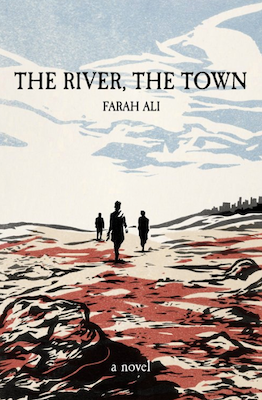
Farah Ali’s debut novel The River, The Town is a haunting portrait of lives relegated to the margins by capitalism and its resulting byproduct: the inequitable distribution of resources. The world of the novel centers two places, the Town and the City, and the narrative focus, in typical Farah-Ali-fashion, is on people. Farah tells me her recurring fascination as a writer is to explore relationships and indeed, in her novel we find relationships thriving, morphing, breaking in the ebb and flow of poverty-stricken conditions.
The story opens with Baadal, a teenager living in the Town where thirst, hunger and diseases drive people’s relentless pursuit of miracles they think would, one fine day, restore the river that once sustained them. Baadal’s days are half spent in school, where teachers from the City preach about the virtues of hunger and thirst, and half spent loitering with his friends, avoiding home where he would have to face his mother Raheela’s constant abuse and his father’s incessant silence. When Baadal finishes school, he has no reason to withstand the abuse, to stay in the Town where people have begun setting up makeshift tents by the river, giving up their regular lives to atone for the sins they think have held back the rain and goodness from the Town and spurred the deaths of many children. Baadal’s drive to find his fortune in the City is heightened when he falls for Meena, his divorced older neighbor. He wants to marry her, provide for her. Reluctant at first, Meena eventually succumbs to the stability Baadal promises, and the two move to the City, only to discover that severing ties from a troubled past doesn’t guarantee a better life, that the rungs of the financial ladder can crack and slip from under their feet at any point.
Farah Ali is the author of People Want to Live. Her work has appeared in VQR, Shenandoah, Copper Nickel, among other places, and has also been anthologized in Best Small Fictions and the Pushcart Prize.
Sharing Karachi as our hometown, Farah and I found our conversation gravitating toward our similar experience witnessing Pakistan’s poverty, media and its vulgar curiosity with the poor and how Farah navigates the idea of Pakistan and Islam being perceived through her work.
Bareerah Ghani: I want to begin with the novel’s throughline of survival and hope. In the Town, despite extreme poverty and destitution, we see people arranging marriages to save lives, believing that babies can bring good luck. I’m wondering how you deconstruct this notion of hope. Can you speak to this in connection with Pakistani culture and the rampant reliance on myths and superstitions?
Farah Ali: As I was revisiting some old notes on the novel, a lot of this is there, this idea of hope, of distorting beliefs in a way to make something easier to live with. These are all coping mechanisms.
The people in the Town are coping with this recurrent problem of a lack of water, and are contending with how to survive as individuals, as a people. Some of them, if they’re able to, they leave. But to leave a difficult economic situation is a luxury that people don’t realize. It’s not easy to get up and leave for greener pastures or more water, in this case. Some people are just stuck there, or have this stubborn belief that maybe if they stick around long enough, the tide will turn, something better will come along. So they resort to such beliefs that let’s just keep on having children and name them a certain way, and maybe that will protect them from the kind of misery that their parents were subjected to. In the same vein of myth and belief, some of the people in the Town end up living by the river because they believe that it’s their fault that they were brought to this state.
In Pakistani culture, it is quite rampant, this stubbornness of holding onto a version of the belief and using that to understand something else. There are a lot of cultural ideas mixed up with the actual parts of Islam. I think the people in the Town behave in a similar way. There’s this one point where they go to the river to cleanse themselves, and start hearing miracles in the water. At no point do I disprove that. I have respect for that belief to the degree that I won’t disprove it, and insinuate that they’re just making it all up. Maybe some of them do end up experiencing something at the water. I leave it to the reader to decide to believe it or not.
Having grown up in Pakistan, and visiting there now, seeing that things really are not better, that daily wage earners are just scraping through their lives, I think that if they want to believe in something, if it helps them somehow, mentally, maybe that’s okay.
BG: I love how the novel explores faith as a coping mechanism too. We watch Meena lean on her faith multiple times, particularly after she loses her first husband as she is navigating loneliness. I would love your thoughts on how you think about faith in fiction, especially since a lot of Pakistani fiction tends to be secular.
FA: I would not want to move away from putting Islam and faith in the book somehow, because my own life deeply centers around that belief and the support it gives. More and more I find that because faith is so key to me, somehow it’s key to at least a few people in my stories. So in this novel, faith is present in every form, whether someone is challenging it or skeptical about it. For instance, Raheela definitely belongs to the Skeptics, or to the people who maybe think that they don’t have time for pondering philosophically about this, you know. But then there are other characters like Meena, who doesn’t question it, she continues keeping faith as part of her, as the thing that sustains her.
As far as Pakistani fiction is concerned, from the Old Guard, so to speak, Islam is not prevalent as a practice so much in the lives of the characters. If it is present at all, it’s at a distance and viewed as skeptically or philosophically, I’ve never really found a narrator in Pakistani fiction that is really out about their religion. You know, maybe it’s not the cool thing to do, or maybe it’s not rigorous enough.
BG: That’s what fascinates me about it. We don’t see Pakistani fiction addressing this very central aspect of Pakistani life. It’s like faith exists outside of the spectrum of lives in a lot of fiction. I’m curious, were you thinking about the perception of Islam as you were writing? Or was it something you don’t even think about?
FA: No. Maybe it sounds like a bullheaded answer. But for me, thinking about the perception of Islam comes in the same category as thinking about the perception of Pakistan. I mean, I don’t want to worry about what people will think about a really practicing person, or like power outages in Pakistan. I don’t want to make the faith look cool or uncool. It is what it is. It’s central to me, and it’s central to definitely some of my characters’ daily lives, whether they’re talking about it outright or not. There’s this belief that something somewhere will figure itself out, or when solutions present themselves it’s not assumed that they came from nowhere. It is thought that they were the result of a greater design. So I wasn’t thinking about Islam’s perception. And if by that, you mean its aggressive political aspects, I wasn’t worried about that. Talking about practicing faith really of any kind in a more visible way is really unfashionable. It’s not considered a clever thing. And so there’s a way to write about it in fiction without making it look like an answer to all problems. Because then there is no story. In our daily lives as well, every day there are scores of problems. But having faith does not mean you say, Oh well, it is what it is. I am gonna say my five times prayers, and that’s it. There’s still anxiety, depression, and faith is not a Band-Aid. It explains that this world is not supposed to be perfect. So the people in my book are not going toward Utopia, thinking Oh, our river is gonna flow big and wide again, and we’ll never run out of food or water, our marriage will be perfect. They do understand that the world is imperfect while struggling with their difficulties. I think that it’s maybe a dialectical approach like, you can understand this is a shitty place to be in while saying, Well, okay, it’s not supposed to be perfect, but it maybe can be a little less difficult. For people who maybe don’t entwine faith in their lives so much, maybe it’s an impossible reconciliation of the two things.
BG: Earlier in the novel, we see that a history teacher comes from the City and makes a comment to the students about how, despite losing children to hunger, thirst, or diseases, people in the Town continued having more children. This reminded me of the campaigns the urbanites have often held in many impoverished areas in Pakistan for raising awareness on family planning, not realizing that for the poor, more children mean more earning hands. How do you contend with such judgment and tone-deafness exercised by the upper class and how do you think we can steer the conversation toward the core issue, the inequitable distribution of resources?
FA: In the world of the novel there are two geographic locations, the City, the Town. But in a mega metropolis like Karachi, where, you know, next to a really posh area we can find a so-called slum district and yet, there are these comments that oh, they have no money, but my maasi has so many children. And there is this tone of judgment, this idea that they lack intelligence, planning and foresight. Like, Sure they don’t have money, but they could improve their circumstances themselves. It’s in their hands, I mean, just have fewer children. There is that superciliousness back home when talking about the poor. So in the novel, I wanted these visitors to come to this Town and do some good. And they do that really visibly with posters, handing out food, doing their good deed of the day. And what I was trying to show was that it’s not a solution. A visit or two, a campaign—these are distraction tactics. These are not focused on, Let’s see what the root of the problem is, let’s make their access to the rest of the city better, make it easier for them to come there for work, find out why the river is drying, and how integral it is to the lives of these people here. It’s this whole idea of looking at the people in the Town as not really my problem. But, hey, they exist so I’m gonna throw some old clothes their way. There’s Junaid who comes from the City to try to fix something, but he doesn’t really do anything. I wanted to have this as a simple reflection of what we see back in Pakistan as well.
To leave a difficult economic situation is a luxury that people don’t realize.
When I was growing up in the ’80s and ’90s, there was this hari chabi (Green Key) scheme that would run on TV every day, about having fewer kids to reduce the population. When we say “have fewer kids” who are we addressing? We’re not thinking about the really well off people with really large families. Why is this in our heads that that is okay? Why is it that when they take up land, it’s not encroaching but when others are forced to live on the outskirts of land because it’s more affordable, it is called encroaching? There are so many terms that creep into our vocabulary where we distance ourselves from the people with less economic power. We don’t really see why they have less economic power. I think that’s a conversation a lot of households back in Pakistan need to have because a lot of them have house help, including really young children coming from places like the Town. And the employers think that well, we’re giving these children jobs, bonuses, paying for someone’s wedding or medical expenses, which is fine but it doesn’t see the issue. Like, why is this kid in your home working in the first place?
BG: I know we’ve been talking about Pakistani culture and Pakistan’s poverty because we share Karachi as common ground. And when I came to the novel, Karachi is the only place I could think of. But the interesting thing is, you never tell us where this City and Town are. I’m wondering why you made that choice and what it means to you. Were you thinking about Pakistan when you wrote it?
FA: I was 100% thinking about Pakistan, about Karachi. When I was growing up there, water shortage was such a part of your daily vocab. You grew up hearing—oh, okay, papa’s gonna get a tanker of water to the house because we ran out, or didn’t you hear? So and so’s neighbor stole someone’s water. Or you grew up with other shortages like power, you know, load shedding at scheduled times, which seeps into unscheduled times. I remember sleeping on the roof many nights with my family. That’s how I grew up and I don’t think it’s improved at all. If anything, the water shortage has gotten worse. So when I was writing this novel, I was thinking about the water tanker mafia, about those who can afford to pay and those who stand with jerry-cans at water stations, about privilege and how we define it growing up in Pakistan. Other countries like the U.S., which loves talking about privilege, don’t understand the nuances of it. Like, basic things that someone might take for granted in the western world are still a privilege to an upwardly mobile family in Pakistan.
As far as keeping the names off the page is concerned, I don’t like naming places. Maybe I have a fear that I will tie myself down to that place that I’m naming, even though in my head it is. But if I call it Karachi, then the world of the novel will shrink. Maybe part of it is fighting against a preconceived notion of the place.
BG: A particularly striking moment in the novel is when a TV crew arrives to interview the Town people but instead of trying to shed light on the Town’s issues, they ask Raheela these ridiculous questions about how she cleans herself and if she genetically passed on her resilience to her son. How do you perceive the role of the media in being the voice of the underprivileged and awakening the conscience of the wealthy, especially in current times where social media offers almost instant access to information but also exposure to political propaganda?
There are so many terms that creep into our vocabulary where we distance ourselves from the people with less economic power.
FA: In the world of the novel, the media is coming from a place of vulgar curiosity, more for a delicious headline. I think mainstream avenues to a great degree are fighting for viewer attention. A lot of the time, it’s about what sells a story. And in Pakistan, the stories don’t really change in their timber. The stories stay horrific. I think we’ve become inured to what it does to our conscience because that’s all we’ve seen growing up on TV and that’s all we hear. And now what is our source of news, really? It’s Whatsapp groups or Youtube vlogs, I don’t know how many people tune into regular standard GEO and ARY anymore. People still do, to a great degree, and they’re so influential, those channels. But to an equal degree people go on to social media to get their news. There is a great opportunity that now, the reporting of news is not in the hands of a few mighty voices any more. You can’t hide the truth so much, but therein also lies the danger of an influential voice, of someone putting the news out there in a soundbite fashion.
BG: I was really fascinated by how the novel does a really good job at highlighting this vulgar curiosity in different ways, like the moment where a teacher from the City asks students to “analyze a poem about forbearance, read an essay on the virtue of abstaining from too much water and food.”
FA: I think there’s this feeling of wanting to explore a difficult life voyeuristically. There was this bulletproof bus in Karachi that would cost a lot, that would take you through the so-called gangster parts of the city, but safely. The idea of it is so fascinating—that you can pay a bunch of money, so you can safely visit those places that people are actually living in. This curiosity, I think, stems from a feeling of being really secure in what you have. And maybe thinking that you deserve the luxuries that you have, even when there’s nothing you did to earn that place. Maybe the thrill lies in knowing that this is not their permanent situation, that they can stop the ride whenever they want.
BG: I didn’t know about the bulletproof bus, but I do know of other instances where people have shown this weird fascination, like, what is it like being you?
FA: Like the “you” is a different species, a resilient, poverty-ridden species. I think, maybe to some degree people from Pakistan are looked upon that way as well. We are maybe a curiosity to so much of the world. Years ago when I was living in the States, my kid’s pediatrician would tell me, oh, you’re going back home, be safe! I had given her no indication that I’m going into a war-torn zone, but she assumed that I needed special bravery. Or the way we’re asked about Pakistan. Just a few years ago I was in a taxi ride on the way to the airport in Portland, Oregon, and the taxi driver found out where I’m from, and I have no idea about his breadth of knowledge, but he started lecturing me about women’s rights and oppression. This exists in our own land Pakistan as well. And the media does a really good job of playing upon that curiosity.
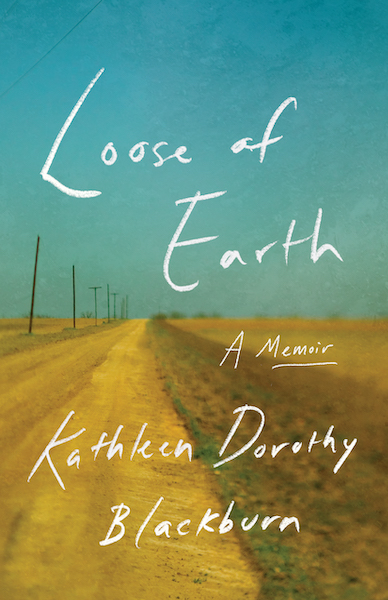
Electric Literature is pleased to reveal the cover for the memoir Loose of Earth by Kathleen DorothyBlackburn, which will be published by University of Texas Press on April 16, 2024. Preorder the book here.
Kathleen Dorothy Blackburn was the oldest of five children, a twelve-year-old from Lubbock, Texas, whose evangelical family eschewed public education for homeschooling, and science for literal interpretations of the bible. Then her father, a former air force pilot, was diagnosed with cancer at the age of thirty-eight, and, “it was like throwing gasoline on the Holy Spirit.” Stirred by her mother, the family committed to an extreme diet and sought deliverance from equally extreme sources: a traveling tent preacher, a Malaysian holy man, a local faith-healer who led services called “Miracles on 34th Street.”
What they didn’t know at the time was that their lives were entangled with a larger, less visible environmental catastrophe. Fire-fighting foams containing carcinogenic compounds had contaminated the drinking water of every military site where her father worked. Commonly referred to as “forever chemicals,” the presence of PFAs in West Texas besieged a landscape already burdened with vanishing water, taking up residence in wells and in the bloodstreams of people who lived there. An arresting portrait of the pernicious creep of decline, and a powerful cry for environmental justice, Loose of Earth captures the desperate futility and unbending religious faith that devastated a family, leaving them waiting for a miracle that would never come.
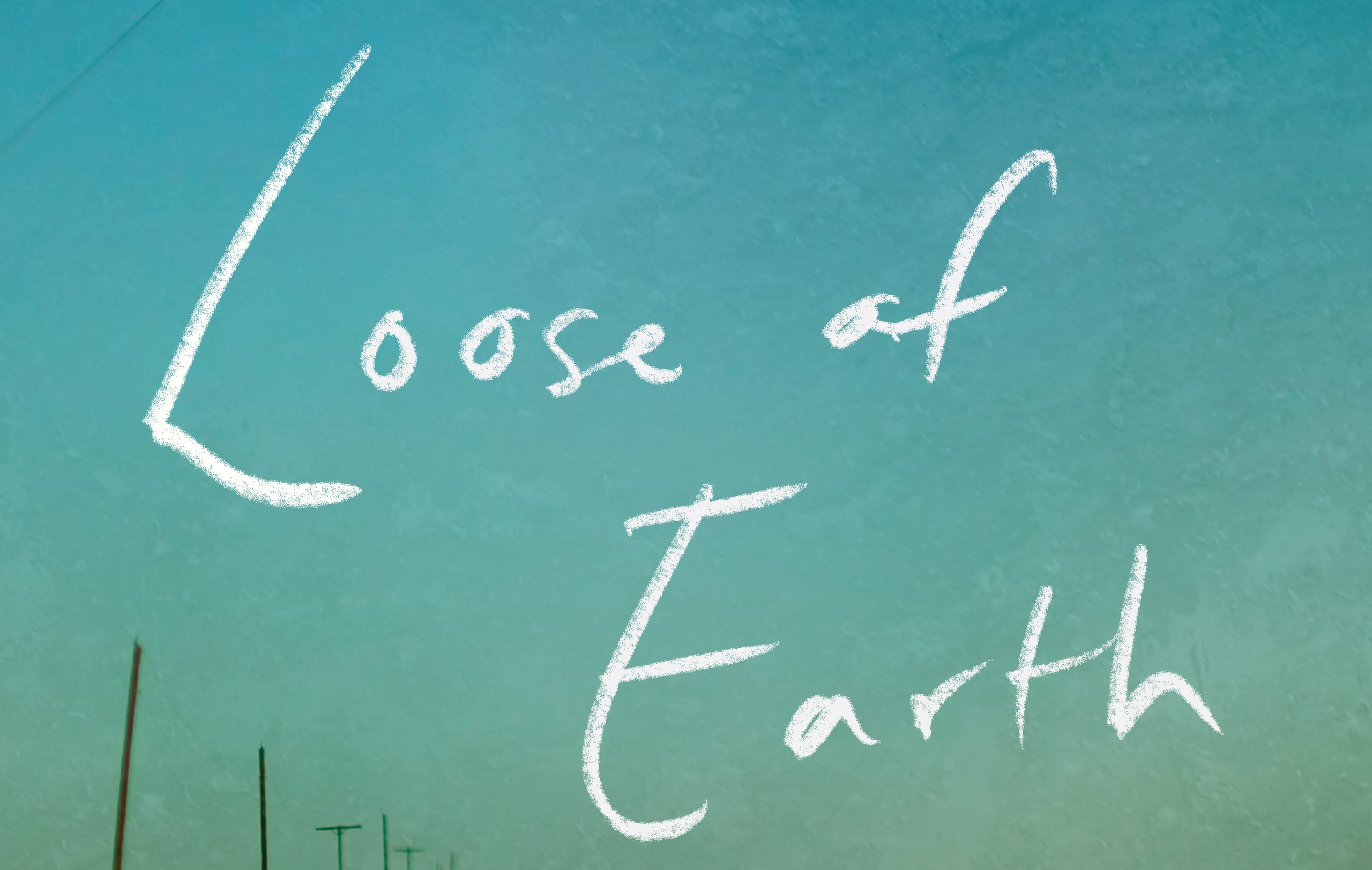
Here is the cover, designed by Sarah Schulte, art by Jack Spencer.
Sarah Schulte: “Loose of Earth conjures strong images and conflicting themes—desolation, vastness, but beauty, too. Kathleen’s landscapes are equally gorgeous and gritty, and there’s an interesting tension at the core of the story between love, loss, faith, grief, and revisitation that matches the complexities of the place in which that story unfolds.
Capturing this powerful sense of place became a goal for the cover early on, and the challenge was to figure out the best way to evoke this landscape. Initially, I explored a range of illustration directions, but something was missing. While the results hinted at the innocence and wonder within the memoir, they did not fully convey the more painful emotions of loss and grief felt throughout the book. We turned to the portfolio of fine art photographer Jack Spencer, who has travelled Texas and photographed much of its majesty. We came across the image of the road that is now on the cover, and it was perfect. The photo had it all: the emptiness, the grit, the beauty, and a unique kind of depth that simultaneously seems to suspend time, while also bridging the past to the present.”
Kathleen Dorothy Blackburn: “Most artists tend to focus on the vast West Texas sky, but Jack Spencer’s photograph gives equal attention to the land, and I love how Sarah Schulte engaged with the surrealism. When I saw her design for the first time, it felt like an encounter with a memory or an image from a dream. This road, are we returning to it or about to begin? The plains in West Texas are among the flattest in the U.S., but where is the steady ground? The place is destabilized, vibrating, unsettled. Words emerge in the longhand quality of Sarah’s script, taking their cues from the lines of the telephone poles and the horizon. The cover hit me between the ribs. It echoed back the story in new registers.”
If we label a work as bilingual for using at least two languages, then how do we quantify a work as having more than one language? For example, would one call Megan Thee Stallion’s song “Hit My Phone” bilingual with these lyrics: “Party like a vato, shots of the blanco / Guaranteed to knock a – out his zapatos?” In a traditional sense, probably not. In a creative sense, I think so, and in more ways than one. By extension, is Beyoncé considered a bilingual artist for singing at least six songs entirely in Spanish (“Irreemplazable,” “Oye,” “Bello Enbustero,” “Amor Gitano,” “Si Yo Fuera Un Chico,” and “Mi Gente”)? Why not?
A possible answer is that there must be a concerted, consistent effort to navigate languages across one’s practice or work to be considered bilingual, right? But then, what is the threshold for one language to be different than another? It’s political. T.S. Eliot’s The Waste Land requires navigating all sorts of languages, dialects, and references to be fully understood. The poem, published on its own in book form in 1922, is taught in college English courses throughout the U.S. as regularly as MLA Format without the label of being a work of bilingual literature. Yet, you won’t find many poems by poets of color taught this way, on their own terms, but with a label demarcating an otherness, without pointing out the use of languages separate than what is “normally” spoken. In fact, when The Waste Land was taught to me in a 3000-level ENGL course, the inability to understand every language, dialect, and reference was not a bug but a feature. And yet, if I received decent compensation every time someone in a workshop told me they couldn’t understand my work because of the Spanish and Spanglish as a criticism, then I wouldn’t need student loan forgiveness. My point? I threw away the rules to that game long ago, and I’m ready for a new playing field.
I don’t try to quantify languages anymore insomuch as try to enjoy how language can help the poet and the reader access that which one couldn’t otherwise in one language. To do that, I seek out and write work that prioritizes playfulness, daring, and a healthy disrespect for English. That last part is crucial. The fact that I write this in English is the result of separate yet linked colonial projects that displaced my mother and father from their countries to the very one I write in now. I wish I could say Spanish is some sort of refuge for me, but it isn’t. It just happens to be the result of colonization in that part of the Americas. Thus, to toss away rigid notions of language is my duty. I play across languages, such as English, Spanish, and Spanglish, in El Rey of Gold Teeth to make language a liberating force rather than a limitation, if such a thing is fully possible. Here are some poetry collections, out of many, many more, that helped me see the possibility of languages and forms as vessels for radical hopes and consciousness.
Ever since I read “In Colorado My Father Scoured and Stacked Dishes,” I’ve taught it every chance I’ve gotten. I start off by asking students how many languages they can identify used in the poem. The common answers will be, of course, English and Spanish. I then ask the class to explain to me what a Jonagold looks like, or a Braeburn. To explain to me what a frijolero is. You’d be surprised how many different groups of people know what greaser means rather than what a Cameo apple looks like.
I then ask why that is, why the language of hate is more imaginable in the mind’s eye than a fruit. Who would know what each of those words mean? I explain we navigate all sorts of languages every day of our lives, that language is relative and there are things we know and don’t know yet we accept. We learn cuate is Mexican Spanish borrowed from Nahuatl. I ask them again how many languages are in the poem. I ask them how many languages they truly know, then. In knowing the limits and bounds of our language begins possibility.
In a lecture by poet laureate emeritus of the Navajo Nation Laura Tohe, she explained that the Diné word tó could be translated to water in English. Tó drips down seven times on the first page of Bitsui’s Flood Song. What follows is the line: “I bite my eyes shut between these songs.” Bitusi writes tó to serve as the oncoming flood of water that bursts open the walls of the English language, facilitating maverick uses of English that would be admonished elsewhere, like when an immigrant repeats a common phrase “incorrectly.”
Can eyes be bitten shut? No? Do you not understand what the line is saying anyways? We then see that communication and language, though linked, are not inherently congruent. The point is now we have a new way to play with a colonizer language. “This windowless house marrows my veins with thinking.” Did you know you could do that? That you can break the rules of a language and still be understood? It’s ok. Imagine the possibilities. “Coyote howls canyons into windows painted on the floor with crushed turquoise.”
Different languages parse out information in different orders. In Spanish, adjectives often come after the noun. A red apple would be la manzana rojo, becoming the apple red when translated directly back, transforming meaning. In Arabic, sentences are read right to left as opposed to the English left to right. There’s a poem in Almontaser’s debut collection, titled “Heritage Emissary,” where she does just that, writes lines of English right to left like in Arabic: “part I hush tongue my floats lake settled a so / need I steam senseless of shrouds spout and lips my[.]” This comes in the middle of the poem, wherein lines are read left to right. Why not read every line in both directions? It is through the disruption of language we explore every possibility.
The Wild Fox of Yemen has many moments like this that make me question the possibilities of book publishing in containing multiple languages. The collection features Almontaser’s translations of Yemeni poet Abdullah Al-Baradouni, untranslated and translated Arabic and English, and photographs. This nuance to provide as many contexts of a poet’s language, written and visual, allows one to parse out vulnerabilities, strengths, and just because. That is power.
To me, bilingualism isn’t limited to literally using more than one language. Sometimes, it is having to navigate how one language fits into another, how one language’s limitations can facilitate or stunt one’s flourishment. Joshua Nguyen’s debut collection Come Clean features a series of poems in the American lục bát form, a variation of the Vietnamese form meaning “six eight,” referring to the alternating lines of six and eight words. In a traditional lục bát, Nguyen explains that the “sixth word of the six-word line rhymes with the sixth word of the next line, which consists of eight words…”
Nguyen, however, notes that the Vietnamese language uses “mostly monosyllabic words with different diacritics…” and his American lục bát form utilizes polysyllabic English words “incorporating internal rhymes” while being adhered to “as tightly or as loosely as one would like.” The poems in the American lục bát form detail the cooking process of Vietnamese food as taught by a prior generation, creating a new self from what’s been given. It is this negotiation of languages and forms across nations and traditions that, to me, define the spirit of bilingualism which, here, allows access to a voice both through and beyond English.
Poetry and bilingualism can also show how languages flourish despite another. A childhood memory of mine is sitting down with my mom to look at immigration forms. I had to go line by line, box by box, and conjured the best translations of bureaucratic English. All I know was that that paper, and the words printed on them, had power over us. It was from an early age I learned that language can force others to be defined in certain ways. This is not an issue unique to Latinx communities. Ayokunle Falomo, of Nigerian descent, showed me how other communities can navigate the same issue in their languages.
I first encountered Falomo’s series of poems regarding the immigration registration process, namely “ALIEN REGISTRATION, or the DS-230 is an animal with 2 parts,” in his chapbook African, American. The poem takes an immigration form and interprets it with poetry, an act of resistance and healing that demonstrates how bilingualism can be a politically liberating force in poetry. His collectionAfricanamerican’t, which includes much of the chapbook, expands upon this notion of navigating languages, including legal and poetic forms, as a journey towards self-actualization on one’s own terms.
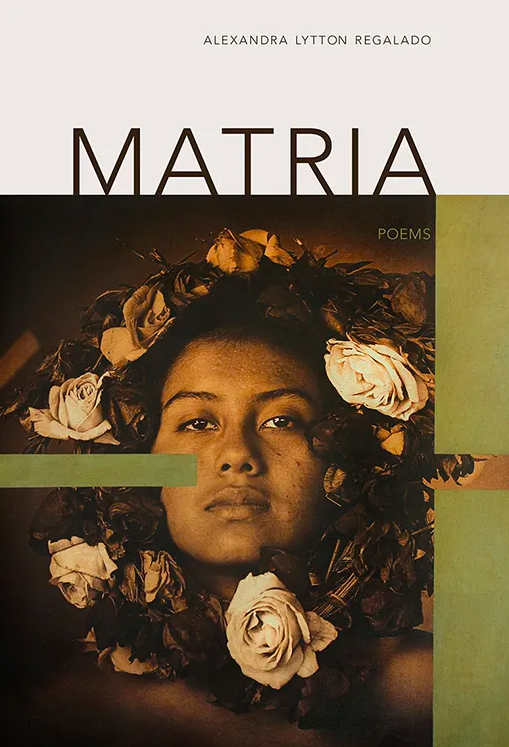
Matria by Alexandra Lytton Regalado
Another aspect of bilingualism is having access to entire concepts and cultural knowledge beyond one language that can interplay with one another. Lotería, for example, is often erroneously described as “Mexican Bingo,” as is Día de los Muertos as “Mexican Halloween.” These gross simplifications, which take reckless liberties with translation at best, erase the complexities of Latinx communities, especially when it comes to our shared and divergent experiences. Lotería is a shared one.
Matria by Alexandra Lytton Regalado, of Salvadoran descent, features a series of poems that explore lotería in a way that is transformative yet familiar. Common tropes of lotería include verbiage before calling out the card, often including mythology or stories or riddles. Regalado, however, redefines the game as a poetic exercise in self-definition and nation building. Each poem’s title takes the form of a traditional lotería card’s label in Spanish but selects entirely new subjects. Though each poem has a succinct line that sets up the premise, they also take various forms, ranging from prose poems to free verse to combinations. It is this playfulness with concepts in different languages that allow a poet to explore the familiar in new and daring ways.
Bilingualism calls attention to what aspects of languages are accessible and inaccessible. This can range from one being unable to roll r’s to understanding, or not, contexts specific to regions and time periods. Though variations of English can be called dialects or vernaculars, my work is mostly in English but still often gets labeled “bilingual.” Why? Perhaps because of its inaccessibility to those who cannot understand certain levels of Spanish and Spanglish?
If inaccessibility, for whatever reason, is a defining facet of bilingual work, then Homie by Danez Smith plays with this. To start off, Homie is not even the book’s true title. Its true title is inaccessible to me and non-Black people in general. Smith’s navigation of their cultural language reveals a nature of consciousness that white poets have attempted to capture unsuccessfully, such as William Blake and John Berryman. That is, language is tied to life and community that carries rules and customs that incorporate violence, power, and joy. People. If you aren’t part of that community, then you simply cannot play in it. Smith’s Homie also features poems such as “my bitch!” that explore different meanings in different contexts. If that’s not bilingualism, then what is?
Gender can be enforced by language, particularly in English and Spanish. He, she, his, hers. El, ella, los, las. Next thing you know, a chair has a gender for some reason or wishing to incorporate more genders becomes a political issue. Sometimes, the rigidity of European-centric language must be cast aside to facilitate a grander vision or traditions of language must be salvaged or empowered. I contend that Spanglish disrupts two colonizer languages to facilitate the growth of community and, by extension, the self. I believe for Marlanda Dekine, Gullah-Geechee does the same.
There’s a point in Dekine’s debut collection Thresh & Hold where they begin using Gullah-Geechee pronouns, namely e/em, in their poetry. The poem “Grain Memory” has lines such as: “What do you know about? E asks. / E bends e old body down […]” It is through the incorporation of linguistic traditions from one’s familial history that the self can be explored fully. It is through this bilingualism that the self can be most honest, where the poet can honor the past and present to build a future.
Guzmán will invent words such as “Queerodactyl” and run with them as far as they can go, placing words into sequences that they maybe shouldn’t go but who cares? “Crude oil gushes out her lumbar piñata, / Tektites buck to a spiked / prerecorded message from bill collectors.” For immigrant communities, language is a tool and tools can be used for anything in a pinch. You wouldn’t use a knife to open a door or a screwdriver to soften a steak, but you must use what’s available to get where you need to go.
Otherwise, how would you get lines like: “Twerking in church, / I outperformed the candles / diarized in the simpleminded annexation. Wussup, / Blastoise / with the veiniest homebound / pika-pika aim?” Across from the playful is the serious. In “Self-Portrait According to George W. Bush,” subsections have English and Spanish titles that mirror the other, such as [ACEITES/WATERBOARDING] or [COLORES/DRONES] wherein an Asian restaurant menu will have Spanish translations and prices. What else is language other than for us to fuck around with?
The National Book Awards took place on November 15th at Cipriani Wall Street in New York City. A day before the biggest night in books, two sponsors—Book of the Month and Zibby Books—announced they were not attending because of “political speeches,” following rumors that the nominees were planning to call for a ceasefire in Gaza. Zibby Owens, founder of Zibby Media and daughter of Blackstone billionaire Stephen A. Schwarzman, rescinded her donation, citing “a pro-Palestinian, anti-Israeli agenda” in her newsletter (which was full of oxymoronic gems like “I don’t support censorship” while using her money to do just that). As of today, more than 11,200 Gazan have died as a result of bombardment by Israeli forces, while millions more have been displaced without access to electricity, medical aid, and food.
A day before, two sponsors announced they were not attending because of ‘political speeches.’
Last year, the topics dominating the National Books Awards were censorship, free speech, and book bans (all political issues). But book bans have not gone away, instead the number of challenged books have surged in recent months. This year, Palestine and Israel were the elephants in the room—only alluded to obliquely by most until the final moments of the evening—while the focus remained on censorship and free speech.
LeVar Burton—who stepped in as the host of the ceremony after Drew Barrymore was disinvited for crossing the WGA picket line—started the evening by asking if there were any Moms for Liberty in the house, a right-wing group at the forefront of trying to ban books containing themes of sexuality and race from libraries and schools. The Reading Rainbow host warned the audience that books are being attacked because they’re so powerful, saying: “The idea of freedom feels especially fraught in this global political moment… We are fighting for control of truth and how we interpret truth in this country. Books are being banned, words are being silenced, writers are under attack.”
The patron saint of books: Oprah
The special guest of the night was Oprah Winfrey, who was being honored for tremendous advocacy of authors and reading. In an emotional and rousing speech, she told the audience about the first time she read a book with a Black protagonist at age 15—Maya Angelou’s I Know Why the Caged Bird Sings: “That book gave a voice to my silences, my secrets. It gave words to my pain and my confusion of being raped at 9 years old. Until then, I didn’t know that there was a language, that were words for what had happened to me, or that any other human being on earth had experienced it. That’s the power of books… To ban books is to cut us off from one another, in a soulless echo chamber. Let us let everyone choose for themselves what they want to read. That is called freedom.”
On a night when the special guest was the OG of the celebrity book clubs, it’s only fitting that Emma Roberts (Belletrist) and Kaia Gerber (Kaia Gerber’s Book Club) were also in attendance.
Poets Jericho Brown and Rita Dove
Next, two lifetime achievements awards were presented: the Medal for Distinguished Contribution to American Letters to poet Rita Dove, and the Literarian Award for Outstanding Service to the American Literary Community to bookseller Paul Yamazaki.
For Jericho Brown, reading Rita Dove gave him the sense of possibility of becoming a poet: “Possibility is what gives us the nerve to write, to make something out of our scribbles. All us here have been told that writing is not a sustainable living, yet we are here proving the naysayers wrong.”
In her speech, Dove, a Pulitzer-Prize winner, said: “What a poet manages to ink onto a page (or put into a computer’s memory, as it were) is just a silhouette, a shadow of that essential enigma that we call life.”
In an introduction by fellow bookseller Mitchell Kaplan, Yamazaki was heralded as “a catalyst of change.”Kaplan reminisced that,“His championing of new and diverse voices and small independent presses, set an example for booksellers everywhere. He showed that these books would find readers when they were made available.” Yamazaki came to City Lights Booksellers & Publishers in San Francisco over 50 years ago after being released from a 6-month prison sentence for activism and protesting. We’ve said it before and we’ll say it again: booksellers are the unsung heroes of the literary world.
Book bans have not gone away, instead the number of challenged books have surged in recent months.
Then it was time for the awards portion of the evening. The National Book Awards ceremony includes five categories: fiction, nonfiction, young people’s literature, and translated literature. Winners, picked by a jury of writers, translators, and poets, are awarded $100,000. Finalists included a children’s book about the Ukrainian famine, a memoir about the relationship between a Palestinian father and son, a short story collection centering Black Muslims lives in America, a novel about the clash between Sami rainherders and Nordic settlers, a Native American history of the United States, tactile poetry by a DeafBlind poet, and a Dutch Suriname queer classic.
The first announcement of the night was for young people’s literature. The winner: A First Time for Everything by Dan Santat, a tender graphic novel about a 13-year-old on a school trip in Europe.
Author Stênio Gardel and translator Bruna Dantas Lobato, winners of the award for translated literature
The winners for translated literature were Brazilians Stênio Gardel and Bruna Dantas Lobato for the novel The Words That Remain. Through tears, Gardel, the author, expressed how growing up as a gay boy in the hinterlands of Brazil, it was impossible for him to dream of such an honor. “Being here as a gay man, receiving an award for a novel about a gay man on a journey to self acceptance, I wanted to say to everyone whoever felt wrong about themselves that your heart and your desire are true, you are just as deserving as anyone else of having a fulfilling life and accomplishing impossible dreams.” Lobat, the translator, thanked the publisher, New Vessel Press, “for putting my name on the cover of the book, where it belongs. #NameTheTranslator. We are not mysterious fairies working in the dark. It is so rare to see the Brazil I know in translation. Here’s to reading the world with curiosity and empathy.”
Indigenous Chamoru poet Craig Santos Perez was the poetry winner for “from unincorporated territory [åmot].” His home Guam, a U.S. territory, “is one of the last remaining colonies in the world. We were never taught my own people’s literature. My mission is to inspire the next generation of Pacific Islander authors.”
Ned Blackhawk, a Native historian, won the nonfiction category for The Rediscovery of America: Native Peoples and the Unmaking of U.S. History: “The subject of American Indian history, while often simultaneously unfamiliar and discomforting, is also a shared experience that touches us all,” he said. “Native America is also a form of our national inheritance. We cannot nor should not continue its systematic erasure.”
The last and most anticipated category of the night was the fiction prize. Justin Torres won for his novel Blackouts,and in a gracious move, he kept his speech short to cede the stage to his fellow finalists for a joint statement. Their speech waspresented by Aaliyah Bilal, author of Temple Folk, and cosigned by 20 out of 25 of the nominees:
“On behalf of the finalists, we oppose the ongoing bombardment of Gaza and call for an humanitarian ceasefire to address the urgent humanitarian needs of Palestinian civilians, particularly children. We oppose antisemitism and anti-Palestinian sentiment and Islamophobia equally, accepting the human dignity of all parties, knowing that further bloodshed does nothing to secure lasting peace in the region.”
It was a moving and courageous show of solidarity that reminded us that literature is and always has been political. Books don’t exist in a vacuum; they are a reaction to the world—the way it is now and the way we would like to one day be. Books have the power to ignite change, inspire activism, and shine a light on injustice. These twenty writers showed conviction and selflessness when they took the stage to stand up for what’s right—for peace, not war, for humanitarian aid, not bombs, for saving lives, not causing death—despite the opposition, the financial repercussions, and pushback from the rich and the powerful. Those of us in the room who gave them a standing ovation did so because we don’t celebrate books only for being well-written, we celebrate authors for their capacity to change the world through their writing.
Here is the 2023 National Book Award shortlist, with the winners in bold:
Fiction
Chain-Gang All-Stars by Nana Kwame Adjei-Brenyah
Temple Folk by Aaliyah Bilal
This Other Eden by Paul Harding
The End of Drum-Time by Hanna Pylväinen
Blackouts byJustin Torres
Nonfiction
The Rediscovery of America: Native Peoples and the Unmaking of U.S. HistorybyNed Blackhawk
Liliana’s Invincible Summer: A Sister’s Search for Justice by Cristina Rivera Garza
Ordinary Notes by Christina Sharpe
We Could Have Been Friends, My Father and I: A Palestinian Memoir by Raja Shehadeh
Fire Weather: A True Story from a Hotter World by John Vaillant
Poetry
How to Communicate by John Lee Clark
from unincorporated territory [åmot] by Craig Santos Perez
suddenly we by Evie Shockley
Tripas by Brandon Som
From From by Monica Youn
Translated literature
Cursed Bunny by Bora Chung, translated from the Korean by Anton Hur
Beyond the Door of No Return by David Diop, translated from the French by Sam Taylor
The Words That Remain by Stênio Gardel, translated from Portuguese by Bruna Dantas Lobato
Abyss by Pilar Quintana, translated from the Spanish by Lisa Dillman
On a Woman’s Madness by Astrid Roemer, translated from the Dutch by Lucy Scott
Young people’s literature
Gather by Kenneth M. Cadow
Huda F Cares? by Huda Fahmy
Big by Vashti Harrison
The Lost Year: A Survival Story of the Ukrainian Famine by Katherine Marsh
A First Time for Everything by Dan Santat
Photographs of the National Book Awards by Beowulf Sheehan, courtesy of the National Book Foundation.
Electric Literature is pleased to reveal the cover for Annell López’s debut short story collection, I’ll Give You a Reason, which will be published by Feminist Press on April 9th, 2024. López is the winner of the Louise Meriweather First Book Prize.
The Ironbound is a large, multi-ethnic immigrant neighborhood in Newark, New Jersey, filled with characters rich in pride, history, and culture—if not money. The vibrant stories in I’ll Give You A Reason, the debut short story collection by Annell López, are a love letter to this place, and its people. Concerned with questions of race, identity, connection, displacement and belonging, the characters who move through this collection are thoughtful, compelling, and unforgettable. Look for the grieving widow who finds herself bear hunting with a near stranger on her first date after her husband’s death, or the unhappy wife who reconsiders her mother’s rituals and love spells in comparison to her own lackluster romance. Then there’s the college student who discovers a porn star with the same name, and obsesses over the young woman for her freedom, and her comfort in her own skin.
Annell López’s characters dive deep into the biggest stuff of life: religion, body image, sexuality, Blackness, gentrification, and they do so during times of great political unrest.
Here is the cover, designed by Brooke Houghton, with art by Layqa Nuna Yawar.
López is especially proud of how the cover speaks to the many realities of living in Newark. “I wanted the cover of I’ll Give You A Reason to represent Newark and to speak to the themes of immigration, belonging, and hope found in the collection. I’ve been a fan of Layqa Nuna Yawar’s work for a long time. When I came across a New York Times piece highlighting Layqa’s murals at the newly revitalized Newark Airport, I knew I wanted him to create the artwork for my book. As an immigrant who once arrived in the United States through the Newark Airport, I felt personally connected to his work. Seeing the Black and brown faces on those murals made me feel seen.”
López adds that she and Yawar actually met up in person—at a coffee shop in the Ironbound—to discuss his artwork, and her cover. “He asked me about the book, my growing up in Newark, and my immigration journey. He let me speak for long stretches of time while he—alternating between notes and sketches—jotted down ideas on his iPad. I talked at length about the book, the liminal spaces we inhabit as immigrants, the grief I feel, the baggage I still carry, and how Newark is so dear to my heart.”
Yawar is most proud of the authenticity this cover represents. “This cover comes from conversations and moments of overlapped lived immigrant experiences, specifically from people in and around Newark. To all the diaspora here, this art collaboration is for you.”
I’ve seen Salar Abdoh only a handful of times. The most noteworthy is in May 2017 when, hearing that I’d be spending vote day in the southernmost areas of Tehran interviewing working class Tehranis about their choice for president, he offered to give me a ride through some of those neighborhoods. Abdoh, whom I had previously corresponded with over Tehran Noir but only met earlier that week, had a motorbike and even more conveniently, knew the area like the back of his hand.
If I’m sharing this anecdote, it’s because reading A Nearby Country Called Love, which is sprawling with characters, intrigues, and story twists, isn’t unlike the experience of zigzagging through the mega-capital and being privy to the woes and wants of a range of dejected but yearning Tehranis. In his latest novel Abdoh takes us through the intimate lives of an assortment of Iranians—washing machine salesman, artist, mechanic, poetess, realtor, surgeon, constructor worker, housekeeper, farmer, and former combatant—as they seek justice, try to affirm themselves and navigate boundaries of sexuality and love in an unforgiving society.
Connecting this cast of characters is Issa, a man returning to Tehran “penniless and broken” after years of working the night shift in a hotel in New York because, as he reflects, “sometimes there simply was no story of triumphing elsewhere in the world. Home was where one belonged even if home was shit.” Moving back into his former building, haunted by memories of his patriarchal father and queer brother, Issa is forced to reckon with his own complicated family history.
Outside, men consumed by their “prickly little manhood” pick fights, protestors erupt in chants, and women burn their headscarves—and sometimes themselves. But it’s in the intimacy of the homes we enter, especially Issa’s apartment and the house of the strong-headed Azeri maid who had helped raise him and his brother, that the characters seek help, become confidants, and find solace.
I spoke with Abdoh in August via Zoom. We discussed patriarchy, gender-affirming surgery, translating women and the pitfalls of Iran being primarily represented by the diaspora. Our conversation was edited for clarity and length.
Ladane Nasseri: Your main protagonist, Issa, is not easy to place. His grandfather was a Shia cleric, and he has some religious tendencies, but he’s not a believer. He’s from a conservative background, but he’s quite tolerant. He doesn’t shy away from getting into street fights, but he’s sentimental in his search for love. How did the character of Issa take shape?
Salar Abdoh: I wrote two essays that originally came out in journals in Tehran. One was about my late brother, who’s a famed international theatre artist who died of AIDS, and the other one was about my relationship to sports—I grew up in a professional sports family, that’s how my dad made his money. I always knew that at some point, I wanted to come to terms with my brother, and my dad, two men who occupied the exact opposite poles of so-called manhood in a country with extreme machismo. I had a brother who didn’t want anything to do with sports and a father whose entire life was based on that, and I was always in the middle. I came from a patriarchal world even more than the typical Iranian because my father’s background is from the Lorestan province. Lors are especially famous for being dast-be-ajor, quick to take a brick and hit each other!
Growing up it was expected of us to rise to that occasion and if we didn’t, we were not respected by our fathers and uncles. My older brother who did not subscribe to it at all was left alone, but for me who came after him it was infinitely difficult to negotiate that world and my love for books and poetry. So, the Issa character and his uncertainties, a lot of it came from my own life.
After years of coming and going, and living in Tehran for periods of time, there were also dynamics in Iran that concerned me. I wanted to deal with all of that. I just didn’t know when the right time would be. After these two essays came out, I thought this is a cross, this is a place where these things come together. I want to find out what it means to be a man in our age.
LN: So, you set off on an exploration of masculinity?
SA: There was an element of dissatisfaction for me because the discourse around women’s issues, LGBTQ issues is a Western discourse. 80% of the world is an entirely different place, it’s not this world of New York. It’s a very brutal and brutalized place for a lot of women or people who don’t necessarily subscribe to the so-called normal society as far as their sexuality goes.
I read memoirs about people coming out, people discovering their sexuality, but I never saw anyone write about what it means to be someone like me. For half a decade before this I spent the bulk of my time with Shia militias in Syria, in Iraq. I’d go for weeks not seeing a single female person. And how do people like that come to terms with this new paradigm in the world that, in fact, doesn’t exist in places like Iran? There is a consciousness about it, somewhat of a discourse among the intellectual class, but it’s a patriarchal society.
I didn’t want to create a character who is a hero and says I’m going to pick up the flag of this oppressed, and that oppressed. Issa is at war with himself and a lot of times, he is hesitant to do things. In his search for love, and his constant failure to find love, he starts to make certain decisions that affect himself, his mind and everybody around him.
LN:I saw similarities between the character of Issa in this book and that of the protagonist in your previous novel, Out of Mesopotamia. I sensed a quest in both these books. In Out of Mesopotamia, I remember this idea of “taking a bullet” for someone, and the question of what makes us want to extend ourselves and die for a person or a cause. In A Nearby Country Called Love, the search is inwardly, the characters are more conflicted. One of the questions that came to my mind as I read was how do we love someone, or care for someone?
SA: In Out of Mesopotamia it was a quest for the character of Saleh more than for me. I knew who Saleh was, why he was in these combats, and why that sense of brotherhood you found in combat is nearly impossible, as Sebastien Junger said, to find in a quotidian life. My objective, if there was one, was to show war from a different perspective. Whereas in A Nearby Country Called Love, as you said,the quest was also my own quest. I was trading in a territory I truly had not had the courage to approach. Women, LGBTQ… I didn’t feel myself up to the task. But the sort of craft I practice, a lot of it comes from my penchant for journalism. I’m not a journalist but I do journalistic things.
LN: Tell me about this. How did you set yourself up for the task?
SA: Like you, I try to have my boots on the ground. I may not understand everything, but I need to be a witness. For example, I needed to go talk to a person in Iran who has gone through gender reassignment. I asked them: “you’ve been a woman and you’re a man, which is more difficult?” and they said, “being a man is more difficult in Iran.” I was flabbergasted and he said “yes, because of the expectations. Even my mother has more expectations from me than before.” That’s one person’s point of view, another person will tell you differently, but to have that POV is interesting to me. I needed to spend time with that person and understand them.
It was a conscious act of wanting to understand what the LGBTQ community goes through in that society and a big part of that was because of my experience with my brother, what he had to do to come out in that society and the way it haunted him to the last day of his life. I asked questions, read material and I also thought about the various feelings I had throughout the years about my brother and his illness, and how it was or was not dealt with within my family, and about my own depression after my brother died.
LN: The scenes between Issa and his older brother, and their relationship with their dad are some of the most compelling. Issa’s reflections seem to mirror some of your own. Did writing this book help you make sense of the complicated dynamics between your older brother, your father and you?
SA: As I was writing this novel, I really came to understand something I already knew and it sounds boring to say, but human beings are really, really complicated. Even when we know why they do the things they do, it’s hard to understand the electricity, where that dynamic comes from.
Iran changes all the time—its dynamics change, its young folks change, people change their mind, the government is always in flux.
Ultimately, I wrote this novel because I’m always searching for love in its various manifestations, and I think everybody else is too. Love shows itself in brotherhood, male-female partnership, male-male partnerships…etc. and to be able to show that I had to understand it first and understand the complexity that human beings occupy in every molecule of their being.
I hope whoever reads this book sees it not just as this thing about Iran—it’s a universal theme. When I read African American memoirs because of my dad’s background, I understand that hard world where every day that you wake up you have to prove yourself and your manhood otherwise you will be belittled and bullied. My brother transcended that world early on, but I never did, and I don’t think I have to this day, but by writing this novel I understood it finally.
LN: The setting of this novel is the less affluent southern Tehran, and your characters are mostly working class. Tell me about this choice.
SA: The area that Issa lives in is around the corner from me, I can jump on my motorcycle and be there in five minutes. It’s a sports shops area and that’s where my father grew up. It’s a traditional neighborhood but it’s no longer the neighborhood where if you look at somebody wrong, they beat you up—you’d need to go another mile down for that!
These areas of old Tehran are areas that I’m not just fascinated by and see as the beating heart of this city of 14 million people. The neighbors shout and leave their shoes outside the doors. I was interested in showing these lives with traditional backgrounds in these traditional neighborhoods. Issa has somewhat followed his brother’s path, he has gone to New York, he’s gotten higher degrees in literature, he’s read all the books but deep down inside he’s still the son of his father. He ticks against that, but he doesn’t always win. That element of depicting segments of societies where you really struggle with your past, with your faith and your background and everything that you’ve known, everything that makes the fiber of your being, that I’d have to situate in the heart of the city that I know well.
LN: I found so much of the Tehran I know in these pages. The Tehran of my grandparents, old Tehran with its own rhythms and rules, and the city as this complex organism that I re-discovered when I lived there as a journalist. It’s a Tehran that is not accessible to visitors or even to Tehranis who live in the northern neighborhoods and who are not interested in immersing themselves in less affluent areas of the capital.
Iranian people are always explained through the diasporic discourse. I wanted to show people as they are in the streets of Tehran.
SA: It really takes a long time to know a place, it’s like a language, you can try but you’re not going to know a language intimately if you just do a crash course of two weeks or two months. You know, I have the six months rule about Iran and that’s if you’ve been out of the country for six months you probably should not say much about it because that place changes all the bloody time, its dynamics change, its young folks change, people change their mind, the government is always in flux. Nearly everything that gets reported about it is not necessarily wrong but just simplistic, and I don’t ever want to fall in that trap.
LN: I agree. What’s depicted in traditional media and by social media influencers based outside of Iran is often oversimplified, ill-informed, or out of context.
SA: One of the reasons I wanted to write a novel about a variety of people but also people on the margins of that society who are kind of invisible was because of this dissatisfaction. Iranian people are always explained through the diasporic discourse. It felt reductive, and agenda driven, and I wanted to show people as they are, as it plays itself in the streets of Tehran—real people with real jobs and not through this continuous diasporic discourse. If you want to understand France you are not going to ask someone in D.C. or LA or NY what French women think or talk about for example when they go to a hair salon, but it seems that when it comes to Iran anything goes. I wanted to show that society in all its ambiguities and complexities.
LN: In the Tehran you write about, people tease one another, have sex, go to see plays, and hurl insults when driving. Ordinary people like everywhere. What is it about Tehran that was most important for you to show?
SA: Tehran as an entity has so many layers as say Mumbai does, or Mexico City does. The issue with Tehran is because of the limitations of access to it people either make a monster of the place, its government, or its people, or they make heroes or heroines of its people. Often when things get written about Iran it comes out as simplistic because the person goes to Turkey, or they write from London or DC or New York. Or they go to Iran for a couple days and have a minder with them. You can’t really blame them because access is limited. So, the discourse by default is narrow.
What happens in these periods of upheaval, of protests, is that the loudest voices which are not necessarily the most sophisticated or elegant or honest are the ones that take over and then the reality on the ground in Iran is forgotten. In writing about Iran and Iranians I don’t set out thinking I’m going to fight against that, but my hope is that I’m giving depth and layers to the discourse that exists and people remember that these people are not heroes, and they are not evil. They can be all these things, and they cover the whole spectrum of society.
I am sick
of not winning the National Poetry Series.
I am sick of waiting
for the mammogram, the ultrasound,
the appointment to discuss the results.
Tomorrow is the first day of school
in the year of our Lord 10x the number
of Covid cases as last fall
and no online options.
In the part of my mind I like to call
The Spite Museum,
I put each of my manuscripts in a different fairly ugly
dress and make a meme: 40 times a bridesmaid,
never a bride. But I always hated that saying.
Mostly because Never a Bride sounded thrilling,
I was killing it there in the Spite Museum
as I made one manuscript unwilling
to wear a dress, and one breast
missing. It went hiking.
When I had a child I named her life
and when I had another he almost died
but then lived so I named him for the echo
that falls down where once a river carved
stone so the walls carry sound. A good place
for a wail.
I am sick
possibly from the lump
but it may also be that this is the time my husband
of 22 years decided to tell me a string of lies.
I have been kind—his word—
and paying very close attention
like a wife or something
for a year and a half.
I understand irony. I hate ironing.
Once I, too, had other feelings.
I have tried to tone it down.
To come clean.
Yesterday I walked for two hours without stopping
and then I sat down in the water and cried.
A heron could care less.
An osprey stabbed a fish.
Ekphrasonnet Adding Gray Hair to the Cauldron
My whole childhood I was a skeleton wax castle. My plan:
to marry Jake      the Alligator Man.

I floated my ghost self      down the boardwalks, growling at every tourist
in our angry coast town,

my father his pizza delivery box beer belly Camels cue stick —
my mother her darned socks Oh dear a rosary clicking

her midwestern teeth &   when I was a calf
I lived   in this thistle-filled pasture so no wonder my adult self is split in half.

When I was a girl      I lived in this stream
When I was a fish      I glid   my metal-sided dream
& borrowed my name from the middle of another country, hail or

cloud, they taught us not to mix metaphors, use sailor
mouth, or to miss meat,

& they will differ——if they do——      as enough to drink from enough to eat
Ekphrasonnet With Contrapuntal Stumble
DON’T MISS OUT
Sign up for our newsletter to get submission announcements and stay on top of our best work.
YOUR INBOX IS LIT
Enjoy strange, diverting work from The Commuter on Mondays, absorbing fiction from Recommended Reading on Wednesdays, and a roundup of our best work of the week on Fridays. Personalize your subscription preferences here.