In 2019 Sarah Viren’s wife, Marta, was subject to a Title IX investigation for sexual misconduct. The allegations, which appeared via Reddit posts and emails, were that Marta had offered students wine during office hours, requested sexual favors, and threw wild parties. Viren knew the allegations were untrue—she’d never thrown a wild party with her wife, and the names of the accusers failed to line up with actual registered students at their university— and yet she couldn’t stop herself from occasionally doubting her reality.
At the time, Viren was on the academic job market, and she would later discover that it was an acquaintance, Jay, a finalist for a job that Viren had been offered, who had spread the lies to derail Viren’s career.
These events, it turns out, unfolded in Viren’s life as she was working on a book about conspiracy and truth through the lens of her high school philosophy teacher. Dr. Whiles was a man who was both inspiring and harmful, who taught students to think critically and develop their own set of values, but who also pushed religion and holocaust denialism.
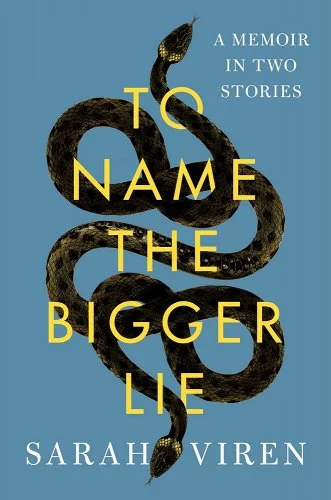
Sarah Viren’s book To Name the Bigger Lie weaves the stories of Jay and Dr. Whiles together, using them to discuss themes of trust, doubt, and deception and to ask the question: how do we know what is real?
I spoke to Viren on Zoom to ask her about punishment, reckoning, and hoping for redemption.
Jennifer Berney: I came to your work through your viral essay in the New York Times Magazine and, like a lot of people, I found it fascinating because of the complicated ways it intersects with #MeToo. I’m curious about what you dealt with in terms of going public with your story, knowing that it might be used to undermine #MeToo or Title IX, to push the idea that false allegations are common.
Sarah Viren: One way of understanding what Jay did was that he weaponized Title IX and he used stereotypes about gay people to prop up the lies that he was telling. There are people who want to dismantle Title IX entirely as it relates to sexual assault and misconduct. And so I tried to make clear within the story that I think Title IX has value. But then, once the story came out, I knew I couldn’t control how it was used beyond just not giving interviews. Somebody wrote to Marta for Fox News, asking her for an interview. In the end, Marta ended up giving one interview to a Spanish newspaper, but we really talked to the interviewer beforehand. And then, after that we just had to let it go. I had to weigh: what are the costs and benefits of telling the story? It felt like the potential harm was that it would be weaponized—which it was—but I felt like the benefits were that it could create a more nuanced discussion of some of these issues.
JB: Does your decision to tell the story align with a philosophy of telling the truth simply because it’s the truth?
I had to weigh: what are the costs and benefits of telling the story.
SV: It feels simplistic to say let the truth out and everything will be okay. But when this article came out, I heard from so many people with stories, and a lot of them were women and people of color—people who are already struggling to have their truths recognized in the larger public sphere. They told of cases in which they had been similarly manipulated, and they didn’t have the clear proof that we did. And I thought that is the value of telling these stories, if it helps others make sense of their experiences or feel less alone.
JB: You write about how you initially wanted Jay’s identity to be revealed for accountability. But then other people found him and outed him, and it’s no longer what you want. But the book continues to long for him to take responsibility and redeem himself on some level. Can you speak to that longing?
SV: Yes, I’ve been thinking about that for a long time, probably even before that happened. One book that was really influential was Lacey Johnson’s The Reckonings. She visited Texas Tech, where I was doing my Ph.D. and people asked her in the audience “What do you want to happen to this man that did this awful thing to you?” and she thinks through that in The Reckonings. I’ve been interested in how we reckon with harm out outside of a simplistic view of punishment. I don’t think that punishment always allows people to reckon with what happened.
What I kept wanting from Jay was a confession. And so I was thinking a lot about confessions. Culturally we’ve gotten used to this idea that a confession brings us closer to the truth, and to a reckoning with. I thought if Jay would just say, “Hey, I did this. I’m sorry.” I really felt like I could forgive him.
JB: Do you think what we might really want through the confession is to feel like the person who harmed us has the potential to change?
SV: Yeah, it’s funny. I have this friend who I talked to a lot during that time period, and she would always say, “I want him to be punished and I want him to hurt.” I think a lot of people feel like if somebody harms you and is punished, it’s balancing something that was imbalanced. But no, I don’t feel that way. If I could know that Jay felt bad and was actually working to not do something like that in the future, that’s what would feel better.
I shouldn’t read comments online, but one person commented on the article something like: “Yeah, it’s fine for you not to name him. But how are you going to feel when he does this to somebody else?” And that does feel bad. That will feel awful. But I don’t know where he is now. I don’t know what name he’s using. I don’t have any ability to stop him.
JB: It seems like we have a cultural narrative about having a responsibility to others once we’ve been harmed by someone.
I’ve been interested in how we reckon with harm out outside of a simplistic view of punishment.
SV: I think that’s a complication of the way we imagine these roles. I was always uncomfortable with the idea of victimhood, because there’s a sort of passiveness to that. But the other extreme can also be this idea that you’re an accomplice if you don’t do enough. Marta was really helpful in thinking through it. Marta would say a lot of times,“If anybody’s responsible it’s these universities that allow this to happen.” Jay was eventually removed from his job in academia, but allowed to quit, so there’s been no public accounting for his actions, and that has to do with institutions not wanting to be sued. And so, there need to be ways that we hold people accountable in situations like this, but it doesn’t make sense to require whoever is victimized to do that. That doesn’t mean that you don’t feel bad. After he was identified on Twitter and elsewhere, a couple of people came forward, men who said they’d been harassed by him. And one of them said, “I feel really bad that I didn’t say anything because maybe this wouldn’t have happened to Sarah.” I think that’s another example of somebody being victimized, and then feeling like it’s their fault because they didn’t stop that person from continuing to victimize other people.
JB: How does this story about Jay connect to the story about Dr. Whiles, your high school philosophy teacher?
I had already started writing this story about my teacher in high school who taught us conspiracy theories but who none of us had really ever confronted. And in that process I kept thinking about how if only we had talked to each other earlier, or if only an adult had intervened and said like this shouldn’t be happening, we might have been able to at least understand it. My friend, who I call Gayle in the book, a Jewish immigrant from Latvia, got close to Dr. Whiles and ended up really confused, and, I think, a little depressed by him pushing her towards holocaust denialism. I often think: Wow, If she and I had just been able to talk, it might have helped her push back against some of the gaslighting that was going on in his classroom. And so I’d been thinking about that.
I felt like these two stories really spoke to each other, but I could not articulate how. When I sold the book on proposal, I couldn’t structurally tell how it was going to work. But rather than braid these two stories together, I wanted to show the interruption of the Jay story, and the way that often those interruptions in life will help us understand something. I think that so often something unexpected happens that we feel like is unrelated to whatever it is that we’re dealing with, and it ends up being the thing that brings clarity.
And so what happened with the Jay story was that there were moments in which I was doubtful of myself in a way that was very similar to how I felt doubtful of myself when I was younger, and there were moments where I felt like: why is nobody freaking out? And so that’s what I tried to write into. But then figuring out how to structure it was hard beyond the fact of starting a story, and then having the Jay story interrupt it. I did want to do something structurally different, and I thought about Plato’s Allegory of the Cave, where the cave has four parts and so that four-part structure felt essential to the story itself in the end. For the last part of the book, I started doing these imagined dialogues.
JB: In that last section you include real present-day email exchanges with Dr. Whiles, and I found myself feeling really nervous for you as a narrator in the book, navigating those email exchanges.
You know, I had the book mostly written, and I really thought, Oh, I’ll reach out to Dr. Whiles. I really didn’t want him to agree to the conversation because I didn’t want to deal emotionally.
JB: I was so surprised at that section because I wasn’t expecting him to become a real, present-day person.
SV: Yeah, I wasn’t either. I was thinking, I’ll just imagine him, and it will be okay. And he did initially say no and I could have left it at that. There was a journalist part of me that was like, no, you just don’t do that. You have to keep pushing. And I did. I think the people we write about, even when they harm us, they still deserve the respect of being fully-formed. Because nobody is a monster, right? And so I was really thankful that he responded, and I could see his pride and his vulnerabilities, and I was able to read some of his moves for what they seem like now—blustering, you know. I don’t think that I realized when I was a kid that he was sort of enamored with his own greatness. I just thought he was great, and so I think, seeing that weakness helped me to see him as more human. And when he finally cut off the interaction, I felt the same rejection and feeling of being shut down that I used to feel in high school.
JB: By the end of that section it feels a little unresolvable to me, the way Dr. Whiles was both a pivotal figure in your development and someone who did you great harm. Does that seem right?
SV: Yeah, I think that’s right. And I think it’s made that much more real by the fact that we get to see him in his own present day terms. It’s so much easier to think that those that harm us are just bad people, or to write them that way, but also in your life to create a narrative in which they exist that way, because it’s just easier to deal with them.
There are awful people in the world, but in these two cases—well, Jay is a complicated person I feel sorry about. I’m not sure that he himself helped me. But Dr. Whiles did. And so the idea is to acknowledge the complexity of it, and sit with it and exist with it, and then also to sit with the fact that he didn’t change. You talked before about me wanting to feel like Jay had changed. I think with Dr. Whiles, I was hoping for something similar.
When he became real, I was able to reckon with who he was, what happened, and the complexity of him in my life. But it also didn’t feel like he acknowledged or could acknowledge having harmed anybody else, or that he had necessarily grown.
I will say there was one person, a friend I had in high school. He was very religious. He wrote in my yearbook, something about how I was going to hell because I was bisexual. He’s now a pastor, and I interviewed him in the book. When I told him what I remembered he recognized that it was real, and he felt bad that he hadn’t recognized it at the time. He said, “You know, I’m sorry. I think I just didn’t have stakes in the kind of harm that Dr. Whiles was causing.” But the fact that he could acknowledge that—I mean it’s not the same as having the perpetrators grow, but it did feel like okay, there are people that are growing. We’re developing and changing. They’re just not necessarily the people we want.
Nearly forty years before the Stonewall uprising—often incorrectly pegged as the moment in history when queer people first began experiencing pride in our identities—Ruth Fuller Field, writing under the pseudonym Mary Casal, published her autobiography, The Stone Wall, where she details a life largely defined by her ferocious pursuit of women.
Even then, Field wasn’t ashamed, nor was she interested in hiding her desire. It felt like the most natural thing in the world to her and when she met Juno, a woman with “the most beautiful hands” in 1892 on her first day in New York City, she began a “rapturous period of wooing”. A bouquet of violets, a trip to the theatre, a kiss—Juno became the great love of her life. It’s striking to read that not only was Juno introduced to Field’s family, but that, considering the time period, it went so well. “Juno and Mother loved each other from the very first. To her death, my mother was always happy in our love and friendship for each other,” Field writes in The Stone Wall. (Any speculation on the connection between the name of Field’s autobiography and the name of The Stonewall Inn has been so far disproven.)
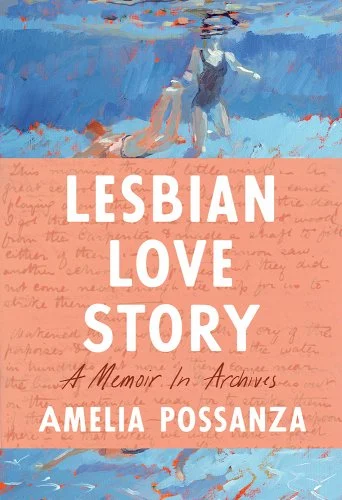
Their 200-year-old lesbian love story is one of the many documented in historian Amelia Possanza’s new book, Lesbian Love Story.
It’s a sexy, illuminating tour through sapphic history. I spoke with Possanza, who is also the Associate Director of Publicity at Flatiron Books, about the history of lesbian resistance she uncovered, how queerness has been criminalized throughout history, and the lesbian stereotypes that have persisted: “We had a lot of pre-1950s U-Haul situations.”
Jeffrey Masters: There’s a moment you write about where you say you decided to become a “collector of lesbians”. Can you talk about that moment and what you meant by that?
Amelia Possanza: I feel like that is sort of at the heart of what I was setting out to do. I grew up without a lot of lesbian role models in pop culture and history. My mom is a librarian and my dad is a classics professor, so I was surrounded by books. The fact that there wouldn’t be a lesbian in a single one was wild to me.
The moment you’re talking about was when a friend on a queer swim team I had joined—you know, a place to go find lesbians or at least be seen as one—did not recognize me as such. And part of me had to forgive him because I’m like, If I’m not seeing them out in the world, where would he see them?
In the spirit of my librarian mom and the literal card catalog in my house growing, I want to make the little card catalog of lesbians for myself and invite other people to come add to it. I’m not going to find them all. So, I took the lack of representation that I saw growing up along with my love of reading and collecting things and put them together.
JM: For the earlier stories you write about where they didn’t use or self-identify as lesbians, how did you grapple with that?
I was interested in who took the risk to live an authentic life, and to be queer.
AP: I think what really intrigued me was to sort of take people on their own terms and use the words that they used. For some of them, like Mary Casal, who didn’t call herself a lesbian, I discovered that she had been asked to write this autobiography by sex researchers and they called her a lesbian. Some people think that the word may have been removed from her autobiography because we don’t have the original edition. It was edited by these two men who asked her to write it. While she didn’t use the word lesbian, she was very much in that milieu. It was attached to her.
I wanted to be really careful. I didn’t want to write a book about people who were suspected to be lesbians. I was interested in who took the risk to live an authentic life, and to be queer. Mary, she doesn’t use the word, but what I love about her and why she ended up in the book, is because her whole book is about her passionate love for another woman and feeling like she was out of place. She was like, “I don’t want to marry a man. What’s wrong with me?”
JM: I found Mary Casal so compelling because she was living in the late 1800s, early 1900s, and she wasn’t hiding or suppressing her desire for women. We’re often told that this embrace of one’s queerness only began after Stonewall.
AP: Yeah. For a long time people in my community were like, Oh, we’re living at the best time to be queer. And I think now, we’re all really starting to question that. This is maybe where the queer people I’m writing about are separate from the stories of queer men. They were sort of given the grace and were able to have really close, intimate friendships with men. They could live together. And around this time, when Mary was alive, women could get an education and have their own jobs and make their own money. They didn’t need to get married to have a husband’s income. And it was this little pocket of time before queerness really became pathologized, when they could live almost openly. Mary even told her mom what was up and her mom was just like, whatever. Go for it.
JM: Criminalization is a recurring theme. The law was being wielded against queer people in almost all of the stories, which feels, unfortunately, prescient today.
AP:Hugh Ryan was such a huge inspiration for me in his book. His second book, The Women’s House of Detention, is so much about how in the early days, prison was a place to put a woman who wasn’t a woman “in the right way”.
JM: He writes that a woman could be locked up for wearing pants, smoking, or simply staying out late.
AP: Also, the definition of prostitute used to be like, “Oh, you’re alone on a corner”. That could be considered solicitation or prostitution. And it’s sort of like, if they truly are a prostitute, there’s got to be customers right? But they’re not going after the men.
I should also give a little asterisk that so much of this depends on who you are. If you’re a Black woman, how you’re presenting in the world…many of these rules were built for middle-class white women.
JM: Going into a project like this, you had certain expectations. What surprised you the most in the research?
I want the sex scenes. I want the romance.
AP: I was struck by how much resistance these lesbians put up. I think I was like, “Oh, I’m going to find romance.” People had their sweethearts and there was definitely a lot of that, but every single one of these people found a way to carve out a space for resistance and refuge. One of the lesbians, Rusty Brown, was being sent to Bellevue for shock treatment and had the intelligence to ask someone what shock treatment was, then steal someone’s uniform, and run out of there in the nurse’s uniform. The resilience and rebellion that was eye-opening and it was not what I went in expecting since I was like, “What’s romantic love about?” I think the definition of lesbian, as it’s grown and shrunk over the years, is about so much more than that.
JM: So much of the queer and lesbian experience has changed in recent years, but what hasn’t changed? What are those overarching commonalities that still exist?
AP: One unexpected, surprising thing, which is maybe telling since I unconsciously picked people who are a little bit like me in their presentation, but everyone was either made fun of or self-identified as sort of hairy or not beautiful. I loved the repetition of that. They were hairy or unsightly or just bad at performing gender. Rusty Brown was literally arrested in a dress for being a female impersonator and went to jail and she was like, No, no, I’m actually a woman. I’m just really bad at walking in heels. And no one believed her.
Andthe other commonality that surprised me, which is such a huge lesbian trope, is a lot of these people found a partner and they were like, Great. Move in with me. We had a lot of pre-1950s U-Haul situations.
JM: Can you talk about the format? It’s not a traditional history in that you fill in gaps and create scenes for the characters based on your research. Was that something you found in the writing process or was that always the plan?
AP: It was something that I found in the writing process. I want the sex scenes. I want the romance. And if you’re reading something that was edited by two men who self-identified as sexologists and wanted to publish something that they didn’t want to be branded as an obscenity, it’s not there. Who knows if Mary Casal wrote some really explicit moments that were taken out? But I want to have those. And I also think a lot of times in academia, there’s a questioning of like, Oh, no, they’re just friends.
I wanted it to be the kind of juicy emotional history that, unfortunately, I don’t think we’re going to get. And part of me too felt a little bit of that anger that we don’t have this because there are all these rigorous rules about history. I wanted to give myself permission to defy them because these rigorous rules haven’t been helping marginalized groups.
What I also found in the writing process was that they are all actually overlapping, right? Mabel Hampton’s chapter is the second one and it’s a lot about the 20s and the Harlem Renaissance. But she lived through World War II, so there’s this opportunity for her to come up again. I think that also created some moments for imagination. It was interesting to think about where their circles or timelines overlapped. They’re not seven separate, totally isolated stories. One is flowing into the next.
JM: There is also the inclusion of Amy Hoffman (Hospital Time) and Mike Riegle. It’s an intimate, yet platonic relationship in a book about love stories. Why was that important for you to include?
AP: I feel very tender about the two of them. I started out being like, Hmm, what’s my love life going to be like? How am I going to solve the mystery of my love life by asking other people about theirs? I think eventually it became about the ways that all of these forbearers of mine are living outside the usual script. Friendship then became a really clear way that that happened. Going back to the law, so many state-sanctioned resources are tied to marriage and weren’t an option.
I’m very intimidated by Michel Foucault. Toward the end of his life, he gave this beautiful interview with a French magazine called, “Friendship as a Way of Life.” This young man was interviewing him and was like, “What does it mean for you to be gay?” And he says this beautiful thing about how the point of being gay is not like, Oh, I need to analyze my own sexuality and come to the truth of it. It’s about asking, what are the relationships I can have in the world? How could they be different? I’m gay and I just loved that. I was so moved by that.
After four years of writing and rewriting a story close to my vulnerable heart—about traveling home to attend my estranged mother’s wedding—the essay finally appeared in the Huffington Post. My best friend Ellen read it seconds after it went live. She texted me her favorite lines, sending my words back to me with affirmations. She also sent a screenshot of the line, “I cried on the floor of the airport bathroom.” You called me from the bathroom floor, she texted.
On that floor, I stared at a text from my mother telling me I was no longer welcome at her wedding. I crouched under the fluorescent bathroom lights with my head between my knees and called my best friend. I can’t recall what Ellen said. I remember it was exactly what I needed to hear.
In that essay, I wrote about my husband, who had been by my side for the entire trip (except when he waited with our baggage while I panic-called Ellen in the bathroom). I wrote about my mother, whose love I desired most, even as Ellen reminded me my mom did love me, if in the limited ways her strict religious community allowed her to express it. Ellen supported me throughout the entire experience, but I never mentioned her in the essay, not even in passing. It didn’t even occur to me to include Ellen into the story. After she read the essay and saw herself in the narrative, I realized I wrote her out of my family drama, though she’s as close to me as family. All of my publications are about sex and love, relationships and family. I’ve written about all forms of nontraditional romantic relationships, about chosen family and expansive love in polyamory. Yet, I’ve never written about friendship. Until now.
When I realized that I had written Ellen out of my personal essay, I returned to the memoirs that inspire me. How had others written about their friends? I was searching for a literary legacy of writing friendship. Over and again, I noted that friends are often mentioned only in passing. They appear as ever-present sources of support, yet are seldom developed into plot lines or characters. Rebecca Solnit frequently mentions friends in Recollections of My Nonexistence, her memoir on finding her voice and becoming a writer. Few of them are named, all are written about with love and gratitude for their place in Solnit’s story. In Abandon Me, Melissa Febos writes several times about her friend Amit, but usually in just one or two sentences at a time. Yet Amit appears frequently: supporting Febos, being stood up by Febos, writing with Febos at a dining room table on a Saturday morning. Carmen Maria Machado’s memoir, too, about being in an abusive relationship, includes passing mention of a friend who helped her first realize she was being abused—a critical relationship in the story of her recovery. This friend is a mirror who allows Machado to see herself. But we, as readers, never see the friend herself.
A network of friends can muddle a storyline—but I also see it as a sign of a rich life.
I wondered if earlier drafts of these memoirs had included more, if these friends were once complete characters. In my imagination, I saw an editor cutting a friend out in order to simplify the narrative. I have, at least once, cut a friend to get an essay under the word limit. I’ve been in workshops in which someone found the additional “friend character” confusing. I myself have advised students to write a composite character instead of including a crowd of friends. It’s true: these kinds of revisions can streamline a narrative. A network of friends can muddle a storyline—but I also see it as a sign of a rich life.
The erasure of friends has roots much deeper than the editing and review process. The problem is that friends don’t fit neatly into the Hero’s Journey. In 1986, Ursula K. Le Guin implored writers to see past the familiar ease of the Hero’s Journey, shaped like an arrow, centered on conflict, and, importantly, featuring men’s stories. Hunter stories in which violence and domination drive the plot. Le Guin argued that it left out women’s experiences, the gatherers whose days may not be filled with conflict but are busied with care and small pleasures. And yet, the Hero’s Journey is still the dominant narrative form. An earlier version of my essay about my mother’s wedding received a kind rejection; the editor explained that the essay was important, but that the story was “too quiet.” The earlier version was a subtle story of unspoken love between mother and daughter, driven apart by a religious cult.
I revised the essay into a classic Hero’s Journey: I made myself the protagonist, on a journey back home and back into a cult. It was a quest: I would save my mom, or at least salvage our relationship. My husband was at my side, a supporting character, but the story was mine and my mother’s love was the treasure. There was no room in the Hero’s Journey to acknowledge that I was falling apart the entire time. There was no room to show how Ellen helped piece me back together.
As I drafted this essay, I texted Ellen: Why haven’t we written about each other? Seconds later she replied: What would be the conflict? It’s true. Our friendship lacks the competition that we both found so riveting in Elena Ferrante’s Neapolitan Novels. We disagree at times, but it’s usually petty. I’m sure I’ve disappointed her, given that I have no clue how to support her journey as a mother. In fact, I was afraid that motherhood would draw her further from me and closer to her mom friends. That hasn’t happened, but I know it’ll be a few years before I can hope to resume our regular happy hours. And I know I’ve hurt Ellen when I’ve gotten on my soapbox a time or two, when honestly saying less would have done just fine.
Ellen once told me that she’d started to write a fictional version of our friendship. As I’m writing this essay, she’s revising her novel. Last month, she texted: I just tried to write from your POV and it was the first time this new book felt . . . easy and alive. To which I responded: I hope it inspired you to write something slutty.
In All About Love, bell hooks reflects on the dearth of stories about love outside of traditional families. She identifies the “privatized patriarchal nuclear family” as the single model in which love stories are told. The nuclear family eclipses all other forms of love, and stories of men’s desire overshadow everything further. For bell hooks—and me—the love among friends is the foundation on which we learn the art of loving. In friendships, women find “our first glimpse of redemptive love and caring community. Learning to love in friendships empowers us in ways that enable us to bring this love to other bonds.” Friendships are how we learn that love is a verb—but the stories of it take shape outside of grand narratives. They lack heroes and conquests.
Friendships are how we learn that love is a verb.
Instead, stories of friendship celebrate the quotidian rituals and small graces. Each friendship has its own rituals. For Ellen and I, watching The Great British Bake Off every Tuesday at 7:30, just after she puts her daughter down for the night, has become its own ten-week holiday season. Ellen’s refusal to let me help with dinner is a commandment. We share the same dream of what a Liz Warren presidency would have been. Ellen texts how are you? each day when I’m depressed. We can both text how’s the writing going? without provoking distress.
If I were to tell the story of the love between me and Ellen, where would I begin? I could start on the 24X bus connecting downtown Santa Barbara to the University of California Santa Barbara, where we both teach writing. Ellen held a different hardcover book from the library each week. We sat toward the front of the bus, two thirty-something white ladies in business professional clothes and sensible shoes, reading novels on our commute. At first, we discussed books, then teaching, then our opinions on all of the overrated male authors. Twice a week, the same routine. Slowly, over bus rides to work, then walks around the lagoon on campus, and then happy hours at the cafe closest to the bus depot, I stopped being intimidated by Ellen the brilliant writer and became enamored with the woman who was my friend. It’s boring content for a love story, but it’s the routine on which our friendship blossomed.
And next? When did our relationship build in intensity? One day does stand out above the rest: In 2019, Ellen and I had a standing Thursday night happy hour at the Endless Summer Bar and Grill on Santa Barbara’s harbor. We chose that spot for the half-price bottles of wine, pink sunset views, free stale popcorn, and bartenders in Hawaiian shirts who always gave happy hour discounts even when we arrived too late for happy hour. We vented about the petty inconveniences all teachers complain about: students who email questions that are easily answered by the syllabus and colleagues who only use reply-all. We talked about the sunset and its hues. We likely complained about yet another New Yorker article that was generating discourse. On this specific night, Ellen shared that she’d realized she was addicted to Excedrin, which she described as the most boring kind of addiction. I had recently realized that my mom was going to get married. Over a few glasses of discount wine, we tossed around the questions: What could knock out Ellen’s migraines if all the medicines caused more problems? Did I even want to go to my mom’s wedding?
“If you go, you could write it. I’d read that essay,” Ellen told me. “I’m not saying you should do it for the content, but you could.” Ellen listened to my story about my mom, and she wanted to read my memoir. She was the first person to tell me that she cared about my story. I hope I said similar things about her writing life, hearting each tweet and listening carefully for every thread of an idea that she talked out over drinks or long walks.
I biked home with a buzz and began writing that night. I kept writing. Ellen told me that my story mattered. Then, in the following months, she taught me how to write it. I wrote about my mom. Ellen read drafts. She listened as I sorted out memories I hadn’t dwelled on in decades. With her help, I learned I could actually rewrite myself: not a rejected daughter but a cult survivor. I spent four years writing and rewriting the story of my mother’s wedding. In the meantime, I published other personal essays, but my identity as a writer started with that essay about my mom’s wedding. I wrote it for Ellen and I’m a writer because of Ellen.
—But wait: am I doing it again? Am I writing the Hero’s Journey, just with Ellen playing protagonist? She is, after all, armed with a pen and encouraging words. Every time I publish a new essay, I tell her: “You told me my story mattered and taught me how to write it.”
“I love you,” Ellen says, “but you’re giving me too much credit. You were always a writer.”
She’s right. I already had a PhD and a long publication history of scholarly articles about women and their desires, and how they cared for one another, even if I never wrote about my own life. In making Ellen the hero who empowered me to write, I’m making the same mistake. In order to fit my story into the classic form, I’m erasing something—this time, part of my own history and agency. And, of course, I’ve also erased other friends who told me to keep writing.
At the end of the day, friendship isn’t a transaction. We don’t tally up who helped whom the most. I’m not Ellen’s friend because she told me my story mattered one day at a bar. I’m her friend because we narrate our lives to each other first.
Friendship need not be a grand narrative. When I looked for friends within my favorite memoirs, I was also looking for heroes, for a literary legacy of friendship, for the people whose smaller roles nonetheless created significant pivots in the narrative. Friendship doesn’t need a man on a loudspeaker or a soapbox. Le Guin offers an alternative to the hero’s narrative: the carrier bag. She writes, “The natural, proper, fitting shape of the novel might be that of a sack, a bag. A novel is a medicine bundle, holding things in a particular, powerful relation to one another and to us.” The story of friendship can’t be told in a straight line. It can’t be told in one voice. Conflict isn’t its most important feature. The monotonous but enduring care is what holds it together. Friendships are the stories of how we hold ourselves together.
The story of friendship can’t be told in a straight line. It can’t be told in one voice.
This past summer, Ellen and I reached a relationship milestone: we went on our first vacation together. We were both invited to be writers in residence at a writing workshop on a Greek island. For two weeks, I woke up and had breakfast with Ellen. Rich Greek yogurt, homemade feta, ripe strawberries, local coffee, and fresh bread: the meals themselves were worth writing about. Ellen and I sat at our table shaded by thick blackberry vines while her toddler Louisa licked butter off of bread in her highchair. Ellen drank English Breakfast tea with milk. I drank hot coffee (even though it was 85 degrees in the shade by 8 AM). We agreed that the apricots were the best we’d ever tasted, and that the peaches were better in California. We lingered for over an hour, until we were both over-caffeinated, and then settled in to write.
Each breakfast was a practice of loving. It was boring content. There’s no place for heroics at the breakfast table. Each day was the same as the one before. Each morning was like the last. Some days we got eggs, other days there was sausage. Once or twice, I could dish out some gossip from the night before, after Ellen had gone to bed. We lingered as if eating breakfast was the reason we’d traveled seven thousand miles to a Mediterranean island. Our breakfasts became the quotidian ritual of our friendship.
What makes friendship beautiful—its subtlety and its bonds of love that don’t ask for visible commitments or grand gestures—is what makes friendship difficult to write about. Friendship asks us to tell quieter stories. It requires us to listen to the ebb and flow of everyday love. As we listen to those stories, we also learn to listen for the myriad of ways that love shows up in our lives. Our friends’ love isn’t shouted from the rooftops—but it may be declared with a casserole. It can be expressed with daily texts, and also with infrequent three-hour long-distance phone calls. Our friends teach us how to speak our love in as many different ways as we have different friends. Each story may be quiet, subtle. But together, each friend’s voice echoes through our lives, building a chorus of love that demands to be heard.
A man stormed into the lobby, straight to the front desk. Mohan was used to the disgruntled; they would come in with authority and demand that they speak to someone. Of course, they ignored that in talking to him, they were, in fact, speaking to someone.
“I’m sorry, sir. I’m not sure, and I don’t really have any control over that. I can have someone contact you, though. What did you say your name was?”
The man slammed his palm on the desk, and Mohan offered a robotic nod.
“If you don’t mind waiting, I can go back and check if someone can see you without an appointment.” Mohan stood. It was well after midday, and he had yet to have lunch. A headache began to coil somewhere between his eyes and the back of his skull.
“No. You look at me.”
His voice was grating. As Mohan looked up to the man’s face, he thought of a lawn mower ripping grass.
“I’m not waiting for anything. You better believe that every last one of you will be hearing from my lawyers.” The man turned and, on his way out, swept the contents off a coffee table and toppled the large rubber tree Mohan was tasked with watering.
“Hey!” Mohan shouted. But the door swung shut. Magazines and mints littered the carpet in the man’s wake. Mohan’s headache worsened.
Mohan’s boss told him he could leave early after tidying up the mess.
When he finally stepped outside, he felt like he might vomit. The air felt muggy and tropical, heavy with the smell of rotting fruit. Yet reports said it was a typical, chilly November afternoon.
He drove with the windows down, but humidity seemed to collect in the car. At a traffic light, his heart began to thump along with the rapid beat of the radio. A truck revved in the next lane. Mohan glanced at the driver—a man with large, obstructing sunglasses. Red turned to green, and the truck sped ahead. Mohan stared at the license plate as it shrunk in size. Someone honked from behind, and Mohan raised a palm in apology before stepping on the gas. He swallowed a ball of mucus. Was a fever next? He felt his forehead: damp. His shirt clung to the hairs on his stomach.
At home, Mohan collapsed on the sofa. Nikita, his girlfriend, had also just arrived. They lived together there—the same house he grew up in.
“You finished early?” Nikita joined him on the couch, head to toe.
“I think I’m getting sick,” he said.
“I haven’t been feeling great either. I don’t think we slept enough this past weekend.”
“Should we go pick up some things?” he asked.
They parked outside a supermarket, with a written list in hand: cough syrup, expectorant, vitamin C.
Inside the store, Nikita inspected the backs of over-the-counter products, appraising generic against brand name. Mohan watched her absentmindedly toy with a particularly distinct curl; he studied this with the awe and affection that her habits inspired. But then, the thought devolved. He remembered the shower drain, how it had sluggishly gulped water that morning.
“I’ll be right back,” he said.
He tried to decipher the difference between various drain snakes—metal, liquid, plastic. A figure approached.
“Man, I have to buy one almost every month. Three daughters will do that to you.”
Mohan let out a sympathetic chuckle and turned. It was the man from that morning. He thought back to the office. Before Mohan had been allowed to leave, his boss had disclosed some details, the heinous amount the man had lost in an ill-advised sale. Mohan recalled his name.
“Simon, right? This is, uh, a coincidence.”
“Pardon?”
Mohan recognized his grating tone.
“If this is about earlier, I am sorry,” he said.
They stared at one another, then Simon grabbed a snake and left.
Mohan didn’t buy anything. He waited in the car and saw Simon pushing his cart toward a parked sedan. Minutes later, Nikita opened the passenger-side door.
“There you are. Did you not see any of my texts?”
“I had to get out of there.”
She frowned and placed the bags at her feet. “Well, if you were wondering, I bought liquid and pills.”
Normally, the drive back required little to none of his attention. It was just six minutes, a blink-and-you-miss-it sort of trek that allowed him to escape thoughts or conversation and then find himself home.
“Mohan!” Nikita shouted. He had just run a stop sign. The driver of a minivan thrust a middle finger at them. There they were, stalled in the center of a four-way intersection. Mohan looked closer. It was Simon, now shaking his head in disgust as he drove off.
“What the hell? What is he doing?”
“Him? You almost got us killed!”
The car was warm, and Mohan rolled the window down.
Nikita shook her head. “It’s too cold.” When he didn’t respond, she turned up the air and touched his arm. “Oh Jesus, you’re really sweating. Should I drive?” She wiped her hand on the upholstery and offered him a pill.
Mohan swallowed it dry and ignored the lurch in his esophagus that threatened to turn to a retch.
They rode in silence.
He parked the car in front of their home and removed the keys from the ignition. Across the way, Simon exited the neighbors’ two-story and skipped to the mailbox. Mohan jumped out of the car and started to scream at him.
Simon froze.
Nikita ran around to Mohan and covered his mouth. “I apologize! He’s not feeling well!”
“What’s going on, y’all?” Simon asked.
“I’m not playing, you need to—” Just as Mohan stepped to cross the street, Nikita grabbed him by the arm and led him inside.
“You need to chill the fuck out!”
“He’s stalking us!” Mohan pulled out his phone and struggled to enter his passcode.
Nikita grabbed it from his hands. “Just breathe. I’m going to get the things from the car and then smooth things out.” She reached for the doorknob.
Mohan rushed to block her path. “Don’t go back out there! I think he’s dangerous.”
“Who is dangerous?”
“Simon—that guy.”
“You mean Mr. Phillips?” She nudged him aside. “Just go lie down for a bit.”
Mohan kicked off his shoes and went to a window. He pulled up a single blind and peered through. As Nikita emptied the car, Simon approached. Mohan tensed, but Nikita just smiled and shrugged as they exchanged words. Simon patted her on the shoulder.
Mohan ran to the next room where they kept a neglected landline. A voice answered.
“A man from work is harassing us.” He took the receiver and went back to the window.
“Sir, are you at your workplace right now? Do you know who this man is?” Her voice was calm.
“No. We don’t even work together. He’s outside my house right now, bothering my girlfriend.” He gave their address.
“Okay, sir, we’ll send—”
“They’re talking right now.” He saw Nikita laugh, and then they parted. “He’s walking away,” Mohan said. He leaned as far as he could against the glass until Simon disappeared from view.
“I’m sorry. Could you repeat that?”
Mohan beat the phone twice into his palm; the battery was old and weak. “I can’t see him anymore. But he keeps leaving and coming back. Earlier at the store—”
The woman said something, but static flooded his ears. He heard Nikita enter and head towards the kitchen.
The voice was audible again, scratchier than before. “Someone is on the way.”
The phone slipped from Mohan’s grasp, and he left it on the floor. The house was suddenly too warm and his body amphibian with sweat. He hurried to the kitchen.
Nikita stood with her back toward him, placing oranges in a bowl. A lineup of remedies stood on the island, the fridge door hung open.
“I really think you should take something else. DayQuil, maybe? You’re not doing well. Luckily, Mr. Phililips was nice about it.”
“What did he say?” Phlegm had pooled in his mouth, his voice was hoarse.
“That you need to rest.” Nikita spun and snapped her fingers to some diddy stuck in her head. Simon had mastered this, the precision with which she bounced on the ball of one foot as she kicked the other—a quirk Mohan loved. He stood before Mohan in Nikita’s jeans and red sweater. With a smile, he placed a hand on Mohan’s chest; the familiar touch now sent a jitter across his skin. Simon popped a Ricola into his mouth, put away a bottle of juice, and shut the refrigerator. “I’ll be right back,” he said. And he left the room.
Mohan’s insides heaved. He turned to the appliance’s gray steel and, seeing the reflection that stood in its cold face, opened his mouth to catch his breath. And out escaped a scream, one that echoed through the kitchen until its sound grew strange and unfamiliar with grit.
When I was growing up in western Canada in the late ‘80s and ‘90s, my sister and I were the only people we knew who were biracial—not quite white, not quite Chinese, but somewhere in the empty space between. I felt like I didn’t belong anywhere. Internalizing both the quiet racism and gender norms I was steeped in, I wanted to be white, blue-eyed, and delicately feminine, but when I looked in the mirror at my dark hair and skin, my broadened face and flat nose, I often felt wrong, even monstrous, like my body on the outside was aberrant to my self on the inside.
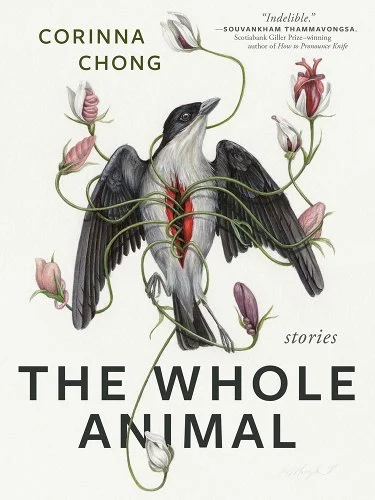
Bodies and body parts that seem disconnected, threatening, and grotesque is a running theme across my debut short story collection, The Whole Animal. In one of the stories, “Porcelain Legs,” the pre-teen protagonist, Queenie, fixates on a long, wiry, black hair sprouting out of her mother’s eyelid. Even though she can’t stop looking at it, Queenie is repulsed by the hair—a blatant emblem of not only Chineseness, but also anti-femininity, both of which Queenie subconsciously rejects.
I’m fascinated by BIPOC writers who explore grotesque depictions of bodies as representations of the elusive experience of finding identity for those whose marginalized race, gender, class, and/or sexuality intersect, to profound and sometimes dangerous degrees. Here are some outstanding works of poetry and fiction I’ve recently discovered that navigate this theme in poignant and illuminating ways.
A 376-year-old woman, who gained immortality after ingesting the supposedly lethal deathlily, reflects on her colorful past while her body, which the Chinese government has declared a “national treasure,” finally begins to (literally) fall apart. A group of women deemed the ugliest girls in China are called upon to serve their country by allowing leeches to extract their most fervent memories of suffering from their tongues, to be fed as an indulgence to the gluttonous elites. A twelve-year-old girl struggles to learn how to swim, not only to live up to her half-mermaid, half-frog mother, but also to justify her right to survive. Wong’s collection of short stories is full of vivid, haunting, “body horror” imagery, but also glimmers with dark humour. At the heart of each story is an incisive commentary on the power that familial and cultural history and mythology hold over the way immigrants perceive themselves in relation to their world.
Despite her best efforts to find happiness, Edith Vane just can’t seem to get comfortable in her own skin. She’s out of shape and chronically insecure, both with her new barista-turned-girlfriend, Bev, and in her job as a professor at the University of Inivea, where she tries desperately to earn the respect of her cutthroat colleagues and indifferent students as “a brown woman with prematurely drooping body and face parts.” Even Crawley Hall, the building on campus that houses the English department, seems to be rejecting her, trapping her in its shifting, labyrinthine halls, sprouting suicidal gargoyles, and threatening to be swallowed up by a giant sinkhole in the earth. As Crawley Hall slowly infects the people inside, turning them into zombie-like harbingers of Edith’s inevitable fate, the lines between reality and fantasy, clarity and madness, begin to blur. This novel is a brilliant satire of the monstrous, all-consuming nature of academia, particularly for women of color.
Fragmented bodies figure prominently in this striking collection of poems, as Belcourt navigates the enduring legacy of colonialism, including the violence, both historical and contemporary, suffered by indigenous people. Woven into this struggle are the poet’s visceral reflections on the queer body as raw, spectral, and often abject as it yearns for a sense of belonging and acceptance in the face of restrictive gender norms and toxic masculinity. While the writing is lucid and lyrical, every poem in this collection is a blow to the heart. In “The Back Alley of the World,” Belcourt writes, “make my mouth into a jar / spit inside me / throw me into the air / leave me there / pretend that this is love.” This collection (unsurprisingly) earned Belcourt the prestigious Griffin Poetry Prize, making him the youngest winner in the history of the award.
Horror, sci-fi, and fantasy collide in this extraordinary collection of short stories that defy expectation at every turn. Bodies in these stories are sites of violence, erotic pleasure, and often both at once. In “The Husband Stitch,” women’s bodies are portrayed as grotesque and monstrous, at odds with their role as objects of hedonism and childbearing for men. “Inventory” begins as a catalogue of sexual encounters relayed in unsettlingly carnal detail, and gradually morphs into a tragic lament for human intimacy amid a deadly pandemic. As a collection, this book is a Frankenstein-like challenge to the strictures of genre and a bold re-visioning of gender, love, and sexuality in the 21st century.
This unyieldingly powerful long poem is structured in fifteen numbered “ossuaries,” which together unearth a network of spaces, both physical and metaphorical, to examine how the skeletal histories of black people on colonial lands continue to haunt us in the present. Yasmine, the central character of the poem’s narrative, represents the black diaspora and women of colour simultaneously, as she struggles to come to terms with the injustices and acts of violence, both personal and political, that undergird her tenuous place in the world. Bodies in these poems are dangerous and menacing, a reflection of the ever-present threat of violence that marks the black community’s everyday experience. As Yasmine reflects in “ossuary III,” “I was caged in bone spur endlessly / eye sockets ambushed me, / I slept with harassment and provocations, / though I wanted to grow lilacs, who wouldn’t?”
In Lai’s debut graphic novel, Ray, a cisgendered Asian woman, and Bron, a transgendered white woman, are a queer couple whose close relationship with Ray’s young niece, Nessie, is an anchor for each character’s sense of identity. When Ray, Bron, and Nessie are together, a magical transformation takes place: they shed their human forms, becoming reptilian-looking monsters with sharp, bared teeth and oozing limbs. While they appear wild and terrifying at first, it quickly becomes clear that this monstrous form is liberating for the characters; only when they’re together in their imaginative world, away from the judgments and expectations of society, can they inhabit their true selves. But when Bron decides to reconnect with the ultra-Christian family she was estranged from when she transitioned, all three characters are forced to figure out how love and happiness can still be found without each other. The atmospheric illustrations that make this novel so memorable elucidate the stifling reality of living within the confines of a body that cannot contain the multitudes of the self.
Samantha, a student in her last year of an MFA in creative writing at a prestigious New England university, has grown accustomed to being an outsider. She’s freakishly tall, socially awkward, and lives in a dingy, one-room apartment on the sketchy fringes of the pristine neighbourhoods around the university campus. She writes dark, angry stories that mystify her professors and are snubbed by “The Bunnies,” a glittery clique of young women in her workshop class. And now she’s fallen into a creative slump that’s causing her to question everything she thinks she knows about herself. The Bunnies, in stark contrast, seem to be thriving; they are supremely confident, ultra-privileged, quintessential mean girls. Obsessed with their looks, they fawn over each other in a cloying, artificial way, and exclude anyone who’s not like them from their tight inner circle. Named for their penchant for calling each other “Bunny,” they seem to move through the narrative as a single, manufactured entity, a monstrous amalgam: “Four heads full of white, orthodontically enhanced teeth. Hair so shiny it will blind you to look at it directly, like an eclipse.” But when the Bunnies suddenly invite Samantha to join their “Smut Salon,” Samantha cannot resist her buried desire to become one of them. What ensues is a twisted descent into “creativity,” where bodies become “hybrid” objects to be manipulated, exploited, and even destroyed.
Kathleen Cheng is having a hell of a Saturn Return. The late-20s protagonist of Jenny Xie’s debut novel Holding Patternhas just been dumped by the man she thought she’d spend her life with. Unmoored and questioning, she drops out of her cognitive psychology graduate program on the East Coast and moves back in with her mother in California’s East Bay.
Her mother, however, is not the mother Kathleen remembers. Marissa is no longer the heartbroken single parent, stranded by her husband’s infidelity and left to struggle with finances, depression, alcoholism, and making her way in an unfamiliar country, where comfort is always out of reach. The new Marissa is engaged to an ABC Silicon Valley tech entrepreneur and wholly embracing the contemporary brand of West Coast wellness: hiking, jogging, green juice, and the perfect Pinterest-board wedding.
No longer her mother’s caretaker but still her maid-of-honor, Kathleen navigates these unbreachable distances and unbearable closeness while trying to square the past with the present. Back in her rapidly changing hometown of Oakland, Kathleen reunites with old friends and explores different forms of intimacy: from a “techno circus” at a co-op in Berkeley to parasocial relationships with pet influencers on Instagram. She takes a gig with a start-up specializing in professional cuddling, which expands her understanding of intimacy in precarious and illuminating ways.
Holding Pattern introduces readers to a spectrum of contemporary characters (including a memorable tech bro opining the lack of UX design in the wilderness), but handles its satire with open-mindedness and a light touch.
“I wanted to write characters who were obviously flawed, but I wanted everyone to be on everyone’s side,” Xie says.
I spoke with Xie by phone about mother wounds, ethical intimacy, and accepting ephemerality. During our chat, Xie recalled her own late twenties, embroiled in a period of transition and upheaval, when she learned the term Saturn Return. “I was relieved to hear that it wasn’t just me,” she laughs. “It was cosmic!”
Katie Moulton: Can you talk about where this story began for you, and how it found its way to this final form?
Jenny Xie: Oh, such a long time ago. It felt like I could only see a couple of feet ahead of me for a long time. I wrote stories with the prototypes of Kathleen and Marissa, and I knew that the mother-daughter dynamic was at the core, so I tried to crack that relationship open.
I wanted these two characters to be each other’s whole world in a way. What happens when you love each other so intensely, but you’re in such close proximity and with such intensity, that every point of friction is amplified. And then it ossifies into a pattern, right? Who else are you in a relationship with longer than your mom? She’s the only person you’ve known your whole life. And you can fall into these canonical roles of mother and daughter and a pattern of speaking and listening that aren’t really speaking and listening.
On top of that, I wanted to give Kathleen and Marissa the weird experience of being totally cleaved into by immigration. Marissa made this choice to leave her entire country and bring up this girl, but that means she doesn’t have any of the same cultural touchpoints or the same values. You’re not even going to have the same music! There’s very little overlap, and then it’s exacerbated by an actual language barrier. So, the two of them are weaving in and out between English and Mandarin, trying to cobble together a common language. On the literal level of language itself, but also in terms of, what does it mean to be a person?
KM:The novel weaves stories from the family’s shared past with Kathleen’s return home, but the central narrative action focuses on the run-up to her mother’s wedding. How did you think about structure in this story?
JX: The wedding aspect was a way to structure how they confront each other. With a wedding, there are these certain beats—like, this many months, you should get the dresses—so it had a natural narrative frame. I could use those beats to think about how they come together and do these weird rituals, but in an upside-down way. Usually, it’s the mother helping the daughter get married, and in this iteration it’s the opposite. Which is fraught for Kathleen because she has always felt like a caretaker for her mom.
KM: There’s interesting tension created between the wedding as this big symbolic ritual and the mechanisms of event being rooted in contemporary, ephemeral culture. We’re dealing with life and death, but the steps—trying on a bridesmaid dress, assembling centerpieces, booking hotels—are consumerist and pretty banal.
JX: I’ve never planned a wedding, but the preparations are fascinating. Marissa is playing into this Silicon Valley-American-Pinterest wedding, which is sort of laughable because it’s so far from what she grew up with—and what Kathleen grew up with. The bachelorette party in Vegas also sprung out of that absurdity, with Marissa like, “I want to do this white person thing.” I think in this new version of her life, she feels like she is finally getting a foothold. She wants to make the wedding happen in a very consumerist sense to say, “I’ve made it. I’m going to achieve the thing that society and media tells me I’m supposed to have. I’m going to recreate the picture that has been told to me of the American Dream, and that will be my symbol of ‘making it.’” Whereas Kathleen grew up with a totally different mindset and is very skeptical of it.
KM: What research did you have to do to find your way through Kathleen’s story? I am specifically curious about the psychology around haptic technology and of course, the gig she takes with a professional cuddling start-up.
JX: The idea for the cuddling start-up sparked when I was looking for a summer job during my MFA [at Johns Hopkins University]. Someone had posted looking for professional cuddlers to work at a new physical clinic. I didn’t apply, but the concept stuck with me.
Kathleen is studying cognitive psychology and working with haptics, so is already thinking about and researching touch. But it’s in this very removed, clinical-trial way. When she drops out and is looking for her next move, she decides to engage with touch in a much more intimate way.
This led me to read a lot of scientific papers on the physiological benefits of touch. Dr. Tiffany Field runs the Touch Research Institute at the University of Miami, and she has been the leader in coining this idea of touch hunger and skin hunger, particularly in American culture. Her studies prove that touch is crucial to infant development, lowers your blood pressure, lowers your heart rate, lowers your cortisol levels, boost immunity. It’s helpful in staving off degenerative diseases. It’s just so good for you.
Touch is the first sense to develop in the womb, and skin is the largest organ. In different studies, they found that you kind of can’t touch too quickly, and you can’t touch too softly. Our bodies are built for tenderness, and we really need it. Yet there are all these social taboos about touch, only exacerbated by the pandemic, and we’ve been experiencing this epidemic of loneliness.
KM: What first-hand research did you conduct?
Our bodies built for tenderness.
JX: I started professionally cuddling myself about a year and a half ago with an online service. I learned a lot about setting very clear boundaries. Of course, sex and intimacy are so related, and there are all these power politics around who is paying for what service. My cuddling clients have always been sparse because, honestly, 99% of people who reach out can’t get through the screening process. But I have learned that when you screen people correctly and set the right boundaries, you can have this intensely intimate encounter with a stranger you met five seconds ago. You can have full body contact, and it can be incredibly intimate—but platonic. It’s very sweet to discover that.
I don’t know if Midas Touch [Xie’s fictional cuddling start-up] is the answer, but I wish there were a service for people to get there safely and ethically.
KM: In imagining this business, which sells the service of ethical touch, how did your thinking develop around care industries and the commodification of intimacy?
JX: Thinking about healthcare—is it ever ethical to commodify it? The way our system is set up, in every place of care, as elsewhere, you see the disparity between people who need care and people who actually get it. I see the need for touch falling into that same trap.
I think about therapy and how expensive each session is, and there are startups offering telehealth and options to make it more accessible. But these are Band-Aids to the actual problem.
KM: In the novel’s tracking of Kathleen’s attempts to communicate with Marissa, there is this sort of blazing distance between them that seems to be a symptom of an overwhelming closeness. Can you talk a bit more about how you view this relationship of care and the impulse to fix or correct each other?
JX: I do feel that the closer you get to someone, you see better how far they are from you. The more you know about someone, the more you realize there’s so much more. Which is normal. And no one ever knows themselves anyway.
There is so much “fixing” coded into the role of motherhood—to nurture, to guide, to teach, to mold. But daughters have a tendency to do that in turn for their mothers. In a way, you’re always thinking back to your mother. You’re always reacting to your mother because that’s your origin. You necessarily, inherently define yourself with or against that.
For Kathleen, she has a lot of resentment about being forced to be a kind of caretaker when she was young. [She longs for] acknowledgement for what she did and validation. She feels resentful of Brian [her mother’s fiancé] and Marissa for changing. Like, snap your fingers and she’s “healed”? But how did I not lift her out of her depression? Why didn’t I matter enough to make her want to be better? By the end she realizes that it wasn’t her responsibility, and it wasn’t within her power. Sometimes it’s just timing.
KM: For a story about an intense one-on-one relationship, Holding Patterns features some masterful scenes conducted within large crowds: a co-op rave, a pet influencer convention, the labyrinth of Vegas casinos. How do these crowd scenes and settings function in a novel focused on intimacy?
JX: In smaller scenes between fewer characters—Kathleen with her mother, or her best friend, or her cuddling client—I go more slowly, focused on smaller gestures.
The closer you get to someone, the more you realize how far they are.
[In a crowd scene] I’m thinking about how you can only point your attention in so many different directions at once. There are all these stimulants shooting at the character like arrows, so I wonder, What would hit her? In the rave scene, I was trying to capture this really joyful, almost monolithic aspect of being in a crowd. There’s that moment where you are so many bodies, but you kind of become one body and you trust everyone around you. I mean, this is like the best version of everybody. There are crowds that are not like this, but when you feel it, you become one animal.
KM: When reading Holding Pattern, I recalled Tony Tulathimutte’s novel Private Citizens, which also examined young people making their way in San Francisco—the other side of the Bay—during a very particular era. In your novel, an evolving, multi-faceted Oakland is, not necessarily a character, but the tumultuous current that all of these characters ride on. How did you approach capturing aspects of the place and culture, and what role do you think it plays in the book?
JX: Absolutely, I was writing about the East Bay the way that I had first seen it, when I moved to Berkeley around 2008 through 2012, 2013. In the novel, Kathleen goes back to where she grew up and is starting to see her neighborhood change. This book is situated on the cusp of the period when the Bay started going off the deep end [in terms of the prevalence of big tech, housing crises, etc.]
When I was living in Oakland, we were scared of all these DIY places shutting down. After the Ghost Ship fire, it really highlighted how people—artists and DIY folks—have been shoved into these tiny, unsafe corners. People have to make it work. I wanted to show the co-op where Kathleen’s best friend lives because even though it’s far from ideal, it is this community of people asking, How do we survive this together?
KM:All these changes and pressures—social, political, technological—are affecting the characters in different ways. Putting them together, drawing them apart, influencing their choices. Yet the external dynamics of the world don’t define the novel’s emotional hinge. How did you think about writing a world steeped in contemporary references that stays timeless?
JX: I’m not shying away from ephemerality. The first draft of this book didn’t include Instagram Stories because they didn’t exist yet. At a certain point, I realized I couldn’t keep up with the technology. A lot of people would shy away from including a brand name or pinning the story to a recognizable time and place, but that just feels disingenuous to me. I don’t need to make up Instagram, because writing about it gets outdated immediately anyway. It’s how I think about tattoos: I don’t really care if I don’t like them later. Because I liked it at the time. You just learn to accept the impulse.
The patriarchy is always on the offensive: yesterday’s reproductive rights can be reduced today and might even be gone completely tomorrow, forcing us to return to the same old struggles, too busy surviving to even think of bigger demands. We are now more worried about the prospect of A Handmaid’s Tale-style life than we are looking forward to a brighter future.
Narrow definitions of womanhood function the same way: they rob women of options, of their humanity. They compress their priorities, causing women to lose sight of what they actually want, of their agency. Tender and nurturing? Yes. Cold-blooded murderers and serial killers? Absolutely not. If they do kill, they better have a good reason. It is dehumanization disguised as virtue.
My debut novel, The History of a Difficult Child, has a number of bad-mannered women inspired by members of my family. I come from a line of women with a history of beating up their abusive husbands, snatching a policeman’s gun, walking about town in the evenings carrying spears. While I do not wish to ever be in a position of having to beat up someone, if it comes down to a future of forced procreation in America, I, a lesbian, wish to be the one who births the Anti-Christ.
The books on this list recount the stories of women who breach those narrow boundaries of womanhood through the commission of violence or the embrace of rudeness and disorder and dirt or a descent into darkness, returning with seismic realizations that could turn the tamest woman into a killing machine.
Firdaus feels no remorse for murdering her pimp. In the prison cell where she awaits execution, she recounts her tribulations, beginning with a childhood of abuse and neglect to an adulthood of violence and betrayals. The ceaseless assault on her body and spirit compresses her sense of identity to such an extent that, at some point, she can’t tell if she prefers oranges to tangerines. She is still relentless about seeking a better life: she runs away, stands her ground, and fiercely pursues love and the hope it carries. At every turn, she is stifled by the men who serve as proud foot soldiers of the patriarchy. In the end, she and those around her realize she is different—not because she murders a man, as there are other women who have done so—but because of her earth-shattering realizations about how women should relate to men. “That is why they are afraid and in a hurry to execute me. They do not fear my knife.”
“I shot him between the eyes,” the narrator tells us of her husband, Alberto, before going to the cafe to recollect herself. This is a story of a man and a woman whose lives are poisoned by patriarchal expectations. Before marriage, they are friends who spend a lot of time enjoying each other’s company, going to the theater, laughing. She tells him she is in love with him, not because she really loves him but because she likes the idea of him and of a marriage. He tells her he doesn’t love her—he loves a woman who is married to someone else—but marries her still because he wants the same things. Despite his initial honesty, he lies to her about the trips he takes to see his mistress, feeling no obligation to be decent, for he is no longer his wife’s friend but a mere prop in a marriage play. How do they escape such a state of dehumanization?
In this explosive book, a hypothetical tourist visiting Antigua is yanked out of his fantasies by a tour guide he didn’t ask for—Jamaica Kincaid. There’s nothing innocent about his visit, he learns, and that everything has been polluted by colonial violence, capitalism, and corruption. The beautiful ocean he has imagined swimming in for so long is full of things one shouldn’t swim with. There are even questions about the neutrality of the taxicab that drives him to his hotel. The notion of the friendly native who greets tourists with an everlasting smile is shattered. As a Black woman, Kincaid is supposed to be extra polite and grateful to this white man who has come from “North America (or worse, Europe)” for taking interest in her island. And yet, she makes him into an “ugly” and “empty” villain, and regales us with a delicious ideation of terrorism: “Do you ever wonder why some people blow things up? I can imagine that if my life had taken a certain turn, there would be the Barclays Bank, and there I would be, both of us in ashes.”
A Cambridge-educated albino woman, Memory, finds herself convicted of the murder of her adoptive father. As she appeals to overturn her death sentence, she recollects the events of her childhood in letters to a journalist. She is othered as a child, bullied by children, avoided by adults who fear she carries evil forces. Later, her attempts to find love are shattered by betrayals. In prison, she begins using writing to decompress events and make sense of them, recover lost memories, and expand her understanding of herself and those around her. She turns her cell into a room of her own. And when new discoveries shatter the foundations of her beliefs about her life, writing and the solidarity she finds among other women prisoners and employees keep her grounded.
Olga grows up with a severe fear of becoming one of those women who “broke like knickknacks in the hands of their straying men.” As a child, she watches “a large, energetic” neighbor disintegrate after being left by her husband. From her mother, she learns that this problem of women being devastated by abandonment is widespread. So, she prioritizes her husband’s career over hers. She avoids “raised voices, movements that were too brusque” and learns “to speak little and in a thoughtful manner.” When her husband leaves her anyway, she tells herself not to be like that poverella of her childhood. The darkness doesn’t seek her permission as it drags her down and, in her descent, she becomes crass and paranoid, the kind of woman who terrifies her own children and alienates her friends. Like that poverella. At her lowest moment, she defecates in the vegetation at the neighborhood park. This is a story of a woman who walks through fire to learn the meaning of solidarity and, in doing so, finds her voice.
Our young narrator, Tambu, begins her story with a confession: “I was not sorry when my brother died.” She lives in a village with her family, helping out on the farm, herding the cows, fetching water, and cooking. The family sends her and her older brother, Nhamo, to school, but Nhamo gets the better deal: he goes to the mission school where his foreign-educated uncle is the principal and lives in a comfortable house with running water. Tambu’s education is not guaranteed as there’s not always enough money to pay the fees for the local school, and her father tells her to focus on learning the skills she needs to be a good wife. Nhamo is increasingly detached from his family in the countryside. When he visits during school breaks, he contributes little and abuses his little sister.
Despite witnessing her brother’s inability to be transformed by education, Tambu latches onto the hope that there is a better life to be gained through education. Look at her uncle’s educated wife. When Tambu leaves the village to attend the mission school and later to a better one, she realizes that even as one moves across class borders, women’s status remains one of alienation, and that race further complicates and increases that alienation. She excels in the classroom but her liberation comes from the piercing clarity she gains about family and her own place in the world.
Korede spends her day keeping order at the hospital where she’s a supervisor nurse. By night, she’s cleaning after a younger sister with a penchant for stabbing her boyfriends to death. The knife Ayoola uses to cut her boyfriends was inherited from a father whose only moments of tenderness were spent on the cleaning of that tool, which he guarded so fiercely that he once threw Ayoola at the wall for smearing it with chocolate. Korede doesn’t know what to do with her sister, who claims that she only kills in self-defense. But where are the wounds, the bruises? Still, Ayoola calls her big sister after every kill and Korede arrives with the material and expertise required to clean the crime scene of “all trace of life” and dispose of the body. What to do then? Should she go to the police? Should she at least cut her sister out of her life? This is a story about the meaning and limits of sisterhood and solidarity in a patriarchal world.
Jack Driscoll writes about working-class men in flyover states. Men who feel left behind and misunderstood, men with calloused hands, men who take reckless risks that often hurt themselves more than others. He writes about people in isolated rural areas who go ice fishing, deadbeat dads, and combat veterans who love their mothers. He writes about ferocious weather, boys with bravado, and men who are haunted by their complicity. The kind of people who accuse politicians and the media of looking down on them.
Driscoll writes about people we need to understand better, whether you call them rednecks or “real Americans.” And he manages to make their gritty, slangy first-person accounts sing with a lyricism that feels miraculously authentic, a diction that lends them a quiet dignity.
Driscoll has won many Pushcart Prizes, so it seems fitting that his Twenty Stories would be published by Pushcart Press. He may not be a household name, but many consider him one of the best short story writers alive. His new book includes twenty stories and spans several decades. Our need to enter into the minds and hearts of the kind of people he writes about is more urgent now than ever.
Reading these stories is a perfect antidote to our news feeds. He shows so much compassion for his characters, no matter what side of the divide they’re on.
Full disclosure: I studied with Driscoll in the low-residency MFA program at Pacific University, and my daughter graduated from the famous creative writing program at Interlochen Academy, which Driscoll founded.
His fiction brings up so many timely issues, including toxic masculinity, the mounting epidemic of “deaths of despair” among men without college degrees, and the way climate change is affecting the lives of people living way up north.
But first I wanted to talk about kindness.
Sharon Harrigan:Some writers run their writing workshops like a “bloodbath.” (I won’t name names.) There’s this idea that you have to weed out people who are too weak.
Jack Driscoll: I think it’s Tony Hoagland who referred to workshop as “the spectacle of maggots condescending to a corpse,” which I thought was just hilarious. But, really, he’s talking about the wrecking ball approach of many workshops. And for me, the positive propels and the negative retards.
SH:You mean comments given with kindness instead of cruelty make people better writers?
JD: Yes. And I say that because I learned so much more by my attention being directed to what I was doing well, instead of lingering in the morass of so much negativity.
SH: Does the world need more kindness?
JD: Absolutely. I don’t know where it’s gone. But it seems to me that meanness does not heal and kindness does.
SH: And we sure need some healing. Some pundits say that maybe if we as a society hadn’t been so dismissive of this demographic, they wouldn’t have responded with so much outrage, and we wouldn’t be so divided as a country. You treat your working class characters with kindness and compassion. What is it that draws you to write about these kind of characters?
JD: Let me answer the question in a larger context first, just about writing characters per se. I quote people all the time. It’s a ritual of mine to wave back and give an acknowledgement of what I learned from reading them. One of them is Raymond Carver, and he says that the fiction that counts is about people. And it seems to me the recognition of an attempt to enter any character’s reality is in fact the fiction writer’s business. It’s what we do, and to do it convincingly is to understand what they’re thinking and feeling and why. In other words, to enter as deeply as possible into the character’s mind and heart, which is what I try to do.
SH: How do you know so much about these kinds of people?
JD: Well, first of all, I wouldn’t be writing about them if I didn’t. If you’re going to write honestly and compassionately and convincingly about people, you better know them well.
We’ve just been talking about me as the founding father of the creative writing major at Interlochen Center for the Arts. Pretty nice. But, when I was hired in 1975, I was working as a grunt on a construction crew—my MFA tucked away, which I never once mentioned. But had I, my coworkers likely would’ve nicknamed me school marm or some such thing. Though, I assure you, in good humor, we drank beers after work, we played pool, we dropped coins in a jukebox, we laughed a lot. Good guys, sometimes rough around the edges, and I love that about them too.
Other blue-collar jobs of mine included bailing rags in a mill in Holyoke, Massachusetts, and which to a large degree defined, in my growing up, this place I lived as a working class town. Stints as a busboy and dishwasher earlier on. I cut and split firewood after that. One summer I drove a Ding Dong ice cream truck.
SH: So you come by your knowledge honestly.
JD: I do.
And when I moved to Michigan, I was not going to learn my way, to the waterways and the woods, from anybody in the academy. My guide was going to have to be somebody local, born and raised there. So I hung around with them a lot and got to know them well.
SH: And your father owned a bar.
JD: Yeah. Well, it’s just astounding. He worked 364 days a year, 16 hours a day, believing he could leverage for his five children, and he did, a better place in the world by providing each of us a college education, something he knew next to nothing about other than mine being the first generation that was expected to go to college. And from him, I learned—though I didn’t know him very well, because he was always working—I did learn from him a certain gracefulness and maybe more importantly, a labor-intensive, hardcore work ethic that has served me well.
SH: You write a lot about something close to my heart: absent fathers. You don’t dismiss them or look down on them. There’s the one in “Gracie and Devere,” for instance. He’s divorced and the mother has put a restraining order on him, he hasn’t paid child support, and yet he redeems himself by rescuing his twin girls. He’s a deadbeat dad, but that’s not his whole story.
It’s possible that a writer goes through an entire career writing under the momentum of one or two obsessions.
JD: We have to take people on their own terms. The way to divine fully formed characters the reader can care about is to love these characters out of all proportion, not for the trouble they let loose on the world, not for the doofuses they sometimes turn out to be, but because of those failings. And it does, I think, at least in the story “Gracie and Devere,” help to define this father who has been labeled almost entirely in negative ways.
It’s possible that a writer goes through an entire career writing under the momentum of one or two obsessions. That’s just a theory, but certainly it holds true for me. I came to understand this by reading reviews of my own work.
SH: Another theme is boys and men who need to prove their toughness. For instance, in the story “Wanting Only To Be Heard,” a boy claims that if Houdini can do something, they should try to do it. There’s also a nude calendar in an ice fishing shanty that plays a big role in the boys’ imaginations, as if they’re showing off for this naked lady. This peer pressure to “man up” causes a lot of self-harm.
I just saw the movie Women Talking by Sarah Polley, and one of the takeaways is that a world in which boys and men are expected to inflict violence is a world that’s bad for those boys and men, not just for the girls and women. Your stories also seem to address that kind of toxic masculinity.
JD: These are young kids, and I write a lot about adolescents. What the young narrator in “Wanting Only to Be Heard” experiences is an awareness of human loneliness and his being complicit in it and emptier for it. And this is the toll you want to exact on the reader, equal at least to what I felt during its composition and what this young narrator is feeling in its aftermath. And a large part of the reason these boys do this is because of the world they grow up in. It’s not a place they’ve chosen to be. It’s the only world they know, and they’re conditioned by it.
SH: The world we live in constricts and defines us. Which is why place and landscape are so important in your stories.
JD: Oftentimes, these are hard living, hardworking, underprivileged, deprived characters. Garth Greenwell says, “Consciousness has to be embedded in a particular place, a particular time. And one sign of the success of a piece of writing is the extent to which I feel immersed in a physical environment.” My response to that quote would be: Right, both feet on the ground, because place isn’t merely a backdrop against which the action occurs. It’s everything. Ortega Y Gasset says, “Tell me the place in which you live, and I will tell you who you are.”
It’s not a place they’ve chosen to be.
I’ve always maintained that there’s nothing more fatiguing in this life than boredom. And boredom is what these kids have in the dead of winter in Northern Michigan, socked in by snow and cold that never ceases and isolates the towns for six months. To break the cycle, the boredom, well, these kids get ideas, as they do in “Wanting Only to Be Heard,” as you just pointed out, and in “Gracie and Devere,” the twin girls wait for their mother to go to work, and then they take off and they get themselves in trouble. Boredom is what provides for the dramatic action. One of our standing jokes about Michigan’s upper peninsula is it’s where summer is known locally as three months of lousy sledding.
In other words, try and locate my stories elsewhere and see what happens. Well, we already know. They no longer exist.
SH: But what I love is that, even though they are so specific to their place, and maybe the boredom there is an extreme example, there are so many other places where young people are bored for other reasons and drop out of school and get into trouble.
Right here in Charlottesville where I live, someone was quoted in my local paper today saying, “These young men are picking up guns because they have nothing else to do with their time.”
JD: Exactly. And the other thing about place is that these boys are too young to leave. So they’re acting out in ways they do to make them feel important, feel larger, feel even legendary. There’s that explicit tension that’s created by what the place provides and what it can’t possibly give. There’s a whole body of literature that speaks precisely to this tension to stay or leap the fence and light out elsewhere. We see it in the characters of James Baldwin, for example, or the ending words of John Updike’s classic Rabbit, Run, the first of the trilogy. And I probably have this a little bit wrong, but it’s something like, “Ah, run, run.”
So all of these things are at work simultaneously. My theory is that the more local it becomes, the better you can orient your reader to this particular place in time, the more universal it becomes.
SH: As writers, we’re now supposed to do our own promotion, so we have to be online. But you’re not on social media at all. I wish I had the courage to pull out. I really admire that.
JD: Well, I think you’re in a real minority on this one. But you are right I have no interest in or aptitude for technology, and it’s a difficult place to find oneself. It hasn’t been easy.
But, here’s what I remember, and it’s stuck with me: years and years ago, I remember reading about a Microsoft researcher who coined the phrase, “Continuous partial attention.” And if this doesn’t stand anathema to the level of intense focus and concentration that defines this writing life we serve, then nothing does. As people have said to me, mostly the younger generation, but not entirely, whenever they see me confounded by my inability to do anything on the computer, “Welcome to the new world.” But it never felt welcoming to me, and it still doesn’t. And mostly, it just feels like distraction, the media circus of self-promotion and how our attention is redirected to so much that matters not at all, or at least not to me.
And so, no, I stand with Miloš who says about writing, “When we go into ourselves, it’s a secret quiet thing that we do.” And technology seems to come head first into a collision with me on that front. And in other words, my feeling has always been, if you’re going to be secret and quiet and fully concentrated in this way, and unambitious for the spotlight, for the wine and cheese, but rather for the work itself, then the rest, I’m pretty sure, will take care of itself.
When my brother calls it’s about his daughter, Didi. She is seventeen, out of control. Total nightmare to be around. Lacks respect for the rules. Out all night with friends he doesn’t know, with boys she’s just met.
“She came home at three thirty this morning in a pair of high heels,” he says. “Last week she returned without any shoes at all.”
It’s not just her footwear. Don’t even get him started about her shorts. Her shirts, too. Too short, too tight, big bold words printed across the front: Juicy and Unwrap Me and the one that stunned him into silence, drove him to pick up the phone and call me: Save Water, Shower with Someone’s Boyfriend.
I laugh. It’s not funny, he tells me. Nothing about this is funny.
He’s tried everything. He’s bought her new clothes. T-shirts—thick T-shirts, cotton T-shirts—and by the next day she’s taken liberties with the scissors. Gashes across the back. A deep V into the neck. The arms are gone, the front tied in a knot above her belly button. Which is pierced. Did he mention that? That his daughter lay flat on her back to let some guy drive a hole through her stomach with a needle he sterilized on his stove?
“Her mother,” he says. Her poor mother. She doesn’t even know what to do anymore. At wit’s end. Haunted by images of Didi facedown in a ditch, shirt up over her head, her body bloody and cold.
What my brother doesn’t say and what we both know: he doesn’t deserve a child like this, but I probably do. Maybe I feel bad for her. Maybe I sense in this phone call that he wants to send her away to a place far off in the wilderness, far away from everything, to dig ditches in the desert or climb mountains with other troubled teens. All in the name of tough love.
“Okay,” I say, “fine. Send her here. Just for a month. Just to reset.”
Immediately, I regret it, realizing my brother is probably taking advantage of me.
My husband tells me I’m being paranoid, a little selfish.
“It’s just a month,” he says. “We can do anything for a month.”
When Didi arrives, I take a week off from work, leave my lab in the hands of my graduate students, give them a single instruction: don’t let anything die. The first thing I notice is that Didi is small, makes herself even smaller by curling up on a single couch cushion. She crosses her arms even when standing in large rooms. Tucks her legs under her body when she sits at the kitchen table, pushes her silverware under the lip of her dinner plate to take up even less space. Everything about her is scrunched, compact. And there is no sign of those clothes. What Didi wears is boring at best, nothing worth commenting on or worrying about. Ill-fitting blue jeans. Baggy tank tops. Sometimes she wears a baseball hat that comes down over her ears and makes her look even younger than she is.
Still, no matter what she wears, Didi’s days are no longer her own. I take her with me to run errands. I tour her around Westport. We see movies in the middle of the day. I drive her out to the beach so she can see the Pacific coast. Just once, because I can’t help it, I take her to the lab with me so I can check on the shipment of mantis shrimp that has just arrived. I show her one of the buckets, a single shrimp inside it. People are normally surprised by how big they are, but Didi doesn’t move away, doesn’t wince, so I pick one up.
“This thing has the fastest animal movement on the planet,” I tell her. “They use this appendage like a crossbow. Wind it up real tight and then let it go, killing prey in a single whack.”
“You do tests on them?” she asks. “Like experiments and things?”
I nod. “We’ve clocked that movement at eighty-three miles an hour.”
“Does it hurt them? When you test?”
I return the shrimp to the bucket. I don’t tell her about our next study, the one our lab is already behind on, where we will remove their eyes from their bodies to better understand how they see color.
“Well,” I say. “We’re getting better at controlling for that.”
At home, Didi reads. Occasionally she’ll get up to get a glass of water, to fetch something to eat, to find a sunnier spot in the house. She tears through the books she’s brought. Biographies of musicians. Short histories of Western philosophy. When she finally puts the books down to come to the table and eat, she asks lofty questions. How can we all be more like Simone Weil? Like Mother Teresa? I bite my lip. When she finishes philosophizing, Didi offers impulsive confessions. She’s never swum in a lake before. She’s never been on a roller coaster that goes backward. She taught herself to ride a bike.
At the end of the first week, I tell Evan I think it is going to be okay. “She’s a little weird,” I say, “but it might actually be fun to have her around.” I climb into bed beside him. I run my hand across his chest and hold on to his shoulder. Even though he’s showered, he still smells like the nursery—the trees he repots, the garden herbs he sells to customers.
“I don’t know,” Evan says. “Something about her makes me nervous.”
“What do you mean?”
“Have you noticed—” he says. He stops. We listen as a door down the hall opens and closes. Didi is in the bathroom. He lowers his voice to a whisper. “It’s like she’s set up mirrors all around her. Like she’s constantly watching herself every time she moves.”
The next morning I call my brother. I ask him if he is sure he sent the right child.
“Don’t let your guard down,” he says. “This is what she does.”
In Didi’s second week, I return to the lab because two of our specimens have already died and my graduate students can’t figure out why. Before I leave, I write my office number on a piece of paper. Under it, my cell phone number and the number to the department just in case she can’t reach me and needs to leave a message with the lab assistant. I magnet it to the refrigerator and tell her it is there. She says she’ll call if she needs anything.
“Or just let Evan know,” I tell her. “He took the day off, so he’ll be around.”
When I return that afternoon, I find her in the living room, curled up on a single cushion of the couch. She barely looks up from the book in her lap when I walk in. Finally, when I interrupt her, she turns to face me, blinks her eyes.
“Fine,” she says, as though this word speaks to an entire day.
When I pry, she sighs, puts her finger between the pages to save her place, and shows me the cover. Another biography. A ballet dancer I’ve never heard of.
“Do you still dance?” I ask her, remembering all the recitals I missed.
“No,” she says. “I quit when I was ten.” “You used to love it,” I say.
She shrugs. “I was bored. And everyone else got better.”
She puts the book on the couch and gets up to go to the fridge.
“Should we go to the pool?” I ask. I’m doubting even her belly button ring now. I think maybe my brother has made that up as well. “Free swim starts at seven.”
Didi returns from the kitchen. She has an apple in her hand.
“I didn’t bring a bathing suit,” she says.
“I have lots. You can borrow one.”
Didi scans me from head to toe, takes a bite of her apple.
“Or we could run down to the mall,” I say, “and get you a new one if you want.”
“I’m good,” she says. She picks up the book and keeps reading.
“Where’d that come from?” I ask. “I don’t remember buying apples.”
“Grocery store,” she says. “I walked down there today.” “Alone?” I ask.
“Yeah.”
“The whole way?”
“It’s not that far.”
“I must have been on the phone with my parents,” Evan says that night as he clears the table. “I didn’t even know she was gone.”
“You can’t do that,” I whisper. “When you’re here, you have to watch her.” My hands are deep in soapy water, and I am scrubbing the forks with a sponge.
“Val, she’s seventeen,” he says, slipping our dirty plates into the sink.
“You said you were okay with this. You said you were fine using your sick days, keeping an eye on her.”
“And I did. We had lunch together. I checked on her twice. I made some calls. She read.”
He dips a washcloth in the water, wipes the counter, and moves to the table.
“But we agreed you’d call me if she needed something. And you even said that you were a little worried. That whole mirror thing. You were concerned.”
“We didn’t need anything. I talked to my parents. Called my sister. Anyway, it was the middle of the day. How much trouble can she actually get in?”
I turn to him, hands soapy.
“That’s not the point,” I say.
“Then what is the point?”
“That something could have happened to her. That she could have gotten into trouble.”
“Like what?” he says. “It’s Westport. It’s not like we live in the most thrilling place.”
He hangs the wet washcloth on the hook above the sink. I grab his hand, but he doesn’t look at me.
“What does that have to do with it?” I say.
“It’s nothing. I’m just saying there isn’t much trouble for her to get into here. It’s quiet.”
“You mean boring. You mean it’s not Chicago.”
Finally, he turns to me.
“Listen, can we just drop this? Please? She’s fine. We’re fine. Maybe tomorrow we can set up a camera and you can observe us both from work, turn us into one of your little experiments, make sure we’re doing everything exactly the way you want us to.”
“Don’t mock me,” I say.
The mirror thing. I want Evan to explain it further. I want him to point it out to me so I can see what he sees because all I see is a girl pulling her knees to her chin, her arms around her shins. Like she’s trying to tuck in her heart. She takes up less and less space at the table each morning. Sits on her hands as we watch movies in the living room. When she takes popcorn from the bowl she chooses one kernel at a time. She lets it dissolve in her mouth before she chews. When I go into her bedroom each morning, it looks like she hasn’t shifted in bed, like she didn’t move from the first place her body touched. This morning, when I look in on her, I see she is sleeping on top of the quilt with no covers at all.
All I see is a girl pulling her knees to her chin, her arms around her shins. Like she’s trying to tuck in her heart.
When she comes out, I am at the table eating breakfast and I ask her if the bed is okay, if she is comfortable in the guest room. She says yes, it’s great. She hasn’t slept so well in a long time.
“Do you not sleep well at home?” I ask.
“Not really,” she says. “Mom refuses to run the AC.”
“Are you too warm here?” I ask. “We can put the AC on at night.”
“That’s okay. I’m mostly comfortable,” she says. “Although I might open my window a little tonight, if you don’t mind.”
When I get home from the lab they are both on the couch watching the TV on mute. I am late; at the end of the day, I successfully removed a specimen’s hard, bead-like eye, but when I tried to transfer it to a test tube, rushing, it popped out and I lost it. On the TV, I see footage of an attack somewhere in Iran, and Didi is telling Evan about the Iranian poet she has been reading. He looks genuinely interested. I don’t interrupt. Instead, I put my bag down quietly, taking a seat on the chair beside Evan, and listen as she talks about the way the poet broke a traditional form to make a political statement about the injustice of the current regime. When Didi finishes, she goes to her bedroom to get her coat, and Evan raises his eyebrows and mouths wow. He leans over to kiss me on my forehead, my nose, my lips, and when Didi returns we all walk into town for pizza.
The waiter is excited to see us. He scolds Evan and me for not coming more often, and he welcomes Didi to town, to the restaurant. He tells her everything on the menu is good, that she can’t go wrong, which is exactly the same thing he tells us every time we come here. Whatever we order, it is always, in his words, a very fine choice.
Didi defers to us. She will eat anything, she says, and so we order two pizzas and a salad to share. As we wait, I try not to watch the TV behind Didi and Evan where they are showing the aftermath of the bombing. It’s bad. More than four hundred dead. They keep showing the same image of a young boy with a bloody face. I’m certain it’s not his blood. His face isn’t at all scratched, but the boy is clearly stunned. I try to refocus on Evan and Didi’s conversation. He is wondering about future plans. Has she thought about college?
“Not a lot,” she says. “I’m thinking about taking a gap year.”
“Be careful,” Evan says. “Those don’t always work out.”
He is speaking from experience. She asks him what he means.
“I had plans,” he says. “I was going to backpack around Europe with my girlfriend. Take the train from Spain to Italy to Germany. Up through Scandinavia. Had it all planned out. Had the plane ticket in my pocket. Two weeks out and she dumps me. Turns out she had applied to college and was going to Boston without me. She was waiting to tell me until all her financial aid came through. That trip abroad? That was her backup plan. I was her backup plan.”
“So you didn’t go?” Didi asks. “Why didn’t you just go alone?”
“Wasn’t like that. Wasn’t about the trip. It was about her. Us.”
“And the girlfriend?”
Evan looks at me with a grin.
“She came running back, eventually.”
“No!” Didi says. “It was you! You did that to him, Aunt Val?! That’s so cruel!”
Evan smiles even wider and turns back to Didi.
“I was okay,” he says. “She did the smart thing.”
The waiter delivers both pizzas and the salad to the table. He serves us each our first piece. We toast with our water glasses.
“To gap years,” I say, and they both laugh.
“Well,” Evan says, “you’ve heard my warning. But what do you have planned? Hopefully nothing with a cruel-hearted high school sweetheart.”
Didi shakes her head.
“No,” she says. “Nothing like that. I don’t even know really. I just thought it might be nice to have a break from school for a little bit.”
She picks the mushrooms off her pizza. Puts them in a tidy pile on the side of her plate.
“It’s kind of nice here,” she says, not looking up at us. She moves on to the sausage, puts it in a separate pile. “It’s quiet, at least. Not as hot as Texas.”
She cuts her crust into bird-sized bites and chews one slowly.
Calculated, I think. Maybe that’s what Evan means with the whole mirror thing. Every move. Every word. Every gesture. It is all very calculated.
“Yeah, Westport is nice,” Evan says.
The waiter returns. He asks Didi if everything is okay. If there was something wrong with the pizza. If he can get her anything else.
“It was so good,” she says, handing him the plate, her pizza picked over but not eaten. “So delicious.”
At the end of the meal, I suggest we walk home and have dessert on the porch. It is a beautiful night. A coastal breeze has come inland. We pay up. As we leave, the waiter runs after us with the box of pizza we left on the table. He apologizes to Didi again, is concerned she hasn’t had enough to eat.
“I’m worried you will float away,” he says.
She promises him she had plenty to eat. She pats her stomach to convince him.
As we walk home, Didi and Evan are back on the Iranian poet. More lofty questions: What do you think is the role of the poet during such violence? What is the role of any artist, for that matter?
At home, Evan brings a bottle of wine onto the porch.
Didi says she needs to call her parents.
“It’s only eight,” I say. “Come eat pie with us.”
“I promised I’d check in.”
“One piece. Look,” I say, holding up the plate. “From the bakery. Look how beautiful it is.”
She agrees, reluctantly. On the porch, she sits on the edge of her seat, picking at the cherries while Evan and I each take a second piece, a second glass of wine. She finishes it though, the entire slice of pie. And then she clears our dishes for us. I hear her at the sink washing them. She comes back out to say she’s turning in. She’s going to go to her room, call her dad. She will probably read after that.
I smile at her. “Tell him we say hi.”
Evan and I talk about our days—the shipment of hostas that arrived at the garden center, how he had to unload them alone; how I lost the shrimp eye and am behind on our data collection—and I hear Didi’s voice coming through the night. It’s soft, but I can tell it’s the voice of someone who is happy. It’s also a young voice. So young. Almost babyish, as though she is talking to a dog, coaxing it to her with a treat. Her window is open. I stop talking. I am straining to hear her words.
“Hello?” Evan says, waving in my direction. “Where are you, Val?”
“Have you ever heard a girl talk to her parents like that? In a voice like that?”
“You would be a terrible mother,” he says.
“Wouldn’t I? Overbearing. Overprotective.”
“A total spy,” he says.
This has been a joke between us. I don’t believe it is untrue.
“Still,” I say. “Admit it. It’s a little weird. The whole thing at dinner. Picking at her food like that.”
He admits it. Yes, it was strange. We stay up late, long after Didi’s voice goes quiet and her light shuts off.
“You had to tell her that story,” I say. I am smiling.
“We could still do it,” he says. “Take a gap year. Travel around by train. Find ourselves and all that.”
This isn’t the first time he has proposed the idea. He brought it with him when he eventually followed me to Boston. And to Minneapolis for grad school. And to Chicago for my postdoc. And now here to Westport for my job. For him to bring it up now, I know it means he is bored, restless, generally unsatisfied with the fact that we have landed in a town he doesn’t like but is, once again, making work.
“Maybe for my sabbatical,” I say.
“In five years?” he asks, exasperated.
I know it is the wrong thing to say. His has been the harder path, I know this. The constant moving. The random jobs he’s accepted not because they will lead anywhere but because they pay rent. The year working construction in Boston. The year as a substitute teacher. Three years waiting tables. And now the garden center, where he works alongside high school students, unloading trees and plants, hauling them into place at the nursery and then hauling them into the cars and trucks of customers.
“What if I had gone?” Evan asks. It is his attempt at a lofty question. “What if I had boarded that plane and spent the year traveling alone? What if I hadn’t been there when you came home that first Christmas?”
I have no answer. I sip my wine.
I look in on Didi after midnight, just before I go to bed, and she is there, her back to the wall, curled up in a ball, the window open, the breeze cool, covers pushed to the bottom of the bed.
I remember a neighbor in Chicago. A woman with triplets, all boys, eighteen months old. We had just moved in, and I was unpacking boxes one day when she came running to our door. She was locked out. She had slipped out to have a cigarette—Not even a full one, she said. Just two drags—and the door clicked behind her. Her boys were inside. She had already called the landlord. He was on the way with a key. We stood at her living room window and watched her triplets slink around on their stomachs, rise to their hands and knees, and begin to crawl. There was no gate to the kitchen. The bathroom door was wide-open. A set of wooden stairs led to the second floor. She was crying, cursing herself for being so stupid, for being so careless, tapping on the window, trying to get the boys to look at her. I grabbed a rock from the yard. If they get too close to the kitchen or the stairs, I told her, I’ll put it through the window. She nodded. She sang to the boys through the glass. They crawled toward us. They smiled at their mother. They extended their arms, wanting to be picked up. They cried. Finally, the landlord arrived with the key, and I walked back to my house with a racing heart, the heavy rock still in my hand, thinking this must be what parenthood is like all the time.
In the morning, before I leave for work, I knock gently. It’s supposed to reach ninety degrees today, and my plan is to go to the lab for a few hours, come home at lunch, and bring Didi to the store so she can get a bathing suit and we can spend the afternoon at the lake. That’s what my calendar says will happen.
I knock again, but Didi doesn’t respond, and so I knock a little louder, and then I let myself in. She isn’t there. I’m thinking that she must have slipped into the bathroom after me. She woke early because she went to sleep early. I move down the hall to the bathroom, but she isn’t there either. I check the back porch, which is as we left it last night. Two wineglasses. An empty bottle of red.
Even when I say it to Evan it doesn’t really seem possible.
Her clothes. Her makeup. Gone. Her shampoo is gone from the shower. Her retainer from the bathroom sink. Hair ties. Everything, gone.
There’s nothing in the closet, no shoes by the door, and all I can say—all I can think to say—is, “She was just here, she was just here. She can’t just disappear.”
Evan already has the phone in his hand. He is calling Didi, and I can hear the phone ring. It goes to voice mail, a mechanical female voice rattling off the digits of Didi’s number. Evan hangs up.
“Try again,” I tell him.
“Val,” he says.
“Do it,” I tell him.
He is scrolling through names in his contact list. He presses my brother’s name.
“No,” I say, taking the phone from him. “Not yet.”
“Maybe he’s heard from her. Maybe she said something last night when she talked to him.”
“She didn’t call him last night,” I say. “No girl talks to her father with a voice like that. You heard her. You heard that voice.”
He nods. He knows I’m right.
We sit on the couch and think of all the possibilities, and then Evan leaves the house to check the bus stop, every business in town.
Before he closes the door, almost as an afterthought, he instructs me to do what I already know I must: “Call your brother.”
Of course he hasn’t heard from her.
While he yells at me, I walk out onto the driveway and stand there as though she’ll show up while I’m on the phone, so I can tell him it’s all been a big mistake, a huge misunderstanding. I consider all the things my brother has told me about her, all the things he’s telling me again.
Teenagers do this stuff every day, I hear myself telling him. Teenagers disappear and come back when they’re hungry.
She’s not a dog, he is saying. She’s not a goddamn dog.
“I just mean—”
“I thought things were going well. I thought everyone was having a great time.”
“They were,” I say. “We are.”
It goes on like this until Evan returns, without Didi, and he gets out of the car and tells me there’s no sign of her anywhere, that it might be time to call the police.
Two officers arrive within minutes. I have seen one of them—the woman—in uniform, walking up and down streets, putting tickets on people’s windshields. How I hated her in those moments when she just stood watching the meter, counting down, waiting for the time to run out, so she could print a ticket and slide it under the wiper. Now, it’s not hate I feel but an intense need to speak directly to her rather than the other officer—a man I’ve never seen before.
“My niece is gone,” I say as she leads me back inside, taking out her notepad and her pen, asking me to tell them when we last saw her, who in the area she knows, how long she has been here, what she was last wearing.
“What does that matter?” I reply. “What she was wearing?”
The woman looks at me. She doesn’t skip a beat.
“For identification purposes,” she says. Before I can apologize, Evan is trying to describe her clothes. Baggy jeans. Loose T-shirts. Sometimes a ball cap. As he speaks, all I can think is, Please let her be okay. Please, please. Let this nice woman, Officer Peterson, find her.
The police ask to look around. They are in and out of our bedroom. In and out of Didi’s room. The bathroom. The porch. They ask about the bottle of wine. The glasses. They check windows and doors. I follow them around the house. I follow this woman, especially. She inquires about locks and alarm systems.
“Do you always keep it open?” she says of Didi’s window.
It takes me a second to make sense of her question. “You think someone came in and took her?” I ask.
“We have to consider everything,” she says. “But between you and me, I doubt it.”
I want this woman to tell me again and again in her matter-of-fact voice, just as she’s telling me now: “Listen, this happens a lot. Teenagers leave. Disappear for a day or two. They usually show up.”
And that’s what I was trying to say to my brother. Not that they return when they’re hungry but that they usually show up.
“Her father thinks she’s a bad kid, but he’s wrong,” I say. “She tries to make herself small. She moves from one sunny spot to another all day, reading biographies of ballerinas and books about Iranian poets. And when she moves, it’s like she’s set up mirrors all around her. Like she’s always watching herself.”
Officer Peterson looks up from her pad. “What do you mean?” she says.
I don’t tell her that I think Didi’s actions seem calculated, borderline manipulative. I don’t want her to think badly of my niece. I don’t want to think badly of her.
I don’t tell her that I think Didi’s actions seem calculated, borderline manipulative.
“I only mean that she’s careful,” I say. “Incredibly alert.”
I catch her looking behind me, beyond me, and I turn and see Evan showing the other officer where we store the bikes. The shed is full, both bikes parked in their separate corners.
I pick up the phone because it is ringing, and I am certain it will be Didi. But it’s my brother, and he is listing off times, and I am confused until I realize he is on a computer, looking at flights, booking something to Portland.
My brother has never been on a plane. He rarely leaves east Texas. He works on the oil rig where our father worked, where our grandfather worked. He has taken care of our sick parents. Has given everything he has to his daughter. Has worked long hours to give her private dance lessons.
“Listen, you might be overreacting,” I tell him, trying to project calm, trying to remain confident. “She’ll probably show up.”
He hangs up on me.
The police leave. I go into Didi’s room. I pull back the covers on the bed. I look for anything she might have left behind, any kind of clue. Suddenly I am furious at my brother. He knew. He knew she would do this, and he sent her here anyway. Surely he is also a little responsible for this. I pick up the pillow. I pull the sheets taut. I make the bed. She was here just last night. Sleeping in this bed. Evan is beside me now.
“We’ll find her,” he says.
It’s a trope, I tell him. It’s a cliché. Girls always disappear. They make themselves small, and then they disappear.
“And if they don’t disappear, they go insane. That’s it. Those are the only two options we get.”
“I thought the cliché was that girls were always in pursuit of boys,” Evan says.
“So we have three options!” I yell.
That I am mad at him is inexplicable, incomprehensible. This isn’t his fault. No more than it is my fault. And yet, I think, if only he had been less cavalier about the whole thing, had been more concerned about the walk to the grocery store, her coy voice on the phone.
His hands are on my shoulders. His fingers are pushing at the muscles, only he’s missing the muscle and hitting the bone, and I shrug off his hands and walk away, down the hall, into the kitchen, where the dishes have been washed and are sitting neatly in the drying rack. He is behind me.
“She knew,” I say. “Last night when we went for pizza, and she ate pie with us, and she cleared our plates, and she washed them. She had already planned to leave. I know it.”
“She knew the second she arrived, Val.”
I don’t want this to be true. I don’t want to believe it.
Evan is going to retrace our steps.
“From the last three weeks?” I ask. “All of them?”
“You stay,” he says, kissing me on the forehead. “In case she comes back.”
My brother calls again. He asks for our address. He wants to know how he is supposed to get from the airport to our house, which is an hour and a half away.
“Rent a car,” I say.
And because I know what he is thinking, I tell him we’ll pay for it.
Evan and I sit on the porch. We wait. This is what you do on the first day while you wait for a teenager to return, which they usually do, almost always do.
You check the local newspaper headlines.
You drive around the neighborhood.
You turn on the TV in the middle of the day, expecting to see her face, her body.
You try to distract yourself with small tasks.
You create false deadlines. She will be back by noon. And when she doesn’t arrive, it’s by three. Then dinner becomes your arbitrary marker, and you push dinner later and later until your husband puts a burger and fries in front of you.
You feel you shouldn’t eat it.
You feel you don’t deserve it.
But you eat it because you haven’t eaten all day and you are hungry.
I watch my brother, a short, balding man with a beard, get out of the car. He looks different. Older and tired and more like our father than I have ever noticed.
I expect the trunk to pop open, for him to pull out his suitcase, but instead I see my brother swing a backpack over one shoulder as he walks to where I am standing at the front door. And now I am crying. Because all he’s brought is a backpack. Because it’s been three years since I’ve seen him. Because his daughter is missing. Because it’s his first time on an airplane, for this. Because he warned me, and I didn’t believe him.
He wraps his arms around me, and I feel like I don’t deserve this either. His comfort. But I take it. It has always been this way with us. Fierce on the phone. Quick with blame. All of that gone when we see each other.
That night, we all pretend to sleep, and in the morning, while I’m still in bed, covers pulled up around my face, eyes closed because I am tired, I hear Evan in the bathroom. He is showering. Shaving. I hear the toothbrush against the sink. And then he is standing at the closet. He is dressing. I sit up in bed.
“You can’t,” I say, but I know as soon as I say it that he will. He has to. If he calls in sick again he will lose his job.
The police station is empty. Just a small waiting room with three seats. An officer sits behind a desk. I hope my brother is comforted by how quiet it is in here. I hope he feels, as I do, that this nice man behind the counter is going to help us. I tell him that my brother has just arrived, that my niece hasn’t been seen in over thirty-six hours, and that we need to talk with Officer Peterson.
“She’s not on duty,” he says. “You’ll have to talk with me.” My brother stands with his hands in his pockets. As he talks with this new officer, I listen.
Yes, she has done this before, many times, about a year ago it started. Every few months. Out all night. Gone for days at a time. Once much longer—more than a week. That was during winter break.
I look at him. What he is saying—none of it makes sense. It’s not the same girl, I want to say.
After we leave the police station, we stop for coffee, and when we get back in the car, I make the absurd offer to give him a tour of town. Maybe a drive out to the beach. He has never seen the Pacific Ocean.
“I told you. You couldn’t take your eyes off her. I told you. You can’t leave her alone.”
“We were sleeping,” I say.
“Before that? All those other days?”
I lie: “We never left her side.”
We go home and sit on the stoop outside the house, waiting. I ask him about his job, and he says what he always says: it’s a paycheck. He asks me about mine, and I go on for too long and in too much detail about how we think mantis shrimp have a different kind of color vision, how we’re trying to get a reading from photoreceptor cells but can’t even fit a recording device onto them because they’re so small. When I look at him, I can see I’ve lost him.
“She wants to come live here next year,” I say. “After she graduates, if she decides to take a gap year.”
“Is that what she told you?” he says.
I nod. I’m trying to gauge whether he is hurt or angry or relieved, but he just shakes his head. He laughs a little.
“She doesn’t have enough credits to graduate next year,” he says. “She’s still considered a sophomore.”
We sit for a long time, watching cars drive by the house. Across the street two dogs bark at the fence. The owner comes out. Tells them to get inside, to cut it out. A kid rides by on a bike. Another one follows on a skateboard. They are singing a song that is popular this summer, one that is played over and over on the radio.
Evan comes home at 5:15. He doesn’t say it, but I can tell he has had a bad day. He kisses me and pats my brother on the shoulder.
“Anything?” Evan asks.
“Nothing,” he says.
That evening, the police call. They ask us to come down to the station. They have a few more questions. They have something we should see.
We are in the car and down the road before anyone speaks.
“Did he say what it is?” Evan asks. “What they want to show us?”
“A picture of some kind,” my brother says. “They wouldn’t tell me more than that.”
A picture, I think. Of Didi alone? At the airport, boarding a plane? Getting into a strange car? Her body, my god. Would they ask us to come down to identify a picture of her body? Would they be so casual about it on the phone?
I hope, when we walk through the police station doors, that Officer Peterson will be there to greet us. She’s not. It’s a different officer. Someone we’ve never talked to before, and it’s my brother he needs to speak to. They disappear down the hall, and Evan and I sit on chairs in the waiting room. I reach for his hand.
“Was your day okay?” I ask.
He turns to me. I think he will tell me about the apple trees he pruned incorrectly or how he overfertilized an entire shipment of succulents. I’m expecting news of broken terra-cotta pots or bamboo sticks that never arrived.
“When you left,” he says, “this is what it felt like. Exactly like this.”
The officer behind the bulletproof window stretches, arms overhead, and yawns. It takes me longer than it should to realize we aren’t talking about Evan’s day, or the plants he tended to, or the nursery at all.
I shake my head. “You knew where I was going,” I say. “You could have called me. You could have come to visit whenever you wanted.”
“I’m not talking about college, Val. I’m talking about all those other times you disappeared, before you left for college—those nights you didn’t call, the weekends you just vanished. And later, all those research trips, how you extended them again and again, sometimes without even telling me, sometimes for weeks at a time.”
We have had this conversation before. More than once. Dozens of times. But I see something new in his face now, not a bitterness but a sadness, and I am convinced this is the first step to him leaving me—maybe for a year, maybe longer. Before I can say anything to talk him out of it, my brother is coming back down the hall, the officer behind him.
My brother shakes his head. “Wasn’t her,” he says, and I can see he is near tears, shocked by what he has been forced to look at.
We drive home in silence.
It all ends just as Officer Peterson promised.
We drive back to the house from the police station, and she is there. My brother is out of the car before I even come to a full stop. I sit in the driver’s seat while he goes to her. Evan doesn’t move. He sits beside me. We watch.
I wonder how many times this scene has played out. How many times has a girl returned to find no one is waiting for her?
And what is it you want to know? Whether my brother hits her? (He doesn’t.) Whether she is crying? (She isn’t.) Or do you want to know where she was, what she was doing? (She will refuse to say.) Is she harmed? (Not in any way that I can tell. No scrapes or bruises. No broken bones. No blood.)
Because you are wondering. Because people always wonder. Because under these circumstances, it matters what she is wearing, by which I mean it matters to me:
My clothes. A pair of jeans—black and tight and cropped. A white T-shirt, baggy and see-through, a baby-blue tank top underneath. Black summer sandals. Beige stitching at the seams. Thin leather straps that loop around her heels, hug her toes, and, I am certain, have left her blistered. I leave Evan in the car, and I go to her. I pull her to me. I feel her body against mine, rigid and small and hard. Her heart pounds against my palm. I fold her in. I tuck her in as close as I can and hold her for as long as she lets me. When she begins to pull away, I let go, certain there is nothing I can say, nothing I can do, to make her stay. So I do the only thing I can. I pull her hands out of her pockets. I push her shoulders back. I am not gentle.
While Finland is often depicted as a uniform country in which people are more likely to engage in cold-water swimming than small talk, the population is by no means homogenous, and there is no better place to see this than in the diversity of Finland’s contemporary literary scene.
Shaped by histories and narratives of exclusion and survival, Finnish authors are blurring the lines of genre to tell new stories in luminous, captivating prose. These prize-winning contemporary novels engage with the effects of war and inequality and offer deeply compelling explorations of what it means to be human.
The novel that I translated from Finnish to English is The Red Book of Farewells by Pirkko Saisio. With her experimental prose and long career starting in the 1970s, Pirkko Saisio can be seen as an influence on many of these writers. The Red Book of Farewells offers a beautiful portrait of a young woman finding her voice as a lesbian and writer in 1970s Helsinki.
Here are seven Finnish novels I consider essential reading:
Bolla by Pajtim Statovci, translated by David Hackston
Born to Albanian parents in Kosovo in 1990, Pajtim Statovci fled with his family to Finland when he was two. Themes of exile, identity, and war feature prominently in each of his novels, and in Bolla, his latest, he delivers a tragic love story with his characteristically beautiful and propulsive prose. Set in Kosovo in 1995, the story revolves around Arsim, a newly married university student, and Miloš, a Serb. The two meet one day in a café, and their attraction to one another leads them into a secret but doomed affair: Arsim is forced to flee the war with his family, and Miloš is sent to the front line. They meet again at the end of the novel, broken by their experiences and an unforgiving society that cannot accept them for who they are. The bolla, a snake-like creature from Albanian mythology, appears throughout as an ambivalent symbol of hope and forbidden desire.
Like Statovci, Cristina Sandu grew up between two cultures, and she was born into a Finnish-Romanian family in Helsinki. In her second novel, she follows the lives of six young women who form a synchronized swim team in an unnamed Soviet bloc country in order to escape to the West. Once a tight unit always moving together in sync, they scatter to places like Helsinki, Rome, and California. These women do not necessarily find happiness or freedom; instead, their stories detail their aching inability to fit in, their desperate attempts to earn money and some semblance of security, and the vulnerability of being female. Each woman’s story delves deep into the heart of loneliness and the harsh realities of trying to survive in society as an outsider.
A Finnish-Estonian writer, in Purge Oksanen depicts the corrosive effects of fear, torture, and jealousy during Stalin’s purges and the post-war Soviet occupation of Estonia. The story centers on two women, Zara, a sex trafficking victim who manages to escape her captors, and Aliide, an elderly woman who reluctantly takes her in and has her own secrets to hide. Zara is looking for her grandmother Ingel’s home in Estonia, who as it turns out was Aliide’s sister. A chilling drama plays out between them as the chapters alternate between the horrors both women have suffered and their distrust of one another, and it is only at the end of the novel that readers find out whether Aliide will ultimately save her own flesh and blood.
When I Forgot by Elina Hirvonen, translated by Douglas Robinson
In Elina Hirvonen’s accomplished debut, a young journalist named Anna Louhiniitty is trying to come to terms with the trauma of her past: the years she has spent trying to protect her mentally ill older brother, Joona, and the generational trauma she has inherited from her family and the legacy of WWII. She is sitting in a café, attempting to read Michael Cunningham’s The Hours, given to her by her lover Ian, a visiting lecturer from the U.S. It’s just over a year after 9/11, and as Anna processes her memories, she also tells us Ian’s story, who has suffered his own trauma as a bullied child with a father who succumbed to mental illness in the Vietnam War. In Hirvonen’s lucid prose, Anna grapples with her painful memories, as well as those of Ian and her family, and slowly begins to find the words to name her experiences and accept them. As she ends her quiet afternoon in the café, she knows she can go on, one day at a time.
In this masterpiece, a photographer nicknamed Angel finds an abandoned troll cub by the trash cans outside his apartment building. He feels compelled to take the enchanting creature home, and so begins Angel’s obsession with his new companion, which in the novel’s world is a real but very rare species. The novel is interspersed with excerpts from reference works that Angel consults to learn about the troll as well as Finnish novels that highlight the uncomfortable, fearful relationship humans have with other animals. Told in the first person, the narrative perspective also changes and includes various other outsiders who are part of Angel’s world: Ecke, Angel’s young and eager suitor; Dr. Spiderman, Angel’s ex-boyfriend and a veterinarian, and Palomita, an abused Filipino mail-order bride who lives with Angel in the same building. As Angel’s obsession with the troll deepens, he takes ever more desperate steps to hide it, but ultimately he is unable to prevent the violent ending the troll brings about.
Veteran author Rosa Liksom delivers her darkest tale to date in this exploration of an unnamed woman enamored with fascism and her violent husband and idol known simply as “the Colonel.” The protagonist eagerly joins the Colonel on his trips to Germany in the late 1930s and early 1940s, a time when the Nazi top brass were supporting Finland in its efforts to rebuff Soviet advances on Finnish territory. However, the Nazis eventually turn against the Finns, and in his rage and disappointment, the Colonel becomes increasingly abusive towards his wife. Told in the first person, readers cannot escape the protagonist, who is by turns loathsome and sympathetic. Liksom based the colonel’s wife on a real person named Annikki Kariniemi and thus offers a fascinating portrait of a complex character from the beautiful wild lands of northern Finland.
White Hunger by Aki Ollikainen, translated by Emily and Fleur Jeremiah
This haunting debut novel takes place during the Finnish famine of 1867 which wiped out 15-20% of the population. This novel follows Marja and her young daughter and infant son on their journey south to Helsinki to find food, and the sparse, tightly-controlled prose is gripping in its relentless depiction of starvation and its effects: the desperate attempts to make bread out of lichen (often poisonous), pine bark, and even ground up bones; how a child’s long-empty belly bursts after eating too much thin gruel all at once; the dehumanization of Marja and her children who are abused and denied food and lodging again and again. Their misery is further emphasized by the story of two well-heeled brothers in Helsinki, one a doctor, and the other a government official, who remain personally unaffected by the mass starvation around them. All the while hunger blazes white through the long winter and constant blizzards, leaving only Marja’s infant son to survive the ordeal at the end.
DON’T MISS OUT
Sign up for our newsletter to get submission announcements and stay on top of our best work.
YOUR INBOX IS LIT
Enjoy strange, diverting work from The Commuter on Mondays, absorbing fiction from Recommended Reading on Wednesdays, and a roundup of our best work of the week on Fridays. Personalize your subscription preferences here.