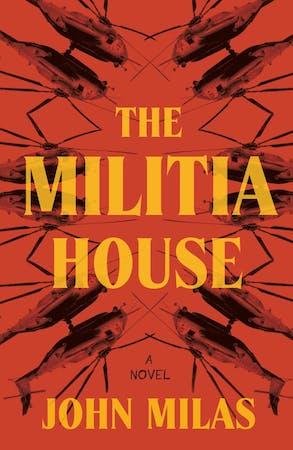
Many of my experiences in the Marines were equally as ugly and terrifying as a classic gothic haunted house. My book studies some of the parallels between gothic horror and the absurd terror of Operation Enduring Freedom, but The Militia House focuses on the experience of one individual. As I read other veteran writers, I encounter narratives that are different from mine yet just as terrifying in their own ways. The US military is a scary place, especially so for those of us who’ve borne witness to the realities of it.
Veterans who share stories through vulnerable and authentic writing will obliterate the propaganda and bold-faced lies that get us into war, an act of patriotism by my estimation. The following list includes writers whose books break the standard of sanitized, routine portrayals of life and war in the US military. Their work faces the truth head on. While some of these books help the reader understand or reflect, and others inundate with unforgettable, haunting images in order to allow the reader’s interpretation, they all demonstrate that scary is not exclusive to horror or combat.
The Short-Timers by Gustav Hasford
Gustav Hasford’s absurd and surreal novel, The Short-Timers, is terrifying between the nauseating violence and the voice of the narrator, Joker, whose ironic and sarcastic responses to atrocity will contrast sharply with the reader’s reaction, hence his nickname. The novel sees Joker, a United States Marine Corps combat correspondent, and his photographer, Rafter Man, roaming an urban battle in the city of Hue as they search for propaganda for the military newspaper. Along the way, they encounter unspeakably horrific scenes and unspeakably horrific people. Hasford punctuates the insanity of the Vietnam War by blurring reality with satire and even genre, sprinkling all kinds of surreal and exaggerated details throughout the book including a literal vampire in one scene. Hasford attended Clarion and was pressured to cut the werewolves in an early draft, but a trace of them remains in the form of haunting figurative language.
Unbecoming scares me because of the military’s willingness to turn its back on those who directly serve its best interests as leaders. If this is the precedent, then no one is safe. Anuradha Bhagwati demonstrates in her incisive, pointed memoir, that those in designated leadership positions can still be helpless in the face of longstanding misogynistic tradition and bureaucratic negligence. Bhagwati was nowhere near the bottom of the military hierarchy, but she describes scenarios in which she, as a commissioned officer who more than earned her rank in the Marines, is still disregarded for her gender, her sexuality, and even her ethnicity.
Unbecoming tells the story of a Marine Corps officer who finds loneliness, abandonment, and abuse within a community typically joined by people in search of purpose and belonging. The second half of Bhagwati’s book details her post-service efforts to better integrate women into the 21st-century military and to hold military leadership accountable for the widespread military sexual trauma endured by many veterans.
The term “no-no boy” was a pejorative for Japanese American men interned by the United States during World War II who did not forswear allegiance to the Emperor of Japan or agree to volunteer for military service against Imperial Japan. Not only were these men charged with crimes and further imprisoned beyond internment, they were largely ostracized post-war by the Japanese American community.
John Okada, who did in fact serve in the US Army Air Forces during the war, tells the story of Ichiro Yamada, who returns home from imprisonment after refusing to serve the federal government. The novel details Ichiro’s attempts at re-integrating into daily life while maintaining his relationships with family and friends, including his friend Kenji who did elect to serve in the military. Okada’s compassionate, but desolate and tragic novel, studies the consequences of Ichiro’s refusal to serve in the US military as someone who was never fully accepted by the U.S. to begin with.
Cherry is an upsetting novel with a lot going on, to say the least. Nico Walker was implored to write Cherry before his release from prison, and large swaths of violent imagery are transferred directly from the original BuzzFeed article that brought his true life story as a traumatized, heroin-addicted bank robber to public prominence. The section in Iraq portrays violence in vivid detail inflicted by an enemy whom the narrator never sees. The substance of Cherry, from beginning to end, is bleak and terrifying, but what I find structurally intriguing is that the narrator’s experience as a medic in the US Army feels limited mostly to the second act, bookended by substantial non-military sequences of his life. Many war stories are told in a vacuum, but Cherry portrays the reach that the US military can have on someone’s life not only during their service, but before and after.
The Lieutenant Don’t Know by Jeff Clement
Jeff Clement’s The Lieutenant Don’t Know partially covers the exact deployment that inspired The Militia House, as he and I were members of the same battalion, but in different companies and performing dramatically different roles.
At times, Clement’s book feels less like a memoir and more like reporting based on the detailed notes he took in 2010, but the book resonates in moments when Clement describes the ambiguous big picture of Operation Enduring Freedom in the Helmand Province of Afghanistan and the confusion many of us felt about the end goal. He calls out higher leadership for protocols that are inefficient or frankly a hindrance to completing a mission, and calls out his own peers who can’t be bothered to take a real life war more seriously than a civilian day job. Clement knows more than he thinks, otherwise I would not have chosen a sentence from his book as one of the epigraphs for my debut novel.
For a candid (read: brutally honest) experience of a young woman enlisted in the US Army, this is your book. Williams, a linguist who studied Arabic at Defense Language Institute, shares a range of stories about her time in the Army. Rather than summarizing from a zoomed-out perspective, she relays her experiences through intricate, intimate scenes.
Her own sergeants sometimes move beyond incompetent to being brazenly disrespectful to their subordinates. Her male peers seem to make innocuous small talk, but then close out these interactions by hinting at a sexual proposition or bluntly speaking them. Most disturbing early on: a lieutenant overseeing the search of a monastery, who refuses to interact directly with an English-speaking monk in Iraq, forcing Williams awkwardly to translate between two people who can see, hear, and understand each other. Love My Rifle More Than You does an excellent job of highlighting scenes and mindsets that are effectively terrifying in their implications.
The most affecting book on this list is the only graphic novel and the only infantry-based entry. Maximilian Uriarte served as a grunt in the Marines and deployed to Iraq twice, returning to create Terminal Lance, a hilarious comic strip very specific to daily Marine Corps life from the enlisted perspective. The White Donkey feels like a book-length culmination of Uriarte’s early work, retaining the same brand of humor while centering Abe (from the comic strip) in an extended narrative that follows an infantry unit throughout their deployment to Iraq. The humor of The White Donkey draws in the reader by building a fondness for the characters. Uriarte then juxtaposes, to maximum effect, our laughter against our reactions to the terrible events that unfold overseas. Uriarte’s candor and vulnerability turn what initially seems like a simple cartoon into a terrifying, but poignant tale of the Global War on Terror.
“The Difficulty of Getting Through to You” by Ren Arcamone
I was rematerializing in the garden shed when Cherie Katsoulas found me and said, “I heard screaming last night. Did you hear screaming?”
Well, this was a delicate thing to handle, because in fact I had heard screaming last night. This was due to the very noisy business of Mr. Dent, the next-door neighbor, murdering his wife. But Cherie is a gentle child, a sensitive child, easily affected by things. When I was alive, I had very little to do with children. It’s difficult to say what a nine-year-old should know, what she shouldn’t know. Just last week, Cherie watched a news video about a beached whale and cried for a good hour. On the other hand, she helped bury the family cat, Chuggo, with minimal anguish. I stalled.
“Screaming? What sort of screaming?”
“And crying,” said Cherie solemnly. “I think it was the man next door. I think he was screaming and crying.”
I said the screaming was due to Dent’s murdering his wife. But that’s not to say the screaming came from Mrs. Dent as Mr. Dent hacked her body to pieces with a butcher’s knife. Cherie’s two older sisters—Cleo in particular—watch television shows ostensibly concerning “law and order,” but which are usually about violent men who kidnap women and torture them or rape them or melt their dead bodies in vats of alkaline solution, and often the men are secret perverts with daytime jobs as solicitors or what have you. But Mr. Dent killed his wife by accident. Certainly, he hit her on purpose. But he wasn’t happy she was dead. Hence the screaming.
“Pick up that stack of pots for me, will you?” I said to Cherie.
Outside was sun and breezy Brisbane spring, the sky a high smear of blue. There were plastic gardening pots scattered higgledy-piggledy across the floor, some wedged inside of one another, which was no good to me; my arms were acting up again. Often, if I’m tired, my hands turn to mist, slip straight through whatever I’m attempting to grab, and I had already exerted myself a great deal this week, foraging the yard for dead geckos. Cherie, considerate child, picked apart a set of three pots and lay them upturned on the bench, as though readying us for a magic trick with an unlocatable ball.
“More, please,” I said. “Thank you, Cherie.”
Cherie clacked the pots one by one onto the table. I had hoped to hide the gecko corpses, fearing a beached-whale-style meltdown, but she saw right through me to the bundle of soft bodies and didn’t blink.
“It’s Cherry,” said Cherie. “Mum says it ‘Cherry.’”
“Nonsense,” I said. And I knew Cherie did not really expect me to change, and nor did I expect her to stop correcting me. I nudged the lizard bodies through the dust across the table, willing my hands to stay solid.
My plan was to place a dead lizard under each of the empty pots, leaving them conspicuously arranged along the length of the table, thereby frightening the unhappy discoverer. Possibly this would be Dina Katsoulas, or her husband, Nick, but with any luck it would be the potential property buyer scheduled to visit this week. I’d recovered about ten lizards, and though I would have preferred more—haunting is as much about scale as it is strangeness—this visit was an early one, a private enquiry, and if I needed to speed things along, then so be it.
I’d been thinking a lot about it, about how to haunt a residence. The Open House was scheduled for three weeks away, by which time I would hopefully have enough frightening phenomena to dissuade even the keenest buyer. The current long-term project was some carefully curated water damage: I was trying to spell out the words I AM STILL HERE on the master bedroom ceiling by arranging ice cubes on the ceiling’s reverse side. So far, this was going terribly. Only the first few letters were even faintly apparent, and I’d gotten the “S” backwards by mistake, so that if you were really looking for it, you could just make out the declaration I AM Z.
A good haunting ought to be a lot more magical than these small pranks. Blood bubbling out of the taps, fireless smoke filling a room, grandfather clocks winding themselves backwards. But I am just one ghost, and a not substantial one at that. My haunting ambitions fall within a narrow range: past “faulty wiring,” but not quite “demonic torture chamber.” I would simply like the house to be unsellable. The Katsoulases are young and full of life, and Cherie, remarkably, can talk to me. I’d quite like them to stay.
“Are we going to throw a funeral?” asked Cherie. “For the geckoes?”
“Yes,” I told her. “And we’re going to inter the bodies. That means we’re going to lay them to rest. We’re going to inter them in a mausoleum. That’s like a house for dead people.”
“Like our house?”
“No,” I said. “Ours is more of a shared residence.”
Together we placed a pot over each of the geckoes. I positioned them apart from one another; Cherie was curious but unwilling to touch the bodies. Some were quite fresh, still limp and juicy. The long-dead ones looked like hard little commas.
“Also I saw Marcus in the space under the house,” said Cherie. “Digging a big hole.”
“You saw Mr. Dent in the space under the house, digging a big hole,” I corrected her. “And you did not. I saw nothing of the sort.”
“Did too. He put a big plastic garbage bag in the hole and covered it up, like we did with Chuggo.”
“It’s very naughty,” I said. “To make things up like that.”
Cherie chewed her bottom lip. “Nobody ever believes me about anything.”
I considered this, poking a grey tail under the rim of a pot. The year I died, there was a new vogue for psychiatric terms: psychopathology, neurotic affect, catecholamine hypothesis. My husband was a doctor—not that sort of doctor—but nonetheless I had an interest in diagnostic terms. I am quite sound of mind these days. Still, I do experience these gaps, what one might call “involuntary dematerialization.” In the past, they could descend suddenly and for prolonged periods; the majority of the seventies, for instance, flew past without so much as a by-your-leave.
Last night—I’d assumed I had seen the whole event. Mr. Dent struck his wife. She fell backwards, hit the corner of the kitchen table, went limp, and Mr. Dent fell to his knees, howling, shouting, Get up, Lisa, get up. A dark puddle surrounded Mrs. Dent’s head, and Mr. Dent began to tremble. Afterwards—well. Perhaps Cherie had a point.
“He carried her under the house?” I said. The neighbor’s house, like my house, is a Queenslander, an old timber structure raised on stilts and enclosed by walls of widely-spaced slats. The Katsoulases had put in a floor and real walls, turning the space into a rumpus room. The Dents had left theirs untouched, although they kept a washer and clothesline under there. I imagined the dirt floor, upturned, a shovel stuck in the hard earth. I tried to remember.
“I saw it,” said Cherie. “Between the gaps in the walls. He turned the light on.”
Which does seem disappointingly in keeping with Mr. Dent’s character, burying a body in plain view of anyone who happens to pass by. This is the trouble with handsome men. They think everyone is so busy cooing over them that no one will notice if they act like perfect devils.
I examined Cherie’s face for signs of panic, but she was perfectly calm. “Get those pots in a neat row, will you, dear?”
Cherie straightened the pots. If I found more bodies, I could extend the row further. “Nice and cosy,” said Cherie, patting the last one.
“Were you frightened, Cherie?” I asked. “You see that Mrs. Dent is dead, don’t you?”
Cherie looked up at me with big eyes. They’re dark eyes, brown-black, like a muddy lake. Sometimes I see a flicker of light pass over the surface. I would like to think this is my reflection: silverly, a faint cloud catching itself in the water below. It has been so long since I saw my face. Whenever I set foot near a mirror I can barely make out my head: I look like I’m behind a shower curtain, or under a wedding veil. I think my eyes were blue. Only Cherie can see me in this house. No one else. She blinked slowly.
“She’s not really gone,” said Cherie. “Now you have a new friend.”
It was impossible to know this for certain, although I wondered the same thing, about Mrs. Dent. The hideous circumstances of her death seemed to prime her for an unearthly return—or so I suspected, having watched several episodes of Spectral Detectives, a favorite television program among the Katsoulas children. A so-called “reality” show, two young men visit supposedly haunted family homes to prove the presence or non-presence of ghosts. One of the men, Tom, a handsome young Asian man, is always convinced the house is haunted. The other, Brad, a handsome young Caucasian man, is always skeptical, and goes in with measuring equipment to detect drafts from the air vents or uneven floor surfaces. He often says, “I have a background in architecture.” Even though both men are beautiful, they are not intolerable; I put this down to the fact of their being inverts, or what my husband would have called “nancy men.” My husband was occasionally mistaken for a nancy man, being handsome himself. It troubled him terribly, and this, I have to admit, made me smile. Attention ought to have its drawbacks.
Anyway, these men, these ghost-detective men, spend a night together in the haunted house, preferably in the most haunted room, and are inevitably awoken by bumps and scratchings and sometimes whirrings from the ghost-detecting machines they’ve arranged in the hallways. Each investigation closes with Tom sitting at the family’s kitchen table, explaining that actually a little girl vanished from this house in the eighties, or that actually an old man had a stroke on this very floor. These explanatory stories are at the heart of the show. Everyone knows you need a good trauma to tie it all together.
I must confess that the bulk of my own understanding about hauntings is derived from these shows. Despite my circumstances, I’m no expert on the subject. What makes a ghost? How often are the dead required to remain?
Cherie is a devoted fan of Spectral Detectives, even though she is technically forbidden from watching it. Mr. Katsoulas lets her stay up and watch it so long as Mrs. Katsoulas is working late and Cherie promises not to tell. It doesn’t really give her nightmares, she says. She’s seen plenty of ghosts.
“There was one at the Buranda house,” she told me early on. “And at Indooroopilly.”
These are Brisbane suburbs. The Katsoulas family have lived in several houses over the years; Mr. and Mrs. Katsoulas are what the television program For Flip’s Sake tells me are “house flippers,” people who renovate old houses and sell for a profit. It has led the Katsoulas family to move houses roughly once a year. I was unsettled to hear ghosts were such a commonplace feature, if only for Cherie.
“Mum and Dad said he was a figment,” Cherie went on. “But there was a boy called Ron at Buranda. He always wanted to play tip. But it was boring and anyway Mum said I couldn’t run up the stairs. Mostly I just ignored him.”
The other ghost, at Indooroopilly, was a baby. They’d found a cot in an otherwise empty room. I thought perhaps Cherie had been shaken by this, or disturbed to find the ghost of a newborn, but when pressed she said only that it was annoying.
“It just cried,” she said. “And cried and cried and cried and cried.”
Cherie rarely speaks fondly of these previous playmates. No doubt it is tiresome to be pestered by the undead. Young Tom from Spectral Detectives reminds viewers that the continued existence of any spirit is centered upon “some real deep sorrow.” I don’t know about that, but I confess: before Cherie arrived, my days were dull indeed. You can only rattle the china cabinet for so long. It is refreshing to be addressed. To be seen.
Cherie didn’t know anything about how the boy or the baby had died. Babies die all the time, and probably the boy had tripped down the stairs, although for all I knew it was polio and the chasing game was making up for a sickly childhood. These assumptions tell me nothing about how ghosts become ghosts. Me, I took my husband’s penknife and slit my forearms open in the bathtub in ’64, went trembly and cold and floated out the bathroom window.
Cherie was right: Mrs. Dent did come back. It was evening. I was standing at the kitchen sink, trying to loosen the faucet, wondering exactly how I might get it to shoot into the air the next time someone turned the tap on. Through the window, I could see into the Dent’s living room, where Mr. Dent sat watching the television. The space under the house was so dark, it was impossible to make out the washing machine or the dryer or any sign of the makeshift grave, but I could see the faint shimmer of Mrs. Dent through the timber battens, curled up in the dirt, sobbing noisily. I went out and stuck my head over the garden fence.
“Mrs. Dent?” I said. “Mrs. Dent, I’m terribly sorry for your loss.” A chorus of bats chittered in the boughs of the paperbark overhead. I raised my voice. “Terrible business. A darn shame, about your husband.”
She had positioned herself directly underneath what I could see were the living room floorboards, so that her husband, if he were at all psychically aware, would hear the moans of her fury. But Mr. Dent, it seemed, was not the slightest bit preternaturally sensitive. He sipped a beer and fondled the remote. It’s difficult, getting through to the living. Mrs. Dent had not yet realized this.
Or perhaps I am too hasty in thinking he was deaf to her screams. Perhaps he heard her and thought nothing of it. My husband had certainly been that way, in my life. “Don’t be hysterical,” he would say, sternly, in response to my wailing. “I know you can help it, Cecelia, so snap out of it right now.” He would use his doctor voice. I said he was a doctor, didn’t I? Well, he was no psychiatrist, or even a general physician. In fact, he was a foot doctor, a chiropodist. But he had a lot of authority nonetheless, when he spoke like that. So I would—I would snap out of it.
Of course, it’s hard to fault him. I had nothing to wail about like Mrs. Dent. Gerald never hit me. I had several friends, I was on good terms with my mother and father, I had a very nice house and nice neighbors and was never hungry. In fact, I don’t know what it was, that ever came over me, why I ever wanted to cry like that. And Gerald was right, I could help it. There was always some sly part of my mind standing guard whenever I sank down into one of these low moments, some cynical and grounded part of myself that thought, Oh, I’m a fool for feeling this way, it’s not so bleak as all that. Sometimes I would try to shut that part of my brain off and really feel crazy, really hysterical. I would gulp air and hiss and let the shudders roll through my body, wait for the feeling to grip me completely. It never would, though. Not the way it was gripping Mrs. Dent right now.
“Mrs. Dent?” I said, louder. “Attempting a haunting, are you? I’ve been in this place a while. I could share a few pointers!”
The sobbing increased, as if in competition with the screeching and crunching of the bats. Given that my own attempts at haunting the Katsoulas family had so far gone unnoticed, I don’t know what tips I imagined sharing, but it would have been nice to talk shop with the new girl. I waved my arm at her, trying to make it look as arm-shaped as possible.
Her neck twisted very slowly as she turned to me. Her eyes were too big, as though they’d been magnified, or her head had shrunk.
“Oh!” I said, faltering. “Oh! Hello, dear.”
She crawled up to the wooden battens that enclosed the underside of the house and pushed through them with jerky, mechanical movements, her body flickering. She couldn’t come through the fence, surely. According to the television, ghosts are bound narrowly to the sites of their death. I myself have never left the perimeter of the property.
According to the television, ghosts are bound narrowly to the sites of their death.
But no one had told Mrs. Dent. Spittle flew from her teeth. She was at the fence, raising her body up, up, up, pressing herself into the barrier and then through it, her face spasming through the solid fence post, and screaming, screaming.
I shot up and backwards and in through the wall of the house, my eyes shut tight. I tried to collect myself. How stupid, to be afraid of Mrs. Dent. There was a buzzing in my head, distant, like a motorized fan. I felt like I was still in her presence, or in somebody’s presence, so I opened my eyes. That’s when I realized I was in the bathroom.
I don’t like the bathroom. I don’t go in there, haven’t since I was alive. Now I stood in the bath. I was alone, but it felt as though I had intruded on someone; I almost said, “I’m sorry” into the still air. Right at eye level, there was a ring of decorative floral tiles, green and orange, and a mirror at the sink, through which I could see the tiled wall behind me and no trace of myself. Panic overwhelmed me. I slipped backwards, pushing myself through the bathroom wall like it was tissue paper, kicking my way down through the floor until I was elsewhere, anywhere else.
I found myself in the rumpus room, waist-deep in the television. The Katsoulas family, all five of them, were sprawled over the black leather sofas, a bowl of Bolognese on each lap. For a moment it seemed like they were staring straight at me. But no—they were watching the television—all except for Cherie, who gasped and clamped her hand over her mouth, and looked, in this instant, so appalled I thought Mrs. Dent must be behind me, until I realized it was me, I was the cause for the shock. My lower body seemed to hum inside the machine, but the top of me was smoky, diffuse, like a ribbon of ink dropped in water. You poor dear, I thought numbly. It’s only me, it’s me. From a distance I heard Cleo, the middle sister, saying “It’s just the DVD skipping, Cherry. God. You’re so dramatic,” and I watched Mr. Katsoulas muss Cherie’s hair, and Cherie’s face harden into a frown, her lips forming the words, “Go away.” But I couldn’t gather myself. I was soft, I was wet meringue. Their voices came to me from the other end of a long tunnel.
“It’s the ghost,” Cherie was saying.
“Cali, hit the DVD player.”
“You do it.”
“Don’t hit the machine, anyone. Pause it and wipe the disk.”
“Mum, it’s the ghost.”
“Yeah Mum, tell the ghost to wipe the disk.”
“Cleo, don’t make fun of your sister.”
“Hey now,” said Mr. Katsoulas. He bundled Cherie onto his lap, spoke to her gently. In the soft blue of the flickering screen, they were lit up like specters themselves. “Maybe your ghost can watch the movie with us.”
“Nick!” said Mrs. Katsoulas. “Don’t encourage her.”
“It doesn’t work like that.” Cherie sniffed. “She can’t do anything right now. She can’t even talk.”
I was in the elsewhere, nowhere, for perhaps three days, perhaps a week. I couldn’t tell. There is nothing that happens inside that space. It’s like being dead, if being dead were the way I imagined it was going to be. It’s like being asleep, except no dreams.
During my life, I had often wanted to be the sort of person who could disappear inside a mania. I had a girlhood friend, Eunice, who was like that, beautiful and manic. She had nervous, narrow eyes and frizzy hair and a slim figure and an impressive record collection. Her husband moved her out to Broken Hill a year into their marriage, said the country air would be good for her, as though Brisbane were anything more than a big country town. An odd man, Mr. Maclean, very boring. I never understood why Eunice married him, although I wondered if his boring nature were a part of it. A tether to her kite.
Even at the time, before she was sent to the sanatorium, I knew it was wicked to be envious of Eunice. And it was envy, it wasn’t simply that I loved her company, although I did. During those early years, when Gerald and I were newlyweds, Eunice would come over for Devonshire tea and bring a small flask of gin and sometimes a record. We were obsessed with Patsy Cline and we would sing as we baked; our favorite was “Walking After Midnight.” I’d burn the scones, tipsy, giggling, giggling about everything, this strange wondrous home with the salmon pink refrigerator and Pyrex casserole dishes and the ocean of time stretched before us, my new handsome husband, beloved by every woman he met, and so impressive to my mother and father—a doctor! my mother told everyone—and so charming, kind even though busy.
Mostly Eunice found everything very funny too, although if she was in a bad mood she was rotten. Sometimes she came round only to sit out on the veranda, smoking, half-catatonic, and when she spoke she said queer things: “I’m an egg without a yolk in it.” Sometimes she stood me up altogether. She didn’t like me visiting her. If she was doing poorly her house was filthy, chicken bones and other food remnants scattered everywhere, not even on plates, kicked to the corners of the room. I would go over despite her requests and find her shaking or crying, in bed in her slip, not caring what Mr. Maclean would say when he returned home from work. He was patient with her, I must say. His eyes, fat with panic at the sight of her like that, his voice soft, like he was coaxing a bird into his hand.
My husband, Gerald, wouldn’t have handled it nearly so well. He pitied Eunice, he said, but he didn’t like me hanging round with her. “A troubled girl,” he said, in his doctor voice. But there was an edge of fear in there, like Eunice was contagious. He took her seriously. He took her sadness seriously. He would never have told her to snap out of it. He knew as well as I did that she simply couldn’t.
Sometimes I hated Gerald. When Eunice went into the sanatorium it was as though, for him, she died, but in a very awkward manner we ought not to talk about. If I mentioned her he would stare out the window, or pat his pockets in search of a cigarette. In company he would change the topic. He was quick on his feet, conversationally, and early in our marriage I had found this charming, but now it struck me as a tic, a cover, for either impatience or fear. I grew to despise him. Whenever anyone said, “Your husband’s a doctor?” I would correct them: “Actually, he’s a foot doctor.” My mother once witnessed this and called me ungrateful. She doted on him. Everyone did. Nearly eighteen months after I died he had a new wife, and they lived here, in our house, my house, with my salmon pink refrigerator, for six months, before packing up and moving all the way to Adelaide for god knows what reason. The house was empty for a while after that, I believe. I wasn’t altogether present for it. For nigh on a decade, I wasn’t altogether present for anything. Later, I heard the house was said to be haunted, so it’s possible I did something I don’t remember, to him or to her. But then again that’s just the sort of thing people say about suicides in old houses, or about widowers who remarry too quickly, and anyway, those stories never stuck, the neighborhood changed and anyone who remembered moved away.
I say suicide. The truth was—this is quite embarrassing—it was an accident. Gerald and I had been having an argument, about Eunice, in fact. He disliked my friendship with her; he found it worrying, although he wouldn’t call it worry; he was “being reasonable.” He’d found the letter I was writing her, picked a quarrel before heading off to work, and in the evening, still stewing, I thought: I’ll give him a good scare. I ran a bath and took the penknife—it hurt quite a lot. I wanted to make it look authentic. I was trying to make a point, I think. But I went too deep. The water was pink and then very red. It was almost funny. I remember giggling. I kept thinking he would wander in at any moment, and then time started passing in an awfully queer way and I was fluttering inside like a gassed bug; I was embarrassed, so horribly embarrassed, and then afraid. I was just going to have to go along with it, pretend this was what I had meant all along. Gerald would come in at any minute and I would say to him, See? I thought: I am making a point.
Looking back, it’s tricky to put into words exactly the point I was trying to make. But what did that matter. I doubt anyone realized I was saying anything at all.
By the time I was me again, the visitor who was interested in buying the house had come and gone, with or without seeing the arrangement in the shed, I couldn’t be sure. Still, somebody had discovered it, and Cherie was getting the blame. She threw a tantrum in the backyard as her mother shook the pots out, gingerly placing the dead geckos in a plastic bag.
“I didn’t do it!” Cherie wailed. “It was Mrs. Whittaker!” She beat the ground with her fists, sounding just as insane as Mrs. Dent.
“Lots of kids still believe in Santa Claus at this age,” Nick Katsoulas said, once Cherie had gone to bed. He and Mrs. Katsoulas were arguing at the kitchen table, partly about the living room furnishings, but mainly about Cherie, what her mother called “her ongoing obsession with the supernatural.” “Lots of ‘em still have imaginary friends.”
The table was covered in paint swatches from Dulux. Several shades of green punctured the cream and beige, candidates for what the television program You Bloody Flipper calls “the quintessential feature wall.” I was hovering about the cabinets, feeling nervy. Several weeks earlier, I had crayoned the words I AM STILL HERE over and over on the linings of several typically-neglected cupboards, imagining the distress of prospective buyers on the day of the Open House. Now, I could see this approach was futile. Each of my haunting efforts so far had only gotten Cherie into trouble. I needed a new strategy.
Mrs. Katsoulas spread her hands between Alpine Dream and Canopy Heat.
“You know what I don’t like?” she said. “I don’t like her lying. Last week we were repainting Cleo’s room and she smashed Cleo’s alarm clock against the wall. Bits of plastic everywhere. Had to repaint the section.”
Mr. Katsoulas sounded dubious. “You saw her smash it?”
“Well,” said Mrs. Katsoulas.
She was sitting right near the affected cupboards. For a perverse moment I really did want her to open one, not only to see the writing, but to know it for what it was, to turn to Mr. Katsoulas in alarm, sensing my presence. I tried to focus my mind like a fine silver instrument, like the hooked scalpel I remembered from my husband’s medical bag. But then—just as Mrs. Katsoulas was tilting her head in my direction—I realized, with no small degree of embarrassment, what Gerald would have said to all of this. I was being a fool. If they knew, truly knew, that I was here, they would simply sell the house as fast as they could.
Mr. Katsoulas was at the kitchen sink, turning the water on and off. “Have you noticed this tap feels looser?”
“Listen, Nick. I heard it smash. When I turned around she looked guilty as sin. And I go, did you break that clock, Cherry? And she goes, oh, my ghost friend did it.”
“She felt bad. Hey!” He stuck his hands up. “I’m not defending her, she knows she shouldn’t lie. But you can be a bit harsh on her, Dina.”
“And how convenient for you. That I’m the bad cop who tells her off.” Mrs. Katsoulas lowered her voice. “You’re the one filling her head up with this shit, Nick. Scary stuff on TV, horror stories, the bloody ghost hunting show—”
They weren’t going to discover anything. Rather than feeling relieved, I only felt tired, and a little guilty. I had absolutely thrown the clock.
I drifted up and through the roof to sit on the eaves. All down the street, porch lights warded off the darkness, casting dim halos around the houses, the lurching eucalypts that divided them. A family of possums sauntered along the tightrope of a power line. Some part of me wanted to apologize to Cherie, but I suspected a tantrum would ensue if I approached her too soon. I would let her cool off. Soon, things would be back to usual.
In the house across the way, Mrs. Dent was standing in the kitchen, smashing wine glasses, stopping only when her husband entered the room. I considered floating up to the fence and shouting out some tips, then thought again. How daft. Mrs. Dent’s haunting prowess now far outstripped my own.
At the third smash, Dent jumped off the sofa, paced down the house, turning the lights on as he went—kitchen, living room, bedroom, bathroom—appearing in each box like a figure in a flickering film strip. When he settled at last on the bed, gripping his knees, Mrs. Dent crawled along the ceiling, kicking dust from the cornices, the dull thumps sounding in each room. “Marcus,” she crooned. “Marcus.”
On Spectral Detectives, the hosts describe three kinds of hauntings: residual, intelligent, and inhuman, the last of which is a consequence of demons, rather than ghosts. Tom calls these inhuman apparitions “salt-the-earth-bad-guys.” “I think we got a real salt-the-earth-bad-guy on our hands here, Brad.” The implication is the deceased are never truly malevolent. “Lost loved ones” only ever want to pass on a message. But what if the message is “go to hell?”
That’s what I thought Mrs. Dent was trying to say, anyway. In life, she had been patient. She had spent a lot of time reassuring Mr. Dent that things would turn out all right. When he was angry she often looked scared; she flinched at his raised voice, the tightening cord of muscle in his neck. But at other moments a terrifying compassion radiated out from her, as though Mr. Dent were a child with a skinned knee, and she knew that she of all people was equipped to tend to the wound. But death had transformed Mrs. Dent. She was no longer patient, or loving, or beseeching. She was all rage.
But death had transformed Mrs. Dent. She was no longer patient, or loving, or beseeching.
Curiously, Dent, too, seemed transformed. In the early mornings, when the Katsoulas’ oven clock showed the dim hour before dawn and Dent was waking, he would sit up and almost immediately crumple. Watching, I felt a strange and terrible shrinking feeling, not only disgust but—forgive me—sympathy. Still, I am glad, viciously glad, that Mrs. Dent torments him.
I have this funny thought, sometimes. Every now and then I come over all queer, and I imagine there’s another ghost sharing this place with me, one confined entirely to the bathroom. That’s silly, of course. That’s simply a personal aversion I have towards the bathroom, on account of my death. I know to be rational about these things.
Nonetheless, it gives me a prickling feeling. Once, in the middle of the day, when nobody was home, I became convinced I could hear someone crying in there, and even though it was stupid I fled for the garden, yanked like a magnet to the shed at the bottom of the yard. Among themselves, the Katsoulas children speak of strange noises coming from the drains, although Mr. Katsoulas puts this down to the old pipes, which he has yet to get around to replacing, and anyway the girls really aren’t helping the matter, what with their long hair clogging the p-trap, whatever that is.
“What does your ghost want?” California asked Cherie one evening. Both Mr. and Mrs. Katsoulas were working late, and Cali, charged with babysitting, had them watching Spectral Detectives. If it had been Cleo, it would have been a mocking question, but California is a gentle child, especially, Mrs. Katsoulas tells people, for a teenager.
“Oh, I don’t know,” said Cherie, sounding like a world-weary woman of sixty. “Probably she just wants attention.”
I was in the wall behind the sofa, grateful I hadn’t announced my presence to Cherie. I felt sick, as though my stomach were turning, as though I had a stomach.
A week to go before the showing, the curtains had been decided upon. They were semi sheer, long and white, gauzy, tissue-paper-light. Despite my efforts, the Katsoulas residence had remained perfectly sellable. I would have to surrender; I would have to resign myself to solitude again. There was a stiff breeze, and in certain moments, the curtains looked much the way I imagined I did.
As if to spite me, Mrs. Dent grew stronger and stronger. Each night, she filled the kitchen sink with knives, overturned the furniture. The police swung by one Thursday evening to find Mr. Dent a wreck. They left without him, prompting a hail of lightbulbs from Mrs. Dent.
I wanted to ask Cherie about the Open House, but she wasn’t talking to me. Dina Katsoulas had found the markings in the cabinets, one of which read MRS.WHITTAKER LIVES. No one had yelled at her. It was past that. Mrs. Katsoulas had booked her to see a psychiatrist. I drifted into her bedroom while she was playing with the small yellow screen, the “game-boy,” and she ignored me. I called to her several times, even stuck my hands right through her middle, which normally produces a squeal, but she just pursed her lips and kept her thumbs on the buttons. Down the hall, Patsy Cline was playing from California’s foldable television, the “lap-top.” Something twanged in me, some mixture of nostalgia and horror. Patsy Cline was falling to pieces again. She had never stopped.
The night before the Open House, I perched myself on a lampshade in the dining room. California and Cherie and Mr. and Mrs. Katsoulas were playing a card game, Bastra. Cleo sat curled like a cat in a chair in the corner, immersed in the flickering of her phone screen.
“See?” said Mrs. Katsoulas. “See how nice it is to all hang out for once? Take a break from the idiot box?” She often said things like this: during dinner, or during pancakes on a Sunday morning, or the time the children helped knock down the dividing wall that once separated the kitchen from the dining room. She would talk about some time that was “quality,” and other times that were not. The times that were not were often the fault of the television, even though she loved it as much as anyone.
I was embarrassed by her, when she talked this way. But I understood. I had longed for quality-time. If my life had been a film reel with the non-quality parts cut out, the floor would be a mess of silver scraps and the ensuing film would run for perhaps a day. I am not trying to be morose. Perhaps I am simply forgetful. I do remember the bright parts: picnicking out at Kangaroo Point with Eunice and Margaret and Julie on a Friday evening, watching the sunset turn the Brisbane River grey-gold. I had finished school and gotten a job at a bank; I was no longer a child; the world was opening itself to me. Sitting next to Gerald for the first time at a dinner party—he was a friend of Margaret’s brother—and thinking he would never speak to me, he was too lovely for words—and then when he did my whole body was alight. The first time he kissed me, and I knew for certain I had him, and the way this knowing made me powerful and beautiful and perhaps cunning, like a story book sorceress. And stray moments that didn’t really mean anything. The first time I plucked a fig from my grandmother’s garden, early in the spring, before the bats had ravaged the tree. When the Browns bought a television set and invited the whole street to watch Alfred Hitchcock Presents. A particular New Years’ Eve, watching fireworks over the river, eating grapes. Moments I was properly alive.
Because there were many moments I was not. I would be moving laundry from the machine into the basket and something would come over me, something that felt very important, and I would have to sit down right there on the tiles and wait for it to pass. It could take an hour, longer. I can’t tell you what it was, it wasn’t anything. It was total emptiness. I was furious with myself, every time, for letting it settle in me, this emptiness. I couldn’t move. Sometimes I couldn’t even move my eyeballs; they were fixed to the thing directly ahead of me, or down. The grout in the tiles, pink, where the mold was creeping in. In my head I was shouting at myself: get up, get up, get up. I remembered my father’s cousin, who had been thrown from a horse and paralyzed from the neck down. Somebody was going to have to find me and pull me upright. But it was me, who did it, in the end. Eventually I would get up again and hang out the washing, still with the dim nothing in my head, but moving, moving.
And of course later, after they had finished playing cards, Mr. Katsoulas brought something out of his pocket, placed it on the table, and said, “You kids see what I found when I was replacing the bathroom cabinet? Looks antique!”
I didn’t kill myself on purpose. It was an accident. Gerald and I were arguing. He’d found the letter I was writing to Eunice, reminiscing about the good old times, a little about the bad times too. Oh, I wasn’t trying to spook her. I was too much in my own head. I had started out normally enough, but then I remembered some afternoon picnic we had taken in the yard, the two of us on a gingham blanket, cutting mangoes on a pewter tray and talking about aristocrats dying of lead poisoning, and suddenly I needed to know whether it still hurt, whether she still woke up brim full of hot ash, frightened and volcanic. It wasn’t only envy and morbid curiosity; I cared about her, I knew how sick it was to fancy myself in her place. But now, picturing her surrounded by nurses, watched, watched carefully, tended to, I felt a putrid longing. In a madhouse you had permission to be mad; it was required.
Gerald was furious. He wanted to know: had I been writing to her often? Did I know how hard I was making it for Eunice to get better? How terribly Maclean was struggling in her absence? Even in anger he looked beautiful: cold green eyes, his teeth white and straight. He said I ought to trust that the doctors had everything in hand, that Eunice was being treated well. I said what would he know about medical care, really? As though he were a real doctor! I won’t deny it: in life, as in death, I was petty. It was pettiness that drove me to it. Then I was in the bath.
The children admired the penknife, the varnish of the handle. The hinge was stiff with age. The blade appeared rusted. I went rigid, watching them. I wondered which of them would see it, would recognize the rust as blood, and panic, or burst into tears—Cherie, surely, and it would be awful, I would feel so guilty, watching her suffer—it’s too much to know, at that age. “Oh, Cherie,” I tried to say, when she said nothing. She was looking right through me. I wasn’t present for her at all—she didn’t know what it was—and again I was nowhere, or everywhere, nowhere in time but still stuck in the walls of the house.
“Did you hear that?” said Mrs. Katsoulas.
I was nowhere, I was in the bath. It was late afternoon, overcast. The sun streamed through the window in intervals, covered by clouds and revealed again, like a great eye opening and closing. I was angry and trembling and I made the bath as hot as I could stand it. I wanted to be warm. I wanted to be awake, properly awake. The truth is I adored life. I only ever wanted more of it. I wanted to be as close as possible to it, to feel it filling me. Gerald’s penknife was on the side of the bath, open. It hurt quite a lot because I wanted to make it look authentic, and at first I was grimly satisfied, and I giggled, I did. But then there was the trouble with my hands, with my right hand, especially. Something twanged. I had severed something, perhaps a tendon, and I panicked. I worried I had broken something irrevocably.
I was nowhere, I was in the bath. It was midnight. I stood up, watched Mr. Dent through the window, shouting in an angry whisper, shaking Mrs. Dent, her eyes wide and terrified. I was watching as she hit the table. He had hurt her. He had hurt her many times before. He was always sorry and this time was no different, except for the main difference. He knelt down and shook her, gentle at first, then rough. I was at the fence, then somehow I was past the fence, far beyond the bounds of my own house, hovering by his kitchen window, watching him. He was crying. I couldn’t help myself; I screamed and screamed and screamed. Mrs. Dent was limp, face slack, and Mr. Dent, gripping her shoulders, looked like a man trying to wake from a nightmare, but there was no reprieve, there is no reprieve that follows anything like that, never again. It was dawning on him that he had done something irrevocable. This is what happens, when you kill a person. It doesn’t matter that it was an accident. Death is not a negotiable state.
I was nowhere, I was in the bath. I wasn’t really giggling. I was sobbing. My right hand hung like a fish. I had not meant it. I needed someone to find me. Gerald found me but it was too late. He went pale and sat down hard on the tiles. He grabbed the body and tried to lift it up and the penknife skittered away, lost itself under the cabinet, water splashing out over the tiles, but the thing he was holding was uncooperative and he staggered, placed it back in the water, put two fingers to her throat, waited. He left the room. He telephoned the police. He went outside, stood in the yard, smoked a cigarette.
There were people filling the house, chatting idly. It was morning. The house was bright and freshly painted, the curtains sheer and wispy. A woman in a sharp suit was leading several couples up the stairs, gesturing to the mid-century molding on the ceiling, and one woman turned to her husband and said, “Did you hear that?”
Because I was rising, I was out of the bath, flickering like faulty wiring, pressing myself to the walls. The tiles were cool on my warm skin. Below me was the body, slumped like a doll in a bath of tomato juice, like a child asleep, insensible. Like a child! Something was squirming apart in me. I wanted to hold her but I couldn’t, I was trembling too violently, my forearms were opening like mouths. I dipped my fingers in the red and wrote FORGIVE ME above the tub. She was still and she wouldn’t answer but I kept going. FORGIVE ME. FORGIVE ME. The shower spurted on, so did the taps in the sink and the bath, and the water was not water but something thin and red and the steam was the color of fat, and it filled the room, damp and hot and thicker than my own body, falling from the shower nozzle to drown me, the other me, the poor girl still stuck in the tub. Now only her head was visible. Her face. Her eyes, still open, blue. At the door, a woman screamed. Others were gathering behind her, gasping and clutching their faces. I couldn’t stop, I wouldn’t. Forgive me, I wrote, on the gaudy floral tiles. Forgive me, forgive me, forgive me.
The house didn’t sell.
It was Tuesday night, and California, Cleo, and Cherie were watching Spectral Detectives. Tom and Brad were shimmying up a ladder to a long-abandoned attic. “You know,” said Brad to camera. “A lot of these creaking noises could be explained by the timber contracting in the cool, dry weather. But we’ll have to explore all the possibilities to know for sure.” His smile was Cheshire-white in the dark.
Cherie is allowed to watch Spectral Detectives now. Mrs. Katsoulas delayed her appointment with the psychiatrist, in light of the events that took place during the Open House. None of the Katsoulases were present at the time, so they are fuzzy on the exact details and frustrated with Angela, the real estate agent. There were no problems with the plumbing in the bathroom when they left in the morning, they told her, and there was no evidence of a burst pipe when they got home, so exactly what the hell went wrong? Angela has yet to give them a clear answer. But Susan Hadid, a neighbor who came to the inspection, had her own take on it, which she shared with Mrs. Katsoulas the following day: “Mate, your bathroom is bloody haunted.”
Mr. Katsoulas approached Cherie in the evening later that week. It was clear she had nothing to do with it. He brought her a Kit Kat by way of apology. His mother had always said she’d seen ghosts, he told her. Maybe he should have taken her more seriously.
Cherie left wafer crumbs over the carpet as her father spoke, and he told her not to be such a grot or she’d get both of them in trouble, and Cherie smiled a monkey grin. He’s a gentle man, Mr. Katsoulas. The house would never sell now, not with the recent upset in the bathroom, and especially not with the news spreading of that other nasty business, the woman found buried under the house next door. The police had come to collect Mr. Dent early one morning, bent his head into the back of the police car. He had, as they say, gone quietly.
On Spectral Detectives, Tom and Brad decide, on occasion, to perform a cleansing ritual. Sage, for purification, and myrrh, for protection, to prevent any new spirits from taking up residence. Whether this is a kindly farewell or an outright eviction has always been unclear to me. The men burn their fragrances with the solemnity of funeral mourners. “She’s somewhere better now,” Tom says, tears glistening in his eyes. “She’s decided to move on. She’s making that leap.”
It doesn’t feel like I’m making a leap, exactly. Still, Cherie doesn’t see me anymore. She asks for me sometimes, alone in her room. “Mrs. Whittaker? Are you still here?”
It’s not that I don’t want to go to her. I try, on occasion. Every day I am less and less substantial. I am coming to pieces, but very gently, the way that clouds do.
Poet Maggie Smith’s debut memoir, You Could Make This Place Beautiful, is about the end of her marriage, grief, motherhood, the pain that comes with change, and where she found herself in these moments. Her prose, like her poetry, is gorgeous and moving. The feelings conjured are flipped and turned and examined from underneath.
Divorce, although common, still feels racy, somehow. A little ominous, and taboo to write about. I’ve been divorced for a couple years, and people still don’t know how to talk to me about it. They jumble words. They awkwardly pause. They ask questions they don’t want truthful answers to. You just want to scream, “I’m the same person!” But this instinct is wrong. Because you’re not the same person. Like Smith says, you’re a nesting doll of yourself. The married person you were, inside the person you are now. Still, you want to be treated the same. You want to feel like you are the same. But you, and that usually well-intended person standing in front of you, know you will never be the same. And that is absolutely okay.
The truth of it is, it’s all just a mess. A beautiful, beautiful mess.
You probably know Maggie Smith from her viral 2016 poem, Good Bones, or her collection, Keep Moving: Notes on Loss, Creativity, andChange, or any of the six other collections she’s written. But you will definitely know her now from this powerful and tangibly raw memoir:
“I’ve wondered if I can even call this book a memoir. It’s not something that happened in the past that I’m recalling for you. It’s not a recollection, a retrospective, a reminiscence. I’m still living through this story as I write it I’m finding mine, and telling it, but all the while, the mine is changing.”
Hoda Mallone: You call yourself a “half-double—half a couple, half a whole,” when you begin the book, then get to a place where you feel “whole.” Do you feel like the process of writing this, helped you find that wholeness?
Maggie Smith: One of the narratives around marriage, it seems to me, is the story of finding someone who “completes you”—your missing half. According to that story, divorce is a halving, a split of a whole into two (diminished, lesser) halves. Certainly in the initial shock and grief of my marriage ending, I felt diminished. But of course that whole story—no pun intended—is a lie. We’re whole on our own. The process of writing the book helped clarify this for me, sure, but it was the process of living post-divorce that helped me see it most of all: I’d been there, whole, all along.
HM: Recently, I had an interesting conversation with authors about the “female protagonist.” Would you consider your character (you) a protagonist? Did you consider how she would be viewed by readers in this light?
MS: If I’m not the protagonist in my own life story, then who is? Or, maybe more to the point: If I’m not the protagonist in my own life story, then where could I ever have that agency? I mean, I’m certainly not the main character in anyone else’s life, even if I am a main character. But I also don’t see myself as a character in this book, I just see… me. I break the fourth wall in this book by speaking directly to the reader, as myself (the writer, the woman, the mother, the daughter, the friend). Maybe my consciousness is the protagonist.
HM: In the chapter, “An Offering,” you describe the idea of “possession.” You say, “The anger possesses you—owns—you.” How do you believe women being angry or expressing anger is regarded in our culture, in your experience?
MS: I don’t think there’s any acceptable way to feel or behave if you’re a woman, to put it plainly. If you’re angry, you’re cast as shrill, vindictive, out of control, even “hysterical.” If you’re calm, accepting, and forgiving, you’re cast as a doormat; you should be angrier! If you cry too much, you’re weak and overly sensitive. If you don’t cry enough, you’re cold and not “feminine” enough. If you’re unhappy, you’re a downer and lacking proper gratitude. If you’re happy, you must be dim or at least in denial about the world. There is no acceptable feeling if you’re a woman, so I say we give ourselves permission to feel our feelings, all of them. Can I say “fuck it” here, because that’s what I want to say: Fuck it.
HM: “Betrayal is neat.” Indeed, I agree. It gives an out to the other side, the victim, the betrayed. You could have taken that route in assessing your marriage. Why did you decide to do the opposite? To become more self-aware and exploratory with your introspection?
MS: Because I wanted to tell the truth, and the truth is never that uncomplicated. I wasn’t interested in writing a book in which I was the “good guy”—a victim, a martyr—and someone else was the villain. I knew in my heart that there were many, many hairline cracks in my marriage, not just one or two big fissures, and that I created, or at least co-created, some of them. Gina Frangello says that memoir has two essential ingredients: self-assessment and societal interrogation. I didn’t hear her say that until after I’d published my book, but I think You Could Make This Place Beautiful has them both. The self-assessment piece is critical.
HM: You talk a lot about the spaces between. The empty places. The quiet parts. What did you find when you looked into those?
There is no acceptable feeling if you’re a woman, so I say we give ourselves permission to feel our feelings, all of them. Fuck it.
MS: White space for me, as a poet, is incredibly important. The white space in a poem is literal breathing room—space for the reader to pause, breathe, sit with what you’ve just handed them, make connections within the book, and reflect on their own lives. A lot is possible inside that “empty” space, which isn’t empty at all, if you think about it—the reader fills it. I built a lot of white space into this book for that reason, to invite the reader to participate more. The “spaces between” in my life are places, too, where I was able to linger, listen, pay attention, reflect, and see things a little more clearly.
HM: After my divorce, I found that people in my life used it as an opportunity to examine their own marriages. Some were not so happy about this opportunity and often projected their fears or judgement onto me and my choices. It seemed like they were upset with me for making them think about the unthinkable. Did you find that to be your experience?
MS: I think divorce is still a taboo subject for this very reason. Divorced people are triggered, dragged back into the pain of their own experience. Happily married people don’t want to think that this dark shadow could fall on their house, too. I don’t think any of this is “unthinkable,” though, not really. Few things are truly unthinkable. What scares us most are the very painful “thinkable” things that happen all too often. Divorce is one of them.
HM: When you discuss making yourself small, declining work and income, withholding good news, it made me irrationally angry. Especially because all your sacrifice did not have the intended result: saving your marriage. Did you, at any point, find yourself angry?
The white space in a poem is literal breathing room—space for the reader to pause, sit with what you’ve just handed them, and reflect on their own lives.
MS: I was definitely angry at times, but I think beneath that anger was hurt and disappointment. Because if the person who should be your biggest cheerleader isn’t—well, you think, why not? I take a lot of comfort in the relationships that some of my friends have—people supporting one another, wanting the best for the person. As I see it now, I think we should want for our partners what we want for our children: the best lives possible. If we don’t want that, then what are we doing?
HM: What do you believe it means to be “good at being a wife?” In “Wolf in Sheep’s Clothing,” you question if you were. Do you still question that?
MS: No, I don’t. Relationships are challenging, but I don’t think they’re harder for me than for anyone else.
HM: I’d love to know more about the moment, after signing your divorce papers, when you looked down and saw your pen in your hand. Even though you weren’t married anymore, you always had writing. What did you feel in that moment of realization?
MS: It’s funny—I couldn’t have written that moment into a novel. It was too on the nose! But that’s exactly what happened, and so there you have it. I remember looking down, seeing the pen, and thinking yes. I still had—have—myself. I still have the writer I am. Joy Harjo has written about writing as sovereignty, and I love that. In that moment, it hit me that while a big part of my life was gone—not just my husband but my family unit, my sense of security, my sense of my own future—I was still there. The me of me.
HM: “The Intangibles” really hit hard for me. When a long relationship is over, so are all the small things (inside jokes, notes, made-up songs, knowing glances). Where does all the shared history go? Where have you managed to put it all?
I wasn’t interested in writing a book in which I was the ‘good guy’—a victim, a martyr—and someone else was the villain.
MS: There’s no place to “put” it. It lives inside me, and pieces bob to the surface now and then, and sometimes I’m able to smile and remember, but sometimes it just wallops me. And the walloping isn’t me missing my husband or wishing we were still together—it’s not that at all. The walloping is the cognitive dissonance of realizing all of that was real, and all of this is real, and it’d hard to square the past with the present. I can’t “put” that anywhere. I just feel my way through it, talk to my therapist about it, breathe, and write.
HM: You end the book talking about acceptance in lieu of forgiveness. I love this. But I still think forgiveness feels more healing than acceptance. Do you feel like you’ve come around to forgiveness as more time has passed? Or does acceptance suffice?
MS: Acceptance will have to suffice. Like, “We are humans, and humans sometimes hurt one another.” Like, “In a life many things happen, and these things happened.” I’ve come to terms with what happened, and I’ve even accepted the outcome, the divorce, as unavoidable. But I don’t think it’s my responsibility to forgive. I can let go without doing that.
HM: Your book is going to deeply touch many, many people, I suspect. Your story is relatable and honest and you. What advice can you leave for those who come to your work for clarity, or at the very least, to feel less alone in their situation?
MS: My hope for the book was a seemingly small one: that someone might read it and feel seen. That someone might read it and feel less alone. Some people may read the book as part cautionary tale, I suppose, and in that regard, I hope women in particular reflect on the space they feel permitted to take up, and the attitudes of their partners toward their work. I want us all to dream bigger and be supported doing just that.
I don’t know about y’all, but I love rewatching a performance after I learn that something catastrophic has gone down behind the scenes. Whether it’s the iconic 1997 Fleetwood Mac performance of “Silver Springs” in which you can watch Stevie Nicks put a curse on Lindsey Buckingham in real time, or a film like What Happened to Baby Jane, which featured an on-set rivalry between Bette Davis and Joan Crawford so legendary that Ryan Murphy had to make entire tv series about it.
When I began researching my debut novel Do Tell, I already had a longstanding love for the films of classic Hollywood. As I learned more about the backstories of the actors, directors, and studio executives of the era, I found myself revisiting the classics and pinpointing the intersection between performance and personal life. There’s something very satisfying about watching The Long, Hot Summer and knowing that Paul Newman and Joanne Woodward are about to destroy their respective marriages in the name of one of the greatest love stories in Hollywood history.
Do Tell follows Edie O’Dare, a gossip columnist who thrives in the gray area between personal and public when it comes to the stars of Golden Age Hollywood. Edie’s livelihood is dependent on her ability to piece together what’s happening off-set—which stars are sneaking off together, who’s feuding, or why that last-minute swap of leading starlets had to happen. I love novels that explore the disparity between what the public is meant to see and what really went down. If you’re like me and you live for the drama, here’s a list of my favorites that show us the mess off-camera, behind the curtain, and backstage.
Elizabeth Gilbert’s story of a rundown New York City playhouse during World War II is a delectable treasure. Vivian Morris has just been kicked out of Vassar, so she heads to the city to live with her eccentric aunt who works in showbiz. Not the Broadway kind of showbiz though—the Lily Playhouse is running on castoff showgirls, recycled costumes, last minute scripts, pennies, and prayers. At the playhouse, Vivian discovers a found family with her aunt Peg and her live-in “secretary” Olive, along with the eccentric cast of characters that inhabit their world. I love how unapologetic Gilbert is with Vivian’s exploits and mistakes, because, of course, she makes the sorts of mistakes any nineteen-year-old would make if given the opportunity to run amok in the bars and clubs of New York with a legion of beautiful actors and actresses. City of Girls is a perfect novel: transportive, entertaining, and empathetic.
Have you ever watched a reality dating show and wondered to yourself: Why aren’t more of these contestants queer? I have the book for you! Alison Cochrun’s The Charm Offensive follows Charlie, a high-profile tech developer hoping to do some PR rehabilitation by appearing on a dating show. There are dozens of women who are meant to be competing for Charlie’s affection, but, oops, he seems to have a lot more chemistry with the show’s producer, Dev. While Dev works to create a romantic storyline for Charlie on-screen, he also has to do a lot of one-on-one coaching off camera to get Charlie up to leading-man status. What follows is a tender-hearted story about navigating through love, sexuality, mental health issues—all in the spotlight of the public eye. It’s the perfect romance for anyone who’s ever binged a dating show and thought: maybe the best on-screen chemistry isn’t always hetero.
Lilliet Berne is the star of the 19th-century Parisian opera scene in Alexander Chee’s incredible Queen of the Night. Lilliet’s origins are vague and riddled with secrets that could cost her the spot on the stage that she’s worked so hard for. When she’s offered an original role in an upcoming opera, Lilliet identifies some alarming parallels to her hidden past in the character she’s meant to play. Chee’s expansive novel follows Lilliet through her many reinventions, both past and present, through war and political upheaval, through royal courts and patrons with ill-intent. Queen of the Night is my favorite kind of historical fiction—not oversaturated with research and facts, but always conscious of how the events and politics of the era shape its characters’ lives. It’s a seductive and enchanting novel that I return to time and time again to see what historical fiction can look like in the hands of a writer like the great Alexander Chee.
This absolute trip of a novel—it’s got gothic horror, it’s got romance, it’s got historical fiction, it’s got metacommentary, it’s surreal and strange and I adore it! In 1902, at the Brookhants School for Girls, a group of young ladies become obsessed with a salacious Sapphic memoir, and they become urban legends when two of the girls are found dead with a copy. A century later, a film crew is set up at Brookhants to adapt a breakout hit novel based on the events in 1902, with an up-and-coming queer it girl playing opposite a former child star. As the two narratives unfurl alongside each other, past and present intermingle, facts become stranger than fiction, and everyone questions both their reality and their sexuality. Plain Bad Heroines clocks in at over 600 pages, but trust me when I say you’ll want to read Emily M. Danforth’s intoxicating novel in a few gulps.
Give me a story about ballet drama and I’m always in—Meg Howrey’s They’re Going to Love You is one of the all-time greats. Set between the 1980s ballet scene and today, it follows Carlisle Martin, a trained dancer turned choreographer, and her father Robert, an artistic director for a dance company. When Carlisle receives a life-changing call from her father’s partner, she has to reckon with a rift in their family that she caused with one impulsive decision many years ago. I love the vulnerability of this novel, emphasized by how beautifully Howrey (a former dancer herself) writes about the physicality of ballet. They’re Going to Love You is about the dance world, but it’s also about being an artist in the modern world, the sacrifices we make and the people we hurt.
Leave it to the musicians to make a big ol’ mess of their lives—while actors and reality stars can clean things up in post, there’s always something very raw about the drama of rock stars. Dawnie Walton captures it perfectly in her debut The Final Revival of Opal & Nev, which follows a music journalist collecting the oral history of the unconventional 1970s duo of Opal Jewel, a Black woman with a voice so powerful it rivals the likes of Tina Turner, and Nev Charles, a white British singer-songwriter. After a race riot is incited by Confederate flag waving rock fans at one of their shows, Opal & Nev are broken up—Nev continues with a great career and Opal eventually fades into the background. Walton’s incredible novel chronicles the harsh realities of racism and misogyny in the music industry, while also offering up a page-turner filled with a chorus of captivating voices and secrets.
Look, fake-dating is my favorite romance trope and The View Was Exhausting is one of my favorite examples of it. In Mikaella Clements and Onjuli Datta’s debut co-authored novel, Win Tagore is an A-list film star who has a notorious on-again-off-again relationship with international playboy Leo Milanowski. What the public doesn’t know is that Win and Leo’s heavily publicized flings are all carefully orchestrated by Win: they just happen to be perfectly timed for when Win needs an image boost. Rather than lambasting Win for the superficial nature of her relationship with Leo, Clements and Datta dig into the world that necessitates creating these scenarios for the public—as a British-Indian actress, Win is subject to heavier scrutiny than her white counterparts. I loved seeing Win and Leo’s story unravel in this sumptuous novel of fame and riches.
I couldn’t do this list without a Golden Age Hollywood novel and Anthony Marra’s Mercury Pictures Presents is one of the greatest. The eponymous studio at the heart of Marra’s novel isn’t like the MGMs and Paramounts of the era—Mercury Pictures specializes in B-list films and is primarily run by a crew of immigrants and refugees from war-torn Europe. Among them is Maria Lagana, an Italian transplant whose father is still being held under arrest by the Fascist regime in their home country. Maria finds herself at the helm of Mercury Pictures as an associate producer, dealing with ego-driven men in power, attacks from the Production Code Administration, racist typecasting, and threat of bankruptcy. What I love about this novel is how deftly Marra moves between high and low brow art, revealing the underlying currents that shape B-list productions and the machine of propaganda in America. It’s always a pleasure to read Marra, and a delight to see him working in this era.
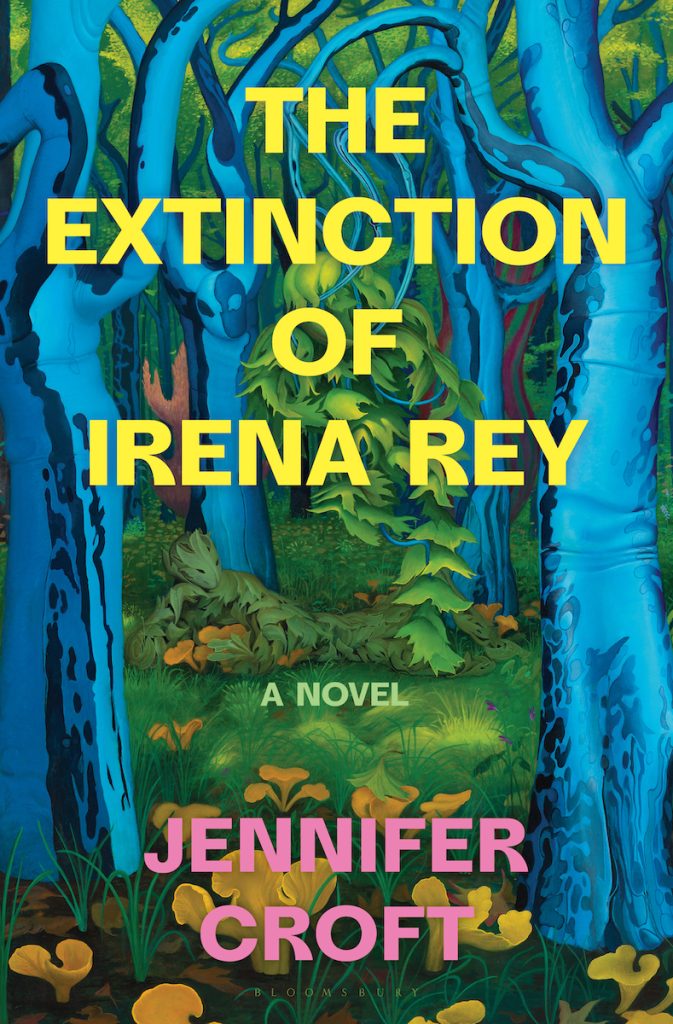
Electric Literature is pleased to reveal the cover for Jennifer Croft’s The Extinction of Irena Rey, which will be published by Bloomsbury Publishing on March 5th 2024. Preorder the book here.
From the Booker International Prize-winning translator and Guggenheim fiction fellow, a propulsive, beguiling debut about eight translators and their search for a world-renowned author who goes missing in a Polish forest.
Eight translators arrive at a house in a primeval Polish forest on the border of Belarus. It belongs to the world-renowned author Irena Rey, and they are there to translate her magnum opus, Gray Eminence. But within days of their arrival, Irena disappears without a trace.
The translators, who hail from eight different countries but share the same reverence for their beloved author, begin to investigate where she may have gone while proceeding with work on her masterpiece. They explore this ancient wooded refuge with its intoxicating slime molds and lichens and study her exotic belongings and layered texts for clues. But doing so reveals secrets—and deceptions—of Irena Rey’s that they are utterly unprepared for. Forced to face their differences as they grow increasingly paranoid in this fever dream of isolation and obsession, soon the translators are tangled up in a web of rivalries and desire, threatening not only their work but the fate of their beloved author herself.
This hilarious, thought-provoking debut by award-winning translator and author Jennifer Croft is a brilliant examination of art, celebrity, the natural world, and the power of language. It is an unforgettable, unputdownable adventure with a small but global cast of characters shaken by the shocks of love, destruction, and creation in one of Europe’s last great wildernesses.
Here is the cover, designed by Patti Ratchford, artwork by Inka Essenhigh.
Cover designer Patti Ratchford: “While I read The Extinction of Irena Rey, I immediately thought of a show I had seen a few years back by the artist Inka Essenhigh. It featured these fantastical portrayals of nature that I thought would be perfect for the surreal, lush setting of the book. But when I looked through her work, nothing quite fit. So, I moved on and developed other covers, but still I couldn’t get anything that fully captured the humor, mystery, and energy of the story. Just after abandoning another attempt, I heard that Inka was just closing a new show and, unbelievably, there it was: the cover. A fantastical primordial forest where the trees somehow look like people gathered around a leaf figure cradling mushrooms sprouting from the ground. What can I say, the art is as wonderous as the story.”
Author Jennifer Croft: “This is my absolute dream cover—Inka’s gorgeous painting is a perfect match for the dreamy forest atmosphere of The Extinction of Irena Rey! I love the twilight-blue trees that seem to be dancing, and I love the slightly scary way all of their branches tangle/intertwine. There are so many fungi in this novel, and I’m thrilled to see them featured in the foreground here, in addition to the lush, gorgeous greenery and those occasional, much-craved splotches of sunlight. I’m so grateful to the artist for trusting us with her exceptionally powerful and evocative piece!”
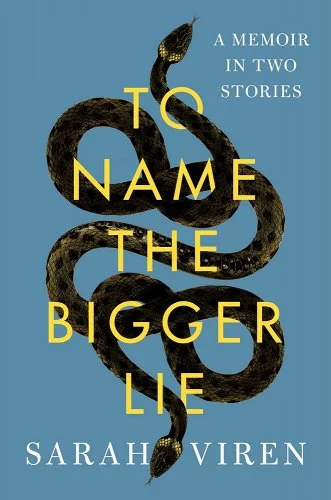
In 2019 Sarah Viren’s wife, Marta, was subject to a Title IX investigation for sexual misconduct. The allegations, which appeared via Reddit posts and emails, were that Marta had offered students wine during office hours, requested sexual favors, and threw wild parties. Viren knew the allegations were untrue—she’d never thrown a wild party with her wife, and the names of the accusers failed to line up with actual registered students at their university— and yet she couldn’t stop herself from occasionally doubting her reality.
At the time, Viren was on the academic job market, and she would later discover that it was an acquaintance, Jay, a finalist for a job that Viren had been offered, who had spread the lies to derail Viren’s career.
These events, it turns out, unfolded in Viren’s life as she was working on a book about conspiracy and truth through the lens of her high school philosophy teacher. Dr. Whiles was a man who was both inspiring and harmful, who taught students to think critically and develop their own set of values, but who also pushed religion and holocaust denialism.
Sarah Viren’s book To Name the Bigger Lie weaves the stories of Jay and Dr. Whiles together, using them to discuss themes of trust, doubt, and deception and to ask the question: how do we know what is real?
I spoke to Viren on Zoom to ask her about punishment, reckoning, and hoping for redemption.
Jennifer Berney: I came to your work through your viral essay in the New York Times Magazine and, like a lot of people, I found it fascinating because of the complicated ways it intersects with #MeToo. I’m curious about what you dealt with in terms of going public with your story, knowing that it might be used to undermine #MeToo or Title IX, to push the idea that false allegations are common.
Sarah Viren: One way of understanding what Jay did was that he weaponized Title IX and he used stereotypes about gay people to prop up the lies that he was telling. There are people who want to dismantle Title IX entirely as it relates to sexual assault and misconduct. And so I tried to make clear within the story that I think Title IX has value. But then, once the story came out, I knew I couldn’t control how it was used beyond just not giving interviews. Somebody wrote to Marta for Fox News, asking her for an interview. In the end, Marta ended up giving one interview to a Spanish newspaper, but we really talked to the interviewer beforehand. And then, after that we just had to let it go. I had to weigh: what are the costs and benefits of telling the story? It felt like the potential harm was that it would be weaponized—which it was—but I felt like the benefits were that it could create a more nuanced discussion of some of these issues.
JB: Does your decision to tell the story align with a philosophy of telling the truth simply because it’s the truth?
I had to weigh: what are the costs and benefits of telling the story.
SV: It feels simplistic to say let the truth out and everything will be okay. But when this article came out, I heard from so many people with stories, and a lot of them were women and people of color—people who are already struggling to have their truths recognized in the larger public sphere. They told of cases in which they had been similarly manipulated, and they didn’t have the clear proof that we did. And I thought that is the value of telling these stories, if it helps others make sense of their experiences or feel less alone.
JB: You write about how you initially wanted Jay’s identity to be revealed for accountability. But then other people found him and outed him, and it’s no longer what you want. But the book continues to long for him to take responsibility and redeem himself on some level. Can you speak to that longing?
SV: Yes, I’ve been thinking about that for a long time, probably even before that happened. One book that was really influential was Lacey Johnson’s The Reckonings. She visited Texas Tech, where I was doing my Ph.D. and people asked her in the audience “What do you want to happen to this man that did this awful thing to you?” and she thinks through that in The Reckonings. I’ve been interested in how we reckon with harm out outside of a simplistic view of punishment. I don’t think that punishment always allows people to reckon with what happened.
What I kept wanting from Jay was a confession. And so I was thinking a lot about confessions. Culturally we’ve gotten used to this idea that a confession brings us closer to the truth, and to a reckoning with. I thought if Jay would just say, “Hey, I did this. I’m sorry.” I really felt like I could forgive him.
JB: Do you think what we might really want through the confession is to feel like the person who harmed us has the potential to change?
SV: Yeah, it’s funny. I have this friend who I talked to a lot during that time period, and she would always say, “I want him to be punished and I want him to hurt.” I think a lot of people feel like if somebody harms you and is punished, it’s balancing something that was imbalanced. But no, I don’t feel that way. If I could know that Jay felt bad and was actually working to not do something like that in the future, that’s what would feel better.
I shouldn’t read comments online, but one person commented on the article something like: “Yeah, it’s fine for you not to name him. But how are you going to feel when he does this to somebody else?” And that does feel bad. That will feel awful. But I don’t know where he is now. I don’t know what name he’s using. I don’t have any ability to stop him.
JB: It seems like we have a cultural narrative about having a responsibility to others once we’ve been harmed by someone.
I’ve been interested in how we reckon with harm out outside of a simplistic view of punishment.
SV: I think that’s a complication of the way we imagine these roles. I was always uncomfortable with the idea of victimhood, because there’s a sort of passiveness to that. But the other extreme can also be this idea that you’re an accomplice if you don’t do enough. Marta was really helpful in thinking through it. Marta would say a lot of times,“If anybody’s responsible it’s these universities that allow this to happen.” Jay was eventually removed from his job in academia, but allowed to quit, so there’s been no public accounting for his actions, and that has to do with institutions not wanting to be sued. And so, there need to be ways that we hold people accountable in situations like this, but it doesn’t make sense to require whoever is victimized to do that. That doesn’t mean that you don’t feel bad. After he was identified on Twitter and elsewhere, a couple of people came forward, men who said they’d been harassed by him. And one of them said, “I feel really bad that I didn’t say anything because maybe this wouldn’t have happened to Sarah.” I think that’s another example of somebody being victimized, and then feeling like it’s their fault because they didn’t stop that person from continuing to victimize other people.
JB: How does this story about Jay connect to the story about Dr. Whiles, your high school philosophy teacher?
I had already started writing this story about my teacher in high school who taught us conspiracy theories but who none of us had really ever confronted. And in that process I kept thinking about how if only we had talked to each other earlier, or if only an adult had intervened and said like this shouldn’t be happening, we might have been able to at least understand it. My friend, who I call Gayle in the book, a Jewish immigrant from Latvia, got close to Dr. Whiles and ended up really confused, and, I think, a little depressed by him pushing her towards holocaust denialism. I often think: Wow, If she and I had just been able to talk, it might have helped her push back against some of the gaslighting that was going on in his classroom. And so I’d been thinking about that.
I felt like these two stories really spoke to each other, but I could not articulate how. When I sold the book on proposal, I couldn’t structurally tell how it was going to work. But rather than braid these two stories together, I wanted to show the interruption of the Jay story, and the way that often those interruptions in life will help us understand something. I think that so often something unexpected happens that we feel like is unrelated to whatever it is that we’re dealing with, and it ends up being the thing that brings clarity.
And so what happened with the Jay story was that there were moments in which I was doubtful of myself in a way that was very similar to how I felt doubtful of myself when I was younger, and there were moments where I felt like: why is nobody freaking out? And so that’s what I tried to write into. But then figuring out how to structure it was hard beyond the fact of starting a story, and then having the Jay story interrupt it. I did want to do something structurally different, and I thought about Plato’s Allegory of the Cave, where the cave has four parts and so that four-part structure felt essential to the story itself in the end. For the last part of the book, I started doing these imagined dialogues.
JB: In that last section you include real present-day email exchanges with Dr. Whiles, and I found myself feeling really nervous for you as a narrator in the book, navigating those email exchanges.
You know, I had the book mostly written, and I really thought, Oh, I’ll reach out to Dr. Whiles. I really didn’t want him to agree to the conversation because I didn’t want to deal emotionally.
JB: I was so surprised at that section because I wasn’t expecting him to become a real, present-day person.
SV: Yeah, I wasn’t either. I was thinking, I’ll just imagine him, and it will be okay. And he did initially say no and I could have left it at that. There was a journalist part of me that was like, no, you just don’t do that. You have to keep pushing. And I did. I think the people we write about, even when they harm us, they still deserve the respect of being fully-formed. Because nobody is a monster, right? And so I was really thankful that he responded, and I could see his pride and his vulnerabilities, and I was able to read some of his moves for what they seem like now—blustering, you know. I don’t think that I realized when I was a kid that he was sort of enamored with his own greatness. I just thought he was great, and so I think, seeing that weakness helped me to see him as more human. And when he finally cut off the interaction, I felt the same rejection and feeling of being shut down that I used to feel in high school.
JB: By the end of that section it feels a little unresolvable to me, the way Dr. Whiles was both a pivotal figure in your development and someone who did you great harm. Does that seem right?
SV: Yeah, I think that’s right. And I think it’s made that much more real by the fact that we get to see him in his own present day terms. It’s so much easier to think that those that harm us are just bad people, or to write them that way, but also in your life to create a narrative in which they exist that way, because it’s just easier to deal with them.
There are awful people in the world, but in these two cases—well, Jay is a complicated person I feel sorry about. I’m not sure that he himself helped me. But Dr. Whiles did. And so the idea is to acknowledge the complexity of it, and sit with it and exist with it, and then also to sit with the fact that he didn’t change. You talked before about me wanting to feel like Jay had changed. I think with Dr. Whiles, I was hoping for something similar.
When he became real, I was able to reckon with who he was, what happened, and the complexity of him in my life. But it also didn’t feel like he acknowledged or could acknowledge having harmed anybody else, or that he had necessarily grown.
I will say there was one person, a friend I had in high school. He was very religious. He wrote in my yearbook, something about how I was going to hell because I was bisexual. He’s now a pastor, and I interviewed him in the book. When I told him what I remembered he recognized that it was real, and he felt bad that he hadn’t recognized it at the time. He said, “You know, I’m sorry. I think I just didn’t have stakes in the kind of harm that Dr. Whiles was causing.” But the fact that he could acknowledge that—I mean it’s not the same as having the perpetrators grow, but it did feel like okay, there are people that are growing. We’re developing and changing. They’re just not necessarily the people we want.
Nearly forty years before the Stonewall uprising—often incorrectly pegged as the moment in history when queer people first began experiencing pride in our identities—Ruth Fuller Field, writing under the pseudonym Mary Casal, published her autobiography, The Stone Wall, where she details a life largely defined by her ferocious pursuit of women.
Even then, Field wasn’t ashamed, nor was she interested in hiding her desire. It felt like the most natural thing in the world to her and when she met Juno, a woman with “the most beautiful hands” in 1892 on her first day in New York City, she began a “rapturous period of wooing”. A bouquet of violets, a trip to the theatre, a kiss—Juno became the great love of her life. It’s striking to read that not only was Juno introduced to Field’s family, but that, considering the time period, it went so well. “Juno and Mother loved each other from the very first. To her death, my mother was always happy in our love and friendship for each other,” Field writes in The Stone Wall. (Any speculation on the connection between the name of Field’s autobiography and the name of The Stonewall Inn has been so far disproven.)
Their 200-year-old lesbian love story is one of the many documented in historian Amelia Possanza’s new book, Lesbian Love Story.
It’s a sexy, illuminating tour through sapphic history. I spoke with Possanza, who is also the Associate Director of Publicity at Flatiron Books, about the history of lesbian resistance she uncovered, how queerness has been criminalized throughout history, and the lesbian stereotypes that have persisted: “We had a lot of pre-1950s U-Haul situations.”
Jeffrey Masters: There’s a moment you write about where you say you decided to become a “collector of lesbians”. Can you talk about that moment and what you meant by that?
Amelia Possanza: I feel like that is sort of at the heart of what I was setting out to do. I grew up without a lot of lesbian role models in pop culture and history. My mom is a librarian and my dad is a classics professor, so I was surrounded by books. The fact that there wouldn’t be a lesbian in a single one was wild to me.
The moment you’re talking about was when a friend on a queer swim team I had joined—you know, a place to go find lesbians or at least be seen as one—did not recognize me as such. And part of me had to forgive him because I’m like, If I’m not seeing them out in the world, where would he see them?
In the spirit of my librarian mom and the literal card catalog in my house growing, I want to make the little card catalog of lesbians for myself and invite other people to come add to it. I’m not going to find them all. So, I took the lack of representation that I saw growing up along with my love of reading and collecting things and put them together.
JM: For the earlier stories you write about where they didn’t use or self-identify as lesbians, how did you grapple with that?
I was interested in who took the risk to live an authentic life, and to be queer.
AP: I think what really intrigued me was to sort of take people on their own terms and use the words that they used. For some of them, like Mary Casal, who didn’t call herself a lesbian, I discovered that she had been asked to write this autobiography by sex researchers and they called her a lesbian. Some people think that the word may have been removed from her autobiography because we don’t have the original edition. It was edited by these two men who asked her to write it. While she didn’t use the word lesbian, she was very much in that milieu. It was attached to her.
I wanted to be really careful. I didn’t want to write a book about people who were suspected to be lesbians. I was interested in who took the risk to live an authentic life, and to be queer. Mary, she doesn’t use the word, but what I love about her and why she ended up in the book, is because her whole book is about her passionate love for another woman and feeling like she was out of place. She was like, “I don’t want to marry a man. What’s wrong with me?”
JM: I found Mary Casal so compelling because she was living in the late 1800s, early 1900s, and she wasn’t hiding or suppressing her desire for women. We’re often told that this embrace of one’s queerness only began after Stonewall.
AP: Yeah. For a long time people in my community were like, Oh, we’re living at the best time to be queer. And I think now, we’re all really starting to question that. This is maybe where the queer people I’m writing about are separate from the stories of queer men. They were sort of given the grace and were able to have really close, intimate friendships with men. They could live together. And around this time, when Mary was alive, women could get an education and have their own jobs and make their own money. They didn’t need to get married to have a husband’s income. And it was this little pocket of time before queerness really became pathologized, when they could live almost openly. Mary even told her mom what was up and her mom was just like, whatever. Go for it.
JM: Criminalization is a recurring theme. The law was being wielded against queer people in almost all of the stories, which feels, unfortunately, prescient today.
AP:Hugh Ryan was such a huge inspiration for me in his book. His second book, The Women’s House of Detention, is so much about how in the early days, prison was a place to put a woman who wasn’t a woman “in the right way”.
JM: He writes that a woman could be locked up for wearing pants, smoking, or simply staying out late.
AP: Also, the definition of prostitute used to be like, “Oh, you’re alone on a corner”. That could be considered solicitation or prostitution. And it’s sort of like, if they truly are a prostitute, there’s got to be customers right? But they’re not going after the men.
I should also give a little asterisk that so much of this depends on who you are. If you’re a Black woman, how you’re presenting in the world…many of these rules were built for middle-class white women.
JM: Going into a project like this, you had certain expectations. What surprised you the most in the research?
I want the sex scenes. I want the romance.
AP: I was struck by how much resistance these lesbians put up. I think I was like, “Oh, I’m going to find romance.” People had their sweethearts and there was definitely a lot of that, but every single one of these people found a way to carve out a space for resistance and refuge. One of the lesbians, Rusty Brown, was being sent to Bellevue for shock treatment and had the intelligence to ask someone what shock treatment was, then steal someone’s uniform, and run out of there in the nurse’s uniform. The resilience and rebellion that was eye-opening and it was not what I went in expecting since I was like, “What’s romantic love about?” I think the definition of lesbian, as it’s grown and shrunk over the years, is about so much more than that.
JM: So much of the queer and lesbian experience has changed in recent years, but what hasn’t changed? What are those overarching commonalities that still exist?
AP: One unexpected, surprising thing, which is maybe telling since I unconsciously picked people who are a little bit like me in their presentation, but everyone was either made fun of or self-identified as sort of hairy or not beautiful. I loved the repetition of that. They were hairy or unsightly or just bad at performing gender. Rusty Brown was literally arrested in a dress for being a female impersonator and went to jail and she was like, No, no, I’m actually a woman. I’m just really bad at walking in heels. And no one believed her.
Andthe other commonality that surprised me, which is such a huge lesbian trope, is a lot of these people found a partner and they were like, Great. Move in with me. We had a lot of pre-1950s U-Haul situations.
JM: Can you talk about the format? It’s not a traditional history in that you fill in gaps and create scenes for the characters based on your research. Was that something you found in the writing process or was that always the plan?
AP: It was something that I found in the writing process. I want the sex scenes. I want the romance. And if you’re reading something that was edited by two men who self-identified as sexologists and wanted to publish something that they didn’t want to be branded as an obscenity, it’s not there. Who knows if Mary Casal wrote some really explicit moments that were taken out? But I want to have those. And I also think a lot of times in academia, there’s a questioning of like, Oh, no, they’re just friends.
I wanted it to be the kind of juicy emotional history that, unfortunately, I don’t think we’re going to get. And part of me too felt a little bit of that anger that we don’t have this because there are all these rigorous rules about history. I wanted to give myself permission to defy them because these rigorous rules haven’t been helping marginalized groups.
What I also found in the writing process was that they are all actually overlapping, right? Mabel Hampton’s chapter is the second one and it’s a lot about the 20s and the Harlem Renaissance. But she lived through World War II, so there’s this opportunity for her to come up again. I think that also created some moments for imagination. It was interesting to think about where their circles or timelines overlapped. They’re not seven separate, totally isolated stories. One is flowing into the next.
JM: There is also the inclusion of Amy Hoffman (Hospital Time) and Mike Riegle. It’s an intimate, yet platonic relationship in a book about love stories. Why was that important for you to include?
AP: I feel very tender about the two of them. I started out being like, Hmm, what’s my love life going to be like? How am I going to solve the mystery of my love life by asking other people about theirs? I think eventually it became about the ways that all of these forbearers of mine are living outside the usual script. Friendship then became a really clear way that that happened. Going back to the law, so many state-sanctioned resources are tied to marriage and weren’t an option.
I’m very intimidated by Michel Foucault. Toward the end of his life, he gave this beautiful interview with a French magazine called, “Friendship as a Way of Life.” This young man was interviewing him and was like, “What does it mean for you to be gay?” And he says this beautiful thing about how the point of being gay is not like, Oh, I need to analyze my own sexuality and come to the truth of it. It’s about asking, what are the relationships I can have in the world? How could they be different? I’m gay and I just loved that. I was so moved by that.
After four years of writing and rewriting a story close to my vulnerable heart—about traveling home to attend my estranged mother’s wedding—the essay finally appeared in the Huffington Post. My best friend Ellen read it seconds after it went live. She texted me her favorite lines, sending my words back to me with affirmations. She also sent a screenshot of the line, “I cried on the floor of the airport bathroom.” You called me from the bathroom floor, she texted.
On that floor, I stared at a text from my mother telling me I was no longer welcome at her wedding. I crouched under the fluorescent bathroom lights with my head between my knees and called my best friend. I can’t recall what Ellen said. I remember it was exactly what I needed to hear.
In that essay, I wrote about my husband, who had been by my side for the entire trip (except when he waited with our baggage while I panic-called Ellen in the bathroom). I wrote about my mother, whose love I desired most, even as Ellen reminded me my mom did love me, if in the limited ways her strict religious community allowed her to express it. Ellen supported me throughout the entire experience, but I never mentioned her in the essay, not even in passing. It didn’t even occur to me to include Ellen into the story. After she read the essay and saw herself in the narrative, I realized I wrote her out of my family drama, though she’s as close to me as family. All of my publications are about sex and love, relationships and family. I’ve written about all forms of nontraditional romantic relationships, about chosen family and expansive love in polyamory. Yet, I’ve never written about friendship. Until now.
When I realized that I had written Ellen out of my personal essay, I returned to the memoirs that inspire me. How had others written about their friends? I was searching for a literary legacy of writing friendship. Over and again, I noted that friends are often mentioned only in passing. They appear as ever-present sources of support, yet are seldom developed into plot lines or characters. Rebecca Solnit frequently mentions friends in Recollections of My Nonexistence, her memoir on finding her voice and becoming a writer. Few of them are named, all are written about with love and gratitude for their place in Solnit’s story. In Abandon Me, Melissa Febos writes several times about her friend Amit, but usually in just one or two sentences at a time. Yet Amit appears frequently: supporting Febos, being stood up by Febos, writing with Febos at a dining room table on a Saturday morning. Carmen Maria Machado’s memoir, too, about being in an abusive relationship, includes passing mention of a friend who helped her first realize she was being abused—a critical relationship in the story of her recovery. This friend is a mirror who allows Machado to see herself. But we, as readers, never see the friend herself.
A network of friends can muddle a storyline—but I also see it as a sign of a rich life.
I wondered if earlier drafts of these memoirs had included more, if these friends were once complete characters. In my imagination, I saw an editor cutting a friend out in order to simplify the narrative. I have, at least once, cut a friend to get an essay under the word limit. I’ve been in workshops in which someone found the additional “friend character” confusing. I myself have advised students to write a composite character instead of including a crowd of friends. It’s true: these kinds of revisions can streamline a narrative. A network of friends can muddle a storyline—but I also see it as a sign of a rich life.
The erasure of friends has roots much deeper than the editing and review process. The problem is that friends don’t fit neatly into the Hero’s Journey. In 1986, Ursula K. Le Guin implored writers to see past the familiar ease of the Hero’s Journey, shaped like an arrow, centered on conflict, and, importantly, featuring men’s stories. Hunter stories in which violence and domination drive the plot. Le Guin argued that it left out women’s experiences, the gatherers whose days may not be filled with conflict but are busied with care and small pleasures. And yet, the Hero’s Journey is still the dominant narrative form. An earlier version of my essay about my mother’s wedding received a kind rejection; the editor explained that the essay was important, but that the story was “too quiet.” The earlier version was a subtle story of unspoken love between mother and daughter, driven apart by a religious cult.
I revised the essay into a classic Hero’s Journey: I made myself the protagonist, on a journey back home and back into a cult. It was a quest: I would save my mom, or at least salvage our relationship. My husband was at my side, a supporting character, but the story was mine and my mother’s love was the treasure. There was no room in the Hero’s Journey to acknowledge that I was falling apart the entire time. There was no room to show how Ellen helped piece me back together.
As I drafted this essay, I texted Ellen: Why haven’t we written about each other? Seconds later she replied: What would be the conflict? It’s true. Our friendship lacks the competition that we both found so riveting in Elena Ferrante’s Neapolitan Novels. We disagree at times, but it’s usually petty. I’m sure I’ve disappointed her, given that I have no clue how to support her journey as a mother. In fact, I was afraid that motherhood would draw her further from me and closer to her mom friends. That hasn’t happened, but I know it’ll be a few years before I can hope to resume our regular happy hours. And I know I’ve hurt Ellen when I’ve gotten on my soapbox a time or two, when honestly saying less would have done just fine.
Ellen once told me that she’d started to write a fictional version of our friendship. As I’m writing this essay, she’s revising her novel. Last month, she texted: I just tried to write from your POV and it was the first time this new book felt . . . easy and alive. To which I responded: I hope it inspired you to write something slutty.
In All About Love, bell hooks reflects on the dearth of stories about love outside of traditional families. She identifies the “privatized patriarchal nuclear family” as the single model in which love stories are told. The nuclear family eclipses all other forms of love, and stories of men’s desire overshadow everything further. For bell hooks—and me—the love among friends is the foundation on which we learn the art of loving. In friendships, women find “our first glimpse of redemptive love and caring community. Learning to love in friendships empowers us in ways that enable us to bring this love to other bonds.” Friendships are how we learn that love is a verb—but the stories of it take shape outside of grand narratives. They lack heroes and conquests.
Friendships are how we learn that love is a verb.
Instead, stories of friendship celebrate the quotidian rituals and small graces. Each friendship has its own rituals. For Ellen and I, watching The Great British Bake Off every Tuesday at 7:30, just after she puts her daughter down for the night, has become its own ten-week holiday season. Ellen’s refusal to let me help with dinner is a commandment. We share the same dream of what a Liz Warren presidency would have been. Ellen texts how are you? each day when I’m depressed. We can both text how’s the writing going? without provoking distress.
If I were to tell the story of the love between me and Ellen, where would I begin? I could start on the 24X bus connecting downtown Santa Barbara to the University of California Santa Barbara, where we both teach writing. Ellen held a different hardcover book from the library each week. We sat toward the front of the bus, two thirty-something white ladies in business professional clothes and sensible shoes, reading novels on our commute. At first, we discussed books, then teaching, then our opinions on all of the overrated male authors. Twice a week, the same routine. Slowly, over bus rides to work, then walks around the lagoon on campus, and then happy hours at the cafe closest to the bus depot, I stopped being intimidated by Ellen the brilliant writer and became enamored with the woman who was my friend. It’s boring content for a love story, but it’s the routine on which our friendship blossomed.
And next? When did our relationship build in intensity? One day does stand out above the rest: In 2019, Ellen and I had a standing Thursday night happy hour at the Endless Summer Bar and Grill on Santa Barbara’s harbor. We chose that spot for the half-price bottles of wine, pink sunset views, free stale popcorn, and bartenders in Hawaiian shirts who always gave happy hour discounts even when we arrived too late for happy hour. We vented about the petty inconveniences all teachers complain about: students who email questions that are easily answered by the syllabus and colleagues who only use reply-all. We talked about the sunset and its hues. We likely complained about yet another New Yorker article that was generating discourse. On this specific night, Ellen shared that she’d realized she was addicted to Excedrin, which she described as the most boring kind of addiction. I had recently realized that my mom was going to get married. Over a few glasses of discount wine, we tossed around the questions: What could knock out Ellen’s migraines if all the medicines caused more problems? Did I even want to go to my mom’s wedding?
“If you go, you could write it. I’d read that essay,” Ellen told me. “I’m not saying you should do it for the content, but you could.” Ellen listened to my story about my mom, and she wanted to read my memoir. She was the first person to tell me that she cared about my story. I hope I said similar things about her writing life, hearting each tweet and listening carefully for every thread of an idea that she talked out over drinks or long walks.
I biked home with a buzz and began writing that night. I kept writing. Ellen told me that my story mattered. Then, in the following months, she taught me how to write it. I wrote about my mom. Ellen read drafts. She listened as I sorted out memories I hadn’t dwelled on in decades. With her help, I learned I could actually rewrite myself: not a rejected daughter but a cult survivor. I spent four years writing and rewriting the story of my mother’s wedding. In the meantime, I published other personal essays, but my identity as a writer started with that essay about my mom’s wedding. I wrote it for Ellen and I’m a writer because of Ellen.
—But wait: am I doing it again? Am I writing the Hero’s Journey, just with Ellen playing protagonist? She is, after all, armed with a pen and encouraging words. Every time I publish a new essay, I tell her: “You told me my story mattered and taught me how to write it.”
“I love you,” Ellen says, “but you’re giving me too much credit. You were always a writer.”
She’s right. I already had a PhD and a long publication history of scholarly articles about women and their desires, and how they cared for one another, even if I never wrote about my own life. In making Ellen the hero who empowered me to write, I’m making the same mistake. In order to fit my story into the classic form, I’m erasing something—this time, part of my own history and agency. And, of course, I’ve also erased other friends who told me to keep writing.
At the end of the day, friendship isn’t a transaction. We don’t tally up who helped whom the most. I’m not Ellen’s friend because she told me my story mattered one day at a bar. I’m her friend because we narrate our lives to each other first.
Friendship need not be a grand narrative. When I looked for friends within my favorite memoirs, I was also looking for heroes, for a literary legacy of friendship, for the people whose smaller roles nonetheless created significant pivots in the narrative. Friendship doesn’t need a man on a loudspeaker or a soapbox. Le Guin offers an alternative to the hero’s narrative: the carrier bag. She writes, “The natural, proper, fitting shape of the novel might be that of a sack, a bag. A novel is a medicine bundle, holding things in a particular, powerful relation to one another and to us.” The story of friendship can’t be told in a straight line. It can’t be told in one voice. Conflict isn’t its most important feature. The monotonous but enduring care is what holds it together. Friendships are the stories of how we hold ourselves together.
The story of friendship can’t be told in a straight line. It can’t be told in one voice.
This past summer, Ellen and I reached a relationship milestone: we went on our first vacation together. We were both invited to be writers in residence at a writing workshop on a Greek island. For two weeks, I woke up and had breakfast with Ellen. Rich Greek yogurt, homemade feta, ripe strawberries, local coffee, and fresh bread: the meals themselves were worth writing about. Ellen and I sat at our table shaded by thick blackberry vines while her toddler Louisa licked butter off of bread in her highchair. Ellen drank English Breakfast tea with milk. I drank hot coffee (even though it was 85 degrees in the shade by 8 AM). We agreed that the apricots were the best we’d ever tasted, and that the peaches were better in California. We lingered for over an hour, until we were both over-caffeinated, and then settled in to write.
Each breakfast was a practice of loving. It was boring content. There’s no place for heroics at the breakfast table. Each day was the same as the one before. Each morning was like the last. Some days we got eggs, other days there was sausage. Once or twice, I could dish out some gossip from the night before, after Ellen had gone to bed. We lingered as if eating breakfast was the reason we’d traveled seven thousand miles to a Mediterranean island. Our breakfasts became the quotidian ritual of our friendship.
What makes friendship beautiful—its subtlety and its bonds of love that don’t ask for visible commitments or grand gestures—is what makes friendship difficult to write about. Friendship asks us to tell quieter stories. It requires us to listen to the ebb and flow of everyday love. As we listen to those stories, we also learn to listen for the myriad of ways that love shows up in our lives. Our friends’ love isn’t shouted from the rooftops—but it may be declared with a casserole. It can be expressed with daily texts, and also with infrequent three-hour long-distance phone calls. Our friends teach us how to speak our love in as many different ways as we have different friends. Each story may be quiet, subtle. But together, each friend’s voice echoes through our lives, building a chorus of love that demands to be heard.
A man stormed into the lobby, straight to the front desk. Mohan was used to the disgruntled; they would come in with authority and demand that they speak to someone. Of course, they ignored that in talking to him, they were, in fact, speaking to someone.
“I’m sorry, sir. I’m not sure, and I don’t really have any control over that. I can have someone contact you, though. What did you say your name was?”
The man slammed his palm on the desk, and Mohan offered a robotic nod.
“If you don’t mind waiting, I can go back and check if someone can see you without an appointment.” Mohan stood. It was well after midday, and he had yet to have lunch. A headache began to coil somewhere between his eyes and the back of his skull.
“No. You look at me.”
His voice was grating. As Mohan looked up to the man’s face, he thought of a lawn mower ripping grass.
“I’m not waiting for anything. You better believe that every last one of you will be hearing from my lawyers.” The man turned and, on his way out, swept the contents off a coffee table and toppled the large rubber tree Mohan was tasked with watering.
“Hey!” Mohan shouted. But the door swung shut. Magazines and mints littered the carpet in the man’s wake. Mohan’s headache worsened.
Mohan’s boss told him he could leave early after tidying up the mess.
When he finally stepped outside, he felt like he might vomit. The air felt muggy and tropical, heavy with the smell of rotting fruit. Yet reports said it was a typical, chilly November afternoon.
He drove with the windows down, but humidity seemed to collect in the car. At a traffic light, his heart began to thump along with the rapid beat of the radio. A truck revved in the next lane. Mohan glanced at the driver—a man with large, obstructing sunglasses. Red turned to green, and the truck sped ahead. Mohan stared at the license plate as it shrunk in size. Someone honked from behind, and Mohan raised a palm in apology before stepping on the gas. He swallowed a ball of mucus. Was a fever next? He felt his forehead: damp. His shirt clung to the hairs on his stomach.
At home, Mohan collapsed on the sofa. Nikita, his girlfriend, had also just arrived. They lived together there—the same house he grew up in.
“You finished early?” Nikita joined him on the couch, head to toe.
“I think I’m getting sick,” he said.
“I haven’t been feeling great either. I don’t think we slept enough this past weekend.”
“Should we go pick up some things?” he asked.
They parked outside a supermarket, with a written list in hand: cough syrup, expectorant, vitamin C.
Inside the store, Nikita inspected the backs of over-the-counter products, appraising generic against brand name. Mohan watched her absentmindedly toy with a particularly distinct curl; he studied this with the awe and affection that her habits inspired. But then, the thought devolved. He remembered the shower drain, how it had sluggishly gulped water that morning.
“I’ll be right back,” he said.
He tried to decipher the difference between various drain snakes—metal, liquid, plastic. A figure approached.
“Man, I have to buy one almost every month. Three daughters will do that to you.”
Mohan let out a sympathetic chuckle and turned. It was the man from that morning. He thought back to the office. Before Mohan had been allowed to leave, his boss had disclosed some details, the heinous amount the man had lost in an ill-advised sale. Mohan recalled his name.
“Simon, right? This is, uh, a coincidence.”
“Pardon?”
Mohan recognized his grating tone.
“If this is about earlier, I am sorry,” he said.
They stared at one another, then Simon grabbed a snake and left.
Mohan didn’t buy anything. He waited in the car and saw Simon pushing his cart toward a parked sedan. Minutes later, Nikita opened the passenger-side door.
“There you are. Did you not see any of my texts?”
“I had to get out of there.”
She frowned and placed the bags at her feet. “Well, if you were wondering, I bought liquid and pills.”
Normally, the drive back required little to none of his attention. It was just six minutes, a blink-and-you-miss-it sort of trek that allowed him to escape thoughts or conversation and then find himself home.
“Mohan!” Nikita shouted. He had just run a stop sign. The driver of a minivan thrust a middle finger at them. There they were, stalled in the center of a four-way intersection. Mohan looked closer. It was Simon, now shaking his head in disgust as he drove off.
“What the hell? What is he doing?”
“Him? You almost got us killed!”
The car was warm, and Mohan rolled the window down.
Nikita shook her head. “It’s too cold.” When he didn’t respond, she turned up the air and touched his arm. “Oh Jesus, you’re really sweating. Should I drive?” She wiped her hand on the upholstery and offered him a pill.
Mohan swallowed it dry and ignored the lurch in his esophagus that threatened to turn to a retch.
They rode in silence.
He parked the car in front of their home and removed the keys from the ignition. Across the way, Simon exited the neighbors’ two-story and skipped to the mailbox. Mohan jumped out of the car and started to scream at him.
Simon froze.
Nikita ran around to Mohan and covered his mouth. “I apologize! He’s not feeling well!”
“What’s going on, y’all?” Simon asked.
“I’m not playing, you need to—” Just as Mohan stepped to cross the street, Nikita grabbed him by the arm and led him inside.
“You need to chill the fuck out!”
“He’s stalking us!” Mohan pulled out his phone and struggled to enter his passcode.
Nikita grabbed it from his hands. “Just breathe. I’m going to get the things from the car and then smooth things out.” She reached for the doorknob.
Mohan rushed to block her path. “Don’t go back out there! I think he’s dangerous.”
“Who is dangerous?”
“Simon—that guy.”
“You mean Mr. Phillips?” She nudged him aside. “Just go lie down for a bit.”
Mohan kicked off his shoes and went to a window. He pulled up a single blind and peered through. As Nikita emptied the car, Simon approached. Mohan tensed, but Nikita just smiled and shrugged as they exchanged words. Simon patted her on the shoulder.
Mohan ran to the next room where they kept a neglected landline. A voice answered.
“A man from work is harassing us.” He took the receiver and went back to the window.
“Sir, are you at your workplace right now? Do you know who this man is?” Her voice was calm.
“No. We don’t even work together. He’s outside my house right now, bothering my girlfriend.” He gave their address.
“Okay, sir, we’ll send—”
“They’re talking right now.” He saw Nikita laugh, and then they parted. “He’s walking away,” Mohan said. He leaned as far as he could against the glass until Simon disappeared from view.
“I’m sorry. Could you repeat that?”
Mohan beat the phone twice into his palm; the battery was old and weak. “I can’t see him anymore. But he keeps leaving and coming back. Earlier at the store—”
The woman said something, but static flooded his ears. He heard Nikita enter and head towards the kitchen.
The voice was audible again, scratchier than before. “Someone is on the way.”
The phone slipped from Mohan’s grasp, and he left it on the floor. The house was suddenly too warm and his body amphibian with sweat. He hurried to the kitchen.
Nikita stood with her back toward him, placing oranges in a bowl. A lineup of remedies stood on the island, the fridge door hung open.
“I really think you should take something else. DayQuil, maybe? You’re not doing well. Luckily, Mr. Phililips was nice about it.”
“What did he say?” Phlegm had pooled in his mouth, his voice was hoarse.
“That you need to rest.” Nikita spun and snapped her fingers to some diddy stuck in her head. Simon had mastered this, the precision with which she bounced on the ball of one foot as she kicked the other—a quirk Mohan loved. He stood before Mohan in Nikita’s jeans and red sweater. With a smile, he placed a hand on Mohan’s chest; the familiar touch now sent a jitter across his skin. Simon popped a Ricola into his mouth, put away a bottle of juice, and shut the refrigerator. “I’ll be right back,” he said. And he left the room.
Mohan’s insides heaved. He turned to the appliance’s gray steel and, seeing the reflection that stood in its cold face, opened his mouth to catch his breath. And out escaped a scream, one that echoed through the kitchen until its sound grew strange and unfamiliar with grit.
When I was growing up in western Canada in the late ‘80s and ‘90s, my sister and I were the only people we knew who were biracial—not quite white, not quite Chinese, but somewhere in the empty space between. I felt like I didn’t belong anywhere. Internalizing both the quiet racism and gender norms I was steeped in, I wanted to be white, blue-eyed, and delicately feminine, but when I looked in the mirror at my dark hair and skin, my broadened face and flat nose, I often felt wrong, even monstrous, like my body on the outside was aberrant to my self on the inside.
Bodies and body parts that seem disconnected, threatening, and grotesque is a running theme across my debut short story collection, The Whole Animal. In one of the stories, “Porcelain Legs,” the pre-teen protagonist, Queenie, fixates on a long, wiry, black hair sprouting out of her mother’s eyelid. Even though she can’t stop looking at it, Queenie is repulsed by the hair—a blatant emblem of not only Chineseness, but also anti-femininity, both of which Queenie subconsciously rejects.
I’m fascinated by BIPOC writers who explore grotesque depictions of bodies as representations of the elusive experience of finding identity for those whose marginalized race, gender, class, and/or sexuality intersect, to profound and sometimes dangerous degrees. Here are some outstanding works of poetry and fiction I’ve recently discovered that navigate this theme in poignant and illuminating ways.
A 376-year-old woman, who gained immortality after ingesting the supposedly lethal deathlily, reflects on her colorful past while her body, which the Chinese government has declared a “national treasure,” finally begins to (literally) fall apart. A group of women deemed the ugliest girls in China are called upon to serve their country by allowing leeches to extract their most fervent memories of suffering from their tongues, to be fed as an indulgence to the gluttonous elites. A twelve-year-old girl struggles to learn how to swim, not only to live up to her half-mermaid, half-frog mother, but also to justify her right to survive. Wong’s collection of short stories is full of vivid, haunting, “body horror” imagery, but also glimmers with dark humour. At the heart of each story is an incisive commentary on the power that familial and cultural history and mythology hold over the way immigrants perceive themselves in relation to their world.
Despite her best efforts to find happiness, Edith Vane just can’t seem to get comfortable in her own skin. She’s out of shape and chronically insecure, both with her new barista-turned-girlfriend, Bev, and in her job as a professor at the University of Inivea, where she tries desperately to earn the respect of her cutthroat colleagues and indifferent students as “a brown woman with prematurely drooping body and face parts.” Even Crawley Hall, the building on campus that houses the English department, seems to be rejecting her, trapping her in its shifting, labyrinthine halls, sprouting suicidal gargoyles, and threatening to be swallowed up by a giant sinkhole in the earth. As Crawley Hall slowly infects the people inside, turning them into zombie-like harbingers of Edith’s inevitable fate, the lines between reality and fantasy, clarity and madness, begin to blur. This novel is a brilliant satire of the monstrous, all-consuming nature of academia, particularly for women of color.
Fragmented bodies figure prominently in this striking collection of poems, as Belcourt navigates the enduring legacy of colonialism, including the violence, both historical and contemporary, suffered by indigenous people. Woven into this struggle are the poet’s visceral reflections on the queer body as raw, spectral, and often abject as it yearns for a sense of belonging and acceptance in the face of restrictive gender norms and toxic masculinity. While the writing is lucid and lyrical, every poem in this collection is a blow to the heart. In “The Back Alley of the World,” Belcourt writes, “make my mouth into a jar / spit inside me / throw me into the air / leave me there / pretend that this is love.” This collection (unsurprisingly) earned Belcourt the prestigious Griffin Poetry Prize, making him the youngest winner in the history of the award.
Horror, sci-fi, and fantasy collide in this extraordinary collection of short stories that defy expectation at every turn. Bodies in these stories are sites of violence, erotic pleasure, and often both at once. In “The Husband Stitch,” women’s bodies are portrayed as grotesque and monstrous, at odds with their role as objects of hedonism and childbearing for men. “Inventory” begins as a catalogue of sexual encounters relayed in unsettlingly carnal detail, and gradually morphs into a tragic lament for human intimacy amid a deadly pandemic. As a collection, this book is a Frankenstein-like challenge to the strictures of genre and a bold re-visioning of gender, love, and sexuality in the 21st century.
This unyieldingly powerful long poem is structured in fifteen numbered “ossuaries,” which together unearth a network of spaces, both physical and metaphorical, to examine how the skeletal histories of black people on colonial lands continue to haunt us in the present. Yasmine, the central character of the poem’s narrative, represents the black diaspora and women of colour simultaneously, as she struggles to come to terms with the injustices and acts of violence, both personal and political, that undergird her tenuous place in the world. Bodies in these poems are dangerous and menacing, a reflection of the ever-present threat of violence that marks the black community’s everyday experience. As Yasmine reflects in “ossuary III,” “I was caged in bone spur endlessly / eye sockets ambushed me, / I slept with harassment and provocations, / though I wanted to grow lilacs, who wouldn’t?”
In Lai’s debut graphic novel, Ray, a cisgendered Asian woman, and Bron, a transgendered white woman, are a queer couple whose close relationship with Ray’s young niece, Nessie, is an anchor for each character’s sense of identity. When Ray, Bron, and Nessie are together, a magical transformation takes place: they shed their human forms, becoming reptilian-looking monsters with sharp, bared teeth and oozing limbs. While they appear wild and terrifying at first, it quickly becomes clear that this monstrous form is liberating for the characters; only when they’re together in their imaginative world, away from the judgments and expectations of society, can they inhabit their true selves. But when Bron decides to reconnect with the ultra-Christian family she was estranged from when she transitioned, all three characters are forced to figure out how love and happiness can still be found without each other. The atmospheric illustrations that make this novel so memorable elucidate the stifling reality of living within the confines of a body that cannot contain the multitudes of the self.
Samantha, a student in her last year of an MFA in creative writing at a prestigious New England university, has grown accustomed to being an outsider. She’s freakishly tall, socially awkward, and lives in a dingy, one-room apartment on the sketchy fringes of the pristine neighbourhoods around the university campus. She writes dark, angry stories that mystify her professors and are snubbed by “The Bunnies,” a glittery clique of young women in her workshop class. And now she’s fallen into a creative slump that’s causing her to question everything she thinks she knows about herself. The Bunnies, in stark contrast, seem to be thriving; they are supremely confident, ultra-privileged, quintessential mean girls. Obsessed with their looks, they fawn over each other in a cloying, artificial way, and exclude anyone who’s not like them from their tight inner circle. Named for their penchant for calling each other “Bunny,” they seem to move through the narrative as a single, manufactured entity, a monstrous amalgam: “Four heads full of white, orthodontically enhanced teeth. Hair so shiny it will blind you to look at it directly, like an eclipse.” But when the Bunnies suddenly invite Samantha to join their “Smut Salon,” Samantha cannot resist her buried desire to become one of them. What ensues is a twisted descent into “creativity,” where bodies become “hybrid” objects to be manipulated, exploited, and even destroyed.
DON’T MISS OUT
Sign up for our newsletter to get submission announcements and stay on top of our best work.
YOUR INBOX IS LIT
Enjoy strange, diverting work from The Commuter on Mondays, absorbing fiction from Recommended Reading on Wednesdays, and a roundup of our best work of the week on Fridays. Personalize your subscription preferences here.