I was a teenager before I learned my father’s real name. During a trip back to Vietnam in my twenties, I discovered he had more children after me, half-siblings I’d never met. It wasn’t until my thirties that I learned how my parents fell in love—over books—and how their story ended, with an unanswered letter my mother sent across the world. I often imagined my father as Bluebeard with his hidden trunk, and thought that if I could ask the right questions—find the right key—he would reveal himself to me. He never did, not really, but I still couldn’t stop searching.
This is all to say that I know something about family secrets, the kind that burrow under all the other stories we hold up to the light. These secrets reveal not only the difficult facts of the past, but how we’ve evolved into the people we are today. They tell the messier stories of human nature, bringing us closer to rage, despair, and, if we’re lucky, forgiveness.
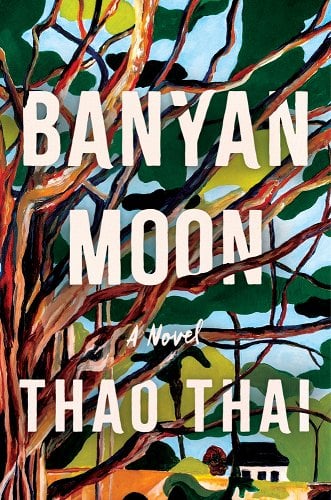
When I set out to write my novel, Banyan Moon, I knew that family secrets would be a central theme. In the book, Ann Tran inherits a crumbling old house in the swamplands of Florida from her deceased grandmother, Minh, a survivor of the Vietnam War. Ann and her estranged mother, Hương, spend months sorting through Minh’s hoarded burdens: walls of creepy dolls, yellowing linen tablecloths, piles of unread magazines. One day, in the musty old attic, Ann comes across a locked trunk that holds the greatest burden of all, a secret that will change the way each of the Tran women interpret their stories—and how they see each other.
The books that captivate me are the ones that explore the dark spaces between families—all that’s unsaid. Often, that’s where we can find humanity and love, no matter how warped. In the end, despite my investigative tendencies, the revelation of the family secret hardly seems the point. The point lies in our desire to search for that darkness, all for a chance to grasp at the truths that bind us.
In 2016, on a whim, reporter Shapiro sends in a sample of her DNA to a genealogy website. To her shock, she discovers that the man who raised her isn’t, in fact, her biological father. Deeply unsettled by this revelation, she grapples with questions about what her parents chose to hide from her, and why. With the help of her husband (also a reporter), Shapiro follows a series of winding threads that take her across the country, where she must navigate the impacts of science, technology, and record-keeping on her own life. In the end, she must determine what constitutes identity, and the extent to which we’ll go to open the closed doors of the past.
Phong Nguyễn, a Vietnamese Amerasian who is Black, is trying to immigrate to America with his family for a better life. However, government officials decide to halt the visa process until he can find concrete evidence that he is the product of a union between a Vietnamese woman and an American G.I., as he’s always been told. This sends him into a frustrating quest with many dead ends and faulty assumptions. Meanwhile, former helicopter pilot Dan returns with his wife Linda to Vietnam in order to try to heal from past trauma as a soldier. But what Dan doesn’t tell his wife is that his secret mission is to find Kim, a Vietnamese mistress he’d kept from Linda during the war. In another timeline, we learn about sisters Trang and Quỳnh, who escape to Saigon in the 1970s to work as bar girls whose job is to entertain American soldiers. All three stories intersect in surprising and touching ways that continue to remind us of the impacts of the war on the Vietnamese people.
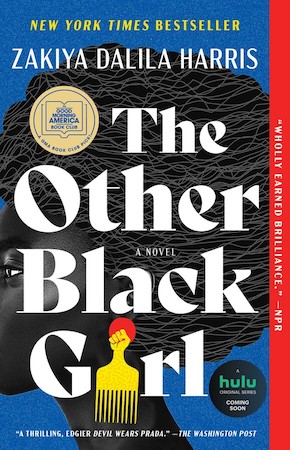
In Georgia, Ailey Pearl Garfield navigates her life between Atlanta and Chicasetta, her rural hometown where her family still lives. Ailey’s thirst for education takes her from her predominantly white high school to Routledge, a historically Black college where her beloved Uncle Root teaches. She wants to be a historian, which prompts her to look back into the history of her family. What she discovers is a more tangled story than she could have ever imagined, illuminating themes of class, colorism, inheritance, and deep ancestral trauma. This epic book is a riveting, unforgettable story of the American South, both past and present.
This essay collection gathers fifteen of the most celebrated voices in contemporary literature—Melissa Febos, Alexander Chee, Carmen Maria Machado, André Aciman, to name a few—to write about the silences between mothers and their children. Here, each author explores seminal experiences from their childhood, such as what it was like to have a deaf mother; whether one can share too much with one’s psychotherapist mother; how to have a relationship with a mother without mediation from a controlling father. Full of heartbreak and hope, this collection articulates the nuanced love we hold for our mothers, well into adulthood.
Four generations of Montrose women all have one thing in common: the mysterious curse that dooms the people they fall in love with to die sudden deaths. Little is known about this curse, except that it originated in New Orleans nearly half a century ago, in a world of powerful hoodoo. In present-day California, Willow and Victoria live in peace with Victoria’s daughter Nickie, until the day Nickie brings a young man home for dinner. This unleashes a series of events that shakes the core of the family, scattering all three women across the country, toward their destinies. Their only hope of reunification is to break the curse, but that means unlocking their silent matriarch Augusta’s past—a near impossible task.
In this memoir, Chung deftly weaves an important story about her experience as a transracial adoptee, and how she came to find her birth family. Growing up, she’d been told the myth that her birth parents sacrificed for a better life. In reality, the story was far more complicated. When Chung became pregnant with her own daughter, she decided to reopen the tidy narratives of her past in order to search for the truth. By transposing her own story with that of her birth sister, Cindy’s, readers are able to follow Chung’s journey to unveiling secrets that transform her relationships—and her own identity as a Korean American woman.
In 2019, Kate is running from an abusive relationship that has taken everything from her. With nowhere to go, she flees to ramshackle Weyward Cottage, bequeathed to her by a great-aunt she hardly remembers. There, among her great-aunt’s belongings, she discovers hints of a centuries-old secret that whispers of magic and violence. Meanwhile, during the second world war, rebellious Violet seeks a way to free herself from the life of convention her father expects of her. As she comes into her own gifts, she begins to ask probing questions about her mother, who died of sudden and mysterious circumstances when she was a child. Her father’s refusal to answer only stokes Violet’s curiosity and determination. In the third timeline, Altha is on trial for witchcraft in the 17th century. She’s been accused of murdering a neighbor, and the final verdict is all too clear to her. These women must fight the desperation of their own circumstances to find their way to freedom—and maybe even joy. Together, their stories paint a compelling portrait of resilience, a trait passed down through the centuries in the Weyward clan, along with the secrets of the past.
An epic recounting the history of the Electric Slide that can also be sung to the tune of The Electric Slide.
I Dream’d A Dream
A stream of consciousness narrative from someone who chose the iconic Les Mis tune at karaoke and now suddenly realizes they absolutely do not have the vocal capacity to sustain the entire song, also it’s really killing the mood.
I Hear America Singing
The judges of X-Factor come together to spill their behind-the-scenes secrets and most cringey audition moments…but in the form of an acrostic.
The Untold Want
A villanelle where a woman secretly hopes her boyfriend will offer to go grocery shopping so that she can watch the Vanderpump Rules finale.
A Noiseless Patient Spider
A tense sonnet of a woman who saw a spider in her apartment but then it disappeared a moment later, so now she lives in agony every second hoping that it doesn’t crawl into her mouth while she’s sleeping.
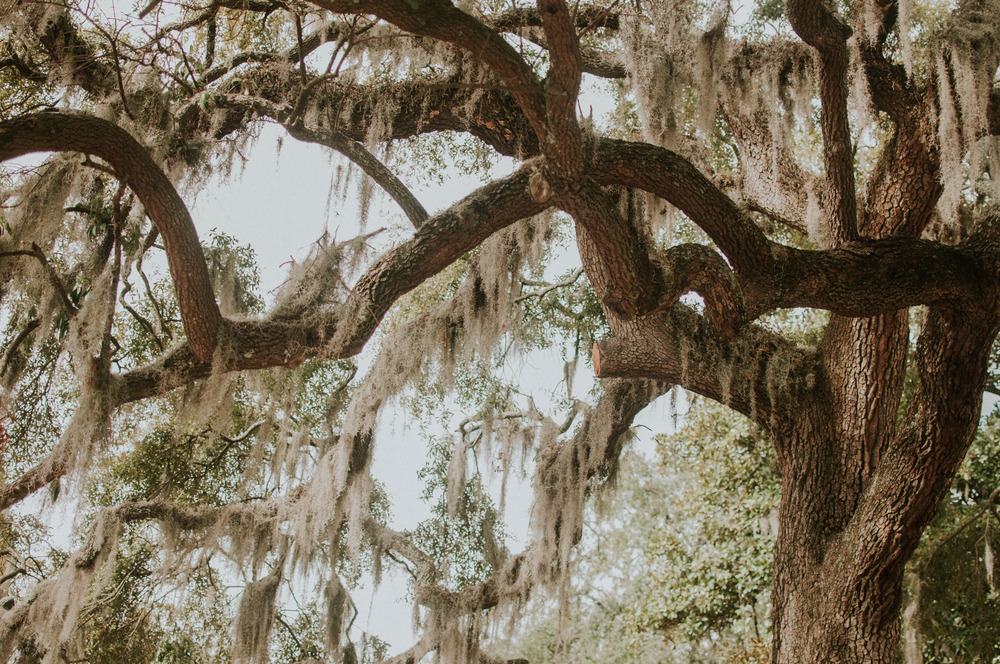
I Saw In Louisiana A Live-Oak Growing
A soothing composition about all the different types of trees the narrator saw in Louisiana and fun facts about them. Essentially a transcript of a David Attenborough show.
The Sleepers
A ballad about a precious little angel baby whose gentle breathing is the beat of the most calming song known to man. The leitmotif is the delicate beauty of the human experience.
Out of the Cradle Endlessly Rocking
A punchy cinquain about an awful little demon baby who somehow has the lung capacity of an opera singer and is able to scream for hours on end for no apparent reason. The leitmotif is the endless pain of the human experience.
Delicate Cluster
An ode to eating one of those Nature Valley granola bars where the entire thing collapses without warning and you are left finding oats crumbles in the folds of your clothing days, or even weeks later.
O, Captain! My Captain
A juicy sestina tell-all from the cast of Dead Poets Society detailing who secretly hooked up, who had big blowout fights, and who accidentally fell off their desk once or twice during the seminal goodbye scene.
Shut Not Your Doors to Me Proud Libraries
A free verse poem where a misfit group of ragtag librarians team up to save their libraries from budget cuts and evil PTA boards trying to ban classic young adult novels. Kind of like Ocean’s 8 but there’s a big section about the dewey decimal system and an army of children armed with Are You There God? It’s Me Margaret storming a school board meeting.
To the obsessed, only one thing in the world has luster: the subject of their obsession. The person or thing we are obsessed with is our only answer to incredible longing. Questions like What is my life about? What is worthwhile and what is not? are easy. The answer is her, him, them, it.
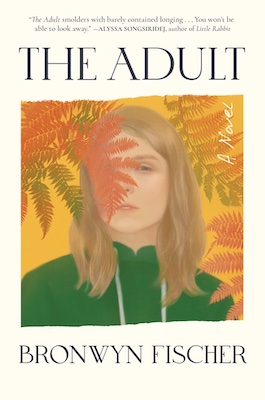
My novel, The Adult, follows Natalie, a first-year university student at the University of Toronto, who has moved to the city from Temagami, a small town in northern Ontario. Deeply uncertain, and lonely, Natalie meets Nora, a 38 year old woman whose unexpected interest gives Natalie a sense of clarity and purpose she has always lacked. The book explores the nature of obsessive romantic love. It asks what we take from one another by loving, it asks what we give, and it asks eventually, what can be salvaged.
The books on the list below encase the intensity of obsessive love. They are at times, devotions to a beloved, they are relics of love’s overwhelm, they are attempts by lovers to stop loving, to remember a different answer to the always-there question— how should life be?
“There are no minor facts in life, there is only the one tremendous one.”
Elizabeth Smart’s work of prose poetry expertly captures the rapturous, all-consuming experience of love, beside which all other experiences pale. Set during World War II, on a journey throughout various states and provinces, Smart shows the ability of tremendous love to make everything around it banal by comparison. The palpable longing in each of her sentences distills the surrounding world, and makes her suffering, her desperation, her love, the only important thing we can think of.
They Say Sarah by Pauline Delabroy-Allard, translated by Adriana Hunter
Pauline Delabroy-Allard tells the story of a teacher in Paris who is swept up in a love affair with Sarah, a violinist. The book is brief and chaotic, as it oscillates between deep loneliness, desire, fear, pleasure, and despair. The emotional intensity of the protagonist shows how responsive life becomes to the beloved. There is no small gesture, no feeling left unfelt. Delabroy-Allard evokes a love in which everything else in life—work, friends, family—fades. She shows how pleasurable this sensation can be, despite the ruinous effects it can have.
Zaina Arafat follows her unnamed protagonist, a young, bisexual woman, through a series of vignettes that take place in the United States and the Middle East. She is riddled with desire, and these longings evolve into reckless romantic affairs and obsessions, and eventually take her to The Ledge, a treatment centre that diagnoses her with “love addiction.” Arafat explores obsession through the lens of self-destruction and introspection; love can be an affliction of the lover and, in this case, her cultural and familial wounds, rather than an obsession with a desired.
Told through a series of couplets, Couplets follows a woman who lives in Brooklyn, with her boyfriend and their cat, who has dreams that rotate around desire and seduction. These dreams become real as she has an affair with a woman she meets at a bar, and enters into new communities—both queer and BDSM—and new forms of desire. Maggie Millner writes of the narrator’s “second first love,” the love that comes after coming out, and the ways that this discovery can feel like a new adolescence, with all of its obsession and sentimentality. While this desire brings about chaos and heartbreak, it also brings about a deeper and more in tune sense of self. As Millner’s narrator says, “For any fierce, untrammeled feeling, / now I know I’d give up almost anything.”
Jeannette Winterson’s nameless and genderless narrator asks, “You want love to be like this every day don’t you? 92 degrees even in the shade.” The book depicts an affair between the narrator and the beloved, Louise, a married woman.
Winterson depicts a love affair based on particularities: in Written on the Body, love is specific. It has a subject, a beloved. Winterson describes parts of her beloved’s body against the anatomical definitions of these parts, for example, drawing into focus the separation between a general understanding of a clavicle, and Louise’s collarbone in particular. This particularity is what makes losing love so painful—as Winterson’s narrator states, “[t]his hole in my heart is in the shape of you and no one else can fit it.”
Esther Yi, conversely, explores the other side of obsessive love: love whose subject is never fully known or understood, despite the intensity of feeling the lover has for them. Y/N follows an unnamed narrator through her obsession with Moon, a member of a k-pop group. The narrator begins writing self-insert fanfiction, in which the reader inserts their name (your/name) and is the main character of a relationship with Moon. When Moon retires, the narrator flies to Korea to search for him, while Y/N journeys towards Moon in their own story. Yi explores our culture’s relationship to celebrity and the kind of love that we feel for people we do not know. Love can, in fact, be a process through which we relate to ourselves, above all. As the narrator’s therapist notes, “[t]he best way to fall out of love is to realize there exists no love out of which to fall.”
Simple Passionby Annie Ernaux, translated by Tanya Leslie
“I had no future other than the telephone call fixing our next appointment. I would try to leave the house as little as possible—forever fearing that he might call during my absence.”
Told from the perspective of an unnamed narrator, Simple Passion is an incisive reflection on a two-year affair with a married man named “A.” Ernaux describes how life transforms itself to accommodate and sustain the affair with “A”, composing an intimate revelation of obsession and passion. Though Ernaux’s novella revolves around “A”, there is a great sense in which her work is not about “A” as an object of love, but rather about the current of feelings experienced by the one who loves. Ernaux gives attention to obsession and love not only as feelings to describe but as ideas to think about. This is a brief and forceful look at a person consumed.
Stories are built on journeys. The best characters start in one place and end in another. They face obstacles, experience setbacks. Sometimes they lose hope. But, in the end, they reach somewhere new. This is the hero’s journey. As Octavia Butler put it, God is change, and watching people navigate change—and move forward despite it—is at the heart of all storytelling.
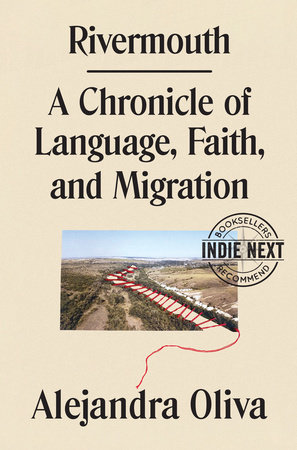
Alejandra Oliva’s new book, Rivermouth, tells the story of multiple journeys, of asylum seekers fleeing political instability in the Global South (made possible by Northern imperialism) only to find cruelty and bureaucratic violence at the U.S border, of her family flowing, like the Rio Grande, between Texas and Mexico, and finding paradise in unexpected places. At its core, Rivermouth is about accompaniment. Oliva grabs her readers firmly by the hand and marches them through the byzantine (often impossible) process of seeking asylum. As we walk with her, she chronicles the societal costs of an immigration system that separates and imprisons families, narrates everything from biblical epics to small moments of care among border communities in Tijuana, and considers how something so fundamentally human—the pursuit of life and protection—became a crime.
nia t. evans: Rivermouth as a title of a story about migration works on so many levels. Can you unpack its meaning for me? How did you come to see rivers as a central theme of the book?
Alejandra Oliva: Rivermouth alludes to a few things. A huge part of the US-Mexico land border is made up of the Rio Grande. My grandmother was born in Brownsville, Texas, which is right at the mouth of the Rio Grande, where the land meets the Gulf of Mexico. But there’s also this idea of the “river mouth,” a place where the fresh water of the river meets the salty water of the ocean. It’s its own ecosystem, a place that’s not quite the river and not quite the ocean. That feels a lot like border cultures and languages. There’s also this idea that a river doesn’t have a singular source. Sometimes a river is a navigation path; sometimes it’s a barrier or a border that you have to cross. It all depends on who you are and where you’re trying to go. That all felt like the right metaphor to be thinking about while writing this book.
nte: This book is about the migration of language as much as it is about people. Can you talk a bit about your experience of translating for asylum seekers at the border. What is lost, gained, and revealed through those kinds of translations? And what principles and allegiances do you hold as a translator?
Sometimes a river is a navigation path; sometimes it’s a barrier or a border that you have to cross. It all depends on who you are and where you’re trying to go.
AO: What is lost is agency. Stories of violence and harm are deeply personal. Violence often strips people of agency. Telling your story, choosing how and whether to talk about it, can be a way of reclaiming power. But when we ask people to disclose these stories for asylum, we are essentially removing that agency from them. We’re saying, “you need to prove that these terrible things have happened to you, that you have suffered very specific forms of violence. And we need you to tell that story in as much detail as you can, regardless of how it impacts you.” As a translator, you can try to make this process as easy as possible. You can find a private, quiet environment. You can give them as much time as they need. But, in the end, you’re still saying “if you want to stay here, I need this story, and you have very little agency in whether you want to share it or not.” And that’s incredibly violent in and of itself.
In the context of asylum work, my allegiance is to the form, to filling it out as correctly as possible. I want to make the process as comfortable as possible, but with the goal of filling out the form as well as I can. You kind of feel the government or whatever forces created this forum and do not care about people’s recovery or healing pressing down on you. You can feel yourself become the instrument of that. It’s painful and difficult sometimes, and you’re doing it to enter people into this system that is deeply violent and dehumanizing. And so, as the interpreter, you’re sometimes stuck in the middle of wanting to do as much justice to this person as possible, but also trying to move them forward and through this system.
nte: You write “asylum seekers and immigrants in detention centers are political prisoners. They are held against their wills for a political belief manifested into action: that they deserve life.” Can you talk about how you came to that realization?
AO: This is true of wherever people are coming to the States to seek asylum from, but I’m going to talk about it in the Central American context, because that’s what people are most familiar with. In Central America, gangs are incredibly prevalent and violent. They’re not controlled by governments in any meaningful way. Many of the people I have talked to left because their families were facing active threats. Children recruited by gangs; women threatened by sexual violence. And with each story they were essentially saying “I deserve a life where my family and I can live without the threat of violence.” That is a political belief. It’s a personal and individual desire for safety but it’s also a political belief that I should have the right to live in a society where I don’t have violence hanging over my head.
You see this in other movements too, abolitionist movements in particular, the assertion that we deserve to live. When people migrate, they do so to make that desire real. They see the United States, for better or worse, as a place where active, pervasive violence will not be hanging over their heads in the same way. They see it as a country where the rule of law is followed. And when they come here, they come here following the laws of this country because you do have a right to claim asylum. They come here and exert that right. But instead of saying, yes you have that right, let’s move you through the system, and find a way to make this work, we put people in jail. We submit them to medical neglect and horrifying conditions.
nte: This is a memoir of “language, faith, and migration.” When most people think about faith within the context of migration, they think of Christ as a refugee. But you write about the Israelites escaping Egypt, the Tower of Babel, the Book of Job, and so much more. Can you talk about the role of divinity, faith, and religion in Rivermouth?
We take these people who have fought incredibly hard for all these values we claim to value as a nation, like freedom and safety, and we put them in jail.
AO: So much of the Bible is people moving from one place to another. You have the Israelites traveling through the desert to get to the promised land, Christ as a refugee, traveling for 40 days and 40 nights. The Bible is full of migration, of different peoples coming together dealing with conflict and translation. A lot of translation theory, which is intimately connected to questions of migration and language, is biblical theory. The very first translators of the Bible were asking “if this text is the word of God, if I translate it, is it still the word of God? How do we preserve that? What is the fairest or best way to preserve this as we move it from one language to another?” In the Reformation, you have all these people trying to translate biblical texts into modern languages, like English, German, Spanish, and French, being treated like heretics because the this was supposed to be language that was inaccessible. It was meant for educated people. And this idea, that some things should be reserved for select groups of people, like say U.S. citizenship or being able to understand this country’s immigration system, is still with us. There is so much elite knowledge that is hoarded for select groups of people, even as it shapes people’s daily lives.
I also think today’s immigrant rights movement is rooted in religiosity and spirituality. You have the sanctuary movement, which uses churches as a place where people who may have deportation orders can stay safe. I spent some time working with the New Sanctuary Coalition, a New York-based immigrant justice organization based out of Judson Memorial Church. There are groups like Never Again Action, a Jewish group that has done some interesting actions around immigration detention and highlighted its similarities to concentration camps during World War II. This isn’t just rhetoric; it’s a moral foundation a lot of people are oriented around.
nia t. evans: You tell horrifying stories about the conditions within ICE detention centers. Just earlier today, border officials confirmed that an 8-year-old girl died in their custody. What is happening in these prisons? And what are the consequences of allowing this mass incarceration to continue?
AO: In that story you can see pervasive anti-Blackness, anti-immigrant sentiment, and Customs and Border Protection not recognizing immigrants as people on a fundamental level. It’s the same tone as that horrific audio clip of Border Patrol agents talking to children who had been separated from their parents, saying “oh we’ve got a real orchestra here.” Of course, these children are crying, they were just separated from their parents after a long and difficult journey. We take these people who have fought incredibly hard for all these values we claim to value as a nation, like freedom and safety, and we put them in jail. We disbelieve and mistrust them. What else is that but political prisonership?
It’s also important to note there are two types of detention. One of them is called hieleras or ice boxes, and those are run not actually by ICE but by Customs and Border Protection. And those are supposed to be places where you stay for a maximum of 72 hours. It’s supposed to be a quick, short-term stay, but in many cases it’s not. These places aren’t set up for long term stays and they are rife with human rights abuses, like what happened to that young girl. There’s also the wider immigration detention system, which is not just for people who have recently crossed the border. It’s for anyone who has been picked up by ICE. There’s usually a mix of people, some have just arrived, some have been picked up by ICE randomly or as a result of contact with the criminal legal system. So, if you get caught shoplifting or in possession of drugs, anything big or small, you go through the criminal legal system. You may end up serving time. And as soon as you finish serving time, ICE will usually be there to pick you up and take you to immigration detention. You essentially serve two sentences, the second of which is sometimes longer than the first.
If you are in immigration detention because of a criminal legal issue, you can’t get bonded out, which is crazy. Those places can be private detention centers like the one I visited in Mississippi, a big jail you would see in Orange is the New Black. Huge dorms, very regimented. Local and county jails also have contracts with the federal government to house ICE detainees as well. And they have the same problems you’d see at any prison: horrific mistreatment, medical neglect, a lack of privacy, dehumanization. There’s also not adequate care taken to ensure staff speak the same common languages as the people detained there, so you have a general lack of communication between staff and people. Theoretically, there’s a person from ICE who comes in once a week and listens to complaints, but as with any bureaucracy that process can get messed up. Immigration detention is unique in that they have family detention centers. Sometimes one parent and their children. Sometimes one parent will be sent to regular detention and the other will be put in family detention with their children. Whole families are put into prison together.
nte: Shifting to a lighter or maybe more complicated note, what was your experience of diving into your family’s history for this book? Did anything surprise you?
AO: I knew a fair amount of our story going in. My great-grandparents felt really alive to me, even though my great-grandfather passed away before I was born, and my great-grandmother passed away when I was probably four or so. My grandmother talks about them all the time. They’re still very vivid people. We still visit the hotel my grandmother grew up at in the mountains in Mexico. In a very magical place, even now. So, there were things I knew, but looking at our story through the lens of immigration was complicated and interesting.
I started looking further back, particularly in my great-grandfather’s history. His last name was Pue, which is a Welsh name. You can trace it back to colonial Maryland, which is where things start getting ugly. I found out that some of my family were slaveowners. It wasn’t a part of history I thought my family would be a part of. But you’re on ancestry.com, 20 generations deep, and suddenly there’s a manifest of their holdings and it includes people. It was shocking. There was some genealogy research that didn’t make it into the book that was surprising to me and made me realized my family’s history goes deep into the roots of this country and Mexican history. It’s complicated and messy.
nte: You recently wrote about the Biden administration’s new asylum laws and the end of Title 42. What are asylum seekers up against now? What? What do you want your readers to know about current policy and how it’s evolved or not evolved?
AO: It’s bad. I’m not an attorney but I’ve worked with many attorneys over the last couple of years. I know how to read these documents and understand what these policies mean for individual people. And I can still barely wrap my arms around this new policy. There are basically two tracks right now. One is for asylum seekers. If you arrive at the U.S. border to seek asylum, you need to have already requested and been denied asylum from any country you passed through in order to apply for asylum successfully in the United States. For a lot of people that means Mexico, a country whose asylum system is as bogged down or more than ours. So, you’re looking at 5-10 years in Mexico trying to adjudicate that process before even having a chance at our border.
Or you can, before leaving your home country, secure yourself a passport, a plane ticket, and a financial sponsor and be awarded something called “parole.” I’m unclear on how or whether parole can lead to a work permit or being able to apply for asylum, but the bar to access parole is purposefully unattainable. This is a program that was rolled out and piloted on Ukrainian refugees who came over last year during the onset of the war with Ukraine and Russia. The difference is that there is a settled and established Ukrainian community here in the United States. There are very few, relatively speaking, Venezuelans living in the United States in a settled way with strong connections to people back home. People who could afford to buy plane tickets and be financial sponsors. The program is not only financially difficult to enter; it’s also logistically and relationally difficult to navigate. It’s also important to note that the Trump administration already tried to do this, and a judge struck it down as illegal. There’s this rehash of rules that have already been tried by an administration by an administration that said they were better than on these issues. These have already been shown to be bad and illegal policies. And all of this was passed not by Congress but by memos and executive orders. They ignored public comments on the federal register begging them not to do this. It feels like there’s no real way to register your displeasure on a policymaking level, which feels infuriating and undemocratic.
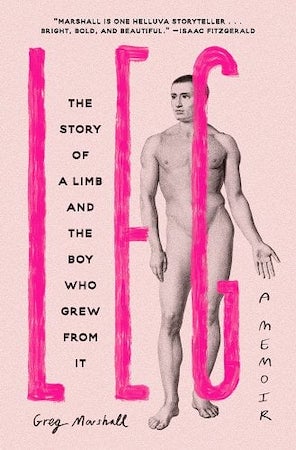
Greg Marshall’s memoir Leg: The Story of a Limb and the Boy Who Grew from It is a brave and hilarious tour de force, taking us through his journey of self-acceptance as he grapples with cerebral palsy, queerness, and the early death of a parent.
By offering us a front seat to the uproarious antics of his quirky and loving family, and sharing with us his sharp and honest observations of past romantic and sexual encounters, he invites us to look back on the more embarrassing and uncomfortable moments of our own lives, and to recognize how these moments have fundamentally shaped us. Vulnerability is a trait that many writers struggle to achieve, and it’s a role that Marshall bravely takes on in his writing, showing how the mere act of acknowledging our physical and emotional vulnerabilities can lead us toward a braver and truer understanding of ourselves.
Greg Marshall and I were newly admitted fellows at the Michener Center for Writers when we first met in 2010. Over zoom, Marshall and I talked about making the leap from fiction to memoir, the role of truth in storytelling, listening to one’s body and its spectrum of differences, and how the queer sensibility can give us the audaciousness to take creative risks.
Monica Macansantos:I know a lot of fiction writers who struggle with the nonfiction form, but you seem very comfortable with it. I was wondering if you could tell us more about that.
Greg Marshall: My writing has always come from a place of humor and, you could say, quirky observation. But when I was willing to write about disability, to closely observe my brain and body, I started showing up on the page in new ways. I knew right away I wasn’t chronicling the misadventures of a fictional character. These were my experiences. They belonged to me. So it became about using the same craft toolkit I’d picked up in grad school—setting, plot, style—to explore my own life. I was using the same voice that I was using in fiction, but nonfiction had much stricter goalposts, which was a good exercise for me. It let me contain what I was trying to do and give it borders and definition, because my fiction, which I love and really want to get back into, was so beyond imaginative—and I don’t mean that in a good way. My last story in grad school was about a father-son duo who have the heads of falcons and the bodies of men, and they run a grocery store in Idaho. Hyper-imaginative stories are great if you can pull them off, but I think that I was exercising those outlandish, imaginative muscles too much.
MM: Your book made me think more deeply about being born with a clubfoot and how I’ve completely forgotten about it because I had corrective surgery as a baby. But then it reminds me at unexpected moments that it’s there, like when I’m running and I trip on it. Maybe that’s one of the purposes of memoir that isn’t often discussed, how it brings out the most vulnerable parts of the reader’s self as well as the writer’s self.
GM: Memoir brings up so many things you might never get around to talking about with a friend, like my leg or your foot. That’s what is delicious about it: you go into the confessional booth and have the most meaningful, deepest, funniest, silliest, strangest conversations that you’ve ever had with another person, because all the niceties are taken away and all of the dead air is taken away. And it’s just the best parts of a person’s story, however you define best: most interesting, most vulnerable, most intriguing.
MM: What I loved about your book is that it’s so embodied. You really took to heart what our teacher, Elizabeth McCracken, told us: that our writing must be embodied because our characters have bodies. In a sense, a lot of your writing ties in with muscle memory. Sometimes you have to listen to your body to make sense of what didn’t make sense in your head.
GM: Elizabeth’s advice was so seminal to Leg! It’s amazing the amount of specificity and feeling and narrative propulsion that you can create just from observing your own body. The most vivid example is, you know, in terms of sex and romance. What does your body do? What is it capable of in terms of pleasure, and does it feel limitations? What hurts, what doesn’t? Having a lover’s conversation with your own body can be really powerful when you want to add specificity to your work, whether you identify as disabled or not.
MM: I guess this ties in with something I said in one of our previous conversations about these parts of ourselves that mark us as disabled. It could be cerebral palsy or club footedness. In your book, you talk about how your parents decided not to tell you about your cerebral palsy in hopes that you would grow up to be this person who didn’t have to shoulder what they imagined to be its burden, or the limitations it would impose on you. Your book proposes that we change that narrative and talk about disability in terms of diversity, rather than as difference.
GM: Yeah, or even just as a spectrum. Disability is a universal experience that can happen over the course of a day or a year. You might experience an injury, you might be in an accident, you might have a new diagnosis. Being disabled is just part of the human continuum. Why shouldn’t it be part of our literature? And by making it part of our literature, we can start to decompartmentalize our conditions. Stories do weird work: by delving into those trashy details we talked about, our personal narratives become more relatable, more universal, more whole. We can accommodate the foibles of our bodies and we can make allowances for them, but we’re really making allowances for our humanity, not just for one specific part of ourselves. That’s the wink and nudge of the title. Nothing to see here, it’s just a leg. And then the book goes in a million different directions.
MM: Your book participates in many conversations simultaneously: there’s disability in here, but also queerness and how these two are intertwined in your life.
GM: Like a lot of gay men, and children of the ‘90s in general, I was fascinated and terrified of the HIV/AIDS epidemic. My obsession started with an Afterschool Special we watched in my seventh-grade science class and culminated, in a terrible way, with the death of my boyfriend Corey at the start of my time as a Michener in the fall of 2010.
Being disabled is just part of the human continuum.
Experiencing a life-changing event like that as I was beginning to study fiction in a serious way—as we were reading Before Night Falls in our first-year seminar with Cristina Garcia—shaped my voice and subject matter as a writer. Chroniclers of the plague like Allan Gurganus, Alexander Chee, and Paul Monette gave me a blueprint for how to write through dark periods with humor, panache, and a sense of resilience.
For as different as they are stylistically, what these writers have in common is that they are willing to go there. They write about everything: the disabled body, illness, sex, family, money, religion, dildos. It’s like they’re laughing in the face of death, flipping death the middle finger, maybe even making love to death—pick your metaphor. The ability to do that seemed intoxicating, to pair outrageously funny with outrageously serious. Like, what could be stranger and more powerful than bottoming for the grim reaper?
I believe it was the poet James Merrill who said that being gay isn’t just a sexual preference. It’s an artistic sensibility, a way of seeing the world. I think there’s something to that: a mix of high and low, innuendo, camp, puns, and a certain neurotic lust for life. I’m not saying only gay people have this sensibility, or that all gay people do, just that it’s a comedy lineage that spoke to me as I wrote Leg. I decided to use my body. I decided to go there.
MM: While reading your memoir, I felt that gayness as a sensibility was instrumental in navigating these experiences of marginalization, and that humor was an intrinsic part of that sensibility. In general, humor helps us cut through the deceptions that we tell ourselves, by making us somewhat more comfortable about these truths that we’d rather not live with.
GM: Comedy does have a way of exposing the truth. Sometimes even a knock-knock joke can contain jaw-dropping honesty just by being literal, and that’s what is outrageous about it. That it just announces the truth in our world full of subterfuge and avoidance.
What I’ve noticed is that the queer sensibility is willing to go there a bit more, to take a deeper cut, to take a more audacious creative risk. To be heard, we’ve had to be louder, and to be understood, we’ve had to be more daring. It helps you go to the embarrassing places, which can be rich fodder for vulnerability and honesty and exploration and help you find a little corner of the human experience that hasn’t been written about a million times.
MM: I feel like kids growing up in Utah won’t feel as timid about writing about their experiences of queerness or disability after reading your book. Once you set an example, people coming from similar backgrounds and experiences feel braver to tell their stories.
GM: I hope that’s true. Once you have a template, you can break it. If you use a canonical coming-of-age story like Tobias Wolff’s This Boy’s Life as a starting point, you can start to filter your own experience through it, like literary cheesecloth, and see what sticks around. Those can be really interesting narrative curds to munch. Are there places Tobias Wolff didn’t go? I’m pretty sure that in the 1950s, he didn’t have his mom’s Brookstone back massager to discover himself. So hey, that’s something new I can write about puberty.
MM: I’m thinking of my own experiences as a memoirist and how a lot of it again ties in with this act of performance that you write about so well in the book. We often think of performance in terms of masking something that should be hidden. But in your case, you write about performance both as a child actor in the book and as a writer and memoirist, as being something that allows you to embrace these difficult truths and to bring everything out there.
To be heard, we’ve had to be louder, and to be understood, we’ve had to be more daring.
GM: Performance is a way of holding space and having a spotlight shone on your own experience, whether you want the spotlight there or not. It has this ability to make things so artificial and heightened you can’t ignore them, like the fashion on a runway. Or a closeted kid making jazz hands and singing his heart out to the Beach Boys.
MM: And by giving your own performance, you make your own rules.
GM: There’s power in a pratfall, well-told. You deliver the punchline versus being the punchline.
MM: You’re also freer when you exist outside conventions.
GM: Exactly! It’s not like there are no risks or blowback or hurt feelings when you break conventions. I just knew that to say something worthy of the conversation, I had to bring my entire self to the page and not hold anything back. There’s an argument to be made, on a human level, that you shouldn’t do that. But artistically, I had a bit of a Joan Didion Spidey-Sense that this was the moment for Leg. There’s an element of exposure, of personal risk, of upsetting the norm of your culture or family when you write a memoir, but isn’t that kind of the point? Because hopefully you’re not just publishing a book. You’re expanding what’s possible for your contemporaries and the people who come after you.
I feel the recognition in my bones when I read the opening line of Viet Thanh Nguyen’s novel The Sympathizer: “I am a spy, a sleeper, a spook, a man of two faces.” When I write in English, I feel like I’m lying. I am making up every waking thought I had since childhood, in a language that I did not grow up dreaming in. And yet, I feel the constellation of letters tickle at my senses, rebuilding a life reimagined in English. For instance, I do remember this being true: waking up in the first house I lived in, the one my father and mother built with their friends, and seeing the specs of dust moving through the beam of light that came through the wooden-framed window. In this beam of light, my mother sat at the desk wearing fingerless gloves that protected her hands from the cold. With a fountain pen with her name carved in its teal body, on green and red lined manuscript paper, she wrote her first book.
It was around then, in China, I learned the word wen xue, literature in English, from the stacks and stacks of books that seemed to spill out of every corner of our house. “Zuo jia, zuo zai jia.” My mother joked, that a writer (zuo jia) sat(zuo) at home (jia). A lover of literature, she seemed to have a joke or a poem to go with any occasion. She said she loved literature because literature allowed the understanding of love. I wanted to write and teach literature like my mother did. But in our life, literature meant Chinese literature and dedicating your life to the Chinese language meant a life of limitations. People who studied English literature could easily go abroad. People who studied other subjects could, with hard work, transition into the field of their study in another language. Choose Chinese and you choose a Chinese life. My mother said, once she became a Chinese major, she knew she’d be tied to China forever. She dissuaded me from getting tethered to this language she loved like her own house; I uttered poetry while knowing that one day, I might live in a place where no one will appreciate its meaning.
…literature meant Chinese literature and dedicating your life to the Chinese language meant a life of limitations.
Growing up, I read through the modern Chinese literary canon, remembering the searing social commentaries by Lu Xun, tender familial memories by Zhu Ziqing, or the romantic, global perspective in San Mao’s twelve volumes of memoir, only one of which was translated into English in 2019. I liked taking a book to bed, reading it before sleep, and waking up in the morning to read it first thing. I wrote on Chinese manuscript paper like my mother did, filling each red or green square with a carefully chosen word.
I’m no longer writing in Chinese in China. I’m writing in English in the United States. I’m crafting a voice: who do I want to sound like? Who can I imagine sounding like? What does it mean to have an authentic voice when I know it will never be authentic if we take the word for its literal meaning, original and genuine?
I didn’t show anyone my prose writing for the first ten years I lived in the United States because I didn’t believe in the legitimacy of my use of the English language. Perhaps, I don’t want to believe I can write in English for the purpose of making art. For me, English has been a language of practicality, business and work, travel, and even reading, but I still doubt whether it is the language of literature in my life. But your English is so good! Peoplesometimes confuse my ability to use English with my willingness to express myself in this language. I don’t want to pass as real. I don’t want to be caught trying.
My affinity to the English language flickers on a day-to-day basis. Some days, I feel seamless in my command of the letters, words, and sounds and their connection to my identity. Other days, I feel like I have never written anything satisfactory at all. “I shouldn’t be doing this,” I think to myself, as my essays stare back, unfamiliar, like a stranger. I wonder if my English should be perfect before it can become art. I know it won’t be.
My father, a migrant from the Northern middle-plain province of Shanxi and the first person in his village to attend university, told me he could not pursue a life of professorial teaching because of his accent. He had trouble differentiating many sounds in putonghua, and even uses a sound-agnostic input method to type, as opposed to the pronunciation-based pinyin. Even before he told me this, I could tell he didn’t sound like my kindergarten teachers or news anchors on TV. When I talk to him, I can still hear the places where his native dialect pushes through his putonghua. “Is it Lao Chen, Lao Cheng, or Lao Chang?” I teased him about saying one of his coworker’s names. Knowing he couldn’t differentiate those sounds, he opened his mouth and smiled with teeth, like a boy.
Some days, I feel seamless in my command of the letters, words, and sounds and their connection to my identity.
An accent is not just about pronouncing words; it’s a way of being, a posture of life. When my father talks, he starts with short, open lines, building a good cadence before blooming into an elastic speech that flows like the xipi segments of the Jin opera he likes to listen to on tape. Like an opera, there is opulence in his speech with the variety of sounds, tonal transitions and vibrations that are out of the putonghua world. Hearing his native dialect is like hearing warmth itself. If the sun made sounds when it moved slowly across the sky, perhaps it would sound as flowing, musical and thunderous as it did in Shanxi. I never learned to speak my father’s native dialect, and I grew up only speaking putonghua, which sounded neutral and official with its ups and downs more regulated at set intervals.
Polishing your speech was not just about regulating the pronunciations, either. It was always to get closer to the source of power. In my father’s case, to speak putonghua was to be wen ming. Wen ming, like wen xue, had to do with reading and writing, with being educated. I noticed him doing small odd things like insisting to call a spoon by its proper name, tiao geng, if we were at a restaurant, while my mother and I would freely use homegrown vernacular without a care for how we would be seen. I realized what he was doing much later in life — performing a facade of acceptability — when I became a migrant myself, when I knew what it was like to want to be perceived as polished and complete.
Being a bilingual writer, I spend a lot of time thinking about linguistic loyalty, which brings me back to the opening line of The Sympathizer, and how the narrator’s linguistic abilities mirror his ambiguous political identity. The cost of being fluid is never feeling true, the curse of being inauthentic to all sides. Many times in my life as an immigrant, I am asked whether I feel more American or Chinese. It is too big a question to answer definitively, but when I set out to make art on a day to day basis, the competition of languages and how much time I am willing to invest in each begs to be resolved with urgency. I had been considering the choice of a primary language as a problem of access: if my father had kept his native tongue, he would not have accessed this educated, urban life. If I invested all my time in Chinese literature, I would likely to home with my mother. In theory, we all have choices; in reality, do we really?
The cost of being fluid is never feeling true, the curse of being inauthentic to all sides.
But here’s the plot twist: I find out that the writers who proposed and practiced ban hua wen, the modern principle of Chinese literature, were fluent in Western languages and had lived extensively in the West. Lu Xun studied English, and San Mao was fluent in German and Spanish; one of the first female playwrights I read, Yang Jiang, spoke fluent English and French from her years of teaching in Europe. The famous founder of bai hua wen movement, Hu Shi, was a student of philosophy at Columbia University in New York, and when he published his first book of bai hua poetry he named it chang shi ji, a collection of attempt, after Montaigne’s essais. I remember feeling a sense of awe, and definitely betrayal, and maybe jealousy, at this discovery. And a tinge of recognition. Some of us bilingual writers can be men of two faces, like Nguyen’s narrator, who did not exist in the rigid void between cultures, but a sleeper, an agent who must declare himself.
What if I never find myself able to feel completely loyal, authentic, original in English? Now I know it won’t keep me from writing. Literature to me has become more than a mission of furthering one language over the other. The writer, seated at her desk, still diligently describes the light that comes through the window, in a childhood home; she records it, in a language that belongs to her, a speech that requires no disguise. “I am here,” she writes, in a yellow legal pad, Chinese manuscript paper, a word processor — “to write like no one else.”
No one knows how dark the darkness is. A bat flaps from the hay barn
dressed in a shawl of webs. Call to the night. It answers with a thud against the neighbor’s house. It screams like a fox at the gate. The black spots on your heart grow blacker. You might never cast off your darknesses. One trots beside you like a black hole on a leash, barking. No one was meant to live at absolute zero, absolute dark. The earth itself cannot imagine it. Its oceans are strung with lanternfish like fairy lights. Tonight, this spongy cloud blotting copies of the moon across the sky. The warmth of your body emits a single photon detectable by the most sensitive machinery. And then another. And then this fog slipping into your pocket like a ghostly hand, seeking comfort.
Diagnosis
How would you characterize the counting? Drawing a star on the face of
everyone you meet. Right now, are you counting these windows? Yes, but
only the edges that make the windows. What is the thing you are most
afraid of? The star peels from your face and floats through the window. In
the mornings, you descend the stairs counting the railings of the banister.
They rise as hammers inside a piano to make a silent music in your palm.
Beyond the window, star-shaped leaves dangle in the tree, turning on their
thin necks. What are you afraid of? The wind in their faces.
Therapy
Stand with your neck bare to the window. The principle of exposure
is governed by how long the camera gazes at its subject. Visualize the
shadow creeping behind you on the porch. The squeak of leather as
he raises an arm. Exposure is saying revolver over and over until the
word discharges its meaning. The exposure takes as long as it takes.
Night passes. Clouds pass between you and the moonlight so you
stand by turns in blindness and clarity. Stand until your heels root
into the floorboards, until your limbs lengthen into vines. Your body
flowers with honeysuckle, luring wild animals to the foyer. And you
will wear an ammunition belt of hummingbirds around your hips,
their shimmering, streamlined bodies. Nothing lives forever, not even
the planet Earth. But nothing lives by always dying. The exposure
includes the bullet in your brain and the drifting continents of bone, remapping a world in which you will die or be reborn.
The parade started early in the morning, before the heat could set in. The humidity in Taiwan was formidable, and heatstroke-addled marchers made for poor celebrants. The bustling streets of Taipei had been half-cordoned off; aggrieved drivers inched along single file. I waited on the sidewalk, craning my neck over the crowd, trying to catch a glimpse of the floats.
First, the loud music of brasses. Instead of gangly high schoolers, I spied a troupe of grannies huffing into their horns and banging on their drums, wearing uniforms best described as somewhere between majorette and cheerleader, with short, pleated skirts and vests pink enough to signal for help from a deserted island. Next came the standard bearers, waving red and gold banners embroidered with dragons and characters like “harmony” and “hope.” Suddenly, the tone shifted. The folksy brass music faded away, to be replaced by . . . EDM? And then I saw them. The teens and twenty-somethings were on their float, blasting a club remix of a pop song. Like the older women, they were there to celebrate Mazu, arguably one of Asia’s most beloved goddesses.
It was hard not to get swept up in the excitement, not to marvel a little at how Mazuism was thriving across generations and across the strait from Fujian, where the historical figure is said to have lived more than a thousand years ago. I surprised myself by tearing up—one of the few times I’d ever done so in response to an act of worship. Why had I never given folk religion a moment’s thought prior to this, I wondered. Why had it taken me so long to embrace a longstanding religion of my homeland as my own?
I was a happily godless child. A distant family member, deeply concerned about my immortal soul, convinced my mother to let her take me to Sunday school a few times, but either the material itself or the way it was taught didn’t connect with me. I remember sitting in an overly air-conditioned room, coloring in a picture of David and Goliath with three stubby crayons that were giving me no pigment at all. The teacher droned on and on about how faith could help one overcome all obstacles. I also remember thinking, rather blasphemously, that if God were so great, then He would have given the church some crayons that worked.
Even if the spiritual teachings had made more of an impact, my mother soon decided that she was more concerned about my inability to play the piano than about my immortal soul (“Your soul won’t get you into a good college!”), so Sunday school gave way to music lessons. I wouldn’t be surprised if she thought that a diploma from Harvard carried weight in heaven—like when I showed up at the gates, I could surreptitiously slip the document into Saint Peter’s hand the way a restaurant patron without a reservation can slip a twenty into the host’s.
Where my mother was indifferent to religion, my father was outright hostile. One of my earliest memories is passing by a famous Taoist temple in Taipei while taking a walk with my father. A service had just concluded, and plumes of worshippers were drifting from the temple courtyard like incense smoke. “Don’t be like those people,” my father said to me. “That’s how you end up getting scammed out of all your money.”
By high school, I was feeling the lack of spirituality in my life even more than I was feeling my lack of dates. Adolescence is, after all, a time of identity formation. Watching my friends peel off after school for Bible study, catching up with them on Mondays and hearing about all the church-sponsored social activities they’d participated in over the weekend, I wondered if I was maybe missing out on something great. But did I want to go back to church? I didn’t love a lot of the ideas I was hearing from these same friends about women, premarital sex, LGBTQ+ rights, etc. And of course, there was that crayon problem.
Like approximately sixty percent of people who grew up in the 90s (I’m approximating here), I was greatly influenced by the movie The Craft. In retrospect, I don’t know why I was so into it. It’s not that great. But I liked the idea of connecting with nature, and I really liked the idea of girls and women wielding power—which explains how I took a movie in which three of the four main characters suffer terrible fates practicing witchcraft and turned it into a plan for personal development. I was going to become spiritual or be damned trying.
Around the same time, as if in support of my terrible plan, a metaphysical store opened a block away from my high school. A hole-in-the-wall space lined with candles and oils, this store quickly became my favorite after-school (and sometimes during-school) hangout. In one corner, books with titles like The Truth About Wicca and Witchcraft for Beginners squeaked around on wire racks. I read them all and immediately threw myself into practice, drawing pentagrams on my belongings, doing rituals in the park with like-minded friends. But something nettled me, something that would take me years to properly articulate: I didn’t feel an emotional connection to any of it. I appreciated Wiccan tenets the way I did avant-garde art. Goddesses like Brigid and Freya were abstract to me, symbolizing concepts like poetry and love, but they were not “people” I could “talk” to when I felt scared or down. If my spirituality wasn’t serving as a source of comfort, I wondered, then what was the point?
A few years ago, I began doing research for my novel about the legendary pirate queen of Qing-dynasty China. I wanted to accurately represent not only the worldly lives of these pirates, but also their spiritual lives. Chinese pirates of that era were often extremely religious, particularly when it came to Mazu, the goddess of the sea. They had to be—their lives were contingent on the whims of nature. A freak storm could ruin everything. My research on Mazu brought back memories of those gilded gods and goddesses my father had warned me about when I was a child. I recalled the fruit-laden ancestral altars found in almost every home and shop, the pungent smoke of burning “ghost money” on festival days, the thin fortune sticks that made a sound like rushing water when you shook them in their containers. My memories were vivid, but I still didn’t consider making those spiritual practices my own.
Then, shortly after I started working on the novel, everything in my life went terribly wrong. It started when a massive tree outside my front door fell over at 4 AM. My partner and I woke to the smell of gas filling our house—the tree had pulled up a gas line. We grabbed our important belongings, stuffed our cat into her carrier while she clawed up our forearms, and evacuated. Once outside, we saw that the tree had fallen . . . onto our car . . . and the power lines. Sparks leapt and gas spewed into the air. Waiting in the cold for the fire department to arrive, I had the half-dissociated thought that this could be it. Everything that we had built together could just disappear.
Thank goddess it didn’t. The gas company and fire department arrived, and, all things considered, the damage wasn’t too bad. We chalked the experience up to chance, or perhaps some trickster god passing through the area. We figured we were done with freak accidents. But the weirdness clearly wasn’t done with us. Over the course of that month, financial problems cropped up, one after the other; our insurance company dropped us unexpectedly and without reason; and our cat suddenly needed very expensive dental work.
But the coup de grâce?
My mother was diagnosed with an aggressive form of uterine cancer. I remember sitting in the hospital waiting room while her surgery took place; on every TV screen, Notre Dame, one of the finest and most expensive religious tributes to Mother Mary, was burning. For the second time that month, I found myself in a dissociative state. It felt as though something immense had shifted in the universe, like a black hole coming into being, and I, having crossed the event horizon without even realizing it, could do nothing but watch helplessly.
It felt as though something immense had shifted in the universe, like a black hole coming into being.
The wait to see if my mother’s cancer had metastasized felt like an eon, though in reality it was only a few days. At the advice of a metaphysically minded friend, I took a raw egg that was still in its shell and rolled it all over myself. Then I repeated the ritual on my mother. Not knowing what to do with the two eggs, I set them aside. By the time I came out of my room an hour later, my mother had cooked and eaten both.
“Why would you do that?!” I asked her, because it doesn’t take a curandera to know that spiritually cleansing yourself with an egg and then eating the “contaminated” egg is . . . suboptimal.
“I don’t waste food,” my mother, who grew up poor, told me. “And you can tell your friend to send all her used eggs to me because, hey, free eggs.”
When everything had settled down and I finally had time to think, the symbols seemed undeniable: the tree, my mother’s uterine cancer, the financial problems, the burning of Mother Mary’s tribute. Whatever was happening had something to do with my roots, with motherhood. It had to do with my maternal lineage. Incidentally, the name of the Chinese goddess of the sea, Mazu, translates to “Maternal Ancestor.”
So, I found my way back, through disaster, to the folk spiritual practices of my birthplace. I visited temples, talking to the aunties who volunteered there, all of whom had very strong and completely different opinions about the “right” way to celebrate the gods. I burned incense for Mazu and my maternal ancestors, turning to them when I felt worried, or excited, or confused. I felt connected to them in a way I hadn’t with the European spiritual figures of my youth. There was something beautiful and almost inevitable about honoring my lineage—I’d grown up in a household of women presided over by my maternal grandmother. From them, I’d learned about the world, and from my grandmother in particular, my culture and family history. I never got a chance to meet my maternal great-grandmother because she and my grandmother were separated during the Communist Revolution, but my grandmother never stopped telling stories about her: a clever woman, as loving as she was sometimes punishing, who moved mountains to keep her teenage daughters from harm when the soldiers came. What a person she must have been, and what a shame it would be for me to not to get to know her, if only spiritually.
Looking back, I wonder why I never even considered folk religion and ancestral worship in all my years of spiritual confusion. Somewhere along the way, I’d bought into the idea that the folk religion of my homeland was backwards, maybe even sinister. It might have come from my father, or from Sunday school, or simply from feeling as a child that I had to Americanize as fast as possible, to fit in, to stay safe.
When I consider everything my ancestors survived—or at least, survived long enough to make my existence possible—I can’t help but be filled with awe. Each of us is connected, in a single unbroken line, back to the Mitochondrial Eve. I imagine a golden thread weaving through space and time, burrowing deep into the earth, shooting through the sky, and being borne along the seas.
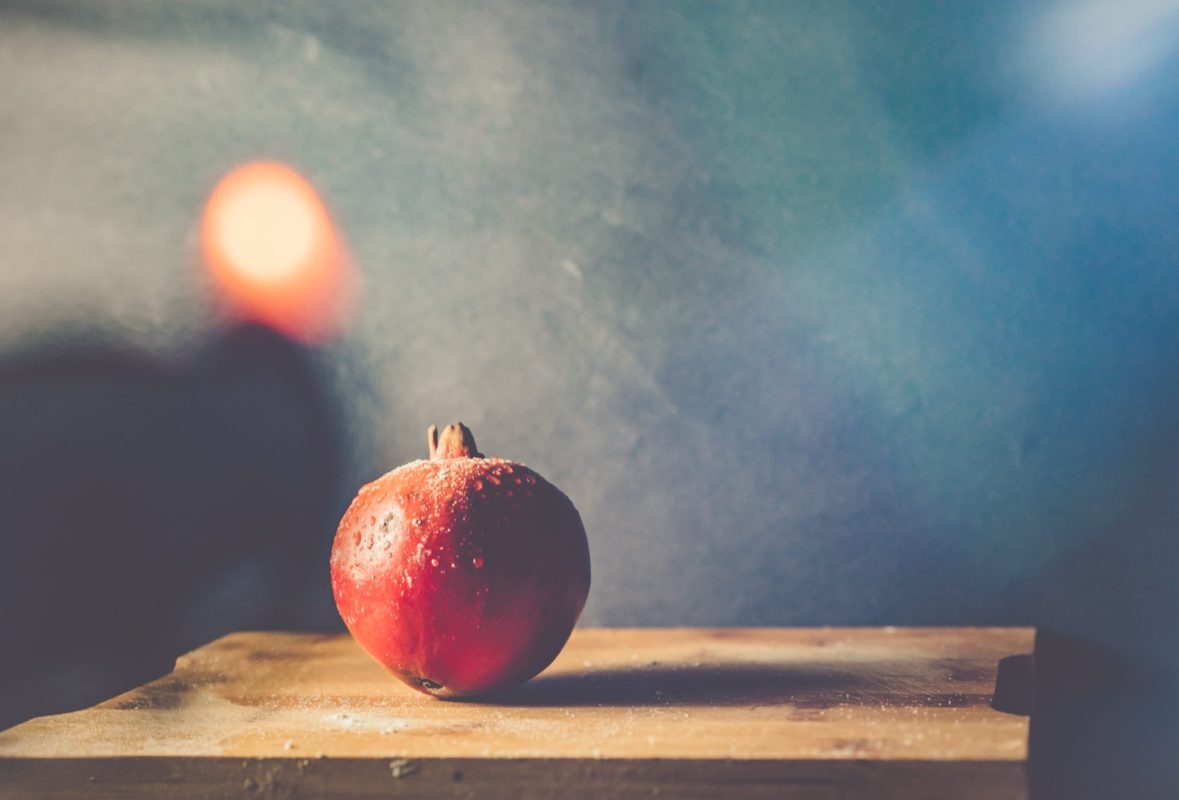
In the first few pages of Helen Elaine Lee’s Pomegranate, protagonist Ranita recalls a moment when her father gives her the titular fruit. She breaks the pomegranate open, “awed by the wild design of it…a whole world, strange and crazy-beautiful, underneath the skin.” In many ways, this scene serves as a metaphor for the novel itself; it is, on the surface, about Ranita being released from prison, working to reunite with her children, trying to understand her queerness, and maintaining her sobriety, but the story is ripe with so much more.
Through alternating past tense sections written in third person and present day moments written from Ranita’s first person point of view, Lee peels back layers to reveal the intentional cruelty embedded in the carceral system and the way trauma can echo through not just one person’s life, but generations. As Ranita slowly opens up in meetings, therapy, and even in the stories she tells herself, Lee also explores the power of narrative itself: What happens when we tell our stories and they are held with care by someone else? What happens when we make a choice to revise, to write a different story as we move forward?
Lee, a professor of Comparative Media Studies and Writing at MIT and a former board member of PEN New England, where she helped to start a Prison Creative Writing Program, brings a wealth of research and experience to these pages. It was a delight to speak with Lee via phone about embodied and inter-generational trauma, what her students in the Bay State Correctional Institution taught her, how stories can be a form of hope, and the different forces that complicate—or encourage—healing.
Jacqueline Alnes: In a 2013 New York Times essay, you write about your time volunteering in a writing class in a prison. You write, “Their possessions and freedoms are few, but their memories are abundant. For three charged hours, through their writing, they become visible. They become more than their worst things.” What did you learn from your students that you might have brought to the writing of this novel?
Helen Elaine Lee: I wanted to write about the experience of incarceration, partially because my dad was a criminal defense lawyer for his whole working life. He embedded in me a couple fundamental beliefs. He taught me that justice is a fiction for many of us. Lots of people grow up without resources or advantages and everybody has a story that is important and deserves to be heard and seen. The people he represented were not invisible to me; they were a part of our community and family life. I had some shapeless desire to write about it but I didn’t know in what way. Since I had never been locked up, I knew I needed to earn that story.
For 15 years, I volunteered at a couple different institutions in the Boston area. First I went in with Growing Together, that’s an emotional literacy program in prisons around the country, and then, through PEN New England, I helped to establish a more formal creative writing workshop. The one I write about in that essay is the Bay State Correctional Institution, which actually is closed now; the men got dispersed to other places. I helped to start a creative writing workshop there. It ran for 8 years. It was important to me not to appropriate and violate people who had already been so deeply violated in another way, so I just listened for a couple of years. More than anything, I am indebted to them for the kind of access that they gave about the kind of emotional and psychological realities of being incarcerated.
I was expanded in so many ways. The generosity I witnessed, it made me realize how deep my ties to them, as Black people very differently situated from me, with all of my privilege and the sense of brotherhood, the sense of respect they gave to me, and how meaningful it was for them to be in community with people on the outside. In terms of outlook that I gained. One time I remember we did an exercise checking in and I was complaining about something trivial. We got to one man serving a life sentence and I asked how he was doing and he said “Great. Every day above ground is a good day.” That sort of perspective made me realize how fortunate I am, all the gifts I’ve been given, all that’s been done for me. I was expanded in that way as well, in terms of seeing the world and seeing my life, and seeing other people’s life and the disparate resources.
Some of the things I’m trying to capture in Pomegranate are the devastating and psychological toll of incarceration, the trauma of retributive captivity and deprivation, feeling invisible, the lack of privacy and respect and choice, and the destruction of families. I could read about those things—and I did do a lot of research—but it was being with that group of men, over time, where I really came to feel like I could maybe understand it enough to write about it.
JA: In the book I was thinking about prisons intentionally making spaces not beautiful. Beautiful things must be kept private, or exist mostly in the mind—in daydreams or memories or conversations happening secretly between two people. These private missives seem like a source of hope. There is power there, even in a place that has tried so hard to strip them of humanity. What do you believe the power of story to be?
HL: My mom was a literature professor; books and stories were the religion in the house I grew up in. Stories are everything—the written down stories that make up books, but also part of my heritage is the oral tradition. For Ranita, too, what her Blackness means to her is the part of the story that has been made and re-made: the oral story of our people and where we’ve been and how we made it through, the codes that have emerged through that history about choosing who to be. Story is everything. It’s healing.
I’m always interested, in everything I’ve ever written, in people who pull light from darkness and the role of narrative in people’s lives. It’s fundamental. We are always making stories about who we are and what we’ve done and who we want to be and will be. Especially for people who are incarcerated, when you live in this present tense, which is an experience of deprivation, as you were saying, of beauty, of human regard, of privacy, and even of the basic food that’s nourishing, and the past is partly about regret, partly what happened in those workshop sessions was the excavation of that healing thing or the good thing or the thing that made you laugh. You hope there’s some sense of the future. The story about who you are and who you might be is a big lifeline.
Writing in that context is really powerful because it represents the opportunity to revise. You perhaps have done some things—I mean there are a lot of wrongfully convicted people locked up—but perhaps you are wishing there are things you could redo in the past and not be there. But there’s a chance, through imagination and narrative, to revise who you are and to recover those parts of yourself that are powerful and generative. Reading stories, writing stories, it’s more fundamental than I could say.
JA: When Ranita tells the therapist her story after she’s released, it feels at first like another form of taking; she’s worried about what will happen to her story when it’s controlled by someone who’s not her or not told in its entirety. And just thinking about the number of narratives imposed on Ranita—her parents’ narratives for her, the world’s narratives, and men’s narratives for what they want her to be. I love that she’s finally telling her story in first person, present tense. It made me think so much about agency and how, when we are able to tell our stories in their wholeness, how much it changes what we are able to say.
HL: Yeah, and it’s a struggle to get there. She’s afraid to tell some things she’s ashamed about, but to bring those into the light and feel love and acceptance and affirmation of her.
Plot-wise, this book is about a woman getting out of prison, trying to stay clean, trying to repair relationships with her kids, and her love for this woman, but to grapple with and accept her story I see as a journey toward healing, self-acceptance, and autonomy. Being able to speak the things that have been pushed into the past is profound.
I could see that in the workshops, with the men and women inside, you could watch, sometimes through a prompt, something emerge that had been forgotten. It was powerful. Off the top of my head, there was one exercise to write about a food that was made for you with love. Or write about a time you learned how to do something, like frame a house or cook something from start to finish, and you would see this different, larger sense of self emerge. That thing had been forgotten along with all the trauma and pain.
JA: Ranita plants black-eyed Susan seeds and says, “I gave them what they needed and they grew.” While the idea that we need nourishment, on the surface, seems simple, it’s more complicated in the real world. We need food, but that costs money—and stigmas around bodies and weight passed down generationally can inhibit our ability to grow, as we see in the novel. We need space—spaces that feel safe, where we can be ourselves—but gentrification is a force that harms many in their efforts to find affordable homes in the novel. We need nurturing from other people. This book seems to ask: What happens when our access to these necessary tools of growth are limited? How do we learn to grow even when we’re planted in the same place twice?
HL: That’s nicely put. I can’t help think of Toni Morrison’s The Bluest Eye, because I’ve taught that book a bunch of times. That opening metaphor of marigolds didn’t grow that year. She circles back to that and says it’s the soil that was inhospitable to the marigolds. There, she’s talking about American society and its racism and misogyny and the trauma that it enacts on people. So again, I am trying to ask: What wounds and what heals?
How are we, Black women, shamed and silenced? Or being looked at but not seen?
Loss is a fact of life. If you’re paying attention, if you’re awake, things are painful. But we can also claim the gifts we’ve been given and the beauty that’s around us, natural and creative, and find our hands filled. Sometimes that’s through memory and imagination. Sometimes it’s small or ordinary on the outside, but wondrous within. I’m trying to ask that: What does it take to grow? How are we hampered and wounded and disabled and what can be done about it? What is there to draw on and resist?
JA: Agency is such an important thread in this book. I’m thinking of Ranita and her changing body, when suddenly, as a teen, she realizes “there always seemed to be someone watching, judging, lying in the cut. Was she her own or wasn’t she?” And later, as she “surrender[s]” her pee for testing, she wonders, “when this body might feel like it’s mine again.” Her body is at risk when she moves through spaces as a Black woman, she is a mother, her parents will her body to get smaller, her body is objectified by others, her body is imprisoned, she loves with her body, her body is deserving of tenderness. What was it like writing into all these notions of a body, especially through Ranita’s intersecting identities?
HL: I’ve lived a lot of it and think about it a lot. I wanted to explore how Black women’s bodies are contended territory, through which control, personal and societal, is exercised, and how the struggle between freedom and domination continue to play out through our bodies. How social and cultural conceptions of our bodies shape our experiences, how our bodies can’t be denied and keep a record of our lives. The strip search was probably the hardest thing to write—that was devastating—but I wanted to tell the truth. I think that moment is where, hopefully, it comes through most clearly the devastation and trauma of captivity and dehumanization and objectification.
The record that that the body keeps—that’s where the generational trauma is. The echoes of Middle Passage and enslavement are felt and resonate down through the generations. From enslavement to incarceration, we’ve had to manage being reduced, being denied the basic things that bodies need, and yet, remaining embodied somehow and insisting on pleasure and joy, and sometimes leaving the body behind. In that strip search scene, that is echoed later in the book when Ranita has to leave her body when experiencing sexual trauma. It figures in all those ways. Ranita’s body hasn’t felt like it belonged to her anyway, in some of the ways you named, so she’s asking: Am I my own?
We are always making stories about who we are and what we’ve done and who we want to be and will be.
You’re told that your body is a sacred temple and that it’s also something that you’re to be ashamed of. It has this power to reproduce which is why, societally, it has to be controlled. It’s really confusing to sort out, as you come of age, and then the sexual pressure that you feel. Ranita has no one to go to with any of that. I feel this is true for Black women uniquely: How are we shamed and silenced or being looked at but not seen? Scrutinized, desired, measured, eroticized, mythologized, reduced in complexity? All of those things take a constant toll. I want the book to name those things, to tell the truth, but also for this to be embodied in the elements of the story: How can we reclaim our bodies and our vision and our voices? There is this abundance within and around us. There are some things that heal. I don’t want to just say it’s a terrible world, which it is in a lot of ways.
That’s Black people’s story. It’s a devastating story of being in this society, brought by the slave trade and everything that’s happened since, not even just in this country. I was just in Brazil for a month and I keep thinking, what a devastating history for Black and Indigenous people. In Brazil, slavery lasted until 1888. I was down there co-teaching a class on those histories and it was a devastating story. It seems more above ground than it is here. Always, there is the other part of it, which is resistance. Survival. Celebration. What we are somehow able to bring out of these experiences. In Brazil, it’s music and insisting on remembering. I treasure that art of the Black story. There is a story of enslavement, exploitation, disenfranchisement, racial terrorism, state-sanctioned violence, all of this, sometimes it feels like it doesn’t ever change, but there is also this resistance. You can’t take people’s dignity from them, actually. There are powers of fellowship, community, memory and imagination, activism, naming the free things. And love, that’s how we’ve always made a way. I hope the book says that, both in a personal sense for Ranita, and in a larger way. And for queer people too. She’s trying to come to terms with that part of her story.
JA: What do you hope people might take from this book?
HL: Each reader is going to have their own experience with a book. Healing and self-acceptance and autonomy are possible. The freedom of spirit is possible. Wholeness, although it’s a lifelong journey, the journey toward wellness, toward telling your story, toward self-acceptance, autonomy, is possible.
It costs something to be awake and pay attention and the forces that make that statement possible are love—the practice of love, with accountability and family and community. Beauty in the world, natural and created, belongs to you; it’s yours. It can be claimed and recovered.
Obsessively scratching her scalp, while simultaneously chiding herself not to, Kendra Rae Phillips sits on a MetroNorth train anxious and jittery. She’s worried about being found, after being found out. Every lingering eye incites more sweat, and more scratching. Relief only comes when her train departs Grand Central Station. This is how Zakiya Dalila-Harris’ debut novel The Other Black Girl begins: in 1983 with a Black woman on the run.
It may be a coincidence that 1983 was also when Toni Morrison, the first Black woman editor at Random House, resigned after 16 years to focus on writing and teaching full-time. But unlike Morrison, Kendra Rae’s departure from her role as the Black woman editor at the fictional Wagner Books was not of her own volition.
Kendra Rae’s flight from New York City is a harried moment, symbolic of an ongoing pattern in book publishing, then and now. The numbers are scarce when it comes to Black people, and Black women, in publishing, and the systems in place have yet to change significantly enough for Kendra Rae, and the other Black women, in The Other Black Girl to feel safe in the professional space they occupy. The novel’smain storyline takes place in 2018 and follows two Black editorial assistants at Wagner Books: Nella who attempts to rise through the ranks as one of the only Black employees, and the newly arrived Hazel. Nella and Hazel’s conflict unravels the sinister motives behind the infiltration of OBGs (Other Black Girls) in the workplace, but Kendra Rae’s story serves as the catalyst for what unfolds.
For much of The Other Black Girl,the narrative surrounding Kendra’s swift retreat is that she chose to leave. The headline summarizing her feelings on the “frigid racial climate” at her workplace, “If You White, You Ain’t Right with Me,” is polarizing, inaccurate, and ultimately positions Kendra as “problematic” for her unwavering desire to work exclusively with Black authors. Kendra Rae’s intention to do her job, and do it well, makes her a threat the moment she vocalizes the issues she faces in the workplace. Even after being assigned a book that becomes a breakout hit by her best friend Diana Gordon, Kendra Rae is expected to retract her statements as if her experience isn’t important or necessary compared to Wagner Books’ image.
As a former acquisitions editor, I found Kendra Rae’s plotline relatable.Sadly, so was her departure.
Kendra Rae’s intention to do her job, and do it well, makes her a threat the moment she vocalizes the issues she faces in the workplace.
Last year, PEN America published a lengthy report on Race, Equity, and Book Publishing. Earlier in 2022, publishing veteran and VP/executive editor at Little, Brown, Tracy Sherrod wrote “Black Publishing in High Cotton” about the history of Black editors in book publishing for Publishers Weekly. Sherrod’s piece noted numbers as slim as seven total for Black editors in trade publishing. (Today, several dozen Black editors [including editorial assistants] exist at Big 5, mid-sized, and small publishers in the United States, totaling about 60 or so.) Prior to Covid, I reported on the inherent biases in book publishing, interviewing several Black women professionals. Almost 30 years ago, in 1995, The Village Voice reported on the “Unbearable Whiteness of Publishing” in two parts. And in 2021, Shelly Romero and Adriana M. Martinez revisited The Voice’s premise for Publishers Weekly. These reports, among others, reflect the same issue again and again and again: BIPOC writers and publishing professionals continue to face exclusion in the publishing industry.
Exclusion begins with erasure. Because if you don’t exist, how can you even attempt to tell your own story?
The year a pandemic and quarantine kept many of us indoors, and a supposed “racial reckoning” had occurred in America, suddenly—suddenly!—the offers came rolling in. The mandate was to quickly diversify publishing teams that didn’t have any, or many, Black team members. Sherrod’s piece mentioned that over the years, layoffs in publishing tended to come in waves, as did the industry’s interest and investment in Black content. So, the question remains: What support systems are in place, not simply for the employees, but for the authors’ whose books these editors will, and have, acquired?
In 2020, I was approached by the heads of five different imprints about editorial positions before I accepted one at Amistad Books, an imprint of HarperCollins. My reasons for joining Amistad were simple: its almost 40-year history and its focus on the African Diaspora. I also admired the leadership and vision of Tracy Sherrod, who, at that time, was Amistad’s editorial director. Like Kendra Rae, I wanted the opportunity to focus on my community’s stories.
Being the only, or one of the few, is an unenviable position no matter the situation or occupation.
Soon after my arrival, it seemed the tide was changing, again. After 10 years at the helm of Amistad, Sherrod left to work at Little, Brown & Company in April 2022. Within a year of being announced publisher of Coffee House Press, and being the first person of color in this role, Anitra Budd announced her resignation in August 2022. A month before Budd, Dana Canedy had left her position as the only Black SVP/publisher of Simon & Schuster after about two years in the role, and ultimately left the industry. Earlier this year, one of Canedy’s team members, VP/executive editor LaSharah Bunting, departed S&S under a similar two-year timeline after joining the company in 2021. People depart jobs for various reasons and under different circumstances. Yet, the shift from positions of power in publishing to sudden departures was, and continues to be, noticeable.
On August 29th, 2022, after 19 months and 18 book acquisitions, I was informed that my position as senior editor at Amistad “was no longer necessary.” (Imagine being told your role was unnecessary less than two years after being assured of the necessity to nurture more Black editors.) One of the first things I thought upon hearing those words was erasure. Erasure as colleagues reached out congratulating me on a new job. (They’d been told I was “leaving” and not that my company account had been disabled five minutes after logging off the virtual meeting in which I was let go). Erasure came to mind when my authors, and their agents, told me they hadn’t heard a word from anyone at the company until I publicly announced my departure two weeks later. And it felt like erasure in the extremewhen I saw how quickly I was removed as “editor” and others were given credit for the labor I’d put into editing, and advocating for, the books I had acquired. I was effectively erased because,like Kendra Rae, the narrative about my sudden departure from Amistad had been woven by others, and not by me.
This aligns with the erasure Sherrod writes about in “High Cotton.” Too few of us are aware of the history of the publishing industry’s many ebbs and flows in terms of providing the necessary resources for Black artists and Black workers. Too few of us understand why people and imprints no longer remain. (Consider One World in its initial iteration, Plume, or Harlem Moon, for example.)
As PEN reported, one of the biggest responses to this “racial reckoning” has been the hiring of DEI-designated personnel at every Big 5 publisher in the U.S. Additionally, many publishers established diversity committees, or ERGs (employee resource groups) advocating for inclusion, reading groups, and continued general education around social justice, specifically racial issues.
Along with hiring, these are attempts in the right direction. However, none of this guarantees that micro- or macroaggressions won’t happen in the workplace. They did not detail a plan for when aggressions or bias or racially motivated incidents occur, nor do they allow for people to continually build on what they learn. They rarely include concrete plans that will hold perpetrators, or anyone who causes harm, accountable. And these efforts do not include plans for training or mentorship or support long-term career trajectory for up-and-coming BIPOC who may be thrown in the deep-end on the job, and be expected from the start to do it well.
This also comes into play when considering how to market books by authors of color, and how the performance of those books is evaluated. DEI initiatives don’t automatically equate to better business practices. A diverse reads book club doesn’t translate to increased publicity or marketing budgets or detailed promotional plans. And diversity committees often result in additional unpaid labor. Being the only, or one of the few, is an unenviable position no matter the situation or occupation. Once you have your marching orders to “bring in books” or more specifically “bring in more books by Black authors,” there’s an ellipsis after the mandate, and it may translate into a lack of strategic support for those authors and their books.
I can speak from experience about the great divide between the excitement of acquisition to the travails of a book’s arrival in the warehouse. I can attest to being privy to, or being the one to speak up in, meetings on the need for sensitivity around the material being discussed. I’ve seen the names of Black people killed by police—names that were and remain hashtags alongside #BlackLivesMatter and #SayHerName—spelled wrong in books while the names of the white “founding fathers” were immediately fact checked. I heard from teams repping Black authors’ books, books granted scarce marketing budgets because the assumption is that these books will either “find their audience or they won’t.” It is both heartbreaking and infuriating to deal with, as a creator or as the editor who believes wholeheartedly in the work and the author entrusting you with their vision. It is deflating to have the same conversations over and over and then not see the impact of the emotional labor; the carefully crafted emails; the endless talks and promises that still broach more questions about how staff and authors are supported, the transparency of the business at large, and how work by BIPOC authors is ultimately received.
We do this work because we believe in the power of books as well as their importance in our lives.
Since 1983, when Morrison and Kendra Rae were editors, imprints—let alone publishing houses—have been consolidated. This has led to fewer publishers and more product. What it hasn’t led to is more staff supporting said product, nor greater diversity among the staff. Add to this the lack of cost of living raises, a perpetual hindrance for many to enter and remain in the industry, and book publishing continues to self-select. Overworked staff doesn’t result in time or space for contemplation, nor does it allow for innovation when the assembly line shifts into high gear.
Like Kendra Rae, I love what I do. I love books. I love words. I’ve found more connections and friendships in the writing & book community than I can count. And I am continually thankful for this because it allows me to consistently remember that I am not solely what I do. We do this work because we believe in the power of books as well as their importance in our lives. For Kendra Rae, books were her life—until they weren’t. Ultimately, she absolved herself from the narrative that followed her. She opted for honesty about being “the only one” at her job and was hesitant, or flat out unwilling, to “play the game” and say otherwise. Over 40 years there has been change with more implementation of “diversity” initiatives. And, yes, there have been more hires and promotions of Black and IPOC industry professionals. (Though the 2022 PW Salary Survey reflected the number of Black staff at 3%, which is not an improvement from the last survey in 2019 or even a year prior to that.) In 2020, several imprints dedicated to BIPOC voices, some celebrity-helmed, were announced. Since 2020, the base salary for entry-level positions at U.S. Big 5 publishers rose from $42,000 to $45,000, and most recently, to $47,500 (and $50,000 in the case of Simon & Schuster). We’ve seen an increase in acquisitions of books by authors of color along with more transparent discussions around the disparity in advances thanks to #PublishingPaidMe. And as much as people online, in offices, and in petitions have called for the industry at large to make substantial and long-standing changes towards a more inclusive environment, the events of 2022 to now, from resignations (and layoffs) to the 3-month long strike by HarperCollins employees for a higher starting wage and more concrete DEI initiatives, shows that when change does happen it is hard-won and the fight never stops. Whether by design or decree, erasureexists because something, or someone, is lacking. Without the freedom for BIPOC employees to live in our truth, and tell our stories, things will remain tenuous in publishing. When that happens, what’s left for the next generation, and what will the narrative be?
DON’T MISS OUT
Sign up for our newsletter to get submission announcements and stay on top of our best work.
YOUR INBOX IS LIT
Enjoy strange, diverting work from The Commuter on Mondays, absorbing fiction from Recommended Reading on Wednesdays, and a roundup of our best work of the week on Fridays. Personalize your subscription preferences here.