A Teenage Girl Is a Funhouse Mirror

“Didi” by Amber Caron

When my brother calls it’s about his daughter, Didi. She is seventeen, out of control. Total nightmare to be around. Lacks respect for the rules. Out all night with friends he doesn’t know, with boys she’s just met.

“She came home at three thirty this morning in a pair of high heels,” he says. “Last week she returned without any shoes at all.”

It’s not just her footwear. Don’t even get him started about her shorts. Her shirts, too. Too short, too tight, big bold words printed across the front: Juicy and Unwrap Me and the one that stunned him into silence, drove him to pick up the phone and call me: Save Water, Shower with Someone’s Boyfriend.

I laugh. It’s not funny, he tells me. Nothing about this is funny.

He’s tried everything. He’s bought her new clothes. T-shirts—thick T-shirts, cotton T-shirts—and by the next day she’s taken liberties with the scissors. Gashes across the back. A deep V into the neck. The arms are gone, the front tied in a knot above her belly button. Which is pierced. Did he mention that? That his daughter lay flat on her back to let some guy drive a hole through her stomach with a needle he sterilized on his stove?

“Her mother,” he says. Her poor mother. She doesn’t even know what to do anymore. At wit’s end. Haunted by images of Didi facedown in a ditch, shirt up over her head, her body bloody and cold.

What my brother doesn’t say and what we both know: he doesn’t deserve a child like this, but I probably do. Maybe I feel bad for her. Maybe I sense in this phone call that he wants to send her away to a place far off in the wilderness, far away from everything, to dig ditches in the desert or climb mountains with other troubled teens. All in the name of tough love.

“Okay,” I say, “fine. Send her here. Just for a month. Just to reset.”

Immediately, I regret it, realizing my brother is probably taking advantage of me.

My husband tells me I’m being paranoid, a little selfish.

“It’s just a month,” he says. “We can do anything for a month.”


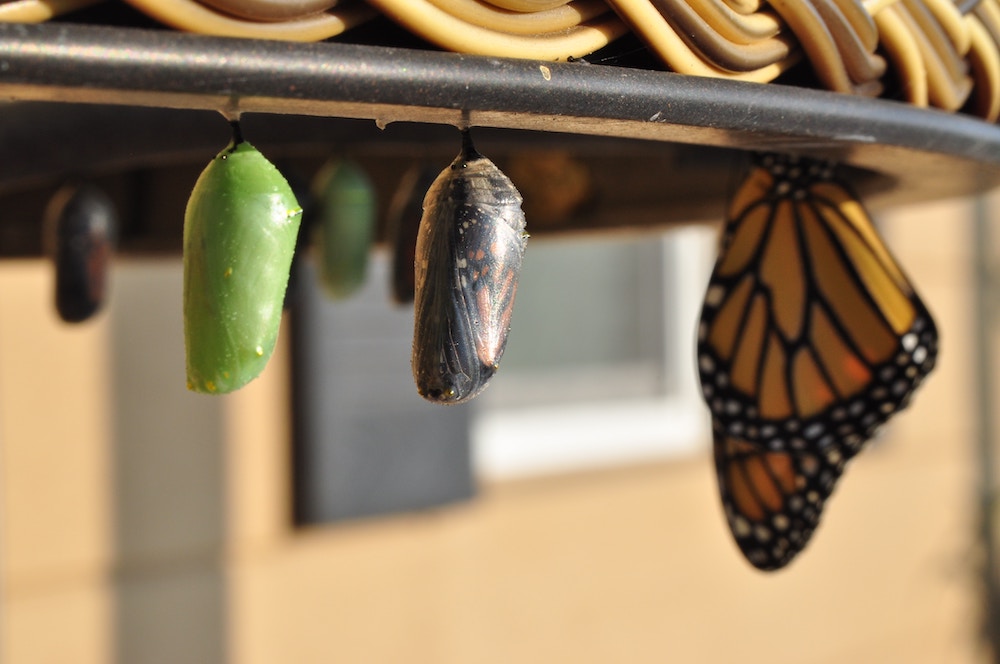
When Didi arrives, I take a week off from work, leave my lab in the hands of my graduate students, give them a single instruction: don’t let anything die. The first thing I notice is that Didi is small, makes herself even smaller by curling up on a single couch cushion. She crosses her arms even when standing in large rooms. Tucks her legs under her body when she sits at the kitchen table, pushes her silverware under the lip of her dinner plate to take up even less space. Everything about her is scrunched, compact. And there is no sign of those clothes. What Didi wears is boring at best, nothing worth commenting on or worrying about. Ill-fitting blue jeans. Baggy tank tops. Sometimes she wears a baseball hat that comes down over her ears and makes her look even younger than she is.

Still, no matter what she wears, Didi’s days are no longer her own. I take her with me to run errands. I tour her around Westport. We see movies in the middle of the day. I drive her out to the beach so she can see the Pacific coast. Just once, because I can’t help it, I take her to the lab with me so I can check on the shipment of mantis shrimp that has just arrived. I show her one of the buckets, a single shrimp inside it. People are normally surprised by how big they are, but Didi doesn’t move away, doesn’t wince, so I pick one up.

“This thing has the fastest animal movement on the planet,” I tell her. “They use this appendage like a crossbow. Wind it up real tight and then let it go, killing prey in a single whack.”

“You do tests on them?” she asks. “Like experiments and things?”

I nod. “We’ve clocked that movement at eighty-three miles an hour.”

“Does it hurt them? When you test?”

I return the shrimp to the bucket. I don’t tell her about our next study, the one our lab is already behind on, where we will remove their eyes from their bodies to better understand how they see color.

“Well,” I say. “We’re getting better at controlling for that.”


At home, Didi reads. Occasionally she’ll get up to get a glass of water, to fetch something to eat, to find a sunnier spot in the house. She tears through the books she’s brought. Biographies of musicians. Short histories of Western philosophy. When she finally puts the books down to come to the table and eat, she asks lofty questions. How can we all be more like Simone Weil? Like Mother Teresa? I bite my lip. When she finishes philosophizing, Didi offers impulsive confessions. She’s never swum in a lake before. She’s never been on a roller coaster that goes backward. She taught herself to ride a bike.

At the end of the first week, I tell Evan I think it is going to be okay. “She’s a little weird,” I say, “but it might actually be fun to have her around.” I climb into bed beside him. I run my hand across his chest and hold on to his shoulder. Even though he’s showered, he still smells like the nursery—the trees he repots, the garden herbs he sells to customers.

“I don’t know,” Evan says. “Something about her makes me nervous.”

“What do you mean?”

“Have you noticed—” he says. He stops. We listen as a door down the hall opens and closes. Didi is in the bathroom. He lowers his voice to a whisper. “It’s like she’s set up mirrors all around her. Like she’s constantly watching herself every time she moves.”

The next morning I call my brother. I ask him if he is sure he sent the right child.

“Don’t let your guard down,” he says. “This is what she does.”


In Didi’s second week, I return to the lab because two of our specimens have already died and my graduate students can’t figure out why. Before I leave, I write my office number on a piece of paper. Under it, my cell phone number and the number to the department just in case she can’t reach me and needs to leave a message with the lab assistant. I magnet it to the refrigerator and tell her it is there. She says she’ll call if she needs anything.

“Or just let Evan know,” I tell her. “He took the day off, so he’ll be around.”

When I return that afternoon, I find her in the living room, curled up on a single cushion of the couch. She barely looks up from the book in her lap when I walk in. Finally, when I interrupt her, she turns to face me, blinks her eyes.

“Fine,” she says, as though this word speaks to an entire day.

When I pry, she sighs, puts her finger between the pages to save her place, and shows me the cover. Another biography. A ballet dancer I’ve never heard of.

“Do you still dance?” I ask her, remembering all the recitals I missed.

“No,” she says. “I quit when I was ten.” “You used to love it,” I say.

She shrugs. “I was bored. And everyone else got better.”

She puts the book on the couch and gets up to go to the fridge.

“Should we go to the pool?” I ask. I’m doubting even her belly button ring now. I think maybe my brother has made that up as well. “Free swim starts at seven.”

Didi returns from the kitchen. She has an apple in her hand.

“I didn’t bring a bathing suit,” she says.

“I have lots. You can borrow one.”

Didi scans me from head to toe, takes a bite of her apple.

“Or we could run down to the mall,” I say, “and get you a new one if you want.”

“I’m good,” she says. She picks up the book and keeps reading.

“Where’d that come from?” I ask. “I don’t remember buying apples.”

“Grocery store,” she says. “I walked down there today.” “Alone?” I ask.

“Yeah.”

“The whole way?”

“It’s not that far.”


“I must have been on the phone with my parents,” Evan says that night as he clears the table. “I didn’t even know she was gone.”

“You can’t do that,” I whisper. “When you’re here, you have to watch her.” My hands are deep in soapy water, and I am scrubbing the forks with a sponge.

“Val, she’s seventeen,” he says, slipping our dirty plates into the sink.

“You said you were okay with this. You said you were fine using your sick days, keeping an eye on her.”

“And I did. We had lunch together. I checked on her twice. I made some calls. She read.”

He dips a washcloth in the water, wipes the counter, and moves to the table.

“But we agreed you’d call me if she needed something. And you even said that you were a little worried. That whole mirror thing. You were concerned.”

“We didn’t need anything. I talked to my parents. Called my sister. Anyway, it was the middle of the day. How much trouble can she actually get in?”

I turn to him, hands soapy.

“That’s not the point,” I say.

“Then what is the point?”

“That something could have happened to her. That she could have gotten into trouble.”

“Like what?” he says. “It’s Westport. It’s not like we live in the most thrilling place.”

He hangs the wet washcloth on the hook above the sink. I grab his hand, but he doesn’t look at me.

“What does that have to do with it?” I say.

“It’s nothing. I’m just saying there isn’t much trouble for her to get into here. It’s quiet.”

“You mean boring. You mean it’s not Chicago.”

Finally, he turns to me.

“Listen, can we just drop this? Please? She’s fine. We’re fine. Maybe tomorrow we can set up a camera and you can observe us both from work, turn us into one of your little experiments, make sure we’re doing everything exactly the way you want us to.”

“Don’t mock me,” I say.


The mirror thing. I want Evan to explain it further. I want him to point it out to me so I can see what he sees because all I see is a girl pulling her knees to her chin, her arms around her shins. Like she’s trying to tuck in her heart. She takes up less and less space at the table each morning. Sits on her hands as we watch movies in the living room. When she takes popcorn from the bowl she chooses one kernel at a time. She lets it dissolve in her mouth before she chews. When I go into her bedroom each morning, it looks like she hasn’t shifted in bed, like she didn’t move from the first place her body touched. This morning, when I look in on her, I see she is sleeping on top of the quilt with no covers at all.

All I see is a girl pulling her knees to her chin, her arms around her shins. Like she’s trying to tuck in her heart.

When she comes out, I am at the table eating breakfast and I ask her if the bed is okay, if she is comfortable in the guest room. She says yes, it’s great. She hasn’t slept so well in a long time.

“Do you not sleep well at home?” I ask.

“Not really,” she says. “Mom refuses to run the AC.”

“Are you too warm here?” I ask. “We can put the AC on at night.”

“That’s okay. I’m mostly comfortable,” she says. “Although I might open my window a little tonight, if you don’t mind.”


When I get home from the lab they are both on the couch watching the TV on mute. I am late; at the end of the day, I successfully removed a specimen’s hard, bead-like eye, but when I tried to transfer it to a test tube, rushing, it popped out and I lost it. On the TV, I see footage of an attack somewhere in Iran, and Didi is telling Evan about the Iranian poet she has been reading. He looks genuinely interested. I don’t interrupt. Instead, I put my bag down quietly, taking a seat on the chair beside Evan, and listen as she talks about the way the poet broke a traditional form to make a political statement about the injustice of the current regime. When Didi finishes, she goes to her bedroom to get her coat, and Evan raises his eyebrows and mouths wow. He leans over to kiss me on my forehead, my nose, my lips, and when Didi returns we all walk into town for pizza.

The waiter is excited to see us. He scolds Evan and me for not coming more often, and he welcomes Didi to town, to the restaurant. He tells her everything on the menu is good, that she can’t go wrong, which is exactly the same thing he tells us every time we come here. Whatever we order, it is always, in his words, a very fine choice.

Didi defers to us. She will eat anything, she says, and so we order two pizzas and a salad to share. As we wait, I try not to watch the TV behind Didi and Evan where they are showing the aftermath of the bombing. It’s bad. More than four hundred dead. They keep showing the same image of a young boy with a bloody face. I’m certain it’s not his blood. His face isn’t at all scratched, but the boy is clearly stunned. I try to refocus on Evan and Didi’s conversation. He is wondering about future plans. Has she thought about college?

“Not a lot,” she says. “I’m thinking about taking a gap year.”

“Be careful,” Evan says. “Those don’t always work out.”

He is speaking from experience. She asks him what he means.

“I had plans,” he says. “I was going to backpack around Europe with my girlfriend. Take the train from Spain to Italy to Germany. Up through Scandinavia. Had it all planned out. Had the plane ticket in my pocket. Two weeks out and she dumps me. Turns out she had applied to college and was going to Boston without me. She was waiting to tell me until all her financial aid came through. That trip abroad? That was her backup plan. I was her backup plan.”

“So you didn’t go?” Didi asks. “Why didn’t you just go alone?”

“Wasn’t like that. Wasn’t about the trip. It was about her. Us.”

“And the girlfriend?”

Evan looks at me with a grin.

“She came running back, eventually.”

“No!” Didi says. “It was you! You did that to him, Aunt Val?! That’s so cruel!”

Evan smiles even wider and turns back to Didi.

“I was okay,” he says. “She did the smart thing.”

The waiter delivers both pizzas and the salad to the table. He serves us each our first piece. We toast with our water glasses.

“To gap years,” I say, and they both laugh.

“Well,” Evan says, “you’ve heard my warning. But what do you have planned? Hopefully nothing with a cruel-hearted high school sweetheart.”

Didi shakes her head.

“No,” she says. “Nothing like that. I don’t even know really. I just thought it might be nice to have a break from school for a little bit.”

She picks the mushrooms off her pizza. Puts them in a tidy pile on the side of her plate.

“It’s kind of nice here,” she says, not looking up at us. She moves on to the sausage, puts it in a separate pile. “It’s quiet, at least. Not as hot as Texas.”

She cuts her crust into bird-sized bites and chews one slowly.

Calculated, I think. Maybe that’s what Evan means with the whole mirror thing. Every move. Every word. Every gesture. It is all very calculated.

“Yeah, Westport is nice,” Evan says.

The waiter returns. He asks Didi if everything is okay. If there was something wrong with the pizza. If he can get her anything else.

“It was so good,” she says, handing him the plate, her pizza picked over but not eaten. “So delicious.”


At the end of the meal, I suggest we walk home and have dessert on the porch. It is a beautiful night. A coastal breeze has come inland. We pay up. As we leave, the waiter runs after us with the box of pizza we left on the table. He apologizes to Didi again, is concerned she hasn’t had enough to eat.

“I’m worried you will float away,” he says.

She promises him she had plenty to eat. She pats her stomach to convince him.

As we walk home, Didi and Evan are back on the Iranian poet. More lofty questions: What do you think is the role of the poet during such violence? What is the role of any artist, for that matter?

At home, Evan brings a bottle of wine onto the porch.

Didi says she needs to call her parents.

“It’s only eight,” I say. “Come eat pie with us.”

“I promised I’d check in.”

“One piece. Look,” I say, holding up the plate. “From the bakery. Look how beautiful it is.”

She agrees, reluctantly. On the porch, she sits on the edge of her seat, picking at the cherries while Evan and I each take a second piece, a second glass of wine. She finishes it though, the entire slice of pie. And then she clears our dishes for us. I hear her at the sink washing them. She comes back out to say she’s turning in. She’s going to go to her room, call her dad. She will probably read after that.

I smile at her. “Tell him we say hi.”

Evan and I talk about our days—the shipment of hostas that arrived at the garden center, how he had to unload them alone; how I lost the shrimp eye and am behind on our data collection—and I hear Didi’s voice coming through the night. It’s soft, but I can tell it’s the voice of someone who is happy. It’s also a young voice. So young. Almost babyish, as though she is talking to a dog, coaxing it to her with a treat. Her window is open. I stop talking. I am straining to hear her words.

“Hello?” Evan says, waving in my direction. “Where are you, Val?”

“Have you ever heard a girl talk to her parents like that? In a voice like that?”

“You would be a terrible mother,” he says.

“Wouldn’t I? Overbearing. Overprotective.”

“A total spy,” he says.

This has been a joke between us. I don’t believe it is untrue.

“Still,” I say. “Admit it. It’s a little weird. The whole thing at dinner. Picking at her food like that.”

He admits it. Yes, it was strange. We stay up late, long after Didi’s voice goes quiet and her light shuts off.

“You had to tell her that story,” I say. I am smiling.

“We could still do it,” he says. “Take a gap year. Travel around by train. Find ourselves and all that.”

This isn’t the first time he has proposed the idea. He brought it with him when he eventually followed me to Boston. And to Minneapolis for grad school. And to Chicago for my postdoc. And now here to Westport for my job. For him to bring it up now, I know it means he is bored, restless, generally unsatisfied with the fact that we have landed in a town he doesn’t like but is, once again, making work.

“Maybe for my sabbatical,” I say.

“In five years?” he asks, exasperated.

I know it is the wrong thing to say. His has been the harder path, I know this. The constant moving. The random jobs he’s accepted not because they will lead anywhere but because they pay rent. The year working construction in Boston. The year as a substitute teacher. Three years waiting tables. And now the garden center, where he works alongside high school students, unloading trees and plants, hauling them into place at the nursery and then hauling them into the cars and trucks of customers.

“What if I had gone?” Evan asks. It is his attempt at a lofty question. “What if I had boarded that plane and spent the year traveling alone? What if I hadn’t been there when you came home that first Christmas?”

I have no answer. I sip my wine.


I look in on Didi after midnight, just before I go to bed, and she is there, her back to the wall, curled up in a ball, the window open, the breeze cool, covers pushed to the bottom of the bed.

I remember a neighbor in Chicago. A woman with triplets, all boys, eighteen months old. We had just moved in, and I was unpacking boxes one day when she came running to our door. She was locked out. She had slipped out to have a cigarette—Not even a full one, she said. Just two drags—and the door clicked behind her. Her boys were inside. She had already called the landlord. He was on the way with a key. We stood at her living room window and watched her triplets slink around on their stomachs, rise to their hands and knees, and begin to crawl. There was no gate to the kitchen. The bathroom door was wide-open. A set of wooden stairs led to the second floor. She was crying, cursing herself for being so stupid, for being so careless, tapping on the window, trying to get the boys to look at her. I grabbed a rock from the yard. If they get too close to the kitchen or the stairs, I told her, I’ll put it through the window. She nodded. She sang to the boys through the glass. They crawled toward us. They smiled at their mother. They extended their arms, wanting to be picked up. They cried. Finally, the landlord arrived with the key, and I walked back to my house with a racing heart, the heavy rock still in my hand, thinking this must be what parenthood is like all the time.


In the morning, before I leave for work, I knock gently. It’s supposed to reach ninety degrees today, and my plan is to go to the lab for a few hours, come home at lunch, and bring Didi to the store so she can get a bathing suit and we can spend the afternoon at the lake. That’s what my calendar says will happen.

I knock again, but Didi doesn’t respond, and so I knock a little louder, and then I let myself in. She isn’t there. I’m thinking that she must have slipped into the bathroom after me. She woke early because she went to sleep early. I move down the hall to the bathroom, but she isn’t there either. I check the back porch, which is as we left it last night. Two wineglasses. An empty bottle of red.

Even when I say it to Evan it doesn’t really seem possible.

Her clothes. Her makeup. Gone.  Her shampoo is gone from the shower. Her retainer from the bathroom sink. Hair ties. Everything, gone.

There’s nothing in the closet, no shoes by the door, and all I can say—all I can think to say—is, “She was just here, she was just here. She can’t just disappear.”

Evan already has the phone in his hand. He is calling Didi, and I can hear the phone ring. It goes to voice mail, a mechanical female voice rattling off the digits of Didi’s number. Evan hangs up.

“Try again,” I tell him.

“Val,” he says.

“Do it,” I tell him.

He is scrolling through names in his contact list. He presses my brother’s name.

“No,” I say, taking the phone from him. “Not yet.”

“Maybe he’s heard from her. Maybe she said something last night when she talked to him.”

“She didn’t call him last night,” I say. “No girl talks to her father with a voice like that. You heard her. You heard that voice.”

He nods. He knows I’m right.

We sit on the couch and think of all the possibilities, and then Evan leaves the house to check the bus stop, every business in town.

Before he closes the door, almost as an afterthought, he instructs me to do what I already know I must: “Call your brother.”

Of course he hasn’t heard from her.

While he yells at me, I walk out onto the driveway and stand there as though she’ll show up while I’m on the phone, so I can tell him it’s all been a big mistake, a huge misunderstanding. I consider all the things my brother has told me about her, all the things he’s telling me again.

Teenagers do this stuff every day, I hear myself telling him. Teenagers disappear and come back when they’re hungry.

She’s not a dog, he is saying. She’s not a goddamn dog.

“I just mean—”

“I thought things were going well. I thought everyone was having a great time.”

“They were,” I say. “We are.”

It goes on like this until Evan returns, without Didi, and he gets out of the car and tells me there’s no sign of her anywhere, that it might be time to call the police.


Two officers arrive within minutes. I have seen one of them—the woman—in uniform, walking up and down streets, putting tickets on people’s windshields. How I hated her in those moments when she just stood watching the meter, counting down, waiting for the time to run out, so she could print a ticket and slide it under the wiper. Now, it’s not hate I feel but an intense need to speak directly to her rather than the other officer—a man I’ve never seen before.

“My niece is gone,” I say as she leads me back inside, taking out her notepad and her pen, asking me to tell them when we last saw her, who in the area she knows, how long she has been here, what she was last wearing.

“What does that matter?” I reply. “What she was wearing?”

The woman looks at me. She doesn’t skip a beat.

“For identification purposes,” she says. Before I can apologize, Evan is trying to describe her clothes. Baggy jeans. Loose T-shirts. Sometimes a ball cap. As he speaks, all I can think is, Please let her be okay. Please, please. Let this nice woman, Officer Peterson, find her.

The police ask to look around. They are in and out of our bedroom. In and out of Didi’s room. The bathroom. The porch. They ask about the bottle of wine. The glasses. They check windows and doors. I follow them around the house. I follow this woman, especially. She inquires about locks and alarm systems.

“Do you always keep it open?” she says of Didi’s window.

It takes me a second to make sense of her question. “You think someone came in and took her?” I ask.

“We have to consider everything,” she says. “But between you and me, I doubt it.”

I want this woman to tell me again and again in her matter-of-fact voice, just as she’s telling me now: “Listen, this happens a lot. Teenagers leave. Disappear for a day or two. They usually show up.”

And that’s what I was trying to say to my brother. Not that they return when they’re hungry but that they usually show up.

“Her father thinks she’s a bad kid, but he’s wrong,” I say. “She tries to make herself small. She moves from one sunny spot to another all day, reading biographies of ballerinas and books about Iranian poets. And when she moves, it’s like she’s set up mirrors all around her. Like she’s always watching herself.”

Officer Peterson looks up from her pad. “What do you mean?” she says.

I don’t tell her that I think Didi’s actions seem calculated, borderline manipulative. I don’t want her to think badly of my niece. I don’t want to think badly of her.

I don’t tell her that I think Didi’s actions seem calculated, borderline manipulative.

“I only mean that she’s careful,” I say. “Incredibly alert.”

I catch her looking behind me, beyond me, and I turn and see Evan showing the other officer where we store the bikes. The shed is full, both bikes parked in their separate corners.

I pick up the phone because it is ringing, and I am certain it will be Didi. But it’s my brother, and he is listing off times, and I am confused until I realize he is on a computer, looking at flights, booking something to Portland.

My brother has never been on a plane. He rarely leaves east Texas. He works on the oil rig where our father worked, where our grandfather worked. He has taken care of our sick parents. Has given everything he has to his daughter. Has worked long hours to give her private dance lessons.

“Listen, you might be overreacting,” I tell him, trying to project calm, trying to remain confident. “She’ll probably show up.”

He hangs up on me.

The police leave. I go into Didi’s room. I pull back the covers on the bed. I look for anything she might have left behind, any kind of clue. Suddenly I am furious at my brother. He knew. He knew she would do this, and he sent her here anyway. Surely he is also a little responsible for this. I pick up the pillow. I pull the sheets taut. I make the bed. She was here just last night. Sleeping in this bed. Evan is beside me now.

“We’ll find her,” he says.

It’s a trope, I tell him. It’s a cliché. Girls always disappear. They make themselves small, and then they disappear.

“And if they don’t disappear, they go insane. That’s it. Those are the only two options we get.”

“I thought the cliché was that girls were always in pursuit of boys,” Evan says.

“So we have three options!” I yell.

That I am mad at him is inexplicable, incomprehensible. This isn’t his fault. No more than it is my fault. And yet, I think, if only he had been less cavalier about the whole thing, had been more concerned about the walk to the grocery store, her coy voice on the phone.

His hands are on my shoulders. His fingers are pushing at the muscles, only he’s missing the muscle and hitting the bone, and I shrug off his hands and walk away, down the hall, into the kitchen, where the dishes have been washed and are sitting neatly in the drying rack. He is behind me.

“She knew,” I say. “Last night when we went for pizza, and she ate pie with us, and she cleared our plates, and she washed them. She had already planned to leave. I know it.”

“She knew the second she arrived, Val.”

I don’t want this to be true. I don’t want to believe it.

Evan is going to retrace our steps.

“From the last three weeks?” I ask. “All of them?”

“You stay,” he says, kissing me on the forehead. “In case she comes back.”

My brother calls again. He asks for our address. He wants to know how he is supposed to get from the airport to our house, which is an hour and a half away.

“Rent a car,” I say.

And because I know what he is thinking, I tell him we’ll pay for it.


Evan and I sit on the porch. We wait. This is what you do on the first day while you wait for a teenager to return, which they usually do, almost always do.

You check the local newspaper headlines.

You drive around the neighborhood.

You turn on the TV in the middle of the day, expecting to see her face, her body.

You try to distract yourself with small tasks.

You create false deadlines. She will be back by noon. And when she doesn’t arrive, it’s by three. Then dinner becomes your arbitrary marker, and you push dinner later and later until your husband puts a burger and fries in front of you.

You feel you shouldn’t eat it.

You feel you don’t deserve it.

But you eat it because you haven’t eaten all day and you are hungry.


I watch my brother, a short, balding man with a beard, get out of the car. He looks different. Older and tired and more like our father than I have ever noticed.

I expect the trunk to pop open, for him to pull out his suitcase, but instead I see my brother swing a backpack over one shoulder as he walks to where I am standing at the front door. And now I am crying. Because all he’s brought is a backpack. Because it’s been three years since I’ve seen him. Because his daughter is missing. Because it’s his first time on an airplane, for this. Because he warned me, and I didn’t believe him.

He wraps his arms around me, and I feel like I don’t deserve this either. His comfort. But I take it. It has always been this way with us. Fierce on the phone. Quick with blame. All of that gone when we see each other.

That night, we all pretend to sleep, and in the morning, while I’m still in bed, covers pulled up around my face, eyes closed because I am tired, I hear Evan in the bathroom. He is showering. Shaving. I hear the toothbrush against the sink. And then he is standing at the closet. He is dressing. I sit up in bed.

“You can’t,” I say, but I know as soon as I say it that he will. He has to. If he calls in sick again he will lose his job.


The police station is empty. Just a small waiting room with three seats. An officer sits behind a desk. I hope my brother is comforted by how quiet it is in here. I hope he feels, as I do, that this nice man behind the counter is going to help us. I tell him that my brother has just arrived, that my niece hasn’t been seen in over thirty-six hours, and that we need to talk with Officer Peterson.

“She’s not on duty,” he says. “You’ll have to talk with me.” My brother stands with his hands in his pockets. As he talks with this new officer, I listen.

Yes, she has done this before, many times, about a year ago it started. Every few months. Out all night. Gone for days at a time. Once much longer—more than a week. That was during winter break.

I look at him. What he is saying—none of it makes sense. It’s not the same girl, I want to say.

After we leave the police station, we stop for coffee, and when we get back in the car, I make the absurd offer to give him a tour of town. Maybe a drive out to the beach. He has never seen the Pacific Ocean.

“I told you. You couldn’t take your eyes off her. I told you. You can’t leave her alone.”

“We were sleeping,” I say.

“Before that? All those other days?”

I lie: “We never left her side.”

We go home and sit on the stoop outside the house, waiting. I ask him about his job, and he says what he always says: it’s a paycheck. He asks me about mine, and I go on for too long and in too much detail about how we think mantis shrimp have a different kind of color vision, how we’re trying to get a reading from photoreceptor cells but can’t even fit a recording device onto them because they’re so small. When I look at him, I can see I’ve lost him.

“She wants to come live here next year,” I say. “After she graduates, if she decides to take a gap year.”

“Is that what she told you?” he says.

I nod. I’m trying to gauge whether he is hurt or angry or relieved, but he just shakes his head. He laughs a little.

“She doesn’t have enough credits to graduate next year,” he says. “She’s still considered a sophomore.”

We sit for a long time, watching cars drive by the house. Across the street two dogs bark at the fence. The owner comes out. Tells them to get inside, to cut it out. A kid rides by on a bike. Another one follows on a skateboard. They are singing a song that is popular this summer, one that is played over and over on the radio.

Evan comes home at 5:15. He doesn’t say it, but I can tell he has had a bad day. He kisses me and pats my brother on the shoulder.

“Anything?” Evan asks.

“Nothing,” he says.


That evening, the police call. They ask us to come down to the station. They have a few more questions. They have something we should see.

We are in the car and down the road before anyone speaks.

“Did he say what it is?” Evan asks. “What they want to show us?”

“A picture of some kind,” my brother says. “They wouldn’t tell me more than that.”

A picture, I think. Of Didi alone? At the airport, boarding a plane? Getting into a strange car? Her body, my god. Would they ask us to come down to identify a picture of her body? Would they be so casual about it on the phone?

I hope, when we walk through the police station doors, that Officer Peterson will be there to greet us. She’s not. It’s a different officer. Someone we’ve never talked to before, and it’s my brother he needs to speak to. They disappear down the hall, and Evan and I sit on chairs in the waiting room. I reach for his hand.

“Was your day okay?” I ask.

He turns to me. I think he will tell me about the apple trees he pruned incorrectly or how he overfertilized an entire shipment of succulents. I’m expecting news of broken terra-cotta pots or bamboo sticks that never arrived.

“When you left,” he says, “this is what it felt like. Exactly like this.”

The officer behind the bulletproof window stretches, arms overhead, and yawns. It takes me longer than it should to realize we aren’t talking about Evan’s day, or the plants he tended to, or the nursery at all.

I shake my head. “You knew where I was going,” I say. “You could have called me. You could have come to visit whenever you wanted.”

“I’m not talking about college, Val. I’m talking about all those other times you disappeared, before you left for college—those nights you didn’t call, the weekends you just vanished. And later, all those research trips, how you extended them again and again, sometimes without even telling me, sometimes for weeks at a time.”

We have had this conversation before. More than once. Dozens of times. But I see something new in his face now, not a bitterness but a sadness, and I am convinced this is the first step to him leaving me—maybe for a year, maybe longer. Before I can say anything to talk him out of it, my brother is coming back down the hall, the officer behind him.

My brother shakes his head. “Wasn’t her,” he says, and I can see he is near tears, shocked by what he has been forced to look at.

We drive home in silence.


It all ends just as Officer Peterson promised.

We drive back to the house from the police station, and she is there. My brother is out of the car before I even come to a full stop. I sit in the driver’s seat while he goes to her. Evan doesn’t move. He sits beside me. We watch.

I wonder how many times this scene has played out. How many times has a girl returned to find no one is waiting for her?

And what is it you want to know? Whether my brother hits her? (He doesn’t.) Whether she is crying? (She isn’t.) Or do you want to know where she was, what she was doing? (She will refuse to say.) Is she harmed? (Not in any way that I can tell. No scrapes or bruises. No broken bones. No blood.)

Because you are wondering. Because people always wonder. Because under these circumstances, it matters what she is wearing, by which I mean it matters to me:

My clothes. A pair of jeans—black and tight and cropped. A white T-shirt, baggy and see-through, a baby-blue tank top underneath. Black summer sandals. Beige stitching at the seams. Thin leather straps that loop around her heels, hug her toes, and, I am certain, have left her blistered. I leave Evan in the car, and I go to her. I pull her to me. I feel her body against mine, rigid and small and hard. Her heart pounds against my palm. I fold her in. I tuck her in as close as I can and hold her for as long as she lets me. When she begins to pull away, I let go, certain there is nothing I can say, nothing I can do, to make her stay. So I do the only thing I can. I pull her hands out of her pockets. I push her shoulders back. I am not gentle.
7 Contemporary Finnish Novels in Translation

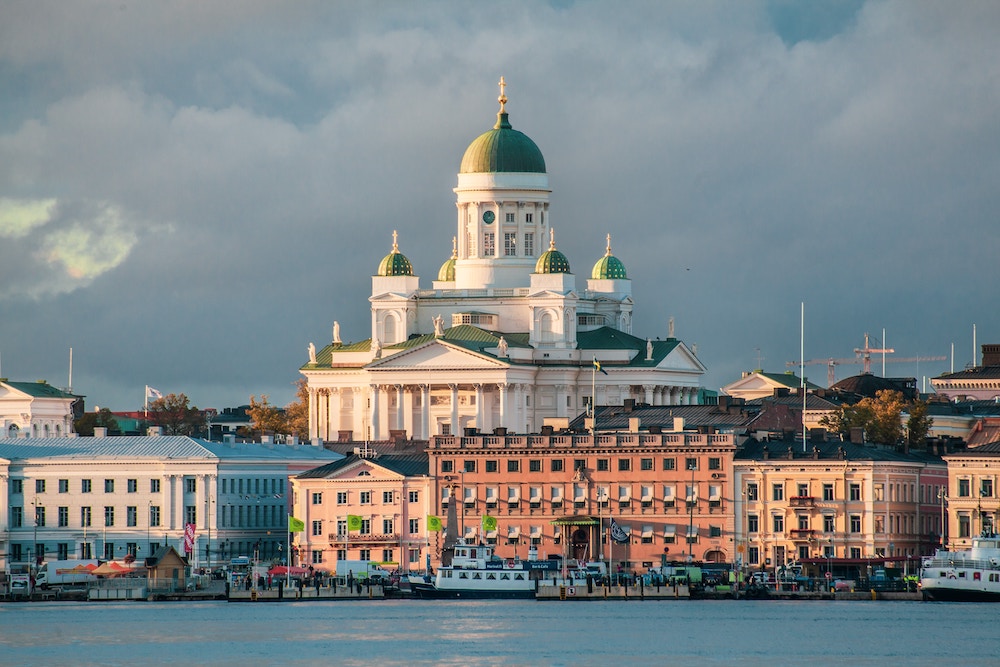
While Finland is often depicted as a uniform country in which people are more likely to engage in cold-water swimming than small talk, the population is by no means homogenous, and there is no better place to see this than in the diversity of Finland’s contemporary literary scene.

Shaped by histories and narratives of exclusion and survival, Finnish authors are blurring the lines of genre to tell new stories in luminous, captivating prose. These prize-winning contemporary novels engage with the effects of war and inequality and offer deeply compelling explorations of what it means to be human.

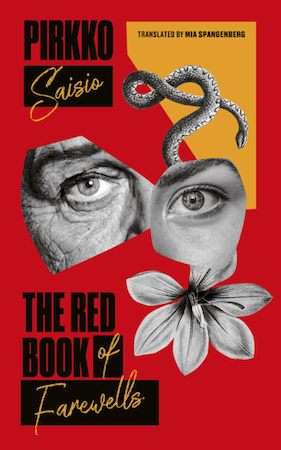
The novel that I translated from Finnish to English is The Red Book of Farewells by Pirkko Saisio. With her experimental prose and long career starting in the 1970s, Pirkko Saisio can be seen as an influence on many of these writers. The Red Book of Farewells offers a beautiful portrait of a young woman finding her voice as a lesbian and writer in 1970s Helsinki.

Here are seven Finnish novels I consider essential reading:

Bolla by Pajtim Statovci, translated by David Hackston

Born to Albanian parents in Kosovo in 1990, Pajtim Statovci fled with his family to Finland when he was two. Themes of exile, identity, and war feature prominently in each of his novels, and in Bolla, his latest, he delivers a tragic love story with his characteristically beautiful and propulsive prose. Set in Kosovo in 1995, the story revolves around Arsim, a newly married university student, and Miloš, a Serb. The two meet one day in a café, and their attraction to one another leads them into a secret but doomed affair: Arsim is forced to flee the war with his family, and Miloš is sent to the front line. They meet again at the end of the novel, broken by their experiences and an unforgiving society that cannot accept them for who they are. The bolla, a snake-like creature from Albanian mythology, appears throughout as an ambivalent symbol of hope and forbidden desire. 

The Union of Synchronized Swimmers written and translated by Cristina Sandu

Like Statovci, Cristina Sandu grew up between two cultures, and she was born into a Finnish-Romanian family in Helsinki. In her second novel, she follows the lives of six young women who form a synchronized swim team in an unnamed Soviet bloc country in order to escape to the West. Once a tight unit always moving together in sync, they scatter to places like Helsinki, Rome, and California. These women do not necessarily find happiness or freedom; instead, their stories detail their aching inability to fit in, their desperate attempts to earn money and some semblance of security, and the vulnerability of being female. Each woman’s story delves deep into the heart of loneliness and the harsh realities of trying to survive in society as an outsider.

Purge by Sofi Oksanen, translated by Lola Rogers

A Finnish-Estonian writer, in Purge Oksanen depicts the corrosive effects of fear, torture, and jealousy during Stalin’s purges and the post-war Soviet occupation of Estonia. The story centers on two women, Zara, a sex trafficking victim who manages to escape her captors, and Aliide, an elderly woman who reluctantly takes her in and has her own secrets to hide. Zara is looking for her grandmother Ingel’s home in Estonia, who as it turns out was Aliide’s sister. A chilling drama plays out between them as the chapters alternate between the horrors both women have suffered and their distrust of one another, and it is only at the end of the novel that readers find out whether Aliide will ultimately save her own flesh and blood. 

When I Forgot by Elina Hirvonen, translated by Douglas Robinson

In Elina Hirvonen’s accomplished debut, a young journalist named Anna Louhiniitty is trying to come to terms with the trauma of her past: the years she has spent trying to protect her mentally ill older brother, Joona, and the generational trauma she has inherited from her family and the legacy of WWII. She is sitting in a café, attempting to read Michael Cunningham’s The Hours, given to her by her lover Ian, a visiting lecturer from the U.S. It’s just over a year after 9/11, and as Anna processes her memories, she also tells us Ian’s story, who has suffered his own trauma as a bullied child with a father who succumbed to mental illness in the Vietnam War. In Hirvonen’s lucid prose, Anna grapples with her painful memories, as well as those of Ian and her family, and slowly begins to find the words to name her experiences and accept them. As she ends her quiet afternoon in the café, she knows she can go on, one day at a time.

Troll: A Love Story by Johanna Sinisalo, translated by Herbert Lomas

In this masterpiece, a photographer nicknamed Angel finds an abandoned troll cub by the trash cans outside his apartment building. He feels compelled to take the enchanting creature home, and so begins Angel’s obsession with his new companion, which in the novel’s world is a real but very rare species. The novel is interspersed with excerpts from reference works that Angel consults to learn about the troll as well as Finnish novels that highlight the uncomfortable, fearful relationship humans have with other animals. Told in the first person, the narrative perspective also changes and includes various other outsiders who are part of Angel’s world: Ecke, Angel’s young and eager suitor; Dr. Spiderman, Angel’s ex-boyfriend and a veterinarian, and Palomita, an abused Filipino mail-order bride who lives with Angel in the same building. As Angel’s obsession with the troll deepens, he takes ever more desperate steps to hide it, but ultimately he is unable to prevent the violent ending the troll brings about.

The Colonel’s Wife by Rosa Liksom, translated by Lola Rogers

Veteran author Rosa Liksom delivers her darkest tale to date in this exploration of an unnamed woman enamored with fascism and her violent husband and idol known simply as “the Colonel.” The protagonist eagerly joins the Colonel on his trips to Germany in the late 1930s and early 1940s, a time when the Nazi top brass were supporting Finland in its efforts to rebuff Soviet advances on Finnish territory. However, the Nazis eventually turn against the Finns, and in his rage and disappointment, the Colonel becomes increasingly abusive towards his wife. Told in the first person, readers cannot escape the protagonist, who is by turns loathsome and sympathetic. Liksom based the colonel’s wife on a real person named Annikki Kariniemi and thus offers a fascinating portrait of a complex character from the beautiful wild lands of northern Finland.

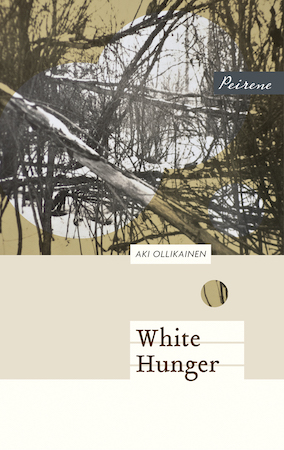
White Hunger by Aki Ollikainen, translated by Emily and Fleur Jeremiah

This haunting debut novel takes place during the Finnish famine of 1867 which wiped out 15-20% of the population. This novel follows Marja and her young daughter and infant son on their journey south to Helsinki to find food, and the sparse, tightly-controlled prose is gripping in its relentless depiction of starvation and its effects: the desperate attempts to make bread out of lichen (often poisonous), pine bark, and even ground up bones; how a child’s long-empty belly bursts after eating too much thin gruel all at once; the dehumanization of Marja and her children who are abused and denied food and lodging again and again. Their misery is further emphasized by the story of two well-heeled brothers in Helsinki, one a doctor, and the other a government official, who remain personally unaffected by the mass starvation around them. All the while hunger blazes white through the long winter and constant blizzards, leaving only Marja’s infant son to survive the ordeal at the end. 

15 Small Press Books You Should Be Reading This Summer

Small presses have been publishing excellent work by writers who you may not know (yet). From compelling short stories to heart-wrenching novels, these books will take you on a journey across states and countries, into the past or to the future, as well as deep into the minds of richly-drawn characters. 

Braddock Avenue Books: The Company of Strangers by Jen Michalski

Whether it is an adjunct having a doomed affair with a tenured professor after fixing her toilet, a woman who purchases a beautiful vintage piano only to deconstruct it as she grieves the loss of her partner, or a young woman who sleeps with her brother’s girlfriend and then forms a tight friendship with an older gay couple who passing through a hostel, the people in The Company of Strangers are all yearning. In trying to heal fractured families, form connection with romantic partners, and build community, these characters come alive. The collection includes both the small dramas of everyday life and defining moments—a sister gone missing as a child, a wedding missed on a cocaine bender that leads to an arrest, missed connections with would-be lovers because of the obligations of parenting. Despite varied perspectives in class and personas, there is a strong thread between the stories, as each delivers an emotional punch. A stunning accomplishment.  

AK Press/Black Dawn: Maroons by Adrienne Maree Brown

The second book the three-part Grievers series continues to follow Dune, whose mother was patient zero in a viral outbreak engineered to target Black Americans, with Detroit as the epicenter. Even in the wake of a decimated community, Dune is persisting through the luck of immunity. They have a routine of foraging for food, documenting lost people, and building on a physical model of Detroit their father set up in the basement of the family home. Yet, when Dune hears an illicit radio transmission from Dawud, a national guardsman who has chosen to remain in the city long after his unit has left, they find his broadcasting location along with him as an ally, another living person in the city. As Dune finds connection with Dawud, and other survivors, the post-pandemic landscape takes on a quality that transcends subsistence living and moves into Black Detroiters reclaiming a landscape which white nationalists tried to destroy. Maroons veers into magical territory, but still stays grounded in a narrative with a sense of hope. Brown remains an innovative and important voice in fiction. 

Red Hen Press: Secret Harvests by David Mas Masumoto

When David Mas Masumoto is contacted by a stranger regarding his maternal aunt Shizuko, he is at first slightly confused. From family, he has only heard whispers of Shizuko, who was institutionalized, and if the information is correct, she would now be ninety-three; it was assumed she was dead. Masumoto is a third-generation farmer in California’s central valley, and his family story is marked by generational poverty that is intertwined with the particular brand of racism against Asian Americans perpetuated by the 1924 Asian Exclusion Act and later Japanese internment camps. Shizuko, who contracted viral meningitis as a five-year old in 1924, had little access to health care and suffered permanent brain damage. There is a stark reminder in Secret Harvests of how precarious childhood was a century ago; for example even if her family had the means to access it, penicillin was not even invented until four years after Shizuko’s illness. With the patience of a farmer coaxing fruit from the vine, Masumoto unwinds his aunt’s story. A beautifully empathetic book. 

Nebraska Press: Dog on Fire by Terese Svoboda

After the death of her brother and in the wake of a divorce, this novel’s unnamed protagonist moves back to the family farm. Her father has rigged up a series of make-shift meat smokers that perpetually puff into the air; her deeply alcoholic mother is often drying out at a facility in Chicago. She sees the ghost of her dead brother, a grave-digger by trade in a town with a history of grave-digging, alongside fences, next to a meteor crater, and in visions. Her own son, teenaged, looks so much like her brother that the brother’s lover, Aphra, follows the son around. Much of Dog on Fire exists in a liminal space—between the living and the dead, between the just lit on fire and the almost-ash. It’s a comedy of errors in many ways, like when the protagonist and her son retrieve canine bones from the high school trash to absolve a crime, and when the protagonist fakes a séance. Svoboda’s most recent novel finds the pulse between the every day and the absurd. A richly imaged novel from a writer at the top of her form.

Forest Avenue Press: No God Like the Mother by Kesha Ajọsẹ-Fisher

A woman gets an abortion just as her lover finally finds work, a mother drowns herself in alcohol and pills after her son is kidnapped, a young girl is abandoned by her mother who has made a dubious bargain with drug dealers. In these nine stories set across Nigeria, the United States, and one in France, women are faced with near constant threats against their very existence. There is danger all around them, from men they know and men they don’t, from bill collectors and hunger, and from a world that does not value them. The collection is threaded by leaving home as a choice or necessity, or by having home being so changed as to be unrecognizable. Yet, these characters are also gorgeously defiant: a teen mother when faced with constant questions about the “father” of her child reiterates the child is hers, even after being kicked out by her own mother. Ajọsẹ-Fisher’s characters act in ways that are true to their hearts, even if that means feeding grief instead of burying it. Full of precise detail, No God Like The Mother is storytelling at its best.

Dzanc Books: The Middle Daughter by Chika Unigwe

When Nani—the seventeen-year-old middle child in a loving if sometimes complicated family—loses her father and her older sister in the same year, she takes it arguably harder than her remaining sister and her mother. Nani, cannot reconcile this loss, and it opens a streak of rebellion. Yet, what might seem a relatively innocuous choice, defying her mother to go to a Christian prayer meeting with a young man Nani has been socializing with, turns into a decision that might derail the rest of her life. By twenty-four, she has three children with the aggressively evangelical man, has been coerced into marrying him, and in consequence is cut off from her wealthy Nigerian family. It is Nani’s children who keep her going, even as it becomes clearer and clearer to her that she has to break free of her husband’s grasp and his abuse. She knows how to leave, but she doesn’t know how to keep her children safe. Unigwe is a master at crafting characters readers will care about, and this deeply emotional novel leaves us supporting Nani at every turn. A redemptive and powerful story. 

IG Publishing: Minor Prophets by Blair Hurley

When the leader of a fringe religious group relocates his family and his followers to the remote woods of the Upper Peninsula, Nora becomes integral to her father’s doomsday prophecies and his recruitment efforts. As she speaks in tongues and prophecies, her status in the church rises, and many of the members trust her implicitly. Yet, this creates a deep friction between her and her brother, and conflict between her parents; Nora’s mother—a powerful advocate for women in the compound—disagrees with how her daughter is being used to stoke religious fervor. By the time Nora is in her twenties, she leaves her father and forges a new life as a hospice nurse in Chicago, finding community among her coworkers, patients, and in online cult survivor communities. Yet, as Pentecost approaches, even though she has been gone from the woods for half a decade, she receives a message from the church that suggests she may not be free of their reach after all. Minor Prophets unwinds Nora’s story back to the day of her escape and through her learning to trust her instincts. A compelling literary coming of age story with elements of a psychological thriller. 

Amble Press: The Fitful Sleep of Immigrants by Orlando Ortega-Medina

In late 1990s San Francisco, Marc is building a life with his partner Isaac in San Francisco. When Isaac—who fled violence in El Salvador in the 80’s—gets a notice about an immigration hearing that threatens deportation, their lives are thrown into turmoil. As they try to navigate what may happen if Isaac is not granted permission to remain in the US in a pre-marriage equality landscape, a deep secret from Marc’s past starts to bubble to the surface. Even though Marc is beginning to heal an estrangement with his prominent Jewish family, as his security in a partnership with Isaac and unreconciled past trauma becomes harder to keep a handle on, his seven-year sobriety is threatened. Throughout all of this, Marc, a lawyer, feels a pull toward a former client who is just as compelling as he is dangerous. Emotions run high throughout this novel, which tackles how everything from legal doctrine to addiction can wreak havoc on individuals and have a devastating ripple effect for families. Written with a raw directness, The Fitful Sleep of Immigrants compels readers to ask what they would do—and what they would forgive—for the people who they love.

University of Arkansas Press: Twenty Acres by Sarah Neidhardt

Disillusioned with the modern world and idealistic about living closer to nature, Sarah Neidhardt’s parents packed up from Colorado—a place that some other back-to-landers would seek out—and moved to small, isolated Fox, Arkansas to attempt living completely self-sufficiently and off-the-grid. In this memoir, Neidhardt examines her memories from that time, and also pinpoints one of the most particularly problematic parts of the back-to-the-land movement, which is that many of its participants were anchored in privilege. Tellingly, she notes that local friends and neighbors in Fox were trying to escape a life so tenuous, often without regular electricity or indoor plumbing, not embrace it. Still, hers was a childhood that was filled with books and music, and the particular freedom that is afforded rural kids to play on their own or with siblings and have no other mandate than to get back to the house before dark. In the idyllic moments, around a fire after a meal or outside in a mild summer as wildflowers bloom, the call to live simply rings clear. There’s a harder edge, though, too: sick children and no transportation, hauling and heating water for basic sanitation, and the constant stress of precarious finances. A memoir infused with both empathy and inquiry. 

Vine Leaves Press: Love Like This by Cynthia Newberry Martin

When the last of Angelina’s three children leaves for college, rather than being saddened by the empty nest, she is delighted to have the family home to herself. A former nurse who left the field to focus on her daughters, she needs space to herself. Yet, only nine days later, her husband, Will, takes an unplanned early retirement after a dispute with his employer. Plus, Will wants to spend time with Angelina just as much as she wants to be alone. To get away from him, Angelina takes a job as a home-health aid and meets Lucy, who challenges Angelina’s ideas about what it means to have a fulfilling life. This novel asks what a long marriage is owed, and what togetherness means. Despite spending over two decades with her husband, Angelina doesn’t know. Love Like This is one woman’s journey to understand how to be true to herself and her desires, which take her in a direction she could have never imagined. A compelling novel about the changing nature of family and romantic love.

Mad Hat Press: Filthy Creation by Caroline Hagood

Dylan is a young but clearly talented visual artist who is trying to make sense of the loss of her father and figure out what her next steps in life are. At the same time, she is consumed by a crush on her neighbor and classmate, Shay, who has also lost her own father. When a famous photographer comes to their arts high school as a visiting lecturer, Dylan is drawn to him and discovers a connection to her mother’s past. Dylan has always made meaning through art, both for herself, and with her family. Reeling from her father’s death, unsure of what to make of the lecturer, and navigating what becomes an intense relationship with Shay, she finds herself unable to create. Filthy Creations looks at the concept of the art monster and draws on Mary Shelley’s Frankenstein to tell the story of a girl who is coming into her own as a woman, and also finding a better understanding of the people around her. This is the classic coming of age story infused with sexual awakening, feminism, adventure, and a reverence for both blood and chosen family. Hagood expertly captures what it is like to be young, when the world is a series of doors just waiting to be opened. 

Book*hug Press: Big Shadow by Marta Balcewicz

In the summer of 1998, freshly graduated from high school, Judy spends her days documenting clouds with her cousin and his friend at his half-abandoned countryside home. They are a tight group, like siblings, but the young men are pulled into magical thinking about a “big shadow,” a cloud with a long reach that will possibly transport them to another dimension—or at least offer some action. After a chance encounter with Maurice Blunt, a former punk rocker and poet who has just enough clout left to land a summer teaching gig at the local university in Judy’s unnamed town, she becomes part of his orbit. She steals cash from the country estate to fly to meet him in New York where he commutes home for weekends, crashing in his comically sad apartment while her cousin covers for her, and obsessed by the idea that she could leave her old life behind and be a part of a real arts scene. Maurice is not quite motivated enough to be a true predator, but the difference in their ages and experiences reveals the depths of Judy’s naïveté and his desperation to be liked. Big Shadow is infused with familiar family dynamics, razor sharp descriptions, and absurd situations rendered cogent by Balcewicz’s clear prose. 

Tin House: The Memory of Animals by Claire Fuller

When a pandemic rips across the globe, Neffy signs up for a highly experimental vaccine trial in London, against the wishes of her family. Like the other volunteers, she is motivated not by pure altruism, but rather by the desire to escape her current situation. For Neffy, who is romantically entwined with her step-brother, still mourning the loss of her father, and has recently lost her job as a cephalopod researcher, the trial seems a place to think things over and get her life back on track. The others, Yahiko, Rachel, Piper, and Leon have their own reasons. Yet, when the impacts of the virus escalate quickly, the volunteers are abandoned by medical staff and forced to consider their basic existence. Leon, a failed tech entrepreneur, has a device that allows people to revisit memories with intense clarity, almost as if time traveling, and Neffy dives deep into her past. However, thirteen days after the beginning of the trial, as food is running out and the hospital generators fail, the cohort must make a decision about who they are to one another and how they will continue to live. Infused with both surprise and recognition, The Memory of Animals looks at the impossible choices sometimes required for survival. 

Clash Books: The Longest Summer by Alexandrine Ogundimu

In the summer before he intends to go to graduate school, Victor Adewale is working at the local mall, in a store that is meant to be edgy. Victor keeps most of his relationships, both platonic and sexual, at an arm’s length, often telling himself he doesn’t care about other people and their feelings; this is a defense mechanism for him, as a closeted man raised by an abusive, alcoholic father who seemingly cares more about his country club membership than his son—and whose money Victor needs to fund grad school. That summer, an experimental drug from a local pharmaceutical company has made its way to the party scene, and there are echoes of Don DeLillo’s iconic Dylar in the blue bills called Dresdenol. When money from the safe at the mall store goes missing, Victor is the primary suspect. In addition to the missing money, many of his friends are caught in a web of using and selling Dresdenol, while Victor is fueled by alcohol and fear of his own mounting debt. Ultimately, Victor has to admit to himself who he is, and who he wants to be. The Longest Summer perfectly captures the liminal space between what is about to be the past and what is almost the future. 

Two Dollar Radio: The Holy Days of Gregorio Pasos by Rodrigo Restrepo Montoya

After being seriously injured in a soccer game in Tucson, twenty-one-year-old Gregorio Pasos is prescribed rest and painkillers by his physician. In his period of forced physical healing, Gregorio filters through his emotional memories to tell the story of his life thus far. Sincerely contemplative, the book is laced with the stories of deep friendships and connections both family and strangers, and readers learn of Gregorio’s profound ability to meet people where they are, whether it is caring for his dying uncle, caretaking a much older woman in exchange for a basement apartment, or congratulating his parents for divorcing amicably. His emotional generosity infuses what is a very serious book about loss—of jobs, of people, of stolen indigenous land, of home and even the idea of it—with a sense of quiet hope. Through Gregorio, Restrepo poses big questions about the nature of forgiveness and love, and what it means to live a life with an open heart. When it comes to Gregorio Pasos, “holy” is the absolute right word. An absolutely gorgeous book from a notable new voice in fiction.

I Learnt About Masculinity From a Colombian Telenovela

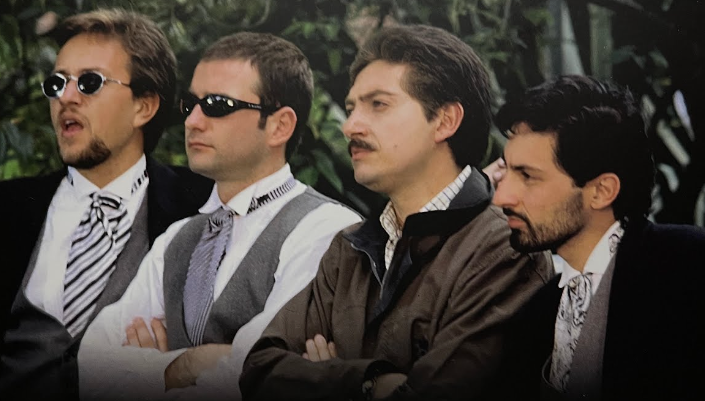
The telenovela gets unfairly maligned as a “woman’s genre,” but its stories make the shows perfect vehicles through which to look at the lessons these hit dramas were teaching young boys like me. This is why Hombres, a 1996 Colombian telenovela I watched avidly as a teen, felt so revelatory: The groundbreaking series riffed on telenovelas while borrowing freely from prime-time American dramas. Its ensemble depicted a cross section of the new kind of man who roamed the streets of Bogotá. Our lead, a redhead named Julián Quintana (Nicolás Montero) is, as it turns out, the blandest of the bunch, an everyman designed to anchor the more outlandish characters around him. There is Santiago Arango (Luis Mesa), a rampant misogynist who abuses his wife and proudly tells his friends that a fist is the best way to keep a woman in check. Then there is, as if to balance such un- savory behavior, Ricardo Contreras (Gustavo Angarita), an older man whose decades-long marriage is the kind his colleagues aspire to have, especially Tomás Holguín (Ernesto Benjumea), a mustachioed young man whose romantic aspirations are constantly sabotaged by his own desperation. Rounding out this sprawling cast of characters are Daniel Rivera (Luis Fernando Hoyos), a self-avowed womanizer with a dis- taste for emotional intimacy, and Simón McAllister (Orlando Pardo), the most junior of the associates, whose wife’s death leaves him as a single dad of two young kids.

Compared to telenovelas with historically flattened male characters, Hombres was grounded in a multifaceted reality. The series tackled contemporary plots (death, divorce, AIDS, and changing sexual mores, among others), and made a point of thinking beyond romance as its central narrative engine. At times it felt more like a character study than a Colombian melodrama, as it posited inquiries into modern manhood that felt incredibly timely. And there was a familiarity at play here. My private, elite school was populated by many boys who would (and did) grow up to be the kind of men Hombres depicted and spoke to. These were the boys whose approval I craved and yet who amused themselves by riling me up and then mocking my emotional outbursts. “Ay, se puso salsita!” one would needle me, calling me out for losing my temper and not taking their jokes in good stride. I often hated how much I hoped to be liked by them (and, actually, how much I was attracted to some of them), but that just meant any attention I got from my schoolmates was always tinged with ill-placed jealousy and self-hatred. What was most annoying—if not outright embarrassing, for them more so than me—was the way such taunts always felt like they reinforced their own bonds. I could get along with one or two of them at a time (especially when we were assigned group lab projects or classroom presentations to work on), but there was something about their pack mentality that brought out the worst in them. They boosted each other up whenever they punched me down (figuratively, thankfully). In this, Hombres was just as enlightening. After all, the series couldn’t escape the oppressive nature of its own gendered ideals. Its title defined an essentialist proposition that could only ever fall short for those of us who knew that notions of Colombian masculinity were defined in our absence.

To watch Hombres is to see a world where men and women are cut from such different cloths it’s a wonder (and an everlasting mystery) how they ever find ways of living together. If telenovelas writ large were enamored with romantic plots that upheld social mores (and yes, prim and proper heterosexual pairings), Hombres posited a different possibility for mainstream television. Here was a conscious exploration of modern Colombian masculinity that was nevertheless not as culturally expansive as its simple title promised. The show’s pilot episode, for instance, opens not with its male ensemble, but with a scene at a restaurant where we hop from table to table and listen in on several conversations women are having about the men in their lives. A middle-aged woman bemoans the fact that her husband left her for a younger woman; her friend tells her she should be lucky he was honest. Hers has been seeing someone behind her back for years and she wishes he’d just own up to it. Another wonders aloud why it seems men nowadays want the very thing they’ve long villainized. Don’t they hate and denigrate stay-at-home moms and housewives? Why, then, do they insist now on wanting their spouses to stay home, play house, and cater to their every whim? Others pride themselves on their newfound assertiveness: “So I told him, leave,” one says. “There’s the door. You think I’d be the first woman to raise a kid by herself?” Another: “What I do with men is what, historically, they’ve done to us; I just bed them.” Later, we see a young woman crying after sharing that her boyfriend wants to stay together (but still see other people) as a nearby waitress worries the guy whose baby she’s now carrying may ghost her after hearing said news. As the waitress then makes her way through the dining room, the din around her takes over; every table is full of women talking about nothing but men, offering a perfect example of how to fail the Bechdel test.

The kicker for this prologue is a brief vignette focused on a young girl set against a white backdrop. She is impeccably dressed, as if styled for a family portrait, in a cutesy dark-blue sailor dress. As she plays with a ball, a young boy comes in and smacks it right out of her hand, only to laugh loudly when he gets a glimpse at her frilly bloomers as she bends down to retrieve it. The camera closes in on her as she grimaces. “Hombres!” she spits out, “Guácala!” (“Men! Yuck!”).

Years before Sex and the City turned girl talk brunch into a tired TV trope, Hombres creator Mónica Agudelo understood the cultural importance of enshrining the intimacy such a setting afforded women in the mid-90s. What’s striking about these vignettes is how they neither seek to villainize men nor outright excuse their behavior. Against an entire genre that so exalted marriage, monogamy, and the nuclear family, Hombres set out from the start to ground us not in the aspirational images of church weddings and picture-perfect images of wholesome happy families (the kind that littered too many a telenovela ending) but in the messy and modern conflicts that were, as was the case in these conversations, the talk of the town. To open with women’s complaints and to tie them to concerns about divorce, motherhood, and courtship remains as revelatory in the 21st century as it was in 1996. These may have once been private concerns, but by staging them in a public setting like a restaurant, these groups of female friends created a choral effect that rippled out from every table. Agudelo made clear this series would air out stories long kept hidden behind closed doors.

Likewise, the modern men at the heart of Hombres would come to feel oddly familiar, contemporary avatars of a generation that was remaking the narratives around romance they’d long been fed. Stock-brokers by trade, they were associated with a cosmopolitan environment and thus a vision of Colombia that imagined the country as economically forward-looking and ready to shed its bad rap. They were, in many ways, grown-up versions of my own schoolmates—many of whom would, in fact, go to Colombia’s top two schools to study Administración de Empresas, the catchall business major preferred by the country’s upper class. Our school was all but a conveyor belt toward early twenty-first-century yuppiedom. Hombres offered a glimpse into a possible future and a rare window into an alien present. For, if these stockbrokers weren’t older facsimiles of my fellow classmates, they were easily legible as their fathers, who ran multinational corporations, were executives at oil companies, or were otherwise part of the movers and shakers in a city that was desperately trying to rebrand itself into a future where it needn’t have to be associated with drug cartels, car bombs, and a decades-old violent conflict that seemed to have no end in sight. Given that my mom worked in a creative industry, those suit-and-tie men were foreign figures to me. I knew—or gathered, more like—that I was supposed to see in them an aspirational image, their menswear supposedly projecting a seriousness to look up to. Our school uniforms instantiated this, in fact.

Had I followed a different path in life—had I, for instance, stayed in Bogotá and gone to either Los Andes or La Javeriana for school— I’d have likely moved in circles like those depicted in Hombres. Revisiting the show all these years later, I am reminded, though, of why I left. For even as the show presents a wide variety of high-powered men who struggle with issues as varied as marriage, parenthood, friendship, dating, and yes, even a crazed female stalker, Agudelo’s show can’t—and didn’t try to—escape the subtle homophobia that undergirded all its commentary on contemporary Colombian men. One that, in this case, nevertheless came wrapped up in a rather tepid push for tolerance and acceptance.

If telenovelas writ large were enamored with romantic plots that upheld social mores, Hombres posited a different possibility for mainstream television.

For, alongside the Juliáns and the Santiagos of the group, Hombres offered audiences a token gay guy. As ’90s tropes required, Marcel was a limp-wristed, fashionable “gay best friend” who ran a clothing boutique and spent many evenings gabbing about with de Francisco’s Antonia. And, though we first meet him having a meltdown over his recent breakup, his romantic (and sexual) life is all but nonexistent. On-camera at least. During one episode, when Antonia cancels their plans as she opts to go out on a date with Julián, we see him joking that he’ll spend the evening reading One Thousand and One Nights, as if his social life were only tethered to her availability. He was, in a way, the Will to Antonia’s Grace before that U.S. sitcom had even been conceived.

Played by Claude Pimont, Marcel was coded as different—as foreign, even. Pimont’s accented Spanish (he was born and raised in France before kicking off his acting career in Colombia), not to mention his shoulder-length hair and endless collection of fancy silk scarves, set him apart from the show’s cast of characters, whose cleancut near-identical looks stressed and encouraged homogeneity.

At the end of the day, the boys club Hombres depicted depended on setting itself apart from men like Marcel. For, in a series known for its battle of the sexes theme, Marcel usually found himself grouped (willingly and giddily, I must add) with the girlfriends and mothers present in the show. This was nowhere more evident than in a two-part episode cheekily titled “Detrás de un gran hombre hay una gran mujer” (“Behind every great man lies a great woman”), which is centered around Julián’s best friend Mafe’s thirtieth birthday party. Wanting to buoy her spirits over crossing that milestone, Marcel suggests she host a raucous costume party for herself. A gender-bending party, in fact: have all the men dress up as women and all the women as men. The ladies are thrilled! At last, a chance to wear baggy suits and play at being men for a day. The boys, though, are less than thrilled. The mere concept of taking up drag for a day appalls them even as they (mostly) begrudgingly agree to take part in such a lark. The only holdout is, unsurprisingly, Santiago, who badgers and belittles his friends for letting themselves be so emasculated as they opt to wear miniskirts, makeup, wigs, and even heels.

The pathetic attempts by these men at finding the humor in their plight is what should make us chuckle; we’re encouraged to laugh at, not with them.

Much of the humor of the episode centers on the inherent hilarity of seeing grown men in feminine clothing. Tomás’s choice to don a wedding gown elicits plenty of quips about being a virginal bride, Julián’s smoky eye makeup and fishnet stockings earn him several lady-of-the-night jokes, and the men’s high-pitched vocal affectations as they role-play are all done in jest, pointing out the hilarity of what it takes to be—to become, really—a woman. In an ironic twist, though, Marcel does not arrive all dolled up in a corset and a killer wig. Instead, he arrives in full Rambo drag, all camo gear and fake guns ablaze. “I couldn’t betray my inner woman,” he explains, “It was easier to betray the man in me.” It’s hilarious to think that such betrayal involved conjuring up this particular image of a “man.” He reached into the far recesses of American pop culture iconography but there was no denying the way his military garb visually invoked a Colombian reality the show otherwise kept decidedly off-screen.

Masculinity and homosexuality were, in the show’s framework, not only incompatible but diametrically opposed. As this double episode illustrated, masculinity is not something you have; it is something you do. Something you perform, really. And, more crucially, something you perform for other men. It is not enough to be a man; you must act like one—and sometimes, that was as difficult for guys like Julián and his friends as it was for those of us who have become canny observers of men to better mimic them and thus hide our desire for them.

Intertwined as they were, homosexuality and masculinity were, from a young age, parts of myself I knew were overly scrutinized. The visibility of one came at the expense of the other. Both were configured in our culture as things to look out for both because they can be seen and because we might not see them. As these episodes of Hombres suggest, the kind of masculinity Santiago so extols is fragile precisely because it depends on its insistent visibility—it’s why he doesn’t dare not wear a tuxedo to Mafe’s party and why he thinks a mere wig will unravel the assured sense of manhood he wishes and demands of his friends. And, while the show does nudge us toward scoffing at Santiago’s retrograde ideas, the twists in the plot all but hand him a win. Shortly after leaving the party together, the men are arrested for being intoxicated. That they’re suffering this humiliation while still wearing skirts and heels is almost too much—and that’s before the cops tease them about their outfits. The police at the precinct all assume they are “transvestites,” and thus worthy of their scorn; they throw the boys out into the gated yard, where they’re further harassed by the other jailed men who are both threatened and amused. Julián worries they’ll be raped and hopes they won’t have to fend any men off, a line that gives them all a chance to curse Marcel again for this ridiculous idea. And, true to form, they do end up needing to fight to prove their masculinity and strength.

When they’re finally picked up by the women, they bemoan their decision to have played along to Mafe’s ridiculous gender-bending party, all while their fellow inmates marvel at their fighting prowess, offering the kicker that captures the incongruity of the entire scenario: “Esas locas terminando siendo unos varones!”: “Those fags turned out to be quite the men!” Though perhaps fags isn’t the right translation. For loca (literally “crazy”) is used as a way to call out effeminacy and homosexuality in a way that conflates them with mental illness, and is most often used as a derogatory insult against trans and gender-nonconforming individuals, the kind who would don wigs and dresses to hit the streets at night. Though, similar to fag, loca is a term that’s continually being reappropriated, used as a way to embrace the scorned femininity it’s supposed to pathologize. By throwing punches and asserting their dominance in the only way they know how, these mocked men end up proving their masculinity by behaving like their most primal selves.

Throughout the show, masculinity—whether championed by Santiago’s retrograde machismo or the cops’ open homophobia—was constantly being negotiated by Julián and his friends. Quite predictably, the series would eventually frame such questions about masculinity in terms of violence. For that is what a varón is: even in a dress, if a man can beat his assailant, he can get away from hurtful labels like loca. As if to nurture their fragile egos, Julián and company decide on a whim to go on an all-boys camping trip, a laughable attempt to reassert whatever authority they believe had been wrestled from them. All alone, away from the prying eyes of the women in their lives, they revert (or become) the most machista versions of themselves they can dream up. At one point they go around in a circle sharing funny jokes that all depend on the gentle misogyny they feel all too comfortable performing for each other: “What does a woman do after making love? Get in the way.” “What would man do without women? He’d domesticate another animal.” The laughter these jokes elicit is rooted in the kind of feminist intervention Hombres was gunning for. The pathetic attempts by these men at finding the humor in their plight is what should make us chuckle; we’re encouraged to laugh at, not with them. For, again, the storyline ends with Mafe and the girls coming to their rescue, further painting these men as hapless fools who can’t go a full weekend without their every whim taken care of.

The series was an answer to an incongruous-sounding question: What would it mean to write a male-centered telenovela?

Reviewing Hombres upon its release in 1996, Colombian magazine Semana singled out how the show presented a necessary corrective to the way telenovelas had been produced in the country’s history: “Although the audience for melodrama is composed mostly of women,” the review argued, “in Colombia the writing of matters of the heart has always been a matter of men.” Some of the biggest homegrown hits had been developed and written by a cadre of talented men who’d created a string of powerful heroines, including Café’s Gaviota, whose love stories had wooed and wowed audiences for generations. With Hombres, Mónica Agudelo was turning such tradition on its head: “Although for many it may look like a sign of a move past melodrama, the show is, on the contrary, firmly rooted within the rules of that genre, only seen with the keen-eyed outlook of a modern woman, for whom Agudelo is undoubtedly becoming, for all her merits, her new priestess.”

The series was an answer to an incongruous-sounding question: What would it mean to write a male-centered telenovela? To write a melodrama about men? What emerged was a bold offering, a series that took men’s inner lives seriously and dramatized that clichéd and endlessly recurring concept of the “crisis of masculinity.” Though perhaps, given its plural title, we should amend its take on such a theme. Maybe Hombres was a series about the crises of masculinity. Or better yet, about the crisis of masculinities. If it feels like masculinity is constantly in crisis, that is because such is its very nature. It may well be that the crisis itself is masculinity. Or, at the very least, the patriarchal masculinity whose fragility masks the very strength it purports to project.

If the tenets of masculinity, as Hombres shows time and time again, are inherently performative, depending on and constantly reinscribed for and by those around us, it’s hard to not both commend the show for that push and pull and to condemn it for so tactfully tackling its male protagonists. In hindsight, its attempt at satire never went far enough—and this had everything to do with the way it careened ever closer to the generic telenovela trappings it was so intent on serving up. Was this a modern dissection of the fragile masculinity that so enthralled well-to-do Colombian men? Or was it an apology for their actions, a way to not merely explain them away but validate them? The fine line between description and prescription, between representation and aspiration, can’t help but be blurred when in episode after episode, Hombres insisted on giving its titular straight men so much empathetic leeway. This was a show, after all, that ended its series finale with the women playfully excusing the men for their shortcomings, teaching the audience an insidious lesson: “Les perdonamos su género,” the women tell the men in the final tableau the show left its viewers with: “We forgive you for your gender.” 

Excerpted from the essay collection The Male Gazed: On Hunks, Heartthrobs, and What Pop Culture Taught Me about (Desiring) Men by Manuel Betancourt, published by Catapult.

7 Poetry Collections About Transformation

For women and queer people, the very act of writing can be an act of resistance. Especially when we shine attention on our own transgressive bodies, poetry is illumination in the darkness, a stay against despair. As Audre Lorde proclaimed in 1977, “Poetry is not a luxury. It is a vital necessity of our existence. It forms the quality of light within which we predicate our hopes and dreams towards survival and change, first made into language, then into idea, then into more tangible action.”

The women poets here write the body in diverse and dazzling ways, channeling imagination into liberation on the page. Their feminist work embodies what Helene Cixous calls an “insurgent writing,” carrying out “ruptures and transformations” in personal and collective history. These are essential books for our times—dive in and let yourself be transformed.

No Sweet Without Brine by Cynthia Manick 

​​The sumptuous second collection from the founder and curator of Soul Sister Revue (the hottest poetry event ever to hit the internet) delights at every turn. Brimming with self-portraits, Black joy, recipe poems, list poems, soul vibrations, litanies and lullabies, No Sweet Without Brine savors play and pleasure while recognizing grief. 

“I want to testify that I’m done with tasting elegies in my mouth,” Manick declares in “B-Side Testimonials,” an incantation on aging and self-care. Her sensual poems contain the “muscle memory” of childhood, the sweet taste of homegrown peaches, the legacy of the Middle Passage, deep reverberations of generational trauma and healing. Even propped in stirrups at a shaming gynecologist’s, Manick writes odes to her own blessed body, works hard to love her uterus “when it feels like a horde of gladiators in a closed ring.” As her voice moves from humor to lyricism, meditation to sharp insight, Manick weaves the sweet and the bitter into one unforgettable poetry feast.

Sex Depression Animals by Mag Gabbert 

This bewitching debut delivers everything the title promises and more. Lyrical and provocative, Gabbert’s poems get right up close to the body, contemplating her skin in the bathtub, describing the swollen sensation of a lip-gloss called “venom,” anticipating the “brief prick/ of needle to bone” before getting tattooed. Animals pervade the collection, often wounded and broken but also metaphors of transformation– a snake that slips out of its skin, a monarch’s wings that “close and open like eyelids,” an oyster holding the erotic tension between pleasure and deprivation. 

Gabbert deftly employs white space and fragmentation; her poems tend to float on the page, free of punctuation. Underneath the strange allure of Sex Depression Animals is a fierce rejection of patriarchal structures, a reclamation of bodily autonomy and sexual power. “I cannot wear a sequined dress/ I cannot slink across the floor/ I cannot drop like coins from a purse/ I cannot scatter brightly,” she writes, refusing to submit or be defined, remaking the self through language.

The Shared World by Vievee Francis 

The astonishing fourth book from award-winning poet Vievee Francis pulses with vitality and grace. The Shared World affirms the interconnectedness of everything—lives and landscapes, humans and animals, love and loss and collective history. “I am haunted by memories as/ present as ghosts,” writes Francis, revisiting the loneliness of an unloved childhood alongside the horror of the 1963 Birmingham bombing. Her lucid poems explore vulnerability and oppression in a world where “every dark body/ is suspect”– they reimagine Rosa Parks in potent rage, the white accuser of Emmett Till defending her lust and her lies, the mourning and keening of “every living thing.” 

With deep empathy and lyric power, The Shared World seeks what we hold in common while singing out for freedom in all its varied forms: “I hunger/ for round people– / the body uncorseted by male design.” The last poem, “Dark Horse,” offers a vision of true merging as the child self rides bareback on a beloved old mare: “I can feel the throb of her blood moving through our dark body.”

Territorial by Mira Rosenthal

Mira Rosenthal maps domains of danger in her stunning second collection, Territorial. “There’s tinder underneath our days,” she writes, bearing witness to drought-ridden California, the female body in peril, the earth in crisis, the constant threat of violence balanced with sensual joy. 

These poems explore risk and womanhood, what it means to live among potential predators (mountain lions, humans), to navigate territories both urban and wild. A mother braces while her two young daughters romp on the playground, a public place where parents must remember to “put shorts under skirts.” A girl freezes in a manzanita grove at dusk, learning stillness despite “some nocturnal female sense/ that feels like snakes inside the flesh.” Rosenthal observes “the exposed world/ of men,” captures the embodied experience of giving birth, making love, being assaulted on a crowded bus in a foreign city. The speaker in Territorial becomes a goddess, a gardener, a fury in the kitchen slicing onions: “I admit at last/ there’s a river of rage below the surface,/ hidden.” Renewal lies in the self’s dynamic energy, a wild internal force driven to create.

Date of Birth by Shawn R. Jones

I was hooked from the opening poem of Shawn R. Jones’ searing debut: “Dirty Little Secrets Are Just Another Set of Facts.” This sardonic, breezy title becomes a kind of manifesto, a counterpoint to the poem’s staccato rhythms, her life story beginning with a failed abortion compressed into taut stanzas spanning four generations. Jones takes a journalistic stance on family history and tragedy, poverty and abuse, forging her own memories with the stories of women in her family to create a blazing testimony of Black resilience and love. Childhood scenes burn bright in the present tense, as in “One Reason She Keeps a Switchblade in Her Pocket”: “She is the only child. Has everything. Was taught to share but they/ demand ‘pussy.’” 

Jones is fearless when writing the body, from “ruby chunks” of miscarriage to “the indelible image” of her father overdosed on heroin. Rage and grief are reborn in Date of Birth, a vital response to the brutality of white America. In the final poem, Jones celebrates married love and her own sacredness: “I know I am holy./ Both in what has been lost/ and what has been sustained.”

Wound from the Mouth of a Wound by Torrin A. Greathouse

Torrin Greathouse took the poetry world by storm in 2020 with her revelatory, evocative debut. Now more than ever, we need Wound from the Mouth of the Wound, poems of transformation and trans flourishing, gorgeous lyrics that contain the world’s violence while claiming the trans disabled body as a site of mythical creation and power. Greathouse livens up the page with her brilliant use of varied forms and invented structures, her trickster gift for cathartic wordplay, as in “That’s So Lame” which interrogates the title slur through etymology and personal narrative: “Before I could accept this body’s fractures/ I had to unlearn lame as the first breath of lament.” 

Wound is a contemporary feminist oracle, mapping the territories of trauma and survival. “Nothing’s more/ femme than empty/ field, a place to bury/ seed,” she writes, her lines pared down, knife-sharp. From the floodgate of crying released by gender transition to the “crookedness” of the body inspected by doctors in a cold exam room, these poems enact a profound intimacy with the reader, one that transmutes violation into connection, pain into a common language. 

Skeletons by Deborah Landau

Deborah Landau’s fifth book goes down like a fine craft cocktail, cold and smooth, with a lingering burn. In a cunning arrangement of short acrostic poems, Landau showcases her signature edginess, wryly ruminating on “existential gloom,” monogamy and its discontents, “the filth and joy” of living in a body. Set in the glam world of Brooklyn parks and Parisian terraces, Skeletons examines midlife angst in spare, startling lines: “We liked birth, it kept the death away–”. The poems chronicle looming catastrophe and pandemic ennui, those “caged days/ traipsing round the living room streaming a cringey dance class.” 
Landau’s self-deprecating wit is so elegant we can’t help but give in to her charms, entranced as she listens to Calm app mantras, fails at corpse pose, takes “the kale and kombucha,/ toting a calamitous hairdo and wrecked face…” Skeletons sings most sublimely in its exaltation of desire. The whole collection is a fierce ode to mortality, mourning time’s passage as it revels in the pleasures of the flesh, urging us to say yes despite everything: “The best time for the body is now.”

Writing a Book is an Act of Prayer

Lamya H’s powerful memoir Hijab Butch Blues is an honest grappling with what it means to be queer, to be a devout hijabi Muslim person who resists gender normativity, to love faith and community. Seeking other queer women in Islam as a young person, H wonders if Maryam, whom no man has touched, is like her. She asks if Allah is a man or a woman and, dissatisfied with counsel from religious teachers, decides for herself: Allah is They. She confronts her fear of jinn, who in lore and anecdote are shapeshifters never to be trusted, yet who are too often conflated with brown men from her own community. Reading the story of Yusuf and the king’s stolen golden measuring cup forces H to confront her own withholding, how she unfairly tests others because she is afraid to lose them. Using the second person point-of-view, she asks Muhammad questions about belonging and betrayal.

We see her speed dating, pining after unavailable (often straight) women, praying in department store fitting rooms. We cheer at her first kiss with Liv. H will not choose between the imposed cultural dichotomies of queerness and faith, family and freedom, selfhood and community. She argues for complexity and nuance, especially around sexuality and gender constraints. She writes, “the only way I can get out of my bed and make it through the day is by wearing masculinity on my body,” and immediately follows this with how she holds dear her “feminist rage” and is “politically aligned with womanhood and yet hates inhabiting it.” H refuses to be reduced to a single self, when singularity risks falseness and queerness is fundamentally a multiplicity of selves.


Annie Liontas: What if our stories about being hurt are actually stories about healing? 

Lamya H: As humans we’re programmed towards negativity bias and to think of stories in terms of pain without thinking of what comes after. The prevailing theme of the stories from the Quran, when I was growing up reading them in school, was always perseverance. There are these horrible things that happen to these prophets and these figures in the Quran, and they emerge victorious from them. But one of the things that I wanted to really think through in my book was, What happens after? Who is the person who emerges, what sort of trauma are you left with because of racism or homophobia or discrimination, or just something that has happened to you? How does this instance affect you, and who is the person that emerges? And how can you heal from that? 

AL: I’m thinking of this in relation to Yusuf and Yunus, and how your patient and devout re-reading yields surprising and new understandings of the surahs. Leaving is not always giving up, sometimes it is protection. Abandonment can lead to love and forgiveness. Have such readings introduced into your life an unexpected expansiveness or grace?

LH: In the process of reading about a lot of these prophets, I found myself unexpectedly having a lot of empathy for them, which kind of surprised me. I’ve always been a little ornery about some of the stories of the prophets. I grew up thinking, I can’t believe that Yunus was this prophet and he left his people and he gets swallowed by a whale. That’s terrible punishment! But, talking about it with a friend really drew me into the story. We said, Wait, what if the whale isn’t punishment? What if it’s more for protection? Or like Moses—in the Quran, he comes off as a little bit arrogant. There’s this one story where he asks to see God and God is like, No, you can’t see me, but Moses insists. And when God tells Moses that he’s a prophet, Moses asks, Can I bring along my brother? As a young person, I thought, Wow, I can’t believe he pushes back against God like that. But in doing more research into his story, I discovered that Moses had a stutter. That knowledge changed how I thought about Moses. When I thought of him as someone who was really anxious and had a hard time connecting with people I had newfound empathy for him. That exercise of having empathy for someone in a story led me to have empathy towards a younger version of myself. I realized I was trying to figure things out, just like these messy, complicated prophets were.

AL: How do women in the Quran, especially Maryam, offer confirmation but also help you imagine your own path forward?

LH: I love the story of Maryam. What a fucking badass! She was essentially sent away to live by herself. How much patience and generosity she must have had for her situation and the people who sent her away? And then there’s a story where an angel comes to her as this handsome man, and she turns him away. She doesn’t want to talk to him. And for me, that story was such a moment of recognition. It was so beautiful to be able to see a story like this. At fourteen, when I first heard the story in Quran class, I was grappling with all of these feelings, too. I found myself so uninterested in boys, I found myself with this crush on a teacher at school. I don’t even know if I would have been able to call it that—a crush—let alone use words like gay or queer lesbian. I was suddenly able to see myself in the Quran, which was the book my life was structured around at that point because I was in Islamic school. I lived in this Muslim country, and the Quran was everywhere. I didn’t grow up reading a lot of books with queer protagonists or even protagonists who were people of color. And so to have that moment of recognition in a text – and the Quran at that – was powerful for me. 

AL: What is it like to slow-read the Quran over a long period of time?

I was trying to figure things out, just like these messy, complicated prophets were.

LH: Honestly, it’s an ongoing process. We’re not done yet, even though my friend and I, when we started, said, We’re gonna crush this, we’re gonna get this done in six years. I think we’re going on year seven now, and we’re about two thirds of the way through. Honestly, it’s been so lovely because there are various layers to the experience. One layer is this text that we’re reading that we’ve both read before, and we’re unpacking it not just in terms of the traditional interpretations but also in terms of how we’ve been taught to question it or not question it. And then the other layer that’s been really lovely is seeing my friendship grow with this friend, and marking the various things that have happened in her life and mine. Getting to have the longevity reflected in a weekly phone call and the regularity of that. And even just being able to say, Oh, do you remember when you read the second surah of the Quran and this was happening in your life? It’s been a really cool way to mark time and friendship.

AL: Some of the most powerful sections in this book are about how you grapple with your faith in God. Specifically, you talk about growing up with a gendered understanding of Allah, who most see as Him, none see as She. You ultimately conceive of Allah as They. How has this understanding of Allah as nonbinary changed your relationship to your faith, yourself, the world?

LH: Recently, it’s become really popular to gender Goddess, which I find so interesting and so limiting in its own way, I know that people have really good arguments for it, where they’re basically like, Oh, we’re just like countering how much “He” has been used. But I actually find that less compelling than this idea of using words like non-binary and genderqueer for God. In some ways I’ve always thought of God as non-binary. But I think being able to put a word on it has been really important. The word “non-binary” wasn’t used very much when I was younger and thinking about gender. People used words like “butch” or “masc” or “genderqueer,” and I have so much love for those words—I have a lot of love in general for words that feel outdated but that carry so much history and so many layers.  But to be able to use a word like non-binary for God has been really, really powerful for me because words shape not only language, but also the world.  I’m someone who came to using the word non-binary for myself pretty late. I had used a lot of those other words for a long time. I really grappled with what it means to wear a hijab while identifying as non-binary; for a long time, I thought that if you aren’t materially facing the consequences of a word, can you really identify with it? So being able to use that word for God let me give myself permission to use that word for myself. I think it’s important to honor the parts of yourself that feel like they need to be put into words.

AL: You seem to write from a place that arises both from resolution and searching. I’m wondering for you, what is the gift of doubt? What is it like to be simultaneously “part of” and “apart from”?

Being in this intergenerational, diverse community helped me figure out that I didn’t have to be authentically gay or be authentically Muslim.

LH: Doubt is one of the most powerful things. It goes hand in hand with faith in ways that are very important. You essentially can’t have faith without doubt, because otherwise it would just be certainty. I think it’s underappreciated and I think it can be such a generative thing. It leads you to ask questions and it leads you to explore things that you wouldn’t have thought of. There’s this way in which people are scared of doubt and are scared that it takes away from faith. For me, doubt also goes hand in hand with writing and asking questions. Writing is a way to explore those things that arise from doubt or anger or something that feels like it’s sticking in my mind and I can’t let go of it. Writing feels like a way of getting at some of those resolutions. I think sometimes the beauty of doubt is that you can doubt your resolutions and really have them be dynamic and use the questioning as a way to lead a life that is intentional. 

AL: So writing might be described as the practice of doubt? 

LH: Absolutely. 

AL: In “Jinn,” you write about being made into “other” by white people and the white supremacist infrastructure. Reading works by bell hooks and Audre Lorde, as you note in the piece, helps you understand the true nature of jinn and your relationship to them. How are telling these stories acts of resistance?

LH: I came to writing through the act of telling stories as a way to counter the narratives being lost. I used to tell stories all the time of just things that had happened to me. One time a friend said, You tell these stories and you are clearly upset and angry but that rage dissipates unless you do something about it. She suggested writing, so I started writing. What I appreciated about it is that it allows me to use the telling of stories as an act of resistance and also as an act of validating the anger. I think about Teju Cole’s tweet a lot: “Writing as writing. Writing as rioting. Writing as righting. On the best days, all three.” The act of storytelling is so deeply enmeshed in justice.

AL: You talk about legibility and the pressure to be “authentically gay,” which includes a mandate to come out to your family, an act incongruous to your experience and one you worry would hurt your parents. How did your queer Muslim community save you? How did it help you embrace a whole, complex self?

You essentially can’t have faith without doubt, because otherwise it would just be certainty.

LH: I don’t know who I would be without my queer Muslim community. Finding them has been one of the most beautiful life-changing experiences of my life. I found them at a point in my life when I was trying to figure out how to live, as one does in their twenties. I was grappling with normative Islam and normative ideas of right and wrong and sin. I was grappling with queerness as well, figuring out which parts felt reductively normative and which were prescribed by others as the “correct” way to be gay. We don’t necessarily have models for how to be queer. So to be around people who were resisting both of those categories and forging new ways to live was so powerful. Being in this super intergenerational, diverse community really helped me figure out that I didn’t have to be authentically gay or be authentically Muslim. I could figure out what those things meant to me and live my life in ways that were true to who I was. 

AL: You’ve said you write because ideas are “entangled” in your head. You also allude to the role of pray in your life, such as when you are at the doctor’s office to complete necessary immigration forms. Has writing these essays and telling these stories been a kind of prayer for you?

LH: The part about this that has felt like prayer is the act of writing the book and having it go out in the world. It’s an aspiration of prayer that you get some sort of response back. So it’s been really cool to see the responses coming in from other queer folks, other Muslims, other queer Muslims. Not all of it has been positive, which is to be expected. But a lot of the responses to the act of putting the book out have been really lovely.

AL: What are you still seeking—might always seek—from your faith and your place in the world as a queer nonbinary Muslim?

LH: I’m still figuring out how to do this whole thing called life. To me, what feels important is intentionality and effort and trying. I’m a big trier. I think what I’m seeking from my faith is the ability to do that—to use some of the tools, like prayer, as pausing points to reflect on what I’ve done and what I want. What is rooted in justice, what’s not. The other place that I seek some of this from is community. One of the best things about community is accountability and having people around you who will tell you when you’ve fucked up. What I’m seeking from both my faith and community is the ability to live in a way that moves me towards the kind of world that I want to be in.

Booktails from the Potions Library with Mixologist Lindsay Merbaum

In Margot Douaihy’s novel Scorched Grace, Sister Holiday is a tattooed, gold-toothed, cigarette-smoking, rock ‘n roll lesbian nun, a resident music teacher and latest addition to the dwindling order, the New Orleans Sisters of the Sublime Blood. When a series of deadly fires breaks out at the school, resulting in the death of a friend and colleague, Holiday becomes a prime suspect. Less concerned with clearing her own name than with stopping a serial arsonist and killer, Sister Holiday devotes herself to solving the crime, working in tandem with the one detective who doesn’t think she’s the culprit. “The devil isn’t in the details,” says Holiday. “Evil thrives in blind spots. In absence, negative spaces, like the haze of sleight-of-hand trick. The details are God’s work. My job is keeping those details in order.” 

The true mystery underlying this story is who Holiday really is, and how her messy past–the ex-girlfriend and ex-bandmate she can’t stop thinking about, the estranged brother whose absence haunts her, and the many losses suffered–have brought her from Brooklyn to a convent in Louisiana where she wears gloves to cover the tattoos on her hands and surreptitiously smokes contraband cigarettes confiscated from foolish teenagers. Written in rich, evocative prose, Scorched Grace is a must-read for Pride this summer. 

The Scorched Grace booktail is, as the author puts it, a “smoky sweet twisty trinity” of fruit, flowers, and Scotch. Many people have very strong feelings about Scotch whisky and its smokiness, which some have compared to cigarette butts. In this case, the peat works to our advantage. A symbol of Holiday’s whiskey-soaked memories, the Scotch is combined with apricot brandy for the ubiquitous sweet olive, a favorite in Southern gardens, including the school’s, which perfumes the story with its scent of apricot. Chicory pecan bitters are a nod to the sisters’ practice of bartering for chicory coffee, and for Sister T’s chicory root blend that Holiday enjoys so much. The booktail is served over ice made from jasmine tea for night-blooming jasmine, mixed with rose, a symbol of the Virgin Mary. The drink is garnished with a deliciously dessert-y bruleed apricot or peach, balanced with a sharply fragrant twist of lemon for Detective Riveaux’s homemade perfumes. 

This booktail is presented against a very-gay-shade of purple that complements the book’s cover, with a mirrored base that distorts the precise rays of color on the cover into flame-like waves. The drink is served over ice shaped like a rose in a purple-sheened glass that looks like it’s been twisted by fire. A sexy, scorched apricot balances on the rim, decorated by a curl of lemon. The overall effect reflects Holiday’s inner life, which is full of passion, drive, and regret, juxtaposed against the exterior by which others judge her. The scene is spotted with flames of calendula, for the scent of the Mother Superior.

SCORCHED GRACE

Ingredients

  • Jasmine green tea 
  • 1.5 oz Scotch (choose level of peat/smokiness based on personal preference. Any will work, from Dewar’s to Bowmore. If you don’t like Scotch, sub in your favorite whiskey)
  • 1 oz apricot brandy 
  • ¼ tsp rose water (or a pinch of dried organic rose petals, steeped with the jasmine tea 
  • 4-5 dashes El Guapo chicory pecan bitters 
  • Bruleed peach or apricot  
  • Lemon twist

Instructions 

Steep the tea until cool, then stir in the rose water and freeze in a mold of any shape, preferably a rose or large cube/sphere. Meanwhile, cut an apricot or small peach in half and sprinkle each side with ½-1 tsp brown sugar. Substitute white sugar if you prefer. If you don’t have a torch, set a small skillet on high. Cook each side of the fruit for a few minutes, until lightly caramelized. Set aside. Once solid, add the Scotch, brandy, and bitters to a mixing glass filled halfway with ice. Stir until well chilled then strain into a rocks glass. Add the jasmine rose ice. Garnish with a bruleed peach or apricot (or fresh if preferred), and a twist of lemon. 

This Apocalypse Brought To Us By 300 Million Dumbasses

An Open Letter to All Survivors

In response to the ongoing public criticism, targeted harassment, and impugning of my character that I endured during my tenure on the White House Infestation Response Team, I feel it is time for me to tell my side of the story. Not just for myself, but to ensure that history is recorded accurately. First, let me just say that I heard your very loud and very vocal complaints during the crisis. While I disagree that I am the buffoon partisan the media made me out to be, I empathize with, and share, your profound disappointment with the governmental response overall. We have all lost so much collectively, but this doesn’t make our grief any less, individually. That said, I believe corrections to the permanent record must be made: it’s not my “fault” a horde of killer beetles slowly murdered (almost!) everyone.

First: contrary to the conspiracy theories, I am not a physician nor some sort of “mad scientist” who created the killer bugs in a lab, as some pundits implied. The “Dr.” in my title refers to my degree in Sociology, earned by the submission of my dissertation, “Mass Denialism in the USA.” Before inexplicably being made a scapegoat and fodder for conspiracies, I was initially brought on for a brief stint as a public-facing advisor at the National Institutes of Health because what I am is an expert on what you do: nihilistically ignoring reality.

Second: for the record, my name and title are Dr. Anthony Dumas, not “Dr. Dumbass,” contrary to those t-shirts you made (ha, ha, witty!). Ironically, the opposite was true. You were the dumbasses. That’s right. The whole time, it was you. Please allow me to explain.

Could we have stopped them before they bred into an army and grew larger than grizzly bears? Obviously, yes! But sadly, I failed in my effort to get many of you to accept that this “impossible” and “absurd” threat of “death by ladybug” was real—on that we can agree. I confess, I did not foresee that many of you would be obstinate enough to cling to your denial right up until you were in one’s digestive tract. Admittedly, I never even dreamed people would leave their homes during the lockdown because, as one half-eaten person managed to whisper before the venom kicked in, “Holy shit, I was so fucking bored.” In hindsight, clearly, this was a failure of imagination, on my part. Specifically, to grasp the capacity for nihilistic denialism, on yours.

In the earliest stages of their arrival, those innocent days when the first shaky, gory videos of people screaming as they were eaten alive began appearing across social media, I must admit that I actually found it fascinating (the phenomenon, not the bloodcurdling screams). I even began a scholarly paper on the subject. My thesis: We, contemporary Americans, are citizens of a nation that only experienced war as an invader. Off in the distance, filtered through competing partisan narratives, we could decide our military shit shows were going “swimmingly” just by squinting our eyes, with little to no effect on the majority of Americans’ lives. Sort of like how white Americans have always dealt with our society’s overwhelming evidence of systemic racism. Over time, we began to believe nothing could affect us if we simply chose to ignore it. Not famine. Not war. Not growing inequality. And certainly not an alien invasion of 300-pound bulletproof beetles with razor-sharp wings and microwave eyes.

My sole motivation on the Response Team was to convince you, the public, that you simply can’t ignore a human-eating predator that can detect carbon dioxide exhalation from three miles away. Also—and let this be my third point—”carbon dioxide exhalation” is not a “myth meant to suppress our freedoms” as the very ill-fated Mouth Breathers movement theorized.

When our former POTUS chose this precarious historical moment to give a public address to a packed crowd live at Fenway Park, was it not I who broke the chain of command to warn you? After that ended predictably in a writhing crimson sea of ripped flesh, I’d hoped the “Boston Buffet” would be a turning point. But, no. “False flag!” partisan networks decried, even as the familiar sounds of machine gun fire and screams could be heard off camera.

Alas, I accept that here I preach to the converted. Because if you’re still reading this letter, I know this about you: you already agree with me. Those who don’t stopped reading in the first paragraph, lest their bubble be pierced like their bodies will soon be. But I need you, the ones I fought for (as opposed to those other troglodytes), to know how hard I am still working. How hard it was for me to find a functioning computer, printer, and photocopier, and then carry these letters for miles, blanketing the streets with copies identical to this one. 

Please take heart, my fellow devotees of reality. In the end, we finally beat climate change, xenophobia, inequality, mass incarceration, and that looming theocratic ethnonationalism we were all so worried about. So, in that regard, I guess you could say we kinda won, right? And we did it all without fully acknowledging the existence of any of that, as is the way of our people. Ultimately, the only cost was everything.

A Dark and Magical Fairytale Starring Argentinian Travesti Sex Workers

“Far below, where the secret rivers of the world flow, appeared a word that stank of death, shit, semen prostitution, the night, the cold, bribery, blood and jail, of misery and neglect. A word sharp as a knife, grime-encrusted and wounded. A word that spoke not just of the creatures we were and are but also of our poverty, of the acts that made us legendary, of the courage with which we headed out to live among families and communities.”

—From “Author’s Note: The Word Travesti” in Bad Girls 

Profoundly influenced by science fiction, magical realism and the absurd, Bad Girls (published by Other Press and translated by Kit Maude) narrates the stories of a group of travestis working the night at the Sarmiento Park to earn their coins. After being rejected by her parents and barred from her small town, our narrator, Camila, arrives in Córdoba to study at a University. One night she shyly approaches the group of imposing travestis working the Sarmiento Park and is immediately welcomed to the herd of luminous night creatures.

Led by Tía Encarna—a spectacular Spanish travesti, 178 years old, who finds a baby in a ditch and immediately adopts him as her own singing lullabies and attaching him to her breasts—Bad Girls explores the lives of these herd of dazzling travestis as they meet the world’s unforgiving violence one stiletto at a time.

To say that I was obsessed with Bad Girls from day uno when I first read it back in 2021 in its original Spanish is a major understatement. As it is also an understatement to describe Sosa Villada’s prose as mesmerizing, raw and brilliant. The fierceness of this book is in its unapologetic embrace of travesti poetics. By which I mean, an aesthetic that drips of the oral rhythms swept up from the dark streets of Córdoba into perfect streams of poetic prose. Sosa Villada’s storytelling is guttural, tender, humorous and punk. It explores what she calls, “travesti grammar”: a crossing of tenses, a riveting self-absorption, a shift in point of view that falls into a fairytale voice. 


Julián Delgado Lopera: In the author’s note that opens the book, which is also a gorgeous poetic rumination on the word “travesti,” you talk about how “travesti” has been stripped away from its chaos, “hygienized” with words like “trans woman.” How this imposing of Western queer theory has no relevance to poor Latin American travestis working the streets. The note which appears in the English translation doesn’t appear in the original book in Spanish. Why?

Camila Sosa Villada: Other Press specifically asked for that clarification. I guess because of the political correctness that exists in the U.S and the lack of knowledge about this word that sounds derogatory. Also, when editions of the book were published in other Latin American countries I was asked to change “travesti” for “trans.”   So, from my illiteracy, I wrote a short note on what I think that word implies inside Bad Girls, but also during a time in which travestis are disappearing.

JDL: How did you feel about having to include the author note?

CSV: It gave me the opportunity to write something that I had already been saying in some interviews and that I had been clarifying to activists here in Argentina and in other places in the world. The fact that I think using the conjunction “trans-woman” says way less than the word “travesti” in economic and historic terms in Latin America.

JDL: Tía Encarna is really loved by readers and calls a lot of attention on the page. I love that she is this imposing matron beating up johns in stilettos, scolding the girls and teaching them the realness of being a travesti. Her house is this heaven to the travestis from the park. Can you talk about this “mother” trope of Tía Encarna in the book?

CSV: The narrator does say many times “our mother” referring to Tía Encarna. “Mother” is a word that activates something really quick in the reader’s imaginary. To call Tía Encarna “mother” and speak about a “travesti family” is something that triggers, que prende. It’s an easy answer to a very complex organization that these travestis have at this time, specially because most of them are orphans or are really far away from their own mothers. So yes, Tía Encarna works as a maternal anchor. Pero fíjate that when the baby arrives she distances herself from all the travestis and she wants to live solely for that kid.

That organization of travestis is more like the organization of a mafia cell joining forces when they have enemies in common after them: the police or violent clients or the freezing night or, in this case, the occasion of finding a lost baby in the Sarmiento park. Una alianza. A herd. I think the word “family” falls short because they can betray each other, they can leave, they can come back. Calling Tía Encarna a “mother” is to reduce her complexity because it is not with a motherly vocation that Tía Encarna helps other travestis that are in greater need that her… because it is not only mothers that are able to feel piety, generosity, when others have fallen in disgrace.

JDL: It is also an organization not formed through biological ties, which is usually how these strong “familial” connections happen, but attachments through a shared experience and the circumstances in which they find themselves. 

CSV: It is something that also has to do with the time period in which the Tía Encarna’s story is being told, the year 2000. During this time, there was no other way of having attachments other than in that style of connection. All of the travestis I met didn’t have families. They were thrown out or banished from their homes, or their families were very far away in other countries or provinces, so it is the only possible connection that we had. We were all daughters of no one. 

JDL: Our narrator, Camila, sees the world’s dark secrets revealed by the night. You’ve spoken before about the “privilege” of Camila’s point of view, her eye on the world’s truth and nakedness. Can you talk about that specific point of view on the world that Camila has?

CSV: Something inherited from science-fiction. An intuitive power that Camila has that allows her to see people as they really are and that others don’t have so they get lost. I understood that the title “Bad Girls” left something very evident regarding a question I was always asking myself, “who are the bad girls?”

We were all daughters of no one.

One day after three years of working very closely with a colleague at the Difunta Correa Cabaret, he distanced himself from me saying that I was “bad.” So while I was writing this book I kept coming back to this question, “what does it mean to be bad?” because I had heard that many times: travestis are bad. It is true that the travestis I met had less patience, were angry at times, held grudges that they couldn’t resolve, many were dangerous, of course, and you couldn’t get close to them. It reminded me when in science fiction movies people that tame the dragons need to understand the protocol to approach the dragon, where to look, the body language, what not to look, some of that was present when I was young and hanged around travestis on the street. 

Travestis are seen in a very specific “bad girls” way but once you go into that travesti world you realize there’s abundance of gentleness, solidarity, complicity that “good people” don’t have. “Good people” are seen as those who get married, have families, and then you find out that 80% of abused children in Latin America are abused inside their homes. That the ones that are murdering their wives are married men with children, are the so called “good people”. Nobody would dare say that a man who wakes up at 6am to go work at a factory, a man that has a few drinks with his friends and comes home to his wife, nobody would dare say is a “bad person.” People say a “faggot” is a bad person. The faggot that wakes up at 3pm to go mess around and hook up with men at a dark park in the middle of the night. When I decided the title “Bad Girls” I needed to show what do these bad girls see? Why are they bad? Why are they stealing from their johns? Why are they fighting each other with so much violence? And this is the power that Camila, the narrator, has to undress those that are always perceived as the “good ones.” The good sons of good families that play sports every weekend, how can those good boys be bad?

JDL: Why does the book take place primarily at night?

CSV: It’s connected to Camila’s eye and her ability to see people as they are. The worse killings and hunting in nature happen at night. It is rare that killings happen during the day. These travestis are awake when everyone is asleep, so they see things, they see exactly how people are. Because most everyone is asleep and those who are out at night are in search of their preys. The day doesn’t admit those nightly creatures.  

JDL: Throughout the novel we see a carousel of travestis entering the narrative for a brief moment, a few pages, and then disappearing. Like an archive of the Sarmiento park. A few characters remain with us from start to finish like Tía Encarna and María the Mute, the characters that are part of Tía Encarna’s house, but most of the characters are with us for only a brief period of a few pages.  

Travestis are seen in a specific ‘bad girl’ way but once you go into that world there’s abundance of gentleness, solidarity, that ‘good people’ don’t have.

CSV: I was very attentive to what I remember regarding the instability of travestis in the world: you could see her for a whole month every night and then boom she would disappear, and you’d find out that she was dead or was in Italy. From one day to the next. It was like that. There were some travestis that survived and were in the park for much longer. But the others would enter the park world with the logic of a show: perform their number as part of this travesti world. They would appear, would make a big mistake—beating someone up, stealing—and then they would disappear. I also do that: appear with the logic of a bank robbery or of a spontaneous choreography on the street.

JDL: How do you live writing?

CSV: With plenty of solitude.  That is the reason why I have been living alone for the past 23 years.  I don’t explain myself to no one. I can wake up at 3 am, make myself café con leche and start writing. I can write anywhere, I don’t have to be in a specific place. Writing is something you can’t share with anyone. Almost all professions serve to flirt, to meet people for a conversation in an airplane or a coffee shop or a date. But what are you going to say? “Oh I’m writing a story about a travesti that finds a baby in a ditch and she takes him to live with her in a house full of travestis”. Come on. Eso no se puede contar!

JDL: How do you feel about the book’s incredible success?

CSV: I feel great in economic terms. The success is economic. Specially for a girl like me, the success is always economic. I am not interested in the symbolic, all that can be lost in one moment. Money you can smell it, you can turn it into something else… there’s nothing more science fiction than money.

JDL: How has been the book received by other travestis?

CSV: With so much love and pride. It is deeply moving. They always have warm words for me and I really do not know how to give back all that love. They connect immediately and tell me, “it was exactly like that!” or “how lucky that there’s someone being able to speak it”. And I understand the deal about history always written by those who win, so that there is some peace that it is one of us, one of the travestis, who is writing about how we lived those 20 years ago. It also worries me. Because I have to be lucid when I talk, trying always to be clear about my position of privilege.  There’s a sense of responsibility and I never wanted to be in this position of having to be “correct,” not politically correct, but correct with myself and the travestis. Specially with a particular type of travesti, not with the whole LGBT community, but with the travestis that I describe in the author’s note, with that type of travesti experience that has nothing to do with identity. It is not something that is built through language but that is constructed through experience. The travestis are always present when I have to respond.

JDL: I want to go back to this idea of the “hygienization” of trans representation in all the media, including literature. You and I have talked extensively about the stripping away of the chaos, the grime, stripping away a very specific experiential story from the “travesti” and the “trans” and homogenizing it, packaging it in a way that’s more palatable. I know you really love movies like “Tangerine” and T.V. shows like “La Veneno” precisely because that travesti chaos is embraced but they remain a niche and not the generally “accepted” trans narrative. Why?

Travestis are not be theorized about or investigated, travestis are to be invented, dreamed of.

CSV: There’s something that I still don’t understand: travestis were here before. We were here before the Spanish conquest. I don’t understand why now we have to ask for permission to exist, to name our truth, to go into a restaurant, a library, a movie theatre. When did travestis lose our sense of ancestry? In my newly published short story collection “Soy Una Tonta Por Quererte” (I’m a Fool to Want You) there’s a story about Cotita de la Encarnación which we’re told is one of the first travestis burned at the stake by the Spanish inquisition in Mexico. So I’m in awe that we still have to be asking for permission to talk about ourselves however we want when we have the proof of our existence written in the Treaty of the Indies. It really blows my mind. We were here before. 

JDL: Why do you think that most of the English coverage of your book has centered around “Trans activism”, the contribution of the book to the “trans movement” instead of focusing on the literary quality, the storytelling masterpiece, you have created?

CSV: With my very limited English I could tell that’s how people in the U.S. have been covering Bad Girls. It speaks to the transphobia of an entire society. Not providing a space to the writing of a travesti. As if my obligation is limited to giving testimony and militant activism. It’s a price that I am not here to pay. While the money is coming in they can say whatever they want but people cannot forget that there is an internalized transphobia in the entire society, in all the structures of U.S culture, that presupposes that travestis can only give testimony of our experience, that we don’t have the right to write fiction. 

JDL: A few times in the novel Camila points us to the unknown saying things like “that which cannot be explained’ in reference to the travesti existence. Can you speak to this unknown and “that which cannot be explained”?

CSV: There’s no language to explain the travesti experience. The white and European queer theorists have created this “trans” language, but it is something that cannot be explained. How can we discuss an experience? To explain what a travesti is we would have to tell the story of every single travesti born in this world throughout time. Because there is no other way of explaining it but through experience. What it meant to live in a country in which you were perceived as a very dangerous man dressed as a woman, a vector of sexually transmitted diseases, earning your coin in exchange for sex. The only way to explain this is through story. And then million other words appear around this experience such as class, skin color, what does each travesti have to lose, what things did I have to lose. It is rare that travestis have something to earn, we didn’t have anything to win back then. It was all loss. We left our homes, we didn’t see our parents, our parents hated us, we weren’t allowed in certain places, we walked the streets in fear, we were constantly arrested, etc, etc, what did we gain in all that? Nothing. All of that cannot be explained. The only way of explaining it is by telling the story. It wasn’t an issue of identity. I think “identity” is such a overused topic. 

In the cover of the Spanish version of Bad Girls two travestis ride a horse. That photo belongs to the archive of trans memory here in Argentina. That archive of trans memory collects photos of travestis since the beginning of photography until today. I believe that it is one of the most stunning visual projects at this time. During an exhibition the folks from the trans archives said, the photos that appear inside of homes were taken in Argentina. The ones in plazas, in beaches, in forests are in Europe because here in Argentina travestis couldn’t be outside during the daytime. Inevitably after hearing something like this you start building a story in your head, one that is not narrated by a queer theorist. You are not thinking, trans are those who do this and that… one that is not comfortable with their gender, etc, etc.. That is a total oversimplification of a much more complex equation that does not admit language. That is why it has been so challenging for political and cultural forces to grapple with us, understand us. Until they didn’t succeed in this hygienization of our experience calling us “trans women” they couldn’t do much else with us but consume our bodies. We are a dimension that does not participate in language, that is deprived of language in the way that we understand language. So I can write a story, but that writing has to be understood as a narration of experience not of identity.   

There are not a lot of travestis left, the older ones are dying. I am part of the generation that had to go through that awful world, a world without a god. Which is why in Bad Girls I vindicate that it is fiction and that it is my right to speak using the terms I use. I write fiction because there is no other way to speak about the travesti experience. There’s this María Felix quote that goes something like this “you cannot investigate an actress, you invent an actress, an actress is a dream” and that is how travestis are: travestis are not be theorized about or investigated, travestis are to be invented, dreamed of. 

A New Novel Offers Literary Mothers a Feminist Alternative

My mother has read hundreds of books aloud to me. The titles changed over the course of my childhood—as my brother and I graduated from picture books to doorstopper paperbacks, fantasy to historical fiction, middle grade to angsty young adult novels—but we could always count on our mom to do one thing: cry if a fictional mother went missing. If she began to suspect that a mother was going to die, disappear, or otherwise become separated from her children, she would choke up, stop reading, and flip to the back of the book to see if the characters would be reunited in the end. 

The crying drove me and my brother absolutely nuts. “It’s just a story,” we would inform our mother impatiently. We made faces and covered our eyes and sometimes rolled on the ground to indicate the scorn we felt for behavior this corny. If the insult cheugy had existed in the early 2000s, we would have leveled it at her. 

This scene played out in my bedroom many, many times because many, many books for young readers rely on a mother’s disappearance to kickstart the plot. Grimms’ Fairy Tales, whose conventions inform so much of modern literature, often contrast an absent, kind mother with a present, evil stepmother. In Harry Potter, the Chosen One’s mother (and, in all fairness, his father) die within paragraphs of the series’ beginning. The Dear America novels, a beloved series of fictional journals “authored” by teenage girls from different historical eras, sentence mothers to occasionally cartoonish fates: In Seeds of Hope, a rogue wave literally drags the protagonist’s mother off the deck of a ship while mysteriously sparing the rest of the family. Even “feminist” alternatives to traditional fairy tales, like Ella Enchanted, frequently dispatch mothers so that child protagonists can get on with their adventures unimpeded. 

Mothers, these stories tell us, are not particularly important. In fact, they say, it’s much easier for a plucky young heroine to achieve independence, embark on a journey of self-discovery, and meet the inevitable prince without a mother nagging them to wear a jacket or get home for dinner. For girls especially, these stories suggest that their value as protagonists has a time limit. If Cinderella’s rags-to-riches tale is made possible by her mother’s death, what will happen to her once she has her own children? 

The literary obsession with missing mothers made little sense in the context of my own life: I was so fully secure in my mother’s presence that I could blithely make fun of her for taking fictional tragedies seriously, and yet somehow, I was still growing up, taking charge of my life, navigating my own modest adventures. But no matter how much I insisted that these stories were “just” fiction, I was absorbing their lessons. In my first fumbling short stories, the protagonists were, as a matter of course, motherless. 

I thought back to these children’s books while reading Molly Lynch’s debut novel, The Forbidden Territory of a Terrifying Woman. The novel follows Ada, a young mother existentially preoccupied with the climate crisis and the dangers it poses to her son’s future. One night, Ada goes missing without a trace; her family soon learns that mothers around the world, many with the same concerns as Ada, have vanished from their homes. Part of a small vanguard of novels interrogating the missing mother trope, Forbidden Territory treats its missing mother not as an accessory to another person’s story, but as a literary symptom of the broader problem of parenting during a period of social and ecological decay. By chronicling Ada’s disappearance and return, Lynch invites readers to imagine the stories we could tell if we weren’t so bound to the missing mother. 

Lynch invites readers to imagine the stories we could tell if we weren’t so bound to the missing mother.

The missing mother trope predates the literature of my childhood, and the era of the Brothers Grimm, by a long shot. The Chinese folktale “Ye Xian,” which dates back to the ninth century, tells a “Cinderella”-like story in which a young heroine has to make her way in the world without her mother. In the Western tradition, novels like The History of Tom Jones, Jane Eyre, and Oliver Twist rely on dead or absent mothers. Missing mothers are common in other mediums, as well: In The Atlantic, Sarah Boxer cataloged animated movies that kill off their protagonists’ mothers in order to make way for father-child adventure stories. (Spoiler: It’s basically all of them.)

There are many possible reasons for the missing mother’s enduring power. Folklore scholar Marina Warner suggests that for much of history, the trope was at least partly grounded in reality, given that high maternal mortality rates meant that many children grew up without mothers. Others have offered more Freudian justifications. In his book The Uses of Enchantment, psychologist Bruno Bettelheim argues that the fairy tale convention of juxtaposing a “good” mother and “wicked” stepmother both preserves the idea of an “all-good mother when the real mother is not all-good,” and “permits anger at this bad ‘stepmother’ without endangering the goodwill of the true mother.” If a mother is absent, in other words, her inevitable flaws can’t jeopardize our myths about ideal motherhood. 

That said, if we are first encountering these myths in children’s literature, writers are increasingly subverting them in the territory of adult fiction. The past decade has seen a proliferation of novels about about “bad” mothers. Rachel Yoder’s Nightbitch, Szilvia Molnar’s The Nursery, Yüko Tsushima’s Woman Running in the Mountains, and pretty much every sentence Elena Ferrante has ever written focus on the pressures of parenting in societies that fetishize motherhood without guaranteeing actual mothers dignity or support. Yet fewer novels confront the missing mother trope head on, among them Alexis Schaitkin’s Elsewhere and Lydia Sandgren’s Collected Works, and in imagining what would happen if mothers went missing en masse, Forbidden Territory feels entirely fresh. 

Ada, the novel’s protagonist, lives in Ann Arbor with her history professor husband Danny, and six-year-old son Gilles. A writer and teacher, Ada holds a deep reverence for the natural world, collecting “special rocks” and stitching owl feathers into her son’s clothes as protective talismans. By most metrics, she lives a comfortable life: She has a loving family, a safe home, and a steady job in academia.

The past decade has seen a proliferation of novels about about ‘bad’ mothers.

Still, Ada spends her days in a fog of anxiety. A compulsive newshound, she gravitates toward ominous stories about deteriorating civil society, far-right extremism, and, especially, climate change. News of “garbage islands” and polluted air make it impossible for her to envision a safe future for Gilles: In her worst moments, she imagines him struggling to survive in an apocalyptic landscape of “burning forests” and “filthy” seas. As she puts her son to bed, she wonders if her instinct to comfort him is misguided and thinks to herself, “Shouldn’t she say, The water is poisoned. The forests are on fire. Genocide and torture are normal. When you grow up you might need to wear an oxygen mask.” When she’s unable to process the onslaught of drastic stories, she comforts herself with a visit to the only patch of unviolated nature available to her, a small strip of forest behind Gilles’ school. 

Then, on the radio, Ada starts to hear stories about local mothers disappearing, walking out of their lives without leaving a trace of their whereabouts. Just as she begins to suspect that the disappearances are connected, she vanishes as well, leaving Gilles searching the house and Danny calling friends in a futile attempt to track her down.  

If Forbidden Territory adhered to the conventions of the novels I grew up reading, Ada’s disappearance might have cleared the way for Danny and Gilles to set off on their own adventure or execute a daring rescue mission. Instead, family life grinds to a halt in Ada’s absence: Danny can barely eat or mark the passing days, and Gilles asks the same questions about his mother’s whereabouts over and over again. Combing through Ada’s computer search history and contacting the families of other missing mothers, Danny attempts to aid the police with his own sleuthing. But neither he nor the cops make any useful discoveries. 

Moreover, Ada’s disappearance is not an isolated incident but rather part of a larger trend. By the time Ada goes missing, enough mothers have met the same fate that the FBI is investigating the “crisis” in motherhood. And while Danny is unable to do much for his wife, he does notice that many of the disappearing women shared Ada’s deep anxiety about the future. The husband of a mother who went missing shortly before Ada, for example, tells Danny that his wife could not stop talking about “the cruelties of the world.”

While Lynch never reveals where the mothers go or how they get there, she hints at the cause of the disappearances by way of the public response to the crisis. Through the historians who quickly posit connections between the missing mothers and mass disappearances during other periods of extreme social transformation, like the Industrial Revolution, she suggests that, like Ada, the other mothers have walked out of the known world because they cannot imagine how their children will inhabit it. Meanwhile, predictably misogynist backlash ensues. A senator calls on the public to fight “the ideologies that he said were causing women to betray their children.” In some countries, groups of vigilante men begin to accost women walking alone, intimidating them in the name of keeping them in their rightful places at home. Given that missing mothers in literature are so ubiquitous as to be unremarkable, the rancor that so quickly develops over these “real” disappearances reads like an authorial nudge. Perhaps these men, who have presumably enjoyed their fair share of fairytales and movies about bootstrapping orphans, are angry because the women in their own lives seem to be disappearing not in service of someone else’s story but for their own inscrutable reasons. 

Eventually, Lynch unveils another—the biggest—difference between Ada and the missing literary mothers who precede her. When Ada returns home of her own accord, she has no idea where she’s been. The only thing she can recall from her weeks-long absence is a mysterious and unexpectedly pleasant sensation of merging with the trees, as if she’d become one with the forest that so beguiled her. Ada’s belief that she enjoyed herself while her family went frantic with worry feels so socially unacceptable that she can barely express it to Danny. And that confused happiness is what makes Forbidden Territory so subversive: By understanding her disappearance as a kind of necessary retreat, rather than a banishment, Ada escapes not only her frightening world but the conventions of the stories long told about women like her. The question this novel asks is not how children can get along without their mothers, but what mothers can do when the project of parenting seems impossible. The answer Lynch provides? They can walk away—at least for a little while. 

Now that I am a grown woman who cries during especially moving chewing gum commercials, I have more sympathy than I once did for my mother’s reading preferences. And I can also see that she was teaching me something by crying over all those literary mothers. Just as Ada cannot harden herself to the news around her, my mother was surprised each time a woman in one of my chapter books was separated from her children. Though she is nothing like Ada (and would consider the collecting of owl feathers an excellent way to contract avian flu), she refused to become inured to what others might dismiss as an unimportant but unalterable literary convention. I couldn’t have put that lesson into words at the time—partly because I was a child unacquainted with feminist literary criticism, and partly because we need new texts to imagine alternatives to the stories we take for granted—but all the same, it was an important one. If Forbidden Territory carries the fear of a world changing beyond repair, it also teaches us to question what came before. 

In the novel’s final pages, Ada is driving home from a meeting with the FBI agent assigned to her case. She still doesn’t know what happened to her, but she has recovered enough to start talking about it. Speeding through the outskirts of Detroit, she encounters a twenty-first-century Valley of Ashes: a smoking, stinking landfill overflowing with rubbish. The dump is a literal manifestation of Ada’s fears about the future, and for a moment, she feels overwhelmed by the “layers of waste, plastics and greases, chemicals and particles of diapers” she imagines churning within the pit. 

“For a brief moment she inhabited that heart,” Lynch writes, “and then she returned to her body, driving.” Ada ends the book laughing. One could read these last paragraphs cynically, as evidence that Ada has simply given up worrying about a future she can do little to change. But I like to think that her disappearance has taught her to confront her fears without letting them destroy her, to move through her days in this world without hardening herself to its flaws. I don’t know what that feels like. Perhaps I’d have to walk away from my life to find out.