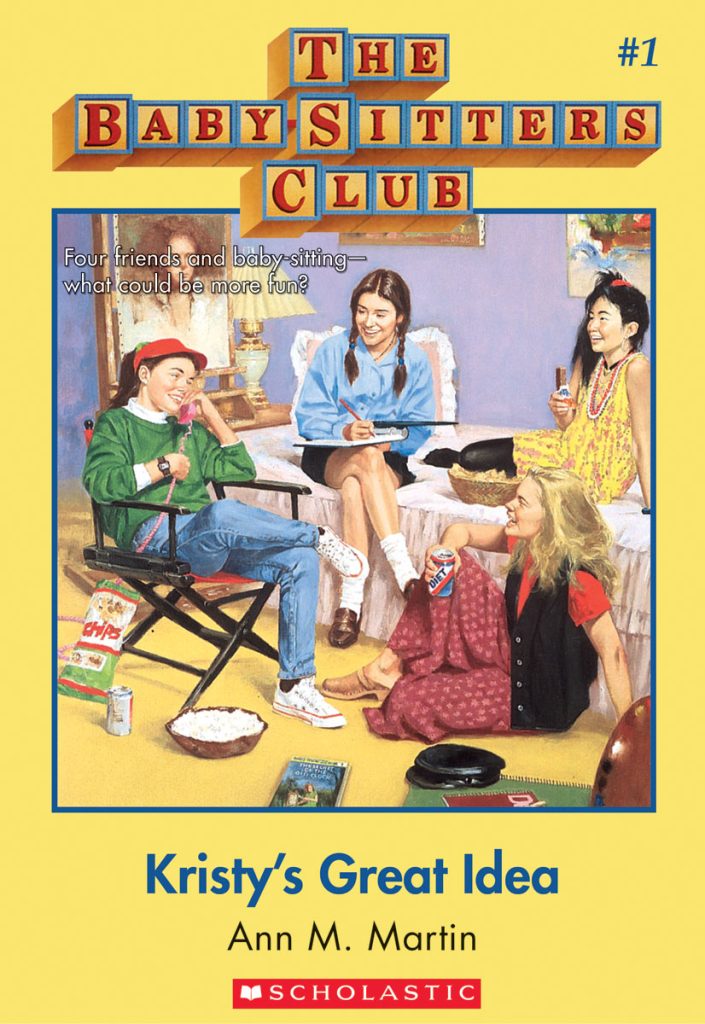
I can’t remember exactly when I discovered The Baby-Sitters Club books. Maybe it was at a Scholastic Book Fair at my school. But I’ll always remember the very first book, Kristy’s Great Idea, with its bright yellow cover and alphabet block letters. I saw four friends hanging out, and I specifically saw an Asian American girl who looked like me. She had her own phone in her room, which I desperately wanted too.
Up until that point, I hadn’t ever seen an Asian American girl on a book cover. Claudia wasn’t just some girl. She was creative, wore funky earrings, and had a style all her own. Her side ponytail game was on point. Her grandmother Mimi lived with her family, just like mine, and she was close to her grandma, too.I was definitely never as cool as Claudia in sixth grade—the fluffy perm I had was proof of that—but she made me feel seen. She had spelling mistakes in her journal entries. She wasn’t great at school. Claudia stashed candy all around her room.
Recently, I reconnected to my nostalgia for the covers when book editor Rebecca Kuss tweeted that she bought a painting of Stacey’s Mistake. I had no idea that the BSC covers were originally oil paintings. Artist Hodges Soileau created most of the covers, spin-off series, and products like calendars. I went on a deep dive through Soileau’s Instagram to look at the original oil paintings. Seeing Claudia and the gang again after all these years brought back fond memories.
I was definitely never as cool as Claudia in sixth grade—the fluffy perm I had was proof of that—but she made me feel seen.
Like many BSC super fans, I have a strong emotional connection to these hand painted covers. The fictional characters in Stoneybrook were a very real part of my life. I saw what I was going through as a kid—friendship fights, crushes, growing up—and the BSC members went through the same things. Now, as a mother and writer, these books resonate well beyond my childhood. The beauty of BSC was that big topics—like a death in the family, single parenting, and stepfamilies—were discussed through characters we loved. I spent time reflecting on the BSC books that impacted me the most, as a kid and now as an adult.
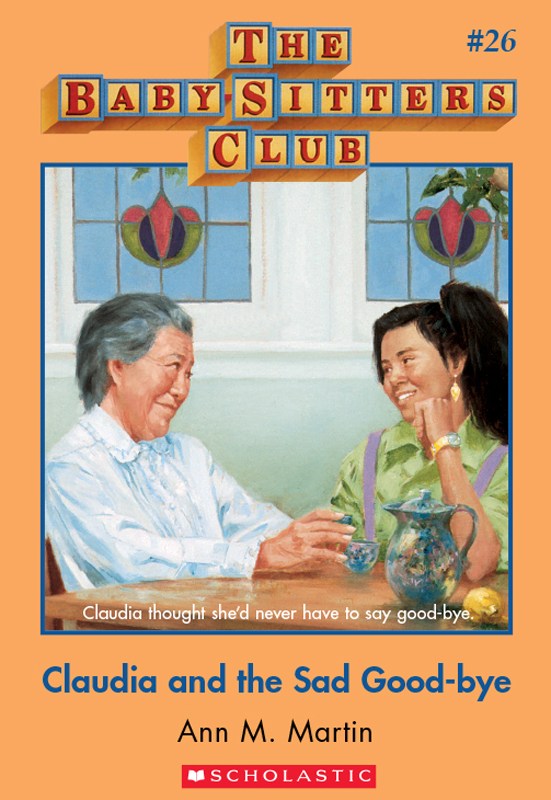
The Baby-Sitters Club book that I will always remember is Claudia and the Sad Goodbye when Mimi passed away. The book cover depicts Mimi and Claudia sitting together, sharing a cup of tea. Mimi, with her short gray hair and white shirt, reminded me of my Ahma. The way that Claudia and Mimi look at each other with love was similar to my relationship. The book stayed with me longer after I read it.
I picked up Claudia and the Sad Goodbye again when I was working with my book editor Vicki Lame on revisions for my debut young adult novel, Artifacts of an Ex. Vicki asked if I could include more of the grandmother character in my book. I studied Claudia and the Sad Goodbye to see how it conveyed the heart of their relationship. Reflecting on Claudia and Mimi’s relationship made my book more fully developed. I took notes while I watched the Netflix TV adaptation and cried when Mimi was gone. Every time I think about this story, I get emotional. It addressed grief and loss through the eyes of a young kid and it made it feel very real and honest.
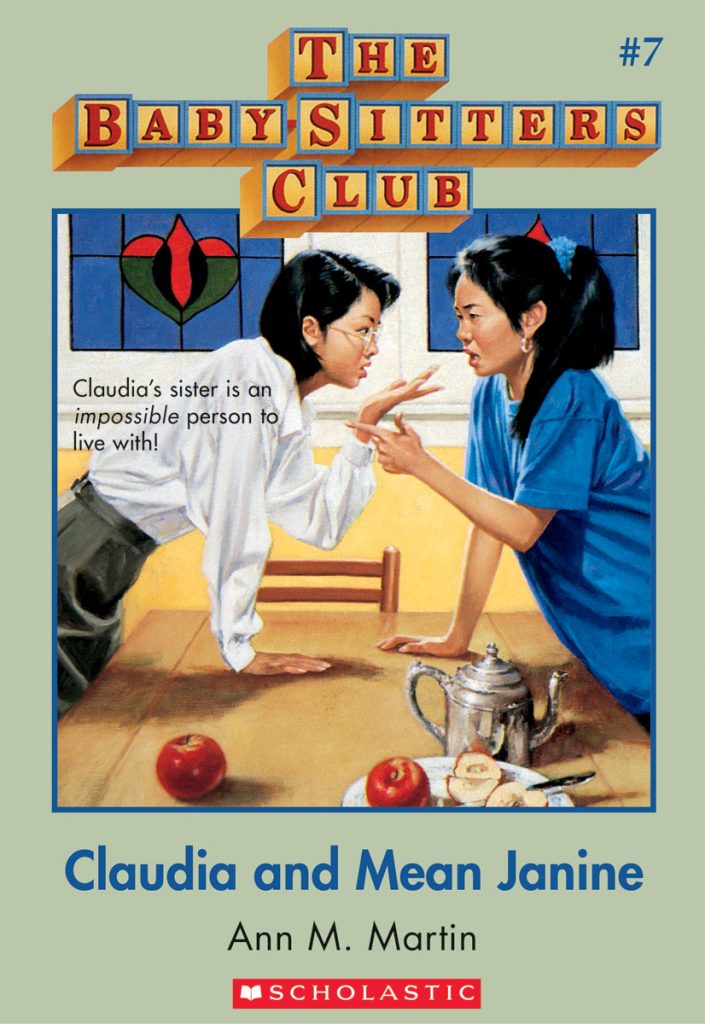
Earlier in the series, Claudia’s grandmother has a stroke in Claudia and Mean Janine. Claudia’s once active grandmother now had trouble speaking and moving. On the cover, Claudia, in an oversized blue and orange sweater, talks back to her sister Janine, in glasses and a plain green sweater, crosses her arms, seemingly annoyed at her younger sister. I was the odd ball kid in my family who dressed differently, I loved seeing Claudia in all of her kooky 80s outfits. As my Ahma grew older, I watched her deteriorate from someone who walked to the grocery store every day to a woman who depended on a wheelchair to get around. Our relationship had to change. It was inevitable and also made me incredibly sad. I know Claudia Kishi is a fictional character, but her journey often felt like mine, even as an adult. There’s comfort in knowing that what I’ve experienced, other people have too.
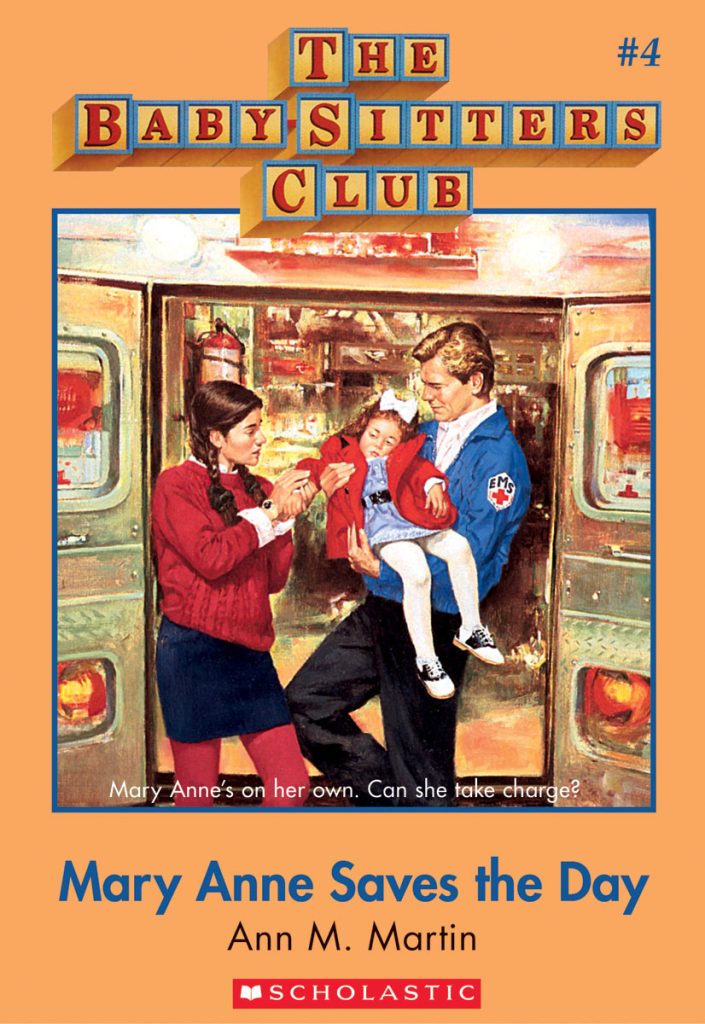
As a shy kid, Mary Anne Saves the Daywas one of my favorites. We see Mary Anne in front of an ambulance while her babysitting charge seems very ill. Mary Anne is known for being quiet and dressing younger than her friends with pigtail braids, but when she is alone with a feverish kid, she must take charge and get the child to a hospital. I was often too scared to talk to adults. I used to hide under pillows when grown ups were in the room, so to see my personality doppelganger talk to doctors, it was inspiring.
I know Claudia Kishi is a fictional character, but her journey often felt like mine, even as an adult.
Years later, the same story holds new meaning for me. In the 2020 TV series adaptation, the child character is transgender. At the hospital, Mary Anne pulls the doctor and nurse aside when they misgenders the child and requests that they use her correct pronouns. It’s a powerful moment. As a mom of a transgender child, I teared up watching the episode. Now, Mary Anne Saves the Day is more than just Mary Anne speaking up. She stands up for the kid because she sees the child for who they are. What a powerful lesson as a parent.
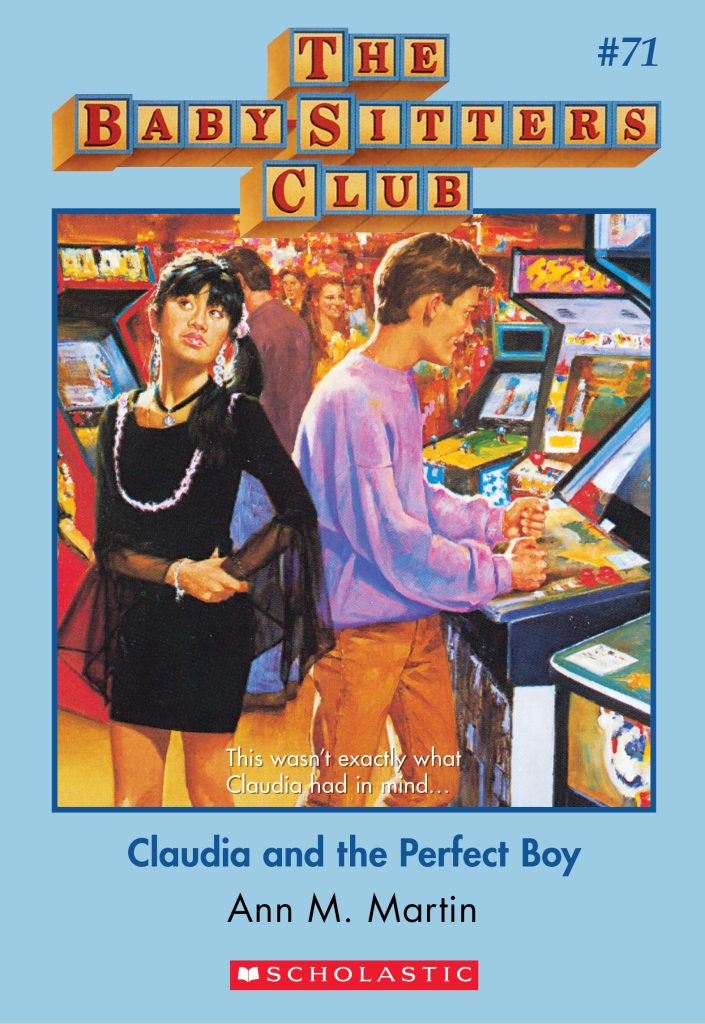
Another reason that Claudia Kishi and the diverse community of Stoneybrook, Connecticut (back before diversity was even a word people used), was important is that it was one of the few places that showed interracial relationships. Back when I read Claudia and the Perfect Boy, I wanted to have a boyfriend and felt like I’d never have one. Seeing Claudia on a potential date, dressed in a flowy black dress, gave me hope that someday, I’d go on a date and have a boyfriend. Claudia’s date ignores her while playing an arcade video game. The exasperated look on Claudia’s face makes it clear she’s not having fun. But even so, movies and TV shows then didn’t show people like me falling in love, so this felt monumental back then. It still does. As an author, I create characters I wish I had seen growing up because we all deserve more than one representation.
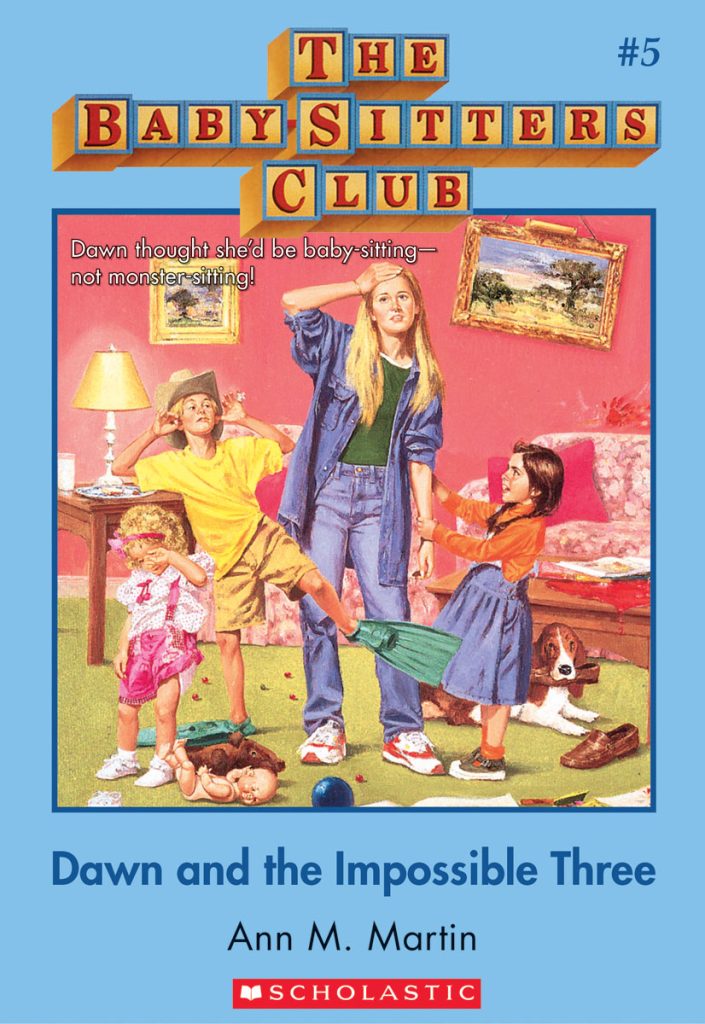
When I was 12-years-old, I used to babysit for families in my New Jersey neighborhood. I took care of three kids that were eerily similar to the Barrett kids in Dawn and the Impossible Three. The book cover features three kids and a wildly chaotic mess. In the story, Dawn finds it hard to speak up to their mother. Each time she babysits, Dawn encounters the kids fighting, constant messes, and the mom not sharing important information (like a child’s food allergy). I related to this book because I had a hard time saying no, especially when the parents fought in front of me. Ann M. Martin included a letter to the reader at the end of the book that suggests ways for babysitters to speak up. I ended up saying no to future jobs with the family.
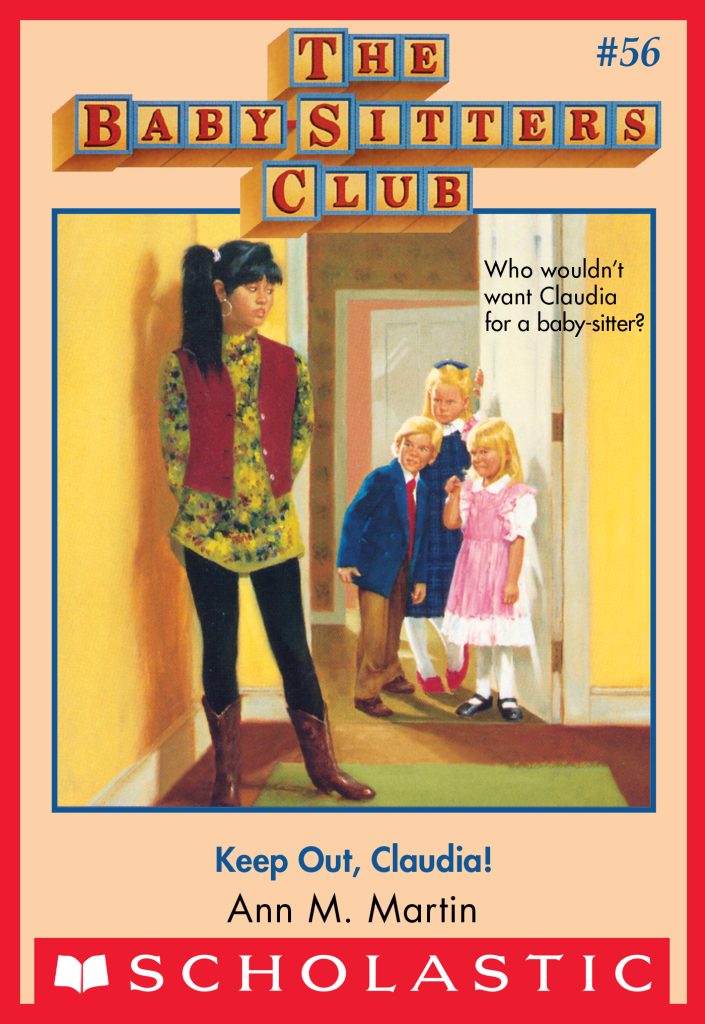
It’s strange to revisit a childhood book that involves racism against Asians and Black people and realize a lot hasn’t changed. The cover for Keep Out, Claudia! Shows Claudia standing in the hallway while three blonde children dressed in their Sunday best, point at her and glare. To me, it’s pretty obvious that they don’t like Claudia. In the book, Claudia babysits for a family who is rude to her. The next time the family calls for a babysitter, the mother specifically requests anyone but Claudia. Jessi, who is Black, arrives and the mom flat out refuses to let her in the house, saying she forgot to cancel. Claudia and Jessi are both angry and confused by the mother’s treatment.
It’s strange to revisit a childhood book that involves racism against Asians and Black people and realize a lot hasn’t changed.
In the pandemic, we all saw incredibly violent acts of racism, like the murder of George Floyd and the anti-Asian attacks targeting women and elders. I had tough conversations with my kids about what was happening in our country. I turned to picture books to help explain this very important but challenging topic, just like Claudia and Jessi helped me make sense of the racism I experienced as a kid. In first grade, another kid called me a “chink.” I didn’t know what the word meant then, but I knew it wasn’t kind. It wasn’t until I read Keep Out, Claudia! that I understood what happened to me was racist. In BSC creator Ann M. Martin’s letter to readers, she wrote about this particular book, “A recurring theme in the Baby-sitters Club books is that of tolerance and acceptance, rather than exclusion. It’s something the characters feel strongly about, and so do I.”
Some people might dismiss BSC as just a kids series and not important literature—but I’d counter that the reason why the Baby-Sitters Club has endured and stayed in our hearts is because it was a safe, empathetic place to understand the complexities of being a kid.
I love the series and continue to adore it, but I hadn’t expected to go back in time and continue to learn lessons from the BSC as an adult. In the books, the babysitters were always friends at the end of each book, even if they disagreed or had a fight, their friendship endured the test of time. Just like its fans, the Baby-Sitters Club will always be our best friend forever.
In the very early drafts of my debut novel,Rootless, Efe took center stage. As a Ghanaian teenager moving to London and sinking under the weight of her family’s hopes, dreams and expectations, it was clear to me that Efe had a story to tell. But it wasn’t until later that I realized Efe’s story wasn’t as limited as it seemed. It was a bigger story about a family that was careening towards a breaking point, a family that is fracturing and falling apart.
In Rootless, it isn’t just Efe’s choices that cause this breakdown in family relationships. Instead, the choices of her husband Sam, and those of their family members all ripple outwards, combining and building over the decades until cracks are formed. Each family member damaged the unit in their own way.
Family stories are complex and nuanced. What I love most is that there’s rarely an obvious villain. Instead, each person is remarkably human, doing the best they can, but often hurting each other along the way.
I’ve encountered many incredible families that are falling apart in fiction. Here are the ones that grabbed me and refused to let me go:
The novel follows Stella and Desiree, identical twin sisters who run away as teenagers and go on to live totally different lives. One sister eventually returns to the town she tried to escape and lives with her Black daughter. The other sister secretly passes as white, and her white husband and daughter know nothing of her past. Despite the different paths the twins have taken and the ways their relationship has fractured, their lives are still intertwined. It’s an intricate and complicated story all about identity, race and expectations.
The novel opens with the death of Kweku, the long-absent patriarch of the Nigerian-Ghanaian Sai family, and chronicles all the ways Kweku’s heart fractures when he’s estranged from his immediate family. At the start of the novel, his ex-wife and grown-up children are spread out across America and the family has been quietly estranged for years, but his death brings them back together again and forces them to confront a multitude of family secrets.
Memphis focuses on the lives of four women across three generations. First, there’s Miriam, who flees to the city to escape her abusive husband; her oldest daughter Joan, the artist of the family; her half-sister August, who leaps off the page; and Hazel, the matriarch of the family who looms large even though she isn’t alive for most of the novel. This family is very much broken at the start of the novel, but witnessing their journey towards growth and healing was incredible.
The God of Small Things is such a beautifully complex novel. For the most part, the novel follows twins Rahel and Esta, growing up comfortably in Kerala, India amid political unrest. It’s also about their wider family, including their cousin Sophie Mol, mother Amma and the secrets and corruption that exist in their family and community— all of which will tear the family apart.
Set in the 1970s in a small town in Ohio, the novel follows the Lee family as they attempt to put themselves back together after the death of 16-year-old Lydia Lee. Back when Lydia was alive, she was the favorite child of both her parents, which is far from as good as it sounds. The novel explores everything leading up to Lydia’s death and the aftermath as the family seeks answers to what really happened.
After the phenomenon of her debut novel, Homegoing, Yaa Gyasi gifted readers with a smaller, but surefooted and intimate novel. Gifty is the daughter of parents that immigrated from Ghana to Alabama. Years later, she is alone in the U.S., a PhD student trying to make sense of her brother’s opioid addiction and subsequent death, her family a shadow of what it used to be.
Ayobami Adebayo’s first novel broke my heart and put it back together again. It opens with Yejide, who is childless several years into marriage and humiliated when her husband’s family insist he takes a second wife to ensure his lineage continues. From the outside, that looks like the moment their family would begin to fall apart, but that’s only the beginning of their story. The book is full of unexpected turns, twists and surprises. It’s a novel about love as it tries again and again to defy the odds.
The School for Good Mothers is a novel about families, but particularly parenthood with a speculative twist. On one very bad day, Frida Liu leaves her toddler, Harriet, home alone for a few hours. Frida is caught and given the choice: she can be re-educated and learn how to be a “good mother” or lose custody of Harriet forever. This novel presents an interesting commentary on the expectations placed on fathers compared to mothers, while following the many different parents trying to save their families as they fall apart
My intersectionality is a bullseye in the culture war spotlight. My wife and I conceal our growing worry within the safety of our floor-to-ceiling black-out shades in our bedroom. The surge of state bills targeting access to gender-affirming care have been proposed and mis-sold under the veneer of saving minors from child abuse, experimentation, and genital mutilation. One of these bills would prohibit institutional recipients of public funds from offering trans care for both adults and minors. Trans families and physicians are under attack. Politically and physically. Another bill proposed would make it a felony for physicians providing gender-affirming hormones or surgery to anyone under twenty-six. In this fast-moving dystopian reality, I wonder where we’ll find safe harbor? Stealth isn’t the answer.
My neck, its circumference, was the last thing to out me.
“Your neck is on the small side,” Dr. C. said after he glanced down my throat. I was at my first appointment with a sleep medicine specialist who, serendipitously for me, was a pulmonologist. In response to the “any changes” question during my annual physical, I’d told my primary care nurse practitioner I was waking up at night gasping for breath. At the time I had no understanding of the correlation between the circumference of one’s neck and obstructive sleep apnea. The one thing I thought I knew about the disorder was that heavy snorers are often diagnosed with sleep apnea and treated with a dreaded continuous positive airway machine. When I told my cousin I might have sleep apnea, she asked if I wanted her unused CPAP. She went on to explain she was tested, retested, and ended up with a machine she didn’t need because of (expletive) false positive results. Dr. C.’s eyes lingered a bit, refocusing on my head and neck.
I’d told my primary care nurse practitioner I was waking up at night gasping for breath.
“What size shirt do you wear?”
I re-looped a KN95 around my ears, wiggled the black cone to adjust its nose piece underneath my glasses before I responded. According to a tailor’s tape, my neck is slightly below fifteen inches with space to sneak in two fingertips. One reason I round up whenever I purchase dress shirts (slim fit) is to make more room. Fudging my neck size allows more space to tuck tails down and around my hips. Slim fit eliminates any bagginess around my chest and lats. I wasn’t sure Dr. C. cared about my arm length.
“Fifteen and a half,” I answered.
Apparently, a thick neck—considered 17 inches or more for a man and 16 inches for a woman—may indicate a narrow respiratory airway making it more difficult for air to flow to your lungs. Excess fat around your neck can also narrow your airway when you lie down. According to the National Heart, Lung, and Blood Institute’s explanation of obstructive sleep apnea, if air needs to squeeze down your throat to your lungs you can end up snoring or wheezing, and if your airways become fully blocked you might stop breathing all together. The truth is at my age, I have the beginnings of a slender turkey neck. My body is aging like a luscious leather couch planted in a bay window alcove — cracks are starting to show. I’ll yield to the possibility my brain container appears small(ish) for the sixty-three-year old transman that I am today.
Dr. C. looked at his computer. I could tell he doubted the veracity of my stated shirt size.
“Did someone take your weight?”
“No.”
“That’s alright. How much do you weigh? I can type it in.”
“Back down to 165,” I said. I was proud and feeling good again after four months of a low-carb slog, ditching my pandemic backslide of double IPAs and sourdough pretzels, flourless chocolate cake and champagne.
“And your height?”
“Five eight. Well. More like five seven and three quarters since I’ve gotten older.”
“I’ll give it to you. But your BMI.”
My father was six four with what I imagine was an average body mass index most of my life. My brother is six two, played Pop Warner from Pee Wee through high school, was probably hitting two thirty the last time I’d seen him before our estrangement. Men on my mother’s side on average are shorter than me with a few exceptions. Black, Filipino and Austronesian lineage. My mother’s mother stood about four seven; at five six my mother towered over her sisters and some of her brothers. Maintaining her weight at or below a hundred and fifty pounds was an unfortunate obsession she ported over to me when I weighed in at one fifty around my 12th birthday. She drove me to her diet clinic that pumped me with HCG extracted from urine of pregnant women to make her feel better. The shots had the opposite impact of their intent: all I wanted to do was binge on ice cream and See’s Candies.
The shots had the opposite impact of their intent: all I wanted to do was binge on ice cream and See’s Candies.
BMI talk from a sleep doctor was borderline triggering. Without putting a finer point on his reference to my body mass index, Dr. C. said, “Your lung volumes are on the lower end.”
I thought about my lungs growing up in Los Angeles during the sixties and seventies when hazy smog concealed the magnificence of the San Gabriel Mountains. My father chain-smoked Winston cigarettes unfiltered before switching to Marlboros. I told Dr. C. I was exposed to my father’s second hand smoke.
Back then, I was enamored with my father’s smoking and wanted desperately to emulate it. Fake smoking with fingered air cigarettes was a regular part of playing alone in my room. I interpreted my father’s smoking as a feature of masculine strength, not a component of any toxic meditation practice. My mother’s mother smoked too. Granny struck her matches on the bottom of her pink slippers. One day my parents gave into my incessant requests to smoke. I was six or seven. I remember my mother led us into the bathroom upstairs and allowed my father to give me a puff of a cigarette he ceremoniously lit to prove their point. I gagged. They chuckled. I cried. “See!” my father said. “Told you so,” my mother said. I don’t remember which one of them threw my cigarette into the toilet bowl. It didn’t matter. Supervised smoking and quitting in the second grade happened quickly. Dr. C. didn’t seem interested let alone have the time to hear about my recollections of secondhand smoke or my parents’ experiment.
“What do you do for a living?”
“I’m retired.”
“And before you retired?”
“Corporate finance.”
“So, you understand ratios.”
I started to worry as Dr. C. launched into a cursory explanation that my lung volumes and other pulmonary function results were outside of the normal range compared to reference values. “Does it matter…,” I began. I heard the pitch of my voice change and cadence slow as I wondered if his medical opinion regarding normal was being filtered through the biological lens of male and female expectations. His expertise brought him to size — head, neck, lungs, one’s respiratory system, the interpretation of capacity curves informed by computed biological sex norms. “The way you’re describing this, does your birth sex matter? I’m transgender. I was born female.”
Based on years of experience I’ve learned to be rudimentarily clear with healthcare professionals regarding gender identity. For example, I imagine it was an assumption about my first name coupled with an attempt at culturally competent thoroughness that caused a nurse practitioner new to me to ask the date of my last prostate exam on a telemedicine videocall. When I chuckled that I didn’t need it, she countered in a tone of admonishment the importance of health screening, as if I were just another obstinate (i.e., Black) patient. As far as I was concerned, all I was doing was going through the motions to get a testosterone refill electronically transferred to CVS. Check the box, let’s move on. Mandatory biannual bloodwork, including a comprehensive metabolic panel, isn’t necessary anymore since I’ve been on T over twenty-five years. The substitute NP saw me, heard me, and yet assumed estrogen refill (which was ridiculous.) “This is a first,” I said to her with an edge of incredulity after I realized I had to articulate I wasn’t born with a prostate.
“Of course, it matters! Gender is not sex,” Dr. C. said in a slightly raised erudite tone.
Here we go, I thought to myself. I had gone from chatty and open about my symptoms to a vulnerable trans person in an unfamiliar healthcare setting — exposed. Decades earlier, an urgent care nurse at Alta Bates Hospital in Oakland practically cursed me out as she took it upon herself to shame me because I misrepresented my sex, despite the fact I was legally male by then with an amended California birth certificate to prove it. I remember her face turning sunburn-at-the-beach pink, her voice raised like Dr. C.’s as she walked out of the room.
I was in for a tetanus shot. To be fair, she was trying to make sense of a potential duplicate medical record. There was someone named Anastasia Cecilia Jackson, same date of birth and social security number in their system. Years later I was instructed to make a 45-minute drive to California Pacific Medical Center’s emergency room in San Francisco because of a two-day 104 fever after my phalloplasty procedure. The attending nurse insisted they perform a rapid HIV test after I “revealed” I had received bottom surgery weeks earlier in their gender clinic. She initially responded with a WTF stare, and began asking questions about my status, which after further probing I realized was shorthand for my history of sexual activity and IV drug use. Fever is a symptom, but I tried to explain that I doubted HIV was the culprit lighting my body up and rolling me into her emergency room. She pushed back and said we needed to rule out HIV. Hours later I was admitted into the hospital to combat a UTI.
Dr. C. scrambled up and out of his chair. “I’ll be back. I’m going to rerun the test to see where you fall within the other ranges. I’ll do it myself,” he said this time in a hushed tone, as if he were a priest in a confession box administering five Hail Marys and two Our Fathers, sworn by an oath to keep my sin of gender omission between the two of us. The way I saw things, a one-sided discussion about assigned sex with Dr. C. was due to an outdated binary intake system. My new dermatologist’s webform asks for birth sex, gender identity, and pronoun preferences. But she is a Black physician and dermatological surgeon running an award-winning medical and aesthetic practice. Based on Dr. C.’s quip about gender versus sex, it could have gone either way in that moment — he could (re)make some attempt at cultural competence or be the bearer of righteous indignation under the guise of the Hippocratic oath in reverse, as if I had broken a covenant of my divine duty to disclose in a medical setting that I was born with XX not XY chromosomes.
My fear and simmering rage aside, in 2002, Bellemare, Jeanneret, and Couture published results from their study Sex Differences in Thoracic Dimensions and Configuration. They concluded the volume of adult female lungs is 10 to 12% smaller than males of the same height and age. Unaware of this data at the time, I waited for Dr. C.’s clandestine analysis using an updated set of female reference values, back to so-called normal.
The way I saw things, a one-sided discussion about assigned sex with Dr. C. was due to an outdated binary intake system.
Intellectually I understand disclosure. How else will providers know the appropriate care to administer if you can’t speak for yourself? Despite the misdiagnosis risks, I’ve treated my birth sex as HIPPA PHI on a need-to-know basis. The one exception to my current rule is primary care. Even then, I tend to omit surgical plus minus additions and subtractions, revisions, ‘ectomies and ‘plasties on generic intake questionnaires. I choose to forego the zoo animal observation in the name of scientific curiosity (i.e., medical education) until I can build a mutual relationship of trust. I once had a urologist at a teaching hospital ask if his students could look at my ding-a-ling. Never again. I will not be pathologized. Disclosure needs to have a pertinent purpose. So no, my dental hygienist does not need to know my testicular implants were taken out because the silicone alternative was too hard and interfered with my road bike performance. Chafing is bad enough on long rides for anybody, even with high quality butt butter!
Dr. C. was taking a long time. Five minutes by myself was nerve wracking. I was in a sparse unfamiliar room within a department treating patients with asthma, COPD, cystic fibrosis, and lung cancer among other respiratory system issues. The breathing test administered right before felt like my nose had been clamped shut with a binder clip. I was instructed to wrap my lips around a tube with a mouthpiece that looked and felt like a snorkel. I hadn’t expected tubes and wiring for a sleep study referral. Before the diagnostic probing, I knew my lungs had scar tissue based on an X-Ray performed for an unrelated medical procedure in college. “Let me try it again. I can do better,” I cajoled the respiratory technician with a resonant tone I hoped she understood (sis, gimme another chance.) “Mm-hmm. I don’t want to use this because I need three good measurements. I can throw one of them one out.” I had no idea how to interpret the graphical lines being mapped real time when I turned my arthritic neck to the right. I felt discouraged I couldn’t blow with the force she encouraged, “keep going, going, exhale; take a deep breath; is your tongue in the way? There needs to be a good seal.” “Yep,” I grunted which sounded like a weak muffle down the end of a blocked megaphone.
We kept at it. In the moment, attempts to achieve the best results seemed more about her skill as a respiratory technician than my limitations. She was distracted throughout the test. I overheard her on her mobile with a care giver of a relative, excusing herself multiple times between measurements, in and out of the spirometry equipment room. Perhaps that explained why there was no height or weight for Dr. C. But my struggles inhaling and exhaling? There is no other way to put it. My lungs suck! This is a feature of my lived experience that didn’t need spirometry validation.
I had pneumonia twice before the eighth grade, with multiple bouts of bronchitis during flu and allergy seasons my entire life. Because of bronchitis, I missed a Girl Scout camping trip and was kicked off my high school swim team after three practices. Both absences broke my heart. More recently I got wet playing golf in coastal North Carolina during the summer of 2021. My brother-in-law and I cut the back nine short after funnels of charcoal clouds and thunder warned of fury rolling our way. The water was warm, my head and chest lightly pelted for five minutes before we drove the cart to the parking lot. It didn’t take much. Being outside in southern rain morphed into a month-long bout of spitting up thick yellow and occasionally brown mucous. A PCR test ruled out COVID-19 which I feared could blow up my fall writing residency. Bronchitis — my nemesis loving on me again. A course of antibiotics was required to fend off pneumonia. Trying to sleep with a rattling painful wheeze and a spit-bag reminded me of my childhood. Clueless and precocious, I used to fake-take tetracycline which I hated swallowing. I’d take the pellet in my hand, squeeze it between my left thumb and index finger, gulp my orange juice, and make a face with accompanying sound effects. Fake-take. When my mother left my room, I would drop the drug down the gap of my headboard. I was sick of taking pills.
I had pneumonia twice before the eighth grade, with multiple bouts of bronchitis during flu and allergy seasons my entire life.
During my gasping episodes my breathing is labored, like the time a kid who lived across the street beat the crap out of me. He called me bitch nigger after I threw a rock into his boy pack in the suburbs of LA County where name-calling happened on the regular. I picked up a blue grey Mexican pebble from my mother’s bonsai garden and connected with his forehead. He responded landing upper cuts on my solar plexus and floating ribs — my back pinned against siding near our front door which served as punching leverage. I remember my mother took me to the pediatrician in addition to calling the cops to submit a police report. “Did he call you names?” Bruised, too embarrassed to repeat the words to the officer sitting with me and my mother on our living room couch, I lied for my attacker, I lied to end the interrogation. I have no idea then or now what type of lasting damage the lung contusion from the old beat-down caused.
Dr. C. was finally back with a printout full of numbers. My rerun: female from male. His reinterpretation: “You’re still on the lower end. I’m going to order a sleep study anda CT scan to rule out bronchiectasis.” After a brief discussion on the benefits of a sleep study at home versus the occasional false negative results, we agreed to start in the comfort of my own bed versus an overnight stay in the hospital sleep lab. I wasn’t referred to Dr. C. for an assessment of my scarred lungs, however if there was something to know I was open to knowing it. I kept the newly prescribed exploratory tests on the down low. I wondered aloud to my therapist what was beneath the surface of my trepidations of sharing my latest referral with my wife. It wasn’t the first time I omitted certain details regarding tests or treatment.
I lied for my attacker, I lied to end the interrogation.
Distrust of doctors and nonprimary care providers by Black people has been well documented and researched given racial disparities in health and the traditional healthcare system. The NIH’s National Library of Medicine’s website is populated with abstracts such as:
African Americans and their distrust of the health care system: healthcare for diverse populations
Disparities and distrust: the implications of psychological processes for understanding racial disparities in health and health care
Knowledge of the Tuskegee study and its impact on the willingness to participate in medical research studies
Neither my mother nor my father as senior citizens in their seventies appeared to trust doctors, resisting recommendations to take medications or perceived invasive interventions. My mother railed against treatment for my father to me, proclaiming dialysis would kill him because she knew he would keep drinking vodka and OJ. On the other hand, my father appeared unwilling to exercise his agency over his own healthcare. Apathy is a form of foul play. Years after my mother died, my siblings found partially taken prescriptions in her bathroom during their preparations to sell our family home. Previously my mother confided she had blood in her stool, however my sister-in-law supported my mother’s subsequent proclamation that all she really needed was a good night’s sleep. My mother’s vital signs were literally fine on her death bed. Who knew vitals don’t reveal the complete picture of a body’s deterioration?
Repeat: You are not your mother. You are not your father.
The first time Dr. C. and I had exposed our unmasked faces to each other was on a telemedicine video call to explain the results of my CT scan. We exchanged pleasantries as if we had never met. The virtual face-to-face felt more intimate than meeting in person masked up the prior month. Moving on to the point of the chat after smiles of acknowledgement, Dr. C. said despite the cyst and nodules, he wasn’t too worried about my lungs if I scheduled annual CT scans from now on. “Now we have a baseline,” he said.
The fact that I don’t have significant obstructive sleep apnea requiring an intervention is a partial victory for me, my gasping awake while asleep still unexplained. The cardiologist I chose to see practically escorted me out of his office with a COVID arm bump and a smile. There was no reason he needed to see me again; he confirmed my heart is healthy. Left to my tendency for hypochondria-fueled research on the Internet (yeah, sure; I admit it), I have concluded the source of my gasps is likely nocturnal panic attacks. The symptoms of a nocturnal panic attack according to the Cleveland Clinic are chest pains, chills, intense feelings of terror, nausea, profuse sweating, a racing heart, numb fingers, toes, trembling or shaking. The research shows nighttime panic attacks present more severe breathing symptoms like gasping for air versus an attack during the day.
I have concluded the source of my gasps is likely nocturnal panic attacks.
As a trans family specifically, my wife and I have both been sleeping on the edge of gasp. Mortal stress has been lurking. Swallowed. Pushed down. I know there is a collective fog of panic in the circles I belong. Culture has been weaponized; red and blue and purple states marked. Book banning. Trans kids, trans athletes targeted. Marriage equality shielded at the federal level. Some claim COVID is a sham. They say critical race theory is to blame. Blue lives matter. More guns — concealed weapons even better. States’ rights to elevate sperm and criminalize choice is terrifying. What’s next? Will the Thomas un-Supreme Court hint at its desire to accept private insurance cases addressing the legality of denying trans health, including puberty blockers, gender affirming mental health, as well as hormones and surgery? Will my F to M gender reassignment be criminalized, monitored by gender vigilantes if states legislate their “right” to protect gender-conforming citizens from moral corruption that could spread to their families?
While sleeping I gasp myself awake sometimes, and occasionally shriek, settled by the soothing sounds of my beloved telling me it’s (just) a dream. Perhaps a consistent deep breathing practice without another medical referral is all I need. We shall see.
This essay, by Stacy Nathaniel Jackson, is the seventh in Electric Literature’s new series, Both/And, centering the voices of transgender and gender nonconforming writers of color. These essays publish every Thursday all the way through June for Pride Month. To learn more about the series and to read previous installments, click here.
When I was much younger, a seer in India foretold that I would never settle down but migrate from place to place as if there were wings on my feet. Or something to that effect. Either way, his prophecy came true and among the many places and countries I lived and worked was Dubai in the United Arab Emirates. It was not the Dubai that we all know today with the fantastical construction projects that defy the laws of nature. It was instead a city in its chrysalis with dreams and blueprints and lots of talk but nothing to show for it. But then, like now, it was a city of immigrants or “guest workers” encompassing everyone from blue-collar laborer to office worker, to company executive.
In my new novel Hope You Are Satisfied, a group of young people, immigrants from different countries, are working in Dubai as customer service agents for a small tour operating company. They are just trying to do their jobs and help their families back home when US armed forces begin arriving in droves as Saddam Hussein’s 1990 invasion of Kuwait plunges the world into a new global crisis, one that threatens their livelihoods and their futures.
Immigrants to the Mid-East come for economic reasons, especially for the competitive wages if they are from a western country. As for those from Asia and Africa, their motives often include improving the lives of their families by sending their earnings back home. For some, the act of immigrating is often one of desperation, borne from a lack of options in their native lands. As there is no path to citizenship for most guest workers in this region, many wrestle with a sense of displacement, an estrangement stemming from the separation from loved ones for years, and sometimes trauma from the treatment they receive in countries where they are but temporary citizens.
So, whether they come from the East or the West, whether they come as immigrants or expats, whether they come for economic betterment or to seek self-redemption, the books below consider the bargains they strike with their destinies when they make the journey to, not from, the Middle East.
The 2022 FIFA World Cup in Qatar brought back into international headlines the unfair labor practices and human rights violations of workers from the Indian subcontinent, East Africa and the Far East who come to the Gulf for work. With these interlinked stories, vignettes and poems, Unnikrishnan employs word play, allegory, and magical realism to critique the social structures and laws that foster the dehumanizing treatment of South Asian guest workers in the United Arab Emirates where they are so ubiquitous as to become invisible. Writing of immigration as exile, as ill-fated destiny, as catastrophic result of global economics, he melds the real and fantastical with stories that speak to what it means to leave one’s homeland and take on a transient existence in a place where labor is valued above all else, even life.
Reminded to don her abaya before she leaves their expat compound in Saudi Arabia, Rehman is struck by the incongruity of waving goodbye to a neighbor sunbathing in her bikini. It is the early 2000s. Rehman has relocated from New Jersey with her husband who will be working at a prestigious hospital in the ultraconservative city of Riyadh. A devout Muslim herself, albeit one who has lived in the States for decades, Rehman’s memoir offers an insider’s look but with an outsider’s point of view, documenting experiences that disabuse her of many misconceptions. The diversity of the culture and people are front and center as she relishes the anonymity provided by her abaya and is understandably disturbed by the tribal and patriarchal forces at work in Saudi society. She writes, “In the West, where our knowledge of Muslim countries is sometimes reduced to soundbites and headlines, we’re prone to a mistaken idea of homogeneity.”
The narrator, referring to himself as X, is a New York lawyer in the painful throes of a broken heart and an existential crisis. He moves to Dubai for a job with a family of Lebanese billionaires (he only gets the job because he is mistakenly taken to be a friend of the well-known businessman but not yet president, Donald Trump). He becomes a front man for the family’s shady businesses, rubber stamping papers he doesn’t understand, and babysitting their overweight and insufferable son. Dubai itself is in the midst of a makeover, but the 2008 financial crisis has brought a halt to its dizzying pace of development, resulting in both our narrator and the city existing in limbo. We are privy to X’s philosophical musings and insights on everything from labor laws to the confusing social and cultural mores of his adopted city, but X is a man who is wrestling mainly with the mystery that is himself.
Sara, a professor of Philosophy at Kuwait University, gives a lecture on Nietzsche that leads to a charge of blasphemy, a capital crime punishable by execution. Sara’s story opens the novel and is the fertile ground out of which grow the stories of the other women in her family. Al-Nakib delves into their sacrifice of self as immigrants moving between continents due to political unrest or familial obligations, yet none more so than Sara’s ayah and second mother, Maria. Born in Goa on the western coast of India into a loving family and a life of poverty, Maria’s losses and need to secure her children’s future lead her to Kuwait where she cares and nurtures children other than her own, namely Sara and her brother. Maria’s loneliness and heartbreak borne from separation speaks to the immigrant experience of maids from around Asia who take up jobs in the Middle East as caregivers to other children, often not seeing their own children for many years. The novel hones in on guilt and regret, and the burden of the constant unanswered question about whether they made the right decision by immigrating.
The death of her father propels young Nour and her family to return to Syria from New York City, a homecoming to a place she has never been to before. She doesn’t even speak much Arabic. It is an importune time to have made the move as it is 2011 and the Syrian civil war shatters their hopes of rebuilding their lives. Forced to flee when a bomb destroys their home, they embark on a trepidatious journey that takes them around the Middle East and North Africa. Paired with Nour’s story is that of Rawiya, a twelfth-century waif of a girl who disguises herself as a boy so she can apprentice with a famous cartographer, joining him in a voyage across land and sea to chart the world. Though separated by eight centuries, Nour and Rawiya’s routes mirror one another’s as they attempt to map their destinies in their own way, encountering violence, heartache, displacement, and in Rawiya’s, case mythical creatures. They both begin to grasp what “home” means to them.
Driven by the lack of options in their home countries, a large number of women immigrate to Gulf countries as maids, housekeepers, or nannies, where they are at the mercy of their sponsor families, with many unable to depart or move jobs without their employer’s consent, leaving them vulnerable to exploitation. The prejudices and skewed power dynamics of such economic relationships give us the narrator of The Bamboo Stalk, a son born out of wedlock from a forbidden love affair between a Filipino maid and the scion of a wealthy Kuwaiti family. The scandalized family arranges for the child to be sent back to the Philippines with the assurance that he can return someday. Growing up poor on the outskirts of Manila with an abusive grandfather and prostitute aunt, and with a face that is clearly mixed race, his fractured sense of belonging is further compounded when he does return to Kuwait. He tells us that like a bamboo stalk he is a person who can be planted anywhere without roots, and yet begin to sprout again with no memory of the past.
With a Bedouin father and American mother, Al-Maria’s memoir considers the influences of heritage and identity on her coming of age while growing up in both the US and the Middle East. A childhood spent with her protective mother in Washington State is forever changed when, unable to cope with her teenage rebellion, Al-Maria’s mother ships her off to Qatar where she becomes part of her father’s large family and attends school. She straddles the divide between her American upbringing and the tribal customs of her father’s Bedouin family, while exploring the social and emotional ramifications of relocation. There is a sense of disorientation precipitated by the act of immigration into a society imbued with different gendered expectations, even for those who return to family and a place that should be home.
Sponsorship is a way of life for immigrants in the Middle East, their continued residency and employment dependent on the goodwill of their sponsors who hold over them the threat of deportation. So too for Naser, who lives in Saudi Arabia after his mother arranged for him to escape Eritrea due to the war. He works at a car wash, drinks perfume in place of forbidden alcohol, steers clear of the prowling religious police, and is coerced into having sex with his sponsor when broke, even with sodomy punishable by death. Women are but faceless, nebulous figures clad head to toe in black, and he wonders if he will get the chance to fall in love when they are off limits, and the consequences of talking to anyone of the opposite sex similarly terrifying. That is, until, one of those women drop him a note in passing. Thus begins an epistolary love affair between Naser and the woman who he knows only by the pink of her shoes visible under her black abaya when she walks by. As their budding romance intensifies, it risks not only everything that Naser and his mother have sacrificed to bring him to the country, but their very lives.
A British couple moves to Jeddah, Saudi Arabia, for a well-paying job in the mid-1980s. The wife, Frances, finds the adjustment difficult and from the start things don’t go according to plan. When no apartments are available in the expat compound, they end up in a place off-campus, and Frances is confined to her apartment most days due to the restrictions of women in public. Mostly cut-off from other expats, bored and growing increasingly frustrated she gets to know her neighbors, a Pakistani and a Saudi, both women. Frances finds much to question about the local way of life but also with the hypocrisy of her fellow expats who disparage and make racist comments about their host country privately, but otherwise kowtow to them. Soon Frances comes to realize that all is not as it seems when she hears noises from the apartment above hers that is supposed to be unoccupied and is warned by everyone, including her husband, that it’s none of her concern. This gothic mystery plays on the dislocation of the expat experience in a country where the greed of western capitalism overlaps with strict Islamic laws and customs, and is based on Mantel’s own time as an expat in Saudi Arabia.
When she was twenty-two she used to spend what little money she could have saved on hardcover books, lattes, and croissants. She read in cafés alone and anonymous, with no reason except to offer the world a glimpse of her. Ten years later, she was leaving and decided to revisit all her old haunts, thinking she could pack up the years the way she had packed up her things: taking them out of context and rearranging them so they fit compactly together. Outside a smoothie shop, she recited her usual in her head. The owner was a Jamaican man; he smiled at her through the window, and she waved. It occurred to her that he had no idea she was saying goodbye.
This sentimentality, purposefully spurred, waned quickly, almost instantly. She’d moved so many times in New York, across different boroughs, that the effect of leaving had all but worn off, and although her nostalgia was premature, it was the only way she could ensure this chapter would close with a proper sense of what had taken place. Not paying attention, she almost knocked heads with two girls coming out of a bodega. They stumbled onto the street, all limbs and hair, grasping each other. They were young women, upon closer inspection. College-age, about. Esther remembered what that had been like.
“Whoops!” she chirped, before pulling back and saying sorry.
The taller one shot her friend a furtive look, then laughed in Esther’s face. She hooked her elbow to her friend’s arm, and the two of them skipped down the street. Their hair clipped after them.
There was something horrible and familiar about that tall one, Esther thought, not moving from where she was, the way she’d dragged her friend away firmly yet delicately, like how a princess might usher her favorite servant when there was something urgent and secret they needed to discuss. She hadn’t gotten a good look at the friend, and now she wished she had. She peered down the street where they had turned, but they were gone.
Back in Texas, Esther had met Julia through Rooney, a mutual friend and Esther’s first roommate. They had remained distant for all of freshman year. They grew close while Julia was subletting Rooney’s room for the summer.
“I didn’t think you had depth,” Julia said to Esther one night while they were lying on the carpet in the living room, staring mindlessly at the ceiling. Their summer break was coming to an end. In a week, Rooney would return to campus and Julia would return to her dorm. They had just smoked some weed and torn through a family-size bag of tortilla chips, leaving shards at the very bottom.
“You smile a lot. I didn’t think someone so cheerful could be smart.”
Despite her nonchalance, it was not a topic that had been raised before. The kitchen light was on, but otherwise the living room was dark. The fibers of the carpet pricked the back of Esther’s neck and shoulders. She squirmed to allay the itching.
“By that logic,” she ventured, “I should have thought you were a genius.”
“And I’m not?” said Julia.
Esther turned to face her, but Julia stayed looking up.
“I think I just thought you were a bitch.”
Julia laughed. Her chest jumped. “Well I was wrong. You’re funny.”
“I could be funny and dumb,” Esther offered.
It had been a habit of hers, softening her viewpoint with self-deprecation.
Julia said no and made a comment about humor and intelligence. After that, they fell asleep on the floor.
Back in her almost-empty apartment, Esther poured herself a drink. Eight years had passed since she’d last seen Julia, in which time Esther had built a life for herself out of the virtues that Julia had imparted. The last she’d heard from Julia, she was getting married. The invitation came four months after their disastrous time in New York, after which they’d stopped speaking. She had flipped the embossed card back and forth, looking for a scribbled apology, or a note. She checked the envelope as well and found nothing. Julia & John invite you to their wedding was all it said, along with a date and location. Merriment to follow. Appalled at first, Esther was then sad, then fuming. She’d cut the invitation to pieces using scissors; the paper was too strong to tear.
On the couch, she brought her whiskey to her lips before remembering to raise it to the light. It delighted her that the ice was chiseled and completely clear, not a streak of cloudiness. The ice clinked liltingly as she swirled the glass. Now she sipped, savoring the bitterness on her tongue followed by a cold sting in the sides of her mouth. She’d boiled the water first, then added it to the tray.
Fancy ice; overnight oats made with meticulous spoonfuls of nuts and berries, making her feel like she was some highly evolved squirrel. She’d come to appreciate these rituals, their patterning and repetition securing dependable results, adding predictability and assurance to her days. She could have her overnight oats anywhere, in Houston, where she was from, or in Nashville, where she was moving soon to oversee the ancillary paper products line for a small, vaguely Christian publisher. Not books, but book-adjacent, she’d told friends when they asked why she was leaving. Back to her Southern roots! she joked. Her friends with a sense of humor had all left in the years preceding. The ones who remained stared at her with long faces. When they asked what she would miss most about New York, she said the ubiquity of art, how it could be found on the streets and in museums, in the people and the ways they chose to live. She knew this was the answer they were seeking, the one that assuaged the precarious matter of continuing in New York, which was brought into question every time another person chose to leave. Art was what she loved about the city, what everyone loved, but it wasn’t what she would miss. She would miss the drugstores that punctuated every block, some of them converted from beautiful old buildings, giving them that stumbleupon quality she’d have to do without in a place like Nashville, where people drove cars and drugstores were treated more respectfully as destinations. After work, or before a night ended, the rows of products provided a sense of order, filled with latent possibility. The colors—condoms, toothpaste, Zyrtec, folic acid—were brighter, more abrasive under white overhead lights. She loved going in and discovering a need she hadn’t known was there. It felt good going home not empty-handed.
After her father died, two years after she and Julia had fallen out, she would walk twice down every aisle, finding more and more things to buy. Her grief had made her angry. The intensity of the emotion brought Julia to mind with a searing vengeance, as though the reaction she should have had to their friendship ending had been delayed, or could only be expressed in light of another, more straightforward tragedy. She thought about it but in the end couldn’t bring herself to call.
That was six years ago. When you want someone’s pity, her mother used to say, that’s when you’ve lost all self-respect. Her mother had hated being a widow and remarried shortly after burying Esther’s father. Before Julia, Esther was like a baby bird displaced from her nest. This was how she’d thought of herself, going as far as to specify her plumage—dark purple, an attractive color that did not announce itself too loudly. Growing up, she chirped pleasantly, incessantly, at her peers, thinking that by appearing helpless she might earn people’s trust. Julia was the one who’d scooped her up and taken her home, fed her nutrients through a dropper, so that by the time Esther’s father died she was strong enough to fend for herself, even without Julia. She had kept her heartaches (there were two) private, giving herself permission to party and drink and work as much as she needed while discussing how she felt with no one, not even Bobby, who’d been her closest friend after Julia and the person she’d hurt the most by turning inwardly morose, outwardly exhaustive.
What was so bad about wanting to be pitied? She was reminded she owed her mother a call. Being adored—wasn’t that basically the same thing?
That summer, they had stayed up late talking in Esther’s room or Julia’s, which was technically Rooney’s room, a fact they frequently overlooked. Their similarities—like that they were both children of immigrants, Esther’s parents Chinese, Julia’s Bulgarian—were unspectacular, looking back, but had felt crucial in a phase when they were searching for themselves in others. Their black hair looked identical but turned different shades under the sun. They played word games. “What a good dog,” one person would say. Then they took turns. “What a kind dog.” “What a beneficent dog.” And so on until they reached something absurd—“What a priestly dog!”
They’d keel over with laughter, in the grocery store, in the library’s all-quiet section, reveling in dirty looks from strangers, even better if the looks came from people they knew. They’d both been the children of bad marriages.
“Cowards,” Julia had said, about both sets of parents when it came up that neither could go through with divorce. “Adults are full of crap.”
Before Julia, Esther never felt qualified to make judgments like these on her own.
Esther shared her loneliness as an only child.
‘The fantasy of a companion became my companion,’ she tried to explain one afternoon.
“The fantasy of a companion became my companion,” she tried to explain one afternoon. They were in Julia’s room, again on the floor. There was a bed, Rooney’s bed, and a nightstand on which they’d set their melting iced coffees. It was an old apartment building, poorly maintained, full of cracks and crevices where dirt could hide. The daylight illuminated small particles in the air. “I had a friend group in high school, but it always bothered me that they didn’t like me for the same reasons I liked myself. When I was twelve, I had a miniature plastic rocking horse that I brought with me everywhere. I don’t even remember how I got it, but I spoke to it in the shower and before bed and in the mornings after I just woke up. That’s sort of how it feels now when I like someone.” She meant like someone as in a crush. As in a boy. Boys were what they talked about when they weren’t bringing up their childhoods. “I get obsessed. I imagine us being in constant communication and run the risk of feeling closer to them than they feel to me, but that doesn’t even matter in the end, because it’s the fantasy that sustains me.” Julia was listening.
Julia folded Esther’s hand and placed it over her—Julia’s— heart.
When the semester started, Rooney took her room back, but they found it increasingly difficult to be apart and burdensome to be together when others were around, so in the spring they found their own apartment. A week before the move, Esther was in her room, eating grapes and typing a paper. Most of her things were in boxes. Rooney entered without knocking.
“You could have at least had a conversation with me,” she said, her voice sounding tattered. “How do you think it makes me feel, being deserted in my own home? You’re so exclusive when you’re with her.” She shifted her weight and ended up back in her original stance. “Always whispering and giggling about nothing.”
Esther felt her nostrils tighten. She couldn’t tell if she was embarrassed for herself or for Rooney, who was waving her heart like a flag in front of Esther’s face. It was true they hadn’t included Rooney in any of the recent changes. “What was that?” Rooney would ask whenever she caught on to one of their games. “Nothing nothing,” came their reply, as they strained to look in opposite directions. When Julia slept over now, as a guest, it was always in Esther’s bed. In the mornings they would walk to the Shipley’s across the street and order a donut each plus a dozen holes to share. It never occurred to them to pick up something for Rooney.
“You know what Julia used to say about you? She said you seemed desperate, that people only like you because you reek of insecurity. I wasn’t going to tell you, but it’s like you’ve forgotten that I exist, you and her both. You’re both cunts.”
Rooney burst into tears. Esther’s impulse was to get up and apologize, but instead she thought what Julia would do, and she sat there. She watched Rooney cry.
“It’s not like you don’t have other friends,” she said, once Rooney was depleted to hiccups.
“Oh, fuck you,” said Rooney, before turning and slamming the door.
On the itinerary for Sunday, Esther’s last, was paying a visit to her very first apartment. She found a crumpled sundress in a box labeled Give Away. She put it on and noticed tiny fibers stuck to the cheap polyester. Last night, thoughts of Julia had kept her awake, threatening the cheerful accord she was determined to leave the city with, her time here like a stone she’d been polishing.
Getting off the bus, she felt self-conscious. There was some fear, an uncanniness, that the girls from yesterday were going to appear, Julia’s young doppelgänger making fun of her about her dress that kept riding up at the waist and because what she was doing, her committed wistfulness to what she was doing, was a cliché. She knew it was, but so was coming here in one’s twenties from whatever sad hometown one wished to escape. Everyone who left the city arrived at the same conclusion: the real alternative life was in the suburbs, where no one deluded themselves into believing a harder life was somehow more worthwhile. Esther smiled. She scooped her hair to one side of her neck, giving the other side to the breeze. Just those girls wait and see.
With graduation looming, they each applied for jobs in New York. It was Esther who got lucky, receiving an offer from an academic publishing house while Julia accepted a job nearby, thinking she would use it to build her résumé. For a while after Esther moved, they stayed talking every night.
“Can you imagine what it’ll be like when we’re both living there?” Julia said on the phone. From the sound of her voice, Esther could tell she was lying on her stomach.
Julia was a lab tech at a small private university not far from where they’d gone to school. The pay was low, lower than what Esther expected for someone who’d double majored in science, and the work was lonesome, Julia had mentioned more than once. She had only one coworker. But this was only temporary, they both believed. There was a life together waiting for them.
“You’ll be doing research at Columbia or NYU,” Esther said. “I’ll be editing books at one of the big trade houses. We’ll grab bagels, walk around Central Park.”
Julia squealed, even though neither of them liked bagels that much, and it turned out Central Park was much harder to get to than a drugstore, especially when home was in an outer borough.
One Sunday, Julia called in the middle of the night, crying. Esther asked what was wrong and felt uplifted to be the one asking.
The guy Julia had been seeing had just broken up with her in an email.
“I’m particular, he wrote,” said Julia, still catching her breath. “I rearranged the furniture in his house, which apparently upset him, though he never told me. I never would have done that if I had known.”
“You wouldn’t have?” Esther asked.
“No,” said Julia.
“What setup did he have before?”
“That doesn’t matter.”
“I think it matters if you made an improvement.”
“It doesn’t matter!” Julia snapped. “Stop trying to prove how clever you are! It’s not going to bring my relationship back!”
“Sorry,” Julia said, when Esther was silent. “I don’t mean to yell.” She spoke softer now but still with an edge. “I’m heartbroken and not myself. Or maybe I’m exactly myself. Maybe that’s why Steven dumped me. Because I’m a total bitch.”
She spoke as though testing the statement out, or to see what Esther would say. But Julia was a bitch, and so was Esther. Since when had they cared? A minute passed, until she felt she’d missed her chance to say “No, no, of course not.” Then Julia hung up.
It had started to rain. Esther considered buying an umbrella but was enjoying the sporadic drops on her head and arms, like tiny reassuring pats. She walked down a street of warehouses and storage facilities, turning left at a park on Bedford. The apartment was only a few blocks away, according to her phone GPS, but she couldn’t tell if the setting was familiar. The flowering pear trees had shed their petals so that from a distance, it was as though the sidewalk were coated in a fine white powder. The wet petals gave off a sweet then rancid scent as Esther stepped on them.
A car sped past. She kicked a pebble onto the road. The wedding invitation had seemed like a jab in true Julia fashion, sharp and sly—Merriment to follow—but what if Esther had been wrong? What if the invitation was the apology? Then she’d rejected it. Even now, when someone, usually another woman, told Esther she was funny or intimidating, or mean, she knew it was Julia they were talking about, Julia they respected and feared. It always made her proud. She nearly tripped over a gap in the pavement.
Esther had just been promoted to associate editor when Julia visited. While her day-to-day was still mostly the same— scheduling, paperwork—she made slightly more money than before, as far as publishing salaries were concerned. Through Bobby, the boy she was seeing casually, she found freelance gigs writing music reviews, which got her free tickets to festivals and shows. Esther named these accomplishments and others as they climbed the bright spiraling halls of the Guggenheim.
Julia only nodded or said, “Nice.” She didn’t seem interested in the art either, shifting quickly from one painting to the next, the way one looks at cars for sale on the side of the road—curious one moment, the next moment totally out of mind. On the ferry to the Statue of Liberty, the first and last time Esther would make the trip, she asked about John, Julia’s then new boyfriend. Julia gave mostly one-word answers.
“Good.”
“Fine.”
“Nice.”
It felt like making small talk. Esther rambled on, annoying herself, dredging up old memories in the likelihood that something would stir Julia to engage.
There was a game they had played in college, called Alcoholic or Hemingway. Julia had invented it, a way of dividing boys into two groups, the posers and the intellectuals.
In front of a Chagall, Julia shook her head.
“Why did we play that game?”
“What do you mean why?”
“I mean what was it about?”
The game was about who was worthy of their attention and who wasn’t. Esther said as much to Julia in those words, not really believing that she’d forgotten.
“Why were we so judgmental? What right did we have? If the genders were reversed, that game would be offensive,” said Julia. “We’d be dicks if anyone ever found out.”
Technically, they would be misogynists, but the genders weren’t reversed. The parity was the point, she had thought. She asked Julia if everything was okay.
There was something robotic in the way Julia turned to face her, her eyes and her head moving along one axis.
“What, because I’m not in the mood to reminisce?”
Julia ascended the staircase, but Esther stayed looking at another painting. She’d assumed it was another Chagall based on the primary colors, but it turned out to be the work of another artist entirely.
The next day, she decided to match Julia’s sullenness, thinking that doing so would wear Julia to her senses. They couldn’t both suffer the silent treatment. Then on the Brooklyn Bridge, Julia told Esther she quit her job, and Esther asked why but was too relieved in the moment to care. Julia had been keeping a secret. Now it was out.
“I’m taking coding classes and waiting tables in the interim.”
“But you love chemistry,” said Esther. “That’s your passion.”
“Yeah, well, being a scientist is cute, but it’s not going to pay the bills.”
Julia stared out at the East River. She tucked some hair behind her ear, uselessly; the wind just tossed it up again.
“I’m surrounded by well-off people. John’s an attorney. John’s friends are attorneys.”
“Everyone in Texas can’t be an attorney.”
“They’ve bought houses,” said Julia. “They vacation to nice places.”
“So? They’re older than us.”
“How old do you think they are? How young do you think we are?”
John was twenty-eight. They were twenty-four. Behind them a bike bell rang, and someone yelled, “Shit motherfucker!” Diamond flecks sprang off the water’s surface.
“So they drown in legalese most of their lives so they can take a trip to Tulum every few months. Who cares?”
Julia straightened, and Esther braced herself. Then Julia said, “Can’t you just be happy for me?”
“Jules. I’m sorry. I am.” She was. “I just don’t think it’s useful to make comparisons, that’s all. You’re not inferior to those people.”
“People like my boyfriend.”
Esther was having trouble finding the right footing for the point she was trying to make.
“Yes, like John. There’s nothing wrong with him or his friends, but there’s nothing wrong with you or me either. We have our ambitions. We’re just starting out. We still have so much time.”
Julia’s hair was everywhere, licking her face, her shoulders, while the rest of her remained motionless.
“It’s called computer science, isn’t it? You’ll still be a scientist.”
It was a stupid joke, and Julia didn’t laugh. They walked the last half of the bridge in silence.
They were polite to each other that night in the apartment, saying “Excuse me” and “Thank you” as they scooted around each other in the cramped space made even smaller by the fabrics and other textiles that draped from the walls and coat racks. This was Esther’s first apartment. Esther’s roommate worked in fashion and had agreed, for fifty bucks, to stay somewhere else that weekend so Julia could have her room. Rooney appeared in Esther’s thoughts for the first time in a long time that night, given the superficial parallels between then and now: an apartment, a phantom third person, a summer.
After they watched a movie, Julia announced she was going to bed. In her room, Esther crawled out the window onto the fire escape and lit a cigarette, a habit she’d picked up from Bobby. She had planned on telling Julia about it but now wasn’t so sure. Her building was next to a KFC. It was ugly from the front, but the back faced the backs of other buildings, row homes and low rises, separated by patchy, overgrown yards, many of them filled with junk. Everyone on the block seemed to have the same idea about blinds, that they were unnecessary when windows didn’t peer onto the street.
Everyone on the block seemed to have the same idea about blinds, that they were unnecessary when windows didn’t peer onto the street.
So far, without even trying, she’d seen a Saint Bernard poking its snout out from one of those protruding window guards. There were two kids, brothers, Esther assumed, who also had the impulse to spy, their eyes turning into four black holes where they made hand binoculars against the glass. She felt bad for them, that while she could see them they couldn’t see her. She made sure of it by turning off all the lights. One time, she saw a woman chopping carrots with small, careful motions and felt moved by the task, the slowness of it and the patience that it required. It was the kind of thing she would have told Julia before, what she saw and how it made her feel.
The night was dry and still. Ambient sounds of the city drifted to her ears, car alarms and reggaeton cut by an occasional human voice. She took a drag from her cigarette and wondered if those children could see the small ember pulsing, like a message in the dark.
The next day, their last before Julia flew back, they wanted to try a pizza spot that had gotten rave reviews on the Upper West Side. Directions had said it would be right next to the station, but there was no sign for pizza when they got off the train, even after they had circled the block. A group of guys was huddled near the station stairwell, standing in such a way as to appear aware of their collective maleness, posturing rigidly with hunched backs, hands inside pockets, not too close to each other.
“They said we got off a stop early,” Esther said to Julia, who’d hung back. “It’s just a fifteen-minute walk down Amsterdam. They invited us to get a drink with them just now.” Esther rolled her eyes. “Apparently even a look in their direction counts as flirting.”
Julia shrugged. “It sounds like they were just trying to be nice.”
For some reason, it was this that did Esther in, this generous read on a circumstance involving strangers.
She felt like a child, like she had just been scolded in public.
Like a child she lashed out. “What’s wrong?”
Julia said nothing, her eyes darting from side to side.
“Why have you been so depressed on this trip, and why are you acting like we didn’t used to shit on guys all the time? What am I missing?”
They stood blinking in each other’s faces.
“I’m sorry I’ve been distant,” Julia said at last, looking away. “I know how much this trip means to you, to us, but to be honest, the timing couldn’t have been worse. I’m really busy right now trying to change my life. You can understand how stressful that is.”
It was such an open and honest response that Esther didn’t know what to say. She was about to say never mind and let it go, when Julia cut her off.
“But it’s not like you haven’t been difficult. You go on about your plans, your plans, where your life’s headed. Meanwhile it’s like you’re stuck in college. You talk about those years like they were the best of our lives, when they weren’t. At least I hope they aren’t. I don’t like who I was back then, always looking down on people, and I’m trying to be different now, but you won’t let me. Sometimes I think you don’t want me to have friends besides you. In college, you kept me separate from the other groups you were part of. And I know it’s not all your fault. I know I’m to blame for acting like I was above it all, but deep down I wanted to be included. I think you knew that but liked keeping me apart.”
Esther hadn’t known that Julia wished to be included. She could admit she enjoyed having Julia all to herself, but she’d never thought of it as keeping her apart. They had been apart together.
“After college, you never seemed that interested in my life.”
“That’s not fair,” Esther said. “All those times we fantasized about making our lives here, and now here we are, and you’ve been nothing but sour.”
“How come you never asked about Steven? You were so mean about him when we broke up.”
Esther recalled the furniture. “Are you defending the person who broke your heart?”
A taxi groaned, bouncing over the potholed street. It was true she hadn’t thought Steven was anything special from what Julia had told her. She had labeled him an Alcoholic but had done the same to her own sweet Bobby, whom she would realize she loved only after he moved on from her. She thought the same of all men. They hadn’t known when they started the game that Hemingway himself was an alcoholic. The irony only made the game more poignant, proving not one of them was worthy.
“I haven’t said much about John because I know you’ll judge him. You’ll write him off as simple. Meanwhile your thing, whatever it is, with Bobby—you might think it’s fun leading him on, but to me it just sounds childish.”
A few people happened to catch Esther’s gaze as they walked by. Afterward they walked faster.
“I reached out to Rooney a few weeks ago,” said Julia. “I called her, and told her I was sorry for treating her the way we did. She was our friend. She introduced us to each other, and we discarded her. Why? Why did we do that?”
She started to cry, but not like she had on the phone following the breakup with Steven. This was measured, almost mannered, hardly any sound.
“We were nineteen,” Esther said quietly. What she really thought was that in order to solidify their friendship, it had been necessary to cut ties that had become secondary.
“What did Rooney say?”
“She’s married and lives in Dallas now. She thanked me for the apology and said we should get coffee if I’m ever in town. She invited you as well, but I told her you left Texas.”
Julia dabbed below her eyes using her wrists. Esther wanted to scream. She’d been tricked. She was being held accountable to terms she never agreed to, and now, as usual, Julia was getting her way. She was judging her. For all her talk of wanting to be different, she was still the same mean girl she always was, only now the rules had changed. She had changed them.
“Have fun with your new best friend I guess,” Esther said. “You and Rooney and your attorney husbands can get together in your big houses to talk about the latest drama in the PTA.”
Julia scoffed, a flash of her old self. “This is what I mean, see?” she said. “You think that kind of life is beneath you.”
She looked up at the sky, and without thinking Esther did the same. The clouds between buildings were faint wisps, as though done in a flick of a painter’s brush. She recalled waking up next to Julia on the floor of the apartment they had shared that first summer. Her neck had been stiff for days afterward.
“At some point we have to grow up. You can put it off for as long as you want, but at some point it’s going to happen.”
“What about New York then?” Esther asked. Later, she would be embarrassed to have been clinging to an idea of a future that Julia had clearly abandoned. “Will you be looking for jobs here when it’s time?”
Julia opened her mouth right as a train was pulling into the station. The ground shook beneath them. The pummeling grew gradually louder.
“You’re right,” Esther said, before she could change her mind. “I was ashamed of you. It’s why I never included you with the others.”
She was lying. Julia had always been astute, but it turned out she was not ruthless. It was Esther who could follow a judgment to its end. This meant she would be alone again.
“Maybe it’s best if we forget we were ever friends.”
She didn’t wait to see Julia’s reaction before looping around and down to catch the subway. At the apartment, she left Julia’s things in the hallway on the landing.
The KFC was gone. A café had replaced it. It was a nice day, hot but not as humid as it had been. Families were out. A man sat at a table by himself and ate a sandwich with perfect posture.
The street was quieter. The building’s edifice, which she once found old and hideous, looked quaint now beside the café, with its Renaissance Revival flourishes carved out of limestone, contrasting with faded brick.
She remembered the red lit-up awning from when she used to walk under it to get home. At night the light was so bright, teenagers set up a living area underneath, complete with chairs and a complicated sound system.
After leaving Julia’s things, she’d climbed out to the fire escape but left every single light in the apartment on, so that Julia would know she was home. Julia would ring the bell, and Esther would open the door. That was how she pictured it. They would both say sorry.
It got later, and darker, until the apartment was like a fishbowl. Anyone on that back-facing block would have had a clear view into her room, which still had that drab flavor of a college dorm. There was a bed, a bulletin board above it, holding pictures of her and Julia and little notes they’d written one another over the years, trimmed in hearts and stars.
She dismantled it methodically, thinking about that woman cutting carrots as she set each item carefully on her desk, catching a thumbtack before it rolled away, stacking photos with other photos, scraps of paper with other scraps of paper—not sure yet what she would do with it all. Those kids with their hand binoculars would get a show tonight, or maybe someone else was in the mood to watch. They might wonder what she was doing, and under their supervision she would feel like she did with Julia, how she’d felt with Bobby in the rare, brief moments when she let herself be loved by him. How she’d felt as a child when her father pushed her on the swing. She laughed louder and more high-pitched when she saw what pleasure it gave him to see her happy. In front of someone else, one comes alive.
In the summer of 2018, my friends and I established a ritual. On Monday nights at 8 pm, we gathered in my sweaty living room in Brooklyn, drank cheap wine, and watched Becca Kufrin as she embarked upon her journey to find love in front of millions. We were joining the ranks of a long-storied tradition: Bachelor Mondays. I was newly out of a particularly terrible breakup — a breakup that had sent me careening into my bed, watching 14 seasons of Grey’s Anatomy in four months. The dramas of The Bachelorette were a welcome distraction to fold myself into, my friends’ laughter a balm, and at least, (I told myself) I wasn’t broken up with on national television.
After one of these wine-fueled nights, a friend nominated me for The Bachelor. He wrote up my sob story, submitted photos pulled from my Instagram, and we laughed as we imagined the ludicrous possibility that I would ever go on reality TV. But amidst my vehement denial that I would “never, ever” say yes if producers approached me, the question remained in my mind: would they approach me? And what would I say if they did?
This is the question that Emily, the protagonist of Julia Argy’s debut novel The One, finds herself answering. Recently fired from her uninspiring job as an administrative assistant at a biotech startup, she is recruited off the street to join a reality dating show called The One, a fictionalized version of The Bachelor. She is 24, has never had a serious boyfriend, and, in her own words, “had no reason to say no.” Four days later she is on the plane to LA, her phone taken from her, and her bag packed with shiny evening gowns, ready to woo a midwestern man named Dylan with “strong family values.”
At 24, I was like Emily. I had no attachments: no budding relationship or full-time job I couldn’t bear to leave (unless you count helping teenagers on the Upper East Side get into the Ivy of their choice). It could be fun. It could be something to do. It could prove that I, Grace Kennedy, yet another aimless 20-something, was a person worthy of admiration and love, or at the very least, someone worth turning on your television for.
Like many millennials, I grew up on scripted reality romance: I watched Lauren forgo a trip to Paris for a boy on The Hills before I had my first kiss and discussed the breakups and makeups on The Jersey Shore with my classmates as we walked from AP History to lunch. As I got older, I graduated to The Bachelor and the UK’s Love Island, arguing with friends over who we thought would “win,” our lips stuck in a smirk while our eyes welled with tears.
The Bachelor producers never approached me, and I’ve since aged out of my chance to compete on a dating show (28 is nearing geriatric on reality TV), but their cultural dominance still holds. The Bachelor has been on the air for over 20 years, launched numerous questionable spin-offs, and premiered local versions in 37 countries. Its success has inspired countless entries into the dating show category, each based on slightly different versions of the same premise: throw a bunch of strangers together, tell them to fall in love, and make good TV.
Most of these shows are aggressively heteronormative, patriarchal, and white, and it wouldn’t be much of a leap to call The Bachelor a Christian dating show. We watch these shows (close to 3.5 million people watched the most recent Bachelor finale), and while we know they’re scripted, manipulative, and utterly absurd, we can’t seem to turn them off. Why?
I had no attachments: no budding relationship or full-time job I couldn’t bear to leave.
My sister-in-law says it is at least half our fetishization of youth. The 2022 season of UK’s Love Island had a 19-year-old contestant searching for true love – something very few people of that age end up realistically finding – and audiences barely batted an eye. Another friend says it is “escapism at its finest.” Netflix has an entire watch list devoted to “Escapist Reality TV,” which includes Love Island, Indian Matchmaking, and a bafflingly titled show ‘Dated & Related’. During the early days of the pandemic, a friend and I communicated exclusively about the most recent Bachelor episodes, sending videos back and forth with long-winded opinions and theories. A few months later after reuniting in person, she confessed she had been fighting with her partner the whole time, while I had been single, living at my parent’s house, and falling into a depression. The dramas of The Bachelor, so far removed from our own, had been easier to talk about.
In a recent and much-discussed New Yorker profile of philosopher Agness Callard, the author, Rachel Aviv, references Phyllis Rose’s study of Victorian marriages. Gossip is often looked down upon, Rose remarks, “but gossip may be the beginning of moral inquiry, the low end of the platonic ladder which leads to self-understanding. We are desperate for information about how other people live because we want to know how to live ourselves, yet we are taught to see this desire as an illegitimate form of prying.”
Reality TV as a medium has, in many ways, provided us with a legitimized form of gossip, a way to peek into the lives of others without the shame traditionally associated with prying. This gossip can feed into our proclivity for finger-pointing, separating the good from the bad, but I think it stems from something more innocent — a question: how are we to live our lives? Are they bad? Am I good? And though we may blush to earnestly ask it, does true love exist?
I might complain about being cat-called on the street but there is a part of me that relishes in the affirmation.
But maybe why we watch is less important than the fact that we do. They got us; we’re hooked. There can be no denying that our fixation on semi-scripted reality romance and the glossy figures it produces has affected our romantic relationships and the identities we form within them. We choose photos for our dating apps as if we are applying to be on TV ourselves, and it is embarrassing to admit how many times I’ve combed through my Instagram page, considering how I would appear in the eyes of an outsider. Our lives are carefully curated, an online performance that bleeds into the mundanity of our day-to-day. Our homes are no longer spaces to live in, but spaces to be captured; our lives are not ours to inhabit, but the Internet’s to consume. The leap from the identities we curate on Instagram to the performances we watch on reality TV is not as large as we like to think. In a Vulture write-up of a recent Bachelor episode, the author wrote, “The older I get, the more I understand why The Bachelor is an appealing choice. The chance to date an emotionally available man andget free housing?” I understand the sentiment: is meeting someone on reality TV any less random and improbable than meeting someone on Tinder?
Couples therapist Esther Perel has described modern dating as “romantic consumerism.” We flick through dating apps like we’re shopping online for a new pair of shoes, looking for partners who will fulfill our list of requirements — too tall, too short, too bright, too bland. Reality TV is romantic consumerism in its most obvious form. One of Argy’s characters explains, “This is all a psychological experiment with a desired economic outcome: trap thirty people together as they fight for a limited quantity of something, something everyone wants, true love, and the results will be scintillating enough to attract millions of viewers to sell advertising.”
None of the contestants in The One (except for Emily), came on the show naively. They know the odds — more reality TV-created couples have broken up than stayed together — and yet, they wager, “Our odds are better here.” And even if they don’t walk away with love, if they stay on the show long enough, they might walk away with a few-hundred thousand Instagram followers and a slew of lucrative brand deals. Finding love (and marriage) on reality TV is as much of an economic exchange as it was for women in the Victorian era. Jane Austen’s Charlotte in Pride and Prejudice justifies her less-than-ideal choice to marry Mr. Collins by saying, “I’m 27 years old. I have no money and no prospects. I’m already a burden to my parents. And I’m frightened.” The average age of contestants on The Bachelor is 26. One of Argy’s characters puts it bluntly, “I need money — and to fall in love and have a husband, but also I need money.”
The followers and brand deals only come, however, to the contestants who prove themselves worthy — who win the hearts of the nation if not of the man. The producers of The One see a “winner” in Emily, the perfect blank canvas upon which viewers can project their hopes of story-book romance and happily-ever-afters. Emily is a “good girl” from a “good family,” so she does what she is told. She flirts, she smiles, and she becomes a woman worth marrying, worth watching, and worth following. Her performance is not unrecognizable; the cameras of TV only heighten a performance inherent to the experience of being a woman. In my 3rd grade journal, I wrote, “Sometimes boys are nice to me. Especially a boy named Adam. Other boys are nice to me but I just have to laugh at their jokes.” When Emily first steps out of the limo to meet Dylan, she thinks, “I can be desirable if I try hard enough.” She just has to laugh at his jokes.
Girls learn from a young age how to perform womanhood and the ways in which they are already doing it wrong. I used to sit on the toilet, squeezing my belly rolls, willing them to disappear overnight. To be an object of male desire is a form of power. And even if that power is ultimately meaningless, the dream of the prince plucking you from your tower is not so easy to untangle. To betray our aspiration to become a “desirable woman” is to let go of not only the power it brings but also the identity we form around it. I might complain about being cat-called on the street but there is a part of me that relishes in the affirmation: “I still exist. Men still want me.” I know it is a weak thread from which to hang my identity and my worth, but the rush of being seen, of being noticed, even if it is as an object, remains an enticing pull.
When Emily kisses Dylan for the first time, she is not thinking about how soft his lips are but rather the “fleeting sense of power” that comes with being chosen: “All I can imagine is the faces of the women watching me thrust my tongue down Dylan’s throat. It was like the rush of a selfie, posted in the seductive whirlwind of golden hour lighting.” When they’re done kissing, she goes to the bathroom. Under the harsh fluorescent lights, the flush of her performance stripped, she is left with the unsettling truth. She kissed a boy she is supposed to like, love, and marry, and yet she felt nothing: “I swish water through my teeth, regretting that I parted my lips for him.”
I wanted no eyebrows raised or rainbow flags suddenly appearing on the lawn.
The first date I went on after my particularly terrible breakup was with a boy with whom I quickly realized I had no chemistry. Still, I played my part well: laughing, smiling, and accepting the free drinks pushed across the table. He walked me to the subway and pulled me in for what I’m sure he thought was a romantic kiss under the sprinkling of rain. The next day, when he asked to see me again, I politely declined, and he couldn’t understand: “I thought we got along so well?” And we did, or he got along well with the version of myself I presented to him: the one whose eyes did not roll when he told me he wrote his thesis on Infinite Jest. It was selfish, I know, to place my need for affirmation and attention over another person’s earnest attempt at connection. But maybe I’m giving him too much credit and myself a hard time — men have been known to equate a woman’s smile with a woman’s desire.
What happens when we step out of the spotlight of male attention? It is a relief, I think, but also a loss. Attention is a buoy even if it comes with a cost. In The One, Emily decides to let go, to pursue a version of herself that is more authentic, or at least trying to be. I don’t think I’m spoiling the book by saying she falls for a fellow contestant; as early as page 50 she mentions having to “look away from the crease where the tops of [Sam’s] thighs meet her hips.” Still, she hesitates: she does not want to be “The One” who comes out of the proverbial closet.
I started dating a woman last fall, and when I told my mom, I asked her to treat my new relationship as if I was dating anyone else. As if I was dating anyone else, meaning what I had done my entire adult life: date a man. I wanted no eyebrows raised or rainbow flags suddenly appearing on the lawn; I just wanted to date the woman I loved. I post pictures of us on my Instagram and friends respond with, “Soft launch??” Hard launch??” Identity is hard to grapple with when it has to be declared online. Still, I can admit it is not just Instagram holding me back: I am scared to shake how others have always defined me, to confront the shock in their voice when I refer to my partner as “she.”When the narratives we’re sold are packaged into 12-episode seasons with heroes, villains, and happy endings, it is easy to think that we too need to present a digestible story and a palatable performance. So how do we define ourselves in the age of Instagram and Reality TV? Maybe we don’t. Maybe we date who we love and plant a garden in our backyard, and when the finale of Love is Blind comes out, we sit on the couch, watch with our limbs intertwined, and laugh and smile and cringe and gasp. Maybe it’s as simple as that.
Aaron Hamburger’s stunning new novelHotel Cuba imbues the immigrant story with love, sadness, and compassion, breathing new life into the classic genre.
This richly detailed book, set in 1922, is the achingly beautiful story of Pearl, a sober young woman fleeing the chaos of the Russian Revolution with her lovestruck and romantic younger sister. The two women are desperate to get to America, but when discriminatory immigration laws get in their way, they head instead to Havana, Cuba.
All this takes place during the time of Prohibition, when the island is flooded with American tourists eager to drink and indulge in various hedonistic pleasures. The culture shock Pearl experiences during her journey forces her to confront her past and make profound choices that affect her future.
Pearl and her story stayed with me long after I reached the book’s final pages, and so I was eager to speak with the author, Aaron Hamburger who won the Rome Prize in Literature for his first book, The View from Stalin’s Head.
Morgan Talty: Where or how did this book start for you? I’ve heard you talk about drawing from your grandmother’s life story, and I’d love if you could talk about the role your family’s history played in writing this book.
Aaron Hamburger: In my family, we’ve always known that my grandmother, an immigrant from a Jewish shtetl in Russia, spent a year in Cuba before coming to the U.S. and that she was arrested for trying to get into the country illegally via Key West. However, I didn’t appreciate the full dimensions of her story until after the election of 2016 when immigration dominated the news cycle. That’s when it really dawned on hitherto lunkheaded me that my grandmother was an undocumented immigrant.
Also in early 2017, I came across an incredibly evocative picture of my grandmother from Key West, at the time of her arrest, in which she was wearing full male drag. This image was so different from the Yiddish-accented grandmother I knew as an old woman.
I was so taken with the picture that I kept showing it to people. When I joined a group of writers advocating for liberal causes on Capitol Hill, I also showed the image to Senator Debbie Stabenow as I advocated for the rights of immigrants. The Senator’s response floored me. She said, “You’re a writer, you have to write your grandmother’s story.”
I had never written historical fiction before, and my first thought was there was no way I could. And then I thought, well, maybe someday I could, but I’ve got other things to do. And then I thought, well, maybe I’ll just try a chapter for fun and see what happens. And then I wrote another chapter. And another. Ultimately I was too fascinated by the story and I simply couldn’t stop.
MT: Hotel Cuba really does read like a renewed type of immigrant storytelling, and I wonder if you could speak a bit to the tradition of immigrant stories and what you think this book brings to the table? Or, in other words, how might this book surprise us about immigrant narratives?
AH: I knew my grandmother, or “Ma” as we called her, as a frail older woman with limited English, whose fondest wish was that someday I might marry a nice Jewish girl. (Sorry about that, Ma, though I did marry a handsome Jewish doctor!) When I saw this picture of my grandmother in a man’s shirt, tie, and pants, I was reminded that she was once young, curious and open to new ideas and experiences just as I had been at that age. I also identified with her as a creative person. In her case, she made clothes; in mine, I make stories.
Another tricky idea out there is that people from earlier times are victims of history, unable to think and feel in complex ways as we do in our so-called enlightened age.
As I started researching this time period, I was impressed by the stories and details I found, how contemporary and modern they sounded. I think there’s this stereotype out there that immigrants from the past are all like the actors in Fiddler on the Roof, simple folk singing about tradition with kerchiefs tied around their heads, but this doesn’t accord with what I found in the historical record. Another tricky idea out there is that people from earlier times are victims of history, unable to think and feel in complex ways as we do in our so-called enlightened age. Oh yeah? Then how do you explain the fact that there were out gay people in Havana in the late 1800s, for example?
I wanted to portray my main character, Pearl, as someone with impulses and feelings we might recognize today, even if her idioms (and therefore her consciousness as it’s affected by language) might be different. For example, I portray Pearl as bisexual in terms of sexual orientation, though she doesn’t use language to label those feelings in the way we might today.
MT:There is so much love in this novel, so much tenderness, yet it is never cloying, and there is also no sense of manipulation—this story is heartfelt in what I would consider all the right moral and ethical ways. It never preys on the reader’s notions of immigrant narratives to achieve a sense of feeling. And so I’m curious: how did you achieve this? Was it a conscious decision or just the way you write?
AH: I approached this story as a writer of literary fiction, struggling to figure out in any given scene what my character might think or sense—not I. What is the best word or sentence structure or paragraph organization to capture Old Town Havana during the rainy season as Pearl might see it, or a how a young woman from a sheltered Russian shtetl might feel trying on pants rather than a dress for the first time? What’s the most accurate word in this particular sentence? Maybe that’s key to the way I write, an insistence of finding the most precise words for what I’m trying to evoke. When the language is false, you can be sure the content or ideas underlying it are false too.
It also helped that I had recordings of my grandparents telling their stories, which I listened to over and over, not necessarily for details of their lives but rather to capture their sensibilities and their idioms. It struck me how insistent they were about very specific details that a casual observer might overlook. For example, my grandfather talked about how when he saw my grandmother for the first time she was wearing a beautiful coat with a fur collar. “I think I fell in love with that coat!” he said. Or later, when my grandmother tried to teach her sister how to cook, her sister confused potatoes and horseradish root. Talking about this fifty years later, my grandfather was still extremely indignant about this. Or when my grandmother described meeting my grandfather and feeling pity for him. “The way he dressed was challushus”—a Yiddish word that means what it sounds like, worse than horrible.
MT:Since you did a lot of research for this book, I’m wondering if you can share with me some details or information you found that didn’t make it into the book?
AH: First, I would have loved to have written more of my grandfather’s story, which was just as dramatic as my grandmother’s. As a young man, he was constantly being sought after by various armies, which would have meant certain death for him as a Jew, given the antisemitism of the time. He had innumerable narrow escapes. Then he managed to reach Warsaw with his younger siblings but couldn’t get a visa, waiting along with the desperate crowds outside the American consulate. However, he heard from someone that he should go to a certain office where there would be a blonde woman at a desk. He was to leave some money on the desk, say nothing, ask no questions. He did. After that, he got the visa.
The fear-based rhetoric around this issue was the same then as it is now. It’s only the places that the immigrants are coming from that have changed.
The most heartbreaking thing I had to exclude from the book is the fate of the characters after the close of the events in the novel. This was included in earlier versions of the book, but ultimately made the story too long and unwieldly. The earlier ending was based on real life: All the Jews in my grandparents’ shtetl (including my grandparents’ immediate families) were killed by the Nazis in World War II. My grandparents heard nothing for a long time, and then the news crossed the ocean. I remember someone saying the phone rang and my grandmother answered it, then let out a loud wail.
Finally, I visited the National Archives to read the correspondence of government agencies at the time, and I was struck by the casual flinging about of vile racist terminology, embedded in flowery formal sentences. I’ll never forget a letter from a dentist in Florida complaining that the government wasn’t doing enough to arrest undocumented immigrants, and he was writing in order to protect the purity of the genetic blood pool of Americans from being contaminated because of immigration. I also held a delicate piece of paper with the most beautiful Chinese writing on it. Then I read the accompanying translation. It was someone reporting to the government about another Chinese person who was in the U.S. without papers.
MT: What were the most challenging aspects of writing this book?
AH: Working on this book was a complete pleasure. I loved the characters, I loved the research, I loved traveling to Cuba and Key West and reading every book I could get my hands on, interviewing scholars and family members. But one challenge was that I had limited information about my grandmother’s true story, and there were gaps that I had to accept I would never be able to fill. (Like why was she dressed in male drag?) I relied on the research and use my best judgment to adopt the most plausible theory I could as to what could have happened. Also, because the book is a novel, I changed the literal truth to make a better and more coherent and convincing story. That’s my responsibility to the reader as a fiction writer.
MT:I feel that so many books situate characters in liminal spaces—placing them neither here nor there, neither where they’re coming from nor where they want to be. One could say these characters are “liminal,” but I’d be hesitant to say such a thing because the book is so deeply detailed and specific. Can you talk a bit about the idea of liminality in immigrant narratives and how Hotel Cuba averts it?
AH: I hear your hesitation about the word “liminal” which seems like a big thing in literature right now. When I was in college, I learned about another hot literary term called “carnivalesque.” Apologies to those who are more conversant in theory than I am as a fiction writer rather than literary critic, but I interpret that term to mean what in Yiddish would be called “a mishmash,” a freewheeling mix of unexpected juxtapositions and combinations. Rather than toeing a line, as perhaps in liminality, the carnivalesque involves blurring the lines, coloring outside the lines, and messing up the lines. I like that kind of creative chaos. I taught English to immigrants in New York for many years, and I saw this dynamic at play, this imaginative mixing of cultures. That’s actually a big part of how English as a language has evolved, through the liberties taken with it by people who don’t feel bound by written and unwritten rules of the language because it wasn’t the one they grew up with.
So whenever opportunities arose in my story to mix and match bits of different cultures, highbrow culture and pop culture, male culture and female culture, I grabbed them. For example, I read about Jewish immigrants in Cuba supporting themselves was by selling Christian religious icons. Androgyny was “in” in the fashion of the period. Also, one of the ways that women without papers got into the U.S. was by cross-dressing as sailors. All these kinds of details were interesting and welcome to me as I wrote.
MT:What do you hope readers take away from the novel?
AH: I’m going to be a total hypocrite here. As a writing teacher, I frequently warn my students not to structure their stories in order to express some kind of message. Kind of like the famous Jack Warner (of Warner Brothers Studios) used to say, “If you want to send a message, call Western Union!” How ironic, given that Warner Brothers, in the Golden Age of Hollywood, was known as a studio for producing socially conscious movies. I want Hotel Cuba to be a beautiful story, a moving story, an exciting story, but also a story that reminds us of the profound everyday courage exhibited by immigrants. So can we maybe as a society stop scapegoating them?
There but for the grace of God go I. If my grandfather had not broken the law by bribing someone in Warsaw and if my grandmother had not broken the law by making the journey she made as an undocumented immigrant, Hotel Cuba and the rest of my books would not exist. In fact, I wouldn’t be alive because my mother would have been rounded up with her fellow townspeople in Russia and shot by the Nazis—as the adult men were—or locked in a building and burned alive—as the women, children, and elderly were.
When people leave their homes, it’s for a reason. I understand the desire to create and debate fair rules and systems, but what I don’t understand is the harshness, hard-heartedness, and callous fearmongering that prevents us from having a rational discussion about immigration just as it did in the 1920s. Do the research. The fear-based rhetoric around this issue was the same then as it is now. It’s only the places that the immigrants are coming from that have changed.
It’s easy for poetry to lose touch with society. Many poems—or authors—are stagnant, stiff in formalistic structure and removed from modern language. Even worse are those pieces that are so strange and esoteric that they almost seem masturbatory.
But that’s not what I have prepared for you.
Beyond the jerrymandered districts and extreme conservatism that has a chokehold on political decision making, the American South is a diverse and dynamic place. While what definitively makes a work “Southern” could easily fill a college course (ending without resolution), there are a few elements that are key. Powerful use of imagery and symbolism. Natural settings. Blurred lines between real and supernatural, or present and past. A focus on place, history, and community. Racial tensions, poverty, and injustice.
The collections below have all this and more. The poems crammed between these covers are emblematic of what I always hope to accomplish with my poetry. They are raw. Unflinchingly honest. Alive. The kind of poems that stick deep in your gut like a wound that you can’t help but pick at. To me, that’s really what it means for a poem to be Southern.
The current U.S. Poet Laureate’s most recent collection revels in the poetry inherent in the natural world and searches for those things that connect our lonely souls. Limón’s work seeks out the small mysteries of life, not to provide answers, but to encourage us to wonder at the weight of being. In doing so, her poems, gentle and warm, stand as a reminder to keep our hearts tender.
This Pulitzer Prize-winning collection examines the normalization of evil and terror in our day-to-day lives. Brown’s poems are urgent and direct, a call to arms before the gardens of our bodies die on the vine. His writing is visceral, at once emotional and sexual and violent and vulnerable. There is a righteous anger present just below the surface in many of his poems, stitching together environments and the bodies that inhabit them in a way that lays open the wounds of society, as though sunlight might provide some disinfectant.
Harris’s collection is lush and honest, reveling in the wild glory of our bodies. The poems distill the ancient and the new, the religious and the erotic, life and death into a single point, weaving disparate scenes together to process trauma and come out the other side with a more profound understanding of the experience. Through it all, Harris toys with time as though it were little more than a pool of mercury, shifting through past and present to find those small moments that stick for a lifetime and, in so doing, bears her heart for us to devour.
“My body was a carcass. Ella and everybody up there wailing. I’m thinking of a black-eyed angel, the dope boy in the attic
innocent as Anne, as a wolf under the moon. Stars hit high notes. A full six octaves of guns. Wasn’t it sound?
I hid my virginity under my shirt. A stain of beets on our laundry when we started hunting with revolvers, kneading the dead through soil.”
—Alysia Nicole Harris, excerpt from “Crow’s Sugar”
Fargason’s debut collection dives deep into the well of loss, memory, sickness, and generational trauma. The poems give voice to the deep grief in our bones, confronting belligerent fathers and toxic masculinity. Fargason pulls back the veil that many white families have used to conceal from themselves the sins of their forefathers and their own complicity in ongoing injustice. The poems rage through darkness and fear, but come light with the hope of reconciling our flawed nature with something larger than ourselves, with sudden shifts and a quiet poignancy disarming the reader as we come to see, memory by memory, life as something worth living to the fullest, pain and all.
“I am rebuilding the engine of my head but no longer from the same parts to keep the Pelham
out of my brain and my brain out of my mouth when my Alabama is an instrument I can’t forget how to play I know I can
only hear the music if I listen when I listen I must listen to overlay the song I was taught with the song I must pass on
each note plucked on barbed wire is full of rust the banjo must be restrung and new notes written behind no gates no violence”
Imhotep’s debut collection is inspired by the plant medicine used by enslaved Black women to induce labor, cure reproductive ailments, and end unwanted pregnancies. Imhotep’s poems are lyrical, sung through a mouth which holds the South like an overripe peach, squeezing joy through gnashing teeth. The poems are a voyeuristic remixed antebellum collection of stories and wisdom, both written and gossiped, supported by archival references that satisfy intellectual curiosity. Reading the book feels like an act of voyeurism as we glimpse Imhotep’s personal history as they leap, surefooted, between emotion and history, between verse and body.
“How everything I know about sound and poem come from up out red clay and get stuck underneath my tongue.
How we wash the headstones white with our mouths full of laughter.
And ain’t that how we mourn?”
—Ra/Malika Imhotep, excerpt from “Home is a mouth full of spit for your tender heart”
Reading this collection is like looking through a cracked kaleidoscope. The book flows like a river through familial scenes to discarded memories to bright Southern evenings in which the twinkle of stars comes warm and friendly. While the collection lacks some of the fury in Finney’s other works, it does keep some of the fire as Finney calls for compassion and community with language that feels like silk when read aloud, accelerating through sharp, well-crafted verses.
“The woman with cheerleading legs has been left for dead. She hot paces a roof, four days, three nights, her leaping fingers, helium arms rise & fall, pulling at the week- old baby in the bassinet, pointing to the eighty- two-year-old grandmother, fanning & raspy in the New Orleans Saints folding chair.”
Davis’s poems are direct and clear, defying sentimentality by using concise narration and carefully controlled images to paint scenes of rural and old Florida. His poems are well informed by his heritage—he grew up an 8th-generation Floridian on a citrus farm—and his writing reflects a beauty and pragmatism that comes from a deep knowledge and appreciation of the cycles of nature, mixed with a careful study of the atrocities of Florida’s history, most notably the infamous Dozier School for Boys.
“They laughed the day they broke my humerus and splinted it with wire coat hangers wrapped in black tape so my skin couldn’t breathe, so I’d understand honest pain.”
My neighbor (32F) is not speaking to me (44M) because I made some repairs to her home while she was out of town. These were mostly exterior and relatively minor (clearing debris, replacing deck boards, adding a utility sink, installing a rain cap), but I did climb onto her roof. She says I was out of line by not asking permission and that she no longer trusts my judgment.
We live two streets away from each other in a small neighborhood of old houses. We have been friends for a year and hooking up for about three months. I would like more, but she is a relatively new widow and single parent to a four-year-old boy and doesn’t have the capacity right now. She is seriously my ideal woman, though, and I am willing to wait. I am not the most attractive guy and never thought I’d interest a person of her caliber. We’ve gone out a few times when her mom was watching her son or if there was a “Parents’ Night Out” at his daycare, but mostly it’s a couple hours together after her son goes to sleep. She’s invited me along with a larger group to go hiking a couple times, and we get each other’s mail and water each other’s plants if the other person is out of town.
I bought a house in this neighborhood after my divorce because it was close to my job and to my ex-wife’s house (we share custody of two teenagers), but a lot of people move here because it is one of the few affordable city neighborhoods in a good school district. Then they realize that because the houses are all extremely old repairing them is a hassle. You think about yanking down the wallpaper somebody painted over only to discover lead paint or try to replace a door and realize you’ll have to get one custom made. I’m an engineer and can get into this kind of stuff, but a lot of people don’t. My neighbor told me on more than one occasion that her house stressed her out. She could handle the yard work and minor repairs and outsource the truly big projects, but then there were all of these things in between. Installing a utility sink felt impossible when you had a full-time job and a young child and no spouse, but were you really going to pay someone to do that? “You don’t have to pay me,” I’d tell her. “Get the sink, and I’ll put it in,” but she wouldn’t let me. I figured it was about her son and his father, about not wanting him to see anyone step into that kind of role, and so I dropped it.
The night before she went out of town, we were on her porch drinking beers and watching for the fox that lives in the overgrown lot across the street. Her son had gone to bed about thirty minutes before and was still sleeping lightly. We couldn’t go upstairs yet and so we got to talk. Work, TV shows, a book she almost loved whose ending felt contrived, my daughter’s failing grade in chemistry that brought me and my ex-wife to a moment of real collaboration. We had a fan going to ward off the mosquitos, and the sunset was just beginning to brighten the edges of the summer sky. When the dog walkers passed, we’d wave, and this gave me a good feeling, all of these people seeing me with her. It felt like being claimed.
“This is nice,” I said.
“What?”
“Being with you. I’m glad we don’t sneak around.”
She made a face. “Why would we do that?”
Her voice had a slight edge to it, and I knew I had to tread lightly. I couldn’t imply she was risking her reputation or trusting a person she barely knew to behave well if whatever it was we had ended.
“That first night you slept with me I was so happy,” I said. “I told myself, she has a kid and we’re neighbors. She isn’t going to hook up with me unless she thinks it could really be something.”
She took a long drink of her beer and seemed to consider her response. I was hoping she would say I was right, but she just shrugged. “We’re both adults. You never struck me as a lunatic.”
“Thank you.”
She laughed. “Sure.”
She tapped her phone and the light came on. “We can go in soon. Unless you want another beer.”
I shook my head. “I’m trying to say that I like you. I—”
She put a finger to her lips and shook her head. “Let’s not do this right now. Please?”
Then she led me upstairs, took off all our clothes, and pressed her warm body against my chest. The next morning, she and her son flew to Florida for a vacation at her parents’ timeshare.
I had a key because I was picking up her mail and watering her tomato plants, feeding her cat and sticking around long enough for him to get some attention. This, she had asked me to do. When a bad storm came through, shutting off the power in half the neighborhood, she asked if I would make sure her sump pump was working. I said, no problem. She has carpet in her basement and seemed real worried. I said, worst case scenario, I’d just install a battery-operated backup. This was over text, but she seemed so happy I almost hoped there would be an issue so I could fix it, but everything was fine. I bounced the toy mouse and let the cat whack it around for a while, and then I made a list of every old or broken thing in her house.
I was at her house every day for several days. I added a utility sink, replaced her dining room light, ripped out and replaced the flooring in her bathroom. I spent most of that Saturday in her backyard, cutting thorn bushes and removing rotten deck boards, and so I am not sure why her neighbors didn’t recognize me. I had waited until dusk to fix her chimney cap because it was hot during the day and I didn’t want to burn myself on her shingles and, apparently, the sight of a middle-aged man with a ladder climbing on top of an empty house at night was suspicious enough that someone called the police.
Three squad cars sped down the street with their lights flashing, and cops ran down the sidewalk with their guns drawn. From the roof, I sensed their urgency and fear and looked around for the criminal they seemed ready to shoot. “Raise your hands,” one of them shouted at least three times, but until he said, “You, on the roof,” I didn’t realize he meant me. They shone a spotlight on my body and instructed me to leave my drill on the roof and slowly climb down the ladder. On the ground, I explained the situation, but it was clear they still found me suspicious. If I belonged here, the neighbors should recognize me; if my neighbor wanted me on her roof, I should be able to call her and let her vouch for me.
“It was supposed to be a surprise,” I said. “I’m not her boyfriend yet, but I’d like to be.”
A bald cop with thick dark eyebrows shook his head. “We’re going to need you to leave. We’re going to stay here until we watch you go.”
His voice said I should be ashamed of myself, and I was starting to wonder if he was right—if I had totally misread the situation with my neighbor, if I was waiting for a time that was never going to come.
“Can I get my stuff?”
Alone with me, behind the house, a young cop with an overgrown crewcut told me he’d been where I was and he got it. He, too, had once been so into this girl that he’d missed the obvious signs that she didn’t really like him. But also I shouldn’t worry. There were a million lonely women out there, ready to meet a guy like me.
“Do you know Tinder?” he said. “Bumble? Hinge?”
His familiarity unnerved me. He looked about twenty. I jiggled the ladder to make sure it was steady and climbed back on the roof to retrieve my drill. From this height, I could see all of the yards between her house and mine, the raised beds of squash and tomatoes, lumber and cardboard shoved under porches, a kiddie pool propped up against a fence to dry, and something about this view made me feel close to my neighbor. I didn’t feel like an asshole yet or even a fool. I thought, “I’m in love with this woman, and she is still grieving. Fixing her house is the least I can do.”
In Delia Cai’s debut novel, family drama meets romcom meets small town politics. Central Places begins in New York and follows Audrey Zhou’s return to rural Illinois so her parents can meet her white fiancé, Ben, over the holidays. The Zhou family is one of the only non-white families in Hickory Grove, and Audrey’s return forces her to reflect on the awkwardness of her upbringing. She reconnects with old friends and an unresolved crush, Kyle, who she left behind. After speaking to Kyle as an adult, she begins to see her high school experience in a new light. Her relationship with her parents, especially her mother, comes to a head as Audrey, Ben, and Audrey’s parents are forced to spend the holiday week together and old feelings bubble to the surface again.
After reading Central Places, I couldn’t stop thinking about how Asian parents and children talk to each other, and the ways we can hurt each other in casual conversation. A relationship that is built on sacrifice and debt can, in many ways, be both unifying and straining, and can lead to a whole minefield of expectations and obligations.
I spoke to Delia Cai, a culture writer for Vanity Fair, about growing up “in the middle of nowhere”, the dynamics between immigrant parents and their American children, and where Asian American art will be in the next ten years.
Olivia Cheng: When did you first start writing this book and what served as the inspiration for the story?
Delia Cai: It’s pretty close to my experiences growing up in Central Illinois and then moving to New York and reconsidering my upbringing with a degree of distance. I’ve been living in New York for seven years now and there was this funny period of time where every time I would go home for the holidays, it felt more and more like entering another dimension. In my twenties, going back to Dunlap, Illinois felt increasingly strange and foreign.
OC: Among many things, your novel is a love story to this rural town in Illinois, and the racial experience of growing up there. The book bursts with emotion about a Walmart supercenter and the local bar, Sullivan’s, even as the rural area often rejects or teases the Zhou family. How did you think about and achieve this balance between having longing and the politics of the post-Trump era?
DC: Growing up, I never really felt like living in Central Illinois or going to places like Sullivan’s or the Super Walmart was romantic. I felt like I lived in a soulless middle-of-nowhere suburban-rural area and there was nothing to love about that. I couldn’t wait to move to the center of the world where things mattered and life felt like living on a television show.
But my experiences going home and revisiting these places that were so central to my upbringing and realizing how much of my life and memories, the experiences of growing up, were tied to these places, I felt a fondness for the random hours I spent at Walmart with my friends or all the hours I spent at the one bar in town that everyone goes to over Thanksgiving break, because nobody had anything else to do!
I wanted to document and create a love letter toward places that you might never see on a TV show.
Tracking how my feelings changed, I wanted to honor these places. Because now that I live in New York, you do feel like you’re on a movie set, but all these places are already claimed in a way. You can’t watch TV without seeing Washington Square Park a million times with millions of people. I wanted to document and create a love letter toward places that you might never see on a TV show or on HBO or in a movie. I just had this suspicion that most people have a really strong attachment and ties to places like these that could be described as forgettable but were also so formative.
OC: Who was the audience you had in mind when you were writing this book?
DC: This sounds cheesy, but you know how everyone says, “Oh, write the book for your younger self,” but I think that’s who it was for. Also I was picturing my friends. I’m not really close with friends from my Illinois life, except for maybe one or two people. All the close people in my life came in college or after. So it felt like my life before eighteen was this box that I haven’t shown a lot of people. Like I’ve never really opened it and shown it, even to my best friends and the people closest to me. I never really knew how to totally explain it. Or my friends weren’t from small towns like that or families like that.
The novel is also an explanation for who I am to people in my life who I care about. An explanation to that hilariously loaded, stereotypical question of “Where are you from?” I wanted my friends to read it and think “Oh, this explains a lot about you.”
OC: What were your inspirations in writing this book?
DC: Reading Jenny Zhang’s Sour Hearts was a story of specificity. Here’s a cohort of young girls who grew up in a not wealthy community in Flushing. I was so blown away, because in some ways, I thought about parts of the story I related to being Chinese American and then parts that felt totally foreign. I remember thinking that the specificity of her stories were inspiring. Those stories were visceral and painful, and it seared images and scenes in my mind.
I was also reading Meg Wolitzer’s novella, The Wife. I looked at that story for structure, because it was about how a woman and her husband go on this trip and shit falls apart on the trip. It also started on a plane and I remember thinking that I should write my book that way! Those were two pivotal works.
OC: I loved Audrey’s self-interrogation and honesty about how she has contributed in her own ways to the detriment of her relationships, which is somewhat of a subversive ending given endings like Everything Everywhere All At Once, where the burden is often on the parent. Did you always know this was the dynamic when you wrote this book?
DC: I’m really glad that comes across, because that was really important to me. Writing this dovetailed with my own growth and understanding of my parents in my twenties. For a long time when you’re a young adult, you can only see and relate to things from your point of view. But there is also a layer of when you’re the child of immigrants where you’re forced from a young age to have this perspective of your parents as people who sacrificed everything for you. You’re told, “we sacrificed everything for you,” “we did this for you.” You carry that perspective and you think about how you don’t want to carry it, because it’s so much! That dynamic was something I struggled with—am I allowed to feel ungrateful, am I allowed to feel resentful knowing that every point of discomfort I’ve had doesn’t even count compared to what my parents have been through? You always have that burden.
Am I allowed to feel ungrateful or resentful knowing that every discomfort I’ve had doesn’t even compare to what my parents have been through?
But the transformation came from understanding my parents as people, especially when I got to the age they were when they came to America. Then I was like, “Oh.” I just turned 30, but my mom had me when she was 29 and when I turned 29, a lot of things made sense. If I imagined having a baby in a country where I barely spoke the language… We had this chat about how during my first few years in New York in my early twenties, I was flailing—I didn’t like my job. She would ask, “do you want to go back to school,” “do you want to get an MBA,” “do you want to go to grad school?” I remember being so angry when she would say things like that, because that wasn’t what I meant. The way I interpreted that was, “See I told you that you weren’t able to do that. Now you need to go back to Plan A.”
It took me a long time to realize that my mom was saying those things because she thought she had failed me. She thought she had set me up for success and when I was flailing, she was saying there were so many things to do, that I had so many options. She was speaking from a place of fear where she was wondering what she did to have me be out in New York and feel so alone. It was this galaxy brain moment where I really thought she was judging me, but she was just freaking out in her way. We finally had a conversation about it a few years ago, and it was the best conversation we ever had. She admitted she was scared for me and wanted me to feel like I had options. I told her I thought she was judging me for doing something wrong.
Breaking past this childlike “me” point of view and breaking past this other barrier of gratefulness to parents and superseding that on a personal level, I saw that my parents had these fears. They came to America, because they wanted to move to America. A huge part of it was inhabiting the age they were when they started making these decisions. I can understand where their mind was, because that childhood narrative is neat, but doesn’t capture the complexity of why my parents picked up and moved their lives, how hard that must have been, and all the reasons they did it.
OC: There has been some discourse in the past five years about Asian American women dating white men. Can you walk me through your thinking of making Ben white and the absence of Asian men in the book?
DC: Because I grew up in this area where there was a very small Chinese community, I didn’t know Asian-white relationships were so fraught until I moved to New York and experienced the Internet in that way. It wasn’t just my family in rural Illinois, but I felt detached from it enough and there wasn’t Reddit or anything. It just never came up, because there were not enough of us in school! As high schoolers, we were not interrogating why the guys we had crushes on were white guys. I’m so fascinated about growing up now where you can have that vocabulary and framework where you can think critically and understand the white gaze. But I just had no idea, so I was writing a dynamic I knew about and that I experienced based on relationships I had.
I think in some ways, I’m writing what I know, and I would also never want to generalize Asian American women who have dated white men, but when I looked at those relationships critically and from the benefit of being informed, I realized that when you spend your whole upbringing in a white place, you start equating whiteness with desirability and superiority. I started to understand where the appeal came from. Assimilating is how you emotionally survive. It can feel like that’s your primary drive. I don’t mean to be dramatic, but you’re thinking, “I’m just here to blend in.”
I gave all those anxieties and fears to Audrey, so it made so much sense to me to make Ben white, because she’s grown up that way. She’s someone who even into her adulthood, and I think there is a degree of internalized racism, and she’s someone who’s thinking, “I’m trying to fit in, I’m trying to survive,” and the idea of American Dream in her eyes is creating and being part of a family that is the opposite of what she had and a family that is safe. A family that is successful and can blend in and feel secure. And a white family is the secure unit pictured in our society. So that made sense for her.
I’m not trying to make a statement of Asian female-white male relationships, but I think about it a lot personally of course.
OC: A lot of modern Asian American literature revolves around really elite, high-functioning women and their immigrant family drama like Everything I Never Told You by Celeste Ng and Chemistry by Weike Wang. How do you think this novel contributes to this modern canon? And how do you think it rebels against it?
DC: I think it’s really funny that there’s this archetype of an Asian American woman who has her stuff together and over the course of a novel can fall apart in different ways. And it’s interesting because it speaks to the type of person who writes a book. One way to look at it is that the Asian American authors who “make it” have probably benefited from a certain kind of personality and drive, where they are thinking “I can write a novel and I can sell it.” There are a lot of forces and biases that may select for that.
When you come from an immigrant or POC background, you’re not walking around like a white guy named Tyler at an MFA program saying “The world needs my voice.” You’re coming from the mentality and background of “until I feel like I’ve earned my place, I’m not contributing my voice.” I don’t want to put words into anyone else’s mouth, but that’s how I felt so it’s funny to me that there’s this clear set of second-gen Asian American woman who have all the privileges and benefits of being in a secure place to succeed professionally and write about our experiences and have the time and energy and wherewithal to reflect on our families. My mother did not have the time and energy and wherewithal to do that.
I’ve written about this in other places, but I see that Asian American art is so much about the origin story. It’s really art created by kids of immigrants who are in a place in life where they are in a place to be making art, to be creative professionals. Of course we’re seeing this story where we’re talking about, “Here’s what it’s like to grow up in an immigrant household,” “Here’s how uptight and successful and professional I am now,” but it’s a big unpacking of this trauma.
Asian American as a term has only been around for a few decades. It’s easy to say it’s the same old story of second-gen origins, but Asian American pop culture and art can be looked at in terms of generations. We’re still at the very beginning. Now that this millennial generation really has the tools and we’re capitalizing on this moment in culture where pop culture says they are receptive to new voices and new stories, this is like some form of a draft of the Asian American story. All of the people in power who can tell stories of this scale come from a similar background to be able to do that. I can’t wait for the next generation who will tell stories about being a third or fourth generation, where the immigrant narrative is no longer part of their story.
OC: Where do you feel like Asian American art will be in the next ten years and where do you want it to be?
DC: What excites me the most is now that we have blockbusters like Shang-chi and Everything Everywhere All At Once, these tentpoles of pop culture, these big pieces of art in the imagination, we can move into stories of incredible specificity. It’s interesting because so much of the criticism around these big moments is that Shang-chi doesn’t do it for everyone. Shang-chi does not represent everyone in the Asian American diaspora, for sure. But I think that these sort of big commercial stories are great, because next we move into stories of incredible specificity.
For example, Minari is an incredibly specific story about Asian America. It’s like this family living in Arkansas and they want to farm. That is based on Lee Isaac Chung’s childhood and I love that we have that. I cannot wait for the thousands of experiences and stories, even under the rural Korean American experiences in the ‘90s, all the tiny, little different degrees of that we can explore.
Asian America’s strength and also where we have the most conflict is that it’s such an umbrella term that ultimately means nothing. We’re all bunched in together, but our grandparents hated each other. It’s wild to think that we’re all in one unit. But on the flip side, we’ve barely begun to go into the infinite swath of stories that are available and I’m really excited for that. I hope Central Places can cover a tiny pixel of all of the possible Asian American stories to be told—Chinese American growing up in Central Illinois, in the Midwest-type of experience during the emo pop-punk days. That’s one experience that I would like to commit to in the capital P project of Asian American storytelling. I can’t wait to experience all the billions of other pixels in that picture.
DON’T MISS OUT
Sign up for our newsletter to get submission announcements and stay on top of our best work.
YOUR INBOX IS LIT
Enjoy strange, diverting work from The Commuter on Mondays, absorbing fiction from Recommended Reading on Wednesdays, and a roundup of our best work of the week on Fridays. Personalize your subscription preferences here.