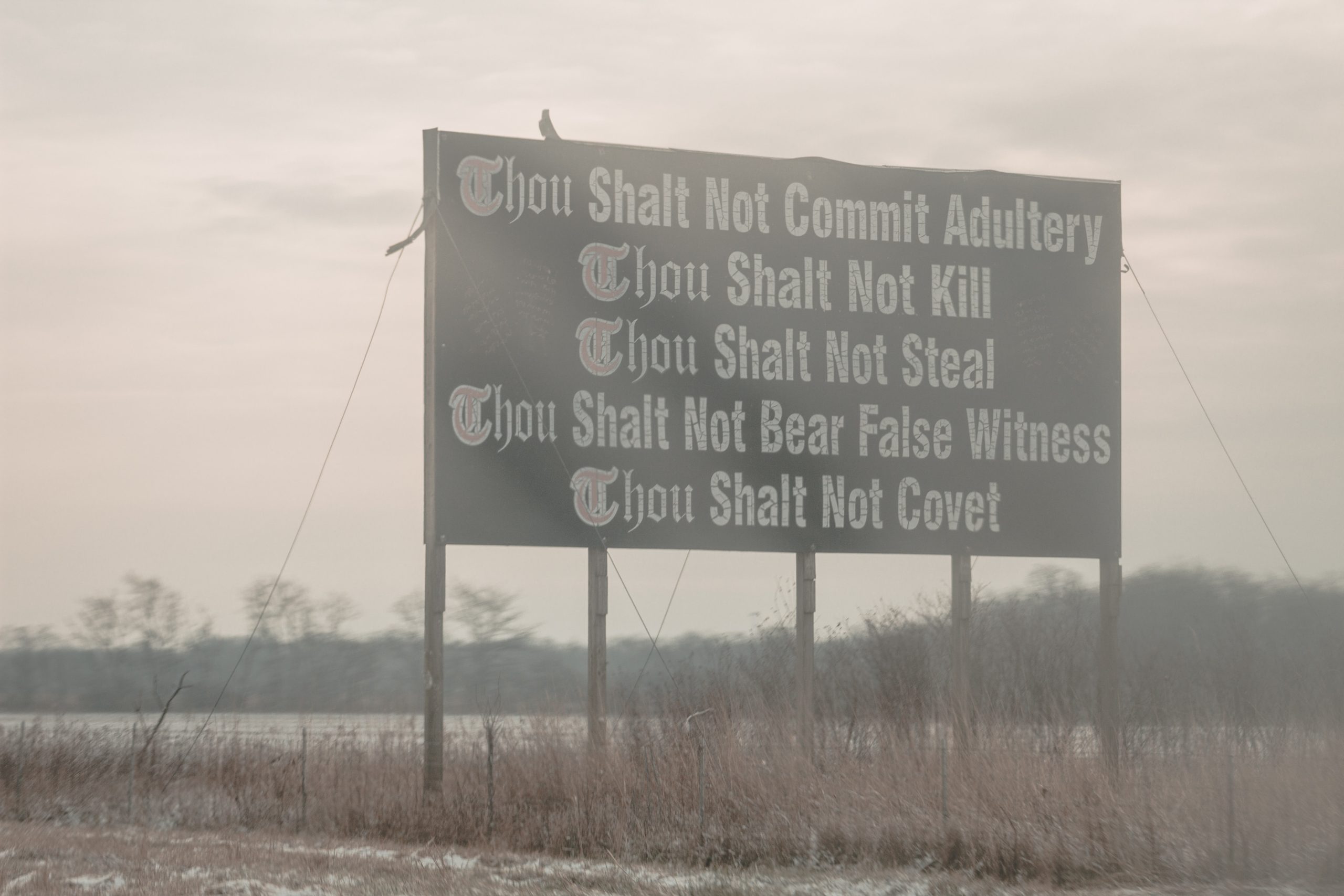
Becoming a Woman at the Paradise Budget Hotel and Gardens

“The First Virginity of Gigi Kaisara” by Gothataone Moeng

She was a beloved girl, so she had accumulated many names. On her birth certificate: Gagontswe Kaisara, two names that had little to do with her. The first she had been given by her father, a hand-me-down, after an aunt of his who had never returned from domestic work in Johannesburg; the second was a family heirloom, belonging first to her great-grandfather, then to her grandfather, both of whom had died before she was born, so she didn’t even know them as she lugged their name around. Also, on her birth and PSLE certificates: Penelope—her most despised name, a name given to her by her mother for no reason other than its elegance and symmetry, its appearance on the page. Only her teachers and classmates at the private boarding school she attended in Gaborone used that name. They chopped it up; they remixed it as they saw fit. Penlop, she answered to sometimes, Penny, Pen, Pen-Pen, P. To her father, she was Nono, after some or other adorable thing she had cooed as a toddler, something her father clung to through the ongoing fissures of their relationship. Since the divorce, she refused to answer to Nono when they spoke on the phone, insisting she would be fifteen this year, that she had outgrown that childish babble, that her father should call her Sadi instead. Sadi was her home name, the name her mother called her, a diminutive she shared with half of the girls in Botalaote Ward, a name heralding the women they would grow into. She supposed it was sufficient, this sign of the immutable and unimaginative love her mother shared with the other mothers of Botalaote Ward.

At eight, she had spent hours with her forefingers stuck in her cheeks, a valiant effort to poke dimples into her face. What a waste those childish hours had been; her fingers were too feeble against the genetic material that had conspired to create her face. But no longer was she a child. She was rising fifteen and in possession of a new determination and a new taste for symbolism, such as: a winter break from school was a prime time for transformation, the bleakness and cloister of the season akin to a hibernation, which was basically what her school break would have been, had her mother not forced her to spend three weeks at the ploughing lands, insensitive to how her only daughter’s skin would fare under the deceptive winter sun. Sadi had worked and worked and her skin had darkened and darkened, and now, though she and her mother were returned to Serowe, Sadi had only a week in which to attend to her complexion, and so she washed and exfoliated and brightened, all an effort to molt and pupate and arrive at school sleek and self-possessed, novel and enigmatic, someone of her own invention.

She had been trying out a new name. Gigi. Call me Gigi. I am Gigi. In her notebooks: Gagontswe “Gigi” Kaisara. GG Kaisara. Scribbled in her copy of A Midsummer Night’s Dream. Her Tricolore Troisieme, her IGCSE Modern World History, 3rd edition.

Another thing: she had just finished reading Steve Biko. Consequently she sat at her dressing table, a plastic bag open on her lap, full of the hair that she had just scissored off her head.

“I must to the barber’s,” she chuckled to her new image in the mirror. “I am mighty hairy about the face.” She dusted the hair off her cheeks and her neck and her bare shoulders. Her face was big and naked and thrust into the world anew.


Her mother was pissed.

“What did you do, Sadi?” she asked, her fatigue from that morning’s shift at Namola Leuba seeming to lift off her.

The basis of her mother’s anger, Sadi understood, lay in the money her mother had spent on Sadi’s hair all these years. Hundreds. Thousands of pula, probably. On relaxers and conditioning treatments, trims and steams, braids and blowouts, cornrows.

Sadi tilted her head away from the mirror. She knitted her fingers under her chin and smiled sweetly, displaying her new face to her mother.

“Does it suit me?” she asked.

“Does it suit you? You are not supposed to cut your hair yourself, don’t you know that? It is taboo.”

It’s taboo. It’s not permitted. You are not supposed to. That is not the way of the Batalaote.

Young Sadi had believed every word her mother uttered, the words weighted with the alchemy of spells. Sadi had been terrified to walk with only one shoe on, lest she be swallowed into a clay pot. She had been afraid to push anything away with her foot lest her laziness show up as later-life barrenness. Many a time she had been coerced into public dancing lest her mother’s crops fail. Now she saw that these superstitions were her mother’s own talismans, with which she hoped to hold the disarray of the world at bay.

Sadi regarded her mother’s face: the constellation of sun moles on its surface, eyebrows knitted together in concern, dark lips parted with their next reproach. A face so known to Sadi that it had been eroded of any and all mysteries.

“Why is it taboo to cut off my own hair?” Sadi asked. What she wanted from her mother was an answer upheld by reason rather than habit, rather than a lingering fear of tempting fate.

Her mother said, “I want you to gather up every single strand of your hair and throw it down the toilet. Every single strand. You hear me? I don’t want any people lurking around to take your hair.”

It had been three years since Sadi was plucked from her government school for her academic gifts and awarded a bursary to attend a private boarding school in the city. Her mother paid neither the tuition nor the boarding fees nor the small living allowance Penny received monthly. This trajectory of Sadi’s life had been so inconceivable that her mother still insisted on a particular kind of vigilance, which included ensuring that no visitor could collect any vestiges of Sadi’s body—not her nail cuttings, not her shorn hair, not the print of her feet in the yard.

“Sadi, your hair was so beautiful,” her mother said mournfully. “Why did you do this?”

“Mama, have you read this?” Sadi held a book up. “Steve Biko said we are trying to be white women when we relax our hair.”

“O-wo-o,” her mother scoffed. “And is he going to marry you, that Steve Biko?”

“That’s what my hair is for?” Sadi laughed. “To find me a husband? What if I don’t want to get married?”

Her mother gave her the look. “What did you say?”

“Mama, Mum, Mummy.” Sadi walked toward her mother. “Mumsy. Dimamzo.”

She cupped her mother’s face in her hands, watching the dawning of a smile on the older woman’s face.

“I am just playing, Mummy,” Sadi said. “I am going to get married and give you as many grandchildren as you want.”

Her mother laughed.

“I am going to fill this house with grandchildren,” Sadi said, flinging her arms wide. “So many babies. Babies everywhere. We won’t know where to put them. We will be crushing them under our feet. There will be babies in that wardrobe, babies in the oven. Babies clinging to the ceiling, babies squirming under this bed. Babies e-very-where.”

“Dear God, for whom I do so little,” her mother said. “What kind of girl is this?”


“Penny, what happened?” The other girls in the boardinghouse shrieked, the first week of August, as they all lugged their suitcases up the stairs to move into their rooms. Gigi, she thought, Call me Gigi. But she did not say it out loud. They were not really her friends, these girls. She was not like them. She had not come from their world of exclusive kindergartens with years-long waiting lists. She had not attended the private primary schools the kindergartens had funneled the girls into, which had then funneled them into this private secondary school. The world they belonged to was rarefied and insular: last names recognizable from precolonial kingdoms and from the first class of legislators in 1965. Their parents were cabinet ministers, CEOs, diplomats, judges.

“What happened to you?” the girls asked.

Their attention was rare and Gigi was cornered in its brilliance. Their faces were stricken around her, mourning the loss of her hair more than she was. Gigi’s fingers went into her hair. This was another new feeling, the springy, spongy feeling as she patted it.

Their attention was rare and Gigi was cornered in its brilliance.

“I flushed it down the toilet,” Sadi told them.

It was into a pit latrine that she had thrown her hair, but she didn’t tell the girls that.

“It will grow back,” the girls consoled her.

“Yeah,” she said, though she didn’t miss the rituals of sitting for hours at a time, the pungent, stinging relaxer crème her legs shaking as her scalp started to sting.

Three weeks into the term, when her allowance had been paid, she took the Broadhurst Route 1 down to the Main Mall. At the table of a street vendor, she bought three pairs of gold-plated hoop earrings. Ten pula a pair. She slipped the earrings on and the vendor held a vanity mirror up to her. Gigi appraised herself honestly. Her face, framed by the earrings, was oval and dark and, regrettably, perpetually shiny. Her sebaceous glands were clearly overactive, releasing at every minute a flood of sebum that broke through layers of talcum powder and coated her face like the bottom of a frying pan. The shininess gave her a frazzled look, never cool and calm and collected. A crop of pimples bloomed on her forehead every few weeks and she mercilessly popped them whenever they ripened. There was nothing at all special about her large brown eyes. Her eyelashes could be longer and curlier. She wished her lips smaller, with a more discernible Cupid’s bow. But the real bane of her existence was her nose, which she had inherited from her father’s mother and was probably destined to pass to her own daughters one day. She regretted it, looking at herself in the mirror, how much bigger it seemed now that she had shaved her head. She tilted her head back and forth, posing for an invisible camera, finding ways to minimize her boulder of a nose.

“Thank you,” she said to the vendor, and the woman put the mirror back onto the table. Gigi paid for six wooden bangles and slipped them onto her wrists immediately. She held her arms up, twisting the stack of bangles farther down.


The exterior of the bank she walked by was covered in large panels of reflective blue-green glass, and strolling past toward the combi stop, Gigi gazed at herself, multiplied on the panels. Behind her, on the edge of every panel, a uniformed security guard watched her. The man tossed a black baton from one palm to the other. He was short and big bellied, like a toddler raised on a daily bowl of porridge and milk. In her reflection, she saw the man summon her with his forefinger.

She obeyed him.

The hand he extended to her in greeting was warm and damp with sweat and, too late, she realized what she had walked into.

“Did Uncle need help with something?” Sadi asked, referring to him in the plural.

“You are beautiful.” The man smiled at her, still holding on to her hand. “You see, me, I prefer this. Short hair. No makeup. So simple. So clean. Not these Gaborone women who want us to buy them wigs and Revlon and Sheen Strate.”

“Uncle,” she said, “I am in form three.”

“A girl in form three is a woman.” He laughed and pumped her hand, and her new wooden bangles clank-clanked together.

“It’s better that a real man teaches you before these little boys spoil you,” the man said. “Hee, moroba, am I lying?”

His bent middle finger scratched the tender flesh of her palm.

Stupid bitch, Sadi thought bitterly, of herself. She had not yet rid herself completely of her habit of obedience, her ordinary trust in those older than her. She saw that she was defenseless against her lapses in vigilance, caused by all manner of things—such as the pleasures of slipping her bangles down her arms, such as the sight of her face framed by large hoop earrings.

Two middle-aged men in business suits emerged from the interior of the bank, laughing and shaking hands. In a just world, Sadi thought, the men would look toward her and, noticing her discomfort, rush to her rescue.

“Dumelang,” she said loudly toward the men, in a way that, she hoped, would convey familiarity. The security guard let go of her hand and she ran off.


In the communal showers of the boardinghouse, she ran scalding hot water down her head and rammed her fingers through her foamy hair. She scoured her palm with a pumice stone. Her scalp throbbed and her body tingled as she dressed. Even after all that, through a supper of shepherd’s pie and green salad, through evening study, through walking with her roommate, Ipelo, to the school tuckshop, the feeling of that finger scratching the meat of her palm flared alive at intervals. At lights-out, she lay very still under the covers and listened to Mrs. Brown coming down the corridor, opening doors and trilling, “Good night, girls.” Same as every night. The second life of the boardinghouse would begin as soon as Mrs. Brown left, desk lights switched back on so the girls could read their contraband copies of Jackie Collins and Danielle Steel. Some of the form five girls gathered in the upstairs living area at night to watch blue movies; some girls snuck into others’ rooms for slivers of emergency gossip.

“Good night, girls,” Mrs. Brown said.

“Good night, Mrs. Brown,” Penny and Ipelo echoed.

Mrs. Brown switched off the overhead light and closed the door. The dark fell over the room like a shroud and, ensconced in it, Gigi felt the scratch of the man’s finger inside her palm. She giggled. She heard the telling noises of her roommate’s movements and through the cover of her sheets she saw the glow of Ipelo’s desk light.

“What?” Ipelo asked.

Penny’s roommate was a thin girl with a narrow, delicate face and almond-shaped eyes that met the world with guileless faith.

“What’s funny?” Ipelo asked.

“Nothing,” Penny said.

Ipelo switched off the lights.

Returned to the dark, Gigi imagined herself with the man. He would have a hairy torso, kinky little coils sprouting out of his chest. His face, close to hers, would smell warmly of tripe or some other glutinous animal innards.

Baby, oh baby, the man would say. He would invade her ear with the wetness of his tongue. He would enclose her breasts in his thick calloused hands.

Baby, oh baby, he would say. Except. He was old. He wouldn’t say that.

He would probably say, Moroba. Morobanyana wa me. Aah, sweetie! Aah, stirrer of my heart! Aaaaah!

And she would say, Oh yeah! Oh yeah! Oh yeah! She would cradle his belly like a baby and lavish it with caresses.

She laughed out loud and Ipelo switched the light on again.

“Tell me what you are laughing at.”

Penny sat up and told the story of her afternoon.

“Can you imagine me with that man?” Penny asked, laughing. “He was so old. Can you imagine his sweat all over me? Covering me? ‘Oh yeah, baby, oh yeah, give it to me, yeah.’”

“That’s disgusting,” Ipelo whispered. She met with the Christian Union every Wednesday night. “That’s someone’s father.”

“You don’t know that,” Penny said.

“Probably.”

“He is the one who said all those things to me.”

“Oh my God. Do you want to do that with him?”

“No. What? No.”

“I am going to pray for you,” Ipelo resolved.


By morning, Gigi had decided that she would fall in love. She chose a boy in her drama class. Although he was in her year—he was in 3K while she was 3L—she had never before taken a class with him. She had never even seen him at any of the swimming galas, the football matches, the baseball games, the athletics days, the V-shows, the Tutti e Solos, the end-of-term discos. She gathered he was a day scholar. He was gangly, with unfairly clear skin and locs just out of that awkward stage. His daily uniform was a pair of black Levi’s jeans, a white collared polo shirt, and black Converse All Stars. At the beginning of the term, in their first class together, they had been placed in the same group. Every double period of their drama class, the group sat in a little circle of chairs and brainstormed their mini productions and their sketches. But he never said anything. Whenever they had to choose roles for their sketches, he would choose the smallest possible role. A narrator, for example, who would step onto the stage and pronounce, “Three years later.” On this Thursday, the day she had decided that she would fall in love, knowing that love could confer newness upon her, that it could slough from her her origins, which were unmistakably small and rural, an unheroic lineage of farmers and maids and diamond mine laborers, on that day she watched the boy burying his fingers into his hair and twisting methodically, moving from one lock to another. He must find it all stupid, Gigi thought. He must be one of those who had chosen the class because they thought it would be an easy A, a way to avoid Chemistry or Physics or the pedantic geography teacher who was notorious for instructing students to move their chairs exactly 3.55555 centimeters away from the wall.

The boy’s name was Tabona. Gigi dreamt of getting lost with him in the velvet curtains of the theater, emerging from their thick luxury with knowing eyes and a new deportment. Between the two periods of their drama class, she followed him outside to the fountain in the walkway. She watched his locs fall over his forehead as he bent down. She watched his pink tongue dart out to touch the upward trickle of water; in and out, in and out, before closing his lips over the spout. Gigi watched his Adam’s apple ripple up and down his throat.

“I am Gigi,” she said to him when he raised his head from the fountain.

“Aren’t you Penny?” he asked.

“Oh, you know my name?”

“We are in the same group.”

“Oh yeah,” she said, as though she had only just that moment realized that. “Gigi is my other name. Call me Gigi.”


Neither Gigi nor Tabona had club or community service or sports commitments on Wednesday afternoons. They met in Geography 2, so close to the kitchen and dining hall that they could predict what her supper would be. Tabona talked about his uncle, with whom he was living while his parents were setting up a business in Mauritania. He rhapsodized about the music he was obsessed with, but never the lyrics themselves, always some esoteric component that, he was convinced, finally brought the song together. Such as the timbre of the chuckle that faded a Toni Braxton song out or the adolescent-like break in a singer’s voice. Gigi nodded and laughed at everything he said, impatient for the moment he would turn around to kiss her, the fever of his lips on her neck. When he did, weeks after they started hanging out, she plowed her hands into his hair, which was not sticky like she thought it would be but soft and dry, like an old cloth left in the sun too long.

Nights, in her room, she filled her thoughts with him. The weight of his arms, the heat of his skin and nothing else.

Nights, in her room, she filled her thoughts with him. The weight of his arms, the heat of his skin and nothing else. Even when she imagined herself on Oprah, pressing her hands to her chest as she extolled his virtues.

I worship him, she would say to Oprah.

I knew as soon as I saw him, she would say. His eyes are my only anchors to this world, and Oprah would nod knowingly, her eyes brimming with tears.


By November, Gigi had saved P350 of her allowance. Tabona knew a motel in Mogoditshane that would cost P75 an hour.

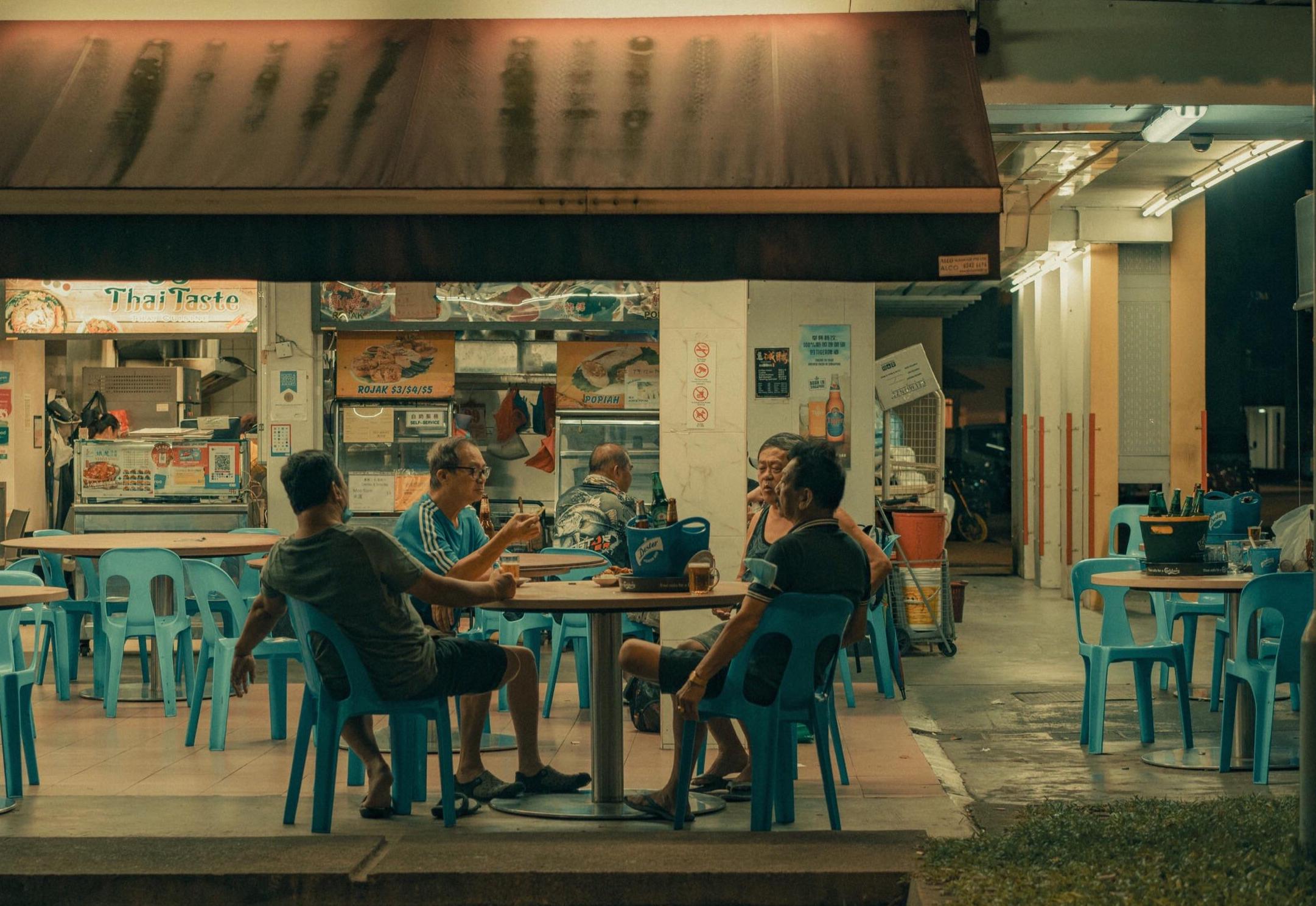
Strangely, the board outside read PARADISE BUDGET MOTEL AND GARDENS. Strangely, it was a Chinese man who opened the gate for them, glancing only briefly, without reaction, at Tabona behind the wheel of his uncle’s Mercedes. Strangely, there were no gardens, just a couple of widely spaced jacaranda trees in the yard and green netting providing shade in the parking lot, under which Tabona parked the car. The rooms were squat, gray, all connected to each other like train houses in Mogoditshane. Strangely, the woman at reception didn’t say anything to them when they paid, but her whole face, her whole demeanor, seemed a knowing wink, and Gigi crossed her arms over her chest. They walked down the corridor to their room in silence, past wide-open windows and gauzy curtains fluttering in the air. Strangely, Tabona’s hands seemed to shake as he slotted the key into their room door.

A TV was set up high across from the bed, which was made up in white linens and an orange coverlet. On the round table in the corner was a silver tray that held two glasses, two white mugs, two bottled waters. A gold-framed mirror hung on the wall.

Tabona walked into the bathroom. She heard him in there, his pee loud against the porcelain of the toilet bowl. He has his penis in his hand, she thought suddenly. She took her shoes off and slid her feet up and down the bristly brown carpeting. She lay on the bed and switched the TV on. On the Emmanuel TV channel, a row of congregants keeled over and crumpled onto the floor, kicking and screaming in ecstasy. Emerging from the bathroom, Tabona didn’t go to her. He sat on the chair, fussing with the bottled water on the table. Gigi switched the TV off and sat up on the edge of the bed.

“We have to do it on the floor,” she said.

“What? Why?”

“These sheets are white.”

“So?”

“The towels are white too,” she said. “And I am probably going to bleed.”

“It doesn’t matter,” he said. “We paid.”

“I can’t,” she said, thinking of her mother’s hands. “I would be too embarrassed.”

“The floor. How is that romantic?”

It was true that being inside the sheets might cast her into a romance, a fantasy, a deception. But she had the thought, just then, hearing him say the word, that what she really wanted was clarity. Gigi: clear of mind.

“Don’t say romantic,” she said. “We made a decision, right? To have sex. Let’s just do it.”

“If that’s what you want,” Tabona said.

“It is what I want.”

“Fine.”

“Fine.”


Gigi’s legs were open. Her legs were up in the air. Her legs met on the small of Tabona’s back. Pain crept from the insides of her thighs, slinked up to her knees. He is inside me, she thought. Pain radiated from her groin, intensifying as Tabona burrowed into her. He is actually inside me. The bristles of the carpet pierced through the coverlet into her back. Her arms lay awkward beside her hips. She lifted them and looked at her hands above the curve of Tabona’s body. Cutting clear through the fog of pain was a pitiful canine yelping, emanating from Tabona’s throat. It struck her as hysterical, as did the sweaty grimace of his face, his locs limp and stuck onto his forehead. She pressed her lips together to stop from laughing. Her eyes traveled to the window: the sluggish movements of the curtains. She listened with intention and this is what she heard: the overhead fan whirring torturously, as if it too were in pain; the receding slap-slap of the caretaker’s flip-flops as she walked past the rooms; the breathless, harried fragment of a song the caretaker was singing, Halleeeelujah, halleeee, halleeelujah; the angry honking of cars out in the streets; the tired calling out of wares by vendors. She listened hard for other secrets of the world.

In another hour, she thought, she would walk out of the room a knowing woman. She would wait outside for Tabona to return the room key to the other knowing woman at the reception. She would climb into Tabona’s uncle’s Mercedes and Tabona would drop her off outside the boardinghouse and she would carry her knowing up the stairs to her room.

Tabona grunted and she rubbed her hands in his hair. She lowered his head, his lips down onto hers. His tongue pushed into her mouth. She moved her butt up, down, up, down, up, down. His humping grew frenzied, his yelping unintelligible.

“Oh yeah,” she said, “oh yeah, oh yeah, oh yeah.”

Tabona let loose an incomprehensible sound. At its culmination, he collapsed on top of her, breathing heavily. After, he retreated into the bathroom.

Gigi gathered the orange coverlet around her and stood in front of the mirror. She studied her face, its thin film of sweat, her lips parted in a slight smile. She studied her eyes. Later, just four years into the future, going by Sadi, broke and freshly dropped out of architectural school, she spent a winter living in the luxurious house of a man twenty years older than her. Nightly, she pretended she had never before had sex, whimpering I am scared or I am not ready whenever he approached. Nightly, she laughed to herself when she saw his growing reverence for her virtue. And even much later, older and more susceptible to her mother’s superstitions, she went for years without sex, wanting to believe that her abstinence would exert some magic onto her life, turn it back on track.

In room 5 of the Paradise Budget Motel and Gardens, she let the orange coverlet fall at her feet like a soundless waterfall. She swiveled back and forth, searching for the muscles that had ached just minutes prior. Her body was still her body: the same sly stretch marks on her hips, same 32AA breasts, same triangle of pubic hair, same birthmark on the inside of her right thigh. Tabona came to stand behind her. His hands were self-assured now, cocky as he cupped her breasts and kissed her neck.

“You are not going to tell anyone,” she said.

“Why would you think that?”

“I am just saying,” she said.

“I won’t say anything,” he said. “You are okay, right?”

“I am fine,” she said with some impatience. “I am fine. I feel just fine.”

7 Thrillers That Explore the Dark Side of Motherhood

Like so many, I never truly understood the dark side of motherhood until I went through it myself. After a complicated pregnancy and a traumatic birth, my daughter burst onto the scene just a few months ahead of a global pandemic. In those early weeks and months, like so many new mothers, I found myself struggling to adapt to sleepless nights and the trials of new motherhood, and was at a loss trying to feel all the feelings I knew I was “supposed” to have. A writer through and through, I was determined to turn these feelings into my next book. After all, I write thrillers, and any mother knows that some of those raw and tender sleepless nights can be more terrifying than nearly anything we grab from the horror shelves. 

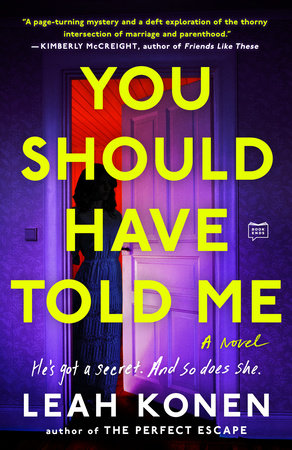
You Should Have Told Me follows Janie, who is struggling to adapt to life with a six-week-old infant. Her baby won’t sleep, she’s not feeling any of the “right” feelings, and a secret she’s keeping from her partner, Max, threatens to tear her new family apart. So when warm, doting Max helpfully offers to do all the feedings for the night so Janie can catch up on some sleep, she jumps at the chance. But at three a.m., she wakes to the sound of her daughter screaming. She finds her alone in her crib, diaper unchanged, fussing and writhing—Max is gone. As Janie cares for her daughter alone and tries desperately to uncover the secrets of Max’s disappearance, a terrifying new development shakes her world even further: a woman in town has been murdered, and the police think Max may have had something to do with it. 

To celebrate You Should Have Told Me’s release, here are some of my favorite thrillers that explore the darker side of motherhood.

The Upstairs House by Julia Fine

A ghost story—or is it?—that cuts to the very heart of motherhood, The Upstairs House centers Megan, a postpartum woman who finds herself both psychologically unravelling and guilt-wracked over her unfinished thesis about children’s literature. Struggling to care for her newborn largely alone while her husband travels for work, one day, Megan discovers the ghost of beloved children’s book author, Margaret Wise Brown, and her lover, Michael, who move into a “house” upstairs that only Megan can see. Megan’s psychological break is peppered with nods to Goodnight Moon—her first vision is that of a single red balloon in her labor and delivery room—and as we delve deeper into Megan’s psyche, and those upstairs ghosts, Fine’s superb writing and characterization forces us to reckon with the pressures we put on mothers and a horrifying lack of societal support. 

More Than You’ll Ever Know by Katie Gutierrez

A rich thriller set both in modern-day Texas and 1980s Mexico City, More Than You’ll Ever Know follows Lore, a woman who creates a complex double life by marrying Andres in Mexico City after she’s already been married—and had children—with Fabian in Laredo, Texas. When Andres comes to Texas and exposes Lore’s secrets, he turns up dead in his hotel room—and decades later, a journalist, Cassie, begins attempting to uncover the long-buried secrets. While the murder and fallout rushes the plot ahead, Lore’s relationship with her own teenage twins, as well as Andres’ children, in addition to Cassie’s pseudo-maternal relationship with her much-younger brother create the real heart of the story. This page-turning thriller is a deft exploration of motherhood in all its forms.

The School for Good Mothers by Jessamine Chan

A dystopian thriller about the pressures society—and in this case, the state—put on motherhood, The School for Good Mothers follows Frida, a Chinese American woman who is struggling to keep it together with her career languishing and her marriage falling apart. A single mistake—leaving her one-year-old daughter home alone for a few hours—turns into a Big Brother-esque nightmare when the government enrolls her in an assessment program to determine her worth as a mother—with Frida risking losing Harriet if she can’t prove her worth.

Just Like Mother by Anne Heltzel

A modern nod to Rosemary’s Baby with a decidedly feminist slant, Just Like Mother follows Maeve and her cousin, Andrea, two children raised in a bizarre cult who reunite in New York City and the Catskills as adults. Maeve is stressed-out and living in a cramped apartment, with a limited social life, a taxing job, and no family ties, and so she naturally she jumps at an invite from Andrea and her husband to spend some time in their sweeping upstate mansion. But the time Maeve spends with Andrea, who runs a fertility industry startup and is currently working on a creepy AI baby doll for prospective and grieving parents, the more she gets the sense that something is off with Andrea and her baby-obsessed friends. As we dive deeper into Maeve’s present—and cultish past—Heltzel brilliantly explores the intense pressure on women to become mothers.

Nightbitch by Rachel Yoder

Another story about a husband regularly travelling for work (a true horror with a young child!), Nightbitch follows a character only named as “mother,” an artist who gave up her career to be a stay-at-home mom and two years on is struggling to adapt as she cares for “the boy,” almost entirely on her own. When one day, she steps into the bathroom to find a dense patch of hair on the back of her nape—er, neck—she gradually comes to believe she is turning into a dog. This body-horror-cum-motherhood-thriller becomes even darker and more howlingly hysterical as we reckon with the fact that the protagonist is a better—and happier—mother as a dog, than she ever was as a human.

The Push by Ashley Audrain

The Push follows Blythe, a warm and doting woman who is set out to be the kind of mother to her own child, Violet, that she never had. But as time goes on, Blythe becomes convinced that something is very wrong with Violet. Is it all in her head, as her husband, Fox, keeps saying, or could Violet actually be growing into a dangerous and violent child? When Blythe has another child, Sam, she’s flooded with the maternal feelings she never had with Violet. But when a terrible tragedy strikes the family, Blythe is forced to confront everything she thought she knew about her own past, her daughter, and her tenuous path forward as a mother to Violet. 

Baby Teeth by Zoje Stage

Yet another tome where a mother has an intuitive feeling about her child and is quickly dismissed by her husband, Baby Teeth is a modern nod to the horror classic, The Bad Seed. The novel follows Suzette and her seven-year-old daughter Hanna, and their strained and oftentimes scary relationship. Hanna has been expelled from nearly every school she’s attended, and while she’s sweet and largely silent around her father, during homeschooling with her mother, she engages in increasingly sadistic games, to the point that Suzette begins to question whether her child wants to actually get rid of her. Is Suzette dreaming this up, as her husband seems to think, or does her own child actually have it out for her? Baby Teeth forces us to confront pressures and challenges of motherhood when the mother-child dynamic is anything but beatific.

“Hysterical” Women Helped Me Regain My Voice

“You’ve been here before, two years ago.” The receptionist’s voice was bright and cheerful. 

“Right, for my hip.”

I heard the smile in her voice. “We received your doctor’s referral for your shoulder. But it’s office policy that you stick with the same physician you’ve seen in the past.”

My primary care doctor had wanted me to see Dr. M—a shoulder specialist. She was concerned I had torn my rotator cuff.

It was easier for her to remain demure, polite, and well-behaved throughout the process.

The receptionist’s sweet tone prompted a similarly polite response from me. “Okay.”

“Now, Dr. B is getting ready to head out on vacation. So the earliest I can get you in is September 20th. Will that work for you?”

I stared at my calendar.The pain of the past two months compelled me to protest an appointment that loomed a month out. I wanted to request we stick with the referral of Dr. M that had been sent over. Common sense dictated that the odds of both physicians being out of the office simultaneously was slim. I stood a good chance of being seen sooner, and Dr. M was a shoulder specialist; Dr. B had addressed a hip issue for me. But I kept hearing the words “office policy” over and over in my head. And I didn’t want to be seen as a difficult patient. 

“That’s fine. Thank you.” 

I couldn’t speak up. Like so many women, I’d learned accommodating behavior throughout my childhood. Mixed with my parents’ lessons to stand up for myself were conflicting messages to respect authority figures—regardless of what they said—and always keep my voice moderated and calm. I’d soaked up the warning that vocally resisting the status quo was unacceptable. 

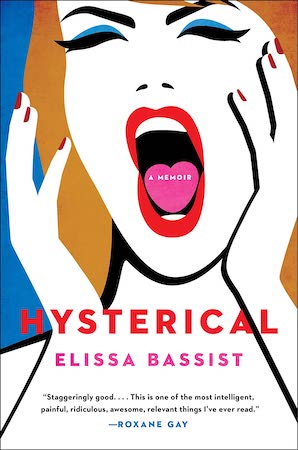
In her tragicomic memoir, Hysterical, Elissa Bassist brings this female programming into the light. She demonstrates how everything around women, from the television they watch to their political stance to the way they’re educated, influences their behavior and how they become quieter as they age—regardless of how outspoken they may appear. The pressure becomes overwhelming, creating an enforced silence that turns women into automatons, fearful of saying anything lest an accusation of stepping out of line or becoming a “problem” emerges. As she writes, “Don’t talk back. Don’t tell. Don’t say this (or that). Don’t draw attention. Don’t be difficult. Be pleasant. Be who everyone needs you to be.”

Bassist’s realization of her own silence arose when she started experiencing dreaded non-specific medical symptoms. Chasing the source of various pains throughout her head and abdomen sent her from one specialist to another, leading to a potentially fatal condition of hyponatremia, or low blood sodium, as each prescribed and adjusted medication. The entire time, she was struggling with undiagnosed OCD and mismanaged depression stemming from an incident of sexual abuse. But it was easier for her to remain demure, polite, and well-behaved throughout the process, wanting to avoid the impression of being a “stressed-out hypochondriac,” the expectation of which was drilled into her from her cultural and educational experiences.

And I was no different.

“I spoke in ‘the good female patient voice’: the pleasant and accepting and grateful voice, the voice that wasn’t too assertive or too blunt or too cold, the voice that didn’t ask too many questions or follow up too frequently, and especially the apologetic voice,” Bassist writes in a description of her doctor visits that mimicked mine to a T.

A stereotype has arisen that dramatic women exaggerate their pain to get attention.

I didn’t walk in and complain that I wanted to scream whenever I washed my hair. That I was contemplating shaving my head to prevent the electric shocks that ran down my shoulder when I attempted more than running a comb through my hair. I didn’t mention the embarrassment of needing my husband’s help putting my bra on because my arm refused to bend behind my back, leaving me wailing helplessly in the middle of the bedroom.

Instead, I quietly explained to my primary care doctor that I was having trouble sleeping at night. I bit my tongue so I wouldn’t curse aloud as she manipulated the joint to ascertain how far I could move. I agreed with her treatment plan and waited six days to call the office and report that the steroids weren’t working. I felt an inexplicable need to stay as calm as possible and not speak of my pain too much. I was afraid that if I told her how much agony I was actually in—that it felt like a blade wedged between the bones—she’d stop taking me seriously. And that pressure kept me quiet.

And I loved my PCP. She listened to me and took my concerns seriously. It had taken me two decades to find her while I suffered with doctors who dismissed every word that came out of my mouth. But I couldn’t get past the signs on the door warning patients of the new pain management policies: referral to a pain specialist, the dangers of narcotic prescriptions, and a refusal to prescribe narcotics without a “significant reason.” The threatening language made me swallow any words related to pain.

I, and other women like me, have learned to stay silent about our medical problems. Even when it means we receive poor care as a result. As Alyson J. McGregor wrote in Sex Matters: How Male-Centric Medicine Endangers Women’s Health and What We Can Do About It, “The more vocal women become about their pain, the more likely their providers are to ‘tune them out’ and prescribe either inadequate or inappropriate pain relief.” A stereotype has arisen that dramatic women exaggerate their pain to get attention. And that’s led to longer wait times at the ER (up to 33% longer) than men who present with similar symptoms. A problem that only reinforces the need to stay quiet and endure in silence.

Women, through both an evolutionary nature and our nurturing process by parental figures, are accommodating. (At least the majority of us; a lucky few manage to escape the programming) As Bassist puts it, “The disease to please is our birth defect, and then we’re brought up to be obliging, reassuring, and non combative. To refuse is ‘demanding,’ ‘hostile,’ and ‘hideous,’ and we should not hurt someone else’s feelings by expressing our own.” I was caught in the quandary of not wanting to make too much of my pain and wanting to acquiesce to the orthopedic office’s policy. My only real option was to agree. And the price was my voice.

Like Bassist, I was determined to “suffer less—invisibly or with a smile—to not provoke or inconvenience or frustrate anyone, ever.”

Until the orthopedic office called again.

“Ms. Kennedy, we need to push your appointment back. Dr. B won’t be available on September 20th. Could you come in October instead?” The receptionist was as polite as always. And I could hear the expectation of my usual accommodation in her tone.

But my common sense wasn’t ready to offer quiet acquiescence. I’d accepted the September appointment while the doctor went on vacation. Now I needed a further delay? Had he decided to extend his trip? Contracted COVID wherever he’d gone? Was he aware of my referral and that I’d been dealing with intense shoulder pain for over two months?

The pause on the other side of the line felt like an indictment of my tone.

When a doctor fails to explore the full battery of testing or refuses to sit down and listen to a patient, the patient has the right to speak up for themselves. No one knows their body better, and that’s especially true for women. Yet females, in particular, are often reluctant to say anything. The engrained lessons that authority figures, such as doctors, know far better than we do make it challenging to ask questions. And that fuels the 20% of women who report that they feel a doctor ignores or dismisses their symptoms, compared to only 14% of men. It was why I hadn’t insisted on an appointment with Dr. M in the first place, leaving me in this situation.

I felt like Bassist was sitting beside me, her hand in mine. I took a deep breath to quell my shaking. “It’s been over two months since I started having problems. What’s the soonest he can see me?”

The pause on the other side of the line felt like an indictment of my tone, and I wanted to crawl under the desk. But my shoulder was already aching, and I pressed my lips together to hold in the need to apologize. The receptionist’s voice was a little quieter but still cheerful. “Would October 6th work?”

“Yes.” I hesitated. “Could you put me on a waitlist in case there’s an earlier cancellation?”

“Of course.”

When I hung up the phone, I felt like I’d run a marathon. I could barely catch my breath. On the one hand, an oppressive weight urged me to call back and apologize for my “behavior.” But on the other hand, I felt a sudden freedom. I’d spoken up—however small the words had been. It was the most rebellious act I’d ever attempted with a medical professional. And I was caught between feeling gloriously defiant and horrified that I dared to ask for “special consideration.”

“Women who feel and express feeling are associated with madness and sickness until ‘vocal’ is a symptom,” Bassist writes. Part of me was convinced the receptionist was, at that moment, making a note in my chart that I was a “difficult patient.” I had visions of my appointment devolving into a catastrophic nightmare of tears and yelling. But I wondered how much of that was due to the ingrained thoughts and impressions of forty-plus years of social and cultural teaching. As Bassist demonstrates in Hysterical, we’re so conditioned to accept the image of an outspoken and confident woman as “hysterical” that it makes it almost impossible for any woman to break free of the mold, regardless of what she attempts to say—whether it’s to declare herself a victim of sexual assault or demand proper medical care.

“It wasn’t my voice that would obliterate me. It was my silence.” Bassist’s words wouldn’t leave me as I walked into the orthopedist’s office. I could repeat my performance with my primary doctor and downplay the agony impacting my life. (In short, I could behave the way society expected). Or I could speak up and tell Dr. B exactly how badly the pain was making me feel. Even if it risked making me sound like a vocal, hysterical woman.

“It’s nice to see you again, Ms. Kennedy,” Dr. B said, walking into the room with a wide smile.

I felt the moment stretching, his expression expecting the usual polite response to his greeting. During my previous visits, I always responded with an immediate smile and automatic cheerful remark. It was what the medical team had come to expect from me.

But my arm felt like it had been torn out of the socket, courtesy of the preceding x-rays. And I’d waited over a month to see him. I took a deep breath, folded my hands in my lap to disguise their shaking, and looked him in the eye. “Not really. I’ve been in pain since mid-July, and it keeps getting worse. And I had to wait an extra two weeks to see you.”

I let my silent winces speak for me, not wanting to be “difficult” or “dramatic.”

The smile vanished from his face. I watched him exchange a look with the transcriptionist. “Well, let’s take a look at that shoulder then.”

Before, I allowed doctors to bend and twist my arm as far as they wanted, regardless of how much pain it caused. I let my silent winces speak for me, not wanting to be “difficult” or “dramatic.” But as he manipulated my shoulder, attempting to bend it into the positions that sparked the sharpest pains, I said, “No” in a firm voice. He stopped immediately, and I exhaled in relief.

“I don’t think you’ve torn your rotator cuff, but I do think you have adhesive capsulitis—frozen shoulder. I’d like to start you with physical therapy for four weeks. If there’s no improvement in the pain in that time, I’ll order an MRI. And we’ll proceed from there.” He paused, lifting an eyebrow. “Does that sound okay to you?”

I couldn’t remember the last time a doctor had checked with me about a treatment plan. Usually, they rattled it off and left the room—whether I agreed or not. I asked a few more questions about the condition, and he stayed to answer them. He didn’t show any inclination to hurry to his next appointment. My body relaxed, and I found myself smiling for the first time. “Let’s go ahead with the physical therapy.”

“If you have any other questions before your recheck, just give me a call.” He reached out and shook my hand.

While it felt like a battle to get past the pressure of sitting in silence, I had managed to speak up.

I walked from the office feeling confident. I’d been an active participant in my care for the first time. And while it felt like a battle to get past the pressure of sitting in silence, I had managed to speak up. The accomplishment eased the tension in my shoulders, taking away some of the pain.

“In a perfect world–not a man’s world or a woman’s world–I’d speak again easily and often, without overthinking or having to hype myself up in the mirror beforehand,” says Bassist. Reading Hysterical shifted the way I approached my typical silences. Instead of hesitating over how my words would be perceived, I started to think of how the fallout of not speaking felt. Did I want to live in a world where I was unheard and unseen? Or did I want to take the chance that saying something might cause a frown but might ultimately lead to a better experience?

The conditioning women experience throughout their lives is intense. And so is the fight to break free. It’s why Bassist has made her call to arms so powerful: “Risk demanding care. Risk a voice that doesn’t demure, a voice that is difficult, unaesthetic, charged, forthright, sappy. Risk it, or risk living a half-a-life person.”

An Experimental Novel About Malaysian Chinese Lives in the Aftermath of the May 13 Riots

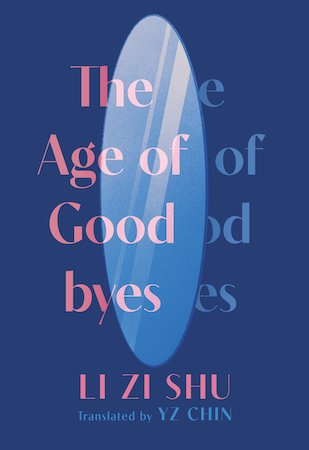
The Age of Goodbyes by Li Zi Shu, translated by YZ Chin, is a wild ride of a novel. It begins on page 513—a nod to the deadly race riots that broke out in Malaysia on May 13, 1969—and follows the ascent of Du Li An from her humble beginnings as the daughter of a street vendor into a formidable matriarch and boss-lady through her marriage to a wealthy, influential member of a Chinese gang society.

While May 13 is a significant date that has been impressed into the minds of every Malaysian (including this reader), no primer on Malaysian history or the Malaysian Chinese community is necessary to immerse yourself in the many worlds of The Age of Goodbyes. Zi Shu, an acclaimed, award-winning writer of Chinese literature, weaves a rich tapestry of the everyday lives of ordinary people in this mining town with the action-filled plot lines, romantic entanglements, and deft pacing of the Hong Kong television dramas that the characters themselves consume religiously. 

The book is no less a daring feat of literary experimentation. Braided into Du Li An’s storyline are two Pale Fire-esque threads of meta-fiction involving a teenage boy who co-habitates a sleazy, rundown motel called the Mayflower with prostitutes who’ve seen better days, and a celebrated author who may or may not have written the very book you are reading. By the end, you, as a reader, can’t help but feel like you’ve been enlisted as a character of the novel as well.

I spoke with Zi Shu—her translator YZ Chin valiantly translating as we went along—over Zoom and live text. We talked about female friendships, the challenge of addressing Malaysia’s race relations in a novel, and Mahua literature. 


May Zhee Lim: Reading this as a person who grew up in Malaysia, the characters’ backgrounds, their social dynamics, and their relationships felt very familiar to me. We always knew whose parents or neighbors had shadowy connections to mobster groups, just like Steely Bo and the Toa Pek Kong Society. Where did you draw your inspiration for these characters?

Li Zi Shu: I think many of the novel’s characters are drawn from my experience working as a journalist in Ipoh. I was a reporter for about eight years in my hometown of Ipoh. During that time, I had the opportunity to rub shoulders with locals from different socioeconomic backgrounds; I was able to observe their lives, their speech, and their mannerisms. Of course I knew my old stomping ground’s general atmosphere and environment like the back of my palm. All of these naturally surfaced when I wrote the novel. Sculpting these characters was actually the most effortless part of writing this book.

MZL: I think you also captured the gossipy nature of the Malaysian Chinese community. Everybody knew everybody’s business. It’s almost like the Greek chorus. Was that part fun to write?

LZS: Describing the daily lives of ordinary folk was definitely the most fun I had while writing the novel. I felt an especially strong kinship to Ipoh [the “fictional” mining town in the novel] when I was writing the parts featuring Du Li An. I had a chance to revisit the impressions and memories I had of my hometown, which then helped me better confront my relationship to my townspeople. With each character I sketched out, I grew to miss and “love” my home more.

MZL: The Age of Goodbyes was first published in 2010 and it has already won an award abroad but it was only translated into English and published by Feminist Press this year. How does it feel to finally introduce a novel you wrote more than twelve years ago to an English-speaking audience?  

LZS: Twelve years ago, I was a young person who approached writing a full-length novel with burning ambition. That’s why I spent many years conceiving and completing The Age of Goodbyes. For a period after its publication, I felt proud of that accomplishment, though in my heart of hearts I still saw it as merely an exercise, a rehearsal. After all these years, I’ve come to develop many more ideas and aspirations for the novel genre so I’m no longer satisfied with the completion of this particular book. But as a Mahua writer, I remain very grateful that I can introduce the book to the English-reading world. I hope the novel draws a bigger readership and more attention to Mahua literature. I’m thankful for the enthusiastic efforts of translator YZ Chin. Without her, I probably wouldn’t have sought out translation opportunities, given my passive personality.

MZL: YZ, maybe you can speak to the translation and publication journey for this novel. How did this book come to be published? Who approached who?

YZ Chin: This book wouldn’t exist without writer and translator Jeremy Tiang. I approached them at a literary event because I greatly admired their novel State of Emergency. They planted the seed of an idea–namely, that I could and should translate. The more I thought about it, the more I found translation to be natural to my state of being. I’m sure you know what I mean. Growing up in Malaysia means being immersed in a multilingual environment. We don’t think twice about slipping between two, three, or four languages. 

MZL: Yes, absolutely. It’s very effortless to switch between languages at the dinner table.

Growing up in Malaysia means being immersed in a multilingual environment. We don’t think twice about slipping between two, three, or four languages. 

YZC: So thanks to roundabout introductions via Jeremy, I got in touch with Zi Shu on Facebook. I’d actually deactivated my account, but reactivated it just so I could talk to her. I’m fortunate that Zi Shu is so open and a dream to work with. We essentially hammered out the details for my translation over Facebook messenger, and then I pitched Feminist Press, the publisher of my first book, Though I Get Home, which is set mostly in Malaysia. I felt there was a foundation I could build upon to emphasize the importance of a book like The Age of Goodbyes, given FP’s mission to lift up marginalized voices from around the world. It was obviously a great fit for us.

MZL: I want to ask you more about the women in the book. I mentioned Elena Ferrante just now in our Zoom chat because there is something about the intense, complicated, and charged dynamics of female relationships in your novel that remind me of the Neapolitan novels. Can you talk more about this?

LZS: I grew up in an environment dominated by women. At home I only had sisters and no brothers. My father was never around. Later on I attended an all-girls secondary school. You could even say I grew up in a matriarchal world. I’ve always felt that the connections and friendships between women are more humorous and colorful than those between men. When you transpose all this into a fictional setting, dissecting these details and nuances layer by layer, you have more than enough to support an entire novel’s plot. When it comes to writing the world of women, there may not be epic quests or grand narratives with the fate of the universe in balance. But it’s possible to depict–from everyday life–heart-stopping scenes as full of conflict as any battlefield.

MZL: I totally agree. The scenes between women were some of the most memorable ones in the book for me. I was both really touched and saddened by the relationship between Du Li An and her best friend Guen Hou. Even their two decades of female friendship could not escape the subtle, casual, yet painful elements of sexism that the women, and the men, in our society have internalized. Sometimes, you convey all of this in just a single, devastating sentence, beautifully translated by YZ. For instance: “Du Li An thought that if she was fated to bear no sons in her life, then she’d be content with a daughter like Eggplant Face to keep her company.”

The riots’ reverberation throughout society is forever a hidden anguish for Chinese Malaysians.

LZS: I feel that female friendships have always been more susceptible, more easily swayed. Especially so in the era described in the book, when women were oppressed under patriarchy; they had to fight for resources to get ahead in a society dictated by men. Du Li An and Guen Hou’s friendship is challenged time and again by the changes in their fortunes and thus their class and hierarchy. What begins as sympathy morphs into jealousy when their circumstances change, and yet their friendship can be rekindled when one party descends into the depths of despair. In my opinion, setting aside the intricacies of female interiority, this is an inevitable result of scrabbling for limited resources in order to survive.

MZL: Yeah, it seems they can only be friends when there’s a power imbalance between them, even from the very start of their friendship. You do something very similar in the book when it comes to depicting race relations in Malaysia, which was and still can be a fraught topic in our country.

LZS: Malaysia is, after all, a multicultural society. Even though I’m writing about Malaysian Chinese stories in Chinese, it’s impossible to evade the painful and uncomfortable question of racial relations that exists perennially in the background. Though the May 13 incident is brought up and yet never directly addressed in the novel, the riots’ reverberation throughout society is forever a hidden anguish for Chinese Malaysians. I don’t think Malaysia’s issues with racial relations is something any single novelist can truly address or resolve. But since the inception of our country, every generation must find the freedom and courage to seek answers.

MZL: It’s certainly a very complex topic.

YZC: By the way, do we prefer “Malaysian Chinese” or “Chinese Malaysian?”

MZL: I’ve always said Malaysian Chinese! What do you two normally use? 

YZC: Yes, same. Sorry to set us off topic!

LZS: it depends, sometimes I want to emphasize the ethnic, sometimes the nationality…

MZL: No, it’s a good point. Let me double check with Electric Literature.

LZS: Malaysian Chinese is fine for me.

MZL: There’s another storyline in the novel that has two male characters: Uncle Sai and the teenage son of the woman who lived in the Mayflower. Why did you decide to set this alongside Du Li An’s?

In Malaysia, there are so few Chinese readers, and the number of them who read literary fiction is shrinking by the day.

LZS: The origins of the Mayflower motel teen are shrouded in mystery. He has a hazy connection to the first narrative strand, that of Du Li An as the main character. What she represents is the initial generation that struggled [for rights]; as for this youth of a later generation, I dropped him into a dilapidated motel and sent him on a quest to discover his roots and find his “father,” which is akin to demanding answers from a history that always remains silent. 

What I wanted to address with his section is the issue surrounding the acknowledgement of a Malaysian-Chinese identity. We’re several generations removed from the migration from China to Nanyang; our attitudes toward culture, home, and country are not the same as those of our ancestors. But this country in which we are situated—will it eternally confine us on a “Mayflower,” stranded and wrecked? Will we be chased away at a moment’s notice and exiled to our “homeland?” Though clearly this ship is going nowhere.

MZL: How does it feel to be a Malaysian writer abroad today? 

LZS: To be honest,  even though I have ample experience living overseas, as a Mahua writer I’ve never considered myself as being “abroad.” I’ve obviously lived outside of the country, and I’ve published in Chinese—and now English—literary circles outside of Malaysia. But throughout I’ve always thought of it as my attempts to carve out more space for Mahua literature. Malaysians who write in Chinese (versus in Malay or English) are used to being marginalized, even within the Chinese literary world. I didn’t feel like I was part of the mainstream when I lived in Beijing for several years. I felt essentially disregarded. Or, put another way, we are basically destined to have trouble blending in with our surroundings. This situation has never changed, even with the considerable sales and great acclaim that my latest novel has garnered in mainland China.

MZL: So I remember always lamenting both the fierce censorship and what I perceived to be the lack of literary or reading culture in Malaysia when I was younger. I felt like I had to leave the country if I wanted to become a writer or pursue my creative dreams. Did you two feel the same way? Feel free to tell me that I’m completely off the mark here.

LZS: In Malaysia, there are so few Chinese readers, and the number of them who read literary fiction is shrinking by the day. If you write in Malay or English, there’s no way it’s bleaker or more hopeless than writing in Chinese or Tamil, right? I keep saying: After you finish writing, the only people who will buy your book are your fellow Mahua writers or certain young readers who are basically your future colleagues—meaning only those who write will read your book, and those who write are vanishing into smaller numbers.

Luckily, we’ve always had the Taiwanese market. Quite a few Mahua authors who moved there have made a name for themselves, essentially opening up a path for other Mahua writers. But Mahua literature being Mahua literature, it’s treated, on a certain level, merely as “minority literature” in Taiwan, which, like any other place, is experiencing a decline in literary readership. The outlook for the book industry is gloomy, which means government support is essential. 

All hope isn’t lost for Mahua literature even in such dire straits though. In the last few years, the work of quite a few Mahua novelists have been introduced to mainland China, where they’ve been received favorably by literature lovers. These Mahua writers have managed to draw attention despite not being physically present in China. I believe the future can only be better if we continue producing good work. Because of that I don’t completely agree with what you said about having to leave Malaysia in order to pursue dreams of becoming a writer.

YZC: I’m greatly encouraged by the success of Fixi, Silverfish, and other local publishers. I admire them so much. At the same time, I understand your concerns about censorship, especially if you work in English. I think the philosophical answer is that writing, like any worthwhile pursuit, should be done despite or against hope. And the practical answer is that we each must find what works for our art, art not being separate from “real life” of course.

MZL: OK, I have to end on this question. You’re in a Malaysian restaurant in the U.S. You have ten seconds to decide on a dish. What do you order?

LZS: I haven’t been to any Malaysian restaurant in the U.S.! Well, if I am in one of them now, oh, sure, please give me a bowl of Laksa. Maybe some satays as well?

Each X-ray Erases Me a Little More

Another X-ray

Any chance you might be pregnant? When was the last time
you wanted to home against another girl’s throat and clavicle,
your mouth taut and mutinous with pearls? What is the name
for a girl who says she doesn’t feel attraction, who staves
her belly with powerlines punctured with birds calling
one minor key note over and over? Which arm would you like
me to use to draw blood today? How long have you been
a casket of steroid pills? Do you have a nice boyfriend? Do you
use birth control? May I ask why not? Is ace
one of those new things they’ve made up these days? What if you
meet the right man and change your mind? Can you
hold still so the technician can try again, please? Can you keep the cross
-hairs of the beam centered on your gut, please?
Are you sure the catheter hurts? Are you sure your gut pain
isn’t just because you’re on your period right now? You see the red
thread your piss like lead lining honey after the nearby cathedral
burned? Do you know how divided a meteor feels, ligatured blue
with flame up in the breathless cold of a million stars arriving
after their deaths? What’s your secret to losing weight?
How often have you found your stool dark lately?
Do you see how your intestine is so obstructed it loops your heart?
When you told your friend you were in hell, did you want
her to come sing you out by holding your tiny wrist, empty
as a halo? Do you know you’re in your prime childbearing years?
What if your husband wants kids? Do you know
when they cut you from your mother she briefly regained feeling
and had to try to wake her tongue, like a cicada under snow?
Do you know the sound a dozen hands make in the dark
kneading a mother’s belly back into place after the C-section,
of how your tongue is a scar that’s proof of the severing?
How many times did your mother teach you to demand
an epidural? How many times did she ask if you imagined kissing girls,
did you imagine lips locking as two people eating matches and silence?
Would you like your mother to draw you churched with morphine
again? What has already begun to nurse your marrow, bladed
with light? When you demanded everyone who love you leave the room
and looked at the NG tube taped to your face, did you call
your dilated pupil a mercury cradle, the hole carved in the shadow
of god that falls across the virgin? Did you call it failure
to tremble for the girl you love, or is that your name
for your ventricles that have learned the art of letting go?
When men running by you yell nice ass
do they know the prismatic dark that hungers down the center
of your eyes? The animal jaws you’ve faithed toward glass
saying love like such a desperate woman falling through your bones?

Elegy for My Mother

I’m sorry, mother, to write you as if you were dead
again. It’s only that I tried to imagine it—
your body on a table for me to prepare
your ashes in a jar for me to carry on my dashboard—
and couldn’t.
Instead, our hands stretched over the electric fence,
the nervous mares pushing their muzzles
into our palms.
Instead, your mother’s gold watch
stopped against your wrist, your hand
guiding ice chips to her mouth.
I’m sorry I’ve been such a hungry throat.
I’m sorry for the C-section scar.
Sorry to always be thinking of the coyote song
you listen to when you walk back alone
to your car at night, of when you wrapped the milk-mouthed kit
in a grease-stained towel. I’m trying to say
I want your arms always, I’m trying to say
that I imagine arranging your hair, your breasts,
your stretch-marked skin, and I thought
of the vulture I saw on the clifftop
swooping between me
and a blue horizon.
Maybe it’s how you cupped my hands
around the dragonfly
after we drowned it
to try to keep the color—how you painted
each faded blue spot back on, showing me
that sometimes the only way
we know how to keep something
is to kill it
so we don’t have to bear watching it
vanish one breath at a time without us
in daylight.

8 Books About the Impact of the Japanese Imperialism during World War II

My native Philippines was colonized three times—by Spain for 370 years, by the United States for 48 years, and by Japan for four years. While the Japanese occupation was the shortest, from 1942 to 1945 during World War II, it proved to be the most brutal. 

In the month-long Battle of Manila alone, about 100,000 Filipinos were killed. The Philippine capital was completely devastated. The battle was the beginning of the end of a ruthless reign marked by famine and hardships and replete with rapes, tortures, burnings, and massacres. Estimates of the number of Filipinos who died during Japan’s rule vary, but it could be as high as one million. There’s no official death toll because many executions and carnages were unreported.

The Philippine experience wasn’t unique. The Japanese military regime killed millions between 1931, during Japan’s first invasion of China, and 1945, when it surrendered at the end of World War II. Historian J.R. Rummel estimated that up to 10 million people—Chinese, Koreans, Filipinos, Malaysians, Singaporeans, Indonesians, Indochinese, and Western prisoners of war—died in the hands of the Japanese soldiers during that period.

Emperor Hirohito accepted his country’s defeat in a radio address in 1945, but didn’t apologize for Japanese atrocities. It took 50 years before Prime Minister Tomiichi Murayama offered an unequivocal apology for Japan’s colonial rule and aggression.

It’s impossible to fully grasp the depth and breadth of the horrors of Japanese imperialism, but the following books have enlightened me as a reader:

Pachinko by Min Jin Lee

Japan demonstrated its military might when it won the wars against China (1894-1895) and Russia (1904-1905), but it was the annexation of Korea in 1910 that made it a bona fide imperial power. Pachinko captures the impact of Japanese colonialism on the Korean psyche through the story of one family over four generations. Sunja, plain and poor, loses her father at 13 and gets pregnant at 17. Her lover, slick and wealthy Hansu, is a Korean who works for the Japanese Yakuza. Worse, he’s married with children and he won’t marry Sunja. Baek Isak, a Christian minister who suffers from tuberculosis, marries Sunja to save her reputation and take her to Japan to start anew. 

Sunja gives birth, first to Noah, the son of Hansu, and then Mosazu, Isak’s son. Japan is no land of milk and honey for Koreans. The family endures poverty, discrimination, and catastrophes. Sunja connects all four generations in a span of 70 years. She’s transformed from a naïve teen to an indomitable matriarch in this exceptional family saga. The best-selling novel’s adaptation is a popular Apple TV+ series. 

Lust, Caution by Eileen Chang, translated by Julia Lovell

Eileen Chang’s 1940s Shanghai teems with socialites married to Chinese men who run the Japanese occupational government, idealistic students, and spies. Wang Chia-chih is a beautiful student and stage actress whose most dangerous role is to seduce Mr. Yee, the head of the puppet government’s intelligence agency. Her mission: to facilitate his assassination. Chia-chih befriends Yee’s wife in order to insinuate herself into the bureaucrat’s life. She poses as the unhappy wife of a businessman so as not to arouse Mrs. Yee’s jealousy or suspicion. She succeeds, and Yee becomes her lover, only to change her mind about betraying him in the critical moment of the assassination. 

I read this compelling novella in one sitting. Its plot is what spy thrillers are made of, but Chang wrote it as a tragic yet unsentimental story of a young woman’s impossible love. Chia-chih may be smart and audacious, but she’s ultimately too humane to assume the role of femme fatale. Yee, on the other hand, basks in his lover’s aborted mission as a proof that he possessed her “as a hunter does his quarry, a tiger his kill.” 

Chang, also known as Zhang Ailing, was born in 1920 in Shanghai. She experienced firsthand the Japanese occupation. The Oscar-winning director Ang Lee adapted the book into a film in 2007. “To me, no writer has ever used the Chinese language as cruelly as Eileen Chang, and no story of hers is as beautiful or as cruel as Lust, Caution,” he writes in the book’s afterword. Indeed, Chang adeptly blurred the lines between love and ruthlessness, between loyalty and deception in this memorable story.

The Gift of Rain by Tan Twan Eng 

“I was born with the gift of rain, an ancient soothsayer in an even more ancient temple once told me,” says Philip Hutton in the opening line of Tan Twan Eng’s debut. The story takes place in the Malayan island of Penang when Philip is just 16 in 1939. As a biracial boy of Chinese-English heritage, he grows up lonely despite his family’s wealth. He only finds a sense of belongingness after he befriends a Japanese diplomat, Hayato Endo. Philip shows his friend the ins and outs of his beloved island, while Endo teaches him aikido and the Japanese language. The ambivalence of the men’s relationship, with just hints of homoeroticism, keeps the reader guessing. 

When Japan invades Malaya, then a British colony, Philip and Endo are torn between their friendship and their loyalties to their respective countries. Malaya is already under Japanese occupation when Philip discovers that Endo is a spy, and everything he’s taught him has contributed to the swift Japanese invasion. The lyrical writing of Tan, a Malaysian writer and lawyer, and the focus on Malaya under Japanese rule make this novel memorable.

When We Were Orphans by Kazuo Ishiguro 

When We Were Orphans looks like a detective novel, but it’s so much more than that. Christopher Banks is an Englishman born in Shanghai, whose parents disappeared mysteriously when he was a boy in the 1920s. As an orphan, he’s sent to England. 

20 years later, Banks has made a name for himself as a detective, but he has yet to crack his biggest case: the presumed kidnapping of his parents. He returns to Shanghai in 1937 amid the ravages of Japanese occupation. He’s drawn to Sarah Hemmings who was orphaned young just like him. What he discovers about his parents shocks him, but ultimately helps him reconcile what he remembers of the past and the reality of the present. He realizes that his desire to find his parents is the “inescapable fate of one caught in the toils of historical turbulence.” In this novel, Ishiguro—born in Nagasaki, Japan, but raised in England—returns to themes he’s known for: memory, love, loss, and social mores. 

The Mountains Sing by Nguyen Phan Que Mai 

A family saga reminiscent of Pachinko, this story of four generations of the Tran family is told from the points of view of Huong and her grandmother, Dieu Lan. The family survives famine and the horrors of the Japanese occupation during World War II and later on, the Vietnam War. It’s both refreshing and illuminating to read a Vietnamese story from the perspective of Vietnamese women. 

Huong escapes the bombing of Hanoi with her grandmother during Vietnam War. As bad as Huong’s experience is, her grandmother has experienced worse. Dieu Lan’s father was killed by the Japanese during World War II and her family’s land was taken by Ho Chi Minh’s communist regime during Vietnam’s land reform in the 1950s. In real life, the land reform occasioned mass executions, imprisonment, and torture of landowners in Vietnam. 

The book’s title comes from a wooden carving of a bird—son ca, meaning “mountains sing”—that Huong’s father had given her. The Mountains Sing is the author’s first novel in English. 

The Flowers of War by Geling Yan, translated by Nicky Harman

Originally titled 13 Flowers of Nanjing, this is the story of a group of schoolgirls that find refuge in a church compound run by an American priest. The year is 1937. The compound is located in a neutral zone in Japanese-occupied Shanghai, which is the reason why a group of prostitutes also end up there. They all know they won’t stay safe for long from the rampaging Japanese army. The collective anxiety and individual concerns result in bickering and infighting. 

Told from the perspective of 13-year-old Shujuan, the novel depicts good versus evil, innocence versus worldliness in black and white. The lack of subtlety is understandable considering that the story is set against the backdrop of the Nanjing Massacre. Shanghai-born Yan was inspired to write the book after reading about Minnie Vautrin, an American missionary who ran a college in Nanjing during the period. Acclaimed filmmaker Zhang Yimou adapted the book into a film in 2011, starring Christian Bale. 

The Last Manchu by Henry Pu Yi, edited by Paul Kramer 

I first heard about this book after watching Bernardo Bertolucci’s 1987 epic film The Last Emperor. The story of the Chinese boy who became an emperor at two-years-old and died a lowly gardener is so hard to fathom that I just had to check out the film’s source.

Bertolucci based his award-winning movie on the autobiography of Henry Pu Yi, also known as Puyi and Aisin Goro, the last emperor of China. He ascended the throne in 1908 and grew up in the Forbidden City among consorts, eunuchs, tutors, and servants. His lavish life was marked by decadence even after the 1911 Xinhai Revolution, which ended the Manchu dynasty. He was forced to abdicate, but he remained in the Forbidden City as a nonruling emperor. 

During the Japanese occupation, Pu Yi was crowned the emperor of Manchukuo, imperial Japan’s puppet state. His reign was followed by imprisonment in the Soviet Union after Japan’s defeat in World War II. He eventually returned to China, by then a communist nation, where he was re-educated in prison camps. Chairman Mao Zedong pardoned him in 1960. 

It’s fascinating to read about someone who never dressed or brushed his teeth on his own and was served 20 different kinds of food for each meal. Pu Yi’s autobiography reveals a sad life devoid of agency and completely shaped by external forces. 

Inheritors by Asako Serizawa 

If you’re wondering how the Japanese people feel about their imperial past, this excellent collection of stories features characters grappling with the lessons and consequences of history. Japan’s role during World War II dominates the stories, which span five generations of related characters in Asia and the United States. 

Most of the stories focus on the past, such as that of a doctor living in a Japanese-occupied district in China. He’s haunted by the inhumane experiments he and his colleagues perform. But this book also peers into the future with stories speculating about future ecological ruin and what cyberwarfare might look like.

One of Asako Serizawa’s strengths is her ability to find a path away from stereotypical depictions of Japanese imperialism. Inheritors won the 2021 PEN/Open Book Award.

Pete Mitchell Wants the Mere Possibility of a Happier Ending

When I consider the memories that feel, in one way or another, like the definitive conclusion to a segmented period of my life, I usually think in images: sitting around a friend’s front porch just hours before we’d go our separate ways for college; a post-graduation happy hour at the neighborhood bar; a disastrous final performance of an experimental musical that found half our cast stricken with food poisoning, crawling through lines at a sparsely attended matinee as my father dissociates in the back row; a game of truth-or-chug around the campfire; one last round of Bud Light in Isaac’s hollowed living room.

And even if I’m standing on the precipice of a new city, a new job, an empty apartment, I’m never alone. In each of these moments, I’m surrounded.

Then they kiss. And it doesn’t feel earned, exactly, but it feels right.

The original 1986 Top Gun, Tony Scott’s melodramatic, feature-length music video-cum-propaganda machine had one of these exact endings. The final minutes find Tom Cruise’s Pete “Maverick” Mitchell, celebrating his victory against vaguely sketched enemy combatants of indeterminate geographic origin, cheering on a naval airstrip alongside pretty much every surviving character from the film’s nearly two hour runtime. Completely triumphant, it’s not just that he’s saved the day, or even that he’s overcome his daddy issues, professional insecurities, and incredibly recent trauma surrounding the death of his wingman, Goose—it’s that he has proven himself to the entire community surrounding him: his love interest, his mentors, and even his rival, Val Kilmer’s Tom “Iceman” Kazanski. In the film’s coda, Maverick accepts an assignment teaching future Top Gun pilots and resumes his relationship with Kelly McGillis’ character. “This could be complicated,” Maverick says, as she approaches him at the bar. “You know, on [our] first [try at this] I crashed and burned…I don’t know [how it’ll go this time], but it’s looking pretty good so far.” 

Then they kiss. And it doesn’t feel earned, exactly, but it feels right. Personally and professionally, Maverick’s story is just about wrapped. He’s entered an unfamiliar situation and emerged having changed. Cue “Danger Zone.” Roll the credits. Turn on the overhead lights. Get home safe and tip your bartenders. 


Except for that’s not really the end. 

After endless discussion around the possibility of a sequel, we meet Maverick again, nearly four decades later, in last year’s Top Gun: Maverick, which, at the time of writing, remains 2022’s highest-grossing film. Although still rocking Tom Cruise’s superhumanly boyish looks, the film opens with Maverick in a very different position than any we’ve seen him in previously: totally alone. 

Following a sepia-toned opening credit montage set to—what else?—Kenny Loggins’ “Danger Zone” Top Gun: Maverick begins in earnest as we reunite with Maverick, eating breakfast (and living?) alone in a Mojave Desert air hanger, a far cry, of course, from where we last saw him in 1986, celebratory and embraced by his surrounding community. Photos of his deceased wingman, Goose, and of his life from the previous movie frame his locker, snippets of a life frozen in stasis, a monument to a bygone past. The portrait painted of his life in these early scenes is one defined almost entirely by his work, with a few requisite social obligations sprinkled across his wall calendar. “October 19th: coffee [with] Lauren,” it reads. “October 27th: dinner with Joe.” “October 31st: Halloween Airshow.” 

Even beyond that, it’s immediately clear that Maverick’s post Top Gun existence is significantly emptier than the promise of the original film’s final moments. We learn very quickly that he lasted only two months as an instructor at Top Gun; that he’s barely advanced professionally; that things with Kelly McGillis didn’t work out; that he torpedoed his relationship with Goose’s son. After he’s reprimanded for illegally piloting a jet past Mach 10 speeds, Ed Harris’ (delightfully named) Rear Admiral Chester “Hammer” Cain chews Maverick out, in a scene genetically engineered to make Tom Cruise appear youthful, even if only by virtue of being twelve years younger than his scene partner. 

“Thirty-plus years of service,” Hammer tells Maverick as he reads his resume back to him. “Combat medals. Citations. Only man to shoot down three enemy planes in forty years. Distinguished. Distinguished. Distinguished. Yet you can’t get a promotion. You won’t retire. And despite your best efforts, you refuse to die. You should be at least a two-star admiral by now, if not a senator. Yet here you are, captain. Why is that?”


That question, why is that, lies at the heart not only of the new Top Gun, but of any worthwhile years-or-even-decades-later sequel that interrogates a familiar character adapting to a radically different, much bleaker set of life-circumstances than the one we remember them in. 

Top Gun’s hero, Maverick, is far from alone in his status as an isolated loner.

Far from an outlier, Top Gun: Maverick is currently the number two film at the box office of this nascent (and, given COVID-19, admittedly quite strange) decade of theatrical releases, sandwiched between two other, similarly nostalgia-baiting sequels. Coming in ahead of Top Gun: Maverick is Spiderman: No Way Home (which saw the return of both Tobey McGuire and Andrew Garfield’s respective Spidermen), and below it is Jurassic World Dominion (which featured return appearances by familiar franchise faces Sam Neil, Laura Dern, and Jeff Goldblum, all three doing their best to ease the landing of a truly lacking script). And, although it’s too early to say, James Cameron’s long-in-development sequel Avatar: The Way of Water seems likely to rival these numbers. In returning to beloved—and profitable!—stories so many years  after the original installments, each  of these films are representative of the latest trend inHollywood blockbusters, which at long last are beginning to skew (or, at least, ever so broadly gesture) away from superheroic melodrama. Instead, the latest trend centers legacy sequels: heavily belated follow-ups that check in with these iconic characters many, many years down the line from the films that made them famous.

Top Gun’s hero, Maverick, is far from alone in his status as an isolated loner. In Spiderman: No Way Home, for instance, we’re reacquainted with Tobey Maguire’s Peter Parker, now a middle-aged, somehow-even-lower-key-than-we-remember-him introvert, still trying to work out his issues with Mary Jane, while Andrew Garfield’s iteration of the character is stuck in a cycle of mourning and violence following the death of Gwen Stacy at the end of his last theatrical appearance. Less contrived but significantly less entertaining, Jurassic World Dominion’s few redeeming moments involve  the reunion between Sam Neil’s Dr. Alan Grant and Laura Dern’s Dr. Ellie Sattler. “It’s over,” Dr. Sattler tells Grant, regarding the status of her previous marriage, a minor plot point from Jurassic Park III. “…it’s okay. I’m back to me, my work. It’s good. I’m alone at last. Living the Alan Grant life.” 

Grant fakes a smile. “It can be lonely,” he replies, in maybe the single emotionally honest moment of the entire film.

There’s a clear throughline: things have gone to absolute shit since we’ve last seen our protagonists. 

These are far from the only legacy sequels to long-milked and/or dormant franchises that open with their protagonists in a state of  isolation and defeat. Jason Bobin’s 2011 The Muppets reboot opens with Kermit sulking around an otherwise dormant mansion following the Muppet collective going their separate ways; Ghostbusters: Afterlife posits a status quo in which Harold Ramis’ Egon Spengler is not on speaking terms with his family or fellow ghostbusters at the time of his death; The Force Awakens introduces us to a vision of the Star Wars universe in which Luke has exiled himself to a far-off corner of the galaxy and Han and Leia have separated following their son’s turn to the dark side. Even this year’s follow-up to Disney’s Enchanted is literally called, uh, Disenchanted

In each of these legacy sequels, there’s a clear throughline: things have gone to absolute shit since we’ve last seen our protagonists. 


A great deal of digital ink has been spilled regarding the cheapness, cynicism, and creative bankruptcy that has led to the proliferation of these nostalgic cash grabs. Writing for The Atlantic, David Sims argues that Spiderman: No Way Home, is “…less a movie and more a fun-house ride through our collective memory tunnels.”For The AV Club, Jesse Hassenger accuses Ghostbusters: Afterlife of “…using a particularly craven reboot strategy: [sending] the audience on a journey of assurance, in this case that their childhood heroes were great and the toys they played with were super-cool.” Film critic Christopher Orr wrote that The Force Awakens, “…is in many ways less sequel than remix, a loving mashup of familiar scenes, characters, themes, and dialogue… it’s ensnared in its own nostalgia.”

All of these arguments and critiques are valid—particularly to the films to which they’re applied—but an under-discussed element of the recent glut of legacy sequels is that, due to the demands of commercial storytelling, each of these follow-ups must begin by establishing that the happy ending from the previously definitive installment has been undone in the intervening years. Chip and Dale have gone their separate ways over creative differences; a new  Ghostface killer is terrorizing Sydney Prescott; The Muppets all fucking hate each other. The ending that you thought you knew is not really an ending at all.

“We pretend to know good news, but we cannot be sure,” Kurt Vonnegut argues in his essay collection, A Man Without a Country. “Maybe this is because true happiness is mundane, like sitting under an apple tree with a friend on a sunny day.” The mundanity of happiness—and its general lack of narrative urgency—surely has a great deal to do with the narrative choices being made in these legacy sequels, but, for however craven the  business strategies behind  them may be, they speak to something honest in life and in art that often goes ignored in commercial, big-budget storytelling: there’s no such thing as a happy ending. 


At the end of the original Top Gun, Maverick is presented with a carte-blanche, storybook resolution. He gets the job, the girl, and the respect of his peers. And, in the intervening years between installments, he fucks it all up. 

In fact, he more than fucks it up. He fucks up so bad that he fucks up storylines that we weren’t even privy to.

“It always ends the same with us, Pete,” Jennifer Connelly’s world-weary bartender, Penny, tells Maverick early on in Top Gun: Maverick, invoking their shared, cyclical history, one that had only been referenced by a stray line of dialogue in the original film. “Let’s not start this time.” Of course, they do end up starting again this time, and, after sleeping with Penny, Maverick climbs out her window like a teenager to avoid being spotted by his ex-flame’s teenage daughter. “This is the last time I go out your window,” he promises. “I mean it, I’m never gonna leave you again.” As he brushes himself off on the grass, Penny’s daughter stares at him through an open window, shaking her head in resigned disapproval. “Just don’t break her heart again,” she tells him.

And Maverick doesn’t even try to protest. Instead, he just stares back, nods to her, and, humbled, staggers towards his car. 

What’s so impressive about this scene is that this moment—in which America’s least relatable but most aspirational movie star, Tom Cruise, nonverbally promises a small child that he will not break her mother’s heart again—absolutely lands, even though we have not, in this movie or in the previous installment, seen him break anyone’s heart, let alone Jennifer Connelly’s, and let alone multiple times. In the years since the original Top Gun, the audience may not have witnessed Pete Mitchell ruin any relationships, but the vast majority of those of watching have certainly done so themselves, or had their own hearts broken, or, at the very least, stepped up to the absolute precipice of saying something honest but irrevocably damaging to the people they rely on most. 

He gets the job, the girl, and the respect of his peers. And, in the intervening years between installments, he fucks it all up. 

For as often as legacy sequels take on the feeling of, say, a small child smashing together their dad’s old action figures, it’s moments like this in which these stories can really sing, when these characters who the audience has imprinted upon and even idolized are forced to reckon with the consequences of having sabotaged their own happiness. And we, as audience members—so often dumb, and easily overwhelmed, and swayed by sentiment or anger or impulse—can’t help but to relate to them, to identify. 

Writing about 2021’s Matrix: Resurrections, Vox’s Emily St. James notes, “If we fans demand that our favorite characters return again and again, then we never afford them any sort of final peace or closure. We are asking them to constantly relive their own worst moments, in the name of our entertainment.” Narratively, this is both a blessing and a curse, often perpetuating, as St. James argues, a relatively lazy and cynical trauma-plot narrative, but also utilizing the toybox of multibillion-dollar media conglomerates to tell stories about iconic characters reckoning with mistakes that will be all too familiar to their aging target demographics, from broken relationships to stalled careers to the general monotony of the daily grind. 

The best of these legacy sequels, from Matrix: Resurrections, to Twin Peaks: The Return, to—hell yeah—Top Gun: Maverick, embrace the passage of time and the inevitability of failure as a feature, not a bug, in prioritizing their aging original cast members rather than a sequel-baiting passing of the torch to a younger generation of A-listers. “We don’t want you to fly it,” Jon Hamm’s Beau “Cyclone” Simpson tells Maverick early on in the film, presenting him with classified information about a vaguely imperialist mission that you can almost feel the screenwriters hand waving in the same sentence that it’s introduced. “We want you to teach it.” 

And in most films, that’s exactly what our protagonist would do: mentor a group of young pilots, and then watch from the sidelines as they successfully apply everything that Maverick has to teach them and carry out the mission.

This isn’t a movie about an aging Tom Cruise symbolically appointing a new generation of movie stars.

That’s not what happens here, though, as, after an anarchic theft of a shockingly expensive jet plane to prove a point to his commanding officer, Maverick himself is appointed as lead pilot for the mission. The specifics of the operation matter less than the  opportunity for our protagonist to get back in the game, and the film reveals its true hand. This isn’t a movie about an aging Tom Cruise symbolically appointing a new generation of movie stars; it’s about his character refusing to call it quits, regardless of his age or of the mistakes that have come to define him, somehow rendering a hyper-competent fighter pilot played by  Tom Goddamn Cruise into a genuine underdog. And so, when Maverick really does the shit out of everything he sets out to do—flies the mission, saves the day, proves himself to his superiors, reunites with Penny, says goodbye to Iceman, and repairs his relationship with Goose’s son—it feels right. And against all odds, it feels earned. 


Following each of those seemingly-conclusive moments that I’ve amassed for myself over the years, there’s come a time, weeks or days or even hours afterwards, that’s felt like the opposite of an ending: an anxious scramble for gainful employment, a flat tire outside of Lincoln, Nebraska, the feeling of smallness that comes from restarting your life in a new city in which not a single person knows your name, an entire season of heartbreak. 

For as craven and opportunistic as much of Hollywood’s blockbuster output continues to be, Top Gun: Maverick exemplifies a narratively authentic path forward, blending its target audience’s nostalgia for their bygone youth with an understanding of the cyclical structure inherent to human nature: we get it together and then we fuck it up and then we get it together again, until, probably, we fuck it up once more. And around and around we go until we run out of sequel hooks. 

“As improbable as it seems right now, someday you’ll be back in a fighter plane with your tail on fire,” Penny tells Maverick shortly after their reunion, rejecting his lamentations that he’s finally gone and ruined his life for good this time, and casually observing the cyclical nature of his melancholy. In this brief moment, Penny seems to be aware of exactly what sort of movie she’s in, and exactly what sort of audience she’s speaking to—the failures they most regret and the memories they wish they could live inside and the second chances they hope deep down might still be possible. And I get it. There’s a part of me that really believes that one day I’ll close down Bently’s Pub again. That we’ll mount a sequel to our shitshow musical. That I’ll live in the same city as everyone I care about. That nothing is ever really over. Sometimes I think I’ll always want to be everywhere I’ve ever been. More so than any other blockbuster, Top Gun: Maverick understands that genuinely satisfying escapism doesn’t come in the form of star destroyers crashing into planetary bodies or beams of light shooting into the sky—it’s in the notion that one day, too far off to clearly see right now, we’ll get right back in the cockpit and re-contextualize the past as prequel. That, for both the average movie-goer and for Pete Mitchell himself, the possibility of a happier ending remains stubbornly in the cards.

Ten Commandments: Writer’s Edition

  1. Thou shalt not worship any other gods. But it’s totally fine to fangirl if you meet Margaret Atwood. And go ahead and swoon over Hilary Mantel’s Wolf House. We’d worry about you if you didn’t weep while reading Toni Morrison. And there’s really no need to hide that Colleen Hoover romance behind a copy of The New York Review of Books. What do you think We read during the sermon? 
  2. Thou shalt not make any idols, nor binge tired shows like American Idol after you canceled mini-golf with your kid so you could write a secret history of Botox. Nor, after blowing off your best friend’s wedding to edit, shalt thou stream Iron Chef, which is a slippery slope that will surely lead to watching Chopped. 
  3. Thou shalt not take the Lord’s name in vain, unless the power goes out and you lose three paragraphs of your post-apocalyptic novel, Pluto’s Revenge: Shouldn’t Have Worried So Much About Asteroids. You didn’t hear it from Us, but the angel Gabriel is a total potty mouth. 
  4. Remember the Sabbath to keep it holy. Didn’t you say you were taking a social media break to finish your end-of-times fashion essay? So We were kind of surprised to see you in a TikTok video using a penknife to remove a questionable-looking mole. Yes, We realize it got seven hundred thousand views. Still. 
  5. Honor thy father and mother, but Jesus, there’s a limit. If your mother’s idea of a festive Christmas dinner was Oscar Meyer on Wonder Bread, you should write about it. The market for memoir is fucking crowded. 
  6. Thou shalt not murder another writer’s work in a review, neither in an obscure poetry journal printed on recycled Birkenstocks, nor on that giant on-line retailer whose delivery driver you see more often than your wife, nor even on one of those cruel reader-review sites. Nor shalt thou ever give fewer than four stars. And would it really kill you to give five? 
  7. Thou shalt not commit adultery. You have to keep the drama in your life to a minimum. You can’t expect to meet the deadline for your review of Top Gun 2052: Flying on Statins and Blood Thinners if you’re being doxxed by a computer-savvy spouse. 
  8. Thou shalt not steal from other writers, unless it’s in an homage or a parody, or unless the idea was pretty much out there in the universe and someone else just wrote it down first, or unless you quote and footnote, or paraphrase and footnote, but that’s kind of awkward in nonacademic writing, don’t you think? Also, is it really stealing if it’s from Wikipedia? 
  9. Thou shalt not bear false witness, except when blurbing another writer’s book. Then thou may stretch the truth and tell complete falsehoods and bald-faced lies, using words like “audacious” and “sublime,” and it is also permissible to lie about having read Ulysses and Infinite Jest if you own copies and have displayed them prominently on a crowded shelf, which is pretty much the same thing as reading them. 
  10. Thou shalt not covet another writer’s National Book Award, nor their place on the Booker shortlist, nor their two-book deal with a big five publisher, nor their top agent, nor their obscure agent who somehow managed to sell their book to Simon and Schuster, nor their MacDowell residency, nor their MacArthur genius grant, nor their Iowa MFA, unless it is the middle of the night and you are awake. If that’s the case, go ahead and hate them for a while before taking another Ambien. And if you just wished them congratulations on Twitter, you may silently hate them, as long as when you see their good news again on Facebook, you post the gif of Meryl Streep clapping.  

America’s Public Libraries Reflect the Systematic Failures and Social Inequality of Our Country

Growing up, the library was not just Amanda Oliver’s favorite place but also her “first beloved destination, first embodied center… it was absolutely sacred.” However, soon after Oliver began her career as a librarian at a Title I school and then in the D.C. public library system, she witnessed how systemic racism, income inequality, the widespread shortage of affordable housing, the opioid crisis and lack of mental health care impacted America’s most vulnerable library patrons, placing the burden on library staff working in high poverty environments to serve as mediators and mental health crisis support personnel.

The constant stress, verbal and sometimes physical abuse took its toll on Oliver’s mental and physical health, causing her to abandon the job she loved and write Overdue: Reckoning with the Public Library, a heart-wrenching polemic challenging the romanticized ideal of being a librarian.

Like Oliver, I am a former public school librarian who left my once beloved vocation after a trauma—I lost the use of my arms for nearly two years due to repetitive motion injuries which necessitated surgery after being ordered to pack a school library on my own. Around the time I resigned, I encountered Oliver’s advocacy for librarians in an essay. Her words made me realize we saw the same disparities, that I was not alone. Oliver and I recently met over Zoom, where we immediately connected over the mutual challenges we faced in the library, from retrofitting outdated collections featuring predominately white authors, to serving the needs of our diverse clientele on a limited budget, to being gaslit by administrators when we raised valid criticisms about how systemic racism and structural issues were impacting our ability to meet the needs of our patrons, to recognizing how working with limited resources in high poverty environments impacted our physical and mental health.


Deirdre Sugiuchi: In the opening chapters you discuss the mythology surrounding libraries: “It can be uncomfortable to think of libraries as social institutions that plainly tell the many layered stories of racism, classism, and deep-rooted neglect of marginalized and vulnerable populations in our community and across our nation…but to continue to laud libraries and librarians as ever-present equalizers and providers of some version of magic …prevents them from making meaningful changes and progress.”

Can you elaborate on how romanticizing libraries and ignoring systemic issues prevents libraries from making meaningful changes and progress?

Amanda Oliver: I completely understand the mythology and romanticization of libraries. It is obvious, and deserved, why they are so beloved. But when we idealize an institution to the point where we can’t or don’t or won’t look at its faults, both publicly and socially and also within the infrastructures of the institution, that’s a profound problem. 

What’s particularly perplexing to me is the almost universally held view in America that libraries are somehow separate, or above, or outside of the many systemic issues impacting our entire country, when in fact our libraries embody them. I think more and more folks, especially in seeing the ways that libraries and librarians worked during the pandemic, started to understand the sheer magnitude of how much community support work was and is happening within libraries. And, again, this was held up as another shining example of the importance of libraries in America. But there’s a few missing pieces to that equation: the why this is the case—why libraries and library workers are tasked with so much and how this is indicative of pervasive inequities in this country—and also the weight of that responsibility being carried out by living, breathing people who are often not trained, capable, or sometimes even willing to do that work. 

We so often look at libraries as beloved institutions without fully recognizing that they are not just physical buildings, or symbols of some best version of America…they are run by human beings who are often overworked and burned out from the insurmountable amount, and nature, of work they are being asked to do.

We can’t make progress or change to something if we don’t recognize there is a problem to begin with. And when we do the opposite—when we uplift an institution to the point of calling it things like “the last bastion of democracy” or “the last great equalizer,” as we so often do with libraries—it stops us from looking at them critically. Which, as with anything or anyone we treat this way, stops us from being able to make change or progress. If we don’t see a problem, we certainly can’t begin to see solutions.

DS: You worked as a librarian in DC, which has the largest gap in racial income inequality in this country, at a time when, due to technological shifts from 1980 to 2010, we have seen the demarcation between the social classes grow more extreme. How did working as a librarian in DC help inform your understanding of how class and caste operates in this country, particularly in regard to institutions like the library?

 AO: I moved to D.C. right after graduating from my Master’s in Library Science program in 2011 and started working as a school librarian at a Title I elementary school a little over a mile from the White House. The students at that school were predominantly Black, Hispanic, and Mandarin Chinese and many of them lived in low-income housing right near the school. I learned very quickly that many of them  were living in one or two-bedroom apartments with 10, 12, 14 other people. They’d come to school exhausted and tell me things like they’d been kept up all night by rats crawling on them. So many of my students lived in ways that I could not begin to really understand and then they still had to show up at school to learn and to take the same standardized tests as everyone else in the district. It became wildly clear to me very quickly how profoundly impactful class was within the K-12 school system, despite all of the reform work people like Michelle Rhea had been rolling out. When I eventually transitioned from school libraries to public I can remember thinking that so many of my adult patrons reminded me of my students and it felt like seeing the impacts of class inequality all grown up.

As far as how all of this plays out in libraries, there is a deep history of segregation in libraries by social class.

DS: You explore the history of the Library Company of Philadelphia, America’s earliest library. How did it shape how public libraries operated? 

AO: The earliest free public library in America is generally accepted to be the Library Company of Philadelphia, founded by Benjamin Franklin in 1731. Franklin formed the Junto Club, which was a group of white, middle-class Philadelphia men who met for weekly meetings to improve their lives, their positions in their communities, and the societies they lived in. They regularly needed to look up information during their meetings and so they pooled their personal books into something of a collection, but eventually they wanted their books back in their homes. Franklin proposed a subscription library, 50 of them agreed to it, and the Library Company of Philadelphia—and the earliest version of the public library in America—was officially born. 

When we idealize an institution to the point where we can’t or don’t or won’t look at its faults, that’s a profound problem.

All people of color were barred from accessing the Library Company. When Franklin and his peers founded the Library Company, teaching an enslaved person how to read was still illegal and punishable by death. Indigenous Americans were also forbidden access, though many had already been forcibly displaced and relocated from Pennsylvania to Midwestern territories by then. White indentured servitude was also common in colonial Philadelphia, and people in these groups—mostly women who were cultural and racial minorities, as well as the poor—were regarded as inferior to affluent white men and barred from accessing materials from most early libraries. Literacy was also a limiting factor, as education was reserved for middle- and upper-class White people. Even as access to education became more accessible to lower classes, and more of a public matter of concern, many students had to resign from school early to help work to support their parents and siblings in the aftermath of the Civil War. 

Essentially, the very first version of a public library was created by and for middle- and upper-class white men, and this has permeated libraries for centuries. 

DS: Can you discuss how libraries historically upheld white supremacy and segregation? 

AO: Like I said earlier, our public libraries embody the history of our country, and this of course includes libraries and librarians upholding segregation, white supremacy, and xenophobia. In the early 1900s, when more than fifteen million immigrants were arriving to the United States, libraries and librarians distributed Americanization Registration Cards that required a signature agreeing to things like the use of a common language, the elimination of disorder and unrest, and “the maintenance of an American standard of living through the proper use of American foods, care of children and new world homes.” Librarians and libraries all over the country aided in the eradication of the culture, language, and customs of immigrants. Knowing that Black citizens fared even worse than them, the majority of immigrants chose to embrace whiteness and demonstrate their cultural and biological “fitness” to be white citizens, which further perpetuated and upheld white supremacy and segregation.

There is a deep, deep and lengthy history of discrimination and segregation against Black people in public libraries. It’s worth mentioning some of the brilliant Black librarians like Rev. Thomas Fountain Blue, Clara Stanton Jones, Virginia Lacy Jones, E.J. Josey, and Albert P. Marshall, who fought throughout their careers to desegregate libraries. We so often hear about Andrew Carnegie and Benjamin Franklin when we talk about the early history of libraries in America, but these folks were really leading the way and making change and uplifting libraries as truly public and accessible institutions. 

By the 1950s and ’60s there were often still inferior and limited library services to Black people, but beyond that, Black patrons were often subjected to experiences in libraries that were humiliating. And librarians were often at the helm of this humiliation, refusing to give Black people library cards or to provide help for them at the circulation desk and supporting, or being complicit, when white patrons harassed them. These stories are often missing from the profession’s collective history. 

DS: Since you left the library in 2018, the culture wars have grown more extreme. What do you think of the challenges faced by librarians now regarding censorship? How does refusing to reckon with our country’s history cause us to replicate the same patterns? 

The very first version of a public library was created by and for middle- and upper-class white men, and this has permeated libraries for centuries.

AO: 2022 is on track to see the highest number of book challenges in public libraries in decades. That mirrors what’s happening in our culture at every level and I think everything is in the same vein—when we don’t acknowledge and work from and with a robust, nuanced, and complete truth about our histories, that includes failures and weaknesses and human and institutional errors and patterns, we’re doomed to repeat them. 

DS: What kind of response did you receive from librarians when your book came out?

 AO: It has been mixed. What I have been told more directly by librarians, usually in emails or at book events or in private messages, is that the book was reflective of, and validating to, their experiences in library work. Those communications have meant very much to me. I ultimately feel like I wrote a book that I wish I could have read when I was doing my Master’s in Library Science. For those librarians who have had dissimilar experiences to mine,  they often express gratitude for the book’s contribution to a larger conversation. 

What I have been told more indirectly, through online reviews and tweets, is that I was not a librarian long enough to have written the book. That came through loud and clear and was something I had been expecting, but still found disheartening. I certainly spent enough time in libraries and library work to understand on a much deeper level what is happening in our public libraries than, say, someone like Susan Orlean. And I was truly only able to write Overdue because I left library work. There was no way, mentally, emotionally, and, most specifically, legally, that I could have written it while working as a librarian. 

So, I wrote the book I needed, and that I felt many others needed, about libraries. And it’s taken a great deal of time, space, and therapy, ha, to accept that I did not need to remain in the job longer to be able to write a “valid” account of my experiences. And certainly the many years of research and interviews that went into writing it are present. The book goes well beyond my personal experiences. Ultimately what I wanted to do was contribute to a more nuanced conversation around libraries and library work and I believe I was successful in that. I genuinely look forward to reading others’ work around their own experiences.

Passing Judgment on the God-Fearing Family Next Door

“The Catholics” by Chaitali Sen

Sharmila and Laurie spent the Obama years renovating a blue two-story on Chestnut Street, a tall, narrow house with a covered front porch flanked by two giant pines. It was built in 1910 and had only one bathroom when they bought it. A steep slope down to the street made the path treacherous and presented a landscaping challenge. They weren’t able to solve the problem of the slope but now their house had two bathrooms and an extension off the back where they built their master bedroom.

They debated over moving so far from Cornell, which meant they would have to drive to work in their one car, but they couldn’t find anything affordable closer to campus. This was a mixed-income neighborhood with a small complex of rough-looking apartments further down the street. Next door to them was a charming red colonial which they’d thought to be as old as their own house, but according to the records it wasn’t built until 1989. When it went on the market in 2016, they had tried to get Pete and Mario, their close friends from New York City, to buy it as a second home in the country. They weren’t interested, and the people who ended up moving in were Catholic hipsters with seven children, going on eight. The father, Dave, was some kind of freelance computer guy and a drummer in a band. The mother, Kiki, was a long-limbed waif with a belly so swollen it was nauseating. They had their own live chickens and traveled in a school bus, painted sky blue.

Sharmila and Laurie had watched from an upstairs window as the blue bus rolled into the driveway and the brood of children burst out of it.

A few days later, they went over to introduce themselves to Kiki and Dave and their small army ranging in age from fourteen to two, not including the one in utero. Kiki gave them a tour of the property. The kids were polite, not in a creepy way, and their little four-year-old girl was particularly cute, but the many eclectic and colorful crucifixes going up on their living room wall raised some alarm bells. If it were not the twenty-first century, Laurie and Sharmila would have assumed that they were liberation theologists or something like that. But to be so stubbornly averse to birth control these days was suspiciously right-wing.

When they got home, Sharmila said Dave and Kiki were probably Trump supporters.

“Really? They just don’t seem like the type,” Laurie said.

“They’re totally the type,” Sharmila said.

Growing up in Brooklyn, and then spending her adult life among artists and academics, Laurie would not have had as much opportunity to encounter conservative hippies, but Sharmila grew up in Waco—a hellmouth of megachurches that vomited up Chip and Joanna Gaines (exhibit 1), Christian fundamentalists who dressed just like Dave and Kiki. Ostensibly they remodeled derelict houses on HGTV, harmless enough, but in reality they propagated a patriarchal domestication cult that Sharmila was convinced would bring on the apocalypse.

They started referring to the family next door as the Catholics. The kids, loud and raucous and doing fun things in the backyard, were homeschooled by Kiki. From the upstairs windows, Laurie and Sharmila could observe their progress on a large airy chicken coop, an elaborate multistory playscape, and a lush vegetable garden. Sometime in mid-September Kiki had the baby, which she kept strapped to her body as the rest of the kids swirled around her. Sometimes they caught her looking up, maybe at Laurie and Sharmila in the window or just at the sky. They hardly ever saw Dave, who went more often out into the world, even after the baby was born. Once Laurie and Sharmila spotted him on the Commons loading his drums into a bar for a gig. They looked at each other with matching grimaces of disgust. Whose life came to a halt to raise eight kids? Not his.

Nothing seemed to change for them after Election Day. Kiki and the kids were in the backyard continuing their work, building a veritable fortress of innocence and ignorance. On Inauguration Day, Laurie and Sharmila didn’t watch the news. Instead they drove to the city to pick up Pete and Mario and continued on to DC for the Women’s March, a communal event unlike anything they’d ever experienced before. That night, Laurie raised a glass at dinner and said, “This won’t take four years!”

Back in Ithaca, Sharmila remembered Laurie’s prediction as they watched the Muslim ban protests. With renewed hope, they watched the people defying the post-9/11 sanctity of airports, the lawyers hunkering down with their laptops, all the signs and footage circulating over Twitter and Facebook saying immigrants and refugees were welcome, and so soon after the inauguration! If there was a silver lining to Trump’s election, it was that the people were awakened. It was the people who would stop Trump, very soon, before he could even get started.

Their optimism was tempered by a simultaneous and unnerving sense of doom. Sharmila worried about her students at the LGBT Center. It weighed heavily on her that this could be the only safe space these students would have for the next four years. And Laurie coped with her grief by sitting in her office and trying to meet the deadline on her biography of Jacob Lawrence; her progress was slow, as she felt utterly useless and self-indulgent making a career out of art history. In contrast, the Catholics were always outside, claiming the open air with their hammering and laughing and running around.

The only thing Laurie and Sharmila looked forward to was a visit from Pete and Mario, who usually came up to Ithaca once a season and had long planned a trip for the end of February. To get ready for the visit, Laurie cleaned the house and got a fire going while Sharmila made osso buco and apple tart. Pete and Mario would sleep upstairs in the guest room next to Laurie’s office. Sharmila never claimed a room upstairs, since she already had a perfectly good office at the LGBT Center, but if Laurie’s office door was open, it meant that Sharmila could sit in there while Laurie worked on her book. There was an armchair set up just for Sharmila, where sometimes all she would do was drink her tea and stare out the window at the view. She was in love with the geometry of this region, the line graph profile of the horizon, the sharp points of the trees, the dips and waves of the hills and valleys. Right from their house they could see the great unfurling of the Allegheny Plateau. She got the same euphoric feeling here that she got in New York City, rooted in her relief and gratitude that this was not Waco.


Pete and Mario got a late start leaving Manhattan and reached Ithaca around nine o’clock, bringing a case of wine in along with their suitcase. They quickly settled in to their old ways, as if they’d gone back to a year before all this, when they all felt as if they’d chosen to live their lives in accordance with their epoch, a time of progress to which each of them were making a small contribution—Laurie with her scholarly work, Sharmila with the LGBT Center, Pete with his curatorial vision, Mario . . . Mario was a corporate lawyer working on acquisitions and mergers, but as the son of a postal worker and a bus driver, his success provided tangible benefits for his family. They talked about art, about work, about the weather and every few minutes there was something that threw them into fits of laughter. After dinner, they cozied up in front of the fireplace with their glasses of wine and slices of apple tart. They tried to watch Mad Max: Fury Road, which they thought would keep them awake but didn’t.

The next morning, everyone was in a good mood. As she made a pot of coffee, Laurie remarked that she’d had so much fun last night, she’d almost forgotten who was president.

As she made a pot of coffee, Laurie remarked that she’d had so much fun last night, she’d almost forgotten who was president.

“Me too,” said Mario. “I don’t think his name came up once. It’s like we called a moratorium.”

Pete said, “Man, fuck that guy.”

But this broke the moratorium. Once they mentioned the unmentionable, they couldn’t let it go.

“Trump’s too stupid to be that much of a threat,” Mario offered.

“It doesn’t take a genius to burn down a house,” Pete said.

“But it’s the whole regime!” Laurie exclaimed, “It’s a vicious cabal!”

The boys cracked up. “Who talks like that? ‘Vicious cabal’?”

Laurie laughed with them. “It’s true though!”

After breakfast, Laurie and Sharmila took Pete and Mario to Cornell for a look around. They stopped at the art museum, a modern building next to the architecture school that always reminded Sharmila of a Polaroid camera. Laurie wanted to show Pete a participatory installation called Empathy Academy: Social Practice and the Problem of Objects. Students in the art department would be adding their own contributions to the exhibition later in the semester. Laurie loved the idea of a living exhibit and she wanted to curate a show like that with Pete one day, but Pete couldn’t conceive of when or where that would be possible. At the moment, he was a curatorial project assistant for the Whitney Biennial, a freelance position that Laurie had helped him get. She had connections because right out of undergrad she had worked for a brief time at the Whitney, back in 2001 during the last big national disaster.

They had lunch at a new farm-to-table restaurant downtown, then went home for some quiet time. Pete was disappointed that it wasn’t snowing. They always hoped for snow on their winter visits, but snow was not as reliable as it once was in Ithaca. Some years it was still abundant, but this winter was a disappointment. Old-timers could remember when it snowed from the end of October to the beginning of April. Then, suddenly the trees would blossom and a short spring would zip straight into a long, hot, humid summer. A fresh snowfall sculpted Ithaca into something magical, but there would be no chance of that this weekend.

While Mario worked on a brief and Pete went into Laurie’s office so they could talk about her book, Sharmila combed through recipes on Sam Sifton’s blog, What to Cook This Week. She hoped Pete would give Laurie the motivation she needed to finish that damn book. Laurie had a virtual vault full of research, interviews, and digital photographs, and had developed a close relationship with several members of Jacob and Gwendolyn Lawrence’s extended family. Laurie owed it to them to get this story out into the world, but Sharmila gave up trying to speed things along. Every time she nudged, however gently, Laurie would have a panic attack and stop writing for days.

Early in the evening, Sharmila was in the kitchen pulling out ingredients to make a roast chicken with wild mushrooms. If this house were nothing but the kitchen, Sharmila would not mind. It was huge, even larger than what she was used to in Texas, fitting a long solid wood farmhouse table that the rest of the house, with its tight corners, could not have accommodated. The kitchen was chic and rustic, modern and vintage, masculine and feminine. It was the last room they did after months of deliberating, finally settling on white quartz countertops with black custom cabinets, dark oak flooring, red brocade chairs, and one magnificent crystal chandelier over the table.

Mario came in, opened a bottle of wine, and watched Sharmila arrange a tray of soft cheese, sliced baguette, and olives. This was the first Pete and Mario visit in years that Laurie and Sharmila didn’t have people over for Saturday dinner. All of their friends in Ithaca loved Pete and Mario. Some of the wealthier liberal types went on too much about how genuine and fun and uncomplicated and “authentic” they were. Laurie and Sharmila did not feel up for all that this time, and even Pete and Mario had said they just wanted to watch movies and relax.

All of their friends in Ithaca loved Pete and Mario. Some of the wealthier liberal types went on too much about how genuine and fun and uncomplicated and ‘authentic’ they were.

Yet this cheese tray cried out for a more festive atmosphere. The house felt too quiet, too dark. True to form, Mario figured out how to lift the mood. He paired his phone with Laurie’s surprisingly robust little speaker and blasted their dance song “Single Ladies (Put a Ring on It)” by Beyoncé. Sharmila and Mario had been practicing the moves to this song for years now. The music shook Pete out of his slumber and Laurie out of her office. Now it felt like a party, and everyone remembered that this was a weekend for fun and happiness. Sharmila could remember them all dancing like this in their tiny apartment in Washington Heights. She couldn’t believe how young they were then, and how lucky she was to have found love so easily.

During dinner, they were mellowed by the wine and Sharmila’s succulent chicken and Ella Fitzgerald playing on the speaker. It had been such a perfect day. Then they cleaned up and sat on the couch to binge-watch the Aziz Ansari show Master of None. They were each annoyed by something different yet no one was in favor of stopping it.

“He is so not sexy,” Laurie said.

“His pining after white women is so boring,” Sharmila said.

In the middle of the fifth episode, someone rang their doorbell. It was past nine, later than they’d ever had unannounced visitors. Laurie and Sharmila went together to the door and saw Kiki standing there, jumping up and down in a parka, perhaps in some kind of trouble. Immediately, Laurie swung the door open.

Kiki smiled and said “Sorry to bother you” with utmost cheer. For once there was no baby hammocked to her chest. The temperature outside had dropped and a blast of cold air flew into the house. “Come in, come in,” Laurie said.

“Is everything okay?” Sharmila asked. Kiki looked so young without her kids, like a college student.

Kiki noticed Pete and Mario in the living room and waved at them. The boys waved back, looking intensely curious and somewhat amused, as if they’d been waiting for something unexpected to happen.

“Do you need something?” Sharmila asked. She was not raised to be rude to visitors but she tried to put a little clip in her voice. They’d successfully avoided the Catholics for months now. She could not believe their streak was coming to an end on their one weekend with Pete and Mario.

“Umm, what am I doing here? Argh, mommy brain. Oh, I was wondering if you have anything for a headache? I’d drive into town, but it’s so late and Dave’s not here.”

“Sure,” Laurie said. “What are you allowed to take?”

“Just over-the-counter stuff. The usual.”

Laurie vanished down the hallway to go look in the master bathroom. Pete and Mario emerged from the living room, like animal cubs coming out of their dens. Mario was empathetic and hospitable. “Are you not feeling well? Do you want a drink? A glass of wine?”

“She probably can’t have a drink if she’s nursing,” Sharmila said.

Kiki rushed to say, “I can have a little.”

“It’ll help you with your headache,” Mario said. With that absurd statement, Mario and Pete were co-conspirators. Kiki was marched to the kitchen, seated at the head of the table, and given not only a glass of wine but some French bread and Brie cheese and grapes. She took off her parka, which Pete whisked away to hang on the coat rack.

“Wow, I haven’t been this spoiled in forever. Are you some kind of angels?”

“So where’s Dave?” Sharmila asked.

Kiki washed her bite down with a glug of wine and explained that Dave was in Europe on tour with his band.

“Is he famous?” Pete asked.

Kiki laughed. “I love the way you’ve done this kitchen.”

Just then Laurie appeared, unfazed by the domestic scene at the dinner table. She set down Tylenol, Advil, Aleve, and Motrin. Kiki took two Motrins and smiled at everyone, incredibly alert and lively. She kept fixing her eyes on different parts of the kitchen, the backsplash, the range, the cabinets, the chandelier.

“Dave’s in Europe,” Sharmila announced for Laurie’s benefit.

With more prompting from the boys, Kiki began to talk about Dave’s tour, what kind of music he played and where he was at the moment—Amsterdam.

Pete interrupted. “I have to ask you, your man is in Amsterdam and you are in Ithaca New York, with . . . you have kids, right?”

Kiki blushed. “Yeah, I have eight.”

“No!” Mario exclaimed as if he were hearing this for the first time. “You don’t look like you could have eight kids.”

“Thank you,” she said, “But I do. Ocho.”

Ocho niños, dios mío,” said Mario.

“That’s actually what Dave calls our baby. Ocho.”

“Doesn’t it bother you that he gets to be in Europe while you’re stuck here with all your kids?” Pete asked.

“I could have gone if I wanted to. I could have left my kids with my parents and just taken the baby. But why would I want to leave my kids? They’re cool people. I like hanging out with them.”

You’re not hanging out with them now, Sharmila thought. Kiki went on to say that her oldest was fourteen and helped a lot, that the baby was sleeping but could sleep until three or four in the morning now. She also said the wine and food and Motrin were really helping her with her headache. By then, they all had glasses of wine. Mario took out his phone and asked if Dave’s band was on Facebook.

“They’re more on Instagram,” Kiki said, sharing their handle, which Mario was able to pull up easily. There was a band picture that he passed around, Dave and three other hipsters in wool hats sitting by a canal in Amsterdam. Pete asked her details about the kids. Names, ages, did they go to school? Kiki explained that she was homeschooling them. When Pete asked her why, she said she thought school was too confining, too institutional. She wanted her kids to be free to explore things at their own pace. If she had any objection to a public, secular education, she didn’t express it here.

“Can I ask if you did this kitchen yourselves? It’s amazing.”

“We did most of it ourselves,” Laurie answered. “We hired people to pull up the linoleum and install hardwood.”

“God, I hate the linoleum. I started pulling it up myself but now there’s just a big sticky mess in the corner of the kitchen.”

“I can give you the name of our guy.”

“I’d love to get a tour of the house one day. We’re planning to renovate next summer.”

“Why don’t you show her the house now?” Pete asked. “You don’t have to rush back, right?”

Kiki clapped with delight. “I would love that.”

Laurie and Sharmila were both raised to keep their house ready for company. They both knew it would have been rude to say no.

Laurie led the way, with Pete, Mario, and Sharmila trailing behind. Kiki relished the tour, taking her time in each room, asking about fixtures and colors and where they got their ideas from. When they got upstairs to Laurie’s office, the least orderly room in the house because the walls were covered with photographs and prints and notes, Laurie explained that she was working on a book about Jacob Lawrence. Kiki’s enthusiasm seemed genuine, though she admitted to not knowing who Jacob Lawrence was. “Who writes an actual book, that’s fucking awesome!”

She went to a different set of pictures on the opposite wall, a triptych that Laurie was writing a paper on for the Arts in Society Conference in Paris. The first picture was a close-up of a group of white people turning their gaze to their right toward the camera, sometime in the 1920s. A different version of that picture could be found on the internet, revealing in the background the charred body of a Black boy hanging from a tree. The next picture was from Nazi Germany, a crowd of thousands on what seemed to be a sunny day, tens of thousands, facing a stage punctuated with towering outsized swastikas. The final photograph was from a Trump rally, resplendent with reds and whites and blues and the rapturous florid faces of his supporters looking at their savior.

Kiki looked closely at the pictures, peering into each one for a long time.

“What do you think of those?” Sharmila asked.

Kiki exhaled. “I mean, yeah, I guess, God, this is so intense.”

For a minute no one said anything. The question of Kiki’s politics went conspicuously unanswered.

“Well,” Laurie said, “that’s the house.”

“It’s awesome. Your house is beautiful.”

They all went back down the stairs. At the bottom, Sharmila planted her feet by the front door. Kiki got the hint. She said she’d better get home before one of her kids woke up and called the cops to file a missing person’s report. She grabbed her parka off the coat rack. But just as Sharmila opened the front door and Kiki stepped toward it, she stopped and faced everyone.

“I don’t know who needs to hear this,” she began. “This may be way out of line. But my heart is telling me just to come out and say it.” She put both her hands over her heart for a brief pause, making eye contact with Laurie and Sharmila. “I just see that you two are so stressed out all the time and I hate that you feel like you have to worry so much. You’re so lucky, you know, and your lives are so great—I mean you made this life that’s so great. No one can take what you have away from you. No one!”

Sharmila smiled and opened the door wider, but Laurie stopped Kiki from leaving. “I’m not sure I know what you’re talking about.”

Kiki looked at Pete and Mario for backup. “Just say what you mean,” Mario said.

“I mean, I know, or I can imagine, I’m reading the signs that you feel vulnerable right now, like the world is out to get you.”

“Not the world,” Laurie said. “Just America.”

“But that’s what I’m saying. I wouldn’t let anything bad happen to you. Neither would Dave. Neither would my kids, for that matter. But I don’t think you’ll need us. I promise you in four or eight years or whatever this will all be over and you’ll be fine. You’ll be better than fine.”

“And you’ll have four more kids,” Sharmila said. She thought it would sound more jocular than it did. A smile froze on Kiki’s face, and everyone else looked at Sharmila like she’d gone too far, like she’d made motherhood the enemy.

“Okay, I hope I haven’t made a total fool of myself,” Kiki said, and Sharmila, to make up for her flippant comment, told her to be careful on the walkway, realizing too late that anything she said now, even out of genuine concern for Kiki’s safety, would sound sarcastic.

As soon as Kiki stepped outside, Laurie grabbed Sharmila’s hand and squeezed. They’d put off working on the front path because it was not an exciting renovation, but one day someone was going to fall and sue their asses. Thankfully, Kiki made it to the sidewalk and ran the rest of the way home.

After Laurie closed the door, Pete said, “That got weird.”

“What do you think she was trying to say?” Sharmila asked. “That she voted for Trump?”

“I didn’t get that,” Mario said. “That’s not what I got.”

“She never said they didn’t vote for Trump,” Sharmila said. “Instead she lectured us on how lucky we are.”

“That was some bullshit,” Pete said.

Laurie was quiet for a few minutes. When she spoke again, it was an impersonation of Kiki saying four or eight years or whatever, and it was so uncanny they couldn’t stop laughing. They didn’t turn the TV back on, but stayed up late talking about Kiki’s visit. They started going around in circles. Was disengaging a way of fighting, or was it just capitulation? Could they not feel the little gears clicking inside their consciences, making frequent, tiny adjustments until nothing was shocking or outrageous anymore? Were they right to be so afraid, or would they, in fact, be fine?

The next day felt especially melancholy. Pete and Mario were going back to the city where there were at least many diversions and the appearance of a robust world more immune to the vicissitudes of the rest of the country. Sharmila and Laurie did not feel so comfortable up in Ithaca, and three days later, when an Indian immigrant was shot dead in a Kansas bar, they wondered what to do, how much meaning they should cull from it. Then there were stabbings in May—a Black college student in Maryland and three white men defending Muslim girls in Portland.

Wanting to escape, Laurie and Sharmila left the country for the summer. They watched the riot in Charlottesville on French TV just days before their flight back to the US and they didn’t want to come home, even to their friends or to the house they’d spent so much time fixing up.

But soon enough, the semester began and they were busy again. On a Saturday in September when the whole neighborhood seemed to be outside, Laurie and Sharmila went out to the porch with their cups of coffee. A landscaper was coming to show them some designs for their front lawn and walkway. From across their yards, the Catholics looked up from their chores and waved, and Laurie and Sharmila, feeling fine, waved back.