On the Eighth Day God Attended a Writing Workshop

God Joins a Writing Workshop and the Old Testament Critique Doesn’t Go Well

Jason (workshop leader): God, do you want to start by reading a few pages? Maybe get to Wednesday or Thursday of creation and stop there.

God clears Their throat, reads.

Jason: Thanks, God. By the way, do you prefer God or Yaweh? Of course, during the discussion we’ll just call you The Author.

God: My friends call me Ya.

Jason: Ya it is. Okay, folks, so what did we think of the Old Testament?

Levi, flipping through pages: The beginning was a quite a slog. Does anyone honestly care about the firmament? (Workshop participants shake their heads no.) Maybe just start with the apple incident and give us information about the rest of creation when we need it.

Selena, looking up from her laptop: Is the book supposed to be nonfiction? Because I don’t get how a couple like Adam and Eve who are just starting out can afford to live in Eden when I can’t even make the rent on my Jackson Heights studio.

God: Can I just—

Jason: Sorry, Ya. The Author doesn’t get to talk during the discussion. You’ll have a chance later.

God: I could smite you.

Jason: You could, but then you’d never get to hear what I think of your work.

God tugs Their beard, appears frustrated.

Alexa, cradling her kombucha: Why does Eve get blamed for everything? She didn’t force Adam to eat the apple for God’s sake—nothing personal, Ya. Where’s Adam’s agency? And I think the term “helpmeet” is offensive. I’m guessing The Author is a Philip Roth fan.

Jason: Moving on, what did people think of the flood?

Selena, sighing deeply: I found Noah pretty unlikeable. I mean, the whole planet’s getting wiped out and the guy just sails into the sunset with his pets. Also, the market for eco-fiction is saturated.  

Amar, opening a bag of chips: I wasn’t sure if the dove carrying an olive branch worked. What if you had the bird return with something else, like a waterlogged mouse or a rusted sled from Noah’s childhood or—

God: If I could just—

Jason: Please, Ya. You’ll have your chance. Levi, did you have something you wanted to say? You have the pained look of a writer who isn’t the center of attention.

Levi, flipping pages: I’m not sure what point The Author is trying to make with the Tower of Babel. Do They have something against construction workers? It’s really classist.

Rina: And the way it’s described as “a tower whose top may reach unto heaven.” Freudian much?

Jason: Anybody notice any similarities between the building of the Ark and the building of the Tower? No one? Okay, then. Let’s move on to Egypt.

Selena: The parting of the red sea was great. Very cinematic. Nice work, Ya.

God blushes. Pretends to take notes.

Jason: How did people feel about the plagues?

Amar, eating a chip: Having ten is redundant. Do you really need more than one insect? Have locusts or flies, but not both.

Alexa, shaking her head: Making blood a plague is anti-woman. We all know who bleeds. Sips her kombucha. I’m guessing The Author is a Norman Mailer fan.

Levi, flipping to the front of the manuscript: Can we talk about the title? I’m assuming Old Testament is just a working title. How about something more exciting, like Secrets of the Israelites Revealed?

Amar: Or Camel Ride to Destiny. And what if The Author told the story from the point of view of the camel or, even better, one of the humps?  

Jason: Oooooh, I like that. Leaving the title for a minute, what did folks think about the begats?

Alexa, Rina, Selena, Amar, Levi groan.

Jason: That’s what I thought, too. Kind of slow. Can anyone think of a reason why The Author might have included them?

God: Could I please just say one thing?

Jason extracts pencil from his man bun, taps it on his pad.

Jason: Absolutely not.

Rina: Maybe They included the begats because They were hoping to get paid by the word.

Selena and Rina snicker.

God rummages in a backpack, pulls out a lightning bolt.

Jason, smirking: Any other parts of the book that you liked?

Rina: I like where Cain murders Abel, but I think Cain’s character should have been developed a little more. I mean, what do we really know about him other than that he was a husbandmen? And what the hell is a “husbandmen,” anyway?

Jason: It’s a farmer.

Rina: Why not just say that then?

Alexa: I thought the whole book was gratuitously violent, like The Author was hoping HBO would pick it up.

Jason: That’ll do it. Great discussion. Ya, I hope it was helpful. Do you have questions? Thoughts? Comments?

A bolt of lightning takes out the workshop.

God, on Their throne, talking to angels: Maybe I should try poetry.

Running an Olsen Twins Fan Page Taught Me to Craft an Online Identity

Before my online life orbited around Mary-Kate and Ashley Olsen, my imaginative play centered on being Mary-Kate and Ashley. The twins were girls like me, except cuter and blonde. A bit older. Certainly smaller, but still, larger than life. They were influencers before the advent of social media. Their empire was built upon their ability to successfully monetize the self. 

 “Do you want to be Mary-Kate or Ashley?” I’d ask my neighbor, Megan, as we waded through the creek by her house. Megan always wanted to be Mary-Kate. That’s why I’d given her a choice. 

Mary-Kate was marketed as sporty and adventurous. Ashley was stylish and demure. Who you chose aligned with the girl you hoped to be—and for me, that was the most feminine girl, the most perfect of girls, everything I’d been told a girl should be. 

Everything the twins marketed was rooted in a reality that could theoretically be replicated.

We divvied up the twins and mimicked plot lines from their direct-to-video mystery and You’re Invited! series, pretending to solve crimes in our neighborhood cul-de-sac, planning occasion-less parties in the garden. Everything the twins marketed was rooted in a reality that could theoretically be replicated—a reality more exciting and beautiful than the mundane life of a rural West Virginia girl. 

By the time the Olsens were in elementary school, their manager, Robert Thorne, began the work that would lead to their jaw dropping fortune. No longer just child actresses, they became a brand.  Their faces appeared all over Walmart, one of the only places to shop in our small town. As my mom filled up her grocery cart, I strolled the dimly lit makeup aisles where I spotted the Mary-Kate and Ashley line: jelly lip glosses and creamy eye shadows in a variety of catching colors. Their makeup boasted no specific cosmetic improvement. Not longer lashes or brighter skin or stronger nails. The only brag was the association. 

I walked to the middle of the store, to their girls’ clothing line targeted to tweens, those in-between childhood and adolescence. There, I picked out one of their tank tops to purchase with my allowance money, a flimsy piece of fabric in aquamarine, its back a maze of strings. 

“I don’t know,” my mom said as I held the shirt up in the freezer section of the grocery store, harsh lighting barely illuminating the small rhinestones sewn into the fabric for embellishment. “You wouldn’t be able to wear a bra with that.” 

“I don’t need a bra,” I argued, though my mother and I both knew that I certainly did. I could tell she was about to say this, though she stopped herself, perhaps for fear that my response to being punished for breasts would be continued attempts to starve them away. 

“You can only wear it around the house,” she said.

“In the neighborhood?” 

“I don’t know. Certainly not out.”

I knew that simply owning the shirt would bring me closer to being the type of girl I longed to become.

And I agreed to this. I knew that simply owning the shirt would bring me closer to being the type of girl I longed to become. 

It was around this time, at the age of 11, that I created a fan page for the Olsen twins. It was the turn of the millennium. The internet was still novel, and logging on required tying up the family phone line. My Mary-Kate and Ashley website served as my entrance into online performance. 

I didn’t know a website could be built by a girl my age until I read an article in a teen magazine that suggested ways for me to become more well-rounded.

On the floor of my carpeted bedroom, I read this article about ways to improve myself between sets of sit ups. 50 sit ups, then another article. 50 sit ups, then another article. As I read, I held a blue pen, marking ideas I could implement in my life. I drew a big, crooked star beside “build a website.” There were several suggestions of places I could go to get started. Expage. Angelfire. Chickpages. Geocities. 

I titled my corner of the internet, The Olsen Twins All That Hangout. To promote my website, I sought community with like minded, faceless individuals on a popular message board devoted to the twins. 

Like today’s body positive influencers, we were learning that we could leverage our insecurities into likeability.

I connected with Rose from Northern Ireland after participating in a thread where we were all asked to physically evaluate ourselves. “I’ve been told I have pretty eyes,” the original post said, “but my upper arms make me so self-conscious. Tell us—what do you like most and least about yourself? And share a pic!” Like today’s body positive influencers, we were learning that we could leverage our insecurities into likeability.   

Rose replied with her photo: emerald eyes, straight blonde hair from a box, pale skin from too much time indoors. No makeup. Sad but friendly expression. “I’m self-conscious about being so short,” she responded. 

“I’m embarrassed about being so tall,” I replied.

Then Rose looked me up on AOL Instant Messenger with the information provided in my signature (or, siggy), username OldNavyBaby with a string of numbers. 

“Want to join a group chat?” she asked in a private message. 

“That’d be great!” I said. Months before, I would have used the “b” for “be” and a “gr8” for “great,” but had since realized that was not the sort of person I hoped to become. 

There were four of us in the chat. Rose, Andy from London, and Jessica from Indiana. One day, Andy shared a link to his personal website, which featured a satirical medical article— complete with passive voice, nominalized verbs, and imagined case studies. His article explored a pathology plaguing young girls, a disease he identified as “Olsenomnia.” 

I scrolled the page, nervously laughing to myself as I read his cutting description of the case study: adolescent girl, obsessional, spending excessive time and allowance money on the Mary-Kate and Ashley brand. 

I needed to pivot my online presence. To speak about liking the twins sincerely felt childish and immature.

And suddenly, after reading this critique, I realized I needed to pivot my online presence. To speak about liking the twins sincerely felt childish and immature. But I could still keep my interest if I discussed it ironically. 

The four of us used the term “Olsenomniac” to describe anyone we’d decided to dislike on the main message board. We became pretentious. We targeted the person who used too many exclamation points. Another with an affinity for all caps. A girl who kept mixing up “their” and “there.” Anyone who seemed to take the twins too seriously. In short, those who could not see the humor in spending their lives talking about the lives of others. 

“Lila’s already watched Holiday in the Sun five times—and it just came out on Tuesday,” I said to our small group.

“She’s such an Olsenomniac,” Jessica replied. 

I’d watched the movie twice, but it had been background noise, something to pass the time as I jumped rope to burn off the calories from dinner. 

“Do you think Olsenomnia is a disease of genetics or the environment?” Jessica said during a lull in our chat. We’d extended the joke well past its initial, mediocre humor. The term became an invitation to mock others: faceless, bodiless others, others so similar to ourselves, and yet, somehow inferior. The cattiness we engaged in online could not be replicated in real life because we had no sphere of influence there. Here, we were insiders. 


In high school, I quit updating my fan site. I began watching movies that were films, reading books that were literature. I continued to visit the message board multiple times a day—as a lurker—to keep up with news about the twins, but there was no engagement on my part.  

The message board participated in a countdown to the Olsen twins’ eighteenth birthdays. Some devoted fans planned real life parties. A handful of lecherous adult males included time clock countdowns in their siggies. Rose, Jessica, Andy, and I made fun of them all. 

Shortly after the twins’ eighteenth birthdays, a tabloid outed Mary-Kate for having an eating disorder. The cover caught my eye in the checkout line at Walmart: anorexia in large letters beside an image of Mary-Kate receiving her star on the Hollywood Walk of Fame.

She was pale, made over with cosmetics. Her lips were thin and dry.

She wore a strappy, violet silk dress. Her stringy, long hair was dyed a honey brown. I evaluated her arms. And her breasts, which were no longer visible. The skin of her chest appeared to be covering a xylophone. She was pale, made over with cosmetics. Her lips were thin and dry. 

And Ashley was beside her. She still had bright blonde hair. Her cheeks looked authentically rosy. She was thin, too, but not painfully so. The good thin. The kind that required work, maybe even obsession, but still received praise. Mary-Kate, though, had crossed over. The difference between them was maybe five to ten pounds. 

When I returned home, I logged onto the message board. There were dozens of posts about Mary-Kate. Some called the reporting into question, others knew it all along. Some referenced a recent article where Mary-Kate claimed a particular love for Krispy Kreme. Which could be true? The anorexia or the affinity for donuts? One post compared photos of Ashley’s body with images of Mary-Kate’s. Responders observed differences between the twins in the presence of bones or the absence of fat stores.

As we filed out the door, I saw another tabloid on the newsstand, a photo zoomed in on Mary-Kate’s skeletal bare back.

Shortly after this, I attended an outing with my church youth group. We stopped by a gas station Subway for lunch. I sat quietly in a booth, tearing the bread of my veggie sub to pieces while others ate their foot-longs and chips and chocolate chip cookies. As we filed out the door, I saw another tabloid on the newsstand, a photo zoomed in on Mary-Kate’s skeletal bare back. 

“What a selfish little girl,” one of our chaperones said as she noticed the image. 

“She’s not selfish. She’s sick,” I said, a fleeting moment of vulnerability. 

“She’s not sick. People with cancer are sick—not her. She’s just vain.”

Quietly, I nodded my head. I did not agree, but I understood. I realized that no good girl would want to identify with Mary-Kate. 


“I look at old photos of me, and I don’t feel connected to them at all,” Mary-Kate said in an interview with Marie Claire. “I would never wish my upbringing on anyone.” 

Mary-Kate and Ashley did not disappear in adulthood. Their fashion line, The Row, is regularly included in New York Fashion Week. Still, they are rarely visible. They do not use their faces to market their notoriously minimalist clothing. Though The Row is on social media, the twins are not. The supposed story of their lives is no longer subject to public consumption. 

Unlike the twins, I have not outgrown my desire to craft my online twin. I’m still drawn to the exciting, beautiful lives of influencers on social media, and I have a compulsion to contribute curation, as well. On Instagram, I post carefully curated pictures in times when my reality feels like the exact opposite. An image of my baby, freshly diapered and dressed, the light of the afternoon sun creating the image of a halo around his head captured moments before rushing to the emergency room for postpartum complications. A snapshot of an idyllic angle of my brick Tudor home, minutes after my husband and I conclude a tense fight. 

Sometimes this duality feels duplicitous. More often, though, it feels like storytelling. Like hope. In composing a tale of what could be, I’m narrating a version of what actually is. I learned it from Mary-Kate and Ashley.  

Booktails from the Potions Library, With Mixologist Lindsay Merbaum

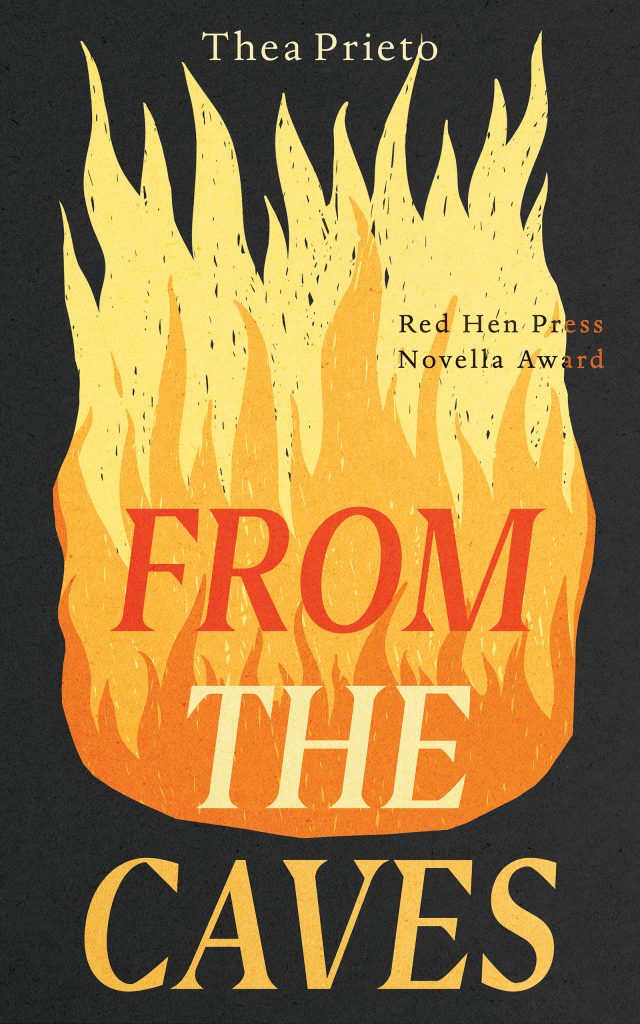
Winner of the Red Hen Press Novella Award, Thea Prieto’s From the Caves, portrays a nightmarish future, where a dwindling number of humans reside naked in caves, trapped between a wasteland and a boiling sea. Every moment, they struggle against suffocating heat, thirst, and starvation. To ease their suffering, they tell each other stories of how their world began: with a hungry sun, a great war, a flood, and a poisoned sea. Sky, the youngest of the group, holds words as precious as drops of water, scouring each for the meaning in his pleasure-less existence.  

This novella grapples with definitive questions about what it means to be human, including how to derive purpose from the act of living. In so doing, the text traces the line between truth and myth, story and identity: “[…] Sky shuts his eyes. He shuts out Teller and the empty drum and Mark is there, screaming Waste and Save it, the walls of Sky’s mind swirling with shadow writing and the dead and the past and we are alone–the darkness cares nothing for us.” 

Making this booktail requires some care and patience, as befits a novella about the struggle to survive an inhospitable climate. Apple-infused vodka serves as the base, for the apple in the Garden of the Gods, a place from the survivors’ reimagined story of Eden. The remaining ingredients are each tied to an element of the myth of the world’s beginning: beet shrub represents Blood. Beets are also a root vegetable, a nod to the protagonists’ measly diet of boiled roots. The sweet, purple-red hibiscus syrup–a reminder of the flower, streaked with red, that sprouts in the moment the divine Moon meets Bear—represents Love. Finally, liquid gold honey liqueur is a symbol of the Light.  

This booktail is presented against a layered backdrop of black and red, colors symbolic of darkness and fire. Both are covered in an iridescent veil whose facets create a rock-like effect, like the walls of a cave. The mirrored base reflects streams of color, transforming the flames on the book’s cover into liquid fire. Meanwhile, the drink stands before it all: a dark, purple-red elixir that appears tempting, yet possibly poisonous, a triangle of beet-infused apple perched on its lip.  

From the Caves

Ingredients

  • 2 oz apple-infused vodka (see instructions)
  • 1 oz beet shrub (see recipe) 
  • 0.5 oz hibiscus syrup (see recipe, or purchase)
  • 0.5 oz honey liqueur (like Drambuie) for golden light 
  • Garnish: a slice, square, or triangle of green apple

Instructions

First, prepare the apple vodka: wash, core, and slice two Granny Smith apples into roughly eight pieces. Add them to a large jar or other lidded container, along with 2 cups of vodka. Seal and set in a cool, dark place. Allow the vodka to marinate from 5 days to up to 2 weeks, shaking the container once daily. The vodka will turn a brown-gold color, similar to apple juice. Once the desired level of infusion is achieved, strain into a clean bottle or jar and discard the fruit. Meanwhile, prepare the shrub, then the syrup. Keep both refrigerated. Once the shrub and vodka are ready, add them to a shaker, along with a large cube or chunk of ice. Pour in the syrup and liqueur. Agitate vigorously for about 15 seconds, then strain into a small stemmed glass. Garnish with a wedge of green apple, if desired. 

Beet Shrub

Ingredients

  • 1 cup red beet, peeled and roughly chopped
  • ½ cup water
  • 1 sprig rosemary
  • ½ cup sugar
  • ¼ cup apple cider vinegar 
  • ¼ cup lemon juice 
  • 1 Tablespoon ginger paste
  • Zest of one lemon 

Instructions

Peel and chop the beets, then add to a blender, along with ½ cup water and the de-stemmed sprig of rosemary. Blend til smooth, then pour through a strainer into a lidded plastic or glass storage container, stirring as needed to extract all the liquid. Discard solids. Zest the lemon and add to the beet mixture, then juice the zested fruit and add the liquid as well. Stir in the sugar, apple cider vinegar, and ginger paste. Apply the lid and set in the fridge for 3 days, shaking the container once a day. 

Hibiscus Syrup

Ingredients

  • 2 cups water
  • ½ cup white sugar
  • ⅓ cup dried hibiscus flowers (available at your local tea shop, or at a variety of online retailers, like Etsy)
  • ¼ cup brown sugar
  • 1 (1/2 inch) piece fresh ginger root, thinly sliced or a teaspoon ginger paste
  • 1 lemon or lime, zested
  • Additional ingredients (optional): 1-2 cinnamon sticks or ½ tsp cinnamon powder; 5-10 whole cloves; 1/4 teaspoon lemongrass; 1 Tablespoon dried rose petals

Instructions

Stir together all ingredients in a medium pot then cover and bring to a boil. Uncover, reduce heat, and let simmer until sugars dissolve and the flowers soften, 20-25 minutes, stirring occasionally. Remove from heat and let stand for another 15 minutes. Strain the syrup and discard the solids. Allow the syrup to cool completely, then store in a bottle or jar and keep refrigerated. Enjoy the syrup in cocktails, sodas, baked goods, or to flavor sauces and marinades.

Embracing Queer Anger as a Source of Knowledge

The poems of Chen Chen’s debut collection When I Grow Up I Want to Be a List of Further Possibilities possessed the color and intimacy of late-night gossip. Nothing seemed off limits: There were porn stars, superheroes, Kafka references, sometimes all within the same poem. 

Your Emergency Contact Has Experienced an Emergency feels even more vibrantly absurd. Written in part during the pandemic, the collection explores Chen’s strained family relationships as he embraces a more independent life with his partner, as well as the increasing rise in anti-Asian racism. Its sorrows feel more profound, but its laughter becomes more hard-won, more hopeful as a result. This is a book that asks, with all sincerity, “What makes poop more pungent on certain days?”, embracing the small wonders that lie at the center of our world. Despite the personal and political problems that weigh down on him, Chen attempts to write “toward [joy], / walking to / the school of // try again.”

I spoke to Chen over Zoom about the knowledge anger can hold, the politics of grief in the United States, and the embodied ways we learn from art.


Austin Nguyen: In previous interviews, you mentioned you wanted to rely less on humor after your debut was published, and your new collection, albeit playful, definitely feels more frustrated, at times austere. What did you discover about yourself, about your writing, as you tried to turn away from levity, and what possibilities did this change open up?

Chen Chen: I’m so glad that came across, those differences, and I’m struck by your use of the word austere because that was the poet I was trying to be early on. I wanted to be this really serious, devastating writer, and I would read that kind of work—I still love reading that. But stylistically, it just wasn’t natural for me, even though that’s what I gravitated toward in my reading life. It was more natural to be playful, and I agree, I think the new book is still very playful. There are some really funny moments; it’s at once a darker and funnier book.

I discovered mainly that I was a lot angrier than I thought I was, when it came to family. It was also something I was really interested in exploring, as a subject of its own, because I think so often, when we see queer narratives, queer characters are often not allowed to be really angry. Or that anger is really one dimensional; it’s an anchor that reduces them to a stereotype or a caricature. I wanted to delve into a much more complicated and layered kind of queer anger because I just think that’s honest. 

For about a year, when I was living in West Texas, it was the farthest I’ve lived from my family forever, so I had this great physical distance from them, and also this emotional distance. I really needed to reflect on what happened in our relationship and what came up in that reflection was that I was really, really angry about their homophobia and their violence towards me. In the first book, bits of that showed up, so I wanted to let that be more visible and prominent in this new collection. It was complete bullshit that I was treated in these ways, so why not name that for what it was.

AN: Do you consider anger a form of care in this collection?

CC: There’s so many shades of a particular emotion. There are kinds of anger that are petty—although I don’t have anything against pettiness—but there are kinds of anger that are more shallow and not worth spending that much time on. Then there are kinds of anger that are really sources of knowledge. They show you something about the truth of what you’re going through and what you feel and what a relationship dynamic is and what it isn’t. It can show you those gaps in what you want and need the world, your family, to be, but they aren’t.

When we see queer narratives, queer characters are often not allowed to be really angry. Or that anger is really one dimensional; it’s an anchor that reduces them to a stereotype or a caricature.

I’ve had plenty of anger in institutional situations as well, and anger can be this form of knowledge that tells you a lot about what’s going on. But so often in these situations you’re pressured not to feel or express anger; you’re expected instead to only be grateful. You’re supposed to be thankful for whatever crumb you received: a crumb of affection or empathy, a shred of dignity or recognition. You’re supposed to just settle for that and wanting more is seen as ungrateful or selfish, even though what you’re asking is actually not that much more. It’s not an impossible thing to have happen, so I think anger can do a lot of affirming things actually.

AN: I love this idea of emotions being a form of knowledge, because I feel like there’s always this disconnect between rationality and emotionality.

CC: I mean, one of the reasons why I fell in love with poetry in the first place is because I see reading it as this opening up of a space where thoughts and emotions didn’t have to be separate. They were very much intertwined: You think through your emotions and you can feel through your thoughts. There’s not so much of that strict binary between so called rationality and emotion.

AN: One of my favorite lines from “a small book of questions: chapter four stood out” as a thesis statement for the collection: “If we could finish grieving there’d be no need to live.” How did this line transform the way you thought and wrote about grief?

CC: Building on what I just said, one of the reasons why I continue to return to poetry is because so-called negative emotions like anger, sorrow, grief get to live full lives in poems. Grief is such an important part of our lives, and if we don’t make the space to really inhabit and go through that whole emotional process, then we’re actually cutting off a part of ourselves. We’re denying loss, the fact that we are mortal beings who exist in time.

That’s something during the pandemic that has really frustrated and saddened me as well: this push—and it’s from the top down, but it’s also ingrained in US culture in a lot of ways—where you’re expected to move on and increasingly quickly, too. It’s not even six months; it’s a week, 24 hours. You’re supposed to move on when the new cycle moves on, which is absurd. I’m really glad for poems, reading and writing them, because it really allows me to live with my emotions instead of just trying to distract myself or move to something else very quickly, just lingering there and seeing what else that brings up.

AN: I appreciate this idea of making space for grief, because I think something that I have always had an interest in about grief is this idea of its invasiveness and how it encroaches into different areas of life. And in your collection, grief isn’t just this domestic phenomenon but it takes root in a classroom, the supermarket, and in nature.

Your own relationship to coming out and outness changes over time; I really wanted to show that.

CC: I’m really interested in the inner life, the dream life as it shows up in all sorts of settings. It’s not contained to one setting or one mode of expression, and a lot of that for me is connected to coming out narratives and feeling like too often, what we get in the media is this one-and-done scene of a character who comes out. That’s it; it either goes really well or not. It’s been really important to me to write truthfully about coming out as not this one isolated event, but something that continues through one’s life in various contexts. Your own relationship to coming out and outness changes over time; I really wanted to show that. Individually coming out versus introducing a partner to your family—it can be a very different kind of experience, like coming out in a workplace versus coming out to new friends and so on. All the specificity of those experiences I really wanted to get into more fully.

AN: Your writing has always been politically charged but there’s a reinvigorated sense of urgency here as you deal with issues and events like white supremacy and the Pulse nightclub shooting. What do you hope your poems do politically speaking?

CC: My politics and my writing, which are very much intertwined, have been shaped by so many other writers and friends. I came into an Asian American political consciousness in college. I didn’t really know where it came from or what it meant until I started taking classes as part of an Asian American studies certificate program. I started to apply some of that to my writing, and in the middle of my MFA, I attended my first Kundiman writer’s retreat in New York, where I met some amazing people there, including Muriel Leung. There are conversations with her that have shaped the direction of certain poems in this book like “Items May Have Shifted,” which is dedicated to her. I just learned so much about form from one of her essays in verse, “THIS IS TO LIVE SEVERAL LIVES,” which is in her second collection Imagine Us the Swarm; that’s just one example. 

There’s also Justin Chin, who I discovered in college. I was reading his work, thinking about his life, his death, but also how he played with hybrid genres and essays. His poem “Lick My Butt” is just fantastic; I was like, “I have to use these lines from ‘Lick My Butt’ as one of the epigraphs for the book.” I also wanted that framing right away to signal to a reader: You are entering a queer Asian American multiverse. Then I have the poem that’s dedicated to him as well because it’s one of my griefs that I never got to meet up or have an actual conversation with him, but through the poem I imagine doing that.

AN: I’m glad you brought up “Items May Have Shifted” and Justin Chin’s hybrid genre. How did you arrive at some of the formal innovations this collection has like playing with genre and punctuation?

CC: I wanted this new book to really be different from the first, so when that wasn’t happening in terms of subject, I really wanted to push formally and challenge myself to do some different things on the page, visually and structurally. I was reading all this work that really inspired me, like Claudia Rankine’s Citizen and Don’t Let Me Be Lonely, being really excited and drawn to her experimentation with text and image. Playing with poetic essay forms or essayistic poem forms is something I’ve been interested in for years, so I really wanted to explore that myself. 

I also just wanted to work on my sentences because so many reviews of my first book made me feel very self-conscious about repetition, anaphora, listing. I was like, “Okay, Let me try to start my sentences in a different way,” and that’s also what led to so many of these prose forms in the book. The seasonal poems, “Summer” and “Winter,” are all written with a sentence as a stanza, which forced me to look at each individual sentence and try to vary the syntax a lot more. It was basically homework that I gave myself after feeling like, “Okay, maybe I’m over relying on this device, I like it so much and I naturally go there.” But that’s how you try to grow as a writer: You notice your tics and quirks and try to use those inclinations in different ways and bring other elements to the table as well.

AN: Another one of the throughlines of the collection are the sequence of poems that are all named “The School of ___”, and I was wondering: As a professor and poet, how are your teaching and writing in dialogue with each other and what does school represent in this context?

CC: It’s similar to how I was thinking about the concept of growing up in my first book. Like coming out, it’s not this one-time thing; you’re settled into this new state of being for your life. It’s continuous, ongoing. I feel similarly about learning and education. One of my former teachers, Aracelis Giramay, I remember her saying in an interview, “I went to the school of that poem,” which I really love—that idea that each poem or book is an education as well. That kind of learning is what I’m most interested in: learning that involves genuine surprise and deep engagements and slowing down to really notice something, an education that involves the senses and emotions. 

It’s trying to break down this idea that learning is just about the mind, that it’s just cerebral. It’s emotional, it’s embodied, it’s all these things. That is what I was writing towards in those poems and really want to emphasize, but I was also reflecting on becoming a teacher. I was getting more teaching experience through grad school, and I started teaching undergrad classes at Brandeis in 2018. All of that came into those poems.

AN: I’m curious to know how you think this collection offers a politics of grief. Narratives surrounding mourning are very much seen as isolating and solitary, but in your collection, it’s one that’s very collective and ripples out in relationships and memory. I’m also thinking of  “four short essays on white supremacy” and the line “to feel is to window” and how this metaphorical window mediates our private emotions and our public lives.

CC: I mean as introverted, as Pisces as I am, my writing process I’ve come to really think of as a conversation: with the poems and books I love that have moved me and shaped me, with other poets and writers, with friends and family. The poems would not be what they are, not happen without all of that interaction, responding to others’ thoughts and questions. Grief I think about in a similar way. I do think it’s a very private personal singular experience; each person’s grief can be quite different. But it doesn’t deny the fact that we need one another to process those emotions. In fact, I think that is where grief can be so different, person to person: why we need to talk to each other, to write poems to each other, or just show up for each other. It doesn’t have to be verbal either. In many ways a poem can explore grief, but can also just hold the space for whatever wants to bubble up.

Ling Ma on the Swampy Logic of Dreams

Ling Ma is one of my favorite writers. Her work is exuberantly uncanny, funny, and full of unexpected emotion. In the middle of amusement or joy or strangeness, Ma will catch you with a shock of familiar grief, a well of deep and personal feeling. Every time I read her work, I realize how insufficient our language is for describing the novel or the short story. Yes, Severance, Ma’s justifiably acclaimed debut, is a work of speculative fiction about an apocalypse. But it’s also a novel about a breakup and family and millennial ennui in the face of late capitalism. 

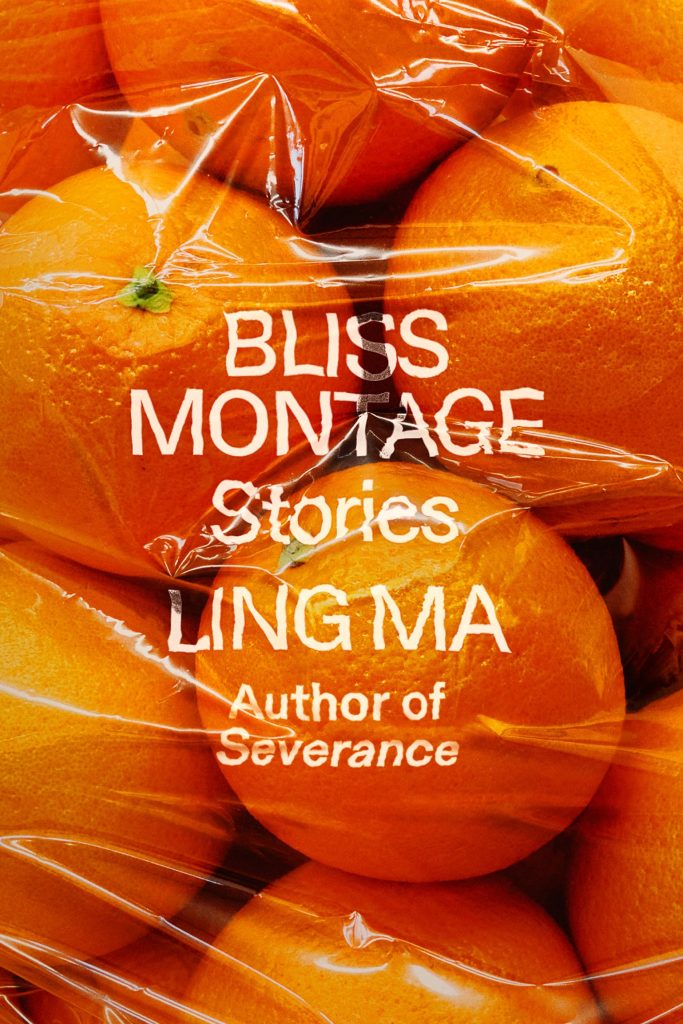
The stories in Ma’s new collection, Bliss Montage, are just as capacious and astonishing. Like the home in “Los Angeles,” where the narrator lives with her one hundred ex-boyfriends, each piece contains what should be an impossible number of meanings, themes, and tones. “Oranges,” which the collection references with its clever cover, shows a woman seeking a way to heal from her past while confronting the limits of storytelling. “Peking Duck,” my personal favorite, shows a cross-cultural mother-daughter relationship and a terrifying encounter, but also actively questions the boundaries of memory and our ability to fully understand other people’s experiences. All of the stories are linked by a singular vision and voice, but each are distinct and wholly unexpected, offering a prime example of what a short story collection can be. 

The following interview was conducted both synchronously and asynchronously by typing into the same Google document. Through this internet-enhanced textual medium, Ma and I spoke about the term “bliss montage,” the burden of representation, how free-feeling is maybe similar to small-feeling, and the swampy intelligence of dreams.


Alyssa Songsiridej: I know from your acknowledgments that the term “bliss montage” comes from Jeanine Basinger’s A Woman’s View, a book of film criticism. Besides just being a great pair of words, why did you pick this term for the title of the collection? 

Ling Ma: Basinger also refers to it as the “happy interlude,” but I prefer her other term, “bliss montage.” In cinema studies, it refers to this brief edited sequence showing the character on a pleasure blitz. It’s pretty common in commercial movies. As a kid, I used to rewatch Home Alone 2: Lost in New York on VHS. There’s this sequence when, after Kevin McCallister realizes he mistakenly took the flight to New York, he’s shown living it up: riding in a cab across the bridge into Manhattan, going to the top of the Empire building, buying firecrackers in Chinatown, etc. It’s a joy spree. According to Basinger, this feature originated with this genre of film called the “women’s film” (now outdated). The bliss montage is often positioned before the complications in the plot, before the heroine’s downfall. 

My entry point into writing fiction is pleasure, a kind of enjoyment that’s not always present in the surface of day-to-day life. A story sometimes begins by attempting to inhabit some kind of fantasy. What usually happens is that it turns nightmarish. But the starting point, for me as a writer, is pleasure. 

AS: I love how your fiction is in conversation with TV and film. Like in “Office Hours,” how the subject of Marie’s film studies course, “The Disappearing Woman,” reflects the themes of the story itself. 

I read in The New Yorker that you worked on most of the short stories during the pandemic, or the early part (since it’s still the pandemic). Do you think that affected the stories in a particular way?

LM: The events of the pandemic made me turn inward more than I normally would have during the writing process. In addition to the quarantines and lockdowns at the time, Severance saw a second wave of attention, and the book became a way for readers to think about the pandemic. I was glad the book was out there, but the attention really made me turn further inward. 

I got some time off from teaching and almost every day I worked in a back room of my apartment. It wasn’t like I was totally insulated from the world (I checked the news constantly and doomscrolled like everyone else), but there was a remove. My daily routine was pretty simple and pared down. Many of the stories came from my dreams, at least the initial premises. I was trying to combine the swampy intelligence of dreams with narrative logic and trying to see where that took me … And I had wanted to write a story collection before I ever tried writing a novel. 

AS: That’s really interesting that many of the stories came from your dreams. I can see that—the non-realist or strange elements feel very particular to your work. How is the “swampy intelligence of dreams” different from the narrative logic of fiction? 

LM: If you were to transcribe a dream, it wouldn’t make any sense because they don’t follow narrative logic. Character motivations are often very fuzzy. So I would take maybe the mood or some elements from the dream and try to anchor this in a story. A reductive idea is that if I could find a way to inhabit the dream in prose, then I could uncover what it’s about. I’m not sure if I totally believe that … but what excited me about writing the stories was I didn’t know how the story was going to unfold. The process was very exploratory. I went into these stories pretty blindly. 

The bliss montage is often positioned before the complications in the plot, before the heroine’s downfall. 

There’s this whole section in the novel Homeland Elegies by Ayad Akhtar in which the narrator deciphers one dream. It’s pretty amazing to see how he translates its images and motifs into meaning. I don’t think I know how to do that, but I just took the more compelling aspects of my dreams and kept circling around them. 

AS: It’s interesting to me that you describe this inward turn, because a theme I thought I saw throughout the collection was about how we represent ourselves or appear to others. Like in “G,” the appeal of the drug for the narrator is that it imparts invisibility, and Eve in “Tomorrow” works at the Image and Reputation Department of the US Government. 

LM: Yes, one theme in this collection has to do with storytelling. I didn’t realize this until we were in edits, reading through the whole book again. But even in “Oranges,” the narrator tells Christine the story of this traumatic event, and she imparts it on social media, and she also tells her ex’s new girlfriend. She can’t stop telling it. Or in “Peking Duck,” that constant framing and reframing … the writer’s version of reality and her mother’s version are depicted as in conflict. I was surprised by how prevalent this theme was. I think I was working through some ideas about storytelling in this collection. I wish I could say something more concrete about it, but I’m still figuring it out. 

AS: Do you think this telling and retelling, and the framing and reframing, helps the characters connect in a way they otherwise couldn’t? It’s compulsive for some of the characters, for example in “Oranges.” What do you think is driving them to do it?

LM: In “Oranges,” the narrator has this dream-memory about her ex and it becomes this key to understanding his abusive nature. Initially I had put this moment at the end, because it was supposed to put this whole past situation to rest for her, maybe give her “closure” to move on (putting that term in quotes because I don’t totally know what they mean). But actually, I realized that even with this so-called epiphany, she was still constantly telling people. It didn’t stop her from compulsively talking about what happened. I think there’s still a sense of disbelief about what happened to her, even though it occurred years ago, and she’s only able to inhabit that reality by telling it and telling it again, perhaps with new insight and ideas each time. Storytelling is a way for her to grapple with reality. It’s where she can feel herself. 

Once I sensed this, I had to move the dream-memory from the end of the story to the middle. It may be an epiphany of sorts, but it doesn’t stop her from engaging in this compulsive disclosing. 

AS: I know they’re different stories, but I couldn’t help but notice that the narrator in “Oranges” acts counter to the words of the mother in “Peking Duck” when she says, “Look, we’re not like Americans. We don’t need to talk about everything that gives us negative feeling.” The narrator of “Oranges” also has a husband that doesn’t want to listen to her compulsively retell these stories.  

LM: Yes, totally. One argument for not revisiting the past or “don’t dwell” has to do with survival. Don’t look down if you’re scaling a giant mountain, just keep moving. As a counter, I’d say that storytelling is a way of metabolizing reality, it’s a processing mechanism. That is also a means of survival. 

AS: Completely. In the case of “Peking Duck,” it seems like the narrator is trying to process her mother’s experience, through writing her story. (Correct me if I’m wrong!) It’s interesting to me, if that’s the case, the way Matthew, another Asian American writer in her workshop, reacts negatively to her work. I’ve never seen Asian American characters struggling through these questions of representation with each other in fiction. 

LM: Why do you think that is? Just curious! 

AS: Why we’ve never seen Asian American characters struggling through these questions? 

LM: Yeah!

AS: Hmmmm. Maybe a disinclination to appear to disagree with each other, or an anxiety about potentially undercutting different kinds of work? I think, or at least choose to operate, from the assumption that there is a lot of space in publishing for all different kinds of Asian American narratives—but that wasn’t always the case, and it wasn’t the case for a long time, so it makes sense that there would be a scarcity mindset around this. Does that make sense? 

LM: Yes, I was also thinking along those same lines. There is a pressure to give the appearance of solidarity, partly due to the historic scarcity of representation. For a time, there was some movie interest in “G,” and I sat in on some meetings with production companies. (Long story short, it didn’t turn out.) I just remember during one meeting, an executive asked me, “What do you think this story says about women?” But that wasn’t the question she was really asking. The real question was, “What do you think this story says about Asian American women?” And of course “G,” which is about two Chinese American girls, one who sabotages the other, is not exactly a heartwarming tale of friendship. Because of the scarcity of representation, there was this pressure to put out a positive portrayal. But then you end up flattening characters and putting out a PSA. 

Anyway, in “Peking Duck,” I think both the narrator and Matthew are laboring under this burden of representation. They’re both frustrated by it and, in this case, he kind of takes it out on her. 

AS: Right! And it was really thrilling for me to see it in your story. Because I recognized how the burden of representation was affecting these two characters, and it resonated with my own experience in a way I hadn’t seen before. I think this is really difficult to do. It’s like, this burden is kind of omnipresent—it’s difficult to look in the face and depict, without getting subsumed by it, or enacting it unintentionally. 

LM: Severance was the first time I wrote an identifiably Chinese American character. Everything else before that, the characters were vaguely white or just unidentified in terms of ethnic background. I was just starting to think around these issues of representation, and still am. I’m uncomfortable being an authority on any of this, but many questions and frustrations came from personal experience as well. 

AS: It’s stressful to work in fiction, which often means working with specifics, while also dealing with this assumption that the work is going to speak for a broad group of people. Which is to say, I’m stressed out and struggling with discomfort too. 

When I wrote Severance, I was thinking about how the immigrant narrative and apocalyptic narrative are similar in that they are traditionally organized by a Before and After. There is this splitting of time, which also results in a splitting of the self.

LM: Of all forms, I find fiction to be the most free space to work in. It’s a play space for unfurling anxieties. But maybe it is easier to feel “free” before you become published and a known entity. I always tell my students, “Now is the most free-feeling time you have as a writer. You might not get that back again.” They don’t always see it that way, and I definitely understand the desire to publish. But when I think back to when I enjoyed writing the most, it was probably before I attended MFA, before I published a book, all of that. 

AS: That’s definitely the most free-feeling time. In some ways, the early pandemic got close to it, or at least that’s how it felt for me, because I had no idea what was going to happen. 

LM: Yeah, in the context of a global health crisis, our writing projects seem small in comparison. The sensation of no one is looking, that can be a nice feeling. Maybe free-feeling is similar to small-feeling.

AS: To go back to what I was talking about with “Peking Duck,” I was wondering if you had any thoughts about your work’s relationship to the past? Sometimes, I think there’s an expectation that work by immigrants, or children of immigrants, will “go back” either in space or time. And I felt that the stories in Bliss Montage played with or challenged that expectation in ways that felt unique and significant. I’ve been trying to figure out how to articulate this since I read the collection. Beyond “Peking Duck,” both “Tomorrow” and “Returning,” feature characters “going back” in some way, but it’s fraught and also intimately connected with a kind of familial future (figuring out the future of a marriage in “Returning,” the baby in “Tomorrow,” whose arm I will never forget). 

LM: Hmm, I like that takeaway, and I’ll have to think about it more. When I wrote Severance, I was thinking about how the immigrant narrative and apocalyptic narrative are similar in that they are traditionally organized by a Before and After. There is this splitting of time, which also results in a splitting of the self. (Although in Severance, that splitting is purposely not very neat or very clear.) When you have multiple selves and multiple timelines, how do you conceive of the future? 

AS: Right, how? This problem of the future also emerges when a group of people tries to move as a singular entity–like a nuclear family, or the married couple in “Returning.” 
Finally, is there anything we haven’t touched on yet that you’d like to talk about?

LM: I like this question but my mind always draws a blank! I’ll answer with a non sequitur, or maybe it’s not really a non sequitur since we talked about dreams … I once dreamed that I was the sole benefactor of a pop song called “Feasting on a Raindrop.” The pop star was dead, and I didn’t know them personally, but somehow I was designated to reap all royalties from that track. I felt so lucky that I was afraid to breathe, in case someone noticed and corrected what might’ve been a cosmic mistake. That dream seems to sum up something about my life since publishing a novel.

Every Year I Tell Myself This Summer Will Be the Best One Yet

For me, summer is a complicated season. As a perpetual student, summers have always been a release from the confines of a busy semester. In the thick of papers to grade, my own dissertation to write, assignments piling up, I often think that if I just make it to summer, I will be fine. Summer becomes an empty space, ripe to fill with my secret plans and little dreams. I spend all winter dreaming of it: this summer will be the best one of my entire life.

But when it comes around, summer depresses me a bit. It goes too quickly and also too slow. I’m lazy, I’m bored, sometimes it is too hot. Often, the empty space from intense scheduling and busyness is too much for me; I spin out a bit. I get nostalgic for the summers of my childhood, before I grew up and started packing my weekends with hiking and day-tripping and doing just a tiny bit more work. I used to read, book after book, draped on a couch or in bed, lost in another world. I had no plans and no direction, only desires that could easily be fulfilled at the library or the ice cream truck or a quick walk down to Lake Michigan. These days, my summers are too busy and too empty. I find it hard to finish more than one book a week—a slow pace for someone working towards their PhD in English. I try to balance work and reading and trips and also some kind of relaxing, but I never get it quite right.

The only place I can reliably read and relax is the beach. I go as often as possible—almost weekly, if I have my way—and when I can’t, I try to make it to the public pool. I love to be in or by water, and I do my best reading like that. Yet the desire to relax—to just get to the beach—can be so intensely distracting, even stressful. Even if my plan for the day doesn’t include an excursion to the beach, if the day turns nice, I wonder if I should go. If I had planned better, could I have made it work?

It’s silly, yes, but for me it feels like summer is a limited resource, one I want to optimize. I hold onto the season tightly: every single day feels precious. Soon, my time will not be my own. Soon, the sun will set earlier and the days will be cold. Soon, this all will end. I do this largely because I want to remember my summers vividly, and with no regret. I want every summer to be the best summer of my life: the most productive, the most full, the most relaxing, the most memorable. In some ways, I’m chasing the summers of my girlhood—the ones that felt wide open and endless, full of perfect days.

I want every summer to be the best summer of my life: the most productive, the most full, the most relaxing, the most memorable.

Wanting a perfect summer is an immature desire, one from my childhood, so I shouldn’t have been surprised to find this state of mind articulated in Andrea Abreu’s novel Dogs of Summer, recently translated from Spanish into English by Julia Sanches. After all, Dogs of Summer follows two young girls, nearly inseparable best friends, through the summer of 2005. Our narrator is only known to us as Shit, a nickname given to her by her best friend Isora. Through one summer, they grow up together, coming of age in the early days of the internet and chat rooms (“mésinye”). Together they negotiate what they should do all day—a question that haunts me too, still.

When Dogs of Summer came out, it was almost immediately compared to Elena Ferrante’s Neapolitan novels, specifically My Brilliant Friend. Like My Brilliant Friend, which centered on the friendship between Elena (Lenú) and Lila, Dogs of Summer follows Shit and Isora’s girlhood in a working-class neighborhood—not in Naples, but Tenerife. Both Ferrante and Abreu are concerned with the undercurrents of a close friendship between girls: there is jealousy, respect, fear, and even erotic love simmering below for Lila and Lenú, for Isora and Shit. For Lenú, narrator of My Brilliant Friend and the rest of the Neapolitan quartet, Lila’s power and brilliance and beauty has a hold over her. It’s the same for Shit, who is dazzled by Isora and intensely loyal to her. They do everything together: exploring the neighborhood, going to the bathroom, walking each other home. 

I don’t have a best friend like that, and I never really have. Both My Brilliant Friend and Dogs of Summer illuminate how my feelings about summer are the feelings of girlhood: of a season that feels too short, bookended by school, a limited resource. All summer, Isora and Shit dream of going to the beach—like me, the beach serves as a cure for their summer malaise. Like Lila and Lenú in My Brilliant Friend, who long to go to the sea as well, the impossibility of making it to the beach is its own pleasure. It becomes its own little heaven. For both sets of girls, the trek to the coast is time-consuming—they must hitch a ride, must find a way there—and a pursuit for people far richer than they are. Imagine, Isora says to Shit, “‘magine being born near the beach.”

I am like this, too. A beach obsessive. The first summer that I lived in Boston, my first summer living in proximity to the ocean, I always wanted to go to the beach. My desire consumed me: all I wanted was to be at the beach, in water, far away from my library job and tiny apartment without an A/C unit. It felt like it was 90 all the time, and I was melting. I had no car or money, few friends, and no way to the beach. I would spend my lunch break at the library scrolling through a list of Boston’s best 100 beaches. You could see which ones were accessible by public transit, which were romantic or family-friendly or had cheap parking. I had the names of beaches, foreign to me, memorized. Nauset Beach. Head of the Meadow. Wingaersheek. Buzzards Bay. Dionis. Merely thinking about going to the beach was pleasurable for me, just like for Shit. The night before an attempted trip down to the sea, she gets “into bed early just so I could lie there and think about the beach,” turning her memories of swimming over and over in her mind, polishing them like shells.

For the girls, as for me, the beach acts as a horizon for desire, a sense of contrast. The depressing, hot expanse of summer finds its cooling match there. Shit thinks, “It was June and classes had only ended a day ago, but I was already dead tired and sad like low clouds hanging over my head. It didn’t feel like summer.” Shit’s parents go to work, her father in construction and her mother cleaning vacation homes, and Shit is left thinking that “It was June and I was sad. It was June and now I was scared too.” Summer can be sad. We do what we can to make it bearable.

That summer, my first summer in Boston, I only went to the beach once. Alone. I took the commuter rail to Manchester-by-the-Sea and walked almost twenty minutes, paying $7 to walk onto the beach. It was beautiful. I sat there alone, reading, only going in the water when I was hot enough to swim. I eavesdropped on other people’s conversations, and ate my food, and wondered when I should go home. I looked around and realized I was the only person alone on the beach—it was full of families and couples and groups of people. When I made it back to my apartment that night, I tried to remember if I’d spoken to anyone all day.

I looked around and realized I was the only person alone on the beach—it was full of families and couples and groups of people.

These days, it’s easy for me to get to the beach: I have many friends with cars who can be easily convinced to drive me. But it doesn’t change the feeling I have. What Dogs of Summer does best with this desire—this intense, childlike desire Shit and Isora and Lila and Lenú and I have, to make it to the beach—is remind us that danger simmers below the surface of our summers. It gets too hot. A fuse blows and my A/C is out. There is a drought in Massachusetts. This is unsustainable. In Dogs of Summer, in Tenerife in 2005, this latency is embodied in the volcano that the girls live on. Shit thinks, of the “vulcano” only visible on clear days, that “it almost never happened, but everyone knew that behind the clouds lived a giant who was 3,718 meters tall and could set fire to all of us if he wanted.” In Somerville, Massachusetts in 2022, the danger of summer is in heat waves and the rising ocean itself. I look at a climate-ready map and joke that my apartment now will be beach-front in twenty years.

Summer is a limited resource. The summers of my childhood are gone: of reading on cool couches, of chilly air on Lake Michigan, of endless beach days in the Outer Banks. These days, I worry about how many summers of beach and pool and relatively pleasing air temperature I have left, that we have left. Perhaps this is the best thing that longing for the beach, longing for an elsewhere where you might be able to relax, gives us: an appreciation for what we have, on the very cusp of losing it.

An Underage Chauffeur Clocks in at Last Call

“A New Place to Hide” by Bojan Louis

There is only one way to happiness and that is to cease worrying about things which are beyond the power of our will.

Epictetus

When I began driving illegally, as a sort of amateur chauffeur, I was thirteen, and this dangerous time in my life robbed me of my innocence. No—I was gutted, my innocence excised. My viscera were scattered across shimmering black pavement, which was my only reliable guide through life. I was a solitary but not lonely child, a condition I hadn’t arrived at on my own. Colonial violence. Borderland divide-and-conquer sentimentalisms. Assimilative educational hierarchies of race and class, exile and abandonment. All of it natured in me. Put plainly: I’d spent my infancy and adolescence on Dinétah, the homelands of The People—my people, I suppose. Eventually, my idealistic and easily bored parents moved us to Flagstaff, an idyllic mountain town filled with the throat-clenching nostalgia of cowboys and pioneering violence. Most people being cowards, that violence was rarely enacted individually, but in a herd, dull-mouthed bleating can easily turn into a battle chant, the stomping of small hooves a weapon of mass destruction. The town felt like the edge of the world, and was, in fact, the western reach of a holy land facing a glacially paced apocalypse. 


Uprooted midway through the fourth grade, I was thrust into a classroom of mostly White students, we non-Whites being a Black boy, two Mexican girls, a half-Mexican, half-Japanese boy, and me. We were suspicious of one another, ignorant of the factors, beyond our control, that had brought us to such a setting, and all too willing to accept the tokenships of our respective White schoolmate cliques. The Black boy, always chosen first for any sort of sport, basketball in particular, was called Muggsy Bogues, as if anyone remembered the shortest player in NBA history; the two Mexican girls, both first-named V, were dubbed diseased whores by the cavalier White boys who cornered them into kissing and exploratory touching; and no one knew what to make of the Mexican-Japanese boy, whom everyone called Taco Sushi, so he was ignored, which turned him into a pariah and bully who focused his attacks on each of us, more than once. I don’t imagine he made it very far in life or has entered law enforcement, maybe taken a menial position in politics. As for me, I was the wild Indian, the red-skinned savage, the other, the enemy, the target for rocks and gang-ups where I was tied to a tree and burned with imaginary fire amid cupped-hand whooping, hands shaped into guns, barrel fingers pointed silently at the sky. This was the town: a simulacrum of childish imagination and a lie good enough to be mistaken for destiny. At the helm of this fourth-grade massacre was Ms. Reinholdt, an older woman with skin like porcelain, who I suspected was a runaway nun. Her long, pleated plaid skirts and dark, billowy blouses cinched at the neck reminded me of the teachers back on the rez, who were all nuns. She stalked across the front of the classroom, between our rows of desks, with her chin held high, eyes darting from student to student. Her gray hair, tied tightly into a bun, had the sheen of gunmetal. She maintained a droll tone of authority, sharpened with quick “Sit”s or “Quiet”s, though not one of us was ever punished or made to feel inferior. Instead, we were assigned books to read, along with short written responses for infractions committed against the school policies, as interpreted by Ms. Reinholdt. Such infractions might include Whispering, which burned God’s ears, or Dawdling, which gave Satan the opportunity for influence, so we must move, sit, or stand with purpose, with intention. For the infraction of Melancholy, which amounted to a disregard for imagination, having rebelled against participating in small-group activities for a week, I was assigned Chitty Chitty Bang Bang. The book was hardbound in a faded slate cloth cover, the gold lettering pressed into the spine still iridescent. I wrote about the car’s large engine and horsepower, how its four-seat touring design made it comfortable enough to potentially sleep in, and how its ability to transform into a hovercraft or airplane made it the ideal getaway car, which afforded me the imagination to envision a world beyond the one I lived in: places in the book like England or France, place-names without any shape or detail in my young, naive perception. She collected my work and read it standing there next to my desk, ignoring, for once, the whispering of the White boys at the front of the class whose commentary increased in volume and pace until Ms. Reinholdt removed a red pen from her skirt pocket, and with a couple of flicks of her wrist added three check marks and three plus signs. Dream as big as you can, she said, far beyond this place, and allow books to guide your imagination. At the end of that miserable year, which was to be followed by many more, the growing urge had been planted in me to get off that mountain and never return, to exile myself further in hope that it might bring about the possibility of happiness, or something close to it. 


Sometime before my thirteenth birthday, my parents separated without any legal formality, just announced their split in the opaline-blue Peugeot coupé that was in constant threat of being repossessed. We were on our way home from a restaurant, where we’d eaten quietly, silent islands in a fog-covered archipelago. My mother sat in the passenger seat, staring out the window as if a missile or comet were coming down at us from the endless sky. I’m done with all this, she said, palm pressed against the glass. Young and beautiful, her well-kept perm a black crown on her head, she was the quintessence of the Naakai dine’é clan—hot-tempered, passionate, and whimsical—the glossiness of her chocolate-brown eyes inspired trust, and a bit of curiosity, in any person she met. It was her attention and affection I often sought and was denied, not because she didn’t love me, but because she knew our lives together would come to an end. She would move south and eventually disappear altogether. Janelle Manygoats just another name I’d say, an innocuous, meaningless name. It’s been like that for a while now, replied my father, a long time coming, if you ask me. He gazed at the road ahead, perhaps seeing endless possibilities, being a reluctant and ineffectual parent, a philanderer who would take up with another woman. A singer of country songs in the bars and nightclubs of Albuquerque. He dressed like a clothing-catalog cowboy, ready to ride into the sunset on the back of almost any creature he came across. Clifton Francisco, bastard son of a Spaniard priest, his mother of the Ta’neezsani Clan, which means “Tangled Clan,” I’m told, and tangled he was, a spineless tumbleweed adrift in the wind. Once we were home, my mother told me to pack my things, which wasn’t much: a mattress, a gym bag for my clothes and shoes, some toys I rarely played with, and my small stack of books from the school library. When we left the reservation, all our belongings had fit into the old GMC pickup we owned then, and packing up on that day had felt similar to how it felt today. We’d always been transient, ready to flee or move at a moment’s notice. And I’ve always kicked myself for not somehow noticing my lack of care and stability. This isn’t happening because we don’t love you anymore or anything, Mom said, helping me pack. We must correct what’s not been right. Okay, I said. 


I went to live with my cousin who, in her early twenties, was pursuing a master’s degree in mathematics and teaching as a graduate assistant at the state university in Flagstaff. Her responsible nature was due in part to our strict and thrifty grandmother, who had raised her while her parents vanished into their depression and the poison of its alleviation. I was her, in a sense; her fondness for me was not at all veiled. She had just purchased a newly built condo in a blighted neighborhood that was within walking distance of my junior high, and her ads for a roommate had come to nothing, so I filled the vacancy. Based on her experience with her own parents, she made an arrangement with my father and mother that entailed a monthly allow ance of $150 from each of them, with the stipulation that if they missed or denied me these monthly payments, I would go to the authorities, maybe the school counselor, with a story of neglect and abandonment, which wouldn’t be so far-fetched, so beyond the stereotypical situation of young minority parents ill-suited for heavy responsibility. In this way, I was beginning to understand how to pit expectation against the potential for profit, and in this way, I was truly assimilated. Father puffed out his chest, a bottom-rung rooster. We will renegotiate these payments, he said, when you turn sixteen, see if you’re in need of money then too. Mother, with her impeccable posture, sat in a chair pursing her red-stained lips. And, she said, when you’re eighteen, hopefully grown into a man by then, the payments will stop. For a year the payments arrived on time, then every other month, until they didn’t arrive at all. My parents eaten up by their lives and the ravenous world. 


The stopped payments should have rattled me more or forced me to follow through on the threat of going to the police or Child Protective Services, but I didn’t assume my parents had vanished with even a semblance of happiness. I knew they had desiccated in their own despair. With my share of the rent, utilities, and food costs suddenly my own, I was encouraged to find employment. You’re on your own now, said my cousin. You have me, but you must learn to make the larger decisions about how you want your life to be, and the more options you have, the better. That way you’ll always have a new to place to hide. At my age, employment options were limited, so I mowed the lawns of a few of the more affluent houses closer to the base of Mount Elden using a push mower that required weekly retightening and reoiling; raked the leaves and pine needles on those lawns; walked the dogs that shit in the leaves and pine needles, as well as the neighbor dogs of the shitting dogs. It was during this time that Ms. Reinholdt would once again pass through my life, although briefly. I discovered that she was the widow of a Mr. Brinkerhoff, and after he passed, early in their marriage, she had made the decision to go by her maiden name to hide the small inheritance he left her: a modest house and a savings account with enough for a comfortable retirement, though most of it went to her daily caretakers, as she was in the final throes of dementia. Once a week for two hours, I dusted the antique furniture and picture frames filled with the memories of their travels and life together, faded black-and-whites of them embracing on a beach or standing together atop a mountain. I vacuumed the immaculate jade carpet and kept the house just as it had been on the day Mr. Brinkerhoff died. All this after-school work managed to keep the trauma of my abandonment at bay, but only for so long. After a month, Ms. Reinholdt passed in her sleep, alone. Her departure unmoored me, and I became a torrent of crying fits, overcast with insomnia. It occurred to me that Ms. Reinholdt had lived in a mausoleum, made in memory of her husband, and she sat each day prepared to join him in her final absence from this world. My memories didn’t fill a shoebox, and the future felt like a bottomless well. 


I began to skip school, sleeping late into the afternoons, which forced my cousin to drag me from bed and into the shower one evening, and then plop me down in the living room, where a pizza sat steaming on the coffee table. I ate ravenously while she chewed slowly, deep in thought. She told me it was time I snapped out of it. I couldn’t go on like this any longer because my clients would lose their patience and school would begin to pry. It’s all right to be out sick a week, she said, in order to get yourself back together, but any longer than that and what you had before might not be there. She asked what might make me feel better again. I thought quietly, munching a slice, and answered that trips to the library had once been something I had looked forward to but had forgotten about since the departure of my parents. There had been, in those days, a single public library across town from where I lived with my parents and from where I now lived with my cousin. It was too far for me to walk, especially round-trip. When Dad still existed, he took me, I explained to my cousin. It was an activity that brought him happiness, at least as far as I could discern. He reveled in being away from Mom, acted childish and giddy, and would tell me off-color jokes. What do Hopis have that is long and hard? he would ask. I would shrug, eager for him to reveal the answer. Their last names, he would say, laughing as we sped toward the library. Once we were there, my father let me out at the front entrance, said he’d be back in two hours. Plenty of time for me to wander around and wonder at the stacks. He never returned on time, was always half an hour to an hour late, dizzy in his boots and flush-faced, shirt-half tucked, hair mussed, smelling like soured perfume and chlorine. My cousin nodded firmly, told me to finish eating and grab my shoes. She had an idea and wanted to know if I still remembered how to drive. 

On the rez it’s understood that once your little legs can reach the clutch, brake, and gas pedals, and once you’re able to gaze over the hood and dashboard, you learn to drive, though this isn’t something specific to reservations but to most bucolic, pastoral communities where the police exist on the fringes of one’s imagination; where the police are indeed the numbskulls who never left town and drank themselves into such servitude, their civil service like a lifetime of failed monthly AA chips. It being understood that the youths will fulfill the expectation of being drivers, uncles and aunties, nálí and cheii, will ask for livestock and hay to be hauled, for cousins and child neighbors who are left behind to be packed into vehicles and taken far enough away for the adults to kick back a little and reminisce. My driver’s education began when I was eight or nine on the dirt and rutted roads around Coal Mine Mesa after the funeral of my only living grandparent—paternal or maternal, I don’t remember. I learned when to accelerate and decelerate, how to ease the wheel against a fishtail and drive in reverse using the mirrors. The basics, I assumed. So when my cousin and I took to the evening streets in her champagne-colored Honda Civic, and continued through more nights to solidify my apprenticeship to the wheel, it was as if the black asphalt had become my veins, every glowing streetlight a synapse burst, and the deeper darkness of the alleyways and trees of the forest my soul. 


One weekend night, my cousin didn’t return from a night out with friends. I assumed she’d lost track of time and slept over, which quelled my initial worry, thinking of my cousin curled up on a couch with a blanket and shared bowl of popcorn, the glow of an action-comedy flickering across her smiling face. In fact, she’d been a passenger in a car full of intoxicated friends, the driver included. A cop watched the vehicle drift and swerve and turned on his red-and-blue lights, pulling the car over. The friend who was driving failed the sobriety test, and because no one else was sober, either, they all spent the night in jail. My cousin walked across town the next morning, entered the front door sweating, her eyes sleepless and swollen. The drunk tank isn’t a place you want to spend the night, she said, bunch of jaans and shit-kickers getting in each other’s faces. She explained the possibility of losing her scholarship if the DUI had fallen on her. I’ve worked too damn hard for this shit for it to get fucked up, she yelled. This was, of course, before the days of smartphone apps and a choice of cab company, the only game in town being Settler Cab, which generally refused to pick up Navajos, or any other minority, especially if they were drunk and looking to get home. If they did happen to be allowed into a cab, these unfortunate folks would be dropped off on the outskirts of town, where they got either lost or picked up by the police, and in some instances froze to death. Women were often assaulted or raped, then abandoned to be gathered by the authorities, and their degradation continued further. Small mountain towns have dark underbellies, no matter how quaint, friendly, or liberal they seem. That’s an illusion, built upon the death and destruction of an Indigenous population, hijacked and rewritten narratives that showcase the leather mask of progress, but from whose skin is the mask cut. The girls who had been in the car with my cousin were two sisters, also Navajo and related to me by clan, which compelled them to refer to me as their “daddy yázhí,” their “little” or “small daddy,” and the girl who had been driving, a half-Hopi, half-Navajo girl from my cousin’s hometown of Tuba City who was like a dart, or a hummingbird, and was affectionally called Birdy. She and my cousin had played on the varsity basketball team together. Birdy, a point guard; my cousin, a small forward because of her solid frame and ability to box out bigger forwards and centers using her strength and elbows. The sisters, a year apart, had dominated their high school’s volleyball squad, bringing home three back-to-back state championships. This crew of Native girls was confident, fist-throwing tough, sharp-witted, with vulgar senses of humor bordering on blasphemy, which made them the ideal role models and customers. There wasn’t a narc among them. 


My first chauffeuring gig went smoothly. My cousin rode shotgun, the sisters bent into the back seat with Birdy sitting bitch—that’s what they called it, sitting bitch, for what reason I never knew. Pregamed and ready, with an elated, carefree buzz, they shit-talked rivals, whom I had never met and knew nothing about, the details of which engrossed me—“That skank snagged out this bull rider with a big-ass cold sore on his lip and then went and passed it to her man, she didn’t even give a fuck,” or “I’ll tell you what, if we see those hoe-bags, I’m down to scrap, take off these hoops, I don’t care if I fuck up my nails, stoodis”—rugged and rezed-out their infectious laughter and swagger, not giving one fuck whom they offended. This was something I wanted: camaraderie and confidence, disregard, happiness. It couldn’t be real. I dropped them off a block from the main downtown drag around ten, when all the bars started hopping and everyone felt sexier and tougher, the air thick with big-dick energy, as the girls called it, and returned ten minutes after 2:00 a.m., parking in the shadows of a parking lot, alleyway, or street. Sometimes one or two of them found other ways of getting home or getting to someone else’s home. Other times one or two people I didn’t know piled in, and I hurried across town to be rid of the commotion and weight. A few nights my cousin appeared alone, her eyes furious, as if she’d been crying, her fists clenched and red with fighting. Two nights, no one showed up at all, though when I got home my cousin was there, asleep behind her locked door. And one time a man I’d never met came to meet me. 


The night was a void when D tapped lightly on the window with the bulbous knuckle of his pointer finger. I cracked the window enough to prevent him from inserting it past the joint. Hey, my man, he said. The girls said you could give me a ride. He told me they had found some snags, that his friends had ditched him, and shrugged as if I could relate. I was trepidatious, but he named the girls, knew where each had gone to high school and what position each played, though he looked too old to have been in the same graduating class. My place is a couple miles south, near the interstate, he said. I’ll pay you twenty bucks. D handed me a crisp note and sat quietly in the passenger seat as I drove. At some point he had me veer right onto a road that went past a new subdivision of prefabricated homes, where the city limits met Forest Service land and the streetlights vanished. We turned onto a nondescript dirt road and arrived at a log cabin, the hard bark logs stacked like bones, the trim on the windows and doorway painted sludge green. Dim light emanated from a window onto a white pickup parked askew. D grabbed my shoulder, sending shudders down my body. All right, my man, listen, he said. If I’m not back in twenty minutes, you leave and don’t worry about me, okay? I nodded and he checked his watch against the digital numbers glowing blue on the dashboard and synced it to his timepiece. Twenty minutes, he said again, pointing to me and then to the treed and darkened road we had arrived on, and exited the car. An inescapable loneliness overtook me, and I began to weep. After ten minutes, I was able to calm myself and wipe away my boyish tears. The dread tightening my throat loosened and a death bell pinged in my ears. At the nineteen-minute mark, I was depressing the brake pedal and shifting into drive when D suddenly opened the passenger door and got in, having emerged out of the darkness like a ghost or time traveler. He smelled sour, hot, and chemically musky. Go, he said. I turned on the headlights and sped through the forest dark. D rolled down the window, closed his eyes, and leaned his head back so the cold night air blew through his black hair. I asked him where we were going, and he laughed. Straight to hell if you’re not careful, he said. I’ll tell you, just drive. The wind crested over him, the starlight contoured the shadows of his dark brown face, his slab of a body rested. I dropped him off at a large apartment complex at the edge of town that seemed to have sprung up overnight. Tall buildings like LEGO sets were clustered around lit pathways and manicured grassy amoebas. D punched my arm when he got out of the car, told me to tell my cousin to get me a pager and to give him the number right away. Here’s an extra twenty, he said, to help you get that pager. 


When my cousin’s friends snagged boyfriends, they went out less and less, until they didn’t go out at all. The younger of the sisters dated a White Mountain Apache guy who studied the biodiversity of soils and hoped to return to his nation to help develop an irrigation and farming enterprise. The older sister went through a string of bronc and bull riders, none of whom were good beyond a single night, until eventually she moved in with a calf roper who made his living as a boilermaker. She followed his power plant work to Utah and Montana until the two were never seen or heard from again. Birdy, the boisterous ex-trovert, got pregnant some months after the crew had dissolved and seemed to be devoting herself to some form of Christianity, not because she believed in a White and all-forgiving Jesus, but for the free and reliable childcare the church offered. I’d heard she still went out from time to time, though not at all with the frequency she had prior to motherhood, and loved her child more than anything in this soulless world. My cousin became despondent, spent long hours in her campus office working on teaching materials and equations of improbability. She wore pantsuits when she taught, instead of her typical jeans and polo shirts. She desired something new from life, and I felt, again, our time together ticking away. 


I began spending more time with D. This time I was driving him to a rural residential area with the name of a failed cowboy western—Silver Bolero, Cowpoke, or Park Ranch—in a silver Lexus, its new smell intoxicating. The trunk held packages I wasn’t supposed to know about. I was given directions to a barn, where I backed the car in, cutting the lights and engine, leaving D to wait in the darkness. Don’t look back until the barn doors are closed, he told me. A different car would be brought to me, which I was to deliver to D’s place, where I’d await a page with a number to call for directions on where and when to pick him up. At his apartment that night, someone knocked. I didn’t answer, or move, right away, not until the second and third round of knocking became more insistent. I looked through the peephole, saw a head draped with platinum blond hair obscuring the face beneath it. The pager remained silent, so I released the dead bolt, and before I made the decision to open the door, a woman drifted in, at least it seemed that way to me, and went directly to the refrigerator and examined its contents without taking anything. She opened the freezer, removed a bottle of clear liquid, took two quick sips, and put it back. I dead bolted the door and sat on the couch. She asked if I was hungry and I nodded yes. We gotta get a pizza around here, she said. While she rose to look at the to-go menus stuck to the fridge with magnets, the pager buzzed, its little green light blinking alien-like. On the phone, D told me the woman needed to stay there for the night. Lock the doors and don’t let anyone in, he said. I’ll be back in the morning. Are you done with your business, sweetie? she asked. I’ll order us a pizza and we can watch a movie. She was familiar with all the cable channels D had access to and complained that nothing new was ever playing, she’d seen every goddamn movie each channel ran. She reached into her large bag and pulled out a VHS tape with no label on it. I thought of something called snuff films and wondered if it was one of those, or maybe a dirty movie, and my heart raced in terror. When the pizza arrived, the woman inserted the tape into the VHS machine, and to my relief the title, Sleepless in Seattle, filled the screen. It was a thrilling experience, sitting on the floor beneath a blanket with her, eating pizza, laughing when she laughed. I felt like both the son in the film and the father, because I didn’t know what fathers could be like, and the man in the movie seemed, perhaps, like one I’d like. After the movie was over and we put the pizza box in the trash, the woman said she was tired and should get ready for bed. While we brushed our teeth, she peed, and I stared at the ceiling. I didn’t have any other clothes with me, so she searched D’s wardrobe and found a pair of basketball shorts and a T-shirt. My skinny body didn’t fill them, though I found comfort in their roominess. In D’s king-size bed, she asked if I could spoon her and I said I didn’t know what that was, so she showed me, and when we fell asleep it was as if I had wanted nothing more than to be held for a long, long time. 


The younger of the sisters paged me after she broke up with the soil-studying Apache. She was bloated and unhappy, dating a sloppy older White man, a monied alcoholic who dodged alimony payments and got blackout drunk. I didn’t understand what she saw in this trucker hat–wearing, bristly-chinned douchebag. Beyond the possibility that it was his deep pockets, I assumed it was loneliness or regret that had birthed self-loathing, self-punishment. The two had gotten into an altercation at one of meat market bars—frequented by college athletes and Greek Lifers who believed they were God’s gift to the earth—where they’d been drinking beer and eating cheap tacos since the early afternoon, when an older, desperate crowd sought an expired sensation of their youths for no cover charge. At one point well into the evening, the man had thrown a half-eaten taco at the younger sister, poured his beer on her head, and pushed her face with his palm. She, of course, retaliated by throwing insults and slaps until she escaped to a pay phone near the bathrooms, paged me, and awaited my call. When she returned to the table, the man had been apprehended by the bouncers and forced to wait outside. She was told she needed to leave as well but pleaded with the bar staff to let her wait inside until her ride arrived. Pulling up outside the bar, I saw the man leaning against a square brick pillar, hardly able to stay on his feet. The younger sister came rushing out of the bar and climbed into the passenger seat. As she did, the man pulled open the rear door and launched himself onto the seat, passing out immediately. One of the bouncers shoved the man’s feet and legs into the vehicle with his foot and slammed the door. I drove without direction, concerned the man might wake at any moment. But the younger sister assured me that once the man was passed out, it was always for the night. She told me to head past the shit-kicker communities and go down into the desert lowlands north of the mountain. After an hour, she told me to pull over at a small, ancient-looking convenience store that was the last place you could purchase booze before entering the western end of the reservation. I parked by the near end of the building. She got out and opened the rear door and, using all her might, which was significant, pulled the man out of the back seat by his feet. His head clipped some part of the car and I heard him make a grunt-yelp noise, which was followed by the dull sound of a body striking the ground and a commotion of dirt. When she got back into the passenger seat, I sped back to town. At some point, she removed the man’s wallet from her pocket, took out the cash, and handed it to me. Then she threw the wallet out the window. Rolled that fucking fucker, she said, tears at the edges of her eyelids. She guided me to her place, where she showered while I checked my pager and waited on the couch, flipping mindlessly through TV channels. I thought about calling my cousin or D to see if anything was happening that night, so as to have an excuse to leave. Dumping a drunk White guy on the reservation border without any money or ID must amount to some type of crime, though I told myself he would be fine. When she emerged from the shower, towels wrapped around her head and torso, the latter hardly covering her upper thighs, she looked calmer but still filled with a sadness beyond my understanding. She took my hand, led me to the bedroom, and embraced me, whispering “thank you” over and over, until her towel fell to the floor and she was naked, her skin hot from the shower. She undressed me, removed the towel absorbing the water from her hair, and we lay on her bed together. She taught me the way to kiss her, where to rub and insert my fingers, and how to do it. When we were finished, she fell deeply asleep, and I trembled and wept quietly until dawn, imaging an apparition standing in the doorway, there to punish me for what my body had done. When sunlight overtook the room, I was alone. The sound of the living room and kitchen being destroyed by two screaming banshees paralyzed me with fear. I wanted to call D, or my cousin, but there was no phone in the bedroom. I heard a gunshot. Another three in quick, angry succession. My head rang sharply and then, like an enormous bell cast into the ocean and sinking, I heard nothing at all. 

8 Books That Investigate Family History with Imagination

When my father died by suicide in 2008, I was unexpectedly flung into a personal investigation of his death, and also of the legacy of suicide within my ancestral line. His marked the third suicide in my immediate family: both of my grandfathers had also died by their own hand, a truth that my parents rarely discussed when I was growing up. I knew little about these men as a consequence—after my father died, I felt compelled to learn more. But how to do it? And where to begin? As I began writing material for what would eventually become my memoir, Sinkhole: A Legacy of Suicide, I found myself puzzling over how to craft a narrative from such a fragmented family history. 

I came to nonfiction after years of writing poetry, and as a writer driven primarily by image and sound, I wasn’t an intuitive storyteller. To conceive of the book, I had to rely almost entirely on my intuition, which meant allowing myself to stray from the limited scope of my family’s story. Place became an important anchor for the book, and with it, research into the history of a single region of southeastern Kansas that came to stand for some part of our family inheritance. To think through the narrative structure, I looked for inspiration in other books that were inventive and genre-bending. 

The list of books below are titles I read before, during, and after the completion of my own memoir. I think of them as companions. These books uniquely tackle the subject of ancestral legacy, leading readers into social and historical questions as one way of understanding the personal past. In trying to understand the suicides within my family and the phenomenon of suicide itself, I found myself trying to understand these deaths inside a social sphere. What might they reveal about our American present and past? As a reader, I looked for books that could be, as Maude Newton puts it, “of service somehow, not an inquiry limited to my own family, but one that might interest other readers struggling to reckon with family patterns that seemed to have a power in their lives they couldn’t understand.”

Ancestor Trouble by Maude Newton

A wide-ranging investigation into ancestry and family, Ancestor Trouble places Maud Newton’s own obsessive research of her genetic line alongside broader philosophical, spiritual, and biological questions of inheritance. Structured in seven thematic sections, Newton places chapters about funeral rites and rituals, eugenics and epigenetics, and the history of genealogy itself alongside her family’s story. As Newton’s investigation unfolds, she discovers dark truths about her ancestors’ roles in slavery and genocide, and examines her place in that history. While Newton attempts to reckon with the blood kin of her past—and in particular, with her racist father—by the end of the book she makes clear that other relationships (with chosen family and friends; with the land) are more integral to her sense of self, offering a spiritual turn to this smart and deeply engaging book. 

The Yellow House by Sarah M. Broom

Sarah M. Broom’s The Yellow House is an ambitious and far-reaching memoir layered with the political and racial history of New Orleans, the natural disaster of Hurricane Katrina, and her large family over half a century. The story revolves around a house in a neglected neighborhood of New Orleans East, a home that serves as both a material artifact and metaphor for the book’s larger discussions of class and race, and as a repository for Broom’s own personal hauntings. Told in three movements that unfold with increasing tension and speed, The Yellow House is both social eulogy and a wry and loving testimony of one family’s life. Broom’s keen observations and eye for detail have rightly earned this book high acclaim.  

Bearwallow by Jeremy B. Jones

In his debut memoir, Jeremy Jones returns to a place in the Blue Ridge Mountains where his family settled 200 years before in a personal search to understand kinship with place. Combining history, myth, and family lore, Jones tells the story of generations, layering personal, geological, and political histories to create a complex portrait of a region that’s often reduced to crude stereotypes. Anchored by voice and poetic language, Jones manages to weave his story of self-discovery into the setting of Appalachia (and Bearwallow Mountain) in highly lyrical ways. His work inspired me to trust my own instincts in a historical section of my book wherein I dig into the history of Pittsburg, Kansas—my family’s ancestral home. I wanted readers to feel a sort of wonderment in my work, in the details of a landscape now troubled with the threat of sinkholes, the metaphor from which my book spins. I wanted them to feel what I felt reading Bearwallow.

Interrogation Room by Jennifer Kwon Dobbs

A haunting exploration of a transnational adoptee’s fractured identity, Jennifer Kwon Dobbs’ powerful second book uses a number of approaches (collage, lyric meditation, essay, and erasure) to narrate the search for her birth mother across borders of the Korean peninsula. Prose poems, letters, and redacted documents frame Dobbs’ imaginative exploration, which is driven by a need to confront the geopolitical histories of the unending Korean War, and heal wounds left open by the absence of personal history. As a fan of autofiction and hybrid projects, I appreciate Dobbs’ deft attention to language and image, the blend of intellect and emotion in her storytelling, and the gaps and fissures she invites into her narrative. Readers interested in genre experiments will especially enjoy these elements. 

Lose Your Mother by Saidiya Hartman

Interweaving research and personal narrative, Lose Your Mother traces Saidiya Hartman’s journey through Ghana as she researches the slave trade. The book details her explorations of present-day sites along the slave route with precise and evocative detail, drawing on history to offer a gruesome account of slavery’s brutal methods and long-lasting trauma. In detailing this history, Hartman also explores the story of her own ancestors—or what little is known to her—reminding readers of the genealogical ruins that three centuries of enslavement leave behind. A beautifully written memoir that reads like a good novel, Lose Your Mother is an unforgettable book . 

Evidence of V by Sheila O’Connor

Novelist Sheila O’Connor combines fiction with history in telling the story of her maternal grandmother, a teenage singer in 1930s Minneapolis who was given a six-year sentence at the Minnesota Home School for Girls for “immorality.” Told in fragments of historical records, diary entries, poetry, and lyric prose, O’Connor’s portrait of her grandmother also illuminates the painful legacy of incarceration through multiple generations. O’Connor’s writing tends toward brevity; here, the spareness of her narrative works to further expose the deep connections between family and national histories—what’s said is just as important as what’s not said, a dictum I held close in the drafting of Sinkhole

Bad Indians by Deborah A. Miranda

Deborah A. Miranda, an enrolled member of the Ohlone Costanoan Esselen Nation of California, traces her roots in the California Mission. She identifies the motivation for writing her book as to confront the “mission myth” of California, one the author learned early. “All my life,” Miranda writes, “I have heard only one story about California Indians: godless, dirty, stupid, primitive, ugly, passive, drunken, immoral, lazy, weak-willed people who might make good workers if properly trained and motivated. What kind of story is that to grow up with?” Miranda rewrites the myth through oral history, meshing the  voices of her grandparents and great-grandparents, tribal history and personal memory with poetry, essay, and visual elements (photography and illustrations). Bad Indians is wrenching in its descriptions of generational trauma, but in Miranda’s writing, readers will find a way through the darkness and be reminded of the way language can shape and reclaim the past. 

Open Midnight by Brooke Williams

Conservationist Brooke Williams unearths the story of his great-great grandfather William Williams, who traveled with a group of Mormons across the wilderness to Utah and died one week short of arrival. At the onset of the book, the writer realizes he has little more than a short list of facts to work with. However, as he sets out to map wilderness regions of the Utah desert, he creates evocative imagined scenes of his ancestor, who serves as a spiritual guide through the book’s arc. Drawing on Jungian psychology to explain the transformative effects ancestral relationships can have on our psyches, Williams contends that the future “survives on creativity and imagination and integration.” This book renders Utah’s Red Rock Desert, and the expansive territory of the writer’s mind, with a unique passion that will resonate with readers.

10 Writers Finding Queer Kin in the Natural World

Being human—especially as defined and policed these days (clearly, only certain humans are granted full rights)—is rarely enough for those of us who find ourselves on the margins. As a queer writer, I often reach toward speaking with and alongside plants, animals, topographies, and atmospheres—my “queer kin,” as feminist philosopher Donna Haraway writes, and, for Rarámuri ecologist Enrique Salmón, my “extended ecological family.”

When I was writing In the Hands of the River, I wondered: what would it be like to love in the body of a flower—perhaps a violet, or a lady’s slipper? What would it be like to move not through or over, but with and among the ecological world? Granted: being able to write openly about queering one’s body is a privilege. For far too long and far too often, those of us outside the dominant (white, male, heterosexual, cisgender, able-bodied) identity have been linked with “nature” to distance us from being fully “human.” We are unnatural, they say; we are primitive, bestial, animal. But I am inspired by feminist anthropologist Val Plumwood’s descriptions of her erotic (sensuous, and sensual) encounters with stones, and by former sex worker and current environmental activist Annie Sprinkle’s identity as “beyond bisexual,” meaning, “I literally make love with … waterfalls, winds, rivers, trees, plants, mud,” and more ecological relatives.

I am inspired by creative writers who model shimmeringly queer and interspecies ways of being with the world. Artist and sex educator Caffryn Kelley says, “Queer is a way of choosing a radical openness instead of a fixed identity.” The writers in this list model an openness to fluidity, to the slippery unknowability of relationships and relating (within and beyond the sexual) that feels essential for finding a respectful, inclusive way of moving with this world—and of moving this world’s humans toward more respect and more inclusion.

Bunny by Mona Awad

The first time I read Bunny, I wasn’t sure (for most of the novel) whether to laugh or scream. If you enjoyed Donna Tartt’s The Secret History, or if you are a writer who might have some workshop trauma, or if you’re just curious about how a group of women might call themselves Bunnies, transform actual rabbits into sexy Darlings, and bring knives to secret workshops, read this book. Not only are Awad’s metaphors sharp (when the Bunnies stare at our narrator and her friend, she sees “their eyes taking us in like little mouths sipping strange drinks”), but I guarantee you’ll never look at a rabbit the same way again.

Slow Lightning by Eduardo C. Corral

Relevant when published in 2012 and still relevant now, Corral’s first poetry collection moves sinuously between English and Spanish without translation and without apology. He pushes language from a cage to a conduit as his speaker witnesses generations of border crossings and trauma. There are moments I cannot forget, like a lover slipping a live canary into his father’s coffin. And, at the same time, Corral captures such erotic gorgeousness. In an early poem, the speaker licks the honey smeared on the hind leg of a deer; toward the end of the collection, his “breath / tightens around him [a lover], / like a harness,” and after tight lines and constant enjambment, “When I ride him at night I call out / the name of his first horse.”

Equus by Peter Shaffer

I slipped Shaffer’s play off a rural library’s shelf, and a few pages in, I was sure some authorities were going to find and punish me for holding this thrillingly homoerotic book. Equus follows a psychiarist’s effort to learn why a teenage boy blinded six horses with a metal spike. As the therapy sessions approach the night of the blinding, the edges between love, worship, and obsession disappear. The boy rides a wooden horse, then a living horse, to orgasm (doesn’t he?). He is led by a girl to a stable for sex, but he cannot stop thinking of his favorite horse. Whether reading or watching Equus, you can’t look away (and you don’t want to look away, do you?).

Freshwater by Akwaeke Emezi

“How do you survive when they place a god inside your body?” Emezi’s debut novel asks, as we follow Ada, an Igbo and Tamil woman, who is also an ogbanje (or a child who must repeatedly die and be reborn). Filled with gods and multiple personalities who largely narrate the story as a collective “We,” Ada moves from a nightmare-wracked childhood to her self-abuse and trauma as a college student, to the devastating takeover of the spirit Asughara, and, ultimately, to Ada’s efforts, with other spirits, to release herself. It’s so refreshing to have a book that doesn’t explore mental illness through the same (white) tropes. Rather, here, even as an “I,” Ada is “a compound full of bones, translucent thousands.”

Our Colony Beyond the City of Ruins by Janalyn Guo

Across these twelve magical stories, Guo weaves a world where touch sparks erotic encounters across species. In the first story, “Bloom,” the narrator follows her aunt’s medicinal work at coaxing plants and mushrooms from men’s backs, “like a milky fur,” and works with her aunt to help these men transform completely into flora. Later, in “Acting Lessons,” the narrator hides in the skin of a leaf, then in the skin of a bird, as she searches for (and runs from) her father. In “The Sea Captain’s Ghost,” a sea captain becomes a mollusk, carried by a man who is his ghost. Guo’s dreamlike stories reinvent the body as a profusion, and the resulting we is wonderfully plural and queer.

Gut Botany by Petra Kuppers

Gut Botany follows one “gender-non-conforming nebula” of a speaker with a wheelchair as they use poetry to move with waterways and environments, reaching toward communion with the environment to resist heterosexism, patriarchy, and ableism. Sometimes, the speaker is an ancient fish with the “fear of being sheared out of the stream.” Sometimes, a person attempting to find “survivor language” when testifying in a hostile courtroom. Sometimes, a dragonfly who is “segmented multitudes.” Kuppers’s surreal and experimental poetry shows how all ecologies are sentient bloomings of contact. Language flows like water, shimmers like a series of moons overhead, and Gut Botany invites us: “Just speak, walk with me, close the loop.”

Bodies of Water: Posthuman Feminist Phenomenology by Astrida Neimanis

All life—all matter, really—is connected through water. Consider your body. It might seem contained, but we are mostly made of water and we are always opening to and releasing waters: laughter, tears, sweat, breath. Neimanis debunks Eurowestern myths of individualism, and she shows how we are instead porous “watery bodies.” We are not separate from the environment or other bodies, and recognizing this reorients us toward how we are in the world, and how some bodies control other bodies through waterways. If you’ve enjoyed feminist philosophy, phenomenology, or environmental theory—or if you’re just intrigued by the chapter called “Fishy Beginnings,” with the subsection “Wet Sex” (I was, and it didn’t disappoint!)—dive into this book.

Boy with Flowers by Ely Shipley

Shipley’s debut poetry collection follows a speaker as he transitions to male, finding his body in sensuous encounters with plants and animals. In the first poem, he declares, “I am / the pig, and you / the hawk,” and amid “skin / pressing in the rubber,” fireworks erupt “like feathers / and blood.” One of the first larger-press poetry collections on transgender identity, Shipley invites all readers who want to become “hollowed out / and bodiless” to find themselves among fur, feathers, and blooms. He is a boy with and made of flowers, as in the title poem, which ends: “my lover is tracing fingertips / around two long incisions in my chest. Each sewn tight / with stitches, each a naked stem, flaring with thorns.”

All the Flowers Kneeling by Paul Tran

I first heard Tran’s poetry spoken aloud by them, but in voice or on the page, the thrilling energy of their lines and images leave me breathless. In this debut, Tran’s speaker flickers from dominance to submission to both at once, as when “As the Master opened me—groin hard // against my hips, hands in my guts—I opened him.” In defiance of colonialism, sexual violence, and homo- and trans-phobia, Tran reaches seamlessly across myth and contemporary culture, often surfacing in the erotic more-than-human. “I unleashed my tentacle. I unleashed all my tentacles at once.” Dynamic and powerful, Tran’s speaker declares: “Go round up / your little lambs. / Nothing is safe / from me,” for, “I want / all the flowers / kneeling.”

We Are Changed to Deer at the Broken Place by Kelly Weber

“Erotic” often means sex, but also means finding meaning through contact—and it’s in this second sense that Weber’s debut collection is erotic and essential. Their non-binary speaker is both “a woman like me / out here alone” but also a body in erotic connection with many bodies of many species. We follow this speaker “to the hour of deer licking between our thighs,” excited in the physical body, and yet in another instant, we are porous “light startled by these bones you’re coming into.” A perspective too often erased from literature, Weber’s non-binary speaker, if you let them (do!), pulls you to where “we are changed to deer at the broken place / following a path to water.”

There’s No Place Like Grandma’s Abandoned Island

Meghan Gilliss’ debut novel Lungfish follows Tuck, her husband Paul, and their toddler Agnes as they all squat on Tuck’s dead grandmother’s island in the Gulf of Maine after running out of money.

While Paul undergoes substance withdrawal in the rustic house, Tuck and Agnes survive on whatever the intertidal zone offers up that day—purple dulse, sugar kelp, jackknife clams. Throughout, Tuck struggles to comprehend how it all came to pass: the empty bank account, the disintegration of trust in her marriage, the threat of starvation or discovery. But rather than rage at Paul for sinking their family into uncertainty, Tuck makes treacherous crossings to the mainland with Agnes to scrounge for dollars, and attempt to locate her father. The man, who disappeared years ago, is beneficiary to the estate; if Tuck can’t reach him via the only contact information she has – an old email address – the island will be sold to pay the executor’s fees. 

Lungfish is a masterful study of isolation, disguised as a mystery. Gilliss titrates the story to us in short, concentrated vignettes unmoored from time that culminate in an ending as heart-wrenching as it is elegant. The author spoke to me over Zoom about self-definition in parenthood, culturally imposed isolation, and how her book addresses substance use disorder.


Arturo Vidich: Tuck’s husband, Paul, is addicted to an opioid-like substance. Could you talk about how you arrived at addiction as the core issue driving the story?

Meghan Gilliss: The story was born out of the isolation of new parenthood, exacerbated and confused by the isolation of having a family member with substance use disorder. And then also feeling like there was a way to figure out how to move through that isolation using art as a tool rather than using conventional wisdom or advice, or reaching out to support groups. It felt possible to me that by keeping a fictionalized record of, not experiences, but states of mind, I could figure something out. I don’t know why I thought that, and I don’t think it was a good idea! It’s not something that I would recommend to anybody else, but there was value in it in the end for me, personally. 

Also, doing the writing, sneaking this time to write, feeling desperate to work on something—there was this faith in art that I had, this ill-advised faith that through the act of writing, I could create a kind of buoyancy to life, build a life raft of sorts. In a lot of ways, it felt like the biggest act of faith, maybe the first act of real faith in my life, just thinking, I’m going to keep pouring my time into this even when it keeps me from doing other things that would actually be more useful, in the hopes that one day it will, in and of itself, become useful.

AV: Useful not just to yourself, but to others.

MG: That would be a nice perk. I hope so. I was going through a lot of really terrible stuff when this book was born, but I was like, this is interesting, this state of mind. Usually, my head is screwed right onto my shoulders. I wanted to share that with others who could relate to it, or understand it. Because until you either suffer from addiction or love someone with addiction, so much is easy not to think about. It felt important to write a narrative that explored that mindset.

AV: There’s a cognitive dissonance you’re describing—of knowing something is wrong, but ignoring or looking away from it, because knowing can completely destroy everything you hold dear.

MG: Thank you for putting it that way. The question of [Tuck’s] complicity was really interesting to me. She’s thrust into this position where we as readers, or as a culture, demand a certain action of her. Part of Tuck’s anger in this novel stems from the fact that her husband is a victim, and she is actually a monster. She sees herself as a monster and understands that she is seen as such. She feels like a monster. There’s so much judgment that we project on people all the time, particularly families who are struggling with substance use disorder and addiction, and sometimes our choices, and the way that we perceive ourselves as we make those choices, are so surprising and disorienting.

As Tuck moves through her own narrative, she does begin to find her power and her ability to see for herself, which takes her a while to reclaim, deciding what she’s going to see and believe. Other people’s addictions are always mysterious. They’re so messy, and they go so far back, and we only know about other people’s addictions what they want us to know about them, in the end. So, all we have to work with are external facts. 

AV: I won’t name the substance Paul is addicted to, because it’s such a reveal, but why did you choose to skip over well-known or conventional drugs like heroin or oxycontin for this obscure opioid-like substance? 

MG: It’s a really good question, and one that I was wrestling with throughout the writing. Unfortunately, if you say heroin addict, or whatever, I think people know what you’re talking about. In some ways, it did help protect the book against people assuming that they knew anything. This drug, about which so little is known, only compounded Tuck’s level of unknowingness and the slipperiness of what she’s able to learn. To me, it helped illuminate the individualized complexity of each person’s substance use disorder. Even though so many behaviors of addicts are similar, the circumstances for each addiction are so different, the solutions so different, and so elusive. The fact that her husband was addicted to something that not only she knew nothing about, but the internet knew nothing about, and the FDA knew virtually nothing about, exacerbated her need not to rely on information that was out there, but just trust her own experience of what was happening, and make decisions that were rooted in an understanding that there was never going to be an understanding. 

AV: Would this story be possible in a country that has a social safety net in place? 

I think we’re always up for slaughter as parents, for sure.

MG: There are a lot of layers of isolation in this story, but definitely one of those layers is culturally imposed isolation. And also the inherited idea I think a lot of Americans are born with, that even if we can’t take care of ourselves, we should be able to take care of ourselves. Tuck sort of invents a lot of reasons for why she’s not worthy of asking for help and I certainly don’t think that’s unique to this character in this book. In some cases, I think this country actually does provide help that’s not taken because we’re sort of taught to be stubborn about it, or taught to blame ourselves for our own failings or difficulties. 

But then, in a lot of cases, help is so hard to access. If you’re somebody experiencing substance use disorder, we haven’t figured out how to support that. I don’t know what it’s like in your state, but there are virtually no public or hospital detox centers in Maine. If you want to have medical oversight while you’re putting your body through that, you not only need to be able to pay, but you need to be able to trust people in your most vulnerable moment—people who are making a profit off of you. For a lot of people, that’s a big barrier, whether it’s for financial or emotional reasons.

AV: The experience of your book was almost too real for me. At one point, Tuck concludes: “The belief that I’m good, it’s dawned on me, has been destructive.” Could you talk about what, for you, it means to be a good mother while in crisis mode?

MG: As a parent, maybe more as a mother—I don’t know, I’m sure all parents experience it—you get told you’re doing a lot of little things wrong, from the way you’re doing sleep training, or how much screen time you’re allowing, but beyond that, you move from being a person who isn’t necessarily viewed in moral terms, to being a person who—everything you do is judged. The decisions you make almost become public. They’re up for critique. In Tuck’s situation, I think, she landed herself in a situation that was not of her choosing, which is not to say that she didn’t play her own part in getting herself there. But I think her case is an exaggerated version of the situation a lot of parents find themselves in, when suddenly the decisions they’re making about parenting are viewed in moral terms. We think about Tuck avoiding facing the situation she’s in. If she was by herself, we wouldn’t care one bit. But because she has this child with her, we’re much freer to judge the choices she makes.

AV: She judges herself, as well. There’s a moment where she’s driving with a huge propane tank in the passenger seat, and Agnes is strapped into her carseat right behind it. Every parent has moments like that, where we judge our own decisions. You can suspend the judgment of others, or feel like you don’t benefit from other people’s judgments, but self-judgment can cut so deeply. 

Judgment can be harsh, but judgment also can be useful.

MG: Yeah. And judgment isn’t always a bad thing either, right? A big part of this book is the way the feeling of being judged forces Tuck to see herself. She imagines she’s being watched by Sharon, a figure who comes in later, and for her, even when she’s not being seen, just imagining she’s being seen by this third party starts to make her more aware of the perils she’s in and the choices that she needs to make. So judgment can be harsh, but judgment also can be useful. But I think we’re always up for slaughter as parents, for sure.

AV: Tuck’s family seeks refuge from their problems on her grandmother’s island, a place Tuck visited as a child. What was it about that particular geography you found so compelling as a setting?

MG: In some ways, using an island as a setting is the oldest trick in the book. It’s such a trope. There I was, stubbornly writing this book, and rejecting a lot of what I had learned about ways to make writing easier for ourselves. There’s nothing really subtle about using an island as a metaphor. But for whatever reason, it just felt like yes, I’m going to put that isolation in stark view of everything and just let it be bald. But it’s also a setting that I have deep intimacy with, and that I’ve written about again and again in different ways. I also notice, as I get older, the ways in which the island setting is the ideal setting. What is it about myself that is drawn to this isolation and actually doesn’t want to be in that constant conversation with the outside world? It has become a bit alarming to realize that tendency in myself to just prefer to be separate.

AV: What’s next for you? 

MG: I have a project, a collection of connected short stories that are set in my weird little neighborhood during the first year of COVID.