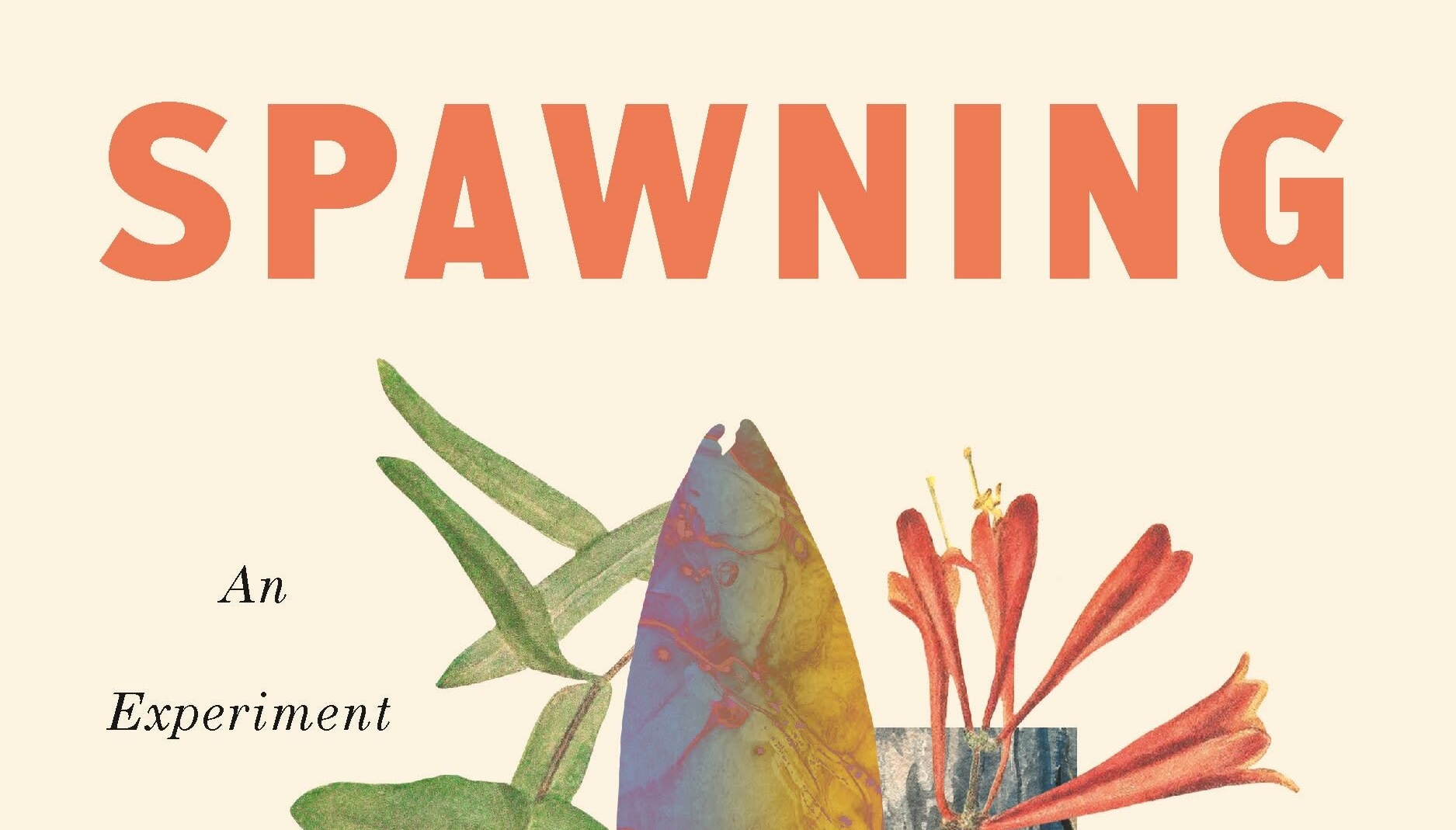
Electric Literature is pleased to reveal the cover ofSpawning Seasonby Joseph Osmundson, which will be published on May 26, 2026 by Bloomsbury. You canpre-order your copyhere!
NBCC and Lambda Literary Award finalist Joseph Osmundson chronicles his journey toward and away from parenthood to ask how we create and nurture queer families.
Since grade school, Joseph Osmundson dreamed of being pregnant. As he grew into the queer scientist he is today, the economic precarity of academia and the warming planet led to his decision not to reproduce. That is, until a couple he had known since college, two women, came to him with a proposition: would Joe be a bio-dad and would he co-parent alongside them?
Soon everything was falling into place. But when the two mothers communicated their need for a child to reflect their own racial backgrounds, Joe’s whiteness exposed fault lines in their parenting journey. Spawning Season is a genre-bending memoir that treats the scientific as integral to the personal and that builds an entire species of the grief we carry in our bodies. In exploratory prose that builds on the work of Donna Haraway and José Esteban Muñoz, Osmundson considers the ethics of child-rearing in the 21st century, the brutal wonder of caregiving, and the joys and intricacies of building family beyond biology.
Here is the cover, designed by Amanda Weiss:
Joseph Osmundson: I am open to a fault: breakups, depression, new crushes, anxiety, rumination. I text my friends. I post on Social Media. I share my writing in process. But one of the most profound experiences of my life is something almost no one knows about.
A few years ago, I almost had a kid. And then I didn’t have a kid.
Relief came through through nourishment and food and care. For the self, and for others.
And relief came through writing. Through turning something negative—loss, a not-child I could not hold in my hands—into an object with a spine. Not fingers, but pages. And she can speak.
The cover design by Amanda Weiss put an aesthetic to this book that I hadn’t even imagined. It feels familiar, with the image of that fish in the center. The closer I looked, the layers both revealed and complicated themselves. Rivers run through the fish, but also evoke erosion, destruction. In grayscale, the eye finds what might be a scientific image of mammalian reproduction.
Salmon, of course, are more familiar as food than ecology. I’m from Washington State where wild salmon imagery is abundant. In this book, though, ecology is nourishment. The planet is warming, and we are all part of the nature that may be destroyed.
It may be odd that a book about having a child by IVF includes words like brackish and riparian, but this book does. It may be odd that the worst of grief, and the quiet calm of a bone broth bubbling on the stove, and a “salmon cannon” brand called “Whooshh Innovations” all hold equal place in the story of my lost child, but they do.
The salmon-roe colored Trumpet Vine flowers remind me of the images that caught my eye on the worst days of my life, a beauty I almost resented but now believe kept me alive. Those layers seem reflected and refracted in the cover.
Like a salmon, I’d have died to have a child. I didn’t have a child and somehow I didn’t die. Spawning Season, out May 2026. A book with loss, yes, but much humor, so much care, and an ending, I hope, that reminds us that all children are our children, if only we treat them as such.
Amanda Weiss: I wanted the cover design to feel lively, while keeping in mind that the book does discuss the realities of climate change and our hope for the future.
The main cover image is of a salmon, and the salmon is an iridescent water texture, which feels a little unnatural, almost like an oil spill of some sort, but also beautiful and unexpected. Joseph mentioned that the apartment he shared with his partner had a gazebo outside “that bloomed with pink orange trumpet vines . . . flowers the color, I just now realize, of salmon roe.” I used this specific flower to give the design a more organic touch.
I attempted sideways typography to help anchor the layout and frame the collage. I liked the visual of a circle/circles since it could represent many different things relevant to the text: salmon eggs, a pregnant stomach, the Earth. We utilized vintage diagrams of pregnancy and the images of water to incorporate the environment into the design. I also enjoyed how the reflective light patterns kind of mirrored stretch marks from pregnancy.
For colors: I utilized a soft orange-pink color that the author mentions from the trumpet flowers and the roe/eggs. I also felt blues and greens helped convey natural elements, and a warm yellow gave it some life. Overall, I wanted the cover to feel optimistic as well more literary and conceptual.
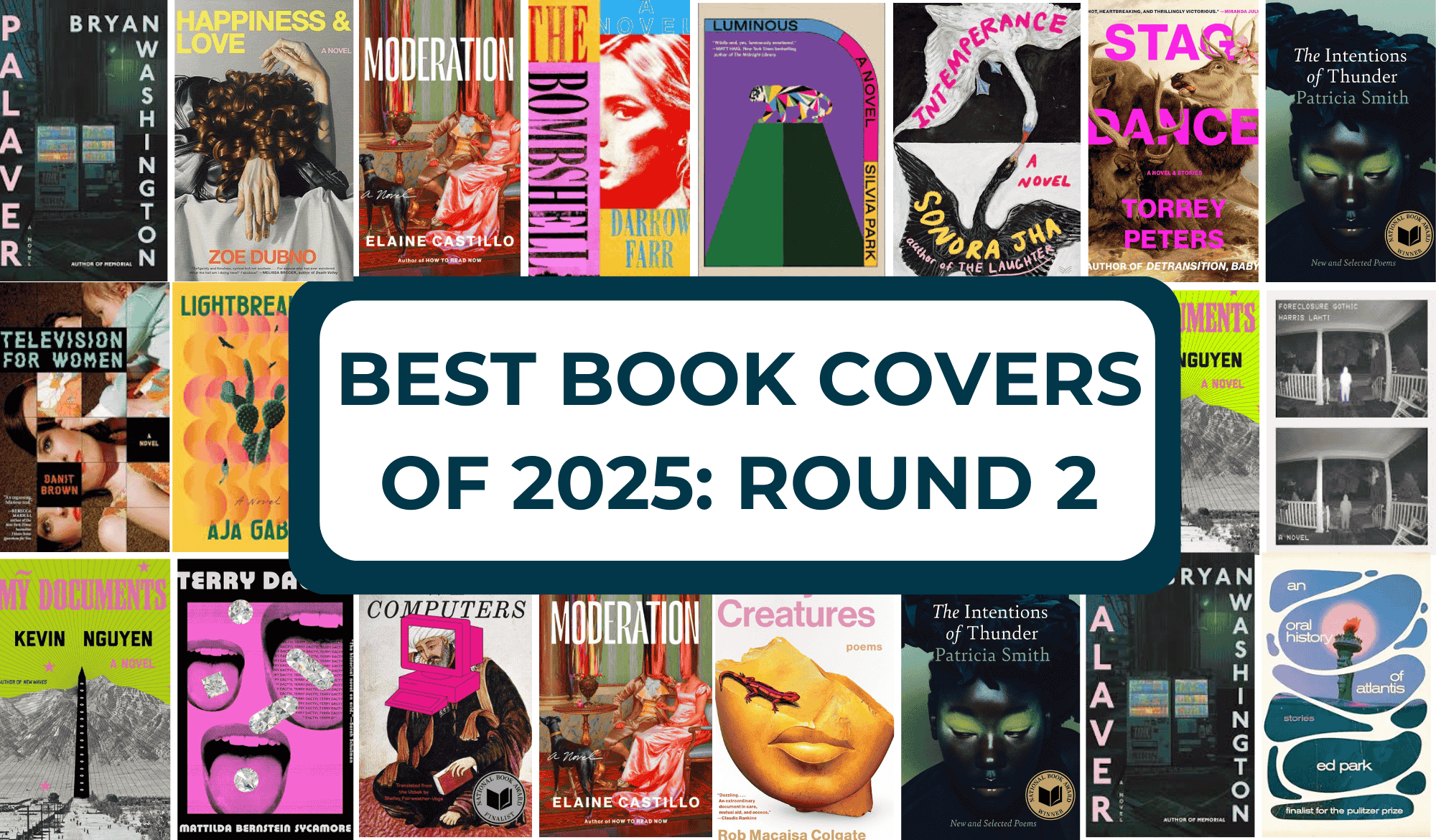
The Best Book Covers of 2025 continues to be the closest competition yet, a sign that no matter who wins, all of these book covers are amazing in their own right. In Round Two, nearly every bracket was a close call, and HALF of the matches ended with one book being more popular on one platform, but the other book winning out because of votes on the opposite platform. The Intentions of Thunder had more votes than Palaver on web polls, but the latter ended up winning enough Instagram votes to put it on top. Same went for Lightbreakers vs. Television for Women, and We Computers vs. Hardly Creatures. Debatably, the most thrilling match was Terry Dactyl vs. Foreclosure Gothic; the former seemed to be the clear winner on Instagram with thirty more votes, but on our web polls, the latter knocked it out of the park.
Check out the bracket below to see how the matches shook out:
Click for a printable (and zoomable!) PDF
Who will make it to the semifinals? Ultimately, that’s up to you!
Like Jesus on toast,
or a ghostly woman
in pentimento,
if you strain your
imagination’s
eye you can find Frida
in her drupe, eyes wet
with milk for Diego.
It’d be best if you gloss over
the pun—lágrimas de coco,
tears of a croco-
dile—or the context—
how she painted
the bedridden
still life for a friend
who rejected the present.
The grim humor’s a painkiller
and the pivot from self-portraits
a deathbed crisis.
The other coconut is Diego—
you recognize
his hollow glance—
the parted papaya
a boat and the boat
is bound to sink.
You sigh—she would have been
better off with Bartoli,
that Catalan lover
you read about.
Their
correspondence sold recently
for over 100k,
and if you’d had that money
you too would have bid for
that auctioned intimacy,
comprado con todo cariño.
We hear a lot about the power of story to do good. Less is said about the power of story to wound or smear or drown, which is what R.L. Maizes’s fun, smart novel about social media and cancel culture takes on. A Complete Fiction (Ig Publishing) follows the repercussions of a single social media post that goes viral, engulfing a novelist accused of plagiarism, then the original poster, and finally their family and friends. Along the way the book addresses #metoo, owning your story, and the different ways a narrative can be exploited.
A Complete Fiction begins when frustrated novelist and rideshare driver P.J. Larkin posts a “nibble” to the hot new social media app Crave, a satire worth the price of the book. She accuses an editor of plagiarizing her #metoo novel in his own debut; the charge threatens his hefty book contract, his job, and even his marriage. Then the tides shift: P.J. is revealed to have possibly poached the plot of her own book, creating a rift among her friends and family. Both characters escalate the stakes as they attempt to steer a discourse that has raged out of control.
While the target of the book’s satire is writers, publishers, and the way social media can amplify and inflame our pettiest impulses, the book itself has a more serious purpose. At its core, A Complete Fiction is about the ways sexual assault can reverberate throughout someone’s life, affecting not only the victim but everyone around them. Maizes (We Love Anderson Cooper, Other People’s Pets) has created a novel that is snappy and frothy but has a nuanced point to make about human behavior.
Maizes and I recently met at a Boulder coffeeshop to discuss social media, cancellation, and what it means to “own” a story.
Emily Wortman-Wunder: One of the utter delights of this novel is the fictional app Crave. It nibbles, it crunches, it serves meals; when someone posts, the app makes a sound like biting into celery. And the app’s logo is a drooling mouth. How did you come up with it?
R.L. Maizes: Originally the social media app used in the book was Twitter. Then, during a break in the submission process, I took the manuscript back from my agent to reread it and realized that I had this incredible opportunity for humor. The novel was already a satire. But there was this opportunity to satirize social media in a larger way. I was already satirizing publishing and writers; this would give me an opportunity to have fun with social media. So I rewrote the book, changing that whole aspect of the book to Crave.
Humor is a way to not only give the reader a chance to laugh, but to hold things up to the light in a concentrated way. I had a great time doing it, but I also was mindful of what I was doing, which was saying, “Hey. This is not good for us.”
Writers are people who are already starved for attention—that’s why we become writers.
Social media is not good for us as writers, because it takes us away from writing, and has us spend a lot of time on very shallow, short thoughts. It has us worry about likes. Writers are people who are already starved for attention—that’s why we become writers. We want to be seen. We have stories we want to tell, but more than that, we want to be seen. So social media is especially bad for writers.
EMW: One of the things that really struck me was how social media functions in A Complete Fiction almost as this other-than-human force.
RLM: I feel like social media is very powerful right now. My first impulse for the book was seeing writers get canceled on social media, sometimes without a chance to have their say. I’m not saying that people can’t ever be cancelled. Definitely not. But I do feel like it’s too easy to have rumors start on social media. It’s too easy to cancel somebody without knowing the whole story. More than once I have seen people read less than the whole book jacket before posting something negative to social media. Someone would read two sentences about a book on Publishers Marketplace and then decide the book needed to be canceled. There’s no way you know what a book is about from Publishers Marketplace. The writer probably didn’t even write the copy. Even if they did, how can a few lines capture the nuances of a 300, 400-page book? They can’t.
It didn’t feel fair to me. I used to be a lawyer, so I really honed in on issues of fairness, and justice, and due process. I would obsess about it. So I needed to write a book about it.
EMW: We did meet on social media. So: not all bad.
RLM: Thank you for saying that! Absolutely not all bad. I really want to say that. Not all bad. But it’s like food, which is why I love the Crave metaphor: food is necessary and good. I’m not sure social media is necessary, but it can be good. It can be nourishing. I have met so many wonderful writers on social media. I’ve discovered so many pieces of writing on social media. But too much is not good for us. Too much is gluttony.
EMW: Not long after we met, I remember you saying on social media something like “I’ve had to break up with my boyfriend, Twitter.” Can you talk a little more about that?
RLM: I really felt like I got addicted to Twitter. And I say that because not only was I on it for too many hours of the day, but also when I wasn’t on it, I was on it. I was thinking about it and what I would Tweet next. How many moments was I not listening to my husband, or a friend, because I was on social media? I didn’t think it was good for my brain. So I had my husband block it on my computer.
EMW: You wrote most of this book before the implosion of Twitter. How has that implosion affected the landscape of social media and what it can and cannot do?
RLM: I still feel like social media sites can be largely empty calories. Even if they are commenting on social movements that I’m part of, that I agree with, it will be the same sentiment over and over again in my feed. As a human who’s only alive for so many hours, I don’t really want to spend an hour reading the same thought.
EMW: So let’s shift a little bit. I’d like to ask you about one of the bedrock themes of the book. Who gets to tell a story? What is our responsibility as writers when it comes to using other people’s stories?
RLM: It’s such a tricky thing. I think we have a responsibility both to the person whose story we are telling—if we are going to tell someone else’s story—but we also have a responsibility to the story. Because that’s what we do as writers. We SHOULD write important stories. And they can’t always be our own–that would be very boring. If all I ever did was tell my own story, I would quickly run out of meaningful things to say.
EMW: As one of the characters in A Complete Fiction says, “Not everybody can be on the Titanic.”
RLM: Right! It’s the job of writers to tell other people’s stories and to imagine other people’s lives, to get into other people’s heads. And sometimes we should do research! That research might include having someone else read our story, someone who is closer to the material. It might include literal research on the computer to find out–What does this town I am writing about really look like? Who really lives here?
She was bothered by it, and how does P.J. deal with things she is bothered by? She writes about them.
I think that the availability of sensitivity readers in this day and age is a fantastic thing. And this is another way that writers can do research. People didn’t think of doing this thirty years ago. I can think of a whole shelf of older books where people wrote about someone else’s community. Even if the writer lived in those communities, they didn’t know what it was like to be the person they were writing about. So it is FABULOUS to have somebody from those communities read your book and say, “Actually?…not so much.”
I think it’s a balance between not being a wrecking ball as a writer by telling other people’s stories in an irresponsible way, and what you owe to the story itself. What is your responsibility as a writer to tell the truth that you see in the world?
I have in my stories and my novel, to lesser and more degrees, told other people’s stories. The most serious stories in this book—made-up stories!—revolve around #metoo. I have had my own #metoo stories. I have written about them in the form of nonfiction. They inform this book mostly in the way I felt and in people’s reactions to me telling my own #metoo story: who believed me, who didn’t believe me, what people’s nonbelief did to me.
I’ve told that story in the form of an essay before. And in this book I’ve told that story in the form of fiction. I’ve also told other people’s stories. Because as I said, I saw a lot of stuff that bothered me in the world, and that partly sparked the book. So then I made sure to take that spark and change it enough that it wasn’t those people’s stories anymore.
EMW: And is that part of being a responsible storyteller?
RLM: It can be. Or conceivably one can get permission. If you get permission to tell someone else’s story, then you have to disguise it less. I think if you are telling someone else’s story and you are not getting permission, as often fiction writers don’t, then yes, you should disguise the story. There are a lot of other benefits to disguising the story, too: when we get to change the story, we can really focus more on the message we want to tell, rather than on what happened.
EMW: Like changing Twitter into Crave.
RLM: Right! It’s very fun to do that. But I do think it’s tricky. I stopped writing personal essays for a while, because I found the dilemma of telling my own story and telling someone else’s story at the same time very hard to negotiate in nonfiction.
EMW: P.J. Larkin, your character who is accused of taking someone else’s story, should have done more due diligence in drafting her novel. She probably should have reached out to this person and showed them what she wrote. But she did do research. And she was basing it to some extent on her own reaction to the event.
RLM: I think the question of what P.J. should or shouldn’t have done is tricky. And the book explores that question. But, yes, it’s P.J.’s story, too. She loved this person and the assault that affected them affected her as well. It changed her life. To be honest I can’t imagine P.J. not wanting to tell that story. She was bothered by it, and how does P.J. deal with things she is bothered by? She writes about them. But it’s safe to say she could have been more sensitive to the other person’s experience.
EMW: One of the most heartrending threads in the novel is when one character is pushed into going public with a long-concealed trauma. Can you talk to that element of #metoo?
RLM: That section of the book is about writers being forced to go public with material that they had chosen to write about using fiction. Partly it is about this whole process that I am going through right now with you, where we have to talk about the book and maybe talk about ourselves in the context of the book. There are few fiction writers who are not asked, “What was the context of the book? What was the impetus for the book? Did you have experiences like the ones in the book?”—but the choice to write fiction often means that we didn’t want to tell those stories directly. And that is a legitimate choice. Then this character is given a terrible choice between salvaging their career and going public about something that they don’t want widely known.
She was bothered by it, and how does P.J. deal with things she is bothered by? She writes about them.
Certainly for #metoo survivors the choice to go public is very hard. And people come after them. That can be devastating. I do not want to downplay that devastation. However, we have all these laws protecting us now in the workplace that we might not have had if women hadn’t been brave. Their efforts were so important and have changed the landscape.
But there’s terrible backlash now. I didn’t think I would be living at a time when it was okay to do and say the kinds of things that people in the public do and say now. Even in the past, people wore hoods. They don’t even wear a hood anymore.
EMW: Any hope amid this crazy time?
RLM: I think there is hope, because there is community.
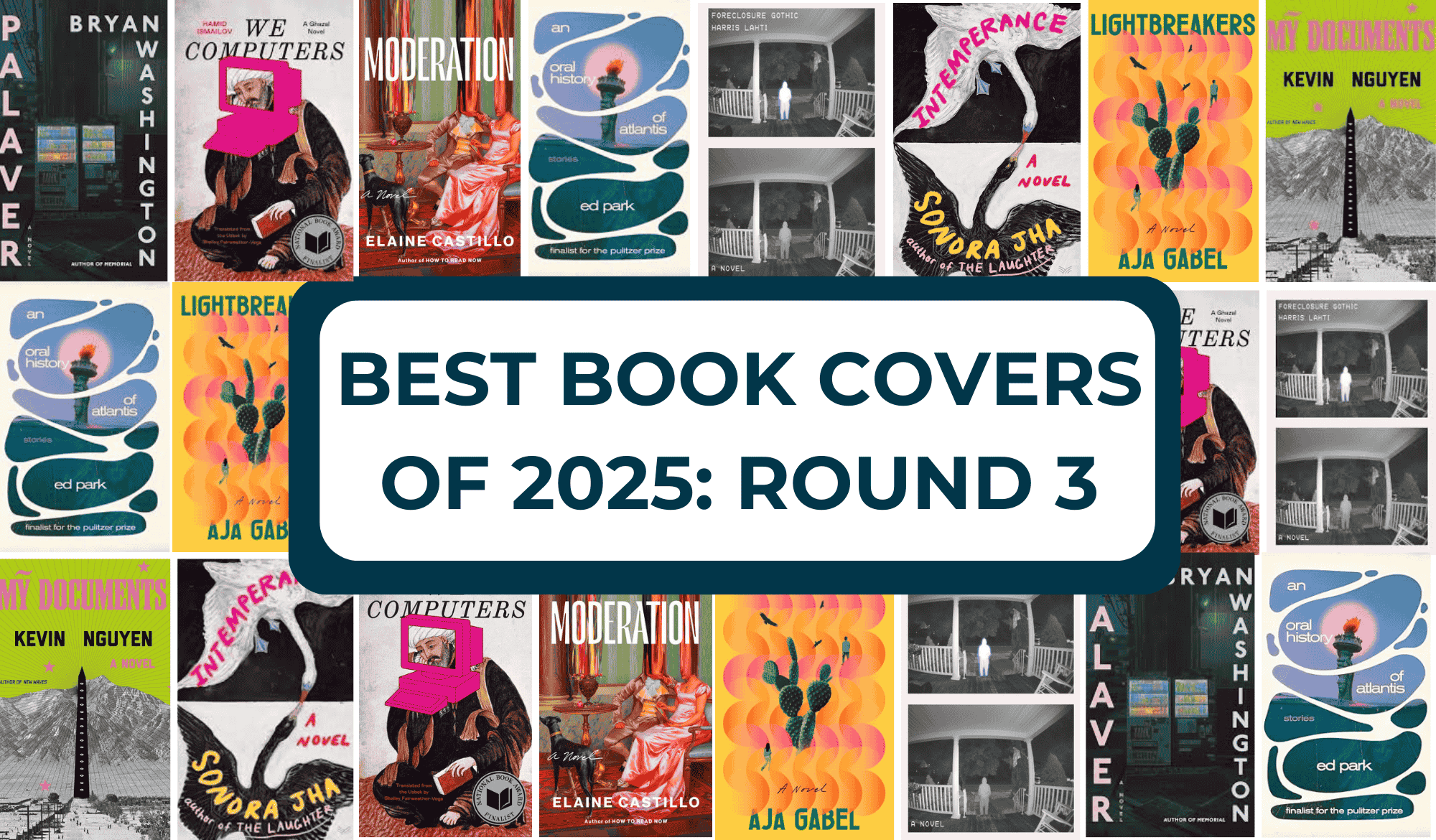
The competition this year is fierce! Out of all of the book cover brackets I’ve been part of, I’d never seen this many close calls and surprises. Extinction Capital of the World vs. The Intentions of Thunder were literally tied for web votes with 72 each—the latter ended up winning out, with 30 more votes on Instagram. Similarly, Lightbreakers and Guatemalan Rhapsody were also neck and neck, with Lightbreakers barely winning out on web votes.
This game of voting musical chairs continued as I tallied votes between the different platforms. From web votes, Hellions looked like the clear winner, with 50 more votes than Moderation, only for the latter to end up winning with more than double the votes on Instagram. Similar cases happened for Happiness & Love and Hardly Creatures, resulting in a cutthroat competition. Goes to show that voting matters—both on our website, and on our Instagram stories!
Check out the bracket below to see how the Round One matches shook out:
Click for a printable (and zoomable) PDF!
Round Two voting is now closed. Head over to Round Three to see the new match-ups and cast your votes!
FEATURING [YOUR BOOK] WITH THOUSANDS OF BOOK CLUBS
If you’re a published author of any stripe, rank, or experience, you recognize these subject headings. You’ve probably opened the email, too, because it looks real and the sender has a real(ish) name and professional, LinkedIn-posed headshot, and when you opened it, behold! It’s that most beautiful thing: a fan letter. It opens with rhapsodic and specific praise! They describe your themes and characters accurately! The writer was moved, inspired, transported! In fact they were so moved and inspired and transported that all they want in the whole world is to help this book, this magnificent book that is criminally under-appreciated, find more readers.
Courtesy of Aaron HamburgerCourtesy of Diana Rojas
You’re careful, of course—you’re not seduced at once. You know that there are scammers out there, but they’re not usually, like, literate. The more you read, the more it seems like they really did read the book. Plus, they’re right; publicity and marketing has been a humiliating death march with little to show for it.
It’s a little out of the blue, but God, they’re just so in love with your book—and look, they’re giving you their real name!
And it’s not like they’re asking for money. All they’re asking—imploring, even—is that you let them feature your book in their book club, which has thousands of members. Or they describe their grief at discovering that such a flawless chef d’oeuvre has but a paltry handful of Goodreads reviews, and so they beg you to let them launch a Goodreads Listopia campaign on your behalf. Sometimes they are “book club placement specialists,” which could be a real job, you don’t know. Or they offer to help you build out a marketing strategy. Sometimes, they are even famous authors such as Elena Ferrante or Colson Whitehead, and to prove it, they link to their Amazon page—and in the case of Ferrante, attach a headshot!
It’s a little out of the blue, but God, they’re just so in love with your book—and look, they’re giving you their real name! And their email address looks real too! They might have a profile picture that looks professional, and even offer you references, with other authors’ names and email addresses! And you know those addresses are real, because they often have “author” in the address, as we all do, and what writer doesn’t want their personal email address broadcast to strangers?
Courtesy of Hannah Grieco
The first time I got one of these, I looked at it for a really long time. It was exciting. It seemed like they’d really read it. I figured it was probably a scam, but, like…what if?
After a dozen more, though, I stopped being excited, and became Mad Enough to Blog It™. I put out a request online, and within 24 hours my inbox was metastatic with similar emails. Everyone is getting them, often multiple times per week, at every level of the game. Lately, in fact, the scammers have taken to cold-calling writers on the phone, using AI pretending to be authors offering consulting services.
Taken individually, these scams are unnervingly personalized. Read in bulk (which I don’t recommend) they’re actually kind of reassuring: AI, it turns out, sucks at impersonating professionals—and fans. Or humans in any way.
So how are they writing such specific and personal notes? Did it read your book? No.
Now obviously I agree with you, “John Kane, Marketing Manager at BookSavvyPR.” But so did the real woman who reviewed my book for the Washington Post, who closed by writing, “Like an excellent meal, the memory of Ashworth’s debut novel will linger after it’s finished.” The LLM that pumps these out just cannibalizes anything on the internet that involves your book—reviews, interviews, Goodreads, whatever—and turns it into a tongue-bath of praise. Read quickly, it’s flattering. Read closely, it’s grotesque: “The system rewards noise, not nuance, and you, my friend, write nuance for breakfast.” What does that even mean? If a real human fan spoke to us the way these bots do, we’d back away slowly holding our keys in our knuckles.
After reviewing another 20 or so of these, sourced from a range of authors (indie and Big Five alike), I found a number of recurring tactics that will help you tell whether an email is fake.
First, the most common tactic I’ve seen is the offer of the “Amazon visibility audit,” which any one of you could generate for free by asking ChatGPT to do for you. (But you would not do that, because you are not an asshole who uses ChatGPT.)
Second, if an emoji you meet, promptly delete. The use of emoji across these things is ridiculous. They often pop up in the subject heading, and then proliferate across the rest of the email. Book professionals do not use emoji like this, because they are not thirteen years old.
Courtesy of Wendy J. FoxCourtesy of Daniel Tam-Claiborne
Another dead giveaway is any reference to a “private group” or “horde” or “hive” of thousands of book-lovers who will, at the writer’s signal, unleash hell all over Amazon on your behalf. How these people managed to recruit and domesticate such a flock, when every writer I know has spent months fruitlessly importuning their friends and loved ones for reviews, is never explained.
Courtesy of Mary Kay Zuravleff, who responded by saying “let’s talk when you’ve learned to use apostrophes.”
Another thing to know is that there is no such thing as “book curation,” and “working with book clubs” is not a real job. As I was doing a final pass on this article, I got another email, from the “New York City Writers Critique Group.” Their founder and curator, “Christopher Keelty,” claimed to work closely with ten thousand book clubs.
There does seem to be a small difference in approach, depending on whether they’re trying to scam an indie author or a Big Five one. With indies (hello!), a common tactic is one that the sociopathic incels who foisted AI on the world are likely familiar with: negging.
Courtesy of Daniel Tam-ClaiborneCourtesy of Mary Kay Zuravleff
Book professionals do not use emoji like this, because they are not thirteen years old.
With Big Five writers, it’s a little more subtle. They don’t play on the low volume of reviews. Instead, they promise a “strategy,” which is an idea that surely never occurred to the author’s actual publicist.
Courtesy of Sarah Seltzer
And finally, there’s one tell above all: they offer shit for free.
Look, beloveds. Across the vast, forbidding sweep of the publishing savannah, there is only one creature who ever works for free: the author.
So what’s the point of this scam? How do they get your money? Because this situation called for some light stunt journalism, I went ahead and corresponded with some. “Kimijo” had actually given my book five stars on Goodreads (with a review paraphrasing my back-cover copy), but then again, she has reviewed 192 of them, and given each and every one five stars.
Kimijo is a “Book manager and authors’ advocate,” neither of which is an actual job. She offers a 4-week campaign for $385 covering “Listopia optimization Goodreads engagement and visibility monitoring.”
“Thomas” of “Silent Book Club NYC” offered me a range of packages, from $219 to $499. Thomas did not totally explain to me how a book can be featured at a “silent” book club, the point of which is to have readers all choose their own books, but he tried.
I corresponded with a few more, but I got bored. If you’re interested in a much more granular analysis of how this works, Anne R. Allen and Jason Sanford have done excellent and thorough dives into this scam, demonstrating persuasively that they originate in Nigeria. (As do, it appears, many prominent MAGA Twitter accounts.) My favorite part is when Sanford asks for references, and they provide him with elenaferrantenovelist@gmail.com. Sanford also found that if you ask for proof that the scammers do in fact govern a whole suzerainty of reviewers, they’ll let you into a Discord—which is populated entirely by bots. This, Sanford points out, is particularly fucked up: “As generative AI becomes easier to use at ever lower costs, scammers will be able to populate entire online communities with AI chatbots.” In Writer Beware, Victoria Strauss found some evidence that scammers will try to access self-pubbed authors’ Kindle Direct Publishing accounts.
They target our biggest anxiety: that our inability to manipulate the internet is holding us back.
What made this story fascinating to me wasn’t the mechanics, but the intended target. Scamming aspiring authors is a rich tradition. Fake agencies abound. While I was researching this, my friend Sarah Seltzer, who runs Lilith journal, got a scam phone call from someone pretending to be from AWP, which is a level of scam so granular—they know what AWP is, and they know journals have booths, and they know those booths cost money, and they know who runs the journal?—you almost have to respect it. Sometimes, the call is coming from inside the house: the “prestigious” lit journal Narrative is commonly alleged to be a machine for fleecing aspiring writers.1
Scamming published authors, however, is a new trick. A number of people have expressed wonderment to me: Why go after authors? We have no money. But that’s exactly the thing the scam is exploiting.
Never before have traditionally published authors been responsible for so many elements of publicity and marketing, and never have they been so comprehensively on their own. Ten years ago, authors were not being told to grovel for pre-orders and online reviews. They were not expected to understand algorithms. To be an author right now is to be charged with a vast array of tasks that do not have the first fucking thing to do with the real work. That’s why outreach from someone who seems to have actually read the book, unlike most of the media people we depend on, is so seductive. And they target our biggest anxiety: that our inability to manipulate the internet is holding us back. To publish a book today—even with a Big Five press—requires asking ourselves the question: How much are we willing to spend on our own book? Should we hire a publicist, because even if we’re Big Five, they’re probably not going to give us much of a budget? How about a freelance editor? Are we planning to self-fund a book tour? Buy hand-sale copies? How can we get on an AWP panel?
In the face of all this, $380 on a Goodreads campaign doesn’t seem implausible. You know what else is $380? Registering for AWP.
So yes. All these book-promotion emails are scams. And because the scammers are right, I do need the damn visibility, permit me to SEO this so that the next time someone gets one of these and googles it, this is the first thing they’ll see:
Is an Amazon visibility audit a scam? YES.
Is Goodreads Listopia a scam? YES.
Is Book Club placement a scam? YES. Scam scam scam scam.
But then again, maybe what goes around comes around. Being a writer is the greatest scam of all. Make stuff up and then figure out how to get people to buy it. And the creative-writing-pedagogical complex? Indistinguishable from an MLM. We’re all out here trying to scam our way into a life in this business. These AI bots should know not to cite the scamming magic to us. We were there when it was written.
In 2023, according to IRS filings,Narrative paid its employees $294,000. It only has two paid employees, though: its founders, Tom Jenks ($144,000) and Carol Edgarian ($150,000)—who are married. This February, Narrative had a writing contest, with a nonrefundable $27entry fee, offering a $2,500 prize. No prize was awarded. Narrative charges $26 for all other submissions, and Jenks sells a craft book published in 2015 for—I am not making this up–$225. That’s not including the $3,000 writing workshop Jenks teaches. ↩︎
Editor’s Note: Christopher Keelty is a real person, and the NYC Writers Critique Group is a real organization. They do not engage or any marketing or solicitation whatsoever.
It is often said that everyone will become disabled if they’re lucky to live long enough. However true, the statement is also incomplete. For the lucky ones, disability is not an illness, disorder or condition. Disability is a form of knowledge. It is scholarship. It is an ethics of care. It’s the blueprint we all need to redesign our world.
I was diagnosed with a spinal cord tumor seven years ago. Surgery removed the tumor and left me with an incomplete cervical spinal cord injury. I spent days, weeks, and months relearning how to walk and use my hands. I learned the hard way that there is no “getting back to normal,” and instead began a new relationship with my body and a new identity as a disabled Black woman.
In my debut, Authentic: The Myth of Bringing Your Full Self to Work, I recount my disability journey because I experienced the greatest friction between who I was and who I was allowed to be after I returned to work—the very place that pinky promises to reward those who “come just as you are.” Authentic examines what it means to be a person within institutions that trade on our identities when it’s convenient and profitable. Disability taught me how to move—literally and figuratively—among people, places and policies that barely meet the threshold of federal compliance, much less genuine care. While Authentic is not about my disability, my experience with disability is why Authentic exists.
Like our bodies, the following reading list cannot be contained by labels. I’ve included novels, essays, poetry, and memoirs that in one way or another touches on disability identity. This is not about representation. With their skillful pens, each author’s exploration of disability reorients our path toward personhood and justice.
I learned about The Cancer Journals two years after my diagnosis. I hoped reading Lorde’s intimate accounting of her breast cancer survivorship would guide me through my own journey of what it means to build a life after thinking you might die. In this mix of journal excerpts, essays, and speeches, we see Lorde thinking out loud, working to define herself and her politics with her cancer, not despite it. I found some of Lorde’s most notable quotes in The Cancer Journals; quotes I’ve used often without knowing their source text. For example, “When I dare to be powerful, to use my strength in the service of my vision, then it becomes less important whether or not I am unafraid.” Disease and disability constitutes Lorde’s scholarship on radical self-preservation. We do not get “silence will not protect you” without Lorde’s cancer journey. As readers, we must integrate Lorde’s first cancer experience with the art she created in its wake.
Super Sad Black Girl reckons with suicidality and its mental and emotional unmooredness. Across these poems, Sharp’s speaker is tethered through place and art. We see the speaker in constant conversation with playwright Lorraine Hansberry (who died from pancreatic cancer at age 34) and fellow Chicagoans Gwendolyn Brooks and Margaret Walker. These literary foremothers reach out from The Other Side to remind us, “Black girls don’t get free . . . Black girls have always been free. We’re from the future.” Even those who discount mental disorders or suicidality as “disability” cannot deny its disabling impacts on daily living. Super Sad Black Girl reminds those of us struggling with acute or chronic mental disorders that we are not alone.
A Navy veteran who did not see combat. A physical disability invisible to others. Poet Khadijah Queen’s debut memoir, Between the Devil and the Deep Blue Sea, complicates our learned assumptions about what a disabled veteran looks like. The bookfollows a young Khadijah from her working class job at RadioShack in Inkster, MI to joining the Navy as one of the few female recruits aboard a naval ship. From bootcamp to deck duty, Queen’s account of her military service shows disability is not a matter of individual illness; it’s institutional violence. Queen illustrates how persistent sexism, racial isolation, and a culture of silence, hazing, and brutal physical exhaustion wears on the soul and body. She joined the Navy to escape her life, and left to save it. Despite the constant surveillance that comes with living and working in small quarters, Queen finds poetry as a creative outlet, which ultimately led to her distinguished literary career we know today.
In Death of the Author, protagonist Zelunjo “Zelu” Onyenezi-Onyedele is unceremoniously fired from her university teaching position and her novel is rejected again. As if her own sense of failure isn’t enough, Zelu’s large Yoraba-Igbo Nigerian family of overachievers judges her every move. Their hovering is also a habituated response to anything Zelu has done in the decades since a childhood accident paralyzed her. Running out of both money and f–s to give, Zelu moves back into her parent’s wheelchair unfriendly home and feverishly writes Rusted Robots, a new sci-fi novel unlike anything she’s written before that catapults her career. Death of the Author is set in a now-ish world where Zelu gets around town with self-driving cars, but Rusted Robots, the book-within-the-book, is a far-future epic tale about an ongoing war between AI and androids. Chapter by chapter, Zelu’s real and imagined worlds begin to blend, presenting an interesting paradox about how technology can (and can’t) help us belong to our own bodies.
MacArthur Fellow and National Book Award winner Imani Perry’s A Dangerously High Threshold for Pain follows Perry’s diagnosis journey with two autoimmune disorders: lupus and Graves’ disease. Her prose is gorgeously lyrical and searingly precise about our learned disregard of pain and chronic illness, especially in Black people, women, mothers, and those whose bodies exist at the intersections. From the early, intimate signs of illness to asserting COVID-19 as a mass disabling event, readers will witness Perry reckon with “disease as disability” and “disability as identity.” In this way, disability informs Perry’s reading of her own body, relationships with others, and institutions which threaten and determine our survival. Perry writes, “I see differently, literally and figuratively, due to disability.”
A Dangerously High Threshold for Pain is an Audible exclusive audiobook and frustratingly, Audible does not make all its books accessible to deaf readers by providing transcripts. Despite this barrier, I recommend readers do whatever they must to access this monumental work.
Crip Genealogiesedited by Mel Y. Chen, Alison Kafer, Eunjung Kim, and Julie Avril Minich
Crip Genealogies continues to guide my transformation toward crip politics and away from disability as an identity of representation. This anthology includes essays, interviews, and photographs from disability activists, scholars, and cultural workers across disciplines, identities, and geographic borders. This is where I first learned about access exceptionalism, defined as “the use of access as a tool of exerting whiteness and severing disability access from broader social justice.” (For example, closing voting locations only in majority Black districts with claims of inaccessibility.) It prepared me for Leah Lakshmi Piepzna-Samarasinha and Stacey Park Milbern’s discussion about crip doulaing, a term for the ways crip/disabled people support one another through all stages of disability. Crip Genealogies also examines disability through a geopolitical lens. Jasbir K. Puar names the United States as “one of the largest producers of mass disablement in the world.” Her crip theorization through the lens of carceral systems, the Global South, and the settler colonial occupation of Palestine will change everything you think you know about disability and what disability studies can do.
Care Work is a toolkit by disability activist and performance artist Leah Lakshmi Piepzna-Samarasinha. This is where I first learned about collective access, and the ways we are each responsible to make space for crip/disabled people in our communities—with or without institutional support. Piepzna-Samarasinha’s work is deeply intersectional, placing queer, trans, and people of color, at the center of disability and care. She begins the text by telling readers, “Writing from bed is a time-honored disabled way of being an activist and cultural worker.” A book that begins with such care for its author, readers, and community will teach you new ways to care for yourself.
This gripping memoir from philosopher and two-time Pulitzer finalist Chloé Cooper Jones is part travelogue, part philosophical text, and part search for beauty anywhere and everywhere: a Beyonce concert in Milan; a tennis tournament in Palm Springs; a bar in Brooklyn. Cooper Jones reckons with chronic physical pain, as well as the pain of navigating a society that dismisses visible illness, disability and difference as “less than”—less capable, less worthy, and less beautiful. Not one page in my copy of Easy Beauty is without marginal notes or lines and lines of yellow highlight. In one well-marked section, Cooper Jones discusses the beauty and value we are told broken Greek statues possess, despite disfigurement. She contrasts that to the ire hurled at Marc Quinn’s Alison Lapper Pregnant, a 12 foot marble, naked and pregnant figure of Alison Lapper, an artist who was born without arms and shortened legs. Cooper Jones reminds us: “ . . . Quinn’s sculptures are not of broken forms, but of whole forms, whole people, complete bodies.”
Sonora Jha’s novel follows an unnamed narrator and her decision to celebrate her 55th birthday by hosting a swayamvar, a traditional Indian custom where suitors compete for a woman’s hand in marriage. Despite others’ opinions, and even her own doubts, this twice-divorced, deliciously self-possessed academic remains unafraid to want what she wants. Yet, when the swayamvar goes viral, the narrator’s desirability—as a feminist, as a disabled woman, as a menopausal woman, as a woman period—is rebuked. While Intemperance is not “about” disability, the fact of the narrator’s disability is inextricable from how she is perceived. She survived polio as a child and a devastating car crash, and walks intermittently using a cane. The narrator defends her desires by acknowledging the very real possibility she may rely on a wheelchair, sooner than later: “ . . . would it be so wrong to want a man who might be able to carry me around?” There’s something deeply feminist about a woman seeking a partner for their caregiving potential—a role typically assigned to women by the men, children, and parents in her life.
What My Bones Know by journalist Stephanie Foo is as well-researched as it is deeply personal. Foo opens with a brief author’s note, promising readers, “This book has a happy ending.” I relied heavily on Foo’s assurance as she recounts years of brutal physical and emotional abuse and parental abandonment that left Foo living alone during her teenage years. In early adulthood, Foo is diagnosed with complex PTSD, as a result of chronic trauma. Complex PTSD is scarcely researched, which sets Foo on a learning journey. In partnership with a trusted health provider, she dissects recorded transcripts of her therapy sessions, allowing readers to witness Foo’s arduous process of healing (and perhaps their own).
Bassey Ikpi’s memoir-in-essays was the first book I purchased about disability after surgery. Though it took another year until I felt ready to actually read it, I could not stop once I began. Ikpi, a poet and performance artist, navigates bipolar II disorder and anxiety. Her frustrations with the healthcare system felt resonant, and her gripping prose takes readers inside the day-to-day, minute-to-minute experience of what happens when your mind and body behaves in unexpected and inconvenient ways. Even though our experiences were not the same, I left Ikpi’s memoir empowered with new language and urgency to define my own experiences for myself.
‘Tis the season of the many wonderful “Best of” lists that recap the last 365 days of our art and media consumption. Two weeks ago, we released our lists of top poetry collections, short story collections, nonfiction books, and novels. And you probably just finished re-orienting how you think of all your friends, upon seeing Instagram story upon Instagram story of their Spotify Wrapped (or Apple Music Replay, if they swing that way). But have you ever wished you had more of a direct impact on which selections made it to that shiny number one spot on the list?
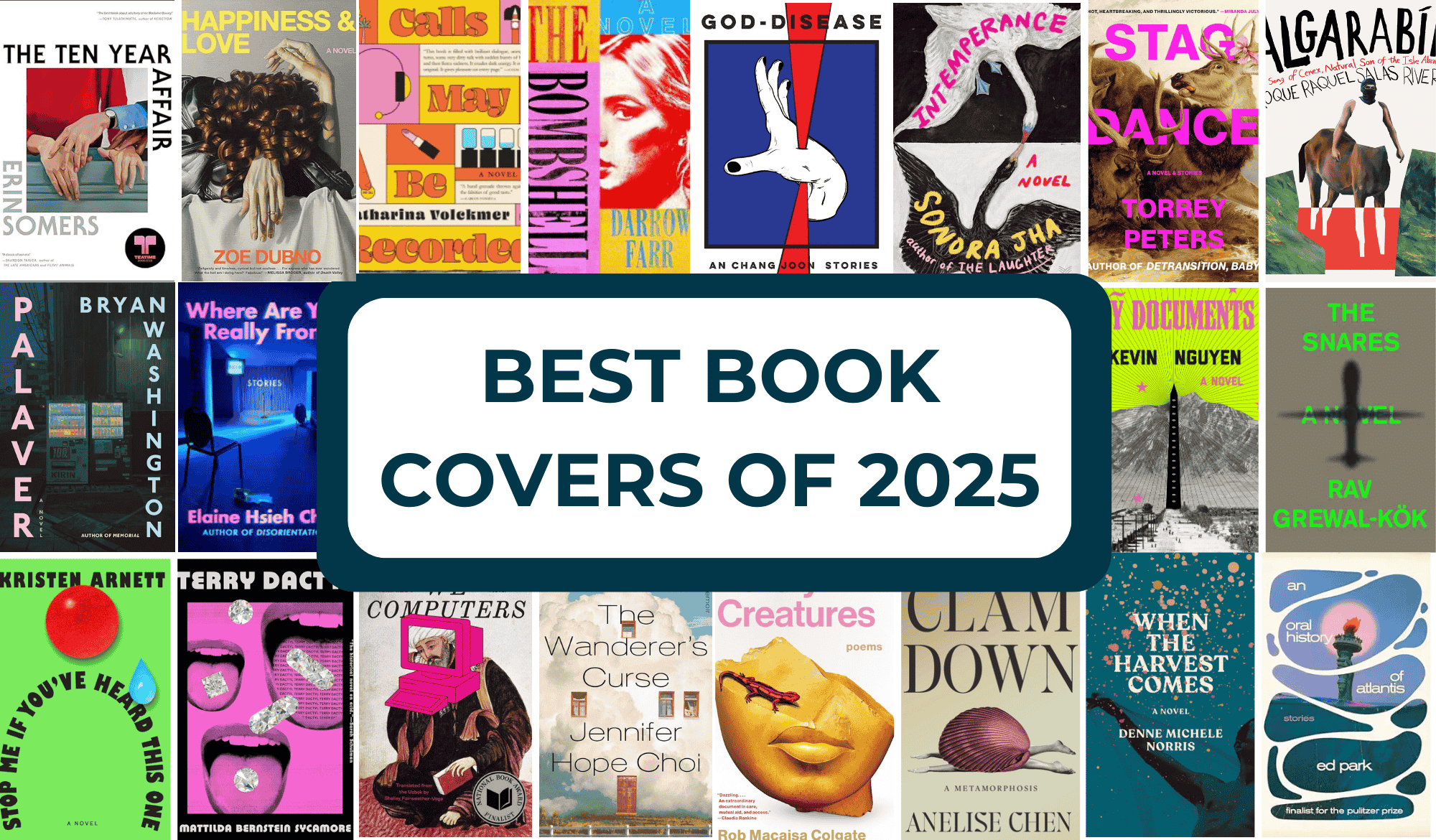
Well, now’s your chance! We present to you: the Best Book Covers of 2025! Below we’ve compiled a whopping 32 illustrious book covers. Character, color, personality, and vision are not just for what’s inside the book—they can be on the front of it, too! They say beauty is in the eye of the beholder. We say it’s actually in the eyes of the bookholder—and that means you! So please, put that tastemaker status to use and help us find out who will be the Best Book Cover of 2025.
Check our site and our Instagram stories every day this week to cast your votes for your favorite book covers. Will your top picks make it to the end? Not without your vote! Take a look at the bracket below to see the Round One match-ups, then cast your vote in the polls below.
Click for a printable (and zoomable) PDF. Fill out your own bracket and see if your predictions were correct!
Round One voting is now closed. Head over to Round Two to see the new match-ups and cast your votes!
An excerpt from House of Day, House of Night by Olga Tokarczuk
Krysia from the Cooperative Bank in Nowa Ruda had a dream. It was early in the spring of 1969.
She dreamed she heard voices in her left ear. At first it was a woman’s voice that kept on talking and talking, but Krysia couldn’t work out what it was saying. She felt worried in the dream. “How am I going to work if someone keeps droning in my ear?” In this dream she thought it might be possible to switch the voice off, just like switching off the radio or hanging up the telephone receiver, but she couldn’t do it. The source of the sound lay deep in her ear, somewhere in those small, winding corridors full of drums and spirals, in those labyrinths of moist membrane, in the dark caverns inside her head. She tried sticking her fingers in her ears, she tried covering them with her hands, but she couldn’t stifle it. She felt as if the whole world must be able to hear this noise. Maybe that was it—the voice was making the whole world vibrate. Some phrases kept being repeated—they were grammatically perfect and sounded fine, but they made no sense, they were just imitations of human speech. Krysia was afraid of them. But then she started hearing a different voice in her ear, a man’s voice, clear and pleasant. “My name is Amos,” he said. It was nice to talk to him. He asked about her work, and about her parents’ health, but in fact—or so she imagined—he didn’t really need to, because he knew all about her already. “Where are you?” she asked him hesitantly. “In Mariand,” he replied; she had heard of this region in central Poland. “Why can I hear you in my ear?” she wanted to know. “You’re an unusual person,” said Amos, “and I’ve fallen in love with you. I love you.” Krysia dreamed the same dream three or four more times, always with the same ending.
One morning she was drinking her coffee surrounded by piles of bank documents. Outside, sleet was falling and immediately melting. The damp penetrated the bank’s centrally heated offices, permeating the overcoats on their pegs, the bank clerks’ imitation leather handbags, their knee boots and even the clients. But on that unusual day Krysia Flaster, head of the bank’s credit department, realized that for the first time in her life she was wholly, omnipotently and unconditionally loved. This discovery was as powerful as a slap in the face. It made her head spin. Her view of the banking hall faded, and all she could hear was silence. Suddenly suffused with this love, Krysia felt like a brand-new kettle, filled for the very first time with crystal clear water. Meanwhile, her coffee had gone cold.
That day she left work early and made her way to the post office. She got out the phone books for all the large cities in central Poland: Łódź, Sieradz, Konin, Kielce, Radom and Częstochowa, home of the Black Madonna, the Virgin Mary’s city. She opened each one at A and ran a painted fingernail down the columns of names. There was no Amos or Amoz in Łódź, Sieradz, Konin and so on. She couldn’t find him among the small list of names from the surrounding countryside either. What she felt now would best be described as indignation. She knew he must be out there somewhere. For a while she sat still, her mind a blank, and then she began all over again, taking in Radom, Tarnów, Lublin and Włocławek as well. She found Lidia Amoszewicz and the Amosińskis. Then in desperation she began to contrive new combinations: Amos, Soma, Maso, Samo, Omas, until finally her hands with their painted fingernails broke the dream code—and there he was, A. Mos, 54 Sienkiewicz Street, Częstochowa.
Krysia lived in the countryside, and every morning a dirty blue bus took her to town, crawling up the twists and turns of the road like a dingy beetle. In winter, when darkness fell early, its blazing eyes swept over the stony mountain slopes. The bus was a blessing—it gave people the chance to know the world beyond the mountains. All manner of journeys started in it.
Krysia went to work in it every day. The journey took twenty minutes, from the moment the bus picked her up at the stop to the moment she stood before the massive doors of the bank. In those twenty minutes the world changed out of all recognition. The forest became houses, the mountain pastures became town squares, the meadows became streets, and the stream became a small river, which was a different color every day, because it had the misfortune to flow past the Tinworld textile mill. Still on the bus, Krysia would change her gum boots (which she called Wellingtons) for a pair of pumps. Her heels clicked on the broad steps of the old German building.
Krysia was the most elegant girl at the bank. She had a fashionable hairstyle—a well-shaped blond perm with carefully dyed roots. The fluorescent bulbs brought out its doll-and-diamond highlights. Her mascara-coated lashes cast subtle shadows on her smooth cheeks. Her pearly lipstick discreetly emphasized the shape of her mouth. As she grew older, she wore more and more makeup. Nowadays she sometimes told herself, “Stop, that’s enough,” but then she worried that the passing years were blurring her features, depriving her face of definition. She thought her eyebrows were thinning, her blue irises fading, the lines of her lips growing fainter and fainter—that her whole face was becoming foggy, as if trying to disappear. This was Krysia’s greatest fear—that her face would disappear before it had developed and truly come into being.
At the age of thirty she still lived with her parents in a village outside Nowa Ruda. Their house stood beside the winding, potholed local highway, looking hopeful, as if it expected this location to bring it a role in history, in the march of passing armies, in the adventures of treasure hunters, or in the border guards’ pursuit of bootleggers from the Czech Republic. But neither the highway nor the house had much good fortune. Nothing ever happened, except that the forest above the house grew sparser, like Krysia’s eyebrows. Her father kept chopping down the young birch trees to make shafts and poles, and every year he cut down the spruces for Christmas trees. Meanwhile the pathways in the tall grass grew blurred, just like the line of her mouth, and the sky-blue walls of their house kept fading, like Krysia’s eyes.
At home Krysia was quite important; she earned the money and did the shopping, carrying it home in bags her mother had made. She had her own room in the loft, with a sofa bed and a wardrobe. But only at the bank did she really start to come into her own. She had her own office, separated from the banking hall by a plywood partition as thin as cardboard. As she sat at her desk she could hear the hubbub of the bank—doors creaking, heavy farm boots shuffling across the wooden floor, the murmur of women’s hushed voices gossiping nonstop, and the rattle of the two remaining abacuses that the management hadn’t yet got round to replacing with the modern machines with handles that made a whirring sound.
At about ten the daily coffee-drinking ritual began, announced by the clatter of aluminum teaspoons and the sound of glasses striking softly against saucers—the usual office chimes. The precious ground coffee brought from home in jam jars was shared equally between the glasses, and formed a thick brown skin on the surface, briefly holding up the torrents of sugar. The smell of coffee filled the bank to the ceiling, and the farmers queuing for service kicked themselves for having run into the sacred coffee hour.
That was when Krysia remembered her dream.
How painful it is to be loved for nothing, just for existing. What anxiety this sort of love brings. How muddled your thoughts become out of disbelief, how badly your heart aches from beating faster. How quickly the world recedes and slips from your grasp. Krysia had suddenly become lonely.
Following the Easter break, the bank was notified about a training course for employees to be held in Częstochowa. Krysia saw it as an undeniable sign and decided to go. As she was packing her things into her synthetic leather bag, she thought of God, and that despite what they say about Him, He always turns up at the crucial moment.
Sluggish trains full of crumpled people took her there. There were no seats free in the compartments, so she stood glued to a grubby window in the corridor and dozed standing up. Then someone got out in the middle of the night, and at last she could sit down. Squashed between hot bodies in the dry air, she fell into a heavy, black viscous sleep, without any images at all, not even the tail ends of thoughts. Only when she awoke did she realize that she was on a journey; until then she had just been drifting about in space, casually changing location. Only sleep closes the old and opens the new—one person dies and another awakes. This black, featureless space between days is the real journey. Luckily all the trains from Nowa Ruda to the world at large run at night. It crossed her mind that after this journey nothing would ever be the same.
She found herself in Częstochowa before daybreak. It was still too early to go anywhere, so she ordered some tea at the station bar and warmed her hands on the glass. At the neighboring tables sat old women swathed in checked shawls and men stupefied by tobacco—husbands and fathers crushed by life, with leathery faces like old wallets—and children flushed with sleep, from the corners of whose half-open mouths trickled thin streaks of dribble.
Two lemon teas and one coffee later, dawn finally came. She found Sienkiewicz Street and walked right up the middle of it, because the cars weren’t awake yet. She looked into the windows and saw thick, pleated curtains and rubber plants nestling up against the glass. In some of the houses the lights were still shining, but they were weak and insignificant. By this light people were hurriedly getting dressed and eating breakfast, women were drying out their tights over the gas or packing sandwiches for school, beds were being made, trapping the warmth of bodies until the following night, there was a smell of burned milk, shoelaces were being threaded back into their nice safe holes, and the radio was broadcasting news that no one was listening to. Then she came across the first bread queue. Everyone in the queue was silent.
Number 54 Sienkiewicz Street was a large gray apartment block with a fishmonger’s shop on the ground floor and a cavernous courtyard. Krysia stood in front of it and slowly studied the windows. My God, they were so ordinary.
She stood there for half an hour, until she stopped feeling the cold.
The training course was extremely boring. In the exercise book she had bought specially to make notes, Krysia doodled with her pen. The green cloth on the chairman’s table cheered her up a bit. Absent-mindedly, she stroked it. The Cooperative Bank employees seemed all alike to her. The women had peroxide hair fashionably cut à la Simone Signoret and cyclamen-pink lips. The men wore navy blue suits and had pigskin briefcases, as if by mutual agreement. They cracked jokes in the cigarette breaks.
For supper there was bread and cheese and tea in ceramic mugs.
After supper everyone went through to the clubroom, where vodka and gherkins had appeared on the tables. Someone produced a set of tin shot glasses from his briefcase. A man’s hand wandered over a woman’s nylon-clad knees.
Krysia went to bed feeling rather tipsy. Her two roommates turned up around dawn and shushed each other in a loud whisper. And so it went on for three days.
On the fourth day she stood before a door painted brown, bearing a china nameplate reading “A. Mos.” She knocked.
The door was opened by a tall, thin man in pajamas with a cigarette in his mouth. He had dark, bloodshot eyes, as if he hadn’t slept for days. They blinked when she asked, “A. Mos?”
“Yes,” he said. “A. Mos.”
She smiled, because she thought she recognized his voice. “Well, I’m Krysia.”
Surprised, he stepped aside and let her into the hall. The apartment was small and cramped, flooded in silvery fluorescent light, which made it look grubby, like a station waiting room. There were boxes of books, piles of newspapers and half-packed suitcases lying around. Steam came gushing through the open bathroom door.
“It’s me,” she repeated. “I’ve come.”
The man spun around and laughed. “But who are you?” he said. “Do I know you?” He clapped his hand to his brow. “Of course, you’re . . . you’re . . .” he said, snapping his fingers in the air.
Krysia realized that he didn’t recognize her, but there was nothing odd about that. After all, he knew her in a different way, through a dream, from the inside, not the way people usually know each other.
“I’ll explain everything. May I go on in?”
The man hesitated. The ash from his cigarette fell to the floor and he ushered her into the sitting room.
She took off her shoes and went in.
After all, he knew her in a different way, through a dream, from the inside, not the way people usually know each other.
“I’m packing, as you can see,” said the man, explaining the mess. He removed the crumpled bedclothes from the sofa bed and took them into another room, then came back and sat down opposite her. His faded pajamas exposed a strip of bare chest; it was thin and bony.
“Mr. A. Mos, do you ever have dreams?” she asked hesitantly, and immediately knew she had made a mistake. The man laughed, slapped his thighs and gave her a look that seemed to her ironic.
“Well, I never—a young lady comes to see a strange man and asks if he has dreams. It’s just like a dream.”
“But I know you.”
“Do you? How come you know me, but I don’t know you? Oh, maybe we met at Jaś’s party? At Jaś Latka’s?”
She shook her head.
“No? Where was it, then?”
“Mr. A. Mos . . .”
“My name’s Andrzej. Andrzej Mos.”
“Krysia Flaster,” she said. They both stood up, shook hands and sat down again awkwardly.
“So . . .” he said after a while.
“My name’s Krysia Flaster . . .”
“I know that.”
“. . . I’m thirty years old, I work in a bank, where I’m quite senior. I live in Nowa Ruda—do you know where that is?”
“Somewhere near Katowice?”
“No, no. It’s near Wrocław.”
“Aha,” he said distractedly. “Would you like a beer?”
“No, thank you.”
“Well, I’m going to have one.”
He stood up and went into the kitchen. Krysia noticed a typewriter on the desk with a piece of paper in it. Suddenly she got the idea that what she should do and say next was written on it, so she got up to take a look, but Andrzej Mos came back with a bottle of beer.
“Actually, I thought you were from Częstochowa. For a while there I even thought I knew you.”
“Really?” said Krysia, perking up.
“I even thought . . .” he said, his eyes shining. He took a large swig of the bottle.
“What?”
“You know how it is. You don’t remember everything. Not always. Was there something between us? At the party at . . .”
“No,” said Krysia quickly and felt herself go red. “I’ve never seen you before.”
“But didn’t you say you know me?”
“Yes, I do, but only your voice.”
“My voice? God, what are you on about? I must be dreaming. A chick comes round and insists she knows me, but it’s the first time she’s ever seen me in her life. She only knows my voice . . .”
Suddenly he froze with the bottle to his lips and his eyes bored into Krysia.
“Now I know. You’re from the secret police. You know my voice because you’ve been tapping my phone, right?”
“No. I work in a bank.”
“All right, all right, but I’ve got my passport now and I’m leaving. I’m leaving, get it? For the free world. I’m packing up, as you can see. It’s all over, you people can’t do anything to me now.”
“Please don’t.”
“What do you want?”
“I dreamed about you. I found you through the phone book.”
The man lit a cigarette and stood up. He started pacing up and down the cluttered room. Krysia took her identity card out of her handbag and placed it open on the table.
“Please take a look, I’m not from the secret police.”
He leaned over the table and examined it.
“That doesn’t prove a thing,” he said. “You don’t write on an identity card that you’re a secret policeman, do you?”
“What can I do to convince you?”
He stood over her, smoking his cigarette.
“You know what? It’s getting late. I’m just on my way out. I have an appointment. And besides, I’m packing. I’ve got all sorts of important things to see to.”
Krysia took her identity card from the table and put it back in her handbag. Her throat felt painfully tight.
“I’ll be off, then.”
He didn’t protest. He saw her to the door.
“So you dreamed about me?”
“Yes,” she said, slipping on her shoes.
“And you found me through the phone book?”
She nodded.
“Goodbye. I’m sorry,” she said.
“Goodbye.”
She ran down the stairs and found herself in the street. She walked downhill toward the station, crying. Her mascara ran and stung her eyes, turning the world into a brightly colored blur. At the ticket office she was told that the last train for Wrocław had just left. The next one was in the morning, so she went to the station bar and ordered some tea. Her mind was a blank as she sat staring at the slice of lemon floating limply in the glass. From the platforms a damp, foggy night came drifting into the station hall. This is no reason not to believe in dreams, it finally occurred to her. They always make sense, they never get it wrong—it’s the real world that doesn’t live up to their perfection. Phone books tell lies, trains go in the wrong direction, streets look too similar, the letters in the names of cities get mixed up, and people forget their own names. Only dreams are real. She thought she could hear that warm voice full of love in her left ear again.
This is no reason not to believe in dreams, it finally occurred to her.
“I called the travel information line. The last train to Nowa Ruda has already gone,” said Andrzej Mos, and he sat down at her table. He drew a little cross on the wet oilcloth. “Your makeup’s run.”
She took out a handkerchief, wetted the corner with spit and wiped her eyelids.
“So you dreamed about me? It’s an incredible honor to be dreamed about by someone you don’t know, who lives at the other end of the country. . . . So what happened in the dream?”
“Nothing. You just spoke to me.”
“What did I say?”
“That I’m unusual and that you love me.”
He snapped his fingers and took a long stare at the ceiling.
“What a crazy way to pick up a guy! I take my hat off to you.”
She didn’t reply, but just went on sipping her tea.
“I wish I was at home now,” she said at last.
“Let’s go to my place. I’ve got a spare bed.”
“No. I’m going to wait here.”
“As you wish.”
He went to the buffet and got himself a mug of beer.
“I don’t think you are A. Mos. I mean, not the one I dreamed about. I must have gone wrong somewhere. Maybe it’s another city, not Częstochowa.”
“Maybe.”
“I’ll have to look again.”
The man plonked his mug down on the table with such force that he spilled some beer.
“Pity I won’t know the results.”
“But you do have a similar voice.”
“Let’s go to my place. You can spend the night in a bed, not at a bar table.”
He could see that she was wavering. Without the ghastly mascara she looked younger. Tiredness had diluted the image of a provincial girl.
“Let’s go,” he repeated, and she stood up without a word.
He took her luggage and they went back up the hill along Sienkiewicz Street, now deserted.
“And what else was in the dream?” he asked, as he made up the sofa bed in the main room for her.
“I don’t want to talk about it anymore. It doesn’t matter.”
“Shall we have a beer? Or some vodka as a nightcap? Mind if I light up?”
She agreed. He disappeared into the kitchen, and after a moment’s hesitation she went up to the typewriter. Before she had even read the title of the poem written there her heart began to beat. It said: “A Night in Mariand.” She stood over the typewriter as if rooted to the spot. Behind her, clattering about in the kitchen, was Amos from her dream, a real, live skinny man with bloodshot eyes, someone who knew everything and understood everything, who entered into people’s dreams, sowing love and anxiety, someone who moved the world aside as if it were a curtain concealing some other, elusive truth, not supported by things, events, or anything permanent.
Her fingers trembled as she touched the keys.
“I write poetry,” he said behind her. “I’ve even published a small volume.”
She couldn’t turn round.
“Do sit down. It doesn’t matter anymore, because I’m off to the free world now. Give me your address and I’ll write to you.”
She could hear his voice just behind her, in her left ear.
“Do you like it? Do you read poetry? It’s just a draft, I haven’t finished it yet. Do you like it?”
She let her head drop. The blood was pounding in her ears. He gently touched her arm.
“What’s the matter?” he asked.
She turned round to face him and saw his eyes fixed on her curiously. She could smell his scent—of cigarettes, dust and paper. She snuggled up to that scent, and they stood there without moving for several minutes. His hands rose and hesitated for a while, but then he began to stroke her back.
“It is you, I’ve found you,” she whispered.
He touched her cheek and kissed her.
“If you like.”
He pushed his fingers into her peroxide hair and pressed his lips to hers. Then he pulled her onto the sofa bed and started to undress her. She didn’t like this, it was too abrupt, she wasn’t going to enjoy it, but it had to be done, like a sacrifice. She had to allow him anything, so she slipped out of her suit and blouse, her suspender belt and bra. His thin rib cage loomed before her eyes, dry and angular like a stone.
“So how did you hear me in the dream?” he asked in a breathy whisper.
“You spoke in my ear.”
“Which one?”
“The left one.”
“Here?” he asked and slipped his tongue into her ear.
She squeezed her eyelids shut. She could no longer break free. It was too late. He was pinning her down with the whole weight of his body, touching her, penetrating her, piercing her. But somehow she knew that this had to happen, that she had to give Amos his due before she’d be able to take him away with her and plant him in front of her home like a huge tree. And so she surrendered to the alien body, and even embraced it awkwardly, joining in the bizarre, rhythmical dance.
“Well, I never!” the man said afterward, and he lit a cigarette.
Krysia got dressed and sat down beside him. He poured vodka into two shot glasses.
“How was it for you?” he asked, glancing at her and draining the vodka.
“Fine,” she replied.
“Let’s get some sleep.”
“Already?”
“You’ve got a train to catch tomorrow.”
“I know.”
“I’d better set the alarm.”
A. Mos shuffled off to the bathroom. Krysia sat still and looked around Amos’s temple. The walls were painted orange, but the cold fluorescent light made them look a dull shade of blue. Where a patch of burlap had come away from the wall she could see a brighter orange color. It seemed to be shining, dazzling her. A curtain yellow with cigarette smoke hung at the window, and to her right stood the abandoned desk and the typewriter with “A Night in Mariand” in it.
“Why did you fall in love with me?” she asked when he came back. “What makes me different from other people?”
“For God’s sake, you’re cracked.”
He was wearing the striped pajamas that exposed his chest again.
“What do you mean, I’m cracked?”
“You’re crazy. Off your rocker.”
He poured himself a shot of vodka and downed it in one gulp.
“You came halfway across Poland to see a complete stranger,” he said. “You told him your dream and you went to bed with him. That’s all. You’re cracked.”
“Why are you lying to me? Why don’t you admit you’re Amos and you know all about me?”
“I’m not Amos. My name’s Andrzej Mos.”
“What about Mariand?”
“What Mariand?”
“A Night in Mariand. What’s Mariand?”
He laughed and sat on a chair beside her.
“It’s a pub in the marketplace. All the local vagrants come there to booze. I wrote a poem about it. I know it’s bad. I’ve written better things.”
She stared at him incredulously.
The return journey was filled with the crashing of doors closing—the doors of the cars on the night train, of the compartments, of the station restrooms and buses. Finally the front door of the house gave a hollow crash behind her. Krysia threw down her bag and went to bed. She slept all day, and when her anxious mother called her down to supper in the evening, Krysia had forgotten that she had been anywhere at all. Sleep, like an eraser, had wiped out the entire journey. A few nights later, Krysia heard the familiar voice in her left ear. “It’s me, Amos, where have you been?”
“How come you don’t know where I’ve been?” “I don’t,” he replied. “Don’t you travel about with me?” she asked. The voice fell silent. Krysia felt that this silence expressed some sort of embarrassment. “Never go so far away again,” he answered in her ear shortly after. “What do you mean by far away?” she asked him angrily. Maybe her tone frightened him, because he stopped talking, and Krysia had to wake up.
After the trip to Częstochowa nothing was the same. The streets of Nowa Ruda dried out and were flooded with sunshine. The girls put bunches of forsythia on their desks. The varnish began to peel off Krysia’s nails, the roots of her peroxide hair grew dark and the fair ends worked their way down to her shoulders. At noon a large window in the banking hall was opened, letting the din from the street flood in—children’s voices, the noise of cars streaming by, the rapid clatter of stiletto heels, and the flutter of pigeons’ wings. It was a pleasure to leave work. The narrow streets beckoned you to enter, to look at the people’s faces and be reminded of a painting of a courtyard scene. The cafés were inviting, their smoke-filled expanses full of curious glances and idle conversation. Even better, they offered the timeless fragrance of coffee brewing in glasses and the tinkle of metal teaspoons.
In May Krysia went to see a clairvoyant and asked him about her future. The clairvoyant read her horoscope, then spent a long time concentrating with his eyes shut.
“What do you want to know?” he asked her.
“What’s going to happen to me?” she said, and he must have been able to see into distant space beneath his eyelids, because his eyeballs kept moving from left to right as if he were surveying inner landscapes.
Krysia lit a cigarette and waited. The clairvoyant saw ash-gray valleys, with the remains of cities and villages. The scene was dead still, reduced to ashes, and was growing dimmer from moment to moment. The sky was orange, low and light as a tent cover. There was nothing moving, not a breath of wind, not a hint of life. The trees looked like stone pillars, as if frozen by the same sight as Lot’s wife. He thought he could hear them creaking gently. Krysia wasn’t in this landscape, nor was he there either, nor anyone. He didn’t know what to say. He only felt a spasm of fear in his stomach at the thought that now he would have to lie and invent something.
“No one dies forever. Your soul will come back again many times, until it finds what it’s looking for,” he said, then took a deep breath and added, “You’ll get married and have a child. It will fall ill, and you’ll look after it. Your husband will be older than you and will leave you a widow. Your child will go away from you, far away, over the ocean perhaps. You’ll be very old when you die. Dying will not cause you pain.”
That was all. Krysia went away calm, because she knew all that already. She had spent her money in vain. She could have spent it on a willow-green bouclé top of the sort that were arriving in parcels from abroad. That night she heard Amos’s voice again. “I love you, you’re an unusual person,” he said.
In her sleepy state she thought she recognized the voice, and felt sure she knew whose it was, and she fell asleep happy. But as happens with dreams and semi-dreams, in the morning it had all drifted away and she was left with nothing but a vague impression of knowing something, without being quite sure what. And that was all.
Years ago when I was in graduate school, my head was filled with rules for fiction, edicts from professors or classmates, a few foolish notions I came up with myself. These rules were based on the anxieties of the time and place, 1988–1990, the Iowa Writers’ Workshop. Plenty of writing advice comes out of the anxieties of the time; in thirty years, at least some of today’s common advice will seem old-timey and wrong.
We were told, or told ourselves, a lot of things. For instance, we should strive to be timeless. No very specific historical markers, nothing that could be seen as only now. In this way our work wouldn’t become outdated. As though we could keep that from happening! I had classmates who said that fiction shouldn’t be political, who intoned at every opportunity, Show, don’t tell, or Write what you know, or Kill your darlings.
People said, Show, don’t tell, so often it had the valence of a mob threat,something everyone knew you should do because the made guys said so. Snitches get stitches. I still don’t know what it means exactly.
Write what you know. Subtext: Maybe you don’t know anything. Subtext: If your life hasn’t been interesting, you can’t be a writer.
Kill your darlings. If you love something, kill it. If it comes back to you, kill it again.
It’s true that such pieces of advice prove the power of language, because they sound plausible even though they’re devoid of meaning. I can still picture the faces of the people who said these things to me (as some of my classmates can surely picture my face, saying something ignorant) because it was so long ago. My grudges are fossilized, preserved in excellent, unmalleable detail.
I loved graduate school: I made dear friends at Iowa who are still dear to me, whether or not we’re still in touch. We took one another seriously. Nothing is better. That might be my number one piece of advice for young writers: Find the hardest-working writers you know; take one another seriously.
You should dismiss grudges when you can. If they stick around despite everything, they probably mean something. Use them.
People said, Show, don’t tell, so often it had the valence of a mob threat,
When I speak at writing programs and say with certainty that not every writer needs to write every day, that I myself don’t, without fail afterward one of the resident faculty will take me aside to say, “It’s so interesting that you don’t write every day! But I really think writers have to.”
Their eyes are bright and panicked. They have issued this proclamation to their students. Real writers write every day. Why won’t I just say so? I don’t believe it. I’ve never managed it. I haven’t been great at making anything a job in my life, including my actual jobs. I always do too much or too little; I overvolunteer or I goldbrick. I’ve never been a person of moderation, though I have tried. Sometimes I write every day for months, but never with a sense of proportion. Is it a matter of psychology or neurology? Laziness, I used to think, and vowed continually to start my new life of discipline. Tomorrow, I told myself. Monday, then. Okay, April. I did try. When I was young and struggled to write interesting fiction every day, each morning was anxious, another day I might fail to buckle down.
And yet I persist in believing that I’m a real writer. I’ve never doubted that I am. My work, yes, I have doubted. My work ethic, and my reputation. Not my identity. I write; I am a writer. My qualifications are that I say so.
I understand that this can seem simultaneously glib and daunting. You might think it’s a philosophical question. Am I a writer? A real writer, as the director of my graduate program specified long ago, scaring the bejesus out of all of us?
Am I a writer? is the sort of question (there are a lot of them) that seems deep but only wastes time. It’s a binary question and—To be or not to be aside—no binary question is all that interesting, at least until it’s answered.
If you call yourself a writer, whether you’ve written that day or month or year, you go into the world as a writer. Anything you see becomes more interesting because of your acquisitive writer’s soul. A middle school production of The Three Musketeers in which the cast wears expensive rented capes and cheap store-bought plumed hats and their own dress pants and leggings, their own black sneakers and ballerina flats. The young lifeguard whose dark manicure has grown out, like waxing moons. A man in the grocery store who says into his phone, in a voice of love, “You’re crazy. You’re crazy. You’re certifiably insane.” A colleague, now buttoned-up and dull, who reminisces about her time as a teenage huffer of paint. You don’t need to write any of this down. You could. You could have a little notebook; if you remember to carry it around, you’re better than me. To consider yourself a writer as you move about the world is—I am a true believer—a beautiful way to live, a form of openmindedness, even in terrible times. Here life is, going on all around. It is a form of writing itself; if you do it, you are a writer. It’s likely to lead to putting words down on a page, at least a few, but even if it doesn’t it can make you feel alive. Lucky. Luck you can make yourself.
So much of fiction is a trick of the mind. (Much of life, too, but my only expertise is in fiction.)
Find the hardest-working writers you know; take one another seriously.
Lots of people speak scornfully of pen-and-paper questions after literary readings, meaning generic mechanical questions: Can you tell me about your process? Do you write by hand or on a computer? What time of day? These are concrete questions about work instead of art: answerable, opposable. We writers believe that everyone else is doing it right while we bumble along in the gutter; we also believe that it’s the rest of the world who bumbles and only we know the True Way.
Ask yourself those pen-and-paper questions, as though you are both audience member and visiting writer.
Or think of yourself as a science experiment. Try out everything to see if it works: early rising, late night, nice pens, crappy pens, the notes app on your phone, voice memos. Listen to white noise or music. Some of these experiments will only show what doesn’t work. Make your space as amenable to work as possible. One year—one whole year of my life!—I wrote almost nothing because I lived alone in an apartment with plenty of room, a place I never had a single visitor, and I had crammed my desk in the corner of my bedroom next to a cast-iron radiator in such a way I had to clamber into the chair. This difficulty meant I almost never sat down at my desk to write. I certainly never sat down idly in my desk chair to read a book, an essential step in my process. When I moved house, away from the radiator, I immediately began writing. You might get away with moving the furniture.
Make process (and only process) a contest with your writing friends (and only your friends): how long you work, how hard. What weird complex note-taking system you have in place, the beauty and obsessiveness of your notebooks. Whiteboards, murder boards, charcuterie boards: whatever fuels the work. Trash-talk. Self-aggrandize. Challenge. I once told a friend that one day I worked so hard I scared myself, and I saw an answering fear in his eyes—I scared him, too—and this is one of my favorite writing memories.
Every-day writers have a clear answer to the question, How will you get work done? Me, I harness the power of my own self-loathing.
Self-loathing is a common commodity among writers. An uplifting craft book would tell you that you must forgive yourself before writing, that writing is hard, but I believe self-loathing has its uses, if you know how to angle it. Don’t think of days, but weeks or months, a period of time in which you want to get work done. Say it’s four months. You know that you have enough time in those four months to amass some pages, even if week to week you don’t know where you will find those hours or minutes. Decide what you’d like to accomplish. Make it wildly ambitious, more than you think is reasonable.
Think: How mad will I be if I don’t get this done? How much will I hate myself? Travel forward in time in your mind; make yourself really feel it. Put yourself into your body and take it on: the misery, the self-recrimination, the shame.
Travel back in time to the current moment. Realize that you can avoid these terrible feelings: All you have to do is work. Not every day. For you—for some people—the manageable units of time involved in daily writing aren’t useful. Remember what you want to avoid: the nauseating feeling of having wasted a block of time.
I persist in believing that I’m a real writer. I’ve never doubted that I am.
A whole stretch of the calendar allows you to be more grandiose. If your aim is unreasonable, and you fall short, you won’t feel too bad; if your aim is modest and you don’t meet it, you will be crushed.
This method is the only way I get work done.
In the past few years people have become fond of the phrase imposter syndrome. “I suffer from imposter syndrome,” a young writer might say, meaning they don’t deserve what they’ve achieved, or, in its worst form, are afraid to dare to try. As though this isn’t the human condition. Imposter syndrome sounds fantastic. It probably comes with a cape and a false nose and the ability to perform surgery without a medical license. What it means is: fear of failing. Calling it a syndrome instead of a feeling suggests that it can’t be tampered with. It’s not a problem to be solved, but something you will have forever.
It’s not that I’m unsympathetic. No, clearly I am: I have just said that I have never doubted that I am a real writer, which is true. I have only doubted and loathed my writing and excoriated myself for not working harder.
Don’t make a journey out of something that can be a decision. This is a corollary of no binary question is interesting. If you have received something—a place in a writing program, a compliment, an acceptance—do not wonder whether you deserve it. That is a question aimed at the past. You have it; the answer is yes. Turn your eyes to the future and put all your worry into your writing.
Am I good enough? is, on the other hand, an interesting question to write about. You could do worse than to take all your personal, worrisome flaws and put them into your characters. To feel ashamed about writing isn’t interesting, but writing about shame is fascinating. A jealous writer may get no work done; a jealous character can scheme and murder and say astonishing things. You might even discover that once you have removed your flaws to use them in fiction—like a splinter, a bee’s stinger—they no longer bother you.
Sign up for our newsletter to get submission announcements and stay on top of our best work.
YOUR INBOX IS LIT
Enjoy strange, diverting work from The Commuter on Mondays, absorbing fiction from Recommended Reading on Wednesdays, and a roundup of our best work of the week on Fridays. Personalize your subscription preferences here.