Electric Literature is pleased to reveal the cover ofA Holy Dreadby R. A. Villanueva, which will be published on February 17th, 2026 by Alice James Books.You can pre-order your copy here.
Inspired by the poet’s identities as an educator, a son, and a Filipino American, A Holy Dread emerges out of questions, hopes, and unshakeable fears about the world we have created and the world our children will inherit.
Villanueva’s sophomore collection grapples with mortality, fatherhood, grief, and every-day life in the Anthropocene with formal balance and restraint. Intense, tight lyrics mirror the speaker’s reality: equal wonderment and worry, tenderness and calamity, beauty and sorrow.
These unrelenting poems—part prayer, part pleading—traverse the complexities of peril, faith, and fear with precision and bravery. The poems in A Holy Dread search for joy and hold it dear, even as things fall apart around us.
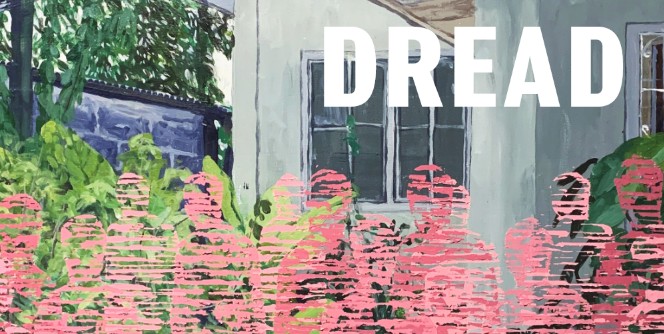
Here is the cover, designed by Tiani Kennedy with cover art by Carzen Arpa Esprela:
R. A. Villanueva: There’s about a decade between my first book, Reliquaria, and A Holy Dread. In that time, I’ve continued a creative practice that’s sustained me through the attendant bewilderments and blessings of keeping alive: year after year, I carry a small, lined journal of notes and ephemera, quotes and sketches with me everywhere; in myriad ways, those commonplace books couple with the digital bookmarks I keep, and an ever-mutating folder synced to my devices named “Catalysts, &c.” where I drop paintings, PDFs, screenshots of group chats, scans of photographs, and more. The combination of those materials is charged with meaning, strangeness, brilliance, surprise.
The consistency and devotion to this wildly personal curatorial work has been a comfort for me—a way to remix the beautiful volatility of the world’s texts with my own fixations, my anxieties, and my ongoing desire to gather close and see anew.
So when the moment came to pair words with visuals, to turn toward cover designs, I found myself digging through drawers and shelves, searching for those books and their rhymes with with A Holy Dread. I eventually stacked them on the couch next to me, flipping through my doodles and lists, memories of gallery visits, lesson plans and lecture notes, diagrams and drafts.
I knew that I wanted the artwork to feature a Filipino painter. I wanted, too, for the image itself to call back to what I’ve been reckoning with across the body of my writing: the sacred and the mortal, the elegy and the praise song, the pressures of language and tradition, grief and gratitude.
With neon pink-fearlessness and heart, Carzen Arpa Esprela’s Full House (Ikot-ikot Po) brings dimension to all those hopes and hauntings. I was immediately drawn to the ghostly figures, their radiance and transcendence, their physicality and intimacy. They’re gathered on the front lawn, a family floating together and framed by luminous, all-caps, sans-serif type. I’m so thankful for the interplay of the title with the art—and how everything pulses with this affirmation from Sandra Cisneros: “We do this because the world we live in is a house on fire and the people we love are burning.”
Tiani Kennedy: Designing the cover for A Holy Dread was an iterative and collaborative process. The artwork selected for the collection is visually rich; it’s full of movement, color, and layered symbolism. As a result, its complexity made it both inspiring and challenging to integrate clear, impactful typography. I explored several directions to understand how the image interacted with type and to align with the poet’s specific vision. As we refined concepts, we returned to an early idea with a clearer sense of what resonated. The final cover features bold, white typography that frames the haunting central imagery, ensuring legibility without sacrificing the artwork’s intensity. The result is a design that feels intentional and attuned to the emotional world of the poems.
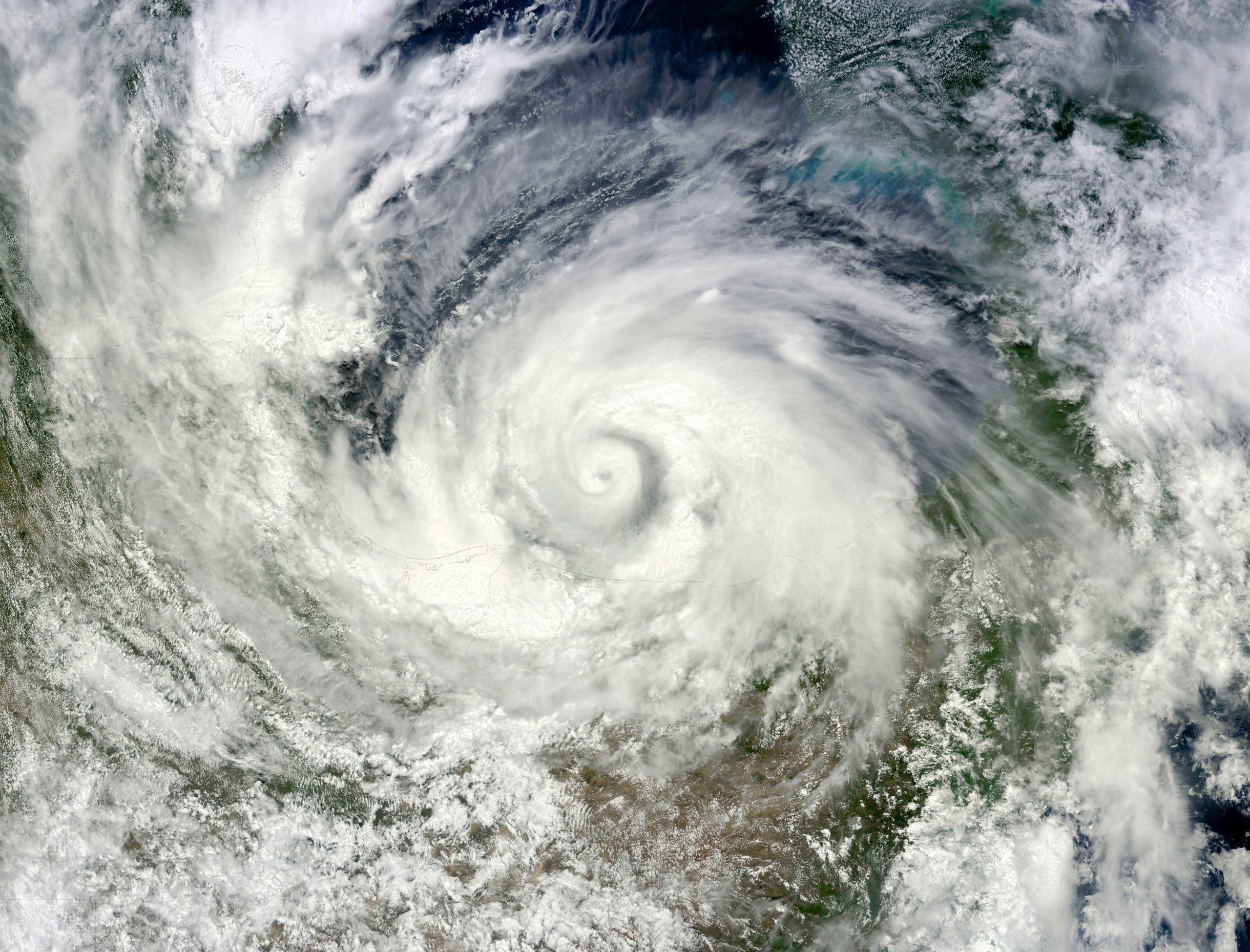
Over the dark Gulf, Hurricane Ida spins towards the coast of South Louisiana.
It is August 29, 2021, and she has spent all night sucking up warm, moist air. She has rapidly intensified into a Cat 4 monster. It is Sunday morning, it is the anniversary of Hurricane Katrina, it is six hours until landfall. Everyone evacuating has already evacuated. If you haven’t left by now, it is simply too late to leave.
I am driving through my neighborhood in New Orleans, turning off of Music Street. The roads are empty. My roommate is in Michigan, my neighbors on every side have packed up and fled, most of my friends are already sitting in twelve hours of traffic, trying to get to Austin, bickering with one another and sick of fumes. I’ve stayed because, by my arithmetic, I’m more likely to be useful than in need of rescue: Our street rarely floods and I have a truck that mostly works. I’d leave if the evacuation order was mandatory, but the mayor has now waited too long to make that call.
I turn up the dial of the radio. A local official is telling communities down around Jean Lafitte to get out, that they are expecting ten to twelve feet of storm surge to sweep through and over the communities not protected by the Army Corps’ federal levee system.
“The storm surge we are anticipating will be unsurvivable.”She says it twice. “Unsurvivable.”
A common symptom of floods, of storms, of catastrophe crashing down is disaster heart.A ravenous, immediate hunger for closeness.
But that hunger drives us down bolder and more human paths. The hunger is loneliness made useful. Though to admit to loneliness can be a little humiliating, it is loneliness that has me eating candy bars at the refugee camp in Tulkarm. It is loneliness that has me awake at 3am in Kyiv, listening to the rap-rap-rap of defense forces. Loneliness that drives me again and again over the flooded roads of South Louisiana.
If you are reading this with a hungry heart, if you jerk and slide towards horror in the blue light of a silent television screen playing impossible news—it is no surprise. You might be experiencing it too.
On the day of the storm, everyone gets to decide where to ride it out, like disaster companionship musical chairs.
My friend Cassi, a dreamy willow of a woman, who rescues baby crows and seduces the local trumpet players, chooses my house to hunker down. She brings her two cats. It is four hours to landfall, and Ida is spinning towards the oil and gas town of Port Fourchon.
A common symptom of floods, of storms, of catastrophe crashing down is disaster heart.
Here on Music Street, the ground is littered with needles, the little orange safety caps of syringes. The condemned flophouse kitty-corner to us used a long metal key to turn their water back on and sometimes they give themselves hasty rag baths on the sidewalk. Everyone calls it The Lips House because in their erratic and colorful stabs at home decor they have affixed a large Rolling Stones lips installation above the front door. Three hours to landfall. I know their names and they know mine and I know their stories; Gary, the primary dealer, has half a face of tattoos, and he amputated his dog’s legs himself in the kitchen because he used to be a vet, or at least he went to veterinary school for a year. Two hours to landfall. Raydell and Cornell usually sleep on the abandoned porches across the street: Cornell sleeps on the porch of the house he grew up in, decades ago, before his dogs died in Katrina and gunshots left him with a colostomy bag. Throughout the summer, I’ve made them sandwiches and taken them to the DMV to get their IDs—tiny basic gestures the government should, by rights, be providing. In six months, they’ll both have housing again, thanks to hard-fought HUD vouchers. In two years, Cornell will be dead, having ODed alone in the apartment he finally moved into. Dead of being alone. But now it is August 2021, and everyone is still alive. One hour until Ida makes landfall.
In my house I’ve stocked the following:
An axe to chop through the roof in case of flooding.
A kayak to float the streets for rescue.
A large and foldable knife in case of men.
As Ida approaches the coast, she pushes the ocean before her. She dumps a foot and a half of rain across the Gulf. After dark, storm surge overtops the levee in multiple parishes and six feet of water sweeps into the little towns outside the federal levee protection system, into Jean Lafitte and Oakville and White Ditch. Ida picks up ton upon ton of floton—a local term for shallow-rooted marsh vegetation that I have never found in any dictionary—and drops it across Lafitte, leaving a mess that will take months to clean up. Boats in the canals of Terrebonne Parish splinter and sink.
Ida crashes into Port Fourchon and her winds reach 150mph, driving inland storm surge fifteen feet high. She pushes the Mississippi into reverse, rolls train cars off their tracks and whole trailers off their foundation, leaving them upside down. In Houma, she rips roofs into the air, drops them across the street, snaps telephone poles at their base for miles up and down the bayou.
In my living room in New Orleans, as the rain goes sideways and the light drains out of the sky, I pace from the front door to the kitchen and back, too nervous to sit down or stop drinking.
“Do you want to play cards or something?” asks Cassi, lounging on the couch and turning her blue spotlight eyes out the door. For now, we’re keeping it wide open, to watch the lashing rain through the screen.
“I can’t concentrate,” I tell her. “But maybe we can listen to music.”
Cassi puts Chopin on my record player and we try to dance like ballerinas, lifting our legs in clumsy plies. We are drunk. Down the street, though I don’t know it yet, the winds are pulling down a brick wall and smashing the side mirror off my truck.
An hour later, Cassi and I see a Lips House neighbor trying to push his van out of a rapidly flooding ditch. We rush outside into the shrieking rain and heave, the metal slick from the downpour, water licking our calves. One, two, three; we heave it free.
“Thank you!” he screams over the sound of the wind. “Jesus Christ, thanks!” And we sprint back inside, howling with something like joy.
After darkness falls completely, somewhere on the rim of the Mississippi River, Ida pulls her next great trick: She rips the screeching, shrieking metal of an entire 475-foot high electrical tower down and hurls it into the thrashing water, snarls the transmission lines and throws them down there too. When transformer boxes blow, one after another after another in great blazing pops, their light is a faint, dull green, like the distant spell of a witch.
Around 8pm, every light left across Orleans Parish blinks off at once.
The internet goes. Then the phone signal goes, too.
And with that, something impossibly rare has happened to us: We are alone.
The post-Ida blackout happens to coincide with me writing a novel about an electrical grid failure amidst a heat wave. So I already knew about our grid’s fragility—I’d talked to experts who used phrases like “matter of time” and “held together by prayers.” And I knew heat was climate change’s biggest killer. But in the days after Ida, I learn quickly that I didn’t understand heat yet. Not really.
In the United States, the counties most likely to experience dangerous “wet bulb” conditions are clustered in southern Texas and Louisiana. Wet bulb is a way of measuring both temperature and humidity, and how it really feels to be outside, soaked in sweat. When it’s really humid, scary humid, sweat stops evaporating from your skin. It stops doing its cooling work. Phoenix’s blazing sun and burning sidewalks may claim heat notoriety, may leave horrific second-degree burns, but it is these Louisiana nights—when humidity never slacks, when the air is wet wool, when sweat only pools, when there is simply no relief—that pose the quiet danger.
“Heat is sneaky,” an expert told me once. When you’re in danger, you don’t always realize you’re in danger. All night your heart hammers, its muscles pushing blood to the surface of your skin, seeking coolness. The body begs. The heart exhausts itself.
But before all that, before the heat, before the death, before the blackness of unlit nights—what nobody tells you is that the morning following a major hurricane, the world is green, green, green.
The terrible winds have spent all night pulling down leaves, whole branches, ripping entire living trees to the ground, and so for a few hours—before the cleanup begins, before the oak even realizes it’s dead—every street, every sidewalk is covered in bright green life. It is stunning. The winds have blown off the humidity for once, and the sun is out, and it’s the most beautiful, breezy, perfect day we’ve felt in months.
For hours, Cassi and I bike around town, checking on the homes of absent friends: You’re okay, we tell each other; you’re okay.
Debris and stray roofing nails turn our tires flat, and then we’re on foot. Everyone who stayed is outside, on the street. The restaurants empty their walk-in fridges, feeding everybody before the food goes bad. Cassi and I devour plates of eggs and bacon and gulp down Bloody Marys on a sidewalk near the French Quarter. Everything is free.
“You’re okay,” we say, a little tipsy now, until we reach Cassi’s home and see how the trees have shattered across her courtyard, crushed cars. We have to climb over them to reach her front door. You’re okay, I say, touching her back as she keels over.
“Is there anything you need?” we ask each other, ask everyone we run into. We change a flat tire. We take water bottles out of the dark freezer, quickly as we can, and roll them on our necks, hand them around, give some to Raydell and Cornell.
In the evening, we sit on our friend Nick’s porch and watch as the tough neighborhood women lovingly dubbed The Lesbian Mafia set up a table with pots of gumbo and jasmine rice and feed every single person who shows up and asks.
And with that, something impossibly rare has happened to us: We are alone.
A neighborhood woman joins the line for gumbo, speaking closely and cheerfully to a younger, dark-haired woman holding a child’s hand. “Es como un guiso,” the neighbor says to the mother. The mother and child just arrived here from Honduras six days ago. It is their first hurricane. It is their first gumbo. The neighbor just met her this morning and has taken on translation duties. She makes the kid laugh. The Lesbian Mafia heaps food into her bowl. The mother tastes it, nods in approval, adds hot sauce. There is no electricity. Everything is still free.
The end of the world makes you want to find somebody. Every end of the world—even the small apocalypses—drive us into one another’s arms.
Former UN peacekeeper Heidi Postlewait spoke of the “emergency sex” colleagues had with one another amidst the horrors in Somalia and Haiti.
During the earliest, murmuring days of COVID, before we knew what was really happening, I stood in the middle of my street on a humid evening with cicadas screaming and licked my friend’s face, drew my tongue from chin to forehead.
Fear makes us touch-hungry. If there’s any blessing hidden in the apocalypse, it is that it cracks us open.
One by one, we leave Nick’s porch and the gumbo table. Cassi goes to her ex-lover’s house. Since it’s the end of the world we all breathe a little sigh of relief; if the world has ended, then nobody cares who anybody else is having sex with. Make your mistakes deliciously. Though I have no arms to be driven into. There’s simply nobody in town that I want, no container around to pour my desire into; my hunger has no place to go.
But there are others who consider wielding a startling violence to meet their every appetite. Which means, that night, a man follows me home.
No one else is around. And without streetlights, it is dark, completely dark in a brand new way. I’m wearing a headlamp as I bike home on a patched tube. A white van turns the corner behind me. Then it stops when I stop in front of my house.
I climb off my bike and lean it against the stoop, knees bent, heart pounding from heat and the slow itch of fear. The man, young, white, grips the steering wheel and stares out the window at me. He is tense, silent, considering, about to lurch. There are no lights, and there are no people, and there are no emergency services, even if I could call.
I’ve stupidly left my knife inside.
“What?” I snarl at the man, suddenly aggressive for no reason I can name. “WHAT?”
It will be unsurvivable. Unsurvivable.
I think it’s the headlamp that saves me. Pointed at him, I can see his face, his hesitant but hungry expression. But he can’t see mine.
Ten long, long seconds pass. And then he slams the accelerator and speeds off.
Halfway down the block, he screams back through the window at me: “You know what, bitch!”
I do. I do know.
Raydell and Cornell have gone, but I tell the sweetheart junkies I don’t recognize on the porch across the street what happened, my heart hammering. We shake hands and they promise to keep an eye out for me because at the end of the world, it’s your neighbors, whoever they might be, who will keep you safe. I go inside and lock every deadbolt, keep my candles away from the windows. In the wall behind my bed, a family of mice chatter and sing. For hours, I lie awake. No one else is in my home, or the home next door, or across the street, or behind me. The electricity won’t be back for a week or two and it has started to pour again. To anyone on the street looking at the dark windows all around, it’s obvious I’m in here alone.
I finally reach Cassi, and she and her ex-lover and a roommate all together pick me up. Neighbors keeping each other safe. I dart through the rain and dive into their car, they bring me home, and in a house with other bodies I collapse onto a couch that isn’t mine and I sleep and sleep and sleep.
There follow days and nights of brutal, mind-warping heat, impossible sleep, bath-warm bottled water, garden hose showers in the yard. Hearts are pounding all the time. There is no time of day or night when it cools off.
Across the city, people who live alone are the ones who die—slowly at first, then faster. They die of heat in senior centers. They die of heat in apartments. They die of weak hearts and heat, of a combination of antidepressants and alcohol and brutal, brutalizing heat. Sometimes, their bodies aren’t discovered for days, until someone notices flies in the window, buzzing against the glass, tick, tick.
On the fourth day I run into Rafael, my neighbor who lives with his girlfriend in a camper across the street.
If there’s any blessing hidden in the apocalypse, it is that it cracks us open.
“We’re looking for volunteers,” he says, breathless, gesturing behind himself with his phone, “They’re evacuating everyone at the senior center. They found a body.”
The senior center is three blocks away. The EMS crews haven’t arrived yet, so instead, a dozen of us are slowly climbing up and down the flights of stairs, knocking one by one on apartment doors, checking for life. Without power, the upper floors and the dark stairwell are sweltering. Sweat pours down my neck as I pass Rafael and his girlfriend, helping an elderly woman down the stairs one excruciating step at a time. The elevators are out, the air conditioning is out, refrigerators are out. People had no way to chill their insulin or charge their nebulizers or call their grandchildren for help. The hallways are dim, the air chokingly still.
“These ones are checked,” a drenched, middle-aged man tells me, thumbing behind him. He and I walk the last corridor of the fourth floor.
“Anybody in here?” we call, knocking on the doors, one by one. We gently push inside, bracing for bodies. The smells of spoiled food drift from inside. Utter silence under our voices; no background hum of electronics. We knock, push the door open: This room’s abandoned. Heat deaths are difficult to diagnose in an autopsy. It looks like the heart simply gave up. Knock, knock: In the last room, a woman is slowly gathering her medications into a green, fake leather purse.
“Where we going?” she asks us, just above a gasp. All the windows are closed. It’s hard to imagine spending an hour in this smothering heat, never mind four days.
“Just downstairs,” we say, pointing out the window to where ambulances have now begun to arrive. We guide her by the elbow down the stairs as the paramedics walk up.
In the end, nineteen people in New Orleans die of heat in the post-Ida blackout. Most of them are elderly, and most of them are Black, and most of them are living alone.
After six days, I surrender.
I drive to Texas to meet an Alaskan crabber I’d been seeing who fled before the storm hit land. The crabber isn’t exactly who I want, but it’s the desire, the loneliness, that slowly sets me spinning down a useful path.
The crabber and I drive down to the bayous of south Louisiana to deliver aid and supplies, and we discover that there, it really is the end of the world. For Pointe aux Chien, for Dulac, for Isle de Jean Charles—this country’s first federally-recognized climate refugees, already pushed from their homes—this is a true apocalypse. Home after home after home has been blown open atop the already rapidly-dissolving land. It will take months, years, to put it back together. The wetlands that the storm ripped up will likely never come back.
It’s down there where I meet Sherri Parfait, Chief of the Biloxi-Chitimacha-Choctaw. She is a mom of three with a librarian’s glasses who tells me about their doomed future, how they’ll all have to pick up and relocate as the land erodes. Her telling of this obsesses me. Her voice pricks at me for weeks, as does the strange post-disaster glimpse into another world, with no money and no cop cars, with every neighbor sharing food and ice, walking one another to safety through dark halls of heat.
When you understand loneliness as a useful form of desire, it all becomes easier to bear.
From Dulac to New Orleans I witnessed what Rebecca Solnit calls the “paradise built in hell,” the documented socio-cultural phenomenon of kindness and solidarity that takes place immediately after disasters, in those heady days and weeks when people discover that this can feed their hunger for connection, for meaning, for immediacy.
We get communal goodwill in the wake of a disaster, yes, but also on top of that, we get apocalypse pleasure. Apocalypse recklessness. And with this, many more things become possible. Yes, today storms and jackboots are at the collective door, but if the future is foreshortened, then our mental calculus of acceptable risk—physical, emotional—must also change.
The wreckage down the bayou, Chief Parfait-Dardar’s tribe—they drive me to pitch my very first reported story, which launches me into journalism, changing my life, to Kyiv and Nablus and Ramallah, driving me to stand outside the razor wire of LaSalle Immigration Detention Center, where I interview the friends and family and rabbis and lawyers who refuse to let Mahmoud Khalil be made alone.
Maybe we are better off thinking of loneliness this way: Not as a lack, but as a drive, a hunger to gather the world towards yourself. A delirious craving to suck the blood out of life. When you understand loneliness as a useful form of desire, it all becomes easier to bear. Then loneliness becomes a sort of gift.
I think by now we all know about the weather. We are, of course, facing down a true apocalypse. In the coming decades, temperatures will (further) soar, hurricanes will (further) strengthen, glaciers will crack and calve, seas will rise, and if I live to be my grandmother’s age, I will see up to three billion people pushed outside the temperature niche, living in an “uninhabitable zone,” three billion strangers stalked by conditions that are simply too hot to endure, hotter than Ida’s nights. Unsurvivable, said the radio.
Here we are at the end of the world, driven into one another’s arms. Here we are as disaster heart pushes us toward one another. We are grasping.
There are many tools and technologies to hide from that feeling now. Businesses built as escape hatches from the messiness of human grasping for connection. But please: let yourself be lonely. Let it push you out the door. Drive to Texas in the middle of the night. Walk towards the sirens. Brave the heat. Knock on the stranger’s door even though you told yourself you would under no circumstances let yourself knock on a stranger’s door again. Stand in front of the riot police shields. Loop your arm with strangers who share no language with you except the demand for protection, before the splintering glass of the bus stops, the smoke and crack of rubber bullets. Loneliness can make us better; might just save our lives, if we let it.
In the morning after Ida, we glimpsed the new world. Before our tires went flat, Cassi and I biked to the Lower Ninth Ward, where a grocery store had burned down overnight. Among the smoldering ash, we picked with strangers through the remainders, boiled candy-colored Big Shot sodas and scorched cigarette packs. Someone had already pried open the ATM, and when I reach in, I pulled out handfuls of burned $20 bills that dissolved into ash in my palm, and with a breeze, they blow away. We’ve stumbled into a world without money, or before money, operating on the logic of children, without taxes or shame, picking through an obstacle course and looking for treats. We didn’t need the burned-up cash, anyhow. Everything was free.
Recently, I lamented an obnoxiously writerly desire to my husband: I wish I had more of a window into other people’s lives.
He gave me a puzzled look. “Katie,” he said. “You’re an editor. A personal narrative editor.”
This made me laugh out loud. Of course! How obvious. I’d been too busy imagining something more literal—going inside people’s homes or something, like in a Samanta Schweblin story. It’s a desire born from a larger want: to better understand others, to connect more deeply. But this is, indeed, a privilege I already have, and one I hope to never take for granted. Through reading, editing, and publishing personal narratives, I spend each day connecting intimately with writers and their personal stories. And while I might get to do this more than most, it’s something any of us, as readers, can do. To engage with art is to be a voyeur of sorts, one who peers only into windows left intentionally open. We look with a goal of better understanding one another or ourselves or—more often than not—a bit of both. It’s through this looking that we become more expansive, and more bound to our collective humanity.
Each of the essays below, our most popular of the year, is a window into a distinctive life and moment, each unique and emotionally resonant. This year, our readers were especially drawn toward reflections on the meaning of home and the forces that shape us in youth. In “Southings,” Thomas Dai reflects on how the American South has stayed with him many years after moving away, probing the meaning and experience of being an Asian Southerner. Maggie Andersen’s “Bus Chasers” looks back on how her father guided her through her hometown of Chicago—where she still lives in the home she grew up in, now a parent herself. In “That Old House,” after moving back to the New England of her youth, Lydia C. Buchanan faces down a reality shared by many: What happens when you realize you want to own a home but may never be able to afford it? All five of these essays take on similar topics and feelings, but their authors shift the prism each time, such that they become brand new.
Take a walk back through our most-read personal narratives of 2025, where you can peer into the open window of someone else’s life, and maybe find a piece of yourself in the process.
In “M.A.S.H,” Sarah Gerard details her experiences with mistreatment at the hands of predatory men, particularly one who worked at her father’s advertising firm. The piece is punctuated by painfully clear markers of awkward tweenage years and subtly pervasive sexism. Through variations on the refrain “It was a different time” and meditations on the fickle nature of memory, Gerard’s essay stands out as a powerful testament to the lifelong impact of a cultural disregard for the wellbeing of young girls.
You might know the feeling of coming across the house: The one in the nice neighborhood you travel through on the way to your (far less charming) home, the one that calls to you; almost convinces you that home ownership couldn’t possibly be as arduous as you’ve been led to believe, the one that makes you overwhelmingly jealous of the exceedingly lucky family inhabiting it. In “That Old House,” Lydia C. Buchanan considers the impossibility of owning this perfect home, writing: “We have things our parents had—Puritan work ethics and loves of beauty—and things our parents didn’t have—graduate degrees and student loans and two-career households—but property ownership isn’t for us.” In an age of horrible housing prospects, anyone who has chased their literary dreams at the expense of financial stability will relate to Buchanan’s lament.
Mariana Serapicos takes readers on a journey through life before, during, and after her father’s battle with ALS in “When The Ocean Retreats.” Serapicos reflects on the strain of losing a parent to a debilitating disease while crafting a beautifully rendered portrait of her dad and his influence. Oscillating between a myriad of memories and places, this heartfelt essay pays close attention to the value of record-keeping and learning how to move forward after loss.
From cicada shells to blue mountains, stunning images of the South abound in “Southings.” Thomas Dai writes concisely about what it means to consider a place—including both the bad and the beautiful—your home. Excerpted from the memoir-in-essays Take My Name But Say It Slow, Dai’s considerations of the American South, immigrant identity, and the experience of being an Asian Southerner are compelling and truthful.
Fueled by the turbulence of Chicago’s busy streets and the process of adapting to adulthood, Maggie Andersen’s “The Bus Chasers” is an essay about the lessons parents teach their children through unwavering, well-intentioned guidance. Throughout the essay, Andersen references her father’s internal map of Chicago, marked by historical anecdotes, landmarks, and direct paths to the best diners. As her father’s map once guided her while she navigated bus rides and a new school, Andersen finds the same support as she enters motherhood and a new chapter of her life.
I was busy massaging the kale for my lunch salad so I didn’t have a free hand to jiggle the mouse to make the little yellow dot on my screen go green so my coworkers could see I was being productive. So I attached a third arm to my ribs on my left side. Contrary to what you might think, it didn’t start trying to jerk me off right away; it took a couple hours. I tried brushing it away with my right hand, but after a minute there it went again, stroking my thigh and fingering at my zipper. I’d always had a rule to not jerk off at work even though literally no one would know. Plus anyway my mom was in the other room folding laundry and watching her daytime talk shows—I’m living back at home temporarily—and I worried she might overhear.
So as a workaround I attached a fourth arm and instructed it to stand guard over my crotch. It got bored with its assignment quickly but found it enjoyed playing thumb war with my horny third hand and that was enough to keep them both occupied. By this point Mom had finished The Drew Barrymore Show and was talking to her mom on the phone, repeating every third word louder and with more articulation. Grandma insists on keeping her landline right next to her TV, which she always has on full volume.
My original two hands were now busy exaggerating then de-exaggerating the contrast on photos and occasionally replying with laughy face emojis to memes my coworkers shared. I was getting pretty overextended so I installed a fifth arm to wipe the sweat from my brow and a sixth to order me a venti iced coffee from Postmates. Unfortunately these two arms immediately began slapping and pinching the shit out of each other. It was almost quitting time—and I tell you, I was watching the clock close that day, imagining the smooth Black Label bourbon I was going to pull from Dad’s special store as soon as the hour hand hit five—when the sixth arm suddenly took the third arm hostage and threatened to break its thumb if the fifth arm didn’t detach itself and run along. I sighed and gave my fifth arm a little nod and it did as it was told. I followed as he scrabbled pathetically down the carpeted hallway and out the front door, which Mom had left open when she went to go water her flowers.
I never saw that fifth arm again, though every time I hear a news report about a severed arm being found in the woods, or near the wreckage of a multi-car pile-up, I wonder if it was him, that arm I never really got to know, distracted as I was when he was a part of me.
For now I was left standing on the front porch, watching Mom struggle to wrestle the kinked garden hose toward her hydrangeas with one hand while trying to keep the wind from ripping away her canary yellow sun hat with the other. Her pink Skechers kept slipping in the wet grass, mud freckling the knees of her pale capri jeans.
None of this was necessary. Didn’t she know they sold arms custom-built for gardening? Better yet, Dad could pay to have one of those automated sprinkler systems installed, the ones controllable via an app on your phone. Then Mom wouldn’t even have to set down her sangria glass.
The flick of a finger would be enough to open the heavens.
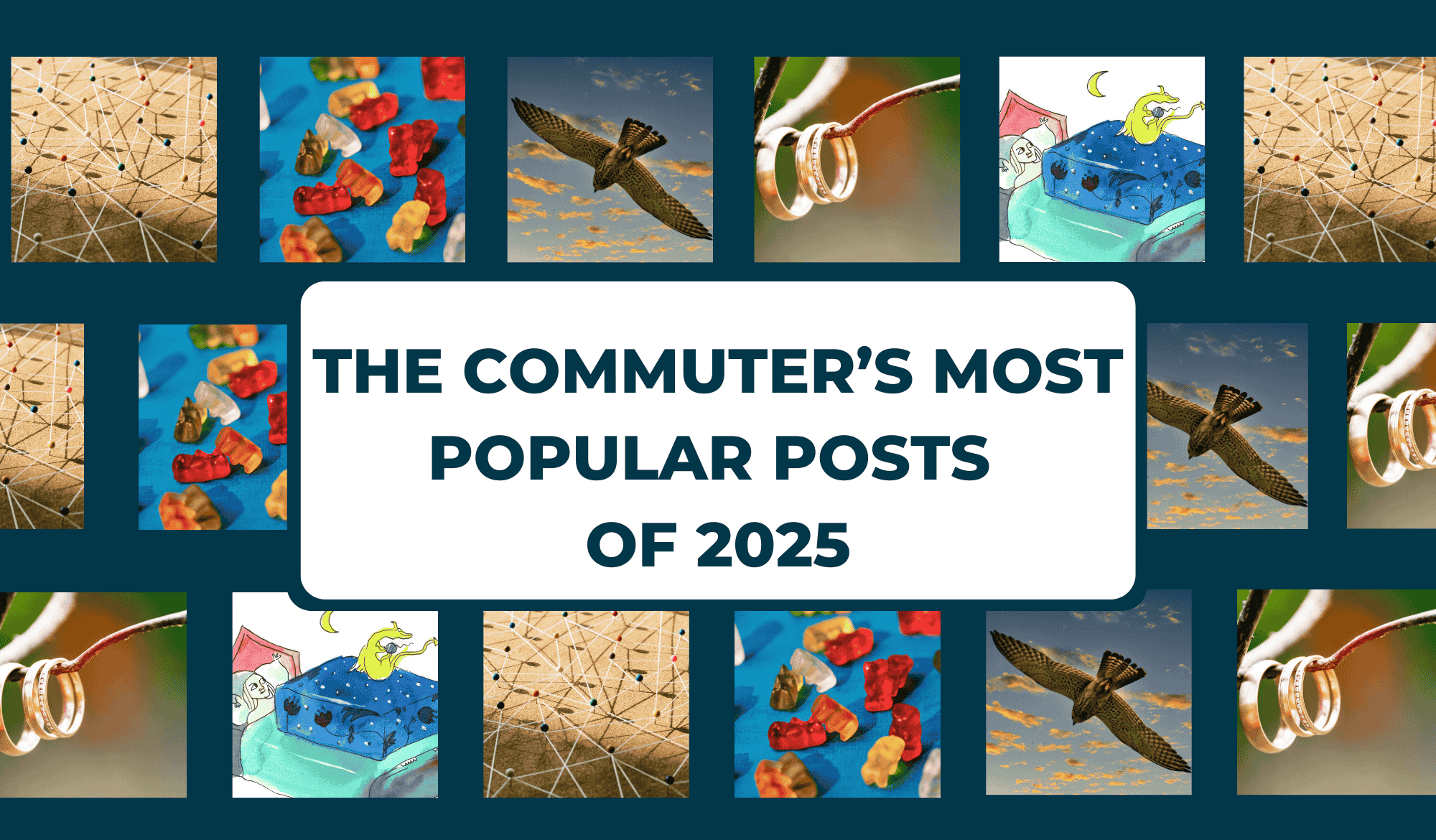
We published 50 issues in 2025—The Commuter’s eighth year of publication—including our milestone 400th. In keeping with Commuter tradition, 98% of these were selected through open submissions. We publish poetry, short prose, and graphic narrative from a range of debuting to established authors, and our full archives are always free to read.
Judging by the posts that were most popular with our readers, 2025 was a year for the literary and irreverent, as well as the horny and deeply reverent. It was a year for poignant explorations of grief and loss and love. And above all, it was a year for calling out one of the most malicious and all-powerful forces hell-bent on destroying our society: The New York Times Connections puzzle.
In this flash fiction by Pardis Parker, an unhinged New York Times word-game creator designs puzzles so diabolical that players spiral from irritation into full-blown madness, triggering the end of relationships, outbreaks of violence, and—eventually—wars that lead to the end of the world as we know it. A taste of his devious word play: “I group together the words CIRCLE, HORSESHOE, PITCHFORK, and TRIANGLE. People try to find the common link. Instruments? Games? The American west? I inform everyone that the words are all shapes of capital Greek letters.”
Andrea Jurjević offers two phenomenally sharp, delightful poems. The first, “Pussy Smoke,” exemplifies a “poetry of profanity,” even as she notes that “some of my readers find my cussing to be a motherfucking pain in the dick.” The second poem, “Summer of ’69,” is cleverly constructed and captures a beautifully disorienting longing.
Part remembrance, part elegy, part quiet testament to the memories that people leave behind, this story by J. Condra Smith was chosen by Ottessa Moshfegh as the winner of the 2025 Stella Kupferberg Memorial Short Story Prize. In it, a grandchild tends to two inheritances left by their recently passed Abuela—a community orchard and a rescued kestrel—each becoming a vessel of shared memory and lingering presence. “Maybe it’s just the way imagination gets stirred into memory,” the narrator reflects, “but I swear there was a time you could watch each tree tilting on its axis. Warming to the glow of her.”
In this piece of flash creative nonfiction by Melanie Faranello, a thirteen-year-old finds an old wedding ring, and a mother must once again face her insecurities about her husband’s first wife, who died suddenly from a heart attack. She’s forced to question her idea of love as being “singular, finite, that in each of our romantic luscious hearts, there is a space reserved for that mysterious one and only.”
This graphic narrative by Miriam Jayaratna, Amanda Lehr, and Jenny Kroik is an irreverent riff on Mary Oliver’s iconic poem “Wild Geese.” It explores the small, sometimes peculiar comforts the body yearns for, like “putting Bugles on the ends of your fingers to make cunning little claws” because, as the story notes, “you do not have to be good.”
At the end of every year, Electric Literature collects its most-read stories, essays, and articles. The intent is to highlight the work that especially resonated with readers, but—for me, at least—it’s also an opportunity to speculate about why. Last year, the most popular Recommended Reading stories inhabited liminal spaces; the emphasis was on perspective shifts, moments of transition, revised understandings of past events. This year, whether it’s my own inborn cynicism or the function of what has felt like a very long year, I think writers and readers are preoccupied with aftermath. The world isn’t changing—it’s changed. And not necessarily for the better.
In the most popular excerpt of the year, from Hannah Pittard’s autofictional novel If You Love It, Let It Kill You, the question isn’t “How do you tell the story of a relationship?” but rather “When a relationship ends, who gets to write its obituary—and how much of it has to be true?” In Kevin Wilson’s “All Stories,” which also features a writer-narrator, the plot begins after the cataclysmic event: “I’d driven my car into a tree on purpose,” the narrator tells us, “and returned to consciousness a week later with a huge scar on the right side of my face.” The story isn’t about the self-inflicted accident, it’s about the life that unfolds after it, about struggling to exist after you’ve discovered something frightening lives inside you.
“Gondola” by Etgar Keret is, superficially, lighter fare. In the opening scenes, a woman knowingly begins an affair with a man who is married—a circumstance he transparently assures her will never change. The aftermath here should be obvious—affairs cross lines and push boundaries and change lives. In Keret’s hands, however, the lines and boundaries and lives are off-kilter, and the consequences are wholly unexpected.
Aaron Gwyn’s “The Cattleman” and Samantha Xiao Cody’s “Blood Makes a Bad Dye” also take sidelong looks at a world remade. In each, the protagonist is set on a canonical trajectory. The cowboy confronts lawlessness in the classic western. The girl faces social pressures and cultural expectations in the coming-of-age tale. And yet, in both, it’s not the familiarity of the arc that keeps the reader reading. It’s the suspicion that the cowboy and the girl are not archetypes. It’s the impulse to understand how it ends.
Recommended Reading’s most popular issue of the year is an excerpt from Hannah Pittard’s candidly intimate novel If You Love It, Let It Kill You. As recommender Maggie Smith puts it, the novel is “about having joint custody of a relationship, and of the memories made in that relationship, and therefore of the story.” The excerpt follows a writer whose ex publishes a novel, “allegedly about our toddler of a marriage and his affair with my dear friend,” and the resulting impact on her present relationship and life as an academic. Beyond the specificity of detail in the novel, there’s a core of truth that extends beyond the central drama, capturing the realities of middle age and the relationships and losses we collect as we get older.
It’s no surprise that Aaron Gwyn’s striking interpolation of the Western was popular with readers this year. The story follows an Oklahoma cattle rancher in the 1970s. He’s losing money on his ranch, his wife wants to move to the city, and relations with the surrounding community are tense. To complicate matters, he finds two of his cows mutilated with surgical precision, and no obvious culprit to pin the crime on. EL’s Managing Editor, Wynter K Miller, aptly describes the appeal of Gwyn’s narrative flourish, as “it positions the reader in a familiar story with familiar archetypes—and then lets them unravel.” Utilizing paranoia and the eeriness of its rural setting, Gwyn turns a familiar narrative on its head, with a truly astonishing result.
Kevin Wilson’s “All Stories” follows a struggling undergraduate student who is socially isolated, barely getting by in school, and overwhelmed with disaffection. When he begins taking a creative writing class, fiction becomes a beacon of meaning and purpose. As Michigan Quarterly Review editor Polly Rosenwaike puts it, “The crisp prose moves our dejected guy forward in an almost buoyant way. And the story soon offers him hope—in the form of fiction and friendship.” This hope deepens the emotional resonance of our narrator’s despair, and speaks not only to the story’s success but to its resounding truth.
“Blood Makes a Bad Dye”—a stunning debut from Samantha Xiao Cody—is a coming-of-age story about identity and belonging, assimilation and desire. Cody’s protagonist is a Chinese American teen charting a new friendship with the popular, resolutely American Quinnie. The narrator’s efforts to assimilate into Quinnie’s gaggle of American teendom are complicated by her cultural roots and lack of experience, as well as by her mother’s vivid presence. EL Associate Editor Preety Sidhu writes of the narrator’s transformation as the discovery of “a desire even more powerful than emulation or seduction.” With vibrant prose and keen attention to the discomfort of adolescence, “Blood Makes a Bad Dye” captures something unexpected about identity, power, and the role that cultural upbringing plays in the stories we tell.
Etgar Keret’s “Gondola” is, on its surface, a story about an affair. However, as readers of Keret know, any supposedly simple trope extends like an iceberg beneath the surface of his prose. “Gondola” follows Dorit, who begins a relationship with the idiosyncratic Oshik, a married man paradoxically looking for a serious relationship. The story unfolds with precise awareness of a reader’s expectations, both subverting and confounding them. As recommender Aimee Bender so eloquently puts it: “A shiny Keret conceit is always in the service of the real, of plumbing the depths to reveal something true about how we relate.” In “Gondola,” the quirks and desires of the characters come to reflect the social and political circumstances that surround them, and the responsibilities that emerge with intimacy.
Fátima Vélez’s Galápagos is a plague novel unlike any other. Lorenzo’s body is disintegrating, his nails are falling off one by one. He takes this as an opportunity for one final journey, charting a course for the Galápagos Islands. His friends and lovers join him on the voyage, drinking wine and eating manchego cheese aboard the Bumfuck as their bodies decompose. Yet their creativity persists even as death presses in, and they swap stories on deck that challenge each others’ sense of love, loyalty, and mortality. In Vélez’s hands, illness is not just an affliction of the body but a force that reshapes language, desire, and art itself.
Hannah Kauders’s English translation captures the strangeness and poetry of Vélez’s prose, which bends syntax and genre, and blurs the line between the grotesque and the sublime. Translating Galápagos required both precision and irreverence: willingness to break linguistic rules, as Vélez does, and dedication to honor the unique style of the original rather than smooth it away.
I spoke with Kauders about how she navigated the book’s queered language, the grotesque humor in her translation, and the story’s haunting themes of art making, contagion, and survival.
Shoshana Akabas: How did you first encounter this book, and what made you want to translate it?
Hannah Kauders: I first found Galápagos through the book’s agent. I was having a coffee with Maria, and she asked me what kind of book I would be interested in translating, which is not a question that anyone had ever asked me before!
I told her I really wanted a project that would be creatively challenging. At that moment in my life, I was longing for something really absorbing to translate, something that would push me to my limits. And I was also interested in working on a book that had queer narratives, or engaged with queered language. Never in my wildest dreams did I imagine that book actually existed. And in fact, it did!
Galápagos is very interested in the inequity that’s built into the fabric of language.
SA: You mention queered language, which I know can be a translation challenge. How did you navigate translating a gendered language like Spanish to a non-gendered language like English?
HK: What’s really helpful about the book is how interested its narrative is in the subversion of that genderedness in language. For example, Paz María, the best friend of the narrator, has boy-girl twins, and she’s very averse to labeling them in the gendered “hijos” [children] (which is gendered male in Spanish), because she has one boy and one girl. She says it’s unfair. And Lorenzo responds, “language is unfair.”
Galápagos is very interested in the inequity that’s built into the fabric of language and how language creates limits in what can be expressed. And so, thankfully, because Fátima is interested in that subversion, I felt license to break the rules in the same way she did.
But because we have more gender-neutral language in English when it comes to words like “children,” it created a new challenge, which was to use the gender-neutral language while drawing attention to the fact that the language was gendered in the original Spanish.
SA: I noticed you left “hijos” untranslated. How did you decide to do that?
HK: Oftentimes when a word gets left in the original language, it’s because, either consciously or not, there’s some desire on the part of a translator (or even an editor) to inject moments of local flair into a text. And I don’t always think that’s a responsible choice. But because Fátima was problematizing the language, I felt like I had permission to keep it that way.
SA: What were some of the other challenges that you encountered in translating this book?
HK: The elements that made this book so exciting were precisely what made it difficult to translate.
SA: You said you wanted a challenge!
HK: I got what I wanted, and it was more difficult than I ever expected. This is a book that defies traditional elements of narrative at every level—at a level of plot, narrative arc, but also at the sentence level. Fátima is a poet, and it’s so clear reading her work that she has a passion for the line. For me, one of the big challenges is that Spanish is so much more syntactically flexible than English. And Fátima took every opportunity to do the kind of gymnastics that Spanish allows for—and that English absolutely does not allow for, because of our subject-verb-object structure. That structure is really hard to play with in English while also keeping things relatively intelligible.
Register was also a challenge, because the work really plays with this tension between literary and colloquial language. And as “fluent” as a translator is, sometimes it can be hard to pinpoint just how colloquial something is. I found myself having to ask a lot of questions, both of the author, but also my friend—just constantly bombarding him with questions: Is this something you read in a book? Is this something that you would hear aloud? If so, who would say this, and in what context? Just to get a sense of how colloquial, then, my translation needed to be.
I realized pretty quickly that I had to just jettison all hope that I would be able to replicate the order of things, but then I realized that it was a book that doesn’t seem particularly interested in the order of things.
SA: You mentioned asking the author questions. Some translators remain totally separate from the author or aren’t able to ask questions because the author is no longer alive. How did you decide when to consult the author? What was that relationship like?
As long as desire exists, a person will be vulnerable to contagion.
HK: I involved Fátima at the beginning when I was trying to get a vision of the book. I asked her a lot of questions about what inspired her to write it, who her references were from a literary perspective that inspired this style, but I did not ask her specific questions about my translation. I worried that I would lose my nerve if I asked her too many questions, so I saved all of my questions for the bitter end. Then I sent her a copy of the manuscript, and she went through this thing meticulously.
SA: Did you receive pushback on anything?
HK: There were some moments where my own need to try to make things seem logical was exposed. It was humbling. She had hundreds and hundreds of comments. We spent hours on Zoom, just going over every single thing. It was a team effort at the end.
EL: It’s a remarkable translation, and I found the sort of grotesque descriptions of physical deterioration quite striking. Can you talk about what role those passages play?
HK: What’s so beautiful about what Fátima does is that she replicates the feeling of being disfigured on the level of language. And at the same time, Lorenzo as a character has to contend with the fragility of his own body that is disintegrating.
This is part of the book’s claim: that art making is an embodied practice. It’s hard to make art if your body is in pain or ailing or uncomfortable. Lorenzo is fighting against his own embodiedness, and he has this inability to reckon with what’s actually happening to his body.
SA: Let’s talk about what’s actually happening to his body. AIDS is never explicitly mentioned, but there’s so much about illness in this book.
HK: Yeah, it’s definitely a plague novel. Fátima’s playing with this motif of storytelling in the time of plague, and she’s drawing that from a lot of things like The Decameron. She is very interested in what it means to tell stories in a time of plague or illness. So in some ways, it fits perfectly into what we might expect from a pandemic novel. What’s so interesting, though, is the way that desire is portrayed in relation to contagion. As long as desire exists, a person will be vulnerable to contagion.
SA: On the theme of storytelling and illness, I was really curious about the Galapagos as the backdrop. What sort of symbolic role does that play as the voyage destination in a book about storytelling and survival?
HK: The Galapagos is a landscape that is desolate if we look at it from the perspective of human habitation, but when we look at it from the perspective of a natural world that is so rich, as an environment, it puts these characters in their place and makes them feel their vulnerability. I can imagine it also felt rich to Fátima as the Galapagos has come to stand for extinction, the fragility of our ecosystem, and the fragility of human life.
SA: Aside from the setting, what else about this book feels specific to the South American landscape in which it was written?
HK: Right now in Latin America—Colombia has been my focus for the last few years—there’s been a rich wave of writers who are interested in how deeply the health of humanity and the health of the environment are intertwined. I think that this book in some ways exists in that tradition.
And I have to say, one thing I’ve noticed about the contemporary writers I’ve been reading—especially from Colombia—is a kind of openness to defying boundaries when it comes to genre, which I don’t think I’ve seen as much in contemporary literature in the US. It’s not because of a dearth of people writing that sort of work, but because of how risky it can feel to publish, and how difficult it might feel to market. So, I’m really excited that a book like this had an opportunity to find an audience in the US. Because frankly, I don’t think a lot of books like this in the US, written by writers inEnglish, are finding a home.
SA: Situated in the tradition of the plague novel, what was it like to translate this novel during the COVID pandemic?
HK: It’s precisely in the darkest times that we long to engage with weighty subjects in a way that feels irreverent. That irreverence was especially welcome to me. My father had just died when I translated this book. Approaching this as someone who had just lost a parent during the pandemic, not to COVID but to cancer, I came to the book in great need of that irreverence, because death was looming over my whole existence.
People who haven’t experienced that loss don’t really understand just how absurd everything feels when you’re grieving, how the texture of life itself feels like it’s been totally destabilized. So this book was a really welcome opportunity to just exist in that space of absurdity where I already found myself at that moment in time. So, in some ways, the timing made it especially difficult because of the subject matter, but the tone and Fátima’s approach stylistically to writing about death and dying felt very fresh and very free.
Frankly, I don’t think a lot of books like this in the US, written by writers inEnglish, are finding a home.
SA: What is something about the translation process, either for this book, or in general, that might surprise people?
HK: People think of art-making as something that we do in the mind. Translating this book was disconcerting a lot of the time because of the way that I would feel its effect in my body—and not just from hours slumped over with a red pen, but also because I had to be in this kind of consciousness where there is so much detail about how the body is breaking down, often portrayed in very unapologetic language that could not be less interested in propriety, that really embraces the scatological and grotesque. So, I felt my own embodiment all the time when I was translating. On the first page, Lorenzo gets a hangnail, and I swear to you I got a hangnail after, and I was like, “Oh my god, my body is unraveling, my skin is falling off, my body is breaking down.” And I think that’s actually what trained me to understand where Fátima’s interest lies in this book, which is precisely in the idea of contagion. I felt it in my body as a translator of the work. And more clearly than ever, I understood how fundamentally physical the activity of a book passing through the translator can be.
To hear a neighbor through the walls in my building, they need to be yelling, and we need to be right on top of each other. When I hear my downstairs neighbors fight, I’m usually in my breakfast nook. This morning, as I sip my coffee, the man’s voice booms through the floor. “You’re mad? Do you want to know what I’m mad about?” I set my mug on the table without a sound. In the silence that follows, it’s possible the woman answers. Her voice rarely carries past the 1950s hardwood and plaster. They fight a few times a week. It is disturbing. Then again, whenever I’ve had a screaming match with a man at his place, no one ever checked in, and things turned out fine in the end.
The couple moved in a few months ago. They have a kid. Sometimes through the kitchen floor I hear him running around. I know what they look like because I’ve seen the man open the mailbox with their number on it, and once I saw him with the woman and their son, just outside the building. They were laughing and talking about ordering Chinese for dinner. The woman is fair-skinned. She has a dark brown birthmark on her cheek that’s about the size of a quarter. If I hadn’t been able to hear the couple’s private arguments, I’d have been jealous of them all. For the most part, I only cross paths with the man. When we see each other in the lobby, he says “Hello, how are you?” He often smiles, and I respond in kind. It’s a reflex that makes me hate myself.
I’m careful never to be in an enclosed space with him. It’s not so much that I’m afraid of what he’ll do to me, more that I don’t think I’ll be able to stop myself from being friendly. If he’s waiting for the elevator, I’ll take the stairs, even though I live on the seventh floor. I don’t know if he knows my apartment number. He has caught onto the fact that I avoid riding with him, and to protect his ego, I guess, if we’re both approaching the elevator, he’ll say hello and reach for the stair door instead. He has pale, waxy skin and I’ve noticed, walking behind him, that he steps on the outer parts of his feet.
Today I cross paths with the man and the kid when they’re coming home and I’m heading to the grocery store. The kid looks to be about five. He has big ears, and he’s missing a bottom tooth. He says something I don’t catch, and the man yells, “If you don’t cut it out, I will leave you in the car.” The kid’s quiet after that.
Back from the grocery store, I’ve just placed the butter into its compartment in the fridge when my phone buzzes. It’s still buzzing as I shelve the yogurt and pepperoncini. Only two people ever call me, and the main one is my mother. I’m shocked to find, after I dig my phone out from the bottom of my purse, that this time it’s Graham. We haven’t talked on the phone in years. When I pick up, I resist the urge to ask if it was a pocket dial. The line is quiet for a few seconds. “Hello?” he asks. “This is she,” I reply, teasing him for not calling me by name. “Please excuse my lack of phone etiquette,” he says, then adds, “How the hell are you?” Though he went to boarding school and I wore the same Halloween costume—cat ears and a tail—all throughout my childhood, our running bit is that I’m too rich for his blood. It’s a little after one p.m. on a Monday, which is my Sunday. Suddenly the afternoon, which had been nothing more than a long stretch of hours before bed, opens up.
I close the fridge door, take a seat at my kitchen table and put Graham on speaker. The afternoon sun coats the room and me in a layer of warmth. I spread my hands on the white Formica and gaze at a blue table leg while he talks. “I just passed by that mural you hate.” “The one with the uncanny valley Busta Rhymes and Jay-Z on it? I can’t believe that’s still up there.” “A child designed it,” Graham says. “Still.” It didn’t seem like the men on the mural were actually meant to be celebrities, more like whoever painted it used their likenesses to fill out the scene of people hanging around a stoop playing cards, jumping rope, and listening to music. The mural is on the Lower East Side, near a bar we used to go to when we worked together.
I ask, “So, what are you doing over there on a Monday afternoon?” I feel the familiar mix of anticipation and anxiety. We used to be intimate, but never physically. He says, “Just running an errand.” I can picture his hunched walk, hands in his pockets, wired earbuds in. His prematurely graying hair and his endearingly snaggled right canine.
I almost call him out on his vagueness, but enough time has passed since we last talked that it would feel more needy than friendly. He asks where I’m working these days, and for a split second I consider lying. “I dance,” I say. “At a bar.”
After a couple of seconds, I ask, “Hello?”
“Which bar?” he murmurs. “I gotta see this.”
I think maybe this is why he called, to see me. Blood rushes to my face.
“Plus I’m planning a bachelor party.” My heart races. I ask, “Yours?” “Don’t sound so surprised,” he says. My stomach drops. “You’ll love her. Everyone does.”
I congratulate him and ask how they met.
“I’m going into the subway, the connection’s about to drop. But it was great talking—let’s get drinks soon, yeah? I’ll call you.”
The day is shot. I pour myself a glass of wine and pull up his Instagram. Did I miss the fact that he has a girlfriend, much less a fiancée? I didn’t: most of his grid consists of blurry close-ups of his ugly dog and screenshots celebrating Knicks and Giants wins. No fiancée in sight. I look at his tagged posts. A few weeks ago, the fiancée posted one of those engagement photo carousels, the phony kind that’s meant to be candid even though they’ve hired a professional to document the moment. From her public profile, I learn that she’s twenty-eight, almost ten years younger than Graham and me. She’s a freelance branding consultant who’s worked with big box stores and local businesses alike. She’s thinner than me, with expensive-looking highlights. In another photo she tagged him in, a sun-drenched brunch table is covered in bacon, eggs, and mimosas. Across from him, she’s having salad with grapefruit and feta. All you can see are her pale hands, her oval nails painted translucent pink, and her tasteful engagement ring.
Graham and I used to work together at a start-up that sold produce that was discolored and misshapen but still edible, at a discount. I worked the front desk, Graham was on the marketing team. He’s a gossip with a natural ability to pull things out of women, a deadly combination. Most people who are good at getting you to talk reveal things about themselves, but Graham could somehow do it by telling other people’s secrets. He once told me he’d seen every woman at our company cry, something I wrote off as an exaggeration until it happened to me.
I assume he’ll call the engagement off. He once said to me, as if it were a compliment, that he and I were “not the marrying kind.” At that point, the longest either of us had been in a relationship was nine months.
I look up Jamaica Noll. In the last few months, she unfollowed but didn’t block me. She hasn’t posted to her grid since before I met her—the last picture is of her father, a man with thick gray hair and her same squashed nose, standing in front of a low wall, the ocean behind him. In the caption she wishes him a happy birthday. There’s no sunset-colored ring around her profile picture: she doesn’t have a story.
Jamaica and Graham worked on the same team. She filed a harassment complaint against him, accusing him of rape. A week later, Graham was gone.
He told me she was unhinged. They’d dated for six months, which I knew, and he’d cheated on her as a cowardly way out of ending things. He said Jamaica called him the day before she reported him, saying no one would believe him.
This was six years ago. I believe Graham. The man bought me coffee at least once a week. He might be a scumbag to the women he dates, but he’s not a rapist. I even offered to talk to HR on his behalf, but he said he didn’t want to drag me down with him.
In 2020, when we went virtual, the produce company laid off the majority of its staff, including me. I don’t know anyone who works there anymore; Amazon has since bought it. I was unemployed for over a year. Money issues aside, getting laid off was a relief. The produce company was my first office job, and I appreciated the stability. I tried to like it. But one day as I was rinsing off tumorous strawberries for my afternoon snack, tears came to my eyes. I didn’t want to spend so much of my life under fluorescent lights, eating out of compostable paper bowls. I was a server before I started at the produce company. I used to think my coworkers at each new restaurant were the most fascinating collection of weirdos I’d ever met. Now I think everyone’s interesting, it’s just that people in service tend not to hide that part of themselves at work. I knew I’d go back to service when I left the start-up.
A few months into the pandemic, when things began to open up again, I started taking pole classes for something to do. I used to love dancing as a kid—contemporary, jazz, and tap: it was the one extracurricular I had on my college applications. I ran up my credit card bill so I could take multiple classes a week. After a few of my teachers, who all made money stripping, rightfully clowned us for paying to dance, I started thinking about putting my new skills to use.
These days I work at Open Bar in Williamsburg. I dance there Tuesday and Wednesday nights and early Saturday evenings. And I gig when I can, dancing at holiday parties or covering when a friend’s sick. I live so far south, I’m an hour from everything, Open Bar included. But it’s worth it for stabilized rent. Even if I wanted my neighbors to be my audience, this area’s too Muslim and family-oriented to have any strip clubs.
Now I’m on my way to work, walking to the Q when the town crier bikes past me. I’m on the main drag of the neighborhood, with the grocery stores, restaurants, bars, and shops. On one side are the old Victorians and the park, and on the other are apartment buildings. The town crier has biked up and down the street every day for as long as I can remember, yelling something in a language I don’t understand. It could be a call to prayer. Or a warning. I can hear him all the way up in my apartment on the seventh floor, even with the windows closed. It took me months to match his face to his voice, because he’s often not yelling, and sometimes he’s on foot. When I finally did catch him biking and crying out, it was like a celebrity sighting. The skin on his bald head is patchy, in shades of pink and brown. In the summer he always wears the same thing, a t-shirt and sweatpants with sandals. Now, when I pass him standing quietly on the street, it’s as if he’s a famous actor trying to blend in.
On the train, I listen to a podcast about how, after a woman went missing, her family was frustrated by the cops’ inaction and launched their own investigation. Evidence the father found by breaking into his daughter’s boyfriend’s apartment was deemed inadmissible.
Open Bar’s a ten-minute walk from the L. It’s a neighborhood spot, wedged between an auto repair shop and a car wash. The street reeks of gasoline. When Danny, the owner, bought the place, it came with a light-up sign—the same one that hangs over the bar to this day—that reads, simply, OPEN, above a number for a landline. The number’s been disconnected for years, not that anyone would ever call it. Why would you, when you’re close enough to just walk in? He figured he’d save money and name the bar to match the sign. The slogan printed on all the menus and in the Instagram bio is: “Buy Your Own Beverages.”
It’s a small space, with just enough room behind the bar stools for people to walk single file to the back room, where there are a few tables. There’s a pole in the bar, bolted to the ceiling. Late Friday and Saturday nights, people line up along the wall, and the back is standing room only. They crowd in the doorway to watch you dance. So I hear. I don’t have the seniority to work those shifts.
Tonight I open the door to the familiar, chipper bass of Chicago’s “25 or 6 to 4.” The music is always ’70s rock, aside from the songs I dance to. It’s March, already getting dark as I start my shift, but still, inside the bar, with its single tinted window and dim lights, it’s much darker than outside, where the street lamps are on and so are the fluorescents in the storage facility across the road. The walls and bar are covered in layers of stickers and graffiti. I relax into the warmth and the smell of beer.
The clientele is half blue-collar Black and brown men who live and work in the neighborhood, half Connecticut-born white boys wearing Carhartt. There are three bartenders, but Danny, the owner, works six of the seven days Open Bar is open. All three bartenders are men, and only one of them works at a time, without a barback. Danny’s around 5’8”, not much taller than me. He’s got a thick head of black hair and the saddest blue eyes that bulge out a bit. He wears the same thing every day: black T-shirt, black leather jacket, black jeans, and Docs. He has a record player he hooks up to the speakers, and the bottom left half of the bar is all albums.
The pole in the bar was Danny’s ex’s idea—she dances too. They split before the bar opened. The counter’s wide enough that behind the men’s drinks there’s space to walk or crawl, and there’s just enough room to move in a tiny circle around the pole. But most of your space is vertical. Because there’s no room for floor work, dancing at Open Bar is harder than it is at other spots.
My routine tonight is a crowd pleaser I could do on autopilot. I’m wearing my favorite heels, the ones that light up like the roller sneakers I had when I was six, and my lilac set with the thong that pops against my skin. I have glitter on my temples and across my collarbone. Danny plays my song, “Goodbye Horses.” I feel good. I even nudge Connor’s shot glass with my toe box. He always gets the beer and shot special for five bucks, tequila and Tecate. He throws the tequila back without taking his eyes off me. His long, stringy hair is still wet from the shower. He’s harmless, a regular who works at the thrift store down the block. He once brought some poor girl to the bar, and I heard him yell over the music, “Sex work is work.”
I try to picture Graham here, sitting next to Connor, shooting the shit with Danny. Sticking out like a sore thumb in his nondescript clothes that somehow still make a statement. I want him here, and I don’t. I’m worried if he comes, it will change the way he thinks of me.
On the spinning pole, I shapeshift from crucifix to brass monkey to goddess. I flirt with certain men, winking at them through the V of my legs, and ignore others. Up and down I go. I fold and unfold, holding on for dear life with the back of my knee, the curve of my waist, or my armpit, always a smile on my face. Nothing in my head but the music, the good pain in my muscles, my men. My legs float.
I flirt with certain men, winking at them through the V of my legs, and ignore others.
There are no TVs in Open Bar. The only thing for men to look at besides each other is me. A magnified version of what I wanted those times I went to a sports bar with a guy and he kept staring at the TV. I’ve been told I’m attractive. Sometimes pretty, never beautiful or gorgeous. I have the kind of face where lighting and makeup make all the difference. The kind a man might look at a second time when he sees me in the street, but won’t linger on. But in Open Bar, it’s all eyes on me.
Upside down, off comes the top. Money. I used to hate my breasts. They’re small, the left one bigger than the right. I have thought this is a reason I don’t get the Saturday night shift. But my regulars don’t seem to mind.
As Connor slides a twenty into my garter, I finally look at him again. He says, “I’d drink your bathwater.” I laugh in surprise. It’s like he read my mind. Not that I want him, but I wantsomeone to want me that badly.
I crawl on the bar toward the other men waving money, kneel as their rough hands graze the soft skin under my thong. A baby-faced boy I’ve never seen before holds his bill out so I’ll take it with my hand. I say, “Thanks, hon.” An old man in a trucker hat, with yellow stains on the beard hair around his mouth, makes like he’s about to kiss me. Danny moves from the other end of the bar so fast it’s like a jump cut. His hand is pushing the old man’s shoulder away. “No,” he says, like the man is a toddler, or a dog.
I have a whisky sour for my shift drink. Danny says I drink like a college girl. “Do you know your neighbors?” I ask him. Jefferson Starship’s “Jane” is playing. I raise my voice over the music.
“That’s like a campaign slogan, right?” he yells back.
I say, “No, this is me, asking.” My eye catches on a sticker on the bar. It’s a woman in a bad wig, blond with pigtails, shot from above, holding a large hotdog up to her open mouth. Those stickers are all over Brooklyn. I hope she got paid.
Danny says, “I mean, someone added me to the building’s group chat, where people plot against our slumlord, but I only know Mike who lives next door. I keep that chat muted. I pay next to nothing, so I’m not trying to rock the boat. Why?” He glances at me, but he’s always watching the bar from the corner of his eye.
A man at the end of the bar lifts his chin at Danny, and Danny goes to take his order.
Walking to the subway after work, I take the residential streets. I come to a group of people standing in the middle of the road. “Let her have fun,” a woman says. A girl breaks off from the group and heads toward an idling car. She’s wearing a bodycon dress and three-inch heels. “Have fun, Mari!” the woman yells. She’s dressed casually. “These niggas ain’t shit!” a man in the group calls after the girl. The woman who said to have fun puts her hand on his chest. “I know because I’m a nigga and I ain’t shit!” The car pulls off into the night, and the group heads off the opposite direction of Mari. I walk the same way as the car, between vinyl-sided row houses and trash cans at the curb. The car turns a corner, and I’m alone on the quiet street.
The usual thoughts cross my mind. I’ve been raped before. Not brutally, by a stranger holding a knife to my throat. By men I knew, nothing violent about the act but the act itself. A man has entered me while I was half asleep. Another pulled off his condom and pushed into me in one swift motion while I watched, frozen.
I make it back in one piece. It’s good to be home with my wall of plants, my framed covers from old issues of Jet, Vogue, and Ebony, my dining room wallpapered in green and white stripes. I wash the subway off my hands and brush my teeth. I turn off the faucet. Under the ringing in my ears and the sound of the toothbrush lathering the paste, I hear the water moving through my downstairs neighbors’ pipes. I spit and return to the living room. After I tried and failed three times to find the right blinds, my windows remain untreated. In the apartment catty-corner to mine, the light is on, but no one’s home. I lie on the couch and watch Law & Order SVU until I fall asleep.
Today is one of those early spring days when hardly anyone knows how to dress. People on the street wear bomber jackets over T-shirts, winter boots with light spring skirts, shorts and hoodies. Spring is ugly like puberty. It’s a transition unlike fall, when you’re settling in. In the spring you’re preparing to take off for the summer, shedding your winter weight and layers. It’s a time for striving, the season of anxiety. I was born in spring.
I meet my friend Chantal for bagels. She insists on getting hers scooped, defeating the whole purpose. We met a few months back at SoHo House’s New Year’s Eve party, where we were cage dancers.
We eat in a crowded postage stamp of a park. We’re not far from where she teaches pole. I interviewed at her studio, but during the mock lesson they said my spotting wasn’t safe: I wasn’t bending my knees, and I wasn’t ready to catch the student on the correct parts of their body. Chantal says I should take the pole teaching class she took and reapply.
We finish our bagels and walk to an antique shop nearby. The woman at the register looks familiar, but it takes me a minute to place her. I recognize the birthmark on her right cheek. It’s dark brown, about the size of a quarter. She’s the woman who lives downstairs. I never see people from my building outside the neighborhood. I keep glancing at her as I pretend to look through a wooden tray filled with old buttons. She wears a pristine, long-sleeved white shirt and a black bow in her hair. I pick a button that says NOT JUST PEANUTS and take it up to her.
She smiles at me. “Just this?”
“We’re neighbors,” I say. I notice her earrings are small pewter anvils.
“Of course! Hello—”
“Mia.”
I find out her name’s Cindy and that she owns the place. There’s a framed interview with her in The L Magazine, away from the register, thankfully. While she’s ringing someone else up, I snap a picture.
Outside, I tell Chantal about Cindy and the man she lives with and the kid. “I can’t believe she owns a store,” I say.
“You think she’s too successful to be abused.”
“I figured she must be dependent on him in some way.”
“If they have a kid, that’s all the leverage he needs.”
We go into a boutique clothing store, and while Chantal looks around I read the article I took a picture of, zooming in with my fingertips.
It says Cindy moved to Brooklyn from Arizona twenty years ago. She opened the store seven years earlier, around the time I got here. From the way she’s quoted discussing the “industrial” nature of the area, it seems she was a pioneer in this little strip of shops.
Chantal pushes a dress aside to look at another one. She knows I’m still thinking about Cindy. “I’m not saying it’s not abuse, but if all you’ve heard is yelling, I wouldn’t do anything. If you lived with a dude, it’d be different,” she says. “And you’re Black. You listen to too many of those white girl crime podcasts. Statistically speaking, your ass is not getting a Dateline episode.”
Before we part ways, Chantal finds a knockoff Tiffany lamp on the street, with a lightbulb and everything.
Cindy’s store’s called Something Old. It has over 10,000 followers on Instagram, and various posts are screenshots of the store featured in articles by the likes of The Cut and The New York Times. Cindy herself is never in any of the posts. I have yet to find her personal account.
Then one day, I get their mail. An issue of The Economist. The man’s name is Joseph, and he has a different last name. Maybe they’re not married. I try to remember if she wears a wedding ring, but I can’t picture her hands. Chantal’s voice in my head: “You think feminists can’t be abused.”
Google only turns up Joseph’s LinkedIn. His profile reads “B2B SaaS Professional.” I could log in to try to see where he works—I still have a LinkedIn profile, which says I work the front desk at the imperfect produce company—but I don’t want him to see my view.
I hope me getting their mail doesn’t mean they’re getting mine.
I don’t see either of them, or their kid, for weeks.
There’s a total solar eclipse in North America today. Apparently people have traveled to Buffalo to see totality. There won’t be another one for twenty years, and at that point the state of New York won’t be in the path.
When the eclipse is supposed to start, I head downstairs. I come out the side door, the one with the faded old signs labeling it a fallout shelter. Dozens of people stand outside our building by the playground across the street, looking up at the sky through their cardboard-and-plastic glasses.
The last time I saw an eclipse, I was at the imperfect produce start-up. It was late summer, and sweat rolled down the backs of my thighs under my midi skirt. The whole company stood out on the sidewalk waiting for the main event. There were barely fifty of us: we only took up one floor of an art deco building in the Financial District. Graham and I waited to borrow eclipse glasses from our coworkers who’d come prepared, the engineers and the parents. I got a few pictures of my coworkers wearing the glasses and looking up, and I posted them on Instagram, because that was part of my job. When it was my turn to look through the glasses, I didn’t feel any different after I saw the moon blot out the sun. Graham leaned toward me and said in a low voice, “The day’s pretty much over. Let’s call out sick. I could really go for one of those big, cleaner-fluid blue fishbowl drinks from that karaoke place.” This was another way he got you to let your guard down: he made you feel like his co-conspirator.
Now, standing outside my apartment building, I spot a neighbor I’m friendly with. We’ve talked before, but I don’t know her name or the name of her dog, a Pomeranian I love. She’s wearing a silk bonnet and Crocs. Clearly, she falls into the camp of Black women who, if they give a thought to white people, think they’ll be racist anyway, and wear what they want, when they want. Tracee Ellis Ross once said fashion gave her control over how others saw her. I agree. I never leave my apartment in sweatpants, much less a bonnet, even if the only place I’m headed is the bodega. I try not to do things a Parisian wouldn’t do, though I fail all the time because I’m an American who lives in America. I always wear lipstick in public. I make my own salad dressing. I air dry my hair.
My neighbor is looking up at the eclipse through glasses. Her Pomeranian sits on his hind legs and waves at me in his special way, to get me to pet him. One paw crossed over the other, he pushes the air down over and over. I scratch the top of his head and my neighbor looks at us, takes off her glasses. She says, “Someone gave me these. I didn’t know what was happening today. He went over to the window and was looking out.” She imitates her dog’s bug-eyed stare. “He always knows when something’s off—and then I saw how dark it was outside. My friend texted me, and I cleansed myself and my apartment before I came down.” She lends me her lenses. Through their opaque filter, the sky is much too dark. All I can see is a little orange nail clipping of light as the moon creeps through space. It feels about how I remember the one from a few years ago. Guilt at the absence of a feeling, really. Maybe it would be different in totality. I take the glasses off, hand them back to my neighbor, and thank her.
“Did you hear this was evil?” my neighbor says.
“I mean, I just found out about it a few hours ago,” I say.
“Yeah, it’s evil because they made the earthquake a magnitude 4.8, then they made this on 4/8.” I don’t ask her who they are. She goes on, “I believe that because I’m connected to the spiritual.” I look at everyone looking up at the sky and wonder what they’re all feeling.
“I’m spooked,” she says. “I’m going inside. You let me know what happens. I should have charged my crystals.”
“You still can,” I assume. I don’t know how crystals work.
In a comforting tone she says, “And you can still cleanse.”
A few days later I hear Cindy and Joseph yelling again. Their voices move back and forth from one end of the apartment to the other, his angry deep one followed by her screams. It sounds like he’s chasing her around the place. I do something I’ve never done before: kneel down and put my ear to the living room carpet. Cindy cries, “Not in front of Jacob!” Then Jacob screams.
I call the police. After I hang up, I don’t hear anything else through the floor.
The next day, I pass Joseph in the hallway as I’m leaving the building. He’s standing in front of his mailbox, keys dangling from the open door, talking on the phone. He says into his cell, “Because she lies. That’s the whole reason the cops were there to begin with.” I glance at him, and for an instant we lock eyes. I can’t tell if he’s paranoid, surprised, or angry at me, if it’s a threat or a coincidence. For the first time, I don’t smile at him. I hold his gaze until he drops his eyes.
I keep walking past him, past the stairs, through the fire doors, past the trash room and the boiler room. The hallway smells like cigarette smoke. My hands are shaking as I emerge from the old bomb shelter entrance into the daylight.
I fantasize about revenge, about Cindy and her kid making their escape like Francine Hughes. Except I don’t want her burning down the entire apartment building with me in it. Maybe I’ll run into her alone outside the building, at the grocery store or the park, and we’ll have a chance to talk. Or maybe I should go back to her store and hand her a note, something to let her know I’m here for her—but what does that really mean, and who am I?
Or maybe I should let her know I’m here for her—but what does that really mean, and who am I?
On the street in front of the new age apothecary, a parked furniture delivery truck is blocking a line of cars. The light changes from green to red, and the drivers lay into their horns. “Noise pollution! Noise pollution!” yells a woman nearby. She sits on an overturned milk crate between the apothecary and the bodega. Stout, she wears a robe and a silk scarf around her head like a turban. “Speak on it,” I tell her.
I take the subway to Lincoln Center. Instead of transferring, I get off a few stops early and walk the extra blocks. This way I get to do one of my favorite things: eye fuck men on the street. The game is to see how long you can get them to hold eye contact. If they talk, the spell is broken. Sometimes I’ll smile a little bit, but it’s hottest when you don’t. By Columbus Circle, there’s a man with his hair buzzed, sleeves rolled up to show his tattoos. He looks mean. I’m wearing my collared lilac dress from Anthropologie and my Jimmy Choo Mary Janes. We catch each other’s eyes crossing the street and hold contact until we pass. On the other side, I turn around and he’s still looking.
The most fun is when you’re with a friend and she’s going on about something mundane, and the whole time you’re eye fucking a stranger and she doesn’t even know. The thing is, a lot of men won’t make eye contact with you. A lot of people in general. You’ll try but they’ll break it immediately. When I first moved to the City, I told a man on the first date that I liked locking eyes with people on parallel subway trains. He told me as a woman, I should be careful. He was a depressive who stared silently at the bar unless he was answering a question. I never saw him again.
In my fantasies, men humiliate me. It’s the only way I can get off. I think it has something to do with the reality that I’m in complete control. I pay all my bills, the only person I cook—or don’t cook—for is me; I consult no one when deciding what I’ll do on my days off. I like it that way, but it’s exhausting. The eye fucking is different, though. I’m not actually imagining sex. It’s more about the game of chicken. It’s better than sex because it’s pure, there’s no disappointment. Then again, I haven’t slept with anyone in months.
I arrive at Lincoln Center. With its tasteful fountain and its floor-to-ceiling arched windows—divided into rectangles, like that Mondrian painting—it reminds me of church. A church of art. I’m here to see the ballet.
The old white lady at the ticket counter has no idea what freaky little thoughts have been running through my head, and yet she has a bewildered look on her face.
I sit in the mezzanine. I’m the only audience member. I usually am. People don’t realize any New York resident can get into working rehearsals for free, as long as you have the city ID. I doubt the choreographers or any of the dancers know I’m here, or that they’d care if they did. The piece is Ravel’s “Errante.” The dancers all wear neutral colors, beige and white. Their bodies are lithe, a word I’m sure never comes to mind while men are watching me dance. The two choreographers stop them frequently, giving notes I can’t hear.
A calm comes over me, the kind of calm I rarely feel anymore when I’m not on the pole. I sit still for an hour without checking my phone or feeling much of anything besides awe. Maybe this is how some people feel looking at an eclipse. Once again, I am annoyed at my mother for neglecting to enroll me in ballet classes when I was three.
I leave them to it, waving goodbye to the forever-bewildered woman behind the counter. It’s a little after four in the afternoon. Everyone in the city is outside. I call Chantal to see if she wants to chill in the park and drink, but she doesn’t pick up because her phone is always on Do Not Disturb. I get a tall boy at the bodega, go to the park by myself, and listen to a podcast about two women who were killed by a cab driver in North Carolina. Though there was strong circumstantial evidence and the testimony of a survivor, his wife provided his alibi for the night of the murders. Police couldn’t prove it was him.
There’s a woman on a bench a few feet away who looks familiar. She has over-ear headphones on and she’s knitting something big, a sweater or a blanket. It sits in her lap like a cat. She has the same squashed nose as Jamaica Noll, the woman who filed the complaint against Graham. I keep stealing glances, becoming more and more certain it’s her. I’m half-listening to the podcast, wondering if I should go over there, and if so, what I should say. Finally, the woman gets up and walks past without acknowledging me, and I realize she’s a stranger. It’s been three weeks, and Graham hasn’t called.
I’m going through another bout of insomnia. I have the kind where you wake up in the middle of the night and can’t get back to sleep until hours later. At 4:23, I get a notification someone’s trying to DM me on my pole dancing Instagram. I get a lot of DM requests on that account—mostly scammers and thirsty men—so I don’t bother to read them. But I’m awake with nothing to do, so I open this one. All the message says is “hi mia.” My name’s not in my handle, and I don’t have it on my profile. Whoever this is, I don’t follow them. I click their profile. It’s Joseph from downstairs. I screenshot the message, then make sure the front door is locked.
In bed again, I remember the time I cried to Graham, in between him getting fired and me getting let go. He called me up one night—this was another thing I found charming about him, hardly anyone ever calls out of the blue anymore. I could tell he’d had a few. I opened a bottle of wine to catch up. It was a long call, over two hours, but I couldn’t tell you most of what we talked about, we were just shooting the shit. Then we got on the topic of fetishes. Graham was having a hard time finding women who were into choking. I told him I would never let a guy choke me, and he asked me what kind of weird shit I was into. As usual, his voice was pleasant, soft, bursting with a laugh. It made you fall in love with him a little.
I said, “Freaks. Like social outcasts, kind of. When I was in high school there was this grocery store cashier, probably around 45, wire thin, with greasy hair that went down to his shoulders. I used to see him smoking outside the store all the time. In the summer, he wore cutoff jean shorts and construction boots. Or there was one of my friend’s dads who was bald, with a gut and halitosis.” Graham asked if I did anything with either of them. I told him I just thought about them. “Nice euphemism,” he said. Then, “Do you think you’re into freaks because you don’t think you deserve better?” And he sounded so earnest it didn’t even piss me off. That’s when I started to cry. Not because he had revealed some deep truth about me, but because I realized he’d seen this all along, my own low opinion of myself. I wondered if that was why we were never anything more than friends. Now I go to his Instagram. We didn’t follow each other until after he was let go. When I really want to feel bad, I know the exact right post to scroll to. A black-and-white photo of his younger brother, who died four years ago. In the caption he wrote about how much he misses him. He’d never mentioned a brother to me. I thought we were close, but I hadn’t really known him at all.
To drown out the bad thoughts, I stream the rest of the podcast about the serial killer cab driver. His wife admitted her alibi was false. Though there was never any hard evidence proving he killed the two women, DNA testing did link him to a cold case that matched the MO of those murders. This is why I listen to so much true crime. It offers answers, if not closure. I finally drift to sleep when it gets light out and the mourning dove on my fire escape begins to sing.
The next time I see Cindy, she has a black eye. It’s on the opposite side from the birthmark on her cheek. I’m on the elevator when I hear heels clicking down the marble hallway. Unsure who it is, but confident it’s not Joseph, to be polite I jam the package I’m holding in between the elevator door and the frame.
“Sorry,” I say, meaning sorry for forcing her to ride in the elevator with me. She doesn’t say anything. When she faces the elevator doors, I can no longer see her injury. Just as I’m about to press the button for her floor, it occurs to me there’s a chance they don’t know that I know where they live. The ride up is so slow, I check the lights on the numbers to make sure we’re moving.
On her floor, the doors open out onto an empty hall. From the corner of my eye, I watch her walk out with her head held high.
I’m working tonight. I’m not in the mood, and I would have called out, but I need the money. I do miss that about a desk job, even the front desk. If you don’t feel like being there, you can phone it in. I could phone it in at Open Bar if it was a real strip club with room for floor work. Dancing vertically, there’s no chance to catch your breath unless you’re in a sit, and even then your thighs are on fire.
Chantal got me into a pole showcase at her studio. It’s a one-time thing that might get me some exposure, which might get me more gigs. If I don’t pick up more work soon, I might need to start thinking gentlemen’s clubs, places in midtown with neon pink signs, private rooms, and tourist clientele taking advantage of their anonymity. If I’m going to be somewhere multiple nights a week, I’d rather everything be out in the open. I’d rather know all the customers, even if some of them are creeps.
It’s funny, tonight I don’t flirt with anyone, barely make eye contact, go through the moves listlessly, and I make more cash than ever before. Men are so fucked it almost makes me feel bad for them.
I see him when I’m in my layback. Right away I feel sick in the pit of my stomach, but it takes me a couple turns to place him, upside down. Joseph. He stares without smiling. I’m not about to take my top off for him. I keep everything on and finish the routine perfectly and heartlessly.
“That’s it?” Hector says as he tucks a tenner into my garter. He’s one of my favorites. He always takes a stool at the end of the bar closest to the door. He has a long, bushy beard and a shaved head. He works at the car shop next door. He used to creep me out because he never says anything, but turns out he’s just shy.
“You’ve seen it all before,” I say.
“That don’t mean I get sick of it,” Hector says. He scratches at his beard. This is the most words I’ve ever heard him string together.
I swing my legs over the inside of the counter and stand behind it, watching Joseph without facing him. Danny’s at the other end of the bar, shooting the shit with a man who has a cleft chin.
Joseph comes over and, instinctively, I take a step back.
“Tequila soda,” he says.
“I’m not the bartender.”
“Funny running into you at your place of business. So far from home, too. You know, Cindy said the same thing happened to her.” I want to turn and signal to Danny somehow. Joseph studies my face. “She tells me everything.”
“It was a coincidence that I ended up in her store.”
“You seem to be ending up around Cindy and me a lot these days. And coincidentally, I’m starting to have some problems.” He moves his jaw from side to side. I shiver. “How many times do you think a man has to show up in the same place as a woman before the police can determine the difference between coincidence and stalking?” He says it like it’s a riddle.
Finally, Danny comes to my side of the bar. Joseph leaves.
“Are you okay?” Danny asks.
“No.”
I spend money I don’t have on a car home.
Every time I leave my place, I imagine Joseph waiting outside my door when I get back, or tapping on my bedroom window, having climbed the fire escape. He hasn’t returned to the bar, but he took my flow. I’ll be in the middle of a move and forget how to finish it, or suddenly become so terrified of breaking my neck I can’t make myself go upside down. I’m dancing when doubt about Graham creeps in. I make it upside down, but when I hook my ankle on the pole for a brass monkey, it unlocks something in me.
What I know about Jamaica Noll: she always got to work on time, she rarely took days off. Her job paid well, and she lived alone. She kept to herself. She was born in Guadeloupe but grew up here. I pull myself up into a figurehead. I don’t know if she went to the police. It’s not as if Graham would have told me if they’d questioned him. I’m shapeshifting, floating my leg behind the pole like I’ve done a thousand times before, when I slip and land on my ankle.
There’s blood: I cut my hand landing on a beer glass while trying to catch myself. Someone makes a crack about drinking and dancing. “Shut it,” Danny snaps. I barely register words. I cry, out of embarrassment. I can’t feel my ankle, which is ballooning like crazy. Danny lifts me up off the bar like he’s carrying me over the threshold between our past and our future. “You’re all right,” he says. He sets me right side up and I lean on Connor’s shoulder. Danny gets my clothes and calls a car. My toe barely grazing the leg of my jeans sends a wave of pain through me that makes me cry harder, so we abandon those and Danny gives me his leather jacket to hold around my waist. He also gives me a shot of whisky and the bottle to take with me.
At urgent care they give me crutches and a cast. Of course, I never broke a single bone before this year, when my income depends on my body. The doctor says it’ll be two months before I can walk on it again. At least I have marketplace insurance; shitty as it is, it’s better than nothing.
Chantal comes over when I get back from urgent care and stays the night. Otherwise I’m alone. I have yet to leave the building. The only way out for me now is the elevator.
After a week straight of nothing but delivery and PB&Js, I’m cooking myself a real meal. Chantal brought groceries when she visited. Cooking takes twice as long as usual on crutches. I do all the chopping and prep sitting down, but even so, I’m sweating by the time I slide the sheet tray into the oven. It’s simple, just chicken and carrots with rice from the cooker. I’m just about to sit for a few minutes when there’s a knock at the door.
I think it might be Chantal surprising me. But on the other side of the peephole is Cindy. I open the door.
The bruise on her eye is healing, mostly yellow now. When she sees my cast and crutches, she seems confused, but then she resets her face into a look of determination. She asks if she can come in. “Smells like home cooking,” she says, which makes me think of Kurt Cobain and body odor.
She declines my offer of water or tea. “I can’t stay long.” She looks around at the disco ball over the dining table, the pink candlestick holders and twisted green candles, the orange couch. She says, “You live here alone.” She goes on, “Every time I see you, you’re alone. You don’t have a boyfriend. Or girlfriend.”
The timer on the microwave goes off, and I hobble to the oven and take a mitt off the counter. “Let me,” Cindy says. I pause with the oven mitt in hand, maybe because unannounced or not, she’s my guest, or because I don’t know why she’s here. But I’m so tired, I hand it over. She pulls the chicken and carrots out of the oven. “Those could use another five minutes.” She slides the tray back in without consulting me. “Let’s sit,” she says, motioning to the breakfast nook. I move the yellow carnations from Chantal so we can see eye to eye. Two broken women. She asks me what happened to my leg.
Again, I hesitate. But out of fatigue or a last-ditch effort to connect, I tell the truth. “I was dancing, but I was in my head. Thinking about my friend who did something so fucked up that for the longest time, I couldn’t bring myself to believe it. The moment I accepted it, my brain disconnected from my body.”
“That must have been some dance, if you broke something doing it.”
“I’m a professional,” I say, wondering how much she knows.
The timer goes off again, and she gets up and motions for me to stay seated. From around the corner, she asks if I have a meat thermometer.
“I usually just eyeball it,” I say.
She announces she’s going to let the meat rest and rejoins me at the table.
“I remember when my friends were the loves of my life. Then once we started marrying off, I realized that what I thought was love was actually circumstantial. The only people you can count on are the ones who see you day in and day out, at your worst, and never leave.” I search her bruised eye for a plea under the words, but her look is unyielding. She gets up again, and I peer around the doorway into the kitchen, where she’s plating the chicken and carrots. “That’s okay,” I say. “Thank you, though.” I don’t want to eat in front of her.
“What are neighbors for,” she replies. She walks back to me and sets the plate down on the table. She stays standing. “Joseph is an excellent cook. He can tell if meat’s done just by touching it. Not that we eat much meat these days. When I met him, I didn’t eat anything that wasn’t white or brown. Now we go to the farmer’s market every Saturday. We’re on a kumquat jam kick. Anyway, we have a meat thermometer. He can bring it to you when you’re cooking and pick it up when you’re done. Full service.” She smiles.
“I’m fine. Thank you.”
“It’s really no trouble. He works from home.”
I’m thirsty, but I don’t want her to get me a glass of water. “I can manage,” I say.
“Well, good. So can we.”
After she leaves, I sit in silence for several minutes. The walls don’t talk.
From down below comes the voice of the town crier. I strain to listen, wishing I could understand.
This year’s best book cover competition was one of our most nail-biting yet. There were upsets. Longtime favorites were toppled. Instagram voters were overriding our web voters and web voters were overriding Instagram voters (who would’ve thought the two groups would have such different aesthetic preferences?). But two books rose to the finals with relative ease: Moderation by Elaine Castillo andWe Computers by Hamid Ismailov, translated by Shelley Fairweather-Vega. It was hard to know which would win. Both had been toppling the competition left and right for many rounds. The final round was another battle between IG and web: Moderation won 62% of IG votes, while We Computers won 82% of web votes. So we hand-tallied the totals to find which of these two incredible covers took the lead. And the winner is….
We Computers by Hamid Ismailov, translated by Shelley Fairweather-Vega! This stunning cover was designed by Jenny Volvovski, with guidance from Yale University Press’s art director, Dustin Kilgore.
Cover designer Jenny Volvovski shared a few words with us about the making of the cover:
“We Computers is about a French poet who, in the late 1980s, builds an AI-like program that is able to analyze and generate literature after being fed ancient Persian poetry. I’d love to take full credit for the cover concept, but I had some excellent creative guidance from the book’s translator, Shelley Fairweather-Vega, and from Yale’s art director, Dustin Kilgore. The juxtaposition of the Persian poet Hafez and an early desktop computer matched both the content and tone of the book. There’s always something compelling about combining seemingly unrelated subject matter, and this cover also gave me the opportunity to pair two very unrelated visual aesthetics. The detailed 14th century miniature painting, with its muted color palette, plays against a digital isometric illustration of a bright magenta computer. I didn’t want the computer to obscure Hafez’s face, since his forlorn expression felt like a timely commentary on our relationship with artificial intelligence. We are all reluctantly stuck in computers, but we have no one but ourselves to blame.”
Translator Shelley Fairweather-Vega says: “We wanted to get readers thinking from the start about what might happen when you cross ancient poetry with hot new technology (hot pink new technology?), so there’s Hafez, pondering the question himself, right on the cover. Everywhere we’ve spoken about the novel, Ismailov and I have received questions and compliments regarding the cover, which means it’s really doing its job. It’s exhilarating to see that excitement, and the slight bewilderment that seems to go with it, continue through this contest.”
For the curious, Volvovski also shared an alternate cover for the book that didn’t make the cut: one that paired a page from a manuscript of Persian poetry with UI elements from a mid-80’s Macintosh operating system. In an alternate world, where would this have fallen on the best book covers competition? We’ll never know!
Our runner up, Moderation by Elaine Castillo, was designed by Lynn Buckley, with art by Vittorio Reggianini. You can see why this gorgeous cover made for tough competition!
In a forthcoming interview with EL editorial intern Evander Reyes, author Elaine Castillo explains a bit about the cover’s creation:
“I knew early on what I wanted. I submitted a painting to my editor and the design team and said, ‘I want this, but glitchy.’ Lynn Buckley, the cover designer, came back with this exact version plus five others that were equally amazing. It was the shortest meeting in Viking Press history—we all agreed immediately that she’d nailed it.
The painting is Admiration by Vittorio Reggianini, who belonged to a school called the ‘Satins and Silks painters.’ He depicted Regency-era romance, so if you search images from Pride and Prejudice or Regency romance, his work often comes up. But while he painted that era, he wasn’t alive for it—he was looking back and romanticizing it. Reggianini died in 1938, meaning he lived through Italy’s rise to fascism. So, here’s this extremely romanticized historical vision being painted during a period of political upheaval, war, and the rise of fascism. That tension—between a nostalgic image of history and the dark realities of the present—connects directly to the book’s themes of how history and romance are reimagined, especially in relation to the tech industry’s collusion with authoritarianism.”
Thank you all for voting, and for making this year’s competition so fun! Here’s a look back at the complete bracket, and all the excellent covers who made for strong competitors along the way:
The richest rewards are never won easily. After four laborious, cutthroat battles on our Instagram stories and web polls, only two shining book covers kept body and soul together to make it to the finals: Moderation by Elaine Castillo andWe Computers by Hamid Ismailov, translated by Shelley Fairweather-Vega.
Making it to the finals did not come easily for either book cover, a sight exemplary of the tough competition that came to the battlegrounds this year. Each book had a moment in which it nearly was knocked out of the competition by serious close calls. That moment came early on for Moderation—the first round, while matched up against Hellions by Julia Elliot. The finalist was well behind in web votes, and only in its dominating Instagram story numbers was it able to make its comeback. Since then Moderation was able to sail mostly smoothly, having sharpened its teeth against such a fierce competitor early on.
We Computers entered the race strong, comfortably beating out The Wanderer’s Curse in round one. But perhaps too comfortably, as it was nearly booted from the race in round two, up against Hardly Creatures. With only thirteen slim votes between them, We Computers barely made it out alive. As Moderation had done, We Computers learned from such a close call, and used its brush with death to inform its skillful takedown of its subsequent competitors.
Take a look at the bracket below to see how the competition has played out so far:
Click for a printable (and zoomable!) PDF.
Two skilled gladiators, sharpened by an entire bracket of juggernauts. It’s as even a match as we could have hoped for. Who will win the final round and take the gold?! That’s up to you to decide, by voting below and on our Instagram stories!
Voting has now closed. Find out the winner and read about the making of the covers for our two finalists here!
DON’T MISS OUT
Sign up for our newsletter to get submission announcements and stay on top of our best work.
YOUR INBOX IS LIT
Enjoy strange, diverting work from The Commuter on Mondays, absorbing fiction from Recommended Reading on Wednesdays, and a roundup of our best work of the week on Fridays. Personalize your subscription preferences here.