How Do You Exist In a World that Sees You As Monster or Ghost?

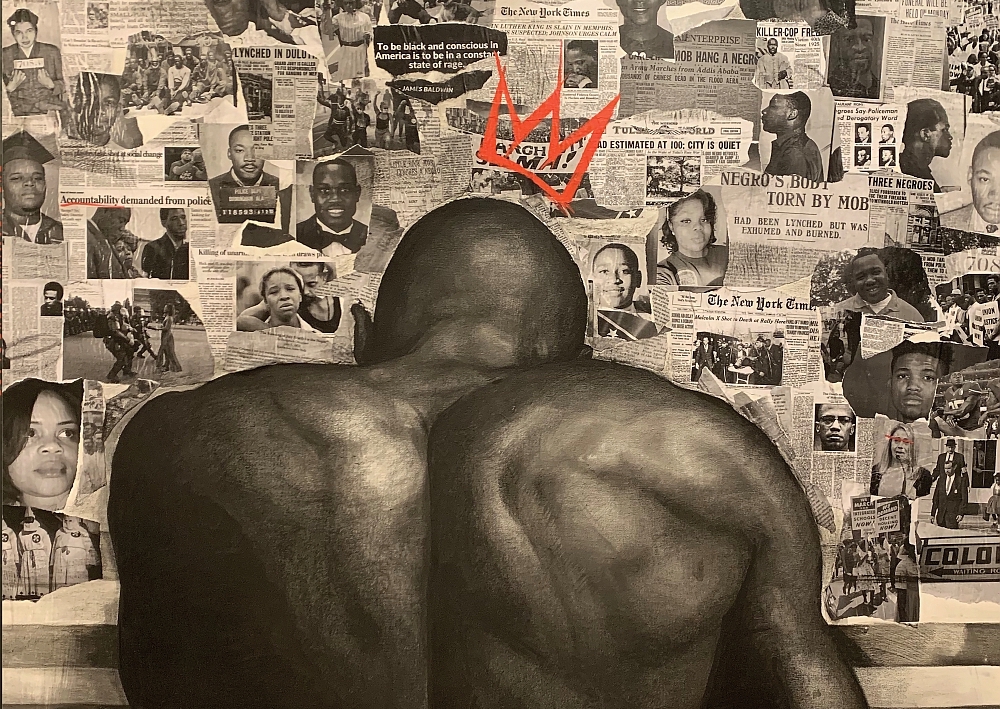
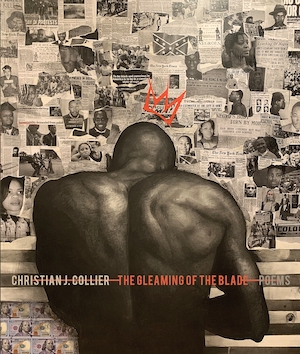
In his debut collection The Gleaming of the Blade, Christian J. Collier resurrects a history that was never truly buried for the Black men whose lives continue to be shaped by its violence:

“Trauma

builds its monsters

from the bones of experience. Blood

records & remembers everything it survives.”

From persona poems that assume the perspective of Candyman to elegies that want again and again for an alternate ending, Collier’s collection draws from elements of horror to show how America made Black men into monsters in order to justify the atrocities committed against them.

Cast to play the role of monster or as ghost, the centuries of dehumanization experienced by the speakers in The Gleaming of the Blade raise the question: What would it look like to survive? I spoke with Collier over Zoom to find out.


Sam Risak: In your book, images of ghosts and monsters combine with violent descriptions of the body to depict the longstanding effects of intergenerational trauma. Given that trauma affects most—if not all—aspects of one’s life, you could have placed these ghosts within a variety of contexts. What made you decide to ground them back in the body?

Christian J. Collier: The body is a route or touchstone in my work. I’m always interested in what the body has the capacity to do, what hovers around the body, what happens to the body after the spirit vacates it. And while combing over the poems, once I paired them together, I realized they started to say different things about the ways that, specifically, a Black body is and is not seen in different capacities and environments. 

SR: Do you ever feel the South has been disproportionately targeted when it comes to conversations about race and white nationalism? That the region has become, in a sense, a scapegoat for issues that are happening on a national and international scale?  

A lot of our capacity to make it from one day into the next means that we not only have to be in absolute control of our emotions, but also how our emotions are perceived.

CC: It depends. For my book, much of it was inspired by real life, by things that actually happened to me. So it can’t be needlessly targeting the South when the South gave me these experiences. But outside of the work, I think it is easy to point to the South and see it a particular way. We look at George Floyd as a tipping point of what’s been dubbed the racial reckoning, and that that did not happen in the South. That not only produced protests all over the country, but all over the world. 

It is easy to lay these things on the South without interrogating the different components of the issue. And race is such a complicated issue, one that’s further complicated because we have never really been willing to collectively have an open and honest conversation about it.

SR: Your collection frequently interweaves the sacred with the monstrous. In your poem “Candyman Blues,” readers assume the persona of the iconic horror figure Candyman who describes how the brutality of others made him both their monster and god. Can you talk a little about this duality and how it might relate to the roles America has carved out for Black men? 

CC: In the Candyman film, you have this Black man who was really just the victim of the time. He’s a visual artist who ends up falling in love with a white woman. He’s brutalized and becomes a supernatural being who comes and murders you once you speak his name. There’s a lot to investigate there. His only crime was loving somebody that society said he could not love, and as a result of that was made into a monster. Nobody thought to question what to call the people who thrust this upon him. 

SR: In “When My Days Fill with Ghosts,” the names of the Black men that the speaker has lost are blacked out because—as I read it—the names that could fill those spots were too numerous to list. Pain then becomes a defining characteristic of the speaker’s reality, so much so that he grows afraid of losing it, “afraid of the release, of feeling empty if it all oceans out.” Seeing as poetry requires one to be vulnerable, I was wondering if you experienced such fear yourself. In writing this collection, you wrote against the stoic Black male stereotype; did you ever worry that, by doing so, you risked losing a sense of yourself?

When we look at horror films or films that deal with the future, you don’t see Black people there.

CC: That’s a good question, but no, not really. When I’m working on poems, I come at it from a perspective that I am essentially a director behind the camera, and I’m crafting a particular shot for whoever is on the other side of it. I want the audience to see and feel something very specific, but I also want to leave a little bit of room for them to walk around and fill in some of the blanks. I want them to feel a little bit of that tension. That danger. Because so much of that encapsulates the Black experience in America. A lot of our capacity to make it from one day into the next means that we not only have to be in absolute control of our emotions, but also how our emotions are perceived. And that’s a certain kind of pressure that your average white person doesn’t experience in their days. I wanted to put people in a seat, and if that’s a new experience for them, then I think that I’ve partially done my job. And the way that we get there is through that vulnerability and through wading into that emotion. 

And if I feel like I’ve ever gone too far, then that poem is probably not going to leave my computer. As much of my experience that I’m trying to bring into the work, I’m also trying to be cognizant of how that could potentially affect people outside of it.

In the poem you mentioned, “When My Days Fill with Ghosts,” one of the reasons that the identities are blocked out is because the people who’ve passed away can’t consent to being in the poem. So how do I preserve their identities? How do I respect that? How do I establish these boundaries? Poems aren’t journalism. Real life things can, and I think in a lot of cases should, inform the work, but they’re not the work. The work is the work. And maybe there is some emotional protection in that.

SR: Several other issues surrounding masculinity arise in the collection, including the hypersexualization of Black men. In “Induction,” the speaker is a bull who sought out by a white couple for sexual acts. While the fetishization in this poem is clear, its tone does not feel angry; in fact, it resolves with the speaker describing the experience as holy. How and why did you decide to end on such a note? 

CC: I don’t write in a linear fashion. I’m not sure if you are familiar at all with the artist Mark Bradford, but I got really big into his work in 2019. His process blew my head apart. I had an epiphany: all text is malleable. And once you have that idea, then everything is fair game. I’ll take poems that I’ve written or had published, and then I’ll completely remix them. I’ll gun them. And human beings, we’re hardwired for narrative. For instance, if I were to take this bottle of vitamins, and put it next to a rock, somebody’s going to walk by and be like: Well, I wonder why these two things are close together. What’s the story here? I like putting different things together because you’re building connections that you consciously would not. “Induction” was a result of that process. At some point, I was dealing with something sexual, and then the bull thing happened, and I was like, Oh, this is interesting. 

Another thing I’ve been trying to do is to incorporate more magic into my work. And once you introduce something that’s magical—be that God or prayer or a dead loved one—you can kind of go wherever you want because you’re no longer dealing in the linear world. So once God popped up [in “Induction”], I thought Well, how can I come back to the bull in an unexpected way

I started researching bull fights. At the end of the fight when the Bull has been slain, the arena is filled with all these roses. And in the poem it goes from “would you believe me if I said it was holy? While sinew & bedspring were pushed to near fracture, / she chanted the word God so many times, He hovered into the room, a pale flame with no shadows” to “Would you believe”—not would you believe me, but “Would you believe if I said, when we finished, the light vanished & / forty cut roses were bent in prayer on the carpet.” With that small removal of “me,” it becomes a matter of belief, period: Would you believe in this this divine entity? 

That gave me the chance to continue the bull imagery and also hearken back to the spirit. If I were consciously mapping it out, that would not have happened. And I figure, if it’s something that surprises me, there’s a good chance it might intrigue somebody else.

SR: The bull is one of many references to the monstrous in your collection; another appears in your final poem “Eulogy for Julius Gaw,” which is a nod to Friday the 13th Part VIII. What drew you to this work? To horror more broadly? What about the genre inspires you and what more would you like to see from it?

CC: The Friday the 13th film fascinated me for a number of reasons. For starters, a good part of it takes place in New York, which I think is interesting. But also, Julius is the only Black character in the film, and—I swear that they did not intend this to happen—but Julius ends up bucking that trend in, not just horror, but in Hollywood films, of the Black character being stupid, buffoonish. Cowardly. Julius realizes this is probably it for him on the rooftop. He is out of options, but he doesn’t try to run around Jason and get back down the stairs. Julius squares up. Only after he’s truly exhausted himself, does he look at Jason, and is like: Do what you have to do. I thought that that was such a bold move. I’m sure it went over the head, no pun intended, of most people who watched that film for over thirty years now, but I was just so taken by that. 

So that film was fascinating to me, but so are movies where Black characters just live at the end. Like in the original Texas Chainsaw Massacre, you have the truck driver who stops, and then a woman runs out, and then so does Leatherface, and what does he do? He grabs a wrench, hits Leatherface in the face and runs and leaves the truck. And in 28 Weeks Later, there’s the Black character who flies the helicopter, trying to pick up the characters, and then the infected come, and he’s like, Get off my chopper. These are just little things that real Black people would probably do, but so often, when we look at horror films or films that deal with the future, you don’t see Black people there. We’ve been a part of the story the entire time, so why would we not be there and actively contributing? Our influence has been sewn into the fibers of America—be that through music or what’s cool or the dialect–and still you have those parents who are complaining about critical race theory; I mean, what’s the soundtrack to their kids going to school? It’s crazy to say that, deep into the 21st century, for Black people to be able to think and act their way out of a situation is profound. But I guess that’s what I’m looking for: a future where Black life exists.

7 Novels Set in the Literary World

At the risk of seeming obnoxiously obsessed with ourselves, writers and readers do tend to love books about writers and readers—especially when those fictional writers and readers behave badly. (It’s no wonder, really, why the Bad Art Friend discourse hit a nerve; so many people were frantic with empathetic outrage or gleeful schadenfreude.) 

A Novel Obsession by Caitlin Barasch

In my debut novel, A Novel Obsession, Naomi is an aspiring novelist and indie bookseller cultivating an obsession with her boyfriend’s ex-girlfriend, Rosemary, who just so happens to also be an editor at a major publisher. As her obsession escalates, Naomi uses their shared love of books to insert herself into Rosemary’s life—and, naturally, to use her as fodder for fiction——with inevitably disastrous consequences. (Bad Art Friends, indeed.)

If you, too, are fascinated by ruthlessly ambitious writer-types, I’ve compiled a list of books set at least partly in the literary world, featuring characters who will do whatever it takes—to find love, to get ahead (or to simply survive) in the industry, to make good art, and/or to lead a more novelistic life. Enjoy the voyeurism!

Last Resort by Andrew Lipstein

Caleb Horowitz, the 27-year-old narrator, is on the brink of achieving his wildest dreams—a life-changing book deal for his novel—when Avi Deitsch, an old college rival and the novel’s inspiration, gets his hands on it. Caleb is then forced to make a Faustian bargain, one that tests his theories of success, ambition, and the limits of art. The book is an often hilarious and ironic skewering of the literary world, and no one is spared. 

The Other Black Girl by Zakiya Dalila Harris

This book was the talk of the town last year, and for good reason! Just after 26-year-old editorial assistant Nella Rogers, tired of being the only Black employee at Wagner Books, welcomes Harlem-born and bred Hazel to the cubicle beside hers, a string of uncomfortable events occur. As Nella starts to spiral over the sinister forces at play, she soon realizes that there’s a lot more at stake than just her career. In a brilliant critique of the publishing world’s dark side, The Other Black Girl is a dynamic thriller and a sly social commentary chockfull of twists and turns.

Must Love Books by Shauna Robinson

Nora Hughes—an overworked and underpaid editorial assistant at Parson Press—decides to moonlight for a rival publisher to make ends meet…and maybe poach some Parsons’ authors along the way. But when Andrew Santos, a bestselling Parsons author no one can afford to lose is thrown into the mix, Nora has to decide where her loyalties lie. This book is both a compelling love story and a wise, honest journey of self-actualization. 

Faces in the Crowd by Valeria Luiselli

Gripping, immersive, and haunting, Luiselli’s poetic debut follows a young mother in Mexico City attempting to write a novel about her experience working as a translator of a small indie press in New York. There’s a thrilling metafictional blur of fact and fiction as she attempts to piece together her past. Artistic obsession reigns supreme!

Book Lovers by Emily Henry

This list wouldn’t be complete without another literary romp from Emily Henry. In Book Lovers, our heroine, Nora, is a cutthroat literary agent who, according to Taylor Jenkins Reid, is a “fierce heroine who does not apologize for her ambition.” (Yes, please.) Because Nora spends all her time and energy focused on her clients, her beloved younger sister Libby convinces Nora to take a sisters’ trip together to North Carolina as a well-earned break from the demanding job. But then, of course, the publishing world catches up with her in the form of Charlie, a brooding editor from the city. As they continue encountering each other in a series of cheeky coincidences, what they discover might just unravel the carefully crafted stories they’ve written about themselves.

The Plot by Jean Hanff Korelitz

Nearly a year after its publication, this book already feels like a canonical example of Writers Behaving Badly. Jacob Finch Bonner, our antihero, was once a promising young novelist but now struggles to write, let alone publish, anything decent. So after one of his students, Evan Parker, details the wildly compelling plot of the novel he’s working on—and then unexpectedly dies—Jacob steals the plot and writes the book himself. Literary fame quickly follows until, at the height of his successful new life, a terrifying and mysterious e-mail arrives, threatening to expose the source of his inspiration and upend his career. The twisty chaos that follows will blow your mind, as it did mine. Because my debut novel also features an ambitious (and desperate) novelist determined to write a book at all costs, I frequently found myself squirming in recognition while reading The Plot, which is truly the highest form of praise. 

Trust Exercise by Susan Choi

So, hear me out: even though this book is largely set at a performing arts school, it also involves an absolutely explosive and thrilling novel-within-a-novel, thus earning it a spot on this list. In the second part of the book, when readers learn that the first part was actually an excerpt from the novel-within-the-novel, it challenges our preconceived notions—not only of the characters we’ve come to know, but also our perception of the ambiguous responsibilities a writer has to their subject, as well as the slippery nature of fiction, truth, and memory. Katy Waldman, in the incisive New Yorker piece “Who Owns a Story,” writes:

“the act of consuming fiction is itself a trust exercise, and Choi highlights how outrageous the novel is as a proposition: a transient agreement that one enters into with an author to pretend that bald fantasy is reality. Her book underscores our trust by breaking it.”

The book, then, ultimately becomes a story about storytelling. 

Modern Narratives of Black Love and Friendship Are Centering Iconic Trios

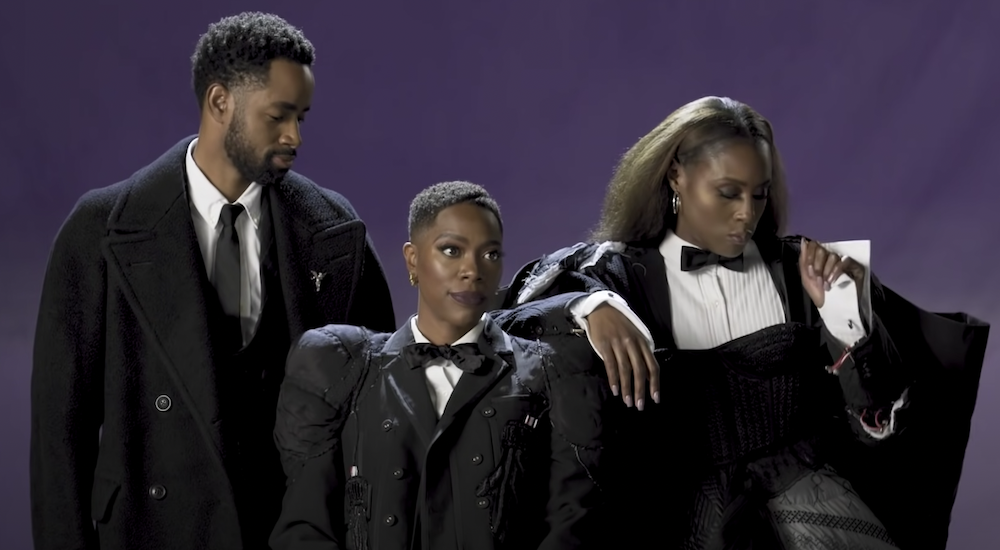
Since the wildly popular HBO series Insecure wrapped at the end of 2021, I’ve been obsessed with a behind-the-scenes photograph on Instagram. It shows a dazzling trio—Issa, Molly, and Lawrence—standing side by side at Molly’s wedding. Issa is draped in a scarlet pleated dress, Molly wears a strapless wedding gown in the center, and Lawrence stands on the end in all black. It’s easy to imagine Issa standing in front of Molly, Molly shifting away from Lawrence, Issa migrating closer to him, and how their constant shuffling tells a complex story about Black friendships and love. 

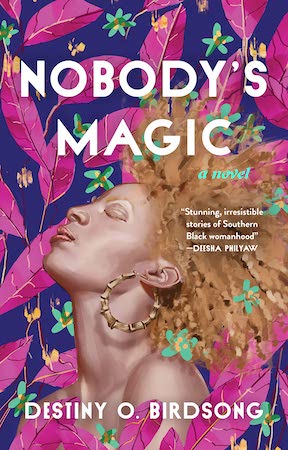
Part of Insecure’s brilliance is seeing Issa, Molly, and Lawrence mess up—and put themselves and their relationships back together—season after season. Whether I’m binge-watching, or patiently waiting for the following week’s episode to air, serial storytelling activates my writer’s mind. When it’s all over, I get to step back and look at a show and figure out how it changed me. I get to ask: how did we get here? That Instagram picture may be one moment in Insecure’s fictional universe, but it has a literary function, too: it’s the show’s very own triptych, telling three distinct, yet intricately braided stories. I can’t help but think of Destiny O. Birdsong’s recently published novel Nobody’s Magic

Centering three Black women with albinism striving to make their way in the world, Nobody’s Magic is a triptych novel that uses form to expand its meaning. Like a triptych painting that features three images, each protagonist gets their own section. This format compresses the time in which readers engage the stories of Suzette, Maple, and Agnes. Each woman navigates desire, self-love, and belonging, while reclaiming narratives about her life. The power of the triptych is that it offers three experiences in addition to the fourth, which emerges when all three are viewed or read together. 

Traditionally, the panels of triptych paintings were held together with hinges to enable folding open or shut, and to support easy transport. They were placed on the tops of altars, often telling a story of a grand religious event like the birth of Jesus. As patrons’ eyes passed from one panel to the next, a narrative developed—one with a beginning, middle, and end. The hinge or crease of the painting clearly demarcated a pause, a moment to breathe and prepare to behold the next panel. I like to think of this demarcation as the threshold of change. Across the threshold of a triptych painting, color, shadow, and the images that those elements form, are manipulated to evoke discourse. Panel 1 speaks to Panel 2 speaks to Panel 3. But what are the panels saying to each other? And about what? Within triptych art—visual or literary—discourse revolves around the work’s central themes and crosses the threshold of change at least twice. The effect is thematic repetition. This repetition then illuminates the significance of some message or question.

In Nobody’s Magic, Suzette, Maple, and Agnes all contend with the distorted association between albinism and the magical; stereotypes that say their skin or eyes possess supernatural qualities. Agnes, for example, tries to darken her skin and alter the texture of her hair to gain a kind of physical protection that will shield her from the backlash of being othered. “And the questions they posed, first about her race and, when she told them, her condition, triggered a silent mortification that surged through her body like a riptide, shifting the center of gravity in every room.” In each section of the novel, these stereotypes are interrogated to reveal their harmful imprints, yet we don’t dwell in any trauma narratives, though repetition can lead us into such tricky territory. Always, the protagonist and her self-perception pull focus. 

The Insecure triptych displays a static connection that comes to life in the show. In Season 4, Episode 8 of Insecure—my favorite episode—we see the fluidity of their connectedness. In this episode, Issa and Lawrence unpack the reasons behind their breakup. The episode opens with Lawrence returning from San Francisco where he’d been interviewing for jobs. At the airport he bumps into Molly, whose disastrous vacation with her then-boyfriend Andrew has come to a tense end. Molly and Lawrence exchange pleasantries and then, moments later, Lawrence texts Issa to ask if she’s free to meet up. The transition is smooth and has an ombre effect. Just as colors blend gradually to form a new hue, the scene takes us from one panel of the show’s triptych painting into the next. At dinner, Lawrence tells Issa about running into Molly. He describes the encounter as “awkward.” Issa says, “Yea, probably because we’re not friends anymore.” Even when the show is focused on Issa and Lawrence, Molly haunts the periphery. She is essential to the overall narrative, waiting just on the edge to alter it.

When it’s all over, I get to step back and look at a show and figure out how it changed me. I get to ask: how did we get here?

After five seasons, seeing Issa, Molly, and Lawrence celebrate and achieve many of their aspirations brought about, in me, a new level of earned TV satisfaction—earned, because it did not arrive without its fair share of heartbreak. Insecure reminds us that sometimes your mess blows up so you can assess the wreckage, then rebuild.

In the case of Agnes in Nobody’s Magic, we see a woman who lingers among the debris of the proverbial house (her choices) that has fallen on her. Agnes, a woman with multiple degrees who dreams of a life where she is appreciated and loved, struggles to achieve economic stability. The treatment of Black women in the labor market parallels the degradation she experiences with intimate partners and family members. “Suddenly, she felt exhausted from the obscene amount of work involved with managing other people’s feelings and not being courageous enough to tend to her own.” How does one find refuge from their suffering when door after door closes in their face? Birdsong exposes the humiliating side of rejection, and expertly depicts how that humiliation might lead someone to ignore the internal voice telling them they deserve better.

Insecure reminds us that sometimes your mess blows up so you can assess the wreckage, then rebuild.

Insecure not only disrupted harmful TV industry barriers that limited the presence of Black creatives in front of and behind the camera, but also employed storylines that illustrated lessons on how Black millennials might lean into our talents, and bet on ourselves. It showed us failing, resetting, achieving. Take Issa’s career trajectory: She gradually ascends from a dejected nonprofit worker to a self-assured creative curator. Molly, on the other hand, finds her career lane earlier, taking a challenging role at a Black-led law firm where she struggles to strike a healthy balance between work and personal life. Then there’s Lawrence, who finds his footing within the tech industry after a long season of unemployment. If Issa, Molly, and Lawrence had all stumbled along the same path, Insecure would have fallen flat for viewers. Thankfully we got something more nuanced.

Insecure builds on the tradition of shows like Living Single and Girlfriends by centering Black friendships from the perspectives of young, gifted, and Black characters. Where Insecure differs is in its depiction of its generation: as millennials, Issa, Molly, and Lawrence navigate their lives with a vigorous drive to make new lanes for Black folks, while leveraging technology and diverse social networks. I envision the next phase of this ever-evolving Black media canon to capture broader conceptions of Blackness, including people with albinism, who are woefully underrepresented in media. 

As millennials, Issa, Molly, and Lawrence navigate their lives with a vigorous drive to make new lanes for Black folks.

In my search for triptychs by Black artists, I found Carrie Mae Weems’ Untitled (Black Love), 1999/2001, featured at the Studio Museum of Harlem. In this piece, three humans stand in front of windows. They look out, or in, or into each other. These photographs tell a story of two people before, after, and during an intimate encounter. In the final panel, they embrace, and their silhouettes emanate, for me, desire fulfilled. When I try to look at each panel individually, I find my gaze being pulled to the images right there. Their proximity is irresistible. 

For a while I struggled with Lawrence’s place in the referenced photograph because it forced me to think about the show in terms of a shared spotlight, and not one that Issa solely dominated. I was willing to concede the show boiled down to Issa and Molly. But Issa, Molly, and Lawrence? His character always felt like a mechanism for exploring hardship rather than a vehicle for enlightenment. But if I view this photo, in which Issa rests on Molly’s shoulder while Molly’s hand cradles the base of Issa’s back and Lawrence intertwines his hand with Molly’s, as one possibility for how to make sense of the show, especially in its final season, I see a story about how relationships require intricate support systems, and how the hardship that Lawrence represents is integral to that overall picture. Relationships take time to build. They evolve, and evolution is not a standalone phenomena. 

Relationships take time to build. They evolve, and evolution is not a standalone phenomena.

In Nobody’s Magic, the triptych form asks readers to consider how works of art can resist the idea that there can only be one. While the novel introduces us to three women with albinism, their family structures, socioeconomic status, and desires all differ. There is no singular narrative because there is no singular way for a person with albinism to be. Just as there is no such thing as a Black monolith. By situating the protagonists among other Black folk, the novel asks: when do we consider Blackness at the intersection of albinism? Not often enough. And, as the title proclaims, dispel the notion that anyone can possess another’s uniqueness or self-defined power. I’m amazing because I am. In another scenario we might have been reading a long novel about Agnes or Maple, but Birdsong—whose poetry collection Negotiations was published in 2020—gives us three arresting tales about what happens when Black women take matters into their own hands. In this way, expectations about narrative dominance are shattered.

By the novel’s final pages, I flipped back to Suzette and Maple’s sections to understand how the three stories all come together. Shreveport, Louisiana – their primary stomping ground – shines brightly as a focal point, as does Birdsong’s interweaving of African American Vernacular English (AAVE). When Suzette must try harder than ever before to figure out why the relationships in her life keep making seismic shifts, she says, “Everybody was acting a fool, and I didn’t know what I was supposed to do aside from going off on folks. But I was tired of all that. They just needed to let me live. Didn’t nothing else have to change.” Here, language magnifies time and place, crystallizes connections between people, and cuts through any veneer of how people are supposed to sound when they speak.

While Suzette, Maple, and Agnes face stigma and rejection, they also experience pleasure, love, and fierce intimacy with people who act as mirrors in a world set on casting out those who are different. Birdsong’s experimentation with form disrupts ideas about what can be accomplished in the space of a novel, and whose story that novel can be. She gives other debut novelists permission to paint beyond the edge of the canvas.

Imagination, Reality, and Two Very Different Americas

Qian Julie Wang’s debut memoir Beautiful Country is a compelling and intimate portrait of  an undocumented childhood. Much like Betty Smith’s A Tree Grows In Brooklyn and Frank McCourt’s Angela’s Ashes, we are carried into the heart and mind of a child: this time, a young, undocumented girl in 1990s New York City who shows us an America that is not quite as it imagines itself to be. For little Qian Qian and her parents, each day is a battle for survival from fears and threats both internal and external, real and imagined. 

Beautiful Country by Qian Julie Wang

With clarity and honest intimacy, Wang’s writing allows us to experience her childhood, taking us to the warm, familial, but constricted confines of her early years in North China, where she was born. We meet her father and mother, two struggling academics longing to raise their young daughter in a place like America, which they imagine to be a place of opportunity, streets paved in gold. With seven-year-old Qian, we discover the cold and hungry realities of being hei, the Chinese term for being undocumented, living fearfully in the shadows of invisibility and poverty. We sit with her and her mother in a Manhattan sweatshop, where little Qian snips threads from clothing her mother has sewn; we smell the stench of rotting fish as we enter a wet and freezing sushi-processing basement, where they sort through fish by hand; we feel the cold squelch of dirty water in Qian’s too-big boots. The fear in her stomach as she navigates the terrifying new world of New York City: constantly afraid of arrest and deportation, she dodges police officers and city workers bearing free food that her empty belly yearns for. 

Reading Beautiful Country as a former undocumented immigrant, I cried and laughed alongside the familiarly deep, endless valleys and small, triumphant peaks of Wang’s years of fear and hiding in New York. In a wide-ranging conversation over Zoom, Qian Julie and I talked about the dangers and blessings of imagination while growing up undocumented, and the emerging canon of undocumented immigrant literatures. 


Jill Damatac: In your book, you often contrast how the American Dream—or what I like to call the American Imagination—actually compares to reality, and that there’s that dissonance: when you were a little girl in China, you heard from family members that America was this land with gold-paved streets. And then you get to America. And as a hungry child, all you can think about is all of the food you ate till you were full in China. But actually, in reality, neither of those things are quite true. Can you talk to me about how the shock of that contrast—what you imagined versus what was real—shaped you into the person you are now, and how it’s shaped your parents, too? 

Qian Julie Wang: Before we left, there were two different Americas painted for me, one paved with gold—and I remember hearing that and thinking, does everyone wear, like, shades and sunglasses everywhere? Because that’s going to be really bright!–and then there’s this other image of everyone just starving and lining the streets, begging for money and fighting over food. And they were, to my mind, equally possible worlds. 

But because what we had been told to expect on both ends was very different from what we faced, and because my parents changed almost overnight, I could not trust anything. I was like, nothing anybody told me to expect is actually happening. I can’t trust what people tell me. I just have to be in control at all times. Take all the cues for myself and just be ready to act, and act perfectly at all instances, because I could not afford mistakes

[My parents] know what I was like before we moved. And so often now, my father tells me to relax. My mom says I’ve faced too much as a child, so now I don’t know how not to work. And it’s true. I don’t know when to stop. I can’t stop. In many ways, even though I’ve slowed down a little bit, it’s very hard for me. And she so wants that child back or wants to preserve that childhood for a bit longer. And that guilt follows her: who would I be today, if we had stayed in China longer, or forever? There’s no telling, but I think that’s it. She carries it with her that maybe I could have lived an easier life if they had made the decision differently. 

JD: One of the things that floored me the most was the contrast between how you saw your mom. At first, you saw your mom in China as this joyful, loving, warm, happy person. And in America, you saw her as this tired, ill, overworked, neglected wife and mother. And it turned out she had this huge plan underfoot this whole time. How did that reshape the way you saw her?

The two selves I had: one that had originally been in me and the other that had been forged in the need to survive.

QJW: I was shocked, because for all of our years in America, she had, to my mind, become my child, even though I didn’t, of course, consciously think it that way. But I was like, “My mother comes to me with questions. I make decisions for her––sometimes very bad decisions!––but I am the person in control. She is not in control. She is not capable of doing something like this.” And yet, here she is in a car outside my school with all of our stuff packed: “I found a way for us to become documented.” And I’m like, “What? We did not run this through me. But let’s just humor her, because she really needs my support, because she really thinks is going to work.” 

And the next day, driving to Canada, I was like, “Oh, this is really complicated. We have documents. It’s a heist. She had a safe house. We got to the border and I expect to jump into my translating. That’s my job, to manage everything. Make sure my mother doesn’t say the wrong thing. And they’re just like, “Go sit over there” and I think, “What? No, I’m in charge. You talk to me. Don’t bully her. If you want to yell, yell at me.” 

And for the first time, I remembered what it was like in China when my mother just told me what to do, I did it, and everything was good. You know, it was two battling selves. The two selves I had: one that had originally been in me and the other that had been forged in the need to survive. They were fighting with each other before coming to a stalemate of “Let’s just see what happens.” 

But time and again, [my mom] kept showing up: she went and got a decently paying job. Almost immediately, she found a house. I’m like, “You didn’t even let me go visit the house with you, to make sure it’s inhabitable.” I was left out, no longer in any sort of control, but still worrying about things. And that worry has very much stayed with me to this day. 

JD: Your book is going to be in the Library of Congress, if it’s not there already. You’re going to be in university and high school curriculums, and there will be kids growing up reading this book. Let’s talk about who you are now: you’ve grown into a love for this country, for America. Beautiful Country isn’t just a memoir of your undocumented childhood. There are people out there who take offense at your book, who see you as unpatriotic, and “You’re ungrateful, and you don’t love this country, and if you don’t like it, get out.” 

But as lots of us know, patriotism takes many forms, and one of them is loving your country enough to want to make it better. To criticize it as a way of making it better. I think your book does exactly what it says on the tin: it is about a beautiful country whose beauty lies in the potential of its people. And in your eyes, America can be beautiful, but only if it faces its own faults first. As someone who has lived in great poverty and has since built a successful life for herself, could you tell me how you think Beautiful Country exposes the imagined exceptionalism of America? 

QJW: I think my story, though singular in detail, shares the very common immigration journey of coming here with stars in our eyes and then seeing that this country––though built by slaves and immigrants––is not really for people of color or immigrants. It currently does not think about immigrants; its health care system and its educational system––the very basic, fundamental poles of  our society––does not consider immigrants.

It’s very comparable how humans evolve and how countries evolve. Neither can grow until they face the stark truth. Until you can embrace everything about yourself, every mistake, every horrible thing you’ve done, every good thing you’ve done–”This is what I’ve done but it does not define me, it was what I did, but I can choose to do things differently”––until you have the safety to do that as a nation or as one person, you will not be able to make different choices, because you remain stuck replicating the subconscious patterns of your past. 

For a long time, I was stuck re-creating the conditions that were handed to me, which was to not let anyone get too close, to manufacture a reality and a version of myself. America has done that for so long. It would like to believe itself to be something that does not yet exist.  And as long as it pretends that it’s already there, it’s never actually going to get there, which is what all of us want. It’s going to take some really hard work to get there, but the starting point is just being honest and examining those cracks. Yes, America did this, this, and this poorly, but those things do not need to define what America is, presently or going forward. And so, I think that if our nation could think about things in that way, our political discourse, our social discourse would be so much more constructive and would bring us closer to that version of America that we all want. Why wouldn’t we all want to live in the country so many claim America to be? 

JD: These ideas shaped the work that you’ve chosen to focus on as an attorney, and that philosophy has kind of infused itself in the book. How did you decide to do what you’re doing now as an attorney? 

QJW: Well, it was really a mirror of that journey. I went into corporate and commercial litigation, because I wanted to pretend that I was someone different who didn’t have this background, and I wanted to pretend that our country was better than it was. Before I went into commercial litigation, I actually interned at Legal Aid, legal services and public interest organizations. And when I saw the reality of what people were still going through, people like me decades later, still dealing with the very same barriers, it hurt. It was hard to see, and it made me feel incredibly guilty and defensive. How dare I live in my house with my books and shoes and handbags when this was still happening? 

It’s very comparable how humans evolve and how countries evolve. Neither can grow until they face the stark truth.

And so I did what a lot of Americans do, which is run away and pretend: “OK, so I’m going to be in this pretty world, this rich world where those things don’t happen. It’s not part of my day-to-day. I don’t need to think about it.” But that can only hold for so long, especially for someone with my background, because I couldn’t go outside without seeing an immigrant child sifting through the trash with her mother. I saw that on my way to work, and as long as our society is the way it is now, I’m always going to run into some reflection of my past life, and it makes me feel incredibly guilty and ashamed for having run away and refusing to be part of the solution. So in the process of writing and editing this book and putting it out into the world, I learned to embrace what I just talked about, which is that I really need to get comfortable and accept the fact that our country is just not there yet. 

What guides me now is thinking about that day that I’m on my deathbed. I don’t want to have any regrets. And looking back, if I have spent my whole life running away from reality and just living in this constructed bubble of “Everything’s fine, I serve the rich people of our country and everything’s fine and dandy, and I’m doing very well and everyone else is doing well, there’s no inequality,” I will not be able to die in peace. And that’s in many ways my self-serving guidance. I feel a moral imperative to push for progress and make inroads whenever possible. And my book is very much about reaching the reachable. I’m aware that a lot of people who most need to read my book will never read it. They may burn it. They may ban it. But any step toward progress is a step closer to living in the country we all deserve. 

JD: You’re building an imagined world into reality. How do you feel about being part of this emerging canon of undocumented memoirs? There’s been a nice buildup over the past decade or so of memoirs written by lots of different kinds of undocumented immigrants. And no one’s experience is similar to anyone else’s. 

QJW: It’s beautiful! I mean, I would not have found the courage to do this without Jose (Antonio Vargas, author of Dear America) and Karla (Cornejo Villavicencio, author of The Undocumented Americans). Jose wrote that essay in the New York Times magazine in 2011 (“My Life as an Undocumented Immigrant”). I was a 2L at Yale Law School on a student visa, then. Very privileged. And yet when I saw his essay and an interview with him, I was like, “Oh my God, he’s so brave.” Just the thought of me sharing that––that I had been undocumented in the past––had me shaking. It was his present! He has made himself so vulnerable to political attacks, to deportation, to everything. And it was so inspiring for me that he could dare to do that. And that was when the seed really was planted in my head: “If he can do it, what are you complaining about? You should be able to put this out there.”

But I had a lot of inner work to do before I could get there, and then of course, Karla’s book came out and focused not just on Dreamers, but on blue collar workers––the frontline workers of our society who are just ignored. And seeing how many people out there are still so impacted by the limits of our immigration system just gave me that final kick to send my story out into the world. 

JD: I think what we’ll probably see is there will be more and more of us [undocumented] authors over time. It’s an honor to be a part of it––I’m kind of in your shoes that it’s not something I have to worry about anymore, but I still feel like I have to somehow protect my parents because they’re still there. But at the same time, I know that if anything’s going to change, the book has to happen. 

Do you have any advice for memoir writers of color? Karl Ove Knausgaard wrote My Struggle, six autobiographical novels about himself. In his 30s! For memoir writers of color, we face a different challenge, in that the way we represent ourselves in the world, we apologize, repress our feelings, we code switch a lot. And sometimes it’s hard to get past that, that code switching tendency when we’re writing our memoir. Any advice on how to represent yourself? 

QJW: We really have to know who we are and stand firm in that, because if we don’t, the world will tell us what to be and what to do. And that is really dangerous. We have to be able to say to ourselves, “I experienced what I experienced, I felt what I felt. And I wrote what I wrote,” and have that be enough; not to justify, not to have to pivot. And as you say, to not code switch, to not to have to explain or apologize or say, “I’m grateful for everything. I’m thanking you for letting me be alive.” Finding that firmness, that foundation of self-determination, is so necessary for anyone going into this field, but particularly for a person of color, for those from marginalized communities, because you will just receive that much more hate and anger. You have to just know that you are doing this because it is important. We are defying systemic barriers that want to keep us silenced, that want to hide our stories. Being a writer of color is an act of defiance. It’s important to remember that. Remember why we came in, remember that we are enough, that we don’t need to apologize.

An Unstoppable Optimist on the Way to Camp Hope

An excerpt from Eleutheria by Allegra Hyde

My name, my full name, is Willa Marks. There’s nothing in the middle. My parents must have had their reasons for the omission, though I’ve always considered it a sign of honesty. A middle name can lurk in a person like a bomb: a secret identity poised to pop off. I’m simply me. 

What I’m trying to say is that I’m going to tell you the truth. I don’t have time to tell you anything else. And it’s important for you to hear the truth because what has been said about Camp Hope, about me, is a shadow of what really happened. 

Let me start with the easy parts. 

I was twenty-two when I boarded a plane and flew to Eleutheria. 

I was drunk on ideas. 

I was so drunk, in fact, that when the turboprop shuddered into a nosedive—cabin lights flickering, pilot crackling over the intercom—my limbs remained limp. While the other passengers hunched in their seats, prayers on their lips, I kept my eyes open, savoring the rush of arrival, the jarring smack of it reverberating through me. 

The turboprop did not land elegantly, but it landed intact. Even so, had the plane crashed onto the island, I’d still have walked out of the wreckage, beatific. I’d been awake the length of a day, a night, and that had not yet become a problem. I was the kind of person who took exhaustion in stride, let it warp my surroundings into dreamscapes. And so far, everything had gone right. 

Out the airplane window: palm trees, a heat-seared tarmac, men in orange vests strolling from the steel maw of a rusted aircraft hangar. Around me, a dozen other passengers unbuckled their seat belts. Some smiled relievedly, others wiped away tears. A woman’s purse had spilled into the aisle and I helped her collect her things, though I curbed my impulse to ask if she was from Eleutheria. To get caught in conversation might break whatever spell had whisked me from Boston to the Bahamas, a spell meant to carry me on to Camp Hope. I wanted to arrive unimpeded, unburdened, slick as a fish released into the sea. If I could have, I would have traveled to the island naked. As it was, my backpack contained only a change of clothes, a passport, sixty-five U.S. dollars, and my well-thumbed copy of Living the Solution: The Official Camp Hope Guide to Transforming Ourselves and Saving the Planet. 

I had the envelope as well—the one from Sylvia—but I tried not to think about it. 

What I thought about was Camp Hope. Specifically, about arriving at Camp Hope and making my life mean something. Had you watched me exit the airplane, my preoccupation would have been obvious. You would have seen a young woman who tripped over her own boots—a size too large—as she entered the hangar. You might have noticed one of my overall cuffs was rolled up higher than the other, that my backpack zipper gaped partially open. Back in Boston, I would have been a person your eyes glazed over on the street: shiftless, among the masses of the newly unemployed. I had an oval face, brittle yellow hair that went dark at the roots, a stub of a nose. I was thin, but not jagged. Scrappy, though in an untested way: like a runaway who has only just left the house, or an actor playing a role. Familiar enough to forget. 

In the echoing dimensions of the hangar, however, I stood out. I’d traveled to the island alone and there was no one there to meet me. I had little luggage. I was white and the only person queued in the International Arrivals line. A weary customs agent took my passport, studied it, shrugged. There were no biometric scanners here. Not in this makeshift terminal, arrivals separated from departures by a plastic partition. The original building, like so much else on the island, had been ravaged by hurricanes. Under different circumstances, I might have been made teary-eyed by the scene of my fellow passengers embracing loved ones, opening luggage to reveal supplies from elsewhere—bags of dried rice, baby clothes, phone chargers—but I fixed my attention on the airport exit: a square of sunshine on the far side of the hangar. 

I have what you could call a tendency toward fixation. This tendency has been described as childish by some. People have told me, in general, that I have a childlike demeanor. My short stature is partly to blame. Also, my smattering of freckles—though these would multiply, day by day, colonizing my complexion the longer I remained on Eleutheria. I did not have any muscle tone, though that would change as well. I had little coordination. I have only ever been graceful in photos. Pinned under someone else’s gaze, I look best in stillness. 

I was not still. Walking with rollicking, over-long strides, I burst out of the hangar into dazzling sunshine. A parking lot shimmered, woozy with heat, its perimeter rimmed by a chain-link fence. In the distance, a narrow highway disappeared into a low swath of scrubland. 

My skin burned hot; I had Living the Solution churning inside me and with it the heat of my own ambition. I tended to flush in odd ways—in my fingertips, mostly—though if you’d been watching, this would have been invisible. You would have seen only a pale girl striking out across a parking lot. A lost girl, harmless—or even in harm’s way—easily manipulated. A rube. It was true, my official education extended only through high school, homeschooled at that. But I was not entirely inexperienced. At twenty-two, I’d had my own unusual education. I considered myself intellectually advanced in one significant way: I was too wise for cynicism. I had outsmarted doubt. 

No one at Camp Hope knew I was coming. No one would know who I was when I arrived. I maintained, nevertheless, a propulsive confidence. Reaching the edge of the parking lot, I started down the side of the highway, soaking in sunshine, electrifying my body, intending only to move closer to my destination—a place in my head, rather than direct view—so that, if you’d been watching, you might have seen my eyes go unfocused, my chin lift, my chest tugged forward by an invisible string. 

Someone was watching. A pickup truck trailed me out of the parking lot and onto the highway. There were four men in the truck: two in the front and two in the back. The pair in the back wore sun-faded T-shirts that billowed in the breeze, their arms stretched along the edges of the truck bed. The man in the passenger seat wore an orange vest, as if he’d just stepped off the airport tarmac. The driver was obscured. 

I kept walking and the truck kept rolling, until the man in the orange vest called: You a surfer? Or— 

A fugitive? interrupted a man in the back. 

There was laughter, but I didn’t care—I didn’t even break stride. In my mind’s eye, my destination glittered: an eco-paradise, a pragmatic arcadia, an answer to the problem that had haunted me my whole life. 

Are you lost? said the man in the orange vest. 

Though I’d barely spoken for a day and a half, my answer burst forth, bell-like and bright: I’m going to Camp Hope.

The truck stopped rolling. The men’s laughter ceased. I continued on, unperturbed, reciting lines from Living the Solution beneath my breath, swinging my arms as I walked the ragged edge of the highway. 

Ten minutes later, the truck again rumbled alongside me. All the men had gotten out except the driver. He leaned across the passenger seat, his face visible for the first time. He was handsome in a plaintive way, his eyes half-closed, his jawline shadowed by a beard, his dreadlocks pulled behind his head. He asked if I was really going to Camp Hope. 

Sure am, I said. 

Camp Hope is far, far from here, he said. 

I can manage, I said—though in truth it was hotter than seemed possible for the month of May. Only squat palms and brambly foliage stretched before me, with no sign of a settlement or even the sea, save for the wheeling arc of a gull overhead.

Also, said the driver, you’re walking the wrong way. He told me to let him give me a ride. He said he didn’t mind, speaking in a tenor of nonchalance I should have perhaps recognized as forced. He was, in fact, keenly interested in what I had to say and where I was going. Deron was his name. For a long time I was angry at him, given what would happen later on, though my feelings have since changed. I hope Deron is well and happy wherever he is now, even if—in his own way and for his own reasons—he did make everything more complicated. 


The truck roared down the highway, wind slicing into the cabin through the open windows. I might have remained quiet, watched the landscape blur past, convinced an invisible current was carrying me closer to Camp Hope—but of course, that was not what was happening. That was not happening at all. 

The truck cabin was cramped and Deron was tall, yet he maintained a casual posture, except where his hand clenched the stick shift. The grip meant little to me; I hadn’t spent much time in trucks and didn’t know anything about driving them. What I noticed was that Deron had used an elastic tie with pink plastic beads—the kind little girls wear—to gather his hair. This made me like him. When he asked my name, I told him. 

I’m Willa, I said. Willa Marks. 

Out the windows: scrubland sprawled in every direction, except for a tumbledown gas station, plywood fixed over one window like a pirate eye patch. Further on, a worn sign indicated an upcoming settlement.

Willa Marks, said Deron, you don’t look like the Camp Hope type. 

I’m exactly the type, I said. 

Deron nodded with exaggerated slowness. The truck rumbled into a small community comprised of cinder-block homes painted pastel pinks, yellows, teals with white trim. A group of men watched the truck pass from the shade of a garage. A lone woman, scowling, sat beside a spread of cucumbers, tomatoes, and papayas. Farther on, a pair of children dangled from a swing set. Chickens skittered into the brush. 

Deron repeated my name to himself, as if trying to remember where we had met, and for the first time on my journey, I felt uneasy. I did not like hearing my name said aloud, chanted like a password to a history I’d forgotten. 

Willa, Willa, Willa. What does that mean—Willaaaa?

I shrugged. My mother once told me she named me Willa because there was a willow in her front yard growing up: a tree everyone thinks of as peaceful, with its long droopy branches, thin leaves. Really, it’s a ferocious tree, with roots spreading underground, fingering the foundations of houses, bubbling up the asphalt of driveways. I never quite believed my mother, though. If she had admired the tree so much, why hadn’t she named me Willow? Now she was too dead to ask.

Why don’t I look like the Camp Hope type? I said.

A smile hitched one side of Deron’s mouth. As if he hadn’t heard my question, he said he had an interest in names. He asked if I knew the meaning of the island’s name—Eleutheria— his accent smoothing of vowels at the beginning and the end of the word, the way ocean water smooths down glass, making me feel a little seasick, storm-tossed too. He started talking about the island’s history. There’d been a shipwreck, religious colonists. My attention drifted. Out the truck window, confectionary-colored houses gave way to abandoned buildings, vines snaking their walls. Beyond them lay piles of twisted metal, roofs displaced from their frames. A rowboat’s rotting stern crested a wave of fruit pods in the branches of a tamarind tree. This part of the island had been hard-hit by hurricanes. 

Isn’t that interesting? said Deron—his smile turning too friendly—How you can end up so far from where you originally intended to go? 

Sure. 

My unease intensified. I did not know if we were actually driving to Camp Hope. I had no map, only the promise of a place spelled out in Living the Solution: the book’s hard corner pressing through the fabric of the backpack in my lap. Perhaps I had trusted too quickly; it wouldn’t have been the first time. And for all the merits of Living the Solution, the book wouldn’t help me if I was about to be abducted. 

They’re expecting me, I said. If I don’t show up at Camp Hope, they’ll wonder where I am. 

Deron steered around a section of washed-out road. He asked why, if the Camp Hope people were expecting me, no one had picked me up. 

Got in on an early fight, I said. 

No other fights coming in today. 

I’m a day early. 

A truck passed from the other direction and Deron lifted two fingers from the wheel to wave. The coast surged into view: the water crystalline, tourmaline-tinged, lapping a stretch of bone-white beach. Deron said that since I’d gotten in early, I should see other parts of the island. Better parts. Better people. He could take me to the new hotel. 

Bahamian-owned, Bahamian-operated, he said. We’re trying to rebuild— 

I’m not a tourist, I said. 

Call yourself whatever you like, said Deron. It might be worth taking your time, before diving headfirst into something you don’t understand. 

I understand Camp Hope perfectly well. 

The truck rounded another bend; we entered a settlement overlooking a harbor. On a stretch of sand, the metal carcass of a backhoe hulked like a beached whale. The corner of Living the Solution pressed deeper into my ribs. That book—it had offered me an option when there seemed to be no others. It described how, despite the odds, a small group of people could change the world for the better. If I tried hard enough, believed hard enough, my life could be more than a series of disappointments, failures, half tries, and hurt. 

When Deron started talking about the new hotel again, I interrupted. 

Look, I said. All I care about is Camp Hope. And getting there. It’s going to launch any day now and I have to be there. I have to help. 

Deron flexed his stick-shift hand, resqueezed. 

Any day? he said. Like tomorrow? 

The truck turned onto a side road camouflaged by overgrown brush. Branches slapped the windshield. I had no idea when Camp Hope would officially launch into the public eye. Living the Solution had not included a precise timetable. All I knew was that the launch was likely soon; it had to be. I said this to Deron, describing the planet’s track toward climatological disaster—how Camp Hope was humanity’s best shot for changing course—my voice raw by the time the truck lurched to a halt, just short of a clearing. 

Please, Deron, I said. 

He lifted his chin toward the windshield. Past the clearing stood a vast wall: twenty feet high and draped with cascading bougainvillea. An emerald city. A green mirage.

Camp Hope. 

I grabbed my backpack and leapt out of the truck. A huge pair of double-doors were set in the bougainvillea wall, their brass handles sparkling in the sun. I might have run straight to them if I hadn’t felt guilty for doubting Deron. 

You’re coming too? I said, as he eased himself from the driver’s seat. 

Deron tugged at his hair tie, cleared his throat. He said: I wanted to give you my number, in case— 

He beckoned for my hand. 

I held it out, trying to be patient as he turned my palm to the sky, pulled a pen from his pocket, and pressed the inked tip to my skin. That close, I could see the stubble around his jaw. He was younger than I’d initially thought; he smelled faintly of paint solvents and I noticed, for the first time, the blues flecked on his T-shirt were the same blues around the island—turquoise, indigo, aquamarine—as if the sea and sky had splashed on him and stuck. A current of anxiety hummed beneath his casual manner, though if it had always been there, or just appeared, I could not be sure. 

He finished writing his number but did not release my hand. I discovered I did not want him to. Hand in hand, I remained anchored to someone known, however slightly.

You should call me, he said. If you ever have something you want to discuss about Camp Hope. Such as the launch, and what it means for the rest of the island. Or, Willa, if you need to talk— 

My heartbeat quickened; I pulled my hand back against my own body. Intimacy, I reminded myself, slowed down progress. I knew that from experience. I also knew that one of Camp Hope’s many revolutionary elements was its approach to two-person relationships: there were none. Love was a distraction—an ethical pollutant—in relationships both romantic and platonic. The same went for family ties, which could poison a person’s moral compass. And morality meant everything at Camp Hope; morality would win our environmental struggle. 

I sprang away from Deron, flinging a goodbye over my shoulder as I hurried toward the doors set in the bougainvillea wall. 

I did not need a partner. I did not need a family. I did not even need a friend. 


By design, Camp Hope did not yet have a web presence—or a public presence of any kind. Everything I knew about it came from Living the Solution: a book I had encountered under unusual circumstances and, technically, not been meant to see. 

There was, however, an abundance of information about the book’s author: Roy H. Adams. A military man, for years he had basked in the computer screen glow of command centers, in the adulation of joystick warriors, his approval one link in the kill chain that turned foreign villages to dust. In photos online, he stood in front of American flags, his hair razor cut, his square jaw set, his eyes flinty. He looked like a man who expected his steaks rare and his golf courses pesticide-drenched; a man who believed he was entitled to all that he touched. 

And yet, that same Adams had written, in Living the Solution, about giving up his military career, his marriage as well. Such sacrifices, he explained, were a small price to pay in the WAR against climate change, a WAR for humanity’s very SURVIVAL. 

We’d been losing that war. There’d been decades of environmental marches and bumper stickers, special light bulbs and bike racks, sit-ins and die-ins and speeches, NGOs and IGOs and NPDESs and panicked scientific studies—and for what? Torrential rain spurred landslides in China, smothered whole cities. Spore-laced dust storms forced mass evacuations in Australia. There were the ongoing food shortages— a drought squeezing Brazilian soy, a wheat blight hitting Russia—along with the desperation brewing on the force of that hunger. Boat people, pundits called the hundreds of thousands of refugees floating from coast to coast. Begging for the right to dock. Begging for scraps. Dying. Bodies washing up along the Bay of Bengal. On the flooded plazas of Barcelona. Americans looked on with ephemeral pity, the tragedy ever seeming elsewhere—acute or temporal—even as wildfires seared the west and toxic algae bloomed in the Great Lakes. We were moored in apathy, in the comfort of willful blindness. Even as CO2 levels ticked upward and glaciers sweated smaller and entire ecosystems expired. The average environmentalist, according to Adams, only whimpered, equivocated, begged for corporate salvation, gave into the ease of greenwashing, the capitalist diversion epitomized in reusable shopping bags: keep on spending. In America, we still had our guns, our flags, our stranglehold on exceptionalism. We still had the distraction of virtual realities, the Hollywood phantasmagoria, the pharmaceutical raft of painlessness. We still had the audacity to call climate change a problem for another time—another country—as if we weren’t already proverbial frogs, our skin sloughing off in hot water. 

Our challenge boils down to one thing, Roy Adams had written, the distance between what people want and what people need. 

Camp Hope was a prototype. A nucleus. A revolution waiting to hatch. It modeled what could be: made progress into paradise, showed how environmental living could be desired rather than feared. And while it’s true land was cheap in the Bahamas—the post-hurricane government desperate for income, any whisper of industry—Adams had also chosen to build Camp Hope in Eleutheria because the location sent a message: he wasn’t afraid of hurricanes or sea-level rise or anyone else’s opinions. 

I couldn’t wait to tell him I wasn’t afraid either. Because in truth, it was Adams I wanted to see as much as Camp Hope. It was Adams—as a repentant man, a reformed man, a visionary—who made me believe humanity could be galvanized, the planet saved. Because if Adams could change, anyone could. 

Including me. 


The doors to Camp Hope opened with ease, well greased, silent. I had to shield my eyes as I stepped inside: the compound’s low breezy bungalows and pavilions and laboratories all painted in a wash so white, the buildings gleamed with snow-blinding brightness. 

But this was Eleutheria: an island blessed by equatorial warmth. Between the buildings were garden plots flush with melon leaves. Feathery carrot tops. Rows of purple beans. An orchard offered trees loaded with avocados and sugar apples. Hibiscus blossomed everywhere, at once jewel-like and giant. This was Camp Hope: the text of Living the Solution rippled into reality. Solar arrays glinted from rooftops. Carbon capture units hummed near the shore. A wind turbine twirled overhead. All of it, all of Camp Hope, spread out as immaculate and people-less as a museum diorama. 

I giggled—astonished and perplexed—and as my voice exited my mouth it diffused into the landscape.

Hello? I called, but that sound also dissipated. 

Sunlight dappled a pathway of crushed shells. I meandered along it, ducking under trellised passion fruit vines, through open-air hydroponics labs, into sleeping quarters filled with bunks made bandage-tight. From an observation deck, I watched an egret slide over a curving stretch of sand, settle on a gnarled clump of mangroves. At the center of the grounds, a geodesic dome humped from the earth, its glassy surface composed of honeycomb panels. 

One of the panels flickered. I rushed forward—bracing for my first encounter with a Camp Hope crewmember—but met only the reflected slouch of my overalls, my knot of hair, my own wide eyes. 

Behind the glass, rows of tables sat empty. 

I licked salt from my upper lip, the sun squeezing sweat from my pores. Everything was right and yet nothing was right. On a rigid laundry line, dish towels fluttered in the breeze, as if trying to tug themselves free. I let one flutter against my face. I turned in slow circles, wandered onward. Time elongated, minutes expanding, doubling back. I became unsure of which pathways I’d taken, the hibiscus blossoms I’d already passed. Though the Camp Hope compound was contained on a stubby peninsula—covering a square mile at most—it seemed city-sized, sprawling. 

I leaned against a raised garden bed to catch my breath. My elbow upset a watering can perched on the ledge, sending the container crashing onto the gravel below. Water glugged out and disappeared. 

My throat tightened; I called another hello into the grounds—still serene, fragrant with flowers and ripening fruit. The wind turbine pinwheeled overhead. The ocean sparkled in the distance. That Camp Hope’s crewmembers could have given up—abandoned everything—seemed impossible. That Roy Adams could have, even more so. I entertained the idea of foul play: there were corporations, governments with something to lose if Camp Hope succeeded. Yet the grounds showed no sign of a struggle. 

I wondered if the crewmembers were hiding. 

I wondered if they were invisible, Camp Hope’s advanced eco-technology having spurred unprecedented genetic mutations.

I wondered if they’d all been sucked into the sky by a green god who welcomed them into a chlorophylled paradise.

The sun pressed down like a hot thumb, crushing these ideas. I slumped into the leafy shade of an elephant ear and unpeeled my backpack straps. Sweat swept my forehead, stung my eyes. I had forgotten to pack a water bottle. In my rush to leave for Eleutheria, I had forgotten to pack a lot of things.

I had Deron’s phone number inked on my palm, but no phone with which to call him. This omission had been deliberate. According to Living the Solution, Camp Hope was equipped with a central communications hub, but crewmembers otherwise abstained from the Internet and its environmental cost: the mineral mines and server farms, the unquenchable thirst for electricity. 

The absence of personal phones and computers would also help keep Camp Hope a secret until its launch. 

I reached into my backpack, my fingers skimming the pages of Living the Solution. The book had compelled me away from everything I’d known—compelled me in a way that made it hard to go back. Even if I wanted to, I didn’t have the funds for a return ticket. 

I pushed my hand deeper into the backpack, past the wad of crumpled bills, my spare underwear, my passport. I touched the envelope from Sylvia. 

Cream-colored, made from smooth, expensive paper, the envelope refused to reveal its contents even when held to the light. Sylvia had sealed the envelope with crimson wax, stamped an insignia with one of her rings—a flourish at once preposterous and elegant. Wasn’t that her way? She must have enclosed a letter; she was the kind of person who wrote letters—her script sinewy, spring-loaded—though it was also likely she had enclosed money. I knew she had: a crisp set of hundred-dollar bills, sharp enough to draw blood. 

I pressed the envelope between my sweaty palms, held my palms to my forehead, closed my eyes. To open the envelope would mean admitting Sylvia had been right. I could hear her telling me so: You try hard to be good, but there’s no such thing as good. Her voice, it reached through my rib cage, squeezed the air from my lungs: There is only scarcity and plenty, our fear of— 

The island wouldn’t let my eyes stay closed. Sunlight tunneled under my lids, pried them open, filled my vision with a quivering orange brightness—like live stained glass. 

I moved to rub my eyes; the color shattered into the air.

Monarch butterflies. As a child, I’d seen them perched on the milkweed growing along the back roads of New Hampshire. I’d thought the species had gone extinct. Yet here they were, whirling upward. I stuffed the unopened envelope into my backpack and scrambled to my feet. Sylvia would have called it juvenile, taking inspiration from butterflies. I remembered I no longer cared. At that same moment, I heard voices—real voices—drifting across the grounds, sweet as light through a church window: a promise made good. 


The Camp Hope boathouse was a leggy, square structure with a breezy deck. From this deck, a wharf extended into a turquoise cove, and beyond that cove, the ocean stretched to the horizon: the edge of cloudless sky. 

At the boathouse, I found the crewmembers. 

They numbered seventy in total. Men and women of many complexions, mostly young—all youthfully athletic—with their hair cut short or drawn into neat ponytails. They wore neoprene wet suits, the letters CH emblazoned on their chests. Some stood knee-deep in the cove, ushering a flotilla of kayaks onto the sloping sand. Others carried the kayaks to storage racks in the boathouse. Still more passed snorkeling gear and scientific instruments toward stations for cleaning.

I marveled at them. These were modern pilgrims: environmental devotees, who’d heard the call for revolution. The crewmembers were among the best and brightest, the most physically exquisite people in the world. They were here on Eleutheria because they believed in Roy Adams’s commitment to reforming society by living it anew. 

While I was disappointed not to see Adams himself, the crewmembers’ operation otherwise enthralled me: balletic in its ease and synchrony. I might have gone on watching, enjoying the sheer perfection of their movements, had I not been noticed. 

Three women rose from beside a pile of snorkeling gear. They approached with a bounce in their steps, a light in their eyes, their ponytails swishing. Even now, it’s easy to picture them. They bore down on me like the future. 

Those women; those newborn women, their skin soft with baby-fat radiance. Women with big straight teeth and strong hands agile enough for knot tying, dexterous enough to play cello. Women who were well hydrated. Women who ate ice cream, but only twice a week. Women with a smug wholesomeness: who knew a lot, but not too much. Women who were swift decision-makers. Women who slept through the night. Women who swam laps at dawn. Women who were pretty without makeup, but not so pretty it caused problems. Women who knew what they were doing and had come to do it. 

Women who looked me up and down. 

It’s an intruder, said one. 

It’s only a girl, said a second. 

Shall I find Lorenzo? said the third, smirking at the others as if to reject the idea.

I’m here to join Camp Hope, I tried to say—but my mouth had gone dry, my tongue immobile and fat. 

The trio squinted at me, whispered to one another. The word girl buzzed between them, which seemed strange since we were all about the same age. 

The girl can’t stay, said one. 

The girl can’t leave either, said another. She’s seen the grounds. 

It had never occurred to me that I might face resistance to joining Camp Hope. The main challenge, I’d always assumed, would be getting there. When I’d imagined arriving at the compound, my mind shot forward—past the logistics of initiation—to the good and important work I’d do as an official crewmember. 

My dizziness made the surrounding landscape spin. I became aware of my scuffed-up overalls and matted hair, my odor. The intense heat and the long journey had caught up to me. Exhaustion plucked at my attention—though also a sense of recognition. I knew these young women: these fellow girls. 

The trio started asking questions, their voices overlapping, interjecting: When had I arrived on the island? How did I get here? How had I found Camp Hope? How long had I been in the compound? Had I touched anything? Had I taken photos? What was the matter—was I going to faint? Would I like something to eat? Would I like something to drink? Did I know even minor dehydration could reduce cognitive function fifteen percent? Had I really come all the way to the island planning to just enlist? Didn’t I realize there were procedures for recruitment? That a person couldn’t just show up? That the crewmembers had been carefully selected for their specific talents, skills, and traits?

The trio asked and asked, often without waiting for an answer, as if the articulation of a question was the point of the exchange. Occasionally, they glanced over at the other crewmembers—continuing to put away the kayaks—as if verifying the distinctiveness of their status. They relished this small performance of knowledge. 

It was then, even through my exhaustion, I realized how I knew the trio—or knew their type. They were quintessentially collegiate, as if plucked from a manicured quad between classes and dropped in the Bahamas. They were like the young women who had once hovered around Sylvia. 

Liberal Arts Girls, I labeled them in my head, putting an emphasis on girls. 

You do realize, said one—the tallest among them, whose name I’d later learn was Corrine—that under no circumstances could a person walk in and “join” Camp Hope. 

You also can’t leave, said the second tallest—Dorothy. For security reasons. 

We’re about to launch, said the shortest—Eisa—with a flick of her ponytail. Isn’t that thrilling? 

The young women who’d hung around Sylvia intimidated me at first. They had read Foucault, and could differentiate Doric and Ionic columns, and they knew what happened to Prussia. They wore sweaters without crumbs embedded in the fibers. They never burped. And yet they’d sought out Sylvia because they’d wanted her approval, not because they’d wanted to truly know her. Let alone love her. Those young women were all so competent, yet their competence was built on the head-pats of supervisors. For all their book knowledge and their museum visits and their semesters in Rome, they were hoop-jumpers. Box-checkers. Résumé-builders. They were so well rounded they had no edges. They were just ethical enough. 

Liberal Arts Girls, I thought again and smiled, even as Corrine said something about putting me in a containment cell. I understood why this trio was here: Camp Hope had been designed as a perfect composite of function and form. This trio had been recruited to fulfill a specific role and to cultivate a specific desire among external viewers. When Camp Hope launched, these young women would look good among the other crewmembers, all of whom had their own roles, talents, desirable qualities. But I had not come all the way to Camp Hope to be sidelined. Liberal Arts Girls could be tamed, you only needed a hoop. 

Well done, I said—interrupting Dorothy’s recitation of international trespassing laws—you’ve nearly passed the Intruder Alert Test. 

Excuse me? 

I licked my lips, my thoughts racing forward, the premise unspooling: There’s only one more step, I said. You’ll need to take me to Roy Adams. 

What are you talking about? said Corrine. 

Your response to the test was excellent, I continued. Especially given the lack of forewarning. But the lack of forewarning was the whole point. All that needs to happen now is for me to speak to Adams so I can confirm your proficiency.

The Liberal Arts Girls narrowed their eyes. 

This test is being timed, I said. 

How are we supposed to believe that? said Dorothy. No one said anything about an Intruder Alert Test. 

Maybe we should get Lorenzo? said Eisa. 

Out in the cove, crewmembers continued their graceful machinations as they stowed the last of the kayaks, though I had the feeling they were listening—that the whole island was listening. All the palm trees and seagulls and hermit crabs and starfish had perked up, trying to catch what came next. 

I reached into my backpack and pulled out Living the Solution

The Liberal Arts Girls drew in a collective breath. Corrine started to ask how I’d gotten a personal copy, only to be overtaken by Dorothy, who murmured that the book hadn’t yet been sent to anyone outside Camp Hope, before her words were overwhelmed by Eisa, who twirled her ponytail with a finger and said: It all makes sense now. 

The Liberal Arts Girls moved quickly after that. The trio was nothing if not efficient, task-oriented, rhetorically effective when it came to explaining the situation to the others. Roy Adams, it turned out, was snorkeling around one of Eleutheria’s most magnificent reefs. If I was supposed to see him, I could travel to his location. 

So, I was installed in a kayak, handed a paddle, and pointed down the coast. 

Once you’re around that peninsula, said Corrine, head north. Just keep an eye out for the coral outcroppings.

Put in a good word for us, said Dorothy. 

Eisa squeezed my shoulder, pushed. 


What to say of the journey that followed? 

I remember it only in pieces. I know beyond the shelter of the cove a stiff breeze sprang up. Once around the peninsula, larger waves jostled the kayak’s sides. My paddle strokes— arrhythmic, unbalanced—launched saltwater into my mouth, sprayed every inch of my skin. I hacked forward anyway. I no longer felt thirsty. I no longer felt tired. I did not feel much of anything except the distance closing between me and Roy Adams. We were two planets, orbits aligning by degrees. We were two people who’d soon be able to sit down and talk. I’d explain why I’d come to Camp Hope, my commitment to helping. I’d officially join the movement that would make the world new. 

I paddled harder, breath seesawing from my lungs. I felt giddy. Sun-drunk and helium-hearted. The sea and sky tilt-a whirled, and more monarchs fluttered past, though they may have been the wink of sunbeams on water, my own eroding consciousness. Below the waves, purple forms bloomed with metropolitan ambition. I was no longer sure where the sea began and my paddle ended, what was large and what was small. I stirred up cyclones with every stroke. I summoned in breakers. I jolted as the kayak’s yellow bow struck an underwater obstacle, sending me splashing out, crawling out, my feet kicking coral, my clothes so heavy, so wet, they felt like a skin I no longer needed to wear. 

I was not surprised when a monstrous figure rose dripping from the water. 

Its horn broke the surface first: blunt-tipped and tubular and channeling a hideous rasping breath. The crest of its head followed. Ten a glassy cyclopean eye. And, finally, a massive man-torso

Did Sylvia send you? I wanted to scream—and maybe I did—though I can’t be sure, because the world had faded into elsewhere. I was gone.


7 Literary Characters Who Famously Refused to Get a Smartphone

I don’t own a smartphone, and never have. While this life choice has made me a happier, more productive person—I don’t know if I could have written my novel Last Resort with another distraction—it has also made me quite “out of the loop.”

Thankfully, like all losers and loners past, I’ve found solace—and some kindred souls—in literature. In fact, while rereading the classics, I was shocked to discover how many of my heroes have been courageous enough to make the same choice I have—and what good it did them. (You don’t have to be an 11th grade English teacher to know a motif when you see one.)

Here I count seven brothers and sisters in arms, my T9 trueloves, my prepaid partners, my flip-phone “fam.”

1. Ishmael

Mental health much? While I’ve never read Moby-Dick, I am very happy that Ishmael put himself first and unplugged—not a small thing for a guy who starts his whole spiel, “Call me.” According to SparkNotes, the only thing #trending in his life was “The Limits of Knowledge,” “The Deceptiveness of Fate” and “The Exploitative Nature of Whaling.” This guy spent some time on himself and it shows!

2. Frankenstein

I know, I know—Frankenstein’s the scientist, not the Monster. But did you know that neither had a smartphone? Pretty telling choice for a book about technology, huh? Even true Shelley stans forget that this wasn’t so in the first draft; in fact, in that version the Monster makes a cringe vlog series while hunting Victor in Geneva—and only asks for a companion to “cross-promote.” Not a bad idea!

3. Clarissa Dalloway

While Mrs. Dalloway could have just as easily hopped on TaskRabbit, she did all of her party prep herself. Plaudits! Most exceptionally, none of the characters at her big bash were allowed phones, which meant none of it ended up on Instagram. All the better to help remember the night for what really made it meaningful—a last, late act of communication from the now-dead Septimus. Talk about leaving someone on read!

4. Caleb Horowitz

The protagonist of my debut novel Last Resort has, famously, never had a smartphone. My copy editor thought I should explain why, but I never do! Something for the next generation of literary theorists to gnaw their little overeducated teeth on.

5. The plums in that famous poem

So sweet, so cold, and SO present. Good for you, plums. You know that the “juiciest” parts of life are the times we spend with each other, not scrolling. Hard to imagine plums having a smartphone anyway, given the lack of thumbs. Haha.

6. Jack “Binx” Bolling

The hero of Walker Percy’s novel The Moviegoer wasn’t totally averse to technology; hell, the guy was obsessed with talkies. But talk about restraint—he doesn’t even have a MoviePass account! While I admire Bolling, you can’t help but wonder: shouldn’t a character permanently alienated from his own life and bereft of meaning be at home, watching crime documentaries on Netflix? And shouldn’t a man who sees women as interchangeable and can’t connect on an intimate level be on Tinder? This one’s on the editor!

7. Hester Prynne

The heroine of The Scarlet Letter is famous for never giving in, even when the whole town turns against her. And by this I mean her not having a smartphone. After not being able to pull up a QR menu one too many times the town’s restaurateurs knit her a very ornate frock with the letter A, for Antediluvian. But when she successfully orders crab cakes at O’Donnelley’s, the town demands to know how she knew that was the night’s special. She replies that that’s the special every night, it’s the 1640’s, how often can a restaurant expect to mix things up, but the truth is much darker: She was dining with Dimmesdale, and he showed her the menu on his phone. Well, her special frock wears out in about a year or two, and this is when everyone else realizes they spend most of their waking hours trying to figure out subtweets, or reading about the off-camera lives of the hosts of The Great British Bake Off. So they forgive her for being right all along, and she accepts their apology under one condition: No more QR menus. Yes, of course, the townspeople laugh with closure, because menus were never meant to be read on an iPhone. The moral of the story is about cancel culture.

“Search Party” Dared Me to Imagine Myself at the End of the World

Midway through the pilot episode of HBO’s genre-hopping, endlessly inventive dark comedy, Search Party—which just debuted its fifth and final season in January—millennial NYU graduate Dory Sief (Alia Shawkat) is turned down for a job. “I read all four pages of your personal statement,” the interviewer tells her. “And it seems to paint a picture of someone immobile. Someone stuck, perhaps.” In the immediate aftermath, Dory’s ineffectual boyfriend, Drew (John Reynolds), attempts to lift her spirits. “This is not the end of the world, let’s just take a deep breath, all right?” he suggests. “When I get overwhelmed, I like to just chill out and think about things I’m grateful for: you, my mom …” Before he can list any further gratitudes, however, Dory erupts at him. “I don’t want to take a deep breath and think about what I’m thankful for,” she says. “I just want you to shut the fuck up.”

While the series will recontextualize this moment over the course of its 2016-2022 run, the pilot is deliberately constructed to put the audience firmly in Dory’s corner. After all, upon being informed at brunch earlier in the episode of their college acquaintance Chantel Witherbottom’s (Clare McNulty) mysterious disappearance, Dory’s three closest friends react with a level of narcissistic disregard that makes her look downright saintly in comparison. Their responses are varied but equally damning: vain influencer Elliot (John Early) dismisses Chantel as having “nothing to offer,” mere moments before tweeting out performative concern for her safety; fledgling actress Portia (Meredith Hagner) feigns shock and dismay until enough time has passed that she can change the subject to her sex life; and Drew ignores Chantel’s disappearance entirely, opting instead to flag down a waiter for a bottle of ketchup. These characters, the show initially seemed to argue, are the self-absorbed hipster Brooklynites that you’ve been warned about. Their exaggerated awfulness allowed me to pat myself on the back, at least for a moment, for being fundamentally better than them: more empathetic, more self-aware, and certainly, well, less shitty.

Like Dory, when I first watched Search Party’s pilot, I too was feeling aimless and anxious about my future, procrastinating on job applications and residency portfolios as I stared down the final semester of my MFA. Early on in the series, very little had been established about Dory beyond her general longing for purpose, and so she works, functionally, as a cipher for the audience to imprint onto. And so, just as implicitly relatable sitcoms once trojan-horsed me into connecting to poorly aged protagonists like Ted Mosby on How I Met Your Mother and JD on Scrubs, of course I related to Dory, recognizing in her my own desire to scream at a world that masks apathy and inaction with vague platitudes about self-care and gratitude. Sure, I thought. Her fixation on a relative stranger’s disappearance might be a little self-serving, but, holy shit, at least she’s not numb to it. Watching her verbally berate Drew on the sidewalk, I couldn’t help but think, Hell yeah, lay into him

But then the episode—written by Sarah-Violet Bliss and Charles Rodgers, who co-created the series alongside Michael Showalter of The State and Wet Hot American Summer—did something that surprised me. Dory yells at Drew to shut the fuck up a few more times, but then instead of following her as she storms off, the camera lingers on Drew as he stands there, looking genuinely hurt and confused as a bystander films him on an iPhone. Watching this, it strikes you that he’d really thought he was saying the right thing. He really thought that he was helping. 

That’s when I realized: I may as well have just watched someone lay into me.

It was one of the most discomfiting viewing experiences I’ve ever had. In Drew’s vapid response to his partner’s disappointment, his unintended minimizing of her emotions, and his half-assed appropriation of therapy language, I saw a specific critique and depiction of millennial behavior—and, to be as clear as possible here, my own behavior—that I’d never really seen before. And, honestly, it felt a little too real for what had been billed as a half-hour comedy. Suddenly, I wasn’t looking down at the characters for their reactions to Chantel’s disappearance; rather, I was implicated in them, scanning through my own responses to tragedy for the times that I’ve posted something disingenuous for social clout, for the times that I’ve changed the subject, and for the times that I’ve reached for the ketchup instead of saying anything at all. 

I was implicated … scanning through my own responses to tragedy for the times that I’ve posted something disingenuous for social clout.

As the show progresses, Search Party refuses to let a single one of its characters off the hook. Although initially presented as at least somewhat altruistic in comparison to her friends, Dory’s single-minded obsession with tracking down Chantel is reframed first as a selfish co-opting of an acquaintance’s ostensible tragedy,  and then, as the series progresses, a compulsive urge to reimagine her life as capital S significant, regardless of her action’s collateral damage. And while Dory and the audience assume Chantel to be a victim, she too is eventually revealed to be anything but, having orchestrated her own disappearance in an elaborate attempt to “find herself,” a decision motivated primarily by jealousy of her sister’s impending nuptials. She is, in a word, the worst. They all are. 

Whether it’s characters selling out their values for a paycheck, returning over-and-over-again to a toxic partner, or overanalyzing every single incident as a signpost along their Personal Journey of Growth™, Search Party captures my generation’s most insufferable tendencies like nothing else on television. And although Search Party is likely to be most remembered for its wild and unpredictable genre-hopping—season one plays out like a mystery, season two a neo-noir, three a legal drama, four a psychological thriller, and five a full-on, apocalyptic fantasy—its genius lays in its ability to make drastic tonal shifts while keeping its characters grounded in its unsettling critique of millennial psychology. 

The series’ first drastic escalation comes at the end of the first season, which finds Dory and Drew accidentally killing private investigator Keith Powell (Ron Livingston), and then roping in Elliot and Portia to help cover up the crime. Even with stakes that are much higher than your traditional comedy—it’s difficult, for instance, to imagine New Girl’s loft-mates covering up a murder—the show forces us to continue relating to its increasingly despicable characters by keeping the series grounded in the implicit relatability of the sitcom form.

… the show forces us to continue relating to its increasingly despicable characters.

At the beginning of the second season, for instance, a familiar sitcom trope—an uncomfortable social situation that our protagonists would like to exit as quickly as possible—is twisted to fit the dire, heightened circumstances. Having just shoved Keith’s corpse in a closet, Dory and Drew want to deal with the body immediately, but are informed by Elliot that, in order to keep up appearances, they’ll have to attend a dinner with the recently “rescued” and increasingly grating Chantel. “We are going to go to dinner,” Elliot tells them. “Then we’re going to come back from dinner. Then everyone else is going to go to sleep. And then the three of us are going to deal with the thing and we are going to be done with it. But right now, I need all of us to do our best to pretend that we are good, normal, non-murdering people.” The effect is downright eerie, taking what would otherwise be an unrelatable experience—covering up a murder!—and making it feel far more emotionally plausible than it should. Well, the series seems to ask, what would you do in this situation? 

Even as the series’ status quo continues to spiral wildly out of control, its protagonists burying bodies, tampering with evidence, defending themselves on trial, rescuing a friend from a kidnapping, and—in a final season twist—inadvertently starting a world-altering zombie outbreak, Dory, Drew, Elliot, and Portia remain resolutely petty, self-involved, and narcissistic. Search Party’s escalating genre experimentation reflects the increasing proliferation of political, ecological, and public health catastrophes that have developed across the show’s lifetime, continually forcing its audience to recognize their own worst traits in the face of these disasters. It’s a move that forces us not only to repeatedly relate to the detestable characters at the show’s core, but also to project forward and imagine ourselves as incurably and insufferably ourselves in the face of unimaginable existential threats and total annihilation.

Which is to say: it forces us to see who we are, right now. And, mostly likely, who we’ll continue to be as things get worse.

Written and filmed in 2021, it’s no coincidence that Search Party’s final season uses its zombie apocalypse to reflect the reality of life over the last two years, evoking everything from COVID-19 to the increasingly visible acceleration of climate catastrophes to 2020’s mass uprisings against police brutality. It’s a lot to tackle over the course of a few short episodes, but its thesis remains impressively consistent with the rest of the series: we mostly just give a shit about ourselves.

[I]ts thesis remains impressively consistent with the rest of the series: we mostly just give a shit about ourselves.

Shortly after the zombie outbreak is unleashed in the series finale, the camera cuts to two 20-somethings sitting inside a fancy restaurant. “It’s sublime,” the young woman says, bragging about what it’s like to raise chickens in Brooklyn. “I’m having fresh eggs every single day.” As they continue talking, though, panicked New Yorkers begin to race by outside. When a zombie tackles someone against the window and violently devours him right in front of them, the young man shakes his head as blood splatters against the glass. “Don’t make eye contact,” he says, evoking an infamous photograph from the early days of the George Floyd protests. “This neighborhood is changing.”

To their limited credit, Search Party’s protagonists take the end of the world much more seriously than the couple in the restaurant, but they’re still beholden to their own desires and neuroses. “I was gonna go back to school,” Elliot’s husband Marc (Jeffery Self) moans as he begins to zombify, getting angrier and pettier as his condition deteriorates. “I’ve never been enough for you, have I?” he shouts at Elliot and friends in his final moments. “You all never made me feel included.” Committed to saving face until the very last, Drew shouts back as he runs away, “It’s normal not to make your friends’ partners feel included!”

Once they’ve escaped the threat of imminent death, the four return almost immediately to their habit of aggressively narrativizing their lives. Holed up in an underground bunker alongside a handful of other survivors, Dory, Drew, Elliot, and Portia take stock of their apocalyptic circumstances. “You know what, guys?” Portia asks, her eyes wide like she’s on the verge of an epiphany. “This is like, the ultimate test, to sort of trust that you’re just in the exact right place that the universe wants you to be in.” It’s a statement that recalls some of the early, Very Online discourse surrounding the pandemic: the reframing of global crisis as an opportunity for self-reflection. It’s in this moment that Search Party specifies its generational critique: everybody’s self-involved in the face of calamity, it seems to argue, but millennials in particular are prone to masking that self-involvement by way of an externally processed and easily digestible personal narrative. What’s a global pandemic if not a reminder to practice gratitude? What’s a missing acquaintance if not an opportunity to give yourself a renewed sense of purpose?

[M]illennials in particular are prone to masking that self-involvement by way of an externally processed and easily digestible personal narrative.

Just as I had recognized myself in the depiction of Drew in the very first episode, here, too, at the very end of the series, I was unnerved to find myself looking into a sort of mirror. It made me think back to March 2020, and how, once the severity of COVID-19 had become crystal clear, one of my first instincts was to think about what it all meant for me. After all, when the pandemic hit, I was fresh off a breakup, a cross-country move, and a career change, finally starting to feel comfortable in my Central Illinois college town and hoping, essentially, to restart my life. This couldn’t have happened at a worse time for me, I remember thinking, even as my heart sank reading early (and, in retrospect, optimistic) estimates that the pandemic would claim between 100,00 and 200,000 lives in the United States alone. 

What Search Party gets right is that, even if I didn’t vocalize these thoughts the way some of its characters might, I still had the impulse to make the mass-death event unfolding across the globe all about me. And, Search Party seems to argue, so did pretty much everyone. For as surreal as the pandemic has felt, the series’ commitment to plugging its loathsome (yet still relatable!) characters into increasingly heightened scenarios demonstrates an understanding that we, too, may soon find ourselves in even more precarious situations than the one we’ve been locked into the last two years. Be it climate collapse, an AI apocalypse, an even more virulent variant, or, god forbid, nuclear war, the show’s writers dare us to imagine what we might look like inside of those moments of crisis, forcing us to consider that even in the face of certain death, we’ll be stuck with all the worst parts of ourselves. 

And so, with this in mind, when I picture myself and how I might react on the edge of oblivion—when the sirens start blaring, for instance, or when the nukes begin flying across the sky—I’m now also imagining the possibility that in those final moments, I might not be thinking anything profound or meaningful or altruistic; instead, I might be wondering if I’ve been excluded from a friend’s end-of-the-world party, if so-and-so is angry with me, or if the apocalypse couldn’t have come at a slightly more convenient time.

Thanks, Search Party. I guess.

Resist Tyranny, Read Dangerously

When I got to an age where I could read the same books as my mom, she started passing them along to me after she had finished. One of the books she gave me was Reading Lolita in Tehran by New York Times best-selling author Azar Nafisi, a book that I remember not only for the window it afforded into life in Iran, but also for the way Nafisi and her students viewed literature as sustenance, as a way of making sense of the world and asking questions of it. As we did after finishing most books, my mom and I talked about Nafisi’s work; our reading encouraged us to start conversations that we are still having with each other about place, politics, gender, history, race, empathy, and so much more.

In light of the way literature has afforded my mom and I access to the world and to one another, it seemed like a gift, 19 years after Reading Lolita, to receive another set of conversations centered around books in Azar Nafisi’s newest work, Read Dangerously: The Subversive Power of Literature in Troubled Times. Structured as a series of letters to her late father, Nafisi turns to James Baldwin, Margaret Atwood, David Grossman, and Zora Neale Hurston, among others, to illuminate the ways in which literature can push back against various forms of oppression. Ranging from what it means to live life during a pandemic to the importance of paying attention, particularly while living on the cusp of a totalitarian state, to the ways in which bearing witness to the world through literature can be a form of activism, Nafisi writes with empathy. She also offers hard-won hope to readers through her work.

We Zoomed to talk about the power of stories, the necessity of knowing your enemy, the intimacy literature can offer, and resisting irreality. 


Jacqueline Alnes: You reckon with different griefs in this book: the loss of your father, which you describe, “As we say in Persian, your place is empty” and grief for both Iran and the U.S., the two countries you call home. What intersections exist for you between personal griefs and more public instances of loss?

Azar Nafisi: The world and the state that it’s in is one reason I write. Sometimes it preoccupies us so much, so overwhelmingly, that it almost forces us to not live. In Iran, there were moments when I was so overwhelmed by rage that I forgot there’s a life going on around here, and I need to live it—not necessarily enjoy it, but live it. My personal grief had collapsed into that other, larger grief. Writing, for me, is a way of linking the personal to the public, but at the same time, keeping that independence, keeping your voice, and not allowing other voices to drown it. 

JA: Did the rage you feel when you were in Iran mirror the way you have felt in the past few years?

AN: Yes. The rage over here was reinforced because people were so unaware of it. I mention in the book that you talk to people about Iran and they become very commiserative. They say, what can we do?, which is very nice and very compassionate, but at the same time they talk as if it only happens over there. It can’t happen here. Beginning with Reading Lolita in Tehran, but especially with Republic of Imagination, I was talking about the ordeal of freedom in this country. When we say it hasn’t happened here, or it can’t happen here, it probably already has happened. We aren’t paying enough attention to our role as guardians of these freedoms.

JA: A letter that hit home for me in that way was when you were writing about reproductive freedoms and Margaret Atwood and all of the recent Supreme Court decisions. These issues don’t just exist in fiction or other places. 

We aren’t paying enough attention to our role as guardians of these freedoms.

AN: You are a teacher. You know how important knowledge is and how important it is for us to read even our enemies, so that we know them. I mean, how could you know someone, let’s say someone extreme like Hitler, without reading Mein Kampf? We have to read things that disturb us as well as things that reinforce who we are or what we want. When you mentioned reproductive rights and Atwood, every absolutist’s mindset, no matter whether they are in democracies or totalitarian regimes like Iran, the first targets are women, minorities, and culture. They go after these. What you see in Texas is a miniature of what goes on in Iran. I don’t want to say America is Iran, because it isn’t, and Texas is not Tehran, but you see these trends that warn us. Women, minorities, culture: whenever they are in danger, our whole society is in danger. 

JA: About your father, you remember him telling you “that one of the most difficult challenges in [his] life had been to understand [his] enemies, to humanize them.” I can imagine, especially at this point in time, that people might push back on this idea: why should they humanize someone who has taken away their rights or undermined their personhood through policies and harmful rhetoric? What might you tell them? 

AN: For me, both when I was living in Iran and now here, one of the most difficult challenges has been to not become like my enemy. If they deny my humanity and I deny theirs, I become like them. I do not want to become like them. That is how I also fight victimhood, and that is why fiction becomes so important. Fiction is never based on judgment. It is based on understanding. It puts you in an experience and then asks you to judge for yourself. Learning from Luther King, Baldwin, and Mandela, some of the best experiences of humanity and humaneness, we learn that we need to humanize other people. If Hitler burned people in concentration camps, the enemies of Hitler, the Allies, they did not burn others, they created courts. They showed the enemy that they were not them. But they also told the enemy that they would be punished in a democratic manner and not get away with it. 

Trump lives on this kind of polemic. I mention Nancy Pelosi in my book, when she says, “I pray for him.” That was such an outrageous thing to say, but Trump has no idea how to respond to that. Trump is bad mouthing this woman, saying all these things about him, and then she says, “I pray for you.” What are you going to say to that? Don’t pray for me? Whatever you say is not enough to counterattack her treating you as a human.

JA: I thought a lot while reading your book about imagined possibilities, especially the way that fiction gives us the opportunity to imagine alternatives to our current world or to see our current world through alternative realities, sort of like a looking glass. You write that the fatwa confirmed your “belief in the close association between imagination and reality: suppression of one inevitably leads to suppression of the other.” What responsibility do writers have, if any, to shape our reality through their work? 

We have to read things that disturb us as well as things that reinforce who we are or what we want.

AN: There’s this quotation I bring from David Grossman in the book, where he says, if we can imagine, we are still free. The imagination has no boundaries. You can’t jail the imagination; it roams the world. Almost every writer, some more specifically than not, through their work, does what I do. They are witnesses to what is happening in the world, what is happening in reality. Their main goal and their main role is to make visible what is invisible, what is hiding. To investigate, to reveal the truth. If they do, that is when they are true to writing. Otherwise they create merely illusions. There is a difference between an illusion and imagination. Imaginative knowledge is a way of perceiving the world, relating to the world, and changing the world. It is a mindset. Writers have to write with that mindset. They have to be seekers of truth. Look at today: the big lie. You constantly have to fight lies and be sure that you won’t be ensnared by the lies that appeal to you. Writers, the best of them, do that for us.

JA: The lies come from everywhere. From banal things like what yogurt to buy, to bigger issues like how to get the vaccine or should I get the vaccine, to what politician to vote for, there are lies all around. It’s difficult to see through, especially in these times when people feel uneasy or rootless. It’s easier to buy a lie than to see the truth.  

AN: It unhinges you. In the Islamic Republic, there was a word I used, and I’ve been using it since Trump became president: reality becomes irreality. Not unreality, irreality. It transcends reality. The big lie overshadows everything that we do. And as you say, from what yogurt we buy to what politician we vote for, we are dealing with this. That is why I feel like society today in America has become so unhinged. People are afraid. And though truth challenges you, it takes away fear. 

JA: In the book, you have a friend in Iran who comments at one point that Trump is beyond everyone’s worst nightmare. Was it helpful in those years to have someone in a different place able to reflect that irreality back at you, and you to her? 

AN: What an interesting point, yes. We define ourselves through our relationships to others, to the way we connect to other people. That is why the way we connect to our enemies is important, and how we connect to them. They define us. Through all the years I spent in Iran, apart from reading and writing and the people I loved, was being able to connect to people, and to see yourself in their mirror. I remember how thirsty I was to talk to my brother and friends who lived abroad, who weren’t living in Iran. I wanted them to know what was happening to us. I wanted to come out of the solitary confinement I felt I was living. My conversations with people abroad were part of my survival kit. And now, of course, it is listening to friends from Iran talk about it. 

JA: It reminds me of the writer in your book who wrote journals in Iran and later published books. She bore witness the entire time to what she saw, but finally had an audience instead of just a secret diary.

AN: She survived on stories. In the period when she was hiding from the regime, going from one friend or relatives to another, she would listen to their stories and write them down for later on. I found quite a connection because of what she was saying. As I say in this book, I really don’t think I would have survived without reading and writing. This is not a hyperbole; I’m not trying to be dramatic. It’s a very simple observation. Stealing words from Nabokov, I called these books that have sustained me my portable home. 

Reality can be so fickle. Things can change in one moment. You don’t have to have a war or a revolution for things to change. You can have a hurricane or a snowstorm and everything you had is taken away from you. But no one can take away your memories and a book you can find anywhere in the world that you want. Imagination is universal.

JA: Did you feel from the beginning of this project like you wanted to write to your dad?

AN: Literature is so intimate. The letter form brings that to the foreground, especially with my father and our letter-writing tradition. I wish I had appreciated it more while he was alive, but that’s the story of all our lives. I went through a very torturous period before I chose my dad. When I started, I was writing letters to other writers, but I discovered that was too artificial. I couldn’t find the right tone. I was talking with a friend about this dilemma and she said why don’t you find a third person and immediately I thought of my dad. I knew I could do it because writing letters was something we had always done. It didn’t seem forced or artificial. He was the first person in my life who told me a story so I wanted to tell him mine.

JA: It relates to the way you talk about illusion versus imagination. Illusion feels more like writing to all writers whereas imagination is letters to your dad. The letters to your dad are grounded in empathy, show us what has changed—or hasn’t—across generations, and the way you can write about place, politics, books, and art while still telling your current story is really beautiful.

AN: What you just said is really beautiful. 

JA: What, and I know you touch on this in the book, do you imagine as a possibility for our current world?

AN: It completely depends on how we respond to the world, what path we choose. Fiction can become such an amazing guiding force to where our reality goes. Fiction is the most diverse form you can find. The structure bubbles with voices, sometimes in confrontation, a lot of times in relation, and even the villain gets a voice. Fiction is usually about some form of freedom of choice and the protagonist matures through the search for that.

You don’t have to have a war or a revolution for things to change. You can have a hurricane or a snowstorm and everything you had is taken away from you.

I bring a quote from Václav Havel, the first president of post-Soviet Union Czechoslovakia and, more importantly, a playwright and amazing human rights activist. I’m saying it from memory, but he says that hope is not optimism. It is not the conviction that we are going to be rewarded for something that we do. It is the certainty that what we do makes sense, it has meaning, regardless of what rewards you might get. That is the hope I have for this world. I think there are enough people who are fighting right now for their own dignity and the dignity of others, as individuals, as human beings, and I see the hope in them. I see the hope in women in Iran, the way they are fighting, and all over the world, including this country.

JA: You’ve been writing for such a long time, and you have this wonderfully large audience from the success of Reading Lolita in Tehran. In what ways have you changed as a writer?

AN: Writing is always an investigation. You really don’t know what you are going to write until you put your pen to paper and start. When I began to investigate myself, one thing I discovered is that when I came from Iran to this country, I felt very guilty. I had so many privileges coming here, having a job and having friends and family around. There were millions of people in Iran and I felt like I’d left them all. I was obsessively writing for people who would empathize with the plight of Iranian people. At that time, the reformists in Iran won and people didn’t want to talk about human rights. They wanted to talk about other things. I got involved with the political aspect of it, especially living in Washington DC. 

As I was writing Reading Lolita and later when it came out, I realized I’m not made for politics. If I want to connect with people about human rights in Iran, I have to talk to people and talk to them through my writing. That is what became important for me. As years have gone by, more and more, that is the place I feel most at home. For example, instead of political organizations, I work with organizations like PEN or Amnesty International. For me, this struggle was not political, but existential. As a woman, as a teacher, as a writer, as a believer in human rights, I could not accept—and I cannot accept, no matter where I am —certain immoralities, certain lies. I have no choice but to speak about it. That is all I have to give to the world. 

Face ID Doesn’t Recognize Me When I Cry

Something, Not a Love Poem

               At midnight I eat your expired for him vitamins.

Email with its body as the subject line.

               The cut on my thumb from a knife. Or was it paper?

My mom sends me floss in the mail.

               The laugh we stained the streets with; the stumbled over sidewalk piss. 

The 2 year old January to do list in my coat pocket: order furniture.

               My back bedroom window asks my neighbor for intimacy.

The man I sit next to on the bus tells me he always wanted to marry an Asian woman. 

               Face ID doesn’t recognize me when I cry. 

I paid $17.60 in postage and the frame arrived broken. 

               After the party, you’re still the answer to my security questions.

I met a stranger yesterday. He’s a stranger today.

               I change my saved address on google maps and imagine a life ubering without you.

I subscribe to the ebird rare bird alert for anywhere but here. 


Latch-hook

easy movement: 
		take a piece of pre-cut yarn. make a loop with your index finger & thumb
	put the latch hook through the loop and under the canvas
the latch will close around it 
& pull
latch-key kid
we do this everyday
I learned how to alone

		hook: follow mom—
		            loop, slide through & under
		            pull
grandma working 
grandpa working 
uncle already gone 
		
             hooked, I became
on making perfect rugs 
not to step on but hang 
my own hand-made decor
they made me smile

		hook: smile for people
            wear your hair long
            stay out of the sun
            pale skin, rose lips
            tiny waist, tiny wrist 
            keep your jade
            stay this way
hou leng—my grandmother says
when I hold the rug up,
two shades of pink
‘B’ in the middle, for Barbie
it’s the first one I finish, alone

		an object of my own making


*the image in this poem is taken from a Boye latch-hook rug-making manual, which can be seen online here. 

8 Utopian Books for Dystopian Times

Disaster is everywhere. In our movies, our television shows, our books, and, of course, on our news channels. Given the many crises plaguing our modern age—from climate change to a deadly airborne virus, the erosion of democracy to NFTs—it is no wonder that dystopic storytelling rules the day. Apocalypse is now.  

There is another reason, too, for the ubiquity of disaster stories. Dystopic scenarios are narrative friendly. Crises create challenges for characters, and challenges create conflict, and—voila!—we’ve got ourselves a plot. 

I am as transfixed by tales of doom as much as the next person, but I also have a long-term fascination with utopian fiction. How can a writer create conflict in a world where everything is perfect? Where does the tension come from? The drama? 

Eleutheria by Allegra Hyde

As the author of a book of short stories exploring the utopian imagination—Of This New World—and now a novel about an aspiring eco-utopianist—EleutheriaI have spent some time wrestling with these narrative conundrums. One approach to creating plot is for a seeming utopia to turn out to be terrible (surprise!). Another approach involves the pursuit of utopia—the struggle to realize an ideal—which subsequently points us to the parallel conflict inherent in losing a paradise (think: Garden of Eden). Still another approach revolves around the fact that one person’s heaven can be another person’s hell (e.g. Chuck E. Cheese).

The books on this list embody a variety of relationships to utopia. Some of the choices may seem surprising, given their conspicuous dystopic elements. All of these works, however, feature an effort to pursue a better world (or country, or community)—an effort that may or may not succeed, and that may in fact be quite troubling, but that still has something to teach us. These books offer us opportunities to reflect on what a better world could look like, as well as why that world doesn’t exist. In times of catastrophe, tales of doom might be omnipresent and narratively omnipotent, but if we are going to move ourselves toward better realities, we need to engage with best case scenarios alongside worst case ones—and fiction is a place to start doing that. 

The Seep by Chana Porter

In many ways, this novel is the most truly utopian of all the books on this list. Aliens called “The Seep” invade the Earth and bring with them enlightenment and incredible new technophysio capabilities. Guns are melted into scrap metal, student loans disappear, and people can grow unicorn horns if they choose. Humanity has loads of free time and infinite opportunities for self-knowledge—but what does it mean when self-knowledge alters the balance of existing relationships? This novel imagines what a healing world might look like, as well as how that world could still be a source of tremendous pain.

Forbidden City by Vanessa Hua

Set primarily in China in the mid 1960s, this work of historical fiction takes readers behind the scenes of the Communist governance of that era, getting up close and personal with Chairman Mao via the experience of his teenage paramour, Mei. The novel explores Mao’s utopian vision for China—the promise of independence and liberation, modernization and prosperity—as well as the distance between those ideals and the lived reality of millions of people. Mei is, initially, an ardent believer in Mao’s vision, but her belief is tested by her exposure to the callousness of the revered political leader, as well as the violence of the Cultural Revolution—which she plays a role in inciting. Forbidden City is a powerful example of devotion to a utopian promise gone wrong.  

Why Visit America by Matthew Baker

Not every story in this collection could be classified as utopian, but its pages are filled with twisty, speculative utopian premises. Take, for instance, the prospect of a society in which owning less is celebrated. Or, the ability to escape the indignities of a physical body by uploading one’s consciousness to the information paradise of the Internet. Or, of a woman-governed world—as is the premise for “A Bad Day in Utopia”—in which a lady having a hard time remembers her grandmother’s musing:

“The worst day under the matriarchy… was still better than the best day she had ever lived under the patriarchy.”

Arcadia by Lauren Groff

It was tempting to included Groff’s latest novel, Matrix, which surely has utopian vibes, but Arcadia is a classic. Set at a hippie commune in upstate New York, the novel opens in the 1960s with a haze of free love and an abundance of tofu. But the paradise can’t last forever, nor can it serve all of its constituents the same way—especially the children of the community’s founding adults, who had no say in the circumstances of their upbringing. A depiction of going back-to-the-land that ultimately surges forward to an imagined present, this novel considers the long-term impacts of a hippie experiment.

Palmares by Gayl Jones

This elliptical and incantatory work of historical fiction is set in the late 17th-century during brutal colonization of South America—specifically Brazil. Centering primarily on the life of Almeyda, a Black woman born into slavery, the novel documents the horrors wrought by plantation owners, as well as the utopian promise of Palmares: a community said to offer sanctuary and freedom to those who have escaped enslavement. However, as Robert Jones Jr. writes in his New York Times review: “utopias come at a severe price.” As Almeyda discovers, freedom is not so straightforward in Palmares, and that freedom is fragile amidst the relentless onslaught of European oppression and greed. 

The Amateurs by Liz Harmer

In this near-future novel, a tech company called PINA invents a product called “Port”—a mysterious device that is advertised as a doorway to any time and place the user desires. After some initial hesitation, nearly all of the Earth’s human population chooses to pass through a Port. Almost no one comes back. According to PINA, this is evidence of the effectiveness of the product: People can live out their wildest utopian fantasies, so why would they return? For the few Port hold-outs, meanwhile, a strange new life on Earth unfolds amidst the detritus of an abandoned civilization. There are no taxes, no desk jobs, no more rules at all—which supposes a kind of return to paradise—and yet, as one character frustratedly reflects: “All utopias were bullshit.”

Another Now by Yanis Varoufakis

A thought experiment in the form of a novel, Another Now asks what the world might have looked like if Wall Street’s collapse in 2008 had precipitated a socio-economic revolution. Like The Amateurs, this novel involves a portal to the multi-verse, as well as a choice to cross over or to remain behind in our current reality. Can a world beyond late-stage capitalism—a world of radical transparency and democratized corporations—offer people a better life? Varoufakis, an economics professor and politician, investigates this utopian prospect through discussions between political archetypes and their doppelgangers in the Other Now. 

Parable of the Talents by Octavia Butler

The sequel to the more well-known Parable of the Sower, and the second book in the Earthseed series, Parable of the Talents is an undeniably brutal—and in many ways dystopic—novel. Butler paints a portrait of an America in the 2030s that is beset by roving gangs of Christian fascists, as well as near constant sexual violence, human trafficking, slavery, and degradation of the most appalling variety. But it is also a novel about a radically accepting community—Earthseed—and the persistent utopian vision of its leader, Lauren Oya Olamina, who imagines a world in which people come together to venture beyond the planet and “take root among the stars.” This novel shows how the utopian vision of a single person can be contagious, and how, despite the odds, that vision can counteract the most dystopic of realities.