How Nudity Both Reveals and Conceals

When the narrator of White on White arrives at the apartment, they assume that they will have the rooms to themselves, a beautiful light-filled place to serve as home base while they conduct their research on Gothic nudes. But soon after arriving, their landlady Agnes suddenly appears and explains that, for unexplained reasons, she and her husband have decided that she should live for some time in Agnes’s studio above the narrator’s rooms. A painter, and the wife of Pascal, a professor in the narrator’s field of art history, it soon becomes clear that Agnes is the primary subject of the book.

White on White by Aysegül Savas

The narrator—unnamed and unidentified, with a gender and history kept purposefully in the background—serves instead as a reflection of an older woman caught in a personal catastrophe. Agnes supposedly begins painting, the white on white works from which the novel derives its title, but her main purpose, it seems, becomes talking, spiraling down into her personal crisis with the narrator as sole and at least partially captive audience.  

The genius of Aysegül Savas’s second novel is the way in which, through the narrator, the reader becomes witness to Agnes’s unraveling via narrative, and through her attempts to put her life in some order via story, we get the clearest sense of the forces driving this woman’s life apart. By stripping away the conventions of fiction, Savas has given us a novel that shows the way storytelling, rather than revealing, can be a way of obscuring, even for the storyteller herself.


Alyssa N. Songsiridej: I’m really interested in writers who write about artistic mediums that are completely different from language and from words. How did you get into the mind of  a painter? What background research did you have to do, and why the choice to focus so much on painting in your work?

Aysegül Savas: Well, first of all, it’s my fantasy career. It’s what I wish I had been, or what I hope to be in a different life, but I don’t paint. Which is helpful, because I wasn’t burdened by a lot of technical details; I could just sort of imagine things. But at the same time, I thought, how is a painter’s process? And when you don’t know too much about the nitty gritty of something, then it seems more alluring and more fun to write about. At the same time, there were things while I was writing when I thought, is this realistic? Like, I mean, do painters really work on easels for example, or is this just a cliché?

ANS: As a matter of fact, I’m at a residency full of painters; I’m the only fiction writer. And they do work on easels, I know that now.

AS: Painting today is such a different thing. I did want Agnes to be an old fashioned painter working with oils, on a canvas and with an easel, because I thought it fit the atmosphere of the book. The one book that really guided me and was a huge inspiration, not exactly for Agnes, but the process of painting, was Celia Paul’s Self-Portrait. She’s a painter and she was married to Lucien Freud, and she wrote an autobiography about being a painter and being a mother and her life.

And, then the other thing about painting, is I thought: Okay, well, I don’t know everything about painting, and maybe I also don’t necessarily want the book to be just about the artistic process or just about the technical aspects of being an artist, but I do want the book overall to have a painterly quality, which is something that you can do with language. I think this is how you transfer another medium on your writing. By paying attention to life. You know, the types of things that painters do, you can also do as a writer: you can pay attention to objects, you can pay attention to dimensions, which is why the narrator also pays a lot of attention to the apartment and the various moods of the apartment.

ANS: Something that really struck me as I was reading the book was the way that, even though, narrator’s interested in nudity and medieval painting, they are so focused on Agnes’s clothes and her objects and the things that she owns. And it seems all connected to this tension between concealment and representation throughout the book, coming through to the objects and through Agnes’s work. I was wondering if you could talk a little bit about that too.

AS: Nudity is one of the bigger themes of the book and it’s not nudity as basically a lack of identity or a state of neutral identity, right? The city that the book takes place in isn’t named, which isn’t to say that it’s not a city, and in the world of the book, there is such a city, but it’s just not named. And the identity of the narrator is also not named. The narrator could be a woman or a man, the narrator could be American or you know, English or Turkish or anything. But there’s the state of concealment that is both a state of neutrality, but also a state of mystery. Once you have a neutral state, you begin to load it with meaning and you begin to guess. Like, the narrator reads as a woman to most people who read it. And I was interested in why that is, why our minds project stories. And a lot of people have guesses for the city. It is Paris, it’s Bruges, it’s Rome. And this ultimately has to do with narrative, which is what Agnes’s story is all about. It’s about how she’s shaped everything into a personal narrative and how she’s made sense of her entire life. And in a way the reader is also making sense of all of the material that is presented to them.

ANS: I love what you said about nudity being neutrality and not like an absence. And it’s interesting what you said about so many people reading the narrator as female. I’m wondering if it has something to do with the way the narrator sort of serves as a surface for all the other characters to respond to. Which we tend to think of surfaces as not mattering, but they actually matter a lot, particularly in painting. The sort of function of the narrator is not quite like anything I’ve seen in any other story. And I’m wondering if you think that the narrator serving as a surface gives the book a sort of painterly quality as opposed to what you’re saying about narrative, the way Agnes is interested in narrative. Because it seems like narrative and painting are in tension, like they wouldn’t connect.

AS: I guess part of the reason that most people read the narrator as female—although I’m not sure about this. I mean, it might be because the author is a woman, so you assume the I speaking is also a woman. But also because the narrator seems like a wall for Agnes’s words to bounce off of. So maybe one begins to conflate Agnes and the narrator, or the narrator is sort of a porous surface that absorbs what Agnes is saying.

Once you have a neutral state, you begin to load it with meaning and you begin to guess.

Another reason for this might be that if Agnes is telling such detailed stories, is opening up to someone, this person must be a woman because only women listen to really intimate stories, and also maybe feel uncomfortable about the situation and can’t say I have to get out of here. But none of those are actually determining facts about the narrator’s identity.

The reason I wanted to eliminate all aspects of the narrator’s identity was because there’s an expectation in fiction that we attach to story if we care about backgrounds, if we care about why a person acts the way they do. There are all of these tropes of fiction. You know, make me care about your characters by giving me a childhood memory, gestures, their particular way of speech, and I thought, Okay, what happens if I get rid of all of those things, all fictional tropes and sort of strip an identity naked? Like the nudes that the narrator’s studying. And then what do we care about? And then who do we side with? Do we side with the narrator? When the narrator is cruel to Agnes? Or do we think that the narrator is being a bit extreme or has gone too far in not leaving the apartment or not telling anything to Agnes?

ANS: Yeah, I love that kind of stripped down fiction, the removal of explanations, and it’s interesting that the reader ends up filling in what’s not on the page, like all the things that you’re saying about all the assumptions people make about the narrator based on what they bring to the book, and how the book makes space for someone else.

I was noticing as I was reading that with the book’s structure, it’s not just that I’m interested in what’s happening on the page—I’m also interested in my own reactions to what’s happening on the page. So it’s almost like the reader is participating in this unusual way. And this also makes me think about Pascal, Agnes’s husband. There’s only one short scene at the end with Pascal. And it was interesting to me that he reacts completely differently to the narrator than Agnes does. He gets very upset that the narrator is not responding to him. I was wondering if you had anything to say about their different personalities and what that says about both of those characters.

AS: I wanted to break some of the some of the tension and some of the tedium of Agnes’s monologue. So that’s one sort of technical reason for why he reacts so differently. But on the other hand, it is mimetic of Agnes and Pascal’s lives in some sense. He’s a selfish man. And he can meet this narrator for the first time and say, hey, why are you not sympathizing with me. And he’s so impulsive in this way, and he’s greedy enough to say, Pay me attention and show me sympathy, in a way that Agnes hasn’t been able to do throughout the novel until maybe the very end. And she sort of patiently or perhaps a little bit madly keeps talking to the narrator, maybe in hopes of some recognition but never with the impulsiveness of Pascal. And this might be gendered in some ways as well, because we see the ways that Agnes talks about her children and how she’s how she’s taking on the burden of parenthood in a way that Pascal hasn’t. And how she’s allowed herself to be changed by being a parent in a way that Pascal hasn’t because he sort of has wanted to live his life the way he wants to live it

ANS: I want to jump back a little bit to what you said about Agnes being kind of an old fashioned painter. I want to talk about Agnes’s work itself. We know that she’s making these white paintings but my brain at least didn’t feel very engaged with them. Like I couldn’t quite see them. I wanted to talk about the nature of Agnes’s own work to the narrative and what’s happening to her in the book.

AS: As far as I can recall, we see three, or three sets, of Agnes’s paintings. One set is the paintings that the narrator sees at the gallery, which are colorful masks, and Agnes later says, well, those weren’t really real paintings. I was just pretending to be an artist, and I thought, this is the type of stuff that that artists paint. And I meant them to be sort of false and therefore masks in the way that the whole book is dealing with these masks and the various costumes that people put on to conceal themselves or to appear differently.

A nude body can also absorb so much meaning. You can put so many different types of clothing on it, right?

And then in the main stretch of the novel, she’s working on these white paintings, but we don’t really see them. The narrator sees one of them, of this figure in freefall. But Agnes says she’s painting, but she’s not really painting. It’s not really clear what she’s doing up there and I did want that to reflect her psychological state.

And the white on white paintings—they can be about nudity or about being who you are, but they can also be a sense of being lost, a sense of unclarity about what’s going on. And I think both are true in the case of Agnes. She doesn’t want to look at certain things, or she doesn’t want to face certain facts about her life. But she is also at a state where she doesn’t really care. She doesn’t care if she appears naked in front of the narrator. She wouldn’t be embarrassed. So I think the white on white paintings work in both ways. And it’s sort of a mental fog that she’s in throughout the novel as she’s trying to process her life. And then we have the third painting, which is the Last Supper, which I imagined as a very white painting. But it’s this painting where she’s also finally been able to say, this is my reckoning, and this is what I’ve made of people I’ve been cruel to in in my own life, and also people who’ve been cruel to me.

ANS: It’s very interesting that she paints portraits, and actually, portraits of the people that she’s been cruel to her—her family and the people that she left behind. Like holding an image of them but that’s kind of lacking in some way.

And about the white on white painting—as I was reading, I was thinking about how we think of white as being blank. It’s like the page, it’s like nothing, but also it’s actually also everything. It’s every color being reflected. I mentioned the book to the painters that I’m here with, and they talked about an artist who works only in white because the white exposes the surface of the thing that the color goes on. So I was wondering about that sort of dual nature of the color that’s the title on the book, the color that’s Agnes’s main medium throughout the book.

Narrative is a way of cloaking yourself, right? Because if you’re constantly coming up with your own story, you’re constantly covering yourself up so people can’t see your vulnerabilities.

AS: Once I figured out that the book would be called White on White, I thought, oh, this will be a good metaphor. It will be thematically rich for the rest of the book. It’s both an absence but also everything at once. The Gothic nudes are also like this. There are very, very few Gothic nude sculptures in the golden age of Gothic sculpture, but when they do appear, the bodies aren’t judged. They’re very pure forms. Often they’re there without gender. And they represent these moments of totality. They appear in scenes of the Last Judgement or they appear in the Garden of Eden when either the world is complete or the world has ended and everyone has gathered together. I thought this was very interesting as well. And the idea of Agnes’s white on white paintings echoing the Gothic nude sculptures.

ANS: Absolutely, like the way that the body is there, but it’s also represents something beyond it. It kind of goes beyond its own meaning

AS: Exactly. And this in the same way that white can absorb everything. A nude body can also absorb so much meaning. You can put so many different types of clothing on it, right?

ANS: It’s kind of been like what we’ve been talking about. A nude the perfect surface for some people to project themselves on—desire or whatever or anger or other kind of reactions.

And I love all the stuff with the narrator talking to their advisors, and advisors like, why are you why are you doing this? Why are you studying Gothic nudes? This is really hard. And the narrator’s goal is to try to look at the nude body in the same way as a Medieval person. And that really struck me, because it’s true that we look at these objects from history and we think we’re reacting them the same way. But we aren’t because obviously we have like a completely different culture and history and sensibility.

AS: Yes. And you know, sometimes we think something’s beautiful, or something’s very happy and it might have had a completely different meaning. And taking on another’s consciousness. seems so difficult when you apply it to hundreds of years ago, but it’s equally difficult when the narrator is listening to Agnes and trying to understand—where is she coming from? Is this woman extremely wise, or is she mad or is she very tasteful? Or is she really weird? It’s sort of hard to read Agnes as well, hard to read her cues in the way that art history is hard to read if you’re not in the era in which it was made.

One of the big challenges was finding the research topic for the narrator. I was writing it, and I had started developing Agnes’s character and some of her monologues, but I thought I still needed a framework. I need this Gothic framework, and I knew that the narrator would be researching something Gothic, just for the sake of atmosphere and for the sake of mystery, but I didn’t know what. For a long time, I thought, well, it could be mourning, which I think is one of the topics the advisors suggests. Like mourners in Gothic sculpture.

But then—a book I really is Katie Kitamura’s A Separation. Mourners is the research topic in A Separation, and it works so well in that book, and I wanted something similarly perfect. So I wrote to a medievalist friend of mine asking what would be a good topic for this fictional narrator. And he sent me a whole bunch of ideas—they were all great. And then he said, by the way, this was my sort of fantasy project as a graduate student, and I never wrote it. And he sent me the proposal for the Gothic nudes.

ANS: It’s perfect. Wow. That’s the perfect person to know.

AS: Exactly. Everyone should have a medievalist friend. Maybe three medievalist friends

ANS: That’s funny what you said about A Separation, because I’ve been talking about White on White with the other editors at Electric Literature, and we feel like we see kind of a relationship between your work and Katie Kitamura’s work. Like your books both have this relationship to language and meaning, but White on White has that object-driven pictorial quality we were sort of talking about.

I know I said this earlier, but I just love the description of all of Agnes’s clothes. The smoked colored robe, etc. The world of the apartment seems very rich with colors too.

AS: That was part of the painterly quality I wanted to give the prose. And also the clothing is important from the perspective of nudity. And narrative is a way of cloaking yourself, right? Because if you’re constantly coming up with your own story, you’re constantly covering yourself up so people can’t see your vulnerabilities. And so it was important to me that Agnes’s clothes would be described carefully and that she would go from appearing very elegant and very well put together, which are the first narratives that we get of her and the way that the narrator perceives her, and then she would become increasingly disheveled. And we wouldn’t know—well is this an artistic outfit? Or is it just an outfit on the brink of madness?

ANS: Right, because Agnes seems so careful about how she’s presented. And so it becomes unclear if she’s deliberately presenting something, or if she’s kind of lost control of the train a little bit and things are starting to seep out.

Is there anything I haven’t asked that you would like to talk about?

AS: I guess one thing—how the spareness of the novel came about. I wanted a sort of ghostly quality, as if something was missing. Like there’s something off all the time, but you don’t really know what it is. And part of the way in which that came about was, there was a whole second part of the book, it twice as long (which happens to be the case in all the books I write; I then cut them in half) about the narrator’s life—the narrator’s friends, this group of young people, they go to museums, they go drinking. And then once I removed all of those parallel chapters, all of a sudden Agnes became really insistent, because every other chapter, Agnes is still there. Whereas before, you know, those were watered down with sections on the narrator’s life.

ANS: Wow, we’ve been talking about the narrator’s neutrality, the surface and it’s interesting to hear that there’s all that stuff there.

AS: I got bold, and once I pulled that all that away, and I saw the potential for what Agnes could become, and how I could push it even more. How I could push the weirdness a little further. I thought, let’s strip the narrator completely. So there’s not even the slightest glimmer of background there.

ANS: Oh, the one thing I could not remember. The doubling with Agnes’s cousin, who she wants to be like, and also the doubling in the book itself, like the repetition of the little passage about moving into the apartment.

AS: Oh, the part about how the apartment appears. I was playing around so much with doubles—the narrator and Agnes, the idea of a past self and the current self as the double that you’re constantly looking for. The double someone you admire, in the case of the cousin, and then how this double becomes a ghost, in a sense. You create a double of your desires, you create a double of your narratives, and this double follows you around throughout your life. And I thought, well, this is ghostly, how can I make the entire scene a double. And I thought, I could literally just copy and paste that opening scene, but maybe with a minor difference. Where you think—is this the same thing? Or has something shifted, like when you encounter your double after many years, when you encounter a person you admire after many years, so much has changed. And I thought, when we encounter that luminous apartments at the beginning of the novel, it’s filled with so much possibility, and anything could happen in this beautiful space. And then when we encountered again towards the end of the book, even though it’s the same words, and even though it’s the same empty, beautiful luminous apartment, it’s tinged with a sinister feeling.

Grief Is the Family Business

At eleven a.m., the landscape already crackles on its way to reaching forty degrees before lunch, and the sound of Kathmandu water bottles being refilled ricochets between the three major holiday parks. Radiant heat beams off the coastline in long fumes, shuddering over highways and interstate buses as the liquid inside our bodies hits a quivering boil. The Northern Rivers in summer shakes the shit out of you.

I stand blinking in the light on the welcome mat in front of the main house. My mother leaves the front door unlocked and a coffee on the console table in the hallway for me each morning. I let myself in, pick up the coffee, and then stroll through to the lounge room where Simon and his partners Hugh and Carmen are sitting on the couch. Everyone has been buzzed about Simon’s new throuple, and the three of them have accepted our enthusiasm with grace.

“Morning,” Simon says, looking up from the laptop which is balanced on his knees.

“Come and check this out,” says Carmen. “I think we found one we like.”

I walk over and look at the screen.

“It’s a two-year-old Carpet python called Harry,” Simon says.

“Hello, beautiful…” murmurs Hugh, while Carmen, who is running the mouse along her thigh, hovers the cursor between the snake’s nostrils.

My mother clacks in from the kitchen, wearing heeled sandals and a sundress, her figure like an ancient fertility sculpture that could be placed in the bottom of a grain barrel for luck.

“I still think a dog would work better than a snake, if anyone else is on board?” She passes me a platter of marzipan fruit, which she makes each week as a snack for the bereaved. Mourners need sugar; it helps keep their blood pressure from dropping and stops them from fainting.

“Our reptile license came yesterday,” says Simon.

Our mother scrunches her nose and drapes her hair over one shoulder, combing her fingers through the length of it, and I smooth down my own, trying to make it sit flat against my head. I know she gets up early to blow her hair out each morning; I can hear it from the bungalow. People often compliment her hair, admiring how groomed and polished she is.

“We can discuss it later over dinner,” she says. “As a family.” She beams at Carmen and Hugh, before grabbing her keys from the table and heading to the door.

“Or you could move out,” I say to Simon. “Then you could have as many snakes as you want.”

“Goodbye, Amelia,” he says as I pass him my half-drunk coffee and follow my mother out the door, carrying the marzipan.

Outside, the season continues to announce itself everywhere like an extrovert. Trailing coastal succulents that have been unremarkable for most of the year are now filled with dark pink flowers blooming all at once. Nature has no sense of pacing. The footpath beneath them is stained magenta from where their petals have been trodden on by enthusiastic, early morning joggers, and the effect is like tie-dyed waves underneath my shoes.

We walk to work along the road that runs parallel to the beach, separated only by the screw pine trees and pearlescent dunes. On days I don’t work, I wade out past the break and stand listening to each wave hit the shoreline behind me like a series of overlapping sighs. If you look long enough at the green water you can see the white streak of foam marking an ungodly rip that spirals between the two headlands. A dead baby whale once languidly circled here for half a week, with one eye to the clouds and the other to the ocean floor. Everyone from the town made a pilgrimage to visit the whale, gathering in the sandy car park to watch its white belly glinting in the sun.

As we walk, my mother releases affection in short bursts along the footpath, pausing to stroke every pet we pass. “Good girl,” she coos to each one as they dissolve into an excited mess at her feet. This means it takes an age just to go a few hundred meters, but I don’t mind.

“I forgot to say that Jennifer’s parents have dropped off some photos for reference.” She sighs. “As usual, they’re useless. Both smiling. Both taken from far away.”

“And her makeup bag?” I ask.

“I had to wrestle it off the dad, but it’s on the bench in the prep room waiting for you.”

I focus on the irregular mowing that the council has performed along the side of the median strip, as my mother takes hold of my hand.

“Remember, the clients look like themselves in the same way that a dugong looks like a mermaid, which is not at all,” she says.

We have this conversation regularly—often on this walk.

“The sailors need the mermaids, though. Why? Because they were sad and lonely and…”

She lets go of my hand to squeeze her fingers between the slats of a gate to tickle a whimpering labrador.

“Mourners,” she continues, “desperately need the body to look like the person they knew. They need the same clothing, same coloring, the same expression.”

“I get it.”

“I’m just reminding you—some cases are trickier than others.”

Aurelia’s Funeral Parlour is heralded by a low blond-brick fence, six apricot trees and a large illuminated sign. We are well known in this town full of retirees and clumsy tradespeople, and we only have to compete with one other mortuary—but it’s a chain, and townspeople here like locally owned businesses. We walk up the pebbled driveway and through the double doors that open to reception.

Our receptionist, Judy, trots in from the back office and plants herself behind the long desk. She’s chewing but seems frustrated by the amount of chews needed to get whatever’s in her mouth down. She flaps one hand in the air in a bid to quicken the pace, and her amethyst rings flash as they move in and out of the sunlight.

“You’ve made it so lovely and cool in here,” says my mother. “What’s it on? Nineteen? I can feel each breath hit the bottom of my lungs.”

Judy smiles at her while masticating wildly before swallowing. “Last week’s marzipan fruit,” she says, looking relieved, as I hand her the new batch.

Judy and I are extremely close, having bonded over our common interest in dating. She let me set her up an online profile. Under a bio listing Zumba classes and chick-lit novels, outlet shopping and bonsais, there are some beautiful photos of her looking poised by the Memory Pond. I did her makeup, and my mother lent her a cream pashmina for the shot. We all think it has a Renaissance tone to it. There’s another pretty photo of her laughing while leaning back on the settee; she got a lot of new hits after adding that one.

Her weekly affirmations pepper the desk in front of her. On a yellow post-it note stuck to the dial pad of the phone, she has written, Be present in your fury.

“How is your fury today?” I ask, and she takes a short breath and places a hand on her chest.

“I am present and I accept it. I have made peace with my fury,” she says, and we all know she’s talking about her ex-husband and his jet ski company.

Like most funeral homes, the foyer has been made to look like a formal sitting room. Boxes of tissues punctuate the corners, and hidden away beneath chairs and shelves are wicker baskets full of face wipes and small packets of complimentary chocolates. Nestled among the lounges and armchairs is an antique table displaying silk flowers trailing like comets from a cut-glass vase. From here, I can see through to the viewing room, where the services are held, and to the mourners’ nook, a curtained area off to the side. The bereaved are welcome to recline here, relaxing on the velvet settee while recharging their phones and inhaling the sweet smell of the floral carpet deodoriser.

We take it in turns to have breaks in the nook when there are gaps between the services. Simon uses the space for midday naps and I like to eat the chocolates and look at my phone. Judy and my mother use the space as their personal lunch room, chatting loudly enough for all of us to hear, which dispels any feeling of privacy that a closed curtain would usually bring.

Judy leans over to the photocopier and pulls a stack of memorial programs from the printing tray. On the front cover is a photo of Jennifer wearing sunglasses and smiling, photo shopped into an oval frame with scalloped edges. Her name and today’s date is typed in an ornate font, and as I trace the small circle of her face with my thumb I feel the first edge of sadness for the day. Over the years I have learned that grief is conta gious. You can catch it if you get too close. Before I knew better, I would go to each service and sit in the back row, staring at the families as they stared into the casket, the low thrum of sadness circling the room until it reached me, where it would spread through my body like shrapnel.

Vincent bounds through the office door, mop in hand.

“Ah, I see my daughter thinks it’s appropriate to arrive late to one of the biggest funerals of the year.” He rests the mop against the wall. “And her mother too.”

There are already rings of sweat on his paisley shirt and the large checked cravat around his neck looks damp as well.

“Turned up late morning, just to torture me.”

He hurries over to one of the lounges and brushes it down with loud whacks, arcing his flat hand through the air and creating a cloud of dust motes that is actually quite cinematic in the morning light.

“And no one except me ever dusts anything!”

Once I saw Judy watching raptly while he cleaned a wall fan. Vincent moves like he’s dancing, she said in an undertone as he waved a damp cloth near the blades. And having witnessed him undulate the vacuum cleaner around Aurelia’s many times, I have to agree: he has a dramatic litheness that is rare.

“Your son is late too,” I say to Vincent as Simon pushes through the door, using one shoulder to prop it open as he kicks forward a box of biscuits and milk. He drops two plastic shopping bags full of tissues in front of Judy’s desk before rummaging around in his pockets for the receipt.

“We should make a move,” my mother says to me. “Only a couple of hours until it starts.”

People turn up early if the person who has died is young. It’s because their discomfort is so agitating that they can’t sit patiently at home or in the car outside. The earliest anyone ever turned up was three hours before the service. That was for an eight-year-old who had drowned in a neighbor’s pool. The mother couldn’t bear another moment without being near him; she was already walking up the drive as we were turning on the computers for the day. It seemed like the whole town came to the funeral, gazing at the boy in his small coffin while his mother stood at the lectern with wide, shell-shocked eyes and spoke about him in the present tense. When I saw her a year later in the local greengrocer, she was choosing mandarins with the robotic action of a person who had nowhere to be. It looked like she was just passing time until she could be with him again. Drowning—years more slowly than he did, but drowning nonetheless.

My mother and I take jumpers from the hallway cupboard and pull them on, then push through the heavy door into the prep room, adjusting to the temperature and the vinegary smell of the chemicals. I switch to breathing through my mouth, and loosen up the muscles in my back by twisting from side to side. It’s a big audience today and I need to do a good job. I’ve read some of Vincent’s books on meditation and everything is related to the mind and the breath apparently. The mind is a muscle, the body is a vessel. If you’re anxious you can dilute the feeling using willpower. Dissipate. Dissipate. Dissipate.

Jennifer is laid out in a mid-range coffin in the center of the room. She is about my age, with broad features, heavy eyelids and a Cupid’s bow for a mouth. As I lean closer, I can see that Vincent has flooded her body with a rose-colored wave of formaldehyde, which makes her look pink and full. I brush her fringe either side of her face, and straighten the green dress she’s wearing so that it is square across her shoulders. Everyone I see in this room is special in their own way. You can’t tell me that a cold body is bad, because to me it’s not even close. Sometimes I try to explain to people that the shell of a hermit crab is beautiful whether it’s empty or being used. It’s a sculpture. It’s a home. It’s natural, organic, delicate. I love the shell. The shell is magical.

“They want her hair in a low bun, some pieces around her face,” my mother says as she walks over to the bench and opens an envelope. “The grandmother’s pearl earrings are in here somewhere.”

She shakes a wad of tissues out onto the bench for me. I’ve always found jewelry difficult because it’s such a tender and slow process. I can’t rush through unclasping and reclasping precious things. Anyone in this industry will tell you that putting a necklace on someone, or pushing an earring into an ear, is an intimate thing.

I unzip Jennifer’s makeup bag and spread the contents across the metal countertop near the sink. There’s a terracotta blusher. Fawn eyebrow pencil. Pencil shavings. Mango lip gloss. A tube of tinted sunscreen. A bent eyebrow brush. Mascara, and four lipsticks. Along either side of the zipper are her faded fingerprints in foundation. A beige pattern of her flight path as she got ready each day, opening and closing this case.

My mother slides the trolley over and I pick out some of the makeup to add to it. As I wheel it across to Jennifer, there’s a brief knock at the door, then Vincent opens it, clutching a bunch of young irises to his chest.

“These just came but it looks like too many to me,” he says, placing them on the bench.

“No, that’s how many I need,” I say.

There’s silence in the room while I adjust the position of Jennifer so that one hand covers the other completely.

“Who did you see last night? Was it the mechanic?” Vincent asks, leaning casually against the cupboard.

“You can’t ask that,” says my mother. “Let her be.”

“Just a friend,” I say.

“Josephine and I would love to meet some of your friends one day,” he says.

“Sure,” I say.

“She’s just blowing off steam,” my mother tells him. “It’s totally natural.”

“I’m just checking she’s not depressed,” says Vincent.

“She’s doing fine,” says my mother. “Aren’t you, Amelia?”

“I’m fine, I’m happy,” I say.

I hold up a few of the foundations next to Jennifer’s face so I can see which one will suit, and settle on two. It’s good practice to use the client’s personal makeup mixed with some industry standards. For an undamaged face like Jennifer’s, you can just use an oil-based, full coverage foundation. Chemist brands are highly pigmented and do the job well. Most of us are already using the makeup that we will wear at our funerals, unless something severe happens.

I pull on the thin gloves and squeeze a large dot of each product onto the back of my hand, then roll a short-haired brush through it before dabbing it evenly across Jennifer’s knuckles.

For suicide cases I prefer to start where the injury is located because that’s where people will be looking. For necks I use scarves and turtlenecks. For wrists I use flowers as a prop so that nothing is showing. Every single person who comes to her funeral today will approach her coffin and look at her wrists. I think it’s human nature to want to look at wounds. It must be.

“Great color,” Vincent says, placing his hand on the edge of her coffin. “You know, before all the legal regulations and blah blah bullshit, I used to get on the tools and do all this myself.”

“You were useless,” says my mother. “Ham-fisted.”

“That’s not true,” he says. “You used to say to me, Only you are allowed to do my face when I’m gone. Don’t let anyone else touch me.

“That was before Amelia was qualified. Until then I had to come in here and blend every day. Every day, Vincent. You gave them all red apple cheeks.”

I change brushes and try to keep my full attention on Jennifer. There are only two shades of nail polish you can use in my opinion, and I get the sense that she is more of a cappuccino than a blushing coral. I’ll paint her nails last, then spray them with a varnish dryer. I glance around the room, trying to locate the crate of nail supplies.

“Name one person I did that to,” Vincent is saying.

“Lucas Reid,” my mother replies immediately.

He waves his palm through the air like a metronome. “That was thirteen years ago, Josie—thirteen years ago.”

“Completely unrecognizable,” my mother says, shaking her head and clasping her hands together under her chin.

Vincent had set Mr Reid’s face a few shades darker than necessary. I remember my mother piling navy chiffon around his face and lighting him from the side, while Judy frantically scattered gladioli around the base of the casket as a distraction.

“I really need to focus if you want her to be ready in time,” I tell them.

Vincent bows deeply in my direction. “I’ll leave it to the expert then.”

“I’ll go too,” my mother says before gesturing to the irises. “Slip three under her hands when she’s ready.”

“I know what to do,” I say, as she follows Vincent out the door. As soon as it closes behind them, I release a breath I didn’t realize I was holding.

Finally. Just her and me.

Are her hands comfortable? I mimic the placement to test it. What about her head? The hairstyle can’t look too matronly. Is she natural enough? Do the eyelids look strained? I tilt her chin. Where would she have liked her head to go? I move it again.

I wish that the people closest to her could see what I do. Then perhaps they could feel that dark things aren’t actually always so dark. Dead things. Bone things. Blood and skin and matter things. It’s now natural that she is this still. That she turns a different color. That parts of her harden. But to the people who knew her and loved her most, it feels better to know that all her openings are sealed shut. Give her face a fresh coat of paint, and put her in a dress that she never even moved in.

As I shift Jennifer’s body into a more natural position, I wonder if her mother is organizing a bathroom renovation that she probably can’t afford. The aunt would organize it. Aunts always spring into action at times like this. They are the ones we argue with the most because they seem to channel all their suffering into creating a space for their siblings to mourn. Aunts write the emails. Aunts haggle over the prices. Aunts are titans in this industry. While holding her sister up, the aunt would be liaising with plumbers and tilers. She would demonstrate the right way to glance around the bathroom, ignoring the dark ring of blood marking the tub, and the rest of the family and the subcontractors would follow her lead with relief.

My concentration is broken by my mother calling out to Judy as she drags the vacuum out of the cupboard. She turns it on, and the high-pitched wail of it merges in and out of harmony with her rendition of “Delta Dawn” as she shunts it across the hallway carpet. There’s a loud thump as she knocks the vacuum head into one of the sofa chairs, almost as if using it as a point to push off from. Judy has joined in with the singing and they both hold a long note together, before my mother voyages so far into the next room that the cord disconnects from the socket and the wailing stops.

As I brush makeup across Jennifer’s face, I wish I could tell her what today will entail. How important it is for her people to see her like this, how they need to witness this image of her at peace before they can begin to feel peace themselves. I want to tell her that people sitting in front of her coffin will be angry and confused by what she did, and that these feelings will be magnified by her three dull cousins singing “In the Arms of an Angel”. I want to tell her that a woman can take another woman’s weight, and that my mother will find her mother and lead her away from it all. They will stand together in front of
the apricot trees outside, with their backs to the other mourners, and my mother will point to the trees and tell Jennifer’s mother that each of these trees loses everything.

Leaves. Flowers. Fruit. Until it’s nothing but sticks under the sky.

She’ll say this part again.

No leaves. No flowers. No fruit.

Her message is significant, so she’ll slow her words down for the next part.

The tree needs to wait. It will all come back if it waits. But it’s a long, long time. Longer than it wants. Longer than anyone feels is natural.

She will take Jennifer’s mother by the hands, and the mother will nod and say she understands that it might take years or decades, but yes, one day her fruit will come back, her leaves, her flowers. She will nod again and wipe her face. I get it, she’ll say. I really get it.

I asked my mother once how long she thought it would take. Lifetimes, she said, but deep down they already know.

By the time I can leave Jennifer it’s an hour before the service and people have already eaten the marzipan and filled the foyer. As I exit the prep room, I pass Judy, who is still humming the song, and I join in on a long, low note with her. As usual, Vincent and my mother are working the room expertly, handing out pamphlets and greeting new guests. I make eye contact with Vincent and give him a subtle nod, and he winks back at me. I pick up my bag from behind Judy’s desk, as well as the spare car keys, and keep my head down as I walk through the crowd to the car park. People know my role here and often feel compelled to speak to me, I think in part because they can’t imagine doing this job themselves and want to break the social barrier between us by being fine with it. I prefer the barrier up. I love my job. The general public tends to squirm around death and anyone associated with the industry, but that reveals more about their own Victorian standards of cleanliness than it does ours. I wish I could tell everyone who approaches me that they absolutely do not have to shake my hand, but they always try. They want to get those barriers down.

Before I start the engine of the Camry, I swipe sweat from my forehead and rummage through the compartment and map pockets looking for a stray water bottle. The interior has absorbed the heat, and the flesh of my thighs stick together, making me feel slightly hysterical. Sweat dots my upper lip and I wipe it away with the back of my hand before unwinding the windows. I’m about to pull out of the car park when I see my mother jogging toward me.

She leans through the window, panting. “You heading to the lookout?”

“Yeah, just for a bit,” I say, hand on the steering wheel, ready to go.

“Need to commune with nature?”

“Always,” I say.

“Do you ever feel his presence there?”

“Nope. Just a good view.”

A Journey to the Underworld in Poems

Debut poetry books are often forecasters of a poet’s potential but every so often, a true masterwork seemingly springs forth fully formed as if the goddess Athena, armor flashing and sword raised. Paul Tran’s full-length collection, All the Flowers Kneeling, arrived ready for war.

All the Flowers Kneeling by Paul Tran

This is an exquisitely crafted labyrinth of a book that deconstructs, decolonizes, and triumphs over a variety of personal and societal traumas that have informed their identity as a transgender first-generation Vietnamese American. Each poem stands proudly on its own but also perfectly connects to the narrative arc as if intricate puzzle pieces. Wielding poetic form and language as weapon and wound, Tran transmogrifies the grotesque to the gorgeous, the victim to the victor, the oppressed to the liberated. At the center of this particular labyrinth is a monster with its bloody heart exposed and whose true face is one of the most powerful thing that ultimately redeems our humanity: love.

I emailed with Tran about their personal and poetic journey constructing the collection, invented forms, and reclaiming/subverting languages and world mythologies as a new decolonized poetics.


Angela María Spring: There are so many striking aspects and themes to the book, but the one that stood out the most to me is that these poems take us through a powerful underworld journey, possibly even more than one. I love underworld journeys, in literature, mythology, and lived reality. I believe all of us who experience childhood trauma undergo our first underworld journeys at a young age and continue traveling there for many years and this collection is a powerful testament to that in so many ways.  

While the poems directly reference the underworld at certain points (for example, “Year of the Monkey”), do you also view the entire collection as one underworld journey, or a journey within a journey (sort of like a Russian doll effect)?

Paul Tran: My debut collection of poetry, All the Flowers Kneeling, is an underworld journey, and it’s a journey within a journey. The architecture mirrors the Greek rhetorical figure of chiasmus. Best understood as a cage within a cage, chiasmus can appear in rhyme as the Petrarchan scheme ABBA or in speech as John Keats submits in the poem, “Ode to a Grecian Urn,” “Beauty is Truth, truth beauty.” In these examples, “beauty” and “A” form the outer cage. “Truth” and “B” form the inner cage. This results in a feeling of emotional or psychological entrapment, of limited progress or stasis.

Such entrapment was my experience as a rape survivor, as a queer and trans person of color, as a child of refugees who had to be the first in my family to graduate high school and attend college. Sometimes I take one step forward and two steps back. Sometimes there’s no victory or redemption, though I so badly wanted there to be. It therefore felt precise to structure the book this way, to resist both personal and public expectation that my survival or success take the form of linear progression, moving simply from A to B or from beauty to truth. 

The book enacts chiasmus by opening with “Orchard of Knowing” in Section 1 and closing with “Orchard of Unknowing” in Section 4, mapping a journey from certainty to doubt, from belief to faith, attachment to a necessary ambivalence. In order for us to make this journey, the book takes the reader into “The Cave” at the beginning of Section 2. The reader encounters evidence that others had been there before, leaving behind images and handprints on the wall, just as I had to discover how the women in my family endured violence for generations. Finally, the book takes the reader out of “The Cave” at the end of Section 3, but not before conscripting the reader to also leave their handprint on the wall, to be part of this unfolding history of survival.

This architecture—this Russian doll effect—also mirrors the story of Scheherazade. Central to the 19-page “sonnet crown within a sonnet crown” that appears in two halves, first at the beginning and then at the end of the book, Scheherazade originally appears in 1001 Nights, a collection of stories in which a king weds and executes a new beloved each morning. To spare her little sister this fate, Scheherazade volunteers to wed the king. She enters his bedchamber at night and proceeds to tell a story. She pauses in the middle of that story to begin another, and then she pauses that story to begin another, ending always on a cliffhanger so that in the morning, upon the hour of her execution, the king asks, “What happens next?” To find out, the king keeps Scheherazade alive, demanding she returns the next evening to resume the stories. Scheherazade returns. She returns for 1001 nights, and out of her stories we get some of our most known tales and myths. Not only did Scheherazade outsmart her destiny, she also gave us both the narrative devices of cliffhanger and frame story.

My book is a frame story. Each poem is a story inside that story, ending on a cliffhanger. It took basically every night of my life to write them, but here I am, still telling my stories, mysteries. The poems and the book brought me here. 

AMS: Why was it important for you to frame the speaker’s healing/redemptive arc through the passage of the underworld and the natural cycle of the seasons?

PT: One of the most known stories is the Greek myth of Persephone. One of the most known poetic works is Dante Alighieri’s The Divine Comedy. Both contain passages through the underworld. Both contend with the seasons of grief, rage, hope, and love. Both are canonical. By writing my passage through the underworld, how I had to be Persephone and Dante, Virgil and Demeter, the lost beloved and the beloved resolved to return from death, I am making an argument. I’m positioning my story next to theirs. I’m saying a story like mine, from voices like mine, the witnesses and primary sources, should matter and matter just as much.

While I make more direct arguments throughout the book, contending with canonical works by Elizabeth Bishop, W.H. Auden, and others, I make this argument via form. The interior sections of “Scheherazade,” for example, are cast in a subtle terza rima to reflect the rhyme scheme of The Divine Comedy. The book itself is cast in four sections, like the four seasons Persephone must endure, again and again. I therefore have deeply political reasons for every decision made in this book, and those political reasons are deeply personal as well.

Though my ambitions might be wild, perhaps lofty or impossible, how could I write about survival and not tackle the commonplace literature of survival imposed upon me from when I first learned to read, write, speak, and dream in English? How could I not expose their oversights? If I thought the master narratives available to me were sufficient for my being, then I would’ve never hungered and dared to be a writer. By writing, I’m implying the master narrative isn’t enough. Let me not imply it; let me say it plain: the master narrative will never be enough. I write to overwrite it. I write to right it. I’m dangerous and happily so. 

AMS: Do you think poets can transcend our suffering through the act of creation or is it more like exorcizing a demon? Or, perhaps, both?

We make because we need; we need because we deserve; and when we belong to communities denied what we deserve and what we need, we make.

PT: This depends on what one understands, or wants, the definition of transcendence to be. Is transcendence the amelioration of suffering? Is it linear progress or the entering of a new suffering, which can be a kind of progress?

I imagine suffering as a self-preserving force: it doesn’t desire to end. It means to elude, to not be detected or named or understood or thwarted. Trauma is this way. As an injury to both the body and the mind, it persists the way a parasite does, replicating inside the host body, grafting its genetic material onto the host’s. For such reasons, so many of us find it impossible to break cycles of violence, of behaviors and choices that threaten our well-being. We find those cycles mutative and metastatic, consistently malignant.

Part of my process was asking whether I even wanted to be understood, whether I wanted to survive and rescue myself from myself, my past, and I shamefully and regretfully realized that often I didn’t. I cleaved to my suffering. I created art that either deflected from my true suffering or merely consoled it, distracting it with false triumphs and righteous rage. I had to want the truth. I had to look in and not just at myself, if I wanted the truth. Truth, in this way, is new knowledge. It wasn’t what I thought I knew. It’s what I discovered and had to, painfully, accept in order to change.

AMS: You interrogate language in such a compelling way, bringing to light the multiple meanings of single words or phrases (“the sharp difference between healing and heeling”) and it’s effective far beyond just being a rhetorical device and I wonder if you also consider the interrogation of the multiple meanings of language is a way to express the multiplicity/possibilities of gender far beyond the binary, as well? 

PT: The intersection of my identities and experiences informs my understanding and use of language. Growing up in a home and neighborhood where Vietnamese was my first vehicle for communicating with the world, I had to distinguish different meanings for the same word. “Ma,” for example, depending on the diacritical marks, could mean mother or ghost. “Nuoc” could mean water or country, or both, depending on the context. Language, whether Vietnamese or English, had a natural ambiguity, and my teachers taught me to exploit the natural ambiguity of language when I write. 

I think, for instance, of my favorite Suji Kwock Kim poem, “Monologue for an Onion,” in which the speaker says, “Poor fool, you are divided at the heart, / Lost in its maze of chambers, blood and love, / A heart that will one day beat you to death.” That final utterance contains lyric ambiguity. It could mean violence, as in the heart will cause the addressee physical harm. It could mean the duality or simultaneity of life and death, as in the heart, which keeps the body alive, is also breaking down slowly as the body ages. It could mean a kind of race, with death as the finish line, and the heart running across that line before the addressee can. And, of course, it could mean the nature of love, which is invoked whenever a heart is invoked.

Whatever the interpretation is, and there are many, relies on who the reader is and what the reader consciously or unconsciously wants the interpretation to be. The poem, therefore, becomes a language game the reader plays, and the game is one in which the reader uses the poem’s materials—its form and content—to make meaning, and to substantiate that meaning with the text. A poem becomes a robust language game when its form and content are intentionally patterned at the level of sound, meter, syntax, grammatical mood, the poetic line, detail, image, figure, and so forth. The more intentional the patterning is the more the reader can play—can stay in the enchantment, the inexhaustible magic.

Lyric ambiguity makes sense to me as well, in terms of my gender, because it pushes language beyond meaning this or that. It’s a “both and” situation, and it’s “neither and,” and it’s “both and neither and.” By activating all the possible meanings at once, I’m interrogating the very meaning of things, and that enterprise is central to this book: What does survival mean? What does a good life look like? What is goodness, in this place and time? And by interrogating meaning, I hope, and intend, to transform meaning itself. 

AMS: Black/Brown/marginalized poets often work through our own erasure with erasures or create erasure and/or collage forms, such as your two “Incident Report” poems, which also reference a Monica Youn poem. How do you view the importance of erasure in both your own work and for contemporary poetry as a whole?

PT: Fire, sometimes, can only be fought with fire. Fire also allows for things to grow, to return to life, as with many California pines that require heat from smoke and flames to produce generations. Through this lens, I understand the importance of erasure for communities that have been and continue to be erased. 

As a queer and trans person of color… I’ve spent my existence looking for the forms my dreams can take.

Even though I want to say my poetics is a poetics of anti-erasure, of recovery or illumination, all of which occurs through my practice of lyric investigation and discovery, I believe anti-erasure results in a kind of necessary erasure. For example, when I appropriate the bureaucratic lexicon of incident or progress report forms, and when I complete the forms with responses that I wish I’d given, or responses I wasn’t permitted to give, I’m revising and therefore erasing what actually happened, what the bureaucracy of the original form denied me, by incorporating my more complete truth and representing myself, and what happened to me, on my own terms and in my own words.

This is not unlike my poem “Scientific Method,” where I borrow the voice of a rhesus monkey separated at birth from its mother and experimented upon to reveal to humans the nature of love, attachment, and early childhood development. That monkey never got to speak back to its oppressors, to the scientists and laboratory technicians who watched it languor for hundreds of days—alone in a cage, sometimes with a bottle of milk, sometimes without, with only a doll made out of terry cloth or wire to serve as a surrogate mother. I ask that monkey for its voice, to render through lyric indirection my own story of isolation, and in return, I give back to that monkey the blank page for it to tell its story, for it to correct the historical record, to disclaim not only how cruel the experiments were, or how the trauma of the experiments impacted its life forever, but how those responsible for harming it were also harmed by their own cruelty. 

Such correction is a necessary erasure. It erases the false narrative, the version of history written by the powerful, and stops the promotion of misinformation, of lies and received ideas that protect the dignity of the few at the expense of the many.

In this light, perhaps every poem participates in a kind of erasure: their existence implies that the author believes, on some level, that what they have to say about a subject matter, and how they say it, is more accurate than what has been said. The author believes that their work adds to the body of work on that subject, and the notion of “adding to” implies whatever is added was missing or found insufficient. That is, ultimately, how art and knowledge production go together. We make because we need; we need because we deserve; and when we belong to communities denied what we deserve and what we need, we make. We fight against our erasure by dismantling, and thus erasing, the systems that would rather we be silent. We fight by inventing.

AMS: You invented a poetic form, “the Hydra” (I love this form and name) for “I See Not Stars but Their Light Reaching across the Distance between Us,” placed in the middle of the collection, the heart of the underworld journey; it is brilliant and complex and everyone should take time with it through multiple readings. Would you share a brief description of the form and how it forms the central tension of the entire collection?

PT: For so long, and still in so many ways, the communities I belong to have been excluded from being “human.” We’re denied our inventions, and our inventions are appropriated by systems of power to suggest shifts in institutionalized power that aren’t shifts at all.

It’s a matter of hubris, I know, to say I invented anything, but the invention of this poetic form saved my life. As a queer and trans person of color, as the first in my family to graduate high school and to go college, and as the first in my family to read, write, and speak in English, I’ve spent my existence looking for the forms my dreams can take. I couldn’t find them, or the forms I found proved insufficient. I had to, therefore, invent my own. As a poet, I learned from my teachers, particularly Carl Phillips and Mary Jo Bang, the imperative to use all the tools of language, to import my idiosyncratic interiority onto the page, and to invent forms that more accurately enacted (for me) and mirrored (for the reader) the emotional and psychological experience of trauma survivors. The Hydra reimagines the sonnet, the sonnet crown, and the sestina to achieve such a form.

The Hydra is a nonce, or invented form, consisting of thirteen sections. Each section is a lyric of thirteen lines. The final line contains thirteen words. The first word of the last line in Section X becomes the first word of the first line in Section Y. The second word of the last line in Section X becomes the first word of the second line in Section Y. This continues for the third through thirteenth words of the last line in Section X and the first words of the third through thirteenth lines in Section Y. 

Confusing? Follow me below:

Bloomed after decades dormant. After dryness and heat. After the rainfall
Blurred the atmosphere. The desert a sea of gold and pink and purple.

Let sprout. Let butterflies and bees and hummingbirds. Let grow

This Desert Gold. This Gravel Ghost. This Golden Evening Primrose. This

Photograph of Notchleaf Phacelia rising three feet high from a bed of stone.

Show the way. Show salt flats and sand dunes and rock. Show faith

That a moment can be a monument. That the monumental can be this momentary.

Human was I who came back and still took for granted the abundance

Nature made known to me. Prince’s Plume. Magnificent Lupine. My suffering

Is that I try to make my suffering beautiful, and I’m no beauty. I’m told that

Nature’s an allegory in which the ego hides. Like the Dark Throat Shooting Star

Cruelest was I who crossed Death Valley to the Valley of Life. By my own

INVENTION, I FOUND A WAY. I’M NO ARTIFACT. BETWEEN ART AND FACT: I.


INVENTION slid into my mind tonight, like a formal feeling, just as

I slid my body into my bodysuit. It was August again.

FOUND in my purse was a boarding pass. And there I was looking through

A telescope in the fog-covered field as someone drew closer.

WAY in the distance, the stars appeared. Still fixed. Still luminous.

I’M going to be far from my pain one day. I’m going to

NO longer feel that pain but something new and just as merciless.

ARTIFACT of the past. Artifice of the future. There I was in the tall grass

BETWEEN the choices I’d made and the choices I was given. The fog’s ambivalent

ART made it so that I saw only what was in front of me.

AND no matter what drew closer—the stranger in the field or the field itself,

FACT or fiction, my need or my desire—I had to focus on what I could see.

I see not stars but their light reaching across the distance between us.

These are Section 12 and Section 13 of the Hydra. The final line in Section 12 is: “Invention, I found a way. I’m no artifact. Between art and fact: I.” The respective first words of the thirteen lines in Section 13 are: invention, I, found, a, way, I’m, no, artifact, between, art, and, fact, I.

The Hydra modifies the sonnet, the sonnet crown, and the sestina to enact the interiority—the emotional and psychological life—of a trauma survivor. Whereas a sonnet has fourteen lines, typically concluding on a conclusive couplet, the Hydra has only thirteen lines, to resist as much as possible the psychological impulse to reach for closure and certitude. Whereas a sonnet crown repeats, typically verbatim, the final line of sonnet X as the first line of sonnet Y, the Hydra repeats in order and verbatim the thirteen words in the final line of section X as the first words of the thirteen lines in section Y, to resist as much as possible the psychological impulse to import, cleanly and clearly, lessons learned from one experience to another. And whereas the sestina deploys word repetition at the end of the line, the Hydra deploys word repetition at the beginning of the line to resist the psychological impulse to move from an unknown beginning to a known end. Instead, by moving from a known beginning to an unknown end, the Hydra enacts the experience of survivors embarking from the immediate aftermath of trauma or extremity toward an imagined future.

I Found My Queer Guidebook in “The Well of Loneliness”

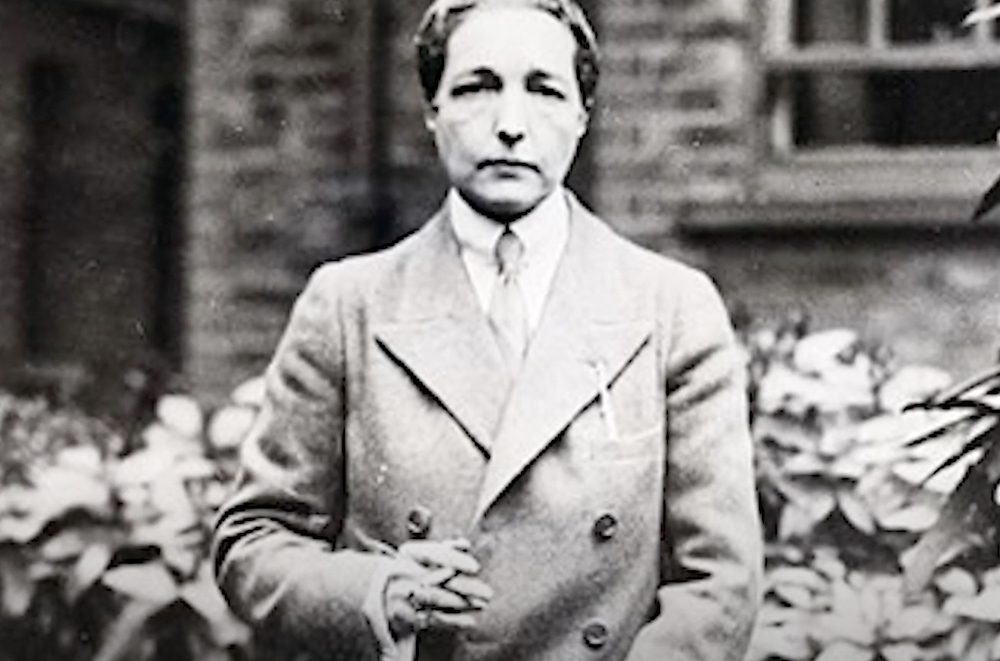
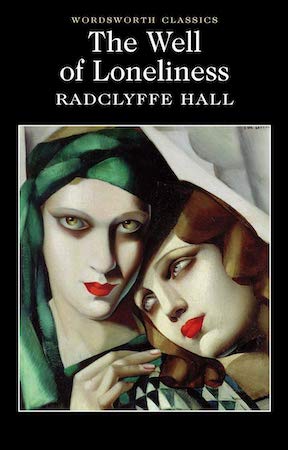
I can’t remember how I happened upon my copy of Radclyffe Hall’s The Well of Loneliness, which is a shame because it’s a first edition. The story in my mind is that it was sent to me by one of my mother’s friends shortly after I came out, but I’m pretty sure I first read it while I was still in the closet, so that can’t be right. Maybe I invented this story because of its narrative advantages; that a book written by an aristocratic English lesbian might be sent to me from an English aristocrat trying to endorse my lesbianism sounds like the sort of story I’d like to be true. I’m not sure that it happened that way, though, and the English aristocrat in question can’t remember either. She thinks it was The Price of Salt.

Anyway, let’s assume for the sake of argument that Lady Fitz-Waterford sent me The Well of Loneliness as a gift when she heard from my mother that I’d told my husband I was leaving him for a life of Sapphic love. I didn’t actually have a Sapphic lover at that point—I was living in the Connecticut suburbs and raising four children largely on my own, which left me a little short on time—but the principle of the matter was that I was a lesbian and, as such, would probably need a companion guide, an instruction manual to show me how to do it properly. 

Radclyffe Hall had been born to a wealthy, respectable British family and so had I; she grew up in the English countryside and so did I; she was a writer and so was I. Charitably, I’m going to assume that Lady Fitz-Waterford hadn’t actually read the book—or its famously depressing ending—and that her intentions had been supportive, not cautionary.   

I was a lesbian and, as such, would probably need a companion guide, an instruction manual to show me how to do it properly.

It’s not a very good book. At best, the writing is dated. At worst, it’s embarrassingly mediocre. But its place in history is unique. Up until its publication in 1928, the English ruling classes had been pretending that sex between women didn’t happen—in case innocent young girls were corrupted into thinking it might be fun to try—so the book was banned as soon as it came out. Of course, the furor surrounding the censorship only served to broadcast across the country that lesbian sex was very much a thing and paved the way for Djuna Barnes to write the much better (and more sexually explicit) novel Nightwood, which must have annoyed the British establishment immensely since it was entirely counterproductive to their original aim.

But Nightwood was not the book I read multiple times, nor was Virginia Woolf’s Orlando, which was published shortly afterward, because I wasn’t looking for literary excellence; I was looking for answers, and each time I read The Well of Loneliness I somehow managed to find them.

The first time I read it I wanted confirmation that the sacrifices I needed to make in the pursuit of true love would be worth it. I was idealistic and naive, certain that my internalized homophobia was the only obstacle standing between myself and eternal happiness; I just needed to figure out how to let go of my past—and the wealthy, white, heterosexual world in which I’d been living—so I could find the woman of my dreams. I devoured The Well of Loneliness in one sitting because I thought it was a book about love and loss, and at the time I felt as if I might lose everything.

I devoured The Well of Loneliness in one sitting because I thought it was a book about love and loss.

The novel’s female protagonist—named Stephen in a surprisingly progressive act of gender-fuckery that I decided not to focus on too closely during that first reading—also had to leave the familiarity and comfort of her homeland before she could find true love, since Paris was the only place to be a lesbian in those days. The book was peppered with longing descriptions of the English countryside, the loss of which could only be justified by Stephen’s desire to live openly with her girlfriend Mary. I could totally identify with this. I was living in self-imposed exile in America, and although I was fully prepared to sacrifice the English countryside at the altar of my desire for a lesbian relationship, I wasn’t so single-minded that I couldn’t indulge in a little sentimental nostalgia now and then.

What I couldn’t identify with, however, was Stephen’s ludicrous decision at the end of the book to send Mary back to England in the arms of a man—the slightly unremarkable Martin—to save her from a life of sexual depravity in Paris. This felt not only like an act of betrayal, but also one of gross stupidity. Wasn’t the whole point of the story that true love—specifically perfect, unadulterated lesbian love—should conquer all? Otherwise why would we be making all these sacrifices? But I reassured myself that lesbian romances weren’t permitted to have happy endings until at least the 1950s (hello The Price of Salt), so this was merely a narrative device that had been designed to rescue the book from censorship. In real life lesbian love would conquer all. Obviously. I mean, we are living in the twenty-first century now. We are allowed to love whomever we choose. 

By the second time I read the book, I had grown a little more discerning. I’d divorced my husband, ditched most of my cis-het friends, found my queer community, and was in a complicated relationship with a woman who was sorely testing my faith in the all-conquering power of lesbian love. Yes, I was irrefutably gay, and yes, sex with women was unquestionably better than with men, but there was still something missing. I was looking for something else, something beyond my lesbian relationship, something that felt more like an identity. 

Yes, I was irrefutably gay, and yes, sex with women was unquestionably better than with men, but there was still something missing.

Up until this point I’d presented as femme—due to a second type of internalized phobia that I wasn’t yet willing to look at—but the more comfortable I got with being a lesbian, the more certain I was that my internal dynamic was on the male end of the spectrum. And yet somehow the butch identity didn’t feel right. Memories surfaced of Stephen’s rakishness, her dandyish wardrobe, and I wondered whether there might be a way of being a masculine-presenting lesbian that was a little more foppish, a little less straight-up butch. So I pulled the book back down from my bookshelf. 

I was surprised this time by how much page space was dedicated to Stephen’s masculinity, details that I hadn’t noticed the first time. I was looking for descriptions of the clothes she wore, but what kept jumping off the page at me were the moments when she seemed confused by her own body. These little revelations were hidden among the text like Easter eggs, but now they felt more visceral than the lengthy, angst-ridden passages dedicated to forbidden love. Stephen spoke of her discomfort about her “hard, boyish forearms,” “the strong line of her jaw,” which gradually grew into an anxiety she couldn’t name, a feeling of being lost, “a great sense of incompleteness,” and then, suddenly: “It’s my face,” she announced, “something’s wrong with my face.”

The sentence sent a chill down my spine. She’d put words to my feelings, voiced the thought that surfaced every time I looked in the mirror. From inside my muffled state of denial, I could hear her trying to acknowledge her own deep-rooted fear of her emerging masculinity, her powerlessness over a body that seemed to be trying to turn male against her will.  

I could hear her trying to acknowledge her own deep-rooted fear of her emerging masculinity.

But for the most part, the rest of the book—when it wasn’t indulging in exhausting descriptions of anguished love—concentrated on Stephen’s desire for gender equality, for a position in society, for the respect of the ruling classes. There was something uncomfortable about her mimicry of upperclass, old-school masculinity—I knew men like these from personal experience and I didn’t like them—but I was interested in her friendship with Martin and her desire for male companionship, although the ending still annoyed me. I understood that Stephen had some kind of martyr complex, but the insistence that Martin take her lover was beginning to look less like an act of grandiose self-sacrifice and more like an act of overt misogyny. Why hadn’t Mary been allowed any say in the matter? 

It was around this time that I decided to name myself for the author. I’d just had a story accepted by the New York Times and I didn’t want to write under a name bequeathed to me by either my father or my ex-husband (because patriarchy). Searching in a hurry for something fitting, I’d settled on Radclyffe, not only because she was an English lesbian, but also because she bore an uncanny resemblance to my grandmother, whom I had adored. Naming myself Radclyffe somehow felt like honoring both my grandmother and my lesbianism at the same time, so Radclyffe I became.

By the third time I read the book, I was specifically looking for the things I’d been trying to avoid seeing in the previous readings. I’d addressed my internalized transphobia and accepted my trans-masculinity, and I wanted to find out whether in a moment of uncanny foreshadowing—or perhaps subconscious intention—I had named myself for someone who might also have been trans.  

I was aware that this was a purely theoretical exercise. The difference between butch and trans is one of self-identification—because there isn’t an objectively defined line on either side of which cis and trans people fall—and, given that the term transgender wasn’t coined until 1965, there would be no way to accurately surmise how Radclyffe Hall might identify today. The only label Stephen applied to herself was that of “congenital invert,” which appears to conflate sexual orientation and gender identity, so it’s difficult to extrapolate from the text how much of her anxiety was related to her masculinity, and how much to her gayness. 

She spoke of “the terrible nerves of the invert … running like live wires through her body … causing a constant and ruthless torment,” and how she must “drag this body of hers like a monstrous fetter imposed upon her spirit,” which sounded suspiciously like gender dysphoria to me, but this described how she felt in childhood, before she had control over her own presentation. I wanted to see if I could find evidence of continued discomfort after Stephen’s butch identity had been actualized; a clue that, like me, identifying as a masculine-presenting woman—and therefore still technically female—hadn’t been enough to relieve her gender dysphoria.

But mostly what I found instead were oblique references to her envy of cis-het masculinity, most notably through the eyes of her dog, who is unapologetic about his preference for male company and always somehow manages to make Stephen feel slightly less than, as if he can smell a whiff of the man about her but is really only humoring her because he loves her. And I couldn’t understand how I’d managed to overlook Stephen’s undeniable misogyny for so long: the superiority, the condescension, the control she exerted over the women she claimed to love.

I couldn’t understand how I’d managed to overlook Stephen’s undeniable misogyny for so long.

Radclyffe Hall paints Mary as an ingenue—consistently referring to her as “the girl” or “my child”—enthralled by Stephen’s superior intellect, whose greatest joy is apparently found in mending Stephen’s clothes, cleaning her house, or hovering silently by her side at the Parisian artists’ salons. It was all beginning to feel a little like literary masturbation, as if The Well of Loneliness was an instruction manual written specifically for Hall’s own partner, Lady Una Troubridge, who by all accounts took it to heart and became exactly the kind of “wife” she’d been instructed to be.

I also wasn’t sure whether my new awareness of—and aversion to—these overtly gendered roles was the result of my having worked so hard to purge them from my own life, or a general evolution into a more empathetic, mature human being, or a side effect of early transition. But I was rubber-necking toxic male behavior everywhere now—a precautionary act of vigilance against adopting the same as I became progressively more masculine—so I suspected it was probably a combination of all three.

And yet, I still couldn’t make a clear call on Stephen’s gender until in the final chapters I finally caught a glimpse of something that might speak to a trans identity. Instead of seeing the dismal ending as a betrayal of true love, as I’d done the first time, or as an irritating act of martyrdom as I’d done the second, in this third reading Martin seemed to represent not just the masculine friendship Stephen craved or the male privilege she envied, but the body she wanted to become. At the end of the penultimate chapter, when she decides to bequeath her lover to him, she “found that she was holding his hand.” This strange act of physical contact now made the transaction seem almost supernatural, as if Stephen had sensed that in the absence of gender-affirming surgery, her “incompleteness” could only be resolved by transference into an actual male body, in this case Martin’s.

I decided to do some more reading—of her biographies, letters and lesser known stories—to see if I could bolster this theory. Eventually, I found a short story published a few years later, in which a female protagonist transforms without warning into a prehistoric man while exploring a cave on the English coast. In “Miss Ogilvy Finds Herself,” the author finally seems to rid herself of all inhibition, exposing a desire for masculinity so extreme that she actually manifests as a caveman, complete with supplicating, half-naked female. It’s almost impossible to read this glaringly obvious symbolism as anything other than a fundamental desire to transition, particularly since she ends the story by killing off the protagonist’s female body. 

It’s almost impossible to read this glaringly obvious symbolism as anything other than a fundamental desire to transition.

So I finally had an answer, although the research it had taken to get there left me feeling a little queasy, since it looked like Radclyffe Hall had not only been a gay rights activist but also a patriarchal misogynist with consensually-ambiguous domination issues. For a brief moment I wondered how I could reconcile myself with bearing the name of someone whose views were so diametrically opposite to mine, until I remembered that ugliness can coexist with beauty, that good people can do bad things, and that we can’t always judge the actions of someone in the past based on our own standards in the present, particularly if that involves devaluing the impact they’ve had on our future. Because however problematic Hall’s position on women, race, and class might seem today, she was still a radical progressive in her own time, and her determination to break through the constraints of her gender not only helped to build a society in which trans people like me could eventually exist, but also one in which I could move away from my own unprogressive background with far greater ease.

As guidebooks go, The Well of Loneliness was far from perfect, but celebrating its existence feels more important to me now than dissecting the flaws of its author. The path from cis-het-presenting to queer or trans isn’t an easy one—I don’t know anyone who has managed to navigate it without falling into a few holes along the way—and let’s face it, sometimes we need someone with a bit of bullheaded persistence to hack through the undergrowth and clear a trail for us, however clumsily they may do it, however unlikable it might make them. My own history isn’t exactly unblemished, but if we lived in fear of exposing our faults, then we’d never write our stories, and the one thing I’m certain of is that more of our stories need to be heard. And if I can hold some compassion in my heart for Radclyffe Hall, in all her messy, dysfunctional, human complexity, then maybe I can remember to do the same for myself.

Books to Read at Every Phase of the Moon

Humans have been working with the moon for millennia, from using its phases for the calendar to farmers using the moon to determine planting and harvesting schedules. We have worshipped her light. We have dedicated holidays to her glory. Who doesn’t love the moon? When I first began basing a lot of my own schedule on the moon’s phases, I was surprised to find how natural it felt. I found my body naturally worked best when it was synced up to the moon.

I worked alongside the moon while writing much of The Boy with a Bird in His Chest, so of course the moon appears a lot in the novel. (Someone cheesier might say, “The moon is a character in my book.”) My debut novel is about Owen Tanner, a boy with a bird named Gail living inside his chest. His mother locks him away for a decade, afraid of what the authorities will do if they discover his secret. Eventually Owen must venture outside, and disaster ensues. After a harrowing escape from a doctor’s office, Owen is sent to live with his uncle and cousin in Puget Sound, Washington. It is here that he finds community with a group of queer punks, all who love the moon.

I thought it would be fun to take this idea of working with the moon’s phases and apply it to the types of books we read. What kind of books would we read when the moon is new? What about when the moon wanes?


New Moon

When the moon is new, it’s a time to begin again, a time to set intentions.

What better way to set intentions than by reading a bildungsroman?

Now is the Hour by Tom Spanbauer

Now is the Hour by Tom Spanbauer follows Rigby John, a gay teenager living in Pocatello, Idaho in the 1970s. Something about Rigby John just doesn’t feel right. He wants out from under his father’s authoritative rule. He wants to escape the small town. Now is the Hour follows Rigby John from when he’s a small child until he’s 18-years-old as he discovers his own sexuality and freedom. An absolute perfect read for when you want to remember how to begin again.

The Thirty Names of Night by Zeyn Joukhadar

The Thirty Names of Night by Zeyn Joukhadar follows a narrator who is unnamed for the first half of the book. As they grieve their mother’s death, they go exploring through New York’s disappearing Syrian neighborhood where they find a journal kept by Laila, a mysterious artist who was adored by their mother. Told in journal entries alternating between Laila and the narrator, The Thirty Names of Night is a book about grief, diaspora, and uncovering a hidden past. Readers will come for the book’s lyrical prose, but they will stay for its incredible magic and honesty.


First Quarter Moon

When the moon is in its first quarter phase, it is ample time to make concrete steps towards the intentions we set when the moon was new.

The Faggots and Their Friends Between Revolutions by Larry Mitchell and Ned Asta

I am uncertain how exactly to describe The Faggots and Their Friends Between Revolutions by Larry Mitchell and Ned Asta. Published originally in 1977 by Calamus Books, a small press started by Ned and Larry with the sole purpose of publishing the book, The Faggots and Their Friends Between Revolutions is a story that is part manifesto, part fairy tale. The book follows several revolutionary groups: the Faggots, the Sissies, the Fairies, and the Women as they all fight against the Men in Suits. The world may be against the revolutionaries but that doesn’t mean they won’t win. For years, the book remained out of print, living only as a PDF shuffled between friends. Nightboat Books reprinted the cult classic in 2019. This is a book to read when it’s time to act.


Full Moon

The full moon is the time for a celebration, an occasion to mark the release of the work you’ve done thus far.

A Dream of a Woman by Casey Plett

Casey Plett’s short story collection, A Dream of a Woman, feels like a snapshot in a moment in time. The collection follows a variety of trans woman as they fall in and out of love, grieve, and grow. The stories are deeply rooted in place: Oregon, New York City, and rural Canada, and while each of the stories depicts conflict and heartbreak, none of it feels wrought or overdone. This is not a collection that relishes in the trauma experienced by the characters, but rather, Plett’s collection is a celebration of transness, of womanhood, and of love. 


Third Quarter Moon

As the moon wanes, it is best to reflect on the intentions set at the beginning of the moon cycle. What is different? What can be released?

Inter State: Essays from California by José Vadi

José Vadi wants to know what it was like for his family who came before him. In his collection of essays titled Inter State, Vadi travels across California, tracking many of the places where his farmworker grandparents migrated to as they followed work. In this masterful collection Vadi, an aging skateboarder, reckons with the gentrification of California, capitalism, and his own family’s lineage.

Little Blue Encyclopedia (for Vivian) by Hazel Jayne Plante

When Vivian, a straight trans woman, dies, her best friend (a queer trans woman) responds the only way she knows how, by writing an encyclopedia about their favorite TV show, Little Blue. Little Blue Encyclopedia (for Vivian) by Hazel Jayne Plante is a book about grief, letting go, and unrequited love. It’s a love letter. Told as encyclopedia entries for an imagined television show, the book is as wonderfully inventive as it is deeply sad. This novel is perfect for when a reader wants to mourn the past so they can move into the future. 


Dark Moon

When the moon goes dark, it is time to be quiet and listen. What do we hear when we stop shuffling and moving forward and wait in the stillness instead?

Unknown Language by Hildegard of Bingen and Huw Lemmey

Unknown Language by Hildegard of Bingen and Huw Lemmey is a dream, a holy vision passed down from on high. A novel written from the perspective of Hildegard of Bingen, a real-world mystic and visionary from the 12th century, Unknown Language follows Hildegard shortly after the apocalypse has begun. Finding angels roaming her town after the rapture, the narrator flees to find a space untouched by the violent authority brought down by God. On Hildegard’s trek, she rediscovers love and herself. A book perfect for dreaming, sure to bring the reader visions of their own. 

Cheering for the Car in Last Place

To the woman at the NASCAR race cheering only for the winless drivers

You know not to trust luck or easy money: I could tell

by the way you ignored the casino owner who started the race
and the Yeti-toting college boys in their boat shoes, gawking

at your orange bra top, a throwback with the Tide logo 

printed across its front. Fearless as a gerbera daisy, that top, 
and oh how I admired the sly joke about good clean fun
 
once I realized it actually read Tits, how I wished for you
 
always the luxury the teenager who sat in front of us must feel, 
the heedless, hopeful way she draped her hair over the bleachers, 
 
letting it frizz in the mist just to get some air on her neck.
 
You smiled at her. There must be a line long as this racetrack 
of people you’ve comforted with whatever you had in your purse:

tissues, peppermints wrapped in cellophane, tampax, loose change. 
 
I lost you in the rain after you draped a faded beach towel
(one you must have brought from home) over your shoulders, 
 
but I think maybe I saw you again—in the windsock at the helipad 
 
flinging its orange at the relentless low sky, or in the helicopter, 
ready, at once forlorn and giddy that today nobody needed saving.


Foreign Affairs

Back in the city after my lover’s funeral
I met with a man who had treated me,
 
during our months together, like a chore.
He had just moved to the city to write poems,
 
which he’d convinced me I shouldn’t bother doing
because nothing about my life was interesting.
 
He was sorry for my loss, he said. 
He handed me a mug I’d left at his place, 
 

a serious gray mug sent by a magazine
I used to pretend I enjoyed reading.
 
He wanted my gratitude for bringing this mug
across four states, my gratitude for remembering 
 
it was once mine. Clean, empty, it reminded me 
that for a long time all I could manage
 
was to get high and fake orgasms and try
not to die, which I am still learning how to do.

7 Unlikely Love Stories in Literature

In the early stages of writing Castaway Mountain, I recall the narrative taking shape very slowly. My book is set in a world made of Mumbai’s garbage, one that may seem unreal, but is very much rooted in reality. I had written up to the moment when fires burned on the vast Deonar garbage mountains at the edge of Mumbai in 2016. At the center of this story was Farzana Shaikh, a spirited waste picker who was born at the feet of the towering mountains. She grew up on their slopes, getting singed, her life ravaged in the aftermath of the epic fires, months before she turned 18. I wondered if anyone would read ahead, past the fires. Partway into writing my book, I worried about whether I should stop. 

Castaway Mountain by Saumya Roy

But then, I remembered the young man who had entered Farzana’s life like the shimmering pompadour he styled with his hair—filled with style, light and life. The two had met on the mountain tops, as she sorted through the city’s waste that tumbled out of the garbage truck he rode in. The two had fallen in love, keeping their affair secret, shrouded by the smoke from the fires. Even in the absurd landscape of this vast graveyard of belongings, love found a way.     

I wondered if it was the darkness and blight of the garbage mountains that made their love appear to shine particularly bright. It was as if the fires, the opposition of their families, and other hurdles had made their love more unforgettable—like so many love stories I had read and treasured. 

Many of these stories came to my mind as I chronicled Farzana and Nadeem’s travails. It was social, political, and environmental constrictions that made their love unlikely, but also more searing, almost like fiction. The novels that follow trace the unlikely journey of love bucking against constrictions within and without—making us all worthy of romantic love, readers and writers alike.

Maps for Lost Lovers by Nadeem Aslam  

Chanda, “the girl whose eyes changed with the seasons,” falls in love with Jugnu, “the man with luminous hands”, as spring is about to bloom in a small British town. Chanda is trying to put her past filled with failed romances and manipulative men behind, when she meets Jugnu, a scholar of butterflies, while delivering supplies to him. “Chanda and Jugnu would both be dead by the time those flowers became fruit in the autumn.” Their magical love story unfolds within the web of their sometimes bending but hardly unbreaking cultural expectations. As the seasons turn, the web tightens around them and the book turns into a police investigation into their honor killing.

Of Love and Other Demons by Gabriel Garcia Marquez

Informed by his experience as a journalist, Marquez writes of a teenage girl bitten by a dog and is said to be possessed by African slave spirits. Hearing the dire prognosis, her wealthy father offers her up for an exorcism at an abbey. The young priest set to perform the exorcism falls in love with her. We see the battle between colonial Catholicism and Latin American folkloric tradition waged on her body, and then the immensely healing power of love.

Cuckold by Kiran Nagarkar

“Cuckold” refers to a man whose wife is an adulterer. In this celebrated Indian romance novel, the husband is the king of Mewar, the wife is the real life 18th-century saint and poet Mirabai, and the lover is Lord Krishna, who Mirabai believed she was married to. The tension builds between the real marriage and the mystical one, with the husband attempting to woo his wife back from the God, even as wars rage and his kingdom nearly unravels.   

The God of Small Things by Arundhati Roy

The beautiful and fierce divorcee Ammu lives with her twin children, Rahel and Esthapen, in Ayemenem, a village caught in the throes of communism and the endless entrails of religion and caste. “There are rules for who is to be loved and how. And how much,” Roy writes in her hypnotic, intense, unforgettable love story set in the ‘70s. Ammu’s family runs Paradise Pickles and mostly lives by “the laws that made grandmothers grandmothers, uncles uncles, mothers mothers, cousins cousins, jams jams and jelly jelly.” Then Ammu and the children see Velutha, their Dalit carpenter, in a communist rally. The unbending laws that dictate their lives begin to quiver and crumble. The powerful last scene is a memory of Velutha swimming across the river to meet Ammu: “he folded his fear into a perfect rose. He held it out in the palm of his hand. She took it from him and put into her hair.” 

Blind Assassin by Margaret Atwood

Atwood unravels a story about the interweaving and interchanging lives of two Canadian sisters, Laura and Iris Chase. The novel begins with Laura dying in a car accident and Iris revisiting their lives through Laura’s autobiographical novel, Blind Assassin. Their father, an industrialist, married Laura off to save the family fortune. The marriage was predictably an unhappy one and Laura yearned for Alex Thomas, an old flame and a communist sympathizer who was involved in their father’s factory. Amidst the stories of the Chase sisters’ catering to the needs and whims of the men in their lives, are the memories of Alex recounting science fiction tales about a planet called Zyrcon where anything at all can happen. 

The Remains of The Day by Kazuo Ishiguro

A love so unlikely it may not have existed at all and yet so undying that the main character sets out to find it, and himself, decades later. Working as a butler, Mr. Stevens dutifully spent years holding up the vestiges of a mansion and with it, Britain’s declining post-war power and nobility. Miss Kanton, the housekeeper, waited for Mr. Stevens to tire of his efforts of keeping up with this slipping world and to turn to building a life of his own with her. Was the unarticulated and unexamined self even there? Years later, Stevens leaves on a road trip, in a rapidly transforming Britain, to reclaim himself and a love that had stayed unspoken and nearly unfelt.  

“Mozail” in The Dog of Tithwal by Saadat Hassan Manto

Against the seemingly endless possibilities of a city that feels as vast and star strewn as the sky itself, this love story unfolds between the glamorous Mozail, who is Jewish, and the newly migrated Tarlochan Singh, who is Sikh. In Manto’s short story, Mozail teases and gets close to Tarlochan on Mumbai’s—then known as Bombay—breezy beaches and cafes, but veers away just as Tarlochan thinks she is his. Bombay’s social rifts come into view as the Partition nears. With Mozail seemingly out of reach, Tarlochan settles for a simple Sikh girl instead. But as riots erupt, Mozail returns, and tragically swaps identities to ensure the safety of Tarlochan’s fiancé. 

Some years ago, on a warm afternoon, I walked around the Nagpada area where Manto had lived and where Tarlochan and Mozail’s story was set. I came across an overgrown municipal garden where I had heard a Jewish cemetery had been. I tore down a poster advertising call center jobs from the cement pillar by the gate and saw an engraved Star of David—the only remaining trace of the real life people, the inspiration behind these characters, who lived, loved, and died in this city.

7 Scintillating Thrillers About Romances Gone Wrong

Did we fall into some kind of Twilight Zone of exes?”

The Perfect Escape by Leah Konen

So Sam asks Margaret in my latest thriller, The Perfect Escape, after yet another soon-to-be-ex-husband has turned up in town. The two women and their friend Diana are all newly estranged from their partners, and their girls’ weekend to Saratoga Springs was meant to be an escape from the heartache and turmoil of their respective divorces.

Instead, mere hours into their trip, they find themselves stranded in a strange town, Diana goes missing, and the men from their pasts begin to turn up in droves—leaving Sam and Margaret to wonder exactly who is pulling the strings on their dangerous would-be getaway. 

To celebrate the release of The Perfect Escape, here are seven scintillating thrillers about romances gone wrong.

My Sister, the Serial Killer by Oyinkan Braithwaite

In Oyinkan Braithwaite’s stunning novella, the exes in question turn up in the form of dead bodies—Ayoola has an unfortunate habit of killing her boyfriends, always turning to her sister, Korede, to cover it up. The plot truly starts to thicken when Ayoola sets her sights on Korede’s kindhearted work-crush, Tade. 

The Wife Between Us by Greer Hendricks and Sarah Pekkanen

A woman is getting ready to marry the man of her dreams, and an ex-wife threatens to bring it all crashing down. This spurned-ex story gets a refreshing twist in the capable hands of Hendricks and Pekkanen, who create a cast of characters—and narrators—who are not who they seem. 

A Good Marriage by Kimberly McCreight

McCreight’s gorgeous murder mystery is set against the backdrop of elite and moneyed Park Slope in Brooklyn, and follows Lizzie, a criminal defense attorney with a marriage on the rocks, as she attempts to defend a wealthy entrepreneur and former classmate, Zach, who’s been arrested for the murder of his wife. Combining multiple points of view and timelines and intercut with grand jury testimony, this spiderweb of a book shows us that marriages are so often not what they seem.

The Last House Guest by Megan Miranda

Set across three summers in idyllic Maine, Miranda’s small-town thriller lifts the lid on the wealthy and powerful Loman family, after Sadie Loman turns up dead and Avery, her best friend and the family’s property manager, suspects foul play. Avery’s investigation leads her into the labyrinths of her own romantic past when she begins to question whether her friend and former flame, Connor, is actually responsible for Sadie’s death. 

The Undoing by Jean Hanff Korelitz

What would you do if the man you thought you loved, the man you’d been married to for years and raised a child with, suddenly disappeared, leaving questions—and a dead body—in his wake? Such is the central question of Korelitz’s emotional and evocative novel, which became the wildly popular The Undoing on HBO. 

The First Mistake by Sandie Jones

When Alice’s husband, Nathan, starts acting suspicious, she turns to her best friend, Beth, for a sympathetic ear and some advice. But as secrets and lies begin to unravel and Nathan’s skeletons (and an ex) come out of the woodwork, Alice comes to suspect that putting her trust in her friend may have been the ultimate mistake. 

The Push by Ashley Audrain

Blythe Connor is just trying to be a good mother, but she can’t help fearing that there is something very wrong with her daughter, Violet—and no amount of assurances from her husband, Fox, can put her fear to rest. It’s only after a family tragedy causes Blythe and Fox’s marriage to unravel that Blythe can finally understand the reality of what happened to her family, no matter how much Fox and his new wife, Gemma, refuse to listen. 

A Novel About Choice Set in an Abortion Clinic

Outside of the titular Mercy Street Clinic, a priest repeats “Hail, Mary, full of grace, the Lord is with thee” into a megaphone. A crowd of people, all bundled in layers against a Boston snowstorm, responds in chorus, all 36 of them united in their protest against abortion. If Jennifer Haigh’s latest novel wasn’t labeled as such, it might be easy to imagine the scene as nonfiction.

Each day, all over the U.S., people make their way through the deceptive advertisements from “crisis pregnancy centers;” through travel, economic, childcare, and schedule-related logistics; through crowds of protestors; and through an increasingly chilling wall of anti-abortion legislation in order to receive sexual health care. And things aren’t getting better. As Elizabeth Nash writes in “State Policy Trends 2021: The Worst Year for Abortion Rights in Almost Half a Century”: “The 108 abortion restrictions enacted in 2021 far surpasses the previous post-Roe record of 89, set in 2011. A total of 1,338 abortion restrictions have been enacted since Roe v. Wade was handed down in 1973—44% of these in the past decade alone.” 

Haigh, New York Times bestselling author and winner of the Massachusetts Book Award and PEN/New England Award in Fiction, explores abortion access through the lens of four unique characters in her latest novel, Mercy Street. Claudia, a counselor at the clinic, offers insight into the lives of patients, as well as the circumstances that complicate their ability to receive care, whereas a man who goes by the name Excelsior11 online, is misogynistic, racist, desperately lonely, and vehemently opposed to abortion.

Over the phone, I talked with Jennifer Haigh about the wave of recent anti-abortion legislation, fake abortion clinics, caretaking, and the ways technology, depending on the context, can foster both sinister and beautiful communities. 


Jacqueline Alnes: There’s a moment where Claudia googles the names of abortion clinics and finds: Women’s Choice, Women’s Options, the Choice Center for Women’s Health, and the Women’s Center for Reproductive Choice. The irony, though, is that it seems like women really don’t have much of a choice, right? 

Jennifer Haigh: I still find it remarkable that these kinds of places exist. They exist in every state, and they really are these dummy clinics. They very intentionally look like real clinics, they are located in the same cities, and all their advertising and their online presence leads you to believe they are actual clinics where actual abortion services are offered. The whole game is just running out the clock. It’s tricking women into making appointments, canceling and rescheduling them, so you run up against the deadline. In every state, though the deadlines vary, the deadlines are very real. Here in Massachusetts, at 24 weeks, it’s over. You have no other options past that point.  

JA: I know you were writing this novel before all of the recent anti-abortion legislation, but I wondered what it was like having this book come into publication at this time, when it seems like the choices people might have are dwindling even further.

JH: Writing a timely novel is impossible if you try to do it on purpose. It just takes too long to gestate. I started writing this one around 2017 and none of this seemed to be on the horizon yet, so that wasn’t at all the motivating factor. The book rose out of my experience volunteering at a clinic. Mercy Street is kind of modeled on that place. I didn’t volunteer with the intention of writing a novel about it. I volunteered there because I believed in what they were doing. 

Over time, I began to wonder: why is nobody writing a novel about this? It seemed to me I had never read anything honest about abortion. I don’t think I have. That’s what led me to write this book. If somebody is going to write about it, it should be done in a way that is true. That’s really the impulse behind it. I never imagined that it would coincide with these horrible political reversals we have seen in the past year. 

JA: There are a few scenes that mark clear disparities in what populations are able to access safe abortions. I’m thinking of the quote, “The Hannah Ramseys of the world—rich white girls torn between Yale and Dartmouth—rarely fell for the con.” There are other populations of people, who don’t have the money, resources, or time, to have an abortion, who might be duped by the fake clinics or run up against the clock because of life circumstances. What was it like writing into those intersections? 

JH: This is in many ways a novel about class, kind of like everything I’ve ever written. It’s a subject I keep coming back to. One thing I discovered in volunteering at this clinic is that class is a complicating factor when it comes to reproductive choice. A character like the Hannah Ramsey character has a mother who goes with her to the appointment, who is eager for her to get this experience behind her, and get on with her life. Not all patients who turn up at the clinic have that kind of support network. 

There is a range of reasons why women choose abortion and that’s something we don’t really talk about. When we talk about abortion and choice, it’s almost never about the woman. It’s about the fetus, it’s about religious convictions, it’s almost never about the very good reasons why women do make this choice. Women from a privileged background have a wider range of options, and are certainly less likely to fall for something like the crisis pregnancy centers and also are less likely to be stopped by regulations like we are seeing in Texas, where abortion access is cut off at 16 weeks. If you have the means to travel somewhere else, if you can buy a plane ticket, if you can get time off work, if you don’t have children, or other relatives to look after, then you can find a workaround. But for a lot of women, that’s just not the case.

JA: I was interested in the consequences of different people in the book choosing to have children, choosing not to have children. Claudia’s mother Deb takes in so many fosters that Claudia finally realizes it’s because “it was one of the few things she could earn money doing” as a woman. She was a caretaker. Claudia obviously works to give pregnant people a choice, a future, but it is clear that people with the ability to become pregnant bear much of the responsibility of childcare. They are responsible for finding the resources—and money—needed to make choices about their bodies. 

What did you consider about caretaking while writing? About motherhood? About the responsibility that people with the ability to become pregnant carry? 

When we talk about abortion and choice, it’s almost never about the woman. It’s about the fetus, it’s about religious convictions.

JH: There’s a moment early in the book where Claudia thinks about this idea that women are supposed to love children, this assumption that there is such a thing as maternal instinct. Claudia reflects that she loves them on a case by case basis, and that’s a result of the way she has grown up, where she has seen these kids in foster care who are hard to love because they have been abused or neglected or suffered some terrible trauma. It does make them really hard to love, and yet someone has to care for them. 

All the caretakers in the book are women. The whole staff of the clinic, except the security guards, are women. I don’t think that is universally true, but it is not uncommon; the clinic where I worked was that way.

JA: There is this pervasive idea, I think, that women should naturally want to be mothers.  I read Arianna Rebolini’s recent tweet about how she does not enjoy being a mom, even though she is a mom, and how she wants to imagine possibilities for communal childcare. As you can imagine, posting that publicly led to some extreme pushback, with people asking, “Why don’t you want to be a mom?” or “How could you post this when you have kids?” In thinking about all these different messages given to women surrounding motherhood, so many of them are tied to morality or the way women can be construed as saints or whores. 

JH: I really think this is the root of a lot of pushback against abortion rights. It really is punishing women for sexuality. It’s not presented that way. It’s presented as being about the fetus and preservation of the fetus, but there is a real punitive element to it. It’s women’s sexual choices that are at the root of this. There’s this idea that if you are pregnant and don’t want to be, well you should have thought of that before you had sex. That is your fault. That is something you should have to live with. And nowhere in this is there a conversation about the man who contributed to this. For every woman who has ever had an abortion, there has been a man involved. It’s striking how seldom that is part of the conversation.

JA: Speaking of men, I feel like we have to talk about Victor and company. Victor is a longhaul trucker who is indoctrinated by a radio host who spews conspiracy theories. He is a prepper, creator of a website called the “Hall of Shame,” which features photos of women heading into abortion clinics (taken without their consent), and he paints his own anti-abortion signs. How did you decide to write about them? 

JH: When I was volunteering at this clinic, there were men protesting outside all the time. Sometimes there were women, too, but there were always men. Sometimes there were only men. When I was conceiving of this story, I knew there would be some male antagonist to Claudia. 

I grew up in Western Pennsylvania, it’s part of Appalachia, in a tiny little town that is overwhelmingly Christian, It really is a part of the world where you see handmade signs along the road, things like “Abortion stops a beating heart,” the kinds of things Victor Prine is painting. I grew up hearing this really adamant anti-abortion rhetoric, and so I do associate that with the sort of town where I grew up. It was very natural for me to create Victor Prine as someone who is from that part of the world, because it is a part of the world I knew well. 

JA: When Victor Prine uses his Excelsior11 username, he seems to perceive he has a lot more power than he might in other spaces. The anonymity of the internet seems to embolden people who are against abortion. 

If you do not want to give birth, you should not be forced to carry a child, whatever your age, whatever your circumstances, nobody should be forced to do that.

JH: That is certainly true. Had I written this novel thirty years ago, there could not have been a Victor Prine character who functions the way this one does. The truth is, now, all of us live some part of our lives online, and some of us live most of our lives online. That’s true for Victor Prine and Anthony. The two of them have struck up a friendship online, which could not have happened thirty years ago. It’s a product of technology. Certainly, there are all kinds of communities online—people who are against abortion, people who are in favor—these natural online communities. Victor Prine is a product of that.

JA: Was it uncomfortable occupying Victor’s head space? 

JH: It became very comfortable, and that is sort of worrying to say. I believe this firmly: it’s the magic of point of view for a fiction writer. Whatever character you are writing, you have to take that character’s side while you’re writing that character, even if that character holds beliefs that are repugnant to you or that are entirely different from your own. When you’re writing the character, you have to make common cause with that character. It’s kind of like being an actor. The actor doesn’t pass judgment on the character she is playing; you become the character. I think that’s true if you are going to write any character’s point of view. You have to show some loyalty to that character and see the world through his eyes, at least while you’re writing him, even knowing that a month from now you might be writing a character with entirely different views. 

JA: Did you learn anything from writing Victor? Or have any takeaways from that experience?

JH: I underestimated his loneliness when I started writing him, and it was something I came to understand as I spent more time with him on the page. They are all lonely people in this book. Victor is by far the loneliest, and he’s been loneliest for the longest; he’s not a young man. He has been lonely since childhood. He did not have a nurturing kind of family, he did not have a mother, he had a very difficult neglectful father, he has never had successful relationships with women. He is an isolated creature and has been isolated for so long that it has warped him.

JA: Smartphones and other forms of technology can be a form of safety, as Claudia notes while watching Dateline, but also can be weaponized, as we see through the online chat rooms where misogynistic, racist users congregate to talk about the everything from abortion to the end of the world. And on the flip side, photos are used to make women less anonymous, in a public “Hall of Shame.” And as Claudia notes, everyone has a smartphone in their pocket; we could all presumably infringe on the privacy of another.

JH: In the book, technology is a way that people lose privacy. The women walking into the clinic are fair game, they are out there on the street walking into a health center. Anyone could have taken those photos, and that’s a reality we all live with. We can all be photographed at any time. We all often have the sense that our phones are eavesdropping on us or that Siri is eavesdropping on us. It is a feature of modern life. The need for privacy around abortion is extreme because having an abortion is like having a target on your back. 

There is a reason why women don’t talk about their experiences with abortion. You feel very vulnerable; it leaves you wide open to this vicious sort of attack.

I had said earlier that I had never read anything true about abortion, and there is a good reason for that. There is a reason why women don’t talk about their experiences with abortion. You feel very vulnerable; it leaves you wide open to this vicious sort of attack. The book is dedicated to the one in four women who will have an abortion at some point in their lives. That’s a huge number. It means that everybody knows someone who has had an abortion, and probably several people who have had an abortion, even if you are not aware of it. Claudia thinks at one point that it is a secret some people probably carry to their graves because people’s reactions to abortion are so extreme.

JA: Have you heard of Shout Your Abortion

JH: Yeah.

JA: I’m interested in what you thought about reading those stories. For me, there was an interesting array of emotions I encountered on the page that maybe I had not associated with abortion before. I remember people expressing joy, expressing relief. I’m curious how you might see this as a complementary text to yours, or a true text. 

JH: I think it’s a terrifically brave thing that someone would have done that. It’s not possible for everyone. Here again, it’s a question of your circumstances. Having an abortion is something that someone would have a very good reason to be secretive about. I understand that it is empowering to other people if you share your experience; I think it is a brave thing to do, but it might not be possible for everyone. The moment I knew I had to write this novel—and it’s actually something that comes up in the story—there was a caller to the hotline I worked on at this clinic who wanted to schedule an abortion. She wanted to schedule it quickly and she said, if my ex finds out I’m pregnant, he’ll come to my house and shoot me and my kids. She really said that. I have no way of gauging the veracity of that, but I’m taking her word for it. She would certainly know better than I would. I was a volunteer on a hotline. People have all sorts of reasons for choosing abortion and all sorts of reasons for keeping it a secret. So I’d never judge someone for being secretive about it. I think it’s great that there is a trend that more women feel able to be open and transparent about it, but unfortunately, that’s not the world yet we live in for everyone.

JA: Since you’ve volunteered and now written this novel, what would you hope to see changed or what stories would you hope to see out in the world?

JH: What I would like to see changed, of course, is for women to be completely in control of this. There are lots of people who are pro-choice but believe that some of these restrictions, like restricting late term abortions, are okay. I used to be like that. Having learned a bit more about the experiences of women who need abortions, I’m inclined to think that maybe those restrictions are not a very good idea. What they mean, in effect, is that someone is going to be forced to carry a child she does not want to bear, and I don’t think that is ever acceptable, no matter what the circumstances. If you do not want to give birth, you should not be forced to carry a child, whatever your age, whatever your circumstances, nobody should be forced to do that. 

7 Novels About All-Women Households and Communities

Depictions of women living without men can be found in literature since the advent of the novel. From Sense and Sensibility to The Golden Notebook to Bridget Jones’ Diary, such women are often unconventional, either unwilling or unable to fit the mould prescribed to them by society. They’re threats, failures, outcasts, but they can also be trailblazers—women who want to determine their own paths. 

A Very Nice Girl

In my novel, A Very Nice Girl, 24-year-old Anna is training to be a singer in London. At first, she lodges in an eccentric couple’s house with Laurie, a woman who she meets through the flat share, and who becomes her best friend. Later, they move to an “experiment in feminist communal living,” run by Mil, who believes that women can only fulfill their potential, can only know what they might be, without men. 

The following books are all about women who are, in different ways, living without men—either out of choice, or because they’ve been compelled to, or simply because, unintentionally, that’s how their lives have turned out. Their situations are used contrastingly by each writer to explore women’s position in the world, their relationship to men and to society. 

The Water Cure by Sophie Mackintosh

In Sophie Mackintosh’s fairy-tale-like dystopia, three girls—Grace, Lia and Sky—live alone on an island with their parents, Mother and King. The girls were too young when they moved to now remember the outside world, but they know that it’s filled with toxins, and that the main source of these toxins are men. The girls have always relied on King for survival, but one day he leaves to get supplies and doesn’t come back, and the women are left alone. An exploration of toxic masculinity and patriarchy, Mackintosh creates a closed world which is meant to prioritize the safety of women, but where a sadistic man—King —remains entirely in charge. Only when he disappears, and three young men unexpectedly arrive on the island, do the girls start acting with autonomy and questioning what they’ve been told. 

To the North by Elizabeth Bowen

To the North, Bowen’s 1932 novel, tells the story of two young women who live together—Cecilia, recently widowed after less than a year of marriage, and Emmeline, the sister of Cecilia’s late husband. The novel follows Cecilia’s reluctant move towards a second marriage, and Emmeline’s destructive love affair with the selfish and predatory Markie. Set during the interwar period, a time of much debate about the position of the single or “surplus” woman after the deaths of so many men in World War I, Bowen’s novel explores the predicament of unconventional women pursuing independent lives. The cohabitation of Emmeline and Cecilia is treated with great suspicion by the other characters in the novel, a sign of the women’s dislocation from society, in a world where “home” for a woman means the home you find with your husband. As Emmeline reflects, when she discovers that Cecilia will remarry, “houses shared with women are built on sand.”

Breasts and Eggs by Mieko Kawakami 

Breasts and Eggs is about Natsuku, a woman in her 30s who is living alone in Tokyo while trying to be a writer. In the first part of the novel, she’s visited by her sister Makiko, an aging hostess who wants to get breast implants, and Makiko’s daughter Midoriko, who has recently hit puberty and stopped speaking. The second half of the book takes place eight years later. Natsuko, who is asexual, single and still living alone, thinks about having a baby and starts to look for sperm donors. Although punctuated by some wonderful and surprising surreal scenes, the tone of the novel is largely reflective—a ruthlessly honest exploration of the rights and wrongs of motherhood, of the different ways that women can live without men, and of whether, as a woman, you are inevitably defined and limited by having a female body. 

The Empress and the Cake by Linda Stift, translated by Jamie Bulloch

One of the madder all-women households in literature, The Empress and the Cake is a psychological thriller by Austrian writer Linda Stift. It begins with an elderly lady, Frau Hohenembs, offering a slice of cake to the young narrator, which triggers a relapse of the narrator’s bulimia. This is the start of an increasingly disturbing relationship with Frau Hohenembs, who believes herself to be (or perhaps really is?) the 19th-century Austrian Empress Elizabeth, known as Sissi.

Before long, the narrator has moved in with Frau Hohenembs and her housekeeper, Ida, and is sucked into performing a series of increasingly bizarre tasks for them, including stealing the Empress Sissi’s cocaine syringe from a museum, and taking part in an Empress Sissi lookalike competition. Concurrently, the narrator falls deeper into an eating disorder which dominates and limits her life. The arbitrary and increasingly restrictive rules that Frau Hohenembs exert over the narrator mirror the arbitrary restrictions of her eating disorder, with Frau Hohenembs herself also obsessed with controlling food-intake—both her own and other people’s—insisting on daily weigh-ins and food diaries for both the narrator and Ida. Haunting and surreal, The Empress and the Cake explores delusion, obsession and control, subtly demonstrating how easy it is to fall under someone—or something—else’s power. 

Animal by Lisa Taddeo 

Joan, 36 and single, has spent most of her life having cold and transactional relationships with men. After witnessing her former lover shoot himself in front of her at the restaurant where she’s having dinner with a new lover, she drives to Los Angeles to rent a house. She’s on a mission to meet and befriend Alice, a woman with an as yet unspecified connection to Joan’s past, and at the same time, she’s being pursued by the daughter of the deceased lover, who blames her for his death. The present day is set alongside flashbacks of Joan’s past, which gradually expose the traumas she’s experienced at the hands of men—traumas that have made her, as she terms it, “depraved.” Animal is a novel about female desire, consent and the extent to which we are defined and shaped by our pasts. In this dark and compulsive depiction of female rage, Taddeo explores the cost of surviving as a woman in a man’s world. 

Burnt Sugar by Avni Doshi 

A novel which focuses on the relationship between mother and daughter, Burnt Sugar explores the extent to which you can escape the legacy left by neglectful parenting. In 1980s Pune in West India, Tara is determined to pursue her own desires, regardless of their impact on her daughter Antara. Tara leaves her husband and takes Antara to live in an ashram, largely abandoning her daughter to be looked after by another woman. Three decades later, Tara has dementia, and Antara allows her to move into her house so she can look after her. The novel alternates between the past—where Antara and Tara live in instability and poverty while Tara seeks personal freedom—and the present—where a now comfortably middle-class Antara must come to terms with caring for a woman who didn’t care for her. A fiercely intelligent and nuanced novel about the complexities of the mother-daughter relationship, and the moral ambiguities inherent in seeking freedom.   

Matrix by Lauren Groff

Set in a 12th-century English convent, Matrix is a reimagining of the life of Marie de France, a visionary poet about whom not much is known. Groff has creatively filled in the gaps, opening the novel with the 17-year-old Marie arriving at an English nunnery. She’s been thrown out of her beloved Queen Eleanor of Aquitaine’s court because she’s too unattractive to be married, and has been sent to an impoverished royal abbey to become prioress. Initially, Marie is lonely and depressed, but then she decides to take charge of the nunnery, becoming prioress and then abbess. In the creation of an all-women utopia, men are expelled from the lands surrounding the convent, and a labyrinth is constructed to protect the nuns from attack. Matrix is a beautiful and profound novel about visionary leadership and the addictive nature of power.