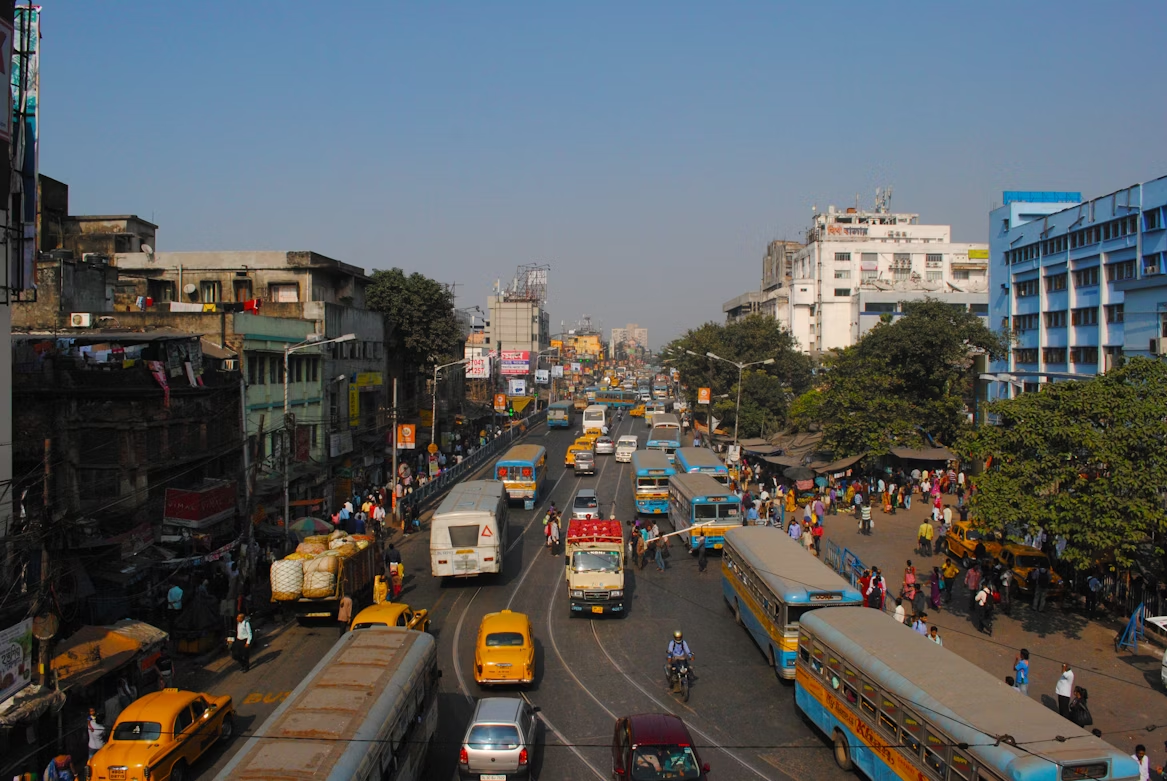
What does it mean to survive when survival itself comes at the expense of others? That’s the central question explored in Megha Majumdar’s sophomore novel, A Guardian and a Thief. The story is set in a crumbling, near-future Kolkata grappling with environmental disaster and food shortages. It follows the intersecting paths of two families: Ma is preparing to flee with her daughter and elderly father to join her husband in Ann Arbor, Michigan—until their passports are stolen. The thief, Boomba, a father himself, is desperate to provide food and shelter for his family as both run scarce. Over one tense week, both families are pushed to their limits in an unraveling city.
A Guardian and a Thief, already on the longlist for the 2025 National Book Award, represents a dynamic shift forward for Majumdar. Where her first novel, A Burning, which saw success as a Read with Jenna Pick, was precocious and scrappy, A Guardian and a Thief is sharp and expansive. Its maturity and richness allow Majumdar to tell a stirring story about the sacrifices required for survival and our own frailty in the face of societal collapse.
We spoke about the inexorable tension between individualism and collectivism, the usefulness of the label “climate fiction,” and the role of art in times of crisis.
Marisa Wright: I was struck by the opening scene where Ma sees someone riding a bike, carrying fruit, and singing, and immediately labels them a thief because she assumes such ease and nonchalance could only come from wrongdoing. We later learn Ma has been siphoning food and money from the nonprofit shelter she runs, but she is also the victim of a burglary by Boomba. How do you think about the psychology of rationalizing one’s own choices when facing exigent circumstances while condemning others?
Megha Majumdar: You’re right that the book is so much about questioning the gaps between our ideal ethical selves and who we might become in a time of scarcity and crisis. The book is very interested in this notion that we might identify acts as villainous or harmful when others perform them, but we might perform them ourselves and see them as necessary manifestations of our love and our hope for the people that we love. I wished to complicate the idea that there is a binary between something like hope, which must be noble and pure and unassailable, and something like harm or violence. How do we live when a community’s collective hope clashes with what an individual sees as their own hopeful act for their children?
MW: Even after Boomba engages in another wrongful act, you write, “Boomba was no monster. All Boomba was, was a man whose moral compass pointed toward the north of his own family. Wasn’t that the most ordinary thing in the world?” On one hand, I totally sympathize with prioritizing one’s family over others, but on the other, it makes me very sad about the nature of humanity and our inability to think collectively on a broad scale. When you wrote this, were you aiming for a fundamentally optimistic or cynical reading?
MM: That’s a great question. I’m thinking about your framing of optimism versus cynicism, and that’s part of what I was thinking through in this book. I was reading a lot about climate change, and one thing that I encountered over and over was declarations of hope. It put me in this space of thinking about what we mean by hope. Being optimistic is perhaps one thing for nations and systems, and quite another for individual, ordinary people. How will we live with ourselves if we find that for an ordinary person, what comes to the fore is their wish to protect their own loved ones, even at the cost of others? Is that a kind of love or hope that we can be proud of? Is that still a form of love that we feel able to get behind? I feel like I don’t really have answers, but the book helped me ask the questions with the rigor and intricacy that interested me.
MW: It seems to me that as the effects of climate change become more and more a part of our everyday lives, climate fiction is no longer really a distinct genre; it’s sadly more like realism now. Do you think “climate fiction” is still a useful label, or has it transformed into something that makes a distinction without a difference?
The book is so much about questioning the gaps between our ideal ethical selves and who we might become in a time of scarcity and crisis.
MM: Well, I think that label has a kind of useful identifying function for a reader who’s looking to think through questions of climate change, but I wonder if there’s also a certain distancing, as if this is fiction, which is apart from fiction about family or fiction about love. As you’ve pointed out, that’s simply not true. It felt very personal writing about this because my hometown, Kolkata, India—where I’ve set the book—is one of the cities in the world that is most vulnerable to climate change. It has already grown hotter and will be affected by sea level rise in the Bay of Bengal. It is predicted to endure more frequent and more severe storms in the coming 50 years or so. My parents live there, and my extended family lives there. What is this place going to become? It’s kind of frightening and sad and alarming to think about the future of this city. So in some ways, I’m glad for the label of climate fiction because it tells a reader there’s a category of books where one of the primary goals is to think about this future. But it is not apart from thinking about love and hope and community and morality and all of these things that so many other novels do as well.
MW: Both of your novels unfold with the momentum of a thriller. As a reader, you want to find out what happens; in A Burning, whether Jivan will be declared innocent, and here, whether Ma will recover the passports in time to leave for America. But unlike a conventional whodunnit or will-they-or-won’t-they narrative, the endings are left more unsettling and unresolved. How did you think about pacing in these novels?
MM: It gives me such a thrill to hear you say that it made you think in some ways of a thriller, because I love thinking about plot. I knew that I wanted A Guardian and a Thief to be set at the edge of something. I knew that it couldn’t be too long. I needed them to be on the cusp of a big change. I needed a moment where I could sustain the pressure of something going wrong. I love putting pressure on every word and every sentence to tell us something meaningful, and so I’m glad the pace worked for you.
I think a lot about the act of migrating because it has shaped my life so profoundly.
It’s funny because so much of the process of writing a book for the first however many years is about telling the story to myself, and figuring out the story for me, and then at some point, my perspective shifts. I start thinking about how do I invite a reader in? How do I guide a reader through this world? What do they need to move in the way that I want them to move through this world? I find thinking about the reader’s experience of the story really invigorating. It’s a really fun challenge to figure out how I can plant the questions that are meaningful and urgent to me in their mind as well.
MW: The precarity of reaching America and the idea of the “American Dream” loom over the novel. Your own immigration experience might be seen as embodying that idealized vision of the “American Dream”—you went to Harvard, became a successful editor and novelist, and now have a lovely family. But the novel repeatedly interrogates and complicates that idea, revealing its fragility and the challenges beneath the promise. If you’re comfortable, could you share how your personal experiences shaped your exploration of these themes and informed the ways the story questions the myths about America?
MW: You’re right. I moved to this country to go to college, and one of the things that the book grapples with is how moving away from home, and I think specifically, moving to this country, can be such a point of pride, such a thing of accomplishment, but also a wound that you bear for the rest of your life. You’ve torn yourself away from the place you know. How do you reconcile those two elements of being proud of the life you have here and also bearing sorrow for what you left behind?
Art is not activism.
I also wanted to think about that through the lens of class, which I’m very interested in. One of the families in the book is middle-class with plenty of resources, and they’re planning to move to the United States. The other main family is struggling to find a foothold in the city and does not have that level of resources. There are also secondary characters in the book who question that privilege; there’s a barber who runs a little shop on the sidewalk for whom it is unimaginable to move to another country. It’s a thing of great luck to be able to move away from where you were born at all. I moved in far more peaceful circumstances, but I think a lot about the act of migrating because it has shaped my life so profoundly.
MW: There’s a lovely moment where Dadu is rushing through town to buy food for his granddaughter, Mishti, when a street painter approaches him. At first, he wants to save his money for essentials, but then he pauses and reflects: “As a participant in the city he loved, it was up to him to insist on the value of a painter’s work—not the value of a famous painter’s work, the kind of work now being traded for rice and sugar—but the value of an unknown painter’s work. It was up to him to secure the meaning of the kind of work that exists not for investment potential but only for the eye’s momentary pleasure, only for the mind’s door to be left, for a small while, ajar. What was the value of that?”
I, probably like a lot of people, have been struggling with the role of art in our current political moment, whether it’s time to double down on its role in our lives or to focus on what might seem like more exigent concerns. How does this scene read to you now? How do you grapple with this balance?
MM: Art is not activism. Art has its own place, but I don’t think there can be any form of crisis where the value of art becomes diminished. Art is our mode of living with attention, right? Art is our mode of living with inquiry, living with curiosity, living with devotion to what’s around us, living with very close attention to elements of our lives which are not logistics or immediate needs and worries and questions. That mode of attentive living feels like an artist’s mode of living, and it feels vital for having a life that cannot be narrowed and cannot be squeezed dry of everything that makes it beautiful.
It’s not like a novel can feed anybody or provide anybody shelter or provide anybody money. In many ways, a novel is very impotent, and I recognize the limits of the novel. But I also want to think about how there is a more vast kind of life awaiting us if we do pay attention to fiction or painting or music or dance or any form of art as a mode of living—the wealth that it introduces to us, the way in which it allows us to access a deeper present beneath our own recognizable present. I think about that a lot: what can art do, and what can it definitely not do?
The Spam bot enters my message requests
with a sober existentialist interest in me.

I came into this world anxious to uncover the meaning of things. . .
Hey, I am kinda interested in everything that is unknown to me.

Interest piqued. What does it mean that this
phishing scheme mirrors my last attempt at

Dating? Hey, I want to meet new people, tell
me all (about yourself). I proclaim I am an open

book. This bot is similarly interested and yet
I charge this inquiry fake. How can I call this

spam bot’s desire false? Desire always
reveals. Here I am an object among other objects.

I respond to this relatable call for connection.
I receive an Invoice for my interest. Yearly

subscription to security software for my heart.
It goes into effect tonight unless you call and

install this malware of heartworms. Spam
bot reminds me my worldviews and intelligence

are artificial. I was programmed to destroy all
I set my heart on. Laptop humming hot, I blush

knowing love was just transferred through fiber
optics. What a Kinky way to jump in an inbox.

     I explode
Against Comfort
After Danez Smith, less hope
How many times will consent be
     manufactured with our names
     on it? Coke can candidates get you
     free entry into the amusement park

of political theater. A rigged game is
     worth it when the ante is somebody
     else’s body and the teddy bear prize
     smiles so sweet. How many elections is

too many elections to bank our hope
     on? Burning buildings done personified
     themselves into people demanding loyalty
     via kinship. A whole imagination auto drafted

and preloaded in the cortex of American free
     thinkers. How many self-care days until
     revolutionary conscience arrives? Check
     the code, the programming—the proof

is in the Java/Script. What isn’t comfort
     affording? What lies in a turn away from
     the individual luxury of a life well lived
     without others in mind? It is afterdeath,

a future of multiverse lighthouses
     where we keep the light /
     energy bouncing where /
     when it is needed.
In Mattie Lubchansky’s comic strip Please Listen To Me, she straddles the line between being a political cartoonist and a cartoonist of absurdity—which, some days, are the same thing. Simplicity represents a departure from her previous work. Set in 2081, it tells the story of an ethnographer named Lucius who leaves New York City for the wilds of the Catskill mountains and a small 1970s commune named Simplicity that has managed to survive for more than a century.
What follows is a story about identity and political engagement, wrestling with questions that have been—and continue to be—central to the American experiment. It’s a lot of weight for a book involving a monster and ecstatic visions, a cult whose “mutual rite” is an orgy, and oligarchs so cartoonishly evil they appear to have stepped out of the news. This is Lubchansky’s most ambitious project to date, and it is as fun and wild as it is thought-provoking. It’s also a hard book to describe easily, but Lubchansky and I talked recently about the book, separatism, museums, Upstate New York, and what the Shakers did right.
Alex Dueben: Mattie, Simplicity is, I think it’s fair to say, a bigger book than you’ve ever done before. On every level.
Mattie Lubchansky: It’s the most complicated work I’ve ever done, both writing and visually. It’s the longest book I’ve done. I think I just had a lot more to say. The whole time I was making it, about a year and a half, I was really nervous because it was such a departure in terms of what readers expect from me and what I’ve done in the past in my published work.
I knew that this was going to be a little dreamier, a little weirder.
I think it aligns with the work that I’ve always been trying to do, which was genre fiction with a lot of ideas. Boy’s Weekend was lightly autobiographical. It was this thing that happened to me in search of what a story could be around that. So much of the work on that one was spinning out the world and characters and motivations from this plot that I already had. This book was much more of a journey, writing-wise. I had this character, and I had where he came from. I had these ecstatic visions. And every other thing was not settled until it was on the page. The plot of this book changed like twelve times while I was writing. The characters changed a lot. The settings changed. This was a much more complicated process of writing. I did research, which I don’t normally do. There was a lot more that went into it, and it’s a lot less straightforward in its ideas and its plot and its execution.
AD: I was curious about how much of that ambition was you consciously trying to do something bigger and different and how much was telling the story in a way that needed to be told.
ML: It was a little of both. I knew that I wanted to do something different. I knew that this was going to be a little dreamier, a little weirder. The beginning of it was literally Lucius’s first encounter with the big monster. That was the thing I started with. It just came to me—almost like one of the visions in the book. I don’t normally work like that. I normally have an idea, and I’m like, how do I go about doing it? [laughs] I had this idea that someone was visiting a cult in the countryside. I was talking to my friend about it, and he recommended a book about 19th century pre-Marxist socialist communes all over the Northeast and into the Midwest right around the time of the Industrial Revolution. Paradise Nowby Chris Jennings. Then I started thinking really heavily about political separatism and utopian communes and it turned into a different book.
AD: The group has its origin in the back to the land movement and really touches on all those groups and that history. The town of Simplicity began when a guy bought a summer camp in the Catskills in the 1970s.
ML: The Spiritual Association of Peers, as I call them in the book, are basically a mashup between some of those groups from the seventies and two groups from the 19th century. One is the Shakers. The thing everyone knows about the Shakers is that they didn’t have sex, and they built chairs and brooms and stuff, right? But the thing that people kind of forget about them is that they used to go crazy and take off their clothes and run around screaming naked in the woods.
The other group started as settlers in the late 1800s, following a French thinker Etienne Cavet, who had written a book about this guy traveling in a utopia called Voyages in Icaria, which is the worst written book ever. It’s awful because it’s written like a travelogue, but it’s a guy turning to the camera, and basically saying “here’s how I think society should be arranged.” It’s a really stolid book. But all these people tried to create that one guy’s utopia in America, first in Louisiana and then Texas and then Ohio and then Illinois. They were trying to create Icaria for real. Which included stuff like people being conveyed around by small packs of dogs, things of this nature.
AD: So the Mutual Rite in the book came from the Shakers—and making it a very un-Shaker-like ritual?
ML: I think the Shakers would have worked out had they simply allowed people to have sex. They had it all figured out. There were people coming to live there just because it was a solid place to live and not have your life completely demolished by the Industrial Revolution. So many of the ideas in the book are me thinking about why separatism would flourish and during what times in human history. It’s always during these great turnovers of society.
Upstate New York was called the Burned-Over District. Somewhat derogatorily because it was so lit with religious fervor that was spreading like wildfire. That was the birth of modern capitalism. People’s lives were getting upended in a really serious way. They were getting moved around. The US went from being mostly agrarian to being industrialized. People are moving into cities to work in these horrible factories. Labor conditions only got worse because basically modern capitalism was being invented around them.
All of a sudden people were going to live with the Shakers. They called them Bread and Butter Shakers because they would go there because they knew they would get three square meals a day. There was no crime because everyone got along. There was a lot of communication. There was a mission. The Shakers failed for a lot of reasons. All these groups failed for different reasons. What’s interesting to me is, what if one succeeded? What would happen? In this book, these guys have been there for a hundred years. None of these communities have ever lasted a hundred years. Not really. Not hewing so close to their original mission. If one worked, does that do anything? What’s the efficacy of that?
AD: I’m curious how you describe the main character of the book, Lucius. Especially knowing the book started with an image of him.
ML: It was this guy having an ecstatic vision. He was always a trans guy. It just always came to me that way. One, I just think trans people are more interesting. Because we are. There is a way in which as a trans person, you will always feel alienated from society in some way that is interesting to me as an author. I would describe him as organized to a fault. You could call it a little OCD, but in a way that is truly deleterious to his own mental health. Sexually closed off and mentally closed off from his own body in a way that I think can be a common experience amongst trans people generally. But a lot of people have this issue where they’d rather be a brain in a jar.
He wants control over everything around him. He lives in a world where everything is controlled, but not by him. He refuses to engage with a structural understanding of the world around him. He knows things are not great, but refuses to see why. In a way that I think once you’ve glimpsed the superstructure, it is easy to remember how things were before, where you are alienated and you just don’t understand where you are.
AD: Lucius is a part of this tradition of academic characters who don’t know or understand the rest of the world much.
ML: The funny thing about Lucius to me is, as I was working on it, I realized he’s not even that good at what he does. He’s bad at being an anthropologist or an ethnographer. I was like, should I stop and go talk to a bunch of ethnographers, read a bunch of academic books, maybe take a class? But I realized that Lucius was not good at what he did, and I think that works better because he’s way out of his element in almost every regard. It works in the story for why the people that hired him would hire a guy that doesn’t know what he’s doing.
The idea of building the shining city on the hill is such an American idea. It was right there at the inception of settler state America.
I think [there’s] an interesting parallel in the way that a lot of these utopians would function. It was all about theoretical understanding of things and less about practical understanding of things. Which is never to say that I’m politically a pragmatist. I think it’s insulting to dismiss radical movements that way. But in this exact instance, these communities would seal themselves off and only see that stuff as theoretical. A very common thing that people in all these groups in the 1800s would do is call society “the world”, and they thought they lived outside of it. That’s simply not true. You live in the world. We live in society.
AD: There are groups that still do that in different ways, but at the heart of the book is this question of separatism and this realization that there is no such thing as leaving the world.
ML: So much of this book was me struggling in the intellectual sense of why would somebody think that this is the answer? It is an impulse I understand. I think we all know—I’m talking about myself and my friends—we all know people that have gone upstate to start a farm and sort of hide out because things are bad. Or people that flee the country. I’m always like, where? Because you and your friends could go start a farm upstate, but global warming will render it useless in forty years. I just don’t know what the end game of that is.
The idea of building the shining city on the hill is such an American idea. It was right there at the inception of settler state America. That idea—that we will build a society and everyone will see how cool we are and they’ll want to imitate it—is, I think, a poor understanding of power and how it functions. People don’t just change their minds that way when they see how cool it is in other places. We can’t even get rapid bus service implemented because we saw it was cool somewhere else. And I think that kind of rhetoric could easily be co-opted for more nefarious means.
AD: The book touches on the cyclical nature of things. Upstate New York was the Burned-Over District, but the eruption of Tambora destroyed agriculture and the economy of the Northeast in the early 19th Century, which really helped to inspire the Second Great Awakening, Western expansion, and industrialization. Then starting in the 1970s through today, upstate New York has become a region of rebirth and change. And eventually that’s going to change.
ML: And that was only because it was the closest wooded area to New York City. That’s why people went there. I think the Hudson Valley is beautiful, but it’s not unique among the world for its beauty. People went there because it was easy to get to from New York City. It’s on the train. It’s on the bus. That stuff matters. To not think of yourself as subject to history that way, I think, is irresponsible.
AD: It’s a very American idea, though.
ML: It is a very American idea. I’m coming at it from the perspective of: This country is cursed. It was born soaked in blood and it will always remain that way. I think the state as it is currently conceived, no good will come of it.
AD: The title page of the book reads: “In the land of Simplicity, a novel, an account of the unusual peoples of the former United States and a sojourn through the exurb suburbs and other unsecured territories by an intrepid explorer for the Coalition of Secured City States.” Which I loved and kind of goes back to those 19th century ideas you were talking about.
ML: Every book from the late 1800s has the longest subtitle in the world. I was really enamored with it. That mode of travelogue storytelling is very interesting to me.
AD: I thought of Washington Irving’s A History of New York. I don’t know if you’ve read that. It’s a fictional history of New York written in the 19th Century. I think he used some actual details, but it was also a satire of what was happening at the time.
ML: It’s funny that you say that because one of the other forty ideas I tried to cram into the book was, who is in charge of history? Who writes it? Who reads it? Who’s it for? Who’s doing the telling? Who’s it being told to? I wanted to present it like it was a true story, despite it taking place in the future, and it being not real.
AD: You touched on that in using the museum visit as the framing. Which is different than an account, but it’s a constructed narrative.
ML: The museum framing came to me—have you ever seen Kelly Reichardt’s First Cow? The first scene of the movie is Alia Shawkat and she’s on the beach and she finds two skeletons. And then the story is about the two skeletons. It just puts you in this mindset that these guys are going to get buried by history. And it looms over the whole movie in this way that I think is so effective and cool. I just loved that idea: This is just one thing that happened and it is not the end of the world. It’s not the beginning of anything. It is on a continuum of our understanding of history.
I was at the Natural History Museum in New York. I don’t know if you’ve been recently?
AD: Not recently.
ML: If you’ve been, you know, it’s all dioramas, and they’ve been redoing a lot of the historical ones. Specifically around Native Americans and Native cultures around the world. They’re making an effort. Whether or not it’s perfect is not up to me to decide, but they are trying to change up what was there.
I started thinking a lot about museums and how they disseminate information.
One diorama they’ve had up forever, The sale of Manhattan by the Lenni Lenape. Dutch settlers on one side, Native Americans on one side, and they’re trading the string of wampum for Manhattan, right? Famous founding of New York story. Instead of getting rid of the diorama, the diorama is now covered in stickers that say what we got wrong. It’s like a pop-up video with little dots and lines pointing to different things saying like, this is wrong. This is wrong. This person wouldn’t have dressed like that. The landscape wouldn’t look like this. This is not actually what happened. It’s apocryphal. The Native American understanding of ownership is very different.
And now the diorama is part of history. It’s all this one big, balled-up thing that’s getting impossible to understand as one cohesive thing. I started thinking a lot about museums and how they disseminate information. The framing of the book was maybe the last thing that came to me and put the POV of the reader in a place that works pretty well, I think.
AD: I think it works, too. Also the museum was originally this Imperial project which sets up perfectly how you use it. Similar to visiting a museum, we’re talking about individual elements of the book, but the experience of visiting it and walking around is very different. Simplicity is hard to describe, but it is such a rich journey.
ML: Thank you. I’m having a hell of a time with the elevator pitch for people. I hope that describing the ideas of the book and what happens in the book is different than the reading of the thing.
AD: Even spoiling the book, it’s hard to describe in a short pithy way.
ML: This setup of the book is pretty inspired by The Wicker Man. You watch that as a teenager, and you’re like, damn, they killed that guy. How evil of them. You watch it as an adult, and you’re like, this guy sucks ass, actually. They were kind of correct to kill his ass.
The twist is that the cult is fine. They’re not evil. They’re not stupid. But they’re also not perfect. They’re not smart. They figured out something that works for them. But it doesn’t work for anybody else. I wanted to play with the reader’s expectations a little bit.
A single neighborhood can be a microcosm of a city at the breaking point, showing how disparate lives brush up against one another, exposing the fault lines of the present moment, how perhaps our starkest divide is between those who own property and those who can’t.
In my novel, Property, the residents of an uneasily gentrifying Toronto neighborhood cross paths over the course of a single day. Nat, a middle-aged queer mother of two, frets about her isolated son, locked in his room upstairs. Her fellow parent and unlikely friend Maddy, a failed actress, obsesses over her missed opportunities and her marriage. Next door, Ilya, a young construction worker grappling with the aftermath of a terrible industrial accident, listens to their conversations as he struggles with the flooding basement of a derelict house. An old woman watches the street through the gap in her curtains. A lonely man wanders. Children observe adults without the adults noticing. Along the network of interlocking streets, small tensions and seemingly inconsequential exchanges accumulate, until tragedy strikes—by evening, someone has died. The novel looks at the complex and contradictory life of cities, the thorniness of class and privilege, how neighborhoods shift: who gets priced out of the places they’ve made their lives in and how we struggle to understand the spaces we share.
This is a list of some of my favorite books that are situated in the local and the question of money, that ponder the apparently unsolvable problem of how to understand the lives that run close to our own, and how we fail to, even with the best intentions.
This novel, published in 1910, remains the model (with a few significant reservations) for how to write about the collisions of opposites and the way that the well-meant interference of the haves on behalf of the have-nots can destroy a life. The Schlegel sisters, cultured and idealistic, tangle with the Wilcox family, who believe in money and the vigorous defense of convention. The families become directly and indirectly involved with Leonard Bast, an impoverished bank clerk who dreams of a wider life. Tragedy and comedy unfold from there, always returning to what it means to have a house and what our houses mean to us, including those of us for whom a house is a rented basement we might not afford to keep. I reread this book every few years, and my wife and I have only connect engraved on our wedding rings.
This collectionfeels like proof that Solie is not only one of the finest living poets in North America, but also one of the finest in the world. Solie commands the telling detail, the small thing that breaks apart through close observation. The poet considers rats, pesticides, housing prices, the catastrophic increases in rent and the widening gaps in Toronto, where Solie and I both live. She tells what she sees, bluntly incredulous at her continued yet increasingly precarious life in a city where some people buy nine dollar loaves of artisanal bread while their neighbors can’t afford basic groceries, where if you don’t already own a house, you will never own one. Wellwater is a masterpiece for the present moment.
In this collection, the poet walks the streets of Brooklyn, alone and with others, talking, arguing, looking closer, looking away. Relentlessly caustic, she plucks associations out of the air, the accidents and the darknesses of history compressed inside her brain and simultaneously present in the cacophony around her. The Natural Hustle is like walking along a frenetic and busy and interesting city street in the evening, in an unstable summer heat. Noticing the world coming at you in pieces, the juxtaposition of beauty and violence, the small saving grace of a place setting on a restaurant patio or a vivid shade or the way that personal history and the history of a place can collide in the mind so everything is linked, just for a moment. These poems notice the tension and catastrophic potential in every interaction, in a city in which obscene wealth sits uneasily alongside deep poverty.
This book is explicitly a reworking of Howards End, with the Schlegel sisters represented by the interracial Belsey family, of impeccable and slightly smug left wing politics, who are thrown into confusion when the eldest son becomes a born-again Christian and falls under the spell of the Kipps family, conservative British-Trinidadians. The Belseys become involved with Carl, a working-class Black man, whom they treat as a symbol of social injustice. As in Howards End, the book chews on class and friendship across what seems (and sometimes is) unbridgeable distance, what a house means, and how our lives are shaped by property and place, even as we struggle in good faith with questions of goodness or justice. It is also a very funny book, both a riff on a beloved classic and an achievement all of its own.
A lonely Toronto librarian, mulling over her childhood, her father, and the strangers she interacts with every day, fills out a series of numbered “incident reports,” which make up the novel. Behind her desk, she is at once on display and erased, observing the people who have come to the library for assistance, for company, and for shelter. This is a book about cities, about the people the city renders invisible, about libraries as a place of refuge even as other institutions fall apart. Each night, the librarian goes home to her small apartment, lost in the city. Each day, she tries to help as best she can, encountering people no one else will help. This is a quietly radical experimental novel about people who are in danger of displacement and disappearance. And it’s a love story too.
This book tells the story of an elderly widow in Toronto’s Chinatown/Kensington Market neighborhood. At a loss after the death of her husband, she drifts through the streets, collecting cans, watched by her neighbors, encountering friendliness, hostility, and sometimes incomprehension, as if she were already a ghost. A young and untrustworthy real estate agent hopes she will sell her house. An entitled white woman menaces her with a garden hose and treats her as less than human. She tries to get a job, but no one wants to hire an old woman. She moves through memories of her husband, of migration, of meals she’s cooked, of the house she’s lived in and now might not be able to keep. Christina Wong’s meticulously observed narration is amplified by exquisite pen and ink drawings by artist Daniel Innes, showing the streets the old woman walks, in the past and in the present. A portrait of a city in flux, a beloved neighborhood rendered unrecognizable by the real estate boom, and a life in danger of slipping away unseen.
This book convinced me that we are on the brink of a new literary form: the novel about precarious housing, and rent. A woman returns to her hometown to live in a dingy, impersonal sublet. She’s on all kinds of edges: in a state of suspension, thinking about the space she’s in that will never be hers, the rented room she’s just left behind in another place, now occupied by someone else, awaiting a reunion with her difficult mother, awaiting a visit from the landlord, awaiting the arrival of an unknown roommate. And she’s on the literal edge of falling off the map, as the lives of the renting class become more tenuous. This is a book about the impossibility of putting down roots when you never know how long you will be able to stay.
As far as American literature goes, an all-white cast of characters is unexceptional and routinized to the point of banality. However, in the fourteen satirical short stories from Mark Doten’s Whites—each centered on a character who is…well, white—Doten does something unexpected. In mordantly comic prose, they write a whiteness that is sharpened to a point and deployed as a precise weapon, skewering white people at their most vulnerable angles. Take the title story, where a nonprofit manager working with unhoused people sees her career unravel after a video surfaces of her harassing a Black man. The internet backlash is swift, and she ends up, of all things, without a home. Her response to the controversy is a familiar white guise—not guilt or accountability but obfuscation, scapegoating, and self-pity. When she finally musters a shred of compassion—“I am so sorry that any of this had to happen to you”—it is directed only to herself. If Whites is about anything, it’s about self-adoration disguised as empathy.
But Doten doesn’t just target “woke” liberals, there’s a wide range of whites in Whites: from a QAnon crank to a workplace Karen, an anti-vax nurse to a nonbinary sneaker podcaster—even Elon Musk. What do they have in common besides their UV-sensitive skin? They’re all a bunch of losers. The biggest loser of all might be the gay white supremacist featured in “Banana Bunch Challenge.” After murdering his parents, he plots a mass shooting at his school, only to have his plans inadvertently thwarted by Gen-Z students filming viral banana stunts for their YouTube channel. The shooter slips on a banana peel and blows his own face off—a grim relief.
Slogging through this parade of white people behaving badly, even reprehensibly, requires a reader both generous and masochistic (we get enough white depravity IRL). While the book opens with a series of epigraphs in red-pilled Boomer-speak that insists these fictions “SPREAD LIGHT INTO DARKNESS,” the reverse may be true: the unbearable whiteness of the characters threatens to blot out all light. But it would be too convenient to castigate Doten for daring to inhabit the peepers of alt-right killers, mothers guilty of filicide, and serial-killer CEOs. Far more intriguing is the way laughter troubles easy judgments, disrupting our urge to categorize who is good and who is bad. Doten’s dark humor forces us to contend with the contradictions and absurdities between each narrator’s self-image and their ridiculous, often horrifying actions. Stick with Whites and you’ll be rewarded with savage, riotous comedy. And what better reprieve is there than to revel in the wreckage of white pieties?
Doten and I spoke over Zoom about mad monologues, white mass shooters, Trump, how to write the internet, and more.
Evander Reyes: What drew you to center this collection on white people?
Mark Doten: When the stories were starting to come together, race kept coming up as an explicit topic across the various narrators. White privilege, “wokeness,” white supremacist ideology. There’s a whole range of ways in which white people were kind of…navigating their whiteness. And I’ve always admired story collections that have a unifying theme. A big influence on this collection is David Foster Wallace’s Brief Interviews with Hideous Men. That book has a theme, but it can also do many different things and incorporate many types of narrative textures.
I considered a different version of this book where it’s not all told from the point of view of white people. But at the time I started this book, it was a very stay-in-your-lane era of who gets to tell whose stories, and, of course, there are a lot of good arguments for white people to not write, for instance, Black protagonists. So I decided to run with that, to have the narrators or protagonists be all white people, and to try to push them towards various types of confrontations, often with race and their ideas of race. I’m interested in the places where these white people get hung up on race, get stuck, lose sight of themselves. I wanted to bring these characters, who have very different backgrounds and politics and ways of seeing things, to places where they were forced to think about race, engage with it, or obstinately do their best not to engage with race or think about it—which is never possible, at least not in the ways they want it to be.
ER:That’s something I noticed about your collection—the many kinds of white characters that inhabit it and the ways they approach race. And while the white far right is a clear target, you don’t spare white liberals either. I was really struck by how your liberal characters respond when their whiteness is called out. They are often, as you said, stuck. They do not meet the moment with reflection or change, but rather with shame or anxiety, and a moral performance that mostly just recenters themselves. How do you think about writing the white liberal versus the white far-right characters? Do you approach them differently, or are they more alike than we might assume?
MD: There are definitely ways in which they’re alike. In “Banana Bunch Challenge,” the story is mostly from the perspective of a gay incel white supremacist. He’s able to articulate his feelings about race in a way that feels direct and clear, at least within his worldview.
The first-person monologue imposes limits but gives freedom to move quickly from idea to idea or scene to scene.
By contrast, in the title story, the protagonist works in nonprofit housing and sees herself as doing good. She talks about race superficially, gestures toward contemporary discourse, but isn’t really honest with herself or the reader. When she confronts a Black teenager she believes stole her iPad, her recognition of race doesn’t meaningfully shape the encounter. I think both characters could become less clear-sighted if challenged, but while the supremacist narrator controls the story and acknowledges race, the woman in the title story seems to wish race didn’t exist at all.
ER:While you approach “Banana Bunch Challenge” and “Whites” differently in terms of race, stylistically they are written in a similar way, using these intense first-person monologues. You put readers in close, often uncomfortable proximity to abhorrent characters. Can you talk about why you chose these kinds of mad monologues?
MD: “Mad monologue” is a good term for it. I’m very influenced by writers who work in that zone. One early model is Dostoevsky’s Notes from Underground. I’ve always been drawn to spiraling first-person narrators who overwrite, contradict themselves, and shift positions as they go. You see it in Kafka’s short stories, like “The Burrow” and “Josephine the Singer, or the Mouse Folk,” which use that kind of narrator. Thomas Bernhard is another key influence, with his intense, often unhinged first-person narratives, and Wallace Shawn’s The Fever shows how the form works in plays.
The appeal of the first-person monologue is that it imposes limits but gives freedom to move quickly from idea to idea or scene to scene. You can show self-contradiction, elaboration, or elision in real time. The performance of the monologue tells you a lot about the character in ways a close third-person narrator cannot, since third-person narration creates distance and doesn’t allow the narrator to undermine themselves in the same way.
ER:I thought a lot about elision while reading your stories. Every character seems to be hiding something from themselves and the reader, and each story contains surprising swerves.
MD: One fun thing about this type of first-person narrator is the flexibility it offers. In “Lord Wumpa,” the narrator is a Gen-X white man who owns a cookie factory in Minnesota. His monologue is addressed to a young, Black podcaster investigating decades-old murders of the company’s employees. By the end, you realize she isn’t conducting an interview at all. She’s tied up; the factory owner is wearing a disgusting old costume of the cookie brand’s mascot, and he either is—or believes he is—channeling an ancient demon from hell.
I enjoy playing with when to reveal information and when to keep deferring it, dropping little breadcrumbs that let attentive readers think, “Wait, what?” For me, it’s fun to have voices mutating and unraveling in the moment as they speak. By contrast, with third-person narration, there’s often more attention to stage-setting—dialogue tags, gestures, people moving and glancing at one another. A first-person monologue lets me skip all that and focus on voice, contradiction, and surprise.
ER:I could tell you were having fun writing it, and it was fun to read—I laughed a lot. Your stories produced many kinds of laughter: chuckling, LOLing, the hand-over-mouth kind. I also laughed when I was uncomfortable, which made me more aware of the thin line between humor and unease. How do you approach humor in satire?
MD: Almost all of my favorite writers are funny, often in a dry or darkly humorous way. Humor in my work often comes from observing how people deal with race—for example, the performative allyship of white people. But more broadly, we live in truly ridiculous times. The Trump administration, for instance, is absurd and terrifying, but Trump himself can be funny. Sometimes on purpose, sometimes not. That half-joking, half-serious mode gives him incredible freedom to disclaim things or change his mind, and I think it’s part of his success.
More generally, we live in a time when almost everyone senses that much of what we see is absurd or bullshit, just in different ways. People on the right and left perceive different truths and falsehoods, but everyone knows that half of everything is performative or nonsensical.
ER: To me your humor excels at handling that kind of absurdity. For example, in the first story, “Even Elon on Human Meat,” you’ve got Elon Musk literally walking on the body of a person while railing against wokeness. It’s such a grotesque image. And, you know, writing satire about people like Musk or Trump is tough because they already are self-parodies. But your story goes further, outpacing their already absurd realities in these really disturbing ways.
MD: I think with both Musk and Trump, if you just transcribe one of their speeches, or in Musk’s case, string together a bunch of his tweets, it already comes out strange and funny. There’s this sense of, how is this the richest man in the world? How is this the most powerful man in the world? That’s also why Trump impressions are so hard. He’s so bizarre and unpredictable that even great impressionists can’t quite capture him.
The challenge is how to depict ideologies without reinforcing them.
So if you’re going to write a monologue from Trump or Musk’s perspective, both of whom are already these weird, funny, infuriating voices, the question becomes: What can fiction do that they can’t do on their own? For me, one answer is the “time-freeze” moment. I love the way Thomas Bernhard does this in hiswork, where entire pages can unfold in the span of someone walking through a doorway. That’s something books can do that reality can’t.
In my story, Musk is literally walking on a person after a shuttle explosion. Then I freeze that moment for several pages. On one level, the drama is: will he get off this person? On another level, we’re in his head as he fixates on whether the person might be Black, what that would mean, and how the internet would react. He blames “wokeness” for making him think about race at all instead of actually helping the person. That layering—external action paused while the mind unravels—is the kind of thing fiction can do that real life Musk could never pull off.
ER:It’s one thing to be in Musk’s head, but going back to “Banana Bunch Challenge,” we are placed in the mind of a white supremacist killer—someone immersed in white nationalist ideology and white-genocide conspiracy theories. How do you write this kind of character in a way that doesn’t reinforce those ideas? How hard is it to write from the perspective of someone so unbearably negative?
MD: Since the early stages of this book, I knew I wanted to include a story about a mass shooting—not because I’m drawn to the subject, but because it’s been such a central, violent political event over the last twenty-plus years. Real mass shooters often have specific racist or incel ideologies, and my character combines elements of both. The challenge, of course, is how to depict these ideologies without reinforcing them. It’s tricky. What unlocked the story for me was Donna Minkowitz’s Slate article, “How the Alt-Right Is Using Sex and Camp to Attract Gay Men to Fascism.” The article is about gay white supremacists. That contradiction fascinated me and allowed me to explore a more niche ideology within white supremacy. My character imagines his worldview to be intellectually sound—though of course it isn’t. One way to write this so it doesn’t appeal to white supremacists or their sympathizers is to make it funny in a way that ridicules that ideology. The book has a narrow audience, and the readers I imagine will presumably understand that it is satire. I don’t think many incel mass shooters would find my character’s portrayal of that ideology appealing. But of course, you can’t fully control how people interpret it.
ER:Who is your ideal reader for this book and what impact do you want these stories to have on them?
MD: That’s another tricky question, because I don’t really think about reader response or imagine an ideal reader when I’m writing. I know some writers use that as a strategy to drive their work, but that’s not how I approach it. A short story collection I absolutely adore is Tony Tulathimutte’s Rejection, which engages with a lot of similar topics like very online culture, questions of race, and characters with weird, fucked up sexualities. I’d say readers who connected with that book might want to give this one a try.
Fiction has always been great at showing the individual in confrontation with vast systems of information.
As for effect, I don’t think most fiction is likely to have any direct, real-world political impact. There are certainly cases where fiction has done that, but for me the goal is different. In this very busy, overstimulated, seven-screens-on-at-once world we live in, I hope that my book can offer readers space to slow down, give their attention fully, and find something rewarding, pleasurable, and surprising.
ER:I thought about Tulathimutte’s book a lot as I read Whites. I saw many similarities, especially the way you both write about the internet. Similar to Rejection, your characters often feel deeply shaped, even warped, by their immersion in online environments. Their politics are influenced by the internet, whether through radicalization into white nationalism or the performance of liberal virtue. How do you think about the Internet as a structural force in your work?
MD: The internet is obviously a huge disaster and a nightmare—politically and in our day-to-day lives. It has its good aspects, sure, but what fascinates me is the shift from the idealism of the ’90s and early 2000s, when people believed in the internet’s democratizing power, to how radically that view has changed. Back then, you’d hear calls like “log off and go protest” during the Iraq War or even Trump’s first term, but the internet was already decisive in shaping politics. The toxic effects were undeniable—it skewed things just enough for Trump to win, which is remarkable. No one really doubts anymore the power of the Internet, of Facebook, or of Mark Zuckerberg.
One book I highly recommend is Careless People: A Cautionary Tale of Power, Greed, and Lost Idealism by Sarah Wynn-Williams, a memoir of her time as a Facebook executive. It gives a fascinating inside look at Zuckerberg’s politics and Facebook’s role in Trump’s victory. And as with any memoir, there’s the unreliable narrator element. She’s casting light on things we didn’t know but also burnishing her own reputation and minimizing her role in the harm. From a fiction writer’s perspective, that’s a really compelling kind of voice.
ER:How do you approach representing the internet stylistically in your fiction?
MD: I think fiction is especially well-suited to engage with it. Fiction has always been great at showing the individual in confrontation with vast systems of information. Charles Dickens did it in Bleak House with the thousands of pages of a lawsuit; David Foster Wallace tackled processing overwhelming flows of information; Joan Didion did it in her political novels, with individuals up against large amounts of information from government and intelligence agencies. Looking at how these writers dealt with pre-internet information overload can help us figure out how to do it now.
The challenge today is that the internet is designed to be compulsively distracting, to keep you hooked. Fiction doesn’t have to compete with that speed—it can sometimes do the opposite: slow you down, capture the weird state of doomscrolling for hours. That’s a very contemporary mode of being, and one I think fiction can uniquely capture.
I had been standing up strumming with my guitar around my neck, and then I had sat down on my amp. My pick was still pinched between my fingers. The last thing I remembered was playing the scratchy part of the riff, right before Carmen went into her “Whoa-oa-oa”s.
“What the fuck?” Carmen said. “Do you know how little I sleep?” She pointed to her eyes, under which I guessed I was supposed to see bags.
LJ watched us from behind the drums. “Maybe you’re getting sick?” they said.
“I feel fine,” I said. I didn’t get sick. I hadn’t had a cold in years.
LJ said, “Do you want some of my Adderall, though?”
“Sure,” I said. I didn’t know if it would help, but my sleep was hungry and unaccountable. LJ ran up to their room and Carmen turned toward the wall, pretending her bass needed tuning. “It’s not something to be mad about,” I said. I put my fingers on the strings and tried to place them where they’d been when my body blinked out. I let one chord careen into another.
“I think it had more of a spastic Bo Diddley kind of sound,” LJ said, ambling back down the stairs. She handed me two blue pills.
“I’ll take them next time,” I said. “I’m awake now.”
After practice I called my ex for advice. We hadn’t officially broken up, but I’d starting calling her my ex to prepare for the eventual detachment. She suggested I look into a sleep study. “I don’t think that will help me,” I said. I slept fine at night. I didn’t snore dangerously, or have insomnia like Carmen, who in the middle of the night would power-clean our kitchen until she wore herself out. Insomniacs had those taut, rangy hours, their own relationship with the dark.
“Then a therapist?” my ex said.
“I’m not depressed,” I said.
“Depression can manifest in a lot of different ways,” she said. “It’s not just feeling sad.” My ex was eight years older than me and ran a tenants’ rights nonprofit, and when I lived in the city over the summer I’d always let her pay for my drinks and dinner.
“I feel 100% normal the rest of the time,” I said. We talked for a minute about her upcoming visit. I looked at the clock—still a half hour until the dining hall opened. “I have to go to dinner,” I said.
That night I woke up at 4am and felt awake. I considered cleaning the kitchen. I felt a little figure knocking around inside my skull, playing it like a drum. I got up and went over to my desk. I dumped the paper clips out of an old Altoids container and found the blue pills in my jeans pocket. I put the container with the pills in my backpack, so I’d have them when I needed them.
In the morning I drank tea in my kitchen and coffee at the café, where I sat outside with LJ and our friends who smoked. I stayed awake in Poetry and Ideology of Early Modern England and fell asleep in Queering the City, which was my favorite class. I usually had something to say. We’d been talking about Giovanni’s Room and I’d been working up to a comment about how David needed to be out of the city, at the cottage in the countryside, to tell his story, as if Paris for him was both possibility and paralysis, and as I was thinking I was noticing how awake I felt and what a relief it was, which was something I often noticed just before the curtain of sleep drew over me. By the time I woke up, moments or minutes later, my insights were irrelevant and on the board was a word I didn’t know.
My ex had left me a voicemail during class. “I’ve been thinking about your sleep thing,” she said. “I wonder if it might have to do with how hard you push yourself, like that thing you told me about your Bat Mitzvah?” I let the message end and threw my phone in my bag, then dug it out and played it again. I’d forgotten that I’d told her about the time I’d had to ask my parents to make me practice for my Bat Mitzvah for an hour a day, because that’s what all my friends’ parents made them do. The story was supposed to illustrate my parents’ inattentiveness. At the end of the message my ex suggested I try taking naps. Who had time to deliberately put themselves to bed in the middle of the day? I didn’t have any classes for the rest of the afternoon, so I went to the library. I chose the room with the least comfortable chairs, and every time I felt myself falling asleep I stood up and got a drink of water from the fountain in the hall, until I didn’t feel like drinking any more water. I tried listening to music on my headphones, a song by Le Suisse that I thought might give me some ideas for the song we’d been trying to finish. There was something in the way the guitar buzzed around the bass line, threatening to land. I had LJ’s Adderalls in my bag but what I had to get done—commenting on a story for my fiction workshop about a guy on a long hike—wasn’t important enough to waste them on.
My workshop met the next afternoon in the lounge of an old wooden cottage that housed the English Department overflow. We sat on couches and armchairs and there was one guy who always sat on the floor and took his shoes off. I was the only sophomore. There was a crew of seniors who looked like writers, two tousled blond guys who I never saw anywhere else and a tall mean girl, Dani, who was nice to me at parties. They went out to the bar with our professor after class. The story about the hike was by one of the blond guys, and I might have gotten more out of if I’d cared more about philosophy, or the Bible. It sounded like a 36-year-old had written it. I had loved the story we’d read the week before by Dani, particularly a scene on a subway where the narrator tells the person he’s talking to on a cell phone that he has to get off because the train is about to go back underground. Then you find out they’re only halfway across the bridge.
I woke up to movement from my left as my couchmate went into his backpack for a pen. Dani was arguing that the girlfriend in the story could be more three-dimensional and the shoeless guy was saying it didn’t matter because all the characters were archetypes. Our professor let them fly. After class I took my time packing up. I liked our cozy lounge, the tiny bathroom in the back, how I’d never heard of any other class that met there. Outside, the people who smoked stood smoking and talking about whether they were going to walk or drive to the bar. My professor, smoking, called me over. “Not such a fan of Austin’s story?” he said.
“No, I liked it,” I said.
“I mean, I get it,” he said. “I used to doze off in lecture classes all the time. Just a little more awkward in our intimate setting?”
“I’m sorry,” I said, feeling something thicker than embarrassment. “I’ve been having trouble sleeping.”
“Insomnia,” my professor said. “Curse of the trade. Are you left-handed, too?”
“No,” I said. It was probably the third time we’d spoken to each other directly, and this was my second class with him.
My professor dialed up a sympathetic smile. “Don’t sweat it,” he said, stamping out his cigarette on the concrete steps. “Coming to the bar with us?”
“I’m not 21,” I said. My ex had given me an old ID of hers, but it was expired and not one of our features was alike.
At the health center I took a number. When the intake person asked the reason for my visit, I said, “I’m falling asleep all the time. At inconvenient times.”
“So, excessive fatigue?” she said. I let her write that down.
Everyone else in the waiting room was wearing sweatpants and looked sick, thumbing their phone screens dull-eyed. The desk person called my name and sent me to the room of the nurse practitioner on duty. She had soft curly hair that reminded me of pictures of my mom in the ’80s. I explained my sleep and she nodded empathically. “Is there any chance you’re pregnant?” she said.
“What?” I whispered, instantly rageful. I tried to remember if it felt more empowering to say I only have sex with women or I don’t have sex with men.
I tried to remember if it felt more empowering to say I only have sex with women or I don’t have sex with men.
“I’m required to ask,” she said, semi-apologetically. She continued to lob off the obvious questions—how many hours of sleep did I get a night? was I drinking excessively?—and suggest possible diagnoses: anemia, thyroid.
“What about narcolepsy?” I said.
“You know,” she said, “depression’s not just feeling sad.” She left me with a referral for Mental Health and a lab order to get blood drawn. I sat with my arm out in the blood-taking chair and felt my sleep pawing around in me, unsatisfied.
At home LJ sat at the kitchen table drinking soy milk from a shot glass. They finished the shot and poured another. “Do you want me to get you a bigger glass?” I said.
LJ had done something to their knee and had to quit rugby one game into the season. “I want to feel powerful,” they said. I’d never asked why they had the Adderall, if they also had other pills.
“Should we have a party?” I said.
I went to my room and got the handle of Bacardi my ex had given me as a back-to-school present. LJ went out to get mixers and I texted Carmen, who said she’d invite people. Davey showed up at 8 with a plastic punch bowl. We poured in the rum and lemonade and Sprite, and decided the drink should be called the Lucky Michelle, for the girl LJ had their eye on. “I need it!” LJ said, meaning the drink or the luck, slamming a cupful, always more modest than anyone.
I drank one cup and ladled another. Everyone was in the living room getting ready to play Celebrity, but this wasn’t the kind of party I’d meant. “Don’t you think we should go find Michelle?” I said to LJ. I wanted a dark room packed with people. I wanted to talk to strangers in word balloons and have them stick wherever.
“I know where she is,” said Davey’s roommate.
Before we left I grabbed Carmen by the wrist and made her watch me throw my phone into the laundry pile. “I can’t find my phone!” I said.
“Call your laundry!” she said.
On the cold sidewalk we were a warm cheery clump, so alive. LJ crouched to let Little Doug pounce up on her back and took off monkey-screaming down the block. Carmen and Davey sang songs from RENT. “My ex knows the writer whose story they stole to make that musical,” I said, and Carmen said, “Does she know you call her your ex? Isn’t she coming next weekend?” and I said, “It’s a really fucked-up story, this writer never saw a cent from it.”
The party was at an off-campus duplex. I let my friends push through to the backyard without me and I stood in the living room surrounded by bodies. I had ended up with the water bottle of leftover Lucky Michelle and I wet my lips with it. Leaning against the staircase was Dani from workshop, who yelled my name and reached her hands out when she saw me. “I knew you’d be here!” she said, grabbing my wrists to extract me from the crowd. “She always knows where to be!” she said to her friend, who didn’t care. “I wanted to tell you,” Dani said, “I loved that you talked about that scene on the subway in my story.”
“It was my favorite,” I said.
“Mine too!” said Dani. “Did you know fucking Austin told me I should cut it?”
“Because it’s not about God!” I had to be yelling in her ear for her to hear me, I was close to her, she laughed harder than I’d thought she would and her shoulder settled, touching mine.
“Why don’t you ever come with us to the bar?” she said. I said I didn’t have an ID. “We need to get you one!” she said. She was wearing a leotard or a shirt that looked like a leotard.
“Maybe you noticed,” I said, “I have this problem with sleeping.”
Dani gave me a quick look. She said something to her friend and pushed me around the corner into the bathroom. It was surprising that at such a crowded party the bathroom was unoccupied, and I took it as a sign—that I should take the key she passed me, that I should sniff up the powder like someone who knew how. I watched what Dani did and tilted my head back, tasting the chemical drip. Sleep was a coward’s drug. “Is this what you wanted?” Dani said, pressing her body back against the towel rack, and her tone with me had changed, I had to prove I deserved her attention.
I felt for my phone in my pocket and remembered I’d set myself free for the night. I took a step toward Dani. “Thank you so much,” I said. “That really helped.” My whole body whistled and I hated guilt. If she offered another keyful I’d say no.
In the morning there was a hole in my memory. It didn’t start right after I’d left the bathroom—I remembered going into the living room and seeing LJ and Michelle making out in an armchair, going into the backyard and seeing Carmen being intense with someone by the keg, I remembered remembering I’d left my water bottle in the bathroom and finding it on a stool by the stairs. When I found it it was empty. I lay in bed and waited for the rest of the night to roil back. I remembered getting home and digging for my phone in my laundry pile and finding it dead, flattening out in bed with one foot on the floor to stop the spins.
I sat up. I felt fine. I found my roommates in the kitchen looking terrible. Michelle sat on LJ’s lap. Carmen was saying something about the pizza she’d eaten at the party on Fountain Ave. “You went to Fountain?” I said.
“We all did,” she said. “It was your idea?”
“Right,” I said.
“Did you black out?” said Michelle, who I didn’t really know. I reached into the hole as far as I could and came up with nothing. I should have been scared but the idea of oblivion awed me. Who had I been there?
Carmen said, “What was going on with you and that Dani girl? You were talking about how you didn’t know if she was a dancer?”
The cocaine, I was pretty sure, hadn’t caused the hole—I’d been arrow-sharp but it hadn’t lasted and I’d found more to drink. “No, nothing,” I said. “We were talking about writing.” I knew how it would sound. For a flash I remembered Dani leaning back on the towel rack and I wondered if I’d found her again and gone back into the bathroom, if she’d given me more drugs, if I’d remember if she had. “I think she might have wanted to make out with me,” I said, to hear how it sounded out loud. Carmen started lecturing me on straight girls and Michelle looked embarrassed. LJ, over-loudly, suggested we get out of the house and find breakfast.
I drank coffee and ate eggs and then did so much work at the library. I took a break and went out on the steps to call my ex. “Are we okay?” she said.
I told her I’d forgotten my phone at home. “We had a cocktail party,” I said. “We made up this cocktail, the Lucky Michelle? Then I guess I drank so much I blacked out.” I said it to feel the satiny cloak. Like my sleep, all it wanted was to pull me in deeper. My ex was freaking out. “I’m fine,” I said. “I’m not even hungover.”
She thought I was in deep avoidance mode. “Can I find you a therapist?” she said. “I’m sure I know people in the city who know people up there.”
I told her I was talking to Mental Health. “I’m not anti-therapy,” I said, which was true. I spent the afternoon finishing the story I had due for workshop. I was writing about the train tracks near my house growing up, which my protagonist had to cross to get to and from school. At the beginning of the year she had taken the long way around, but she had eventually decided it wasn’t worth the extra time. She joined a group of her friends who walked home over the tracks every day. They walked down the muddy embankment and under the overpass where pigeons nested and shat and cooed warily. Someone had spraypainted REVENANT in red on the overpass wall, but it didn’t really have a Satanic effect. When they got to the tracks a freight train was stopped there. My protagonist’s friends walked right up to the train and hoisted themselves up and over the platform between cars, but she wasn’t that coordinated. The train was heavy and silent and still, its bottom lip a few feet off the ground, so she tossed her backpack through and went under. I printed the story and got copies to everyone’s mailboxes, thinking for a second about writing something extra on Dani’s. I didn’t want more drugs from her. But if I did—what would I write? I’m still sleeping or I’m not sleeping anymore.
At practice I kept trying to get my friends to give me information about what I’d been like during the part of the night I’d lost, but all Carmen remembered was that I’d been “bossier than usual,” and LJ remembered that I’d been singing on the way to the second party. “It sounded amazing,” she said, “there was something in your voice.” I tried to get her to bring back some words or a tune—was it “Archangels Thunderbird”? “Bury the Hair”? Did it sound like something I was coming up with on the spot?—but all she could say was “You sounded so free.” We were still trying to get through the song we were stuck on. LJ banged, Carmen noodled, and I buzzed without landing. We couldn’t talk about what we wanted the song to sound like, that wasn’t what we did. One by one we stopped and glowered. My amp hummed, blotting our air.
At practice I kept trying to get my friends to give me information about what I’d been like during the part of the night I’d lost.
“Are we okay?” I said.
On Monday morning I felt as alert as I had been all weekend, which I attributed more to the hole than the drugs. Some knot in me had worked itself out. It made sense that it had had to happen when I wasn’t, or couldn’t be, paying attention. I had a voicemail from the health center after Early Modern England saying my results were normal. My iron was a little low. I wasn’t displaying the symptoms of narcolepsy. At lunch I filled a bowl with spinach from the salad bar, and in Queering the City I sat in the third row and was alert at my desk. I listened, I answered, I took notes. I thought, “I’m so awake!” The rush of relief, and that was the end of me—the flurry of fast blinking and then the sinking sensation / when someone drowns, who was that, Schuyler, who we’d read a few weeks before.
The professor asked to speak to me after class. She made me walk with her to her office down the hall. “Sit,” she said. She said, “Is anything alright? I mean, everything?” She didn’t wear compassion naturally.
I tried to get in front of it. “It’s happening to me everywhere,” I said. “At band practice the other day. . .” She asked if I’d been to the health center. “Last week,” I said. “I’m waiting on the results.”
“Unfortunately,” she said, “one’s actions can still be read as disrespectful.”
“Oh no,” I said. “I can’t help it.” I wanted her to find the Adderall in my bag, blame my sleep on drugs. Weren’t Schuyler and those other poets crazy for pills? I said, “Is it disrespectful to you or the other students?”
She didn’t like the question. “The other students are doing what they can to be present and attentive,” she said.
“Oh right,” I said. “Good information. I mean, I’m sorry. My coffee this morning must have been decaf.” The thing about the Schuyler line was the irony, which only floated if the medium was right.
I walked home past Fountain Ave and tried to feel some animal pull. My hole wasn’t a cloak but a void, flat black and unreadable. At least my sleep let me feel the release of succumbing to it. At home LJ was having a long goodbye on the porch with Michelle, and Carmen was napping. I went up to my room and called my ex. I got really comfortable on my bed. “About next weekend,” I said. She sighed in a way that sounded melodramatic but I knew was real. I’d heard it on the humid, impervious nights I’d spent in her apartment over the summer, drinking cold wine on the fire escape and watching movies that came out before I was born, when she realized in a few hours she’d have to get up and take care of the world.
“You’re doing a really bad job,” she said. I didn’t say anything. I was thinking about how at our last dinner before I went back to school I thought about paying and didn’t. “So there you go,” she said. “I know you’ve always wanted to hear that.” She was right. I felt innocent. Not of what she’d accused me, but of everything else. My brain eased and quieted. It was dough in a bowl. “Oh my god are you asleep?” my ex said. After she hung up on me I closed my eyes and slept until it was dark.
When I woke up the house felt empty. “I’m home!” I yelled.
Carmen came down the hall and pushed my door open. “Are you sick?” she said. “What are you doing?”
“I don’t get sick,” I said. I should have invited her to sit down and told her that I’d ended things with my ex, or brought things closer to ending, she’d be glad to hear it, but I didn’t yet know how the story should go. I sat up and turned on my bedside light. “You don’t have a fake ID, do you?”
“Hold on,” she said. She came back with an ID of a 23-year-old named Casey, who looked remarkably like both of us. “I used it to get into shows in Boston last summer,” Carmen said. It was such an un-Carmen thing to have done.
“My fiction professor invited me to come to the bar after class,” I said. “Is it cool if I borrow it?” I turned on the light and we looked at Casey’s face. She really could have been our brother or sister, our grown-up child.
Before my next workshop I put the ID in my wallet and hid mine behind my leftover Metrocards. I went to the café and drank 16 ounces of coffee—iced so I could get it quickly through a straw—and reread my story, which I thought was pretty good, though I felt self-conscious about having used the word “shat” for the pigeons; it didn’t sound like me. Dani was outside the English building smoking with Austin. “What’s up,” she said. “You don’t smoke, right?”
“Not really,” I said. I stood there with my ice-filled cup.
“Rachel and I hung out at Caleb and those guys’ party last week,” Dani said.
“Cool,” said Austin. I wanted him to ask a question about me so I could hear what Dani would say. I tried to look at Dani without looking at her.
“Austin just got into divinity school,” she said. She could have been joking, but he was her friend.
“Wow, congratulations,” I said, and then it was time to go in. As in all workshops I sat and listened and took notes, and most things people said were what I expected, how the logistics of the walk from the school to the tracks were confusing (true), how the protagonist’s friends didn’t raise enough of a protest when she started to crawl under the train (intentional), how they wanted to know what was up with her parents, who weren’t in the story at all. When the guy without shoes brought up the parent thing I felt embarrassed for writing a story about someone so young.
It was our professor’s habit to keep quiet until the whole class had spoken. Then he would pronounce. At the end of our discussion, he agreed about the logistics and the friends, said the parent part didn’t seem relevant. Then he sat back and said, “And I was thinking, when she decides to go underneath,” and he hadn’t even finished his sentence when Dani started nodding, and I could feel the 16 ounces sugaring my veins, and Austin and everyone were nodding, and I nodded too, though I couldn’t see it coming—“wouldn’t it have been something if the train started moving?”
As I sit down to write this piece, I’m reeling from the news that the Supreme Court might hear a case whose sole purpose is to undo the right to marriage that queer activists fought so hard for. I have a family who thinks I will burn in hell for being gay. I have been told that my queer YA romances will harm teens. The seemingly best candidate for a Democratic presidential run in 2028, Gavin Newsom, has thrown trans people under the bus of fascism.
And threaded through the fear of all of the above is the specter—more well-formed than phantom, really—of censorship. Since 2020, attempts to challenge, ban, and remove books from school and library shelves have exploded in number. In fact, in 2024, the American Library Association (ALA)’s Office for Intellectual Freedom “tracked 821 attempts to censor library materials and services. In those cases, 2,452 unique titles were challenged.”
Although those numbers indicate a decrease from 2023’s numbers—likely due to factors such as under-reporting, quiet censorship, or broad legislative restrictions—the ALA pointed out that “the number of documented attempts to censor books continues to far exceed the numbers prior to 2020.”
When I studied journalism back in the 2010s, I learned about things like impartiality and objectivity. If I were writing this piece in 2015, I would stick to facts and quotes from experts; no personal feelings or Karis interjections. But here’s the thing: I dropped out of my journalism grad program in 2016, and over the past nine years, I’ve learned that good journalism is subjective at times. Because in 2025, we in the US are living under a blatantly fascist government, and it’s actually the duty of journalists to tell that truth.
This is my offering of truth to the world on the subject of book bans and authors. Because in addition to having studied journalism, I am an author. I have written eight young adult novels and one for adults; more than half of my bibliography is made up of sapphic romances. And I am scared.
I am scared that once my books are published, they’ll be banned, and I’ll be put on watchlists. I am scared that my books won’t even get bought by publishers because they’re so queer. I am scared. Book bans are having a chilling effect on authors at every stage of their careers, from aspiring ones like me to award-winning, multi-published bestsellers.
Romance author Adib Khorram, whose bibliography includes award-winning and oft-banned YA novels like Darius the Great is Not Okay as well as adult romances including It Had to be Him, said he’s aware that authors of romances geared toward adults are “very sensitive to the creep of obscenity laws.” He mentioned the Miller Test, which determines what counts as obscenity.
“If any mention of sex becomes defined as obscenity, a large percentage of romance novels will be considered ‘obscene,’” Khorram said. “This carries not just concerns about sales, but concerns about legal ramifications. There is a current of puritanism at work in many of these attempts, and we must fight hard to reject it.”
I am scared that my books won’t even get bought by publishers because they’re so queer.
There are societal, financial, legal, and emotional consequences to book challenges, and authors are facing the brunt of these attacks.
Lukoff spoke to the ways things have changed, indicating that events like the inauguration of a second Trump administration and right-wing legislative attempts to broadly censor information have intensified, with authors and reading champions simultaneously rising up to fight those attempts.
“The right people are being empowered to fight this and also the wrong people have much more institutional power behind them,” Lukoff said.
He also mentioned a belief in the interconnectedness of the fascism-on-a-government-scale that we are seeing and attempts to ban books, a position that I entirely agree with.
“I think book banning is interwoven with these larger fights around racial justice, around trans liberation, around queer rights, around religious diversity, around anti-Zionism,” Lukoff said. “Book banning is intertwined with…this larger sort of evangelical Christian project of educating children to be loyal to empire. Book banning has its roots in all of those issues, so it neatly encapsulates a lot of ideals that are connected to both fascism and also liberation.”
Lukoff is an author of many picture books and novels for young readers. He’s also a trans man who hasn’t shied away from writing books like When Aidan Became a Brother and Too Bright to See—books where queer and trans children can see themselves. Which means he has been a target of bans and censorship for more than five years, engaged in a fight for basic rights on top of his job as an author.
“[Today], the largest impact that it’s having on me is a kind of detached numbness that I really don’t like,” he said. “I can’t feel anything anymore. I think I’m felt out.”
Lukoff described receiving messages from educators or librarians sharing the consequences they have met as a result of championing books, and added, “The hardest part for me is knowing that the worst thing that’s happening to a person is for me just, like, a Tuesday.”
And he’s not the only author feeling the weight of these five years. Katryn Bury is the author of the Drew Leclair mystery series for middle grade readers.
“I set out to write Drew Leclair Gets a Cluebecause when I was a kid, I got the messaging that I was too much—too many marginalizations,” Bury said. “The messaging was, ‘You can’t also be queer.’ So I wanted to write a Nancy Drew-like character that was all those things, but none of those things were the central part of the story.”
After her book was shared on ALA’s 2023 Rainbow List, Bury received reports and read news articles in which Drew Leclair was added to several challenge lists. Bury described the shock of feelings that came from there.
“When I first got the news, I had this run of emotions where I felt like, ‘this is ludicrous,’ and then I did feel this wave of shame,” she said, confessing that for a moment she wondered if the challengers were right, and she shouldn’t have written the books.
I know the feeling of shame that comes when someone declares the work you’ve done is problematic. In fact, the first time I came out to my family, it was on the heels of an email which expressed grief over the news that my books were queer. It said that my books “could do harm to young readers.” I haven’t even published a book, yet I relate so deeply to Bury’s fear of—maybe they’re right.
“And then…I got so, so mad,” Bury added, though. “I just don’t want kids to have to go through that, because I remember how exhausting it was, to try to mask and fail. I don’t want any kid to go through that.”
It was the reminder I need, too, that this work—the work of writing books, yes, but also of fighting for freedom of information at all levels and in all areas of public life—has resonance far beyond myself.
Khorram, whose four YA novels have all been challenged or subjected to soft censorship, spoke to the care and concern kidlit authors have for their young readers.
I know the feeling of shame that comes when someone declares the work you’ve done is problematic.
“If you ask almost anyone who writes for young people, they do it because they care about young people, because they want kids to see themselves in books, because they want kids to have access to literature that’s relevant to their lives, fun, engaging, sometimes educational, and representative of the world they live in,” Khorram said. “So to have people saying that the work I’m doing is harmful to children is really disheartening.”
The tag “groomer” has been applied to many a queer or BIPOC kidlit author (including Khorram) by right-wing agitators, who often go on to be credibly accused and even convicted of crimes against children themselves.
“What I keep getting accused of, they keep getting arrested for,” Khorram said. “I know what I’m about, but it still really sucks to have people call me a groomer.”
Although censorship of kidlit books is often the bigger news item, authors of books for adults—and not just romance authors, but authors of all genres—should be warned that their books aren’t necessarily safe, either. “The book banning movement has been slower to affect many authors of books for adults, though of course there are always exceptions (just ask Art Spiegelman and Jodi Picoult!),” Khorram said. “Nonetheless, if the pace continues, we’re likely to see closures of entire library systems, and that will affect everyone.”
Libraries are invaluable public resources, home to books but also a safe space for children to hang out and a spot where people without WiFi access can connect. If library systems get shut down, we in the US will be much poorer for it.
By now, I’ve filled this article with a lot of really negative things. The piece is kind of a bummer, because, let’s be real—the world is a bummer lately. Which is a very mild and euphemistic way of saying that fascists are running the US and that it is dangerous and terrifying to live here. Authors, as public figures, know firsthand the dangers of being in any way misaligned with the cishet, white, Christian model. Bury even described receiving hate mail that went so far as to single out her daughter, a frightening and invasive missive.
It’s a scary time, but there are glimmers of hope, of communities banding together to fight back, and of ways that we—authors, readers, citizens who care about children and the right to freedom of information—can join this fight.
Since the spring of 2024, Authors Against Book Bans (AABB) has brought together authors from across the country to join the fight against censorship. In addition to his job as an author, Khorram is one of the National Leaders of AABB, a role he describes as, “a bunch of spiders in the web liaising between all the regional leaders and organizations and connecting people to all the resources they need.”
AABB provides organizing assistance, information, and calls to action, in addition to other resources. These resources include training on things like “how to speak to legislators,” Khorram said. “AABB also partners with lots of other Freedom to Read organizations across the country to share knowledge, resources, and strategy.”
The organization has seen wins in various states in its efforts to enshrine the protection to read legislatively in the US.
“Even in places like Texas and Florida, AABB members helped stop not all but some of the worst legislation…this year,” Khorram shared.
And authors aren’t the only ones who can fight back.
“I see what the right is doing and how they’re mobilizing and I think, ‘we need to be that motivated,’” Bury said. “We need to be showing up at library board meetings, school board meetings, to voice our support for these books…we need to show up for the things we support!”
It’s a scary time, but there are glimmers of hope, of communities banding together to fight back.
It doesn’t matter whether you’re a parent of a schoolkid or a daily library patron, Bury added. “If your community is having anything like this, it should not matter if you have kids,” she said.
That said, if you are a parent of a school-aged child and you, too, feel the frustration that comes with news like this, there are actionable steps you can take. They go beyond attendance at school and public library board meetings, and include active support of librarians and educators. A simple action step can be to write letters to superintendents praising diverse book collections and requesting banned books be stocked on the shelves. And, of course, voting in local elections matters greatly.
“People should vote in their school board elections, vote in their library board elections, they should patronize their school and public libraries,” Khorram said as well. “The public library and the school library are some of the greatest inventions ever. They cost a tiny amount of budget…it’s a drop in the bucket compared to what gets spent on the military or, now, on kidnapping people and sending them to El Salvador. [But] a place where anyone can go and have access to knowledge is one of the most wonderful things about our democracy, and I think people need to fight for that.”
Librarians are already doing so much good work, but Bury did have a request for them as well: Work hard to diversify the books you put in your displays.
“I would love it if more librarians did that deep dive and started supporting not the same 10 books for Banned Books Week every year,” Bury said. “God love Captain Underpants, but that does not need uplifting anymore. I would love it if librarians would…make 25 percent of their selections from authors that are new or not well-known.”
The world is a scary place right now. I’m scared—every day, I battle the fear and despair that threaten to immobilize me. Stories like those of Khorram and AABB; Bury and her librarian colleagues; Lukoff and the countless other kidlit authors who continue to write their stories so well that freedom cannot help but ring—they give me hope.
And so I fight on. I will keep writing my books, keep supporting stories of queer and trans and BIPOC and disabled kids and adults. I am afraid, and I am demoralized, and in many ways I am numb, but the fight marches on, inside of me and in the world.
Vampires are a mixed signifier. They can represent sinister, unstoppable power or conquerable vice. While their folkloric iterations were possible to ward off with garlic and other household items, as the figure of the vampire has evolved into modernity it has become chained to its victims by bonds of power and desire. Eighteenth century Europe imagined vampires as physically grotesque, but by the nineteenth century, the German literary imagination was already transforming them. Goethe’s vampire girls search for ancient pagan lovers. In the hands of tubercular Romantics, vampires could signify the hot, appealing scions of the upper class who would delight, use, and then abuse you (Polidori, author of The Vampyre, based a vampyric sketch on his boyfriend/boss, Lord Byron).
Gay overtones were part of the vampire tradition from the start—Christabel, written between 1797 and 1800 by Samuel Taylor Coleridge, focuses on a woman seduced by a female supernatural being named Geraldine. Bram Stoker knew Oscar Wilde from childhood and wrote Draculashortly after Wilde’s indecency trial over sex with men. The book features clear caricatures of Wilde’s manners. In the trial’s wake, a reactionary Stoker destroyed his own correspondence with Wilde, edited all references to personal correspondence with Wilde to add condemnation of him, and began work on a book about a predatory monster who lures a young man to his castle. Even if vampires weren’t gay, they were frequently menacing men with foreign accents or viciously sexual women—in either case, threats to the system of control and containment represented by state and family. It’s interesting to note that the appearance of literary vampires coincides with the acceleration of European imperialism, anxiety about revolutionary violence, and the enforcement of racial hierarchy.
In my bookFawn’s Blood, vampires are about blood drinking, gay sex, and taking pleasure in monstrosity and perceived deviance. I wanted to write about young queer people’s relationship to their need for other queer people—the raw, sexual kind of need, the desire for inspiration while living a life without precedent, and also the kind of need that asks for advice, care, solidarity and support. Like vampires, queer people have, depending on the era they live in, a tendency to be lonely. In imagining vampires, I want to show a web of people tied together through bonds of desire, people who have the potential to harm themselves and others but who also have the potential to survive if their needs are met. Vampires can signify a lot morethan contagion and the erosion of newly-invented family structures.
Here is a list of queer vampire novels that approach the idea of “inhumanity” in creative, queer ways.
Carmilla was published in 1872 and is among the first vampire novels written in English. Laura is our Gothic heroine: an Austrian girl who as a child dreamed of a vampiric panther and a beautiful scary woman by her bed. After a carriage accident, she meets Carmilla, a sickly girl who looks just like the lady from her dreams. Carmilla touches Laura’s hair, kisses her, and invites herself to live in Laura’s house. She hates the sound of church bells and hymns and her presence causes Laura to have nightmares of a catlike beast feeding on her. It takes a shockingly familiar old painting to clue our heroine in that this stranger might be a seventeenth-century fiend. Conversational, serially published, salacious, and quite readable, this book’s great surprise is how clearly lesbian it is (they kiss each other’s faces, bounce each other’s long brown hair in their hands), even though the framing is that lesbianism will lead you to a coffin of blood.
Hungerstone, a Carmilla-redux, is part of a recent lit-fic grappling with the Gothic origins of speculative fiction and the novel in general. Here, Dunn revives the Victorian lesbian in a tale about the wife of a steel magnate discovering her true desire…for Carmilla, who, as in the original, invites herself into Lenore’s house and feeds on local girls. Desire becomes a source of tension as she grapples with terror of the unknown and her need for companionship, sensuality, and love. There’s something fun about taking what you like from a literary predecessor and running with it—Carmilla is ripe to inspire more lesbian takes.
Thirst is a contemporary novel that follows a monstrous sapphic vampire unleashed on 19th century Buenos Aires. After a self-enforced hibernation of over a century, she falls in love with Alma, who is grieving her dying mother in the present day. Our nameless vampire was never human since she was gifted as food to a male vampire, fed on in childhood, turned, and taught her only feral hunger. After her vampire sisters are killed by slayers, she becomes a solitary woman of the world— an inverted Gothic heroine who murders the innocent rather than fight for her own virtue. Vampirism in this book is about distance from humanity, the hypocrisy of “civilization,” and the disconcerting proximity between intimacy and the ability to do harm. Each time our vampire comes close to the women she desires, she can only watch as they die at her hands or destroy themselves to avoid her; as she risks pursuit of Alma, the woman who opened her tomb, she wonders if love means death. One could also ask—does feminism or lesbianism mean abandoning the family?
This novelette follows Finley, a gay trans man who is nonconsensually, but pleasurably, bitten by Andreas, an ancient gay vampire of dubious morals. In this world, laws prohibit vampires from biting humans and turning them into vampires without government approval. There is also an explicit ban that prohibits trans people from turning into the undead. When Finley’s new body betrays him, he goes for medical help, only to discover that his long, new life will be spent outside the confines of the law and in a slightly alien body that will no longer respond to human medicine. Sexy, worldbuilding-heavy, and trans, I didn’t read this until after I’d written my own book, yet many of Sparza’s ideas about vampires, transness, medicine, and contagion echo my own.
Everything is going wrong for the trans man vampire and archivist at the center of this book. He is trapped in early hormonal transition, a dead-end archival job, lives in the basement where he works, and his TERF colleague is trying to get him fired—she saw an embarrassing personal object on his desk which is also his bed. Suddenly, he is handed a trove of documents related to a dead TV writer by the writer’s attractive wife. The black box of human nature, the terror of confronting desire, and the embarrassment of being truly known by someone else form the heart of this vampire love story.
This Southern novel from the goth-inflected trans New Orleans-ophile of ’90s bad boy fame involves a teen runaway, a vampire bar owner, and plenty of blood, guts, and intrigue. Set in the same town as Drawing Blood—a gay story about two traumatized men falling in love in a haunted house—Martin’s vampire novel is a character-driven story of a half-vampire youth and a pair of human teens motivated by passion for countercultural music and tangled up in the business of a vampire coven whose leader is an age-old predator. This Southern, counterculture, over-the-top horror adventure takes itself just seriously enough, like a Marilyn Manson lookalike with real knives in their belt. Martin later wrote a much tamer book called Liquorabout two gay guys just trying to open a restaurant in New Orleans. Lost Souls is him at his darkest and pulpiest.
Holly, trapped in her adolescence after being turned by predatory vampire Elton, tries to get revenge. Hartl mocks the romantic hero of vampire/monster romance in the form of abusive, manipulative Elton, who seduces teen girls and turns them into vampires. Holly, Rose, and Ida, his victims, pursue him righteously, yet there’s melancholy Anne Rice angst going on as well—the women have had their lives derailed and options restricted by a bloodthirsty boy. There is meaning they can find together, but it might be a slog. Nestled inside its revenge narrative, the book explores how these women struggle to find sustainable dynamics with one another. The ending is not fluffy, and despite what they learn, these girls are not well-adjusted.
These essays meditate on queer and trans relationships to the horror genre. I love the essays on Hereditary and Dead Ringers more than I love the movies themselves. There are explorations of The Birds and unconsummated lesbian desire, takes on trans pregnancy, closeted feederism, love for one’s body, and the echoing afterimages of Sleepaway Camp through different queer brains. An unexpected highlight of the book is Bishakh Som’s beautiful black-and-white illustrations that punctuate the thematic sections organizing these essays.
While I’ve never been one to match my reading habits to the seasons, I recognize certain books pair well with different times of year. Breezy novels for summer, thick heady tomes for winter. Fall books tend to be moody—something to get you to feel. Carson Faust’s If the Dead Belong Hereis the ideal fall book, perfect to read curled up with a blanket and hot mug of tea.
If the Dead Belong Here deals with the disappearance of six-year-old Laurel, and how her family navigates the aftermath of her loss. Moving through time and varying perspectives, it is a gorgeous meditation on grief—with appearances by those the living are grieving: yes, as ghosts. But despite the ghosts, or maybe because of them, I’d describe If the Dead Belong Here as a family saga. While it deals with the preternatural, exploring what it means to be haunted, at its core, it’s a story of the love and legacy of family—including chosen family.
I read the novel over the summer, the time my reading habits tend toward quickly tearing through books. But If the Dead Belong Here slowed me down, in the very best way. Despite wanting to know what happened to Laurel, her sister Nadine, her mother Ayita, and the rest of the family, I was spellbound by Faust’s poetic prose and wanted to savor the novel as long as possible.
I met Carson Faust at Tin House Summer Workshop in 2021, and he is the person who introduced me to astrology. Before the interview, we emailed about this novel being a Libra—fitting for such a gorgeous book. I loved getting the opportunity to catch up about his debut novel and discuss storytelling, ghosts, and fear.
Rachel León: You mention in the acknowledgments this book wouldn’t exist without your grandma Betty and the stories she shared with you about ghosts. Should we start by honoring your grandma and the power of storytelling?
Carson Faust: Absolutely. A lot of the novel stemmed from family silences when I was growing up. The narrative centers around loss, especially that of my uncle Shane. I think my uncle Shane was 15 when he passed, and my dad would have been 13 or 14. The circumstances around my uncle’s death weren’t revealed to me early on, but I know now that it was always kind of hanging over my family. As I grew up, I started asking questions—my aunties and my grandma were more willing to talk about losses and processing grief. It wasn’t until I was late into my teenage years and adulthood that I truly started listening to family stories. My grandma talks about what people would consider preternatural things. She chats about when she started dating her partner, who she was with for like 50 years: “His parents, even after they died, wouldn’t leave me alone. They’d always hated me, so they stayed in the house and stomped up and down the stairs and made a ruckus in the rocking chair. I eventually had to talk to them and say, Listen, this is our house now; you have to leave.”…I’ve never had experiences with ghosts like that, but that they were brought up as if they’re people—because they are—shaped how I thought about ghosts in this novel. I think of ghosts as people with very limited communication skills.
Communing with ghosts, both through storytelling, and in a novel, was a way of combating silence. Bringing ghosts into the novel was a way of bringing folks who were not physically there into the narrative itself. This novel moves through time, so it was a way of bringing the past into the present of the novel.
RL: So the (written) novel was inspired by your grandma’s (orally told) stories—I’m wondering what each form can and can’t do.
I think of ghosts as people with very limited communication skills.
CF: I think when you tell a story orally, it’s often a recounting of a perspective. Whereas writing on the page—my preferred mode of communication—allows you space to ruminate and obsess and get into the psychology of a choice. If I’m relayed a family story from someone, their opinion can come through in tone or in the information they’re sharing. I found it kind of liberating: I felt a level of agency as I retold and fictionalized my family history. I could think: If this person had made a slightly different choice, what might the result have been? Or, if the last conversation with this person had gone this way, how would that translate to the emotional charge of the loss?
RL: At the beginning of the novel is a family tree, and while I used to think such an inclusion was to help orient the reader, in your novel, it felt like a nod to lineage, legacy, and inheritance.
CF: A good deal of my family in South Carolina map out their family trees in the front page of their Bibles. So to me, the presence of a family tree at the beginning is a nod to that. In previous drafts, there were also more structurally heavy-handed reinterpretations of the documents that I thumbed through as I was doing research—affidavits, census records, anthropological studies…non-primary sources about my family. As I was writing, I was like, do I need to center how other voices have described my family in the past? It became more important to instead center voices that reminded me of my grandma. In a world where so much information on Native people comes from non-Native sources, I had the license in this novel to tell the story how I think it will best come across. And the closest I can get to a voice that sounds and feels like the ones I heard telling these stories growing up feels correct for this novel.
RL: This novel is beautifully poetic, but also has a strong plot. I’ve heard writers talk like it’s either one or the other, maybe because it’s hard to pull off both organically. But you do. Any thoughts on the marriage between language and story?
CF: I don’t identify as a plotter, so I appreciate that it’s coming across okay as it’s not my natural state. When I draft, it’s not even language driven, but emotion driven. I’m trying to capture a moment, and it’s not until later that I can connect that moment to an arc, which is what plot asks of you. For me, it’s easier to bring a plot to an organic situation. If you start with plot and try to imbue some chaos later, I find that more challenging. I feel the same way about the language. I am by nature a little ornate with my writing. It’s the editing process that allows me to peel some of that back. What I try to think about as I edit: Is this metaphor serving the structure of the narrative? There are plenty of cool metaphors you can use, but if it doesn’t fit the tone of the piece, it might not belong.
RL: We get two male perspectives, but the women dominate this story, and the family is very matrilineal. Can you talk about this decision?
CF: It’s funny, it doesn’t feel like a decision per se—it’s how the story came to me. When you edit a book, you start to ruminate: Why did it come up that way? Almost all of the lessons that I carry with me came from the women in my life. My true strength came from elder women, like my grandma and my aunts and folks who shaped who I am. I think that’s why the women in this story came to me so fully formed.
I want to make sure I’m doing this as accurately as possible, and I’m presenting women that feel real, because that can be a challenge for anyone, but especially as a male writer. I want to do as best I can to make it feel true and authentic, and I hope it came across that way. Because so many layers of myself reflect more deeply the lessons that the women in my life gave me, it felt easier to do.
RL: I’d like to talk about one of the male characters: Morgan.
CF: Morgan’s narrative first came to me from an emotional sense. Morgan is a 15-year-old gay boy in the 70s in the deep South. When you’re that young, it feels easier to run away, sever ties, and start your life anew. It doesn’t always feel realistic or desirable to fight the battles one would need to fight—with relatives, loved ones, the community—to just be your authentic self. Morgan’s impulse to escape is based in fear, but it’s a fear of self. The fear of starting anew is much smaller than the fear of confronting potential rejection violence and seeing love transform into something ugly.
I think a novel is a vehicle for obsession. And every character in this novel is seeking connection. Often, they’re not getting it from the source that they want it from, so they find other ways of feeling that connection. Morgan fears a weakness in his connection to his family if he is his authentic self, so he seeks connection with Fallon. We have Nadine, who’s like, I’m a huge support for my mother, but she is unable to support me. So she goes to Dallas. It’s that aspect of chosen family or chosen people—it takes shapes in ways you don’t always expect.
RL: Reading Morgan’s story now, as we’re again seeing assaults on LGBTQIA+ rights, made me think of something I heard Carmen Maria Machado say recently. She was talking about how history is a circle, that people think we move forward and make progress, but we don’t, we return to the same stuff over and over.
CF: I agree that history happens in cycles, and current affairs happen in cycles. Violence and bigotry don’t go away, but they change shape. Right now, we’re seeing all of these attacks on trans folks. I think people who benefit from violence are cowards, so they often go after the smallest population, or the smallest category of person within a community, and see what they can get away with, then build from there. These cowards have no interest in taking on the whole of any community.
A novel is a vehicle for obsession.
In terms of Morgan’s narrative—he’s the only person in that small community who is queer, so of course, he is going to be a target for bigotry—that’s where all the aggression is going to go because he’s the only option. This violence doesn’t go away. It just changes shape.
It’s in my mind that as long as I’m alive, these themes will be relevant.
RL: You posted on Instagram recently that you hope these ghost stories also prove to be love stories, which is beautiful and true to the novel.
CF: One of the many things I was trying to subvert was genre. It’s less common now, but in many stories, the ghost is there for vengeance, and the ghost wants their death to be explained. They want everyone to understand what they had to live through. The way my grandma talks about ghosts, and the way she interacted with my uncle’s ghost after he passed, was very different. He came to her the week of his death, and explained he was okay and had passed on. There are times when she’s told me that story where she feels peaceful about it, but there are other times where she’s terrified.
RL: So the stories are the same, but her response to them changes?
CF: Yeah, the first time, she was like, “I was really glad that he told me he was okay. I got some closure.” And then I asked her a couple weeks ago, and she said, “I hate ghosts. I hate when they show up. It’s awful.” I’m like, Well, which is it? The answer is it’s all of it.
In this novel, so many of the ghosts are trying to connect with their relatives because their communication skills are not fantastic. Their communication is read as terrifying, and it probably is, but they don’t know that. Here, ghosts are trying to help their family—it is based in love and wanting their relatives to survive what they couldn’t. “Just because I couldn’t make it through this disease, this depression, whatever it may be, it does not mean that you have to do the same.” It’s a cliche that love is an action, but the ghosts in this novel are trying to spark these characters into action, and in most cases it works because they’re terrifying.
RL: I’d like to contextualize the novel within the scope of contemporary literature. You had a story in the 2023 anthology Never Whistle at Night. It seems to me like there’s a bit of a renaissance with Indigenous horror stories. But then I also wouldn’t consider this horror, I suppose…
CF: I think horror does the same thing that a lot of literary novels do. Horror specifically is good at taking the temperature of where society is at.Think of the way Get Out contextualized police violence. Horror novels and movies are like temperature checks for what was scaring people at the time. In terms of Native representation and BIPOC representation in the genre of horror, I think there’s a lot of anxiety about race in the United States—go figure. One of the novels that really shaped how I began writing this novel was White is for Witching by Helen Oyeyemi, which is very much a novel about how the UK deals with race and colonization. I think that’s why I responded to that novel so strongly. The novel gave me a map as to how to write this one.
Horror specifically is good at taking the temperature of where society is at.
I interviewed Stephen Graham Jones recently and he said something along the lines of: for the longest time he felt he was walking on two different paths—he would write hyper-literary novels, and he would write hyper-horror novels, and he wouldn’t attempt to mix the two. But he reached a point in his career where he finally wrote something that was literary and horror. He finally gave himself permission to walk in both worlds. When Station Elevenwas nominated as a finalist for the National Book Award, that was huge—that a sci-fi-leaning dystopian novel was heralded in literary circles. We’ve been moving toward this space of breaking down that barrier between genre and literary fiction for a long time, and I’m glad to see it, because I sometimes struggle with straight up genre fiction and with straight up literary fiction—I need both.
RL: If you had to categorize the novel, would you call it literary horror?
CF: I didn’t write this novel attempting for it to be scary. I didn’t want one of the emotions that people walk away from this book with to be fear. I think the presence of ghosts and the presence of preternatural elements will lead people to read it as horror, and I welcome that. But if intent matters—I’m going to embarrass myself here, but I was reading my Goodreads reviews, and somebody who I very much agree with, was like, This is less of a horror/fear novel and more of a sadness and despair novel. That’s true. I’m always trying to be depressing. There are things that will scare some people in this book, but I find what the living people endure to be much more horrifying than any of the stuff that ghosts and spirits are capable of. The living beings with more agency in this novel are far more terrifying than whatever the ghosts can pull out.
RL: Yeah, I never thought this novel was trying to generate fear. I read it as a meditation on grief and loss.
CF: Cancer being sad? Groundbreaking. [Laughs]
RL: I loved how you illustrated the way substance use can offer a thinning of the veil, which is something I hadn’t considered before.
CF: I think about heavy substance abuse in the same way I do about any form of self-harm—it often stems from or manifests when you feel that you have no control. Like harming yourself in some way is something you can control. A lot of characters in this novel, when they feel they don’t have control—over a situation, over themselves, over the world at large—turn to these different forms of self-harm. Alcohol is a poison, and poison, by its very nature, does bring you closer to death. When Nadine finally feels the presence of the preternatural world is when she’s near death. The more death that surrounds you, the closer you get to it yourself. Those are all ways of thinning the veil. And to me, that’s just becoming aware of your own mortality. It’s less about the act of crossing over somewhere, more about your awareness of where consciousness will or won’t go after a chapter closes.
RL: You’re the person who introduced me to astrology, so I thought we could end on an astrological note. You’re an eighth house sun, and eighth house suns are said to be intuitive, not shying away from the hard things like death and mysteries, because they understand that these things are also responsible for rebirth and transformation. Is that true for you?
CF: Yes, obviously. And even outside of writing, I’m that same way. When I even think about the music I would listen to growing up… I’m like, You are 10 years old. What do you have to be sad about? It feels dramatic, but I think melancholy and heartbreak are things certain people inherit. Even if life were just peachy keen, I would find something to be melancholy about. It’s built into my DNA.
I am seven years old, sitting nude on the toilet, staring at the line where the pattern breaks on our linoleum floor, when my little brother bursts through the unlocked bathroom door. He jumps up and down to announce the new toy my best friend, Joey, has brought over to show me. From my warmed plastic toilet seat, I have a straight eyeshot across the hallway, through my bedroom door, and to my open bedroom window. Outside the window, Joey and three neighborhood kids wait for me to come admire the toy. Erin, the neighbor girl, points at me. It doesn’t matter which toy Joey is holding. I can’t see it, and in less time than I have left in elementary school the toy will reach obscurity. Now, the commercials for it run incessantly between pre-dawn segments of the Bozo the Clown show, and any other time we might possibly sit in front of our family’s 13-inch black and white screen. Our TV has only a few channels and we change them with clunky dials. We live in base housing on the Air Force Academy, and each day the TV networks begin with the national anthem. I believe the uniformed good-guys who live on bases have special TV channels, and I believe TV stations off base don’t open with the anthem. Erin, the neighbor girl, says something I can’t hear, and I scream at my brother to shut the door. His excitement shifts, his face turns to horror. Either I leap up, my ass unwiped, my prepubescent bits dangling, to slam the door, or my brother does it for me. I assume it’s me because I’m standing there and because I refuse to give my little brother agency beyond what he’s capable of breaking. I hear laughter outside. I lock the door and scan the bathroom for another way out.
I am fourteen, reading Watchmen for the first time, and I’m angry at the wrong parts, the pages full of text I have to slow to read as my page-flipping hand shakes with Tourette’s impatience. I’m not angry at the rape that, while necessary-ish to the plot, seems so common. It’s the 90s and kids my age have stories of what would soon be called date rape, but what the courts currently refer to as: “an error in judgement,” or “boys will be boys,” or they don’t bother to name it at all and instead ask if her skirt touched her knees, or if the no could possibly be taken as an answer to another question. Does is mean is, for example. Our reelected president and role-model says: It depends. My mother, the Air Force Major, refuses to discuss her Commander in Chief with her children. My father stays out late and is still in bed when I leave for school.
I lock the door and scan the bathroom for another way out.
I grow my hair long like a skater I saw on MTV and for the first time notice girls glancing at me in the halls. This attention is what I decide I will always want. Does yes mean yes? The young dark-haired intern mouthing, “Yes, Mr. President” from beneath his desk says: It does. On the day I finish Watchmen, the girl I love more than toys or graphic novels says yes to a school dance, and it’s a big deal because I’m me and she’s Mormon, and I practice dancing alone in my room all weekend and into the next week. I walk to the dance, and we meet on the front steps of the school where I’m wearing Bugle Boy pants and an O. P. shirt and she’s in a 90s hot-pink dress that drops barely below her knees.
When I walk up, her shoulder length brown hair flips in the twilight breeze that carries woodsmoke through our Cayuga Lake valley. Fiery leaves gather, swirling in the school doorways, and I don’t have a coat to offer her. We don’t hold hands, but our knuckles brush as we walk into the school dance. We make sure our friends see us together. We eat and drink soda from the lunch line. And for the first time I get onto a dance floor and in the middle of the second song she asks, “Is that the only dance you know?” And it is. The softer me that believes it could work out with a Mormon girl, that believes learning one dance is enough, panics through the school-pizza-filled pit of my stomach and changes, and lies, and says, “No. I know lots of dances.” For the last time I leave the dance floor. I buy a Dr. Pepper and sit on the partially extended wooden bleachers and perfect the mental gymnastics that will allow me to watch my future partners dance with other men from the sidelines for the rest of my life.
I am twenty-one and drunk in the back of a cab with girls in short party dresses sitting on either side of me. I can feel the cabby’s jealousy through the rearview mirror. The girls are kissing me, and they are kissing each other so close to my face I can smell their clove cigarettes, their vanilla perfume. I grab one’s thigh, and she takes my hand and pulls it up into her crotch, a really weird word for something so warm and damp and desired. I want her now even more than I will want—six hours from now—to never drink again.
When we reach their apartment, we stumble through the humid air, up outdoor concrete stairs, and I slip, or trip, and slide against the stucco wall, embedding fiberglass hairs along a gash beneath my eye. As we sit in the good light of the kitchen floor, their drunken hands are unsteady with the tweezers, and I imagine going blind for this. Neither of them are the woman I’m in a relationship with—a serious relationship where I take her out to clubs and drink and watch her dance with other men. That woman fell asleep hours ago in another town, trusting me like I trust her. I stumble into the bathroom and lock the door. In the mirror, the deep maroon lines along my cheek have begun to swell and feel numb when I touch them with my shock-shaking hand. I pray to the god who only taught me one dance to please not let me scar, even though I was raised Catholic and know I deserve far worse. Outside the door I hear a man’s voice, and when I leave the bathroom he and one of my kissing companions, and another woman I’ve never seen before, walk into one of the bedrooms. The woman who stays with me, who held my hand between her legs, runs past me into the bathroom. She kneels on the terracotta tile floor, wraps her hair around her hand from behind, leans over the toilet bowl and vomits.
I walk into the kitchen, open a couple cabinets, give up and grab a glass from the sink, and fill it for her with water. From the other bedroom two girls moan together as if the man wasn’t even there. When I walk into the bathroom, she flushes and she brushes her teeth. She lights a clove and takes a drag, and I can hear it crackle. She hands it to me and I take a few drags too and try to believe I can’t taste her vomit on the sugar-coated filter. I lean back into her couch with my eyes locked to a water stain on her ceiling and try to stop the room from spinning. When she’s done with the clove, she takes my hand and leads me to her bedroom. She keeps her apartment cold, her air-conditioner cranked, but we’re both sweating. In her bed, we strip to our underwear. She turns on a lamp next to the bed. I lay at the edge of the bed on my back and put one foot on the floor to hold the world to its undulating axis, to keep it steady. She puts on a Mazzy Star CD and lays on my chest with her naked breasts against me, and begins to snore before the first song ends.
From this moment on, our alcohol laced sweat is the most intimate thing our bodies will ever share. When I wake five hours later, the sun cuts razors through her plastic window blinds. My eyes want to puke themselves out and my heart pounds in the half of my face that feels on fire. She has rolled over and her black thong underwear has shifted half way down her ass. Where I had laid my face, pale streaks of blood stripe her pillow, and the tableside lamp remains on. I turn it off and stand and lean against her wall and want to die. I drink the glass of water I’d filled for her, and quietly dress myself.
I am asleep and dreaming when they hose the boxes down with thirty-six-degree water.
I walk past the other bedroom door and imagine the scene inside. All I want is a quick peek. Instead, I slip from the apartment, closing the front door and hear the handle-lock’s soft click behind me. At the bottom of the stairs, the Texas summer sun hits me, unapologetic and vengeful. I walk across the parking lot and, after checking for fire ants, kneel behind a dumpster and vomit up the water I just drank. There’s nothing else in it really, some yellow foam that comes out last and briefly floats on top before the dry earth absorbs it all. Some snot clings to my long hair. My neck sweats down my back. I hate this state. I remember: The name of the toy Joey wanted to show me was The Animal. The Animal was a truck with claws that came out of the wheels so that, no matter the situation, it could claw its way out.
I am twenty-eight and my country keeps killing innocent people and I believe I can make a difference. I’m in the Air Force officer’s version of basic training. Kinder. Gentler. They can shave my head, but they can’t call me names, or beat me. Apparently that annoys them, so they pack me off to survival school where they are allowed to treat me as a prisoner of war. In a three foot wide by four foot deep room, I have a prisoner’s burlap hood over my face. They play Muslim prayers and “Boots” by Kipling on repeat for hours, then Yoko Ono screaming the refrain of “Hey Jude” for an entire day. Two feet in any direction from madness, I piss into a can in the dark and they scream at me while I try to pour the can into a bag and drench my sleeve in my own urine. They hit me in the face for that. Then they hit me for reasons I don’t understand.
Later they fold me into a small box with a perforated lid which it sounds like they lock from the outside with a padlock. Maybe I can’t make a difference. Maybe I should have planned for this better. I begin to disassociate from reality. My unbreakable imaginary fists begin to chip away at the top of the wooden box. My hits land like they do in Kill Bill, until the roof slowly splinters. I am asleep and dreaming when they hose the boxes down with thirty-six-degree water. I know the temperature because they tell me exactly how cold it is, and it feels that cold as it soaks through my layers of fabric. It falls through the holes in the box top into my nose, onto my face. Awake, and drowning, and unable to move, I wish I was back on the toilet with the open door, or on the dance floor. This “training” teaches me things I doubt they intend—how to hate them for example. How to distrust a United States uniform as much as any other, maybe even more, maybe even if I’m wearing one. Maybe the water pouring through the top of the box and filling the scant air space around me will wash my own piss off my arm. I begin to struggle and gasp for air.
The Animal could not claw its way from this place, even with its claws out. In practice the claws never worked right anyway—they always ended up getting the truck stuck as they lodged into every crevasse. All that weaponized design and preparation, and when it mattered, the smooth wheels worked best; at least they could steer around obstacles and wouldn’t sink into every hole, every puddle of mud. Maybe the honest and softer me, fourteen and buried on the dance floor, receives a wake up tap on the shoulder as my fortifications of lies, built to protect a vulnerable core, fail in this flood. Or maybe I’m not drowning. Maybe it’s just a locked box and sweat, and the water from the frozen hose comes later. Regardless, I won’t walk away from today as I was. When the water reaches my ears I yell like a wounded dog, and they open the box. Too cramped and cold-numbed to move on my own, two men in camouflaged uniforms drag me by my shoulders from the box and let me fall into a pile of snow. On my back, soaked and shivering, the gray sky appears new to me as if everything outside the box is unknown space, untouched experience. A few flakes flurry on the breeze. And when they finally pull the hood back down over my head, they’re too late to blot out my hope. The me that remains is no longer guided by belief, only purpose.
I am thirty-five and also seven, learning to navigate a used life and a new one. I have left the Air Force, and thirty-five-year-old me makes the uniforms I no longer trust pay for my brain meds and my graduate school. I have a toddler now, a daughter whose name means dreamland. With her I am seven, and for the first time in my life I know how to be the age I am because I’ve been there before. My role is the big brother I never had, and I teach her the things I wish I had known. She teaches me too. We play, and she moves in and out of her imagination and tells me the sounds I need to make. I am a train, and she rides upon my back. I am a sun bear, and she rides upon my back. There’s a lot of riding happening. When we visit the local pool together, I’m a dolphin, but when I sit on the aluminum bleachers during her swimming lessons I find myself holding my breath for her, so I try not to watch.
I am seven with adult fractures and I need help.
At night, she falls asleep in her bed beside the stereo, and I write about music because I’ve yet to read words that reach the same transcendence. I tell the VA shrink, when words I write can move beyond their physical nature, so perhaps can I. For education, I read poems about jazz by writers desperate to capture in verse what they heard in a night so tactile it left their hair smelling like cigarettes for days. And it was too late for showers anyway. The music had soaked into their pillows and dreams, victims of an unexpected high low high low -high-high-higher wrapped in a sound tornado. These dead white beats all want to talk about the Buddha, and petty thievery, and about getting teenagers on their dicks. I just want to figure out how to exist on a page and also float above it. I want to look up at a sky of snow again and close my eyes and open them to the same sky over and over, like it’s some magic trick that no one’s waiting there to cover my head in burlap.
I am seven with adult fractures and I need help. I don’t heal like I did the first time around. My new body remembers every hurt in its bones, and every slight in its dreams. It finds comfort in illusion and hides from the real. I cry harder at movies than at funerals. Though I’ll never wear a uniform again, marching became almost second nature, and my favorite dance move is the about-face. I perform it every bit as well as my otherwise constant state of immediate future preparation. This march of time, this off the dancefloor dance that keeps me unmoored from anything resembling life in the present tense—I am always twenty minutes from now, and always twenty years ago. The new seven year old me plans ahead, and I know to always lock the bathroom door, and by the time she is seven so will my daughter. The younger woman I married, who is also older than me, crawls beneath my blankets. Some nights we share our bodies and some nights we share blanket forts. Either way, she falls asleep on my shoulder, her breasts against me, and when I wake she’s still there. And I don’t have to sneak out, or drink her glass of water.
I am forty-two and have all the answers. They come to me, one after the other, a quick succession of midlife wisdom without doubt, a clarity of purpose I call my midlife opportunity. What I want is as clear to me now as what I wanted at fourteen. I want to go back, and try smarter. And so, I am also fourteen and also have all the answers, a confidence laced in a redo attitude of “if I knew then what I know now,” because this time I do.
I read Watchmen for the second time, and I fear for my daughter and the chain reactions that will shape her many possible futures. I notice for the first time, the only double page spread in the graphic novel, except for the very end, spans the exact center, and the turning point of the story. My story has turned. This time around I am not humiliated by my lack, and my daughter won’t be either. I am a father, and she looks to me for certainty. I feel today-years-old every time I discover “I don’t know” is also a certainty. My daughter takes every cushion off every chair and couch and from them makes a soft three sided tunnel of boxes that she crawls into and calls her “queendom.” She says I may enter, and I tell her I don’t really do boxes. So she crawls out and sits on my lap and says the rest of the apartment can be part of her queendom too, and the soft boxes can be her chambers. Except she doesn’t say chambers. She says “chang-ers,” like hangers with a ch in front. I tell her, we will join your queendom. And I don’t correct her pronunciation. She asks me how many queendoms the world has and I say, none I know of, but we do have queens. She asks why they aren’t called queendoms and I tell her, some words take time to invent. She asks me to play with her hand-puppet badger, Constance, and tells badger-me to keep her company. Together, she and Constance practice holding their breath. After forty Mississippis, she asks me if I was a baby. I ask, me or Constance? She says me. I say, a long time ago I was, but I remember it like you remember your first step, which she then swears she remembers. She asks if she can put her music on while she reads a book about a goat who’s a picky eater. I put on her favorite band, Pearl and the Beard, and when she falls asleep beside her book and begins to breathe heavily, I change it to Mazzy Star.
At forty-two, I no longer take as many medications in the morning, and my dreams run more glide than panic. My quiet revenge against indoctrination is raising a young mind the government will never get to use against itself. My quiet revenge against groupthink are the post-military degrees I milk for all the tax payers are worth. I about-face, regrow my MTV hair, reclaim an earlier mind. I un-remember what ribbons they awarded me for my service. When my daughter wakes, she asks for a back scratch and asks fourteen year old me to dance with her at the living room ball. And I say, yes.
I am forty-nine and I am twenty-one, at a confluence of adulthoods. Forty-nine-year-old me collects memories, and copies them into stacks of legal pads. And I’m doing twenty-one right this time, not in the back of a cab between women I barely know, or dodging tweezers on a central Texas apartment kitchen floor. We have a house now, a dining room. On my birthday, we sit at our dining room table, and the two women beside me in their queendom are neither false nor fleeting. Over dinner, my brother calls for my birthday and I put him on speaker phone while he excitedly fills us in on his new job, tells how he builds organized teams, and works closely with animals. He talks about a few animals he’s in charge of then pauses. He’s been thinking, he says, and the enthusiasm leaves his voice. He begins to apologize for that time when we were kids and he opened the bathroom door when my friend… I tell him we’re at the dinner table and remind him he is on speaker phone. And he says, oh, and his voice brightens as he explains, in laughing detail, exactly what happened anyway before apologizing again. He explains it the way I do, where I’m the one to jump up and shut the door. While my daughter and brother laugh, I say I barely remember any of it, and I say I forgive him. It’s a lie—I do remember. But it’s true that I forgive him. I tell him about a story idea I have where the plot is a spinning top, like a tornado and an anti-tornado meeting in the sky.
We have a house now, a dining room. On my birthday, we sit at our dining room table.
While we talk, my daughter takes a quick call from her boyfriend. She dates boys who show up at our home in expensive cars that can avoid obstacles, pot holes, low water crossings, cars that basically drive themselves. I want to tell the boys to keep their hands on the wheel anyway. I don’t, though. Instead, I tell them what time I want her home, and I tell them no means no, and I don’t ask any questions I don’t want honest answers to. I know what can happen in the seats of cars. My daughter sings, and memorizes K-Pop dances, and plays ethereal instrumentals my words fail to approximate. She has no problem asking for what she wants.
When I hit my socializing limit, my wife listens to my brother, responds with dinner-table kindness, and fills him in on our lives adding the details I always miss. While they chat, I clear the table and wash some dishes before putting them into the dishwasher—clean—to be cleaned again. Walking toward the bathroom I pass our hallway mirror with its small ledge where we place treasures we find in the Pacific Northwest forests: tiny pine cones, the lower jawbone of a shrew, a shard of snowflake obsidian. I stop and pull back my graying hair. I turn my face in the mirror, and press my fingers along the two invisible lines that once ruined an evening. Even looking close I can’t see a single scar, but they are there.
DON’T MISS OUT
Sign up for our newsletter to get submission announcements and stay on top of our best work.
YOUR INBOX IS LIT
Enjoy strange, diverting work from The Commuter on Mondays, absorbing fiction from Recommended Reading on Wednesdays, and a roundup of our best work of the week on Fridays. Personalize your subscription preferences here.