The thread that ties Choi Eunyoung’s short story collection together is the unlikely, tenuous friendships that form between various social outcasts—like Shoko, a troubled young Japanese exchange student, and an elderly Korean grandfather in the title story. Another through-line is Choi’s exploration of gender, particularly what it means to grow up, survive, and grow old as a woman in South Korea. Through these stories, Choi deftly shows how the political dynamics of the world and social injustices enmesh themselves into the personal lives of her female narrators. Amidst this pain, Choi makes sure to emphasize the human connections that both sustain and trouble us.
Shoko’s Smile is filled with a tender vulnerability, presented simply in unadorned prose. “I didn’t want to stage a protest about my pain to other people,” the narrator states in “Hanji and Youngju,” a novella about a Korean woman negotiating a complicated relationship and quiet heartache. There is nothing staged or forced about Choi’s stories, which are filled with understated tragedy. Rather than focusing on the drama of the event itself, they reflect the nuances of the grieving process, and what it means to continue living with trauma—such as the violent repercussions of the Vietnam War or the repressed aftermath of the Sewol sinking.
I corresponded with author Choi Eunyoung and translator Sung Ryu over email, where we chatted about female self-scrutiny, how to represent violence, and the difficulties of translating Korean linguistic hierarchies into English.
Translations from Korean to English in this interview are done by Sung, the translator for Shoko’s Smile and a member of “Smoking Tigers,” an acclaimed collective of Korean-English translators.
Jae-Yeon Yoo: Shoko’s Smile—as well as your other works—call attention so poignantly to the margins of society; in one way or another, your narrators are all somewhat misfits, outsiders, and/or loners. Could you speak about this focus, and why it’s important to your work?
Eunyoung Choi: Korean society underwent rapid economic growth, instilling in people a hypercompetitive, materialistic mindset. The country may be wealthy but it struggles with rising inequality and lack of adequate safety nets for minorities. There is a dominant narrative that poverty is “the individual’s fault,” along with a growing insensitivity to human rights violations and discrimination against minorities. I think the biggest issue in this sort of climate is our tendency to identify with the strong: a worker might think like a capitalist, for example. Such a society is bound to have widespread hate toward its weakest members. Social media, the most accessible media to us, functions as a space to exhibit versions of ourselves we want to show off. In a culture of flaunting “mainstream” images of ourselves, it’s easy to empathize with the mainstream and see the world from the mainstream’s perspective. I think it’s important for outsiders, people who’ve been pushed out of the world, to claim their own voice and gaze as a subject rather than an object. Because hate and violence are apt to occur against people who are objectified and flattened.
JY: A deeply humanizing element in your collection was its depictions of friendships between the various social outcasts, like Shoko and the grandfather. These relationships are often complicated and painful, while simultaneously life-giving and crucial. Could you speak more about your focus on friendship?
EC: I try not to idealize or exaggerate human relationships in my stories, preferring to paint them in the most realistic light. I’m particularly interested in friendships, which often take a back seat to romances in fiction. What Grandpa and Shoko have is a friendship, as you said, and it is friendship in its various forms that connects our lives. I don’t think there is success or failure in a relationship. In “Xin Chào, Xin Chào,” the friendship between Mom and Mrs. Nguyễn looks broken, but has it failed? A relationship can’t be fully explained by duration or outcome alone.
Korean society underwent rapid economic growth, instilling in people a hypercompetitive, materialistic mindset. The country may be wealthy but it struggles with rising inequality.
The narrator of “Xin Chào, Xin Chào” gets the chance to rediscover and understand her late mother as she looks back on her mother’s relationship with Mrs. Nguyễn. Observing, appraising, and understanding another person is like looking into a mirror. A relationship is really the process of observing, appraising, and understanding yourself through others. In that sense, all of the relationships portrayed in this collection are linked to the process of self-understanding.
JY: I was very struck by how the stories highlight moments of quiet trauma, of what it means to live with painful memories. For example, two of the stories are centered around the tragic Sewol sinking, in which 304 schoolchildren and teachers perished. However, the stories never directly show or address the sinking; the focus is instead on the grieving process, sometimes through a narrator who has not realized what happened. Was it an intentional choice to have the actual act of violence or tragedy happen “offstage,” so to speak?
EC: The Sewol sinking has numerous existing victims and is an ongoing incident that hasn’t even been fully investigated. Many people were scarred by the incident when it happened in 2014 and still are. To fictionalize such great pain of others is a scary, delicate task, as you run the risk of objectifying and othering real-life victims. But when I wrote those two stories in 2014 and 2015, there were calls to “bury the past and move forward” and to “stop raising a fuss.” I felt strongly that the incident shouldn’t be intentionally forgotten and, as a writer, I had to write. There were attempts by certain people to corner and isolate the victims’ families by spreading the framework of “us vs. them” and “over-demanding surviving families vs. ordinary citizens.” I felt such distinctions were violent and wanted to ask these people if they truly, hand on their heart, thought they had nothing to do with the incident. My portrayal of the sinking is cautious, and never direct, to avoid objectifying the suffering of others in a rough manner, and to show that even people who appear to be unrelated are, in fact, connected to what happened as members of a shared society.
JY: In your interviews, you’ve mentioned how female artists undergo intense self-scrutiny, particularly how you’re “cold and cruel” about your own art. I’m curious at how this plays out within the world of Shoko’s Smile, where all the narrators are female. Could you talk more about the role of women in your writing? How do you think this intense self-doubt affects your work?
EC: Growing up, I was seldom praised by my parents. I didn’t fare much better in school and my ineptitudes were always criticized. Deep down I dreamed of becoming a writer yet didn’t have the courage to even admit it. I believed I wasn’t good enough and didn’t dare think I could write. One reason for my thinking might be that I was born and raised a woman. Because I had to be perfect and irreproachable in everything I did, my self-censoring instincts were strong and kept me from ever finishing the first draft. Thoughts like I’m no good, I can’t do this were a tall barrier, but my buried passion finally erupted in my late 20s, overtaking my fear. I was completely crazy with the passion to write, at which point the self-censorship and the uncertainty lost their power. I agree with the saying that love is stronger than fear. I went on to publish my book, found readers, and was even received favorably. The response was hard to believe at first (that’s how little I believed in myself) but two years of therapy and studying my mind have given me the assurance that I definitely have something in me. Now I have the strength to not criticize myself, to believe in my ability even when the writing isn’t going well.
JY: Your writing achingly shows the many ways in which we, from one human to another, keep hurting each other in our society. Are there ways in which you think we can help lessen this overarching pain and cruelty?
One small thing we can do is to call out people who, in our everyday interactions, try to joke about or justify discrimination.
EC: On the news I see anti-Asian hate crimes cropping up all over the world. Considering that only the most egregious cases make it onto the news, how many “lesser” hate crimes and discriminations are happening? Some people choose to blame, target, hate, and dump their rage on those who are weaker instead of fighting their powerful oppressors. How were such people raised and educated? Their values had to have been planted in them originally—no one is born a bigot. That’s why we need to educate children painstakingly on human dignity. One small thing we can do is to call out people who, in our everyday interactions, try to joke about or justify discrimination, and make it very clear to them that their thinking is harmful. And when we ourselves start to feel prejudiced against a certain group or entity, it’s important that we introspect, interrogate our emotions, and reflect on why we’re projecting our problems onto another person or group.
JY: In that vein, I deeply admire how your work is very politically-conscious yet not didactic. Stories center around both national and international events (like Korea’s participation in the Vietnam War, the Inhyukdang Incident, the Sewol sinking). Have social issues and writing always been linked for you?
EC: I’m very interested in modern and contemporary Korean history. I think that the country’s long dictatorship and militaristic culture have affected me even though I’ve never lived through a dictatorship myself. I’ve still experienced an intensely hierarchical society and military-like schools. The oppressive atmosphere that silences the weak. Where did all this come from? In Korean we have the word “hwatbyeong,” or “anger-sickness,” and we say that “There isn’t a soul who isn’t angry-sick.” Looking at the lives of my mother’s or grandmother’s generation, I realized people were driven sick with anger by extreme injustices and cruelties that were rooted in the times. A deeply violent history was bound to impact individual lives. I came to feel that the telling of a person’s story was incomplete without telling their lived, historical truths. So when I write, the historical circumstances surrounding a character is important to me whether I depict them directly or indirectly.
Jae-Yeon Yoo: As the translator, what drew you to Shoko’s Smile? I know translating an entire manuscript is an investment, and I’d love to hear more about why you chose this collection.
Sung Ryu: I’ve had a somewhat nomadic existence since childhood, moving between languages and lands every couple of years, meeting and parting with people, constantly, inevitably. So I’ve ended up with an oversensitivity to the ever-changing distance between two people, and with the memories I cradle of everyone who has come and gone in my life. There is a lot I love about Shoko’s Smile, but its articulation of subtle, private feelings born in shifting relationships is what probably hit me hardest.
JY: Shoko’s Smile constantly draws attention to the alphabet it’s written in, as well as the limits of language. For example, “Hanji and Youngju,” a story about international monastery volunteers in France, has scenes of the characters talking about Youngju’s journal and includes their letters, written in faulty English. In other cases, Eunyoung discusses the visual image of certain hangeul characters (the Korean alphabet), which is included in the English manuscript. What was it like, to translate text that is already marked as “translated” in the original?
SR: Although Shoko’s Smile features a fairly international cast, none of them are fluent English speakers and many of them, according to the source text, converse in broken English with each other. How stilted do I render their English then? What registers do I use? For the most part, I followed the author’s lead. Wherever she used noticeably stilted Korean, usually in dialogue, I did the same in English; for narration, critical segments of dialogue, and letters, I prioritized their emotional flow over all else, which is what I think the author also did. One unexpected upside to having the Korean alphabet show up conspicuously throughout my translation was that I felt bold enough to insert the Korean spelling of obscure band and song names mentioned in “A Song from Afar,” in brackets right inside the text! I get a little kick out of knowing that interested readers will be able to look up the songs Meejin Sunbae sings, such as “Mung Bean Flower” [녹두꽃] by Nochatsa [노찾사], and the history behind Korean protest songs.
JY: What would you say is distinctive about Eunyoung’s prose, and how did you try to achieve a similar effect in English?
Honorifics reflect and dictate the distance between two people—their hierarchy and intimacy—and this is true in Korean society, where honorifics often stand in for names.
SR: Choi Eunyoung and I did a bilingual reading once and I remember trying to consciously lower my natural volume to match her soft-spokenness. The translation process was similar. Her prose is quiet. She never shouts or gushes, keeping her syntax simple, her rhythm like that of slow, careful chewing. Her characters are always chewing over emotions and memories. Many Korean readers have said that reading Shoko’s Smile feels like reading their own diary. At times I’d be tempted to “punch up” the prose, but I resisted the impulse because I felt that her artistry lay in its artlessness, the stripped-down honesty that goes straight to the heart. My key task, then, was to catch and match the intense emotional undercurrents of her quiet sentences.
JY: More generally, what were some of the biggest challenges in translating this collection? Any surprises?
SR: Because the collection revolves around various types of relationships, it turned out to be a minefield of Korean honorifics. Not just the usual Unni or Oppa, but male honorifics used atypically by women to reject their femininity (Hyung), Jamaenim and Hyungjenim between Korean Catholics, Sajang and Yeosa between proprietor and patron who are also frenemies… I translated most, transliterated some, and likely omitted a few, because how do I carry over the passive-aggressive politeness and tense power dynamics of the term “Sabuin” without at least listing some k-dramas about feuding in-laws? (I settled for the disappointingly less colorful, but courteous “Mrs.”) Honorifics reflect and dictate both the vertical and horizontal distance between two people—their hierarchy and intimacy—and this is especially true in Korean society, where honorifics often stand in for names. I translated rather than transliterated honorifics where I felt it was important for the reader to process these social and emotional cues—all valuable information—immediately and intuitively.
Good morning, little bunny. I hope you had a good night’s sleep. Oh, me? Funny you should ask. I did not sleep that well because I was up all night pondering a question: Why is it that every night you spend an hour and ten minutes wishing goodnight to a frankly not-that-crowded room, but can never bother to wish me goodnight?
As a bunny, your eyes are located on the sides of your head, which means you literally stare at me on your bedside table throughout your entire bedtime routine.
I’ve been trying to comprehend this hurtful slight. I know I’m not invisible; I am the first object mentioned in the so-called “great” green room. Plus, as a bunny, your eyes are located on the sides of your head, which means you literally stare at me on your bedside table throughout your entire bedtime routine. And don’t even try to pretend you’ve never noticed me—with those large ears, I know you hear me ring.
Am I that insignificant to you?
Imagine what it’s like to be me—staring at the tiger skin rug every night at bedtime and listening to you say your goodnights. Expecting my name to come up at any time and then it never does. You say goodnight to “nobody”? Nobody!? That doesn’t even rhyme with mush or brush! Am I supposed to be the nobody here?
The final straw was last night when I even heard you tell the socks goodnight! Have socks ever helped you schedule a playdate with your friend Cinnabunny from Hare Scouts? Have socks ever been a lifeline in an emergency? (Speaking of emergencies, is anyone going to put out that log fire?)
And look, I get it—we all get sleepy when nighttime comes. I’m not a heartless monster. I just can’t stop thinking about how you always get into bed at 7:00 pm (according to the two clocks in your weird bedroom), begin wishing the room goodnight at 7:16 pm, and you continue until 8:00 pm, with one last goodnight at 8:10 pm. In 70 minutes, a typical speaker can say 9,100 words. That’s a lot of missed opportunities to acknowledge me.
You know, out of all the objects in the room, I am the one that is specifically designed for talking! Me! The telephone! When you talk through me but never to me, it makes me feel used.
When you talk through me but never to me, it makes me feel used.
Here’s another thing: As a telephone, I hear tons of words all the time: Carrot. Whiskers. The annual bunny hop. I’ve even heard the old lady who was whispering hush say a lot of other words, like, “Little bunny is finally asleep—took him long enough! Want to come over and watch a movie?” So you can see why it pains me to hear the same goodnight message repeated 20 times. Maybe try varying your word choice? Here are some other options I’ve overheard in my many years of facilitating calls:
“Sleep well”
“Sweet dreams”
“Nighty night”
“Hope you don’t have any nightmares about jarringly bright green rooms”
Here’s another idea:
“Goodnight telephone”
I hope you can take some time to consider who you will be wishing goodnight to in the future. The slippers, tiger-skin rug, and I will be busy commiserating tonight from 7:00–8:10 pm. Don’t bother trying to reach us.
And one last thing: Maybe put the mush away before you go to bed? I think it’s not supposed to be out overnight.
In our series “Can Writing Be Taught?” we partner with Catapult to ask their course instructors all our burning questions about the process of teaching writing. This month we’re featuring Cinelle Barnes, author of Monsoon Mansion: A Memoir and Malaya: Essays on Freedom. Barnes is a regular instructor at Catapult, teaching seminars on various aspects of memoir and nonfiction writing; check out her profile to see her upcoming classes. She talked to us about cheese boards, “soft” writing, and why all the go-to advice is so condescending.
What’s the best thing you’ve ever gotten out of a writing class or workshop as a student?
Writer friends who read my work and let me read their work, and who are practicing their craft in ways that have informed and inspired mine.
What’s the worst thing you’ve ever gotten out of a writing class or workshop as a student?
He didn’t say what could be done, why ‘soft’ was apparently bad, or what he even meant by the word.
In an MFA workshop with a guest editor from a literary magazine, I was told by said editor that my writing was “soft.” This person was a cisgender, straight, white male who I can only guess was more interested in seeing imprints of his perceived self in the works he was reviewing than he was about assisting someone in their craft. He didn’t say what could be done, why “soft” was apparently bad, or what he even meant by the word. Not even when I asked for him to expound. I learned from that experience who or what I did NOT want to be as an editor or teacher.
What is the lesson or piece of writing advice you return to most as an instructor?
I tell writers all the time, as I do with my child and myself, “Practice does not make perfect; practice makes practice.”
Does everyone “have a novel in them”?
I’ll get back to you when I actually finish mine, ha.
Would you ever encourage a student to give up writing? Under what circumstances?
If it’s harmful to them or others, yes. And “harmful” can be many different things. Luckily, I’ve never had to say this to anyone.
What’s more valuable in a workshop, praise or criticism?
We all need praise and encouragement, so I lavish people in my classes with these. I don’t really give criticism as much as I ask questions, offer solutions or alternatives (sometimes in a visual or animated way!), or suggest that someone let the work and their mind rest prior to revisions. I want to be helpful as much as my bandwidth, schedule, and boundaries will allow, and I think whether it’s one-sentence or one-page feedback that I give, I give it AFTER I’ve established trust. Just with any relationship, the basis of it are attunement (verbal and non-verbal understanding of motives and feelings), containment (respecting, making room for, and carefully holding someone’s ideas and personhood), and repair (assisting someone as they reconstruct or deconstruct however necessary).
Should students write with publication in mind? Why or why not?
All these maxims have been used as tools for oppression, so no wonder they all sound so condescending and limiting.
I think that depends on who the person is, where they are in life and in their career, and what energizes them. I am very entrepreneurial, so it’s energizing for me to imagine where I could place an essay and who might read my work. I guess, for me, publication isn’t so much about the byline but knowing and examining who my audience is. That’s maybe the only reason why I would tell someone to imagine publishing their work somewhere—ask yourself who you are writing to and why.
In one or two sentences, what’s your opinion of these writing maxims?
Kill your darlings: I’ve never killed anyone or anything, except a few plants… so I can’t recommend the killing method.
Show don’t tell: I show AND I tell now, which I wasn’t taught to do early on at school… I wish I was more explicit in my earlier writing.
Write what you know: Writing is a discovery for me and I’m a very impatient and easily bored person, so the unknown is so much more interesting to me.
Character is plot: Character can be plot but it doesn’t have to be… the world is so big. The imagination is too.
All these maxims have been used as tools for oppression, so no wonder they all sound so condescending and limiting. They’re all about elimination.
What’s the best hobby for writers?
It’s not really a hobby, but I highly recommend breathwork. Walking, too.
What’s the best workshop snack?
IRL, anything that has no allergens and that can be consumed by all. But in my perfect world, a cheeseboard…preferably one created by the poet Tiana Clark, who has a knack for them. 😉
While we were walking home from dinner one night, my mother asked, “Why did you marry him?” No name, no context, as if she’d been stewing on it for blocks.
I said, “He asked me to.”
In most conversations, this would lead quite naturally to follow-up questions: sure, he asked, but didn’t you think about what you wanted? Did you have a plan for where you would live? What about money? He had no job and you were a student; how on earth were you two going to support yourselves? But my mother remembered the man, remembered the relationship and the way I was in his thrall. All she could do was change the subject. He asked me to marry him, and I did it, because he asked.
I came of age during the supremacy of the teen melodrama—think Skins, or Degrassi. Very Special Episodes ruled the day, whether they were about drugs or sex or, very rarely, a third thing. Ensemble casts were a must, the better to inflict the widest possible range of traumas on a show’s characters. Visiting such a range of trials on a single central character would have strained credulity, but spreading those trials around the show’s cast made their relentlessness more believable. Overall, the shows were riveting but hard to take seriously, even then. My fondness for them stemmed from my general inclination towards campiness. I liked big hair, big style, big problems.
I missed the show’s understanding of youthful romantic agony, the way those early miseries echo off the walls of your life forever.
As such, My So-Called Life didn’t appeal to me much. Oh, I’d watch it if it happened to be on, and I accepted Jared Leto as a heartthrob with the grace of any teenager who understands what she’s supposed to find attractive. (He wasn’t my type, but that didn’t matter—he only needed to be a man over whom I could ostensibly fawn. The particulars were unimportant.) But I had missed the boat on the show in minor but unignorable ways. It had aired for only one season in 1994, and it looked very ‘90s in a way that I couldn’t ignore from my vantage point in the ‘00s. The episodes were longish, an hour apiece, and moved much more slowly than did my beloved Degrassi. And the overall tone was subtle. On early viewings, I missed a lot, looking as I was for soap-opera splashiness. I missed the show’s understanding of youthful romantic agony, the way those early miseries echo off the walls of your life forever, dampening in intensity over the years but never really going away.
Now, of course, we’re so familiar with the timbre of prestige television that we expect realism from everything we watch. But in 1994, realism in TV for teens was a rare thing. The era’s critics adored protagonist Angela Chase, played to brooding perfection by Claire Danes, for her introspectiveness and her slangy teenage wisdom. (Sample line from Angela’s narration: “What I, like, dread is when people who know you in completely different ways end up in the same area. And you have to develop this, like, combination you on the spot.”) They’d never seen those massive teenage feelings demonstrated with such verisimilitude before. But I, full of massive teenage feelings myself, couldn’t relate to those feelings when they were demonstrated so subtly. I didn’t have an ear for the quietude in the show’s depiction of heartbreak, isolation, heartbreak, longing, heartbreak, heartbreak, heartbreak.
The moment I met the man who would eventually become my husband, I was smitten. I’d been waiting for him at the top of the Woodley Park Metro escalator, watching the clusters of people emerging from the trains unloading at the station. He was five minutes late, then ten; more and more trains disembarked without him on them, and I was about to leave when I heard a deep voice say, “Rax?”
Red flags abounded: he already had a girlfriend, he began borrowing money from me immediately without ever paying it back, he was interested in nothing except sex and partying. But I felt there was nothing I couldn’t conquer. The redder the flags, the richer the terrain in which they were planted, or so I thought. I was 19.
The redder the flags, the richer the terrain in which they were planted, or so I thought.
Part of me was just plain stubborn about our problems—the classic “I can fix him” attitude of beleaguered lovers everywhere. He was a fixer-upper in every sense, and I always did like a challenge. But also, he seemed utterly devoted to the art of being a boyfriend. I hadn’t seen anything like it since high school, when an early relationship feels so destined to end in marriage that its participants throw themselves into it with destructive gusto. Nobody has ever brought me as many flowers as he did; nobody has ever given as many gifts. When we weren’t fighting, he was so complimentary and adoring that it became embarrassing, which of course only made his ardor all the more charming…when we weren’t fighting.
At the time, our fights felt very adult. I’d had boyfriends before, but none who had cared so much about whether I spent time with my male friends or what I wore out of the house. I liked the monitoring at first. It felt like care. Plus, of course, the surveillance never stood alone—he always sandwiched it between gift-giving and ostentatious date nights at places we couldn’t afford. When he picked fights with me, the foundation supporting those fights was always his love for me, and my inexplicable need to reward his devotion by wearing too-slutty outfits to class.
Some part of me has always been good at being bullied. I like the sense of order inherent to the relationship between bully and target. I learned the rules, ironically enough, from the anti-bullying craze of the late ‘90s—every school assembly, every Very Special Episode in which a bully faces his comeuppance. Following rules suits me, and he rewarded me handsomely for following his rules, at least at first. By the time his behavior escalated enough that I was comfortable calling it abuse, I had nowhere to go.
Whenever we had sex, he’d burden my body with the entire weight of his much bigger and heavier one. Early into our relationship, I said, “Can you prop yourself up on your elbows or something? You’re crushing me.”
He laughed and said, “No, I’m not.” And from then on, when I felt crushed under him, I’d tell myself that it wasn’t because he was crushing me.
After a year or so, my father and I devised a way to buy me some time away from my husband. My father was already sick and, though he was too ill and broke to offer much material help getting away from my husband, had given me blanket permission to blame his illness anytime I needed to escape. “Tell him you need to take care of me and come over,” he said often. “We don’t have to talk about it. We’ll eat whitefish salad and watch TV.” As the months dragged on, I needed more and more whitefish salad and TV, until whitefish-and-TV time far outweighed the time I could force myself to spend in my marital home.
I was sleeping on my father’s living room sofa. The coffee table was littered with the debris of my temporary freedom: weed baggies containing only seeds and stems, empty contact lens cases from which the saline had long evaporated, crumpled up deli paper from the Jewish deli whose wares my husband had proscribed from our household for being too stinky and fattening. My father’s Shih Tzu kept ambling past this disaster zone and gazing up at me balefully. I didn’t know how to explain to him that I didn’t like the way I was living, either.
When my mother and I watched TV together, it was a loose, communal activity, full of chatter. Not so with my father. His hearing had gone, to the point that he kept his TV at wall-rattling volumes; he could abide no distracting chitchat. So when I came home from the grocery store one day to find him watching My So-Called Life, I knew to wait until a commercial break before offering commentary.
At the break, I said, “I used to watch this in high school.”
“What? You hated this show. You made me watch that other thing all the time. Degrassi something.”
“I didn’t hate this show,” I said. “Just thought it was boring.”
“Boring?” he said. “It’s wonderful.”
Every dismissive thing that the emotionally unavailable Jordan said or did was almost identical to something my husband had said to me.
I’d walked in on a great episode. Jordan Catalano, played by Jared Leto, is supposed to swing by Angela’s house to pick her up for their first date but stands her up, displeased at the thought of meeting her parents before being permitted to go to the movies with her. Angela bustles about her house in her date outfit as the minutes drag on, never doubting him for a moment. Her parents know what’s happening before she does. Her excitement ferments into humiliation as she realizes he’s not coming.
The next day, Angela’s friend Rickie asks Jordan why he didn’t even bother to call her to tell her he wasn’t coming. His response was, “She just makes too big a deal out of everything. She makes everything too complicated.”
She makes everything too complicated. It was, word for word, what my husband had said about me when he realized I was angry at him for staying out all night with “just a friend” without calling.
The channel was running a marathon of the entire show. My father and I watched it into the wee hours, and when it replayed from the beginning, I watched it again. Every dismissive thing that the emotionally unavailable Jordan said or did was almost identical to something my husband had said to me. Not in the early months, when he showered me with flowers and gifts and adulation. Jordan Catalano was a variation on a more recent version of my husband, the guy who looked at my date night outfits and said, “You’re wearing that?”
When I returned to my marital home after my visit, I watched my husband with new eyes. I noticed the way he slouched around the house, his inability to pass a mirror without scruffing and re-scruffing his hair to his preferred degree of insouciant moppishness. His voice was low and forever unsure of itself; his insults all seemed to end in a question mark. I kept calling him out on his all-night visits to Just Friends, not because I still hoped to repair our marriage, but in order to dissect his reaction. It was always the reaction I predicted: flamboyantly astonished any time I made clear that I expected to be treated with a modicum of respect.
He’d always bestowed teenage love on me, youthful in its scale and intensity despite the fact that he was six years older than I was.
He’d always bestowed teenage love on me, youthful in its scale and intensity despite the fact that he was six years older than I was. At 19, I’d wasted years on guys who couldn’t even be bothered to text back half the time. My soon-to-be husband’s devotion felt so much like what I’d been searching for that I didn’t consider whether I should have been searching instead for something less consuming.
It was teenage love, and also teenage hate. As skilled as he was at showering me with affection, he was twice as skilled at despising me. He targeted my insecurities with laser precision. When we married, he immediately adopted the position that I’d let myself go since we’d begun dating, and that he was engaging in a remarkable act of charity by remaining married to me. I’d gained too much weight, I let too many days pass without shaving. Tantrums along these lines would continue for a day or two, only to suddenly course-correct if it seemed that I might leave him: he was sorry, he was so in love with me, he didn’t deserve me, and wouldn’t I pretty please consider giving him another chance?
When I’d met my husband, the order of operations had been clear. I complied with his rules, and was loved for it; any time my compliance budged an inch, the love went away. Over time, as the circumference of my life shrank more and more, compliance became not only the key to keeping his love, but also the only option. By the end, it didn’t matter how well I complied. The love had become unavailable.
One day at school, Angela and Jordan are leaning against some lockers when Angela’s narration begins. “It’s such a lie that you should do what’s in your heart. If we all did what was in our hearts, the world would grind to a halt,” she says. “Because in that moment, I would have done anything, I wanted him so much.” My marriage lived in that realization—a two year relationship that proceeded entirely within the moment of wanting to do anything for this person you want so much.
Teenage relationships obviously aren’t all abusive, but abusive relationships do have a hint of the teenage to them. To be a kid in love is to joyfully abdicate power to another person—you simply haven’t learned moderation in romance yet. Youthful relationships are based on little more than the sudden hormonal need to experiment with love. My first boyfriend was a kid with whom I had nothing in common, who happened to show interest in me. I was fortunate that the first person to show interest in me wasn’t much more objectionable. I would have tolerated anything if only it meant I could finally funnel all my hormonal churn into a willing receiver.
To be a kid in love is to joyfully abdicate power to another person—you simply haven’t learned moderation in romance yet.
I joyfully abdicated power to that boyfriend and to my husband, too. And for months, it felt like I’d made the right choice. In any event, he rewarded me for making it so often that I ignored the nagging voice in my head telling me it was the wrong choice. It was only once he grew comfortable enough to stop rewarding me that I could see the relationship for what it was: a mean kids’ relationship, inhabited by two people who were, among other things, too old for such behavior. A middle school bully and a kid coughing up lunch money to him.
My husband could drive me to wail, to beat my chest, to rend my garments—in short, to throw temper tantrums like a child would. I’ve never had another adult relationship so focused on the act of provocation. Sometimes he’d poke and prod at me until I burst into tears, and then watch me loudly crumble in satisfied silence. Those moments are my only memories of him looking unmistakably happy.
In one episode, long after Angela and Jordan have broken up, Angela wakes up one morning to realize that she no longer has romantic feelings for Jordan. And her response is to dance across her bedroom to the song “Blister in the Sun” in a performance of unmitigated glee. Months after I finally left my husband, I woke up one morning to the same realization. What else could I do? I honored the realization with a tribute dance of my own, feeling like a kid again, but in a nice way this time.
Milton and Nolan stew in the musky heat of Milton’s basement, sipping lukewarm coffee from styrofoam cups. Upstairs, Milton’s parents watch the news and clear away the remnants of dinner, their footsteps and the clattering of dishes in the sink like thunder. Nolan’s busy on his phone, trying to find out what their other friends are doing—there might be a party later. Woolly Christmas garlands and old coats peer at them from corners.
The night is just getting started, but Milton is already a little drowsy. Low music plays, a riff on a riff on a riff of some song by the Cardigans, sped up and looped infinitely over a soft electro‑synth.
“You drowsing or what? It’s all this sleepy‑ass music.”
“I’m good, I’m good,” Milton says, and tries to sit upright on the beanbag chair, but it’s seen better days and he almost dumps himself on the floor.
“How are you this wasted already?”
“It’s my birthday,” Milton says. “I’ll do what I want.”
“Tate and Abe say there’s a burner on the hill.”
“Bet.”
Burner means that there will be ten to fifteen people they vaguely know and kerosene‑soaked rags torched in metal barrels. Cheap whiskey, cheap beer for the Christians. Coke, molly, and weed for the true believers. Heavy bass pumping from the mudder trucks—Kendrick and Luke Bryan in some kind of awful mash‑up like a diversity poster. Tommy Boy cologne, white polos, Wallabees, and dark denim turned white in the crotch and ass from wear. Exhausting.
“Unless you wanna waste a good high in your fucking basement,” Nolan says, his gaze leveled on Milton.
“It’s whatever.”
“You’re such a little girl sometimes.”
Milton shimmies his jeans up over his basketball shorts and pulls on a gray sweater made for him by his grandmother from the wool of Sturdy Matilda, her bossy ewe. “Get up, lazy.”
Nolan is already dressed in his jeans and eye‑searing orange hoodie. They’re almost the same height, and people sometimes mistake them for siblings. Nolan is beige and drenched in freckles. Milton has only one black grandparent, but Nolan calls him a pale-ass nigga just the same. Milton doesn’t see a resemblance except for the parts of them that aren’t white.
On his feet, Nolan punches Milton in the gut, then bounds up the stairs. Milton stomps after him, grabbing at his heels. They emerge into the back hall, and Nolan jerks the door open and sprints out through the garage to the safety of the driveway. Milton catches sight of his mother in the living room.
“Where you boys off to?” The gentle music of her voice makes Milton shift awkwardly near the door. He rests his hand on the outside knob. She’s folding a thick blanket.
“The hill, I guess.”
“Make sure you’re back before too late.” There’s something else, he knows, but she won’t bring it up.
“All right, yes, ma’am,” he says.
“Milton,” his father says from the kitchen. The news plays through the ending credits. Wheel of Fortune will be on soon. His father’s tall and solid. He watches Milton over his glasses and that long straight nose of his.
“Sir?” Milton asks. Nolan kicks a pinecone from foot to foot at the end of the driveway. Milton waits for his father to say what he needs to say.
“Having a good one?”
“Yes, Pop,” Milton says. “I am.”
“Get back safe.”
“Yes, Pop.”
“Milton.”
“Yep?” Milton puts his forehead to the white grain of the door. Nolan’s on his phone in the yard. His father twists a white towel around the inside of a glass bowl, though it must certainly be dry by now. The opening music of Wheel of Fortune enters the living room, and the glow from the television illuminates the side of his mother’s face. Her pale brown eyes are on him, too. He thinks for a moment that they’re going to stop him. It’s his birthday. Let me have this one thing, he thinks. This one thing. Before it’s all gone. His eyes sting a little.
“Have fun.”
“Thanks, Pop,” Milton says, and he gently taps the door with his fist. His mother smiles at him and turns to the television. His father goes back through the kitchen doorway. Milton shuts the door behind him, lets it click firmly, and steps out into the cold.
It’s the very beginning of November, and the early evening sky is the color of crushed lilacs. A thick forest of pine trees encircles their subdivision, and beyond that, in the distance, is the shadow of the mountain, one of those low hills at the cusp of Appalachia in northern Alabama. Standing in his driveway, Milton cranes his neck back and stares out over the top of his house and the next and the next, all the way into the city that has been built into this mountain, its lights like a string of pearls. Wood smoke crests on the air. He’s trying to fix the image of the mountain in his mind, because soon he’ll be halfway across the country, shoved down into a valley.
After winter break, Milton’s parents are sending him to what they are calling an “enrichment program.” For the entire spring, he’s going to be on a small farm in Idaho, trying to make something of himself. No phone. No internet. Nothing but the hard slopes of the hills and what he imagines to be the vast plain of the sky, studded with stars, streaked with clouds. They have been disappointed with the shape his life has taken, and this is their last attempt, they say, their last big effort. Milton doesn’t know what they want from him. He’s seventeen today, and he feels that he should have more control over his life than he has. Nolan’s got it easy by comparison—his parents give him whatever he wants.
Last week, on Glad Hill, he and Nolan got popped buying the pot they smoked earlier. Tate and Abe had said that this was it, this was the end of high cotton, and Nolan had shrugged. Nothing came of it, of course. No charge materialized, because it turned out that the cop who’d busted him had beaten a domestic charge the year before, thanks to Nolan’s dad. The thing that bugs Milton about it is not that Nolan gets off all the time. Nolan complained about his dad after the fact. He said he loved me, Nolan said. They don’t give a shit. It gets on Milton’s nerves. Nolan wouldn’t enjoy being treated like an animal circling his parents’ love like a too‑small enclosure. Milton would just like a little elbow room.
No, Nolan wouldn’t like it one bit, parents whose love had a long, reproachful memory.
On the night Nolan got popped, the same cop delivered Milton home in the back of the cruiser, but didn’t turn the lights on. Instead, he sent Milton out into the cool night on unsteady legs, tipsy and a little queasy. His parents looked at him as though from a precipice and shook their heads. No, that’s it, Milton. No more chances. How many times was that already since spring? Four? Five? No, Nolan wouldn’t like it one bit, parents whose love had a long, reproachful memory.
Idaho had materialized as a vague threat in September, and that threat had grown ever more solid until they came into his room a few days before and laid it all out for him. His father had put the pamphlet in his hand. Milton had taken it, though he couldn’t meet their gazes. His room smelled damp on that day. Outside, he could hear music from a few houses over. Maybe it was best that he got some time away. That he spent some time on his own, learning how to be a man on his own terms. To see what the world would hold for him if he kept on this way. But Milton had wanted to ask them, What way? Because he drank? Because he smoked? Because he ran with Nolan and Tate and Abe? Because he’d stopped going to church? Because he stopped praying? He had sat clenching the slick, laminated pamphlet, its cover featuring a tough‑looking boy with a white line down his face, on one side smirking, sneering, mean, and on the other a stern, hard gaze. But Milton couldn’t tell which was meant to be the before and which was supposed to be the after. He’d stared at the pamphlet, thinking, What’s so wrong with me?
They said they’d write him letters when he went—or his mom had, anyway. His dad said nothing except that he expected him to do something with this chance, not to piss it away.
Fucking Idaho.
“Come on,” Nolan says.
Milton squares his shoulders. He hasn’t told Nolan about Idaho or the camp yet, but soon he’ll have to. After Thanksgiving break they’ll have finals, and then Christmas vacation, and then it’s Idaho. He shoves his hands in his pockets. He can hear how pathetic he will sound if he’s like I have to tell you something or There’s something I gotta say. Like he’s about to ask Nolan to prom or to the fucking movies. There’s no way to get into it that isn’t dramatic or stupid. It’s all like showing off or making a scene. He can’t get it out and downplay it at the same time. So he keeps it to himself. He’ll text or something on the way to the airport. That’s when he’ll say it, when there’s no turning back, when the suddenness of the information will flash and disappear in the same instant. Easy. Simple.
The homes in the subdivision are all the same two levels, squat in the front and narrow in the back. They’re in shades of pale blue and ecru, with hunter‑green shutters. Even the mailboxes are the same matte black plastic at the ends of the driveways. It’s a wonder that they don’t all wander into and out of one another’s homes by accident, so remarkably identical are these houses, and as they wind past them, Milton wonders, as he always does, if each house harbors some better, happier version of himself, and if so, who does that make him, on the sidewalk with Nolan, if not the failed twin—the bad news come to rest at the door of his true self, the real Milton, the one not meant for Idaho in the spring.
“You on one tonight,” Nolan says. “You could have stayed in your basement.”
“I wish you would drop that,” Milton snaps.
“Titty Baby’s all upset.”
“Stop pretending to know shit about how I feel,” Milton says. They’re outside Hank Dayton’s place at the edge of the subdivision. Hank’s beat‑up Chevy drips oil onto the pavement.
Milton wonders, as he always does, if each house harbors some better, happier version of himself.
Nolan frowns, then scowls, then takes a step toward him. “This is the shit I’m talking about,” Nolan says as he sticks a finger directly into Milton’s chest. “Just what is up your ass?”
“I said I’m good.” Milton pushes up against Nolan’s finger, and Nolan shoves him. Milton shoves back, and they grip at each other’s shoulders, their feet shifting for purchase. Their shoes scrape across the pavement, and Nolan calls him a pussy, a fag, a bitch‑ass nigga. But the heat has gone out of the grappling, and they’re wheezing for breath by the end of it.
“You lucky it’s your birthday,” Nolan says. He spits thick and white down between his knees. Milton finds his breath more easily than Nolan. His pulse slows.
“We can go again.”
“Quit playing.” Nolan puts his hand up to stop Milton from getting closer. Milton slaps at his palm. They knock fists, let it go. They cut into the woods, and as they go, Milton raises his fingertips to his neck where Nolan had put him in a headlock. He’s burning there. Alive with heat.
As kids, they had made a game of testing each other’s courage by seeing who could go farthest into the woods at night. They’d shut their eyes and dart ahead as if they could beat their fear with speed.
“Do you remember that game we used to play out here?” he asks.
“What game?”
Milton steps over a thick branch downed in his way, and Nolan scrapes up alongside him, almost tripping. “Jesus.”
“We used to go through here without looking,” Milton says. “Used to.”
“Funny.”
Their footsteps throw up a soft rustle as they move across the bed of leaves and sticks. Milton feels his way ahead with his feet, searching for hidden dangers. Nolan bumps against him occasionally, and Milton commits these nudges to memory along with the shape of the mountain pressing against the night sky.
“Who are you texting anyway? Abe?”
“No, not Abe. Nobody, really.”
“Somebody,” Milton teases. “Can’t be nobody, can it?”
“None of your business, anyway, is it?”
“None of my business,” Milton repeats. “Sure.”
“Do you really want to know? That’s weird, right? But I’ll tell you if you want to know.”
“If you wanted to tell me, you would have.” There is more meaning to Milton’s voice than he intends, but he cannot deny the truth of it or how much it bothers him. Perhaps it’s that soon he’ll be gone and whoever is on the other end of that phone will remain. That even when Milton’s gone, Nolan will be able to speak to this other person, and so this moment may be the last time he and Nolan will walk together through these woods, among the shadows of their history. He grins, pushes at Nolan’s shoulder. “Don’t be so sensitive.”
“We’re almost there,” Nolan says. Milton catches the tilt of the sky through the trees overhead. The incline underfoot pitches higher.
“Yeah.”
“Man, look. You got something to say, then say it. You hate me? What?”
“Hate you?”
“I mean, you know, if you’re sick of my shit, I get it. I don’t think it’s fair, but I get it.”
“I don’t even know what that means, Nolan.”
“It means if you’re sick of my shit, I get it. I would be.”
“I’m not sick of your shit,” Milton says, but Nolan isn’t looking at him. He’s back on his phone, scrolling.
“Sure, okay.”
“Because I didn’t jump up right away to go hang out with fucking Abe? Come on.”
“Why do you hate him so much?”
“I don’t hate him. I don’t hate anybody,” Milton says. They’re at the edge of the woods now. The park is a series of gentle green slopes, trees, paths, and farther on, a playground of sorts. In the distance, he sees a couple of people with dogs tossing colored disks in the low light of evening. The sound of traffic from the nearby road washes in like the sound of the ocean.
“Don’t cry, man,” Nolan says, and Milton almost screams.
“Shut up,” he says.
“Are you gonna cry about it?”
“Cry about what, Nolan?”
“Hell if I know, you won’t tell me anything.”
“Well, that should tell you everything, shouldn’t it? What’s to tell?”
When they reach Glad Hill, people are gathered around an orange fire in a barrel. Music plays from a portable speaker nearby. Milton doesn’t recognize anyone except for Tate and Abe, of course, and one or two others. Abe is enormous, well over six feet and bulky. He resembles a large, white bull, with a massive head and a forehead that juts forward. Tate is almost hilariously thin, reedy and short. He has crooked teeth but a good, kind face. He is neither good nor kind, however, and his favorite act of violence is to burn holes into people’s clothes when they aren’t looking.
Compared with Nolan, they are rough and dull. But then, compared with Nolan, anyone would seem lesser, made of inferior stuff, Milton included. Abe and Tate bring out the worst in Nolan, excite the animal part in him. The last time they were all together, smoking in the woods and drinking cheap beer, Tate gripped Nolan’s arm, hauled him up, and punched him. Not a hard punch. Tate could never hurt Nolan. But the surprise of the act, the vicious courage of it, made Nolan stagger. Milton was up off the ground in an instant, gripping Tate’s throat, but Nolan pushed him aside, and headbutted Tate one hard time. And then, in the evening, they were all over each other, he and Tate and Abe and Milton, throwing fists and elbows. They fought for what felt like hours, but for what must have been only minutes, biting and scratching and punching.
After that fight, Abe and Tate went home together, shouting and shoving. Nolan reached for Milton’s raw, ugly hand. The scabbed edges of their fingertips brushed once, and then no more.
Here, tonight, with the fire going loud and brilliant, Milton tightens up. Abe cracks a loose grin.
“Millie,” he says.
“Fuck you, Abraham.”
Abe smiles—a cold dagger in the night.
“’Sup, No Dick?”
Nolan gives Abe the finger, which elicits a hoot. Abe slaps his hand against his thick thigh and then stands up. “Beer’s in the cooler, ladies.”
“God, I hate him,” Nolan says with a shake of his head.
“Could have fooled me,” Milton says.
“Well.” There’s nothing to say. They’re here. Milton finds a place under some trees and squats. Around the tree from him, some skinny kid is going at it with a girl. Their wet kissing sounds to him like slugs being peeled apart. Nolan’s standing with Abe and Tate, talking. He’s gesturing broadly with his hands, telling some story or another. Abe’s expression is placid and gentle. Abe used to be good—sweet, even. They were all in Sunday school together, the four of them. But then something had gone wrong in each of them, something turning suddenly hard and cold and malicious. A wildness in them waking up after a long hibernation.
Milton hears Nolan’s voice over the music—he’s making a sound like gunfire, spraying all the people around them with bullets made of air.
“Keep the change, you filthy animal,” Nolan says, and more gunfire rains down on them. It’s that scene from Home Alone where there’s a movie playing, an old movie, and the man on the screen pulls out a gun and shoots someone who had come to betray him or something like that. Nolan aims his fingergun squarely at Milton’s chest and fires as if he, too, were nothing more than an animal. The gesture’s cruelty jolts him momentarily, and in an instant, an awful transfiguration: Nolan, the hunter, fierce and terrible, come to shoot them all down. Milton digs his fingers into the ground to steady himself.
There’s a hand on his shoulder, and Milton jumps. A girl he doesn’t know.
“Hey,” she says, “isn’t it your birthday?”
“How did you know?”
“I saw it online. We’re friends there.”
“We are?” Milton strains to remember where he has seen her face before. At school, maybe, or out with everyone like tonight. But she is plainly pretty, pale and blond with delicate features. He’s familiar with the look, everything straightened and cleared, frosted and dyed and perfect.
“We are,” she says. Her voice is musical and high. “I’m Edie.”
“Milton.”
“Oh, I know. Happy birthday, by the way.”
“Thanks,” he says. Even though he doesn’t ask her to or make a gesture that’s welcoming or open, she sits next to him.
“Shouldn’t you be out celebrating?”
“What do you think I’m doing?” he asks, and she rolls her eyes at him.
“Some celebration.”
“I know, it’s great.”
“Then why are you here?” she asks.
“Nolan wanted to come, and I couldn’t tell him no.”
“That boy,” she says, and it makes Milton lean toward her.
“What do you mean?”
“Oh, I don’t know. People have a hard time telling him no. Or he has a hard time hearing it, I should say.” There’s something resigned about the way that sounds to him, and Milton wants to press her on it, but before he can, Abe and Nolan have made their way over.
“You can’t sit around here talking all night. We gotta get you high,” Nolan says. Then, noticing Edie, he smiles. “Hello, Edie.”
“Nolan,” she drawls.
“How you been?”
“Oh, you know.” She shrugs.
“How’s your sister?” Nolan asks, and something mean catches the underside of his words. But Edie sighs, rises from the ground. Abe snickers to himself nearby. Edie turns her head subtly, her eyes ranging over all their faces. They are not alone. They are at the edge of the crowd. The holler and hoop of the others. The music pressing down on them all, percussive, driving in the way Nolan remembers church music to be. So solid in its presence that he had once asked his mother if it was the Holy Spirit, and she had laughed and said, No, boy, that’s just the drums. Edie’s shoulders open and she tilts her chin up stiffly.
“Better every day,” she says firmly.
“Glad to hear it,” Nolan says. “Praise the Lord.”
“On high,” she says, her voice a wavering song. Then, with a glance at Milton, a failing smile, she slides between Nolan and Abe, and then she is gone.
“What was that all about?” Milton asks, but Nolan has already turned away from him toward Abe.
“You got it?”
“Tate.”
“Then I need to see Tate. Don’t go anywhere,” Nolan says directly to Milton, who nods. He, too, leaves. Abe leans against the tree and folds his arms behind his head. Milton’s digging in the ground with his shoe.
“When are you going to get it over with?” Abe asks.
“Get what over with?”
Abe smiles. He comes away from the tree toward Milton, and Milton takes a step back, roots himself against the ground, bracing. Abe leans down and whispers, wet against Milton’s ear: “When are you going to suck his dick? It’s getting pathetic.”
“Fuck you, Ahab,” Milton says, but he’s shaken by it. For a moment he worries that Abe’s voice has carried to Nolan, who is just a few feet away.
“Oh, it’s not me you want to fuck,” he says, licking his lips.
“I’m not the fag.”
“I didn’t say you were,” Abe says, calmly, evenly. “I said you wanted to suck Nolan’s dick.”
“Please shut up.”
“There’s no shame,” he says. “I mean, I don’t blame you. It’s nice.”
“Oh, and what do you know?”
“Plenty,” he says, and then steps backward. There’s a small drop‑off, where you slide down until you’re standing under the crest of the hill. Abe vanishes. Milton follows him through the veil of gray night, down the grassy hill.
“What are you talking about?”
“You know what I’m talking about,” Abe says, even as he’s reaching for Milton’s pants to undo them. Milton grabs Abe’s thick wrists, stills him.
“What is it you think I know?”
“Oh, you have to know,” Abe says. “About Nolan and those girls and me. He had to have told you.”
“No,” Milton says, his mouth dry. “I don’t know anything about it.” Abe grips him through his pants, and he’s hard, against his will, he’s hard. Abe starts to pump his dick through his jeans, and he smirks.
“Well, last week, he says, hey, bud, I got this girl. She and her friend are a couple of freaks, do you want to come over? I say, yes. I come over. They’re already naked, going at it, licking each other all over like a bunch of cats.”
“You’re lying,” Milton says. Abe guffaws, soft and deep. He pushes open Milton’s jeans and grips his bare cock. Abe’s hand is warm and rough.
“I’m not. One of the girls gets real antsy about it. Nolan’s already poking around inside of her, and she’s like, no, you gotta stop, you gotta stop. And Nolan is like, let me finish, and I’ll stop.”
Abe is pumping him harder and faster, rough. It hurts, but it also feels good, and it’s that first time that someone has wanted to touch him, has seemed to need it the way Abe does. His eyes are hungry and wet.
“So he’s like, no, I’m gonna finish, and she’s whining and crying, and I’m like, shut that bitch up, I’m losing my hard‑on, and her friend is like, no, no please, let us go home, and I’m like, shit, man, it’s not worth it.”
Milton pulls away from Abe, but Abe has gripped the back of his neck and kisses him now, hard. He pulls away again, and this time, Abe has had it, pushes him up against the hill, leans in and growls.
“What’s your problem, man? You want this or not? They’re gonna be here any minute.”
“Want what?” Milton asks, and then, looking down, remembers his cock and how hard it is, and how damp. But there is also the hellish image of those girls in that room, trapped with them, wanting nothing but to go home, to be anywhere but there. “I don’t want anything.”
“Then do mine,” he says, pushing his hips forward. “Come on, it’s almost there anyway.”
“No,” Milton says.
“Come on.” Abe takes Milton’s hand and puts it on his dick, and after a moment, Milton does it, gives in, takes Abe into his hand, and strokes him until he comes quietly, his face nestled in the crook of Milton’s neck.
Tate and Nolan slide down the hill and find them sitting on the ground.
“Got the shit,” Nolan says. Milton can barely look at him. Nolan sits on a rock next to him, and Milton tries not to breathe because he cannot trust himself not to turn the air into words. Nolan rolls a joint and hands it to Milton. “Your birthday, you start.”
Milton lights up first, even though he can still feel the joint from earlier in the day. He takes a long inhale. He hands the joint off to Nolan, holds the smoke inside, lets it build. Then he lets it glide out, slow and easy.
“What were you and Edie talking about?” Nolan asks.
“She wished me a happy birthday,” he says.
“Is that all?”
“Yeah—how do you know her?”
“I don’t. Not really. I know her sister better,” Nolan says, and there’s a not a crack in his voice or his face, nothing to suggest anything more than a passing acquaintance. Abe chokes on the joint. Nolan shrugs casually. He takes a hit off the joint. The red bead of its lit end is angry with heat, like a sore.
“How do you know her sister?” Milton asks, watching Nolan breathe smoke out into the air through his mouth and nose, his eyes closed, as if in a state of ecstasy. The calm that comes with the edge of pleasure after pain has given way to something sweeter. Abe takes the joint from Nolan, and there’s a pause, a silence rising out of the smoke. “How do you know her sister?” Milton repeats, and this time Nolan opens his eyes and pins Milton with a sharp, direct look. There’s confusion in his gaze, suspicion, annoyance.
“Why do you want to know so bad?”
“I don’t.”
“Is that so?”
“It is.”
“Ladies,” Abe cuts across them, making a chopping motion with his hand. He’s got the joint pinched to the corner of his mouth. “Let’s not get carried away here.”
“Who’s getting carried away?” Nolan says.
“Okay, okay,” Tate says, and he makes to snatch the joint from Abe’s mouth, but Abe swats him hard across the face, so hard that there’s no way it’s a joke, there can be no way back from it. Tate puts his palm to his cheek, slides it down to his lip, where there’s already blood. Abe hisses, leans forward to inspect his hand, which must be hurting him now, the impact of it. Milton tenses, glances at Nolan, who is looking at them all as if from some vast distance, as if he’s already on the other side of what is to come and is looking at them with pity. Nolan leans forward and puts his chin in his hands. Milton feels a hot, hard knot press down against the back of his throat.
“Pussy,” Abe says to Tate, who is not crying, just blotting the blood from his mouth with his fingertips.
“Fuck you,” Tate says, spitting.
“You can’t take a lick? One little slap and you’re bleeding like a pussy. Fuck.”
“That’s enough,” Nolan says.
“Oh, that’s enough.”
“Abe,” Nolan says.
“Abe. Listen to you. You’re a bigger faggot than Millie and Titty Tate both.”
Heat fills Milton’s nostrils, and his vision momentarily blurs. He puts his knuckles into the bulk of his thigh and grunts.
“Just a couple of little nigger fags,” Abe spits.
The light from the fire is distant and inadequate. Milton leans forward to catch Abe by his throat. Abe’s eyes switch to him suddenly, widen, and then go slender with hatred. He smirks, the heft of his shoulders opening up. He’s leaning toward Milton, too. Their fingers brush, but before they can get a solid hold on each other, something hard strikes the back of Abe’s head and he gives a little jerk. The impact is dull, abbreviated. There and gone again, hardly discernible at all.
Milton’s gut drops. Tate leaps up, breathing hard. Abe watches him, perfectly still despite having been jarred suddenly into motion. Nolan hangs over him. He’s still holding the rock in his hands. It’s the size of an apple. His face is pale and smooth. Then Milton sees it all happen, as if at once: Tate rushing, Abe tumbling backward, Nolan reaching out to grab him, and that horrible, horrible burst of sound, a guttural roar, and then there is blood running along the edges of Abe’s face. It’s hard to tell where it’s coming from. His scalp? His nose? His eyes? His cheeks? Where, where is the source? It’s warm and slick, sticky as it oozes out of him, gathering into torrents that fill with dirt as he moans and writhes. Milton gets his sweater off and blots the blood the best he can. He tries to get Abe’s face clean. Abe’s eyes dart around quickly, in fear, in flight, in pain. He’s on the ground, laid out, twitching, convulsing, and the three of them are trying their best to get the bleeding under control, but they don’t know where it’s coming from. It’s hard to know, in the dark, with their clumsy hands, where to press to stop the insides from leaking out. Abe fights them, thrashes on the ground. Tate keeps muttering, “Fuck, fuck, fuck.” And Nolan’s straddling Abe to try to keep him still, saying, “Abe, please Abe, stop, chill, fuck, chill.” But it’s Milton with the sweater trying to find and plug the source of the blood. It’s Milton who eventually feels the loose plate of bone shifting under his scalp, and when he looks up, Nolan’s staring right at him, his pupils wide, as if he’s been suddenly thrust into the light from some vast, deep water. Abe’s hand lands on Milton’s arm again, his fingers stiff, his nails piercing Milton’s skin. Abe’s eyes widen, and his groans turn to something like the lowing of cattle. His eyes then roll to the back of his head, and he seizes one hard time, goes so still and rigid that for a moment, none of them dares to breathe, dares to do anything. They wait, holding on to Abe, as if that alone could bring him back to himself. He jerks again. Fills with motion, and they all exhale. Nolan turns to Tate and says, “Call a fucking ambulance.” Milton holds his sweater to Abe’s head, holds it as still as he can and tries, with his eyes squeezed shut, to imagine himself far away from all of this. From Abe and Tate, from Nolan, from his parents, from himself. Anywhere else. Anywhere else.
Milton doesn’t put the sweater with the dried blood back on. There’s too much of Abe on him already by the time they load him into the back of the ambulance, groaning and gummy. Milton leans against the side of a tree at the edge of the park. He feels like he’s made of something insubstantial. Nolan is coming toward him through the twilight of the cop car headlights. He’s just given his statement on the matter, probably. Milton had walked away after giving his, unable to stomach the way he knew Nolan could effortlessly tell a lie. They were all standing around, and Abe must have tumbled off the side of the hill. No, sir, they weren’t drinking. Freak accident. Tate had gone home, chewing his fingers raw, eaten up with nerves. Nolan, their fearless leader.
Nolan reaches Milton, looking tired, run down. He smells like blood. Like a wild thing. Like when they used to play in the woods and come home smelling like wildcats, their mothers said, wrinkling their noses. Half raised, half animal.
Nolan drops down to the ground and sits among the roots of the tree, and Milton wants to join him down there, to put an arm around his shoulder, to hold him close. Milton hands him the yellow hat from before. They’re both a little shocked it’s not covered in blood. Nolan lets out a snort.
“Oh, thanks.”
“Sure thing.”
“Jesus,” Nolan says, shaking his head. Milton kicks one of the roots.
“Think he’ll be okay?”
“Some birthday.”
Milton’s fingers are still sticky. He’s got blood caked under his fingernails.
“Fucking Abe,” Nolan says, a wet creak of sympathy in his voice. “Ah, well.”
“You really did a number on him.”
“Seems like I did.”
“You all right?”
“What do you think, Milton? I bashed Abe’s head in. How do you think I feel?”
“I wish I knew,” Milton says, which makes Nolan sigh loudly. He picks up a loose rock and hurls it into the night.
“Man, I’m tired. Would you just spit it out already?”
“I’m leaving,” Milton says.
“Well, fine. You smell like shit anyway.”
“No, I mean I’m leaving this spring. My parents are sending me away.”
“Fuck. Where?”
“Idaho,” Milton says. “They’re sending me there because I get into all this shit here, and they want to fix my fucking life.”
“Maybe then you’ll stop being such a little bitch,” Nolan says, and there’s a hint of levity in his voice.
“Hey, come on, Milton. It’s been a terrible night already.”
“I can’t be here anymore,” Milton says.
“What does that mean?”
“What I said. You coming? Staying? I can’t be here,” Milton says. But that isn’t exactly what he means. What he really wants to say: Come with me. Come with me. Let’s go. Let’s get away from here. Let’s go be by ourselves. Let’s go. But he cannot ask that. And if he cannot ask it, Nolan cannot and will not answer him.
“I’ll stay a little longer,” Nolan says. There are still three or four cops in the distance, watching the last of the smoke trickle out of the barrels. They put out the fire. They sent everyone home. But Nolan wants to stay here among the wreckage of the night, this lost evening. There’s a kind of sadness on his face, a flicker of regret, but Milton is not sure if the regret is for what’s happened to Abe or because the evening’s been busted up early. Nolan spits off to the side, kicks a few stones down the hill. “Maybe I’ll hit you up later. We can try this birthday thing again.”
“All right,” Milton says.
“Or you could stay, too,” Nolan says.
“No, I can’t,” Milton says.
“I guess not,” Nolan says, giving Milton a long, slow smile that leaves Milton chilled.
Milton turns, moves underneath the black‑stubble cedar and pine trees, the scent of burning paper wafting after him. He cuts into the woods, which are cloaked in a sooty mist.
Milton runs without thinking, without caring what he will emerge into on the other side. What he craves is the sensation of distance traveled, raw mileage. It suddenly seems to him, snapping twigs and getting whipped by lashing vines, that Idaho is not the worst thing that could happen to him, that even if he were to stay, Nolan would already be lost to him.
Milton reaches the other side of the woods. The night is thickening overhead. The mountain looms. He can see his house from here. His stomach turns. He retches. His throat is hot with vomit. His eyes water. In the distance, he can hear branches breaking. The woods shift with soft, hushed voices of motion. He leaves the woods entirely and steps back onto the street. Milton thinks again of all the homes and their interchangeable lives and wishes that it were as easy as stopping at someone else’s door, knocking, and switching places with the version of himself who lived there. If only he could enter into another version of his life, one in which things have not gone quite as horribly awry—if only he could pass from this world into the next or into the next, some other place without Abe or Tate, some place where he and Nolan might be as they were, though perhaps they have always been this way, full of violence and calamity.
Maybe he’s had it wrong this whole time—it’s not that Abe and Tate bring it out of Nolan, and it’s not that Nolan brings it out of them. They’re always in the thick of violence. It moves through them like the Holy Ghost might—except the Holy Ghost never moved anybody to rape a girl or ruin her life. The Holy Ghost never moved anybody to bash a boy’s head in. There was some other god, then, a god for whom the spilling of blood was a prayer, an act of devotion. And they’ve been praying to that god their whole lives.
There was some other god, then, a god for whom the spilling of blood was a prayer, an act of devotion.
The streetlights glow, and bits of grass stick up coarsely from the pools of shadow below them. Milton puts the butt of his hand to his eye, which is throbbing, low and deep. The pressure in his chest intensifies, and he thinks, in that moment, of cutting himself open to let it out. Toward home, then, he says to himself. Toward home. His steps are stiff, ragged, hard, but he keeps going. One foot in front of the other until he’s at his door. The lights are off. He unlocks the door and pushes it open with his hip. Then it’s down the stairs, into the warm cave of the basement. He tugs on the cord and the basement is once again bathed in dim, yellow light. His mouth is sour and skunky from vomit and spit. His hand feels filmy and gritty, from Abe’s come and blood and the dirt and the grass. He glances down and sees smudges on his palm, white mucosal remnants, like he’s squeezed snails or slugs. There was a time when he and Nolan were boys and playing out by the creek, when they’d catch frogs and other small animals and bash them with rocks until they resembled nothing like themselves or anything else. And when they got older, they shot deer and pulled fish from the river and held them up, grinning into cameras, smiling like Look what I’ve done.
Milton turns and sees along the back wall of the basement his father’s work stand. Hard, flat wood with metal rivets to keep it in place. A string of knives hang along the wall. Milton puts his hand against one medium‑size knife, touches its cold, silver surface. He takes it down and holds it against the fat of his palm. Nolan, he thinks. He slides the knife up, though not breaking skin. He presses it to the crease below his fingers. Nolan, he thinks again, and he puts the back of his hand against the table in the corner. He couldn’t cut his fingers off even if he wanted to. Not with this knife, its edge too dull, his bones too thick.
Bones. Milton smirks to himself. There’s a thought. What he wants is not to maim himself but rather to pry open the world, bone it, remove the ugly hardness of it all, the way one might take the spine from a deer or a fish or some other animal snared. Milton lifts the knife from his hand and stabs it into the table. When he was younger, he killed senselessly because the thrill of the act was like dipping his face into a clear, rushing stream. He didn’t have to consider the lives he ended. It was as if they were merely parts of a game, tokens to trade with his friends. If there was any merciful part of his childhood, it was that, the cleanness of it, how the act didn’t taint them, how the violence seemed to leave no trace at all. But he’s older now, and the meat of the world is full of bones. Everybody’s walking around all the time full of bones, full of jagged shards, flecks of hardness that need taking out and would, upon swallowing, prompt a person to choke. There’s no mercy in the basement tonight.
Nolan, Milton thinks, and he squats by the table and thumbs the numb place left by the knife. He digs his nail into the thin, translucent space left by the knife until he sees the blood pooling beneath the skin. The pain abates quickly and leaves behind a memory so friable, so delicate, that it’s like blowing an eyelash and making a wish.
Idaho.
Milton lies down on the floor. The oblong shapes of boxed‑up boyhood toys throw curious shadows that shift along the walls and the raw, unfinished struts of the basement. They look like the muscles of some enormous animal, getting ready to leap, to strike, to snatch him down into its shadowy belly.
Each “Unfinished Business” will examine an unfinished work left behind by one of our greatest authors. What might have been genius, and what might have been better left locked in the drawer? How and why do we read these final words from our favorite writers — and what would they have to say about it? We’ll piece together the rumors and fragments and notes to find the real story.
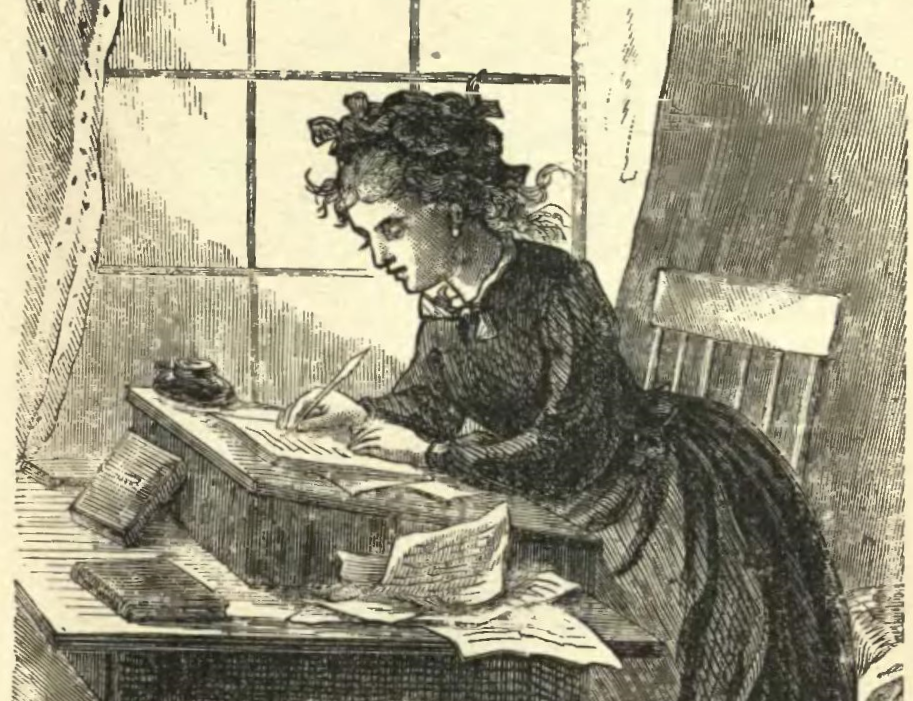
Last summer, an unfinished and previously unknown work by American writer Louisa May Alcott was published in The Strand Magazine, a small literary quarterly based in Birmingham, Michigan.
“Aunt Nellie’s Diary” is not a lost tale about the March sisters, Alcott’s best-known creations. In fact, the unfinished story published in The Strand dates from the very beginning of Alcott’s career, before Little Women or any of its sequels. Discovered in Harvard University’s Houghton Library, “Aunt Nellie’s Diary” was handwritten by Alcott in an 1848 journal, when she was just 17 years old. The story comes in at 9400 words, which is quite long compared to the stories published in the magazines Alcott admired like Godey’s Lady’s Book. (Among the poetry, gossip, advice columns, and essays on fashion, one issue I examined contained several short stories, all well under 7000 words).
But “Aunt Nellie’s Diary” is still an incomplete fragment, not because the ending was lost or damaged, but because Alcott never finished it. She just stopped writing partway through a sentence: “I begged and prayed she would…”
Did she get stuck? Bored? Distracted? We have no way to know.
What we do know is that at 17, Alcott was already an ambitious writer. According to biographer Katharine Anthony, at this point Louisa “could write melodramatic fiction with extreme fluency and prolificness.” She’d grown up writing plays with her siblings, which were often performed at family events. By the end of the following year, she’d finish her first novel, The Inheritance—though her first publication, in 1852 would come with a poem called “Sunlight” (under pseudonym “Flora Fairfield”) in Peterson’s Magazine, for which Alcott was paid $5.
Arguably, these early pieces can shine a light on crucial moments in a writer’s development.
Scholars would class “Aunt Nellie’s Diary” as a piece of “juvenilia,” meaning that it comes from a writer’s youthful period, before finding publication or achieving wider recognition. Arguably, these early pieces can shine a light on crucial moments in a writer’s development, showing their interest in certain themes and highlighting supposed talents as well as deficits not yet overcome.
In The Strand’s introduction to the story, Dr. Daniel Shealy, a professor at the University of North Carolina-Charlotte, claims that “Aunt Nellie’s Diary” has this kind of appeal, showing readers “an emerging talent on the cusp of a promising career.”
Alcott’s diaries show that she modeled her early work on the stories that dominated popular magazines at the time. She hoped that commercial success would allow her to make an independent living as a writer. So she closely studied the wildly beloved Sketches of Everyday Life written by Fredrika Bremer. Bremer published stories of independent women travelling through Europe and the Americas, and describing the tangled marriage plots of others. Though called “sketches,” these were not insubstantial works at all—Bremer, sometimes called the “Swedish Jane Austen,” is regarded as an early activist for gender equality and radical for her view that fiction should center less on male characters. Alcott thought her stories were important, and in a memorable scene in Little Women, Alcott depicts Mrs. March reading Bremer’s book to her four daughters.
Critics categorize stories like Bremer’s as “sentimental” works, employing high emotions and feelings to manipulate a reader’s sympathy disproportionately. The term “sentimental fiction” originated with a class of respected 18th century novels, like Goethe’s Sorrows of Young Werther and Samuel Richardson’s Pamela, but by Alcott’s time it was becoming synonymous with terms like “women’s fiction” and “domestic fiction,” and viewed as frivolous entertainment. One of Alcott’s biographers, Harrier Reisen, described these sentimental stories as the “chick lit of the day.”
In any case, the 17-year-old Louisa Alcott enjoyed these stories, and wanted to write some of her own, like “Aunt Nellie’s Diary.” But she also submitted her sentimental works to publishers under the pseudonym A.M. Barnard, suggesting she may not have wanted her own name associated with them. In her diaries Alcott confessed she secretly preferred more “lurid things” like the Twice-Told Tales of Nathaniel Hawthorne, as long as they were “true and strong also.”
Her attraction to realistic fiction clashed with the uplifting sentimentality and melodrama she was writing.
Louisa knew Hawthorne as an associate of her father, Bronson Alcott, who had also worked closely with Thoreau and Emerson in Concord. Hawthorne’s stories depicted a turn towards darker allegories like “The Minister’s Black Veil” and the complex psychological realism of stories like “Wakefield.” But for Alcott, her attraction to realistic fiction clashed with the uplifting sentimentality and melodrama she was writing.
Shealy argues that “Aunt Nellie’s Diary” reflects Alcott’s struggle between these two diverging literary paths, and that her abandonment of the story could be a sign that, at 17, she was not yet able to reconcile these strands as she eventually would, to great success, in later stories like “The Masked Marriage” and “The Lady and the Woman,” and then in her masterpiece, Little Women.
As the title suggests, “Aunt Nellie’s Diary” is written in the form of the actual diary of “Aunt” Nellie, beginning on her 40th birthday. (Unmarried and seemingly quite content, Nellie is a classic Bremeresque narrator.) The day is marked by the arrival of Nellie’s 18-year-old orphan niece Annie, and Annie’s friend Isabel Loving. Annie is “gentle,” “simple, loving, and sunny-haired,” and “full of quiet happiness,” even as a “solitary childhood and lonely life have thrown a shade of sadness over her.” But by a few days into the visit, Aunt Nellie seems to have had enough of the “beautiful” and “dark-haired” friend, Isabel: “How often are we deceived by a bright exterior, little dreaming of the darkness within. Isabel is not what I thought her. I fear under a fine gay manner of a light laughing face she conceals a cold, unfeeling heart, bent only on the accomplishment of her wishes. There is something not quite true about her,” she thinks. Nellie believes that it is Annie’s harder upbringing that has left her with “frank simplicity” while Isabel has been spoiled by a “selfish worldly” father who, in raising Isabel, “allowed her will in everything.”
The plot revolves around the girls’ shared interest in Edward Clifford, a sickly young man who has also lost his mother, and who blends a “gentle heart” with the “calm and noble mind of his father.” Once a “pale, slender boy” weeping at his mother’s deathbed, Edward is now a “tall noble-looking young man” with a “low musical voice.” Understandably, Aunt Nellie and Annie and Isabel are more than happy to nurse him back to health.
Then come a few pages of horseback riding and society parties; Edward reads aloud from a “Life of Napoleon” and does a sketch of Isabel. Annie refuses to get jealous, which annoys Isabel. There’s a fancy ball where Isabel wears a black Night costume covered in silver stars and moons, and Annie, naturally, wears all white with a “rose-coloured veil” and a wreath of “dewy half blown buds” so as to be Morning.
You get the idea.
Here, the descriptive writing is already lush and impressive, but the symbolism is a little on-the-nose.
It’s far from the quality of Alcott’s later works. Still, lovers of Little Women will find resonance with the sisterly tug-of-war between Jo and Amy over Laurie—though with far less shading and complexity. Here, the descriptive writing is already lush and impressive, but the symbolism is a little on-the-nose, the characters more like caricatures, and the plot stalls for pages. Once Alcott gets the initial pieces in place she couldn’t decide what to do with them.
Will the lovely (but much blander) Annie win over Edward? That would make for a suitable, sentimental story ending. But Alcott pulls repeatedly away from this conventional choice, in favor of spending more time with the more interesting (selfish, jealous, secretive) Isabel. In a Godey’s Lady’s Book story, Isabel should not triumph without being somehow morally redeemed. Over and over in the story, Alcott sets up moments that could push this to happen, then stops short.
Perhaps to try and resolve this (quite late in the story) Alcott adds a stately friend of Edward’s to the mix: a “Mr. Ainslie,” who arrives at the costume party dressed as “Saint Guy.” Seeing him makes Isabel turn “very pale” and hastily drop her veil. She claims she doesn’t know him, but rushes away. Nellie later witnesses Ainslie in the cloak room with Isabel, begging her to see him again, saying that he forgives her “for all that has passed” but that she should not “try” his love again.
Annie later confesses to Nellie that when she and Isabel were at school together, her friend had been engaged to “high-born rich and handsome” Herbert Ainslie, but that she did not love him. Annie simply can’t understand how her friend “could be cold and careless when she had won so true and fond a heart.”
And possibly Alcott could not either, because a few lines later, she abandoned the story in mid-sentence: “Well not many days ago she told me she had written to Mr. Ainslie, breaking off the engagement, that she no longer loved him and would not be fettered by any bonds. I begged and prayed she would…”
Here, The Strand Magazine urges its readers to submit their own endings to the story, in a contest for a chance to have their final scenes published in some later issue. One challenge in doing this would be reconciling the many inconsistencies in the story: did Isabel only just call off this engagement? If so, why hasn’t Annie once brought this up during her competition with Isabel over Edward?
Perhaps Alcott would have dealt with these issues in a second draft, in which she’d also have needed to trim a lot of wheel-spinning in the middle, to get the story to publishable length. But she never did.
Perhaps Alcott would have dealt with these issues in a second draft. But she never did.
Why did young Louisa never finish the story? Possibly she saw the sentimental ending coming, found it unsatisfying, and so preferred to just walk away. If she later would become a huge success for her ability to combine Hawthornian surprise and depth to romantic characters like the March sisters, at 17 she may simply have not quite been ready yet.
Of course, it is also possible that Alcott didn’t abandon the story because she was stuck, or lacked interest, but simply because life was getting in the way.
In 1848, Louisa’s father Bronson had spent his wife’s inheritance on an idyllic farmland in Concord he called “Hillside,” leaving nothing left to keep up with living expenses. The solution was to rent out the house and move everyone to a tiny basement apartment in Boston’s South End, where Bronson wanted to give a series of intellectual lectures called “Conversations on West Street” based on his transcendentalist work with Emerson and Thoreau.
Biographer Susan Cheever notes that Louisa was stretched thin in taking care of her siblings and their household while their mother was busy working. Due to the potato famine in Ireland, the city of Boston had recently become flooded with starving Irish immigrants—Louisa’s mother Abba Alcott was running a Mission project to care for them, even as the Alcotts themselves were falling into poverty.
At one point everyone in the Alcott household got smallpox, supposedly passed from an Irish family that Abba had been feeding at their home. Louisa wrote a series of “Hospital Sketches” during this time, describing the grotesque scenes of illness and death that she witnessed while helping her mother in these charity efforts, and these are notably quite different in tone from “Aunt Nellie’s Diary.” But she had little time for writing at all in that year.
Louisa was running the household, on top of teaching: her mother brought Louisa to help run a series of reading classes for emancipated former slaves in their neighborhood. Both women were active in the abolitionist and feminist protest movements of the day. Meanwhile, the nation was lurching towards Civil War, and Bronson Alcott’s ambitions as a street philosopher weren’t exactly paying the bills. During this period her father was also “experiencing mental states and visions that suggest a frighteningly disturbed mind.” According to Cheever, “he began working on a series of arcane charts showing invisible forces. He refused to sleep or eat. He thought he was God.”
It was one of the darkest and most difficult chapters in Louisa’s life. It is almost amazing that none of this weight is reflected in stories like “Aunt Nellie’s Diary.” Instead, it seems that Alcott relied on her scant writing and reading time as an escape from all the uncertainty and horror around her. Remarkably, she’d later look back on this same time in life as her “sentimental period.” Even as her father was turning into a character in a Hawthorne story, Louisa was reading as much “Charles Dickens, Sir Walter Scott, and Charlotte Brontë” as she could get her hands on, and we can hope she found lots of “tenderness and compassion” in all the exploitation of “high emotions and feelings.”
Shortly after abandoning “Aunt Nellie’s Diary” Alcott began working on her first novel, The Inheritance, which Cheever describes as a “short romantic Cinderella story written in girlish, sentimental prose” that is “weirdly enlivened by desperate feelings of its author.” This novel revolves around an Annie-ish character: a young orphan named Edith Adelon, who works tirelessly for the wealthy Hamilton family, only to discover that she is actually the true heir to their fortune. When a will is finally discovered that proves she should get the inheritance, angelic Edith rips it up and says she doesn’t want the Hamilton family’s riches, but only their love. (But of course she does then marry a wealthy prince or something and so ends up wealthy anyway).
Harriet Reisen noted that the novel was also a kind of escapism for the overworked, struggling, impoverished Alcott, and with pages “furnished with the fine things she coveted.”Reisen notes that “Louisa never attempted to publish The Inheritance. She had written it only for practice, and as an exercise it is impressive.”
The Inheritance was not published until 1997, when editors at Dutton announced it as a “lost novel” of Alcott’s and compared it to the work of Jane Austen. There was no introduction explaining to readers that it was written by Alcott at age 18, or in any way framing it as a work of juvenilia that lovers of Little Women might find less accomplished.
There was no introduction explaining to readers that it was written by Alcott at age 18.
A review in Publisher’s Weekly called the novel “charming” but noted it does not rise to the “smart dialogue or lived-in characters” seen in Austen’s works. (Interestingly, they noted that biographers contend that The Inheritance is the novel that Jo March is meant to have written in Little Women.) In either case, PW remarked that it is an impressive accomplishment for Alcott at age 17, a reminder again that the book, which Alcott herself never tried to publish, should be read and judged not as a mature work but as “juvenilia.”
Scholars will argue that juvenilia provides useful insight into the early training of great writers, and undoubtedly these works are of great importance to biographers. But by the same token there is something exploitative about unearthing these journeyman works and publishing them as if they are “lost” works by the master writers they’d someday become. These works weren’t misplaced somewhere, or held back by censors—they were never published because these writers didn’t want readers seeing their early fumblings, let alone comparing it to the work of their mature literary idols.
In a 2007 Guardian review of a newly published collection of Virginia Woolf’s early writings, Nick Tanner puts it this way: “Is there any point in reading juvenilia? Loosely defined as work created during a writer’s youth, the term encompasses everything from early jottings about pets to works of the status of Frankenstein. While the genre has always fascinated academics, however, a recent batch of publications has attempted to bring the writing of youthful authors to a wider readership. But are such works really a chance to watch a great artist finding his or her voice, or simply the literary equivalent of seeing a photo of your friend on a potty?”
In the case of Virginia Woolf, the publication was a collection of homemade family newspapers, some written when she was as young as 10, called Hyde Park Gate News. An introduction to the volume by biographer Hermione Lee, suggests that one can detect seeds of genius in the little news articles written with her siblings.
These works weren’t misplaced somewhere, or held back by censors—they were never published because these writers didn’t want readers seeing their early fumblings.
These works are no doubt appealing to publishers because there aren’t many chances to sell “new” work by long-dead authors—never mind that this work from early in the lives of some of these early 20th century authors handily falls in the realm of public domain, and so can be printed freely, without need for royalties or obtaining permission from these writers’ estates.
The Strand Magazine has, as part of its stated mission, published a slew of “previous unpublished” stories similar to “Aunt Nellie’s Diary” including “John Steinbeck, Ernest Hemingway, F. Scott Fitzgerald, Dashiell Hammett, Raymond Chandler, Joseph Heller, Mark Twain, Tennessee Williams, and H.G. Wells.”
In some cases, these stories may have been better left resting in the university archives, for ardent scholars to find, without risking any public damage to the reputations of these authors. If a fan of Little Women were to pick up The Inheritance without knowing how young Alcott was when she wrote it (and that she never attempted to publish it), they might come away disappointed. On the other hand, there’s not likely to be much general interest in these kinds of works at all unless the writers’ reputations are widely secure. (Penguin Classics isn’t publishing volumes of the childhood work of just anybody.)
Recently, I told my own students that I’d saved my first rejection letter, for an 80-page fantasy “novel” based on an Advanced Dungeons & Dragons campaign, which I sent to publisher TSR when I was thirteen. I’m proud of getting the rejection, but I’d sooner set the floppy disks on fire than have anyone read it now.
I’m reminded of a former professor of mine who said it was once traditional for graduates of our writing program to break into the university library to steal back their graduate theses so that these fumblings wouldn’t be found if they someday became famous. It’s a romantic idea, of course, from back in the day when these theses were actually printed out and filed away in hardcopy. Today’s writers would probably need to hire skilled hackers if they wanted to wipe their own juvenilia from the digital archives—let alone what floats around inevitably forever on the internet (old emails, blogs, forum posts, etc., etc.).
In some cases, these stories may have been better left resting in the university archives, for ardent scholars to find.
Perhaps one of the best approaches to dealing with one’s early work is that of another reclusive writer, Thomas Pynchon. In 1984, he published a volume of stories called Slow Learner, containing several pieces written early in his career that he looked back on already as lesser work.
In a lengthy introduction to the book, Pynchon dissected these stories, pointing out for each what parts he now saw as cringeworthy, and what parts he still admired. “My best hope is that, pretentious, goofy and ill-considered as they get now and then, these stories will still be of some use with all their flaws intact, as illustrative of typical problems in entry-level fiction, and cautionary about some practices which younger writers might prefer to avoid.”
For a writer who had by then already been living for twenty years out of the public eye, it is a touching and honest self-exposure—a comfort to young writers who admired him, to show that all that fumbling and awkwardness is a natural part of the process.
Maybe the early and previously unpublished works mentioned here will have that same impact on young writers today. Maybe a reader of The Strand will find “Aunt Nellie’s Diary” compelling and be inspired to find an inventive ending—and maybe it will inspire other readers to go deeper into Alcott’s work and life. But we should still be mindful of the fact that, from the start and then all through her long career, Alcott herself was not interested in going back to the piece, just as she never sought for The Inheritance to be published. Whatever reasons she had for leaving these in the drawer should still be taken into account.
“America is adolescence without end,” Ben Lerner writes in The Topeka School. His witty, revelatory novel follows the Gordon Family—Adam, a high school debate star, and his parents—in 1997 Kansas. The book is dense with themes, but none more haunting than the question of toxic masculinity’s source. While Lerner offers no straightforward answer—nothing about this book is straightforward—the setting itself is a clue. Do high school debate tournaments provide hints for what will become of its champions?
The Topeka School stayed with me for months. In the weeks after reading, I relived every infuriating experience from my own high school debate league. The boy who explained that the distribution of semi-finalists was designed to ensure a girl must make it to finals, because without interference, she wouldn’t get there. The boy who suggested Hillary Clinton was too angry to be President, and then, when I countered, asserted I was too angry to be the victor. The judge who docked points from me because I was “too emotional” (I wasn’t even crying!).
It’s a scary thing to imbue a young boy with confidence he hasn’t yet had the time to earn.
I knew Lerner’s characters. I’d debated them in high school and college. It’s a scary thing to imbue a young boy with confidence he hasn’t yet had the time to earn. As Lerner writes of Adam and his classmates, “they are told constantly…that they are individuals, rugged even, but in fact they are emptied out, isolate, mass men without a mass, although they’re not men, obviously, but boys, perpetual boys, Peter Pans, man-children.”
Several of Lerner’s boys turn alt-right years in the future, and I wondered if the same became of any of my former debate rivals. What happened to the diligent, smart 17-year-old boy who won the national championship arguing against punitive measures for the investment banks that perpetrated the 2008 financial crisis? And the one who equated affirmative action to fascism? Has he changed his mind, or had he already become his final form? Is he a lawyer, looking towards a future run for office, or did he leave politics behind? 20 years from now, when I’m watching their Supreme Court nominations, will they be Kavanaughs?
By the end of October 2020, I’d Googled each and every one of my former debate competitors to determine which way they were voting. As I figured it, nothing about a Biden vote suggests someone has turned out okay, but a Trump vote screams something went wrong. I scrolled the profiles of the few rogue Trump supporters. I read their arguments. I reread their arguments. I screenshotted their arguments and sent them to dozens of group chats. “Can you believe this????” I’d write, as though it was shocking to know one of the 74 million Trump voters. But the thing is, it was. Encountering a Trump fan at some point is a statistical likelihood, but it’s eerie when it’s someone from your formative years—how could you see the world so differently when you had started in the same place? How did the girl who first explained to you the mechanics of a blow job end up defending the police? She used to be fun! It was even eerier to see this uncritical embrace of our fascist President from the people with whom I’d learned to think critically about politics. My old debate pals used skills I’d watched them develop as teenagers to defend our ignoble Commander-in-Chief.
By 2021, I had become a curious observer, but I must admit that in high school, I was one of Lerner’s boys. I always thought I was right. I was (and am) a privileged white person who believed my opinion mattered more than it did. I once hid a competitors’ shoes to prevent him from getting to the round on time (in my defense, he shouldn’t have taken them off). Another school’s coach once yelled at me for openly talking shit about a competitor. His exact words were “we never root for someone else to lose.” (I was confused—in a world where only one can win, isn’t rooting for yourself the same as is rooting for everyone else to lose?) No one I knew in high school would have been surprised if I’d sought public office, although I consider it a great act of service that I have not.
Still, my membership into their club—not so much a friend but rather a person worthy of being treated as a threat—depended more on my assimilation than anything else. It was still a boys’ club, with or without me, and toxic masculinity depends on the compliance of some women—white women in particular. Arrogance and an inability to admit error aren’t unique to men, but they are more common. Like the U.S. Senate, my debate league was mostly boys. I’d argue it’s not a stretch to attribute much of the toxicity to their nascent masculinity.
I didn’t need to wait long to meet another of Lerner’s boys. On January 6th, 2021, violent protesters stormed the Capitol to protest the results of our election. Six Republican senators voted to overturn the results, and on that day, our nation minted a new villain—Missouri Senator Josh Hawley.
Josh Hawley is no ordinary Josh. Like Lerner’s characters, his familiarity shook me: his ability to talk around an issue, his champion high school debate record, his smug confidence. Look at his Wikipedia page—he’s literally sneering in the photo. It took no effort to picture him as a 17-year-old cross-examining me in the finals, lamenting my ill-preparedness, leering just the way he does on FOX News.
Of course, debate is not the only high school activity that breeds overconfident youngsters, and Hawley is far from the only right-wing senator with a high school debate record. You can’t throw a stone in Washington without hitting an Ivy-League-educated right-wing senator who cut their teeth on high school debate, although I’d encourage you to try. Ted Cruz, a champion Princeton debater, has a similar background, but he simply didn’t strike the same spooky chord as Hawley. Perhaps it’s that Cruz is older, so he feels more distant. Hawley is disturbingly boyish, and the familiarity haunts me – his hairline cannot recede fast enough for him to become a stranger. Perhaps it’s that I was given more time to ease into Cruz’s villainy. With a personality like his, Hawley should have had the courtesy to offer us some warm-up time! Instead, he turned himself into a household name overnight by opposing Democracy in a country notoriously obsessed with Democracy. In the most toxically-masculine-high-school-debate move of all, he took an unwavering line on an unpopular position to turn the spotlight squarely on him.
You can’t throw a stone in Washington without hitting an Ivy-League-educated right-wing senator who cut their teeth on high school debate, although I’d encourage you to try.
Teenage debaters do this tactically. In the climax of The Topeka School, Adam competes against a team from Austin. His opponent employs a tool not common to their category: the spread, in which you speak at a pace of several hundred words per minute so the other team cannot possibly refute every argument. Some judges love the spread, others hate it, but either way, it’s a strategy that allows the debater to center himself (or herself – but probably himself). The gamble pays off: Adam is caught off guard, and the spreaders win. Hawley essentially did the same—he intentionally confused us to garner attention very quickly. He took a shocking viewpoint to force the conversation further to his side, when in truth, his position was so unreasonable we should never have needed to address it. Whether or not he’s won remains to be seen.
Hawley may well have learned his behavior as a Missouri debate star in the 1990s, one state over from Adam. Early in The Topeka School, Lerner describes a debate round in which Adam scores an easy victory: “Adam had no idea if what he was saying was true…The key was to narrate participation in debate as a form of linguistic combat; the key was to be a bully, quick and vicious.” Debate is less about figuring out what you think is right than it is about proving someone else wrong. It doesn’t teach values—there is no discussion of what’s actually good or bad, only that such a dichotomy exists at all.
High school debaters take fixed positions on issues they can’t possibly fully comprehend, whose outcomes they’ll never see. The judge—likely a parent who doesn’t have the answers either—has a matter of minutes to decide who’s right. Aggression wins. Volume wins. Confidence wins. Being right doesn’t win—if a high schooler knew how to solve the Israeli-Palestinian conflict, we’d surely live in a very different world.
Of course, kids should grapple with our social issues. They’re our only hope. But we don’t have to teach them the other side is always wrong, and that truth is determined by persuasive elocution. We can teach them to hold opposing viewpoints in their head at once. We can teach them to be kind. We can teach them that they don’t yet have all the answers. It’s terrifying that we teach kids how to argue before we teach them how to empathize.
In debate’s defense, it teaches students to follow the rules—at least, as long as the power resides with the judge. In the most iconic image from the January insurrection, Hawley holds his fist in the air, saluting his supporters. This photo is an undeniable salute to white supremacists. But I saw something else, too. In debate, a fist in the air means “stop”—you’re out of time, and you’ll be disqualified if you continue. Hawley was, by all accounts, a successful debater. He stopped when he saw the fist. Now, he was using the fist to egg people on. What if the debate fist was the last rule he ever followed? In debate, if you don’t follow the rules, you lose. In politics, you can break all the rules (“laws”), and still be elected President of the United States. Hawley would listen to a debate judge who could bar him from the final round, but not the will of 81 million Americans.
It’s terrifying that we teach kids how to argue before we teach them how to empathize.
If a fist in the air reminds me of debate, a stop sign means something else to me, too. My freshman year of college, I was sexually assaulted by a boy on the Stanford Debate team. I said no, and he went forward. He was also a skilled debater; he respected the fist of a judge. When the judge had authority, his stop sign mattered. But mine did not. Boys who want to win know what rules they must follow. Those with power must be obeyed. Those without it can be ignored.
I may have just made the January 2021 insurrection about me (that’s sort of my thing), but I do think the fist is important. Wasn’t Hawley’s fist in the air a stop sign of his own? Stop counting votes. Stop respecting democracy. When did he stop obeying the signs of authority figures, and instead start issuing his own? Was it when he became a Senator, or the Missouri Attorney General, or was it long before that?
Not all former debaters turn into Josh Hawley, of course, and not all become sexual predators. Nor are white supremacy and sexual assault the only two ways to be bad, but they are significant both in their severity and in their frequency (case in point: Trump became President). Maybe there’s hope, though. Maybe we can find these boys at their forks in the road and prod them in the right direction, or at the very least, away from power. As Lerner writes of Adam’s young, right-wing debate coach, “one moment, Evanson struck him as a precocious young man, destined for the corridors of power—a conservative judge, a senator, the president of the NRA—and at other times Evanson seemed fated to drive sleeping debaters, sleeping drivelers, home from Junction City.” Perhaps this is the crux of it, the turning point. Go one way, and you might be okay. Turn the other, and you’re Josh Hawley.
The Topeka School doesn’t tell us, though, how its characters choose which way to go. The liberal Adam isn’t seduced by bad politics, but continues to treat other people poorly; the violent, future-MAGA fan Darren is dealing with cognitive challenges that complicate his behavior; the right-wing Evanson shows up after college, with only brief hints of his past. Without answers from Lerner on how his boys turned into his men, we must look elsewhere.
Hawley’s mentor, John Danforth, described supporting Josh Hawley as the “worst decision he ever made in his life.” Did Danforth really not know? Were there no clues? A former college classmate said of Hawley, “Most freshmen are on a journey to discover who they are and what strengths they have to offer the world, but Josh seemed to have already completed that process by the time he arrived at Stanford.” And that’s just the danger. In Hawley’s 2021 world, Donald Trump was President, and he was unwilling to consider another option. Was college too late? His signature on a friend’s eighth-grade yearbook chillingly reads “Josh Hawley, President 2024.” A 13-year-old wanting to be President isn’t terrible—a 13-year-old who has already become Josh Hawley is. 2024 is soon, but don’t rush it, Josh—you have the next 40 years to destroy us.
One genre of post-insurrection-Hawley-tweet that annoyed me most was the joke that he’s proof “idiots” can go to the top-tier universities, too. I’m not offended by the sentiment—I’m intimately aware that top universities are populated by people with a wide range of intellectual capacities. Rather, it’s the idea that Hawley is an “idiot” for having heinous political views. The word “idiot” is a dismissal (and one with an ableist history). “Idiots” aren’t scary. “Idiots” aren’t a threat. Hawley did not think Trump was the legal victor; he was making a bet on January 6th. And we should all be very afraid of whatever he’s betting on. Taking the wrong side and doubling down may have been impressive when he did it in high school, but now, it’s simply terrifying.
They know their power is fragile. They know they’re no better than anyone else, and they know we know.
I hope the past four years have made us keener to identify toxic masculinity early. Lerner agrees, writing, “If we’ve learned anything, it’s how dangerous that fragile masculinity can be.” The fragility is what makes it so toxic. That’s why the neo-Nazis in Charlottesville chanted, “Jews will not replace us,” why Republicans fight against affirmative action, why men fear the #MeToo movement. They know their power is fragile. They know they’re no better than anyone else, and they know we know.
TheTopeka School points towards the roots of toxic masculinity, but it doesn’t offer all the answers. Josh Hawley is one version of what Lerner’s boys could grow up to be, but there are others. Lerner uses a high school debater to show us that language is no longer used for communication—it’s used as a weapon. If we’re going to give it to children, we must teach them to wield them responsibly, teach them to think through their positions before attempting to win with them. If we don’t, we may be looking at a whole lot more Josh Hawleys.
Open Water is part of a new wave of Black British literature, telling authentic stories that connect to people who have felt unheard and unseen. Debut novelist Caleb Azumah Nelson, a 25-year-old South Londoner, manages to voice the inner thoughts so many Black people have felt with nuance and care, without homogenizing our experiences.
The backbone of Open Water is a delicate love story burgeoning in South East London. A photographer meets a dancer while working together on a project to document Black life in London, their connection is electric, intense, and complicated. But at its core, the novel takes an unflinching look at the complexities and nuances of being Black in Britain—from racial profiling, the pressures of masculinity, and the multifacetedness of Black love, art, and community.
Niellah Arboine: How did the story came about and why now?
Caleb Azumah Nelson: I think it’s weird because the story feels like it’s taken on a different sort of dynamic and different meaning on this side of the pandemic.
While so much of the book is fictional, it really felt like a confrontation with myself and with my feelings and experiences that I had had.
NA: Did you ever feel pressure to accurately represent the Black British millennial experience?
CAN: The experience I was so insistent on getting right was the Southeast London experience. And there’s a really specific texture to Southeast London. And also how the community comes together and interacts. I really wanted to portray that specifically.
NA: At the root of Open Water, it’s a story about forbidden love or love under unexpected circumstances which I think is quite a classic, universal theme. What was the inspiration behind it, and what are some of your favorite love stories?
CAN: I really wanted to explore love in its various ways and forms, like Moonlight and Beale Street—those have just been massive influences in my life. Maybe not so much thinking about forbidden love, but the ways that we love and the ways that we share each other in various circumstances. So much of our day-to-day expressions are expressions of love in various forms: self-love or, expressing love for your family, for your friends, or romantic partners.
NA: Why did you show a multifaceted look at Black love? Which parts of Open Water do you think this shines through the most?
CAN: I wrote the novel, wondering whether love could be a site of freedom. That was my guiding force. The moments where the main characters are spending time together, choosing to spend time together (which I think takes a certain kind of trust), allowed me to really think about the ways in which we love each other and the ways in which this love is expressed.
NA: What role does music and art play in Open Water?
I’m interested in how Black people want to be seen.
CAN: Art, especially music, was so central to the lives of the characters. They served as a place where they could honestly express themselves, but could also use art to map their emotions when they didn’t have the words. There was also a sense of community and intimacy which was fostered when the characters were engaging in art together, or with others. I think sharing that experience of seeing and hearing art, and really feeling it, is a powerful thing.
NA: Open Water shows a really balanced look at identity, you managed to go from trauma and Black masculinity and the police to what freedom looks like for Black people and art and expression. How did you manage the mix like the personal with the political?
CAN: I think it emerges from my work as a photographer, 99% of my work is portraiture. I’m just really interested in what space I can afford for Black people when I’m seeing them, and how Black people want to be seen. And trying to afford people this fullness and wholeness that isn’t really afforded to us generally in our day-to-day life.
It was important that this is what the width and the breadth of the Black life can look like. There’s trauma and there is state-led violence that is consistently going against us, but there’s also this real love, and there’s also this real hope, that permeates our days.
NA: Why is community such an important theme within Open Water?
There’s trauma and state-led violence that is consistently going against us, but there’s also this real love and hope that permeates our days.
CAN: There’s a knowledge, when you’re a Black person, of your proximity to death, be it physical, psychological, emotional. You know that at any moment or any day, you could be faced with a situation that brings you face to face with such death. But I think Black people forge communities with each other, with this knowledge, but also with the view of continuing to hope. To create small worlds with each other which reflect the world as we want it to be. Otherwise, the only thing we end up doing is waiting for our demise, and that’s not a life.
NA:With your US debut out now, how do you think Black Americans might receive Open Water?
CAN: It’s weird, I didn’t anticipate it getting the sort of attention. I woke up this morning and someone had written a review for The New York Times. It feels like, despite the fact that it’s such a specific sort of experience, that there are connections and parallels being made—and something that I’m really grateful for is that there’s not this like homogenization of Black experiences.
One of the reasons I’m fascinated by teenage friendships is because my own experience during those years of my life was so confusing. My family moved to Florida from New York when I was 9 and I found it very difficult to make friends at my new school. My homeroom teacher thought it would be funny to seat me next to the other Brittany in class, and the rest is history. Well, actually the rest of the story is that as the years went on, more and more Brittanys came to our school, and eventually there were five. We had to call each other by our last names so lunchtime and hallway banter wasn’t a complete shit show, and the fact that we all remained friends throughout middle school and most of high school became quite the novelty.
We were known in school as “The Brittanys,” but the truth is, our name alone couldn’t keep us all as close as perhaps I’d wanted it to. We grew up and eventually the five Brittanys went our separate ways. I wrote my debut novel, The Brittanys, in an attempt to re-write the past, to imagine a world where these friendships were the epicenter of my own existence, where the girls who were all named Brittany were everything—were it—when in reality we were all just girls blessed with the same namesake. In writing, I’m able to deepen these years on the page and create plot and meaning and also a whole lot of questioning. How does the fragility of youth affect our future selves? How can one friend (or five) influence us as we grow up? Do girls need each other to survive?
Here are 7 books about teen friendships from the 1970s to 2000s:
The 14-year-old narrator of In Zanesville is best friends with Felicia, aka Flea. These two girls, who are members of the marching band, are invited to the popular girl’s sleepover by some sweet strike of luck.
“I look at Felicia, who looks back at me, coolly, chewing. I point to my chin, and her eyes bug out in alarm. She takes her napkin and saws away at her own chin, eyes grateful. I give her a slight nod—Yes, you got it—and then glance questioningly at the pop on the counter. She discreetly mimes opening a bottle and then looks back to her plate.”
These are friends who read each other’s minds, who can understand a glance from across the room, who are always aiming to help each other fit in, or at the very least not stand out. The book encapsulates a year in the life of these two girls as they grow apart, fall back together, and try not to burn down the house.
Berie is 15 when she meets Sils at her job in Storyland in upstate New York where Berie sells tickets and Sils gets to play Cinderella. It’s the kind of friendship where doing nothing becomes everything, listening to records, hitching rides to concerts, snacking on whatever you can find in the fridge, sharing clothes, sharing lives. Berie is envious when Sils gets a boyfriend, Mike, and contemplates her own womanhood and existence:
“I only wanted my body to bloom and bleed and be loved. I was raw with want, but in part it was a simple want, one made for easy satisfaction, quick drama, deep life: I wanted to go places and do things with Sils.”
Their easy-going, almost dream-like friendship is challenged when Sils needs Berie’s help and the tables are turned. Lorrie Moore’s writing is masterful amidst the backdrop of Storyland, where fairytale characters smoke cigarettes in costume on their break. One summer changes everything for Berie, who ultimately, like the rest of us, just wants to find where she fits in, how she can blossom, and when she’ll be loved.
The narrator of Zadie Smith’s brilliant Swing Time meets Tracey at a ballet class. The plot of these two girls’ lives unfolds in a friendship that spans years and cities, all with the humble beginning of that one dance class where, lined up next to each other, the girls were like “two iron filings drawn to a magnet.” The book is a revelation of how friendship can be the mirror from which we learn our own identity and that it is in others that we can find ourselves.
“I saw all my years at once, but they were not piled up on each other, experience after experience, building into something of substance — the opposite. A truth was being revealed to me: that I had always tried to attach myself to the light of other people, that I never had any light of my own. I experienced myself as a kind of shadow.”
This treasure of a novel argues that who we are is defined by our interpersonal exchanges—our jealousies, our admirations, our mistakes, our rivalries, our struggles—ultimately, our complicated love.
Callie, the narrator of The Blurry Years, is a young girl coming of age on the chaotic Florida coast. Her experiences in girlhood take her to all the darkest places and the book is an immaculate story of why we sometimes need to leave places in order to grow. Throughout the novel, Callie meditates on gender and identity:
“Like there were formulas to being a woman, and you just needed to be reminded every so often of the right ways to act, the right things to say, the right clothes to wear.”
Callie is drawn to Jazz, a neighbor, who she befriends about halfway through the novel. Jazz is everything Callie is not in her bikini top and cutoffs. She has her period, she is an expert at eyeliner and makeup, and she is an oasis for Callie who is seeking escape from her tumultuous relationship with her mom. But ultimately Callie must decide if she’s ready to plunge into the deep end of womanhood and give up her innocence, even with a bestie at her side as bold and daring as Jazz.
“And this was what I finally realized, that even as we sank deeper and deeper into our lives, we were always separate. And I wondered what it would feel like, to fall but to hold on to someone else so you weren’t alone.”
The narrator of Kevin Wilson’s perfect novel, Nothing to See Here, Lillian, took the fall for her roommate and best friend, Madison, back in their prestigious boarding school days. Lillian had ended up at the school for her intelligence, had truly earned her spot with her smarts and wit, while Madison came from money and privilege like the rest of the students. The two meet again as adults in 1995 when Madison once more needs Lillian’s help. Lillian is now 28, but her undying love and affection for Madison proves the key to the door of her future, one that involves two step-kids who spontaneously combust; all of it a metaphor for the fragility of our harbored resentment, how we fall short as human beings, and how we tenderly love each other in an attempt to fix and repair the world.
Forsyth Harmon’s illustrated novel, Justine, takes place in the summer of 1999 in Long Island. This story holds space for the ways teenage girls desire, the ways they worship, the ways they get themselves into trouble. Ali befriends Justine at the local Stop & Shop and is immediately entranced by her thinness, her coolness. Justine takes Ali under her wing as they spend days sunbathing, obsessing over the latest trends in makeup and fashion, and Justine slowly but surely becomes Ali’s idol. The intensity of Ali’s first crush drives her to reshape her every waking moment towards perfection, towards Justine: “Justine was the light shining on me and the dark shadow it cast, and I wanted to stand there forever in the relief of that contrast.”
This book made me look back on all my past crushes, the ones that did exactly what the word implies—“crushed” me and flattened me in a way that made me reconsider my whole existence. Although the title places emphasis on Justine, the true character study for me was with Ali and her coming-of-age story of sexuality, longing, and the ubiquitous spring of youth.
First of all, I would happily read Sarah Gerard’s grocery list if she chose to publish it. Sunshine State is a marvel of Florida, women, religion, pyramid schemes, sex, and humanity taking place in the late ’90s and early aughts. “BFF,” the first essay in the collection, dives into the narrative of a long-lost friendship that is so true to the enigma of the relationships of our youth. The back and forth dynamic between the two girls leaves the reader to fill in the gaps.
I’ve shown countless creative writing classes this essay and had students imitate its form, its beauty in the simplicity of sections like “Lies I know you told me, Lies I heard you tell yourself, Lies I told you” and “You were the closest thing I had to a sister. I knew your body like it was my body; I knew it as it was changing.” Although this piece is about a friendship falling apart, the degeneration of trust and honesty over time, it feels important to add to the list because of how true it is that we often drift away from our former selves, versions of us that were tied to the past.
The boy should be in a robe ringing altar bells or chasing a tattered and dust-covered ball through an equally ragged plaza or searching in a mirror for his first whisker, but somebody’s given him a uniform and a rifle and the idea he belongs here with us. The white poplars creak and sigh—a haunting language—while the flames of the campfire dance in the boy’s agitated eyes. He pinches the nub of a cigarette. A few of his teeth have already rotted, black and splintered. Through the poplars is the moon. It casts a silver light upon their thin and groaning tops, and, as if somebody elbowed him to explain his presence among us, the boy begins:
“My father didn’t run. The fascists surrounded the village. He changed from his suit so we could bury him in it, kissed my mother, told me and my two younger brothers we were now the men of the house, then stood by the door, smoking, waiting for their lorry. It startled the fascists, how, with his shoulders back, he stepped out to meet them. A few must have been hoping for a fight. One grabbed me by the arm. I stiffened my spine, too, but another said, ‘Leave him, he’s only a child.’ When they pulled away that’s when my mother collapsed, like she’d been struck behind the knees. She was crying, screaming something, but I was already out the door for the gravel pit. That’s where they’d taken the other group a few days earlier. A soldier was posted as a sentry on the road. I didn’t have time to go around him, so I nodded and wished him a pleasant evening. He was too confused to respond. Their smartest don’t guard the roads. The second I was in the shadows I was sprinting again. They’d parked by the pit’s edge. The fascists stood before the headlights, passing around bottles. My father was seated closest to the tailgate. He shook his head and chuckled when he saw me, an expression like so this was the best my seed could produce. The fascists glanced back occasionally, but the headlights were in their eyes. I untied my father and helped him free the others. ‘Now go,’ he told me. I tried to say it was no use, that a guard had seen me. ‘I’m joining the fight,’ I started, but he slapped me, a quick soundless pop on the lips. ‘Go,’ he shouted as a whisper. To the men he said, ‘We give him a minute, then we run.’ From a distance, I watched my father and the others escape, and I followed them through the night. They were going to reunite with Manolo’s Division along the Arroyo de San Juan. The birds could have told you the division had recently regrouped along the bent elbow of that river. Each stone between Carrascal del Río and Valle de Tabladillo knew it. Clouds took the shape of an arrow every few hours and pointed to their camp. So, through the trees, I counted the lorries of fascists as they barreled past. Countries have sent fewer to conquer foreign lands. By the time I reached the river, it was almost over. Only my father and another remained. That soldier hadn’t counted his bullets properly. He was rolling fallen comrades off their weapons, pushing the barrels to his head, but they’d all been emptied. He was determined to rob the fascists of the pleasure. Finally, he palmed a large stone. As for my father, the fascists encircled him, tightening notch by notch like a garrote, until he was out of bullets. They took their time with him. Time I had to get closer, from one tree to the next. I saw each of them so clearly.” The boy examines the last of his cigarette, tries to pull smoke from it but draws nothing so flicks it into the fire. “Should they get scarred, grow a beard, lose half their face to a bomb, I’d still recognize them.”
There will be no end to this thing. That’s the bitter brew. The boy’s going to live long enough to sire a few sons who will watch helplessly as fascists drag him toward a lorry, and on and on it will go.
Isidro passes the boy a crumpled pack of cigarettes. The war had, at some point, torn two fingers from Isidro’s left hand. But eight remain. You only need a thumb and finger to squeeze a trigger. Many yet still to lose. And, afterwards, you might think it would fall to our disembodied limbs to go at the others’, carrying on our noble fight, but, no—I saw early this morning, the stars still out, how it ends.
In the dream, a bullet caught me, clean through the neck. My last thought was, so long I’ve been waiting for you, I thought you’d never show. Then I was above my body, watching it curl like a fetus and sink into the earth. My skin melted away, then my organs. I was bones joining with the bones of our ancestors, and together we coiled and became a ladder that twisted amidst a starless space, and from the infinite depths of the darkness beyond I didn’t feel God necessarily but judgment. We were fucked. We were terribly, irrevocably fucked. I awoke with a start, grabbed hold of my fleeing breath, my galloping heart, then searched for a comfortable position so as to fall back asleep. What else was there to do? The lions long ago locked and loaded their rifles while the lambs have nothing stockpiled. Arm in arm, we go marching to the end.
DON’T MISS OUT
Sign up for our newsletter to get submission announcements and stay on top of our best work.
YOUR INBOX IS LIT
Enjoy strange, diverting work from The Commuter on Mondays, absorbing fiction from Recommended Reading on Wednesdays, and a roundup of our best work of the week on Fridays. Personalize your subscription preferences here.