The clown room was off-limits. It lay behind a narrow door at the bottom of the basement stairs, which I crept down when my mother was otherwise distracted—having tea with a neighbor, or cutting someone’s hair. She had a salon in her parlor and one of those hairdryers that looked like a space helmet. She served all of her guests strawberry wafers in plastic sleeves. Some days I ate only strawberry wafers, washed down with orange juice.
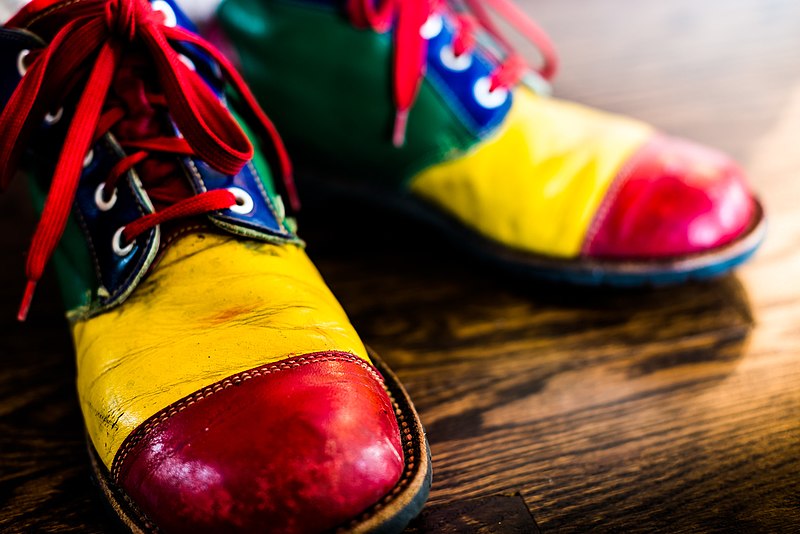
The clown room was a small room with wood-paneled walls. There was a painted chest full of tricks, and clown shoes were lined up against the baseboard. The shoes were too big, clearly fake. They looked less like shoes than sculptures of shoes. The room was a closet for all intents and purposes, but in this closet was another closet, and in that closet were the clown suits and wigs. They smelled like burned things. Marionettes hung from hooks in the ceiling. The wigs hung from hooks in the walls. The wigs were long and curly, either red or every color of the rainbow. I would put them on, and the stringy hairs would fall over my nose and mouth. They tasted how balloons tasted: manufactured, toxic. I never tried the suits. They were too large and floppy. I never had enough time to deal with their limp arms and sticking zippers before my mother came creaking down the steps.
My mother was one of a troupe of party clowns who went by the names of mediocre candies. Tootsie Pop, Sweet Tart. I could never keep them straight. Their faces were impossible to make out beneath all that paint. At family reunions and birthday parties, the clowns juggled, made crystal balls float, pulled handkerchiefs out of thin air. In the summertime, we would attend two parties a day. I would sit at the back of a crowd of cross-legged children, whose frank sense of belonging left me intimidated. I worried constantly that they would tell me I shouldn’t be there, I hadn’t been invited, but no one ever bothered me so I would remain where I was, trying to understand how a birthday cake could blossom out of a top hat.
The answers, I knew, were in the clown room. Each trick was diagrammed in a booklet I’d discovered one day in the bottom drawer of the blue-and-white chest. I had paged through the diagrams and scrutinized the numbered instructions beneath each until my mother flung open the door. I hid the booklet behind my back. She sunk to her knees and asked if I had found her secrets, and I admitted the truth: that I had, but I couldn’t understand them.
She nodded. “That’s the way it is,” she said.
For a long time, my only friend was a neighbor, Imogene. She was a year older than me, a fourth grader at the all-girls school. I could see a sliver of her through the fence separating her yard from mine. One heavily lidded eye, a streak of blonde hair, a soft freckled cheek. “Hello,” we would whisper to one another. I would wiggle a finger through the gap, try to touch her, and Imogene would skip away. Whenever I invited her to my house, she said she couldn’t; her parents wouldn’t let her. I assumed she was trapped and became determined to free her, but I didn’t know how. When I asked my mother for help, she and her troupe teased me. They sang, “Jeans, beans, and Imogenes.”
My father was not a clown. He didn’t have much interest in them, either. He existed primarily in his chair, by the TV, watching The Lone Ranger. The TV troll, my mother called him. Only when I had been caught in the clown room would I stop by his chair, and he would hoist me onto his lap and tell me about Iwo Jima. One day he asked, “Have you seen that picture? The famous one of the Marines raising the flag?” He said that he knew one of those men. Don Maggiano was his name, and my mother leaned against the wall and said, “It’s not him!” So they called him up and Don Maggiano said, “I have to admit, Clive, it isn’t me.” But my father remembered him fondly. “He was a kind person.”
I patted my father’s warm, round belly and asked why he never became a clown.
“Bah,” he said, “that never interested me.”
I asked if he knew how the clowns did their magic, and he said that magic wasn’t real, God was. He informed me that the clowns were tricking me, but that God had created everyone before the foundation of the world, and that was no trick. My father’s fingers were huge. He dipped them into fonts of holy water he’d hung about the house. My mother never did this; she saved all the blessings for him. “He needs as many as he can get,” she said. She wasn’t joking. He had constant chest pain and could often be found with his hands over his heart. “Heal me, Lord,” he would say intermittently, which I fully expected to happen. I was surprised when he died of a heart attack when I was eight years old.
After the funeral, people showed up at our house, no clowns among them. They brought macaroni salad and paper plates, and stabbed at grapes with silver forks. I sensed Imogene before I saw her: beautiful, wan, blonde. She had come out in the open. It was a miracle. Yet, together, her eyes were not what I’d expected; one was slightly higher than the other, and its blue iris seemed to wander—as if being tugged by a gentle distraction over my shoulder.
“What are you staring at?” she asked, nibbling the edge of a cracker.
I had only ever seen her through the fence. “You’re so whole.”
She smiled. “You’re so funny,” she said, and stepped toward me. This close, she smelled soapy. I was dying to show her the clown room.
We wound toward it, through the house, around guests’ black pantlegs and skirts, and arrived at the top of the steep wooden staircase. She followed me down, each step groaning beneath our feet. I pushed open the clown room door, flipped on the light. I tried to see the place through Imogene’s eyes, but her reaction was unreadable. She took in the dark walls, the chest of drawers. She opened one, found plastic candies in it, put one in her mouth.
“Clowns terrify me,” she said, sucking. She spit out the candy, wiped it with her dress, and replaced it in the drawer. “You won’t become a clown, will you?”
Loosening my necktie, I retrieved the diagrams from the bottom drawer. “Can you understand this?”
She studied the papers, tracing each line with her index finger. She was only a few inches taller than me, but I seemed to be staring up at her.
“This is easy,” she said. Then she looked up from the answer sheet, one blue eye aimed straight at me, the other seeming to focus just behind me. “Which trick should we do first?”
I never told my mother that I’d learned her secrets, but after some time I think she knew. She must have noticed I was no longer sneaking downstairs. I had no reason to. She and I began to move about the house independently and oddly at peace. She picked up a job at the Italian diner half a mile away, but on weekends she continued fooling children at their parties. One night, while she was sipping tea in my father’s chair, I asked why she had become a clown in the first place. She pressed the tea bag against the side of her mug and told me that she hadn’t chosen. She said it’s the kind of profession that happens to you.
When she passed away many years later, she left the house to me. I dragged most of the boxes and tricks out to the roadside, but not before trying on the wigs one last time. I couldn’t squeeze into the suits. Now they were too small. But the shoes fit just fine.
The final frontier is an epithet famously attached to outer space. Don’t strap on a spacesuit just yet, though: closer to hand, our home planet remains plush with underexplored terrain (or the aquatic equivalent thereof). The ocean yields newly-discovered species every year, such as 2019’s glow-in-the-dark pocket shark and 2020’s adorable entry to the Dungeons & Dragons Monster Manual, a “gelatinous blob” ctenophore; not to mention new appreciation for creatures like the poor misunderstood blobfish.
Of course, even as we eagerly rifle their pockets for fascinating new species, the world’s waters still maintain plenty of mystery. From the strange sound known as “the Bloop” to phenomena like phantom islands, to disappeared ships and submarines, to the sheer incomprehensible strength of a storm at sea, the ocean can be a strange and dangerous place–the perfect setting for myths and stories across the ages and around the world. Between its beauty and its innate unknowability, the deep waters of home offer fertile ground for many writers to sow the seeds of imagination.
In my book Sun-Daughters, Sea-Daughters, I sought to riff on the classic notes of The Little Mermaid by giving my genetically engineered “mermaid” a whole new sea to explore: the depths of space. Perhaps by the time humans have colonized worlds like hers, space really will be a true final frontier.
The sea can be beautiful, but it’s dangerous first. In Solomon’s novella, we get the accounting of that power as it is reclaimed by the birthright of the descendants of African women thrown from slave ships to drown. Like Solomon’s other work, this is characteristically intense, a world forcefully drawn in shades of deep blue.
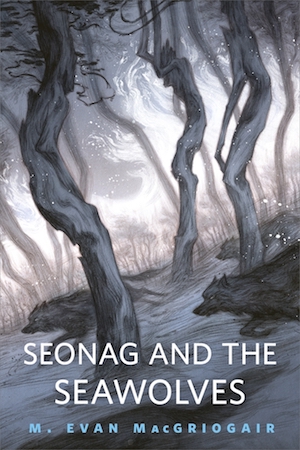
Seonag and the Seawolves by M. Evan MacGriogair
The sea is full of strange creatures. MacGriogair evokes the lovely sparseness of the Hebrides with each carefully chosen word. Seonag and the Seawolves offers a character who, finding little kinship in her home village, seeks what may be found in the strangeness of the sea instead.
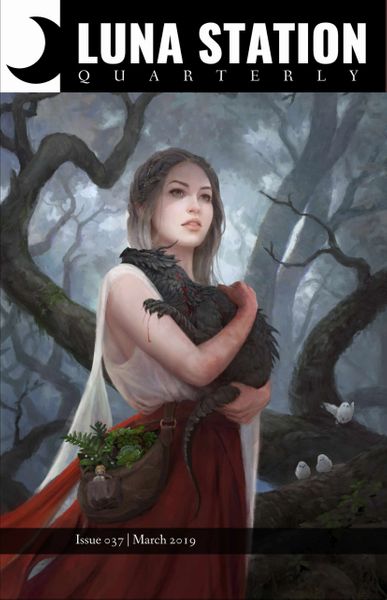
“Auger” in Luna Station Quarterly by Sarah Pauling
The sea is a dangerous place, of course, as are many of the things that dwell within it. Sometimes, though, human beings are the ones to be afraid of. In showing the arrival of a visiting mermaid—or what appears to be one—Pauling deftly constructs the sharp, salt-air atmosphere of a seaside town whose men are mostly destined for sailing-ships, and pokes holes in the tender places where the fabric of this life has worn thin.
Short and poignant, this is a selkie story turned inside out in a fairly literal fashion. The language is both beautiful and violent, like a storm seen from a safe distance; this is a story you can’t help but feel in your bones.
What’s a list of sea creatures without a mermaid story? The ending of The Little Mermaid, in both its Disneyfied incarnation and Anderson’s original fairy tale, can ring unsatisfactory, as the titular mermaid racks up sacrifice after sacrifice for her human love. In this story, Chen weds the detail of the mermaid’s every painful step to the practice of footbinding and exacts the denouement’s satisfying price.
Okay, you probably don’t need me to tell you to read Sofia Samatar, but just in case, this is as good a place to start as any. Selkie stories are so often tales of love and loss, and this one is too, but it is a different sort of a love and a different sort of loss; bittersweet and beautiful in Samatar’s characteristic way with words.
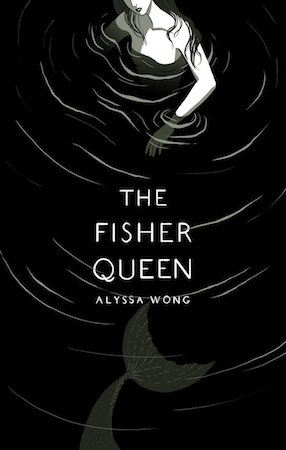
“The Fisher Queen” in the Magazine of Fantasy & Science Fiction by Alyssa Wong; reprinted in audio in PseudoPod
“My mother was a fish,” this story begins; mermaids are merely fish, not people, so the story avers; mermaids are even sold at the fish market. The narrator of this chilling but gorgeous story confronts the tangled nets of familial relationships and social strictures that has been woven around her for her whole life.
The plink-plink of a tack piano gives way to the voice of Kristin Windbigler, executive director of The Western Folklife Center, asserting “2020 taught us that our perspective on the state of the world looks better when viewed through the ears of a horse.” Kent Rollins stands on a windy Oklahoma plain and describes how to make the low-maintenance sourdough starter we all needed eleven months ago. Legendary cowboy poet Dick Gibford explains the popularity of his genre among ranch hands in the bunkhouse—“good poetry is good poetry no matter what walk of life you’re in”— more recently minted cowboy poet, Jonathon Oderman, jokes with his chicken Penny, and the center’s sponsor Nevada Gold Mines makes a case for an inexorable bond between mineral extraction and Nevadan prosperity.
The 37th National Cowboy Poetry Gathering is underway. And this time, for the first time, the gathering’s gone virtual.
The cowboy poets are not the sort of cowboys who ride the ranges of popular culture’s iconography.
Every year since 1985, the Western Folklife Center has hosted the National Cowboy Poetry Gathering, a dead-of-winter celebration of Western ranch culture and traditions on the high desert plains of Elko, Nevada. Music, visual arts, dance, cooking, leather crafts, storytelling, rope braiding, and more are all part of the show, but cowboy poetry, the performative folk art practiced primarily in the ranching communities of the West, is the point. The cowboy poets are, almost to a person, real cowboys, defined by what they do (or at least what they write about doing)—physical work in support of cattling operations, ranch work, which can happen, among other places, on the range, in the rodeo ring, on the farm, at the feed store, in the forest, on the mountain, and in the home–and not by race, gender, or a simple-minded and violent reactivity. In other words, the cowboy poets are not the sort of cowboys who ride the ranges of popular culture’s iconography, a historically inaccurate fiction born in the movie studios of 1930s Hollywood.
The gathering normally attracts upwards of 6,000 fans: rodeo riders, ranch hands, cattlemen, folklorists, Western families, and a growing number of literati, media outlets, and cowboy-curious greenhorns. Attendees pay hundreds of dollars each for six days of recitations, poetry discussions, and social events at which the cowboy poets are stalked like Timothée Chalamet at Vanity Fair’s after-Oscars party. Many of the evening poetry performances are standing room only, and most end with boot-stomping ovations that shake the 900-plus-seat Elko Convention Center Auditorium.
Because of the pandemic, this year’s gathering took place online. On a recent Saturday, while the East braced for a significant winter storm and Elko endured one, cowboy poets and their fans put the coffee pot on the stove or cracked open a Sierra Nevada and gathered for a ten-hour video marathon. The streamed version managed to maintain, and sometimes even amplify, much of the charm of a live gathering (though admittedly without the foot-stomping, hat-waving, spur-jangling, whiskey-gulping raucousness of the real thing). Cowboy poets checked in from their ranch properties, atop their horses or aside their dogs or among their grazing cattle, in pre-recorded segments (a necessity because both Elko and most of this year’s performers reside on the far side of America’s urban-rural digital divide, and don’t have a reliable connection for live video). A chat scrolling below the video stream was a steady stampede of shoutouts to old friends and gentle poet-to-poet ribbing as each participant took the virtual stage. During breaks in the readings and music, footage from the first gathering in 1985 ran, and the chat box swelled with the guffaws of those seeing their younger selves perform and the laments of those suddenly looking on the faces of friends long gone.
Much of the success of this year’s video gathering is down to Windbigler, who, despite fierce opposition from the many in the Elko community for whom the gathering represents substantial tourist dollars at an otherwise slow time of year, started in June to make plans to take the event online. And given her involvement, it’s no surprise the virtual version went so well. When it came to lassoing digital technology in aid of corralling a scattered audience, this was in no way Windbigler’s first rodeo. Her previous jobs were working with TED in New York to expand the reach of its talks worldwide, and before that with WIRED magazine in San Francisco.
Bringing on the digital media savvy Windbigler is part of broader effort on the part of the Western Folklife Center to attract a younger, more diverse, more national audience to the gathering (the mandate the center’s board gave her when they hired her in 2017). As part of that, the Western Folklife Center is doubling down on its efforts to redefine (or, as history tells us, correctly define) the “cowboy” in “cowboy poetry,” countering the stereotype of a gun-toting, right-wing white male, slow-witted but quick with the trigger finger anytime he feels a threat to his God-given freedoms. Think John Wayne, Ronald Reagan, Cliven Bundy, or Couy Griffen (the founder of Cowboys for Trump, currently locked in a D.C. jail awaiting charges related to his participation in the January 6 insurrection at the Capitol).
Rebranding the cowboy poet as something other than white, male, and mean seems essential.
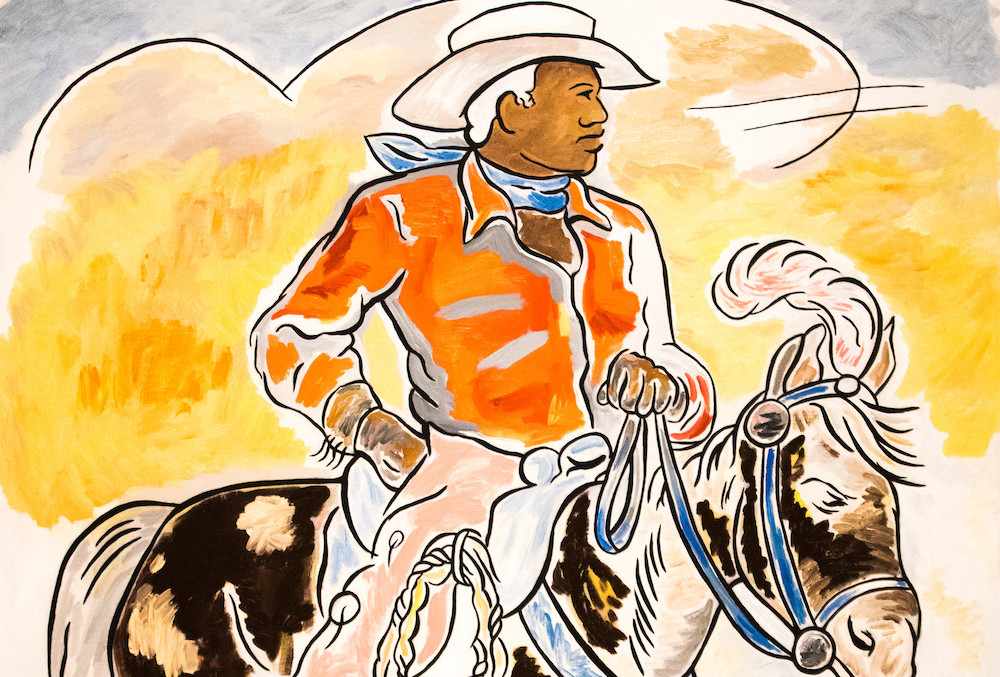
Last year’s 36th Cowboy Poetry Gathering provided a powerful counternarrative by focusing on the Black cowboy. Performances included: Grammy-winning Dom Flemons playing songs from his 2018 album Black Cowboys; urban cowboys from South Central LA discussing the horsemanship, traditions, and art of the historical Black cowboy community there; Black, white, and multiracial members of Oregon’s rodeo-riding McKay family telling stories and talking up their latest film project; and several lectures on the history of Black cowboys, who made up 25 percent of the wranglers working the great U.S. cattle drives that took place from the 1860s through the first decade of the 20th century. The first cowboy poets, and presumably the first cowboy poetry fans, were among the herdsmen who moved 27 million cattle from Texas to Kansas’s rail centers during that era.
Rebranding the cowboy poet as something other than white, male, and mean seems essential if the Western Folklife Center is going to succeed in using the National Cowboy Poetry Gathering to further its stated mission of deploying “story and cultural expression to connect the American West to the world.” After all, Amanda Gorman is the face of poetry in 2021, not the Marlboro Man.
And the Western Folklife Center did certainly counter that image with its 2020 gathering and again this year, as a number of featured artists dialed in from Indigenous American ranching communities. A highlight of the stream was the Martin Sisterz performance of “Piccadilly Billy,” a traditional Diné tune updated with the perhaps equally traditional pop theme of teen crushes. (All ten hours of the 2021 National Cowboy Poetry Gathering will be made available in early March to members of the Western Folklife Center, a membership that also includes early access to tickets for the 2022 gathering). But the truth is the National Cowboy Poetry Gathering has from its inception challenged the popular and historically inaccurate stereotype of the American cowboy. From the first keynote lecture at the first gathering, when Jim Griffith, gathering cofounder and folklorist, outright stated the premise, organizers and supporters of the center and the gathering have made it clear that the cartoon caricature of the cowboy is too simplistic to produce the type of poetry that has always been the focus in Elko. Cowboy poetry is a complex and evolving art, staying true to its roots and relevant to modern Western ranch culture. As English Professor Emeritus at Utah’s Westminster College David Stanley explains in his essay “Form and Tension in Cowboy Poetry,” cowboy poetry is a combination and refinement of a number of styles, traditions, forms, topics, inspirations, and metrics: the Victorian era’s embrace of parlor poetry recitation as prime time entertainment; Homer’s Odyssey to the Bible to Ulysses, both Tennyson and Joyce’s versions; Old English folk poetry, beat poetry, rap, and poetry slams; balladeers like Robert Service and Rudyard Kipling; modern political bards like Woody Guthrie and Bob Dylan.
This is not poetry for incurious meatheads.
Furthermore, again according to Stanley, mastering the performative art of cowboy poetry is the work of a lifetime. It comes not from “…reading essays that dissect and analyze the poetry but from being in the midst of a lively poetic subculture that also values hard, practical knowledge of cattle and horses… The conventional norms of this poetic tradition—how far the poet can depart from standard forms, what the generally accepted limits are, how rules can be altered, and what constitutes a good or successful poem—exist within cowboy poetry and within cattle culture and are learned subconsciously and over time.”
Dr. Limerick ended her lecture with a proposal: that President Biden invite Amanda Gorman and a cowboy poet to some future national unity event to recite poetry that speaks beyond stereotypes to the honest history and real lives of messy, complex, diverse Americans. The cowboy poet doesn’t need a rebranding to earn a place on that stage, something anyone who has followed the National Cowboy Poetry Gathering and the Western Folklife Center already knows. But for those who doubt, perhaps instead a refocus is in order—to look past a distorted image of the American cowboy toward the wider horizon against which today’s cowboy poets honor the traditions, challenges, and work of the American West.
In our series “Can Writing Be Taught?” we partner with Catapult to ask their course instructors all our burning questions about the process of teaching writing. This month we’re featuring Alex McElroy, author of the forthcoming novel The Atmospherians, who’s teaching a course on how to make the first few pages of your novel really sing. We talked to them about leaning into your flaws, resisting feedback that prevents you from being true to yourself, and why writers should learn to cook.
What’s the best thing you’ve ever gotten out of a writing class or workshop as a student?
Can I name two things? For me, the most important part of workshop was making friendships with trusted and brilliant readers. These are spaces to learn who reads and understands your work, and to discover the work and writers that most resonate with you. Also, I left workshops with a pretty thick skin. I learned to value and defend what I loved about my writing.
What’s the worst thing you’ve ever gotten out of a writing class or workshop as a student?
Readings of my work that have nothing to do with the work itself. At times, workshop can push writers away from their vision and can lead them to rethink entire projects or revise in directions meant to please other people. This has happened to me a couple times, and it always takes some effort to get back to what I believe in about my writing. Also, I could’ve done with a few less assigned readings of “A Good Man is Hard to Find.”
What is the lesson or piece of writing advice you return to most as an instructor?
Lean into what might appear, on the surface, to be flaws in your work—there is value in what makes your writing unique. Consider the moments where readers are most engaged by your writing: positively, negatively, loudly. Making a reader feel something is key. And even a reader’s impulse to “change” aspects about your work might be a sign you’re doing something right if the reader found themselves returning to particular passages. In short, cultivate what sets you apart.
Does everyone “have a novel in them”?
I think it’s vital that instructors be transparent about the financial realities of writing professionally.
Does everyone have a story to tell? Yes. I believe this. However, is everyone able to—due to life/family/career circumstances—carve out the space necessary to commit to writing a novel? I don’t think so. Though I wish we lived in a world where people could, but that’s another conversation. This isn’t to say not everyone can do it. But writing is hard, especially writing a novel, and it takes a great deal of confidence, encouragement, luck, sacrifice, and safety to put together an entire book. Writers can gain the first two things from a class or writing community. The others, though, require a lot that is outside of the writer’s control.
Would you ever encourage a student to give up writing? Under what circumstances?
I would never encourage a student to give up writing. However, I think it’s vital that instructors be transparent about the financial realities of writing professionally. This might take the form of encouraging writers to work a day job and write in the spare hours, or to write whenever they have met their immediate needs of safety and survival and community. But I would never advise a student to give up if they are committed to keeping writing a part of their life.
What’s more valuable in a workshop, praise or criticism?
Praise—by which I mean enthusiasm. Anything that makes the writer want to keep writing. That is my primary goal in the classes I teach. Similarly, I like when authors speak directly about their aims or intentions. This helps the readers in the room consider what the author wanted out of their piece, and it guides readers toward encouraging the writer in that direction, helping them enhance the parts of their work that most interest and excite them.
Should students write with publication in mind? Why or why not?
Unless you’re on assignment, I don’t think writers should write first drafts toward publication. But it is helpful to revise with publication in mind—you’re revising for an audience, after all, even an audience of peers in a workshop. Personally, I like to get published and share my work with readers. Many authors feel the same way. And, similar to my comments about professionalization above, if a student is looking to make a career out of writing, they should absolutely be considering publication—and thus audience and venue—when they work through their drafts.
In one or two sentences, what’s your opinion of these writing maxims?
Kill your darlings: Cryogenically freeze your darlings and dethaw them for later drafts, gauge their chance of survival in this modern, unfamiliar landscape.
Show don’t tell: Why not both?
Write what you know: I would revise this to “Write what you care most about.” Knowing about something doesn’t necessarily mean you’re interested in writing about it—and the reader will be able to tell if you aren’t.
Character is plot: Character can help move the plot forward when you’re stuck, but not everything can emerge from character.
What’s the best hobby for writers?
Cooking. It gives you something physical to do with your body, keeps you away from a screen for hours, impresses friends and lovers, and, critically, teaches you good taste.
What’s the best workshop snack?
Tootsie Pop! (ignore what I said about good taste)
I picked up Lydia Davis’s Almost No Memory again recently for the first time in years, and as I flipped through, one line shone out to me like a beacon. In “The Mice,” Davis writes, “our house is much less tidy than the houses of our neighbors. There is more food lying about in our kitchen, more crumbs on the counters, and more filthy scraps of onion kicked against the base of the cabinets.” If I even registered the onion on my first reading, I don’t remember it. But this time around, I’m 37, and because of the coronavirus pandemic, I’m home pretty much all the time, trying to juggle work and housework and childcare. And I know that when you’re a woman with a career and a family and maybe another career—a side hustle, a passion, an aspiration—on top of that, there are probably going to be some onion skins on the kitchen floor.
I turned to Davis’s Collected Storiesin search of more and found domestic failures everywhere. When Davis discusses disorder in the home, she reports on it with a cool remove. Of her children, she writes in a story called “Selfish”: “they have clean clothes most of the time, a fresh haircut fairly often, though not all the supplies they need for school, or not when they need them.” From another story called “Our Kindness”: “Our house is not clean, not completely clean. Our family is not completely clean.” In “The Caterpillar,” Davis writes, “Now the trouble is the stairs are so dirty. I don’t clean them because no one ever sees them here in the dark.” In a story called “Her Damage,” which clocks in at a total of 535 words, Davis recounts, in a single matter-of-fact sentence, an episode that in another author’s hands might serve as an opportunity for self-flagellation: “The baby rolled off the side of their bed and fell onto the floor.” I’ve seen Facebook mom group posts longer than 535 words on far less risky baby situations.
It makes a lot of sense to me that Davis writes so much about the things that go wrong in her home. I suspect most women who work outside the home obsess over the messes, the school supplies that weren’t purchased on time, the little injuries that might not have happened had they been paying more attention. I know that finding the right balance between caring for a family and doing my own work obsesses me, too. Lydia Davis sums up the dilemma in a story called “Mrs. D and Her Maids,” in which a writer works through three drafts in an attempt to create an ad for a maid to help manage the domestic burden:
Writer couple with well-trained schoolgirl daughter and year-old baby
Writer couple who must have harmonious household with wife free for morning work
Woman writer who must be free of household problems every morning requires helper…
By now, we all know the basic facts of life for the modern American woman: Even though women make up more than half of the U.S. workforce, they still do more housework and childcare than men. Married American women who have children spend nearly twice as much time on housework as their male counterparts. In heterosexual couples where both partners work, finding and paying for domestic help like housekeepers and day cares is still often women’s domain. In one 2018 survey, “mothers were 40 percent more likely than fathers to report that they had personally felt the negative impact of child care issues on their careers.” Leaving the workforce for even a few years to care for a child can also have a big impact on a woman’s lifetime earnings–reducing it by as much as 20 percent. The pandemic has only exacerbated the issue. It is women who leave their careers to care for the children and manage online school, even in families where the woman is the breadwinner. More women have left the workforce than men in the pandemic. In September 2020, when virtual school came back in session for many, 865,000 women left the workforce, more than four times the number of men who left in that month. One mom famously shut down her business and laid off 13 employees because her husband (who was unemployed) couldn’t handle twelve-hour days of solo childcare. Their case was extreme, but the story went viral because women find themselves making similar choices all the time.
Women do more housework and childcare because society expects them to and because they’ve internalized those expectations.
Why is it like this? In 2019, the New York Timesreported on a trio of studies that illuminated how Americans think about domestic duties. When shown photos of a messy room in one study, participants judged it as more messy when they believed it was a woman’s room than when they believed it was a man’s. They also thought that this imaginary woman would be less comfortable having guests over and would be less positively viewed by those guests than a man. Women do more housework and childcare because society expects them to and because they’ve internalized those expectations. The messages that women get from society are transmitted in a variety of ways, but even when they’re subtle, women feel them acutely. Women know what we’re supposed to do: cook nourishing meals, make sure our family looks nice, create enriching activities for our children, have a beautiful clean home, and somehow, in addition to all that, have a career.
For me, at least, even before the pandemic I found it impossible to do all the things I thought I was supposed to. And I have to assume it’s the same for other women. We purge belongings with Marie Kondo, we make schedules with the Fly Lady, we watch an army of cleaning influencers clean toilets and countertops and organize toy closets. All of these people offer a false promise: that if you just follow the program, you’ll finally be able to get it all done. But none of it helps, because the problem isn’t in the method. The problem is in our minds.
When I sit down to work with laundry unfolded next to me and dust bunnies collected in the corners of my room, I tell myself that my creative projects are more important than a perfectly clean house and press on, but I still feel guilty. However, I notice that my daughter, nearly three, sees a smudge on the wall or a cobweb in the corner and has no reaction to it. To her, these things are just part of our house, like the front door or the living room rug. She doesn’t yet know to derive any meaning from them. Somewhere between three and 30, women learn to feel guilt. But we can unlearn, too, with enough practice and the proper influence.
Part of the trouble is that there are few places we can turn for an alternative model, one that’s perhaps dirtier and more equitable. Social media is little help. A few months ago there was a trend on TikTok where women showed off their messy houses (a response to all the pristine mansions showcased on the app). These so-called messy houses were a little cluttered, lived-in, played-in. But they weren’t dirty. They were relatable, cute, funny—not anything you’d be embarrassed about if a guest came over. Then there are the Instagram moms with their letterboard signs. One mom vacuuming a white rug in a perfectly clean house had a sign that read “Cleaning with kids in the house is like brushing your teeth with Oreos.” These accounts are supposed to help us feel less alone, but they don’t because they’re trying to have it two ways. They’re not truly messy. They don’t normalize the reality that most of us live in and feel bad about.
I’d like to offer up Lydia Davis as the patron saint of the messy mom.
What’s missing from this landscape is someone to help us accept messiness and find a new way to think about and distribute the burden of housework. I’d like to offer up Lydia Davis as the patron saint of the messy mom. Davis’s stories show us what it really looks like when you’re struggling to be a writer with two children. And she provides a model in which the responsibility for maintaining that life, messy though it may be, is evenly distributed to all the adults involved.
Many of Davis’s stories use a first-person plural narrator—a “we” narrator—which has the effect of forcing shared responsibility of domestic duties on Davis’s characters. The narrator of “St. Maarten,” shares house-caretaking duties with another, unnamed person: “We” is the pronoun used throughout:
We hardly knew what a clean house should look like. We would begin to think we were quite tidy, and then we would see the dust and clutter of the rooms, and the two hearths covered with ash. Sometimes we argued about it, sometimes we cleaned it. The oil stove became badly blocked and we did nothing for days because the telephone was out of order. When we needed help, we went to see the former caretakers…The old man came by sometimes, and when he saw how the grass had grown so tall around the house, he scythed it without comment.
The failure to clean and take care of the house is just a fact. There’s no remorse expressed and no fretting. It’s a collective problem, just like the baby who fell off the bed. No word on who was watching the baby when he fell: their bed, their baby, their responsibility. Shit happens, the baby survived, let’s get back to work.
On a societal level, we tend to give men a pass when it comes to mess—as in that study where a man’s mess seemed less messy than a woman’s. But men are just as capable, and just as culpable. When Davis writes “we” it shifts that culpability to right where it should be: from her shoulders over to theirs. They both carry the yoke and therefore share the load. These problems belong to all of us that live in this house. If a mess doesn’t often distract from a man’s work it cannot be allowed to distract from a woman’s work.
James Wood once wrote about Lydia Davis, “You could say that selfishness, in every sense of the word, is Davis’s real theme: the overbearing presence of the self, the insistent internal volume of the self, the dunning inescapability of being who one is.” I’d argue that the focus on the self is what allows Davis to detach from her messy house and detach from the undue pressure women feel. We think the answer is to give up more of ourselves for our family and our children, but when we allow ourselves to be equally important and our work to be equally important—if not more important—than some of the household tasks, and even the work of our husbands, that’s when we’ll find true gender equality. And that’s when we’ll find the time to get our work done.
What Davis offers is validation that the work is worth it—that the work her female characters are doing is more important than the dust and the onion skins. That a woman’s work is valuable and necessary is never questioned, never called up for reconsideration. And that’s what we most need to be influenced by, for ourselves and our daughters. It doesn’t really matter if my daughter has chicken nuggets for dinner again. It doesn’t really matter if my baseboards are dusty and my bathtub has gray soap scum around the drain. But it will matter, and matter a lot eventually, if my work is not complete. It will matter to me and to my daughter. The example I set for her will guide the way she lives her own life, and perhaps influence the guilt over housework she does or does not carry when she is grown up. I want her to live comfortably with the idea that she can let some of it go, without remorse, in the service of something greater.
Pan entered Gubeikou Station at top speed, hurtling through the crowds, hand on her purse. It was late and her father would be getting restless, prone to wandering; she needed to get home, get on the train. At the end of the line a guard lazily waved his security wand over her duffle coat, both sides, slowing her down. “I’m in a hurry,” she said plaintively.
Down the steps, then, quick-stepping on the too-shallow stairs, dodging the march of people headed in the opposite direction, determinedly clutching their bags as they went. “Let me through!” she cried. But it was 5 p.m. and Gubeikou was crowded. A train had just arrived, disgorging more people now headed to the exits; she was beaten back against the wall by the crowds.
By the time she reached the foot of the stairs the train doors had closed; it had left the station.
That was all right, Pan thought. She’d get the next one. She made her way to a bench, sat down. Haste didn’t pay, she reminded herself. Today she’d miscounted the change at the register and ended up 20 yuan short: she’d had to make up the difference. At home as a child, her family had nicknamed her Ranhou Ne? because she was always asking, “And then?” from the time she was young.
“I got some leeks today,” her mother might say.
“And then?”
“I’ll make some soup.
“And then?”
“And then we’ll eat it.”
“And then?”
“And then you’ll go to sleep and stop asking questions, baby.”
The station filled with people. A middle-aged woman with a perm sat down beside her and took out a tube of crimson lipstick and smeared it on her face. Opposite them was a yellow ad featuring a grinning Jack Russell terrier jumping in the air to catch what looked like the world, a globe. It was too large: Pan doubted the dog would be able to catch it; it would just bounce harmlessly off his nose.
Another ten minutes passed. Then, an announcement: “The next train will be delayed. We thank you for your understanding.”
The train was a marvel, just two years old, state-of-the-art. It had doors that swung open like a singing mouth, emitting a merry chime, and closed after twenty seconds with precision. There were twenty-six lines already built, with another ten under way. No other city in the world had built its subway stations so quickly.
At home as a child, her family had nicknamed her Ranhou Ne? because she was always asking, ‘And then?’
Half an hour passed. The crowd swelled and milled around unhappily, everyone bundled in their coats. Pan was glad she had her seat. Every ten minutes or so, the announcer would return: “The next train will be delayed. We thank you for your understanding.”
A pair of teenage boys took off their coats and laid them on the ground and sat atop them. A handful of others followed suit, and then others.
Pan’s legs were starting to fall asleep, and she twitched her chilly toes inside her pink boots. It had been a while since anyone else had entered the station, she noticed; they must be turning people away.
Down the platform, a man in a bright-blue coat was the first to try leaving. Indignant, he led a group of half a dozen commuters back up the stairs, where they banged on the access gates, which consisted of tall, solid plates of hammered metal.
One guard must have taken out a stepladder, because suddenly his whole face and part of his torso appeared, peering out over the barriers.
“We’ll get the train moving soon,” he said kindly. When shouts rang out, he nodded sympathetically. “I know,” he said. “You’re tired. I’m tired, too. You want to go home and eat a nice meal, rest for a while. I do, too. Please be patient. We’ll get there together.”
Then he did a little shimmy of his hips, at which the crowd laughed. After the subway system had opened, the government had hired teams of beautiful young women to dress in tight-sheathed skirts and blouses with red sashes across their chests that read TRAIN GODDESSES SERVE THE PEOPLE. During rush hour, they stood on the platform and twitched their hips as they sang the same song:
Thank you for your cooperation, please line up, do not push
Be a civilized passenger, for your safety and that of those around you
We’ll get there together.
Pan didn’t laugh. Her father was waiting at home, waiting for her to come back and cook dinner. By now he would be pacing anxiously in the living room, where she had left the television on all afternoon in an effort to amuse him, but his favorite program had ended an hour ago and who knew what he might decide to do next: Light the stove? Bang his head repeatedly against a wall?
She took her subway card and waved it repeatedly over the gates, which flashed a red x. “Let us go!” she shouted, but the guard’s head had already disappeared.
That night they slept on coats at careful distances from one another, on islands spread of newspaper, heads pillowed on bags. The lights never went out. A baby made small keening noises through the night, but did not cry. They were too far down to get any signal, but Pan, who seized a patch of ground near the bathroom at the west end of the tunnel, kept an eye on her phone anyway, watching the time: 11:10, 4:30, 6:32. Her stomach clenched anxiously anytime she thought of her father: perhaps one of the neighbors would have stopped to check on him, she thought to herself. It had happened before.
At 8 a.m. two guards reappeared, this time through a side door marked STAFF ONLY that had been locked overnight. The first came wheeling a cart stacked with boxes of ramen and tall thermoses filled with hot water. Each person got a cup, a toothbrush, and a sliver of soap, which came in pouches that bore the stamped white letters HUMANITARIAN SUPPLIES.
“Repairs still under way,” he said shortly.
A man dressed in an untidy, reflective smock, the kind that street cleaners wore, got up, brushing himself off. “You can’t treat us like this!” he shouted. “We have things to do. Let us go.”
The first guard shook his head regretfully. “Passengers must exit at a different station from where they entered,” he said. “It’s in the rule book.”
The second guard taped a sheet of paper to the wall. Owing to a mechanical breakdown, it ran in printed letters, trains at Gubeikou Station will be delayed. We assure passengers they will get to their destinations. Thank you for your cooperation. A red seal was affixed in one corner.
“Let us out with you,” another man said, pointing at the door through which they’d entered; a third guard was wheeling in another cart.
“Can’t do that,” the first guard said. He tapped the STAFF ONLY sign and began to lay out trays of plastic utensils, washcloths, and napkins. Other passengers gathered, peppering the man with questions: How much longer? What was the problem, exactly? Could their fares be refunded?
“We’ll get you to your destination,” is all they would reply. They would take messages to loved ones, they said. They would ensure work units were notified.
One of the teenage boys darted toward the door. In response, the second guard unsheathed an electric baton and whirled it about his person once, striking the young man, who dropped to the ground and began quietly moaning.
“Look what you made me do,” the guard said angrily.
In a matter of minutes the men had erected a small supply station near one end of the platform, complete with soy milk, crackers, instant noodles, coloring books, pencils, and stacks of coarse yellow blankets. “Thank you for your cooperation,” they said to the crowd, before leaving. “We’ll get you moving soon.”
We’ll get there together.
That day, the two teenage boys tried scaling the subway turnstiles, but were warned back by guards who stood just outside, faintly visible through the cracks, wielding electric batons. “Down!” they cried, gesturing at signs that said NO CLIMBING.
Pan and others tried standing by the entrance, shrieking repetitively, “Let us out!” There was something both liberating and terrifying in all the fuss they were causing; it made Pan think of her grandmother, who, in her final years, had similarly appeared to lose all inhibitions, shedding her pants in a supermarket, calling other neighbors “slovenly” to their faces. It also made Pan’s head hurt, and with the guards unmoved, eventually the group’s efforts subsided.
By the second day, the train still hadn’t come, to everyone’s bewilderment. The announcements kept playing: “The next train will be delayed. We thank you for your understanding.”
“Soon,” the passengers kept telling one another. “It must be soon.” Maybe a new part needed ordering. Someone remembered hearing that the trains had been made in Germany. How long did it take to ship something from Germany?
On the third day, the man in the blue coat set off into the tunnels. “We may as well,” said the man, named Jun. He tied plastic bags around his shoes; the tunnels were damp, and at night they could hear the sound of water dripping.
“Be careful!” Pan shouted as Jun set off. She liked the slender-hipped way he would stand for hours at the platform, listening earnestly for sounds of the train, the way he helped pick up the scattered ramen lids and neatly stack them after meals. He wasn’t from the city; his speech was lilted like that of someone from the country’s west.
He returned when they’d nearly given up expecting him, face and hands dirtied. The tunnels extended for miles in all directions, lit by only ghostly lights, he said. He’d gotten lost. The track layout was bewildering, he said. Some tunnels were partly caved in and appeared to have been abandoned halfway, while others led nowhere at all.
The next day he went back in anyway, this time carrying a bag full of their trash, which he used to mark his way. He began disappearing for hours like that, every day. Occasionally the teenage boys would go with him.
“There must be a way out,” he said.
Sensing discontent among their charges, the guards wheeled in a television set, which carried cartoons in the morning, sports games and dramas in the afternoon, and every night, the evening news. There were winter dust storms sweeping the north. There was a new scourge of telephone scams happening; residents were urged to stay on the alert.
Together they slid, uneasily, into this new life. In the mornings, one woman began leading calisthenics sessions to the sound of a tinny transistor radio from one of the guards. The children spent hours chasing one another around the benches on one end of the platform, and did not appear to weary of their game. In the afternoons, adults chatted, watched television, or slept.
At night Pan heard whispered endearments exchanged between a teenage couple who slept a few feet away. Unlike the others, the two seemed utterly content, staying up for hours to eat ramen and watch the television as it flickered in the dark, schoolbags discarded to one side. At times Pan touched the roof of the small cardboard cove she’d erected above her head, offering a semblance of privacy. On its inside, she had stenciled in a number of stars.
She made one for Jun, too, bending and taping the cardboard with care. “You don’t have to draw on it,” he’d said, and she’d nodded, embarrassed.
One morning, a shout went up in the station: someone had seen a flash of color peeking out from the pile of blankets where one construction worker slept and found that he had been hoarding piles of ramen. When they pulled back his bedding, they found dozens of packets had been stuffed inside.
“Selfish!” shouted the middle-aged woman with a perm. “Don’t you think of the rest of us?”
“Get up! Apologize!”
Eventually the group took a vote, and a retired professor among them was chosen to manage the ramen. A sign was drawn up and pasted to the supply station: NO SEEKING PERSONAL BENEFITS: TAKE ONLY WHAT YOU NEED.Later that afternoon (some had begun to eye the professor with suspicion), a second vote was taken and it was decided that they would instead draw up ramen ration tickets, to be handed out every day, and that system lasted for a few days before the guards brought in additional boxes and there was an excess of ramen anyway and everyone abandoned it.
Pan thought of the first time she’d taken a train, thirteen years ago with her mother, before she’d passed away from stomach cancer. Her father had been there, too; it was before his accident, before his confusion had set in, before his illness had turned him into an invalid. She had been ten, and they had been going to see the famous karst landscapes of the south. The train was a hulking green locomotive that carried them for hours, and when they’d arrived, the air was hot and humid and the hills lush with foliage. Later she would understand her mother was already sick at the time, and this was a final trip for them all to help say goodbye.
Time passed. At night, the baby cried. Jun ventured into the tunnels less frequently, and, like the others, started sleeping for long intervals during the day. “When will the train come?” they asked the guards every morning. “Together we’ll get there,” they replied, like manic pharmacists given only one pill to administer. The calisthenics woman stopped leading group exercises in the morning after she came down with a cold; dampness from the tunnel had caused it, she was sure.
And then in the middle of the afternoon, two weeks on, it happened. The air changed abruptly, a wind blew through the station, and a rushing noise grew louder.
“It’s a train!” yelled one of the children, getting to her feet and dashing near the edge.
“Careful!” her mother warned. “Don’t run!”
Others shouted, too. “A train! A train!” On mattresses around the floor, several who’d been taking a post-lunch nap fumbled for their glasses and quickly rose to their feet.
Jun was already at the end of the platform, waiting, peering into the tunnel. Pan hurried to join him. “Do you see it?”
“I see it.”
The light was getting stronger, streaming through the thick air of the tunnel. The crowd lined up around them, watching. The light grew nearer; there was a honking sound. The train entered the station, moving fast. Inside they could see the train car was empty. There was a moment, too late, when everyone realized that it was not going to slow. It did not stop.
After it departed the station, they sat around dazedly, trying to console one another. “Next time,” they said. “It’s a good sign, anyway.”
A short while later, the sound of the Train Goddesses’ song came on the audio system.
Thank you for your cooperation, please line up, do not push
Be a civilized passenger, for your safety and that of those around you
We’ll get there—
Then it was abruptly cut off, as though an order had been quickly countermanded.
Later, lying in bed, it occurred to Pan that the careful trails of debris that Jun had been leaving had probably been obliterated by the train. It didn’t matter, she told herself. So far his periodic searches hadn’t yielded anything, anyway. She suspected he was keeping them up just as a way to be alone: twice she’d seen him shrug off the teenage boys who tried to join him.
Days drew themselves out, days in which Pan, like the others, spent hours prone in bed. After long days on her feet at work, and long nights caring for her father, for the first time in years, she found she could sleep for twelve, thirteen hours straight: such richness, such intoxication. At times it was an effort to pull herself out of bed, to push herself to think of what was required of her now.
For the first time in years, she found she could sleep for twelve, thirteen hours straight: such richness, such intoxication
“Something’s wrong,” Pan told the group one morning nearly a month after they were stranded, slowly stirring her ramen. “We’re never going to get out. Not unless we do something.”
“It’s a mechanical issue,” said one man who worked in a metallurgical plant and snored loudly through the night. “Have a little patience.”
“Patience?” Jun said. “It’s been weeks.”
“What do you have to do outside that’s so important, anyway?” the woman with the perm said. Her voice sounded coquettish, and Jun’s face flushed. It was true that he didn’t have a wife or children waiting for him, like some of the passengers did. It was true that he would not be missed at the factory, either; they would just move another man up the line.
“Anyway, it’s not so bad in here,” a woman who worked as a schoolteacher said, sensing his discomfort. “They’re taking good care of us.”
Since the first days, the guards had brought in mattresses, folding tables, chairs, and pillows. They’d wheeled in extra television sets and for meals had begun serving simple boxed lunches: steamed buns, sandwiches, fried noodles. There were towels, even a badminton set, lots of paper and markers and pens for the children, a few boxes of books and videos. What else did they need?
“That’s not the point,” Pan said.
“What is the point?” the retired professor said, with what sounded like genuine curiosity, as though she were a student who’d posed an interesting academic question.
Pan stared at him crossly, not knowing what to say.
“I’m getting more rest than I have in years,” said a man to her right, and a few of those assembled laughed, as if he’d been joking.
“So you aren’t upset?” Pan said, appealing to the group.
“Of course we’re upset,” the professor said. “But it doesn’t do any good to be anxious. Just calm down.”
“I am calm!” Pan said. Then she turned away and walked back to her blankets, slowly and deliberately, to show how calm she was, and to camouflage the heat around her eyes.
It took two days to hatch her plan, and then one night after everyone had gone to sleep, she arranged her three other co-conspirators by the staff door. Jun was the one who’d had the good idea to lay additional blankets on the floor and recline on them, as though they’d simply chosen to move their sleeping spots. “There are cameras,”he said. “They could be watching.”
The next morning, the four of them woke early and listened intently for sounds of movement, each holding an extra blanket. When the click of the lock turned and the first guard entered, Jun sprang up and flung a blanket over him. It was harder than they’d expected: one of the teenage boys had to rush to his aid before they managed to pinion the guard’s arms to his side.
By then the second guard had entered, baton aloft, but also disappeared sputtering into a blanket. Farther down the platform, heads were beginning to turn.
“Hurry!” Pan yelled to the others, as she and the teenager fought to keep the blanket pulled tight and the guard’s arms to his side and wrestle him to the ground. “Get the door!”
“Help!” the other boys cried. “Help!”
No one moved. In another moment, roused by the commotion, half a dozen other guards had rushed in, pulling the blankets from their colleagues’ heads and administering shocks to Jun and the two teenage boys. Pan they left alone: she registered the surprise on their faces, seeing she was female. “Wait!” she screamed. “Please!” They ignored her and gave Jun and the other boys a few halfhearted kicks as they left, bloodying Jun’s nose, taking their still-laden cart with them.
After that another vote was taken: Pan and Jun and the teenage boys weren’t allowed anywhere near the staff door in the mornings.
“You’ll get us into trouble,” the woman with the perm scolded them. “Don’t you realize, we depend on them for everything?”
“We could have escaped, if more of you had just helped,” Jun said angrily, rubbing his head, still sore from being struck by the baton.
“Yes, and what would we have done once we got there?” said a man with a small, pointed face and a shadow of a mustache, who monopolized the bathroom in the morning. “Do you think we wouldn’t have been punished?”
“We just wanted to get out,” Pan pleaded. “We have important things to do outside.”
“Are you saying the rest of us don’t have important things to do outside?” the woman with the perm said indignantly.
“It’s not the guards’ fault,” the construction worker said abruptly, and everyone turned to him in surprise. It was rare for him to say anything at all.
That night, without saying anything to anyone, Pan defiantly pulled her mattress across the platform, close to Jun’s. In the middle of the night, after she’d gotten up to use the bathroom, she came back and lay down, tensing, wondering if he was awake. After a few minutes, she stretched out her arm and let her hand rest on top of his blankets, where it stayed for perhaps thirty seconds, until he grabbed it and pulled it inside. She let out a low laugh and rolled toward him.
Two months after they were stranded, the country’s state broadcaster sent a team to do a report on the group, sending reporters to film their badminton games and to interview the passengers. The guards let them respectfully through as the stationmaster, a woman they’d never seen before, wearing a shiny badge and a black tricornered hat, supervised.
The reporters moved through the crowd, picking their subjects. “Sometimes I despair, but I trust in the authorities,” the middle-aged woman with a perm said, lip trembling, in the clip that all the news stations aired that evening. “Together we’ll get this train moving!”
Back in the studio, the broadcaster nodded and intoned to the camera, “The spirit of Gubeikou Station is strong.”
The next day, theirs was a front-page item, under the headline GUBEIKOU SPIRIT. The newspapers carried each of their names, in a double-page spread, along with their photos, opposite an editorial that praised them for their bravery, for “inspiring a nation with their fortitude and optimism.”
The atmosphere in the tunnel changed as they pored over the papers the guards had brought that morning, examining their photos. The woman with the perm asked for, and was promised, extra copies.
The spirit of Gubeikou Station is strong.
After breakfast, the retired professor called a meeting. “It’s time we organized ourselves,” he said. “We have been here two months, and we may be here much longer. The nation is watching us,” he said sententiously. “We need to be role models.”
Pan made a face and turned to Jun, waiting to see his expression, but to her surprise his eyes were trained on the professor’s face, and he was nodding.
“Look at this trash,” the professor said, gesturing at the detritus around the tables where they’d eaten. “The bathrooms are a mess, too. We need to organize cleanup crews. We need discipline. We need a schedule.”
There was a sound of general assent. “We represent the Gubeikou Spirit!” he said. “We need to come together.”
Soon the group had drawn up a list of tasks. Jun volunteered to lead the cleanup crews. The woman with the perm said she’d help run morning calisthenics. The schoolteacher said she’d tutor the children, and asked for volunteers to help. Another woman offered to lead a team to do regular laundry: two items per person per week. They would use the bathroom sinks. The construction worker said he would hang some clotheslines.
A sudden camaraderie seemed to have seized the group. Looking around, Pan felt her skepticism weaken. “I’ll help work with the children on their sums,” she offered, and felt herself embraced by a smile from the teacher.
The woman with the perm began singing a chorus from the Train Goddesses’ song, giggling, shuffling her hips. A little self-consciously, as though they were on camera, the rest of the crowd caught the tune, too:
Thank you for your cooperation, please line up, do not push
Be a civilized passenger, for your safety and that of those around you
We’ll get there together.
After that news broadcast, donations started to flood into the station. First it was pallets of dehydrated beef sticks and tins of cookies. Then a store donated piles of new down jackets. One culinary school down the street offered to have its trainees cook for them, and fresh, hot meals began arriving twice a day. To the group’s delight, someone sent an old karaoke machine as well, and soon the afternoons were punctuated by the sound of people warbling lustily, taking turns at the microphone.
The guards, too, turned unexpectedly solicitous. After seeing TV commercials for a new kind of fried chicken, the guards brought them samples. When the retired professor complained he was chilly, they sent in an electric heater. When the group wearied of their existing stock of videos, more arrived.
“It’s better here than on the outside,” a few of the stranded passengers were heard to joke, and others agreed.
Every now and then, the announcements still sounded—“The next train will be delayed. We thank you for your understanding”—but at longer intervals now, and someone had turned the volume down. It was possible, at times, to forget that they were even in a train station. After the news broadcast, more reporters kept arriving, and with them new comforts, as well. The stationmaster ordered couches and more television sets. There was a new program featuring the palace intrigue and romances of a family with two daughters unlucky in love that the group assembled daily to watch, shouting and jeering at one sister, cheering the other on, Pan’s head curled on Jun’s shoulder.
And meanwhile, the train system kept growing. In the distance, if they craned their necks just right, they could sometimes hear the sound of hammering and drilling. There were twenty-eight lines now open throughout the city, the newscasters said. By the end of the year, there’d be twenty-nine. “With the Gubeikou Spirit,” an anchor said one night, “we will continue to persevere, to build the world’s most advanced train system!”
At that, the crowd on the platform cheered. They were more considerate of one another, stood a little more upright. The mayor had come to see them, had shaken their hands and posed for a photo before a red banner that bore the words GUBEIKOU SPIRIT. In the mornings, after calisthenics, they ran twenty laps around the platform together, laughing as they tried to round the corners without knocking into one another. In the afternoons, they traded off taking care of the baby, who had grown a soft cloud of hair and begun issuing her sunshiny smile to anyone who looked at her.
To her surprise, Pan found she liked working with the children, helping them with their math, joining them as they colored. On large sheets of paper, she encouraged them to create jungle scenes and geometrical patterns, big whorls of colors and diamonds that they taped to the subway walls.
It was only late at night that her thoughts turned, reluctantly, to her father. By now, surely the neighborhood committee had taken charge of his care, she told herself. Perhaps he didn’t miss her, she thought—some days he was so confused. She was a poor caretaker, she thought guiltily, working long hours, always away: he might do better in a real institution.
Still, lying near Jun, she found herself restlessly trying to conjure up new methods of escape anyway. They could revolt en masse and climb over the turnstiles—surely some of them would get away. They could refuse food, refuse water.
The next morning, Jun would gently dissuade her. “At this point, we just need to be patient,” he said. “We’ve done all we can. If you haven’t noticed,” he added, “most people here are actually pretty happy.”
He got up and went to play badminton; in recent weeks he’d begun a heated competition with the construction worker. Disgustedly, Pan ate two extra bowls of ramen for lack of anything else to do, and then stopped. Across the way, the calisthenics woman had started up the karaoke machine and was beginning a bouncy rendition of a folk tune with two other women. Pan lay down, shut her eyes, and again fell into a deep slumber.
One morning, the guards came in and affixed a new circular to the walls. Attention, it ran. Gubeikou Station is currently conducting track work. Passengers are advised to stay off the tracks until further notice.
A ripple of interest ran briefly through the group, then dissipated. The woman with the perm was diligently leading an aerobics session, which was running behind because a few people had slept late, and the group was anxious to finish and have their breakfasts (fried mushrooms and steamed rice porridge with pickled vegetables, which smelled very good indeed). It was an unnecessary notice, anyway: Jun and the teenage boys had long ago given up their quest to find a way out through the tunnels.
Shortly after the notice went up, another train arrived. Everyone paused what they were doing and looked up as a rushing sound grew nearer, and a horn sounded full blast. Some of the children moved toward the platform, but the adults simply froze and watched. The locomotive, when it entered, was full of people, they saw: a pack of dusty-faced commuters looking tired and sallow under the fluorescent lights. It zoomed forward without slackening its speed, and, in another moment, it was gone.
Afterward, the adults went back to quietly chatting, struck by seeing so many strangers after so many months. “That was strange,” the professor said aloud, as though to himself.
“They looked so unhappy,” someone said.
“It’s not easy, being outside,” the calisthenics woman said, nodding.
It’s not easy, being outside.
Someone turned on the television: the evening newscast was starting up again. Jun and two women on duty moved around and began collecting plates and stacking them on platters for the guards to remove the next day.
That night the newscast was about the job losses being suffered at two steel refineries that were shutting down. For several weeks, the news had all been in a similar vein, a steady drumbeat; the economy was slowing. There was a crime spree in certain neighborhoods; news anchors advised viewers to lock their doors. “Sad,” the construction worker said with a sigh, and the others agreed.
After that, trains started coming into the station every day or two. Sometimes they arrived with horns blaring, other times they silently sped through, all their lights off. Twice they saw that the cars had people inside: once, another group of commuters, and another time, a man in an orange repair suit who stood alone, tinkering with a light.
Each time the train never slowed, never stopped. While most of them learned to ignore their appearances, their repeated arrivals seemed to drive one woman, with a spotted face and a badly knitted sweater, over the edge. After each one departed, she would sit in a corner rocking back and forth by herself, muttering. When the next train arrived, she would chase it and pound her arms against the swift-moving body of the locomotive, terrifying those around her, who eventually began forcibly restraining her whenever one arrived. “She could hurt herself like that,” they said to one another. “She could fall onto the tracks.” But the trains came at all hours of day and night, and it wasn’t possible to watch her. Eventually they asked the guards for a short length of chain with which to tether her to a drainpipe by the bathroom.
They moved her mattress and placed a television set in front of her. “It’s for your own good,” they told her. “We don’t want you to get hurt.” The woman howled at first, but eventually quieted.
The woman reminded Pan of her father. In the afternoon, she would sit and draw pictures by her side as the woman watched, fascinated. She began bringing her plates of food during meals, to make sure she ate properly.
“More celery,” she’d say, imitating herself when she was with her father. “Eat some fruit.” The woman would make an assortment of pleased-sounding noises at Pan’s attentions. It could not be determined if she had always been so incoherent, or if it was life at Gubeikou that had made her so.
When the trains came, the woman would rise up and lunge at them, as though the locomotive had wronged her family in a past lifetime, her chain rattling. The other passengers speculated about her quietly: Where had she been going the day they’d been stranded, anyway? What would happen to her when they were freed?
“Poor thing, no work unit would want her. She’s lucky she wound up here.”
The professor had the bright idea of finding the long-ago newspaper article that had listed all those stranded. Together, they located her picture wonderingly: it said she was an accountant.
A chorus of indignation broke out. “Not possible—look at her,” the professor said.
“It must be an error,” the others said.
Then one day, the train snuck up on them. It was late in the evening. The kids were playing down on one end of the platform, by the badminton net. They had just finished eating their dinner, roast pork and steamed rice and braised bamboo shoots, and now that the plates had been stacked and put aside, most of the group was congregated around the television, watching a detective show. Pan was leaning back in her chair, her legs casually slung over Jun’s lap, comfortably encased in one of the newly donated sweatshirts the guards had unpacked the other day, which read GUBEIKOU SPIRIT across their fronts. It was a Friday, but it might as well have been a Tuesday or a Wednesday; it made no difference—all the days ran together. The atmosphere was warm and convivial: the retired professor was already nodding off in his chair, and around the table, some of the others smiled at the sight.
The volume on the television was turned up, and it was only the sound of metal rasping against metal that made them look up. Across the way, a beam of light was streaming through the tunnel: another train was coming through. Down the platform, the woman was on her feet, yanking futilely at her chain and lunging forward, her chain clanging noisily against the pipe. The group frowned. “Calm down!” the middle-aged woman with the perm shouted.
The rushing sound of the train was quieter than usual, though, and in another moment the group realized why. The train wasn’t moving that quickly; in fact, it was slowing down. It had stopped. In another moment the train’s doors had opened with a merry chime. The train car was empty. Its insides had a faintly yellow cast, the carpet dirty and worn.
“It’s stopped!” someone cried. Pan stood and gazed at the open doors, heart pounding, joy and fear coursing through her veins in equal measure.
The group was silent. On the screen, a detective was rushing down a set of stairs in pursuit of a woman in flight. Pan turned toward her sleeping pallet to grab a few possessions. No, there wasn’t time. “Jun!” she called. “It’s here!”
He was still seated, slowly tying his laces. “It might not be safe,” the professor warned. No one moved.
“We should ask first,” one of the others muttered. “Find out what’s going on.”
“This could be our only chance!” cried Pan. A few wary pairs of eyes glanced over from the television. “Come on, get up! What have we been waiting for?”
The train’s warning chime sounded: in another moment, the doors would close. “Hurry!” she yelled, but the others stayed seated. Incredulous, she wrenched her eyes from the group and hurtled toward the train, socked feet flashing white. Farther down the platform, she heard the sound of the woman’s metal chain rasping and felt a twinge of guilt, but kept running. Two of the teenage boys rose and joined her. The doors slid shut. “Pan, wait!” Jun shouted.
She didn’t hear him. She stood panting, exhilarated and afraid. She was already through the door.
I wish I remembered exactly where my dad got the 1992 Royal Rumble tape. I imagine it was from the packaging factory in the Toronto suburbs where he worked for most of his life. We couldn’t afford to order the pay-per-views, so we relied on bootlegged copies from his co-workers for the majority of our wrestling videos. We collected others by recording WWE (then WWF) Saturday Night’s Main Event off the TV each week. Sometimes, we’d rent a show from the local video store, set up two VCRs, and record it onto a blank VHS. I was six or seven years old at the time and my mom worked the afternoon shift as a custodian on an assembly line, so dad and I would watch these recorded tapes each weeknight. Dad, exhausted from his own laborious day shift, would often fall asleep on the couch beside me, while I repeatedly poured over the familiar matches. This was as close as he ever came to reading to me before bed.
Wrestling was always on in our house, but the 1992 Royal Rumble was special. We watched this tape together often, each time pretending to be unaware of the outcome. We feigned surprise every time the villainous Ric Flair weaseled his way to a victory in the 30-man over-the-top battle royal to win the championship belt. Dad cheered for his cheating antics while I faithfully rooted for the wholesome Hulk Hogan to regain the title. Dad played heel to my babyface, illuminating the struggle between good and evil to me through wrestling.
Why—almost 30 years after the 1992 Royal Rumble and sixteen years after my dad’s death—am I still watching professional wrestling?
Every January, during the build up to the annual Royal Rumble, I think about my dad, who, like a wrestler who lived too hard, suddenly passed away in 2005. I also consider Flair, the renowned dirtiest player in the game, and what my dad tried to teach me through the Nature Boy’s elusive ways. Above all else, I contemplate a larger question. Why—almost 30 years after the 1992 Royal Rumble and sixteen years after my dad’s death—am I still watching professional wrestling?
My grandpa was perpetually disappointed when he caught dad and me watching wrestling matches. He ridiculed our passion, referring to it as “a waste of time.” He mocked us for “watching these naked men dancing around” and never missed an opportunity to tell me it was “fake,” no matter my degree of obsessive belief.
Grandpa, a stout three-piece suit-wearing Punjabi Sikh who matched the colors of his tie and turban, recited the daily Sikh prayers loud enough for the entire house to hear every morning. He specifically targeted me before school, encouraging me to repeat the prayers in the shower, while I got dressed, and during breakfast. The religious texts themselves were inaccessible to me, as they were often bound in lavish cloths and kept in the most elevated places, usually the top shelf of a closet in the highest room in the house. Even if I could have reached the scriptures, I wouldn’t have been able to read them, because they were written in Punjabi or another dialect that appeared simultaneously foreign and familiar. As a first-generation South Asian growing up in Canada, I recognized the words but failed to understand the non-Romanized alphabet that formed them. Without complete physical or mental access to the scriptures, my grandpa resorted to dictating and translating them to me. Roughly, these sacred texts described a “formless” yet “all-pervading” God who was equally present and obscure.
Despite Grandpa’s insistence, Dad never adopted religion at his beckoning. He let grandpa force the prayers on me, but I never heard dad repeat them publicly, except for an occasional sarcastic waheguru (oh God). Even at Grandpa’s funeral in 2004, one year before his own death, Dad silently listened to the ceremonial prayers rather than reciting them with everyone else.
During particular bouts of religious fervor, my grandpa would advocate for me to grow my hair and wear a turban like a true Sikh. “Your father didn’t listen to me, but there’s still time for you,” he said. I kept delaying, maintaining that I would consider formalizing my religious devotion next year, and then the year after that.
Unlike the abstract prayers, wrestling had narrative arcs that informed my morality.
My elementary school days consisted of prayers in the morning and wrestling in the evening. Scripture and mythology. Absolute truth and fiction. I always preferred wrestling because I understood it. Unlike the abstract prayers, wrestling had narrative arcs that informed my morality. I learned never to look at another man’s wife from the Hulk Hogan-Miss Elizabeth-Randy Savage love triangle, when Savage infamously accused Hogan of having lust in his eyes and in his black heart. The Hart Foundation taught me how to love my siblings unconditionally, despite the family rivalries, jealousy, and outside interference from those trying to split us apart. I discovered that death is inevitable for everyone—except for the Undertaker, because you can’t kill what’s already dead.
Despite Grandpa’s rumblings, Dad continued to be an advocate and my tag team partner for watching wrestling. The extent of his fascination is confirmed in a collection of family photos that I recently revisited. In one, I’m maybe four years old, resting in my dad’s arms, holding my chubby cheeks to his youthful face in front of a “Rowdy” Roddy Piper poster. In another poster, my dad stands alone with his hands crossed in front of his slender frame, in faded jeans and a blue crewneck sweatshirt, in front of Million Dollar Man Ted DiBiase with Virgil and the Honky Tonk Man. The last photo is of my mom and dad sitting together on the bed. Dad has his arm loosely wrapped around Mom, the most affection I ever saw between the two. Their intimacy is awkwardly mirrored by the portrait in the background of Macho Man Randy Savage and Miss Elizabeth: wrestling’s royal couple, often called “the match made in heaven.”
What strikes me about the posters in these old family photos is the nuanced choice of performers. These weren’t the titans of wrestling at the time: Hulk Hogan, Andre the Giant, the Ultimate Warrior. Instead, it was the intercontinental champions, the exaggerated American gimmicks of wealth and music, and a Canadian pretending to be an unhinged kilt-wearing Scottish wrestler. These were immoral anti-heroes that illuminated the goodness of the megastars that I adored. Dad lived the heel gimmick to my babyface as he specifically sought out these posters and then convinced my mom to pose with them.
As an immigrant from a small agricultural village in Punjab, India with minimal English skills, my dad used wrestling to communicate with his co-workers. If wrestling was my first fiction, it was potentially a language for him, a way to assimilate at work and connect with life in a foreign country. Suplexes and submissions replaced reading and writing. Maybe he was indoctrinating me so I too could engage with my peers at school—or perhaps wrestling was his language to connect with me.
Wrestling was our shared education of North American values, our common fiction.
Wrestling was our shared education of North American values, our common fiction. Our fandom and understanding of the world grew together. We never explicitly discussed sex or sexuality, but we watched the raunchy and distasteful segments with Sable and Sunny on Monday Night Raw. That was as close as we got to “the talk.” We never discussed our Indian immigrant identities, but proudly sided with Canadian icon Bret Hart during his heated nationalist feud with Shawn Michaels in the late ‘90s. We were proud Canadians because our own Hart was the best wrestler in the world and morally superior to Michaels. We never talked about depression or death, but we saw Mankind manically pull his hair out in a boiler room while grieving for a lost childhood before burying another man alive. We had all of life’s sensitive conversations in silence, through the fictitious portrayal of morality in the wrestling ring.
This was no different than a father reading to his kids, indoctrinating them into the fandom of his favorite sports team, or encouraging them to follow in his professional footsteps. All those formative moments occurred for me through a single medium. Professional wrestling was my simultaneous introduction to fiction, sports, and the grown-up world. Although Dad never said much, the in-ring lessons were self-explanatory based on what we watched together. Sergeant Slaughter was to blame for America’s war in the Persian Gulf and that was why Hulk Hogan had to defeat him at Wrestlemania VII. Nobody liked paying taxes because Irwin R. Schyster (IRS) was a greedy and corrupt heel just like the internal revenue service. Ravishing Rick Rude—with his mullet, thick mustache, and muscular body —was a real man because the women in the audience gushed over him every week even though he brutally insulted their hometowns.
Dad could never be compared to wrestlers capable of cutting a stirring 10-minute promo that left the audience anxious for their next match. He was quiet and sensitive, which is why I think he was drawn to loudmouth wrestlers like Flair and DiBiase. They were obnoxious and cocky, the opposite of his reserved, unambitious persona. He worked in the same factory for decades, rarely bought new clothes, drove his cars until they halted on the side of the road, and hated any disruption in his routine. He was content with the first variation of immigrant life he found and never felt the need to expand it. He didn’t seek additional knowledge about the world. Instead, he survived in it as he saw it: a confined ring with ropes and turnbuckles. Wrestling, as both a fiction and language, was his simplified introduction to life abroad and so it naturally became mine as well.
I absorbed wrestling before ever reading a book, watching a movie, or adopting a God.
In Grandpa’s absence, Mom has gladly inherited his role when she catches me watching wrestling alone. “This is what your father did his whole life and now you’re going to do it too,” she says, condescendingly. I used to rebel against her resentment, trying to explain the rooted life lessons from the fiction that shaped my childhood. I absorbed wrestling before ever reading a book, watching a movie, or adopting a God. It always made sense to me because it made sense to my dad. But I no longer fight back against Mom’s cynicism. Instead, I too watch quietly now, letting the fictional conflicts in the squared circle restore memory and meaning.
Wrestling occupies the silence around me. Each match mirrors the last one, and the one years and generations before that. Good versus evil. The story never changes. The repetition evokes nostalgia for a time when tapes could be rewound, Dad slept by my side, and praying was a mandate.
No single wrestler, feud, or moment keeps me engaged with wrestling. Rather, it’s the harmonious sequences—the sleeper holds, elbow drops, and leg locks—that form a language to converse with the past, to seek answers to questions that I never asked. Dad’s silence has transformed to absence, yet I still hear echoes of his sentiment each time a body crashes onto the mat and a loudmouth heel mocks his babyface opponent. I don’t need to imagine Dad’s voice, because he wouldn’t have said anything—only fast forwarded to the next match.
In the 2017 film Revenge (directed by Coralie Fargeat), the protagonist Jen is raped by a friend of her lover. Her lover, the rapist, and a third man then chase her to the edge of a cliff and push her off. She falls several stories and is impaled on the spearlike branch of a small, dead tree. Her assailants leave her for dead, and since they are ostensibly on vacation to hunt, they decide to pick up her body and dispose of it later, on their way to go slaughter some animals.
Jen is able to free herself from the tree, but then has to walk around for half of the movie with a penis-like branch protruding from her body. She is eventually able to remove the phallus, take some peyote, and cauterize her wound with a beer can. The label of the can has a phoenix on it, and when Jen saves her own life, she also brands her abdomen with her own large phoenix tattoo.
The movie is heavy-handed, gory, and very Freudian. The symbolism is obvious, and the plot follows closely in the tradition of the rape-revenge genre: girl is wronged, girl survives, girl murders everyone in her wake. Certain scenes are difficult to watch because of the amount of blood and gore. Despite all this, I love this movie with all my heart because when all is said and done, Jen is victorious. She wins.
The entire superhero genre, in a sense, is about good guys avenging wrongdoing.
I’m not the only one who likes to see a hero triumph over someone who has done her wrong. Movies like The Crow, Kill Bill, John Wick, and The Dark Knight are beloved by millions of watchers. The entire superhero genre, in a sense, is about good guys avenging wrongdoing. Three of the top ten grossing movies of all time are Avengers films.
Because of my love for Revenge, and for similar movies like the 2007 Teeth, where a young woman with vagina dentata moves through the world castrating would-be rapists, I was excited to see Promising Young Woman, the Carey Mulligan vehicle directed by Emerald Fennell. I’d been watching the trailersfor months, and was ready for what I thought would be a witty, ruthless revenge movie.
The colors in the trailer are all neon pink and blue (very similar to the marketing and trailers for Revenge) and in it, we watch the protagonist Cassie (played by Carey Mulligan) smash a windshield and draw hash marks in a diary. An instrumental cover of the Britney Spears tune “Toxic” accompanies the images. This version of the song, with its screeching violins, sounds less like a pop hit and more like the soundtrack to a slasher film.
The movie starts out by making fun of the men who approach the protagonist. In one of the opening scenes Cassie goes to a bar and pretends to be blackout drunk. She acts as if she’s having a hard time keeping her head up, and when a “nice guy” played by Adam Brody approaches her she slurringly explains that she can’t find her phone. He offers to take her home, only to “change his mind” at the last second, taking her to his place instead.
He carries her into his bedroom and begins to take off her underwear. Still pretending to be drunk, she asks him what he’s doing. He continues and Cassie asks again. When he does not stop, she sits up straight in bed, revealing she is actually sober, and asks him pointedly, “Hey, what are you doing?”
Over the course of the movie, we learn that Cassie’s best friend Nina was raped in medical school by one of their classmates. Because Nina was drunk, the rape was dismissed by the school. Toward the end of the film, Cassie confronts a female dean who explains to her that the school didn’t want to ruin the young man’s future, that he was a “promising young man.”
I turned to my boyfriend at one point and said, ‘So all she’s going to do is talk to them and make them feel bad?’
We watch as Cassie catches a series of men in attempted rape, and here is where the movie defies expectations. Having watched the trailers, I assumed that at some point Cassie would murder one of these men. Instead she makes them realize that she is not drunk, makes them explain themselves, and leaves. I turned to my boyfriend at one point and said, “So all she’s going to do is talk to them and make them feel bad?” I wanted one of these men to suffer violence for trying to hurt Cassie—a moment of discomfort wasn’t good enough.
Promising Young Woman is clearly situated in the rape-revenge genre, yet most of Cassie’s movement in the story feels less like action and more like sleight of hand. We watch as Cassie loses more and more: her best friend, her career, her boyfriend, and ultimately, her life. All of the men survive, and only one of them suffers any legal consequences. When the credits rolled, I felt depressed, anxious, and disappointed. In contrast, at the end of Revenge I felt happy, even elated.
In many ways Promising Young Woman is a more complex, more feminist movie, despite the fact they are both directed by women who are self-described feminists. The plot of Promising Young Woman is unique, and it refuses to objectify Cassie. Revenge, on the other hand, spends a lot of time in close-ups on Jen’s lips and butt. (I believe Fargeat is making a comment about the male gaze with these shots, but still, they are there, and we get to gawk at actress Matilda Lutz’s rear end just as much as the men in the movie do.) So why did I feel like Promising Young Woman was such a bummer?
One key difference between Promising Young Woman and Revenge is the scope of the story. Jen is isolated in the desert with her three assailants. She must fight and kill to survive the men who are hunting her. Because the movie does not appeal to anyone beyond the four lead characters, it eliminated my need to worry about any legal system or outside community. Within the parameters set up by the story, either Jen will kill, or she will die. As a viewer, I’m let off the hook for enjoying the slaughter.
Similarly, her three assailants are blatantly awful, cold-blooded people. About halfway through the movie, Jen’s rapist (Stan) wakes up in an SUV after waiting in it all night, keeping an eye out for Jen. What Stan doesn’t know is that one of his friends (Dmitri) is floating dead in the lake nearby, having been stabbed to death by Jen.
While Stan pees outside, he spots a spider and urinates on it, chuckling while he does so. We watch as the creature struggles and then dies. Even while taking a pee, this man is mean and callous. He has to dominate everything around him, even the natural world. He is easy to hate, and that’s why, when Dmitri’s bloated corpse floats up to Stan while he’s washing his face in the river, I laughed. The scene is shocking, but it is also funny.
In contrast, Cassie is stuck in the modern world. She has access to anyone in her town who might deign to listen to her. She is a modern-day Cassandra, who pleads with former school mates, the dean, Nina’s mother, and her own parents to take Nina’s plight seriously. (Nina is never seen on screen, and the film implies that she committed suicide because of the pain and humiliation resulting from her rape.)
Promising Young Woman engages with the reality: Help is not coming, and catharsis may not be either.
Cassie is telling the truth, and she wants someone to do something about it. Yet in this version of the story, rather than not believing her, it seems that everyone around her knows she is right and they just don’t care. She is met with responses like “we were just kids,” or “we get accusations like this all the time,” or “you gotta let it go.” As far as support from her community or legal ramifications go, she might as well be in the desert. Revenge offers the fantasy of an isolated moment when anything, even bloody justice, is possible. Promising Young Woman engages with the reality: Help is not coming, and catharsis may not be either.
Director Emerald Fennell imagined a different kind of story, where revenge is taken non-violently—but it’s clear that this is not a choice on Cassie’s part, but a constraint. Cassie is repeatedly put in situations where the other characters believe she has done something awful, killed someone, or put another woman in a position where she could be assaulted. She explains over and over that she can’t do something like that. The men in this story can get away with things. She can’t.
Cassie’s community turns its back on her. No one will help until it’s too late. While Revenge is a fantasy where Jen is allowed to completely transform herself into a blood-soaked, victorious survivor, Cassie refuses to transform, to hold her friend’s tragedy close and live her life by its memory. Because of that, she is completely crushed by the apathy of those around her.
My negative reaction to Promising Young Woman made me realize there is something in the violence of more traditional revenge films that makes me feel better about the world. These movies may be gross and terrifying, but if the story is well-executed, I’m left with the feeling that justice has been done, that the protagonist has received a kind of payment for the trauma they have suffered. Revenge that has to operate within legal and moral constraints doesn’t feel like it matches the power of my anger.
But at the same time, fantasies like Revenge do us a disservice by letting us feel satisfied. I can watch Revenge and then immediately go about my day. I’ve been granted catharsis and can let the experience fade away into the background of my life. I think that is part of the reason why revenge movies are so popular. Promising Young Woman isn’t like that. It won’t let you go. Even now, weeks after watching the movie, I still can’t shake the feeling of despair Cassie’s story brought me. I can’t look away, and I think that was the point. Within the constraints women operate under, catharsis is a lie. The best revenge we can hope for is forcing people, for one moment, to listen.
In Cherie Jones’s debut novel,How The One-Armed Sister Sweeps Her House, the fictional Barbadian town of Baxter Beach looks like paradise. Soaked in sun, rich tourists, and sugary alcoholic drinks, what outsiders may call paradise is really a false reality for locals.
The titular story is told to Lala as a teenager by her grandmother Wilma: it is about a sister who has “a taste for things that her mother tell her not to have.” She defies her mother, visits a forbidden tunnel, and loses her arm during a struggle to escape the evil lurking in the darkness. It’s a cautionary tale that is meant to serve as a warning, but instead, Lala imagines the limitless possibilities the one-armed sister—and subsequently, her herself, can live. Years later, Lala is pregnant and embroiled in an abusive marriage to Adan, a carnival unicyclist. But it’s the murder of a rich white tourist that sets off a whirl of chaos that goes from bad to worse, as Jones explores the cycle of trauma that is fed by toxic masculinity.
Over the phone, Cherie Jones and I spoke about the harmful effects of tourism, generational trauma, and who is paradise really for.
Yannise Jean: There’s so much going on in this novel. You’re exploring tourism, violence against women, class, and race. You open up the novel with Lala’s grandmother telling this story about the One-Armed Sister Who Sweeps Her House, which is essentially a cautionary tale, warning women about the consequences of not listening to their elders. I guess you could say it applies to all the women in the novel, but I found Lala’s reaction to it to be particularly endearing. She doesn’t see the sister losing her arm as a hindrance, instead, she’s thinking about how this sister can still live the life that she desires. Was this tale something you heard before?
Cherie Jones: No, that story is one that I made up for the book. But there are so many local tales that elders would say to younger people as a caution against something that they don’t want the children to do. For example: if it’s going out at night, the grease man or other mythical characters could get you and it’s just a way to try to scare children off.
YJ: Right, and the story certainly alludes to what happens between Layla and her husband. Their relationship is quite toxic and abusive, but overall there is a lot of violence within the book. A lot of the violence is endured by the women in the novel is at the hands of men. Violent scenes can be difficult to write, what was the process like to write those scenes?
CJ: It was actually quite difficult to write as I’m a survivor of domestic violence. When I first was inspired to write this story and heard [Lala’s] voice, I think I probably internally resisted it. From a personal perspective, I felt it would be uncomfortable to do. One of the things that I’ve always treasured as a writer is the ability to review things quite dispassionately. I think that’s usually best when you’re trying to tell a story because you have to be faithful to the story and nothing else. So, I resisted that. I didn’t want to glorify the violence itself and that was a deliberate choice that was important to me because I didn’t want it to become like a voyeuristic type of novel. I didn’t want anybody reading it to get lost in the details of violence as opposed to the psychological reports that come out from it so I want to focus a little less on the acts themselves, and more on the repercussions.
YJ: Repercussions are essential to the theme of How The One-Armed Sister Sweeps Her House. There is a cycle of violence and the inheritance of trauma that runs through the novel, with Lala—who at a young age imagines a different life for herself—sees her adult life reflected in her grandmother’s. It seems like this kind of treacherous cycle is a normal occurrence on this island. Why do these women accept this cycle of violence?
CJ: I think it was important to explore it from the perspective of being down through generations and the cycle of abuse because I can’t just sit and write and say what causes violence. There are things that I’ve observed around me that I think contribute to it. There is this culture that is cultivated in spaces like this, where older women tell younger women that they should expect and accept this kind of abuse. I witnessed that violence within my family. I think there are a lot of generational, cultural, and traditional norms and values—if you could call it that—that we have in the Caribbean region that contributes a culture of violence. It’s really important that if you’re going to explore those elements, that you include the history of it, whether it’s at the micro-level or a macro-level. For me, I wanted to examine the impact violence has and the repercussions, not only on the person who is subject to it but on subsequent generations and how it comes out of past generations.
YJ: Besides the domestic violence, there’s also this discussion about race and tourism. It made me think of the current pandemic we’re in now, with people traveling to the Caribbean, putting these locals at risk for their gratification. Tourism is ingrained in their ecosystem, they kind of rely on these travelers, and tourists take advantage of that. You kind of juxtapose the paradise that tourists experience to the realities of Caribbean life that the locals live. It was good to experience Barbados through your eyes as a Barbadian.
I wanted to examine the impact violence has, not only on the person who is subject to it but also on subsequent generations.
CJ: Tourism is so ingrained in our culture and who we are as a people that we don’t recognize it as a simple thing. The fact that if you go to the West Coast, which is considered a prime spot for tourists vacationing here and wealthy tourists, is that you’ll notice the police station is going to look a lot different. The market is going to look a lot different with just how everything is laid out. There is this type of sort of fantasy. That becomes clear when you look at these areas. And I think that spills over without thinking about it.
We had a court case where the judge was saying everybody in Barbados is entitled to be safe and not to have their place burglarized and so on, but you know tourism is part of our economy. It was important to make it clear that there’s another perspective. This is real life and all human life is complex and it has many faces. We all have this particular interest in wanting to present our best face, but I wanted to explore something different.
YJ: Yes, there’s always that discussion with authors of marginalized identities writing about their culture. It becomes a question of what audience you’re trying to appeal to. But you approach your story from a nuanced position. While drafting, were there any particular Caribbean authors that stayed with you while you wrote?
CJ: I like Earl Lovelace, Jamaica Kincaid, I mean, there are so many authors whose work I appreciate and understand, in terms of writing this book. I can’t say there’s only one Caribbean author who inspires me, I believe my writing is the total of all the wonderful work I’ve read.
YJ: There’s very little light by the time we get to the end of the novel. How did you come to the conclusion you did?
CJ: I felt like the ending was true for the story. Besides the trauma, there is also the side of survival. Everyone is trying to survive in different ways: Wilma tries to protect her daughter and granddaughter from her husband. Lala is trying to protect herself and her baby from Adan and so on. There is very little light, but with survival, you can still come out somewhat unscathed, maybe even better than before. That is the impetus that was important to show, the resilience of these women, and how they survive despite everything.
When I was growing up in Sydney, I did not often read Australian writers. This wasn’t necessarily a decision I made consciously, they simply weren’t brought into my orbit. I read more British and American writing than I did Australian, and I got through six years of high school without any Australian writers being set in English classes, bar the poet Kenneth Slessor. My earliest experiences with Australian literature were men, and this too shaped a sense of myself as an Australian.
It was only as I got older and began to start writing that I went in search of women who would guide me in a different direction. Discovering writers like Christina Stead and Elizabeth Jolley rearranged my sense of who I was and helped me carve out a place for myself.
Too often, Australia is depicted as a masculine place, populated by surfers and rugby players, a place that gave rise to Crocodile Dundee, the murderous psychopaths of horror films like Wolf Creek, and the bland handsomeness of the Hemsworth brothers. Our literature bears out the same preoccupation with the stories of men.
Working at McNally Jackson bookstore in New York, I managed the Australian and New Zealand literature, and I knew which writers sold: Richard Flanagan, Peter Carey, Gerald Murnane, Patrick White, and Tim Winton. I attempted to turn the tide. I recommended the books of Helen Garner, Shirley Hazzard, Josephine Rowe, and others, at any chance I could. These women were not easy to categorize outside of holding the same kind of passport. Many of them were writing outside of Australia, and many of them were writing around the demands of their families and their jobs. They were rarely as well known as their male counterparts, on either an international or national level. But they were the writers of the books who gave me a sense of myself as both an Australian woman and an Australian writer, and they were the writers who meant the most to me. When I came to write my own book, The Inland Sea, many of these women served as models and inspirations—how to write about anti-heroines, the environment, and the way it feels when everything comes undone.
Helen Garner
I remember buying Helen Garner’s novel Monkey Grip from Ariel Books in Darlinghurst when I was a teenager, and the bookseller smiling and saying, “oh, you’re in for a treat with this one.” Monkey Grip was Garner’s first novel, published in 1977, and the first to depict Melbourne’s countercultural milieu, a novel about a doomed affair with a heroin addict.
Her real triumph is The Children’s Bach, a novel about the ways that sex and desire undo a group of interconnected families and friends. It was published in 1984, and it’s maybe one of the best short novels ever written. Garner also happens to be Australia’s greatest essayist, and the volumes of her diaries currently being published are a high point in a career that has played at the edges of fiction and non-fiction. I plowed through every single book Garner had written during 2012, buying them used from Sappho Books in Sydney, and they were for a long time the books I returned to for comfort and fortitude when I doubted whether trying to make money at writing was a worthless pursuit.
Christina Stead
Born in Sydney in 1902, Stead left Australia in her early 20s and lived in London, Paris, Spain, and New York. Her novels are as different as the cities she lived in. For Love Alone was the first Stead I read—in the backyard that first summer after high school—and the story about a young girl growing up and escaping Sydney remains my favorite.
Stead is most known for The Man Who Loved Children, a novel about the ways in which a father (much like Stead’s own) terrorizes his family. But I’ve always found that book a little grim, and the fact that her publishers convinced her that Americans weren’t interested in Australia and therefore she should, at the last minute, change the Sydney setting to Washington DC makes the book read strangely to both Australians and Americans.
Shirley Hazzard
Another Australian who ended up in New York, but one who led a far more glamorous life, Shirley Hazzard’s greatest novel is The Transit of Venus. I first read The Transit of Venus when I was 19, struck down with a bad flu over the winter break in my first year at university. Reading it with a fever was almost the perfect way to first encounter Hazzard. The novel follows two orphaned sisters as they leave Sydney and move to England, landing in London to meet the three men they’ll fall in and out of love with for the rest of their lives. The book floated around in my brain for eight years in a fever haze before I re-read it. There’s a great tradition of coming back to The Transit of Venus, from Geoff Dyer to Michelle de Kretser, and upon re-reading Hazzard’s masterpiece, I was convinced that she had written one of the best novels of the 20th century.
Elizabeth Jolley
I first came to Elizabeth Jolley because her most famous novel, The Well, was set for a class I took at university on the Australian Gothic. The Well is a deeply unsettling book about two women living together out in the country who accidentally kill a man one evening and drop his body down a well. While excellent, it wasn’t until last year when I read the out-of-print Vera Wright trilogy that I fully understood Jolley’s power. The books, fragmented and disorienting, move us back and forth through time and cover much of Jolley’s own autobiography: a Quaker childhood, nursing in London during the war, giving birth out of wedlock. The books anticipate the work of writers like Rachel Cusk, and share similarities with Tove Ditlevsen and Renata Adler. I only wish they were more widely available so that I could give them to every woman I know.
Maria Tumarkin
I first came to Maria Tumarkin’s work by chance, having picked out her 2005 book Traumascapes from the stacks in the University of Sydney’s Fisher Library one night. Traumascapes is an exploration of the fates of places that are marked by violence and loss, and the ways in which those places can hold that trauma for years afterwards. Her most recent book, Axiomatic, takes as its starting point different axioms: Give Me a Child Before the Age of Seven and I’ll Give You the Woman, You Can’t Enter The Same River Twice, etc. The book asks, fundamentally, how do we speak about the past? Using the axioms, Tumarkin forces us to grapple with how we tell the stories of our pasts, how we incorporate the past into our present. With Axiomatic, Tumarkin cemented her place as one of Australia’s best and most unflinching writers of creative non-fiction.
Alexis Wright
Alexis Wright is a member of the Wanyi nation of the Gulf of Carpentaria. She is a formidable writer of non-fiction, including Grog War, a study of alcohol abuse in Australia’s Northern Territory, and Tracker, a collective memoir of the Aboriginal leader Tracker Tilmouth. Lyrically complex, with sprawling narratives, Wright’s fiction centers Indigenous ecological knowledge in stories that revolve around ecological responsibility and land tenancy, drawing on oral storytelling traditions and myth. My favorite is The Swan Book—one of the earliest works of climate change fiction I encountered—which follows a mute young woman taken away from her home in the North to a Southern city flooded by the rising oceans.
Josephine Rowe
Josephine Rowe is one of Australia’s best writers working today, and one of the finest sentence-writers in the English language, in my view. I first encountered her through her short story collection, Tarcutta Wake, and was blown away by her exquisite stories, which were unlike anything else I had read from an Australian writer. The precision she brings to the writing of her short stories lends itself to her novel, A Loving, Faithful Animal, which I read in a great two and a half hour gulp on the train from Sydney into the mountains. Told from the perspective of multiple members of the same family, who are all dealing with the sometimes violent, and sometimes absent, presence of their Vietnam War veteran father, the book proceeds in sparse, knife-sharp sections.
Beverley Farmer
Beverley Farmer was a writer difficult to classify, whose stories, novels and essay-fiction hybrids touch on themes of home and restlessness. I first came to Farmer on the recommendation of Josephine Rowe who recommended the undefinable The Bone House—a difficult-to-categorize triad of essays about the life of the body and the elements that shape our lives: water, fire, blood, darkness. The Bone House was published in 2005 (and Rowe has since written a book on Farmer, On Beverley Farmer: Writers on Writers, published in 2020). Reading Farmer was like having the lights turned on in my mind, a focus and attention suddenly brought to bear on every part of life. On a trip back to Australia I bought This Water, a collection of five long stories and the last book Farmer wrote before her death in 2018. The opening story in This Water, “A Ring of Gold,” is a perfect novella, and a master-class on the themes Farmer depicts best: water, women, transformation.
Yumna Kassab
Kassab’s debut short story collection, The House of Youssef, was published in 2019. A beautiful book reminiscent of the minimalist stories of Amy Hempel and Raymond Carver, all of Kassab’s stories take place in the Australian Lebanese community centered in the western suburbs of Sydney—a part of Australia think-pieced to death after election cycles, much like the American Midwest and England’s North. Kassab’s stories focus on the downward spiral of the one family, threaded through with vignettes about other people in the community. Like the work of Carver and Hempel, Kassab has shaped the form to the content. In a craft essay for Kill Your Darlings, she writes:
“One day I looked around and saw I lived in an ordinary place. The people I knew were ordinary people, and the food I ate with these people belonged on the ground…This is life stripped to its essentials, and the wording in my stories has been chosen in a similar way. My language is humble. It speaks the story of a common life using a dressed down word.”
Ellena Savage
Published in early 2020, Ellena Savage’s debut Blueberries is one of the best essay collections I have read in recent years, or ever. Having spent many years reading her work in The Lifted Brow before I moved away from Australia, I was already primed to be impressed by her writing. Blueberries is a collection of essays that are somewhere between personal essay, prose poetry and polemic. Fiercely intelligent, the book is both a memoir and an interrogation of the whole idea of memoir, approaching the kind of formal experimentation of Wayne Koestenbaum and Maggie Nelson with more humor and heart than I could ever have anticipated.
DON’T MISS OUT
Sign up for our newsletter to get submission announcements and stay on top of our best work.
YOUR INBOX IS LIT
Enjoy strange, diverting work from The Commuter on Mondays, absorbing fiction from Recommended Reading on Wednesdays, and a roundup of our best work of the week on Fridays. Personalize your subscription preferences here.