When my grandmother was a child, she and her family fled Ukraine to spend the war in a factory town in the Ural Mountains, where her father, an engineer, made tanks for fighting the Nazis. Though she never sat down and told me the story in one go, bits and pieces always floated around my consciousness, from the story of my grandmother and her family hiding under a train during a Nazi bombing to the moment when her own grandmother fell under a train to her death while holding her hand. These stories seemed to point to why my grandmother was so tough and resilient, and to make me wonder what to make of my modern, significantly more cushy life in the United States.
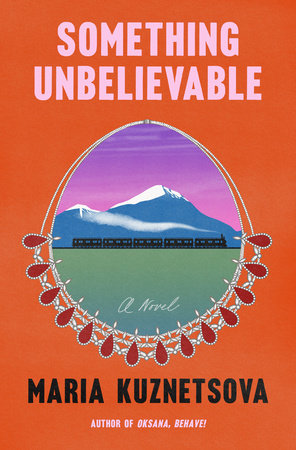
In my sophomore novel, Something Unbelievable, Natasha, a struggling thirty-something actress and new mom, asks her own Kiev-born grandmother, Larissa, about her World War II story so she can put it on stage and jumpstart her career and outlook. Though the story Larissa tells is much more salacious and offbeat than my grandmother’s, revolving around a love triangle and a beloved bobcat, I found Natasha asking herself the same questions I asked myself when hearing my grandmother’s story: what has the older generation passed down to me, willingly or not? Will I ever fully understand my elders or my native land? How can I pass my family’s history and culture down to my American-born child?
It’s no wonder that many of my favorite books feature a complicated story that is passed down from one generation to the next. It’s often the younger person, the child or grandchild, who is left with the story, trying to make sense of it. Whether these narrators just want to make a record, to figure out their own lives, or even to use the stories to make some money, here are seven books that meditate on the burdens and blessings of the inherited family story.
David Benioff’s City of Thieves begins with a frame of the writer-narrator, David, preparing to write down his grandfather’s story of surviving the devastating Siege of Leningrad during WWII. As the story goes on, the reader can’t help but wonder which love interest from the past is the current grandmother from the present—after the story is over, the reader finally learns who is who, though what matters more is how the narrator will make sense of his family’s story. At first, the narrator is concerned that his grandfather doesn’t remember every part of it because he wants to make sure he gets it right. But his grandfather doesn’t care. “You’re a writer,” he tells him. “Make it up.”
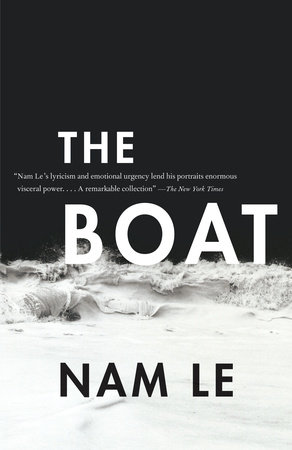
The first story of Nam Le’s story collection,“Love and Honor and Pity and Pride and Compassion and Sacrifice,” is also about a young writer who wants to hear his father’s story of being in a massacre during the Vietnam War, but his father burns the story he writes about it on his typewriter in the garbage at the end. “Why do you want to write this story?” his father asks him. Eventually, the writer lands upon an honest answer: “If I write a true story…I’ll have a better chance of selling it,” he says. Yet the rest of the eclectic and moving collection is a testament to the fact that the author (and the narrator of the first story, one can’t help but think) is more than just an “ethnic lit” writer trying to sell out his family, but one who is capable of telling the stories of a girl who narrowly escapes the Hiroshima bombing, a Colombian hitman, and Vietnamese refugees alike.
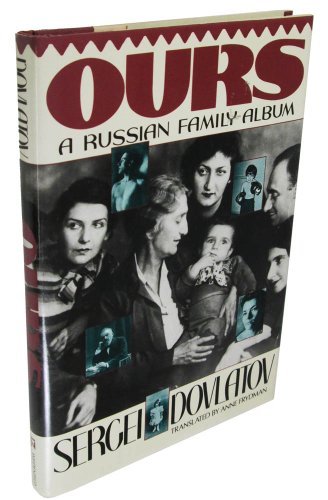
Sergei Dovlatov’s Ours: a Russian Family Album is a humorous chapter-by-chapter biography of several members of the author’s family, starting with his grandfather, moving on to his wife, and ending with the birth of his son, Kolya. The album, read together, tells one family story of which Dovlatov is only a part, even if he sees himself in every character. It begins with his Grandpa Isaak, a Jewish peasant from the Far East whom he had never met. He writes, “ ‘I often think of my grandfather, though I never knew him.’ For instance, if one of my friends says in surprise, ‘How come you drink rum out of a teacup?’ I immediately think of Grandpa.” Later he says, “When my children leaf through the family album, it won’t be hard to mistake us for one another.” Though the book digressed and entertained and affected our narrator along the way, at the end of the book, with the chapter about his son, Dovlatov writes, “I hope it is clear to everyone that this has been his story.”
In Octavia E. Butler’s time-traveling tour-de-force Kindred, Dana, a Black woman in 1970s California travels back in time to the Southern plantation where Rufus, one of her white ancestors, is a small child, and rescues him from drowning, and saves his life over and over again as she continues to return to the plantation against her will, escaping danger every time. She realizes that his problematic family story is her own, and that the two are bound together for life, even if she is fundamentally opposed to his way of living. At the end of the book, Dana seeks closure with her family story and travels to find records of her family with her husband. “Why did I even want to come here,” she asks. “You’d think I would have had enough of the past.”
Wallace Stegner’s Angle of Repose is the story of the ailing and embittered retired historian, Lyman Ward. Ward is delving into the art and correspondence of his grandmother, Susan Burling, a renowned artist and author, and his less-refined mining engineer grandfather, Oliver Ward, to write his own dramatized version of her life. As the story unfolds, the reader learns that it is much more than a biography, and more of a search of where her marriage went tragically wrong as a way for the narrator to understand the disillusion of his own marriage, and to see if there’s any hope on the horizon. “She had rooms in her mind that she would not look in to,” he writes of his grandmother, and yet, through the writing, he tries to turn on the lights in these dark, unknowable rooms. He writes about his grandparents, “What really interests me is how two such unlike particles clung together, and under what strains, rolling downhill into their future until they reached the angle of repose where I knew them. That’s where the meaning will be if I find any.”
The Nesting Dolls chronicles the lives of several generations of courageous women in one Russian Jewish family. The novel begins with Zoe, an American-born child of Soviet heritage preparing for her great-grandparents’ anniversary party. It transitions to the story of her great-grandmother Alyssa’s own mother, who was in a Soviet gulag in the 1930s, where she found herself in a surprising romantic entanglement after her husband was allowed to leave. Present-day Zoe is trying to find herself in her career and is torn in her affections between the more suitable man and the one her heart really wants; as Zoe makes her decision, it’s obvious that her great-great grandmother’s story of heartbreak and survival resonated with her.
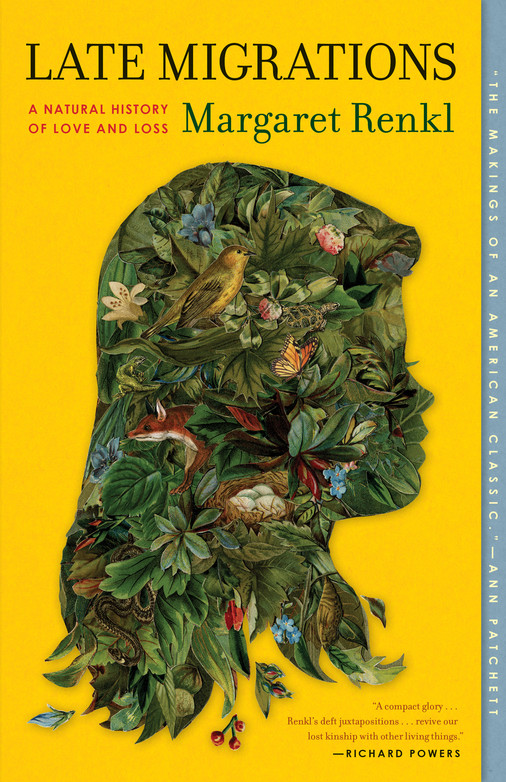
Margaret Renkl’s Late Migrations covers the author’s trajectory from child to caregiver for her parents, while also exploring the natural world and her grandparents’ lives in Lower Alabama. The memoir begins with the story of her mother’s birth as narrated by her grandmother, in 1931, and the weight of history hangs heavy throughout the wondrous book. Several chapters begin with the title, “In Which My Grandmother Tells the Story of My Grandfathers’ Death/the Day She Was Shot/Her Mother’s Death” and describes the lives and deaths of the author’s relatives in heartwarming and heartbreaking detail.
While our lives are transient, the author takes comfort in both the predictable changes and permanence of the natural world. She writes, “…but still the snow moon rises between the black branches in our postage-stamp yards, as lovely as it has ever been, untouched by all our rancor, unmoved by our despair.” This is sound advice for anyone out there who is soul-searching through the past or worried about the future.
When the internet first became part of human life, it began to appear in literature as a source of paranoid anxiety (think Pynchon). For “digital natives” who have grown up online, though, the internet is no longer really alarming (even when it should be)—it’s just a fact of life. As more and more of life takes place online instead of IRL, it’s not surprising that the internet is transcending that original paranoia, and moving into a terrain of alienation, acceptance, resignation, possibility, or simple indifference.
All of which, I think, is seriously fascinating. We now devote windows of time to scrolling, watch people become brands, bond with strangers online, or tragicomically Google things like medical symptoms or “how to console friend after breakup.” And fiction is catching up with us. Last February, two new releases, Patricia Lockwood’s No One Is Talking About This and Lauren Oyler’s Fake Accounts, gave rise to discussions about what constitutes an internet novel. Because the internet is our real life, though, the genre of “internet novel” is actually much larger than these explicitly Very Online new releases. Whether you’re completely new to the notion of internet fiction or seeking more perspectives after reading Lockwood and Oyler, the books below offer an exciting range of strategies for representing the present literary moment.
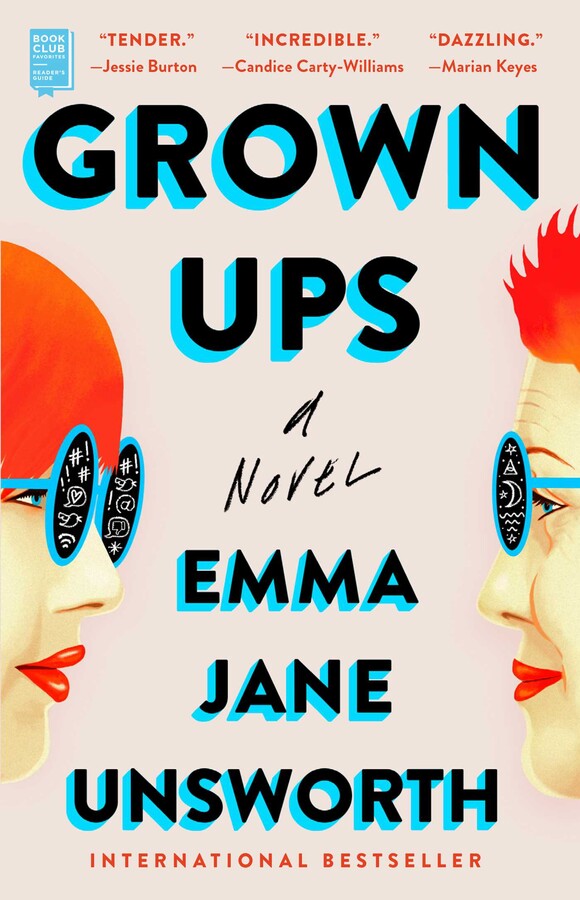
Jenny McLaine’s life is a mess, and she knows it. Exasperated by her lukewarm and precarious career as a columnist, sharing her London house with unamused lodgers since her ex moved out, failing at friendship, and ambushed by her mother, Jenny feels cornered into inaction—all she does is idolize (read: stalk) flawless women on Instagram. Grown Ups is the hilarious and heartbreaking account of what happens when she begins to lose control. Bonus points for the all-around pissed off energy.
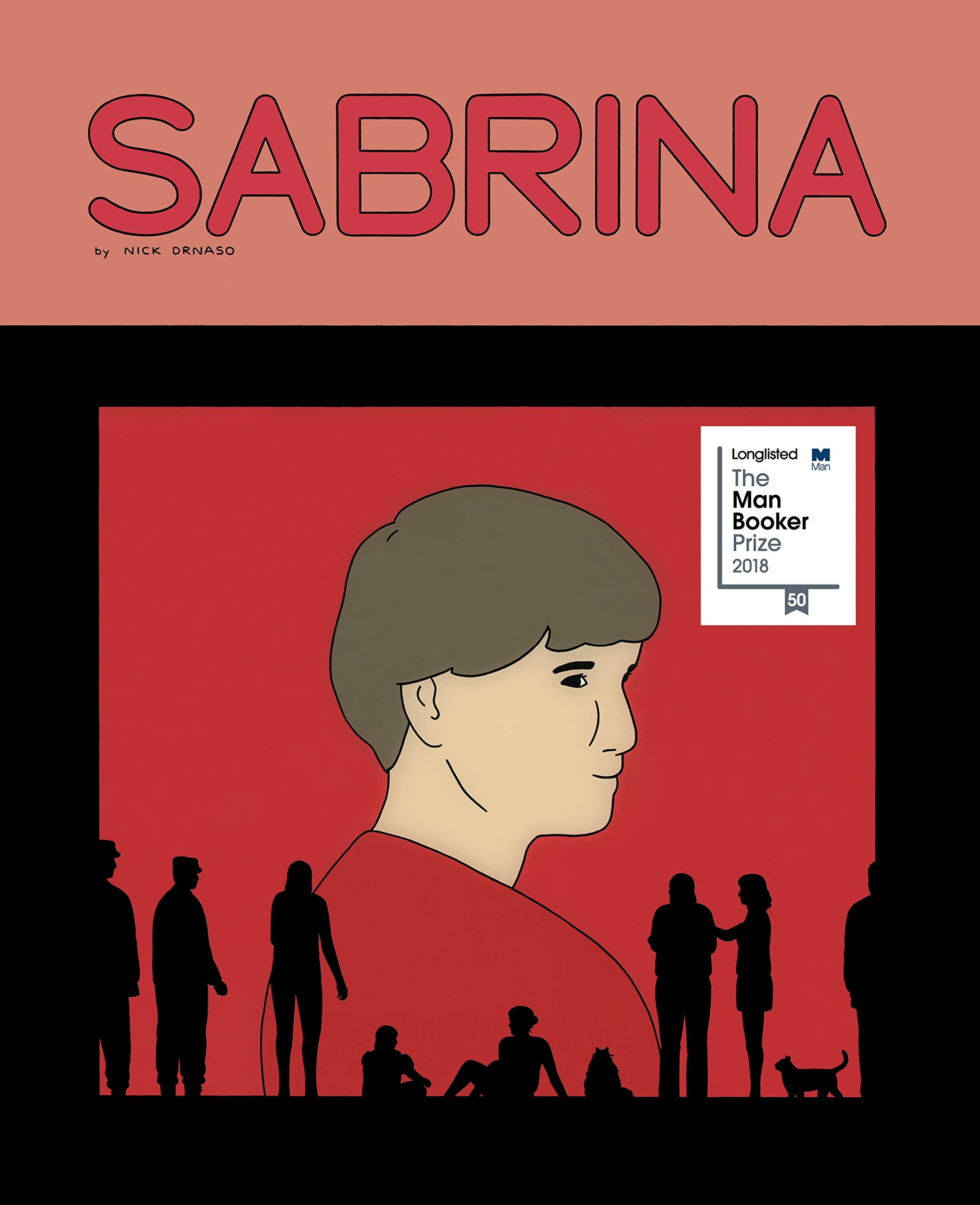
This graphic novel begins when a woman called Sabrina disappears in Chicago, launching her boyfriend Teddy and sister Sandra into media scrutiny. When footage of Sabrina’s murder is shared online, conspiracy theories that warp events beyond belief complicate Teddy and Sandra’s grief and destabilize the truth. In this bleak story of numbness and anesthesia mediated by screens, the real and the surreal bleed into each other.
Shitstorm is a novelette about, well, the various shitstorms that happen as a regular part of the news cycle. An excruciatingly accurate satire of the repeated virality-outrage-oblivion model, it traces a spiraling series of events that spark online controversies. The narrative begins with an American dentist killing a protected lion in Africa, but soon enough the world’s attention has moved on to another crisis of the moment, and the next, and the next, in a relentless cycle.
And of course all of us are now policing people’s reactions to an atrocity, as is the tradition these days. Why do we care so much about London when last week bombs went off in x or y? ask some of us. Why don’t people care about London when they cared about the bombs that went off last week in x or y? Why do we only care about terrorist attacks when they happen at our doorstep? Why do we care about all terrorist attacks except for those that happen here?
While visiting New York, Alice Hare becomes obsessed, via Instagram, with Mizuko Himura, a Japanese writer living in the city. Noting the parallels between them (and fashioning some where needed), Alice is increasingly convinced that she and Mizuko are “internet twins,” and so arranges a not entirely serendipitous chance meeting. Reflecting the web’s overload of information, this unsettling and complex novel shows the online self at its most alienated.
When we met, we were both online constantly. In fact, I would say I was online constantly because she was, and I was monitoring her usage. For her, the Internet was primarily a tool of self-promotion and reinforcement for her multiple selves while for me it became a tool designed for the sole purpose of observing her.
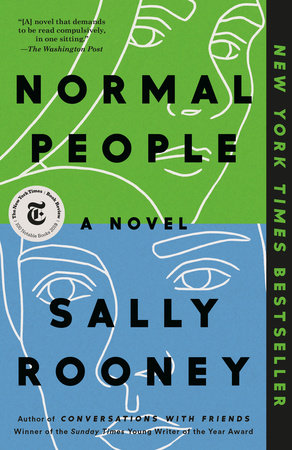
Normal People stars Marianne and Connell, two Irish teenagers navigating social and class tensions. Charting the shifting dynamic between the two as they graduate from school and move to Dublin for university, this taciturn novel examines all the things that pull them together and draw them apart. While their new lives unfold, the internet remains a constant and natural presence as they exchange texts and emails—here, an awareness of surveillance is present not as a source of paranoia, but as an amusing fact: “I feel like the NSA agent reading these emails has the wrong impression of us,” observes Marianne.
This is a warm-hearted, metafictional novel that hovers between two narrative planes: one follows an author named Ruth, living in British Columbia, and the second a Japanese schoolgirl named Nao. The two are connected when Ruth discovers Nao’s diary beached near her home, and suspects it was brought to her by the movement of ocean gyres in the wake of the 2011 tsunami. This non-linear, formally flexible book involves emails, diary entries, letters, and Google searches. In the world of A Tale for the Time Being, the internet is simply one of many things that connect human beings in an already global whirlpool of flotsam and jetsam.
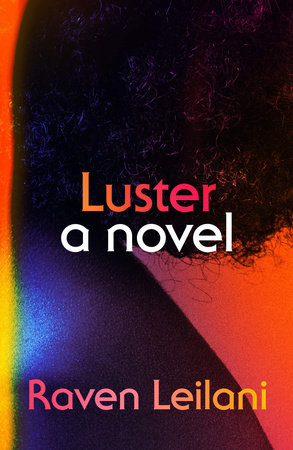
Luster is not self-conscious about involving the internet in its narrative—the web is there as an unquestioned part of contemporary reality. The protagonist, a young Black woman named Edie, meets Eric online. According to his dating profile, he’s in an open marriage; he’s 23 years older than her; white; an archivist. What starts as an episodic and feverish sexual relationship assumes a new momentum when Edie, suddenly unemployed, is forced to move in with Eric. Touching on racial tensions, class, and loneliness, Luster is a magnetic novel about the uncertainty of youth, firmly rooted in the technological wackiness of the present.
In between these texts, I want to ask him what he’s eating. I want to ask him why he is awake. But then I worry he’ll remember I’m on the other end and the texts will stop. This is the way it was when our relationship only existed online.
Dana Spiotta’s Stone Arabia is a novel concerned with the act of chronicling. It takes the form of a “counter-chronicle” written by Denise, whose musician brother, Nick, has always documented his (often imaginary) career as an artistic and performance project. Denise’s acute self-consciousness makes for an unreliable narrative steeped in identity anxiety. Her inability to knowingly contribute to the all-chronicling web will ring true to anyone who’s ever discovered scraps of themselves on Wayback Machine (blog you wrote when you were 13, anyone?)—and anyone who’s ever felt a little existential about the way they present themselves online.
I just couldn’t say something spontaneous and pithy and then have it hang there for all eternity. Those are opposite pulls—eternity and pithy—and if I thought at all about what to say, it was even worse.”
How the Light Gets In, like several of the books above, does not explicitly thematize life on the internet. This collection of flash fiction offers a vision of modern life in Britain—and some of that happens to take place online. In “blip blip blip,” Skype starts buffering mid-call, hurtling lost meaning between two screens. In “midday in my mind,” the buzz of a phone interrupts the narrator’s thoughts of romantic joy, prompting them to conclude: “I’ve found the answer to modern life—the way to be everywhere at once. Everything would be much easier, for you, for me, for us, if I just turned into your phone.”
I spent my childhood wondering what I was. I grew up in the ’90s in a sheltered evangelical home in Portland, Oregon, so I didn’t know trans women existed until I was 15. I was not like some other women, the ones who know from an early age who they are, trying on Mom’s pearls and pumps, begging for Barbies instead of Transformers. I did not understand what my gender was or how to perform it at a young age. I knew the way I was supposed to be (boy, sports, short hair, go run around outside) but I couldn’t make it fit, and I had nothing to replace it with. It was an emptiness. My body was like a floating amorphous blob with no ground to tie to and no form to fill. There was no Laverne Cox or Pose or Hunter Schafer or Transparent or Janet Mock or SOPHIE or Steven Universe or Teddy Geiger or Jen Richards or even Caitlyn Jenner to show me the way. All I knew was the ogre who lurked behind me and whispered into my ear, “Something ain’t right.”
I made it my mission to figure out what I was.
The trans person as a monster is a tired trope, foisted upon us by society—but there is a reason I gravitated towards these types of stories.
I read comic books and sci-fi novels in order to go someplace else (anywhere else) but also as research.Every movie I watched and book I read was a possibility. Maybe I was an alien. A mutant a la X-Men. Possibly a fifth Ninja Turtle. Might have been a mermaid who’d lost her tail. I thought for sure I was something monstrous. The trans person as a monster is a tired trope, foisted upon us by society—we are not monsters, we are simply humans with a complex and dynamic relationship to our gender—but there is a reason I gravitated towards these types of stories. When I was young and saw no one like me, when I had no idea who or what I was, when I thought I was the only one who felt this way, I did feel monstrous.
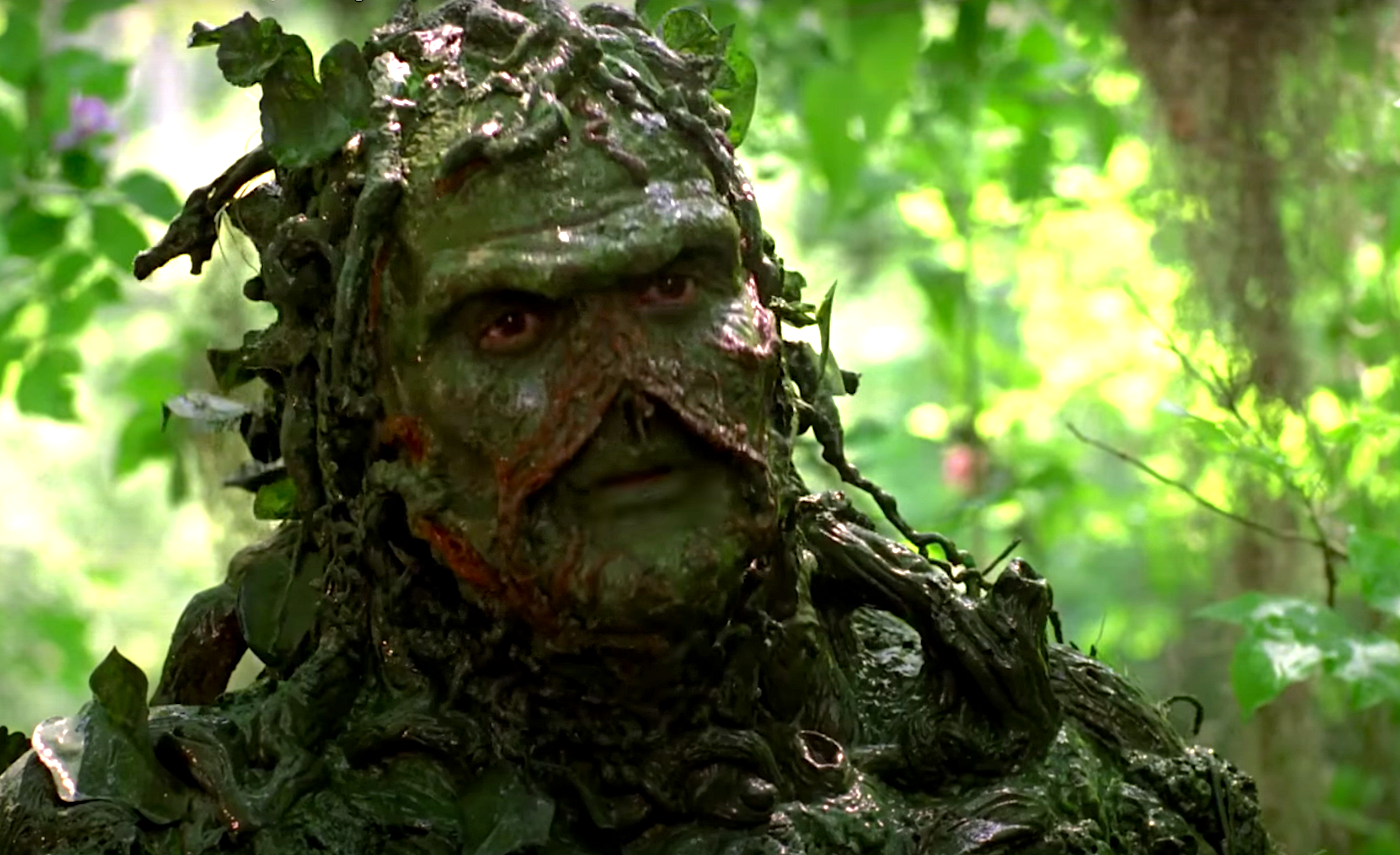
I don’t remember the first time I watched The Return of the Swamp Thing. It’s one of those movies that seems like it’s always been in my life. My parents recorded it onto a blank VHS tape for me when a local TV network ran it one night. I watched it so many times I still remember many of the commercials that aired during the ad breaks (including a terrifying trailer for one of the Chucky films). To me, the movie always felt like it was made for people who feel monstrous, a portrayal of a monster’s survival and eventual happiness.
The sequel opened the possibility that my parents’ home under evangelical rule wasn’t where I was meant to be. I wondered if there was a place that could be my swamp, the place where I belonged. Swamp Thing fits perfectly in the bayou, like they were made for each other. (He is, after all, half-swamp.) The bayou is otherworldly: murky water, vines descending from trees, and moss painting every surface. Here, Swamp Thing seems like the most natural thing in the world. His body made of twigs, moss, roots, vines, leaves, and grasses blends into the dark browns and greens of the swamp. In the bayou, it’s the humans that are out of place.
I turned to these stories to confirm that if I did turn out to be a monster, everything would still be okay.
I wasn’t interested in Swamp Thing’s origin story, so I never cared for the original Swamp Thing, a movie with barely any connection to its sequel. In fact, I was never interested in the origin story in any of the monster/alien/superhero books or movies. I didn’t care about how the creature became monstrous. I wanted to know about the After. I turned to these stories to confirm that if I did turn out to be a monster, everything would still be okay. For me, the most interesting parts of these stories were the moments between the fighting, when the monsters were back on the spaceship making tea or lying in bed in the lair. I wanted to see how Alec Holland lived once he became the half-human-half-plant bog monster known as Swamp Thing. I wanted the intricacies of it. Did he build a home in the swamp? Did he befriend other swamp creatures?
How does he make a life for himself as a swamp thing?
I can see now why young Emme was obsessed with a movie where a monster is the hero and most of the humans are monsters. The villains are all straight, cis, and rich, and so what is typically heralded as the default becomes the monstrous. The Return of the Swamp Thing was my introduction to the notion that being the default does not automatically mean you are good and that being different doesn’t make you a monster. The most grotesque of the villains is Anton Arcane, the mad scientist from the original Swamp Thing. He is tan, hair turning dark gray, handsome. In another movie, he could be the striking lead, but those are only appearances, which, in my 8-year-old mind, did not matter in The Return of The Swamp Thing. Dr. Arcane seeks immortality. He splices the genes of humans with creatures from the swamp, transforming humans into half-human-half-cockroaches, humans with trunks for noses, and other monstrosities. Occasionally, the mutated creatures escape the lair and terrorize the swamp, but even then, they are not the true villains. They are more the victims, unsure of what to do with their newfound monstrosities. Dr. Arcane is the one who uses gene splicing to destroy their human form, and to this end, the man is the monster.
What I truly loved about The Return of the Swamp Thing, the thing that fed my obsession, was the love story between Swamp Thing and Abby Arcane, Dr. Arcane’s stepdaughter. We first meet her in Los Angeles, worlds apart from the swamp we see in the opening scenes. Abby mists the leaves of her indoor plants and laments her dating life, wondering, “Why can’t men be more like plants?” The camera pans to show the name tags she’s written for each of her potted plants: Jimmy. Annette. Murray. Tommy. Abby determines that she’ll never find love until she confronts her stepfather about what happened in her mother’s mysterious death. She goes to the bayou for answers. When she is attacked one night in the swamp by moonshiners, it is Swamp Thing who saves her. At first sight, Abby is slightly repulsed by Swamp Thing. When we encounter the unknown it is often repulsion or fear that finds us first. Swamp Thing towers over her, his body made of plant matter, but there is a glint in Abby’s eyes. Right away, we know they’ll be in love soon. The next day when Swamp Thing saves her for a second time, she announces he is her boyfriend. Who can be surprised? After all, he is the manifestation of her desire just days before. A man who is more like a plant.She doesn’t find him attractive despite the fact that he is half plant, half human. It is exactly the half-plant aspect that she desires. Swamp Thing offers her a vegetal pod from his hip. They each take a bite. The camera lens shifts into soft focus. Light glitters on the edges of the swamp. Swamp Thing has disappeared, and now, it is Abby Arcane and a handsome blond man. What is happening is not exactly clear, but I think they hallucinate that Swamp Thing is in his human form so they can have sex.
It’s perfect.
The notion that someone like Swamp Thing could find love and build a home fed me so much hope as a child. It didn’t matter that some people found him monstrous.
The notion that someone like Swamp Thing could find love and build a home fed me so much hope as a child. It didn’t matter that some people found him monstrous. Swamp Thing was far less monstrous than most of the humans in the movie. He was caring and delicate at times. It was the After I had been craving. The part post-mutation, where we see he has carved out a home and finds love. He is revered.
The Return of Swamp Thing didn’t show me who I was. How could it? I am not a monster. I am not a mutant. I am not a science experiment gone wrong. In fact, with HRT, I am science doing what it was intended to do. But The Return of the Swamp Thing did teach me that no matter what I discovered about myself, there was a place for me on this planet and there would be people who loved me for my swampiness.
In the end, Anton Arcane does not become immortal. Instead, he is betrayed by his scientist/lover and dies in a fire in his lab. Swamp Thing and Abby return to the bayou together. Here, a lesser movie would have removed Swamp Thing’s monster status, but Swamp Thing does not revert back to his human form. There is no curse to be lifted, because being half human, half plant is not a curse. It simply is. Nor does Abby convince Swamp Thing to return with her to Los Angeles. Why would she? His home is in the swamp. Rather, she stays with him. They embrace on the marshy floor. The camera pans down to show a flower bloom growing out of Abby’s left foot.
So many of the monster movies of my youth ended with curses being lifted or lovers parting ways because love between a monster and a human is not supposed to work. But in The Return of The Swamp Thing, not only does Abby join Swamp Thing, she becomes something like him—not because she has to, but because she wants to. The two lovers could eat another vegetal pod and hallucinate Swamp Thing in his human form, but in this movie, it is better to be half-swamp than it is to be human. The last image is of two swamp things’ silhouettes walking arm in arm into the sunset. When I watched the movie for the first time in 20 years, this image was one of my most salient memories from watching it as a kid. It is clear. Happily ever after.
In this movie, it is better to be half-swamp than it is to be human.
Watching the movie now, a part of me is sad this was the representation I gravitated towards. But what other option did I have? I was so sheltered in a home ruled by an evangelical church that nearly nothing got in. Sometimes I’m surprised The Return of the Swamp Thing made it through. How would something with queer characters or trans women even make it into a house like that? Impossible. So I watched The Return of the Swamp Thing over and over again. I watched him make a home and find love in the bayou. I watched it because it helped me understand a little bit about myself, made me understand that someday I’d know what the ogre meant when he whispered, “Something ain’t right,” and no matter what I was, someone out there would love me for it.
In the 30 years since The Return of the Swamp Thing was released, I have ended the search for what I am, coming to understand my gender and sexuality. I have found my form to fill, have tied myself to the ground. I have a community of friends who surround me like family, who love me not despite my gender but because it is a part of who I am—not all of who I am, but a part. We meet at the park or bar or bookstore or my living room and we laugh and we cry and hold each other. We are each at home in our swamp, our bodies overrun with vines, roots, and moss, and gradually, we burst into bloom.
I read A.E. Osworth’s debut novel, We Are Watching Eliza Bright, very quickly. The novel is fast-paced, but I couldn’t put it down because the story felt so familiar—and relevant to anyone who’s ever used the internet. Sometimes I fell asleep reading and had anxiety dreams about being online, but this didn’t stop me from passing out with the book on my face every night until I’d finished.
The heroine, Eliza Bright, works as a coder at a gaming company, and is the only woman in such a high-level position. When she reports workplace sexual harassment, she’s dismissed. She then talks to a reporter, whose story about sexist culture at the companygoes viral. Eliza is fired from her job, and then doxxed by superfans of the game she worked on, a game she herself loved. The more Eliza tries to hide, the more the gaming community’s harassment escalates—both on- and offline (in “meatspace”).
The novel is narrated by two collectives: the first, a subreddit of angry online gamers who believe their “world is being invaded,” rails against the changing culture of games. The second, a clandestine group known as the Sixsterhood, lives relatively off the grid in a Queens warehouse. The groups’ differences are perhaps best encapsulated by the way they deal with anger. The subreddit: “we love when anger bubbles up, floods the landscape like lava. Explosive at times, slow and crawling at others. But as transformative. As destructive.” The Sixsterhood: “the way We deal with Powerful Anger is to call a Powerful Anger Circle in the silks studio and participate in a Group Primal Scream.”
Over the phone, Osworth and I discussed unreliable narration, meta-narratives, and how the pandemic has changed general perceptions of “real life.”
Deirdre Coyle: The story is told from the perspective of an ever-shifting online collective, a subreddit. How did you decide to narrate the story from this kind of hive mind?
A.E. Osworth: I’m trying to remember the nexus of it, the genesis of it. I don’t know that I have a particular moment that I decided this. I’m not sure I can pinpoint the exact moment, but I can tell you that when I think of the internet, that is how I think of the internet, as this sort of connected collective, this hive mind. [The narration] went through a couple of iterations. There was a time I was trying to make it whittle down to one person at the end that was narrating, and that didn’t feel right, because that’s not what I think of the internet. So it remained this collective narrator. It was almost not a decision. If I can sound a little mystical, it almost was something I did not think about. It just happened.
DC: Did you always have these dueling collectives with the Sixsterhood and the subreddit, or did that change forms as you were working?
AEO: No, the Sixsterhood is the newest part of this book. It was in the last year that the Sixsterhood became my second narrator—which is hilarious, because the Sixsterhood as a voice and as a community is closer to how I spend my time. It’s closer to how I live my life. I am queer and trans, and my people kind of do sound like that—and yet I had not written in that voice, and I had to back into it. Originally, the Sixsterhood wasn’t a part of [the book] at all. I changed the back corridor of the book before it even went on submission, and that’s when the concept wasborn, when I edited right before submission.
What’s interesting is that I could not figure out a way to make the Reddit narrators’ concept of the Sixsterhood make sense. Because they wouldn’t know, right? This is so far outside of their idea of what people are like. It was my editor who was actually like, “Can the Sixsterhood narrate the parts where [Eliza is] in the [warehouse]?” And I was like, “Yes, absolutely, I am going to change it completely. That’s absolutely what’s going on here.” I changed it, and then I got edits back that were like, “Cool, they still sound the same.”
My editor, Seema Mahanian—she’s a damn genius—and I got on the phone during lockdown, and we sat there and analyzed all of the things that I had osmosed from reading a lot of Reddit to make the Reddit voice, but that I hadn’t actually crystallized into, like, “Here is how these sentences work.” Then I sat there and drew lines from them and I was like, “What is the complete and total opposite choice?” Not just in terms of point of view, but in terms of constructing sentences. And that’s how the Sixsterhood—the really big, expansive sentences, and no punctuation—got born.
I had to back my way into the voice that was closer to my community and to the way that my people speak.
What I was able to articulate after having done that, and why I was able to go back and rewrite the Sixsterhood to have the voice that they have, is that in many coding languages, there are a bunch of operators that you can essentially [use to] make the computer do stuff for you. In this particular case, the ‘or’ operator and the ‘and’ operator. The “or” operator is the Reddit voice: they think that one thing happens, or another thing. They operate from this place of scarcity. The Sixsterhood is the “and” operator. They think one thing is true and also another thing is true. They operate from a place of abundance. And that is my community, that’s my people. I don’t quite know why it was my inclination to do the Reddit voice when it is not how I live my life, and I had to back my way into the voice that was closer to my community and to the way that my people speak, but that is what happened.
DC: Speaking of the “and” and “or” operators, I also want to talk about the unreliability of the narration. Particularly in the subreddit-narrated chapters, this unreliability manifests in many often surprising ways. Hopefully this isn’t too much of a reach, but what was it like writing that unreliability during an era where journalists’—and really everyone’s—credibility is so frequently called into question by people in power?
AEO: It’s not a reach, but it’s not something I would have articulated before today. I think probably the very fact of truth being constantly assailed is part of how this book turned out. I started it before—we’re talking about the Trump presidency, right? That’s what we’re referencing?
DC: [Laughs] Yeah.
I write fast and then draft over and over and over again, like a 3D printer.
DC: There’s a meta-narrative about the collective narrator(s) arguing over what Eliza’s Gchats mean, and whether those documents should be taken at face value. The Gchats and emails are the only things that we, as readers, know to be objectively “true.” As a reader, this all felt very coherent. But as a writer, how did you keep your brain from turning to mush while holding all of these threads together?
AEO: I started it before the Trump presidency, and I rewrote the whole thing after the election to set it directly after the 2016 presidential election, in the December after. Because I have to. Because exactly what you just said—the relationship to truth has been so murky. What’s interesting about, for instance, the juxtaposition between these two narrators is that one believes only one thing can be true and everything else is false, and one believes that a lot of things can be true at the same time. Obviously there are instances where each one of those worldviews will work better, and I was just trying to explore what those are and what those could be.
AEO: So as a practical thing, I think of it kind of like—have you ever seen a 3D printer operate?You print one layer, and then you print another layer, and then you print another layer. You watch it essentially build up and up and up and up. So I started with one [thread], and then I went back and did another one, and then I went back and did another one. I iterate a lot. I write fast and then draft over and over and over again, like a 3D printer, in this way. In the middle bit where we have to wonder if [Eliza] and Preston are sleeping together, those three chapters present three different ways that that night could have gone. That part was also a late addition where I went through and did three very different storylines that could all be true, or some of them could be mixed, or one of them could be true. 3D printer.
DC: You’ve also done a lot of online reporting and writing about technology, and referred to the GamerGate/alt right subreddit, KotakuInAction, as “the butthole of the internet” (I need to start using this). How did your experiences writing nonfiction about those communities affect the way you wrote about them in fiction?
AEO: So I’ll push back on journalism—I’m not a journalist. I don’t consider myself a journalist. It’s not as though I’m not, you know, what I usually call “committing acts of reporting”; it’s not as though I’m not calling upon some of those skills. It’s that I do not ever want to mess with the idea of objectivity. I am not objective. Ever. And so I will not call myself a journalist, because I don’t even want to think about it. I am a writer; I have a lot of opinions. I try to make sure that when I am committing acts of reporting, that they are solidly based in fact, but I am not objective at all. So I just want to push back on that, just a little bit.
This is the way people behave. It’s not about it being on the internet; all the internet does for us is make us faster and bigger.
Anyhow, so how does the nonfiction inform the fiction? [The nonfiction I wrote about GamerGate] got me obsessed with it. Truly, madly, deeply, that is the one thing it did for me, is that I couldn’t stop thinking about it. I love games, I love playing games—I’m not particularly good at videogames; my heart’s actually in tabletop—but because this is not how I live my life, when I can’t stop thinking about it, I have to expand beyond what I am given. That’s why fiction. It lit the fire. It got me angry, because it’s nothing new, right? This is the way people behave. It’s not about it being on the internet, we just are now faster and bigger; all the internet does for us is make us faster and bigger. So it got me mad at things that were not just. And especially when anything messes with play? I love play; it is my number one value as a person. The ability to learn through play is truly my jam, and when something fucks with play, I get mad. And of course it’s not just fucking with play, it’s fucking with women, it’s fucking with objective truth, it’s fucking with a lot. So it got me obsessed, and it got me mad. Those are the two things it did for me. But the rest I made up, because I couldn’t stop thinking about it.
DC: At one point, Eliza says “the virtual world is just as ‘real’” as meatspace. How would you define the “real world”—if you would at all?
AEO: I think about it a lot. It’s all the real world. That is something I believe. This and digital space together—and with other kinds of worlds—comprise reality. That’s the short answer. I feel like before the pandemic, this was the hill I was going to die on by myself. Other people, maybe, are starting to agree with me. We’re living our whole lives right now in digital space—and what, are you just going to say it’s all fake? The consequences of every interaction we have in digital space are real consequences. That is how I define reality, are the consequences real? Do the consequences matter, do they affect you, do they come for you in every aspect of your life? Yes, they’re real. Okay, great. If the consequences were imaginary, it wouldn’t be real.
Around 11:00 a.m., slack-limbed and sighing on the toilet seat, eyes closed, Javed heard a rap on the bathroom door.
He opened his eyes to the broken first flood of daylight. It was typical of the cook, these days Javed’s only house help, to disturb his delicate morning routine.
“Ye-es?” Javed said, his voice neutral, as if speaking across a glass door in an office.
“A gori madam is at the front door,” the cook mumbled.
As his fingers unclenched from the Muslim shower he was holding, Javed gulped back his sleeping breath. He’d gone to bed at 5:00 a.m., after recording a special report on the state of Pakistani democracy in his studio at Jeet TV.
“Show her to the drawing room. Use your common sense. And don’t disturb me in the potty next time.”
Javed had become even more of a workhorse six months before, after a raw and, he thought, unnecessary divorce.
He peeled the night shirt off his chest and let it fall to the floor. He looked in the mirror and breathed deliberately: once, and twice, three times, four times. These days a little meditation went a long bloody way. He brushed his teeth and walked back to his swampy bedroom. The bedsheets were soft with humidity. Javed threw on a clean kameez over his shalwar and sprayed Issey Miyake on his neck.
As he walked into the drawing room, Javed smiled to buoy his own confidence. “Aha! How nice to see you.” The good thing about being a television personality was that even in his gloomiest moments he could transform his mood at a moment’s notice. Tone of voice, steadiness of gaze, the spring in his smile: these aspects of himself now operated without effort, with the cold autonomy of need. Marianne Almond, an economic officer at the American embassy, had set foot in his house for the first time, but he knew her. He knew she lived in a house across his street; he’d seen her jogging in the neighborhood several times, a police officer always sprinting behind her.
“Sorry to have barged in,” said Marianne, a pale hand raised, as if testing for rain. “I figured you’d be home today.” She was wearing brown linen trousers and a black T-shirt. She had clear green eyes, and Javed saw that she was almost as tall as he was. Her eyebrows were so sparse light bounced off them.
She sat down on his plastic-covered sofa. “Do you have time to chat?” she asked.
“Absolutely,” Javed smiled, sitting on the sofa in front of her. “There’s an insect on your knee—”
“I’m having a party at my house tomorrow—”
“Go on,” she said. She swept a hand into her hair with the studied patience of a foreign dignitary. Then she cupped the beetle in her palm, set it on the floor.
“Would you like something to drink?” asked Javed.
“Oh, it appears your drinking pipes are leaking. My staff noticed the leak. You might want to get that checked.”
“I have bottled water. I’ll bring you a fresh bottle.”
To his relief he found two small bottles of Nestlé in the fridge. He grabbed a clean glass from the cabinet and brought the items to Marianne on a tray. He removed the cap in front of her.
“That’s very kind of you,” she said. She took a sip from the bottle and placed it between her feet.
That’s very kind of you. People in Pakistan had stopped uttering statements such as that’s very kind of you. No one said that’s very kind of you when you brought them water. The utterance reminded Javed of the photos he’d seen of Marianne at the launches of restaurants, boutiques, movie premieres, and inaugurations. In each photo, she had a that’s-very-kind-of-you air about her: eyes beaming with apology, face bashful with delight. That people invited her to cultivate proximity was obvious enough: Marianne Almond could always help in the facilitation of a visa. But they also jostled around her to inhale the source of her pristine foreignness, her teasing jokes, her voluminous brown hair that shone brassy in the Islamabad sun.
“Anyway,” said Marianne, interrupting Javed’s reverie. “I’m having a party at my place tomorrow. The guests will be a smattering of journos and diplomats. Join us if you can. I’ve been an appalling neighbor. Goodness. I’ve been meaning to extend an invitation for a long time.” And she rolled her eyes at her own unearthed delinquency.
“Don’t be silly,” said Javed. “It’s so nice that you came here. I will certainly try. I have a prior engagement,” he fibbed. “But it’s not so important. If I get done early I’ll be there with bells on.”
“Wonderful. I look forward to seeing you then,” said Marianne. She got up and smoothed the pleats of her trousers.
Javed couldn’t think of anything more to say, and she was already on her feet and waving goodbye with a twirl of her long fingers.
From the moment Marianne Almond had arrived in Islamabad two years before, during which time Javed had gotten married and divorced—his infant daughter lived with his ex-wife— he’d been reassured by an American presence across the road. Marianne had broken with tradition and chosen to live outside the Diplomatic Enclave—the sprawling complex of houses, gyms, grocery stores, tennis courts—where most ambassadors and embassy officers resided. Her decision was sanctioned by the Embassy, if unusual. The security architecture installed by her team had upgraded Javed’s neighborhood. Once a dusty expanse of eucalyptus-shaded bungalows, Green Acres now looked like the suburb of a spotless city: steel barriers, spikes, ramps, and towers padded by sandbags dotted most streets. The black-and-yellow concrete barriers had turned the roads into go-kart courses. “No security issues,” Javed would say to his friends. “Amreecans live here. Security is outstanding.”
Javed had switched to political commentary after fifteen full years as a television actor. He’d been a graceful presence on the screen, his gaze touched with roguish charm. When his first movie came out, in the early nineties, he’d had a business card emblazoned with the words Film Star. His friends had sniggered, and he’d burned all two hundred cards. A few years later Pakistan’s national channel had approached Javed to consider hosting his own talk show: he was selling himself short by being just an actor. He had more to offer the world, the producer said, like his wit and charisma. Javed had turned down the proposition. He had been, at the time, unsure of his ability to discuss, cleverly, culture and politics for a whole hour. Television had a way of revealing the inner truth of the host.
By the time privately funded channels came around, in the 2000s, Javed was in his late thirties, at the peak of his acting career. Umeed TV lured him with a package he couldn’t refuse: co-anchoring a news show with his then-girlfriend of three years. They were a power couple, beloved, on the verge of marriage. His girlfriend, a lawyer, had said the opportunity was the culmination of everything she had dreamed of. Javed’s analyses—critiquing the corruption of the ruling party, India’s belligerence, American interference in global affairs—had been widely praised on TV. What most people didn’t know was that Javed typed out his bare thoughts into bullet points; his girlfriend spun them into stunning discourses.
After a year of sitting next to each other four days a week behind a long red desk—of Javed occasionally pinching his girlfriend’s thigh behind it—she’d told him she was having an affair with the owner of the channel. Her expression was one of flat, unerring conviction, the same look she emitted to her viewers during a broadcast. She didn’t know where the relationship with the boss would go, she said, but she was certain she wanted to pursue it.
It was around this time that Javed, stricken, presented himself as a sacrificial offering. His parents reminded him he was approaching forty, that he was mad to still be single, so he said yes to his mother and his father. Actually what he said was yes—yes—yes, find me someone and I shall marry her. Then came Sameena, a marriage, a child, a rapid divorce.
After Marianne left, Javed fidgeted with his wristwatch and looked around. The torpor within him had been dislodged. Now that he was awake, he wondered what he would do for the rest of the afternoon. He said, “Allah ho Akbar,” with a long exhaling sigh to relieve a peculiar mounting restlessness. Though Javed lived alone, he’d observed that silences unsettled him: they rang in his skull, set his nerves on edge.
He walked around his house with curiosity, poking his head into dirty corners—behind the fridge, over the soot-stained wall above the oven—in astonishment at how seamlessly the order in his home had collapsed in the absence of his ex-wife. He didn’t miss Sameena, but his home had looked and smelled pleasant while she’d been around. These days going back to sleep often seemed like a sensible choice—if only he could truly sleep. He touched the blackened wall above the oven and looked at his smeared finger. Why had Marianne come bearing the invitation for the party? She could have sent a card; she could have asked any of her friends in the media for Javed’s phone number.
He meandered back to the drawing room to see it anew through her eyes. The walls were covered with framed photos of his parents and siblings and daughter. The room wasn’t sumptuous, but it was a picture of restrained dignity: a large red carpet bathed in afternoon light, sofas covered in plastic like expensive new cars.
He wondered if he should go to the party the next day.
He knew from experience that a little withholding went a long way.
For now, he would drive to the home of his former in-laws to see his daughter, Inaya. Before the divorce Sameena had complained that Javed’s working hours left him no time for their small family. She’d texted him verses from Rumi, urging him to realize the wound was where the light entered.
He hadn’t responded. Not once.
One day, she’d returned to her wealthy parents.
As Javed held his daughter in Sameena’s home, he was relieved to see Inaya gurgling with laughter at the slightest provocation: when Javed widened his eyes, when he touched and withdrew his hand from Inaya’s leg in repetitive fashion. His own face was thwacked with tiny hands, his chin streaked with spit. Sameena didn’t so much as offer him a cup of tea.
The next day, as a sound technician pinned a microphone inside Javed’s shirt, he thought of the way Marianne’s smile had lingered as she’d said I figured you’d be home today.
He resolved to skip her party.
On his way back from work he stopped at the supermarket and bought three crates of Nestlé bottled water. He bought bags of ice. He called up a friend to procure the number of a bootlegger, and ordered from Vicky Boot—the name under which his friend had saved the contact—bottles of red wine, scotch, and vodka. On the phone Vicky Boot spoke in a guarded tone; the indolence in his voice annoyed Javed until he realized that Vicky’s lagging manner was its own learnt protection.
Marianne’s party came and went. When Javed didn’t hear from her the day after, he curled under a cotton sheet and watched his most-viewed clips on YouTube.
Three days later, around 10:00 p.m., Javed heard the doorbell ring. He’d just gotten home from work, and his heart sped up as he switched on the air conditioner in his bedroom. He took off his white dress shirt and put on a white linen shirt. He spat in the sink and rushed to the door.
A police officer was standing next to Marianne. He was tall and square-jawed; a black handgun jutted from the holster around his waist.
“Any problem? Everything okay?” asked Javed.
“Jaav-ed!” said Marianne. “He’s here for my security. Nothing to worry about. May I come in?”
“Of course.”
Javed invited the officer in but he said he’d prefer to stay outside.
Javed led Marianne to the drawing room. “One moment, please.”
He returned with a bottle of scotch, a juice jar full of water, a bottle of wine, and a bucket of ice. Some spicy peanuts in a bowl.
“What would you like to drink? What may I pour you?”
“You’re all so frantically—adorably—hospitable.”
“It’s in our genes.”
“But just a tiny bit.” She raised her index finger. “Red, please. Won’t you have any?”
“I don’t drink. Sadly.” And he shrugged.
“Why not?”
“Don’t like the taste. Honestly.”
“How come I didn’t see you at my party?”
“I was with my daughter,” said Javed, fibbing, since he’d seen Inaya the day before the party. “She lives with her mother and I get to see her once a week.”
“Ah, right,” said Marianne. “The American ambassador asked after you. She was complimenting your show on the recent case of land grabbing in Karachi.” She took a sip of wine from the glass, looking at Javed over the rim. “ ‘Brave of him to do it,’ she said.”
“The channel wasn’t happy. They say I ‘cost’ them too much.” He took a deep breath. “But that’s jolly nice of the ambassador,” he said, and felt the intrusion of “jolly”—a word unpracticed on his tongue—hang awkwardly in the air.
He said, “The three of us should do dinner soon. InshaAllah.”
“That would be great. It seems you’re busier than ever.”
“Not really.”
“Oh good.”
Then swiftly, but smoothly, Javed reached for the tips of Marianne’s fingers and kissed her hand. It was an old trick, the gesture courteous, restrained, poised on the edge of chivalry—or possibly something more. When Javed lifted his eyes to observe Marianne’s face, she was staring back at him, dumbly stunned, as if what he had done was strange yet somehow acceptable. Her lips were neither open nor sealed, but set in an uncertain moue. It was as if she was about to whisper, That was very kind of you.
She cleared her throat. “How do you think the government is doing these days?”
“Completely clueless.”
“It’s a nightmare, isn’t it.”
“Everyone in the world should have a right to vote in the U.S. election, however,” said Javed.
“That’s interesting.” She was smiling. “But what a relief. For us, I mean. Anyway, I should get going,” she said and put her glass down. With her fingers she raked her hair into a crinkled bun. “I hope you managed to get those pipes fixed.”
“Not yet. The leak isn’t so bad. Let me show you out.”
After she’d gone, Javed stared at himself in the mirror for a long time. He saw a divorced workaholic who could, if he really wanted, seize happiness at this late, wrecked stage in his life.
Marianne did not return the next day, or the day after. Javed had recorded a two-day segment on the energy crisis in Pakistan. He’d said solar-driven energy was the way forward, that the American government was going out of its way to provide Pakistan with sustainable solutions. It didn’t help to be pro-American these days, but he’d slipped in a compliment, and he wondered if she’d seen the show.
He saw a divorced workaholic who could, if he really wanted, seize happiness at this late, wrecked stage in his life.
He rushed home as soon as he finished recording in his studio. He lay on his bed, slightly red in the face when he didn’t hear from Marianne. The ceiling fan whirred. He told himself not to worry. He would have to be patient.
Or he would have to be proactive.
He picked up his phone. He told his research assistant to comb Google for the words “Marianne Almond.” He wanted all the information, especially the stuff that seemed irrelevant.
The next morning his assistant dropped off a file at Javed’s house. Javed spent the morning huddled in his bedroom, orange highlighter in hand, going through a stack of printouts. He smiled as he highlighted the word “divorce” in a Saturday profile of Marianne. He noted her decision to retain her ex-husband’s last name—it was easy to pronounce in the parts of the world in which she worked, she’d said: Almond, just like the nut.
Around noon Javed showered, changed into blue jeans and a lilac polo, and walked across to Marianne’s house.
“I’d like to see Marianne,” he told the officer outside her gate.
“All right,” said the officer. “You have an appointment?”
“Just tell her Javed is here. From that house.” He pointed to his wrought-iron gate.
“Like I asked, sir, do you have an appointment?”
“It’s Saturday!”
“I’m sorry, you can’t go in without pre approval.”
“If you tell her my name, she’ll be okay with it.”
“Let me see what I can do.” As the officer crackled his walkie-talkie, Javed heard a familiar voice: “Jaav-ed!”
He turned around. How pretty she looked.
“It’s okay.” She waved to the officer. “Let him through.” She was standing by the main door in jeans and a loose faded T-shirt printed with the words Yes We Can. Her feet were bare and her T-shirt dug a sharp V into the surf of her breasts. Three bars of sunlight pooled over her face, and seeing her framed in the doorway in her shoeless feet, her décolletage shimmering in the sun, Javed felt a tingle of delight at the sudden hidden provocation of the afternoon.
He was led through a hallway, patted down, his shoes, wallet, and keys put through an X-ray scanner, then handed back to him by a younger-looking security official.
Marianne laid a hand on the officer’s shoulder. “Thanks, Imran.”
She pointed to an open door. “I’ll be with you in a second, Jaav-ed.”
He walked into a vast, gray-carpeted, bureaucratic-smelling room. Plaques of Plexiglas lined the main shelf to the side of her desk: an award from the Pakistan Greens recognizing Marianne Almond as an environmental leader, another from the Government of Pakistan lauding her efforts to push renewable energy in the Punjab province, and one from the State Department honoring her commitment to public service. Behind her desk, a framed map of Minnesota—a cartoonish profile of a man with a long beak—hung next to a framed map of the Punjab.
Marianne walked into the room, a soccer ball in her hand. “Made in Sialkot.” She smiled.
She breezed past him like a headmistress inspecting the lineup for morning assembly.
“How are you, by the way?” she asked.
“Very well, thanks.” He paused. “All the better for seeing you.” He motioned with his hands that she should throw the ball to him, and she lobbed it.
“The soccer World Cup balls are all made here,” said Javed. “I mean in Pakistan.”
“I’m not a bad player myself,” she smiled.
“Are you not!”
“What would you like to drink? Lemonade?”
“That would be lovely.”
Marianne placed the order on the intercom in Urdu—“Dou nimbu paani shukria”—the words stacked together as if shukria were part of the drink. Her identity fragmented for a moment into that of a child in a foreign land.
She took three scarves from the top drawer of her desk and laid them out. “This one”—she trailed a finger over an orange scarf—“is from Larkana.” She looked up. “And this is from one of the Afghan shops in Jinnah Super. And this, oh, my favorite, a woman at Faisal masjid just gave it to me. I said no but she insisted I have it. Isn’t it beautiful?”
The words—Larkana, Sialkot, masjid in lieu of “mosque”— slipped from her mouth like air. Her pronunciation was far from perfect, but what a thing her confidence was!
“Frankly, I’m quite amazed by you,” said Javed. “By your resourcefulness, your positivity, your decision to live here. God knows this country is neither safe nor easy. I’m amazed by your courage—worn so lightly. It’s a hard place in which to plant roots.”
Marianne looked at him. She was quiet. She met his gaze. “I appreciate that.”
She knotted the orange scarf around her neck. “I wanted to live outside the enclave to experience the real Pakistan. It’s important to me. It’s important to immerse oneself.”
Javed strode across the carpet and kissed her on her hair. He’d meant to kiss her lips, but her height unsettled him, and the gesture spilled into solemnity. The blinds in the room were drawn. At first, Marianne didn’t respond. She stood stiffly erect, as if up against a wall. Then, she placed a palm on his cheek, and brushed her lips against his.
Javed could hear his heart thrashing inside his ears.
She led him to the sofa, where she shifted her buttocks deeper into the creased leather upholstery. She touched Javed’s nose. “You’re sweet.”
He blushed and looked at the carpet. “You don’t watch my current affairs show?”
“My Urdu isn’t that great.” He laughed.
“I’m sure it’s brilliant,” she said. “But, listen. This”—she pointed a finger at Javed, at herself—“is tricky.”
“I understand. Of course.”
“You’re not in the government, so it’s technically fine, but we have to be careful about this kind of thing. Only for security purposes. As I’m sure you understand.”
“You shouldn’t have to worry about anything. I’ve lived across from you for two years.”
“This reporter at my party—when I brought you up she said she was engaged to you at some point. She didn’t say more.”
“She left me. For the owner of the channel where she and I used to work.”
Marianne’s eyes softened. “Sorry, Jaav-ed.”
“Soon after she ditched me I got married very quickly. That too was a disaster.” And he laughed wearily.
“Oh dear.”
“She wanted to make it work but I was too busy getting my show going.”
“Sorry to hear that.”
“You don’t have to be sorry.”
Marianne fidgeted with her opal drop earring. She had beautiful fingers, long and clean, like a librarian’s. Then briskly she got up from the sofa, her arms crossed over her chest.
Javed didn’t want to sink the mood. “I’ll check in with you soon,” he said, standing up. He kissed her shoulder and walked out the door, past the security scanner, past her guard—whose stare he ignored—and onto the barricaded road, where he breathed a sigh of complicated relief.
When the map on the wall confirmed what he’d read of Marianne, that she was from Minneapolis, Javed set about reading everything he could about the city. He memorized the names of its historic sites of protest, its most famous parks—Minnehaha Park, Chain of Lakes, St. Anthony Falls—the names of renowned politicians who’d come from the city. The next time he saw her it was at his home, two days later.
The formality of their last encounter had disappeared. She rang a triple chime ding-ding-ding, and as soon as Javed opened the door she leaned in to hug him. He noticed that she’d ditched her security guard.
Javed handed Marianne a glass of wine as he sat beside her on the red damask sofa in his living room.
The TV screen was split into three: a male anchor with coal-black hair to the left, Maulana Amin of the Islamic Board in the middle, a female anchor to his right. The Maulana was asked his opinion on the recent talk on social media of reviving Basant, a kite-flying festival that had been banned by the government several years before. The government had argued that the string attached to kites was coated with glass: as the kites fell from the sky they often landed on the necks of cyclists and motorcyclists, leading to instant death. Dozens died every year. And since the illegal manufacturing of glass-coated string could not be halted, Basant would remain banned.
Maulana Amin rubbed his eyes, his stomach a gushing sack in the center of the screen. “Basant is a Hindu festival,” he said. “It was never part of Pakistani culture. That is why it should stay banned.” He raised a finger. “Today I hereby issue a fatwa against all those Pakistanis who are promoting this Hindu festival—”
“Sir,” the lady interrupted. “Public opinion shows that most Pakistanis miss flying kites.”
“I will give a fatwa.” He hiccuped. His speech was slurred. The anchors cast their gaze downward. A moment later they cut him off.
“Oh, Maulana sahab!” said Marianne. “He came to the Ambassador’s house recently and guzzled half a bottle of Black Label.”
“Openly?”
“Of course. With us they’re open.”
“God, the hypocrisy. He wants to prove his moderate credentials to you,” said Javed.
“There are, like, fifty liberals in this country and I’ve met all of them.” Her mouth was slack, in exaggerated disdain, like that of a comedian. “The ‘silent majority’ isn’t interested in secularism or liberalism or for that matter fundamentalism.” She took a big gulp of the wine. “Folks just want economic uplift.”
Javed took a sip of his soda. He was listening.
“The conservative elites are definitely my favorite,” she chuckled. “At least they’re consistent: no sleeveless, no sharaab!” She tapped her finger against her wine glass. “And what about you?”
“What about me?”
“Leftist? Bhuttoist? Closet Islamist?”
“That’s right: you don’t watch my show. How would you know?”
She flared her nostrils.
She grazed her lips against his.
He led her to the bedroom, where she drank, slowly, another glass of wine. With her toes she peeled off the back straps of her sandals and climbed into his bed, cool in the vacancy of the afternoon. Their clothes were off before Javed could get nervous. He was astonished at the ease of the process, at Marianne’s instinctiveness guiding his own. He was accustomed to more tortured maneuverings, conversations held in codes of innuendo. He buried his face in her chest, scented like cake. He tipped her left breast upward with his fingers. “Mini apple,” he said. “Mini apple being the nickname of Minneapolis.”
Her face collapsed into laughter. Javed saw crow’s-feet, elegant in their translucence, in the corners of her eyes.
“You’re supersweet,” she was saying.
Afterward, she asked him about his daughter. He said Inaya was just under a year old, that she was a piece of his heart. His ex-wife, when they were still married, had wanted him to leave his job on TV, he told Marianne. He’d declined to do so, and, soon after, she’d left him, saying his career in the media had ruined him, that he acted like he was still a bachelor. He hadn’t at all, he said. He missed his daughter dearly.
Javed laid his head on Marianne’s chest, feeling the rise and ebb of her breath.
“Why didn’t you have children,” he asked.
“I never wanted kids.”
“And your ex-husband?”
“He was happy to go along with what I wanted. He’s all right. We talk sometimes.” Her green eyes flickered. “He worries about me.”
“Why does he worry?”
“Because I’m in Pakistan, of course.”
Javed sat up. He held her shoulders. “You shouldn’t worry. Pakistan has embraced you. And you fit in so well.”
She brushed her thumb against Javed’s eyes. “It’s nice here with you.” She looked down at her bare breasts. “Mini apples, eh?”
“Would you prefer another, more obvious, fruit?”
She laughed. “I like mini apple. How clever of you. It can be our little secret.”
Javed and Marianne saw each other twice a week—in the afternoons or at night, depending on their schedules—once at his house, once at hers. They made love right away, and talked afterward. Javed longed to know the names of the journalists and lawyers and politicians with whom she frequently dined. Once he knew he could decide whether or not to feel anxious. It was too early in their relationship, if he could call it that, to ask her. Marianne shared select details of her social life in Islamabad, and Javed was smart enough not to prod.
One evening, as Marianne was standing in the kitchen of her home making an avocado sandwich, Javed asked her what Minneapolis was like. She said quickly and flatly that she disliked it. She was wearing billowy white pajamas and a white tank top. Her hair had been hurried, without a pin or a clasp, into a bun. Her parents had not gotten along, Marianne told him, and going back to Minneapolis filled her with a nagging sadness. That was one of the reasons why, she said, she’d taken a job that enabled her to see the world. She couldn’t stay in one place for too long; she became restless. Pakistan was not without its share of troubles, she said, but it was “resilient as hell.” Javed told her she seemed comfortable in Islamabad and she agreed.
“By the way,” he said. “When you came over to invite me for the party: Was that a pretext?”
She raised an eyebrow. “For?”
“This. Us.”
A ringing laugh, at once wild and surrendering, and a toss of her head that sent her hair cascading onto her breasts.
Another weekend rolled along, and Javed canceled his social engagements. Instead, he went shopping for snacks. He bought artisanal cheeses, hummus, crackers, lime cordial, soda water, tonic. He bought hand towels and arranged them in his bathroom. He sponged the sooty wall behind the kitchen stove. With a thistle broom he swept behind the oven, scraping out burnt matchsticks, Cheerios meshed with human hair, a cracked tennis ball. He scraped out a couple of dead roaches from under the sink cabinet, flicked them to a corner.
When the cook said he felt embarrassed watching Javed clean, Javed looked him dead in the eye. “The only thing permanent in life is change,” he divulged.
He gave the cook two weeks off.
Javed arranged a list of songs on his phone—Nusrat Fateh Ali Khan, the Beatles, Abida Parveen—waiting for the moment when Marianne would ring the bell, and he’d rush to the door, the silence between them a promise of things to come. He chilled bottles of beer and wine, bought air fresheners and new underwear. He felt comfortable walking around in front of Marianne in his underwear, a hand patting the flatness of his stomach, as if the action ensured slimness. Marianne laughed at him, told him he was image-obsessed. “The camera puts on fifteen pounds,” he told her, grudging the fact as much as he was transfixed by it.
Marianne liked red wine, and Javed made sure he had a new bottle for her every week, though she never drank more than two glasses. He admired her discipline, and tasting the sour wine on her mouth made him stiff with desire.
She asked him, while they were sitting on his bed, what the real reason was for his abstinence. He told her his father had liked his drink a bit too much.
“We have more in common than you realize,” she said, stretching her legs. “My mother was an alcoholic. I went through a period in college when I didn’t drink. Then I realized how stupid that was: a reaction. You should try it sometime.”
He said he would, if they traveled abroad together.
On an overcast April afternoon, as Javed and Marianne sat on a glazed wicker settee in her veranda looking out at the garden, Marianne asked Javed if he wanted to go for a drive in her SUV. A light rain had begun to fall, and the raindrops trickling into the two-tiered stone fountain in the garden created a feeling of nostalgia, as if it were a scene from one of Javed’s old films. It occurred to him it had been nearly three weeks since he’d seen Inaya. He longed to introduce his kid to Marianne, perhaps take them to a restaurant. He could imagine a life in which Marianne encouraged him to be a better father. He could imagine accomplishing quite a lot with her at his side.
“I know how much you love cars,” said Marianne, trailing a finger across her chin.
“Will you drive?” he asked.
“Not allowed, I’m afraid.” She exhaled, leaning her head back.
“Don’t you miss the freedom of your old life?”
“I miss walking. Like literally walking to the supermarket to pick up a toothbrush. The U.S.? Not so much. I’m big on adventure.” She got up and stretched her arms.
“How much longer are you here for?” he asked.
“Could be a day, could be a decade! Not up to me.”
“I’ll drive your car, if it’s okay with you. Just this once.”
“Hmmm.”
“That buffoon guard of yours can follow us.”
“Mmmmm,” she said, twirling on her feet. “Do I detect a hint of jealousy?”
“He’s very protective of you.”
“He’s here for my security. That’s all.”
“Are you sure?”
“Of course!” She pulled him by the hands. “Let’s dance.”
“Stayin’ Alive” had begun playing on Marianne’s phone. Javed stared at her.
Then his shoulders shimmied while his feet remained perfectly still. His forearms flicked and unlocked. The right hand rose skyward, finger erect, his hip thrust gorgeously to the left. He danced a pointy-finger dance. He spun on his feet and landed on a seamless toe stand.
Marianne grabbed him and kissed him on the lips. “Spend the night today. I don’t know when we’ll get the chance again.”
“What do you mean?”
“I’m really happy to be with you and I want you to stay. And I want to be able to say that.”
“Of course. I’ve always wanted that, Marianne.” He pulled her by the hands beyond the veranda and into the rain, where her face, streaked with rain, flushed a sultry freckled red.
On Sunday afternoon as Javed was shaving shirtless in front of the sink, his phone vibrated on the terrazzo countertop.
“Haan jee!” Javed pressed the speakerphone button.
His producer said he wanted to talk to Javed about something important. It would be best, he said, if they met in person. Javed said he would be happy to meet immediately, since he was busy in the evening.
Javed showered and changed and drove, his car zigzagging through the black-and-yellow concrete barriers, onto the main road, and on toward the studio headquarters of Jeet TV. He walked into a harshly lit meeting room with yellow chairs and a long beige table. His producer, Ahmed, in khakis and a denim shirt, met him inside. They hugged, and Ahmed tapped his hand to his heart. After asking Javed how he was, and whether he’d like some tea, he told Javed that the rating of Javed’s show had dropped. He wasn’t sure why, he said: the channel had monitored the rating for a month, and instead of climbing up, it had dipped. He told Javed, taking long pauses in between his words, that the channel had decided to shift Javed’s show to the 3:00 p.m. slot.
A wave of distress plowed into Javed. The 3:00 p.m. slot was given to second-rate anchors and watched by housewives. He recognized a demotion when he saw one.
“I see,” said Javed. “This is news to me.”
He knew it would make no sense to share his concerns with a junior producer—a twenty-seven-year-old kid—like Ahmed.
To register his displeasure, which he knew would be reported to senior management, he added that the decision felt very sudden, and strange. He told Ahmed he would get back to him.
When Javed told Marianne the news over dinner at a Chinese restaurant, she tipped her head. “How do you feel?
“Bloody upset,” he said, sliding to one side the chopsticks he couldn’t use. “Feel cheated.”
The restaurant was small, bathed in red and black tones. The ceiling was strung with illuminated red lanterns.
“Ask them to show you the numbers,” she said. “Don’t leave the slot without having seen the numbers.”
“It’s so bizarre. My show is one of the most popular. There’s something fishy going on.”
“Are you surprised?” she asked. “Did you have a sense of how the show was going?”
“Absolutely fine,” said Javed. “As far as I know. My interview with the Chief Minister had the highest rating recently.”
She placed her hand over his. “You’ll be fine.”
“I want to get to the bottom of this,” he said.
“You absolutely must. And I’m here for you. Let me know how I can help.” From the small bamboo steamer she pinned a dumpling between her chopsticks. “Try this, they’re so good.” Javed leaned over and she slipped the dumpling into his mouth.
Two days later a sanitation team in white uniform arrived to fix the pipes in Javed’s house. Marianne had sent three Pakistanis, and an American supervised them. Javed was touched by the gesture. It hinted at a subtle intimacy, one that asked no questions but took liberties with its love.
Javed watched the men as they went about their work soundlessly. When he offered to pay, the American supervisor said the bill had been taken care of.
Javed went to the local florist and bought a large bouquet of imported lilies. He picked up a bottle of wine from his house. He’d never anticipated responding so readily to a woman’s needs.
At the gate, the guard stopped him. “You should know me by now, buddy.”
“How can I help you?”
Javed told the guard to pat him down quickly so he could see Marianne.
A pink-orange sky stirred behind rows of swollen cloud. The guard said Marianne Almond had left.
“What do you mean left?”
“She’s gone back to the U.S.”
The guard said she’d left Pakistan the night before. A new officer was due to move in.
Javed stood still, not sure if he had heard right. He knew he had heard right. A hot rushing pressure rose in his chest.
“But why?” he finally asked.
“You’ll have to ask her that.”
Javed stood on the pavement, trying to suppress the panic lashing inside him.
“I see,” he said, and turned back.
In his bedroom Javed opened up his laptop and wrote Marianne an email. He typed an anguished note—How could she just leave without saying goodbye? What was going on? Was she planning on returning?—and deleted it. He typed a cooler note—Why had she left? Had something happened?—and deleted it. With a woman like Marianne, confrontation would not get him far. In the few weeks he’d known her, he’d learnt that resolute cheerfulness and candor—a strange combination— worked best with Marianne. Her own temperament was a mix of the two, and she’d demanded the same of her lover. As he fought back his tears, he thanked her, first, for having had the pipes fixed. He told her he’d walked over to her house to find her gone. He said he missed her terribly. He said he wished she’d told him about her departure. Why hadn’t she told him?
Was she planning on returning?
As soon as Javed sent the email, he received an automated reply. Marianne Almond, the text said, would be away from her email for the next two weeks. It was her personal email address. The message didn’t say more.
Javed coiled onto his bed, summoned by a sticky ache in his heart. A gusty rain swept Islamabad, showering leaves in his driveway. It carried away dust, glittering the trees and bushes. Marianne had told him that rain in Minneapolis made her blue, but the thundering Islamabad rains always gladdened her. It was impressions like these, so removed from his expectations of a foreign sensibility, which made her unique. He had marveled at her ease, her interest in his land and his people. Or perhaps she had said these things to impress him. Well-traveled people made masterful liars. As the rain slashed against his window, Javed imagined being killed. A scenario composed itself in his head: a group of terrorists would get past the barricade while Javed was out for a walk. They would kill him, and the Americans would retaliate. Javed would become a martyr, and Marianne Almond, cut up by relief that she’d escaped, and a very American guilt that Javed had not, would start a fund in his name. Old clips from his show would be played on TV. “A crusader on the screen. A hero in life.” Marianne would feel wretched for having deserted him.
Javed looked out the window; the sky was a glinting pane, blue-gray, after a storm.
Without feeling coerced or pressured, he’d fallen in love.
He wished desperately to cover the ground of his pain as fast as his body would allow. To muffle the wound for the time it took to forget it. It was how someone like him got by.
That night, Javed emptied a bottle of wine in the kitchen sink and watched with grim focus as the liquid slunk down the drain. The splash of red-purple filled him with despair. Without feeling coerced or pressured, he’d fallen in love. It wasn’t an idealized past he missed, but the real encounters of intimacy—the jointly created jokes in which they’d sought sanctuary, the exchanging and shedding of vulnerability in their homes. She’d managed to pull him up from above, helping him become a more secure version of himself, at once holding him, comforting him from below.
He wished Marianne were standing next to him, pleading with him to not break the bottles. She would hold his arm and he would prop her up on the sink and fuck her.
From the kitchen window, Javed saw a new officer, perhaps Marianne’s replacement, getting out of a black bulletproof SUV. She was a small woman with a mousy face and small shoulders. She tottered on high heels. She didn’t touch, in passing, the hands and shoulders of her colleagues, as Marianne used to do.
He sprinted out of his kitchen, toward the gate, and up to the SUV.
“Javed Rehman.” He plunged his hand forward. “Your neighbor.” He pointed to his house.
“Hello, Javed. Vicky Shields.”
“Welcome, Miss Shields. Excuse the intrusion, but any idea why Marianne Almond left so suddenly?”
“Not at liberty to say. I’m sorry.” Her face froze. And she turned on her heels.
“One moment!” said Javed. But her security guards indicated, their palms out, that he should stay away.
Though Javed had retreated to the sofa, to the churning darkness offered by his eyes, sleep eluded him. He flipped and tossed. No matter how hard he pressed his eyes shut, the mind chugged. Javed ignored the many phone calls from his producer asking him where he was, what he’d decided, and, finally, if he was alive.
When he arrived at the home of his former in-laws to meet Inaya, Sameena came by to say hello. Javed apologized for not having shown up for four weeks.
“We were wondering what happened,” said Sameena, a hand on her hip. “Bachelor life too hectic?”
“I’m sorry,” he said. “I’m really sorry.” His voice was rough, dispatched from a place deeper than his vocal cords.
He placed his phone on the table in front of him. He picked up Inaya, inhaling her tart, powdery scent. Sameena sat down on the sofa next to the door.
“I need to see Inaya more often,” he said.
“Just look at the bags under your eyes.”
“I just. Please. Twice a week.” He kissed Inaya’s belly.
“Once a week is more than enough if you can be bothered to make it.”
“You can send her to my house if you prefer.”
“Absolutely out of the question.” Sameena flicked the hair out of her eyes. “Your house is a hovel. Just stepping inside gives one depression.”
“I promise it’s clean now. I clean it myself sometimes.”
“If you’re going to lie about stupid things, I’m not letting my child near you.”
“I’m not, but fine. I’m really not. I’ll come here to see her.”
His phone lit up. The locked screen showed the first line of the email. Javed heaved himself toward the phone, handing Inaya to her mother.
Hi—great to hear from you. Sorry for late reply—just arrived in Sierra Leone. And sorry not to have said a real goodbye! Left in a rush. Am working in the countryside, not checking email regularly. Yrs, MA.
He read Marianne’s email twice. The first time his heart surged so loudly he could barely focus on the words. He read it again, taking in the more helpful aspects of the information she’d provided. He imagined Marianne in a green field, brushing hair off the foreheads of strangers’ children. The thought of her walking around in her cotton tunic, her breasts safe and fragrant, steadied him. He read the email for the third time, registering her heartbreaking reserve. He wondered why she had signed off so formally, with her initials.
His eyes mapped the text.
Yrs, MA
Yrs, Mini Apple
He looked up from the phone and saw Sameena staring at him. He sat down next to her and, his hands hanging by his sides, gazed blankly forward.
Anjali Enjeti’s essay collection, Southbound: Essays on Identity, Inheritance, and Social Change, is a discerning look at how to come to terms with the question “Where are you from?” It’s such a complicated discussion and Enjeti unearths the answer through her essays focused on her childhood in the South, her reckoning with racism, and her efforts as a social justice activist.
In the book, Enjeti writes “I am half Indian, a quarter Puerto Rican, and a quarter Austrian. I am an immigrant’s daughter and also a daughter of the Deep South. Despite an ever increasingly diverse United States, I remain a perpetual foreigner.” While her mixed-race identity became an easy target for racism and contributed to her feelings of otherness, she is also aware and confronts her personal complicity of not providing allyship to other marginalized voices. This is the strength of Enjeti’s collection—she is comfortable pointing out her flaws and showing how she chooses to learn and grow to offer support to those who need it the most. Her essays confront difficult subjects like white feminism, abortion, sexism, racism, the AIDS crisis, and the 2020 election.
As a South Indian girl who grew up in Texas, I found myself nodding my head at many of the essays in Enjeti’s collection. Enjeti and I conversed over Zoom for a few hours about our South Asian identities, what it means to define heritage, and the impact of this discussion on social justice and activism.
Rudri Bhatt Patel: The epigraph for Southbound is from Arudhati’s Roy My Seditious Heart: “Either way, change will come. It could be bloody, or it could be beautiful. It depends on us.” These particular words set the tone for your essay collection. Can you tell me about the choice to have this particular epigraph and its impact on how you examine identity, inheritance, and social change through your essay collection?
Anjali Enjeti: That quote in particular focused on the process, the sort of evolution of social change work, which was a really good analogy I thought for my own evolution. I talk a lot in the essay collection about how for a long time, I was very complicit in the oppression of other minority groups and I was not conscious of how I was complicit. I didn’t have the critical eye I needed to look at myself and my own actions until I was much older.
I thought about my own personal journey to trying to be more aware of how other people suffer, the ways that I contribute to that suffering and the ways that I’m working on myself to do better and I loved how that quote encompassed movement work in general. The process of building the coalitions and moving to a place of less harm and more love and more justice.
One of the things that I like to say is that a lot of the work we do is a verb tense, right? Solidarity is a verb and the work that one does to engage in solidarity is a verb.
RBP: In the chapter, “What are You? Where are You From?,” you carefully distill your identity in the following quote, “For others, my racial and ethnic identity is oftentimes a Rubik’s Cube to be solved. I am half Indian, a quarter Puerto Rican, and a quarter Austrian. I am an immigrant’s daughter and also a daughter of the deep South. Despite an ever increasingly diverse United States, I remain a perpetual foreigner.”
You end your collection with the essay, “Identity as Social Change,” and answer the question, “Who am I? I am a woman of color. I am brown. Mixed race. Indian. Austrian, Puerto Rican. I represent multiple souths — South Asia, southern India, and the Deep South. I am an immigrant’s daughter.” In this particular ending, you’ve made peace with your multifaceted identity.
Is this an epiphany that arrived as you were writing the collection? Was it a natural progression to end your collection with this particular essay?
AE: I started realizing that our identities are kind of our superpower. We have various perspectives and histories that are really intimately entwined with who we are, and this illuminates for us ways to help other people and ways to understand their struggles. I began quieting the trauma and looking externally, instead of thinking, “oh gosh, this is such a terrible experience and I don’t want to talk about it and don’t know what to do with this pain.”
This helped me shift my focus to the ways that I’ve been harmed because of my identity, to engagement with a wide coalition of communities, many of whom are far more marginalized and oppressed than I am. I feel like because of my background, I have a perspective that helps me to see where I can be most useful when it comes to social justice: Where I can be effective? How do I comfort people? How do I amplify their voices?
RBP: That’s commendable, Anjali. It’s vulnerable to transition personal pain into wanting to help others. When do you think this started happening for you?
Maybe I can use this pain for good: to get people in my community to the polls to vote, to really hear what other people are trying to say.
AE: Most of this started jelling for me, not necessarily in writing the book, I think it started probably a few years earlier, even before I knew this book was coming to be. I thought maybe I can use this pain for good. Maybe I can use this pain to get people in my community to the polls to vote. Maybe I can use this pain to really hear what other people are trying to say, who aren’t writers, who don’t have the platform, who are oftentimes erased from narratives. I wanted to take that energy, which is negative, and shift it into a more healthy, more positive, more empowering one where I’m not just alone on this island, but I am part of a coalition that actually goes far beyond even Indian identity and South Asian identity, a part of a group of people who are working to dismantle white supremacy, the patriarchy and fight bigotry. And how beautiful and wonderful this is, instead of me just thinking about all the ways that I’ve been traumatized.
RBP: Two vulnerable points of your personal trauma stand out for me in your collection regarding your willingness to call out your complicity. First, you lament that you didn’t do enough to defend fellow National Organization for Women intern, E., who was fired. And second, you’re haunted by your dentist, Dr. K’s suicide and that you didn’t do enough to be a better friend to him. Can you talk about how you were able to relive these moments and be vulnerable enough to point out your flaws?
AE: This took a lot of emotional work. Because when I feel guilty about something and when I feel ashamed about my behavior, my natural instinct is to be defensive and to justify it. In the case of the essay, “Fraught Feminism,” I was only 20 years old and the whole office leadership at the National Organization for Women, everyone in power, was white. So it was too intimidating at the time for me to say something publicly to defend my co-intern E. I had a mentor named Faith who taught me what to do in situations like this and it was my decision to ignore his teachings. I knew that I did the wrong thing pretty much right away. I realized I didn’t have to do anything bad to be complicit. Silence is complicity.
I had to do the work on myself in order to write the essay right. I had been carrying that guilt for so long and my complicity in it for a really long time.
My complicity in Dr K.’s situation, that I write about in the essay, “Treatment,” was more subtle. I loved him. I made it very obvious to him that I loved him, that he was important to me. And it took me writing that essay to really come to grips, to evolve enough as a human being, to ask myself why didn’t I ask him about his partner. Why didn’t I ask him about what they did for fun?
I could have very subtly opened the door, especially when dentists were being so scrutinized during the AIDS epidemic. To be a gay dentist must have been a really tough thing. So, it took me longer. It took me years as an adult to realize that kind of complicity is a lot more subtle but still harmful.
RBP: What do you hope readers take away from you calling out your complicity?
Understanding complicity is knowing that nothing bad has to happen for you to be complicit. Silence is complicity.
AE: I have learned that understanding some of the shame we feel about what we did actually can have some kind of productive use. It can have a value to it. Because once we share the ways that we feel like we’ve completely messed up and we’ve harmed people it allows us to grow, but it allows other people to grow. I’m hoping that other people reading it can sort of reflect on the ways that they have fallen short and engage in that grueling interior, mental, and psychological and emotional work. I feel like maybe me saying it first makes it safer for them to confront it themselves
RBP: In your need to be completely honest with yourself, I thought it was interesting you attributed your shift to social activism to your father’s compassionate treatment of HIV and AIDS patients. When did this realization arrive?
AE: I knew all along how difficult it was to be in that space in that time with other healthcare workers who were not as open to treating AIDS patients. From the beginning, I was in awe of my father. I was proud of him. I was in my pre-teen years during the early part of the epidemics. I didn’t understand the breadth and the depth, but I heard about it certainly on the news. You would hear about all the horrific discrimination that AIDS patients were experiencing and the horrible things that were said about it being a gay disease.
I understood the magnitude of the work he was doing at the time. What I did not put together until years later was that the work he did was another way of being an activist.
I had to step back from my own prejudices about who is an activist and who is not an activist, and what it means to engage in activism. I had to have this process where I removed my vanity as an activist and really looked at what it was that he did in order to appreciate that his treatment of AIDS patients early in the epidemic was also activism and that his work modeled activism for me.
RBP: Speaking of activism—and given the recent win of John Ossoff in Georgia’s recent runoff election—have you considered penning another essay reflecting on your experience in campaigning and how this has further impacted your conversation with identity and social change?
We have this romantic notion of publishing that if you work hard enough, you’re gonna get your day and I feel like that’s sometimes a disservice to writers.
AE: I am still processing that win to be quite honest. I sometimes text my fellow organizers and I’m like, isn’t this amazing? We won because we were so invested in the election. My whole life was that election. I was teaching in an MFA program. I was reporting on the runoff election. I was organizing for the election. I was canvassing and making phone calls. But I am still too close to it to write about it in the current moment.
RBP: A common theme seems to have developed in your activism and writing. Your perseverance is palpable.
AE: I’m lucky I have the support. I often say that I would not have persevered if I didn’t have a really strong support system. The majority of that strong support system comes from Black and Brown women and femmes, and they are the ones who are like, “we know it’s bad out here, keep going.” They cheer me on, let me cry on their shoulder, hear me out when I say, “I’m done, I’m giving up. I can’t do this anymore.” So if I had not had that support network, I wouldn’t have lasted as long in this industry because it’s too brutal, especially when you’ve been trying to get a book published for so long and you just can’t get your foot in the door. And I know too many amazing writers who are not writing or submitting anymore and it makes me so sad because this industry really does break people. It really does keep them from writing. We have this sort of romantic notion of publishing that if you work hard enough, you’re gonna get your day and I feel like that’s sometimes a disservice to writers because for a lot of people, it’s not true.
Lauren Hough grew up in The Family, an international doomsday cult that preached free sex as a means to bring you closer to God and corporeal punishment for difficult children—of which Hough was one. Often desperately poor, her parents dragged her from Chile to Argentina to Germany to Japan to Texas. After joining the Air Force, she was court-martialed for setting her own car on fire—and acquitted, as it wasn’t true. Shortly thereafter she was kicked out for being gay. After that, she found gigs as a bouncer in a gay club, a bartender, a barista, and a cable guy (she notably worked on the cable of Dick Cheney, to whom she made a quip about waterboarding). She’s lived out of her car, gotten into a few fistfights, spent time in jail, done a lot of drugs, and experienced her fair share of tumultuous romance. She’s also loved the hell out of her dog, Teddy, packing up her home in Texas and moving to Cape Cod because it was a better climate for his failing health.
In other words, Hough has been around the block. And has stared down misogyny, homophobia, and classism. Lucky for us, she’s here to tell about it.
Her collection of essays Leaving Isn’t the Hardest Thing is by turns vulnerable, outraged, riotously funny, heart-crushing, and hopeful. These bare-chested journeys into Hough’s life provide glimpses into worlds some will be familiar with, others not. Regardless, the emotional gut-punch will knock the wind out of you. But the sheer beauty of her unstinting tenderness for the world, despite the outrage, provides a new kind of solace.
Jane Ratcliffe: You write “sometimes what looks like depression is your brain slowing down enough to think” and “maybe depression’s the natural reaction to a world full of cruelty and pain.” We do seem to exhaust ourselves trying to be happy in this unstable world as if it’s our perceptions that are wrong, and not what’s actually happening.
Lauren Hough: You usually develop coping mechanisms with depression, and one is learning that your brain is lying to you; that things aren’t really that dark; and if you hold on, things will get better. But this year? It seems absurd to not be a little depressed about the world at large right now. And I think everybody’s experiencing the reality that is depression. We’re all in it. So weirdly I’ve been less depressed this year. I’ve talked to other people who have been battling depression for longer periods of time. Same. I think the coping mechanisms that you develop for depression have been useful, but at the same time… I’m not being very articulate here. Why wouldn’t you be depressed right now?
It seems absurd to not be a little depressed about the world at large right now. And I think everybody’s experiencing the reality that is depression. We’re all in it.
JR: Are you saying it’s almost a relief not to have to engage the coping mechanisms?
LH: Usually the societal demand is that no matter how depressed you are, you pretend to be all right. You pretend to be happy. And you get through your day. And that’s supposed to somehow help you. But, yeah, now there’s no pressure, you can just be depressed. It’s fine. You can not answer emails for a few days. Everyone gets it. We’re all starting emails with “I hope this email finds you… I just hope it finds you.”
JR: That’s how I start mine! You’re so good at articulating your despair and horror and fury and disappointment and it’s all so bang on. But all through the book I found myself wondering what gives Lauren hope. And does it counter any of the trauma you’ve lived through?
LH: It absolutely does. You really have two choices: you can have hope or you can have despair. With despair you can’t get out of bed, you can’t function, so you have to have hope. Where you find it? Hope is something I think you practice having. You work on it. It’s a physical effort sometimes to keep it. I think if you exercise it, if you fill your life when you can with the beauty that is in this world, then when you need it you hope it’ll be there
JR: You have this persona, in a certain way, of being such a hard ass. In fact, when I asked one of my friends if she had any questions for you she said, “No, she scares me.” Yet you strike me as so tender. I think you hold both. What you just said was tender and thoughtful. But then on Twitter, you are kind of this champion: you defend a lot of marginalized people, you speak truth to power, you take on a lot of bullies. And in return, you get a lot of abuse. I was surprised when I was reading your book to discover that you had spent so much of your life keeping yourself small and trying to dodge conflict. What changed? And are you really handling all the abuse that comes your way as well as you seem to be?
LH: It shocks me when people tell me I’m intimidating. But sure, we’re all a little braver online. That’s why people feel free to hurl weird abuse at me because I’m not standing in front of them. I know this is a ridiculous thing to say for someone who wrote a memoir, but I am a very private person. I am extremely sensitive. And, yeah, there have been days when the Twitter abuse made me cry and I had to shut off. But you learn to only look at it if you’re capable of laughing it off. If I’m feeling a little more touchy, I will not look at my mentions. You can pick a fight on Twitter, or one will come at you. And there’s sort of a demand that you stand there and take all of the abuse. If you go private, people think they won. But if they were standing on your lawn screaming at you, and you shut your door, that wouldn’t be a victory. That’s all it is, that sometimes you just have to shut the door and let them scream themselves out. They get bored and move on eventually.
Societal demand is that no matter how depressed you are, you pretend to be alright. You pretend to be happy. And that’s supposed to somehow help you.
At some point, I figured out there’s no point to having 60,000 followers if I wasn’t using that to try to help someone else. But I’m learning I need to start building a couple walls there and maybe not share everything because there’s a parasocial relationship that happens where people believe that they know you and they own you. They get very angry if you don’t match the expectation that they’ve built up you. They’ll see me make fun of a bully on Twitter and throw all manner of abuse at me and be shocked that it affects me. That I block them or lock the door. I don’t really understand the reaction I get from people entirely. I’m just being me. But just like you write a book and put it out in the world and have no idea how people are going to take it, what people are going to do with it. Once you let it loose, it becomes theirs.
JR: You swear a lot in your writing. What is it you love about that form of language?
LH: There are so many restrictions, especially on women’s speech. You’re told from the time you’re little to be more ladylike and speak softer. A lot of it developed in rebellion to that. I wasn’t going to speak more softly or edit the words that came out of my mouth. They’re useful words. I am absolutely sure I’m going to get Goodreads reviews that are solely about my profanity. I am really excited for them.
JR: You write:
“One thing I learned late in life is there are people who are shocked when bad things happen to them. More than that. They expect good things to happen. There are others who tell you to think positive thoughts and focus on something pretty and the universe will hand it to you…I’m not one of those people…I’ve learned, if not to expect the worst, to not be surprised by the worst.”
Positive thinking can seem woo-woo. But thinking negatively can be draining.
LH: That’s the journey of life really, figuring out the balance between what’s cynicism and what’s hope, and what’s protecting yourself and what’s closing yourself off. That’s why we’re all in therapy, right? What’s a wall and what’s a boundary?
JR: You have this unique lens through which to view Trump and QAnon. Could you talk about that?
LH: I don’t think we have the word for what’s happening. There was only so much of a reach for a cult before this. Unless you go back to Germany, but they weren’t sharing things on Facebook. There weren’t a thousand ways to get into it and a thousand recruiting methods. Yes, it’s cult-like. Yes, they get the same things that you get from a cult; they get the camaraderie and the brotherhood and feeling like they’re part of something and have a purpose. And the big-ticket item, thinking you have the secret to life.
But they don’t have to do anything for it. All they have to do is hit share on Facebook. They’ve done their part. You don’t have to go join a commune and you don’t have to give up everything you own. You don’t have to give your money to anybody even. Although I’m sure there are people who will take it. I don’t know that we have the vocabulary for this yet. It’s interesting, and terrifying. I know it’s providing the same high, but I don’t know where it ends. I don’t know what happens without Trump. Generally, when a cult leader dies off, it either becomes a religion or it disbands. I guess we’re about to find out.
JR: Do you feel like you’re reliving what you’ve already lived through?
LH: Yeah, every day. It is absolutely bizarre. I’m very proud that all we were in was a dumb little cult. And not storming a Capitol. It has been surreal to watch. How reasonably intelligent people buy into whatever the fuck this is. The recipe was there. It always has been in America. The desperation. Our lives revolve around work, and there’s no way to get ahead. And when someone offers you a golden ticket, it’s really easy to buy into that. We don’t have the sense of community we should. People just kind of live in the suburbs on their own. So someone comes and offers them a purpose and unconditional love and someone to blame for all their problems. It’s really easy to buy in. I’m stumped as anyone else.
JR: You write about the shame you experienced growing up, living out of your car, later getting kicked out of the military for being gay, and having to do whatever you needed to do to survive. You trained yourself to hide your emotions and smile and carry on. Firstly, you can articulate what you were ashamed of? Because, while it’s understandable, you weren’t actually causing anyone any harm in any of those situations. And secondly, can you speak to how shame can be used against people? Or possibly be beneficial?
There’s no way to get ahead. So someone comes and offers purpose and unconditional love and someone to blame for all their problems. It’s really easy to buy in.
LH: The great thing about shame as a motivator is it doesn’t really have to have a source. You can just install it by telling someone they’re supposed to be ashamed. You hear that enough and you start feeling it, internalize it. It’s the classic motivator of the abuser to perpetuate what they want to do. If you can get someone too ashamed to talk about it, they won’t talk about it, and you have control. Every religion that I know of uses shame as a control mechanism.
And shame has a place in society. We get into a whole lot of discussions about cancel culture, depending on who you are and how you want to word it. We used to just say, “that person’s an asshole. And they’re irrelevant.” They weren’t canceled; we’d all just agree they’re an asshole. So, yes, shame has its purpose in society. But anything that you use to control people can have bad side. Shame definitely has one.
JR: Do you still carry a lot of that shame that built up over the years?
LH: Nah.
JR: Oh, good!
LH: I don’t know when I lost that. I hang onto a little bit of it. I think writing about it helps. I liken it in the book to coming out of the closet and it’s pretty accurate. Once you come out it’s an almost instant release of that shame. It doesn’t survive the daylight.
JR: I love hearing that. Linked with that, I wondered what your thoughts were on forgiveness. If you feel like it’s necessary to heal or get to a better place in your life.
I’m hating like twelve people right now. It requires no energy whatsoever. I just hate them and move on with my day.
LH: It depends on if you want to keep someone in your life or not. If you want to have relationships with people, yes, you have to forgive because we all hurt each other, intentionally or not, constantly. We have a way of demanding forgiveness from people who have no reason to give it to us. I’m not a huge fan of it as a concept. I think if you love someone and you want to keep them in your life, you forgive them. And if you don’t, there’s no need to; you can just not deal with that person. And that’s fine, too.
JR: Do you feel like by not forgiving, it eats away at you in any way?
LH: Yeah, go on Instagram and there are hundreds of quotes about how hatred will eat your soul alive. But, I mean, I’m hating like twelve people right now. It requires no energy whatsoever. I just hate them and move on with my day. If you ask me about them it’s “yeah, I hate that fucker.” I think maybe it’s healthy for those of us who were taught you have to forgive everybody to learn to hold a little bit hatred in your heart because it keeps you from getting hurt again by that person. Like every other goddamn thing, there’s balance. And this is why we’re in therapy.
JR: Your essays are often laugh-out-loud funny yet you’re writing about such painful stuff. You write that this is a direct result of growing up in constant fear. What’s the connection between humor and fear?
LH: Humans are great that way. You can go through the saddest moment of your life and be laughing about it. The hardest I’ve probably laughed in the past year is when I was burying my dog. My nephew and I were discussing how to get the body out of the trunk in the back of my car. You know, is that the head and is that the feet and he might have pooped. He was wrapped in a blanket. We thought the person standing behind us was my niece. It was the pizza guy. Who took off. And that’s when we realized that we had just given a pizza guy a story about the time he showed up at a house and people were moving a body into a wheelbarrow. It’s still funny to me. It’s still funny that you can dig a grave in your backyard and your neighbor will come out and look and go right back inside.
We’re all just trying to hold it together.
I think humor is the way we learn to deal with things. I don’t know how you come out of that without a sense of humor and have any semblance of sanity or any hope whatsoever. You have to think it’s funny. And a lot of it is objectively funny. It’s a skill you develop. A defense mechanism, absolutely. It can get really grating if you’re trying to have an emotional moment with me and I’m cracking jokes. But it has its use. It releases tension. It gives you something to do with the pain until you figure out how to how to get rid of it.
JR: As you were writing about growing up in a cult and being kicked out the military and all these experiences, did you develop more tenderness for yourself?
LH: I think I developed more tenderness for other people. I was angrier when I started that book than when I finished it. There’s some argument I was having with a girlfriend at some point and in writing this scene—and it’s been a good 20 years where I’d been really damn sure who the asshole was in that situation—and it turns out it was me. I was completely fucking wrong. I hope she doesn’t read the book! I have more compassion for everyone involved, myself included. You know that morning where your aunts are like, “go play outside.” At some point you realize they were hungover as shit. That is a lot of noise that children make. You thought your parents were supposed to have answers; why the fuck would they, they were 20. We’re all just trying to hold it together. I think it takes a little bit of age to realize that your parents weren’t any different. Most of the people in your life weren’t any different. If someone is convinced they have all the answers, that’s not the first person you want to hang out with.
When I tell people about the idea behind my debut novel—a fictional town in Kansas is named the most homophobic town in the nation, and a queer task force is sent in to try to teach them acceptance—they usually say something like, “Wow! How on earth did you come up with that?” The simplest answer is that I, too, could have used a queer task force in the small Maine town where I grew up.
By “small,” I mean small. My childhood house was heated by a wood stove, and if you took a walk during deer hunting season, you had to don a neon orange hat and vest to not get shot. I’m sure my town wasn’t the most homophobic one in America, but it wasn’t the most aware or accepting, either. My house was across the street from my grandmother’s, and the woman who lived next door to her was short and stocky, with short gray hair. She lived alone, and drove a Subaru, and tended to wear Carhartt pants and turtlenecks. I never knew her name because my extended family only ever called her “the lesbian.” I found out recently she actually isn’t even gay, but the snide, jokey tone my relatives used when they referred to her let me know that being gay wasn’t condoned.
Reading books was a way for me to partially see past the rural confines of my town. Today, YA is known for being one of the most diverse genres, especially when it comes to LGBTQIA representation. But when I was young, there were no books like Pet by Akwaeke Emezi or Simon vs The Homo Sapiens Agenda by Becky Albertalli or Like a Love Story by Abdi Nazemian. In elementary school, we were largely assigned books like Hatchet, My Side of the Mountain, and The Cay—all centering young male protagonists who learn how to survive in the wild and, in the process, [cue cheesy music] learn about themselves. Stories about young women weren’t really assigned in school—boys got to learn how to understand themselves, and girls learned how to understand boys. So outside of school, most girls I knew read The Babysitters Club books, about an entrepreneurial group of female friends who, of course, start a babysitting service. While some of the books were about larger themes like family issues or illness, many of the stories centered on the various crushes the girls had on boys.
As instructed, I had crushes on all the boys that all the other girls had crushes on.
As instructed, I had crushes on all the boys that all the other girls had crushes on. I pinned pictures of Jonathan Taylor Thomas and Leonardo DiCaprio above my bed. In that same bed, a female friend and I invented a game called “nap time,” where we pretended to be asleep while we rolled around pressing our groins together. We pretended to be asleep because it wasn’t something we could possibly want when we were conscious. When we heard my Mom coming up the stairs, we would spring apart like a bomb had gone off.
When I hit puberty, I wondered why the thought of kissing boys (not to mention doing more) was mortifying. After a guy with spiky bleach-blond hair stuffed his tongue down my throat, I hid in my bedroom the entire next day, thinking I had the flu because I felt so sick. What I liked best was sleepovers with my female friends. We watched movies where the girl always got the guy, and sighed as we massage-trained and ate whole packages of Oreos. One night, we decided to play a game of strip poker—it was probably my idea. I had never wanted to win a game so badly. When most of us were down to our bras and underwear, everyone else agreed it was time to call it quits, but I wanted to keep playing. I still remember the uncomfortable, judgmental looks on their faces when they laughed and told me I was gross. At some point, my best friend Margo and I started taking showers together. We would wash each other’s hair and shave each other’s legs, but we never touched in a sexual way, and we wore bathing suits. Once, my mom busted in on us and took a picture. I remember the look on her face as she pulled open the shower curtain, braced for impact, like she thought she was going to see something shocking.
When my friends started getting boyfriends and I saw them less and less, I would sulk and go into private rages. Partly because I was jealous, and partly because I felt left behind, somehow knowing that I couldn’t have what they had. I was trying, but I didn’t understand why I couldn’t feel what I was supposed to. A boy started picking me up for school some mornings. On the days I knew he was coming, I would sit in front of my bowl of cheerios, watching the Os bloat in the milk, then dry-heave over the sink as his red Pontiac pulled into the driveway.
In high school English classes, we were assigned books like The Great Gatsby, The Sun Also Rises, Portrait of the Artist as a Young Man, and Catcher in the Rye. Much like what I read in elementary school, these books also centered male protagonists and their journeys toward understanding themselves. For many years I considered The Great Gatsby my favorite book, partly due to the intensely lyrical writing style, and partly because a book about a man obsessed with another man appealed to me in some way I couldn’t articulate. To a straight reader, Nick is simply interested in Gatsby because he represents the American Dream, but to a queer reader, Nick is interested in Gatsby for other, more private reasons. In The Sun Also Rises, our teacher didn’t tell us that a war injury rendered Jake impotent, and since the characters never speak about it directly, I assumed there were other reasons why he couldn’t consummate his relationship with Lady Brett. Jake’s body couldn’t allow him to be with Brett, much like my body couldn’t allow me to be with men.
I started to feel nauseous all the time. I convinced myself I had an ulcer, so my mom took me to the doctor and I swallowed a white chalky substance that made my insides glow. When they didn’t find anything, I went to counseling. My parents thought I was having a hard time because my dad had recently been diagnosed with Hepatitis C, and things at home were pretty rough. But I knew it was something else. I knew it was related to my fear of intimacy, but I couldn’t articulate any more than that. My counselor asked me a lot of questions about my mother. She never once asked me about being gay. It still didn’t occur to me, even in my diary, even in my most private, hidden thoughts, that I might be a lesbian.
I had never been shown the full range of what queer women looked like, so I had to rely on the paltry stereotypes I had been offered.
I went to Emerson College in Boston, drawn to the idea of a city where I’d be surrounded by different kinds of people. The ratio of gay men to straight men at my college was about three to one, but the only lesbians I could identify had slicked-back ponytails and popped collars and walked around like there was an apple stuck between their legs. This isn’t to say there weren’t others, but I couldn’t see them—I had never been shown the full range of what queer women looked like, so I had to rely on the paltry stereotypes I had been offered.
Even with this high percentage of queer students, Emerson didn’t offer an LGBTQIA literature course at the time. I took American Lit, Brit Lit, Latino Lit, Native American Lit, and the Contemporary American Novel, and none of them included queer authors or characters—at least not outwardly. When we read Mrs. Dalloway by Virginia Woolf, my teacher didn’t mention that Woolf was considered by many scholars to be queer, having a long-term relationship with a poet and writer named Vita Sackville-West. For my Contemporary American Novel class, I wrote an essay titled “Women As Shit in the Male-Dominated American Novel,” about how the women in all the novels we read were treated as completely worthless, a joke or worse. There was one scene in particular (from a novel I now can’t remember the name of) that tied the essay together, in which the main male character flushes a toilet on the second floor of his house and the plumbing explodes. His wife, who had been standing directly below the toilet on the first floor, bears the brunt of this explosion and is covered in feces. In the world of literature (and the world at large), if straight women were shit, then lesbians were something below shit, something not even worth mentioning, like a vague fart that dissipates into the air and no one notices it was ever there.
After I slept with a man for the first time, I puked until all that was left was foamy, neon-yellow bile. I wrote anguished entries in my diary questioning my intense fear of sex and relationships. I “fell” for completely unavailable guys and then cried about how they didn’t like me back. When they did like me back, I found some other reason to end it. I trapped myself in the perfect catch-22, ensuring my loneliness and sadness. I read books with titles like Kiss and Run: The Single, Picky, and Indecisive Girl’s Guide to Overcoming Fear of Commitment. I still had fiercely close relationships with my female friends, and I still felt inordinately betrayed when they found boyfriends. When I got so drunk that I didn’t know what I was doing, I would exchange prolonged pecks with my female friends, just lips pressed together with no tongue, but I remember feeling more in those pecks than I had ever felt from anything else.
It still didn’t occur to me that I might be a lesbian. I thought I was just really picky, or hadn’t met the right person yet, or was commitment-phobic, or had some kind of emotional problems, or just wasn’t a very sexual person, or was asexual, or had been molested when I was younger—all of these things occurred to me, but the simplest and most obvious option did not. Due to the dearth of queer representation, I didn’t know that a lesbian wasn’t only a woman with a slicked-back ponytail in cargo pants, and I knew I wasn’t attracted to that, so I assumed I wasn’t attracted to women.
After college, I moved to New York City. I started a job at an ad agency, where I met a woman named Ashley who had short brown hair, doe-like brown eyes, and a strong Roman nose—a trait I had always been attracted to. She wore a lot of designer sneakers and skinny jeans and striped t-shirts. She started flirting with me, which is another thing to note—a woman had never before in my life made a move on me. I was so consumed by my own closeted-ness that it never would have dawned on me that I could flirt with a woman. Someone else had to pull the metaphorical blindfold off for me to get there. I gchatted my friends from my receptionist computer, “A lesbian is flirting with me and I think I like it!”
Even when I was finally out of the closet and out of school and thus free to read books by whomever I wanted, I still didn’t read queer books.
Things moved very quickly and very seamlessly from there. The first time I called myself a lesbian out loud, my whole body vibrated with confirmation. The puking and the doubts and the fear stopped, and were replaced with comfort and happiness and pleasure. And then love. Ashley and I have been together for more than thirteen years now. She’s since told me that when we first met, her gaydar (which should be world-famous, it’s so spot-on) went off like an alarm.
But even when I was finally out of the closet and out of school and thus free to read books by whomever I wanted, I still didn’t read queer books. They weren’t the ones being presented to the culture at large, and it didn’t occur to me to seek them out on my own. So I read books by straight white men like Dave Eggers and Jonathan Lethem and Jonathan Franzen and Joshua Ferris and didn’t question if they were what I wanted to be reading. I can’t even remember what the first queer book I read was. It might have been We the Animals by Justin Torres, which was the first time I can recall a literary fiction book by a queer author making such a big splash that even straight people read it.
I was nervous to come out to my parents and my brother, but not afraid. I never questioned that they would accept me and keep loving me. I told them on Christmas Eve, about five minutes before my grandparents pulled into the driveway for blackberry pie and ice cream. Perfect movie snow was falling outside the windows. The look on all of their faces was like a google image result for “consternation,” but they were simply surprised, not upset or judgmental. I felt safe. My family was never a barrier to discovering my sexuality. Imagine how much harder it would be to realize you were queer and to come out if you knew that your parents would disapprove, or even worse, stop loving you.
I’ve shared all of this to show that someone who was so deeply, unquestioningly a lesbian still couldn’t figure it out. Men literally made me sick, and I didn’t think the problem could have been simply not desiring them. When society doesn’t allow you to see yourself, you stay hidden. Four of my closest friends, one from childhood, two from high school, and one from my early days in New York, are now queer. None of us were out until after college, and some for years after that. We all had different experiences coming to these realizations, but we agreed that the dominant heteronormative society suppressed our own recognition of our sexuality.
When society doesn’t allow you to see yourself, you stay hidden.
People think that if you’re “really” queer, you know from when you’re a young age. But this assumes that we live in a cultural vacuum where we’re not being bombarded by images of men and women kissing on TVs and movie screens, where the books we’re assigned in school are not 100% straight, where our parents and relatives don’t ask us, “Is there a boy you like?” or “Is there a girl you like?” instead of asking, “Is there someone you like,” where the successful people we see on the covers of magazines are equally queer and straight. It’s impossible to say what might have happened if I had grown up in a different world, but I think my chances of being happier sooner would have greatly increased in a world where queer people are visible, where our stories are just as valid.
To me, 2019 seemed to be the first year it was possible to read mainstream adult books that were by and about queer people: On Swift Horses by Shannon Pufahl, Delayed Rays of a Star by Amanda Lee Koe, Mostly Dead Things by Kristen Arnett, On Earth We’re Briefly Gorgeous by Ocean Vuong, In the Dream House by Carmen Maria Machado, Red, White, & Royal Blue by Casey McQuiston, A Year Without a Name by Cyrus Grace Dunham, Girl, Woman, Other by Bernardine Evaristo, Naamah by Sarah Blake, Lot by Bryan Washington, Long Live the Tribe of Fatherless Girls by T Kira Madden, How We Fight for Our Lives by Saeed Jones, and I could go on. So this is how straight people must feel, I thought to myself reading book after book. You can choose from a large array and see parts of yourself reflected in each one. But this was my particular reading experience as a lesbian—even with LGB sexuality more represented, there were only a few adult books from major publishers that were by openly trans or nonbinary authors, and none I knew of by openly intersex or asexual authors.
2020 continued in the same fashion, with my book being one of many that LBG readers could choose from, but there was still an overall lack in trans, nonbinary, intersex, and ace representation. I can only hope that with each passing year, wider and wider swaths of the queer community will see themselves represented, so the need for task forces in all the small towns of America will become less and less necessary.
soft purple yams and common talk past
expiration, sticky citron tea in thin glass
stewed daikon, wet miyeok in two black plaits
inverted nipples, pitted olives in a pinch pot
pinched beyond intent
armpits like split figs pink in the center, a dead wasp
in the center, cut into rounds the way she did it
no use for solitude today, come over pls
rice cakes suspended in cum soup, laced with raggy egg
soondae dotted with barley, the blood of whom
pinching at the edges is how much
these things cost and for what sustenance
to look at the surface
where pleasantries live and histories abbreviate
custom compels me to offer you
this poem by way of invitation
Leftovers for the End of Summer
1.
Yesterday was nothing on the street
the people sounds, you murmured. You.
The open window to hear the people sounds
drinking in the kitchen together, so important
you said. Me. Insistence fluctuating
between heart murmurs, co-pilot
toying with eject, with switch, end stop.
Earthy strawberries, small and fragrant,
part armpit held in aspic, a saucer of them
mulching down toward mold. You are so poor,
you said. Poor baby. Me. The pages of summer
ablaze against the white sheet of our window
but night. Glistening heat jellied to an
unctuous vein pulsing slower. Mulching. Swoon.
An organ surpassing the rack of confines.
You. This is why I steal the roses, you said.
Night murmurs an octave lower, moans
gleaming over tight complexes. Our city

2.
Outside the furthest reflexes of moon
a varnish of light sweeps the balcony
you are shaped from within, honey,
your pants laved with thrumming impulse
drawing back to bare teeth
slivering scallions lengthwise to make them curl
I think of this: springing, recalcitrant pussies
confessing their emptiness in the coolness of night
earthling approximation of divine rapture
tonight a bowl of rice heaped with tendrils
vibrissae of scallion and purslane, lovage and perilla
threading together an exquisite corpse
I ask you are you eating well have you called
your father and what of this debt
One of the things I try to drive home in my book, How to Raise a Feminist Son: Motherhood, Masculinity, and the Making of My Family, is the value of failure. Of slipping up, recovering, and apologizing. Feminism is replete with false starts and faltering steps, and if there’s one thing you can be sure of when you set out to live a feminist life or raise a feminist boy, it is that you will blunder. And if you are fallible, your boy will surely encounter failure over and over again.
But that’s where the magic (or the witchcraft, since we’re talking about feminism) happens. The spell is cast when we tell our boys cautionary tales of the patriarchy, give them rich stories that decenter masculinity to instead center women and other genders, and then give them the talisman of insight with which they may rescue themselves.
One of the ways I did this with my son was through stories—in movies, in nursery rhymes, and books. One big, yawning gap in literature and culture, though, is the tale of the man who encounters and overcomes his own male fragility and entitlement. We have heroes upon heroes going on journeys upon journeys. They must save humankind, they must rescue women, they must win battles, capture whales or conquer Wall Street, avenge ancestors, lead rebellions, come of age, surmount the wild, fall in love, thrash about venomously when heartbroken, and so on… but so few of them launch a quest to the perilous journey within, to slay the beast that lies there: toxic masculinity.
Here’s a list of seven novels and short stories in which we do encounter such men (and one teenaged boy). Their authors place their characters within the struggle and watch them squirm. Some of these characters make it to the other side and others don’t. The journey, the faltering, the failure, all make them memorable.
Akhtar’s 2020 novel reads like a memoir, and the author says he deliberately wanted to suspend his readers between fact and fiction. His protagonist, also named Ayad Akhtar, a Pakistani-American playwright, struggles with identity and belonging, capitalism and love. Through it all, we also have deeply-etched female characters who more or less transcend the role of props on a man’s journey and figure, instead, as major influences in the narrative of the complex, often unlikable, yet sympathetic Akhtar. His boyhood bears witness to his mother’s love for a man she cannot have. His youth is mentored by an aunt who tells him what books to read and later by a beloved professor who tells him to record his dreams. Akhtar the author does not flinch at skewering Akhtar the protagonist in his treatment of his lovers—a white woman who participates in role-play as a sort of receptacle for his sexual rage as a brown Muslim man, and a Pakistani-American woman with whom he experiences true love and loss. The author also focuses a glaring light on the man’s behavior toward his father’s mistress, his struggle with his father’s authoritative masculinity, with American masculinity and its obsession with money, wars, and Islamophobia.
Roy Hamilton and Celestial Davenport are a young Black married couple. Roy is dashing and ambitious, flirtatious but committed to his wife. Celestial is a little more ambivalent about their union. When Roy is incarcerated for 12 years for a crime he didn’t commit, he must reckon with what he believes he is owed by his wife. He believes he is a good man, faithful to his wife, not oppressive, so he should receive her undying devotion. He also believes that on account of his incarceration, he “should receive some sort of special consideration.” Celestial believes she is free to fall out of love and break free of a system of racism and also the patriarchal expectations of the long-suffering wife who awaits her husband’s release. Roy encounters his fragile masculinity in his desire to dominate his wife and also dominate a rival until he comes to realize that what he really craves is empathy and a shared sense of humanity.
One Part Woman by Perumal Murugan, translated by Aniruddhan Vasudevan
This is the first book in a trilogy in Tamil by Dalit writer Perumal Murugan, translated into English by Aniruddhan Vasudevan.
In colonial India, in the southern state of Tamil Nadu, a young couple—Kali and Ponna—are trying in vain to have a baby. Ponna is shamed for being “barren,” and useless as a woman who cannot bear a child. They try modern remedies and indulge in ancient superstitions alike. Ponna is told she can get pregnant by having sex with another man, with the blessing of a deity who is one-part man and one-part woman, at an annual chariot festival. She believes her husband Kali has agreed to this, only to find out after the deed is done that he hasn’t. Kali loves his wife but is egged on by traditions of patriarchy, caste, and religion to rebuke her.
This story is about the oppression of women, yes, but also about the dehumanization of men under toxic masculinity. The author came under attack by right-wing Hindu forces in India after the book gained popularity. He swore never to write again, but swung back hard with two novellas that provide alternative endings to Kali and Ponna’s tragic love story. In A Lonely Harvest, Ponna comes home to find Kali dead by suicide, unable to confront the affront to his masculinity. In Trial by Silence, Kali turns oppressor against his wife and the marriage begins to fall apart. If you haven’t discovered Perumal Murugan, you are in for a treat from this author who challenges patriarchy while rooting his characters lovingly within their farmland, their animals, and their community.
This story places you on the edge of your seat, right by the plane seat of a man who tells the woman sitting next to him on the flight that he once raped a girl. The story creeps up on you (and him and her) slowly, like an uneasy flight, now turbulent now still. John Morton is a software salesman, attracted to the pretty young passenger next to him. The conversation starts off casually enough, and then something she says about being an alcoholic takes him through a suppressed memory. John resists and recoils against recognizing it for what it was. “No,” he said. “It wasn’t a real rape. It was what you were talking about—it was complicated.” He is left bereft when he realizes he cannot apologize to a woman deliberately faded by memory, even when what he did to her is rendered visible by the clarity of our times.
David Lurie is a divorced, middle-aged, white English professor in Cape Town. He preys on a young female student, Melanie, and is fired when he refuses to apologize in the wake of sexual assault charges. He seeks refuge on a small farm run by his lesbian daughter Lucy, in eastern South Africa. When Lucy is brutally gang-raped by three strangers while he is locked up in a bathroom, Lurie pushes his daughter to press charges, but Lucy refuses because she believes the rape to be racial retribution from oppressed Black men in apartheid South Africa.
Coetzee gives us a disturbing and layered story that becomes all-too-relevant in the #MeToo era with its critique of white male entitlement. Lurie is aware of his growing irrelevance as an aging man grasping at youthful sexuality (“Can they be blamed for clinging to the last to their place at the sweet banquet of the senses?”), but, much like the protests of “a witch-hunt” by the likes of Harvey Weinstein and Woody Allen today, he considers himself wronged and stops short of any real reckoning, leave alone an apology. The author presents to us an indictment of racism and misogyny through this unlikable, troubling character whose notions of disenfranchisement extend to himself but not to the other predatory men whom his daughter chooses to forgive.
I have to throw in this classic, Thomas Hardy’s last finished novel, often hailed as indicative of the author’s feminist sensibilities. The story follows Jude Fawley, a working-class man in Southern England at the end of the Victorian age. Jude dreams of becoming a scholar at a prestigious university while he struggles through love, sex, and marriage first with the seductive Arabella Donn and then with the true love of his life, the rebellious Sue Bridehead. Hardy gives voice to the women in his novel, and his protagonist Jude is a willing participant in the progress. Sue Bridehead pushes against the institution of marriage as undermining the agency of women and making them subservient to their husbands. Sue and Jude’s union is presented as an example of equity and mutual devotion beyond the entrapment of marriage. Jude struggles with the expectations of his sexuality and his masculinity and responds with admiration and love to Sue’s rejection of social norms.
In Foreign, my novel from 2013, a 14-year-old boy named Kabir runs away from his grandparents’ home in India to find a father he has never met, a social worker in the villages of India where farmers are dying by suicide. His frantic and furious mother arrives from America to take him home, but they become entangled in the lives and loves of the farming community. Kabir pushes past the emerging patriarchal impulses and circumstances of the men around him—a father who abandoned him and his mother, a farmer who feels he has failed as “provider” for his family, a village official who threatens strong women with dire consequences, and the men who rape an emerging woman leader in the village, Gayatribai. Kabir sees Gayatribai as the true savior of her own people. He asks her, “What do you want”—turning on her a question she has asked the boy every morning to make him breakfast as a guest in her home. He then follows her on a quest to empower the dying men in the village through the protest marches and political actions of its formidable women.
DON’T MISS OUT
Sign up for our newsletter to get submission announcements and stay on top of our best work.
YOUR INBOX IS LIT
Enjoy strange, diverting work from The Commuter on Mondays, absorbing fiction from Recommended Reading on Wednesdays, and a roundup of our best work of the week on Fridays. Personalize your subscription preferences here.