How to Survive Underground

“Gubeikou Spirit”
by Te-Ping Chen

Pan entered Gubeikou Station at top speed, hurtling through the crowds, hand on her purse. It was late and her father would be getting restless, prone to wandering; she needed to get home, get on the train. At the end of the line a guard lazily waved his security wand over her duffle coat, both sides, slowing her down. “I’m in a hurry,” she said plaintively.

Down the steps, then, quick-stepping on the too-shallow stairs, dodging the march of people headed in the opposite direction, determinedly clutching their bags as they went. “Let me through!” she cried. But it was 5 p.m. and Gubeikou was crowded. A train had just arrived, disgorging more people now headed to the exits; she was beaten back against the wall by the crowds.

By the time she reached the foot of the stairs the train doors had closed; it had left the station.

That was all right, Pan thought. She’d get the next one. She made her way to a bench, sat down. Haste didn’t pay, she reminded herself. Today she’d miscounted the change at the register and ended up 20 yuan short: she’d had to make up the difference. At home as a child, her family had nicknamed her Ranhou Ne? because she was always asking, “And then?” from the time she was young.

“I got some leeks today,” her mother might say.

“And then?”

“I’ll make some soup.

“And then?”

“And then we’ll eat it.”

“And then?”

“And then you’ll go to sleep and stop asking questions, baby.”

The station filled with people. A middle-aged woman with a perm sat down beside her and took out a tube of crimson lipstick and smeared it on her face. Opposite them was a yellow ad featuring a grinning Jack Russell terrier jumping in the air to catch what looked like the world, a globe. It was too large: Pan doubted the dog would be able to catch it; it would just bounce harmlessly off his nose.

Another ten minutes passed. Then, an announcement: “The next train will be delayed. We thank you for your understanding.”

The train was a marvel, just two years old, state-of-the-art. It had doors that swung open like a singing mouth, emitting a merry chime, and closed after twenty seconds with precision. There were twenty-six lines already built, with another ten under way. No other city in the world had built its subway stations so quickly.

At home as a child, her family had nicknamed her Ranhou Ne? because she was always asking, ‘And then?’

Half an hour passed. The crowd swelled and milled around unhappily, everyone bundled in their coats. Pan was glad she had her seat. Every ten minutes or so, the announcer would return: “The next train will be delayed. We thank you for your understanding.”

A pair of teenage boys took off their coats and laid them on the ground and sat atop them. A handful of others followed suit, and then others.

Pan’s legs were starting to fall asleep, and she twitched her chilly toes inside her pink boots. It had been a while since anyone else had entered the station, she noticed; they must be turning people away.

Down the platform, a man in a bright-blue coat was the first to try leaving. Indignant, he led a group of half a dozen commuters back up the stairs, where they banged on the access gates, which consisted of tall, solid plates of hammered metal.

One guard must have taken out a stepladder, because suddenly his whole face and part of his torso appeared, peering out over the barriers.

“We’ll get the train moving soon,” he said kindly. When shouts rang out, he nodded sympathetically. “I know,” he said. “You’re tired. I’m tired, too. You want to go home and eat a nice meal, rest for a while. I do, too. Please be patient. We’ll get there together.”

Then he did a little shimmy of his hips, at which the crowd laughed. After the subway system had opened, the government had hired teams of beautiful young women to dress in tight-sheathed skirts and blouses with red sashes across their chests that read TRAIN GODDESSES SERVE THE PEOPLE. During rush hour, they stood on the platform and twitched their hips as they sang the same song:

Thank you for your cooperation, please line up, do not push

Be a civilized passenger, for your safety and that of those around you

We’ll get there together.

Pan didn’t laugh. Her father was waiting at home, waiting for her to come back and cook dinner. By now he would be pacing anxiously in the living room, where she had left the television on all afternoon in an effort to amuse him, but his favorite program had ended an hour ago and who knew what he might decide to do next: Light the stove? Bang his head repeatedly against a wall?

She took her subway card and waved it repeatedly over the gates, which flashed a red x. “Let us go!” she shouted, but the guard’s head had already disappeared.

That night they slept on coats at careful distances from one another, on islands spread of newspaper, heads pillowed on bags. The lights never went out. A baby made small keening noises through the night, but did not cry. They were too far down to get any signal, but Pan, who seized a patch of ground near the bathroom at the west end of the tunnel, kept an eye on her phone anyway, watching the time: 11:10, 4:30, 6:32. Her stomach clenched anxiously anytime she thought of her father: perhaps one of the neighbors would have stopped to check on him, she thought to herself. It had happened before.

At 8 a.m. two guards reappeared, this time through a side door marked STAFF ONLY that had been locked overnight. The first came wheeling a cart stacked with boxes of ramen and tall thermoses filled with hot water. Each person got a cup, a toothbrush, and a sliver of soap, which came in pouches that bore the stamped white letters HUMANITARIAN SUPPLIES.

“Repairs still under way,” he said shortly.

A man dressed in an untidy, reflective smock, the kind that street cleaners wore, got up, brushing himself off. “You can’t treat us like this!” he shouted. “We have things to do. Let us go.”

The first guard shook his head regretfully. “Passengers must exit at a different station from where they entered,” he said. “It’s in the rule book.”

The second guard taped a sheet of paper to the wall. Owing to a mechanical breakdown, it ran in printed letters, trains at Gubeikou Station will be delayed. We assure passengers they will get to their destinations. Thank you for your cooperation. A red seal was affixed in one corner.

“Let us out with you,” another man said, pointing at the door through which they’d entered; a third guard was wheeling in another cart.

“Can’t do that,” the first guard said. He tapped the STAFF ONLY sign and began to lay out trays of plastic utensils, washcloths, and napkins. Other passengers gathered, peppering the man with questions: How much longer? What was the problem, exactly? Could their fares be refunded?

“We’ll get you to your destination,” is all they would reply. They would take messages to loved ones, they said. They would ensure work units were notified.

One of the teenage boys darted toward the door. In response, the second guard unsheathed an electric baton and whirled it about his person once, striking the young man, who dropped to the ground and began quietly moaning.

“Look what you made me do,” the guard said angrily.

In a matter of minutes the men had erected a small supply station near one end of the platform, complete with soy milk, crackers, instant noodles, coloring books, pencils, and stacks of coarse yellow blankets. “Thank you for your cooperation,” they said to the crowd, before leaving. “We’ll get you moving soon.”

We’ll get there together.

That day, the two teenage boys tried scaling the subway turnstiles, but were warned back by guards who stood just outside, faintly visible through the cracks, wielding electric batons. “Down!” they cried, gesturing at signs that said NO CLIMBING.

Pan and others tried standing by the entrance, shrieking repetitively, “Let us out!” There was something both liberating and terrifying in all the fuss they were causing; it made Pan think of her grandmother, who, in her final years, had similarly appeared to lose all inhibitions, shedding her pants in a supermarket, calling other neighbors “slovenly” to their faces. It also made Pan’s head hurt, and with the guards unmoved, eventually the group’s efforts subsided.

By the second day, the train still hadn’t come, to everyone’s bewilderment. The announcements kept playing: “The next train will be delayed. We thank you for your understanding.” 

“Soon,” the passengers kept telling one another. “It must be soon.” Maybe a new part needed ordering. Someone remembered hearing that the trains had been made in Germany. How long did it take to ship something from Germany?

On the third day, the man in the blue coat set off into the tunnels. “We may as well,” said the man, named Jun. He tied plastic bags around his shoes; the tunnels were damp, and at night they could hear the sound of water dripping.

“Be careful!” Pan shouted as Jun set off. She liked the slender-hipped way he would stand for hours at the platform, listening earnestly for sounds of the train, the way he helped pick up the scattered ramen lids and neatly stack them after meals. He wasn’t from the city; his speech was lilted like that of someone from the country’s west.

He returned when they’d nearly given up expecting him, face and hands dirtied. The tunnels extended for miles in all directions, lit by only ghostly lights, he said. He’d gotten lost. The track layout was bewildering, he said. Some tunnels were partly caved in and appeared to have been abandoned halfway, while others led nowhere at all.

The next day he went back in anyway, this time carrying a bag full of their trash, which he used to mark his way. He began disappearing for hours like that, every day. Occasionally the teenage boys would go with him.

“There must be a way out,” he said.

Sensing discontent among their charges, the guards wheeled in a television set, which carried cartoons in the morning, sports games and dramas in the afternoon, and every night, the evening news. There were winter dust storms sweeping the north. There was a new scourge of telephone scams happening; residents were urged to stay on the alert.

Together they slid, uneasily, into this new life. In the mornings, one woman began leading calisthenics sessions to the sound of a tinny transistor radio from one of the guards. The children spent hours chasing one another around the benches on one end of the platform, and did not appear to weary of their game. In the afternoons, adults chatted, watched television, or slept.

At night Pan heard whispered endearments exchanged between a teenage couple who slept a few feet away. Unlike the others, the two seemed utterly content, staying up for hours to eat ramen and watch the television as it flickered in the dark, schoolbags discarded to one side. At times Pan touched the roof of the small cardboard cove she’d erected above her head, offering a semblance of privacy. On its inside, she had stenciled in a number of stars.

She made one for Jun, too, bending and taping the cardboard with care. “You don’t have to draw on it,” he’d said, and she’d nodded, embarrassed.

One morning, a shout went up in the station: someone had seen a flash of color peeking out from the pile of blankets where one construction worker slept and found that he had been hoarding piles of ramen. When they pulled back his bedding, they found dozens of packets had been stuffed inside.

“Selfish!” shouted the middle-aged woman with a perm. “Don’t you think of the rest of us?”

“Get up! Apologize!”

Eventually the group took a vote, and a retired professor among them was chosen to manage the ramen. A sign was drawn up and pasted to the supply station: NO SEEKING PERSONAL BENEFITS: TAKE ONLY WHAT YOU NEED. Later that afternoon (some had begun to eye the professor with suspicion), a second vote was taken and it was decided that they would instead draw up ramen ration tickets, to be handed out every day, and that system lasted for a few days before the guards brought in additional boxes and there was an excess of ramen anyway and everyone abandoned it.

Pan thought of the first time she’d taken a train, thirteen years ago with her mother, before she’d passed away from stomach cancer. Her father had been there, too; it was before his accident, before his confusion had set in, before his illness had turned him into an invalid. She had been ten, and they had been going to see the famous karst landscapes of the south. The train was a hulking green locomotive that carried them for hours, and when they’d arrived, the air was hot and humid and the hills lush with foliage. Later she would understand her mother was already sick at the time, and this was a final trip for them all to help say goodbye.

Time passed. At night, the baby cried. Jun ventured into the tunnels less frequently, and, like the others, started sleeping for long intervals during the day. “When will the train come?” they asked the guards every morning. “Together we’ll get there,” they replied, like manic pharmacists given only one pill to administer. The calisthenics woman stopped leading group exercises in the morning after she came down with a cold; dampness from the tunnel had caused it, she was sure.

And then in the middle of the afternoon, two weeks on, it happened. The air changed abruptly, a wind blew through the station, and a rushing noise grew louder.

“It’s a train!” yelled one of the children, getting to her feet and dashing near the edge.

“Careful!” her mother warned. “Don’t run!”

Others shouted, too. “A train! A train!” On mattresses around the floor, several who’d been taking a post-lunch nap fumbled for their glasses and quickly rose to their feet.

Jun was already at the end of the platform, waiting, peering into the tunnel. Pan hurried to join him. “Do you see it?”

“I see it.”

The light was getting stronger, streaming through the thick air of the tunnel. The crowd lined up around them, watching. The light grew nearer; there was a honking sound. The train entered the station, moving fast. Inside they could see the train car was empty. There was a moment, too late, when everyone realized that it was not going to slow. It did not stop.

After it departed the station, they sat around dazedly, trying to console one another. “Next time,” they said. “It’s a good sign, anyway.”

A short while later, the sound of the Train Goddesses’ song came on the audio system.

Thank you for your cooperation, please line up, do not push

Be a civilized passenger, for your safety and that of those around you

We’ll get there—

Then it was abruptly cut off, as though an order had been quickly countermanded.

Later, lying in bed, it occurred to Pan that the careful trails of debris that Jun had been leaving had probably been obliterated by the train. It didn’t matter, she told herself. So far his periodic searches hadn’t yielded anything, anyway. She suspected he was keeping them up just as a way to be alone: twice she’d seen him shrug off the teenage boys who tried to join him.

Days drew themselves out, days in which Pan, like the others, spent hours prone in bed. After long days on her feet at work, and long nights caring for her father, for the first time in years, she found she could sleep for twelve, thirteen hours straight: such richness, such intoxication. At times it was an effort to pull herself out of bed, to push herself to think of what was required of her now.

For the first time in years, she found she could sleep for twelve, thirteen hours straight: such richness, such intoxication

“Something’s wrong,” Pan told the group one morning nearly a month after they were stranded, slowly stirring her ramen. “We’re never going to get out. Not unless we do something.”

“It’s a mechanical issue,” said one man who worked in a metallurgical plant and snored loudly through the night. “Have a little patience.”

“Patience?” Jun said. “It’s been weeks.”

“What do you have to do outside that’s so important, anyway?” the woman with the perm said. Her voice sounded coquettish, and Jun’s face flushed. It was true that he didn’t have a wife or children waiting for him, like some of the passengers did. It was true that he would not be missed at the factory, either; they would just move another man up the line.

“Anyway, it’s not so bad in here,” a woman who worked as a schoolteacher said, sensing his discomfort. “They’re taking good care of us.”

Since the first days, the guards had brought in mattresses, folding tables, chairs, and pillows. They’d wheeled in extra television sets and for meals had begun serving simple boxed lunches: steamed buns, sandwiches, fried noodles. There were towels, even a badminton set, lots of paper and markers and pens for the children, a few boxes of books and videos. What else did they need?

“That’s not the point,” Pan said.

“What is the point?” the retired professor said, with what sounded like genuine curiosity, as though she were a student who’d posed an interesting academic question.

Pan stared at him crossly, not knowing what to say.

“I’m getting more rest than I have in years,” said a man to her right, and a few of those assembled laughed, as if he’d been joking.

“So you aren’t upset?” Pan said, appealing to the group.

“Of course we’re upset,” the professor said. “But it doesn’t do any good to be anxious. Just calm down.”

“I am calm!” Pan said. Then she turned away and walked back to her blankets, slowly and deliberately, to show how calm she was, and to camouflage the heat around her eyes.

It took two days to hatch her plan, and then one night after everyone had gone to sleep, she arranged her three other co-conspirators by the staff door. Jun was the one who’d had the good idea to lay additional blankets on the floor and recline on them, as though they’d simply chosen to move their sleeping spots. “There are cameras,” he said. “They could be watching.”

The next morning, the four of them woke early and listened intently for sounds of movement, each holding an extra blanket. When the click of the lock turned and the first guard entered, Jun sprang up and flung a blanket over him. It was harder than they’d expected: one of the teenage boys had to rush to his aid before they managed to pinion the guard’s arms to his side.

By then the second guard had entered, baton aloft, but also disappeared sputtering into a blanket. Farther down the platform, heads were beginning to turn.

“Hurry!” Pan yelled to the others, as she and the teenager fought to keep the blanket pulled tight and the guard’s arms to his side and wrestle him to the ground. “Get the door!”

“Help!” the other boys cried. “Help!”

No one moved. In another moment, roused by the commotion, half a dozen other guards had rushed in, pulling the blankets from their colleagues’ heads and administering shocks to Jun and the two teenage boys. Pan they left alone: she registered the surprise on their faces, seeing she was female. “Wait!” she screamed. “Please!” They ignored her and gave Jun and the other boys a few halfhearted kicks as they left, bloodying Jun’s nose, taking their still-laden cart with them.

After that another vote was taken: Pan and Jun and the teenage boys weren’t allowed anywhere near the staff door in the mornings.

“You’ll get us into trouble,” the woman with the perm scolded them. “Don’t you realize, we depend on them for everything?”

“We could have escaped, if more of you had just helped,” Jun said angrily, rubbing his head, still sore from being struck by the baton.

“Yes, and what would we have done once we got there?” said a man with a small, pointed face and a shadow of a mustache, who monopolized the bathroom in the morning. “Do you think we wouldn’t have been punished?”

“We just wanted to get out,” Pan pleaded. “We have important things to do outside.”

“Are you saying the rest of us don’t have important things to do outside?” the woman with the perm said indignantly.

“It’s not the guards’ fault,” the construction worker said abruptly, and everyone turned to him in surprise. It was rare for him to say anything at all.

That night, without saying anything to anyone, Pan defiantly pulled her mattress across the platform, close to Jun’s. In the middle of the night, after she’d gotten up to use the bathroom, she came back and lay down, tensing, wondering if he was awake. After a few minutes, she stretched out her arm and let her hand rest on top of his blankets, where it stayed for perhaps thirty seconds, until he grabbed it and pulled it inside. She let out a low laugh and rolled toward him.

Two months after they were stranded, the country’s state broadcaster sent a team to do a report on the group, sending reporters to film their badminton games and to interview the passengers. The guards let them respectfully through as the stationmaster, a woman they’d never seen before, wearing a shiny badge and a black tricornered hat, supervised.

The reporters moved through the crowd, picking their subjects. “Sometimes I despair, but I trust in the authorities,” the middle-aged woman with a perm said, lip trembling, in the clip that all the news stations aired that evening. “Together we’ll get this train moving!”

Back in the studio, the broadcaster nodded and intoned to the camera, “The spirit of Gubeikou Station is strong.”

The next day, theirs was a front-page item, under the headline GUBEIKOU SPIRIT. The newspapers carried each of their names, in a double-page spread, along with their photos, opposite an editorial that praised them for their bravery, for “inspiring a nation with their fortitude and optimism.”

The atmosphere in the tunnel changed as they pored over the papers the guards had brought that morning, examining their photos. The woman with the perm asked for, and was promised, extra copies.

The spirit of Gubeikou Station is strong.

After breakfast, the retired professor called a meeting. “It’s time we organized ourselves,” he said. “We have been here two months, and we may be here much longer. The nation is watching us,” he said sententiously. “We need to be role models.”

Pan made a face and turned to Jun, waiting to see his expression, but to her surprise his eyes were trained on the professor’s face, and he was nodding.

“Look at this trash,” the professor said, gesturing at the detritus around the tables where they’d eaten. “The bathrooms are a mess, too. We need to organize cleanup crews. We need discipline. We need a schedule.”

There was a sound of general assent. “We represent the Gubeikou Spirit!” he said. “We need to come together.”

Soon the group had drawn up a list of tasks. Jun volunteered to lead the cleanup crews. The woman with the perm said she’d help run morning calisthenics. The schoolteacher said she’d tutor the children, and asked for volunteers to help. Another woman offered to lead a team to do regular laundry: two items per person per week. They would use the bathroom sinks. The construction worker said he would hang some clotheslines.

A sudden camaraderie seemed to have seized the group. Looking around, Pan felt her skepticism weaken. “I’ll help work with the children on their sums,” she offered, and felt herself embraced by a smile from the teacher.

The woman with the perm began singing a chorus from the Train Goddesses’ song, giggling, shuffling her hips. A little self-consciously, as though they were on camera, the rest of the crowd caught the tune, too:

Thank you for your cooperation, please line up, do not push

Be a civilized passenger, for your safety and that of those around you

We’ll get there together.

After that news broadcast, donations started to flood into the station. First it was pallets of dehydrated beef sticks and tins of cookies. Then a store donated piles of new down jackets. One culinary school down the street offered to have its trainees cook for them, and fresh, hot meals began arriving twice a day. To the group’s delight, someone sent an old karaoke machine as well, and soon the afternoons were punctuated by the sound of people warbling lustily, taking turns at the microphone.

The guards, too, turned unexpectedly solicitous. After seeing TV commercials for a new kind of fried chicken, the guards brought them samples. When the retired professor complained he was chilly, they sent in an electric heater. When the group wearied of their existing stock of videos, more arrived.

“It’s better here than on the outside,” a few of the stranded passengers were heard to joke, and others agreed.

Every now and then, the announcements still sounded—“The next train will be delayed. We thank you for your understanding”—but at longer intervals now, and someone had turned the volume down. It was possible, at times, to forget that they were even in a train station. After the news broadcast, more reporters kept arriving, and with them new comforts, as well. The stationmaster ordered couches and more television sets. There was a new program featuring the palace intrigue and romances of a family with two daughters unlucky in love that the group assembled daily to watch, shouting and jeering at one sister, cheering the other on, Pan’s head curled on Jun’s shoulder.

And meanwhile, the train system kept growing. In the distance, if they craned their necks just right, they could sometimes hear the sound of hammering and drilling. There were twenty-eight lines now open throughout the city, the newscasters said. By the end of the year, there’d be twenty-nine. “With the Gubeikou Spirit,” an anchor said one night, “we will continue to persevere, to build the world’s most advanced train system!”

At that, the crowd on the platform cheered. They were more considerate of one another, stood a little more upright. The mayor had come to see them, had shaken their hands and posed for a photo before a red banner that bore the words GUBEIKOU SPIRIT. In the mornings, after calisthenics, they ran twenty laps around the platform together, laughing as they tried to round the corners without knocking into one another. In the afternoons, they traded off taking care of the baby, who had grown a soft cloud of hair and begun issuing her sunshiny smile to anyone who looked at her.

To her surprise, Pan found she liked working with the children, helping them with their math, joining them as they colored. On large sheets of paper, she encouraged them to create jungle scenes and geometrical patterns, big whorls of colors and diamonds that they taped to the subway walls.

It was only late at night that her thoughts turned, reluctantly, to her father. By now, surely the neighborhood committee had taken charge of his care, she told herself. Perhaps he didn’t miss her, she thought—some days he was so confused. She was a poor caretaker, she thought guiltily, working long hours, always away: he might do better in a real institution.

Still, lying near Jun, she found herself restlessly trying to conjure up new methods of escape anyway. They could revolt en masse and climb over the turnstiles—surely some of them would get away. They could refuse food, refuse water.

The next morning, Jun would gently dissuade her. “At this point, we just need to be patient,” he said. “We’ve done all we can. If you haven’t noticed,” he added, “most people here are actually pretty happy.”

He got up and went to play badminton; in recent weeks he’d begun a heated competition with the construction worker. Disgustedly, Pan ate two extra bowls of ramen for lack of anything else to do, and then stopped. Across the way, the calisthenics woman had started up the karaoke machine and was beginning a bouncy rendition of a folk tune with two other women. Pan lay down, shut her eyes, and again fell into a deep slumber.

One morning, the guards came in and affixed a new circular to the walls. Attention, it ran. Gubeikou Station is currently conducting track work. Passengers are advised to stay off the tracks until further notice.

A ripple of interest ran briefly through the group, then dissipated. The woman with the perm was diligently leading an aerobics session, which was running behind because a few people had slept late, and the group was anxious to finish and have their breakfasts (fried mushrooms and steamed rice porridge with pickled vegetables, which smelled very good indeed). It was an unnecessary notice, anyway: Jun and the teenage boys had long ago given up their quest to find a way out through the tunnels.

Shortly after the notice went up, another train arrived. Everyone paused what they were doing and looked up as a rushing sound grew nearer, and a horn sounded full blast. Some of the children moved toward the platform, but the adults simply froze and watched. The locomotive, when it entered, was full of people, they saw: a pack of dusty-faced commuters looking tired and sallow under the fluorescent lights. It zoomed forward without slackening its speed, and, in another moment, it was gone.

Afterward, the adults went back to quietly chatting, struck by seeing so many strangers after so many months. “That was strange,” the professor said aloud, as though to himself.

“They looked so unhappy,” someone said.

“It’s not easy, being outside,” the calisthenics woman said, nodding.

It’s not easy, being outside.

Someone turned on the television: the evening newscast was starting up again. Jun and two women on duty moved around and began collecting plates and stacking them on platters for the guards to remove the next day.

That night the newscast was about the job losses being suffered at two steel refineries that were shutting down. For several weeks, the news had all been in a similar vein, a steady drumbeat; the economy was slowing. There was a crime spree in certain neighborhoods; news anchors advised viewers to lock their doors. “Sad,” the construction worker said with a sigh, and the others agreed.

After that, trains started coming into the station every day or two. Sometimes they arrived with horns blaring, other times they silently sped through, all their lights off. Twice they saw that the cars had people inside: once, another group of commuters, and another time, a man in an orange repair suit who stood alone, tinkering with a light.

Each time the train never slowed, never stopped. While most of them learned to ignore their appearances, their repeated arrivals seemed to drive one woman, with a spotted face and a badly knitted sweater, over the edge. After each one departed, she would sit in a corner rocking back and forth by herself, muttering. When the next train arrived, she would chase it and pound her arms against the swift-moving body of the locomotive, terrifying those around her, who eventually began forcibly restraining her whenever one arrived. “She could hurt herself like that,” they said to one another. “She could fall onto the tracks.” But the trains came at all hours of day and night, and it wasn’t possible to watch her. Eventually they asked the guards for a short length of chain with which to tether her to a drainpipe by the bathroom.

They moved her mattress and placed a television set in front of her. “It’s for your own good,” they told her. “We don’t want you to get hurt.” The woman howled at first, but eventually quieted.

The woman reminded Pan of her father. In the afternoon, she would sit and draw pictures by her side as the woman watched, fascinated. She began bringing her plates of food during meals, to make sure she ate properly.

“More celery,” she’d say, imitating herself when she was with her father. “Eat some fruit.” The woman would make an assortment of pleased-sounding noises at Pan’s attentions. It could not be determined if she had always been so incoherent, or if it was life at Gubeikou that had made her so.

When the trains came, the woman would rise up and lunge at them, as though the locomotive had wronged her family in a past lifetime, her chain rattling. The other passengers speculated about her quietly: Where had she been going the day they’d been stranded, anyway? What would happen to her when they were freed?

“Poor thing, no work unit would want her. She’s lucky she wound up here.”

The professor had the bright idea of finding the long-ago newspaper article that had listed all those stranded. Together, they located her picture wonderingly: it said she was an accountant.

A chorus of indignation broke out. “Not possible—look at her,” the professor said. 

“It must be an error,” the others said.

Then one day, the train snuck up on them. It was late in the evening. The kids were playing down on one end of the platform, by the badminton net. They had just finished eating their dinner, roast pork and steamed rice and braised bamboo shoots, and now that the plates had been stacked and put aside, most of the group was congregated around the television, watching a detective show. Pan was leaning back in her chair, her legs casually slung over Jun’s lap, comfortably encased in one of the newly donated sweatshirts the guards had unpacked the other day, which read GUBEIKOU SPIRIT across their fronts. It was a Friday, but it might as well have been a Tuesday or a Wednesday; it made no difference—all the days ran together. The atmosphere was warm and convivial: the retired professor was already nodding off in his chair, and around the table, some of the others smiled at the sight.

The volume on the television was turned up, and it was only the sound of metal rasping against metal that made them look up. Across the way, a beam of light was streaming through the tunnel: another train was coming through. Down the platform, the woman was on her feet, yanking futilely at her chain and lunging forward, her chain clanging noisily against the pipe. The group frowned. “Calm down!” the middle-aged woman with the perm shouted.

The rushing sound of the train was quieter than usual, though, and in another moment the group realized why. The train wasn’t moving that quickly; in fact, it was slowing down. It had stopped. In another moment the train’s doors had opened with a merry chime. The train car was empty. Its insides had a faintly yellow cast, the carpet dirty and worn.

“It’s stopped!” someone cried. Pan stood and gazed at the open doors, heart pounding, joy and fear coursing through her veins in equal measure.

The group was silent. On the screen, a detective was rushing down a set of stairs in pursuit of a woman in flight. Pan turned toward her sleeping pallet to grab a few possessions. No, there wasn’t time. “Jun!” she called. “It’s here!”

He was still seated, slowly tying his laces. “It might not be safe,” the professor warned. No one moved.

“We should ask first,” one of the others muttered. “Find out what’s going on.”

“This could be our only chance!” cried Pan. A few wary pairs of eyes glanced over from the television. “Come on, get up! What have we been waiting for?”

The train’s warning chime sounded: in another moment, the doors would close. “Hurry!” she yelled, but the others stayed seated. Incredulous, she wrenched her eyes from the group and hurtled toward the train, socked feet flashing white. Farther down the platform, she heard the sound of the woman’s metal chain rasping and felt a twinge of guilt, but kept running. Two of the teenage boys rose and joined her. The doors slid shut. “Pan, wait!” Jun shouted.

She didn’t hear him. She stood panting, exhilarated and afraid. She was already through the door.

Professional Wrestling Was the Language I Shared With My Dad

I wish I remembered exactly where my dad got the 1992 Royal Rumble tape. I imagine it was from the packaging factory in the Toronto suburbs where he worked for most of his life. We couldn’t afford to order the pay-per-views, so we relied on bootlegged copies from his co-workers for the majority of our wrestling videos. We collected others by recording WWE (then WWF) Saturday Night’s Main Event off the TV each week. Sometimes, we’d rent a show from the local video store, set up two VCRs, and record it onto a blank VHS. I was six or seven years old at the time and my mom worked the afternoon shift as a custodian on an assembly line, so dad and I would watch these recorded tapes each weeknight. Dad, exhausted from his own laborious day shift, would often fall asleep on the couch beside me, while I repeatedly poured over the familiar matches. This was as close as he ever came to reading to me before bed.  

Wrestling was always on in our house, but the 1992 Royal Rumble was special. We watched this tape together often, each time pretending to be unaware of the outcome. We feigned surprise every time the villainous Ric Flair weaseled his way to a victory in the 30-man over-the-top battle royal to win the championship belt. Dad cheered for his cheating antics while I faithfully rooted for the wholesome Hulk Hogan to regain the title. Dad played heel to my babyface, illuminating the struggle between good and evil to me through wrestling.

Why—almost 30 years after the 1992 Royal Rumble and sixteen years after my dad’s death—am I still watching professional wrestling?

Every January, during the build up to the annual Royal Rumble, I think about my dad, who, like a wrestler who lived too hard, suddenly passed away in 2005. I also consider Flair, the renowned dirtiest player in the game, and what my dad tried to teach me through the Nature Boy’s elusive ways. Above all else, I contemplate a larger question. Why—almost 30 years after the 1992 Royal Rumble and sixteen years after my dad’s death—am I still watching professional wrestling? 


My grandpa was perpetually disappointed when he caught dad and me watching wrestling matches. He ridiculed our passion, referring to it as “a waste of time.” He mocked us for “watching these naked men dancing around” and never missed an opportunity to tell me it was “fake,” no matter my degree of obsessive belief.

Grandpa, a stout three-piece suit-wearing Punjabi Sikh who matched the colors of his tie and turban, recited the daily Sikh prayers loud enough for the entire house to hear every morning. He specifically targeted me before school, encouraging me to repeat the prayers in the shower, while I got dressed, and during breakfast. The religious texts themselves were inaccessible to me, as they were often bound in lavish cloths and kept in the most elevated places, usually the top shelf of a closet in the highest room in the house. Even if I could have reached the scriptures, I wouldn’t have been able to read them, because they were written in Punjabi or another dialect that appeared simultaneously foreign and familiar. As a first-generation South Asian growing up in Canada, I recognized the words but failed to understand the non-Romanized alphabet that formed them. Without complete physical or mental access to the scriptures, my grandpa resorted to dictating and translating them to me. Roughly, these sacred texts described a “formless” yet “all-pervading” God who was equally present and obscure.  

Despite Grandpa’s insistence, Dad never adopted religion at his beckoning. He let grandpa force the prayers on me, but I never heard dad repeat them publicly, except for an occasional sarcastic waheguru (oh God). Even at Grandpa’s funeral in 2004, one year before his own death, Dad silently listened to the ceremonial prayers rather than reciting them with everyone else. 

During particular bouts of religious fervor, my grandpa would advocate for me to grow my hair and wear a turban like a true Sikh. “Your father didn’t listen to me, but there’s still time for you,” he said. I kept delaying, maintaining that I would consider formalizing my religious devotion next year, and then the year after that. 

Unlike the abstract prayers, wrestling had narrative arcs that informed my morality.

My elementary school days consisted of prayers in the morning and wrestling in the evening. Scripture and mythology. Absolute truth and fiction. I always preferred wrestling because I understood it. Unlike the abstract prayers, wrestling had narrative arcs that informed my morality. I learned never to look at another man’s wife from the Hulk Hogan-Miss Elizabeth-Randy Savage love triangle, when Savage infamously accused Hogan of having lust in his eyes and in his black heart. The Hart Foundation taught me how to love my siblings unconditionally, despite the family rivalries, jealousy, and outside interference from those trying to split us apart. I discovered that death is inevitable for everyone—except for the Undertaker, because you can’t kill what’s already dead. 

Despite Grandpa’s rumblings, Dad continued to be an advocate and my tag team partner for watching wrestling. The extent of his fascination is confirmed in a collection of family photos that I recently revisited. In one, I’m maybe four years old, resting in my dad’s arms, holding my chubby cheeks to his youthful face in front of a “Rowdy” Roddy Piper poster. In another poster, my dad stands alone with his hands crossed in front of his slender frame, in faded jeans and a blue crewneck sweatshirt, in front of Million Dollar Man Ted DiBiase with Virgil and the Honky Tonk Man. The last photo is of my mom and dad sitting together on the bed. Dad has his arm loosely wrapped around Mom, the most affection I ever saw between the two. Their intimacy is awkwardly mirrored by the portrait in the background of Macho Man Randy Savage and Miss Elizabeth: wrestling’s royal couple, often called “the match made in heaven.” 

What strikes me about the posters in these old family photos is the nuanced choice of performers. These weren’t the titans of wrestling at the time: Hulk Hogan, Andre the Giant, the Ultimate Warrior. Instead, it was the intercontinental champions, the exaggerated American gimmicks of wealth and music, and a Canadian pretending to be an unhinged kilt-wearing Scottish wrestler. These were immoral anti-heroes that illuminated the goodness of the megastars that I adored. Dad lived the heel gimmick to my babyface as he specifically sought out these posters and then convinced my mom to pose with them. 

As an immigrant from a small agricultural village in Punjab, India with minimal English skills, my dad used wrestling to communicate with his co-workers. If wrestling was my first fiction, it was potentially a language for him, a way to assimilate at work and connect with life in a foreign country. Suplexes and submissions replaced reading and writing. Maybe he was indoctrinating me so I too could engage with my peers at school—or perhaps wrestling was his language to connect with me. 

Wrestling was our shared education of North American values, our common fiction.

Wrestling was our shared education of North American values, our common fiction. Our fandom and understanding of the world grew together. We never explicitly discussed sex or sexuality, but we watched the raunchy and distasteful segments with Sable and Sunny on Monday Night Raw. That was as close as we got to “the talk.” We never discussed our Indian immigrant identities, but proudly sided with Canadian icon Bret Hart during his heated nationalist feud with Shawn Michaels in the late ‘90s. We were proud Canadians because our own Hart was the best wrestler in the world and morally superior to Michaels. We never talked about depression or death, but we saw Mankind manically pull his hair out in a boiler room while grieving for a lost childhood before burying another man alive. We had all of life’s sensitive conversations in silence, through the fictitious portrayal of morality in the wrestling ring. 

This was no different than a father reading to his kids, indoctrinating them into the fandom of his favorite sports team, or encouraging them to follow in his professional footsteps. All those formative moments occurred for me through a single medium. Professional wrestling was my simultaneous introduction to fiction, sports, and the grown-up world. Although Dad never said much, the in-ring lessons were self-explanatory based on what we watched together. Sergeant Slaughter was to blame for America’s war in the Persian Gulf and that was why Hulk Hogan had to defeat him at Wrestlemania VII. Nobody liked paying taxes because Irwin R. Schyster (IRS) was a greedy and corrupt heel just like the internal revenue service. Ravishing Rick Rude—with his mullet, thick mustache, and muscular body —was a real man because the women in the audience gushed over him every week even though he brutally insulted their hometowns.

Dad could never be compared to wrestlers capable of cutting a stirring 10-minute promo that left the audience anxious for their next match. He was quiet and sensitive, which is why I think he was drawn to loudmouth wrestlers like Flair and DiBiase. They were obnoxious and cocky, the opposite of his reserved, unambitious persona. He worked in the same factory for decades, rarely bought new clothes, drove his cars until they halted on the side of the road, and hated any disruption in his routine. He was content with the first variation of immigrant life he found and never felt the need to expand it. He didn’t seek additional knowledge about the world. Instead, he survived in it as he saw it: a confined ring with ropes and turnbuckles. Wrestling, as both a fiction and language, was his simplified introduction to life abroad and so it naturally became mine as well. 

I absorbed wrestling before ever reading a book, watching a movie, or adopting a God.

In Grandpa’s absence, Mom has gladly inherited his role when she catches me watching wrestling alone. “This is what your father did his whole life and now you’re going to do it too,” she says, condescendingly. I used to rebel against her resentment, trying to explain the rooted life lessons from the fiction that shaped my childhood. I absorbed wrestling before ever reading a book, watching a movie, or adopting a God. It always made sense to me because it made sense to my dad. But I no longer fight back against Mom’s cynicism. Instead, I too watch quietly now, letting the fictional conflicts in the squared circle restore memory and meaning. 

Wrestling occupies the silence around me. Each match mirrors the last one, and the one years and generations before that. Good versus evil. The story never changes. The repetition evokes nostalgia for a time when tapes could be rewound, Dad slept by my side, and praying was a mandate. 

No single wrestler, feud, or moment keeps me engaged with wrestling. Rather, it’s the harmonious sequences—the sleeper holds, elbow drops, and leg locks—that form a language to converse with the past, to seek answers to questions that I never asked. Dad’s silence has transformed to absence, yet I still hear echoes of his sentiment each time a body crashes onto the mat and a loudmouth heel mocks his babyface opponent. I don’t need to imagine Dad’s voice, because he wouldn’t have said anything—only fast forwarded to the next match. 

Can a Revenge Movie Succeed Without Violence?

In the 2017 film Revenge (directed by Coralie Fargeat), the protagonist Jen is raped by a friend of her lover. Her lover, the rapist, and a third man then chase her to the edge of a cliff and push her off. She falls several stories and is impaled on the spearlike branch of a small, dead tree. Her assailants leave her for dead, and since they are ostensibly on vacation to hunt, they decide to pick up her body and dispose of it later, on their way to go slaughter some animals. 

Jen is able to free herself from the tree, but then has to walk around for half of the movie with a penis-like branch protruding from her body. She is eventually able to remove the phallus, take some peyote, and cauterize her wound with a beer can. The label of the can has a phoenix on it, and when Jen saves her own life, she also brands her abdomen with her own large phoenix tattoo. 

The movie is heavy-handed, gory, and very Freudian. The symbolism is obvious, and the plot follows closely in the tradition of the rape-revenge genre: girl is wronged, girl survives, girl murders everyone in her wake. Certain scenes are difficult to watch because of the amount of blood and gore. Despite all this, I love this movie with all my heart because when all is said and done, Jen is victorious. She wins. 

The entire superhero genre, in a sense, is about good guys avenging wrongdoing.

I’m not the only one who likes to see a hero triumph over someone who has done her wrong. Movies like The Crow, Kill Bill, John Wick, and The Dark Knight are beloved by millions of watchers. The entire superhero genre, in a sense, is about good guys avenging wrongdoing. Three of the top ten grossing movies of all time are Avengers films. 

Because of my love for Revenge, and for similar movies like the 2007 Teeth, where a young woman with vagina dentata moves through the world castrating would-be rapists, I was excited to see Promising Young Woman, the Carey Mulligan vehicle directed by Emerald Fennell. I’d been watching the trailers for months, and was ready for what I thought would be a witty, ruthless revenge movie. 

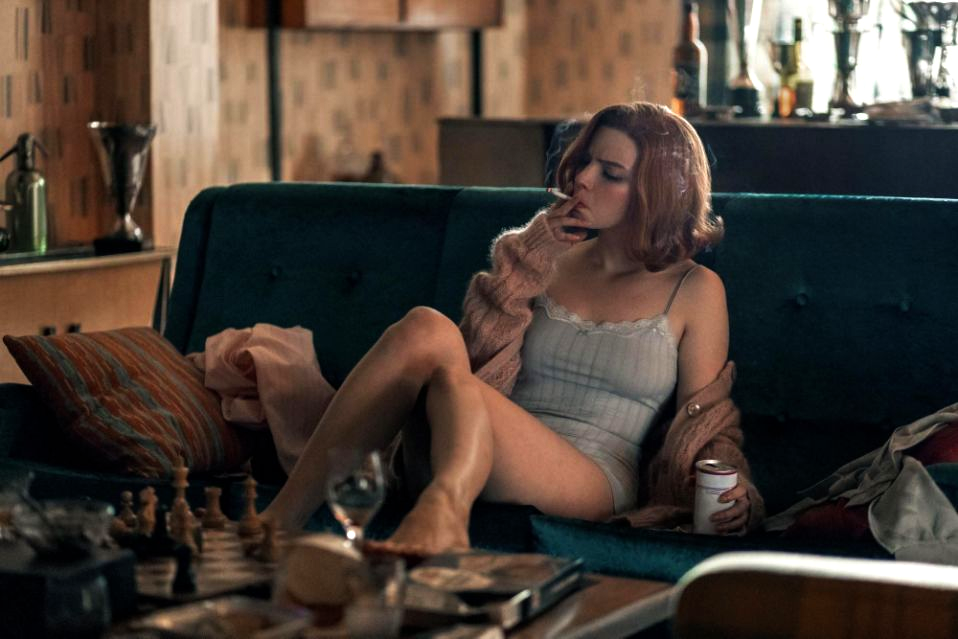
The colors in the trailer are all neon pink and blue (very similar to the marketing and trailers for Revenge) and in it, we watch the protagonist Cassie (played by Carey Mulligan) smash a windshield and draw hash marks in a diary. An instrumental cover of the Britney Spears tune “Toxic” accompanies the images. This version of the song, with its screeching violins, sounds less like a pop hit and more like the soundtrack to a slasher film.

The movie starts out by making fun of the men who approach the protagonist. In one of the opening scenes Cassie goes to a bar and pretends to be blackout drunk. She acts as if she’s having a hard time keeping her head up, and when a “nice guy” played by Adam Brody approaches her she slurringly explains that she can’t find her phone. He offers to take her home, only to “change his mind” at the last second, taking her to his place instead. 

He carries her into his bedroom and begins to take off her underwear. Still pretending to be drunk, she asks him what he’s doing. He continues and Cassie asks again. When he does not stop, she sits up straight in bed, revealing she is actually sober, and asks him pointedly, “Hey, what are you doing?” 

Over the course of the movie, we learn that Cassie’s best friend Nina was raped in medical school by one of their classmates. Because Nina was drunk, the rape was dismissed by the school. Toward the end of the film, Cassie confronts a female dean who explains to her that the school didn’t want to ruin the young man’s future, that he was a “promising young man.” 

I turned to my boyfriend at one point and said, ‘So all she’s going to do is talk to them and make them feel bad?’

We watch as Cassie catches a series of men in attempted rape, and here is where the movie defies expectations. Having watched the trailers, I assumed that at some point Cassie would murder one of these men. Instead she makes them realize that she is not drunk, makes them explain themselves, and leaves. I turned to my boyfriend at one point and said, “So all she’s going to do is talk to them and make them feel bad?” I wanted one of these men to suffer violence for trying to hurt Cassie—a moment of discomfort wasn’t good enough. 

Promising Young Woman is clearly situated in the rape-revenge genre, yet most of Cassie’s movement in the story feels less like action and more like sleight of hand. We watch as Cassie loses more and more: her best friend, her career, her boyfriend, and ultimately, her life. All of the men survive, and only one of them suffers any legal consequences. When the credits rolled, I felt depressed, anxious, and disappointed. In contrast, at the end of Revenge I felt happy, even elated. 

In many ways Promising Young Woman is a more complex, more feminist movie, despite the fact they are both directed by women who are self-described feminists. The plot of Promising Young Woman is unique, and it refuses to objectify Cassie. Revenge, on the other hand, spends a lot of time in close-ups on Jen’s lips and butt. (I believe Fargeat is making a comment about the male gaze with these shots, but still, they are there, and we get to gawk at actress Matilda Lutz’s rear end just as much as the men in the movie do.) So why did I feel like Promising Young Woman was such a bummer? 

One key difference between Promising Young Woman and Revenge is the scope of the story. Jen is isolated in the desert with her three assailants. She must fight and kill to survive the men who are hunting her. Because the movie does not appeal to anyone beyond the four lead characters, it eliminated my need to worry about any legal system or outside community. Within the parameters set up by the story, either Jen will kill, or she will die. As a viewer, I’m let off the hook for enjoying the slaughter. 

Similarly, her three assailants are blatantly awful, cold-blooded people. About halfway through the movie, Jen’s rapist (Stan) wakes up in an SUV after waiting in it all night, keeping an eye out for Jen. What Stan doesn’t know is that one of his friends (Dmitri) is floating dead in the lake nearby, having been stabbed to death by Jen. 

While Stan pees outside, he spots a spider and urinates on it, chuckling while he does so. We watch as the creature struggles and then dies. Even while taking a pee, this man is mean and callous. He has to dominate everything around him, even the natural world. He is easy to hate, and that’s why, when Dmitri’s bloated corpse floats up to Stan while he’s washing his face in the river, I laughed. The scene is shocking, but it is also funny. 

In contrast, Cassie is stuck in the modern world. She has access to anyone in her town who might deign to listen to her. She is a modern-day Cassandra, who pleads with former school mates, the dean, Nina’s mother, and her own parents to take Nina’s plight seriously. (Nina is never seen on screen, and the film implies that she committed suicide because of the pain and humiliation resulting from her rape.) 

Promising Young Woman engages with the reality: Help is not coming, and catharsis may not be either.

Cassie is telling the truth, and she wants someone to do something about it. Yet in this version of the story, rather than not believing her, it seems that everyone around her knows she is right and they just don’t care. She is met with responses like “we were just kids,” or “we get accusations like this all the time,” or “you gotta let it go.” As far as support from her community or legal ramifications go, she might as well be in the desert. Revenge offers the fantasy of an isolated moment when anything, even bloody justice, is possible. Promising Young Woman engages with the reality: Help is not coming, and catharsis may not be either.

Director Emerald Fennell imagined a different kind of story, where revenge is taken non-violently—but it’s clear that this is not a choice on Cassie’s part, but a constraint. Cassie is repeatedly put in situations where the other characters believe she has done something awful, killed someone, or put another woman in a position where she could be assaulted. She explains over and over that she can’t do something like that. The men in this story can get away with things. She can’t.

Cassie’s community turns its back on her. No one will help until it’s too late. While Revenge is a fantasy where Jen is allowed to completely transform herself into a blood-soaked, victorious survivor, Cassie refuses to transform, to hold her friend’s tragedy close and live her life by its memory. Because of that, she is completely crushed by the apathy of those around her.

My negative reaction to Promising Young Woman made me realize there is something in the violence of more traditional revenge films that makes me feel better about the world. These movies may be gross and terrifying, but if the story is well-executed, I’m left with the feeling that justice has been done, that the protagonist has received a kind of payment for the trauma they have suffered. Revenge that has to operate within legal and moral constraints doesn’t feel like it matches the power of my anger.

But at the same time, fantasies like Revenge do us a disservice by letting us feel satisfied.  I can watch Revenge and then immediately go about my day. I’ve been granted catharsis and can let the experience fade away into the background of my life. I think that is part of the reason why revenge movies are so popular. Promising Young Woman isn’t like that. It won’t let you go. Even now, weeks after watching the movie, I still can’t shake the feeling of despair Cassie’s story brought me. I can’t look away, and I think that was the point. Within the constraints women operate under, catharsis is a lie. The best revenge we can hope for is forcing people, for one moment, to listen.

Who is Paradise Really For?

In Cherie Jones’s debut novel, How The One-Armed Sister Sweeps Her House, the fictional Barbadian town of Baxter Beach looks like paradise. Soaked in sun, rich tourists, and sugary alcoholic drinks, what outsiders may call paradise is really a false reality for locals.

How the One-Armed Sister Sweeps Her House

The titular story is told to Lala as a teenager by her grandmother Wilma: it is about a sister who has “a taste for things that her mother tell her not to have.” She defies her mother, visits a forbidden tunnel, and loses her arm during a struggle to escape the evil lurking in the darkness. It’s a cautionary tale that is meant to serve as a warning, but instead, Lala imagines the limitless possibilities the one-armed sister—and subsequently, her herself, can live. Years later, Lala is pregnant and embroiled in an abusive marriage to Adan, a carnival unicyclist. But it’s the murder of a rich white tourist that sets off a whirl of chaos that goes from bad to worse, as Jones explores the cycle of trauma that is fed by toxic masculinity. 

Over the phone, Cherie Jones and I spoke about the harmful effects of tourism, generational trauma, and who is paradise really for.


Yannise Jean: There’s so much going on in this novel. You’re exploring tourism, violence against women, class, and race. You open up the novel with Lala’s grandmother telling this story about the One-Armed Sister Who Sweeps Her House, which is essentially a cautionary tale, warning women about the consequences of not listening to their elders. I guess you could say it applies to all the women in the novel, but I found Lala’s reaction to it to be particularly endearing. She doesn’t see the sister losing her arm as a hindrance, instead, she’s thinking about how this sister can still live the life that she desires. Was this tale something you heard before?

Cherie Jones: No, that story is one that I made up for the book. But there are so many local tales that elders would say to younger people as a caution against something that they don’t want the children to do. For example: if it’s going out at night, the grease man or other mythical characters could get you and it’s just a way to try to scare children off. 

YJ: Right, and the story certainly alludes to what happens between Layla and her husband. Their relationship is quite toxic and abusive, but overall there is a lot of violence within the book. A lot of the violence is endured by the women in the novel is at the hands of men. Violent scenes can be difficult to write, what was the process like to write those scenes?

CJ: It was actually quite difficult to write as I’m a survivor of domestic violence. When I first was inspired to write this story and heard [Lala’s] voice, I think I probably internally resisted it. From a personal perspective, I felt it would be uncomfortable to do. One of the things that I’ve always treasured as a writer is the ability to review things quite dispassionately. I think that’s usually best when you’re trying to tell a story because you have to be faithful to the story and nothing else. So, I resisted that. I didn’t want to glorify the violence itself and that was a deliberate choice that was important to me because I didn’t want it to become like a voyeuristic type of novel. I didn’t want anybody reading it to get lost in the details of violence as opposed to the psychological reports that come out from it so I want to focus a little less on the acts themselves, and more on the repercussions.
YJ: Repercussions are essential to the theme of How The One-Armed Sister Sweeps Her House. There is a cycle of violence and the inheritance of trauma that runs through the novel, with Lala—who at a young age imagines a different life for herself—sees her adult life reflected in her grandmother’s. It seems like this kind of treacherous cycle is a normal occurrence on this island. Why do these women accept this cycle of violence?

CJ: I think it was important to explore it from the perspective of being down through generations and the cycle of abuse because I can’t just sit and write and say what causes violence. There are things that I’ve observed around me that I think contribute to it. There is this culture that is cultivated in spaces like this, where older women tell younger women that they should expect and accept this kind of abuse. I witnessed that violence within my family. I think there are a lot of generational, cultural, and traditional norms and values—if you could call it that—that we have in the Caribbean region that contributes a culture of violence. It’s really important that if you’re going to explore those elements, that you include the history of it, whether it’s at the micro-level or a macro-level. For me, I wanted to examine the impact violence has and the repercussions, not only on the person who is subject to it but on subsequent generations and how it comes out of past generations. 
YJ: Besides the domestic violence, there’s also this discussion about race and tourism. It made me think of the current pandemic we’re in now, with people traveling to the Caribbean, putting these locals at risk for their gratification. Tourism is ingrained in their ecosystem, they kind of rely on these travelers, and tourists take advantage of that. You kind of juxtapose the paradise that tourists experience to the realities of Caribbean life that the locals live. It was good to experience Barbados through your eyes as a Barbadian.

I wanted to examine the impact violence has, not only on the person who is subject to it but also on subsequent generations.

CJ: Tourism is so ingrained in our culture and who we are as a people that we don’t recognize it as a simple thing. The fact that if you go to the West Coast, which is considered a prime spot for tourists vacationing here and wealthy tourists, is that you’ll notice the police station is going to look a lot different. The market is going to look a lot different with just how everything is laid out. There is this type of sort of fantasy. That becomes clear when you look at these areas. And I think that spills over without thinking about it. 

We had a court case where the judge was saying everybody in Barbados is entitled to be safe and not to have their place burglarized and so on, but you know tourism is part of our economy. It was important to make it clear that there’s another perspective. This is real life and all human life is complex and it has many faces. We all have this particular interest in wanting to present our best face, but I wanted to explore something different. 

YJ: Yes, there’s always that discussion with authors of marginalized identities writing about their culture. It becomes a question of what audience you’re trying to appeal to. But you approach your story from a nuanced position. While drafting, were there any particular Caribbean authors that stayed with you while you wrote? 

CJ: I like Earl Lovelace, Jamaica Kincaid, I mean, there are so many authors whose work I appreciate and understand, in terms of writing this book. I can’t say there’s only one Caribbean author who inspires me, I believe my writing is the total of all the wonderful work I’ve read. 

YJ: There’s very little light by the time we get to the end of the novel. How did you come to the conclusion you did?

CJ: I felt like the ending was true for the story. Besides the trauma, there is also the side of survival. Everyone is trying to survive in different ways: Wilma tries to protect her daughter and granddaughter from her husband. Lala is trying to protect herself and her baby from Adan and so on. There is very little light, but with survival, you can still come out somewhat unscathed, maybe even better than before. That is the impetus that was important to show,  the resilience of these women, and how they survive despite everything.

10 Australian Women Writers You Should Be Reading

When I was growing up in Sydney, I did not often read Australian writers. This wasn’t necessarily a decision I made consciously, they simply weren’t brought into my orbit. I read more British and American writing than I did Australian, and I got through six years of high school without any Australian writers being set in English classes, bar the poet Kenneth Slessor. My earliest experiences with Australian literature were men, and this too shaped a sense of myself as an Australian. 

It was only as I got older and began to start writing that I went in search of women who would guide me in a different direction. Discovering writers like Christina Stead and Elizabeth Jolley rearranged my sense of who I was and helped me carve out a place for myself. 

Too often, Australia is depicted as a masculine place, populated by surfers and rugby players, a place that gave rise to Crocodile Dundee, the murderous psychopaths of horror films like Wolf Creek, and the bland handsomeness of the Hemsworth brothers. Our literature bears out the same preoccupation with the stories of men.

Working at McNally Jackson bookstore in New York, I managed the Australian and New Zealand literature, and I knew which writers sold: Richard Flanagan, Peter Carey, Gerald Murnane, Patrick White, and Tim Winton. I attempted to turn the tide. I recommended the books of Helen Garner, Shirley Hazzard, Josephine Rowe, and others, at any chance I could. These women were not easy to categorize outside of holding the same kind of passport. Many of them were writing outside of Australia, and many of them were writing around the demands of their families and their jobs. They were rarely as well known as their male counterparts, on either an international or national level. But they were the writers of the books who gave me a sense of myself as both an Australian woman and an Australian writer, and they were the writers who meant the most to me. When I came to write my own book, The Inland Sea, many of these women served as models and inspirations—how to write about anti-heroines, the environment, and the way it feels when everything comes undone.

Helen Garner

I remember buying Helen Garner’s novel Monkey Grip from Ariel Books in Darlinghurst when I was a teenager, and the bookseller smiling and saying, “oh, you’re in for a treat with this one.” Monkey Grip was Garner’s first novel, published in 1977, and the first to depict Melbourne’s countercultural milieu, a novel about a doomed affair with a heroin addict.

Her real triumph is The Children’s Bach, a novel about the ways that sex and desire undo a group of interconnected families and friends. It was published in 1984, and it’s maybe one of the best short novels ever written. Garner also happens to be Australia’s greatest essayist, and the volumes of her diaries currently being published are a high point in a career that has played at the edges of fiction and non-fiction. I plowed through every single book Garner had written during 2012, buying them used from Sappho Books in Sydney, and they were for a long time the books I returned to for comfort and fortitude when I doubted whether trying to make money at writing was a worthless pursuit. 

For Love Alone by Christina Stead

Christina Stead

Born in Sydney in 1902, Stead left Australia in her early 20s and lived in London, Paris, Spain, and New York. Her novels are as different as the cities she lived in. For Love Alone was the first Stead I read—in the backyard that first summer after high school—and the story about a young girl growing up and escaping Sydney remains my favorite.

Stead is most known for The Man Who Loved Children, a novel about the ways in which a father (much like Stead’s own) terrorizes his family. But I’ve always found that book a little grim, and the fact that her publishers convinced her that Americans weren’t interested in Australia and therefore she should, at the last minute, change the Sydney setting to Washington DC makes the book read strangely to both Australians and Americans.

The Transit of Venus by Shirley Hazzard

Shirley Hazzard

Another Australian who ended up in New York, but one who led a far more glamorous life, Shirley Hazzard’s greatest novel is The Transit of Venus. I first read The Transit of Venus when I was 19, struck down with a bad flu over the winter break in my first year at university. Reading it with a fever was almost the perfect way to first encounter Hazzard. The novel follows two orphaned sisters as they leave Sydney and move to England, landing in London to meet the three men they’ll fall in and out of love with for the rest of their lives. The book floated around in my brain for eight years in a fever haze before I re-read it. There’s a great tradition of coming back to The Transit of Venus, from Geoff Dyer to Michelle de Kretser, and upon re-reading Hazzard’s masterpiece, I was convinced that she had written one of the best novels of the 20th century. 

Elizabeth Jolley - Penguin Books Australia

Elizabeth Jolley

I first came to Elizabeth Jolley because her most famous novel, The Well, was set for a class I took at university on the Australian Gothic. The Well is a deeply unsettling book about two women living together out in the country who accidentally kill a man one evening and drop his body down a well.  While excellent, it wasn’t until last year when I read the out-of-print Vera Wright trilogy that I fully understood Jolley’s power. The books, fragmented and disorienting, move us back and forth through time and cover much of Jolley’s own autobiography: a Quaker childhood, nursing in London during the war, giving birth out of wedlock. The books anticipate the work of writers like Rachel Cusk, and share similarities with Tove Ditlevsen and Renata Adler. I only wish they were more widely available so that I could give them to every woman I know.

Maria Tumarkin

I first came to Maria Tumarkin’s work by chance, having picked out her 2005 book Traumascapes from the stacks in the University of Sydney’s Fisher Library one night. Traumascapes is an exploration of the fates of places that are marked by violence and loss, and the ways in which those places can hold that trauma for years afterwards. Her most recent book, Axiomatic, takes as its starting point different axioms: Give Me a Child Before the Age of Seven and I’ll Give You the Woman, You Can’t Enter The Same River Twice, etc. The book asks, fundamentally, how do we speak about the past? Using the axioms, Tumarkin forces us to grapple with how we tell the stories of our pasts, how we incorporate the past into our present. With Axiomatic, Tumarkin cemented her place as one of Australia’s best and most unflinching writers of creative non-fiction.  

Alexis Wright

Alexis Wright is a member of the Wanyi nation of the Gulf of Carpentaria. She is a formidable writer of non-fiction, including Grog War, a study of alcohol abuse in Australia’s Northern Territory, and Tracker, a collective memoir of the Aboriginal leader Tracker Tilmouth. Lyrically complex, with sprawling narratives, Wright’s fiction centers Indigenous ecological knowledge in stories that revolve around ecological responsibility and land tenancy, drawing on oral storytelling traditions and myth. My favorite is The Swan Book—one of the earliest works of climate change fiction I encountered—which follows a mute young woman taken away from her home in the North to a Southern city flooded by the rising oceans. 

Josephine Rowe

Josephine Rowe is one of Australia’s best writers working today, and one of the finest sentence-writers in the English language, in my view. I first encountered her through her short story collection, Tarcutta Wake, and was blown away by her exquisite stories, which were unlike anything else I had read from an Australian writer. The precision she brings to the writing of her short stories lends itself to her novel, A Loving, Faithful Animal, which I read in a great two and a half hour gulp on the train from Sydney into the mountains. Told from the perspective of multiple members of the same family, who are all dealing with the sometimes violent, and sometimes absent, presence of their Vietnam War veteran father, the book proceeds in sparse, knife-sharp sections.

Beverley Farmer

Beverley Farmer was a writer difficult to classify, whose stories, novels and essay-fiction hybrids touch on themes of home and restlessness. I first came to Farmer on the recommendation of Josephine Rowe who recommended the undefinable The Bone House—a difficult-to-categorize triad of essays about the life of the body and the elements that shape our lives: water, fire, blood, darkness. The Bone House was published in 2005 (and Rowe has since written a book on Farmer, On Beverley Farmer: Writers on Writers, published in 2020). Reading Farmer was like having the lights turned on in my mind, a focus and attention suddenly brought to bear on every part of life. On a trip back to Australia I bought This Water, a collection of five long stories and the last book Farmer wrote before her death in 2018. The opening story in This Water, “A Ring of Gold,” is a perfect novella, and a master-class on the themes Farmer depicts best: water, women, transformation. 

Yumna Kassab

Kassab’s debut short story collection, The House of Youssef, was published in 2019. A beautiful book reminiscent of the minimalist stories of Amy Hempel and Raymond Carver, all of Kassab’s stories take place in the Australian Lebanese community centered in the western suburbs of Sydney—a part of Australia think-pieced to death after election cycles, much like the American Midwest and England’s North. Kassab’s stories focus on the downward spiral of the one family, threaded through with vignettes about other people in the community. Like the work of Carver and Hempel, Kassab has shaped the form to the content. In a craft essay for Kill Your Darlings, she writes:

“One day I looked around and saw I lived in an ordinary place. The people I knew were ordinary people, and the food I ate with these people belonged on the ground…This is life stripped to its essentials, and the wording in my stories has been chosen in a similar way. My language is humble. It speaks the story of a common life using a dressed down word.”
Blueberries

Ellena Savage

Published in early 2020, Ellena Savage’s debut Blueberries is one of the best essay collections I have read in recent years, or ever. Having spent many years reading her work in The Lifted Brow before I moved away from Australia, I was already primed to be impressed by her writing. Blueberries is a collection of essays that are somewhere between personal essay, prose poetry and polemic. Fiercely intelligent, the book is both a memoir and an interrogation of the whole idea of memoir, approaching the kind of formal experimentation of Wayne Koestenbaum and Maggie Nelson with more humor and heart than I could ever have anticipated.

The Infinite Doors at the Center of Myself

Differential Diagnosis

There is a door at the center of myself. 
That door belies the existence of many other doors. 
This trend knows no sign of stopping. 

(I dislike it. But it must be.) 

I am really made of little vaults. 
Vaults the color of my insides.

(My doors lead to the vaults.)

When things are not my fault I step through the door and close it in my wake and in my wake I 
close my eyes and say, well, none of it was my vault.
 
Luckily, my vault 
is safe and full of goods. And only I can see it. 
And all you see is text but I can see the outline of my vault.

My goods are little pieces. 
They never exceed my skin. I stack them 
every volume fewer than the last.

(My goods do not breathe oxygen.)

When I look I cannot find my goods.
My goods are gods whose holes can’t fit a finger.

I am chronically holy.
This is not healthy under any circumstances.

I call my goods my precious gods because I cannot see them.
When I look I find my subtle vault 
alone and faith the difference,

like I just believe electrons 
fear arrest
by laws of physics.

The Variance Variations

         
                                              “Empathy, evidently, 
                                             existed 
                                                    only within the 
                                                   human 
                                             community,          whereas 
                                             intelligence to some degree 
                                             could be found throughout 
                                             every phylum and order 
                                             including the arachnida.”  –– 
                                             Phillip K. Dick, Do Androids 
                                             Dream of Electric Sheep? 
  
 To dream of going haywire.
 When wires bared and fringing
 sting bare fingers in repair,
 doctor calls the shock
 autistic.
 
                                          Today andys aren't retired      but
                                          socialized
                                          and manufacture stops at
                                          obsolescence.

Years don't work the same
for us, I track in terms of generation
model and expiry date. Nine ago,  
the first self: the i
Mac, 20 in human years.

                                             Real autistics bite, they say. 
                                             Realer autistics         voight-
                                             kampff   at   thequiz   dot   com   and      
                                                  here, You're A Replicant Who
                                             Thinks 

 You know
 how it goes: the child drowned
 swallowed by the family pool, 
 looked at first like she was dancing

                                                  It's Human!

7 Books About Break-Ups and Heartbreaks

The best way to get over a breakup is to throw yourself into art and experience the catharsis of observing someone else’s pain. For some, this might be listening to Fleetwood Mac’s album Rumours on repeat. For others, perhaps a double feature of  Lost in Translation and Her. For readers, the post-breakup reading list should be carefully curated to allow an emotional purge. A story about another person’s heartbreak simultaneously makes the reader feel justified in their misery and ridiculous for thinking that they are alone in the pain of lost love. 

Whether it’s you doing the heartbreaking, receiving it, or even if it was a painless transition to a new normal, here is a list of books to help get you through it.  

Bluets

Bluets by Maggie Nelson

Heartbreak can materialize in countless forms. For some, it’s a visceral feeling. For some, it’s an intellectual phenomenon. For Maggie Nelson, heartbreak is the color blue. Borrowing theory from philosophers and writers who have pontificated on color, from Wittgenstein to Goethe, Nelson constructs a cerebral account of a broken heart through her relationship to blue. 

Trust Exercise by Susan Choi

Sometimes it is more painful to experience the deterioration of a friendship than to pick up the pieces of a heart after a breakup. Choi’s novel, set in a competitive performing arts high school with morally ambiguous faculty, chronicles the opposing stories of two friends whose lust for boys and men pushes them farther and farther apart until the only thing left in the wreckage is jealousy and bruised memories. The relationships in Trust Exercise—from the messy, passionate fling between teenagers to the deeply problematic intimacy between students and teachers—offer a sweeping and thorough display of the ways that heartbreak can occur. 

The Hour of the Star by Clarice Lispector 

The Hour of the Star is a man’s intrusive narration of an uneducated, though ceaselessly curious, woman named Macabea whose boyfriend cheats on her with her coworker. The reader is only allowed to engage with Macabea through an unreliable narrator obsessed with himself and his writing, leaving us only a small glimpse of her experience and echoes the lack of autonomy that she is permitted in her abusive relationship. Lispector’s novella uncovers the consequences of ardent yearning without self-government. 

The Pisces by Melissa Broder

The Pisces by Melissa Broder

The breakup in Broder’s experimental and fantastical novel is imbued with a dark metaphor. Death and love are immutably tied. In French, the term for orgasm, le petit mort, literally means the little death. The Pisces explores the depth of this connection with a desolate protagonist who projects her lust and suicidal ideation on a mythical, aquatic creature. To commit to this aberrant relationship means to leave her organic life behind entirely, to give in to an extraordinary passion that will end in a loss of consciousness. And yet, to walk away, to leave this creature and this unparalleled ardor, is unthinkable. 

Freedom by Jonathan Franzen 

Set in rural Minnesota at the turn of the 21st-century, Freedom depicts the demise of a marriage and the expansive consequences. The five-part novel revolves around the titular theme of freedom: the heart of American pride that can be defined in as many ways as there are people in the country, and the ways in which the search for this elusive objective affects the way we relate to one another. Told from varying perspectives, this narrative allows the reader to comprehend the enormity of a broken marriage and the countless ways that one divorce can be understood by the people affected. 

Someone Who Will Love You in All Your Damaged Glory by Raphael Bob-Waksberg

Someone Who Will Love You in All Your Damaged Glory: Stories by Raphael Bob-Waksberg

If you’ve ever watched an episode of Bojack Horseman, the darkly comedic animated series created by Raphael Bob-Waksberg, you’re probably familiar with the gut-wrenching humor that saturates this collection of anti-love stories. Written in an unconventional and amusingly absurdist style, Bob-Waksberg leads you through a maze of heartbreaks—ranging from a Craigslist missed connection post to a fairytale about a man who can visit an alternate reality in which he still loves his partner. Though every story is set in an entirely strange and novel world, they are all tied together by the eerie way in which Bob-Waksberg reaches into the darkest part of your mind and reveals the things about love that you were afraid to face. 

Autobiography of Red by Anne Carson

Autobiography of Red by Anne Carson 

In Autobiography of Red, Anne Carson rewrites the story of Herakles and a red, winged monster, originally told by the Greak poet Stesichoros. In the style of Stesichoros, Carson writes her bildungsroman novel in verse from the perspective of Geryon as his infatuation with Herakles inevitably leads to agony. Through the journey of this complex and unrequited love, Geryon actively seeks to discover himself. Devising his autobiography with sculpture, photographs, and words, he explores what it means to be the monster of his own story. 

How to Write About Kink Without Going Full “Fifty Shades”

It is hard to talk about sex and literature without making some sort of Fifty Shades of Grey reference. But where Fifty Shades shows a caricature of S&M, the new anthology Kink is a celebration of the range of human desires. From the power of control and the titillation of voyeurism, this collection is a toe in the water that is sexuality. 

With Kink, editors R.O. Kwon and Garth Greenwell sought to gather a diverse collection of stories which speak to the complexity of kink and human interactions. With stories from Brandon Taylor, Carmen Maria Machado, Alexander Chee, and more, this collection shines in its moments of small intimacy, especially in a time when touch and connection are so hard to find. 


Parrish Turner: What does it mean to center kink when having conversations about sex, especially in literature?

R.O. Kwon: I have trouble answering that question in part because I have been just shying away from definitions of kink. I think especially with an anthology it does feel important for the definition to be as open as possible to however people want to define it. 

Garth Greenwell: It’s definitely true that from our first conversations, Reese and I were both really clear that the last thing we wanted to do was start drawing lines and saying “this is kinky and this isn’t.” We made it really clear that we were interested in work that writers felt was centered on kink, whatever that meant to them. 

I too really shy away from trying to define what “kink” is. Whatever definitions I find myself reaching for are objectionable for different reasons. Like, if I say “non-normative sexual practices,” then that falls into the trap of a paradigm I don’t really believe in. I do think that something that is true about kinky practices is an understanding that sex is something that is staged and can be negotiated and potentially theatrical or have elements of ritual. Just that sex is something that doesn’t just happen. It is something that we are agents in staging and negotiating. 

ROK: One result of centering kink maybe can help demonstrate something that I very much believe, which is that there is no such thing as normative sex and that the norms are bogus and largely harmful. 

GG: And community that forms around certain sexual practices and that that was something that was interesting to us. Seeing those communities on the page was exciting to us. 

PT: Part of what interests me about centering kink in sex is that I see this as part of a  shift in the way that we talk about sex in literature. What we define as pornography or erotica is kind of shifting. How did that impact how you approached an anthology of sex stories? 

ROK: I feel as though Garth will have a closer viewpoint on this. I do feel as though there has been and continues to be more pushing back against the idea that there are any genres at all and the idea that genres have to be separate. It feels as though Garth’s writing is very much a part of this as Garth has been such a stalwart and eloquent defender and champion of the place sex has in literature. And it’s wild that anyone thinks it doesn’t have a place. 

Centering kink can help demonstrate that there is no such thing as normative sex. 

GG: One of the things I find myself pushing back a lot is against easy notions of pornographic as a term of derision. That supposed dichotomy. That there is something about serious literature that prevents putting sexual bodies graphically on the page is something that I think is dumb and I utterly reject. 

PT: Tied to that is the impact that having so many queer perspectives in the anthology. Part of what you are referencing is what is “okay” to portray and as a wider variety of queer lives are being portrayed in “mainstream” literature. I often felt as a teenager that anything I did was kinky just because I wasn’t straight. 

GG: We’ve been fielding a lot of questions about an overlap of kinkiness and queerness, which clearly there is no easy identity between the two, but I think it is true historically that queer communities have been amenable to kink practices and kink communities have been amenable to queer people. One thing I hope the anthology does is multiply our sense of what both of those terms mean. If someone has an easy idea of kink as just bringing whips or handcuffs into the bedroom, which is certainly part of kink, but the anthology makes clear that’s not the only way to think about what kink is. And I hope the anthology also makes clear that there is not just one paradigm for what queerness looks like either. 

ROK: The anthology is predominantly queer. Which I love. I think it’s so queer that at some point Garth and I were looking at our list like “Wait, do we even have a single straight person?” We ended up with one or two, but barely any. It was really important to us that the anthology be as inclusive as possible. It happened so organically too, it just happened.

PT: That makes sense when trying to get a variety of perspectives on kink and sex, of course queer people are going to be involved with that. I am also curious about the range of ethnic identities represented in this collection. That diversity should be standard practice, but I am wondering the impact that had on the specific stories in the collection, especially given the intersection of race and sexuality. I am thinking along the lines of stereotypes about various groups and their sex lives. 

ROK: A general rule for myself is that, when I’m spearheading a project or event, I try to never have more white people than people of color involved in a project or event. 

Instead of generalizing, I will speak for myself. I didn’t read any Korean writers until after college and I didn’t get serious about it until after graduate school. A large part of it was that I didn’t know there were any of us out there. And when I was getting out of college, there were far fewer of us than there are now. There is always that consciousness that, in putting out a story with S&M with a Korean central character in it, I haven’t read much of that so there is always that doubled consciousness. That said, I know when I’m writing, I try to never think about stuff like that. I try to never wonder about the weight that that puts on the story that I’m trying to make. For me, I’m conscious of it, but I try to not let it bother me. 

Great writers of sex have always recognized that bodies are situated in history.

GG: That’s so smart. Part of my proselytizing about what good sex can do in literature, I think it’s a really powerful way to talk about history and cultural situated-ness. Great writers of sex have always recognized that bodies are situated in history and much of the meaning of our bodies and therefore ourselves is not made by us but assigned to us. One of the things that kinky sexual practices can do, and several of the stories in the anthology show them doing, is try and take some of that assigned meaning, by making it theatrical, making it something that one has some control over. To sort of make that assigned meaning visible and therefore negotiable and a source of an assertion of agency. I also think that you see if you read Toni Morrison, who is a great writer of sex, James Baldwin, Raven Leilani… A characteristic of great writing about sex is an awareness of  the fact that sex is historical and the meanings our bodies make is always historically and culturally situated. That is part of the pressure put on the scene just by the scene being fully written. 

PT: So your book is coming out during Covid. Have you see the way that Covid has changed the way that we talk about sex and how this book might be talked about differently when it comes out? 

ROK: Yes, the book comes out February 9, five days before the most wretched Valentine’s Day in the history of Valentine’s Days. I saw someone said on Twitter that the great thing about this book is that, because there are so many kinds of desire portrayed, a really fun thing to do is to underline passages with interests of your own and you could hand it off to somebody you might be getting involved with. This is glorious.

GG: That is a great idea. I am really shocked at how much the affective emotional power of literature has shifted for me. I was on a book tour for Cleaness when everything shut down. Cleaness became a radically different book after Covid for me. The idea of touch, the idea of intimacy. That is true of this anthology too. It is such a difficult time. This is true for a lot of queer people, [but] so much of my erotic life relied on the free circulation of bodies. That part of my erotic life has just shut down because it’s hugely unsafe. It’s not as though anything on the page changed, but the meaning of the book changed for me. 

PT: I listen to Dan Savage’s podcast and early in the pandemic, he talked about the rise of financial doms post the 2008 financial crisis. He speculated on how the pandemic would affect fetishes. Like how will our fetishes change to respond to our tramas?

GG: Will there be coughing fetishes? There probably already are. Anything you can imagine, someone is probably turned on by it. It both horrifies me and gives me hope about humanity. 

ROK: Years and years ago, I read this column by Dan Savage and someone wrote in to tell him about their specific scuba diving fetish and they just wanted to have sex in scuba diving gear. They were so ashamed and didn’t know how to bring this up. And there were so many lovely replies of people being like I would be so down, it sounds so nice and chill. 

GG: It sounds great. Nobody gets hurt! 

ROK: It warmed my heart; I almost cried. All these people saying “You’re fine.” I wish we lived in a world where people could experience more of that openness and far less of the shame and the punishment and sorrow and loneliness. 

There are so many things that people are ashamed of that do no harm. I love the idea of a world that is more accommodating to those things.

GG: Queer writers have been aware of the ways promiscuity and kinky practices are a practice in humanness. T Fleischmann talks about this kind of promiscuity as a kind of practice of sociality. I feel very grateful for promiscuity for that. There have been so many tender moments. There have been so many moments where a stranger has said to me “I’m into this weird thing.” And there is this kind of vulnerability and fearfulness in that, but it calls such a tenderness from me. I feel very grateful for moments when it has been possible to say yes to these things. There are so many things that people are ashamed of that do no harm. I love the idea of a world that is more accommodating to those things. 

PT: Anthologies function as part of a conversation in and of themselves. What are your hopes for how this book fits into the narrative in ten years?

ROK: I can speak to one of my hopes. I personally am exhausted beyond belief by the ways that kink and S&M are portrayed in movies and TV shows. There are so many serial killers! The percentage of kinky people who are serial killers is just wild to me. There aren’t that many serial killers and there are so many kinky people. That kind of stereotype is incredibly harmful. I just think of the 11-year-old who thinks “the only thing I know about people that want the things my body seems to want is that they are serial killers.” I would love for that caricature to be gone. 

This is only one book and we wanted the book to be as inclusive as possible, but there is so much that isn’t in here. I would love if in ten years there is nothing remarkable about this book being centered on kink. 

PT: I feel like if people were given spaces to be honest about what they want, they would be way less likely to be a serial killer. Tina Horne has a podcast and she talks about how you can work through your shit through kink in this safe environment and if you need it to stop it can stop. And you can push yourself and you are better prepared for the real world. The therapeutic nature of being on good terms with your desire. 

ROK: Oh, being on good terms with our desires. I wanna get there. 

Everyone Else Is in Love and I’m Just Listening to Taylor Swift

When I think of Taylor Swift as a foundational part of me—and like so many others, I do—I think of the blanket on my bed in seventh grade, which was a bright gingham pattern in purple and lime green. My bus driver liked playing the pop station while we zigzagged through the woods, and after I’d heard that day’s iteration of “You Belong With Me” (or “Replay,” or “Use Somebody,” or “Your Love Is My Drug”), she’d drop me off and I’d walk home and sit on my bed and do homework, and play more Taylor Swift.

Spanish homework was my favorite, because it was exciting to know I was getting better at another language every day. Math was a close second, because I was still in those fun pre-algebra stages where they just ask you to do the same thing over and over again.

I know the point of this story isn’t my homework. But my homework feels crucial to the story—felt crucial to the story, even then. Because it was all part of the scene. Two years shy of high school, I wanted to be that typical teenage girl, as I’d constructed her from movies and music videos: dreamy, in her room but lost in her own world, lying on her bed with her feet kicked up behind her like in the movies, listening to music and doing her homework. Sometimes I’d get up and grab my hairbrush and sing along to really feel like I was completing the image—as if anyone else could see me here, and as if the image of me doing this might prove something to them.

A lot of what I thought it meant and would mean to be a teenager came from Taylor Swift songs. In “Fifteen,” she sings from the perspective of a high school freshman: taking a deep breath, walking through the doors of the big high school, sitting down in class next to her future best friend. Sharing secrets and heartbreaks, staying up late, dancing around her room. And falling in love for the first time.

I wanted to want something, and a romance with a boy, for a while there, felt like the most obvious and easy thing to want.

I cared about these songs deeply, and I therefore expected that in time, my real life would echo them. I exuded no real romantic energy into the world, yet at sleepovers I’d guess which boys might have crushes on me. I was afraid of the idea of actually kissing anybody—more than afraid, at times I felt actively resentful of it—but I sang about kissing in the rain, because I liked doing literally everything else in the rain, so it only made sense. I figured soon it would happen for me, like a kiss in the rain was the sort of thing that just arrived at one’s door. I wanted to want something, and a romance with a boy, for a while there, felt like the most obvious and easy thing to want.


It’s eerie to think of the ways in which music worms itself into our own personal expectations. As a child I tried mustering up a crush on a neighbor because I thought girl-next-door love sounded sweet—“Mary’s Song (Oh My My My)” is a classic example of this, the story about two small-town lovers growing up together that always used to make me cry. I saw it also in the “You Belong With Me” video with the neighbors holding up signs in their windows for each other to read, and in the opening scene that “I’m Only Me When I’m With You” effortlessly sets: “Friday night beneath the stars / In a field behind your yard / You and I are painting pictures in the sky.” To be in love, in these songs, was to have a best friend—one single presence you could count on.

But I’ve caught myself framing my expectations around song lyrics since then, too, with other archetypes—searching for the kind of love that looks like “dancing around the kitchen in the refrigerator light,” or the kind of love that never goes out of style, or the kind of knee-jerk affection at the beginning of “Paper Rings” (“Went home and tried to stalk you on the internet / Now I’ve read all of the books beside your bed”). Cold-wine love, cardigan love, haunted love.

The love is the common strand here, but it’s also where things usually stop for me, real-life-wise. I am all about starry nights out in fields, and long, hilly autumn drives. But give me these things and I’ll feel full and happy already; eight or nine times out of ten, add a person who wants to kiss me and all I’ll want to do is roll my eyes. Ask any of the few lovely people who have sincerely tried to begin something with me, and been met in return with awkward silences, feigned misunderstandings, and a resistance that neither of us quite understand.

The idea of being in love, the way it’s presented to us, is the idea of being relaxed, of being understood.

It could be the idea of love I’m attached to—because the idea of being in love, the way it’s presented to us, is the idea of being relaxed, of being understood, of being happy and newly interested in the world around you. Pop culture teaches us, consciously or inadvertently, that finding a partner is the best, easiest, or even the only route to these feelings. But I have been all of these things, sometimes even all at once, and I have never been in a romantic relationship.

One of the first times a friend told me they were asexual, they said, “I don’t know if I will be a year from now or two years from now, but right now I am.” Something about this made some essential part of me relax. I hadn’t thought of labels as things that could change with time, but in retrospect it felt obvious.

This is what I want, I knew then. This is what the point is: not defining oneself, but taking power over the ways one is defined.

I steer away from calling myself asexual or aromantic, because I’ve had sexual and romantic encounters before and enjoyed them. But it’s also not overall a very consuming part of my life or something I usually feel proactive about. I also hesitate to label myself as anything at all, in any context (particularly in a place as permanent-feeling as the internet). It feels odd, now, to be writing these things and simultaneously not quite wanting people to know them, which may be why I usually stick to forms of writing that are not personal narrative. I don’t want anyone to know what I consider myself (but I still want everyone to know what I consider).

This—this constant refocusing, this power over definitions and definition—is one of the things Taylor Swift does so well. She defines herself more deftly than anyone else can—and in doing so, she makes it not mean anything. She’s innocent but also mature, wronged as well as culpable. In “Blank Space,” she took the persona the press had given her at the time—“crazy but seductive but glamorous but nuts but manipulative”—and embodied it so thoroughly that no self-serious person could really feel smart applying it to her again.

She wants us to see many sides to her and therefore not quite believe any of them: how she can be forgiving but also vengeful, self-conscious but also unrepentant. All people are homes for these sorts of contradictions. Her hits when I was in high school were love songs, but I also used to love the cold blame inherent to songs like “White Horse,” and the barely-contained, trembling anger that arrives late and victorious in “Dear John,” every word of it marvelously felt: “Don’t look now / I’m shining like fireworks over your sad, empty town.” Even in “Ours,” a sweet, simple song, the line, “Life makes love look hard,” used to lift a feeling of contempt in me: How dare life make love look hard? What kind of a vicious lie is that?

I’m used to loving her music in all sorts of ways that don’t make immediate sense. In high school, she was the only current pop artist I listened to (my other obsessions were Bob Dylan, The Beatles, and, somehow, Beck). Sometimes when I was feeling rageful, I’d turn up the volume knob all the way and rock out with my door closed, reassured by the idea that my parents likely wouldn’t think I was rebellious or at all troubled because it was Taylor Swift I was listening to.

If this is true, love might not be an answerable thing—which would make it okay that I have never had an answer for it.

One explanation for liking these songs and stories could be escapism—but to bring in the word escape sounds like it implies a lie, and the route down which music leads you is anything but a lie. What I feel like it offers me personally is less a way out of something I want to avoid, and more a way of directly accessing something better. What I initially thought I was accessing was some experience I lacked: flirting with a cute boy through a window (or being attracted to a cute boy, period), getting swept off my feet at a dance, spending the same four years at one high school. The breakups that first tore me in half were not with people but with cities; my first love affairs were platonic. It would take me years to understand that what I loved in Swift’s music was less to do with the central relationships I felt so pressured to emulate, and more to do with the music’s changing narratives and textured trajectories of understanding—from track to track, from album to album. The way retrospective love operates in “Tim McGraw” is different from the way it operates in “The Way I Loved You”; the way love works in “Mine” is different from how it works in “Lover.”

If this is true—if love has many sides to it, none of them the most real or the most actualized—there might be no moment at which we understand love most fully. If this is true, love might not be an answerable thing—which would make it okay that I have never had an answer for it.


To grow up loving Taylor Swift is to grow up having Taylor Swift define, at least in some way, what love means for you. In the beginning, that was the fierce attachment that comes with knowing someone who understands your childhood, at that crucial point in life when so far your childhood is all you have to share. This attachment is glaringly bright in “Mary’s Song (Oh My My My)”—“Take me back to the creek beds we turned up / Two A.M., riding in your truck and all I need is you next to me”—and in “Our Song,” with the “slamming screen door / Sneakin’ out late, tapping on your window.”

These trappings have evolved with subsequent releases, as Swift’s own life has evolved—country roads replaced by the High Line and Sixteenth Avenue, fairy-tale daydreams solidified into literal mansions. And her representations of love have shifted, too—through the vengeful Reputation and the lighthearted but mature Lover, most recently into Folklore and Evermore, which use made-up stories and half-forgotten personal legends to craft mellow, tormented snapshots of characters caught up in the dreams of each other. Folklore insists so firmly on its own fictionality, even in its title, and yet how could its lyrics—“Your integrity makes me seem small / You paint dreamscapes on the wall / I talk shit with my friends / It’s like I’m wasting your honor”—be anything but some form of truth?

To grow up loving Taylor Swift is to grow up having Taylor Swift define, at least in some way, what love means for you.

What all these records share is Swift’s insistence upon carving out her own definitions of love, and her struggle to maintain the power of defining what love means for her (as well as what life means for her, and her own ambitions and surroundings) in spite of an outside world that thinks it knows better. This, she proves, is the thing to insist upon: not to love love in a singular way but to reconsider it, all the time, in each stage of one’s life—and in reconsidering it, love it and experience it anew.


I know I mentioned the math homework, the bus rides and the gingham blanket. But my first experience with Taylor Swift—maybe the first time I ever heard her music—came earlier. I was at a friend’s birthday party in fifth grade, in her basement, and someone gave her Taylor Swift’s self-titled debut, at that time her only album out, as a present. The birthday friend knew what it was by the CD shape before she even unwrapped it. “Is this—?” Immediately she put it in the CD player and—urged on by the friend who’d given it to “put on our song!”—skipped ahead to what I learned was actually titled “Our Song.” The two of them had made up a dance to the chorus, and we all watched as they performed it, thrilled to share this with the rest of us.

It feels like a betrayal of them in a way, writing about it. It’s hard to write about other people without feeling like I’m betraying them, especially if the experiences I share with them are ones I cherish. There must be a part of me that feels like cherished things should be the most secret of all. But “to betray” can also mean to tell a secret, or to accidentally let one’s true self show. And that means we betrayed ourselves to each other first of all, and in truer ways; what I’m putting here is only an echo, a reproduction designed to be both true and understandable, when the real self-revelation only needed to be true.

I say all this, but really there’s not much way around this messiness; it’s hard to get away from betrayal in writing, in part because writing, after all, is spending time with the things you cherish and telling the secrets of them. I write about love and I risk betraying love; I write about the tree outside my window and I risk betraying the tree outside my window. I take this very seriously. I write about anything important and I risk getting it wrong, losing its trust. This applies to myself, too: Maybe all writing is a necessary self-betrayal. And since I think of writing as love and love as writing, maybe all love is a necessary self-betrayal, too. Can a betrayal also be true to something? I’m not sure, but sometimes I think betrayal is the truest thing, and not even in a bad way. Betraying our past selves, our past lives, is the whole essence of growing up and of the changes we move through all the time.

Betraying our past selves, our past lives, is the whole essence of growing up.

What I do know is that Taylor Swift knows how to write about the absolute closest things to her heart without letting go of them—she betrays everything, but gives up nothing. This, more than the images of stolen kisses and little black dresses, more than feeling like I have one specific role to fulfill, is the relationship I want to have with love.

A little time has passed and I’m not trying to fill a typical teenage scene anymore; I might be trying to fill a “typical young adult” scene if I could firmly decide on what that looked like, but it’s probably a blessing that I can’t. I am still attempting to dream, recreationally but also professionally, and I still have not been in a long-term relationship.

There is a self somewhere, deep within me, that is unafraid of anything. I believe that because I know how big the world is, even if I can’t internalize the meaning of it, and because if I can believe in aliens and ghosts and whatnot (hell yeah), I can believe that about myself. There is a self in me that is exasperated at every single thing it comes across—but there is simultaneously a self in me that wants love, in an exciting, “Fearless” way, in a wrenching “All Too Well” way, in a developed “Lover” way that speaks of friendship and companionability. But my heart only talks to this self from time to time, and there are other selves in me too. Part of me recognizes it as odd that I’ve found my way to embracing the coexistence of all my possible relationships to love—whether I’m ace or aromantic, gay, bisexual, or something I have yet to consider (or all of the above!)—through the music of someone who has so consistently written about the experience of definitely being straight. But there you have it—there’s more to it than that.

I have always been skeptical of defining myself, partly because I don’t find it the most interesting, but also because the idea of defining feels linked to the definitive, the finite. Finishing. I do not think of love as something that finishes. Love, as an experience, does not end with riding off into the sunset, or a marriage proposal—nor does it quite begin with a step through the doors, or a Wednesday in a cafe. It is a fluid thing, constantly finding new formations and expressions and moving between people, constantly being rediscovered. Our selves are the same way.

I do not think of love as something that finishes.

This state of change, this questioning that is an always-shifting mix between hope and doubt, isn’t happenstance. It isn’t something that occurs in the background, along the journey, cropping up as a link between the real times when we understand ourselves. It is the entire point, the state in which we understand ourselves best.

In the title track of Evermore, the resolution Swift reaches is a turning-away from the idea of forever: “This pain wouldn’t be for evermore.” It’s parallel to a move she made in Folklore, titling a song “peace” and then making its central question a negation of the idea: “Would it be enough if I could never give you peace?” Her two quarantine albums resist conclusion in newly explicit ways. Things that die don’t stay dead; speakers upend other characters’ happy endings by adding their own sides to the story. They eye the roads not taken, they cast off closure, and they force confrontation with a lack of clear answers. The next time I find myself loving someone, I will too.

“100 Boyfriends” Is Scripture for Gay Dysfunction

Transgressive, hilarious, and lewd in all the best ways, 100 Boyfriends by Brontez Purnell is scripture for the dysfunctional homo—a testament to queer men’s oftentimes losing battle to self-sabotage. From soliciting sex on lunch breaks, to sleeping with satanists, co-worker’s husbands, and white boys with dreadlocks, and concluding with a debaucherous tour of Europe, Purnell’s characters are a manic melee, each flirting with disaster, each resplendent in their own magnificence.

This short story collection is glorious in its messiness, splattering desire, loneliness, and desperation onto a canvas of vulnerability. Dispatched from the queer nadirs, it is, above all else, an irreverent gift.

There are triple-threats and then there’s Brontez Purnell, a writer, musician, dancer, filmmaker, and performance artist with accolades to boot: he is the recipient of a 2018 Whiting Writers’ Award for Fiction and was named one of 32 Black male writers of our time by The New York Times Magazine. Sorry for sounding like a cheesy infomercial, but that’s not all: he’s also the author of a graphic novel, a novella, a children’s book, the novel Since I Laid My Burden Down, and now, the short story collection 100 Boyfriends.

Two weeks before its official release, I caught up with the Oakland-based polymath to talk about the collection whose residue I’m reluctant to rub off. 


Greg Mania: I mean, is there anything more evergreen than gay dysfunction?

Brontez Purnell: CHILLLLLLLLLLLE, the MANY-headed hydra of gay dysfunction. If it wasn’t for dysfunction I wouldn’t have any functioning at all. 

GM: SAME. I think dysfunction just has bad PR, you know? What are some advantages to yours?

BP: Mostly weariness. And, to be quite honest, weariness is a great defense mechanism in side-stepping a bunch of bullshit. My lack of weariness has certainly fueled a lot of economies of me joining cults and jumping off (metaphorical) bridges. But now I’m older and my goddamn back is tired. So basically, it’s weariness for the win.

GM: Same goes with self-sabotage, something I personally have a lot of experience with. A lot of my queer friends do, too. Do you think that, as queer men, we harbor more of a propensity to react that way than non-queer folk?

BP: Not at fuckin’ all. There are cis women who are, like, the most reckless cum dumps I know, and I applaud them for it. At the end of the day—as with most things—I think we should just all hold hands and blame the patriarchy. Basically, perfectionism and professionalism are patriarchal concepts and it’s from these flawed viewpoints that too many navigate romantic relationships. I look back on mistakes I’ve made and they seem less like “self-sabotage” and more like unavoidable structural landmines that, even with the best of intentions, are detonatable. Even under the best of circumstances most people are wildly incompatible. When choosing to love another person, the only thing we can really hope for is that both people are really, really, really hoping for the best.

GM: I’ve never thought of it that way—just goes to show how nefarious patriarchy is. What do you think about non-toxic romantic relationships in this regard?

BP: Even in the most “non-toxic” of relationships—the ones where two people are not actively trying to fuck each other up—it’s still WORK: it is a constant and active thing to make sure you and another person are on the same page about hopes, goals, timelines, and also if things should not go well, the most reasonable and dignified way in which to drift apart. Essentially, I feel like relationships are always living documents.

GM: I’m obsessed with this collection. There’s kind of a punk attitude, almost like it’s rebelling against traditional short form. Does this come from your other life as a musician? How often do your other roles—filmmaker, performance artist, dancer—influence your fiction?

At the end of the day—as with most things—I think we should just all hold hands and blame the patriarchy.

BP: I mean, I’m always trying to find a flow or a pattern or a melody that strikes me, even in my writing. As much as I do it, the process of creation is still a mystery where I’m always crossing out and re-drawing lines in the sand. Even the anti-formulaic can become a formula if you’re not careful. I’m way more interested in things that work for all the wrong reasons or completely fall to hell for all the right reasons.

GM: The title comes from a line of dialogue in the story “Mountain Boys.” What about that line encapsulates the collection the best?

BP: The book isn’t really about 100 dudes—maybe in a tongue-in-cheek anti-rom-com way, sure—but ultimately it’s more about the residues left. The whole collection of stories are actually called “The Boyfriends” cause they all sit in relationship to each other. The accumulation of men sometimes feels less like individuals and more like this one big body or entity that you have to start dealing with.

GM: So this collection is less about the boyfriends and more about how to examine yourself in relation to them. Was writing this collection a way for you to metabolize past relationships?

BP: Not really. This is where I have to go into the part about how this book is not really a memoir—or really that it’s not its highest aim—it’s a composite and more of kind of a survey of all the ways communication can break down in navigating the really tumultuous terrain of emotional attachments people have—both for better and for worse. It’s a brave thing to love.   

GM: The line, “‘Where god closes a door, he opens a window,’ but in this particular case the window was on the fifth floor and the house was on fire,” appears in two different stories. Why did you decide to include it twice? Why is it significant to you?

BP: I like callbacks a lot—it’s akin to early battle rap and also some punk songs where lines from other songs are repeated and the writer is making an allusion to themselves. Or whatever it’s called.

GM: Geographic location plays a strong role throughout the collection. How does place inform what you’re writing about?

Anytime you’ve been in a place a long time and see it gentrifying, if you’re any form of lower-class person, there’s always this stopwatch in your head that’s like, ‘When will I be next?’

BP: Overpopulated cities or sparse farm towns just really have a solid and informed sense of place, right? I think the landscape around us informs a lot of feelings—in one sense though, most of the action in the book need not be located anywhere geographically specific, as most the interchange happens between two people in very secular spaces: mainly bedrooms. But I do have this kind of sense that when location is involved in a collection it feels like flying in an airplane at night and going over cities that look like one big light grid. You look at it and think, how many people are down there fucking in their bedrooms, like RIGHT NOW. It gives you a more 3D vision of time and space in this abstract way. I have definitely been accused of being an elitist coastal gay, but whenever I write stories about the South I remember that, the South is in fact a coast, too, so then I feel like an elitist coastal gay 2.0. Basically, it’s good to be king.

GM: There are some nods to gentrification, though, that I feel play a significant role in this context. Like, it just feels like there are less places to make bad decisions because of it; gone is the gay bar of yore where there’s a tub of Crisco at the door and no one asks any questions. What was your intention with including it in this collection?

BP: I don’t think it was like a super “intentional” choice—like what ISN’T gentrified these days? I just think when writing about general landscape or painting life in any urban setting, it almost feels like not describing it feels negligent, or like the writer who wouldn’t even think to describe it is probably the type of dude I’m taking the piss out of in the book. I think anytime you’ve been in a place a long time and you see it gentrifying or clearing out an older era of itself, if you’re like any form of lower-class person or artist, there’s always this stopwatch in your head that’s like, “When will I be next”? It’s almost like the city can become a metaphor for another boyfriend.

GM: Has writing 100 Boyfriends changed you in any way? If so, how?

BP: Well, it’s always good to watch a child be born. I think making art at its most pragmatic is a way to mark time. Plus, it was like this kind of marked ending to all the questions I’ve ever really had about men and my relationality to them vis-à-vis myself. From this point on, I think I’m either gonna be the best boyfriend that’s ever-walked earth or totally and proudly single the rest of my life. We’ll see.