What We Need Right Now Is the Gentle Novel

For those of us who are both responsible and fortunate enough to protect public health by staying home, the past year has raised questions about what we should be reading and watching and listening to during periods of crisis. In the early days, a lot of people I know reached for stories about disease outbreaks, like Emily St. John Mandel’s Station Eleven or Steven Soderbergh’s Contagion. Later, those same people opted for a kind of numbing escape in Tiger King or Emily in Paris. But I have been craving a different kind of experience: in my solitude, I have wanted art that takes pleasure and sociability as its central themes, and that wants to share its pleasures and its community with me. I have wanted the kind of art that I have taken to calling “gentle.”

Gentleness is not one of our more celebrated aesthetic categories, but I want to insist upon its value, especially during historical moments like our own, with overlapping crises and ubiquitous violence. At its best, gentle art can create a fictional space of freedom from the grosser aspects of our world. And it can do so, importantly, without emptying itself out, or becoming like the “ambient TV” that Kyle Chayka recently wrote about for the New Yorker. Gentle art demands, and rewards, our attention. I am, more than anything, a reader of novels, and I was inspired to think of gentleness as an aesthetic category by one particular novel: The Ambassadors, by Henry James.

In my solitude, I have wanted art that takes pleasure and sociability as its central themes, and that wants to share its pleasures and its community with me.

When Lambert Strether—James’s protagonist—enters the scene, he is relieved to discover that his friend Waymarsh is not there to meet him. He has just sailed from the U.S. to Europe, and feels, upon apprehending his solitude, “such a consciousness of personal freedom as he hadn’t known for years.” On the ship, where passengers consorted, “he had stolen away from everyone alike,” and remained “indifferently aware of the number of persons who esteemed themselves fortunate in being, unlike himself, ‘met.’” Unburdened by Waymarsh’s presence, he will now, he decides with a purity of pleasure, give “his afternoon and evening to the immediate and the sensible.”

So much for the novel’s first two paragraphs. In the third, Strether recognizes, and is recognized by, another American in Europe, “a lady,” Maria Gostrey. In the fourth and fifth, he responds to her inquiry—yes, he is meeting that Waymarsh—and is surprised by his own sociability: “It wasn’t till after he had spoken that he became aware of how much there had been in him of response.” In the sixth paragraph, they have laid “the table of conversation,” and by the end of the first chapter Maria has “led him forth into the world,” toward, Strether thinks, “his introduction to things.” In this otherwise meandering novel, Strether’s shift from luxurious solitude to amiable intimacy is remarkably sudden.

The Ambassadors follows Strether as he travels from Chester, briefly to London, and then, for the bulk of the novel, to Paris. He has been sent on a mission by his fiancée, Mrs. Newsome, to bring her son Chad back to America, where the family business awaits him. The orders are clear: time is of the essence; don’t get distracted. The problem is, Strether immediately gets distracted—by Maria Gostrey first, in the third paragraph, but there will be others. In Paris, where “the cup of his impressions seemed truly to overflow,” he finds himself committed not to retrieving Chad, but to “the common unattainable art of taking things as they came.” From the moment he sets foot in Europe, he is just having the best time.

An impartial observer of our cultural landscape might conclude that violence and its effects are the most fitting subjects of “serious” literature, television, and film—that the value of art lies primarily in its willingness to confront the traumatic experiences that all-too-frequently characterize people’s actual lives. Of course, serious art should address real world traumas, but we should not make the mistake of reducing it to trauma, or to a particular politics of trauma. In part, this is because art about trauma can itself be traumatizing or gratuitous. It is also because, in a violent world, it can be difficult to see, as I think James saw, that the absence of violence—the basic fact of co-presence—is no simple matter, and is matter enough for art.     

In a violent world, it can be difficult to see that the absence of violence is matter enough for art.

It seems fairly clear what gentle art is not: it is not violent or traumatic. But what motivates it, instead? The Ambassadors is, I think, James’s gentlest novel, and it gives us a chance to sketch out some of the criteria of this aesthetic category. Strether is “in tune” with Europe: he “floats,” he lingers, he enjoys “slow reiterated rambles,” he works, against a sense of guilt, to appreciate “the full sweetness of the taste of leisure”; he goes to the theater and the museum; he breakfasts at noon. To a high, if not absolute degree, gentle art is about pleasure. This is, in some ways, its most straightforward criterion. But it is not entirely so: for Strether, as we have seen, living for the moment is an “art” both “common” and “unattainable.” You might say he’s having a midlife crisis: his youth, he reflects, was not spent to advantage. “One has the illusion of freedom,” he exclaims to the much younger Little Bilham, “therefore don’t be, like me, without the memory of that illusion.” The pleasure Strether advocates is no simple hedonism: it is an existential effort, Sisyphean.

The second criterion for gentle art is that it finds its drama—its tensions as well as its pleasures—in what Simone Weil calls the “indefinable influence that the presence of another human being has on us.” Strether, James writes, “had wanted to put himself in relation, and he would be hanged if he were not in relation.” With whom or what is not named. With Chad? Yes, but also no, because as the next sentence specifies, he is never more “in relation” than when he stands alone outside a Parisian theater. “In relation” with Paris, I think—or Europe, and with everyone in it. After he is taken in hand by Maria Gostrey, Strether, “pleasantly passive,” never stops entering into relation with, well, everything.

One of the inspirations for The Ambassadors is the simple but amazing fact that people can exist in relation with each other at all. The philosopher and critic Stanley Cavell calls language—language itself, alone—“a thin net over an abyss,” but one strong enough to hold things together. That is what inspires his philosophy: that we are able to avoid the abyss of solipsism. I think there is something similar in James—a sense of wonder at the fact that people can share meaning, that they can not only coexist but affiliate. James is a master of conversations where a shared sense of meaningfulness is like an ethereal substance, one that is somehow connected but not entirely reducible to the words spoken, floating between and around the speakers. Often, meaning is shared wordlessly: a silent glance with Waymarsh “was one of those instants that sometimes settle more matters than the outbursts dear to the historic muse.” Their eyes meet, and somehow, that “indefinable influence” makes itself felt.

But relation is a dangerous game to play, as Strether discovers. Gradually, he shifts from trying to get Chad home for Mrs. Newsome to protecting Chad from Mrs. Newsome. He fails utterly, intentionally, as an ambassador. He is taken in by Chad and his circle, including Little Bilham and the glamorous Madame de Vionnet—with whom Chad is having an affair, although Strether allows himself to be convinced that they are not. When he realizes his mistake, late in the novel, “he kept making of it that there had been simply a lie in the charming affair—a lie on which one could now, detached and deliberate, perfectly put one’s finger.” At the point of Strether’s revelation, readers will likely have already inferred that Chad and Madame de Vionnet have been sexually entangled all along. Our revelation, as readers, is that Strether didn’t get it. The many vectors along which the “indefinable influence” of co-presence, the “thin net” of meaning, travel include misunderstanding and bad faith.

Gentle art can create a space of freedom from the violence of the world, without thereby becoming unserious.

The third criterion of gentle art is that it develops a style that acknowledges and reproduces the drama of putting oneself “in relation”—the sense, captured in Strether’s failure to understand, that successful communication and affiliation are challenging, even stunning, accomplishments. James’s late style is famously and idiosyncratically complex. Part of the pleasure of reading it is in solving the sentences, so to speak. As the critic Ian Watt puts it—in an essay tellingly titled “The First Paragraph of The Ambassadors: An Explication”—there is often “a delayed specification of referents.” Where we are and who we’re with and what we’re doing can be slow in their revelation, a characteristic of Jamesian prose made more demanding by his use of intransitive verbal phrases (in relation with whom?) and a healthy dose of syntactical subordination. One of the things that having a style means—or, as James puts it in his memoir, what it means to “cross that bridge over to Style”—is that one could pick a sentence almost at random to illustrate it: “But it was in spite of this definite to him that Chad had had a way that was wonderful: a fact carrying with it an implication that, as one might imagine it, he knew, he had learned, how.” Here, we see the abundance of pronouns and flurry of commas that makes his prose dense; and we also see the ways in which it is light in the triple, downhill rhyme “Chad had had.” This is what I mean when I say it demands and rewards our attention: we have to work to enter into relation with the text.

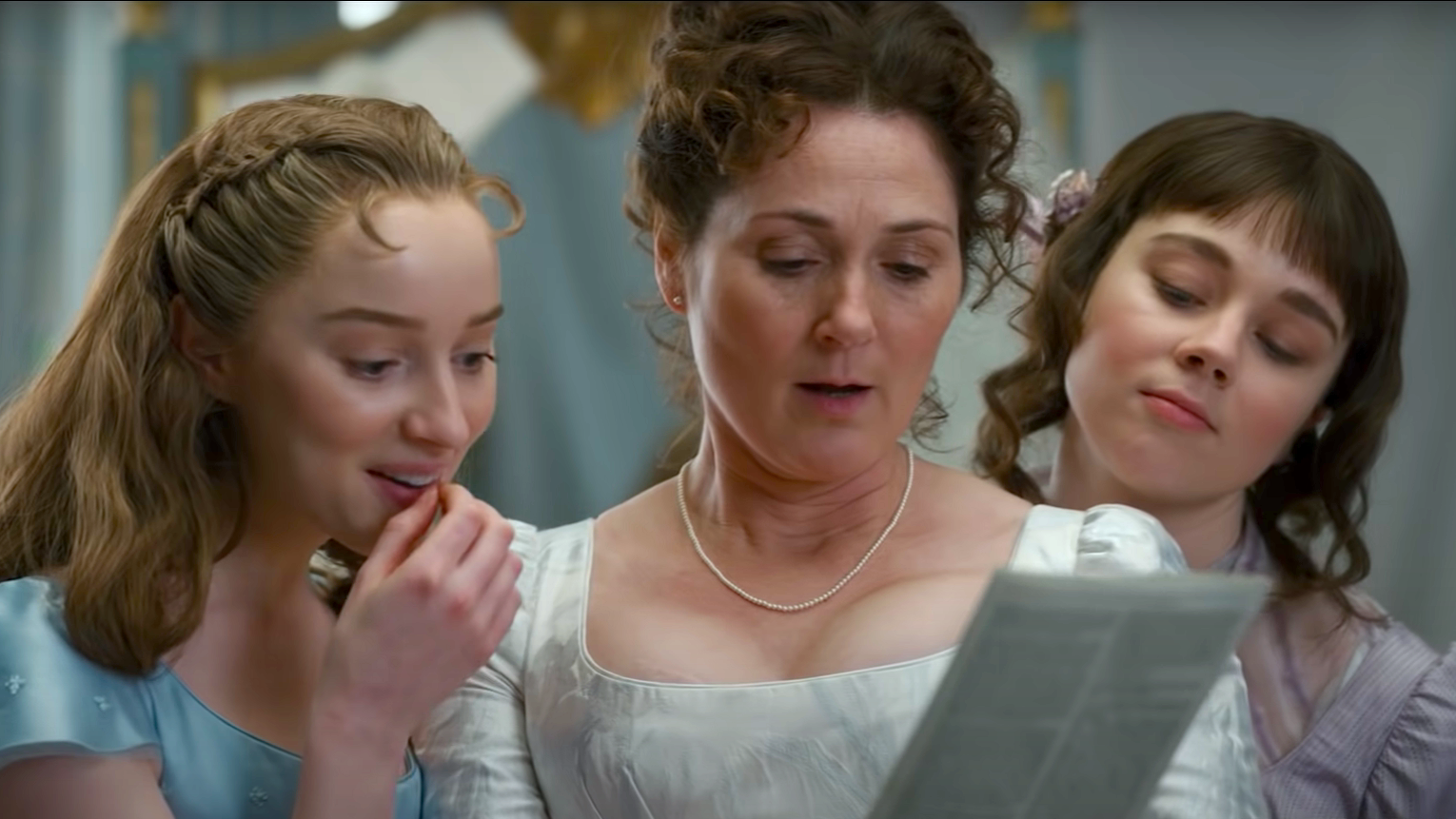
By meeting these three criteria, gentle art can create a space of freedom from the violence of the world, without thereby becoming unserious. Strether in Paris is an altogether different proposition than Emily in Paris. You needn’t rush out to get a copy of The Ambassadors to get gentle (though I doubt you’d regret it): I’ve found a similar aesthetic in more recent works like Autumn de Wilde’s Emma. and the novels of Ali Smith, and I’m sure it’s visible in many other works. Such stories offer, perhaps, only an “illusion of freedom”—and it is important to acknowledge that this particular illusion is constrained by the fact that everyone in The Ambassadors is white, and most of them don’t have to work for a living. But these are not necessary conditions of gentleness. What makes gentle art gentle is that it finds the story of co-presence and affiliation in the posited absence of violence. As crises accumulate, don’t go easy on me, but please, be gentle.

Please Just Let Women Be Villains

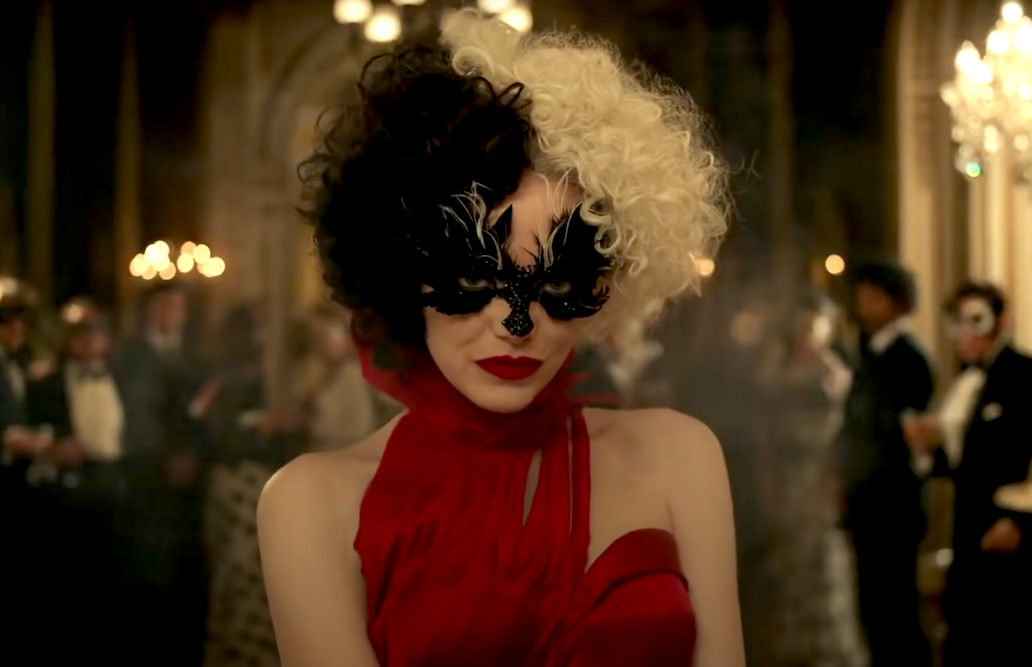
When the trailer for Cruella dropped, Twitter greeted it with jeers. People mocked it for being too much like The Joker; too much like Disney’s earlier film Maleficent; too much like Warner Brothers Birds of Prey— and contributed tweet after tweet about what an odd choice it was to rehabilitate Cruella DeVil in particular: a character who spent her original 1961 film trying to kidnap and kill puppies to make their skins into a coat. 

This seems far from the response Disney expected. It introduced the trailer with the tag line, “Brilliant. Bad. A little bit mad,” calling to mind the oft-quoted characterization of Lord Byron by his ex-lover Lady Caroline Lamb: “mad, bad, and dangerous to know.” The allusion carefully positions Cruella not as a villain, but a Byronic hero: a talented, melancholy rebel, tragically misunderstood by their society. Cruella’s dialogue also reflects this, as she explains: “From the very beginning I realized I saw the world differently from everyone else. That sit didn’t sit well with some people. But I wasn’t for everyone.” Cruella is not, therefore, a two-dimensional villain who likes to kill dogs and inspired a song that rivals “You’re A Mean One, Mr. Grinch” as a Renaissance blazon of bad qualities. She is a misunderstood #girlboss whose actions will be justified by the film, and whose actions most likely were in reaction to bad things other people did to her first… a hard sell for literally cartoon villain whose name is a pun on “cruel devil,” and who lives in Hell Hall.

Cruella is the reductio ad absurdum of a long trend of redemptive retellings featuring pop culture villainesses.

Cruella is the reductio ad absurdum of a long trend of redemptive retellings featuring pop culture villainesses. These female villains are introduced in two dimensions—quite literally, in many cases. But when given depth and turned from antagonist to protagonist, their narratives take on a curious similarity. These recentered stories aren’t a straight retelling of events, but a complete restructuring of the narrative. We don’t merely get the villain’s perspective; we get her justification. She had to kidnap Dorothy, curse a baby, smuggle a machine gun into a mental asylum, or kill a hundred and one puppies. We, the audience, just didn’t have the whole story. We didn’t know the context of her actions—which exonerate her. And in the end, she really wasn’t punished for her crimes in the end, but redeemed—so you see, she isn’t really a villain! She was just tragically misunderstood. She was good all along. 

We don’t see this sort of reboot with say, Jafar from Aladdin, or Count Olaf from A Series of Unfortunate Events. Even Joker allowed its main character to exist within a realm of moral ambiguity; though it was clear social systems had failed him on every level, the movie makes no apologies for Arthur Fleck’s descent into murder. But when big media conglomerates decide to make their villainesses—their literally cartoonishly evil villainesses—into main characters, they also make them into heroines who repent of their evil ways, while also demonstrating that they were never really that evil after all. 

American culture tends to want to explain away the evil actions of women—mostly fictional women, but sometimes real ones—because female villainy rests uncomfortably with lingering cultural perceptions of women’s purity and virtue. The idea that all women must be innately virtuous took form in the mid-19th century, in the movement towards “True Womanhood,” which historians like Barbara Welter have dubbed “the cult of domesticity.” Building off of the late 18th-century idea of “separate spheres,” which claimed that innate gender differences made men more suited for public life and women for private life, the cult of domesticity provided social regulation for the rapidly expanding American middle class and a sense of social stability in a time of great political, economic, and societal upheaval. Middle and upper-class white women became revered for the domestic labor to which they had been confined: social regulation enshrined as near-religion. Women were the center of the family, the light of the home, and the angel of the house. “True Women,” as Welter put it, were known by their domesticity, submissiveness, piety, and purity. In a case of mingled cause and effect, women showed their mastery of the domestic sphere by displaying these qualities, and the display of these qualities proved that they were naturally fitted for that sphere because they were more pious and pure. Indeed, they were naturally religious and moral. Popular fiction of the time often showed criminal men redeemed by the virtue of a true woman. Their moral fiber was perceived to be so much stronger and purer than their male counterparts that a woman could never really commit a crime, and a woman who did commit a crime must have been tricked into it, or led into it by the bad influence of men. Within this structure, such a woman then becomes “fallen.” And yet the very language of exclusion centers on the angelic nature of woman. She is not bad or evil or a villain, she is fallen, like an angel into hell.

Middle and upper-class white women became revered for the domestic labor to which they had been confined.

More than 100 years later, this idea of women’s inherent goodness has proven hard to shake. The cult of domesticity centered around cis white women, whose virtue is still used as a pretext for violent rhetoric and action against Black and trans people, from whom their purity must be protected. And in fiction, when pop culture focuses on a woman who committed a crime, it’s either a cautionary tale or one of these rehabilitation stories, focused on the idea that the villainess’s fallen state is not her fault and is certainly not permanent. 

This justification (it isn’t her fault she’s a villain) and the means of showing it (recentering a popular narrative around a female villain) reached popular prominence in 1995, with Geoffrey Maguire’s novel Wicked, and with the musical adaptation in 2003. Both the book and the musical reconsider the Wicked Witch of the West from L. Frank Baum’s The Wonderful Wizard of Oz. The witch, whom Maguire named Elphaba, does have a song in the second act of the musical where she makes a conscious commitment to give up trying to be good, but the show goes to great lengths to point out that Elphaba was not born wicked, and though she may make a big show of giving up good deeds, she never consciously chooses to do an evil one. Her greatest sin in the show—animal abuse in the form of magically creating flying monkeys— is something she was tricked into, and her villainous reputation thereafter springs mostly from Elphaba setting herself up as the Wizard’s enemy, and the Wizard mounting an extremely effective PR campaign against her. In the end, Elphaba regains her goodness by playing into stereotypes about her villainy and then completely rejecting her wicked reputation. The Wicked Witch dies because her soul is so unclean, water can melt her; Elphaba lives thanks to a trap door, and gets her “happily ever after” with her love interest, outside of Oz. 

Maleficent, Disney’s first retelling centering on a female villain, likewise uses its reframed narrative to prove the heroine’s inherent goodness but gives her even less agency in her fall from grace. In the original 1959 Sleeping Beauty animated film, evil fairy Maleficent curses the infant princess out of pique at being left out of the baby’s welcome party. This is an enjoyably petty reason for committing a villainous action—who hasn’t wanted to hex someone for a social snub?—but it’s not deep or detailed or justified, because it doesn’t have to be. Maleficent enters the movie a villain, spends the film acting like a villain, and then dies like a villain. By contrast, in Maleficent, the 2014 live-action movie that revisits the character’s early life, she begins in innocence in an almost Edenic forest, and falls in love with her childhood friend, Stephen. Maleficent is a fairy guardian of a beautiful natural landscape and fights only to protect it. But what turns her into a villain, complete with a costume change from earth-toned gauzes to heavy black draperies, is a heavily implied (the film is rated PG) sexual assault by an intimate partner: Stephen drugs Maleficent and cuts off her wings. 

In pop culture, sexual assault is still one of the most common motivators for female vengeance—and, by implication, an acceptable justification for a woman committing a bad or violent action. If Stephen gave her “true love’s kiss” and then cut off her wings, thus proving that true love does not exist, then it is not only appropriate but righteous for Maleficent to curse his baby to die, with the caveat that only true love’s kiss can save her. (Elphaba, at least, chose to oppose the Wizard and thus be branded wicked.) In the end, Maleficent provides “true love’s kiss” herself, and regains her wings, returning her to the angel she really was at heart. 

Harley Quinn, in the 2020 Birds of Prey, also ascribes the heroine’s misdeeds to trauma. The film opens by showing how her father abandoned her and her boyfriend abused her and how this led directly to Harley’s transformation from psychologist helping to rehabilitate villains to becoming a villain herself. Once Harley is free of their influence, however, and has real female friends, she becomes a hero of Gotham. She does not choose to be a villain; the emotional abuse she experienced from the men in her life is the true cause of her crimes. 

They don’t commit evil actions because they want to; they do it because they have been tricked or because they have been so wronged, they have no other choice.

In an odd way, these updated villains have less agency than their initial incarnations. They don’t commit evil actions because they want to, even if the want is extremely petty; they do it because they have been tricked or because they have been so wronged, they have no other choice but villainy— which is more a reaffirmation of a damaging patriarchal stereotype than a refutation of it. But this still leaves us with the fact that the traditional literary and pop culture canon is dominated by male creators, and many of their best female characters are, in fact, villains. If we want to interrogate those traditional, familiar stories by centering the most interesting and compelling female character, how should we do it?

Madeline Miller’s Circe has one good way forward: allow female characters to exercise their agency by consciously choosing to do evil, and then to repent. Circe transforms her romantic rival Scylla into a monster not because she was tricked into it, or because she didn’t know what would happen, or because she was so wronged she had to redress it, or because someone had done something so bad to her it rattled her sense of right and wrong. She did it because she was jealous. She wanted to do it, so she did. Circe’s later regret over this evil deed drives her actions at the climax of the book, where she rights this wrong by killing the monster Scylla’s become. Having chosen to do evil because she wanted to, her choice to do good— again because she wants to—shows her growth and gives her moral journey real weight. 

Circe has the benefit of being a novel, rather than a corporately owned and produced piece of intellectual property. Miller had the creative freedom to rehabilitate her villain in a way that is truly transformative, rather than reinforcing outdated ideas. But the book shows that a villainous character can remain fully culpable—Circe deliberately turned another nymph into a monster and owns it at every opportunity—without being unrelatable, uninteresting, or unsympathetic character. Hopefully the HBO Max adaptation of Circe will preserve what makes it so truly interesting a retelling starring a female villain: its instance on and its acknowledgement of the fact that giving a female character agency means that sometimes the character will choose to be bad. 

Dating After the Worst Day of Her Life

“Exuma”
by Emma Duffy-Comparone

Gina wasn’t big on kids, but on an individual basis, like dogs, they could be all right. So when she got fired from the nursing home where she was the activities director, she decided to become a nanny while she looked for a new job. She interviewed with mothers and asked to hold the babies: Aidan and Hayden and Braden. She cooed and smiled to her molars. She called them honey bunnies. She asked if they were silly billies. She insisted she didn’t mind—No, really, I love it!—when they ripped fistfuls of hair from her head.

“I’ll certainly read them something,” she said, when asked if she liked Dora the Explorer. “I’ll keep them safe.” Parents liked that she was thirty-four. They liked it very much.

A family in town hired her. The boy was nineteen months. His name was Malachi, which Gina thought was unfortunate. She called him Mallie, and Kye, and sometimes Malocchio, but it was only a joke!

He shrieked all day like a bad oboe, and it made her sweat.

Her left pit always smelled worse than her right: it had since middle school. She lugged him around on her hip, the family collie bursting past her on the stairs, and shakily sang, “It’s okay, it’s okay, oh, I know it, it’s okay.” He wouldn’t quiet, not even when bribed with an extra bottle of warm milk, not even when she tangoed to the “Baby Beluga” song for him and blasted her shin on the dishwasher door, not even when she let him suck on his binky outside of naptime—which, the mother told her, eyes wide with disapproval—risked binky addiction.

The shrieking never stopped. Neither did the lime-colored mucus that sat in his eye like a slug.

Now and then she could get a little loose. Sometimes, when he woke up early from his nap, she didn’t go in right away. Not for that long: five minutes, maybe twenty. One day, she grabbed a bottle of vodka from the top of the fridge, shook it like a trophy, and yelled, “Why don’t we just have a big drink!”

Once she gave him the finger.

But she was conscientious! She chopped food twice so he wouldn’t choke. She wiped the green thing from his eye with warm washcloths. She kept him away from her cell phone, for fear of baby radiation. And on a December noon, after a blizzard, she dressed Malachi in his snowsuit (with two hats!) and put his mittens on (before his jacket so they would stay on better!) and propped him in the blue sled she found in the garage. His parents did not encourage her to take him outside. It was too messy, they said. It was too high-maintenance.

It was good snow, the kind that stuck, blown into swells like a frozen sea. A baby had to see that, Gina thought. A baby had to smell it. She pulled him down the sidewalk and pointed to things: ice on branches, little red berries dropped in the snow, a cross-country skier, a shovel in a bank, a blackbird. When she crossed the street, to Prescott Park, where she would build him a fort, a car scissored around the corner, hurtling toward them sideways. As she tried to yank the sled out of the way, she watched a bit of blue vanish under the bumper.

Two hats did nothing, nothing.


It made sense, Gina thought, that she lived in a house wrapped in ivy. She was a gnome. A forest gnome, living on the third floor. A Bertha Mason forest gnome, with a fire escape. Now, in June, the house was disappearing altogether: just a big leafy thing with double doors.

It was a brick Federalist house, down the street from Strawbery Banke, the settlement from 1650, where volunteer actors walked around in elfin shoes and whisked eggs with sticks. When Gina moved in, she had been excited. She had planned to water the flower boxes each morning through the window, like something out of an opera. She had a bright galley kitchen with a pantry. She had a fireplace and a window seat, perfect for quiet, self-possessed reverie. But the flower boxes just had dirt in them, and she mostly ate soup out of a can, and she wasn’t into quiet, self-possessed reverie these days.

She was into TV.

Her friend Joanne came over a lot and watched with her. She worked for the Human Rights Campaign, a nonprofit for marriage equality, and spent her days driving around New Hampshire, badgering pastors. Joanne was gay, or gayish: she wasn’t sure. She liked men fine, but she had begun dating a woman from work. She had sex, she said, but only half of it. She could only receive so far. Couldn’t handle giving yet.

“Surprised the ladies aren’t banging down your door,” Gina said.

Joanne was afraid she’d be bad at it. She wasn’t even a good masturbator. Why wasn’t she a good masturbator? There was something symbolic about that, she thought, some gross deficit of self-awareness. “I’m working up to it,” she kept saying.

“Down, baby,” Gina said. “Work down.”

After work, Joanne brought ziplock bags of homemade soup and pints of lemon sorbet, which she put in Gina’s freezer. She brought movies from the library in tote bags. Sometimes in the bottom was a self-help book or the folded classifieds with a few yellow circles on it.

Once in a while, Joanne drew a bubble bath and made Gina sit in it while she kept her company, painting her toenails on the toilet seat or standing in front of the mirror and studying her hair. “Look at this,” she had said last week, pulling at tufts and moaning to herself. “Do you see this?” She took out scissors and began clipping indiscriminately, dropping hunks into the sink. “You know those old wigs with the hanging things here?” She held her fists by her cheeks. “I look like fucking George Washington.”

Now they were sitting on the couch passing a sleeve of water crackers back and forth. Gina liked Channel 3, which didn’t have any shows except a montage of images from the Seacoast to attract tourists—crabs poking in and out of holes, lighthouses, maple trees. You didn’t really watch it. You just had it on.

A lobsterman in waders was tossing traps from his boat, but then the image changed to the shoreline: a mother, a baby squatting to touch a shell.

Joanne lunged for the remote and changed the channel. Jane Fonda from the eighties appeared in a belted leotard. She had  a sweat going, walking in place with five-pound weights. She was asking the women behind her if they were ready for buttock tucks.

They watched it for a while in silence.

“The one in the back,” Joanne said finally. “That’s her step-mother. I think she’s younger than Jane.”

“Which one?”

“The one with the crazy wedgie. Frontal action. What do you call those?”

“Should I be calling them something?”

“Shit, what was it? Donkey something.”

Gina looked at her.

“Or camel—camel toe!”

“Camel toe.”

“Yeah,” Joanne said. She tried to demonstrate with her hands for a minute. Then she stood up and pulled the elastic of her sweatpants up near her chin. “See?” she said, nodding toward her crotch. “Like a hoof.”

Gina chuckled. Joanne was a good friend.

“Thanks,” Joanne said, straightening her pants. “Thanks for laughing.”

After Joanne left, Gina trudged down to the fish market to buy a six-pack of beer. She drank all of it. Her mother called but Gina didn’t answer. She ate Joanne’s minestrone and put the rest of it in a pot; there was something terrible about soup in a bag. It made her think of a hospital—of Ringer’s solution, of blood. She went to bed and tried not to dream, but did.


Joanne’s girlfriend was the manager of the old theater in town, and they needed a projectionist. Gina had worked as one at her college movie theater for a few years after she’d graduated. “This will be good,” Joanne said to Gina, who had used up the last of her savings on rent. “You have to get out.”

Over the past five years, a board of millionaires had sponsored the hall’s restoration and renovation. It had velvet seats and a large rotunda with a mural of cherubs on clouds.

“They recently restored the artwork,” Joanne’s girlfriend said. Her name was Veronica Messenger, and she wore glasses with green lenses. “It was painted in 1914. Isn’t it magnificent?”

“Oh.” Gina looked at all the naked babies on the ceiling. She suddenly could not walk, could not do the left and right of it. She would have to wear a floppy hat to work, with a big brim, so she could see only her shoes. Or one of those suits for beekeepers with the metal face shield. She could wear that.

Or she could wear both and then jump off a roof.

“You know, Veronica,” she whispered, “I don’t think I can work here. I don’t even like the movies. I forgot all about that.”

“Joanne said you were funny,” she said, and motioned for Gina to follow her up the carpeted staircase, which was burgundy and soft. Gina held on to the golden ropes that ran along the walls. She looked at framed pictures of Pavarotti and Sting and Wynton Marsalis. A few retired Nutcracker rat masks hung there, too. At the top of the stairs, people in silver vests were making popcorn behind a counter. They smiled and said hello.

Veronica introduced them: Jerry and Marge. They were volunteers.

“Nice to meet you,” Gina said.

The projectionist’s booth was on the third floor, behind the balcony. The ceiling dipped, and Gina had to stoop. A large copper padlock hung from the door. “Sorry,” Veronica muttered, yanking at it for a second and then fishing in her pocket for a key. “That was Henry’s thing. He was the guy before you. He locked it from the inside.”

“Really.”

“Anyway, the restoration didn’t make it this far. Ran out of money.”

The projector stood in the center of the room. The booth had a leather chair with wheels. Stained cotton poked through a long rip in the back, as if the cushion had been slashed with a knife.

Veronica showed her how to lace up the projector. “We only have one, so we do an intermission while you change the reel. It’s sort of our claim to fame. Increases sales, too, because they liquor up at the bar. Makes a night of it, like a play.”

“Smells like Henry was enjoying a few butts in here,” Gina said.

“I’m sure he was enjoying lots of things in here,” Veronica said. “I’ll get that lock off the door and we’ll clean the place up a bit.”

“It’s all right,” Gina said. “I don’t need anything special.”


Each night Gina arrived early and scurried up to the third floor. She threaded the film in long loops and drags like a big sewing machine. Then she sat in her chair, listening to the quick shudder of film, and watched its beam shoot through the rectangular window, a bright tunnel of dust in the dark.

Sometimes, during a showing, she sifted through broken filmstrips that Henry had saved in a shoebox. Time was frozen in a little square, like a postage stamp, laid out for you to consider. If you liked a moment, you could linger there. Otherwise, you could skip over it. You could cut it out with scissors. You could rewind before you got to it. You could pause it and stay forever in the second before, when you were just pointing to a blackbird in the snow.

You could say, I choose not to watch this fucking movie at all, and put a lit match to it.


Every Wednesday they showed an oldie. On those nights they gave out black licorice and opened up the balcony, where Gina peered out from her booth. She had begun using Henry’s lock on the inside of the door—partly for the novelty of it, partly because she had truly reached gnome status. She decided to embrace the role. Celebrate it. She would wear it like a cloak.

Rear Window was one of her favorites. Grace Kelly had brought slippers in a compact handbag and Jimmy Stewart was breaking out the telescopic lens. Gina thought about getting one for herself. After all, she had begun opening her blinds.

She saw a woman sidestepping past knees toward the aisle. People were standing up clutching popcorn buckets. Gina recognized Malachi’s mother: hair curled in a rock at the neck, shoulders stooped, a smooth little nose. Her husband wasn’t with her. Gina remembered hearing he had moved out and was renting a room downtown over the brewery.

Gina ducked and dropped hard onto her knees. She trembled and held her own hand. There was no one else to hold it. The first reel ended, and the tail flapped as if tied to a bicycle. She rocked on the floor. Five minutes passed, or more. She rocked like that, and rocked. She heard people calling up from the seats. A strong voice was yelling, “Is everything all right in there?” Someone was banging on the other side and jiggling the knob. Henry’s lock bounced. The room was silent for a moment. Then the door was suddenly struck, gave way at the top hinge, and spun crashing into the room. A man was groping for switches: the projector, the house lights.

A pair of pointy blue shoes was asking her, Gina, if she needed a tissue or an ambulance or a drink. Hands were on her shoulders, and when she did not speak, they slipped around her, under her knees, across her wing bones—she felt thin and clumsy, sexy as a hat rack—and lifted her up. She was pulled from the booth and carried down the carpeted staircase, her head bumping the wall, her cheek grazing the hanging witch mask, her long legs emerging from her skirt and dangling— they were so hairy they could be a man’s, Gina realized—over the golden ropes. She grew hot in the face. “Put me down, please,” she said, pushing at the man’s chest, but he only held tighter and continued to walk. “This is really fucking bizarre.” People milling downstairs looked at her, at those legs, perhaps even at her underwear, which, she had absently observed that morning but was now remembering with acute accuracy, had a hole that a tiny hedgehog of pubic hair poked through.

The crowd murmured, taking in all that Gina had become, and parted like water to a prow.


His name was Eric and he looked about forty. He had all his hair, which was black, and a red beard. His chest was wide, which made up for the height he did not have, and he whisked her—he appeared to have whisking issues—down the street to a bar she had never been to, where he called the waitress by name and ordered two fancy-sounding martinis before they even sat down.

“I’ve had them in Exuma,” he said.

“Eczema?”

“No, Exuma. Like, you know, to exhume.”

“Never heard of it.”

“They have these colorful fish there that you can swim with. Parrot fish. They just swim around you. Sometimes you just can’t believe how fucking beautiful the world is. You know what I mean?”

“No.”

“Well,” he said. “It’s the perfect escape.”

They were sitting at their third table. The first one, Eric declared, was too close to the bar and the second had too much light. “You’re very particular,” Gina had said, padding behind him from booth to booth.

The waitress placed their drinks on the table. “Thank you, my dear,” he said. He spoke loudly, with importance. “Let’s take good care of our Gina.” Our Gina. He was an asshole. A whisker, too, a loud one. She would drink her eczema martini quickly, Gina decided, and then crawl out the bathroom window.

Eric was the new president of the theater’s board. He said he had worked for fifteen years as an independent producer for Pixar. Now he had lots of money he didn’t know what to do with, so he funded things.

“That must be nice for you,” Gina said.

“I write these checks, and they want me to show my face. But the movies! It’s all incest and abortions these days.”

“I like those movies,” Gina said hotly. “Those movies are very true to life.” She couldn’t remember the last time she had been in a restaurant. She felt overexposed and paranoid. Her eyes were sore, shot from too much TV. All around her were Grecian-looking busts of women with hair tied at the neck. They were in the window and on pedestals next to plants. She could not stay in this restaurant. She could not stay in this town. She would move to Fort Myers and live with her mother. She would play Bingo. She would become the youngest Bingo player in Florida. Then she would die. She would ask that her ashes be scattered over something ugly, like a parking lot.

“So depressing,” he was saying. It seemed he was still talking about the movies and using his hands to do it. They were big hands. They had touched her back and the skin of her legs. “I mean, Christ, I can have a bad day on my own, no problem. I don’t need any extra help, you know?”

“Sure,” Gina said, drinking with both hands now as if out of a goblet.

“Of course,” he said, winking. “You’ve had a beauty of a day, yourself.” She let the wink slide—the man had hauled her hairy legs down the stairs. “You should eat something,” he said, holding the menu but not looking at it. He was looking at her. When he blinked, it was catlike, imparting meaning that she couldn’t quite interpret.

“I should go,” she said. “Thanks for the drink and before with—with the thing.”

“Don’t go,” he said. “You don’t have to explain. I get like that during my annual physical. Nothing like a finger up your ass when you’re wearing a paper dress. The nurses have to carry me in sometimes.”

“Really,” Gina said. She stared at him.

“I’m joking!” he said. His teeth were so white they were blue, with an impish gap between the front ones.

“I realize that.” She put her drink down hard and it tipped over, breaking. The olive rolled off the table and across the floor like a tiny head.

“Oh, boy, there she goes again,” he teased, grabbing a cloth napkin to push the glass into a pile. Gina took one, too, and ducked under the table to wipe up the floor. She looked at Eric’s Shakespearean shoes. “It’s just a drink,” he was saying from above. “I’ll get you another one. I’ll get you five!”

“Eric,” she said, sitting back up. “You seem to be wearing slippers.”

“Slippers?” He lifted his foot up over the table. They were suede and pointy and baby blue. “These are Prada,” he said, grinning. “I paid too much for them and they can’t get wet.”

“That’s nice,” she said.

He put his leg down and sighed. “Where are you?” he asked. “What can I do?”

“Nothing,” she said. “But thank you.”

“What if I held your hand?”

“My hand?” she said. “Oh.” She set one on the table and looked at it, as if it were something at a yard sale. “That would be all right.”


They spent most of the time at Eric’s place. He was living at the Wentworth by the Sea, a rambling hotel on New Castle Harbor. Teddy Roosevelt had stayed there once, and the royal family. Eric had been working on a divorce for a few years and hadn’t gotten around to finding a real place.

“I’ve grown to love it,” he said. “There’s something cozy about coming downstairs for a real dinner. I never had that as a kid. I just made myself cornflakes and cold cuts.”

He was staying in the Turret Flag Officer’s Suite,  in one of the two towers of the hotel. The second floor had a raised canopy bed with a dust ruffle and lots of crimson tassels. Each of the four walls had a little porthole window. The room had a chaise longue, too. “I just sit in it so I can say I sit in a chaise longue,” he said. “It’s probably from IKEA.”

Sometimes Gina let him come to her apartment. He helped with little things: the dust bunnies churning across the floor, big as Ferris wheels (“Down, girls, down!”), her rank sponges, the laundry under the vacuum. Gina had started a pile of it on the bottom of her closet and used that instead of drawers, wearing the same thing over and over, shaking out the wrinkles once in a while, putting deodorant on the outside to make it smell fresh.

“What do you mean, on the outside?”

“It’s fairly straightforward, Eric,” Gina said one late afternoon, a little edgy from watching him flutter around her house in his fancy shoes. She showed him—lifting her arm, dragging the stick across her shirt.

“Oh, the crime!” he cried, and fell dramatically onto the couch. He brought her down to her basement by the hand. “We’ll do a sock load first,” he said. “We’ll start with white ones.”

She stood there in her bare feet. The basement was unfinished, with a boulder in the middle of the floor. “I don’t think I understand.”

“Take all of your socks and put them in here,” he said. “Socks? Oh, no,” she said. “I just do it like this.” She shoved clothes into the machine. Then she stomped on them with her foot. “Like that. I just put them all in together.”

He washed her windows with newspaper and vinegar. He planted begonias in the flower boxes. He even bought a bergamot candle and trimmed the wick for her. “Burns funny, otherwise,” he said.

“I didn’t know straight men bought candles,” she said, sniffing it for a long time. Then she hugged him, the warm animal of him.

She didn’t tell him about her past and he never asked. “You were a stray cat stuck in a tree,” he liked to say. “You just climbed too high!” He often narrated the story as if she hadn’t been there: “And then I was carrying your beautiful body down the stairs, and I had been working out lately, luckily, so I was only sweating a little. Just the pits!”

Sometimes, when Gina was at work, Eric would sit in the balcony. “All the movies look better when you do it,” he said. He had screwed the door back into place (“That was pretty manly, if I may say so myself”) and brought in an old fashioned fold-up stretcher, which he stuck in the closet, just in case. He thought that was very, very funny. When the movie began to play, he would clap. “That’s my Gina!” he’d yell out to no one, his hand happily dawdling in his popcorn.

Afterward, he would stand at the top of the stairs while she closed up the booth, thanking people for coming: “She has such a touch, doesn’t she?” he’d ask them. They would smile, confused and slightly alarmed, and push their way down the stairs.


Gina grew to like Eric’s tower and its constant sense of occasion: the soaking tub as big as a rowboat, the white-gloved room ser- vice, the bleached sheets, changed too often for them to smell of anyone or anything. She spent more and more nights there and left her clothes in the nineteenth-century chifforobe. At night, she peered out the porthole windows at the harbor and could have been anywhere at all.

Joanne came over to the hotel now instead of Gina’s apartment. If Eric was around, he’d head to the library to give them privacy. Then he came home hours later bearing takeout and little gift boxes of cannoli, and the three of them played gin rummy.

“You haven’t fucked him yet?” Joanne said.

“Do you feel you’re in a position to ask me that?” Gina said.

Veronica had dumped her. “Do you even like him?”

“Sure,” Gina said.

“The guy’s besotted.”

“I know.”

“I say this with love, Gina,” Joanne said, “but I really don’t see why.”

She would have to sleep with Eric eventually, Gina knew. He had been kind enough not to push it, though she wasn’t sure if she should have been grateful or insulted. She some- times practiced her explanation out loud: “It doesn’t do it for me, really.”

“I’m celibate.”

“I’m emotionally celibate.”

“I’m a eunuch.”

At the top of the tower, they would lie in Eric’s  bed. In the dark he touched her body. He dressed the wound of her, attended to things in silence: a nipple, a knee, the soft coin at the bottom of her spine. At times she gave into it, but then her mind wandered somewhere unsafe—to a tiny coffin packed in snow—and she would turn from him, grateful for the weight of his arms.


On the last Saturday of October, the theater was having its annual sponsorship gala. All of the wealthy art appreciators would be there, with their berets and neutral-colored shawls. Eric, as the board’s president, was in charge of picking the location. He had reserved the Wentworth Banquet Hall downstairs and had spent an agitated afternoon in his tower, rearranging the furniture in his boxers. He would push a couch to the other wall. Then he would stand in the middle of the floor, eating a package of gummy bears, considering his decision. Gina watched this process from the bathroom, where she was filling the tub.

“I liked the couch where it was,” she called over the running water.

“It was all wrong,” he said, his back to her. “If you sat there you felt like you were in time-out!”

“You’re very busy,” she said, lowering herself into the bath. Sometimes it got so hot in there she thought she was going to vomit.

“I know,” he said. He dragged a wingback chair over by the gas fireplace. Then he slumped into it. “It’s just—what if no one has a good time? What if people hate the hors d’oeuvres? They always hate the hors d’oeuvres.”

“All you did was reserve the room, Eric,” Gina said. “Give yourself less credit.” She had put bubbles in the bath. She liked that. She also liked to let her hands float in the water. She let them float like that until she couldn’t feel them anymore, but only see them, as if they were mannequin hands.

The party started at six o’clock. At two, Eric left to pick up his suit from the dry cleaners and do a few other errands. “Will you be okay here?” he asked Gina, standing by the door.

“I’ll be fine,” she said. She was doing a yoga program she had found on TV. She had begun to return to her body a little. It was an old body, tight and dry as a corkboard. She looked at him upside down, framed between her legs, as if he were someone on a postcard.

“You look good like that,” he said, a little sadly, and walked out the door.


At four o’clock, Eric rushed in with his suit in a plastic sleeve and a large shopping bag with two gift boxes in it. “Open them,” he said. She did. Inside were a black dress and a pair of high heels. “They’re just Nine West,” he said, pointing to the shoes. “I wanted to get you Prada, but you would have hated them.”

Gina held the dress up to her body. It had long sleeves and a simple, sweeping V-neck. “It’s beautiful,” she said. “How did you pick it out?”

“I had one of the saleswomen help me. I told her you were no-nonsense. ‘Gray or black!’ I told her. ‘She only wears gray or black. She’s not showy—I’ve never seen her look in a mirror!’” His blue teeth shone.

“Thank you for this,” she said. “It’s very kind.”

“Yeah, but will you wear it?” he said, pulling her to him, grinning. He hummed frantically—something with no melody—and led her in an awkward jig around the bed.

“No,” she said finally. “I can’t go to that thing. I don’t want to be in public.”

“Right,” he said. “You never want to be in public.” He let go of her arms. “Fucking Jesus.”

“What?”

He seemed to be thinking. “You really could consider trying once in a while,” he said finally.

“Meaning?”

“Try—I don’t know! Do you even like me?” He made a face and put up his hands. “I didn’t mean that to sound as whiny as it did.”

“Of course I like you,” Gina said.

“I get hugs. Sometimes I don’t even get those.”

Gina was quiet.

“I don’t know where you are, Gina, but you’re not in the world. You need to be in the world.”

“Don’t tell me where I need to be,” she snapped, running down the spiral staircase. Downstairs, she shut herself in the bathroom. There was a little nook for the toilet with a pocket door. She shut herself in that, too. She put the seat down and sat on it. There was a phone on the wall. You couldn’t even take a shit anymore without being in the world.

Minutes passed. Gina heard a gentle knock on the outer bathroom door. When she didn’t answer, she heard Eric’s feet pad away. Then the phone rang. In the small space, it was as loud as a siren. After five rings, she picked it up.

“Gina?”

“What.”

“Please come. It would mean a lot to me if you were there.”

“It would?”

“Look, I’ll tell you what. Come to the party and I’ll fly you to Exuma.”

“Exuma?”

“Exuma. Remember, with the fish? Tomorrow I’m going to get us two tickets. Forty-eight hours from now you’ll be floating in a turquoise sea, numb from a margarita. You won’t even remember your name!”

“Oh,” she said. She had never liked her name. “That does sound nice.” The nook was growing hot and close, like a tomb. A tomb with a toilet, no less. A toilet with a fancy gold handle.

“Everyone needs an escape, Gina,” he said.

After she hung up, she sat for a long time. An hour, maybe. Then she pulled back the pocket door. In the larger bathroom she stood in front of the vanity. The sink bowls were copper. There was a stack of small white towels. It was the kind of sink you wanted to wash your hands in just for the sake of it.

So she did.


By the time Gina stepped out of the elevator, she was an hour late to the party. She walked into the banquet hall, where people were milling with drinks and greasy napkins in hand. A long table ran along the back wall with silver serving platters. The hors d’oeuvres had been picked down to the nubs— severed shrimp tails, yellow pepper seeds, felled toothpicks with colored hats. Now people were helping themselves to slices of meat, the ribs of its animal bared and open on the table. It made Gina sick—the hostility of it, the shame. She ate a warm square of cheddar and a few grapes with browning navels. Then she situated herself behind an ice sculpture of the Greek masks of Comedy and Tragedy, popping her heel in and out of her shoe, feeling displaced and panicked, like a penguin on a plane. She looked for Eric but didn’t see him anywhere. She smiled at a few people she had never seen before and scanned the room for the booze.

After three glasses of champagne, the roof of her mouth dry-walled with cracker, she finally saw Eric’s back. He was talking to a woman with sexy braids—they were messy and relaxed, as if thrown together at a stoplight. She watched them for a while. Gina didn’t understand those women, those women who could look good like that. Eric was holding up one foot, showing his blue shoe, and they were laughing.

Braids weren’t that great, Gina decided. They were just tails sticking out of your head. It was like saying, I have two assholes on each side of my head. She went back to the elevator, to the tower, to the room with the portholes, straight to the IKEA fucking chaise, where she lounged, and where she drank a lot of wine.


“You never came,” Eric said, at ten o’clock, draping his suit jacket over the plasma TV. He was in a good mood. Gina was under the covers in her dress and shoes.

“I came,” she said. “I came and went.”

“You did?” he said. “You should have found me!”

“Who was that woman?”

“I have no idea. Was there a woman?”

“Braids.”

He thought about that while he took off his tie. “Oh, that was Amy. She’s on the board. She’s a glassblower. She blows glass.”

“Oh,” Gina said. “She blows glass.” She flipped her pillow and smacked it. “Well, in that case.”

Eric turned off the light and got in bed with her. “Can this place make a bed or what?” he whispered, kicking his feet joyfully under the covers. He turned on his side and tried to drape a leg over hers. She felt his foot bump her high heel and then yank back. Then he touched it again, tentatively, and pulled back. She yawned.

“Honey,” he whispered. “You got your shoes still on.”

“I know that, Eric,” she said.

“Oh,” he said. He was quiet for a long time. She could feel him studying her in the dark. Seagulls wailed from the roof. “I like it,” he said. “I think it’s hot.”

“Hot,” she repeated.

Really hot,” he said. He moaned softly and made a show of buffing her shoe with his foot. His leg hair made an animal scratching sound under the sheets.

“No, you don’t,” she said.


When she woke up, Eric was gone. It was four in the morning. Gina got out of bed and looked around. His suit jacket was no longer on the TV. The closet was open. She looked in all the obvious places for a note—the door, the bathroom sink, on top of her shoes—but couldn’t find one anywhere. She could see from the window that his Porsche was missing from its parking spot. She called and called but he didn’t answer. She got back in bed and lay there, stiff and alarmed, until the porthole windows whitened with sun.

At ten, Gina ordered a three-egg omelet, an oily beret on a silver platter. She watched a game show where obese people weighed themselves and then clapped ecstatically.

By two, Eric still had not been in touch. Gina called him twelve times, but he didn’t answer. She drank three beers and fell asleep.

She woke up an hour later, logy and trembling. She thought about Eric’s raucous, solo applause from the balcony, about his quiet humming as he scrubbed her tub, about the way he stroked her fuzzy legs from knee to foot, “with the grain,” he called it. And the more she thought about it, the more she felt she could have tried to let him love her.

Or, for Christ’s sake, let him do a sock wash. Why hadn’t she just let him do a sock wash?

She hadn’t had enough socks. Maybe four pairs. Why didn’t she have any socks?

She wanted to raid T.J.Maxx of their argyles and knee-highs, their low-cuts and hiking wools, and run to him, hold them all up in the air—Wait! I’m here!—like a woman too late for a train.

Gina took off the dress and draped it on the bed. It was five o’clock. She put on jeans and a sweater, stuffed the rest of her clothes in a grocery bag, and closed the door of Eric’s tower room behind her. On the ground floor, she pulled the outer cage of the old-fashioned elevator open, passed two bellhops with their gloves and silver buttons, and stepped through the main double doors.

It was four miles back to town. The road wrapped along the marsh, with its battlefield of cattails. Gina could see touch-me-nots growing in the reeds. Her hands were cold, everything growing cold now, the seasons always lurching into the next: trees had only half their leaves, and soon it would be winter.

It would be winter again.

Gina walked through a section of woods, where the wind had scattered pine needles across the road. She walked on, over the wooden bridge that sang out, the river churning under her, pushing its striped bass out to sea. There were three bridges to town. On the third, the sky offered up its final strip of light. Across the water, Gina saw the old port, colonial houses clustered together on the hill, the steeple of the North Church.

At the outskirts of town, she smelled fruit burning. Jack-o’-lanterns were lit on stoops. Gina had forgotten about Halloween. It was dark now. Groups of masked children fled up the street, clutching buckets and bags and pillowcases, stumbling up stairs and down again, peering at their loot. There were witches and cats and gypsies. There were pirates and ghosts.

Some porches had cobwebs draped from the roof. Cardboard gravestones slouched in the white grass. Gina heard a cackle come from a haunted house somewhere. As she walked farther into town, she saw the quick flicker and dash of flashlights across the trees, silhouettes waiting in front doors with bowls of candy in their arms. Everyone was scuffing through the leaves.

As Gina made her way down her street, she saw the dark windows of her apartment up ahead. The ivy had dropped, baring its brick. As she looked, a group of toddlers ran around the corner. They shrieked, darting around her like quick fish, and as Gina sidestepped out of the way, one little skeleton slammed into her legs and collapsed to the ground.

“Oh!” Gina said.

She dropped her bag and stooped to pick up the little boy. “Oh, buddy.” She set him on his feet and adjusted the bones on his suit. “Are you hurt?” He shook his head. She held his arms for a moment and looked him over. “Are you?” she said. He shook his head again. The rot of crab apples was thick as a hand towel in her mouth. “What hurts?” She pulled him against her breasts. He puffed short candy corn breaths in her ear. “I tried to get out of the way,” she said.

She heard people walking around the corner, laughing. Flashlight beams skimmed the leaves. She clutched the boy. “I’m so sorry,” she said into his neck. “I tried to get out of the way!” She held him gently by the sides of his head and looked at his face. “Honey,” she said. She was weeping now. “Do you hear me?” The boy began to squirm. What happened? Parents were standing around her now, flashlights on her. Is he all right? She gripped his little face. “Honey,” she whispered, blinking into the light.

Why New Fiction Is Making Mothers into Monsters

In a column for The Cut titled “How Am I?” Amil Niazi paints a grim picture of pandemic working motherhood. In the middle of her realistic itinerary piece about care of two young children while balancing deadlines, she writes that a gaping hole opens up in her kitchen floor which is a portal to hell. “Exactly,” one commenter succinctly replies. Motherhood is monstrous this year—an impossible debit when emotions and workloads are already maxed out. The only word that comes to mind is horrific, and the literature that helps me come to grips with this time period weaves in elements of horror.

Motherhood has always suggested emotional disruption in books. The first time I read The Yellow Wallpaper in college, I thought, “impossible.” The fact that I would become dissociated from my body and reality because of the birth of a child felt sexist and ridiculous. Modern feminism wouldn’t allow women to become victims of PPD and despair. The second time I read it, after the birth of my first child, I thought, “too possible.” 

One night, when my son was about two months old, I remember waking up once after hearing him crying on the nightstand by the bed. I groped desperately on the table, my brain wheeling with terror. Had I put my infant son to sleep on top of my books, in a nest of used Kleenex, next to my dusty lamp? My hand grasped the baby monitor, of course, which synced with the one in his room. I remember how my hands shook as I walked to feed him, my hands looking strange even to myself in the shadowed hallway. He was fine—just hungry. I, however, didn’t know how to reconcile the stream of unending terrible thoughts that circled in my brain, not just that night, but every night and almost every day.

Books like these introduce elements of the monstrous or ghastly to question who—or what—mothers become in the act of mothering.

One familiar trope in literature is the “enfant terrible,” seen in The Bad Seed by William March, and more recently in Ashley Audrain’s The Push and Baby Teeth by Zoje Stage. These novels reveal a tension between nature and nurture. Horror like this examines the unknown, terrible potential of children. Horror can also be heightened by seeing peril through the lens of a mother trying to act as a protector (think Bird Box). But the newest and, in my opinion, most interesting trend makes the mothers themselves the locus of horror. Books like these introduce elements of the monstrous or ghastly to question who—or what—mothers become in the act of mothering. Several recent and forthcoming books push against the seams of society to reveal the unreasonable expectations of modern motherhood, especially bonded with female ambition. In this time and place, these questions and the novels that pose them feel even more prescient during the time of their publication than when they were written. Like the narrator in The Yellow Wallpaper, mothers are trapped within their walls, with little opportunity to escape.

The title story in Karen Russell’s Orange World speaks to this moment of incomprehension—of what you become during night feedings and what you’re supposed to do to be a good mother. In this story, Rae, a new mother, seeks support from a group of local moms to help deal with night feedings, because when she goes to feed her child during the night, she must appease a demon as well. This is not a “bad seed” story—the child is not the demon. The demon doesn’t even interact with the child. Rather, this mother—and, it turns out, all the mothers in her circle—have become hellish wet-nurses. The story shook me deeply, because I recognized the mental knots, the bargains we make as parents to wish our children safe. 

Notability, though, this short story doesn’t allow for the full examination of the woman as mother—she is in many ways sexless and primarily a caretaker. Like “Orange World,” The Upstairs House by Julia Fine introduces us to a new mother; unlike Russell’s short story, The Upstairs House includes a sex scene with a ghost. Fine’s heroine Megan Weiler struggles to balance new parenthood, the desire to finish her dissertation, and the ghosts who inhabit the roof apartment above hers—the ghosts of Margaret Wise Brown and Brown’s lover, Michael Strange. Megan, like many new parents, wrestles with the new identity she has as a mother. When she meets Brown’s ghost behind a mysterious door on the roof of her building, one of her initial thoughts is, “Can this ghost babysit for me?” 

Horror interlaced with the fantastic can teach us clear lessons about how little women are allowed to want in motherhood.

Like only truly good fiction can, Fine weaves the hilarity and horror, and in a truly original story she explores the ways that we lose ourselves in parenthood, academia, and unhealthy romantic relationships. Fine braids texts throughout this work—snippets of the dissertation, scenes between Wise Brown and Strange as they begin their love affair. Society ostracized Wise Brown and Strange in different ways for this lesbian relationship. In Fine’s novel, Strange’s ghost haunts Weiler’s apartment, demands recognition denied to her in life while in some ways threatening, and in other ways, seducing Weiler. Weiler recognizes, but doesn’t recognize, the life she lives. Is she truly being haunted or is it a heightened PPD? Fine doesn’t provide easy answers. Weiler is allowed to be a woman—a woman wanting. Wanting what? Sleep, sex (perhaps), but most assuredly to understand her reality. 

Horror interlaced with the already-fantastic can teach us clear lessons about how little women are allowed to want in motherhood. Fairy tales often take darker turns, twisting away from reality to help the reader better understand their world. Two 2020 short story collections twist these stories to reveal new truths about modern womanhood. Amber Sparks’s And I Do Not Forgive You features ghosts and mothers who worship saints, cults and forgotten wives of famous figures. Mothers lose their anonymity in Sparks’s work, often to reveal dark secrets that they aren’t ashamed of. With arguably the best cover of 2020, Animal Wife by Lara Ehrlich weaves a rich variety of stories with one central beating heart: womanhood, in sickness and in health, in youth through old age, but mostly in fear and in fierceness. The title story, and its corresponding “Animal Wife Revisited” bookend the collection and mark the clearest and starkest views of motherhood and wifehood and its horrible transformations, with callbacks to Leda and Zeus. The aforementioned “animal wife,” it is suggested, had been a swan, then captured and forced into domesticity. Ehrlich allows the reader to see the perspective of the daughter from this arrangement, as well as the wife herself, and as she explores in her ongoing series Writer Mother Monster, she questions which is the more unnatural transition: animal or mother?

The forthcoming Nightbitch by Rachel Yoder answers this question. The nameless “every-mother” narrator is a former artist/gallery employee-turned-stay-at-home-mom after the birth of her child. Her dizzying first 30 pages so aptly describe the conundrums that come from early parenthood, especially in terms of breastfeeding, that my chest ached. When our every-mother turns into a dog while her husband is away on business, readers must choose to buy into Yoder’s vision of a strange half-truth. The nameless every-mother engages with the local Mommies group at the library. Just as the nameless narrator is rudderless without art, multilevel marketing schemes become a substitution for these women’s previous ambitions. Through Yoder’s prose, the reader comes to understand the strange hungers that our every-mother feels for raw meat as keenly as the MLM lifestyle. Nightbitch is a satirical swipe at the failed “have it all” lifestyle that so many Gen X and millennial mothers assumed was possible. By its conclusion, readers have to wonder: what is the “all” that we were promised to have, and who is the “we” that gets a chance to obtain it?

Notably, these modern works are by white women, typically the first to reap the benefits from feminist movements toward equality in pay and better childcare support systems. It is easier to mourn the lack of opportunities outside of the house, especially those which feed your personal ambition, when society supported that ambition tacitly to begin with. Though all written before COVID hit, these stories feel even more prescient with the rapid expulsion of women from the workforce and the unequal balance of duties at home during the pandemic. Though not trapped at home with ghosts, women are haunted by the gap year (and counting) that many were forced into.

The system is untenable, and mothers cannot continue to live this way.

Ancient texts are full of demons blamed for the events that happened in a family’s life: madness, marital strife, and the strife of young parenthood. An external force is always easier to blame for the problems at home. What I appreciate about these literary works is that there is no enfant terrible, no possessed child. It is not the child’s fault that society has gutted or failed to implement systems to help caretakers. It is not the child’s fault that the default caretaker in a heterosexual relationship is presumed to be the mother. In these stories, the children are just children. The mothers are eely, and their characters reveal the holes that mothers are allowed to fall through: holes in mental health care and child care and sexual satisfaction. The system is untenable, and mothers cannot continue to live this way.

In a Twitter thread talking about motherhood during the pandemic, Amber Sparks wrote, “Honestly the more I talk about it the more I feel I lose personhood and become just ‘a mother’ but if I don’t talk about it I feel like I’ll never have any personhood again.” Though none of these books speaks directly to religion, there is something holy about the shared experience of terror of the unknown in new parenthood. We are the monsters, and we are not happy.

How to Convey the Refugee Experience Without Resorting to Refugee Tourism

The project of American Dirt was noble: make the migrant experience compelling and relatable for those who might otherwise turn away. The prose is slick, the story structured. The only problem––well, one of many cited as the novel’s infamy snowballed––was how far the writer was from the migrant experience, despite a marketing campaign that positioned her as an expert. Author Jeanne Cummins has Puerto Rican ancestry, but had not made it part of her identity before American Dirt, previously identifying explicitly as white. To convey her emotional stake in the topic, she cited fears that her immigrant husband would be arrested and deported; according to a Vulture postmortem in January, publishing staff at Macmillan were later shocked to learn he was Irish.

What would have happened to this project—compellingly conveying the migrant experience—if someone from inside the story held the pen? A new autofictional novel by the Iraqi writer and former refugee Hassan Blasim gives us an alternate model. God 99 (translated by Jonathan Wright) seeks to counter the “refugee tourism” that critics ascribed to American Dirt. It depicts these tourists in the form of a character named Heidi, who is described as “full of ambiguous feelings towards the refugees” with a tendency to speak “about them as if they were a homogenous mass, not individuals with differences.” But it’s those individuals, not Heidi and her ilk, who are the focus here. Blasim recomplicates stock images of cages and orange life vests by portraying a multitude of ex-refugee characters––a techno DJ, a video game developer. Complex characters require a complex home; Blasim does not adhere to the narrative structures held dear in commercial and book club fiction. Instead, he deliberately sidesteps Western storytelling conventions to reveal the intolerable randomness of pain––how, for example, stopping to help an injured fellow migrant might result in another’s death. Instead of trying to appeal to Midwestern housewives, God 99 asks readers to tolerate living without resolution. It is a limbo analogous to that of many refugees, one foot in their new country, the other one lifted, ready to return to a home that might never again exist.

God 99 alternates between two genres, internet journalism and the epistolary novel. In alternating chapters, a translator of Romanian literature emails an Iraqi writer in Finland named Hassan Owl (a stand-in for the author, Hassan Blasim). Her missives are printed without Owl’s replies, leaving the reader to imagine his interiority. Omitting Owl’s replies adds to the realism of of the text; in an actual inbox, one is mainly confronted by the words of others. This mirrors the situation of refugees, who are often spoken to and on behalf of by journalists, governments, and NGOs. Refugees are left with little space to speak, or are granted space with the expectation they stick to a certain kind of story. Owl cynically and realistically describes how a blog project called “God 99” takes off after refugees came to Europe in large numbers: “The doors of finance opened up here in Finland, because the migrants or refugees might have voices, faces, and stories to tell. I received a reasonable grant because of the disaster.” 

God 99 asks readers to tolerate living without resolution. It is a limbo analogous to that of many refugees.

That blog forms the other half of the novel. Interviews are presented as they would have appeared online, with Owl’s questions in bold, followed by stories from other refugees or people in the places refugees have left behind. One of the interviewees is Owl himself, sometimes referred as Mr. Palomar, a name taken from Italo Calvino’s novel by the same name. Mr. Palomar is structured as an expanding triptych, with three chapters per subsection and three subsections per section. The mathematical composition attempts to fit reality’s complexities into neat and regular units. God 99, while also aimed at coming to grips with philosophical concerns, also acknowledges the act’s impossibility––that no number of stories, even 99, could contain the multiplicity of refugee experience.

The splitting of a protagonist into two characters is employed elsewhere in fiction about escapes: Viet Thanh Nguyen’s The Sympathizer shifted point of view from first to third person to reflect the dissociation that occurs when people are subjected to extreme pain. A dual self also reflects the split identities of immigrants: how they balance multiple homes, tenses, and languages in a single body. This duality is also part of the act of writing, which is as much Blasim’s subject as the refugees themselves. A writer creates on the page a second self, one to hold stories too difficult for the writer to bear. “Writing brings relief,” Owl/Palomar says in an interview with himself. “It is the indirect revenge of those who find shame unbearable and who use words to rebel against themselves and those like them.”

Maintaining two selves is an effort, one sometimes abandoned through assimilation, the act of wholly embracing the new self at the expense of the old. One of the saddest things I’ve ever heard from a former refugee was her admission that she had stopped dreaming in her native tongue. The United States had infiltrated her down to her dreams. In lieu of integration, God 99 presents disintegration as a thing of beauty. One of the interviews concerns a recluse who invents wooden models that make unrelated sounds, such as a fish that brays like a donkey; the nonsensical creations sell like hotcakes. The idea that the fractured and illogical might be desirable is an ongoing hope for those writing at the margins, who often have difficulty forcing their experience into forms like three-act structure because of the way reality works, as well as gaps in memory brought on by trauma. 

A dual self also reflects the split identities of immigrants: how they balance multiple homes, tenses, and languages in a single body.

Blasim appears to enjoy not only remaking narrative, but snatching the narrative away before the reader can grasp it. One character speaks from the dead, a detail revealed at the end of a multi-page interview that recasts all the text that came before. Another interviewee walks off before finishing her tale. One describes a story told by his father: “It was a rambling, incomprehensible story, full of internal and external twists and subject to something called the disease of forgetfulness among humans. Betrayal, bloodshed, secret chambers, screams, and eyes waiting in the dark for hope or death. I felt a little dizzy and I didn’t really understand any of it.” Blasim’s fictional refugees refuse to fulfil the reader’s desire to consume their stories. Joan Didion writes that we tell stories to live. But do stories sustain, or do they suffocate? Blasim writes about how refugees must, after arduous physical journeys, undertake the final labor of persuading “the people and animals” that they deserve to stay: “If they’re convinced, you stay. Otherwise they’ll deport you to where you came from, and you have to try to reach the same place again, or go somewhere else.” In a capitalist society, refugees are sold safety in return for a perfect, polished narrative. But this final labor never quite succeeds; the novel is peppered with mentions of racists and other intolerants roaming Finland, people recognizable to anyone who has turned on Fox News.

God 99 references one form of narration from within: the traditional oral storytelling once popular in some Iraqi cafes. But after the fall of Saddam Hussein, international news became more widely available, and new media eclipsed older forms of exchanging knowledge: “The country was so full of news, pictures, analyzes and celebrities that people could no longer tell what was real and what was imaginary. The stories were distorted again, but in a different way. This time the truth was drowned out in a deluge of news and images.” Blasim replicates this deluge in his interviews, which seek to needle closer and closer to the truth. 

The idea that the fractured and illogical might be desirable is an ongoing hope for those writing at the margins.

Yet the act of storytelling, even by someone from within, can be handicapped by its tools; language can obscure even while pretending to reveal. An elderly woman, whom one character is trying to kill through heart-stopping tales in a strange reversal of Scheherazade, comments on the state of Arabic literature, which she claims is constrained by the limits of formal written Arabic (incidentally, also the language of the news). “Standard Arabic brings exaggeration, idealism and romanticism to literature that belongs to an environment that for many centuries has been torn apart by violence, ignorance and injustice!” she says. “It’s not the language of their emotions, their worries or their joys.” In other words, as soon as people begin writing in formal Arabic (or English, or any other colonial language), their project is already doomed. Instead, the fictional translator wants writers to use colloquial Arabic, which is usually reserved for contexts like text messaging and which varies across populations; a Moroccan would therefore write in a different language than a Yemeni. To be more authentic, writers must assert their difference.

In arguing for that difference, God 99 paradoxically shows how similar the refugee experience is to others. “I didn’t understand how you are supposed to carry on after your peace of mind had been stripped away, the way skin is stripped away by fire,” says one. “My memory sounds like an electric razor,” says another. Such thoughts might sound familiar to those who’ve survived other disasters: an attack, a hurricane, the death of a child. It is from the inside that people are most able to identify aspects of their stories in common with others, rather than what sets them apart. “When you lose your home and your sense of security you become sensitive, lazy, and suspicious of everything, your willpower breaks down and your ability to think properly is distorted,” says an interviewee. “Aren’t humans in general really migrants who carry around shattered fragments of their peace of mind deep inside them?”

The Poems of “Ghost Letters” Erase Boundaries of Language

Baba Badji’s new poetry collection, Ghost Letters, begins in English, but quickly defies the category of “Western” or “American”: One by one, other languages—French, Arabic, Wolof—join the fold. His technique of mixing languages on the page not only reflects his personal background, but also imbues the poems with a diasporic resonance that complicates the themes of heritage, homeland, race, and trauma. 

Badji, a Senegalese American poet, translator, and scholar, beautifully waves images from his childhood together with scenes of contemporary life in America. Many of the poems, written as letters, address various “Ghost Mothers”—women both real and imagined—who haunt Badji’s collection. “I have nothing but Ghost Mothers and a thick accent resembling a baobab trunk,” Badji writes. “I have nothing, but a thick accent. Its western beat. A Rabbi’s Challah bread. The blessing.” Lines from these poems have nestled into my brain and stayed with me long after I finished reading the collection.

These ambitious poems move through the trauma of being an outsider; the beauty, pride, and pain of Blackness; and the unceasing desire to belong with both clarity and compassion. Each piece is a seedbed for different languages, religious experiences, and voices to flourish.

I spoke to Badji—whom I first met when we were translation students at Columbia University—about his collection and how the poems are inspired by his personal history and the current landscape of America.


Shoshana Akabas: I want to start out by talking about language. One of the most remarkable features of your collection is the number of languages intersecting in every poem. And of course, each language plays a different role, which comes out in lines like, “I dream in Wolof and write in English”. Can you talk a little about the different languages in the collection and why you chose to include them?

Baba Badji: I’m originally from Senegal and growing up, I would speak in Wolof and in other African dialects like Manding and Diola. So, you would have your family speaking Wolof, and you have friends who you play soccer with who do not speak Wolof, so you play soccer in a different language. Or you go and play outside in different languages. You learn these languages as a young kid. And they stayed with me. I was really lucky to have not forgotten the Wolof. 

In a sense, the Wolof is my way of reaching out to my roots. Without the Wolof in the poem, the poem becomes a European poem or a Western poem. Without the Wolof in a poem that also doesn’t have French, that poem strictly becomes an American poem, whatever that definition is (I’m still trying to figure out what is an “American poem”). But for me, a diasporic poem or a universal poem has to have Wolof, has to have English, and has to have French together. And what happens when all these worlds meet in one text? Does it allow the text to travel across the Atlantic? Does it force the poem to move around the diaspora? 

SA: As a fellow translator, I’m curious if your translation background helped you approach this multilingual project? 

BB: Oh, absolutely. I feel that I’m always translating, even when I’m reading, when I’m writing, when I’m thinking. And in a sense, this is almost like a confession: when you write in English, you are thinking in French, or you are thinking Wolof. But the style of writing is different. So, this is where translation comes as a space for freedom to allow you to express yourself the way you want to express yourself. But definitely translation is a big part of my work. Translation has been sort of like the backbone. My creative artistic devices are basically sealed in theories and methods of translation. Because every line you read, even when you read newspapers, you read a line you wonder, how do I write this in French, or does this word really exist in French or in Wolof? 

SA: You use the word confession — that strikes me, because so many of the poems are in letter form and feel confessional. What drew you to that structure?

The Wolof is my way of reaching out to my roots. Without the Wolof in the poem, the poem becomes a European poem or a Western poem.

BB: I started working on these letters, and then I thought about how letters are really important spaces to express oneself, whether it’s love, whether it’s fixing a relationship, whether it’s forgiveness, whether to discover oneself, right? The only way, I think, to recover the past is to return to the correspondence—in those spaces we find so much. And I flip it, so in these letters, the main figure is the ghost mother. Every letter is written for “ghost mother.” And for me, this is a way to reach out to the motherland. The letters actually are a way of corresponding or linking the Diaspora to a ghost mother figure, and it is me confessing to that powerful figure that I’m still working with, and I think I’ll always be working with. I suppose there’s a sense of freedom, too, in the letters: that only you know what you are telling to that person.

SA: You mentioned that some of these poems were written many years ago in an MFA workshop, but some of the poems reference very recent events. How did you go about interweaving the past and the present in these poems?

BB: We’re always told when a poem is done, that poem is put away, but that’s an idea I’m trying to challenge. You can always return to those lines and change them and speak about today. You can always feel present in a poem, and I wanted to link the past in the present. I always take notes, so a lot of these poems were “done” and then when I went back to my notes.

There’s one poem where I’m reaching out to what is happening today in America, a poem where I mention Abner Louima, “Bush Boy’s Nationalized Hymn.” This poem was written a long, long, long time ago. But then I was just looking through my notes on Arbery, Amari, and Zari. And then Théo Luhaka and Adama, they rhyme in the end, and I thought about how everything that’s happening to the Black body is actually linked. So, we have this really brutalized awful event that’s happening in France, not far from Paris. And then you have another crazy, crazy situation that happened actually in New York, years ago, so I thought Briana, Sandra, and Abner Louima, they actually rhyme too, and I was like, this would be really nice to put together and see: Do we hear these ghosts? And for me, every single person in this book is a ghost. Whether it’s Floyd, whether it’s Sandra Bland, whether it’s Breonna Taylor, whether it’s Abner Louima—and these people don’t know each other, but I’m just trying to tell people: When you read these poems, you can do the work, and you can see why these people are related.

SA: What you mentioned about drawing connections and starting a conversation really goes back to the idea of the correspondence, right? Even the parts of the collection that aren’t in letter form still felt like letters. As you’re quoting Baldwin and Ngũgĩ wa Thiong’o, it feels like you’re writing back to them, in a way.

BB: Absolutely. That is one of the big knots I’m trying to untangle in my personal creative work and in my criticism, because the only way to reach out to those people is to write back to them. When we write to our heroes this way, it’s like reaching out to them, and it’s meaningful when you read a poem and the ending lines are Baldwin’s lines.

SA: The idea of “reaching back” connects to the themes of “return” and “belonging” which seem to echo in your work. I wonder how your experiences have informed how you think of home and belonging?

BB: Those themes are really important for the work, in the sense that I’m still trying to define my home. I am an American citizen, but it is a very complex fate. I think Henry James said that being an American is a very complex fate. So what is home for me? I’m Senegalese, I’m Black. But, my adopted mom is Jewish. We’re not afraid to talk about race at home, but, you know, I’m a Black man, I have hair, I have an MFA from Columbia, I’m getting a dissertation done. But I’m Black, so when I walk into a store right now, or walk on the streets, people don’t see that. All they see is, Oh he’s a Black man. So you become regularized by the gaze. In a place where you’re supposed to call home. The place where you’re supposed to belong. So, to tell you the truth, every time, before I leave my studio or my apartment, I have to calculate everything I have to wear for the gaze not to disturb my day, or my way of thinking—whether I’m going to the park, whether I’m going to a bar, whether I’m going to see a friend. You always feel that you want to belong, but I’m just speaking for myself, there’s always a question.

All they see is, Oh he’s a Black man. So you become regularized by the gaze. In a place where you’re supposed to call home. The place where you’re supposed to belong.

It’s crazy, whenever I return from international travel, when I hand my passport to the security guard, the TSA folks will say “welcome home.” It’s so powerful, but then you question that, too. So home, belonging, exile. For me, those are really important themes in the sense that it allows me to push my artistic creativity. It allows me to push the boundaries and question things, and criticize things. I love America so much. It’s a very complex relationship, too. I always criticize America, or the idea of being American, the idea of being French. So those themes are really gonna be questions for the rest of my life.

SA: I also see the theme of belonging with the religious references in these poems. You’ll mention the Quran and Jesus in the same stanza or line, and the image of the braided challah comes up a few times. How do these different religious traditions coexist or overlap for you?

BB: I just mentioned my adoptive mom is Jewish, and I was beaten to attend the Quranic school in Senegal. I’m not religious, by the way, but I pray to something. I pray to the Rabbi, I pray to Jesus, and I pray to Allah, because I know the Quran. My religion actually is my poetry. I don’t do it because it’s cool, because it’s hip, because it’s smart; I do it because it heals me, as sad as that sounds. I’m exhausted after finishing this book. In this particular space, it leaves you with something—whenever you go back to the poem, you are at peace.

When you think about religion in general terms, it can be violent, it can be scary, it can be sexist, and people have used religion to brutalize other folks. But for me, that sense of not knowing and reaching out to these people, whether it’s a rabbi, whether it’s Jesus, whether it’s the Quran… Pope Francis comes into these poems, he’s a very important figure. And he’s a very important figure in my general work. I think the sense of freedom he portrays heals me. The sense of freedom that Jesus portrays heals, and the sense of freedom the Rabbi gives heals me, as well.

SA: That’s interesting, because you don’t often hear that religions are not mutually exclusive.

BB: Exactly. And this is also my way to start a conversation. It’s beautiful when we allow people to explore religion in this sense. So write a poem and put Jesus in there, put the Rabbi in there, and put the Quran in there. That’s what I’m trying to do with the church and the mosque—those two spaces are symbolic. They portray peace, for me. 

SA: That’s beautiful. I guess my last question is: What do you want readers to know about the collection? 

BB: They should be patient with the book because it’s dense. And also they should not be afraid to read it however they want to read it. There is no specific way to read this book. You can start with the notes, you can start from the front, you can start from the middle.

9 Novels About Gossip

There’s nothing like pulling up a chair and settling yourself in for a good gossip with a friend whom you can always rely on to spill the chai. And let’s not forget the pleasure of finding an empty seat at a café, occupying your hands with a beverage, and opening your ears to the full range of tattle that comes your way. In a past life when we could wander freely, you may have experienced the privilege of being in the right place at the right time, of hearing stories about people you didn’t know and would never meet, unadulterated opinions, and confessions that were thrilling even when they were mundane, simply because they were not yours. 

My debut novel The City of Good Death opens with a dead body being pulled out of the Ganges, and the moment gives life to a strand of gossip that weaves itself into the city of Banaras, twisting with threads of other stories and tightening around the city, from the crowded steps of the ghats to the bustling market stalls. And while sometimes the gossip can be amusing and harmless, some of the tales passing from one mouth to another generate a momentum that obliterates the line between truth and fiction. 

These days, I wonder if the limitations of texting, video chatting, and phone calls mean we’re also losing out on the joys of gossip in its most unadulterated and spontaneous form. Until it’s safe enough for us to once again become conversation voyeurs, here are nine books to quell your appetite for a good gossip.

The Mothers by Brit Bennett

The Mothers by Brit Bennett

A chorus of women narrate the events of Brit Bennett’s debut novel, closely following the lives of three young members of their church’s congregation. Under this collective gaze, Nadia, Luke and Aubrey grow up—each carrying a personal burden that follows them into adulthood as they form attachments with each other, as well as deep secrets that threaten to crack open the carefully structured community that watches them. As the chorus notes,

“All good secrets have a taste before you tell them, and if we’d taken a moment to swish this one around in our mouths, we might have noticed the sourness of an unripe secret, plucked too soon, stolen and passed around before its season.”

Our Mutual Friend by Charles Dickens

Our Mutual Friend by Charles Dickens

In classic Dickens fashion, this sprawling novel introduces us to characters up and down the Thames, from the spoiled Bella Wilfer, betrothed to a man she’s never met, to Bradley Headstone, a doomed schoolmaster who falls in love with Lizzie Hexam, the waterman’s daughter who helps her father troll the river for dead bodies. Throughout, members of the upper echelons—dubbed as the collective Society—compete to be the one to pounce on the juiciest story and be the final word of judgement, as they do with the huckster Veneering:

“…Society will discover that it always did despise Veneering, and distrust Veneering, and that when it went to Veneering’s to dinner it always had misgivings—though very secretly at the time, it would seem, and in a perfectly private and confidential manner.”

Chronicle of a Death Foretold by Gabriel García Márquez

Chronicle of a Death Foretold by Gabriel García Márquez

After revealing the title’s death scene in the opening pages, Márquez proceeds to tell us each of the events leading up to and after the fateful moment Santiago Nasar is stabbed by the Vicario brothers to avenge their sister’s deflowering. Far from being a secret plot, the murder is openly discussed by the entire town, in a case of gossip taken far less seriously than it needed to be:

“The Vicario brothers had told their plans to more than a dozen people who had gone to buy milk, and these had spread the news everywhere before six o’clock.”

The Mercies by Kiran Millwood Hargrave

After a storm kills all the men on a Norwegian island in 1617, the women left behind have only themselves to rely on. While they grieve, some get to work manning the fishing boats, others take care of storing winter provisions—and a handful decide to busy their tongues with whispers that quickly ignite into something uglier. Taking inspiration from a real-life storm that preceded the 1620 witch trials, this book is a dark and brooding exploration into how women can shift roles, form bonds, and light the match that sets the whole thing ablaze. Gossip takes a dark and sinister turn, as one character observes:

“But now she knows she was foolish to believe that evil existed only out there. It was here, among them, walking on two legs, passing judgement with a human tongue.”

A Tree Grows in Brooklyn by Betty Smith

Whenever I find myself losing enthusiasm for reading or for writing, I pick up Betty Smith’s classic, and it never fails to instantly revive me. Covering Francie Nolan’s life from age 11 to 17, the novel shines when it indulges in its many side-story diversions that keep the neighborhood humming with a constant buzz of chatter—as when Francie’s mother has an encounter with a notorious killer:

“…the neighborhood forgot the murdering pervert. They remembered only that Katie Nolan had shot a man. And in speaking of her, they said she’s not one to get into a fight with. Why she’d shoot a person just as soon as look at them.”

A House for Mr. Biswas by V. S. Naipaul

A House for Mr. Biswas by V.S. Naipaul

I was on a writing residency when, after a few days of feeling uninspired, I picked up this classic Naipaul novel and instantly fell into the world of Mohun Biswas and his quest for a home and a life of his own in postcolonial Trinidad. This book sparkles with wit and humor and some of the most effervescent gossip I’ve had the pleasure of reading, from neighbors ribbing neighbors, family members side-eying their own, and brothers-in-law warning our title hero against the perils of siding with the wrong crowd:

“‘These Aryans say all sorts of things about women,’ Seth said. ‘And you know why? They want to lift them up to get on top of them. You know Rai was interfering with Nath’s daughter-in-law? So they asked him to leave. But a lot of other things left the house when he left.’”

1259911

December Stillness by Mary Downing Hahn

All my Mary Downing Hahn stans, put your hands up. From Doll in the Garden to Time for Andrew, I spent my grade-school years tearing through Hahn’s oeuvre—yet the one that remains with me years later is December Stillness, a frank exploration of a teen’s coming of age as she tries to befriend a traumatized Vietnam veteran. As Kelly McAllister tries to get inside Mr. Weems’s head, she must contend with an unsympathetic community more intent on labeling the man with increasing paranoia:

“‘He could be a psychopath,’ he said. ‘The kind who pulls out a gun and shoots everybody in sight.’ The woman gasped and clutched her books to her chest. ‘Good lord, I never thought of that.’”

Okay for Now by Gary D. Schmidt

Doug Swieteck has just moved to upstate New York when word gets around that he’s the brother of a likely criminal, and he quickly finds himself trying to forge his own way in a place where everyone around him has already decided his character. Trudging against the tide of gossip isn’t easy—as Doug says,

“That’s how it is in a small town like stupid Marysville. All you have to do is spit on the sidewalk, and the whole town figures you’re the kind of guy who might commit homicide, and everyone in your family is likely just the same.”

But he keeps on, aided by a librarian who ignites an interest in Audubon’s Birds of America, in this wonderful story of growing up during the Vietnam War. 

Palli Samaj: The Homecoming - Sarat Chandra Chattopadhyay, Prasenjit  Mukherjee • BookLikes (ISBN:8171675603)

Palli Samaj: The Homecoming by Sarat Chandra Chattopadhyay, translated by Prasenjit Mukherjee

Perhaps you’ve seen the Bollywood sob-fest that is Sarat Chandra’s Devdas, wherein the title hero turns to the bottle after societal pressure separates him from his true love. Similar themes emerge in the lesser known Palli Samaj, the tale of an engineer who returns to his home village hoping to coax it into modernity, only to fall in love with his widowed childhood sweetheart and invite the wrath of the community’s moral police. The book plunges the reader into the unforgiving world of village gossip from its opening pages:

“‘I have forgotten nothing, Benimadhab! Tarini had wanted to get his son married to my Rama…he got Bhairav Acharya to conduct some black magic on this poor girl so that within six months of her marriage she was widowed…. That scoundrel has died in as horrific a manner as he deserved….’” 

Solving the Riddle of My Mother’s Secret Room

The Clown Room

The clown room was off-limits. It lay behind a narrow door at the bottom of the basement stairs, which I crept down when my mother was otherwise distracted—having tea with a neighbor, or cutting someone’s hair. She had a salon in her parlor and one of those hairdryers that looked like a space helmet. She served all of her guests strawberry wafers in plastic sleeves. Some days I ate only strawberry wafers, washed down with orange juice.

The clown room was a small room with wood-paneled walls. There was a painted chest full of tricks, and clown shoes were lined up against the baseboard. The shoes were too big, clearly fake. They looked less like shoes than sculptures of shoes. The room was a closet for all intents and purposes, but in this closet was another closet, and in that closet were the clown suits and wigs. They smelled like burned things. Marionettes hung from hooks in the ceiling. The wigs hung from hooks in the walls. The wigs were long and curly, either red or every color of the rainbow. I would put them on, and the stringy hairs would fall over my nose and mouth. They tasted how balloons tasted: manufactured, toxic. I never tried the suits. They were too large and floppy. I never had enough time to deal with their limp arms and sticking zippers before my mother came creaking down the steps.

My mother was one of a troupe of party clowns who went by the names of mediocre candies. Tootsie Pop, Sweet Tart. I could never keep them straight. Their faces were impossible to make out beneath all that paint. At family reunions and birthday parties, the clowns juggled, made crystal balls float, pulled handkerchiefs out of thin air. In the summertime, we would attend two parties a day. I would sit at the back of a crowd of cross-legged children, whose frank sense of belonging left me intimidated. I worried constantly that they would tell me I shouldn’t be there, I hadn’t been invited, but no one ever bothered me so I would remain where I was, trying to understand how a birthday cake could blossom out of a top hat.

The answers, I knew, were in the clown room. Each trick was diagrammed in a booklet I’d discovered one day in the bottom drawer of the blue-and-white chest. I had paged through the diagrams and scrutinized the numbered instructions beneath each until my mother flung open the door. I hid the booklet behind my back. She sunk to her knees and asked if I had found her secrets, and I admitted the truth: that I had, but I couldn’t understand them.

She nodded. “That’s the way it is,” she said.

For a long time, my only friend was a neighbor, Imogene. She was a year older than me, a fourth grader at the all-girls school. I could see a sliver of her through the fence separating her yard from mine. One heavily lidded eye, a streak of blonde hair, a soft freckled cheek. “Hello,” we would whisper to one another. I would wiggle a finger through the gap, try to touch her, and Imogene would skip away. Whenever I invited her to my house, she said she couldn’t; her parents wouldn’t let her. I assumed she was trapped and became determined to free her, but I didn’t know how. When I asked my mother for help, she and her troupe teased me. They sang, “Jeans, beans, and Imogenes.”

My father was not a clown. He didn’t have much interest in them, either. He existed primarily in his chair, by the TV, watching The Lone Ranger. The TV troll, my mother called him. Only when I had been caught in the clown room would I stop by his chair, and he would hoist me onto his lap and tell me about Iwo Jima. One day he asked, “Have you seen that picture? The famous one of the Marines raising the flag?” He said that he knew one of those men. Don Maggiano was his name, and my mother leaned against the wall and said, “It’s not him!” So they called him up and Don Maggiano said, “I have to admit, Clive, it isn’t me.” But my father remembered him fondly. “He was a kind person.”

I patted my father’s warm, round belly and asked why he never became a clown.

“Bah,” he said, “that never interested me.”

I asked if he knew how the clowns did their magic, and he said that magic wasn’t real, God was. He informed me that the clowns were tricking me, but that God had created everyone before the foundation of the world, and that was no trick. My father’s fingers were huge. He dipped them into fonts of holy water he’d hung about the house. My mother never did this; she saved all the blessings for him. “He needs as many as he can get,” she said. She wasn’t joking. He had constant chest pain and could often be found with his hands over his heart. “Heal me, Lord,” he would say intermittently, which I fully expected to happen. I was surprised when he died of a heart attack when I was eight years old.

After the funeral, people showed up at our house, no clowns among them. They brought macaroni salad and paper plates, and stabbed at grapes with silver forks. I sensed Imogene before I saw her: beautiful, wan, blonde. She had come out in the open. It was a miracle. Yet, together, her eyes were not what I’d expected; one was slightly higher than the other, and its blue iris seemed to wander—as if being tugged by a gentle distraction over my shoulder.

“What are you staring at?” she asked, nibbling the edge of a cracker.

I had only ever seen her through the fence. “You’re so whole.”

She smiled. “You’re so funny,” she said, and stepped toward me. This close, she smelled soapy. I was dying to show her the clown room.

We wound toward it, through the house, around guests’ black pantlegs and skirts, and arrived at the top of the steep wooden staircase. She followed me down, each step groaning beneath our feet. I pushed open the clown room door, flipped on the light. I tried to see the place through Imogene’s eyes, but her reaction was unreadable. She took in the dark walls, the chest of drawers. She opened one, found plastic candies in it, put one in her mouth.
“Clowns terrify me,” she said, sucking. She spit out the candy, wiped it with her dress, and replaced it in the drawer. “You won’t become a clown, will you?”

Loosening my necktie, I retrieved the diagrams from the bottom drawer. “Can you understand this?”

She studied the papers, tracing each line with her index finger. She was only a few inches taller than me, but I seemed to be staring up at her.

“This is easy,” she said. Then she looked up from the answer sheet, one blue eye aimed straight at me, the other seeming to focus just behind me. “Which trick should we do first?”

I never told my mother that I’d learned her secrets, but after some time I think she knew. She must have noticed I was no longer sneaking downstairs. I had no reason to. She and I began to move about the house independently and oddly at peace. She picked up a job at the Italian diner half a mile away, but on weekends she continued fooling children at their parties. One night, while she was sipping tea in my father’s chair, I asked why she had become a clown in the first place. She pressed the tea bag against the side of her mug and told me that she hadn’t chosen. She said it’s the kind of profession that happens to you.

When she passed away many years later, she left the house to me. I dragged most of the boxes and tricks out to the roadside, but not before trying on the wigs one last time. I couldn’t squeeze into the suits. Now they were too small. But the shoes fit just fine.

7 Stories About Mermaids, Selkies, and Sea-Wolves

The final frontier is an epithet famously attached to outer space.  Don’t strap on a spacesuit just yet, though: closer to hand, our home planet remains plush with underexplored terrain (or the aquatic equivalent thereof). The ocean yields newly-discovered species every year, such as 2019’s glow-in-the-dark pocket shark and 2020’s adorable entry to the Dungeons & Dragons Monster Manual, a “gelatinous blob” ctenophore; not to mention new appreciation for creatures like the poor misunderstood blobfish.

Sun-Daughters, Sea-Daughters

Of course, even as we eagerly rifle their pockets for fascinating new species, the world’s waters still maintain plenty of mystery. From the strange sound known as “the Bloop” to phenomena like phantom islands, to disappeared ships and submarines, to the sheer incomprehensible strength of a storm at sea, the ocean can be a strange and dangerous place–the perfect setting for myths and stories across the ages and around the world. Between its beauty and its innate unknowability, the deep waters of home offer fertile ground for many writers to sow the seeds of imagination.

In my book Sun-Daughters, Sea-Daughters, I sought to riff on the classic notes of The Little Mermaid by giving my genetically engineered “mermaid” a whole new sea to explore: the depths of space. Perhaps by the time humans have colonized worlds like hers, space really will be a true final frontier.

The Deep

The Deep by Rivers Solomon

The sea can be beautiful, but it’s dangerous first. In Solomon’s novella, we get the accounting of that power as it is reclaimed by the birthright of the descendants of African women thrown from slave ships to drown. Like Solomon’s other work, this is characteristically intense, a world forcefully drawn in shades of deep blue.

Seonag and the Seawolves by M. Evan MacGriogair

The sea is full of strange creatures. MacGriogair evokes the lovely sparseness of the Hebrides with each carefully chosen word. Seonag and the Seawolves offers a character who, finding little kinship in her home village, seeks what may be found in the strangeness of the sea instead.

Bookish Universe | Bookish Universe

Auger” in Luna Station Quarterly by Sarah Pauling

The sea is a dangerous place, of course, as are many of the things that dwell within it. Sometimes, though, human beings are the ones to be afraid of. In showing the arrival of a visiting mermaid—or what appears to be one—Pauling deftly constructs the sharp, salt-air atmosphere of a seaside town whose men are mostly destined for sailing-ships, and pokes holes in the tender places where the fabric of this life has worn thin.

 “Sealskin” in Zooscape by L Chan

Short and poignant, this is a selkie story turned inside out in a fairly literal fashion. The language is both beautiful and violent, like a storm seen from a safe distance; this is a story you can’t help but feel in your bones.

The Price of Knives” in The Dark by Ruoxi Chen

What’s a list of sea creatures without a mermaid story? The ending of The Little Mermaid, in both its Disneyfied incarnation and Anderson’s original fairy tale, can ring unsatisfactory, as the titular mermaid racks up sacrifice after sacrifice for her human love. In this story, Chen weds the detail of the mermaid’s every painful step to the practice of footbinding and exacts the denouement’s satisfying price.

Selkie Stories Are for Losers” in Strange Horizons by Sofia Samatar

Okay, you probably don’t need me to tell you to read Sofia Samatar, but just in case, this is as good a place to start as any. Selkie stories are so often tales of love and loss, and this one is too, but it is a different sort of a love and a different sort of loss; bittersweet and beautiful in Samatar’s characteristic way with words.

The Fisher Queen” in the Magazine of Fantasy & Science Fiction by Alyssa Wong; reprinted in audio in PseudoPod

“My mother was a fish,” this story begins; mermaids are merely fish, not people, so the story avers; mermaids are even sold at the fish market. The narrator of this chilling but gorgeous story confronts the tangled nets of familial relationships and social strictures that has been woven around her for her whole life.

The National Cowboy Poetry Gathering Is Rewriting the Typical Image of the Cowboy

The plink-plink of a tack piano gives way to the voice of Kristin Windbigler, executive director of The Western Folklife Center, asserting “2020 taught us that our perspective on the state of the world looks better when viewed through the ears of a horse.” Kent Rollins stands on a windy Oklahoma plain and describes how to make the low-maintenance sourdough starter we all needed eleven months ago. Legendary cowboy poet Dick Gibford explains the popularity of his genre among ranch hands in the bunkhouse—“good poetry is good poetry no matter what walk of life you’re in”— more recently minted cowboy poet, Jonathon Oderman, jokes with his chicken Penny, and the center’s sponsor Nevada Gold Mines makes a case for an inexorable bond between mineral extraction and Nevadan prosperity.

The 37th National Cowboy Poetry Gathering is underway. And this time, for the first time, the gathering’s gone virtual.

The cowboy poets are not the sort of cowboys who ride the ranges of popular culture’s iconography.

Every year since 1985, the Western Folklife Center has hosted the National Cowboy Poetry Gathering, a dead-of-winter celebration of Western ranch culture and traditions on the high desert plains of Elko, Nevada. Music, visual arts, dance, cooking, leather crafts, storytelling, rope braiding, and more are all part of the show, but cowboy poetry, the performative folk art practiced primarily in the ranching communities of the West, is the point. The cowboy poets are, almost to a person, real cowboys, defined by what they do (or at least what they write about doing)—physical work in support of cattling operations, ranch work, which can happen, among other places, on the range, in the rodeo ring, on the farm, at the feed store, in the forest, on the mountain, and in the home–and not by race, gender, or a simple-minded and violent reactivity. In other words, the cowboy poets are not the sort of cowboys who ride the ranges of popular culture’s iconography, a historically inaccurate fiction born in the movie studios of 1930s Hollywood.

The gathering normally attracts upwards of 6,000 fans: rodeo riders, ranch hands, cattlemen, folklorists, Western families, and a growing number of literati, media outlets, and cowboy-curious greenhorns. Attendees pay hundreds of dollars each for six days of recitations, poetry discussions, and social events at which the cowboy poets are stalked like Timothée Chalamet at Vanity Fair’s after-Oscars party. Many of the evening poetry performances are standing room only, and most end with boot-stomping ovations that shake the 900-plus-seat Elko Convention Center Auditorium. 

Because of the pandemic, this year’s gathering took place online. On a recent Saturday, while the East braced for a significant winter storm and Elko endured one, cowboy poets and their fans put the coffee pot on the stove or cracked open a Sierra Nevada and gathered for a ten-hour video marathon. The streamed version managed to maintain, and sometimes even amplify, much of the charm of a live gathering (though admittedly without the foot-stomping, hat-waving, spur-jangling, whiskey-gulping raucousness of the real thing). Cowboy poets checked in from their ranch properties, atop their horses or aside their dogs or among their grazing cattle, in pre-recorded segments (a necessity because both Elko and most of this year’s performers reside on the far side of America’s urban-rural digital divide, and don’t have a reliable connection for live video). A chat scrolling below the video stream was a steady stampede of shoutouts to old friends and gentle poet-to-poet ribbing as each participant took the virtual stage. During breaks in the readings and music, footage from the first gathering in 1985 ran, and the chat box swelled with the guffaws of those seeing their younger selves perform and the laments of those suddenly looking on the faces of friends long gone.

Much of the success of this year’s video gathering is down to Windbigler, who, despite fierce opposition from the many in the Elko community for whom the gathering represents substantial tourist dollars at an otherwise slow time of year, started in June to make plans to take the event online. And given her involvement, it’s no surprise the virtual version went so well. When it came to lassoing digital technology in aid of corralling a scattered audience, this was in no way Windbigler’s first rodeo. Her previous jobs were working with TED in New York to expand the reach of its talks worldwide, and before that with WIRED magazine in San Francisco.

Bringing on the digital media savvy Windbigler is part of broader effort on the part of the Western Folklife Center to attract a younger, more diverse, more national audience to the gathering (the mandate the center’s board gave her when they hired her in 2017). As part of that, the Western Folklife Center is doubling down on its efforts to redefine (or, as history tells us, correctly define) the “cowboy” in “cowboy poetry,” countering the stereotype of a gun-toting, right-wing white male, slow-witted but quick with the trigger finger anytime he feels a threat to his God-given freedoms. Think John Wayne, Ronald Reagan, Cliven Bundy, or Couy Griffen (the founder of Cowboys for Trump, currently locked in a D.C. jail awaiting charges related to his participation in the January 6 insurrection at the Capitol). 

Rebranding the cowboy poet as something other than white, male, and mean seems essential.

Last year’s 36th Cowboy Poetry Gathering provided a powerful counternarrative by focusing on the Black cowboy. Performances included: Grammy-winning Dom Flemons playing songs from his 2018 album Black Cowboys; urban cowboys from South Central LA discussing the horsemanship, traditions, and art of the historical Black cowboy community there; Black, white, and multiracial members of Oregon’s rodeo-riding McKay family telling stories and talking up their latest film project; and several lectures on the history of Black cowboys, who made up 25 percent of the wranglers working the great U.S. cattle drives that took place from the 1860s through the first decade of the 20th century. The first cowboy poets, and presumably the first cowboy poetry fans, were among the herdsmen who moved 27 million cattle from Texas to Kansas’s rail centers during that era.

Rebranding the cowboy poet as something other than white, male, and mean seems essential if the Western Folklife Center is going to succeed in using the National Cowboy Poetry Gathering to further its stated mission of deploying “story and cultural expression to connect the American West to the world.” After all, Amanda Gorman is the face of poetry in 2021, not the Marlboro Man. 

And the Western Folklife Center did certainly counter that image with its 2020 gathering and again this year, as a number of featured artists dialed in from Indigenous American ranching communities. A highlight of the stream was the Martin Sisterz performance of “Piccadilly Billy,” a traditional Diné tune updated with the perhaps equally traditional pop theme of teen crushes. (All ten hours of the 2021 National Cowboy Poetry Gathering will be made available in early March to members of the Western Folklife Center, a membership that also includes early access to tickets for the 2022 gathering). But the truth is the National Cowboy Poetry Gathering has from its inception challenged the popular and historically inaccurate stereotype of the American cowboy. From the first keynote lecture at the first gathering, when Jim Griffith, gathering cofounder and folklorist, outright stated the premise, organizers and supporters of the center and the gathering have made it clear that the cartoon caricature of the cowboy is too simplistic to produce the type of poetry that has always been the focus in Elko.  Cowboy poetry is a complex and evolving art, staying true to its roots and relevant to modern Western ranch culture. As English Professor Emeritus at Utah’s Westminster College David Stanley explains in his essay “Form and Tension in Cowboy Poetry,” cowboy poetry is a combination and refinement of a number of styles, traditions, forms, topics, inspirations, and metrics: the Victorian era’s embrace of parlor poetry recitation as prime time entertainment; Homer’s Odyssey to the Bible to Ulysses, both Tennyson and Joyce’s versions; Old English folk poetry, beat poetry, rap, and poetry slams; balladeers like Robert Service and Rudyard Kipling; modern political bards like Woody Guthrie and Bob Dylan. 

This is not poetry for incurious meatheads.

Furthermore, again according to Stanley, mastering the performative art of cowboy poetry is the work of a lifetime. It comes not from “…reading essays that dissect and analyze the poetry but from being in the midst of a lively poetic subculture that also values hard, practical knowledge of cattle and horses… The conventional norms of this poetic tradition—how far the poet can depart from standard forms, what the generally accepted limits are, how rules can be altered, and what constitutes a good or successful poem—exist within cowboy poetry and within cattle culture and are learned subconsciously and over time.”

This is not poetry for incurious meatheads.

In the keynote address for the 2021 National Cowboy Poetry Gathering, “Philosophers on Horseback: Cowboys as Pacesetters in Western American Thought,” Dr. Patty Limerick of the University of Colorado’s Center for the American West warns against allowing a poisonous stereotype to keep us from benefiting from the “wisdom and thought (and here I would add ‘art’) of people who work with material reality.” She’s talking, of course, about the cowboy poets.

Dr. Limerick ended her lecture with a proposal: that President Biden invite Amanda Gorman and a cowboy poet to some future national unity event to recite poetry that speaks beyond stereotypes to the honest history and real lives of messy, complex, diverse Americans. The cowboy poet doesn’t need a rebranding to earn a place on that stage, something anyone who has followed the National Cowboy Poetry Gathering and the Western Folklife Center already knows. But for those who doubt, perhaps instead a refocus is in order—to look past a distorted image of the American cowboy toward the wider horizon against which today’s cowboy poets honor the traditions, challenges, and work of the American West.