The Post-Divorce Catharsis of Chopping Wood

“Lumberjack Mom” by Carribean Fragoza

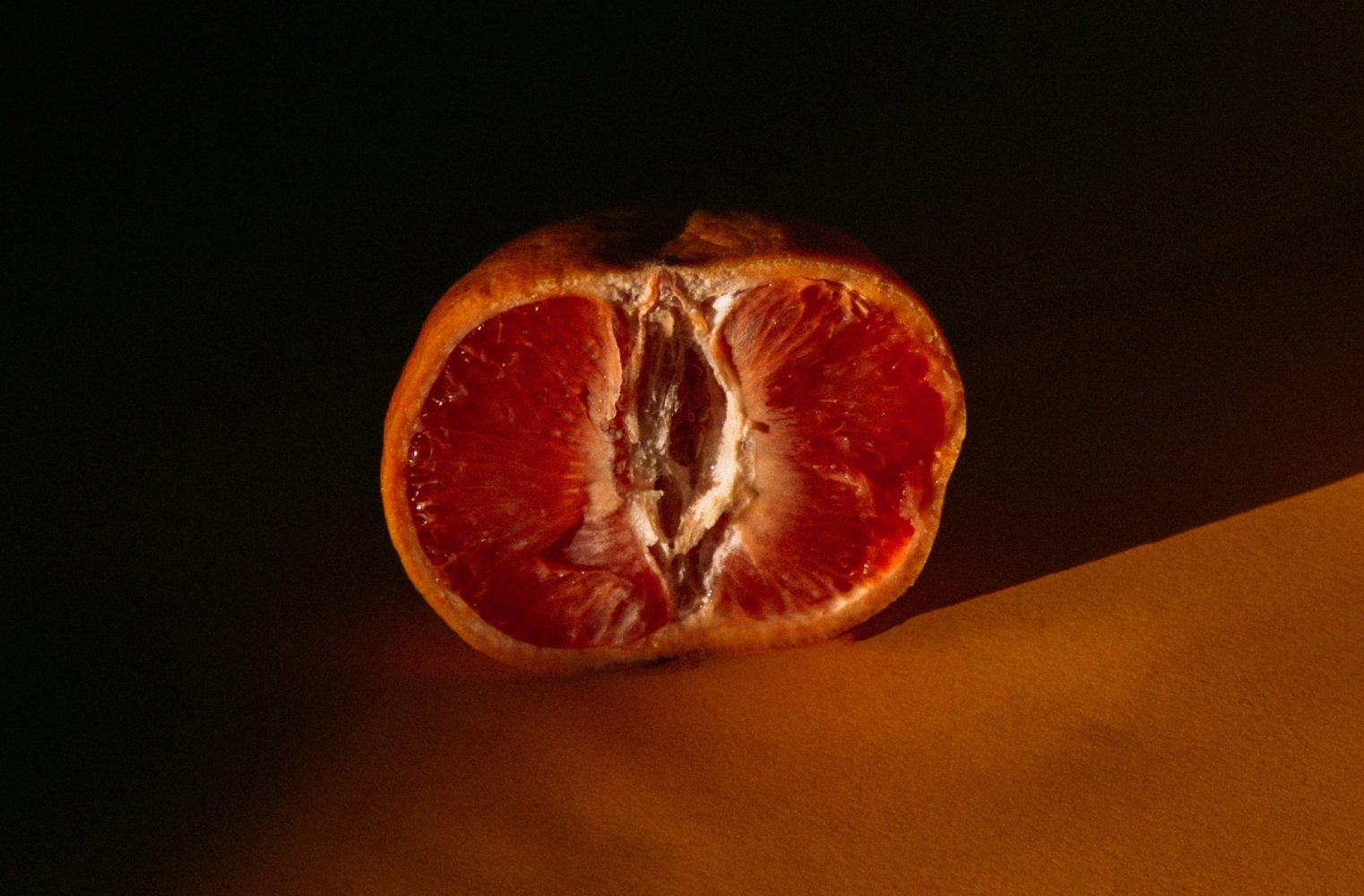
That Spring, when the dormant roots and seeds started sprouting and our father stopped coming home, our mother took to the backyard with fervent urgency. Overnight, it seemed, vegetation had burst through the cracks, split the tile and cement, broken through the clay pots and tin cans. Grass spilled over the hedges with a despicable gusto. One morning, my brother and I woke up to find our breakfast already cold on the kitchen counter and our mother at work in the backyard, crawling on her hands and knees, clawing out odd weeds with tiny flowers we’d never seen before that now burgeoned in tenacious clusters throughout the lawn. She dedicated hours to these new invaders, ripping them out from the grass like clumps of hair. Fistfuls of roots dangling dirt and squirming worms like freshly torn scalps still steaming. Our mother’s face sweated and twisted under the sun. We watched her silently from the bathroom window, heads butted together. We heard our sister call out from another window, Mom are you okay? Yes, mija. It’s just hot, she answered, wiping the sweat with the back of her bare hand.

The next day, we noticed she’d pulled out some gardening tools, small hoes and some shears that she sharpened with a rock. We recognized the hand-sized, volcanic slab from our grandmother’s house in Guadalajara, from before she passed away. One of her prized possessions, our grandmother had used it to sharpen her knives and shears, sitting alone and in silence at the head of the table. My brother and I would sit in front of the TV and pretend not to watch her. She’d then retreat into the kitchen with her knives to perform mysterious domestic acts.

Our mother used her freshly sharpened tools to cut up the thick roots of unidentified plants that seemed to be waiting for the right time to reveal themselves. She wasn’t going to give them a chance. Eventually, we noticed that her favorite tool was a set of narrow-nosed pliers that she’d stab into the ground to extract even the most reluctant roots. She’d have to pull very hard, sometimes using both hands and the weight of her small body. Often it was the thin, spidery roots that were the most persistent and dug themselves in the deepest. Our mother, however, was very thorough, for any remnant would have sabotaged everything.

She also found tiny insects chewing at the leaves of potted plants that she’d grown from cuttings or from seeds she’d sprouted herself. She not only trimmed these contaminated leaves, but also the ones she suspected would soon become infected. At first she snipped gently at the herbs, only removing the diseased tops of the hierbabuena or oregano. Eventually, she cut them down to stubby brown stems, but left those roots intact.

As the days passed, we watched her rove through the garden, flower bed to flower bed, potted plant to potted plant, and then cycle back methodically to rip out the invasive flower clusters that resurfaced in the grass. When she arrived at the lime tree’s jagged shadow, she immediately got up off her hands and knees. I thought she might have hunched after spending so much time curled over the ground or that she might need to steady her head if it was spinning with blood having been bent low beneath the sun. But she stood straight up before the lime tree as if measuring her height against it. She seemed taller than usual, as if she had height stored inside of her for certain occasions.

That night at supper, my siblings and I watched her swallow down a large glass of water with hardly a breath. And then she announced that she wanted to cut down the lime tree. My brother and sister and I looked at each other in silence. Although she’d never outright said so, we knew she’d wanted to cut it down for some time now. The tree is useless if it doesn’t produce limes, she stated bluntly. And that, she pointed out, was our father’s fault.

When we were very young, my parents had lovingly smuggled the seeds in their luggage from Mexico. They wrapped them in embroidered, perfumed handkerchiefs that they carefully packed into plastic baggies, rolled into socks and then stuffed into tennis shoes. They’d even planted a decoy in their suitcase so that when the customs people pulled out our candied fruits and held up the sugared rolls to toss them ceremoniously in a trash bin, we feigned disappointment. Together, bound by complicity, we silently relished our secret accomplishment, and held warmly in our hearts the knowledge of those protected little seeds that were on their way to starting a new generation. Just like us.

Together, we watched the tree grow. We talked to it as one might talk to a baby, using sweet gibberish and tickling its leaves. We’d tell it what a lovely little tree it was, oh what a beautiful little tree growing so big so big now, bigger every day look at you, drink your water, stretch toward the sun, ay que bonito limoncito. We celebrated every one of its lime tree milestones, its first tender branch and its first flower. Its first lime was observed carefully and treasured. How we loved its sour fruit. She had loved it too.

Over time we allowed the tree to grow at its own whim, not having the heart to cut off a single one of its beloved leaves or branches. However, instead of growing juicy limes that ripened fully and dropped to the green grass for us to gather, it produced many tiny, hard limes that it guarded with a web of knotted branches and vicious thorns. The fruit would ripen deep within the foliage and finally drop to rot on the ground. The interior growth was so dense and low that we could no longer reach under it to rescue the limes. The shade spoiled the ground, and the lime acid spoiled it too. Most trees that spoil their own ground, roots deprived of essential nutrients, gradually suffocate themselves. Yet this one continued to grow, and we accepted it, cruel thorns and all.

Several years ago, our father made his last attempt at landscaping. My mother had asked him to prune the tree, said that it had been choking itself with its own gnarled branches. The tree needed maintenance and care like any other living being, my mother said to my father. He knew where she was headed with this, so he grabbed a machete from the garage and began chopping. He left the tree entirely bereft of its flowers, fruit and foliage, sparing only a large chewed-up grey bulk of thorny twigs and branches attached to its short trunk. It looked like a lopsided brain that had been cut up but remained alive, sputtering splintered thoughts. We wept for days, including our mother, and our father didn’t come home until we shut up. Our poor tree. After several seasons, it eventually recovered its green leaves and grew back its barbed branches, and it even began to flower, but refused to give fruit altogether.

My siblings and I continued to watch the lime tree for signs. We studied the flower buds, careful not to disturb the fragile petals. We also refused to trim it, even though we knew, as we always had, that we should for the good of the tree. We loved it, perhaps as much as we loved each other, but didn’t know how to care for it.

Since then, our mother had avoided the tree. She had blocked it from her field of vision, until now. Sitting at the dinner table, my brother and I said nothing in response to my mother’s idea. However, we saw that our sister was carefully sifting through something in her mind. It shifted quietly in her head, trickling a little in one direction then another, moving it in a subtle bob that was neither a nod nor a shake. Through the silence, our mother’s thoughts seemed to have moved on to a different subject as she finished off her meal in a few large bites and stood up to gather the dishes from the table. As she disappeared into the kitchen, we could still hear her chewing, crunching on her char-edged tortilla. I thought for an instant of her strong teeth, large for her small thin-lipped mouth. None of us had inherited teeth like that.

After several days, when she had finished tearing bald spots into the lawn and taming the hedges, at least for a while, she noticed all of the crap we’d put out in the yard over the years and forgot about. Mostly defunct furniture we never got around to throwing away. She turned her instinct to an old chest of drawers we’d long abandoned in the far end of the yard, where it was now rotting. From our usual window, my brother and I watched her break it up with her bare hands. A family of cats ran out, the kittens chasing after their mother. She pushed the chest over on its side like a small whale carcass and pulled on the panels with the weight of her body. She tore out small rusted nails and staples that once held  the pieces together. We could hear her grunt as she worked, clenching her teeth, the bone of her jaw gleaming. The veins in her forearms and hands bulged as she pulled and snapped off the rotting boards.

At dinnertime, we watched her bandaged fingers scoop food from her plate with bits of tortilla. Without looking at us, she said, I’ve been thinking about getting rid of some of the old furniture in the house. My brother and I were overjoyed, relieved. Our sister’s head bobbed excitedly. There was plenty of old, not to mention ugly, furniture we’d insisted on getting rid of for ages. Most of it was furniture my parents bought on layaway when we were still babies. By now, their emotional value had worn out. Their laminated surfaces blistered and peeled, revealing the cheap particleboard underneath.

The next day, our mother showed us a new pile of what used to be a bookshelf. The following day, a sewing table. Throughout the week, some old chairs, an entertainment center, a lazy boy. She found a rusty saw among the tools our father had abandoned in the garage. She sawed into the legs of various upright pieces, then broke them down into smaller pieces, which she arranged into tall piles in the middle of the yard. As the days grew longer, she’d work later through the afternoon and the piles got larger. My siblings and I came out to the yard to admire them at the end of each day. At dusk, our sister hugged our mother until it grew dark, while my brother and I filled the trash bin with debris. We smiled too, but started to think that maybe she’d cut up enough furniture. We didn’t want her to start chopping the stuff that we actually liked and needed.

It occurred to us, my brother and me, that our mother had demonstrated such natural chopping skills, that perhaps she could make an excellent lumberjack. We imagined her out in the woods somewhere marching with great determination, every part of her body radiating strength as she swung her ax at redwoods that were no match for her. With a single blow she’d splinter the entire thing into perfect logs that would land in neatly arranged cabins, their small windows somehow already curtained. Our mother, smiling, sweated gold.

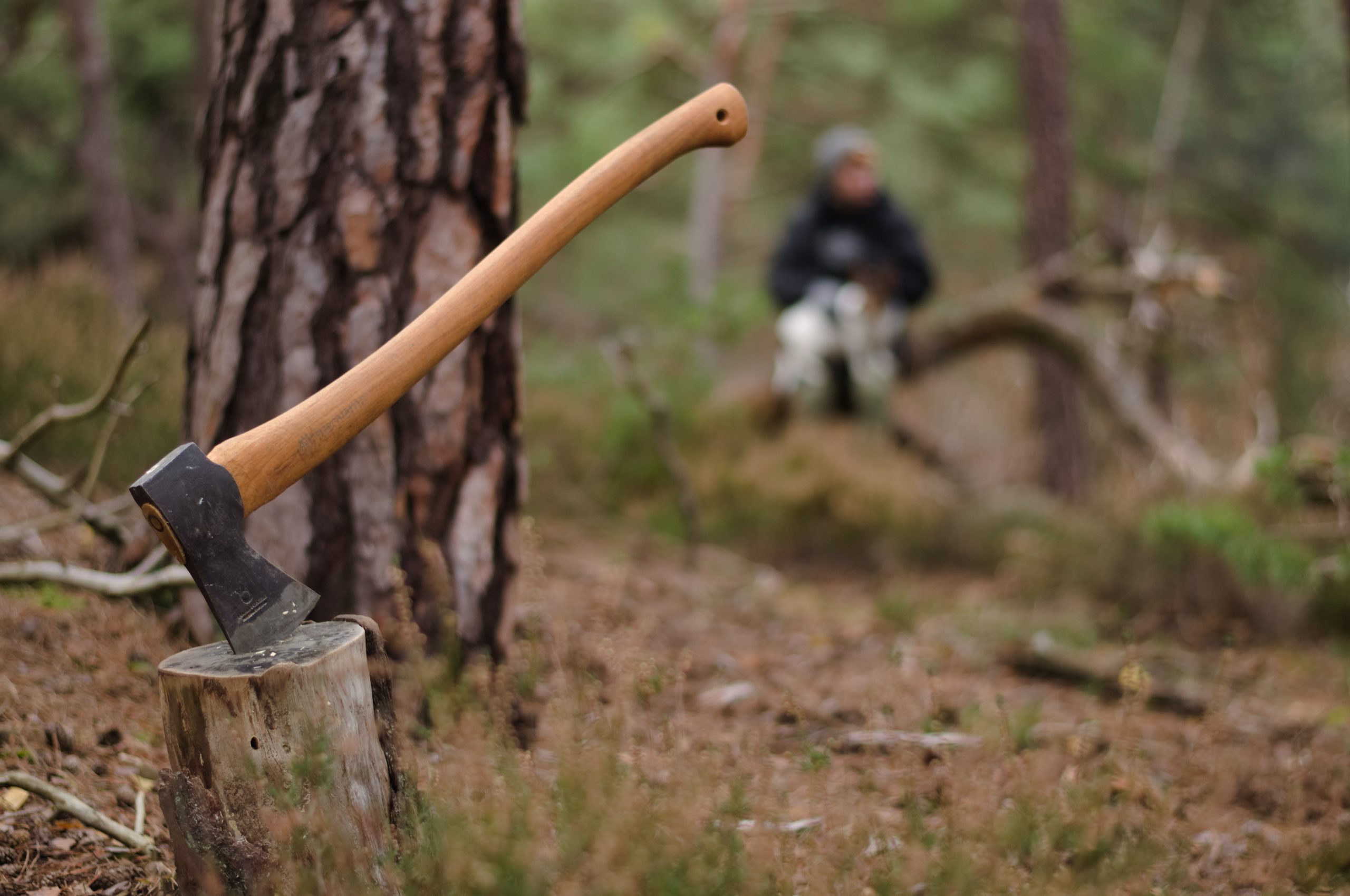
We decided to surprise her with a new ax and a small pile of neat logs. We installed one strong stump in the yard to hold the blocks, take the blows and hacks. She went at it immediately with remarkable precision and grace, like a dancer slicing each log down the middle. It was a beautiful thing to watch. She held that ax as naturally as if it were the hairbrush she’d used, until recently, to brush her hair out of a braid while she waited for our father late into the night. She’d brush and brush until her long hair gleamed like cascading water or the grain of polished wood.

Now that her wait was over, she just split logs most of the afternoon, one after the other in clean strokes. In the evenings she oiled her calloused hands before walking off to bed without saying goodnight.

Every morning we’d find our mother in the yard, chopping away at logs or pausing to scan the yard for returning weeds. She spent most of her time outdoors, coming inside only to use the restroom, drink some water and prepare her usual tortilla thinly slathered with beans and a bite of raw green chile. My siblings and I were also on the bean-tortilla diet. Following her brief meal, without a pause, she’d wipe her hands on her clothes and reach out again for the ax. My brother and I were pleased by her focus and commitment, but started to wonder what would come next.

To break the monotony of watching this daily routine through the bathroom window, we started playing checkers in the bathtub. We waited for an idea to come to us about what to do next as we listened to the sound of wood cracking beneath a neatly sharpened blade. One day, the sound of screams shook us from our pensive game. We ran outside to find her axing through the weathered boards of our backyard fence. Our sister stood by, watching with crossed arms. The neighbors stood frozen in shock over their vegetable patch as my mother shredded the old wood fence. They were nice people. They often left grocery bags filled with freshly picked oranges, sometimes odd fruits we didn’t have names for, hanging on our side of the fence. Usually they smiled and waved at us from their back porch. Today they gripped onions to their hearts, shouted at us in their language. She remained focused on the fence even while my brother tore the ax from her white knuckles and I held her tightly against my body with all of my strength. I could feel her heavy breath pushing through her small rib cage. I expected to feel her heart whipping its wings against her ribs like a parakeet shaken in its cage. Instead, inside I felt a large furry animal balled up, breathing slow but strong. It waited patiently to break out.

We knew that she was ready for more than mere log splitting. My brother and I deliberated while our mother rested in the dark living room, our sister watching her intently. By dinnertime, we had a plan. We proposed an excursion to a nearby mountain to cut down her first tree, after which, we promised to treat her to dinner at her favorite Italian restaurant. Another silence spread over the dinner table. Our sister peered at our mom from the bottom of the glass of water she’d long finished drinking. After a minute or two, our mother stopped glaring through the blinds at something in the yard and seemed to be considering our proposal. Finally, she nodded, tight-lipped. We accepted that as a gesture of approval and even perhaps determination. We felt encouraged. Things were going to move forward.

That following Saturday morning, we wrapped up her ax in an old crocheted blanket we found in the garage. It used to be our baby blanket, but for this occasion, we’d pulled it out of the black trash bag where my mother had stored it. We all packed into the car and drove up the nearest mountain until we found enough trees to call it a woods.

My brother and I had printed out instructions from the Internet for beginner lumberjacks. Apparently, selecting a proper tree for your experience level and body type was essential. We fumbled with the instructions while our mom and sister opened the trunk and carefully pulled out the ax, still wrapped in its blanket. It seemed heavier here in the woods, its steel duller but somehow more dangerous, and its wooden handle felt like it might blister one’s hands more easily. Something about the air here made everything more so.

We scouted around for a proper tree, calling back to our mom to put on her new gloves on and get ready. My brother and I disagreed and then agreed on a tree. We chose a medium-size tree that seemed to be drying up. It looked ashy all over, and we could see some dusty spider webs up in its branches. The bark flaked off easily in thick scabs against our palms.

My brother and I shuffled through the crumpled printouts. There were sections about posture and handling the ax and how to strike your tree at just the right angle. It seemed there was a right way and a wrong way to cut down a tree. Our eyes glazed over the italicized and underlined phrases, the little diagrams of people and trees with green check marks next to them for Yes, red circles and slashes for No. We just wanted our mom to get right to it. Cutting trees is a timeless practice, we figured. Didn’t we all cut trees at some point to build our civilizations? It must be the kind of thing you get the hang of once you get going. Although we briefly talked about having our mom use a hardhat or some kind of helmet, we realized that we hadn’t brought one along, so that ended that conversation. We decided not to read the rest of the instructions.

When we returned, our mother leaned against the car eating sandwiches out of paper napkins with my sister. She offered us the ones she’d packed for us, but we told her it was time to get to work on that tree we’d picked out for her. She pulled on the new gloves and flexed her fingers to break in the tough leather. She picked up the ax awkwardly, without a hint of the grace we’d witnessed days earlier. When we arrived at the tree, she stopped. She seemed to not know what to do. Neither did we. We tried to encourage her. Try it out, just hit it and it’ll come! You’ll figure it out! You can do it!

She tried swinging the ax but had a hard time raising it over her shoulder. Her wrists kept getting twisted up. She couldn’t even figure out how to stand and kept shifting and switching her feet around. Finally, she swung and the blade hit the flaky trunk. A few bark chips flew off. She swung and hit it again with a thud and some dust fell from the spider webs onto my sister’s hair. My sister is terrified of spiders.

My brother and I realized something. Chopping down a tree in the woods is completely different from chopping up furniture or logs in the yard. Nothing was happening.

Our mother dropped the ax onto the pine needles covering the forest floor. She didn’t want to do it. Her heart wasn’t in it. It was more difficult than we all expected. And besides, she said, the tree, although it was dying, deserved to die with dignity on its own. Let’s just leave it alone. Just leave it alone and let it die, she said softly.

My brother and I stared at the ax on the ground. I ran to it, panicked that already it might be rusting and then all hope would be lost. Our mother dropped to the foot of the tree and buried her face in our sister’s arms.

After that, our mother insisted on staying indoors. She picked up the crochet needle my grandmother had left her, complete with an unfinished doily still attached to the spool of thread. My mother’s siblings had found the crocheted thing at the base of our grandmother’s armchair shortly after she passed away, and somehow figured that my mother should have it, though she had never crocheted. Nonetheless, she’d kept it at the base of her own seat on the couch. We watched her pick up the doily and needle. She held it in her hands and laid it on her lap before throwing it back to the floor, and remained still and silent until it became dark.

My brother and I wished she would pick up the ax again. We bought a fresh pile of logs and even collected some old furniture from the neighbors, hoping to entice her back to chopping. We rubbed the rust out of the steel and even oiled the wooden handle. We laid it out on a pretty gingham cloth next to a pitcher of cold lemonade on the kitchen table though she hardly made her way to the kitchen at all now. If only we could get her started again, we could figure out what to do next.

She remained in the living room for three days.

On the fourth day, my brother and I went out to collect more furniture discarded along the curb. We weren’t ready to give up on our mother. We began arranging the pieces around the front and back yard. We placed them by the front door and near windows where she might catch sight of them. There was one particularly attractive small log about the size of a meaty arm that we even left out on a coffee table in the living room.

When we returned from one of our excursions, we noticed  a trail of splinters, long shreds of wood. The small tables we’d left in the front yard had been pulverized. We were excited. We looked at each other eagerly. Finally! Our mother, we were going to have our mother back. We’d figured things out. We were going to make the best of it.

We followed the trail of debris to the backyard. We followed the sound of her ax. It sounded different than wooden logs or particle board or panels of cherry wood or anything like that. Our sister stood solemnly at the gate to the yard and did not look at us.

We found our mother chopping through a tangle of branches. Her arms were gashed by the long thorns, as if they’d been fighting back for their lives. Her face was also covered in a web of thin scratches, but they were hardly visible against her darkly tanned face. The scratches were lined with tiny beads of black blood that shone like unblinking eyes in the sun.

The lime tree, our little lime tree. We were aghast. She had chopped it down. She chopped our lime tree down to brambles. She’d slashed off all of the leafy branches without regard for  the countless white blossoms, heavy with pollen and bees. The yard was littered with tender leaves, their young flesh brilliantly green against the coarse dry grass. The blossom scent was sweet in the dense air. She’d cut through the tree’s gnarled underbrush, which was piled waist-high all around her. She stood at the center of a ring of thorns with the amputated limbs strewn at her feet. Through the underbrush, we could see that the limbs had been healthy and green at their core. They were covered not in scabby bark, but in a thin skin that would break easily even with the lightest fingernail scratch. We remembered how vulnerable the tree always felt to us.

Oblivious to us, our mother continued chopping the remaining branches with greater ease and expertise than we had ever witnessed before. Finally, she arrived at its naked trunk that stood alone among the brambles that now filled most of the yard. We could not reach our mother without crossing this field of thorns. Our mother, ax in hand, and the tree trunk, alone, guarded by this destruction.

We cried out, “No!” Not our tree, not our little lime tree, but our shrieks awakened her from her dizzy reverie, and then, as if in reflex, she swung the ax into the tree’s body, piercing it halfway with the blow. And without pause, she swung again a final time, leaving but a thin ligament of green fiber attached at the base of the tree’s neck. Without breathing, we watched our mother drop the ax over the bed of thorns and grip the trunk’s limp fiber with both hands. She wrenched it free with one long grunt that became a scream at the end. It shook the wild parrots out of the neighboring trees, and all we could do was watch them flap away as her scream dissipated into the hot, colorless sky. And the air became very still and unusually quiet. Except for my mother’s breath, which came in long draughts, in and out like a strong tide.
“Howl’s Moving Castle” Is the Perfect Read If You’re Struggling Under Pandemic Housework

You’re trapped in your house. Every attempt to leave it is charged with danger. You’re overwhelmed with housework. You feel like you’ve aged 20 years. For many of us, that’s been our experience of the pandemic. 

It’s also the plot of Diana Wynne Jones’s children’s fantasy classic, Howl’s Moving Castle.

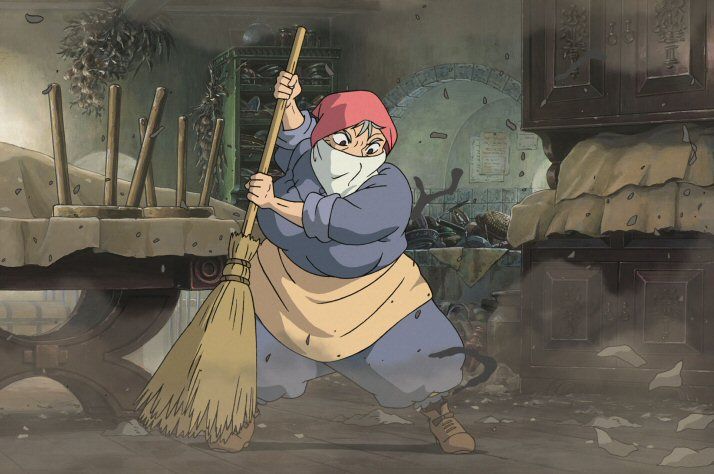
In the novel first published in 1986, Sophie Hatter, a young woman growing up in the fairy tale land of Ingary, is turned into an old woman by the villainous Witch of the Waste. As a result, she decides to leave home to seek her destiny. Jones seems initially to adhere closely to the traditional arc of the fantasy genre established before her by writers like J.R.R. Tolkien and Lloyd Alexander, albeit with a female protagonist and a lot more hat-trimming. Sophie’s first encounter is with the castle of the supposedly wicked wizard Howl, which is lurching across the countryside near Sophie’s town. But rather than serving as the initial trial in a grand quest, as it might for Frodo or Bilbo, the castle becomes Sophie’s new home. There are quick excursions outside—the castle has a magical door to four different locations—but Sophie and the novel always return to the castle, and mostly just its one main room. Indeed, whenever Sophie, exasperated by the selfish Howl, resolves to leave permanently, she is prevented, whether by a magical scarecrow, by the arrival of guests, or by her own self-doubt. 

The claustrophobic quest of Howl’s Moving Castle is a perfect read for this pandemic year, when many of us are trapped inside, or when the outside world that we need to navigate is historically perilous. Not only is it delightful and psychologically complex, but it focuses on a topic that dominates our contemporary lives: housework. As my wife and I talk over and divvy up the never-ending series of domestic tasks—I do the cooking, she does the meal planning, I sweep the floors, she scrubs the sinks—it’s refreshing to encounter a fantasy novel that actually validates that people can’t just cast spells all day, but have to shop for food and clean. This year of course has brought domestic labor to the forefront of popular consciousness. As article after article has chronicled, the pandemic has been especially brutal on women: our lack of a strong federal response to the pandemic and deep-seated devaluation of carework has forced many women to continue in their jobs while simultaneously shouldering a disproportionate burden of child care and domestic chores. Meanwhile, the ever-present risk of infection renders help from the community—from family, friends, or professionals—literally dangerous. 

Like so many women, in Howl’s Moving Castle it is Sophie who does the housework. A lot of housework. One of Jones’s chapter titles is, “Which is far too full of washing.” She also makes spells, but whole chapters of the novel are devoted to Sophie cleaning the castle, cooking breakfast, or mending Howl’s suits. This may sound like regressive gender politics, but Jones always points out how Howl’s relationship to Sophie is, at least at first, fundamentally exploitative. Indeed, the word “exploit” is used constantly in the novel. At one point, Sophie’s half-sister remarks that her mother “knows you don’t have to be unkind to someone in order to exploit them.” And Howl, who also seems to know this, likewise acknowledges that he is exploiting Sophie in the novel’s final pages.

Through this focus on housework and exploitation, Howl’s Moving Castle is clear-sighted about how gender functions in society.

Through this focus on housework and exploitation, Howl’s Moving Castle is clear-sighted about how gender functions in society. Sophie is remarkable because she remains so unaware of herself and her own powers, a trait she shares with protagonists of other of Jones’s novels like Fire and Hemlock and Hexwood. We as readers—and certainly the other characters—may pick up on the fact that Sophie is a powerful witch from the first few pages, but Sophie only recognizes her own magical capabilities near the end. Her negative self-perception derives, the novel implies, from her stepmother, who has her work without pay in her hat shop at the beginning of the novel. But that sense of inadequacy is also a function of larger ideology: the first sentence of the novel reads, “In the land of Ingary, where such things as seven-league boots and cloaks of invisibility really exist, it is quite a misfortune to be born the eldest of three. Everyone knows you are the one who will fail first, and worst, if the three of you set out to seek your fortunes.” Sophie—the eldest of three daughters—has internalized this story that “everyone knows” so thoroughly that she has become completely unaware of her own exceptional agency. This is how gender ideologies work as well, with “being born a daughter” carrying with it a set of implicit messages which confer a sense of internalized inferiority onto women, just like “being born the eldest of three.” 

Habituated to this subordinate position once she arrives at the castle, Sophie quickly puts herself to work doing housework for Howl. While she grumbles and curses Howl as she cleans up after the green slime left behind by one of his frequent tantrums, she has a hard time imagining alternative ways of existing. Nor is she compensated for that labor, except through room and board in the castle. As such, the novel works as a companion piece to the work of a feminist theorist who has been increasingly cited as the pandemic has progressed: Sylvia Federici. Federici was one of the founders of the Wages for Housework movement in the 1970s, and in her classic essay “Wages Against Housework,” from 1975, she rails against how domestic labor has been systematically devalued: “To demand wages for housework is to make it visible that our minds, bodies and emotions have all been distorted for a specific function, in a specific function, and then have been thrown back at us as a model to which we should all conform if we want to be accepted as women in this society.” Sophie too has been literally “distorted” by the spell that has turned her into a “hale” old woman, but the idea that she must conform to this model of selfless service remains the same whether or not she is young or old. 

It’s one of the few fantasy novels to focus not on grand quests but on the cyclical never-ending tasks like childcare and cleaning.

But, crucially, Federici declares that housework is about economics, not just ideology: “To say that we want wages for housework is to expose he fact that housework is already money for capital, that capital has made and makes money out of our cooking, smiling, fucking.” For Federici, capitalism is only possible through the fact that it creates a category of work—housework—and of workers—overwhelmingly female—that are not compensated for that work. Indeed, Jones is hyper-aware of the importance of pay and markets in the novel: Sophie grows up in the parallel world town called Market Chipping, and Sophie’s sister complains about her mother not paying Sophie a wage for trimming hats: “That hat shop is making a mint these days, and all because of you!” Hats are themselves an interesting choice of profession, since their production straddles the line between housework and the market economy—they are trimmed as a kind of domestic craft labor within the home, but then are sold in Sophie’s family’s shop. It’s unclear how familiar Jones, writing in the mid-’80s, was with the transnational Wages for Housework movement established the previous decade, but Howl’s Moving Castle similarly represents housework as uncompensated, exploitative, and difficult to escape. 

Through the focus on Sophie’s housework, Howl’s Moving Castle risks naturalizing domestic labor as “women’s work.” But women in the novel are not just doing the housework. They are also, or instead, powerful—and professional—witches: the Witch of the Waste, Mrs. Pentstemmon, Mrs. Fairfax, Sophie’s sister Lettie, and, eventually, Sophie herself. Indeed, the witch is central to Federici’s theories in her classic book Caliban and the Witch, in which she argues that women who resisted the devaluation of their labor in the transition to capitalism were demonized and terrorized as witches. As a witch specifically, then, Sophie is particularly caught in the middle of these conflicts about the relationship between the market and the home. Witches are of course common in YA fantasy, but they function for Jones to break down the gender binaries which normally structure fantasy, and specifically the divide between domestic space and the public sphere. For interestingly Jones does not make the narrative trajectory of her novel Sophie leaving behind her housework and becoming a more traditional fantasy heroine: she doesn’t become, for example, Lucy Pevensie sitting atop a throne or Hermione Granger slaying Voldemort’s minions. The novel does not reject domestic space and domestic tasks: it’s one of the few fantasy novels to focus not on grand quests but on what Hannah Arendt calls “labor”: the cyclical never-ending tasks like childcare and cleaning. Rather than having to choose between the domestic space and the outside world, Sophie is able to turn domestic spaces and features—kitchens, and bathrooms, and cleaning supplies—into the stages and tools of adventure. Sophie helps craft spells for duels and sea voyages in the kitchen, deploys magical powders to absurdly enlarge one of Howl’s suits, and cooks breakfast each day on a fire in the hearth that is actually a demon named Calcifer. 

The moving castle that provides the backdrop for almost all of the novel’s scenes provides a spectacularly apt metaphor for how Jones dissolves the divide between the public and the domestic, the famously specious “separate spheres.” In a moving castle, your home moves around with you; Sophie is able to go on quests without leaving home for long. She can meet the King, tangle with the Witch of the Waste, pick flowers, journey through a portal to Wales, and still be back in time for lunch and to tend the (demon) hearth. 

Yet this is not a fairy tale ending, despite the fairy tale setting, and despite the fact that Sophie gets to have by the conclusion power, a profession, and love with Howl. Like Sophie, Howl changes over the course of the novel, gaining a heart (literally) and becoming more honest, so that he can serve as a more suitable romantic partner. Yet he remains Howl: still manipulative, still on some level afraid of commitment, or a “slitherer-outer,” in the novel’s parlance, a nice phrase for those who are always finding ways to avoid household (and other) labor. You can’t quite imagine Howl sitting down and dividing up the chores with Sophie like my partner and I do, but you also can’t imagine Sophie not giving him hell for leaving the kitchen a mess. Sophie and Howl at novel’s end are not so much equals as equally matched: when they finally acknowledge their feelings for each other, with Howl saying, “I think we ought to live happily ever after,” Jones writes, 

Sophie knew that living happily ever after with Howl would be a good deal more eventful than any story made it sound, though she was determined to try. “It should be hair-raising,” added Howl.

“And you’ll exploit me,” Sophie said.

“And then you’ll cut up all my suits to teach me,” said Howl.

At a time when much of our lives and our relationships are a muddle, Howl’s Moving Castle provides a satisfying ending while not insisting that all problems are solved, all characters fully redeemed. After a year in which most men seem incapable, even under historically adverse circumstances, in doing anything more than the bare minimum of caretaking responsibilities, Howl’s Moving Castle does not magically turn Howl into a perfect partner, and instead insists even at its end on the potentially exploitative conditions of housework. Rather than disavowing or solving the unequal conditions of domestic work, or accepting its exploitative basis, the novel by its end acknowledges and makes visible the domestic space as a place of inherent and ongoing struggle over labor. 

When I’ve taught Howl’s Moving Castle to undergraduates this pandemic year in my online class on children’s fantasy literature, I’ve found that of all the novels we read it provokes the most enthusiastic reactions. When all year long you’ve been stuck inside of the same house, it’s liberating to imagine being able to flip a knob and have your door open to four different locations, as it does for Howl. When all year long you’ve been relentlessly doing housework—often without the essential caregiving help you need—it’s exciting to fantasize that those chores might themselves be part of a magical journey. And when all year long you’ve been at best repeatedly rehashing how to parcel out the endlessly required chores with your housemates or at worst trying to get your partner to accept their fair share, it’s gratifying to read a novel that acknowledges and centers that deeply gendered conflict. So in a pandemic we might not need to turn to fantasy literature simply as an escape from our locked-down lives. We might turn instead to Howl’s Moving Castle to represent both the possibilities and the limitations of those at-home explorations.

Who Gets to Profit off Black Culture?

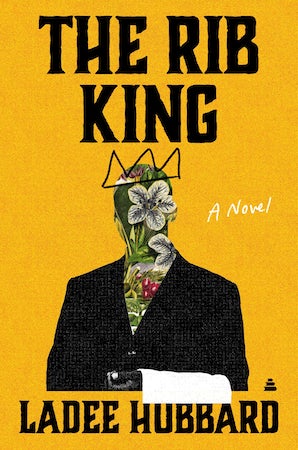
Ladee Hubbard’s sophomore novel, The Rib King, may take place a hundred years ago but it touches on just about every pressing socio-cultural issue in the zeitgeist. The book deftly examines the theft of Black genius, entrepreneurship, and art, through its central character, the indelible August Sitwell, whose prim and proper countenance is swiftly replaced by a well-earned streak of vengeance. A groundskeeper for a white midwestern household in the early 1900s, Mr. Sitwell possesses an unusual olfactory gift. He can identify all of the ingredients in a dish by simply smelling it. A white businessman takes notice and sees a potential for profit. When Mr. Sitwell is then backed into a corner, he’s forced to enter into a business deal that places his racialized likeness on a label for a sauce he created. 

While reading The Rib King, one can’t help but recall Bon Appetite’s refusal to adequately compensate food writers of color for their video series, Test Kitchen. Or the calls for John T. Edge, the white founding director of the Southern Foodways Alliance, to step down. Or corporations’ long overdue jettison of racially stereotyped brands like Uncle Ben’s and Aunt Jemima. The Rib King strikes a nerve, and in the process, delivers a dazzling story that navigates the fine line between revenge and justice.


Anjali Enjeti: Where did your interest in exploring special talents or powers, and having them shape your stories, come from? 

Ladee Hubbard: That element of The Rib King is an effect of its specific origins. The Rib King, as a character, was initially mentioned in my previous novel, The Talented Ribkins, as the deceased patriarch of the Ribkins family, making this book a prequel. 

The Talented Ribkins evolved from my interest in the cultural impact of W.E.B. Dubois’ essay, “The Talented Tenth,” published in 1903. The essay is about the need to cultivate and educate a Black leadership class and posits that 1/10 of the Black population is born with the innate talent that, if properly trained, will make them naturally fit to assume this leadership role.

In The Talented Ribkins, I gave the characters “talents” that are physically manifested, a part of their tangible reality as opposed to being an abstract potential. They struggle with themselves and each other about how to put these talents to good use, thereby troubling the idea of “talent.” I think it was easier to represent the limitations of the concept that way, as well as the specific pressures brought to bear on the characters themselves.

AE: The book feels so timely for so many different reasons. It could have been set in the present day, but you set it in the early 1900s. I’m curious about what drew you to that time period. 

LH: The book was written in reaction to current events and my desire to draw links between the past and the present. I began writing it while I was still working on the first novel, right around the time the Black Lives Matter hashtag first emerged in response to the acquittal of the man who murdered Trayvon Martin. The specific vulnerability of African American children to racial violence influenced the development of the plot. As a mother of a teenager, the fact that Trayvon Martin was a child was stark, as was the fact of how obscure this aspect of their deadly confrontation was in many media accounts. More broadly, I was struck by how disturbing it was that we were still grappling with many of same social tensions as 100 years ago—namely, the fundamental difficulty to respect the rights of African Americans as equal citizens.

AE: The Rib King is an important conversation about how white people profit off of Black images and iconography. Aunt Jemima and Uncle Ben brands have been recently redesigned, but other brands and professional sports teams, like the Atlanta Braves, are still putting up a fight. How do you hope this book will advance the conversation on the theft of likeness? 

LH: On a fundamental level, it all seems to go back to a tendency to identify nonwhite people with commodities, which is what Black people literally were prior to emancipation. 

In terms of advancing a conversation, I think it would be enormously helpful to strive for a level of honest reflection about the persistent appeal of these icons, to really address their origins and what they say about the society we live in and its values. Whose likenesses are they really? 

AE: This is such an important point—the images never did resemble any real people, just grotesque stereotypes. What’s interesting to me, is that despite the fact that there are far greater representation and visibility of nonwhite races in positions of power (certainly more than when The Rib King takes place) our society still clings to these images and reproduces them. Is it fair to say that representation alone will not solve the issue of the widespread dissemination of stereotypes? Is more representation the panacea or is it simply one part of the equation?

It all seems to go back to a tendency to identify nonwhite people with commodities, which is what Black people literally were prior to emancipation.

LH: I think it is part of the equation. It wasn’t too long ago that people were describing the U.S. as post-racial in part because of the greater visibility of certain, individual nonwhites in power. Images of Black people who had “made it,” who had money and power, were held up as proof that race was no longer an obstacle to success, an idea which, on the level of representation, culminated with the election of our first Black president. I think that what has followed Obama’s time in office proves that the issues mediating the persistent saliency of Black stereotypes, the persistence of racism and its very real repercussions, are far deeper than that.

AE: The theme of cultural appropriation in The Rib King has been a hot topic the past few years especially in the food industry, though it’s oftentimes misunderstood and discussed with disdain. Why do you think there’s still so much resistance when it comes to understanding and acknowledging the harm of cultural appropriation? 

LH: Since it’s systemic, it is a difficult problem that requires conscious and dedicated commitment to confront. There is a deep-rooted pattern whereby many peoples’ cultural productions are not recognized as culture but are instead regarded as raw materials that do not truly acquire value until after they have been appropriated, as if appropriation itself were a form of refinement and acculturation. I think it is important to recognize how deeply this type of thought and behavior has impacted the history of this country as a whole. Certainly, the history of enslavement and colonialism made cultural appropriation—and the right to profit from appropriation—a habitual gesture of racial entitlement.

AE:  There is a very dark, sudden turn in the novel, one that shifts the narrative in the complete opposite direction of where I expected it to go. The Rib King defies formulaic kinds of storytelling – it’s one of the reasons why the book appealed to me so much. How do we as readers and writers nurture and encourage different forms of storytelling? How do we help these types of books be discovered?

People were describing the U.S. as post-racial in part because of the greater visibility of certain, individual nonwhites in power. Images of Black people who had ‘made it’ were held up as proof that race was no longer an obstacle to success.

LH: I think it is important to have and cultivate outlets that can highlight and provide access to a broader range of work that is being done both in the United States and outside of it. There are a lot of really good stories that may be considered unconventional because people are not aware of them, because of the clear tendency for some types of stories and cultural perspectives to be promoted and celebrated over others. Different forms of storytelling are often marginalized, as are different types of storytellers whose voices are not always acknowledged as being of value and so are ignored. 

AE: And it seems that the search to publish more nontraditional forms of storytelling might need to be more intentional. I’m wondering if you think part of the publishing industry’s reliance on expected/traditional/formulaic forms of storytelling has anything to do with the fact that, compared to other countries, we publish so few books in translation here.

LH: Yes, I do think so. A certain amount of disconnect from other parts of the world makes many things seem “new” when they in fact aren’t. And yet it is important to engage with other parts of the world– both within and outside of the United States. People cannot participate in a wider dialogue if they do not even know that dialogue is going on because there is no reference to it available in a language they can understand.

AE:  We’ve seen a lot of big changes in the publishing industry over the past year, including the appointments of Black women to high positions at major publishing houses. Is the publishing industry finally reckoning with itself? Do you think these changes will be long-term? What more needs to be done?

The history of enslavement and colonialism made cultural appropriation—and the right to profit from appropriation—a habitual gesture of racial entitlement.

LH: I hope so! I certainly think it is important and am encouraged by the current push for more diversity in publishing—I hope to see a lot more. At the same time, like the question above, I think a lot of the problems are systemic and therefore not dependent on the actions of any one person. 

AE: And it seems to also depend on sustainability. I worry that too many people in power see members of marginalized communities in certain positions of power, and then think, “Oh, okay, we did X, Y, Z, so now we’re done.” Is there a risk, do you think, in becoming complacent—in folks thinking change is finite, instead of continuing to themselves accountable and push to do better? 

LH: Again I would note that the Trump presidency was preceded by several decades of assertions that the U.S. was a post-racial society. I know many people recognized this as a falsehood, but the diffusion of that idea did seem to breed a lot of complacency and confusion that was very harmful to efforts to actually address the myriad implications of the persistence of racism in our society. If nothing else, I would hope that what this country had gone through over the course of the past few years has demonstrated the seriousness of the issue, the gravity of the stakes and the extent to which they will require persistent, active commitment on the part of all people who actually care about these issues in order to overcome them.

AE: After a string of police and vigilante killings of Black people, including Ahmaud Arbery, Brionna Taylor, and George Floyd, a number of Black-authored books entered and stayed on bestselling lists. I’ve been wondering, in light of a very close presidential race, whether you think these sales actually reflect a better understanding of racism and anti-racism. Have non-Black people made any progress? Or is what’s happening now purely performative?

LH: It’s not really for me to say whether it is performative or not. 

Aunt Jemima has been sitting on the shelf for over 100 years. I am cynical and so suspect that company executives tend to only really listen when they believe that not doing so is affecting their bottom line.

At base I think the answers to all these questions—about appropriation, valuing a more inclusive range of stories and cultural perspectives, whether or not current interest in understanding racism is a performative gesture—at this current moment, ultimately circle back to the significance of public protests. I have a hard time believing that institutional changes happen from within unless people demand those changes or else they would have happened a long time ago. Aunt Jemima has been sitting on the shelf for over 100 years. I am cynical and so suspect that company executives tend to only really listen when they believe that not doing so is effecting their bottom line. 

AE: Yes, public protest seems to be crucial. It seems that over the last four years, especially the last year, protest has become a more common and widespread activity in the U.S. Is this a new era for protest? 

LH: I hope so. Right now it seems pretty clear that real change will require sustained, committed resistance—of both thought and action—to the stunning inertia of complacency. 

“Minari” Is an Intensely American Film—Why Do We Still See It as Foreign?

Minari, the gorgeous semi-autobiographical film written and directed by Lee Isaac Chung, opens with Monica Yi’s first glimpse of the wide, empty landscape that is her new home. Jacob, her would-be farmer husband, bounds out of the moving truck, ready to boost his children up into the stairless trailer. He digs his fingers through the tall grass, holding up the dirt. “This is the best soil in America,” he tells his increasingly panicked wife. “This is why I bought this place.”

The film follows the Yi family as Jacob pursues his dream of growing Korean vegetables in the Ozarks, embarking on a financially challenging and socially isolating life that threatens to break his marriage and family. Before being (rightfully) nominated for the Best Picture Oscar, Minari became the center of controversy surrounding the Golden Globes’ rule that candidates for Best Picture must be at least 51% in English. Otherwise, they are relegated to the “Foreign-language film” category, an award which Minari ultimately won. 

I keep on returning to the feeling of watching the film, of seeing something distinctly representative of American culture.

I already knew about the Golden Globes insult before I sat down to watch Minari, but during the movie I realized just how absurd the “foreign-language film” categorization really is. The film just feels so American. When expressing outrage about the Golden Globes, critics and filmmakers tend to point out the circumstances under which the film is made. American director, American producer, filmed in America with American financial support. But I keep on returning to the feeling of watching the film, of seeing something distinctly representative of American culture. Lulu Wang, who directed The Farewell (also nominated for a foreign language Golden Globe), stated on Twitter, “I have not seen a more American film than Minari this year.” I repeated similar versions of this to my partner, even though I struggled at the time to pinpoint exactly what I meant. 

My Antonia

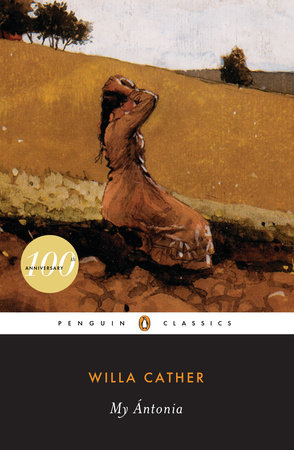
The film immediately reminded me of a novel I had to read as part of my Midwestern high school curriculum, My Ántonia by Willa Cather. Told from the point of view of Virginia-born Jim Burden, Cather’s novel reflects on the narrator’s boyhood on a Nebraska farm and the family of immigrants from Bohemia (now part of the Czech Republic) next door, the Shimerdas. Their daughter and Jim’s boyhood love is the titular Ántonia. As a teenager, I fell deeply in love with the novel and the possibilities of literature that Cather opened up for me. Before reading the book, I’d never seen the Great Plains, the place I was from, so lovingly depicted in writing. 

Chung, it turns out, loved the novel as well, and Cather is in fact essential to the origin story of Minari. In an article for the LA Times, Chung described calling out desperately for inspiration and hearing a voice in his head respond, “Willa Cather.” He went to the library and checked out what seemed to be her most popular book, My Ántonia. Chung also found himself in the novel, in the story of immigrants struggling with farm life. Like Jim, Chung also moved from the heartland and ended up among the East Coast elite. Chung in fact wanted to adapt My Ántonia into a film, but when he realized that Cather would not have wanted it, he turned to his own memories instead in a process that led him to write Minari.  

Both My Ántonia and Minari are homesteading narratives, stories driven by the incredible difficulties of remote farming life. In such tales, the landscape becomes a character, both the antagonist and the beloved. During their first winter, the Shimerdas go hungry, their poorly-kept potatoes rotting and their sourdough bread turning out sooty and poor. In Minari, the soil that Jacob Yi loves betrays him when his well runs dry and he has to start paying for water to keep his Korean vegetables from withering. Both the film and the book also take care to depict the extreme beauty of their settings. In My Ántonia, Jim returns again and again to the light on the long red grass that will soon be cut down for farmland, and in Minari the camera pans across the wild woods as David runs in his cowboy boots and thigh-high shorts. At any moment in either work, a gorgeous hot summer day can bring immense pleasure or turn into a dangerous electrical storm. 

Minari is not described as a film about the Ozarks, even though the land and place are essential to the story.

But while My Ántonia and Cather have become closely associated with the prairie, Minari is not described as a film about the Ozarks, even though the land and place are essential to the story. The Golden Globes did not even identify Minari with America because of the race of the main characters. Instead, the film has become a flashpoint for how narratives centering non-white characters are othered in the United States and what it even means to be an “immigrant story.” 

Chung, in a New York Times roundtable interview with other Asian American directors, expressed discomfort with characterizing Minari as an “immigrant story” and said that he did not set out to make an “identity piece” or an “Asian American film.” Critics such as Jane Hu have identified this intense self-awareness and concern about falling into stereotype as “the most Asian American thing” about Minari, while also emphasizing that it is, of course, still a film telling a very specific story of an immigrant family. Other Asian American writers, such as Jay Caspian Kang in his profile of Minari lead Steven Yeun, also express discomfort with the phrase “immigrant stories,” which has been used to describe narratives that exploit the suffering of people of color for the entertainment of a white audience. The problem is not the term itself, but the way the phrase “immigrant story” traps characters of color in relation to whiteness. The use of “immigrant narrative” and “identity piece” in the current cultural conversation assumes that whiteness is the center against which everything that is not-white is compared to.  

The reason Minari feels so American to me, I believe, is because it shows the Yi family struggling with ambition, optimism, and obligation while also being enormously unconcerned with white people, a reflection of my own personal American experience. The main axis of conflict is not between Korean and American culture, or the Yis and the white people around them, but among the Yis themselves. Jacob’s ambition is in direct conflict with Monica’s loneliness and concern for the health of her mother and son, and the core question of Minari is whether their marriage will survive. The film does not care about how the white peripheral characters see the Yis and shows very few interactions between the family and the white townspeople. And the Yis themselves are generally indifferent to whiteness, too occupied by their own lives to think about how they are received by others. 

In my daily life as a Midwestern Asian turned East Coaster, I really only consider my relationship to whiteness when forced to.

In my daily life as a Midwestern Asian turned East Coaster, I really only consider my relationship to whiteness when forced to, an occasion that actually became more frequent once I moved to the cities. In graduate school, I faced a lot of assumptions about how Midwesterners must have treated me, meaningful pauses and implications about the “importance of my story” that were perhaps well-intentioned but left me feeling othered as well as confused, as I could tell my own experience did not line up with the speaker’s expectations. No matter the purpose, I’m always left after these interactions feeling at best uncomfortable and at worst violated or invisible, the actual story I am trying to tell subsumed under a broader cultural narrative. 

American mainstream culture is still not used to seeing people of color depicted as actors, rather than those who are acted upon, as subjects directing their lives rather than objects suffering at the hands of others. The difference between what is assumed to be an “American story” versus an “immigrant story” is that in one we see whiteness doing or performing, and in the other we expect to see whiteness acting upon an other. Minari refuses this binary by leaving out the concerns of white people altogether. 

Part of Minari’s success in avoiding the white gaze is the lack of white interference in its creation. After the Golden Globes, Chung revealed to CNN that he’d written two scripts for Minari, one with the Korean and one without, due to concern that he would not find distribution for the film if it was not in English. But his producer, fellow Korean American Christina Oh, pushed him to keep the film in Korean in order to preserve a picture of the way they grew up. Having other Korean Americans involved in the process helped him resist the pressures and expectations of white gatekeepers in the creation of his own particular story.  

Minari refuses this binary by leaving out the concerns of white people altogether. 

My Ántonia is actually considerably more concerned with xenophobia and culture clash than Minari. Part of this has to do with its first-person framing, as the reader sees the world through the perspective of Virginia-born Jim. When Ántonia moves to work for a family in town, she and the other foreign-born “hired girls” are viewed as exotic, potentially dangerous and deserving of pity as they have to work to send money back to their families. Town life turns out to be dangerous for Ántonia, as American-born white men try to assault and take advantage of her. Jim is criticized for being too interested in Ántonia and her friends, rather than girls of “his own set,” and when, as a college student in Lincoln, he reconnects with his old friend Lena Lingard, his professor worries that he will be ruined by the “handsome Norwegian.” He’s whisked off to Harvard instead to complete a law degree. 

Like Jacob in Minari, Ántonia ultimately finds satisfaction once she moves back to the country and marries another Bohemian, turning away from town life. The world she creates with her husband and many, many children is inwardly focused and connected to the land. When Jim visits his old friend at the end of the novel, he finds a woman worn down by hard work but still full of purpose and life, caring for her orchards of fruit trees so she can make spiced preserves for kolaches to feed to her Bohemian-speaking children. Her family seems to have little interest in integrating or assimilating, preferring to keep company with other Bohemians. And, like the Yis, this inward turning allows Ántonia to integrate further with the landscape that she loves. 

We seem to only notice foreignness when that foreignness is non-white.

Even though Cather is fixated on the foreignness of her characters, her books are not often characterized as “immigrant stories.” The difference, of course, is that she writes about European immigrants, who are not othered in American culture. Even now, one can still drive into a small town in my home state of Iowa and purchase an obscure Dutch pastry or, until recently, attend a Lutheran church service in German. But such markers are viewed more as quirks rather than cultural differences.  

The double standard of the treatment of European vs. non-white immigrants is apparent in the Golden Globes. While films like Minari and Wang’s The Farewell were barred from Best Picture, Quentin Tarantino’s Inglourious Basterds was not, despite failing to meet the 51% English-language requirement due to its dialogue in French and German. Even The Crown, a show about the British monarchy, was treated more like part of American culture by the award association than Minari. We seem to only notice foreignness when that foreignness is non-white. 

Much of Minari’s power comes from its disinterest in the language of white American culture, in what Chung referred to “the discourse that’s out there” during the New York Times roundtable interview. Chung, in his Golden Globes acceptance speech, slyly acknowledged the anger and controversy over the outdated rules that put his film in the wrong category while turning the attention back to his own vision. “Minari is about a family. It’s a family trying to learn how to speak a language of its own,” he said. It’s a language that ultimately exceeds—and expands—our culture’s limited understanding of what a movie like Minari can do.  

7 Books About Faith and Doubt

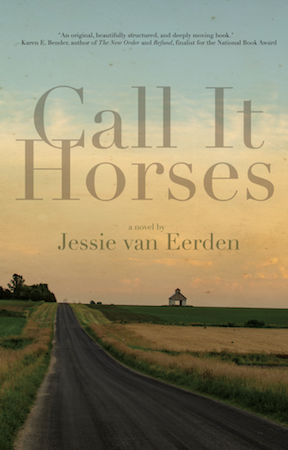
When writing and revising my novel Call It Horses, I spent time in the narrator Frankie’s two spiritual homelands—the desert and the bog. I tromped in the desert scrub and camped in the Appalachian bog, the deep sandstone reds and the verdant greens, respectively, providing a physical correlative for Frankie’s restless spirit. 

This epistolary novel, in which Frankie Donne and her aunt Mave undertake a road trip in 1990 from the small town of Caudell, West Virginia to Abiquiú, New Mexico, attempts to connect the often-estranged body and spirit, not only the human body, but also the body of the wounded world. In writing the account of their westward flight, Frankie tells a story of spiritual liminality and yearning which butts up against religious tradition. Writing the novel raised the question for me: what makes spiritually-oriented literature effective and alive? Not preachy, not reductive, not sentimental, but alive?

I recently read Desert Notes, an early Barry Lopez classic, having heard he died this past Christmas. “You must come with no intentions of discovery,” he writes in the intro. “You must overhear things, as though you’d come into a small and desolate town and paused by an open window.” This imperative struck me as a description of successful spiritual writing: it does not come in through the front door with agenda in hand. At its most resonant, such literature picks up on the hints, shadows, and murmurs of ineffable reality as manifested in our everyday lives and bodies. 

I have drawn books around me, like a dense cloud of witnesses, that bear witness to the union of body and spirit, of mystery and the mundane. Here is a small collection of them.

All the Living by C.E. Morgan

C.E. Morgan’s debut novel All the Living thrums with a slow electric current. The main characters, Aloma and her lover Orren, are people hardened by hard places and hard work. Aloma is orphaned, raised by aunt and uncle; she learns piano at a Kentucky settlement school and falls for Orren who has lost his family to a car accident and is worn down by trying to get the family tobacco farm through a drought alone. She joins him in the project, and theirs is a love between two solitudes, a love formed from loss:

“Aloma had learned of loss only by hearing that it had once happened to her, but Orren had lived that heavy change in the undying instant when the steel rumpled like hard cloth… And now Orren was like a man who had not heard the thing was finished, begun but not yet ended, no final word yet from that empty road… She spied a tree that had begun to turn early in defeat. Her eyes were wide to the miscarriage of the summer, the ruth and pity of it. She suddenly desired the betterment of everything, for herself and Orren and every single thing that had ever died, or would.”

Aloma finds solace in playing piano at the local church, and in the young pastor there—that context is her source of softness and a chance to test beliefs and try on another self while in Orren’s stark house, their sexual energy and burnt silence offer her fire but also closedness. The theology in this novel is felt in blood and bone and in the rural Kentucky landscape that presses Aloma thin. “She couldn’t trust the world to make her happy for more than a minute at a time, and generally less than that, but her life had to be borne.”

The Secret Lives of Church Ladies by Deesha Philyaw

The passionate characters in Deesha Philyaw’s fierce new story collection, The Secret Lives of Church Ladies, are decision-makers; they’re decisively scrubbing off a Christian theological grime that has needed attention for some time. The men and women in these nine stories seem to say, collectively, “Finally, I am living and breathing and loving myself out of the corners in which a moralistic script has kept me. I’m writing a new script.”

There’s a lot of reckoning with scripture in these stories; scraps float around, making accusations about same-sex relationships as an abomination, about desire as something to tamp down. The reckoning is especially layered and forceful in the story “Jael,” in which 14-year-old Jael—named, if inadvertently, for the biblical character who deceives a general and drives a tent peg into his forehead to, reputedly, enact the judgment of God—crushes on the pastor’s wife and discerns her own form of justice for an older man who preys on young girls. But spiritual tradition is not only an oppressive weight here.

Philyaw’s narratives sometimes revise conventional interpretation to nudge toward a version of liberation inherent in a not-so-airtight story of God: “‘Do you think God wants you, or anybody, to go untouched for decades and decades?… maybe you should question the people who taught you this version of God. Because it’s not doing you any favors.’” But religious heritage is equal parts familial and cultural heritage, and for these characters deeply rooted in the Black community, raucous claims on freedom still hold space, in these stories, for the grief inherent in any departure from the fabric of tradition.

In “Snowfall,” a woman chooses her female partner over reconciliation with an intolerant Southern home and mother, and there is room here for the beautiful litany of things missed by two Southern women living in the frigid Midwest:

“We miss their bare brown arms reaching to hang clothes on the line with wooden pins. We miss their sun tea brewed all day in big jars on the picnic table in the backyard, then later loaded with sugar and sipped over plates of their fried chicken in the early evening. We miss lying next to them at night in their four-poster beds with too-soft mattresses covered by ironed sheets and three-generation-old blankets.”

The decisions of these characters are clear, often joyful, even when they hurt.

Things That Are by Amy Leach

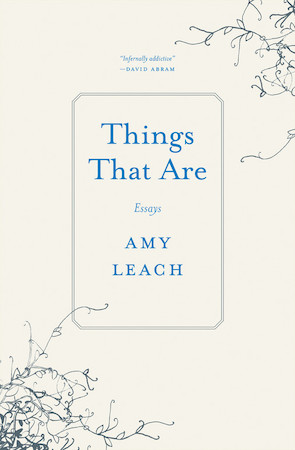
Amy Leach’s essays in Things That Are focus on the body of the world, creatures very “strange and themselves”: jellyfish, beavers, donkeys, ostriches, moons. This is a slantwise book of praise as well as a book of science writing, a book of fables, tales, spiritual inquiries, even jokes! Leach is all wonder and tumble and tuft, as effervescent in language play as in the way she sees and depicts the animal kingdom. About the caterpillar and people’s impatience for its metamorphosis, she writes: “This is understandable of course: when that which is like a plodding lozenge turns into that which is like an angel, everything that belongs to the lozenge’s time seems mere preliminary.” But is it? People cannot “infest the caterpillar with their anxious urges to ‘Become!’” That tiny caterpillar hanging from a leaf over a creek does not think, “‘Alack!…I will never, now, wrap myself in silk and wake up with powdery, iridescent blue-and-green wings’…Rather, it thinks, ‘I’m swinging, I’m swinging, I’m swinging.’”

In rendering this inner landscape of creatures, Leach turns us toward our own glowing innerness. These essays shine with the holy but do not make use of conventional holy words such as God because “the hoopoe and the bat do not say this word. Neither do the eagles or the vultures or the black vultures.” But spirit does strum through this book, in each wingbeat and scurry, each movement of the moon, each piling-up of surprising descriptors and similes:

“The Sun is so loud, like a million bombs all the time, that fine-spun sounds cannot be heard, like birds wading or figs tumbling or the muttering of mathematicians. On the Sun all private qualities disappear into the main loud yellowness.”

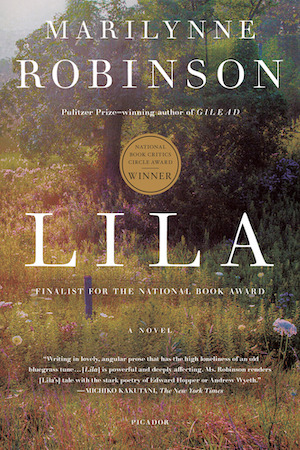
Lila by Marilynne Robinson

Of Marilynne Robinson’s four novels set in the world of Gilead, Iowa, Lila is my favorite for its enfleshing of scripture, its midrashic embodiment reminiscent of her treatment of the story of Noah’s wife and the deluge narrative in her 1980 novel Housekeeping. In Lila, a lesser-known passage—from Ezekiel 16—is the central text and is the text in which Lila sees herself. Israel is compared to an infant cast out and abandoned. God says to this infant in the sixth verse: “And when I passed by you and saw you wallowing in your blood, I said to you in your blood, ‘Live!’”

Lila sees her own lonely youth and sees in Doll—the vagrant that took her in for a life of togetherness, homelessness, and poverty—the prophetic power of someone who has said to her: Live. But Doll’s godlessness lies outside of salvation in the theology of Lila’s new husband, the minister John Ames, and so she sets out to reconcile theology with lived experience.

Though steeped in Calvinist thought, Robinson manages to create a liminal character in Lila, exploring a spirituality deeply inscribed into the Christian tradition while remaining outside of it. An outsider’s perspective can apply pressure to theology and ask more of it than an insider knows how to, exposing its strangeness, elasticity, possibility. And Lila’s spiritual yearning beautifully infuses the physical and the mundane:

“She liked to do her wash. Sometimes fish rose for the bubbles. The smell of the soap was a little sharp, like the smell of the river. In that water you could rinse things clean… Her shirts and her dress looked to her like creatures that never wanted to be born, the way they wilted into themselves, sinking under the water… But when she hung them over a line and let the water run out, and the sun and the wind dry them, they began to seem like things that could live.”

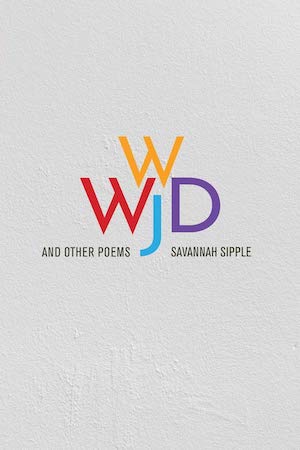
WWJD and Other Poems by Savannah Sipple

Savannah Sipple’s debut collection, WWJD and Other Poems, wrestles with an Evangelical culture known for its focus on a “personal savior” and making choices based on asking “what would Jesus do?” But Sipple’s Jesus is more intimate chum than lord, more likely to accompany you to Wal-Mart or sign you up for a dating app than chastise you. This is a book full of sexual hunger, a coming-out narrative that reckons not only with religion but also with the complicated layers of place: Sipple’s rural Appalachian homeland. “I never wanted to stay I never wanted to/ leave I never wanted to come back to gravel dust… I hate/ the mountains I love.”

My favorite sequence is the last third of the book in which Jesus serves as a vehicle for exploring the nature of desire itself and all the ways it is muted or thwarted—or sometimes celebrated—along the difficult road that leads to self-acceptance. When “Jesus rides shotgun”: “We go balls to the wall,/ windows down,/ aviator sunglasses always on./ …I used to be afraid. Sometimes/ I still am. Maybe./ Don’t hit the brakes, Jesus says./ Turn the wheel. That’s how you know/ the way you want to go.” Sipple’s poems are heartrending but also hilarious, and her mix of sincerity and humor creates a push-pull with faith that goes deeper than easy mockery.

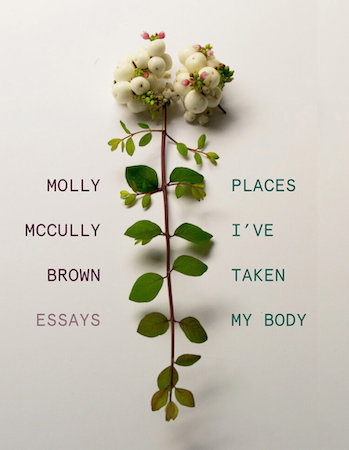
Places I’ve Taken My Body by Molly McCully Brown

In Places I’ve Taken My Body, the first essay collection by poet Molly McCully Brown, the disabled body entangles itself with faith and doubt. These essays intimately render the experience of living in a body with cerebral palsy and compromised mobility—what that means for sexuality, travel, artistic achievement, belief, and the furnace of anger (as well as an inexplicable tenderness) that a human being feels toward her own limitations.

In writing the body’s brokenness, Brown helps her reader defamiliarize the fact of living in a body; in “Muscle Memory,” she describes her dissolved memories of once standing and walking without pain as “just some strange, exaggerated version of what it means to age: huge sections of our lives lost to the way memory buckles and muddies and fades, the versions of ourselves we couldn’t find our way back toward if we tried.”

These essays are honest about loss but also, very unsentimentally, about accepting, even cherishing, life in a body that suffers. In “Bent Body, Lamb,” an essay about Brown’s conversion to Catholicism, she tests out in her mouth: “I don’t have to hate my body.” I most love how Brown writes about her former selves, as if these essays were really a letter to them. In “What We Are,” an essay about teaching creative writing to inner-city kids in Texas and coming to grips with her anger, the narrator addresses her child self:

“Hey, stubborn little blond-haired girl, we won. We are alive. And now the work is to be gentler with ourselves and with the world. I want such a sweet life for you. I want the fierceness of attention, of the light coming over the hill, of your own hand bringing a cup to your mouth. Of love, which will abide so much longer than the fire.”

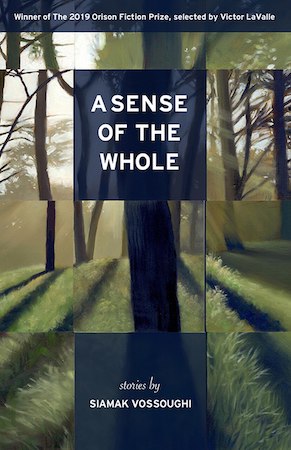
A Sense of the Whole by Siamak Vossoughi

The stories in A Sense of the Whole, by Siamak Vossoughi, explore the inward bloom of life in characters I desire to know in the world as they treat small things with great compassion, thinking and feeling their way through non-scripted, non-ironic interactions. The collection is written in a language that helps us stay soft and not harden.

The narrator in the story “So Long” says, “I wanted to write like people still had stories. Not just things they could say, but things they really wanted to say.” Indeed these characters, Iranians and Americans and many who are both, discern and articulate love in small moments: children learn to play games without guns, immigrants tap into a largeness in watching the World Cup, a man learns a new language because “language had everything—people and what they’d said and what they’d only ever said to themselves, and even somehow, something unsayable, too.”

I’m reminded of the fiction of Noy Holland by these stories’ unapologetic interiority and fable-like quality; Vossoughi’s stories are brief and often focus keenly on a singular issue that is densely layered, like a formerly imprisoned Iranian forgetting his email password, trying to remember his password which is the name of a man who died in that prison; or an Iranian American boy grappling with his huge feelings when his teacher is teaching his American classmates about Iran which, until then, had been his “home thing,” a secret world. Vossoughi writes the emotions and large souls of children especially well. And, with great subtlety, his stories push us readers toward a more just and whole world. When the first Black realtor comes to work at a real estate office, the white racism is exposed as the thing it is—false living: “It is not living because when I put a wall between myself and another person, I put a wall between my heart and me.” The spiritual radiance of this book comes not from interaction with spiritual tradition but from the belief in the miraculous in each person and that person’s connectedness to the whole human community.

Your Only Job Is to Ignore That Phone

The Temporary Job

It was a recession and I got laid off.

“I’m sorry,” my boss said, “I just can’t afford to have an assistant right now. I might know of something for you, though.”

He handed me a business card. It was white with bright red lettering. It said: Echo Enterprises.

“I met this guy last night at a party,” my boss said. “He said he’s looking for someone.”

I thanked my boss for the lead, then I gathered my things and went outside. It was a Friday, a summer afternoon, and very hot. I walked until I found a payphone and then I dialed the number on the card. The phone rang ten, fifteen times, but no one answered. I walked until I found another payphone and tried again. Once again, it rang and rang. On the eleventh ring, a woman answered. She sounded young, around my age, and told me to come in the next day for an interview. I thanked her and hung up. Later that night, I realized she had never asked for my name.


At the interview I was greeted by a middle-aged man wearing a red tie. He gave me the usual spate of grammar, spelling, and typing tests. After I finished those he took me to a small, windowless room.

“Congratulations,” he said. “You passed all your tests. Now it’s time for your interview. First question: Do you mind working on a temporary basis?”

“No, that’s fine. I’m just looking for something to tide me over until I figure out what I’m doing with my life.”  

“Great,” the man said. “You’re hired.”

He escorted me into another small, windowless room. There was a square table in the center of it. On the table was a beige telephone.

“When this phone rings, your job is to not answer it.”

“I don’t understand.”

“It’s a very simple job,” the man explained. “Don’t answer the phone.”

“If you don’t want anyone to answer the phone, why do you need someone to sit here? Why not just shut the door and let the phone ring?”

“I’m not paying anyone to answer the phone. I’m paying you not to answer it.” He glared at me. “You should bring something to read tomorrow. It usually takes a while for it to start ringing.”


I arrived the next day with a newspaper and a novel. I took a seat at the small table and moved the telephone to the corner. I spread the newspaper and began to read.

By then end of the morning, the phone had not rung and I had read the entire paper. I was pleased with myself; I felt as if I had learned more about the world in one morning than I had in several years.

I took a long walk during my lunch break. When I returned to the office, I began the novel I had brought with me. The phone remained quiet and the afternoon passed peacefully. 

At the end of the day, the man in the red tie came by.

“Did the phone ring?” he asked.  

I shook my head.

“Great.” He handed me an envelope filled with new bills. I counted the money. It was three times what I was typically paid for a day’s work.

That night I treated my friends to dinner. I told them I was working as a secretary at a big law firm. My primary responsibility was to answer the phone. Easy money, I said.


Two weeks passed by in this manner. I went to work, read in the windowless room for seven hours and collected envelopes from the man in the red tie. In the evenings I went out with my friends or to the movies. I was happy, but sometimes I felt guilty. My life was too easy.


Nearly a month passed before the phone started to ring. But when it rang, it really rang. It rang like rain beating on the windows; it rang like locusts in summer — incessant, unstoppable, freakish. 

The strange thing was, I didn’t have any desire to answer the phone. I wanted it to stop, yes, but I wanted only in the way you want a headache to recede, or a car alarm to shut off. That is, I didn’t feel like I had much control over it.

At the end of the day I went to the office of the man with the red tie. “The phone started ringing,” I told him.

“Good.” He handed me my cash. “See you tomorrow.”

The next day, the phone was already ringing when I entered the room. I wondered if it had been ringing all night. Something about the way it sounded made me think it hadn’t been. That the phone waited for me.

I actually started to feel better about my job, because now I was actually doing something. There was a challenge. It was hard to concentrate but after a while, I learned to read between the rings. 


It wasn’t until the phone stopped ringing that the job began to get to me. After two weeks of ringing, it stopped midday. The silence was luxurious, a sea of quiet. But at the same time I felt as if I had missed a terrible opportunity. As if a window had been open and now it was shut. I began to feel anxious. It was hard to concentrate and I couldn’t read as much. I kept thinking: What if it never rings again? And then: If it does start ringing, should I pick it up? And then: But what if never rings again?

And then: Who had been calling?


To my great relief, the phone began to ring again. But this time it was excruciating to hear, an itch that couldn’t be scratched.

“Why can’t I answer the phone?” I asked my boss.

“Because you aren’t supposed to answer it.”

“Then why does it keep ringing in my room?”

“Because you aren’t supposed to answer it.”

“Then why doesn’t it ring in the room of the person who is supposed to answer it?”

“Because you’re the one who’s not supposed to answer it,” the man said, exasperated. “Are you going to be just like the other girl? It’s so simple, it makes me want to scream!”


The phone stopped ringing again. Once again, I was overcome with anxiety. When the man with the red tie came by at the end of the day I told him I wanted to quit.

 “The only way you can quit this job is to answer the phone.”

“Are you saying I can’t quit this job if the phone isn’t ringing?”

“I didn’t say that.”

“I’m not going to sit around and wait for the phone to ring so I can quit. That’s absurd. I’m quitting.”

“You can’t quit.”

“I just did.”

He looked at the phone. “No you didn’t.”


The next day I did what people do when they call in sick to work. I washed my clothes, cleaned my apartment, drank wine with lunch, and went to a matinee. But I couldn’t stop thinking about my job. It was as if there were a beige phone in my mind, perched at the corner of all my thoughts. I saw what the man in the red tie meant and I hated him for it.


I had to wait another two weeks before the phone started ringing again. When it first started I felt a strange and physical elation, as if I were in a plane that was just taking off, but a moment later I had vertigo and couldn’t even look at the phone without getting a cold feeling in my chest. I listened as it rang five, ten, fifteen, times. Then it stopped and my heart stopped, too. I thought to myself, that’s it, I’ve ruined my chances, I’ll be stuck with this job forever. Even when I die that phone will somehow still be with me; I’ll drag it like Jacob Marley and his chains, its spiraling cord will bind my wrists and ankles, its spurts of ringing forever curtailing my unwound thoughts.

And then the phone rang.

I waited to answer. I don’t know why. It was like I wanted to make sure it was real. It rang five, ten times. On the eleventh ring I picked it up.

“Hello?” I said.

A young woman responded, “Hello. Is this Echo Enterprises?”

“Yes.” There was something familiar about her voice but I couldn’t place it.

“I’m calling about a job? Someone told me there was an opening there?”

“Yes, there is. You can come in tomorrow for an interview.”

I gave her directions and then we said goodbye. It was only after I hung up that I realized I had not asked for her name.

7 Books About Long-Distance Relationships

A year ago, I abruptly moved from New York City back to my parents’ house in Southern California. Suddenly, after spending years living with my closest friends and loved ones, I was thousands of miles away. But mine isn’t a unique story—since the start of quarantine roughly a year ago, almost everyone has been separated from the people they care about, from neighbors to favorite coworkers to their closest friends or partners.

But at the same time, over the last year, plenty of new relationships have formed. From starting new jobs to falling in love over TikTok, we are still finding ways to reach out to each other, albeit remotely.

If you feel like you’ve reached the limits of Zoom and Netflix Party, there is a rich history of stories that show ways to persevere through separation. Here are seven books about staying connected across the intervening miles.

Patsy by Nicole Dennis-Benn

Patsy by Nicole Dennis-Benn

When Patsy, a queer Jamaican mother, sees an opportunity to move to Brooklyn, she takes it, leaving her young daughter, Tru, behind in their working-class neighborhood in Kingston. Once in New York, Patsy dreams of finally being together with her childhood best friend and crush, who has married a man and adapted to a new life. Across the sea, Tru struggles with her own feelings towards her mother, whom she desperately misses, and her relationship to her identity.

This Is How You Lose the Time War by Amal el-Mohtar and Max Gladstone

This Is How You Lose the Time War by Amal el-Mohtar and Max Gladstone

This epistolary novel is split between authors el-Mohtar (writing Blue) and Gladstone (Red), whose characters take turns sending threats and boasts to an opposing agent in a time-traveling war who they are sworn to kill. Amid a world torn apart by collapsed timelines and chaos, Agent Red of the Agency finds a letter from an enemy Garden spy, Blue. The spies poetically weave through time, history, and war, slowly realizing that the soldiers of war have more in common than the powers behind their commands.

84, Charing Cross Road by Helene Hanff

84, Charing Cross Road by Helene Hanff

In 1949 New York, Helene Hanff struggled to grow her collection of antique and rare British literature. Then after seeing a newspaper ad, she started writing to Frank Doel, the chief buyer of Marks & Co., a London-based bookstore. What follows is 20 years of recorded letters. The correspondence of Hanff and Doel may start as stiff, but over the years melts into passionate discussions about obscure authors, a life-long loving friendship, and a testament to finding community an ocean away.

Ghost Forest by Pik-Shuen Fung

Ghost Forest by Pik-Shuen Fung

Pik-Shuen Fung dives into the tale of an “astronaut” family in her forthcoming debut novel. The unnamed protagonist grows up with her mother and grandmother in Canada, while her father stayed in Hong Kong for employment. Years later when he passes, she has to navigate the landscape of grieving for someone who she barely knew both because of his physical and emotional distance. While trying to find answers, she connects with her family through their combined sorrow and love.

Little Eyes by Samanta Schweblin

Little Eyes by Samanta Schweblin

Kentukis, remote-controlled stuffed animals, are ubiquitous and potentially dangerous in Samanta Schweblin’s Little Eyes. Location is not an issue for these creatures as they are connected to an online network, meaning anyone can buy one and become a voyeur across the globe—from Oaxaca to Berlin to Tel Aviv. The characters in these stories navigate this new, almost adorable, form of mass surveillance and discover what it means to be the one watching, and the one being watched.

Swimming in the Dark by Tomasz Jedrowski

Swimming in the Dark by Tomasz Jedrowski

Ludwick is a gay Polish man who has recently fled to New York from the Polish People’s Republic. A few summers before while working at an agricultural camp, Ludwick met Janusz, a student and staunch believer in the Communist Party as a way out of debt. The two bond over James Baldwin’s Giovanni’s Room, and over time fall in love in a country that has outlawed their relationship. Told in second person, this novel acts as a letter of reflection to Ludwick’s lover who remains across the world.

Love at the Speed of Email by Lisa McKay

Love at the Speed of Email by Lisa McKay

When Lisa McKay received an email from Mike, a humanitarian worker in Papua New Guinea, she wasn’t surprised. After her nomadic childhood and finishing her degree in psychology, Lisa developed a career of coaching and aiding humanitarian workers globally. What Lisa didn’t expect from Mike’s email is that their relationship would blossom into something more and would finally teach her what “home” really means.

Tracy Clark-Flory Is Horny on Main

Without want, there is no personhood. Whether the flush thrill of sex, or the gratification of a good meal (or both, and then some!), our desires constitute and catalyze us. But while the act of desiring might seem automatic—something both feral and essential—understanding why we want what we want can be a fraught endeavor.

Want Me by Tracy Clark-Flory

Erotic desire, in particular, seems to bewilder most everyone it inhabits. What is it about that person, that touch, that kink? And how do we embrace what gives us pleasure without turning on ourselves with shamefaced scrutiny? There’s a certain ineffability to our erotic inclinations, and perhaps, for this reason, they preoccupy us all the more. And so they always have, from the far-flung age of antiquity, when Sappho committed her agonies to lyric poetry, until today, when nearly every cultural entity celebrates or curses the niceties of erotic life. For all desire’s inconvenience and even, sometimes, misery, we can neither stop wanting nor trying to master it. 

Sex writer Tracy Clark-Flory is both a student and a philosopher of want. It is the province of her intellectual enthusiasm and, most recently, it is the organizing concept for Want Me, a memoir of her sexual desires and a topography of straight women’s erotic culture. Clark-Flory understands sexual want as an exquisite conundrum. On the one hand, it is a site of possibility: for pleasure, for play, and for the enduring work of self-knowledge. But it is, simultaneously, territory occupied by culture. As Clark-Flory argues in her book, it is impossible to detach our desire from the influences of our milieu, thick as it is with normalized ideologies, all of which tell us stories about how we ought to engage our libido. As she sifts through the archive of her own sexual coming-of-age—comprised of naively salacious internet chats, Baz Luhrmann’s Romeo and Juliet, and of course, grainy internet porn—Clark-Flory considers her personal history with the compassion of an elder sister, the intellectual curiosity of a social critic, and the ethical rigor of someone pushing towards progressive clarity. 

I recently caught up with Clark-Flory about Want Me, self-disclosure in internet writing, and the various pernicious impacts of normative sexual culture.


You’ve been writing about sex on the internet for over a decade, a beat that entails a significant amount of self-disclosure. The internet has also shaped our respective careers—we’ve both even blogged for Jezebel! So, we are both familiar with the tricky negotiation between personal boundaries (what am I comfortable sharing about myself?) and the awareness of certain mercantile realities endemic to internet writing (will sharing intimate details help my career?). And we are familiar with the frequently-relitigated debate about the Personal Essay Industrial Complex: women-identified persons are so often asked to bleed onto the page, to narrate our traumas.

I am curious to know how this context has shaped the way you write about sex, particularly when it comes to personal testimony. How do you make decisions about what stories to tell?

Tracy Clark-Flory: Early on, I had a mentor of sorts tell me, “I know you’re capable of so much more” with regard to my covering the sex beat, as well as writing about “women’s stuff.” Meaning, as I interpreted it, you could be writing about important topics. I’ve long resented the idea that sex, and “women’s stuff,” are not important topics. At the same time, I think the media’s devaluing of sex writing places an overemphasis on quick turnaround personal writing that is either clickbait or service-oriented. I was well into my career before I was given the support to develop my reporting skills and approach sex as the important topic that it is. 

That shift gave me greater power to decide when, and how, to publish personal writing. So far, it seems I’ve decided to mostly save the personal writing for longer, bigger projects—like this book.

RVC: Towards the end of Want Me, you recount a conversation with your husband in which you share a deep-seated wish: “Sometimes…I want to step outside of our culture, or to pretend for a few moments that I can.” I’m sure that yearning resonates with many readers; after all, it’s noisy out here! In fact, one of the many things your book does is make manifest the work—the exhaustion!—involved in cultivating and holding fast to one’s sexual subjectivity, especially in a world that flagrantly caters to straight white cisgender men. How do we learn to differentiate ourselves from our context, which so often annihilates sexual nuance, rendering it, as you say “one size fits all”?

TCF: This question speaks to the conundrum of sexual authenticity, which I wrestle with throughout the book. Sociologists like Erving Goffman argue that basically everything in social life is a performance, that we’re always gauging other people’s reactions to ourselves and managing impressions within cultural norms. He would say that there is no authentic self, really—the self only exists through these unending performances. Of course, Judith Butler has made related arguments around gender. If all of social life is a performance, if sexual scripts are adapted from cultural norms, then what the heck is authenticity?

I don’t think that there is a pre-cultural self. We’re all the result of cultural and social influence, and our sexual fantasies in particular so often draw upon cultural and social meaning and symbolism. I spent a lot of time interrogating my fantasies for authenticity, but ultimately I arrived at an interest in my own bodily feeling and pleasure as being an important measure of authenticity. The most basic measure being: Does it feel good? Are you in your body? Feminist scholars like the developmental psychologist Deborah Tolman talk about subjectivity in terms of girls being in touch with their own embodied sexual feelings, even as “a variety of contexts constrain or make their expression dangerous, difficult or even impossible for girls themselves to discern.”

Unfortunately, I think sexual subjectivity and authenticity, whatever you want to call it, requires sitting in that ambiguity.

RVC: Public discourse about sex and sexuality is generally pinned to cisgender, able-bodied experiences, thereby excluding the myriad genders and bodies that exist in the world. How can we effectively chisel away at these normative structures, and—once and for all—unhook our understanding of sexuality from an illusory gender binary, with its tethered assumptions about what all bodies should and can do?

I’ve long resented the idea that sex, and ‘women’s stuff,’ are not important topics.

TCF: So much of my book depicts my struggling against normative assumptions about sexuality within the gender binary. There are my assumptions about “straight men’s desire,” which are incorrect, because there is no “straight men’s desire,” there are just men and desires, emphatically plural. There are my own insecurities and uncertainties around my own desires and whether they are “normal” for a woman. Normative assumptions are most of what we’re fed around sex—and those assumptions are almost always a tragic misdirection. I don’t exactly know how we unhook from that, but I do know that over the years the best sex advice I’ve encountered has nothing at all to do with gender, and everything to do with context, connection, and creativity. It has to do with letting go of those normative injunctions and reaching for unscripted territory. 

RVC: As a teenager, I watched porn every now and again, but more often than not, I turned to Cosmopolitan’s famous listsicles—10 Ways to Suck His Toes, or whatever—in order to learn about straight male desire. Seemingly, we are inundated with this sort of information from the moment we’re aware sex exists until the day we die. It’s the ultimate quest—to learn what men desire, what women desire. But oftentimes, this information says so little: for all my poring over Cosmo, I don’t think I retained one useful lesson. What if we just didn’t worry about it? Is it possible to reach a place in the realm of human sexuality where we no longer treat desire like the conclusion to a detective story, or a fossil to be excavated?

Sex education should begin at birth.

TCF: Those questions around what men or women desire are so endlessly fruitful because they don’t have a real answer. It’s incredibly appealing to imagine that you can master desire, just grab the key and unlock the secret. We want to believe that desirability is something that can be bought and sold, learned and taught. Ironically, that grasping for generalizable expertise takes us away from the vulnerability of exploration. It forecloses intimacy and discovery.

RVC: In Want Me, you refer to the shameful state of American public schools’ sex education programs, and it occurred to me that you are the sort of person who should be designing these curriculums. Please humor me: what does a robust, progressive sexual education program look like? What age does it begin? What are the most important things for kids to learn about this unwieldy realm of human experience?

TCF: This would make for quite the clickbait headline but: Sex education should begin at birth—but not in the way we usually think about it. I’m borrowing here from countless feminist academics and sex educators whose ideas I have absorbed over the years, but: sex education should begin with age-appropriate lessons about bodily autonomy, boundaries, consent, and biology. I have a 3-year-old, so at that age it can mean everything from naming body parts accurately to never instructing him to hug or kiss such-and-such relative. 

We’re so afraid that young people will have sex that we drain all the good from it in our telling.

As for adolescents and teenagers, the feminist academic Michelle Fine noted the “missing discourse of desire” in sex education, in which an emphasis is placed on avoiding risk. We have to talk with young people about desire and pleasure, too. Adults discredit themselves not just by overemphasizing the dangers of sex, but also by oversimplifying the act into a biological event. There is a whole wide world of sex beyond basic anatomy diagrams—one that encompasses fantasy and community, play and experimentation. 

I want to see adults talking with kids about sex with… excitement and wonder. Can you even imagine? We’re so afraid that young people will have sex that we drain all the good from it in our telling. We turn ourselves into unreliable narrators. Kids know when they’re being lied to—and they will seek their information out elsewhere.

RVC: Writing about sex means writing sex. How did you learn to narrate the experiences of desire and pleasure? What writers or books have served as models or inspirations for what sex writing can be and what it can achieve?

TCF: I cherish Sallie Tisdale’s Talk Dirty to Me and Lisa Palac’s The Edge of the Bed for numerous reasons, including their poetic and unflinching honesty about their own desires, as well as their feminist sense of conflict around those desires. I like sex writing that allows for a sense of turmoil and conflict. This also more generally makes for good personal writing—Mary Karr writes of the importance of depicting the “inner enemy.” I’ve also been deeply inspired by Cheryl Strayed’s treatment of sex as a vital part of emotional life, especially in her essay, “Love Of My Life.” More recently, Garth Greenwell’s Cleanness—well, I bought the e-book, and then immediately after finishing, I rush-ordered the physical copy because I needed to hold this beautiful piece of art in my hands.

The work of resisting normative injunctions, the reaching for unscripted territory, doesn’t just impact our sex lives. As Melissa Febos wrote, “I suspect that to write an awakened sex scene, one may need to be awake to their own sex. “

7 of the Best Mystery Novels Set by the Sea

I might argue that the sea is literature’s greatest character, living as she does among the best mysteries ever written. And yet she is modest. She rarely takes center stage. Instead, she washes around the drama’s edges, an ever-present, ever-changing companion. She is a shining, shifting backdrop, quietly reflecting all that’s worth knowing about the story and its players.

The Lamplighters by Emma Stonex

There is no better setting for a mystery than the sea. I once read that we know more about outer space than we do some regions of the ocean. The sea represents the unknown, her depth and darkness calling us on a voyage of discovery. Her changing moods harness the breadth of our own emotions: she can be calm, brutal, quiet, monstrous, peaceful, passionate. Her presence in literature invites the imagination in a way little else does—the sea exists on a curious plane between the thinking and the unconscious, a place where dreams and nightmares surface, where invented shapes can form and dissolve.

A few years ago, I came across the real-life disappearance of three lighthouse keepers from the Outer Hebrides, Scotland, in 1901. Immediately, I was hooked. The vanishing alone spooked and thrilled me, but the sea setting deepened the magic. What happened to those men? I had the uncanny sense that only the sea knew the truth. My new novel The Lamplighters moves this event to 1972, as we follow the keepers and their wives on a path to unraveling what happened.

Here are my top seven mysteries set by the sea, in which the seascape plays as important a role as any in the story:

Light Between Oceans

The Light Between Oceans by M. L. Stedman

A tale of love, loss and sacrifice set on an Australian lighthouse, where Tom and Isabel make a harrowing decision that will ripple through generations to come. The sea acts as a foil for the couple’s troubled conscience, as they come to accept that some lies can never be drowned.

The Lifeboat by Charlotte Rogan

The sea represents the highest stakes in this haunting suspense novel about a group of strangers forced together after their ocean liner sinks on passage to New York. Newlywed Grace faces a struggle to survive—not just against the ocean but the people she’s with, in an elegantly horrifying work that asks how far we’ll go to protect ourselves.

The French Lieutenant’s Woman by John Fowles

Writers have long used the sea as a metaphor for yearning, its tides and cycles returning desires as fast as they sink them. Here, Sarah Woodruff stands on the famous Cobb—a stone jetty in Lyme Regis, Dorset—staring out at the indifferent water and awaiting her lover’s return. But what tragedy has befallen her, and can she ever pursue the freedom promised by the sea?

The Beach by Alex Garland

The Beach by Alex Garland

Backpacker Richard follows a map to a mysterious Thai island in search of paradise—only to discover that the sea can hide the worst secrets. Lord of the Flies meets Heart of Darkness in this stylish ’90s thriller, which captured a moment in time and served as a warning for traveling 20-somethings everywhere.

The Talented Mr. Ripley by Patricia Highsmith

Glamour and deception weave an intoxicating web in this gripping tale of murder and mystery, played out against the glittering Mediterranean. The sea holds a mirror to Tom Ripley’s slippery identity and uncertain motivations, as well as one of the most memorable boat scenes of all time.

Rebecca by Daphne du Maurier

A young unnamed narrator is swept into romance with mysterious widower Maxim de Winter—but what happened to his first wife? And why is Manderley, his home, steeped in secrets? Du Maurier is the queen of the Gothic romance novel, and here she uses the rugged, atmospheric Cornish coast to exemplify her narrator’s vulnerability and isolation.

Life of Pi by Yann Martel

Both a survival story and a modern fable, this is the unforgettable tale of Piscine, a young boy stranded on a lifeboat in the Pacific Ocean with a Bengal tiger. Martel employs the sea to devastating effect: under his pen it becomes a magical, illusory, all-seeing pool from which miracles surface and truths become fluid.

The Pandemic Made Me Feel Removed from My Body—This Book Put Me Back

For years, I convinced myself I couldn’t grasp the sense of a sentence without paper and ink. The same letters, flashed on a screen, never seemed to hook their way into my brain. I’d scan whole books’ worth of grad school readings at the campus library just to print them out again. When I worked my way through them, I’d crease and crimp the pages with restless hands.

Now I read on my Kindle app, sneaking a few paragraphs between inbox refreshes and desultory tweets. On my phone, the words look manageable enough—each about as small as the pale moon-edge of my thumbnail, hovering just to the right of the screen.

I’ve dropped my phone so many times by now, but I can only see the cracks on the screen against the white of simulated pages. At certain angles, lines of gray score their way through sentences, cleave words in two, and lop the serifs off some letters. It’s my only reminder that reading this way is corporeal too, an interaction with something that has substance and can be broken. But when I turn the page, the scarred glass is almost frictionless underneath my thumb.  


There’s a scene in Kristin Lavransdatter that made me think about reading physical books again. The titular protagonist—already, unknowingly, near the end of her life—thinks back on a book she once saw as a young wife. It was a thick volume in Latin, filled with the words of the thirteenth-century theologian Bonaventure. 

Illuminated in gemmy ink, this book was “written on such thin and dazzling white parchment” that Kristin couldn’t believe “calfskin could be prepared so finely.” Her memory of that vellum, so fine and so white, now sounds to me like an apt description of my phone screen, a foreshadowing of the smooth glow I hold at my fingertips when I read. 

Kristin Lavransdatter, I: The Wreath by Sigrid Undset

Set in fourteenth-century Norway, Kristin Lavransdatter is a trilogy that follows one woman’s life from childhood to death, unfolding it at the scale of historical epic. True to its setting, it makes the rarity and value of every book clear. We learn that Kristin’s father, a wealthy landowner, owned five of them, which passed into her possession after his death. Her husband gifts her with another three. For Kristin, who learned to read in both Latin and the Norwegian vernacular as a girl, access to this library—lavish for the time—signifies her place among “the land’s best lineages,” like the meat at her table and the gold adorning her hands.

Written by Nobel Prize-winning author Sigrid Undset in Norwegian, the trilogy was published a century ago: volume one, The Wreath, came out in 1920. The digital omnibus I borrowed downloaded within seconds—in print, those megabytes would have come out to over a thousand pages.

I can picture that physical copy weighing down the empty space on my bookshelf, a volume with a scriptural heft. But on my phone, translator Tiina Nunnally’s language slipped into my head easily enough. Each paragraph felt finite and possible, like text from a friend I hadn’t seen in months. As I went, I found myself reading continuously for longer, instead of toggling to a different app every few swipes.

At certain points, Kristin Lavransdatter felt more real than the life I was living. I started thumbing through it last October, when I’d already been in my apartment for five months. The local library that sent the .mobi file to my phone was less than five minutes away on foot. I’d strolled past it before, on the walks I took my first few weeks in town, but I’d never been inside. It had been closed to physical patronage since before I arrived from the Bay Area.

Minnesota, where my partner’s family lived, seemed like a good place to wait it all out. And so we packed our stuff into cardboard boxes and sat in a socially distanced plane with an empty seat between us, breathing nervously into surgical masks while the chilled air circulated around us. Before we left, I got rid of so many books, abandoning them inside the glass-doored hutch of a Little Free Library that stood up the street from our apartment in Berkeley.

Reading Kristin Lavransdatter took me back to a time when my body wasn’t just an automaton but organ of feeling.

This was in the early days of the pandemic, when gloves seemed much more de rigueur than they are now—at least, people mentioned wearing them on Twitter, even if you rarely saw them on anyone in the street. I had a box of blue rubber ones that I used to rub purple coloring conditioner into the bleached ends of my hair, and I wore a pair of them to drop off my books. When they no longer fit in the Little Free Library vertically, I started stacking them horizontally, just a few slim volumes stacked over the top. I stacked the last of them on the grass, around the post that held up the little birdhouse that I’d stuffed with books.

I left well-thumbed foreign language dictionaries and textbooks spidery with annotations, readers I’d used to teach undergrads, and novels that I’d loved. A slick coffee table volume on Japanese street fashion, culled from the Half Price Books in town. This work didn’t pain me as much as I thought it would—I became just a body, jittery with energy, muscles strung too tightly for any other feeling. All I wanted was to be done with it quickly, so I could get back inside where the air didn’t seem ambient with potential harm. I remember the powder on the inside of my gloves mixing with sweat, forming a paste that made the rubber cling to the backs of my hands. 

By the time I started reading Kristin Lavransdatter, the fearful, high-wire intensity of the move had faded to a dull memory. My adrenalinated gratitude at pulling it off safely had calcified too. What remained was a sense of roteness, as if the nerves had been abstracted out of me. I wasn’t scared anymore, or sad, or anything—I was a wind-up toy. I tried to take care of myself, drinking eight glasses of water a day and marking each of them in an app. I cycled between a series of easy Instant Pot stews and ate without tasting them. Three days a week, I made time to exercise, dancing along to ballet barre videos on YouTube without feeling whether my legs were turned out or my feet made the right shape. I stopped often between combinations to check my phone.

Reading Kristin Lavransdatter, though, took me back to a time when my body wasn’t just an automaton but organ of feeling. That’s because Undset clings so closely to the concerns of her protagonist, reporting her every sensation with tactile precision. Across her three volumes, Kristin’s existence unfurls in densely textured detail. From the lusterless quiet of my sealed apartment, the vividness of Undset’s language disoriented me, like a bottle of too-strong perfume.

Partway through the book, I ordered fragrance samples online, little vials filled with the smell of balsam and incense.

As Undset tells it, Kristin’s maiden years are wind-dried reindeer meat and the cool touch of golden-yellow silk—then, when she meets the man who becomes her husband, the feel of ardent fingers sliding into her hair. Later, marital life emerges as an accumulation of rough textures, muddying over the smoothness of her pampered girlhood: coal-black dung on her hands, the itch of her homespun wimple, her arms going knotted with muscle from farm work. Even her emotions are rendered in thickly corporeal language, sentences prickly with feeling. Thinking of her grown sons leaving home, Kristin grieves that they “would take with them bloody threads from the roots of her heart,” an image that made the skin at my breastbone physically itch. 

Inside Kristin’s exhaustively rendered world of cotton and tallow, mud and sweat, I found myself remembering the reach of my own senses. Partway through the book, I ordered fragrance samples online, little vials filled with the smell of balsam and incense. I wore them in two dashes on my wrist when I read, sometimes bringing the inside of my arm to my nose. But then, inside the story, the Black Death entered Norway on an English ship.


I know I’m lucky. My parents were vaccinated last month, and I’ve been able to keep working from home, running little errands in a succession of floral-printed masks. Throughout the pandemic, I’ve drunk my water and eaten my stew, danced without feeling the strain or the joy of dancing. I can imagine myself holding still in this pattern, for years if necessary. I’ll almost certainly be safe at the end of that waiting.

From the beginning, I knew that Kristin Lavransdatter ended with the heroine’s death from plague. In truth, I started reading it in the vague hope that I could use it as a narrative mirror for these strange times. Instead, I found escapism into a more vivid life, a body that felt more precisely and deeply than my own. As I read, Undset’s thickly textured descriptions of Kristin’s sensory experience brought me back to a détente with my own senses. But then the Black Death slashes the story wide open. 

Kristin Lavransdatter renders the physical reality of death in its usual, unsparing detail. Feverish and vomiting, the dying Kristin slumps, “soaked with sweat,” inside her convent dormitory, feeling “a sharp, stabbing pain” on every breath. Yet after weeks nestled inside her perspective, I felt strangely unaffected by her death. Her last, fevered hours felt abstracted to me, in a way the small sensations of her life never did. They were unfathomable from my place of safety.

I found escapism into a more vivid life, a body that felt more precisely and deeply than my own.

As Kristin’s body burned away from the inside, it became closed off to me. Instead, what undid me was Undset’s account of the early plague—the collective disorientation, not the individuated pain. When the Black Death first arrives,  the narration disentangles itself from the nerves threading Kristin’s singular body for paragraphs at a time, hovering above to survey the anonymous mass of bodies instead. From that distant vantage, we see people, undifferentiated and unmoored, attempting to make sense of “a world without time”: “No more than a few weeks had passed, if the days were to be counted, and yet it already seemed as if the world that had existed before the plague and death began wandering naked through the land had disappeared from everyone’s memory — the way the coastline sinks away when a ship heads out to see on a rushing wind. It was as if no living soul dared hold on to the memory… nor was anyone capable of imaging that things might be that way again….”

When I encountered that passage for the first time, it left me reeling from recognition. Nothing else I’d read—not first-person essays, or reportage, or other pandemic novels—nothing had captured that early shock so precisely. But here, Undset gets at what it feels like for the impossible to take hold of your own small life and break it open, emptying out your sense of futurity like yolk. 

Afterwards, I had to stop reading. I set my phone down to pace the length of my apartment—just a few strides from window to wall, from wall back to window. There  was the same view I’d been looking at since I moved in May, adjusted incrementally by the shifting of the seasons. 

This is the only view I can imagine having for months, a year, longer, as the snow slushes off the ground and the spiny trees grow back their leaves. In this world without time, there’s nothing else to look at—except for the pages on my phone, smoother and more dazzling than the finest vellum.